
WORLD NEWS
First British soldier has died in Ukraine – and Russia may exploit it | World News


The first serving member of the British armed forces has been killed in Ukraine since Russia launched its full-scale war.
He died on Tuesday following a “tragic accident” while watching the Ukrainian military test a new weapon away from the frontline, the Ministry of Defence (MoD) said.
Hostile fire is not thought to have been involved.
Latest – Trump lashes out
The frontline town of Kostiantynivka in Donetsk region in Ukraine. Pic: Reuters
The Sun newspaper reported that the serviceman was in the Special Forces. An MoD spokesperson would neither confirm nor deny the claim and the individual’s rank and service have not yet been revealed.
Prime Minister Sir Keir Starmer and Defence Secretary John Healey paid tribute to him.
“My deepest sympathy and condolences to the family of the member of our Armed Forces who sadly lost their life today,” Sir Keir said.
“Their service and sacrifice will never be forgotten.
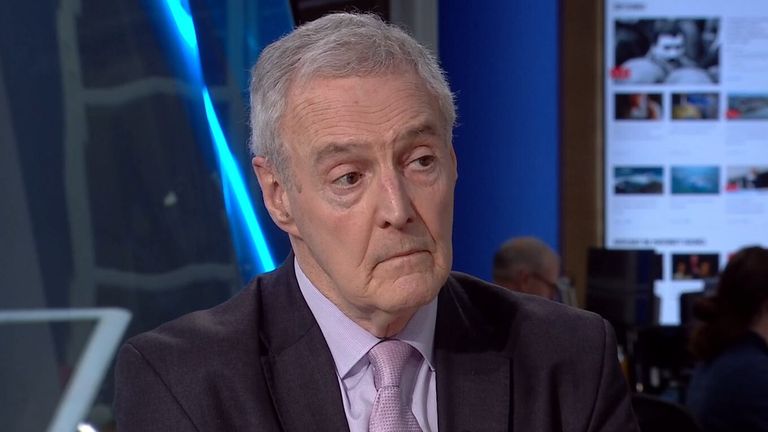
Trump ‘desperate’ for a peace deal
Mr Healey said he was “devastated by the death of a UK service person in Ukraine.
“My thoughts are with their family, friends and colleagues as they grieve for a loved one. Our hearts go out to them.”
The UK has previously acknowledged the presence of a small number of service personnel in Ukraine who are helping the Ukrainian military, as well as providing security for the British ambassador and other diplomats at the embassy in Kyiv.
There are also British troops who have been giving medical training.
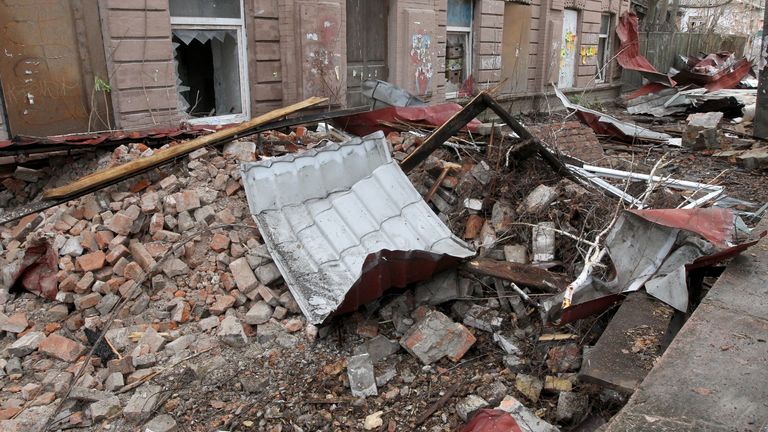
The aftermath of a Russian drone attack on Dnipro. Pic: AP
Dozens of former British troops, as well as foreign fighters from many other countries, have travelled to Ukraine to fight for the Ukrainian armed forces ever since Russia launched its full-scale war almost four years ago.
A number of them have been killed in battle.
But this is the first time a serving member of the military has died.
“It is with deep regret that we must announce that a member of the UK Armed Forces died in Ukraine this morning, Tuesday 9 December,” the MoD said in a statement.
“He was injured in a tragic accident whilst observing Ukrainian forces test a new defensive capability, away from the front lines.”
It was not immediately clear whether the accident happened on the same day that he died. The location where it occurred has also not been confirmed.
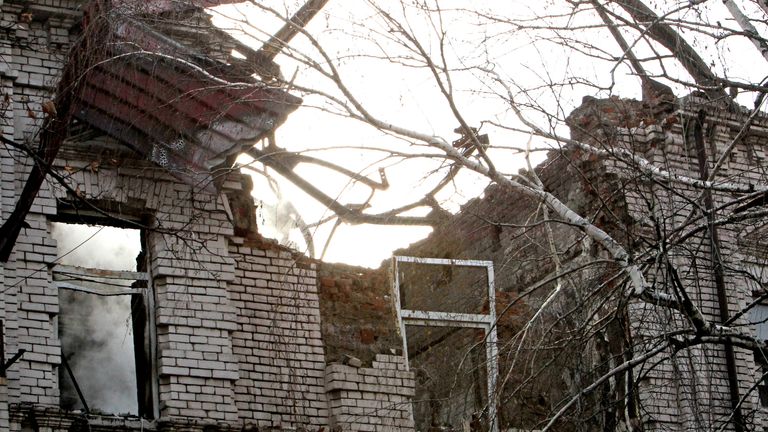
Russian troops launched a drone attack on Dnipro on Monday. Pic: AP
The serviceman’s family has been notified.
Shines a light on UK military’s role
The death shines a rare light on the little-discussed work of the UK military inside the country.
Very little is said about the mission amid concerns that Russia could exploit the discrete UK presence to falsely claim that serving British soldiers are actively fighting against Russian troops.
Read more on Sky News:
‘Cheap ceasefire – expensive peace’
Putin ‘ready for more war’
The first confirmed death of a serving member of the British armed forces confirms the significant risks they are taking.
But the Kremlin will also likely seize on the tragedy to amplify bogus claims about NATO forces already being deployed in Ukraine, fighting directly against Russia.
WORLD NEWS
‘Gaza doctor murdered Israeli hostage by injecting air into her veins… before her father received video of her dying and begging for her life’


The father of an Israeli woman abducted on October 7 has revealed his daughter was murdered in Gaza by a civilian doctor – and that he was later sent a video showing the moment she was killed.
In the footage, Avi Marciano said a medical worker is seen injecting air into his 19-year-old daughter’s veins as she lies on a bed inside Shifa Hospital, begging for her life.
Marciano, who was speaking publicly to a small crowd for the first time, said that by the end of the clip ‘she was sweating and showing no signs of life’.
His daughter was later identified as Cpl Noa Marciano, who the IDF said had suffered injuries during heavy bombing and gunfire but none that were considered life-threatening.
As Israeli forces advanced towards where Noa was being held, her captors moved her to Gaza City, where she was later killed.
Marciano said the video was sent to him on Telegram and showed clearly how his daughter died while in Hamas captivity.
He added that what he went through was the ‘biggest nightmare you could ever imagine’, saying there are mornings he still wakes to the image of her murder replaying in his mind.
The father of an Israeli woman abducted on October 7 has revealed his daughter was murdered in Gaza by a civilian doctor. In the footage, Avi Marciano said the medical worker can be seen injecting air into his 19-year-old daughter’s veins as she lies on a bed inside Gaza’s Shifa Hospital, begging for her life

At the end of the heartbreaking talk, Marciano can be seen choking up as he describes what he witnessed, pausing as he is comforted by those around him

Cpl Noa Marciano was killed by Hamas after being abducted on October 7

Marciano said the video, originally posted on Instagram by Israel activist Shai Deluca, was sent to him on Telegram and showed clearly how his daughter died while in Hamas captivity
‘Noa was my eldest daughter and there’s not a day when I don’t miss her,’ he said.
At the end of the heartbreaking talk, Marciano can be seen choking up as he describes what he witnessed, pausing as he is comforted by those around him.
Noa was one of seven female soldiers to be kidnapped from the Nahal Oz military base on October 7 and the only one not to have returned alive.
Her body was recovered from a building adjacent to Shifa Hospital in Gaza City by the IDF in November 2023, and returned to Israel for burial.
Hamas insisted she was killed in an Israeli airstrike.
But the IDF said military experts believed her injuries were more consistent with bullet wounds, with evidence suggesting she may also have suffered trauma from a fall.
It comes after the Daily Mail revealed the inside of Gaza’s terror tunnels where many of the 254 hostages were held captive by Hamas.
Video footage shows reporter Natalie Lisbona crawling on all fours into the entrance of the dark passage that leads to one of the terror group’s largest underground networks.

IDF intelligence located her body and brought her home for burial a week after her death. Hamas insisted she was killed in an Israeli airstrike

Soldiers carry the coffin of Israeli soldier Corporal Noa Marciano at Modi’in Military Cemetery on November 17, 2023
Lisbona describes the tunnel as ‘one of the most harrowing places on earth’, saying the ‘air is thin and stifling’ and the conditions ‘brutal’.
‘I cannot stretch out my arms. I can barely see a few centimetres ahead. Without my torch, I would walk face-first into the walls,’ she said.
‘The air is thin and stifling; within minutes my chest tightens, heat overwhelms me, and my voice catches as I try to record a video.’
Share or comment on this article:
‘Gaza doctor murdered Israeli hostage by injecting air into her veins… before her father received video of her dying and begging for her life’
WORLD NEWS
First civilians killed in Thailand as conflict with Cambodia erupts again following ceasefire | World News

The first civilians have been killed in Thailand as the conflict with Cambodia erupted again, days after a ceasefire pushed by Donald Trump.
Three Thai civilians were killed as heavy fighting continued along the border, the Thai military said on Thursday.
Nine Thai soldiers have so far been killed in the conflict, and more than 120 have been wounded.
Cambodia said nine civilians have been killed, including a baby, and 46 others have been wounded.
Hundreds of thousands of people have been evacuated from border areas in both countries.
Flame rises from a house which, Thai local security forces say, was damaged by a Cambodian artillery strike in Surin province, Thailand, on 11 December. Pic: AP
Clashes at more than a dozen locations along the 508 mile-long (817km) border on Wednesday saw some of the most intense fighting since a five-day battle in July – the worst conflict between the two countries in recent history.
Thailand said a hospital in Surin province was evacuated after rockets landed about 500m away.
It came as both sides waited for a telephone call from Mr Trump, who says he believes he can again end the fighting between the two Southeast Asian nations.
Mr Trump says he expects to speak with the countries’ leaders on Thursday.
Read more from Sky News:
Why did the US seize an oil tanker?
British soldier killed in Ukraine named
Enable Cookies
Allow Cookies Once
In July, Mr Trump stopped the fighting with calls to both leaders in which he threatened to halt trade talks unless they ended the conflict.
“I think I can get them to stop fighting. Who else can do that?” Mr Trump said on Wednesday in an exchange with reporters.
He also repeated his claim of settling eight wars around the world since his return to the White House.
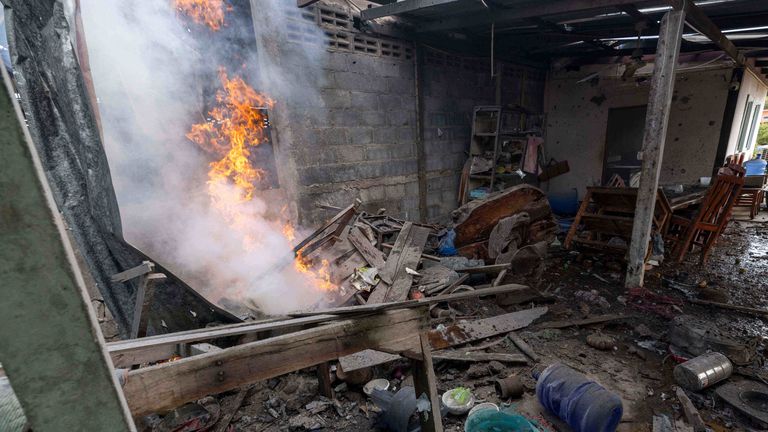
Flame rises from a house which, Thai local security forces say, was damaged by a Cambodian artillery strike in Surin province, Thailand, on 11 December. Pic: AP
However, Thailand has reacted more warily to overtures from Mr Trump and Malaysian Prime Minister Anwar Ibrahim, who helped broker the July deal, which resulted in an extended ceasefire signed in October.
Thailand insists the matter is for the two nations to resolve.
The roots of the Thai-Cambodian border conflict lie in a history of enmity over competing territorial claims.
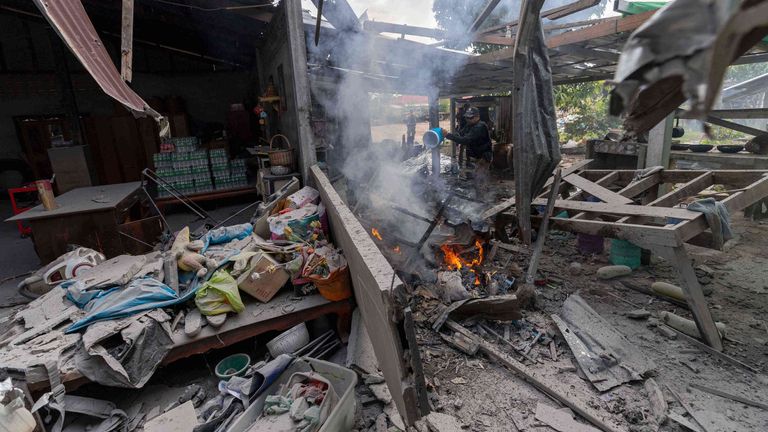
A Thai police officer splashes water to control fire at a house which, Thai local security forces say, was damaged by a Cambodian artillery strike in Surin province, Thailand, on 11 December. Pic: AP
These claims largely stem from a 1907 map created while Cambodia was under French colonial rule, which Thailand argues is inaccurate.
Tensions were heightened by a 1962 International Court of Justice ruling that awarded sovereignty to Cambodia, which still angers many Thais.
Despite October’s deal to stop fighting, the two countries carried on a bitter propaganda war, and minor cross-border violence continued.
Malaysian PM Mr Ibrahim said he had talked to the leaders of Thailand and Cambodia on Tuesday and, though no definitive resolution was reached, he appreciated “the openness and willingness of both leaders to continue negotiations in order to ease tensions”.

Thailand-Cambodia airstrikes force people to take cover
Thai Prime Minister Anutin Charnvirakul said on Thursday he would “explain and clarify” the situation if the US president called.
Thailand and Cambodia have blamed each other for the latest clashes that started this week and have traded accusations that civilians were being targeted in rocket and artillery attacks.
The latest large-scale fighting was sparked by a skirmish on Sunday that wounded two Thai soldiers.
Around two dozen people have been reported killed in the latest fighting, while hundreds of thousands have been displaced on both sides of the border.
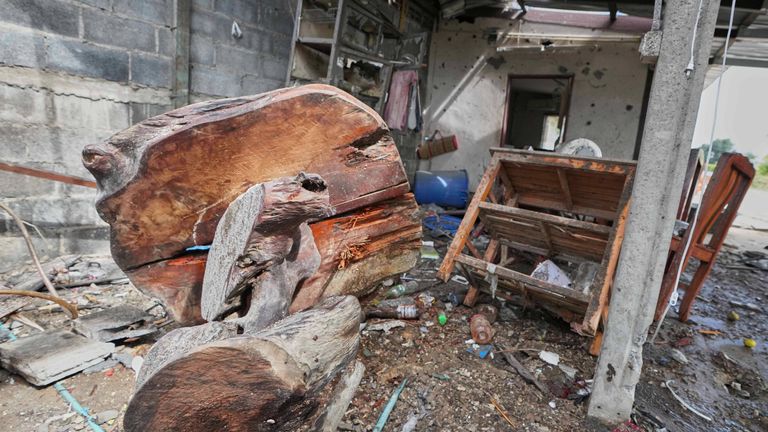
A house which, Thai local security forces say, was damaged by a Cambodian artillery strike in Surin province, Thailand, on 11 December. Pic: AP
Cambodia’s interior ministry said in a Wednesday evening update that homes, schools, roads, pagodas and ancient temples had been damaged by “Thailand’s intensified shelling and F-16 air strikes targeting villages and civilian population centres up to 30km inside Cambodian territory”.
On Thursday, Cambodia’s defence ministry accused Thailand of committing “brutal acts of aggression” against civilian targets, including schools and temples. Thailand denies that it targets civilian infrastructure.

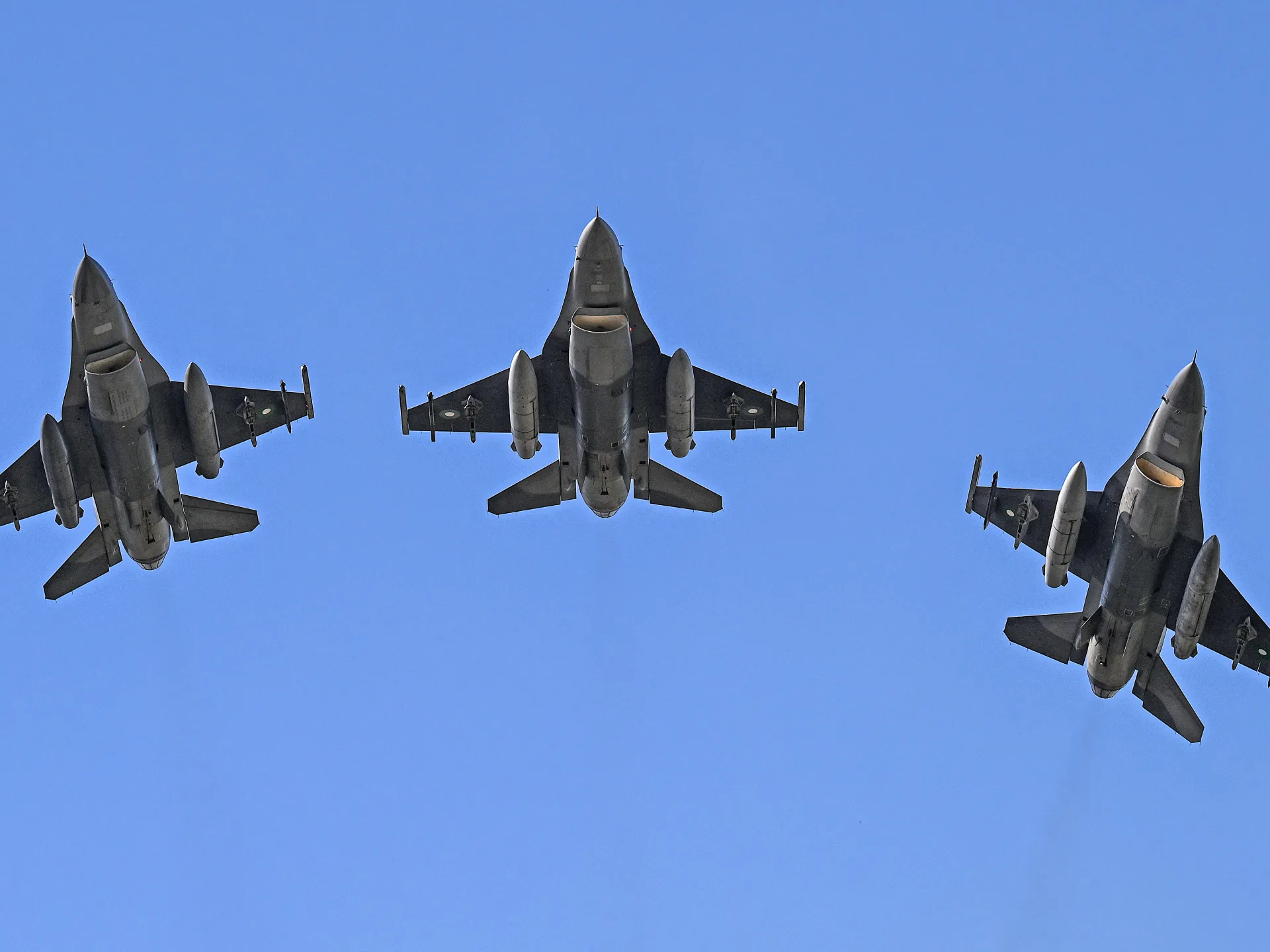
The United States has approved the sale of advanced technology and upgrades for Pakistan’s F-16 fighter planes worth approximately $686m.
The deal was struck amid simmering tensions between Pakistan and its neighbour, India, which engaged in a five-day war following a rebel attack in Indian-administered Kashmir in May this year. The US recently pressured Indian Prime Minister Narendra Modi to buy more weapons from it.
We take a closer look at the US-Pakistan F-16 upgrade deal and why this is significant now.
What has the US agreed with Pakistan?
Praveen Donthi, a senior analyst at the Brussels-based non-governmental organisation (NGO) International Crisis Group, told Al Jazeera that the latest approval is part of a 2022 maintenance deal the US agreed in 2022 to sustain Pakistan’s fleet of F-16s.
“The F-16 deal remains a key part of the broader US-Pakistan bilateral relationship, which is why there has been continuity from President Biden to President Trump, despite some delays. Both sides emphasise the fleet’s utility in joint counterterrorism operations in the region.”
The latest US deal is for the sale of technology, which will support and upgrade Pakistan’s existing F-16 fleet. It was confirmed in a report sent to the US Congress by the Defense Security Cooperation Agency (DSCA) on December 4.
Pakistan is believed to have 70 to 80 working F-16s. Some of these are older, but upgraded, Block 15 models, some are former Jordanian F-16s, and some are newer Block 52+ models.
The US offering comprises hardware and software updates for enhanced flight operations and aircraft electronic systems; the Advanced Identification Friend or Foe (IFF) system, which allows pilots to identify friendly aircraft from enemy ones; navigation upgrades; spare parts and repairs.
Alongside $649m-worth of support and upgrades for the F-16s, the US sale also includes major defence equipment (MDE), which are items of significant military equipment on the US munitions list, worth $37m. This includes 92 Link-16 systems.
The Link-16 is a secure military tactical data link network which allows real-time communication between military aircraft, ships and ground forces. It allows communication through text messages and images.
Six Mk-82 inert 500-pound (226.8kg) general-purpose bomb bodies are another type of MDE authorised to be sold to Pakistan. These are empty metal casings of an Mk-82 bomb, which are used for training or testing.
Instead of an explosive such as tritonal – a mixture of trinitrotoluene (TNT) and aluminium powder used in munitions – the casing is filled with a heavy material such as concrete or sand. The Mk-82 is an unguided bomb developed by the US. It can also be used as a warhead for precision-guided munitions.
What are F-16 fighters?
The F-16, also called the F-16 Fighting Falcon or the Viper, is a single-engine aircraft used for air-to-air combat and air-to-surface attack by the US and its allies.
The jets are currently manufactured by US defence and aerospace manufacturer Lockheed Martin, which took over production in 1995. It was originally developed by General Dynamics, a US industrial and technology company.
The jet was developed towards the end of the war in Vietnam, during which the Soviet Mikoyan-Gurevich (MiG) overwhelmed heavier and slower US fighter planes. It first flew in 1974.
The F-16 is now one of the world’s most widely used fighters. F-16s are operating in 29 countries, according to the Lockheed Martin website.
Besides Pakistan, some other countries which have F-16s are Ukraine, Turkiye, Israel, Egypt, Poland, Greece, Taiwan, Chile, Singapore, Belgium, Denmark, the Netherlands and Norway.
F-16s perform aerobatic manoeuvres during a rehearsal for Pakistan Day parade, March 16, 2024 [Aamir Qureshi/AFP]
What role did F-16s play in the May conflict between India and Pakistan?
On April 22, armed attackers killed 26 people in Pahalgam, a popular tourist spot in Indian-administered Kashmir. The attack was claimed by The Resistance Front (TRF), a separatist group designated a terrorist organisation by India and the US, and which New Delhi alleges is linked to Pakistan-based Lashkar-e-Taiba (LeT) – a claim Islamabad denies.
Following the Pahalgam attack, New Delhi scaled back diplomatic ties with Islamabad and suspended the Indus Waters Treaty, which ensures the appropriate sharing of the Indus River water between India and Pakistan.
On May 7, India struck nine sites in Pakistan and Pakistan-administered Kashmir with missiles, which Islamabad said killed dozens of civilians. Over the following three days, the countries engaged in a heated aerial war, using drones and missiles to target each other’s military bases.
During the aerial war, Pakistan deployed 42 “hi-tech aircraft”, including the F-16s, and Chinese-made JF-17s and J-10s, according to Pakistan’s Air Vice Marshal Aurangzeb Ahmed.
A ceasefire – for which US President Donald Trump took credit – was eventually brokered on May 10.
Is the US applying pressure to India?
Yes, for a couple of reasons.
The US approval for Pakistan’s F-16 upgrade comes as the Trump administration presses India to buy more weapons from it.
In August, New Delhi put its plans to buy US weapons and aircraft on hold, the Reuters news agency reported, quoting three unnamed Indian officials familiar with the matter.
This came just weeks before Indian Defence Minister Rajnath Singh had been scheduled to visit Washington to announce some weapon purchases. That visit was cancelled.
India-US relations have also been tense in recent months.
On August 6, Trump imposed an additional 25 percent tariff on imports from India as a punishment for buying cheap Russian crude oil. This was on top of the existing 25 percent tariff already levied on Indian goods, bringing the total levy on Indian imports to 50 percent.
Trump announced the tariff in an executive order, in which he wrote that Russia’s continued military actions in Ukraine constituted a “national emergency” and it was therefore “necessary and appropriate” to place heightened tariffs on India, a top consumer of its crude oil.
“I find that the Government of India is currently directly or indirectly importing Russian Federation oil.”
While pressure from the US has resulted in India slightly scaling back purchases of Russian oil, New Delhi plans to continue to buy from Moscow. It remains the second-largest consumer of Russian oil after China.
President Vladimir Putin met Prime Minister Modi for the annual Russia-India bilateral summit in New Delhi last week, during which he said: “Russia is ready for uninterrupted shipments of fuel to India.”
The announcement of the latest US deal to provide maintenance and upgrades for Pakistan’s F-16s is likely to be poorly received by India.
Donthi said New Delhi has previously opposed the defence cooperation between Pakistan and the US under which the two countries collaborate to maintain Pakistan’s F-16 fleet. India has claimed the F-16s are used against it.
“Washington pre-empted it this time by stating that the sale ‘will not alter the basic military balance in the region’,” Donthi said.
How much does the US sale strengthen Pakistan?
Donthi said that while the latest package from the US will help Pakistan maintain its fleet until 2040, it is China which has supplied more than 80 per cent of Pakistan’s weapons since 2020.
This statistic is also backed by Swedish think tank SIPRI in a report this year, which stated: “Pakistan used Chinese J-10 aircraft in the May conflict with India. Islamabad continues to balance between Washington and Beijing, benefiting from both.”
WORLD NEWS
Trump’s strategy has echoes of ‘extreme rightwing tropes’ from 1930s, former minister tells MPs – UK politics live | Politics

Trump’s strategy plan contains echoes of ‘extreme rightwing tropes’ from 1930s, former cabinet minister tells MPs
The Trump security strategy paper contains language reminiscent of 1930s Germany, MPs were told.
Liam Byrne, a former Labour cabinet minister and the chair of the Commons business committee, made the suggestion as he said the shift in US policy meant it was even more important for the UK to strengthen economic security links with the EU.
Speaking during the urgent question, he said:
The language of the US national security strategy was deeply regrettable and, frankly, it was not hard to see the rhymes with some extreme rightwing tropes that date back to the 1930s.
Byrne said the publication of the document coincided with talks on the UK joining the EU’s Safe (Security Action for Europe) defence loans programme broke down. He said the government should adopt the recommendations in his committee’s report on economic security, and he said the UK should open talks with the EU on the sort of economic security union that could provide Europe with the growth “that rearmament is going to require”.
Byrne was clearly referring to 1930s Germany in his opening comment, and to Nazi thinking about racial purity. There are echoes of this in the new US national security strategy where it talks about Europe facing “civilisational erasure” in part because of migration. It says:
Economic decline is eclipsed by the real and more stark prospect of civilizational erasure. The larger issues facing Europe include activities of the European Union and other transnational bodies that undermine political liberty and sovereignty, migration policies that are transforming the continent and creating strife, censorship of free speech and suppression of political opposition, cratering birthrates, and loss of national identities and self-confidence.
Should present trends continue, the continent will be unrecognizable in 20 years or less …
Over the long term, it is more than plausible that within a few decades at the latest, certain Nato members will become majority non-European.
In response, Malhotra said she agreed with Byrne that it was important for the UK to further develop its own defence capabilities.
Liam Byrne speaking in the Commons in the UQ on Trump’s national security strategy Photograph: HoCShare
Updated at 12.40 CET
Key events
Show key events only
Please turn on JavaScript to use this feature
I have updated the post at 11.03am with the full, direct quote from Matt Western about the US national security strategy. You may need to refresh the page to get the update to appear.
Share
Trump’s strategy plan contains echoes of ‘extreme rightwing tropes’ from 1930s, former cabinet minister tells MPs
The Trump security strategy paper contains language reminiscent of 1930s Germany, MPs were told.
Liam Byrne, a former Labour cabinet minister and the chair of the Commons business committee, made the suggestion as he said the shift in US policy meant it was even more important for the UK to strengthen economic security links with the EU.
Speaking during the urgent question, he said:
The language of the US national security strategy was deeply regrettable and, frankly, it was not hard to see the rhymes with some extreme rightwing tropes that date back to the 1930s.
Byrne said the publication of the document coincided with talks on the UK joining the EU’s Safe (Security Action for Europe) defence loans programme broke down. He said the government should adopt the recommendations in his committee’s report on economic security, and he said the UK should open talks with the EU on the sort of economic security union that could provide Europe with the growth “that rearmament is going to require”.
Byrne was clearly referring to 1930s Germany in his opening comment, and to Nazi thinking about racial purity. There are echoes of this in the new US national security strategy where it talks about Europe facing “civilisational erasure” in part because of migration. It says:
Economic decline is eclipsed by the real and more stark prospect of civilizational erasure. The larger issues facing Europe include activities of the European Union and other transnational bodies that undermine political liberty and sovereignty, migration policies that are transforming the continent and creating strife, censorship of free speech and suppression of political opposition, cratering birthrates, and loss of national identities and self-confidence.
Should present trends continue, the continent will be unrecognizable in 20 years or less …
Over the long term, it is more than plausible that within a few decades at the latest, certain Nato members will become majority non-European.
In response, Malhotra said she agreed with Byrne that it was important for the UK to further develop its own defence capabilities.
Liam Byrne speaking in the Commons in the UQ on Trump’s national security strategy Photograph: HoCShare
Updated at 12.40 CET
Lib Dems call for review of UK’s security strategy in light of Trump’s foreign policy shift
Calum Miller, the Lib Dem foreign affairs spokesperson, said that President Trump has driven a “coach and horses” through the alliance with Europe with this document.
He called for an urgent review of the government’s strategy in response to this.
And he asked the minister to state clearly that the UK will not tolerate American interference in elections.
And he asked if the elections bill will deal with the threat of foreign interference.
Malhotra said national security was the priority for the government. She said it was important to recognise that Trump is making efforts to promote peace around the world.
Share
Chi Onwurah (Lab) told Malhotra that she thought she was too discreet to say what she really thought about Trump. But she asked if the government accepted that any defence capability reliant on the US would not be a sovereign capability.
Malhotra said that the UK respected the US as a democracy, and that friends and allies should respect each other’s choices.
Share
Speaking for the Conservatives, Mike Wood, a shadow Cabinet Office minister, did not say anything directly critical of the Trump document. Instead, he asked for confirmation that the government will raise defence spending, and sought an update on Ukraine policy.
Share
Trump’s threat to interfere in European elections in new US security strategy ‘chilling’, MPs told
Matt Western, the Labour chair of the joint committee on national security strategy, told MPs that the Trump document showed that the US consensus that has led the world since the second world war has been “shattered”.
And he said the implication that the US will interfer in European elections is “chilling”.
He criticised Trump for his comments about Sadiq Khan in a recent interview.
And he said he was worried there was no criticism of Russia in the Trump document.
He said he did not expect the government to criticise Trump.
But he wanted to know if the government’s national security strategy is being updated in the light of this document.
Malhotra said it was for the US to set its strategy.
She said there were elements of the strategy that the UK agrees with, such as the importance of Europe providing for its own defence. But there are some aspects of it the government disagrees with, she said.
Referring to Khan, she said he was doing a great job for London – and she disagreed with what Trump said.
UPDATE: Western said:
The whole house should be under no illusion, the United States consensus that has led the western world since the second world war appears shattered.
It refers to Europe facing, and I quote, ‘civilisational erasure’, and it will be unrecognisable in 20 years. It vows to, and I quote again, ‘to help Europe correct its current trajectory and promote patriotic European parties’.
The prospect of United States interference in the democratic politics of Europe, I believe, is chilling.
The president’s comments on Tuesday further demonstrate this, he called European leaders weak and singled out one of the United Kingdom’s mayors as, I quote, ‘horrible, vicious and disgusting’.
But sometimes what is not said is as important as is what is said. In this case, the absence of condemnation for Russia is extraordinary, though not surprising.
Given certain UK dependencies on the United States, this leaves the United Kingdom especially vulnerable.
Share
Updated at 12.59 CET
Minister tells MPs UK governments takes ‘a different view’ from US on some aspects of Trump’s national security strategy
Seema Malhotra, a Foreign Office minister, is responding to the urgent question about President Trump’s national security strategy (even though it was addressed to the Cabinet Office – see 10.12am.)
The Trump document was published at the end of last week. Peter Beaumont has an analysis of it here.
Malhotra said all MPs would agree the US/UK relationship has delivered security for more than a century.
She said the PM and President Trump have both emphasised their commitment to this relationship.
The US strategy has many aspects, she said. But “on some areas we take a different view”, she said.
She said the UK government sees Europe as strong. And it recognises that Europe is spending more on defence.
Europe is united behind Ukraine, and behind its values of freedom and democracy, she said.
She said trade links between the UK and the US were strong, and the UK would continue to develop that. Having a strong relationship allows the UK to discuss issues “where we disagree”, she said.
Share
The TSSA transport union has joined the FBU (see 9.49am) in saying parliament should sit at the weekend if necessary to get the employment rights bill onto the statute book. Its general secretary, Maryam Eslamdoust, said:
The Labour government must now treat this an emergency and override the Lords’ attempts to override democracy.
It’s imperative that the bill is delivered in full by Christmas, even if that means the Commons sitting at weekends to ensure it passes.
Share
Electoral Reform Society says it’s ‘ridiculous’ that Starmer has created more peers than he’s removed
Coming back to the House of Lords, Darren Hughes, chief executive of the Electoral Reform Society, issued this statement criticising the appointment of more political peers yesterday. (See 8.42am.)
Keir Starmer himself not long ago described the wholly unelected and grossly bloated House of Lords as ‘indefensible’. Nothing has changed since then so it is deeply disappointing to see even more peers being stuffed into the upper chamber.
Firstly, it is absurd for the Lords, which at more than 800 peers is already the second largest legislative chamber after China’s National People’s Congress, to be getting even more members. It is also patently ridiculous that the government has now added more peers into the Lords than the 92 hereditary peers it is in the process of removing.
The ending of the remaining hereditary peers is a step in the right direction, as people should not be making our laws because of who their parents were. But [the new peerages] highlight just how unsustainable a wholly unelected and unrestrained chamber is.
Share
Former Tory MP Ben Bradley defects to Reform UK, saying his old party ‘failed to deliver’
The former Tory MP Ben Bradley has defected to Reform UK.
Bradley, who lost his Mansfield seat at last year’s general election and who is also a former Nottinghamshire county council leader, has been appointed as Reform’s “head of local government action” to help cut council spending, the party said.
Bradley said:
Successive governments have failed to deliver for so many people, and have demonstrated that they’re unwilling to actually deliver on key promises to voters.
They have talked about being tough on crime, reducing immigration, about helping working people, whilst in practice they’ve failed to act and have delivered the opposite. The trust in those parties has gone, and it’s not coming back.
I’ve been out of politics altogether for a little while, but I feel strongly that I can’t sit on the sidelines any more and watch our country fail.
I’ve come to the conclusion that Reform UK is the only party that is prepared to be different and to tackle the most pressing issues. I’ve been impressed with their recent policy announcements and the clarity they have on a range of issues, and that’s why I’m joining today.
At least 20 other former Tory MPs have defected to Nigel Farage’s party, not including the Reform UK MPs Lee Anderson (who defected in the last parliament from the Tories) and Danny Kruger (who switched three months ago).
In a post on social media, Anderson said that getting Bradley to defect was “a major coup for us as he has left an extremely well paid job to join our team”.
The commentator Sam Freedman has a different take on Bluesky.
Former Tory MP Ben Bradley has now defected to Reform. They really are taking all the worst people from the Boris era.
Share
Treatment hospital waiting list figures rise slightly, NHS England figures show
The waiting list for routine hospital treatment in England has risen slightly, PA Media reports. PA says:
An estimated 7.40 million treatments were waiting to be carried out at the end of October, up from 7.39 million at the end of September, NHS figures show.
The number of patients waiting for treatment is broadly unchanged at 6.24 million.
The list hit a record high in September 2023, with 7.77 million treatments and 6.50 million patients.
Share
Minister to answer Commons urgent question on Trump’s national security strategy
At 10.30am a Cabinet Office minister will respond to an urgent question on Donald Trump’s national security strategy. It has been tabled by Matt Western, the Labour MP who chairs parliament’s joint committee on national security strategy.
Share
MPs should sit if necessary at weekend to get employment rights bill passed before Christmas, union leader says
The Fire Brigades Union is saying Keir Starmer should if necessary force MPs to sit over the weekend to ensure that the employment rights bill will become law before Christmas.
The Commons is due to rise a week today for the Christmas recess, but the employment rights bill cannot become law until the dispute between the elected house and the Lords is resolved. (See 8.42am.) Commenting on the vote in the Lords last night, Steve Wright, the FBU general secretary, said:
For 14 years, the Tories hammered the living standards of working people. They are now using the unelected Lords to continue that policy.
This is a disgraceful attempt to subvert democracy. The employment rights bill was a clear manifesto commitment, and the electorate has backed it.
The Labour government cannot allow the Tories to use their inbuilt majority in the Lords to deny workers protection against unfair dismissal and zero-hour contracts.
There must be no more watering-down of the bill. Keir Starmer must prioritise the urgent delivery of the legislation – and get it passed before the Christmas recess. If that means MPs must sit on a Saturday, as the Commons did during Brexit, then so be it.
Share
Updated at 11.45 CET
Tory MP inadvertently allowed APPG on defence technology to be part funded by Israeli government, standards watchdog says
Neil Shastri-Hurst, a Conservative MP, has been ordered to apologise after an investigation found that he allowed an all-party parliamentary group (APPG) that he chairs to receive funding from a foreign government.
In a report, the Commons standards committee says that Shastri-Hurst failed to carry out proper due diligence checks in his capacity as chair of the APPG for defence technology.
It says:
As the registered contact of the APPG, Dr Shastri-Hurst failed to ensure that adequate due diligence checks were made on RUK Advanced Systems Ltd, which in turn enabled a foreign government, in this case the Government of Israel, to act as an indirect, eventual funder of the secretariat.
APPGs often receive funding from organisations linked to the subject area they cover, and the APPG for defence technology invited groups to contribute either as tier 1 partners, paying £1,499, or tier 2 partners, paying £5,000. In return, partners received either limited or enhanced access to its events.
RUK Advanced Systems Ltd was a tier 1 partner.
Shastri-Hurst referred himself to the parliamentary commissioner for standards after Declassified UK revealed that RUK Advanced Systems Ltd is part of a defence firm owned by the Israeli government.
The committee says Shastri-Hurst should issue a written apology for breaking the rules.
The committee also says the Commons authorities should consider “taking advice from external advisors with professional expertise in due diligence on how best to advise APPGs on conducting due diligence, perhaps by seeking to establish clear principles and a checklist which chairs and registered contacts might use to inform their actions as they undertake this responsibility”.
Next year the committee is going to carry out its own review of the rules governing APPGs to see if they need clarifiying.
Share
Homelessness minister promises to end use of B&Bs as emergency housing
Alison McGovern, the homelessness minister, has pledged to end the use of bed and breakfasts as emergency housing, even as new figures show that the country’s homelessness problem has worsened since Labour came into government. McGovern was speaking to the Guardian to promote the homelessness strategy being announced today. Kiran Stacey and Jessica Murray have the story.
Share
Peers told they risk ‘constitutional crisis’ after surprise vote to continue blocking employment rights bill
Good morning. Yesterday Keir Starmer announced the creation of 25 Labour new peers. About an hour or so later, the government lost an important vote on the employment rights bill – by 24 votes.
The defeat was unexpected, because the government had already announced a significant U-turn on the bill, as part of a compromise deal negotiated with business and unions intended to ensure the legislation clears the Lords quickly. What is going to happen next is not yet clear.
Here is the PA Media story on the Lords vote.
Flagship workers’ rights reforms face a further holdup as peers inflicted a defeat over a late change linked to the government concession on unfair dismissal that has been branded “a job destroyer”.
The latest setback means a continuation of the parliamentary tussle over the employment rights bill known as “ping-pong”, when legislation is batted between the Commons and Lords until agreement is reached.
In an attempt to end the stand-off, the government recently ditched its election pledge to give employees day-one protection against unfair dismissal and instead accepted a six-month qualifying period for the workplace safeguard, demanded by the upper chamber.
However, alongside this it introduced at the 11th hour a measure to scrap the compensation caps for unfair dismissal, which are currently the lower of 52 weeks’ pay or £118,223.
The government insists this formed part of the compromise agreement reached with business groups and trade unions although this is disputed.
With the clock ticking down to the Christmas recess, peers backed by 244 votes to 220, majority 24, a Tory call to force a review of the existing compensation limits, which ministers are seeking to remove.
The fresh defeat has sparked an angry response from the unions, with unelected members accused of “defying the will of the British public” and told to “move out the way”.
But speaking in the Lords, Tory shadow business minister Lord Sharpe of Epsom said: “The constitutional implications of introducing major new policy at ping-pong are profound.”
He added: “This is not obstruction. It is the bare minimum that a competent administration should undertake.”
Speaking after the vote, Paul Nowak, the general secretary of the TUC, said:
Continuing to vote down the employment rights bill – a clear manifesto commitment – is undemocratic. This bill has been debated and scrutinised for months. Tory Peers are actively defying the will of the British public and their own supporters who overwhelmingly support measures in this bill.
Mike Clancy, general secretary of the Prospect union, went further. He said:
The behaviour of the House of Lords can no longer be seen as constructive scrutiny and increasingly looks like cynical wrecking tactics that risk a constitutional crisis if they continue.
Further delay is in nobody’s interests and only prolongs uncertainty, the bill must pass before Christmas including lifting the caps on compensation.
The Lords vote came as Starmer was also facing criticism over the fact that he has now appointed almost 100 new peers to the Lords, an institution he once suggested he would abolish.
Here is the agenda for the day.
9.30am: NHS England publishes its monthly performance figures.
Morning: Keir Starmer is on a visit in Norfolk promoting government policy on buses.
11.30am: Downing Street holds a lobby briefing.
2pm: Starmer holds a further video call with ‘coalition of the willing’ leaders, after a call yesterday with Donald Trump involved “pretty strong words”, according to the president.
If you want to contact me, please post a message below the line when comments are open (normally between 10am and 3pm at the moment), or message me on social media. I can’t read all the messages BTL, but if you put “Andrew” in a message aimed at me, I am more likely to see it because I search for posts containing that word.
If you want to flag something up urgently, it is best to use social media. You can reach me on Bluesky at @andrewsparrowgdn.bsky.social. The Guardian has given up posting from its official accounts on X, but individual Guardian journalists are there, I still have my account, and if you message me there at @AndrewSparrow, I will see it and respond if necessary.
I find it very helpful when readers point out mistakes, even minor typos. No error is too small to correct. And I find your questions very interesting too. I can’t promise to reply to them all, but I will try to reply to as many as I can, either BTL or sometimes in the blog.
Share
Updated at 12.53 CET


Kayla Epsteinand
Ione Wells,São Paulo
Watch: Video shows US military seizing oil tanker off Venezuela coast
US forces have seized an oil tanker off the coast of Venezuela, President Donald Trump said, marking a sharp escalation in Washington’s pressure campaign against Nicolás Maduro’s government.
“We have just seized a tanker on the coast of Venezuela – a large tanker, very large, the largest one ever seized actually,” Trump told reporters at the White House.
Releasing a video of the seizure, Attorney General Pam Bondi described the vessel as a “crude oil tanker used to transport sanctioned oil from Venezuela and Iran”.
Caracas swiftly denounced the action, calling it an act of “international piracy”. Earlier, President Maduro declared that Venezuela would never become an “oil colony”.
The Trump administration accuses Venezuela of funnelling narcotics into the US and has intensified its efforts to isolate President Maduro in recent months.
Venezuela – home to some of the world’s largest proven oil reserves – has, in turn, accused Washington of seeking to steal its resources.
Brent crude prices inched higher on Wednesday as news of the seizure stoked short-term supply concerns. Analysts warn the move could threaten shippers and further disrupt Venezuela’s oil exports.
US Attorney General Pam Bondi, who leads the US Department of Justice, said the Federal Bureau of Investigation, Department of Defense, Department of Homeland Security, and the US Coast Guard co-ordinated the seizure.
“For multiple years, the oil tanker has been sanctioned by the United States due to its involvement in an illicit oil shipping network supporting foreign terrorist organizations,” the nation’s top prosecutor wrote on X.
Footage shared by Bondi showed a military helicopter hovering over a large ship, and troops descending on to the deck using ropes. Uniformed men were seen in the clip moving about the ship with guns drawn.
A senior military official told the BBC’s US partner CBS that the helicopters used in the operation launched from the USS Gerald Ford, the world’s largest aircraft carrier, which was sent to the Caribbean last month.
It involved two helicopters, 10 Coast Guard members and 10 Marines, as well as special forces.
Watch: Venezuela’s Maduro sings “Don’t worry, be happy” as he calls for peace with the US
Defence Secretary Pete Hegseth was aware of the operation, and the Trump administration was considering more actions like this, a source told CBS.
When asked by reporters what the US would do with the oil on the tanker, Trump said: “We keep it, I guess… I assume we’re going to keep the oil.”
Maritime risk company Vanguard Tech identified the vessel as the Skipper and said it believed the ship had been “spoofing” its position – or broadcasting a false location – for a long time.
BBC Verify has since confirmed that the vessel in the footage released by the Department of Homeland Security is the Skipper.
The US treasury department sanctioned the Skipper in 2022, CBS reported, for alleged involvement in oil smuggling that generated revenue for Hezbollah and the Islamic Revolutionary Guard Corps-Quds Force.
BBC Verify also located this tanker on MarineTraffic, which shows it was sailing under the flag of Guyana when its position was last updated two days ago.
A statement from Guyana’s Maritime Administration Department on Wednesday evening, however, said that the Skipper was “falsely flying the Guyana Flag as it is not registered in Guyana.”
The Skipper’s port of call log shows it called in Iran, Iraq, and the UAE from 30 June to 9 July this year. Its most recent stop, according to MarineTraffic, was at Soroosh port in Iran on 9 July.
That does not mean that it has not called at multiple other ports since then.
MarineTraffic shows it was last near Iran in mid-September before arriving off the coast of Guyana at the end of October and making minimal further movement since then. This data may be partial or incorrect because of spoofing.
MarineTraffic lists the beneficial owner and operator as Nigeria-based Thomarose Global Ventures Ltd and it lists the registered owner as Marshall Islands-based Triton Navigation Corp.
Watch: Trump says US has seized “large tanker” off Venezuela coast
The Venezuelan government issued a statement denouncing the seizure as a “grave international crime”.
Interior Minister Diosdado Cabello called the US “murderers, thieves, pirates”.
He referred to Pirates of the Caribbean, but said that while that film’s lead character Jack Sparrow was a “hero”, he believed “these guys are high seas criminals, buccaneers”.
Cabello said this was how the US had “started wars all over the world”.
Speaking at a rally earlier on Wednesday, Maduro had a message for Americans opposed to war with Venezuela. It came in the form of a 1988 hit song.
“To American citizens who are against the war, I respond with a very famous song: Don’t worry, be happy,” Maduro said in Spanish before singing along to the lyrics of the 1988 hit.
“Not war, be happy. Not, not crazy war, not, be happy.”
It’s unclear if Maduro knew about the seizure of the tanker before this rally.
In recent days, the US has ramped up its military presence in the Caribbean Sea, which borders Venezuela to the north.
The build-up involves thousands of troops and the USS Gerald Ford being positioned within striking distance of Venezuela, BBC Verify reported.
The move has sparked speculation about the potential for some kind of military action.
Since September, the US has conducted at least 22 strikes on boats in the region that the Trump administration says are smuggling drugs. At least 80 people have died in these attacks.

Follow the twists and turns of Trump’s second term with North America correspondent Anthony Zurcher’s weekly US Politics Unspun newsletter. Readers in the UK can sign up here. Those outside the UK can sign up here.


Amid tariff disputes, the war in Ukraine and environmental problems, Europe is looking for a new direction for its economic strategy. A key question is what role environmentally-friendly production, agriculture and the protection of natural resources should play in the future.
Through its 2019 Green Deal, the EU has been working towards making its industries more efficient and climate-neutral by 2050. But the plan is facing increasing criticism and pressure. Not least from the conservative EPP group in the EU Parliament, which is seeking to gain majorities with the help of far-right parties.
Several resolutions are currently being watered down, while the implementation of certain measures is being postponed or even completely rolled back.
Loosening of reporting obligations for companies
Two central instruments of the Green Deal are the EU Supply Chain Act and companies’ obligations to report on their own social and environmental impacts. The aim being to ensure comparability and make responsibilities visible.
The conservative EPP group is looking for partners in the European parliament. Far-right parties, including those of Viktor Orban (Hungary) and Marine le Pen (France) could become kingmakers in BrusselsImage: Ricardo Rubio/Europa Press/IMAGO
Until now, some 50,000 EU companies with a workforce of at least 250 were obliged to prepare such reports annually. But company complaints about the regulation burdening them with bureaucracy and tying up too many resources means small and medium-sized companies will no longer be required to report.
The rule is now set to apply exclusively to major corporations with a turnover of hundreds of millions of euros.
Critics say fewer reporting obligations mean less transparency, both for the public and for investors who support sustainable practices and want to avoid environmentally harmful or unethical business models.
The European Central Bank (ECB) had warned in advance that the discontinuation of these reports could lead to a regulatory imbalance. In a letter to the Commission, it emphasized that climate change has a “profound impact on price stability” and requires a sufficiently robust database to manage financial risks.
The EU is planning less monitoring of production regulations across industriesImage: Jochen Tack/picture alliance
In the ECB’s view, this database would be jeopardized if the number of companies subject to reporting requirements were to be reduced by up to 80% — as is currently planned in the package.
Less monitoring of supply chains
The adoption of the so-called simplification package has also resulted in weakened rules for the Supply Chain Act.
This should include thousands of large companies from high-risk sectors such as the textile industry, fishing or mining industries that produce for the EU market.
Companies along the entire supply chain were to be obliged to recognize, curb and end human rights and environmental violations. This goal has now been significantly watered down.
The rules now only apply to multinational companies with more than 5,000 employees and a turnover of at least €1.5 billion ($1.7). Also, victims of environmental and human rights violations along the supply chain don’t have a right to sue. And companies no longer have to present their own climate strategies, as was originally intended.
Products not linked to deforestation? Not yet
The 27 EU member states had also agreed on rules aimed at protecting forests. Products such as tea, coffee, soy and beef were only to be available for sale in the EU if verifiably not linked to deforestation.
The idea was to ensure companies acted responsibly in protecting forests, particularly in agriculturally-intensive regions such as Brazil and Indonesia.
However, the introduction of the new rules has been postponed until the end of 2026. In addition, significantly fewer companies will have to prove their products are manufactured in deforestation-free ways.
To put this into context, the Food and Agriculture Organization of the United Nations estimates that around 420 million hectares of forest — an area larger than the EU — were logged between 1990 and 2020. EU consumption accounts for around 10% of global deforestation, with palm oil and soy making up more than two-thirds of this. Forests store carbon and are extremely important for biodiversity.
Palm oil is used in many products, but plantations are often linked to rainforest loggingImage: AFP
Weakening environmental regulations for agriculture
Around a third of the entire EU budget goes to agriculture, the majority in the form of subsidies. The bloc’s rules for more sustainable food production have long been a thorn in the side of large farms.
Here too, politicians are also increasingly giving in. In 2023 and 2024, farmers protesting stricter rules around the use of pesticides led to them not being adopted. The Nature Conservation Act, which provided for greater protection of ecologically important peat lands, was massively watered down. Farms were originally supposed to contribute to this goal.
In a series of proposals aimed at simplifying bureaucracy for farmers and deregulating the agricultural sector, the main focus is on weakening environmental rules. For example, inspections of environmental standards are to be limited to a maximum of once per year.
Overall, significantly more natural landscapes across Europe are to be permitted to be converted to arable land than previously planned. At the same time, small farms with up to ten hectares of land are to be given access to subsidies without having to meet certain environmental standards.
Sustainability strategies in agriculture were also supposed to be continuously adapted to new environmental regulations. But that is no longer mandatory, meaning EU farms will have to do less for the environment in future, despite the major role of agriculture on the climate.
Cut-off date for new combustion engine cars postponed
The EU decision to stop the production of combustion engine cars within the bloc from 2035 could be history before it has even come into force.
The German government has voiced loud opposition to the deadline and the country’s car industry has always been against the decision. Now the EU has officially decided to “review” the end of the combustion engine, leaving a question mark over when a ban will come into force.
In the short term, this could benefit the European car industry, which continues to rely heavily on combustion engines. But with the trend towards electric vehicles predicted to continue, experts see better long-term opportunities for car manufacturers that offer EVs.
Less climate commitments at home
The European climate targets are also being cut further. In order to avoid even more extreme climate catastrophes, the EU’s Scientific Advisory Board recommended a reduction in emissions of 90% to 95% by 2040 compared to 1990 levels.
Just last month, the EU agreed on its climate targets, including a 90% cut in carbon emissions. But there is a catch. Parts of these emissions reductions can be offset through measures taken in other countries that are financed by the EU.
In other words, the EU actually only has to reduce its own emissions by 85%, as it can buy up to 5% through things such as reforestation projects abroad.
The target can also be amended further if there are difficulties with implementation. At the same time, member states decided to postpone the start of carbon pricing in the buildings and transport sector (ETS 2) from 2027 to 2028.
This article was originally published in German.
Changing supply chains: Making trade safe and fair
To view this video please enable JavaScript, and consider upgrading to a web browser that supports HTML5 video


On The Ground newsletter: Get a weekly dispatch from our international correspondents
Get a weekly dispatch from our international correspondents
Get a weekly international news dispatch
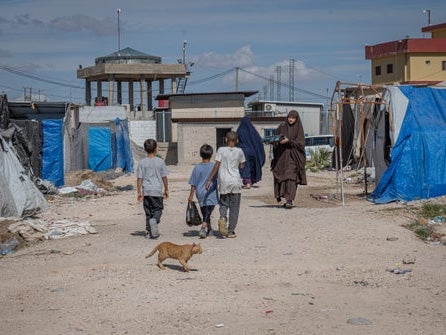
The sandstorm raged so suddenly, the air became opaque and tents began to move. Children struggled to take cover while their mothers braced for the worst. This is midsummer in north-East Syria.
Camp Roj and its sister camp, Al-Hol, are home to 42,000 people, primarily the wives, other adult female relatives and children of male Isis suspects. Guarded by Kurdish-led forces, no-one can leave.
It’s hard to see how this blasted, forgotten patch of Syria could be relevant to nine million people in the UK but a damning report released by Reprieve and Runnymede Trust on Thursday explains exactly why.
In Roj, there are between 15 and 20 women and 30 to 40 children, most under ten years-old, who are linked in some way to the UK.
The United Nations says the conditions are inhuman, dangerous and degrading, raising serious concerns under international law.
The Kurdish-led authorities who staff the camps tell me they lack the resources to do this indefinitely especially after the punishing USAID cuts.
open image in gallery
In Roj, there are believed to be dozens of children, most under ten years-old, who are linked in some way to the UK (Bel Trew)
But in Roj, many of those linked to the UK will remain due to policies taken by the British government that make it an outlier in the West.
Even Russia and the US have taken responsibility for their citizens and brought them home, one British MP said at a meeting in parliament on Wednesday. The UK, by contrast, ranks the highest in the G20 for stripping our citizens of their citizenship en masse.
The British government is stripping Britons of their citizenship in a “racist two-tier system” that leaves millions at risk, the report says.
Since 2010 alone, the UK has stripped more than 200 people of citizenship on “public good” grounds, a number only surpassed by Bahrain and Nicaragua, the report added.
The stripping, Runnymede and Reprieve says, is done through a “secretive” system that allows for the removing of citizenship from Britons with dual nationality, or any naturalised Briton, with little to no access to the evidence and no requirement for the government to inform them.
And so the report warns that this “vague” legislation in total leaves at least 9 million people, or 13 per cent of the population, vulnerable to having their citizenship removed. It also found a shocking racial disparity, with people of colour 12 times more at risk than their white peers.

open image in gallery
Shamima Begum was 15 when she travelled to Syria via Turkey with two other girls (Metropolitan Police/PA) (PA Media)
Many of those stripping cases are Britons – or now ex Britons – currently trapped here in Syria. The most high profile case is Shamima Begum, who in 2015, at just 15 years-old was groomed and likely trafficked by Isis to the so-called caliphate in Syria. Her citizenship has been stripped, leaving her stateless.
This is because the UK ruled the year before she left, that they can even strip citizenship from people who don’t have another passport “if there are reasonable grounds for believing that the person is able to become a national of another country or territory”. Her parents are of Bangladeshi origin.
She is not the only ex- British citizen stuck here. I spoke to several women that day I was in Roj, although they could not come on the record.
Some had only found out they were no longer British when they tried to be repatriated home, and were informed the UK doesn’t repatriate foreigners. I learned of one case where a baby as born stateless, as a pregnant woman had been unknowingly stripped and gave birth.
The Home Office dismissed the report’s findings as “scaremongering and wrong” in a statement that added “only a small number of people have had their citizenship revoked in 15 years”.
A spokesperson said the system was only used “to protect the British public from some of the most dangerous people, including terrorists and serious organised criminals”.

open image in gallery
The al-Hol camp in northeastern Syria’s Hasakeh province, where tens of thousands of mostly women and children linked to the Islamic State group have been living for years (Copyright 2025 The Associated Press. All rights reserved)
But in the end people like Shamima, and even the men in ISIS prisons in Syria, have not been formally accused of any crime, faced trial or any legal proceedings whatsoever. Children are caught up in this as well.
The Kurdish-led authorities who hold them have repeatedly told me over the years that they have no recognised legal system to even begin investigations into the foreigners. They have no capacity to keep managing this problem for ever.
The practice of stripping citizenship is actually a modern development. It fell almost completely into disuse across Europe in the aftermath of the Second World War, in disgust at the Nazis’ mass removal of the status of Jewish citizens.
From 1973 to 2002 in the UK, there were no deprivations of citizenship other than for fraud, the report says.
But that has changed in recent years, with the escalation of legislation and a surge in its use, particularly against citizens accused of travelling to Syria to join Isis.
And so Reprieve says in the last decade there has been more than 4,000 per cent increase in deprivations.
Families caught up in this describe a frightening system in which, “you’re kind of trying to fight back with both your hands tied behind your back”. Speaking in testimonies shared anonymously with the release of the report they said no information is given.
Faisal, whose brother’s citizenship was stripped, warned it is a dangerous system that impacts us all.
“Everybody’s sleepwalking right now. They don’t realise. Over time, our rights are being eroded. Most people don’t know.”


The joy of getting home and slipping into cozy clothing is unmatched, but that doesn’t mean loungewear should be reserved for nights spent on the couch. Quince offers a wide selection of luxe-looking matching sets that are ideal for any occasion.
We scoured the site to find pieces that look polished while still offering undeniable comfort, and prices start at just $30. Whether you opt for fleece styles, including a sweatshirt that one shopper claims is the “softest” piece of clothing they have ever “put on their skin,” or splurge for a cashmere zip-up and coordinating joggers, there are so many styles hiding at Quince that are sure to earn permanent spots in your fall and winter rotation.
Shop our top 10 picks below, including multiple back-in-stock and best-selling options.
Quince Matching Loungewear Sets
- SuperSoft Fleece Crew, $35
- SuperSoft Fleece Shorts, $30
- Back in Stock: SuperSoft Fleece Joggers, $35
- Flowknit Pullover Crew, $35
- Moisture-Wicking Material: Flowknit Pullover Hoodie, $40
- Flowknit Mid-Rise Jogger, $40
- Luxe-Looking Staple: Mongolian Cashmere Full-Zip Hoodie, $120
- Mongolian Cashmere Straight-Leg Pants, $120
- CloudComfort Crewneck Sweatshirt, $35
- CloudComfort High-Rise Cropped Sweatpant, $40
SuperSoft Fleece Crew
Quince
This fleece crewneck sweatshirt, which can be worn with either the matching shorts or joggers, is made from a super-soft material that has a slight stretch for extra comfort. While the piece is breathable and a great weight for transitional temperatures, one shopper said it was “heavier than expected,” but in a “good way.” Snag the piece and matching bottoms in five colors. Another person said it’s the coziest piece you could “ever put against your skin.”
Mongolian Cashmere Full-Zip Hoodie
Quince
If looking put together is just as important to you as feeling relaxed, this cashmere hoodie strikes the ideal balance. The small details, including a zippered front, hood, and metal drawcord tips, help the soft and comfy piece “look luxe,” per one customer. The soft cashmere hoodie comes in nine fall-ready colors, and it pairs well with the brand’s cashmere pants.
Flowknit Pullover Crew
Quince
Whether you’re going for a walk, playing tennis, or hiking, fall’s outdoor activities require layers designed for an active lifestyle. This crewneck pullover, made from a moisture-wicking material with added stretch, is ideal to wear during or post-workout, and it also comes in a hoodie style for versatility. Pair either top with the matching joggers for a complete set.
CloudComfort Crewneck Sweatshirt
Quince
It’s crucial in fall and winter to have the right layers available in your closet, and this lightweight sweatshirt is a great piece to wear under a jacket or style solo. The breathable material can be worn during casual or active occasions, and the shirt has a fitted silhouette and a high-low hem for extra flair. One shopper compared this sweatshirt to pricer brands like Lululemon and Vuori, adding that the “fabric is amazing.”
Keep scrolling to shop more loungewear pieces from Quince.
SuperSoft Fleece Shorts
Quince
Flowknit Pullover Hoodie
Quince
CloudComfort High-Rise Cropped Sweatpant
Quince
WORLD NEWS
Ukraine sends Trump details of land it is prepared to give up in huge peace talks breakthrough – after US president said he had ‘strong words’ with Starmer and Macron

German Chancellor Friedrich Merz said Thursday that US President Donald Trump had been sent a proposal on territorial concessions Ukraine is ready to make to end its war against Russia.
Merz said the proposal was sent after he and other European leaders had spoken by phone with Trump on Wednesday.
‘It mainly concerns the question of what territorial concessions Ukraine is prepared to make,’ Merz said.
He cautioned however that ultimately ‘the Ukrainian president and the Ukrainian people have to answer the question’.
Merz, in a joint press conference with NATO chief Mark Rutte, said ‘it would be a mistake to force the Ukrainian president into a peace that his people will not accept after four years of suffering and death’.
On Wednesday, Trump expressed impatience with Ukraine and its European allies France, Britain and Germany.
Trump said ‘strong words’ were exchanged in the phone call with Merz, British Prime Minister Keir Starmer and French President Emmanuel Macron.
Merz said that further talks with the Americans were planned this weekend and that an international meeting on Ukraine ‘could take place at the beginning of next week’.
‘Whether the American government participates or not very much depends on the joint drafts of papers which are currently being worked on,’ he said.
Merz said his conversation with Trump on Wednesday had ‘left the strong impression that he is ready to go down this path with us, because he knows that the Europeans and their interests have to be heard’.
Donald Trump has revealed ‘strong words’ were exchanged with Sir Keir Starmer , Emmanuel Macron and Friedrich Merz during crunch talks on Ukraine – days after he branded Europe’s leaders ‘weak’

Pictured: A handout photo made available by the State Emergency Service shows a fire in a residential area after Russian missiles and drone strikes in the Kyiv region of Ukraine, December 6

French President Emmanuel Macron (R), German Chancellor Friedrich Merz (2nd R), Ukrainian President Volodymyr Zelenskyy (L) and UK Prime Minister Keir Starmer (2nd L) leave 10 Downing Street after their meeting in London, United Kingdom on December 08, 2025
The leaders of Germany, Britain and France were among those expected to take part in Thursday’s meeting of Ukraine’s allies, dubbed the ‘coalition of the willing’, via video link.
Zelensky indicated the talks were hastily arranged as Kyiv officials scramble to avoid getting boxed in by the US president’s demands for a swift settlement.
European governments are trying to help steer the peace negotiations because they say their own security is at stake.
Trump said on Wednesday that he and European leaders had discussed proposals by phone in ‘pretty strong terms’, adding that Zelensky ‘has to be realistic’ about his country’s position on a peace plan that would cede Ukrainian territory to Russia. He did not elaborate.
Asked about the call, Merz shrugged off suggestions of a clash with Trump and insisted their conversation was ‘constructive’, with both sides showing ‘mutual respect’.
He said Trump had been sent a proposal outlining potential territorial concessions Ukraine may be prepared to make to end the war.
‘It mainly concerns the question of what territorial concessions Ukraine is prepared to make,’ Merz said.

A handout picture made available by the Dnipropetrovsk Region Prosecutor’s Office shows Ukrainian firefighters extinguishing a fire after Russian missiles and drone strikes in the Dnipropetrovsk region, Ukraine

German Chancellor Friedrich Merz attends a press conference with NATO Secretary General Mark Rutte
But he cautioned that ‘the Ukrainian president and the Ukrainian people have to answer the question’, adding that it would be a mistake to force Kyiv into a deal it cannot accept.
Trump’s latest effort to broker a settlement is taking longer than he wanted.
He initially set a hard deadline for Kyiv to accept his peace plan before Thanksgiving at the end of November, but previous Washington deadlines have already passed without a breakthrough.
Russia is also keen to show Trump it is engaging with his peace efforts, hoping to avoid any further US sanctions.
Russia’s foreign minister Sergey Lavrov said on Thursday that Russia has relayed to Washington ‘additional proposals … concerning collective security guarantees’ that Ukraine and Europe say are needed to deter future aggression.
‘We understand that when discussing security guarantees, we cannot limit ourselves to Ukraine alone,’ Lavrov said. He did not offer details of the Kremlin’s proposals.
Meanwhile, Ukraine launched one of its biggest drone attacks of the nearly four-year war overnight, forcing flights in and out of all four Moscow airports to be halted for seven hours.
Airports in eight other cities across Russia also faced restrictions, Russian civil aviation authority Rosaviatsia said on Thursday.
The Russian defence ministry said air defences intercepted 287 Ukrainian drones over multiple Russian regions.
The display of Ukraine’s military capability to strike deep inside Russia appeared as a counter to the Kremlin’s argument that its invasion is overwhelming for its smaller neighbour.
Russian President Vladimir Putin wants to portray himself as negotiating from a position of strength, analysts say. But since launching the full-scale invasion in February 2022, Russia has captured only about 20% of Ukraine.
There are signs that the negotiations are coming to a crossroads. The talks are at ‘a critical moment’, European leaders said in a statement on Wednesday.
Next week, Ukraine will co-ordinate with European countries on a bilateral level, Zelensky said late on Wednesday.
‘Ukraine is working swiftly,’ he said.
It comes after earlier this week Trump erupted at Zelensky for not accepting his Ukraine peace deal and warned that Russia has the ‘upper hand’ in the war.
The President said that the Ukrainian leader needs to ‘get his act together and start accepting things’.
Trump also issued withering criticism for America’s ‘weak’ European allies, accusing them of ‘talking too much’ while ‘not delivering’ peace for the Ukrainian people.
‘I think they’re weak,’ the commander-in-chief told Politico in an interview. ‘But I also think that they want to be so politically correct.’
‘I think they don’t know what to do,’ he added. ‘Europe doesn’t know what to do.’
Trump last month ratcheted pressure on Zelensky and Vladimir Putin as he unveiled a 28-point peace plan, modeled on his landmark Gaza deal.
However, the plan faces significant hurdles, particularly concerning Ukraine’s potential territorial concessions to Russia and measures to protect against future military action.
When pressed on whether Kyiv or Moscow holds greater leverage at the negotiating table, Trump was unequivocal: ‘There can be no doubt about that. It’s Russia. It’s a much bigger country.’

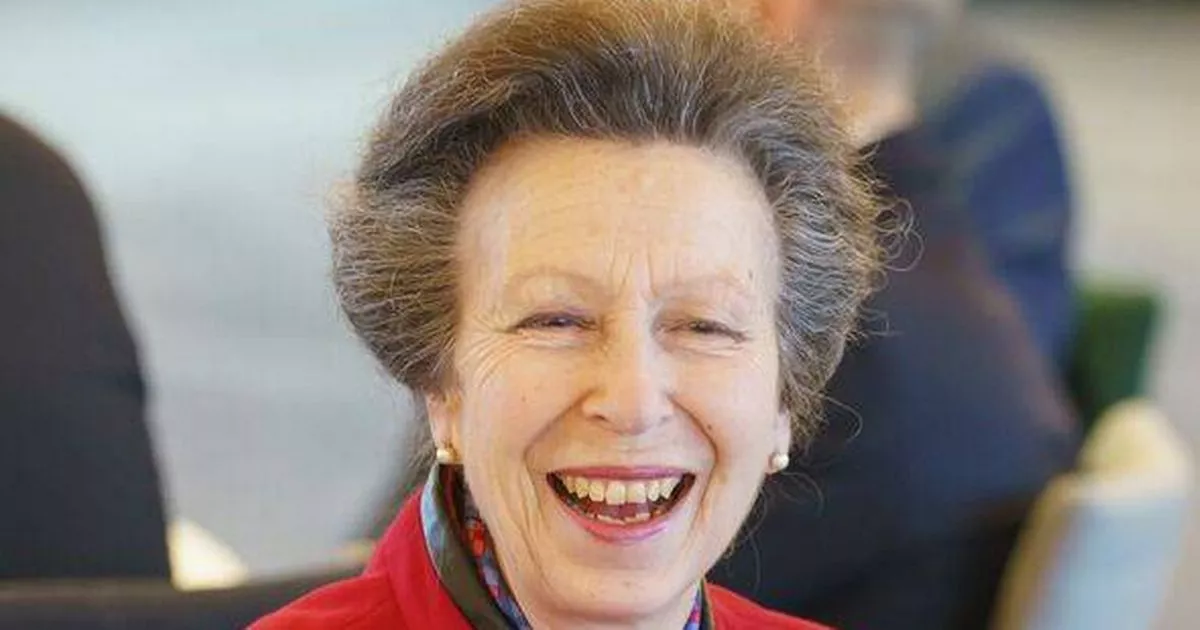
The Princess Royal has a reputation for her no-fuss attitude and practical approach to royal duties – and eagle-eyed fans were quick to spot an interesting detail about her Christmas card
10:06, 11 Dec 2025
Princess Anne’s Christmas card had a personal touch(Image: (Image: Dominic Lipinski/Getty Images))
Princess Anne takes a famously no-nonsense approach to her royal duties. At 75, the King’s sister is considered the hardest-working royal, often performing nearly 500 official engagements a year. And she does it all with a practical, down to earth attitude that also makes one of the most popular members of the Firm.
It’s perhaps no surprise then that her Christmas card sign-off is simple and fuss-free. Eagle-eyed fans spotted a significant detail in Anne’s festive greetings after the Governor of Queensland’s office shared the card on social media.
Princess Anne and her husband Sir Timothy Laurence chose a photo showing them during their visit to Sark in the Channel Islands this past May, travelling by horse-drawn carriage. The couple signed the card off in handwritten pen, simply writing, ‘From Anne and Tim,’ – forgoing their official titles to give their card a more personal touch. The signature sits below a printed greeting which says, ‘With Best Wishes for a Happy and Peaceful Christmas and New Year.’
READ MORE: Princess Anne’s strict morning routine is very relatable – apart from one stomach churning foodREAD MORE: Princess Anne’s playful nickname for King Charles revealed in hilarious exchange The card was very low-key
It comes after King Charles and Queen Camilla released their Christmas card, featuring a picture taken during their trip to Rome in April. The image was first shared to mark their 20th wedding anniversary, and it shows Camilla wearing a cream Anna Valentine dress and a Lily of the Valley brooch.
The message inside the card reads, “Wishing you a very Happy Christmas and New Year.” But there is no signature.
Similarly, Prince William and Princess Kate – who have not yet released their 2025 offering – didn’t sign their official Christmas card in 2024. The family photo they chose was a still from the September 2024 video that Princess Kate issued to share that she completed chemotherapy treatment after announcing that she was undergoing treatment for cancer.
READ MORE: Hilarious moment Princess Anne gifted King Charles a toilet seat for Christmas Kate and William’s 2024 family Christmas card(Image: Instagram)
“Wishing you a very Happy Christmas and New Year,” read the inscription next to a photo of them with their children, Prince George, Princess Charlotte, and Prince Louis.
While it may seem unusual for the royals to not sign their Christmas cards, there’s a practical reason behind it. Members of the British royal family reportedly avoid signing autographs due to the risk of forgery, and Princess Kate had a polite reply when asked why she couldn’t sign drawings she made with schoolchildren in 2022.
“My name’s Catherine. I’m not allowed to write my signature, it’s just one of those rules,” the Princess of Wales told young fans at the Chelsea Flower Show. William and Kate tend to sign personal messages on social media simply as ‘W’ or ‘C’, while King Charles and Queen Camilla sign statements with “Charles R” and “Camilla R,” their regnal signatures as King and Queen.
Yesterday King Charles joined a group of senior Christian clerics for an annual Advent service at Westminster Abbey.
The monarch joined the members of the church from the UK and Middle East to celebrate “light, hope and, above all, the peace of this season”. Charles attended the service at the iconic London church, where the congregation was drawn from churches across the country to mark the run-up to Christmas.
In a foreword to the official order of service, the King, who is a committed Anglican Christian and head of the Church of England, said: “It is a great joy to gather with you in the most glorious setting of Westminster Abbey as we celebrate the light, hope and, above all, the peace of this season of Advent.
“This period is one of preparation, of readying ourselves and looking forward to the wonder of Christ’s birth. Today, we gather for prayer, reflection and music, and to celebrate the Good News in which all Christians rejoice: those around us, and those in areas where it is not easy to live out one’s faith.
“I am so pleased to be joined by church leaders from across the UK and Middle East, leaders of other faiths, charity representatives, and so many of you who contribute to your communities in myriad ways.”