
TECHNOLOGY
ChatGPT now allows users directly access Photoshop, Acrobat and Adobe Express


Adobe has announced that ChatGPT users can now access its design and editing tools directly on the platform. Starting from today, users can use Photoshop, Acrobat, and Adobe Express directly from the AI chatbot.
In a blog post made on Wednesday by the company, the aim of the initiative is to help users save time switching apps. The development is a partnership between OpenAI and Adobe.
“We’re thrilled to bring Photoshop, Adobe Express and Acrobat directly into ChatGPT, combining our creative innovations with the ease of ChatGPT to make creativity accessible for everyone,” said David Wadhwani, president, digital media, Adobe.
As the feature is free, users can activate it by typing the name of the app alongside an uploaded file and prompt, such as “Adobe Photoshop, help me blur the background of this image.” In addition, users won’t have to specify the name of the app again under the same thread of prompts in making additional changes.
 Image Credit: Adobe
While prompts vary, Adobe’s apps may offer a selection of results to choose from or provide results such as Photoshop sliders for adjusting contrast and brightness. It can also offer a range of results that users will manually control and choose from.
However, the in-apps don’t provide the full functionality of Adobe’s desktop software.
For instance, the Photoshop app can only edit specific sections of images, apply creative effects, and adjust image settings like brightness, contrast and exposure. Also, Acrobat in ChatGPT can edit existing PDFs, compress and convert other documents into a PDF format, extract text or tables, and merge multiple files together.
The Adobe Express in ChatGPT lets users generate and edit designs, such as posters, invitations, and social media graphics. Users can also access photos, designs and PDFs they started in the chatbot on the apps directly, and continue the editing.
The new features are available on ChatGPT desktop, web and iOS. Adobe Express for ChatGPT is also available on Android, while support for Photoshop and Acrobat for ChatGPT on Android is coming soon.
For OpenAI, the integration of an additional everyday tool is an attempt to keep users on ChatGPT and make them spend more time than before. It’s also an attempt to fend off competition from Google’s Gemini AI, Meta’s AI and other rivals.
Also Read: ChatGPT now prone to cyberattacks, NITDA warns.
ChatGPT’s app integration
In October, OpenAI commenced the campaign for app integration into its chatbot. The first rollout allows users to connect third-party services such as Spotify, Canva, and Zillow directly within ChatGPT chats, enabling actions like creating a music playlist and creating designs.
“The magic of this new generation of apps in ChatGPT is how they blend familiar interactive elements—like maps, playlists and presentations—with new ways of interacting through conversation,” the company said in October.
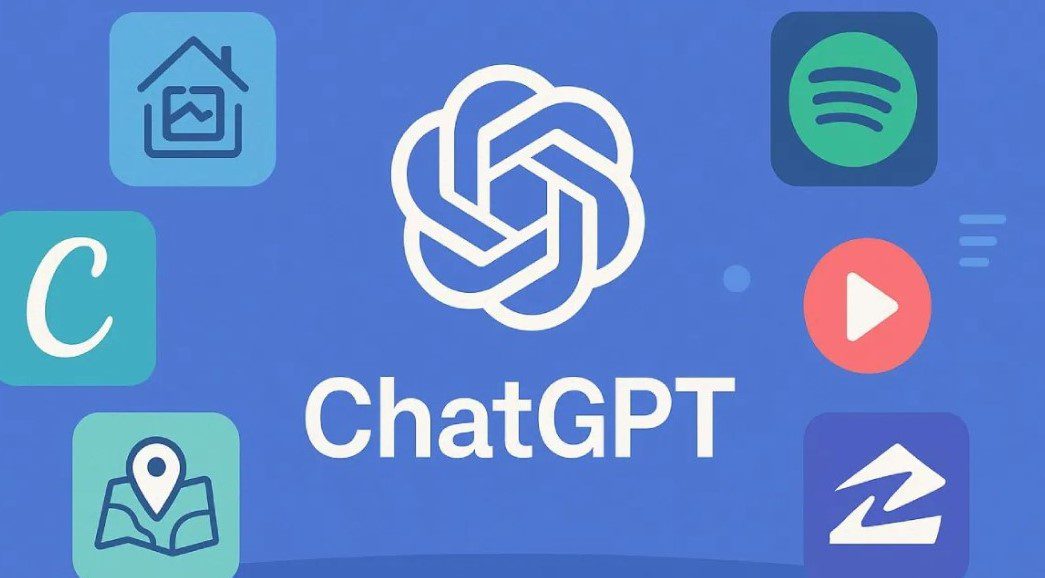
OpenAI also disclosed that 11 additional partners, including Khan Academy, Uber, TripAdvisor, Instacart, and DoorDash, will launch apps on the chatbot before the end of 2025.
The company emphasised that every app must comply with OpenAI’s usage policies, privacy standards, and partner rules for third-party integrations. This is necessary to limit the information the apps can access, and also put users in control of their privacy.

Laura Cress,Technology reporterand
Lily Jamali,North America technology correspondent, San Francisco
 Getty Images

TikTok’s Chinese owner ByteDance has signed a deal with investors to run its business in the US.
But what does this mean for the over 170 million Americans (or so the social media platform claims) who use the app?
The key may lie in how TikTok’s recommendation algorithm – the powerful system that curates the platform’s For You Page to predict content you might watch – is managed when it changes hands.
Social media industry expert Matt Navarra told the BBC the question will not be whether TikTok survives, but “what version of TikTok survives”.
‘Safer’ but ‘less relevant’
Currently, TikTok’s system depends on huge amounts of global data and feedback loops, which can change recommendations in an instant.
Under the terms of the deal TikTok’s algorithm, which will be licensed by investor Oracle, is set to be retrained on American user data.
Mr Navarra said this could leave the app feeling “safer and sturdier” but also leaving it at a risk of “becoming less culturally essential” as a result.
“TikTok’s power has always come from feeling slightly out of control – weird, niche, uncomfortable, sometimes politically sharp content for anyone else or before it goes anywhere else,” he said.
“If you start smoothing those edges, you don’t just change moderation. I think you change its relevance.”
Matching ByteDance’s algorithm
Whether the US version will differ from the TikTok so many know and use already may also depend on if it gets “all the new features, security updates and platform improvements” as soon as the international version does, tech journalist Will Guyatt told the BBC.
And computing expert Kokil Jaidka from the National University of Singapore said she expected the things that make the platform popular – such as its short videos and shopping – are likely to “stay intact” as these features are not dependent on the algorithm.
She said the changes might be more subtle and gradual, depending on if the narrower data inputs of the “siloed” US version can match the app’s global reach.
“If TikTok is operating with a licensed or partially diluted version of its recommendation algorithm, some of the system’s blind spots may start to matter more,” she said.
For users, she said this means in practice the US algorithm may “lag in personalisation” and take longer to adapt to viral content.
To experiment or behave?
Oracle is TikTok’s longtime cloud computing partner in the United States, and is chaired by Larry Ellison, an ally of President Trump.
Another foreign entity, MGX – an Abu-Dhabi government investment fund – will join it along with private equity firm Silver Lake as the main incoming investors.
Pressure from these investors may also add to the US app feeling “blander” said Mr Navarra.
“I think the real test won’t be whether the users leave,” he said.
“It will be whether TikTok still feels the place the internet goes to experiment – or if it becomes the place it goes to behave.”
Additional reporting by Peter Hoskins.


Regularly consuming high fat cream or cheeses including brie and cheddar, could slash the risk of developing dementia, research today suggested.
Swedish researchers, who monitored the health and eating habits of over 27,000 middle-aged adults, said those who regularly ate cheese or high fat cream, were less likely to have a diagnosis.
People who tucked into 20g per day of cream — roughly one and a half tablespoons — had a 16 per cent lower risk of dementia than those who consumed none, scientists found.
Eating 50g of cheese daily, meanwhile, saw their risk cut by 13 per cent, compared to those who ate less than 15g per day.
Cheese may contain certain nutrients that boost brain function, but further studies are needed to confirm the results, the scientists said.
While high in calcium and protein, currently the NHS recommend people consume no more than around 30g of cheese per day, due to its saturated fat and salt content.
Maintaining a healthy weight, not drinking too much alcohol and keeping blood pressure at a healthy level are recommended by health chiefs to reduce the risk of dementia.
Professor Emily Sonestedt, an expert in nutrition and public health at Lund University and study co-author, said: ‘For decades, the debate over high-fat versus low-fat diets has shaped health advice, sometimes categorising cheese an unhealthy food to limit.

Swedish researchers, who monitored the health and eating habits of over 27,000 middle-aged adults, said those who regularly ate cheese or high fat cream, scored better in cognitive tests
‘Our study found that some high-fat dairy products may actually lower the risk of dementia, challenging some long-held assumptions about fat and brain health.’
High fat cheeses are typically those which contain more than 20 per cent fat, such as cheddar, parmesan, stilton and brie.
In the fresh research, scientists asked participants to keep food diaries tracking how often they ate certain foods.
Over a follow-up of 25 years, they discovered 3,207 people developed dementia.

Everyone experiences dementia differently. Use this checklist to help you make a note of your symptoms before you talk to your GP.
After accounting for factors that could skew results, they also discovered that those who ate more high-fat cheese had a 29 per cent lower risk of vascular dementia—the second most common form after Alzheimer’s.
It is caused by reduced blood flow to the brain, damaging cells, while Alzheimer’s involves plaques and tangles of certain proteins.
There was also a lower risk of Alzheimer’s disease among those who ate more high-fat cheese, the scientists said.
But this was only found among those not carrying the APOE e4 gene variant — a genetic risk factor for Alzheimer’s disease.
Writing in the journal Neurology, they added that full-fat cream appeared to have a similar protective effect.
Those who consumed around 1.5 tablespoons a day, were 16 per cent less likely to develop dementia, compared to those who consumed none.
No such association, however, was found between dementia and low-fat cheese, cream, milk, butter or fermented milk products.
Experts, however, who were not involved in the research urged caution over the findings, arguing other confounding factors, aside from cheese, may explain the link.
Professor Naveed Sattar, an expert in cardiometabolic medicine at the University of Glasgow, said: ‘I do not believe there is a causal link here, as this is an observational study rather than a randomized controlled trial.
‘It is important to note that individuals who consumed more high-fat cheese and cream were, on average, better educated.
‘This raises the possibility that other “healthy” characteristics associated with higher education, rather than the cheese or cream itself, may explain the lower dementia rates observed.
‘We already know of several well-established and proven factors that reduce dementia risk, such as maintaining healthy blood pressure, managing weight, and preventing heart disease or stroke.
‘These interventions should remain the priority, given their strong evidence base, rather than focusing on unproven dietary associations.’
Professor Tara Spires-Jones, Director of the Centre for Discovery Brain Sciences at the University of Edinburgh, added: ‘ It is highly likely that diet and other lifestyle factors changed over the course of the study.
‘Strong evidence from across the field indicate that healthy diet, exercise, and cognitively stimulating activities — education, challenging jobs and hobbies — can boost brain resilience to diseases that cause dementia.

‘There is not strong evidence for any individual food protecting people from dementia.’
The condition now affects around one in 11 people over the age of 65 in the UK and claims 76,000 lives each year and is the UK’s biggest killer.
Costs to the UK economy, including that of the round-the-clock care many need as dementia takes hold, is an eye-watering £42 billion a year, according to the charity Alzheimer’s Society. That figure will double by 2040, it warns.
Earlier this month, the Daily Mail launched its Defeating Dementia campaign, in association with Alzheimer’s Society, to raise awareness of the disease, increase early diagnosis, boost research and improve care.
Scientists now believe around 45 per cent of all cases of dementia may be preventable or — at the very least — that the symptoms can be delayed, in some cases for many years, allowing everyone to live longer, healthier lives.


Startups On Our Radar spotlights African startups solving African challenges with innovation. In our previous edition, we featured seven game-changing startups pioneering healthcare, transportation, education, and artificial intelligence. Expect the next dispatch on December 26, 2025.
This week, we explore five African startups in the education, fintech, software development, and artificial intelligence sectors and why they should be on your watchlist. Let’s dive into it:
CodeFundi is turning AI agents into a software teammate for global development teams (AI, Kenya)
Felix Waweru, a software engineer with a decade of experience, founded CodeFundi in 2023 to solve the reliability and maintenance issues plaguing software development. He realised that while writing code is a part of the job, testing, documentation, debugging, and long-term maintenance are often slow, error-prone, and too complex to manage manually. CodeFundi addresses this with its all-in-one AI solution that automates coding, testing, and documentation to help teams maintain software faster and more reliably.
Rather than have users copy and paste snippets into a chatbot, CodeFundi connects directly to a team’s codebase, such as repositories hosted on GitHub, to understand an entire software project. This allows users to interact with their codebase through a conversational interface to understand complex packages or generate new features. On the backend of this conversation, CodeFundi uses multiple specialised AI agents with different roles. One conducts research and deeply analyses the code, another maintains contextual memory of the user and organisation, and a third compiles results into actionable outputs.
This setup allows the platform to automatically identify bugs, generate fixes, write tests to validate those fixes, and produce detailed technical documentation explaining how each part of the code works. The platform also includes analytics that show teams which programming languages or components dominate their projects.
CodeFundi operates on a subscription model ranging from a $5 monthly starter plan to a $1,000 monthly enterprise tier that offers on-premise hosting for data security or region-specific deployments. The startup also offers credit-based usage and an API, currently in beta testing, that allows companies to embed CodeFundi’s AI agents directly into their own products.
Why we’re watching: CodeFundi is modelling its system on how real engineering teams work. It breaks software development into discrete tasks handled by multiple collaborating AI agents, which mirrors the separation of responsibilities between frontend, backend, testing, and documentation teams. Waweru says that this approach improves reliability and reduces the forgetfulness that can occur when one AI handles everything.
The startup competes with tools focused solely on testing, such as Zof AI, and other AI product development platforms like Kasa AI and Bolt AI. They have secured partnerships with Google Cloud, Microsoft for Startups, and Cognition AI, the team behind Devin. CodeFundi claims to have acquired 5,000 users across 47 countries since its launch, and says it has crossed $1,000 in monthly recurring revenue as a bootstrapped business.
TalkPDF AI wants to turn PDFs into interactive tutors in local languages (Edtech, Nigeria)
TalkPDF AI is an AI-powered learning assistant built to help students move from regular memorisation to real understanding. The idea came when founder Lukman Abimbola saw his younger sister struggle to prepare for her West African Senior School Certificate Examination (WASSCE). Despite spending hours rereading chemistry textbooks, she could not explain basic concepts because she was memorising words instead of trying to understand the concepts. Her breakthrough came when Abimbola asked her to explain the ideas back to him in Yoruba, as if she were teaching a younger cousin.
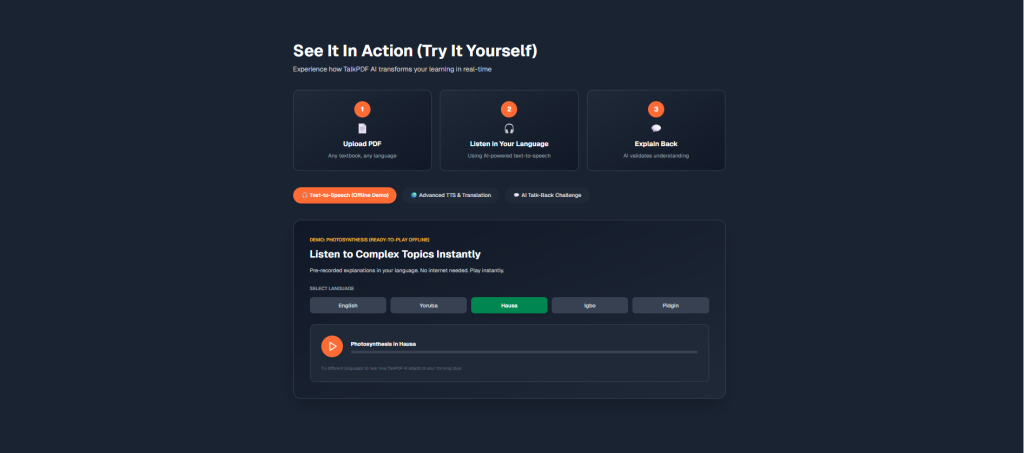
That moment shaped Abimbola’s core insight: that many students fail because they are forced to learn complex ideas in a second language, with no way to validate whether they truly understand what they’ve studied. To solve this language-induced learning crisis, TalkPDF AI converts textbooks and PDFs into an interactive audio tutor in English, Yoruba, Hausa, Igbo, and Pidgin. A student uploads a text-based study material, and the system instantly converts it into natural-sounding audio in the learner’s preferred language.
As the student listens, the AI pauses at key concepts and activates what Abimbola calls an explain-back mode, asking the learner to explain the idea in their own words. If the student repeats textbook jargon or gives a memorised definition, the system pushes back and asks for a simpler explanation, prompting them to explain as if they were teaching a 10-year-old. Each chapter is graded with an understanding score, as users can earn bronze, silver, or gold badges. The system also schedules spaced repetition for concepts the learner has not fully mastered.
TalkPDF AI is currently in beta and has sold 43 out of 50 paid beta slots, with full launch scheduled for early 2026. The startup operates a freemium model, with a limited free tier offering five minutes of audio per day, and a Student Pro plan priced at ₦40,000 ($27.47) yearly, which includes unlimited uploads, full explain-back mode, offline downloads, and all supported languages.
Why we’re watching: TalkPDF AI stands out from competitors like uLesson, Gradely, and MyLesson for combining active learning with local-language support. By merging active validation, which refuses to let students fake understanding, with offline functionality and local language support, the startup addresses African infrastructure challenges of data costs and language barriers.
TalkPDF AI is planning B2B licensing deals with universities, the West African Examinations Council (WAEC), the Joint Admissions and Matriculation Board (JAMB), and an expansion into K–12 exam preparation. The startup is preparing a pre-seed raise to fund product development, campus ambassadors, and university pilots.
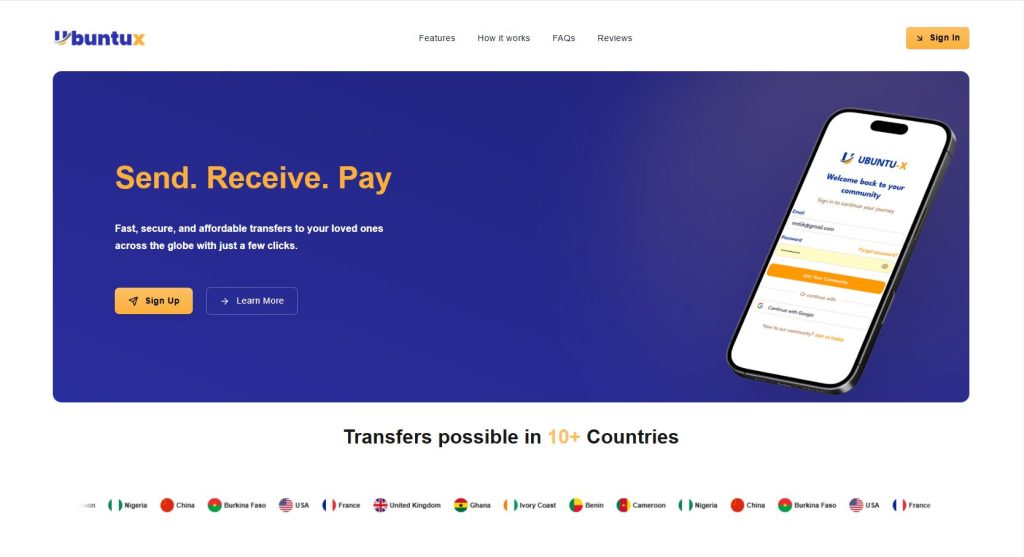
Ubuntu X wants to unlock global payments for Francophone Africa (Fintech, Cameroon)
Founded by Manuel Songfack, Njinowo Brandon, Miamo Karl, and Fitzgerald Mouliom, Ubuntu X is a Cameroon-based cross-border payments and remittance startup building infrastructure to move money seamlessly across African countries and the rest of the world. The founders observed that global transactions from the U.S. or Europe are seamless. However, sending money from Cameroon to neighbours like Nigeria or Benin or to major trade hubs like China remains slow and expensive.
Ubuntu X is building a mobile-native payment gateway that connects local payment methods across countries. Its solution is a ‘network of networks’ that connects local mobile money wallets, including MTN and Orange Money, directly to international payment endpoints such as Alipay in China and Access Bank in Nigeria. The system currently supports remittances and payments, with plans to add cryptocurrency purchases and virtual cards.
Users sign up on the web platform, complete a one-time know-your-customer (KYC) process that includes personal details, ID upload, and a selfie check. Once verified, they select their local payment method and input the receiver’s details. The founders claim that transactions are reviewed by validators and are typically completed within 5 to 10 minutes.
Ubuntu X launched operations in January 2025 and initially processed transactions manually, using stablecoins and merchant accounts in destination countries before it began automating workflows through APIs. The startup charges between 2% and 4% on remittance transactions, 1% on payments, and plans to charge 1% each on crypto purchases and virtual card issuance.
Why we’re watching: Ubuntu X is tackling the persistent problem of fragmented payment rails across African countries. While regional remittance startups like Reasy facilitate transfers to China, it requires the recipient to have a Chinese bank account, whereas Ubuntu X integrates directly with digital wallets like Alipay. Similarly, legacy players like MoneyGram rely on an agent-to-agent model that requires physical presence. The startup also positions itself against crypto platforms like Binance by promising simpler onboarding and direct mobile money integration.
Ubuntu X claims to have processed over 100 million CFA ($178,000) in remittance volume, with over 55% of transactions flowing from African countries to China. The startup is planning to raise $200,000 for product development and plans to launch virtual cards by June 2026 to further democratise online spending for users who cannot afford traditional prepaid bank cards.

SabiScholar wants to make online learning work offline for Nigerian students (Edtech, Nigeria)
Founded by Divine Iloh, a US-based data analytics manager, SabiScholar is a learning management system (LMS) for secondary schools and universities to deliver courses, resources, assignments, assessments, and results digitally. The product was born from Iloh’s insights into the limitations of digital learning platforms like the National Open University, which still requires students to take physical classes.
On the platform, schools can access an array of curriculum-aligned courses, currently covering WAEC, JAMB, and NECO subjects. Institutions can import SabiScholar’s own internal learning material or upload materials of their own. It also allows teachers to manage students, mark assignments, track results, and view performance dashboards. On the other side, students can log in, learn through video courses, complete assignments, and access school resources.
So far, the startup claims to have completed a pilot phase involving around 2,900 secondary school students across Nigeria, who used the platform to prepare for O-level exams.
Although the platform is currently online-only, SabiScholar is designing an offline delivery model built on AI. The approach uses predictive downloading to ensure that learning isn’t disrupted by poor bandwidth. This AI teacher monitors a student’s deadlines and network availability, automatically pre-downloading course materials during off-peak hours or whenever a stable connection is detected. This ensures assignments and videos are available on the device before they are due.
The platform also includes a career recommendation engine, SabiCareer, that uses student history and subject preferences to suggest career paths and universities. SabiScholar expects revenue to come from state-level and institutional partnerships, where governments and schools subscribe to deliver digital learning at scale.
Why we’re watching: SabiScholar is distinguishing itself by solving the infrastructure hurdles that limit edtech adoption in Africa, specifically bandwidth reliability. Unlike global competitors such as Coursera or Udemy, which may lack local context, SabiScholar is building for schools, empowering them with infrastructure, curriculum, content, and operations, rather than going directly to the consumer.
Get The Best African Tech Newsletters In Your Inbox
Bit68 wants to replace traditional apps with agentic AI interfaces (Software Development, Egypt)
Founded in 2014 by software engineer Ibrahim Gharbawi, Bit68 is a software services company that builds and scales products for entrepreneurs and corporate clients, with a growing focus on AI-driven and agentic interfaces. The company started as a web development firm but has expanded its services to include e-commerce, mobile applications, digital transformation, and AI-enabled solutions.
With a team of about 80 people, Bit68 operates as a consultancy rather than a product-based business, conducting brainstorming sessions with stakeholders to define solutions that automate internal processes efficiently. Bit68 interfaces with Large Language Models (LLMs), including paid, open-source, and pre-trained models, directly with a client’s database, allowing users to interact with services through a chat interface rather than standard application menus.
Why we’re watching: As more businesses move to adopt AI into their product offerings, Bit68 stands out with its approach to integrating AI into a user’s product. Instead of treating AI as a bolt-on feature, the company is actively pushing clients toward agentic interfaces that sit on top of existing databases and services. The company’s recent partnership with South Africa-based offshoring firm SoluGrowth to grow its South African presence and its expansion beyond Egypt into the MENA region suggests Bit68 is positioning itself as a cross-regional partner for AI-led digital transformation.
That’s all for today. Expect our next dispatch on December 19th. Know a startup we should feature next? Please nominate here.


OpenAI is in talks to raise up to $100 billion in a funding round that could value the ChatGPT maker at up to $830 billion, the Wall Street Journal reported Thursday, citing anonymous sources.
The company is aiming to raise the funding by the end of the calendar first quarter next year, and it may ask sovereign wealth funds to invest in the round, the WSJ reported. The Information first reported news of the deal, though it said the fundraise would land OpenAI a $750 billion price tag.
The funding would come as OpenAI commits to spend trillions of dollars and strikes deals around the world as the company tries to stay ahead in the race to develop AI technology. The cash injection would also help the company with its spending on inferencing, which seems to be funded more by cash than cloud credits, suggesting the company’s compute costs have grown beyond what partnerships and credits can subsidize.
And, as competition intensifies from rivals like Anthropic and Google, OpenAI has had to step on the gas to release new models and expand its presence in the developer and tooling ecosystem.
Meanwhile, broader sentiment around AI has recently cooled as investors start doubting whether the pace of debt-fueled investment by giants like Amazon, Microsoft, Oracle, and OpenAI itself can be maintained in the long run. It also doesn’t help that the production of chips is being constrained by shortages in the supply of memory chips, which threatens to affect the broader tech sector.
OpenAI has also been rumored to be working on an IPO as a way to raise tens of billions and fund its development efforts, which are currently said to be generating annual run-rate revenue of about $20 billion. There are also rumors that the company is courting Amazon for a $10 billion investment that would also give the AI lab access to the tech giant’s new AI computing chips.
If the fundraise happens, it would add a substantial amount to OpenAI’s coffers, which currently have more than $64 billion, according to PitchBook data. The company was most recently valued at about $500 billion in a secondary transaction.
OpenAI did not immediately return a request for comment.
Techcrunch event
San Francisco
|
October 13-15, 2026

Image: Techloy.com
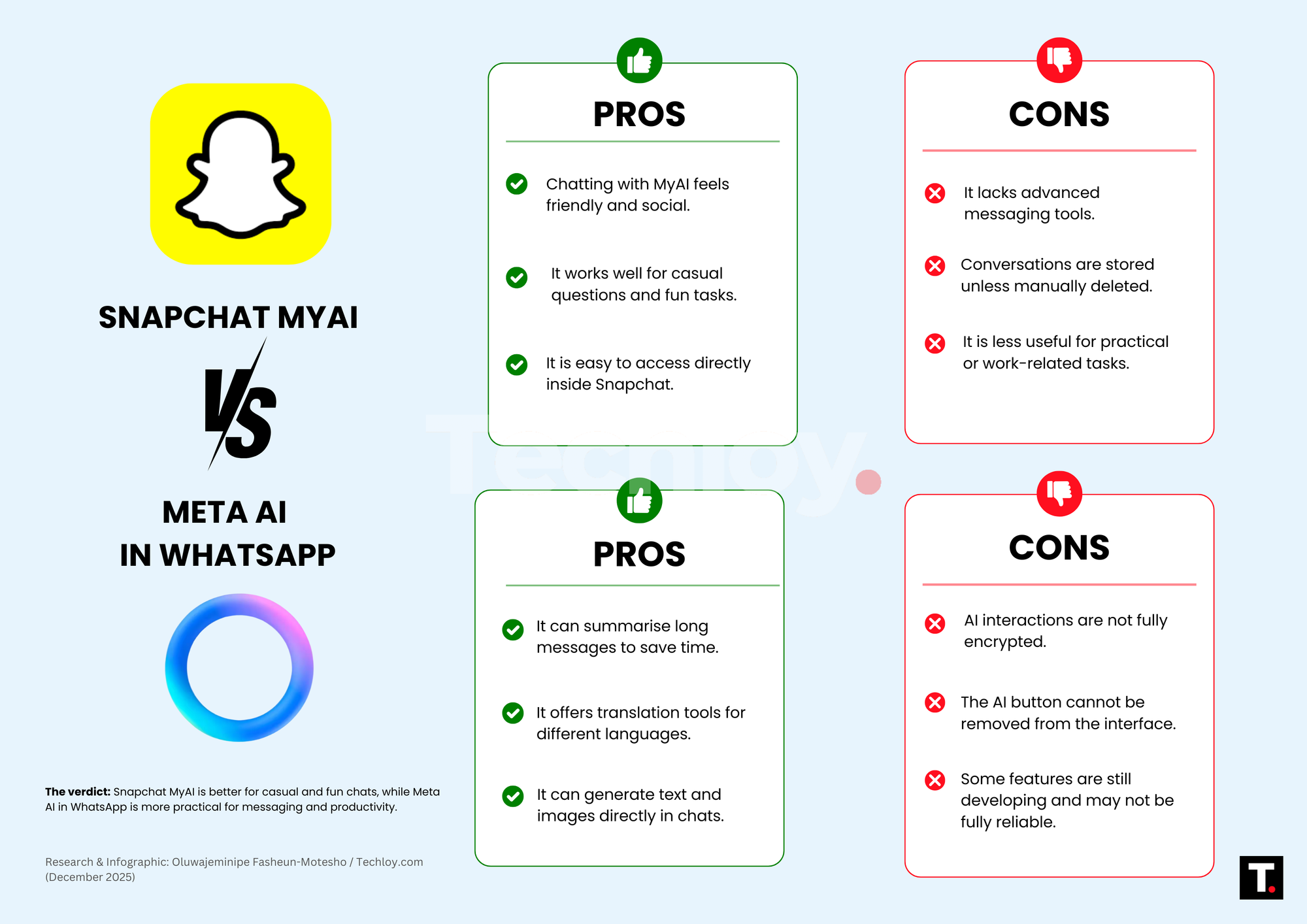
If you use Snapchat or WhatsApp a lot, you would have noticed the AI assistants sitting right inside your chats. You did not download a new app or turn on a special setting. They simply showed up. On Snapchat, it is called MyAI, while on WhatsApp, it is Meta AI, built directly into the messaging experience. As these apps become central to how people talk, work, and share information every day, it is worth asking how useful these AI tools really are.
Snapchat MyAI is an AI chatbot that appears as a chat contact inside Snapchat. Users can talk to it like a friend, ask questions, get advice, or request ideas for things like trips or captions. Meta AI in WhatsApp is an AI assistant built into the WhatsApp interface itself. Instead of acting like a friend, it works more like a tool users can access while chatting. It helps answer questions, explain information, and assist with messaging tasks.
This difference in design raises an important question: which AI assistant actually helps more in everyday chats?
Snapchat partners with Perplexity in a $400 million deal to integrate AI search into Snapchat
A quick search can pull you out of Snapchat. With Perplexity built into chat, it seems Snap is trying to keep that flow unbroken.
/1. How They Work Inside the App
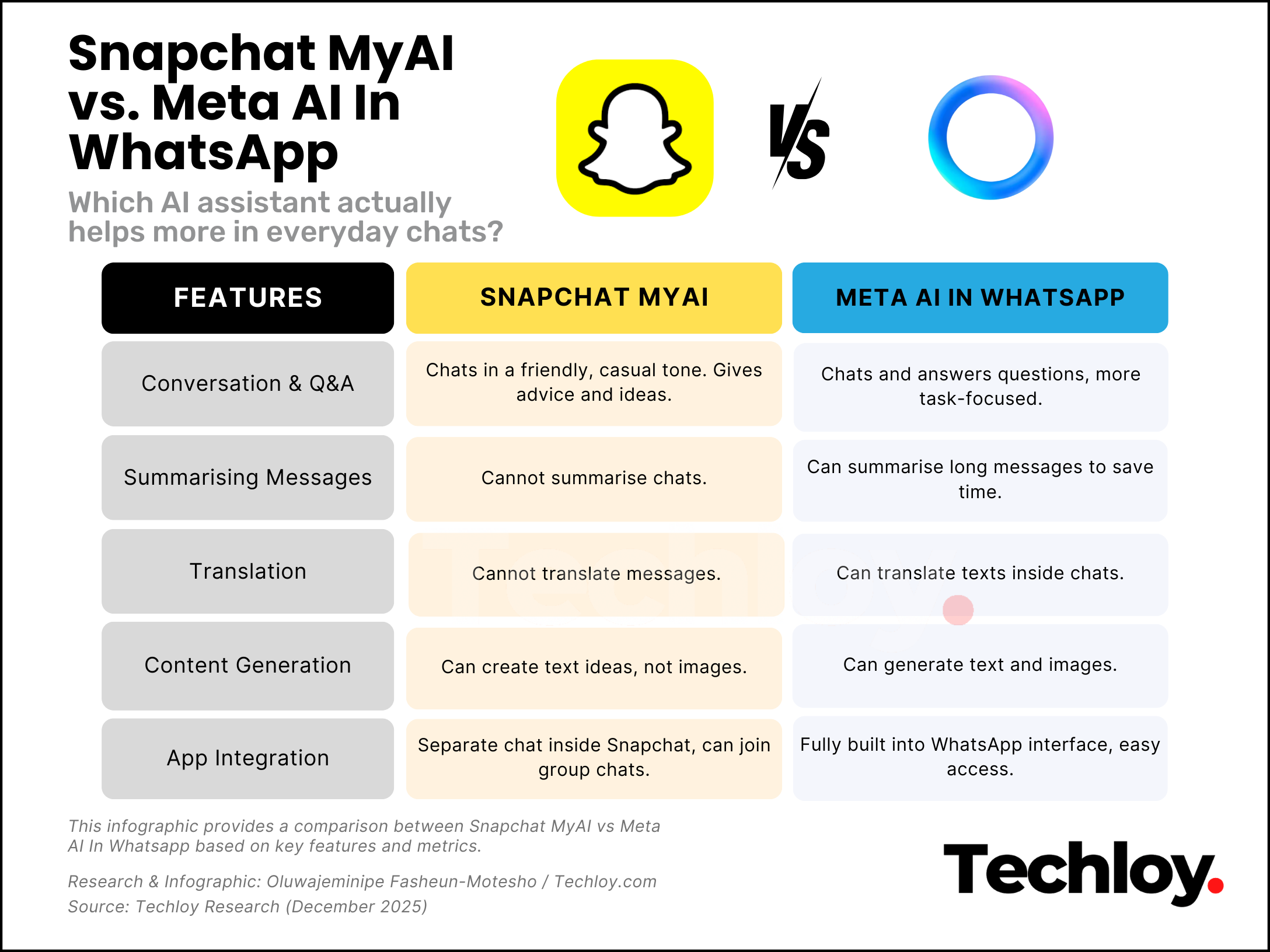
How they work inside the app matters because it affects how easily you can use the AI while chatting. Snapchat MyAI works as a separate chat. You open it, type your question, and receive a reply. The experience feels like chatting with a smart digital friend. It stays mostly in its own space, although it can be mentioned in group chats. This makes it simple but also slightly detached from other conversations.
Meta AI in WhatsApp is deeply integrated into the app. Users can access it through an AI button or inside chats without leaving their conversation. This makes it easy to use while messaging and reduces friction. It feels like part of the messaging flow rather than a separate feature.
💡
Verdict: Meta AI in WhatsApp offers a smoother and more natural experience because it blends directly into messaging, while Snapchat MyAI feels more like a standalone chat.
/2. Features and Capabilities
The features and capabilities of each AI show what they can actually do to help you during chats and how useful they are for different tasks. Snapchat MyAI focuses mainly on text based interaction. It can answer questions, give suggestions, help with writing, and offer creative ideas. However, its feature set is limited to conversation and simple assistance. It does not provide tools like chat summaries or translations.
Meta AI in WhatsApp offers more advanced features that support communication. It can summarise long chats, translate messages into different languages, explain links, and generate text or images. These tools are especially helpful in busy group chats or work related conversations where time and clarity matter.
💡
Verdict: Meta AI in WhatsApp clearly offers more powerful and useful features, while Snapchat MyAI is better suited for casual and creative conversations.
/3. Privacy and Data Handling
How each AI handles privacy and data matters because it affects what happens to your conversations and how secure your information is. Snapchat MyAI stores conversations until users delete them. These chats may be used to improve the AI experience and personalise responses. Because it lives inside Snapchat, the data may also influence recommendations within the app.
WhatsApp messages remain end to end encrypted, which protects normal chats. However, conversations with Meta AI are not encrypted in the same way. These interactions can be stored and used by Meta to improve the AI system. This creates a separation between private chats and AI usage.
💡
Verdict: Neither option offers full privacy for AI interactions, but WhatsApp still protects normal messages better than Snapchat protects AI chats.
/4. Ease of Use and Practical Value
An AI that feels intuitive and practical can make daily messaging smoother and more efficient. Snapchat MyAI is easy to use for people already comfortable with Snapchat. Opening a chat and talking feels natural and familiar. It works best for relaxed use and casual questions.
Meta AI in WhatsApp is designed for frequent and practical use. Because it sits inside messaging, users can access help without breaking their conversation flow. This makes it more valuable for daily communication, especially for work and group chats.
💡
Verdict: Meta AI in WhatsApp is more practical for everyday use, while Snapchat MyAI is easier for casual and social interaction.
Final Verdict
Snapchat MyAI and Meta AI in WhatsApp reflect two different approaches to AI in social apps. Snapchat MyAI focuses on friendly conversation and creative help inside a social platform. It works well for users who want an AI that feels like a chat companion. Meta AI in WhatsApp focuses on improving communication by offering tools that save time and reduce effort in messaging.
Overall, Meta AI in WhatsApp delivers more value for users who rely on messaging for work, family, and daily coordination. Snapchat MyAI remains a good option for relaxed and fun interaction. If usefulness and productivity matter most, Meta AI is the better choice. If social engagement and conversation matter more, Snapchat MyAI is worth using.
Meta Starts Mining Your AI Conversations for Ads Today — Here’s What That Actually Means
Every question you ask Meta AI is now a data point in the company’s advertising engine. And unlike past privacy changes, there’s no direct way to opt out.
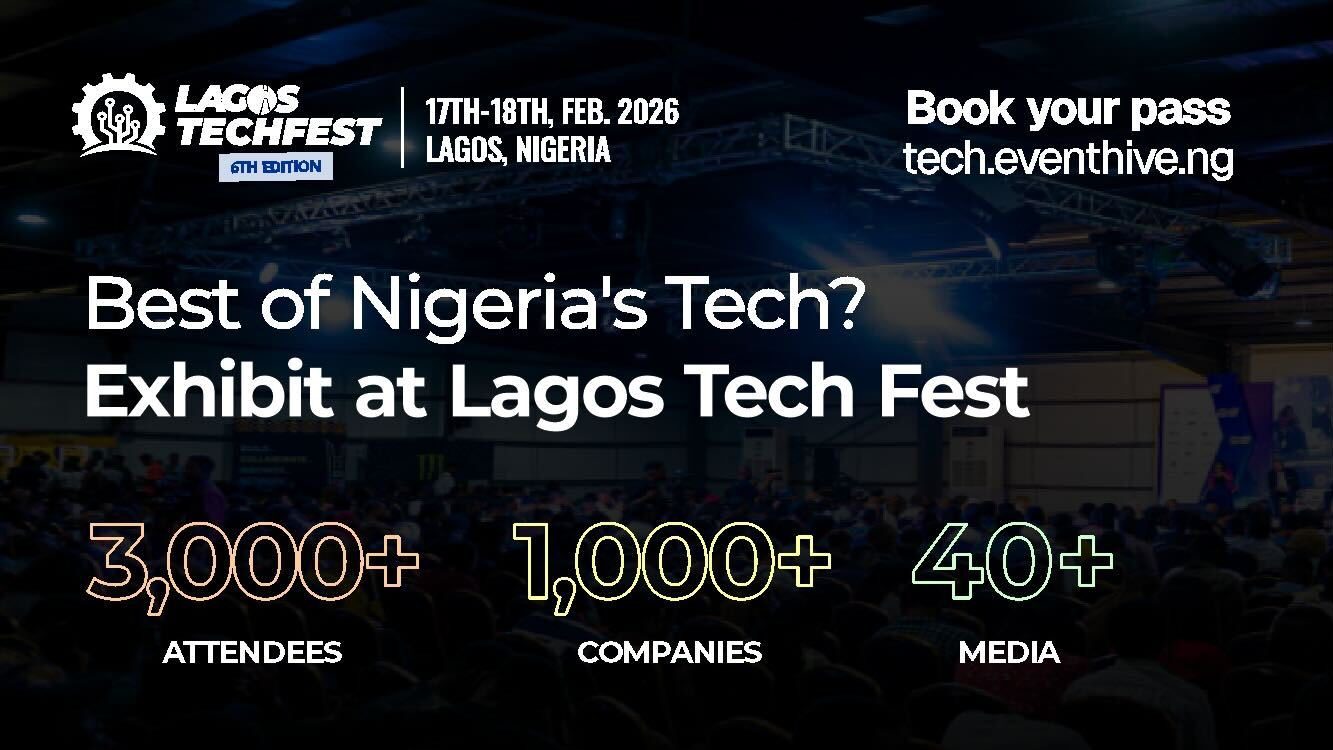
Eventhive, Africa’s leading B2B2C event servicing company with a strong portfolio across key sectors and six major cities, is thrilled to announce the sixth edition of its flagship event, the Lagos Tech Fest.
The event is part of the Africa Tech Series, Eventhive’s pan-African platform for technology and innovation dialogue, which hosts fintech-focused gatherings in Lagos, London, Nairobi, Kigali, and Johannesburg.
The Lagos Tech Fest returns to convene tech leaders, emerging startups, innovators, investors, global tech giants, and government representatives to define the future of Nigeria’s tech ecosystem, address key developments, and uncover countless opportunities within the Nigerian and African tech market.
Combining conferences, roundtables, an industry party, pitch live events, exhibitions, and networking, the event annually creates a veritable platform that seeks to drive investments into the ecosystem.
The 2026 edition promises to be the largest yet, with projections of 3,000+ attendees, 70+ industry leading speakers, and representation from 1,000+ companies across more than 25 countries, supported by over 80+ sponsors and 40+ media partners.
This year, the event will introduce four distinct stages designed to cater to diverse interests and facilitate deeper, focused discussions: the Money Stage, Off The Record Stage, Innovation Stage, and Founder Stage.
The Lagos Tech Fest 2026 is set to take place across three major venues in Lagos: Fourpoints By Sheraton and The Garden in Ikoyi/VI on February 17, 2026, and the Landmark Event Centre in Victoria Island, Lagos, on February 18, 2026.
Ahead of the main event, the annual Nigeria’s Tech Leadership Roundtable returns on February 17, 2026, bringing together strictly C-level executives and government representatives at Fourpoints By Sheraton, VI, Lagos, for exclusive, high-level engagement to chart the future of the ecosystem.
Key highlights also include the Nigeria State’s Pavilion, which will showcase the vibrant tech ecosystems across multiple Nigerian cities, and a Larger Expo focused on showcasing transformative solutions defining the next decade of Nigeria’s tech ecosystem.
An industry party, After Dark Hours, will provide a dedicated networking session at The Garden, Ikoyi, Lagos, on the evening of February 17, 2026.
Commenting on the launch of the sixth edition, Jamiu Ijaodola, CEO of Eventhive, said: “Lagos Tech Fest is the annual engine room where the blueprint for Nigeria’s digital future is drawn. As we launch our sixth edition, we are seeing unprecedented convergence of finance, talent, and innovation.
The introduction of our four focused stages will ensure every participant leaves with actionable insights and valuable connections. We are committed to not only hosting Nigeria’s best but also creating the crucial platform that drives billions of dollars in investment and collaboration needed to solidify Nigeria’s position as Africa’s undisputed tech leader.”

The 2026 edition boasts a powerhouse line-up of confirmed speakers, including, Uzoma Dozie (CEO, Sparkle), Tayo Oviosu (CEO, Paga), Olumide Balogun (Director, West Africa, Google), Tosin Faniro-Dada (Partner, Breega), Takuma Terakubo (CEO & General Partner, Uncovered Fund Inc.), Kazeem Tewogbade (CEO, Bluechip Technologies), Emeka Ajene (Founder & CEO, Afridigest), Ojoma Ochai (MD, CcHub Africa), Adedeji Olowe (Founder, Lendsqr), Napa Onwusah (Managing Partner, PlacidCode Labs), Dr. Abasi Ene-Obong (CEO, Syndicate Bio), Lexi Novitske (General Partner, Norrsken22), Victoria Fabunmi (National Coordinator, Nigerian Digital Innovation, NITDA), Olaniyi Yusuf (Managing Partner, Verraki Partners), Abdelaziz Saidu (Country General Manager, Nigeria & Ghana, Cisco), Dr Ayotunde Coker (CEO, Open Access Data Centers), Adekanbi Oluwaseun (Growth Lead, Cleva), Chichi Nwoko (CEO, What Media Group), Francis Sani (Programme Director, 3MTT), Adesuwa Omoruyi (Co-founder, Accrue), and Akpor Ikogho (Managing Partner, Mark Renee LP).
The event is made possible by the strong support of confirmed sponsors including Odoo, Open Access Data Center, Paga, Tetrad, Cleva, Keystone Bank, Accrue, Radiant Money, Radiant Digilog, and Mark Renee LP.
For more information about Lagos Tech Fest or to explore partnership opportunities, please visit https://tech.eventhive.ng/.


Sony has taken control of Charles Schulz’s Peanuts franchise including Snoopy and Charlie Brown in a deal worth C$630m (£340m).
The Japanese conglomerate has bought 41% of Peanuts Holdings, which owns the intellectual property Schulz created, from the Canadian children’s entertainment company WildBrain.
The deal raises Sony’s total stake, which it began building in 2018, to 80%. The Schulz family owns the remaining 20%.
Peanuts, which first appeared as a comic strip in seven newspapers in 1950 and ran daily until the cartoonist’s death in 2000, has gone on to become a global franchise spanning TV, toys, films and theme park attractions.
In October, Apple TV announced an extension of its deal as the exclusive streaming home for Peanuts until 2030, which includes the production of a new Snoopy and Charlie Brown animated feature film.
20th Century Fox Animation and Blue Sky Studios produced The Peanuts Movie in 2015.
Sony, whose empire spans film, television, music, gaming and electronics, has been bolstering its push into entertainment and original content in recent years.
The company achieved significant success with the hit TV series The Last of Us, which was adapted from a popular PlayStation game.
In the UK, Sony owns, or has majority control of the TV production companies behind series including Downton Abbey, Outlander, Industry and His Dark Materials. Its film studio, Sony Pictures, is behind franchises including Spider-Man and Venom, and Sony Music is home to global artists including Beyoncé, Adele and Pink Floyd.
“With this additional ownership stake we are thrilled to be able to further elevate the value of the Peanuts brand by drawing on Sony Group’s extensive global network and collective expertise,” said Shunsuke Muramatsu, the chief executive of Sony Music Entertainment.
“We are deeply committed to carrying forward the legacy of Charles Schulz and the Schulz family.”
Sony said the publicly listed WildBrain would be retained under a multi-year service arrangement to handle licensing, production and distribution relating to the Peanuts franchise.
WildBrain, which acquired its 80% stake in the Peanuts franchise in 2017, also owns intellectual property rights to franchises including Strawberry Shortcake, Teletubbies, Degrassi and Inspector Gadget.

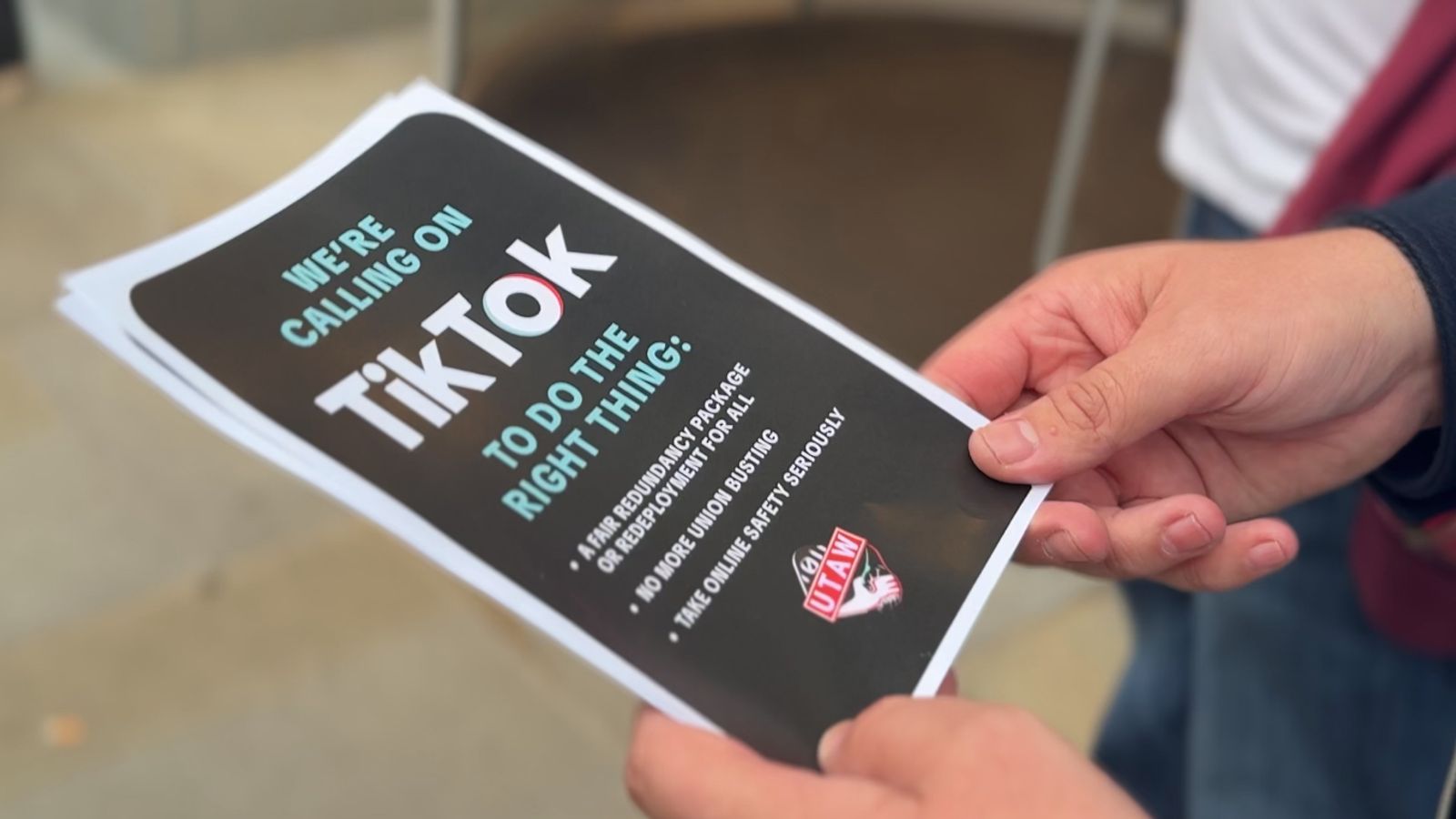
TikTok is being threatened with legal action over cuts to its UK online safety teams.
In August, the social media company announced more than 400 workers would lose their jobs, with AI replacing some of the workers and other jobs being rehired abroad.
TikTok is being accused of threatening those safety workers with redundancy days before they were due to vote on forming a union.
Read more: TikTok moderators warn users may be at risk
Now, two moderators have sent a legal letter to TikTok laying out the terms of a potential legal case on grounds of unlawful detriment and automatic unfair dismissal.
Unlawful detriment is when an employer treats a worker unfairly because they used a protected employment right, for example, being a union representative, asking for flexible working or whistleblowing about the company.
“In June, TikTok said it was going to hire hundreds more content moderators, then two months later, they fired everyone,” said Stella Caram, head of legal at Foxglove, a non-profit supporting the moderators.
“What changed? Workers exercised their legal right to try to form a trade union. This is obvious, blatant and unlawful union-busting,” she said.
Moderators gathered to protest the redundancies in London
TikTok has been given one month to respond to the legal claim.
A TikTok spokesperson said: “We once again strongly reject this baseless claim.
“These changes were part of a wider global reorganisation, as we evolve our global operating model for Trust and Safety with the benefit of technological advancements to continue maximising safety for our users.”
The two moderators launching the case are working with the United Tech & Allied Workers (UTAW), the non-profit legal organisation Foxglove and law firm Leigh Day.

TikTok safety fears as hundreds of moderators leave company
In exclusive interviews last month, three whistleblowers told Sky News the cuts would put UK users at risk, a claim repeated by Julio Miguel Franco, one of the moderators behind the legal action.
“TikTok needs to tell the truth,” he said.
“When it says AI can do our job of keeping people safe on TikTok, it knows that’s rubbish.
“Instead, they want to steal our jobs and send them to other countries where they can pay people less and treat them worse. The end result is TikTok becomes less safe for everyone.”
Read more on social media:
Online sleuths and fake news: The world of missing people
Parents of sextortion victim who took his own life sue Meta
Internal documents seen by Sky News show that TikTok planned to keep its human moderators in London for at least the rest of 2025.
The documents lay out the increasing need for dedicated moderators because of the growing volume and complexity of moderation.
TikTok’s head of governance, Ali Law, also told MPs in February that “human moderators … have to use their nuance, skills and training” to be able to moderate hateful behaviour, misinformation and misleading information.

Dame Chi Onwurah speaks at the House of Commons. File pic: Reuters
After a series of letters between TikTok and MPs, Dame Chi Onwurah, chair of the science and technology select committee, said she was “deeply” concerned about the cuts.
“There is a real risk to the lives of TikTok users,” she said.

Is TikTok improving safety with AI?
Last month, in an exclusive sitdown with Sky News, however, Mr Law said user safety would not be compromised.
“We set a high benchmark when it comes to rolling out new moderation technology.
“In particular, we make sure that we satisfy ourselves that the output of existing moderation processes is either matched or exceeded by anything that we’re doing on a new basis.
“We also make sure the changes are introduced on a gradual basis with human oversight so that if there isn’t a level of delivery in line with what we expect, we can address that.”
TECHNOLOGY
Bon voyage! Interstellar comet 3l/ATLAS safely passes Earth and is now whizzing towards Jupiter


The interstellar comet that has had scientists around the world mesmerised for months safely passed Earth this morning.
At roughly 06:00 GMT, 3I/ATLAS reached its closest point to Earth, coming within 168 million miles (270 million km) of our planet.
To put that into perspective, that is still nearly twice the average distance between Earth and the sun.
The comet is now whizzing towards Jupiter, where it will make a relatively close pass of the gas giant at a distance of 33 million miles (53 million km) on March 16, 2026.
From there, 3I/ATLAS will make its way past the orbit Saturn by July, without coming close to the planet, and cross the orbit of Uranus in June 2027.
In 2028, the interstellar object will travel beyond the last of the planets as it shoots by Neptune at 137,000 miles per hour (221,000 km/h).
Astronomers predict that the comet will reach the orbit of Pluto in April 2029, before striking out into the outer reaches of the solar system.
Finally, 3I/ATLAS will wave goodbye to our stellar neighbourhood as it returns to interstellar space sometime in the mid 2030s.

The interstellar comet 3I/ATLAS safely passed Earth this morning, reaching its closest distance to our planet at 168 million miles (270 million km) away

3I/ATLAS was discovered in July and marks only the third time that astronomers have been able to find an object that formed around another star in our own solar system
3I/ATLAS was discovered on July 1 by the NASA-funded ATLAS telescope in Chile.
When scientists traced back the approaching object’s trajectory, they made the startling discovery that it had arrived from outside the solar system.
This was just the third time astronomers had detected a visitor from another solar system, following 1I Oumuamua in 2017 and 2I Borisov in 2019.
Scientists believe that 3I/ATLAS formed around a distant star around eight billion years ago.
That makes the comet older than our solar system, and the oldest thing that we have ever been able to study close up.
On October 3, the comet reached its closest distance to Mars as it passed just 19 million miles (30 million km) from the Red Planet.
Then, on October 29, the interstellar object reached its closest point to the sun at a distance of 130 million miles (210 million km).
While some immediately leapt to wild conclusions about alien spacecraft, this was actually a fantastic opportunity for scientists to learn more about the history of the galaxy.

Astronomers believe that 3I/ATLAS is around eight billion years old, making it older than our own solar system

All of the objects behaviour is consistent with that of a comet heating up and releasing gas and dust as it approaches the sun
3I/ATLAS’ journey through the solar system
July 1: 3I/ATLAS is discovered by the ATLAS telescope in Chile
October 3: The object passes Mars at 19 million miles (30 million km)
October 29: 3I/ATLAS reaches perihelion, passing the sun at 130 million miles (210 million km)
December 19: Object reaches its closest distance from Earth at 168 million miles (270 million km)
March 16, 2026: 3I/ATLAS passes Jupiter
July 2026: 3I/ATLAS reaches Saturn’s orbit
June 2027: Object crosses the orbit of Uranus
2028: The comet passes the last planet as it reaches Neptune’s orbit
2029: The object passes Pluto and heads for interstellar space
Mid 2030s: 3I/ATLAS leaves the solar system
All that time, telescopes on Earth and out in space were redirected towards gathering information about the interstellar traveller.
NASA even used spacecraft orbiting Mars, normally used for recording the planet’s surface, to capture data about the passing object.
Professor Chris Lintott, an astronomer from the University of Oxford, told Daily Mail: ‘We’ve been scrambling to observe 3I/ATLAS with everything we’ve got since it was discovered.
‘So far, it’s a fairly normal, active comet – plenty of carbon monoxide, some water, a sprinkling of Nickel.’
As comets approach the sun, their outer layers of ice and dust evaporate into a glowing cloud known as a coma and several long tails stretching out in different directions.
The closer 3I/ATLAS got to the sun, the brighter and more active the coma and tails became, and the more layers of the comet’s outer surface were burned away.
‘Because it’s being heated by the Sun, it’s changing all the time, and it’ll take some time to work out what it’s really made of,’ says Professor Lintott.
‘One idea is that it’s like a baked Alaska, with a crunchy outer layer affected by the billions of years it spent in outer space, surrounding a nice fresh ice core.’

Scientists have been ‘scrambling’ to observe the comet ever since it was discovered. This diagram shows all the spacecraft the European Space Agency has repurposed for investigating the object

NASA was able to use spacecraft in orbit around Mars to capture to spectrum of light coming from the glowing cloud of gas and dust surrounding the comet (pictured)
And, while it might take scientists months to comb through all the data, researchers have already learned enough to decisively conclude that it is not an alien spacecraft.
All of the object’s supposedly anomalous behaviours, such as changing trajectory or producing jets of sublimating gas, are entirely consistent with what we know about comet behaviour.
Dr Matthew Genge, an expert on near-Earth objects and astrobiology from Imperial College London, says: ‘Suggestions that 3I/Atlas was an alien spacecraft on route to Earth have thus been shown to be very wrong indeed.’
However, one of the most important lessons that scientists have learned from this encounter is that we need to be better prepared for the next interstellar object.
Interstellar objects are not particularly rare, as scientists predict there are around a billion billion billion of them in the galaxy, we are just very bad at spotting them.
But as telescopes like the newly-completed Vera C Rubin Observatory start to survey the sky, we should start to find many more.
Professor Mark Burchell, a space scientist from the University of Kent, told Daily Mail: ‘Now we know how to spot them, it gets easier each time.
‘The next science goal to my mind is to prepare to see a ‘fresh’ comet from the outer solar system, which means parking a spacecraft in space in advance.’

Having passed Earth, 3I/ATLAS is now whizzing towards Jupiter, where it will make a relatively close pass of the gas giant at a distance of 33 million miles (53 million km) on March 16, 2026
Normally, it takes years to plan, build, and launch a new spacecraft – which isn’t possible within the window we have to catch an interstellar object.
Yet with a spacecraft waiting out in space, scientists could simply redirect this interceptor craft to catch suitable comets when they approach.
Professor Burchell says this might be much harder to do with interstellar objects, since they are so much rarer than comets.
But if scientists were suitably prepared, the potential for learning about the formation of the galaxy could be incredible.
Explained: The difference between an asteroid, meteorite and other space rocks
An asteroid is a large chunk of rock left over from collisions or the early solar system. Most are located between Mars and Jupiter in the Main Belt.
A comet is a rock covered in ice, methane and other compounds. Their orbits take them much further out of the solar system.
A meteor is what astronomers call a flash of light in the atmosphere when debris burns up.
This debris itself is known as a meteoroid. Most are so small they are vapourised in the atmosphere.
If any of this meteoroid makes it to Earth, it is called a meteorite.
Meteors, meteoroids and meteorites normally originate from asteroids and comets.
For example, if Earth passes through the tail of a comet, much of the debris burns up in the atmosphere, forming a meteor shower.

The power brokers in Egypt’s startup scene shifted sharply in 2025. While Africa’s startup funding appeared to rebound, with $1.4 billion raised in H1 2025, up 78% from H1 2024, the recovery was narrow. Egypt emerged as a major beneficiary, raising over $339 million in H1, trailing only behind South Africa among the Big Four.
The wins came from how Egypt’s market pulled money and talent into fewer and stronger bets. It created deals that carried clear strategic value. Yet founders still faced heavy pressure from volatile macroeconomic conditions and sharp currency swings. The market pushed through those issues and delivered outcomes that stood out in a tough year.
Venture capital (VC) funding in Egypt grew by 31% year-over-year (YoY) in the second half of 2025 (excluding December), hitting $524 million raised from 71 deals. The rise was driven by more deals compared to 2024, according to TechCabal Insights (TCI) data. However, funding was concentrated in a small number of large, strategic deals.
The divergence shows how the market split, as major funds, especially from outside Egypt, channelled their money into a small group of mature companies with proven traction, while pulling back from early-stage bets that became too costly and unpredictable under Egypt’s volatile macro conditions.
The 2025 most notable wins were concentrated around a landmark $75 million financing round secured by proptech leader Nawy, and a deep-tech exit that delivered liquidity to early investors. These outcomes reinforced fewer deals and higher strategic impacts. TCI’s data shows that only four startups raised larger funds between $50 million and $100 million, while 23 startups raised lower deals between $100,000 – $500,000.
Proptech and the hybrid capital model
Proptech led the funding surge in Egypt. In May 2025, proptech platform Nawy secured $75 million in total financing, making it the year’s largest funding package. The round combined $52 million in Series A equity led by international VC firms like Partech and Shorooq, and a $24 million debt facility.
This hybrid blueprint is now the strategic template for scaling capital-intensive ventures in Egypt. The debt portion was secured directly from major Egyptian financial institutions, including the National Bank of Egypt and Banque Misr. The equity component, provided by international VCs, was strategically de-risked by leveraging local balance sheets to finance product-specific needs, such as Nawy’s rapidly expanding mortgage offering.
It signals that local financial institutions are now integrating into the technology funding stack, allowing global investors to prioritise regional expansion and product development.
Elsewhere, capital deployment remained selective but deliberate. Wealthtech platform Thndr raised $15.7 million in May, led by Prosus Ventures, to expand into high-growth markets including the UAE and Saudi Arabia. In May, MoneyFellows, which digitises the traditional rotating savings and credit association (ROSCA) model, closed a $13 million pre-Series C round, validating solutions that blend cultural familiarity with modern fintech convenience to drive financial inclusion for underserved demographics. Automotive technology company Sylndr in May also secured a $15.7 million Series A equity round to inject transparency and efficiency into Egypt’s massive, fragmented used-car market.
Deep-tech validation beyond consumer apps
While consumer-facing mega-deals dominated the funding headlines, the most significant strategic validation of Egyptian talent came through a high-value exit.
In November 2025, the acquisition of Cairo-based deep-tech semiconductor startup InfiniLink by U.S. chip manufacturer GlobalFoundries provided crucial liquidity. This merger and acquisition transaction delivered a reported 400% return on the original investment for Egypt Ventures.
The InfiniLink deal was a key moment because it proved that Egypt can produce globally competitive intellectual property sought by international acquirers and diversifies the ecosystem’s success beyond local consumer apps.
Egypt ranked third in the MENA (Middle East and North Africa) region for AI-linked startup funding in the first half of 2025, raising $69 million across seven transactions. A significant share of this funding was from Nawy’s Series A round, highlighting how crossover startups are increasingly shaping sector-level statistics.
In healthtech, Rology, an AI-assisted teleradiology platform, raised undisclosed funding in December with participation from global heavyweights, including the Philips Foundation, Johnson & Johnson Impact Ventures, and the Sanofi Global Health Unit’s Impact Fund. Having delivered over 1.3 million radiology reports across 13 countries, Rology’s validation confirms that Egyptian startups are building exportable infrastructure capable of addressing critical global shortages.
The Startup Charter
Recognising the effect of macro instability on early-stage investment, the Egyptian government is preparing to launch its most comprehensive intervention, the Egypt Startup Charter, an integrated framework of measures designed to support startups and investment to foster a more dynamic operating environment. Key targets under the plan include attracting $5 billion in investments over the next five years and creating 500,000 jobs.
The most concrete measure is the commitment to launch a “unified financing initiative” valued at EGP 50 billion ($1 billion). The fund will support 5,000 startups, to help 500 of them attract more than $1 million in investment.
A long-awaited regulatory win was the introduction of a specific, unified legal definition of a “startup.” This eliminates prior bureaucratic confusion, with startups often miscategorised, ensuring that state-backed incentives and the new EGP 50 billion fund are deployed efficiently.
The $1 billion government commitment acts as a non-volatile market floor, directly addressing investor caution stemming from bureaucratic friction and currency risk. This public-private collaboration is viewed as essential for sustaining momentum and attracting long-term Foreign Direct Investment (FDI).
As Egypt maintains its ranking as the lead startup ecosystem in North Africa and climbs one spot globally to position 65, 2025 proved that while the total volume of deals may be shrinking, the quality and strategic importance of the wins are increasing.