
NIGERIA NEWS
Nigeria’s second-best performing stock to be acquired by London-based Helios Investment


Talks to take over Beta Glass, Nigeria’s second best-performing stock this year, by a new majority owner, Helios Investment Partners, has been completed with a deal reached to consummate the transaction at $100 million.
Frigoglass Group, the majority shareholder, closed the deal with the London-based private equity firm, with the understanding that cash settlement will follow latest by next March, Beta Glass announced Tuesday.
It will sell “the entirety of its shareholding in Frigoinvest Nigeria Holdings B.V, the holding company of its Nigeria glass business and Frigoglass Industries Nigeria Limited,” the company said in a regulatory filing.
Frigoglass Industries and Frigoinvest Nigeria hold 61.9 per cent and 8.2 per cent interests respectively in the glass container maker, putting the potential stake to be snapped up by Helios at 70.1 per cent.
Africa-focused Helios Investment is buying Frigoglass’ stake on behalf of the funds to which it provides advisory services.
Its investment interest included fintechs, digital infrastructure and tech-driven businesses, the information on its website shows.
The acquisition needs a nod from regulators to fly, and plans are in place for Beta Glass to help the acquirer through the regulatory approval process to ease transition.
Market performance
Traders have been piling into Beta Glass’ shares since April, when the release of its first quarter accounts showed that after-tax profit soared nearly seven times to N10 billion, compared a year earlier.
That helped bring the stock, which until then had been in obscurity, to increased investors’ attention.
With year-to-date yield at 531 per cent, it is so far this year Nigeria’s best-performing stock after NCR Nigeria.
Return on equity January through September stood at 30 per cent, compared to 12.8 per cent in the same period of last year.
Bloomberg, citing an interview with Frigoglass’ chair, Gagik Akparian in September, reported that the company wanted to divest from Beta Glass so it can use the proceeds to repay maturing senior secured bonds.
The strong profit performance of the company, which is West and Central Africa’s biggest glass container producer, makes it a strong attraction to buyers, according to the chairman, the news outlet said.
Francophone Africa’s expansion push
In February, Beta Glass unveiled plans to extend its footprints in French-speaking African countries.
As of then, its reach, apart from its base Nigeria, where it runs two glass manufacturing plants, spanned at least twelve export markets on the continent.
It is committing €17.5 million to scale-up plans in the West and Central Africa region, hoping to ride on the back of Africa Continental Free Trade Agreement to access promising markets.
READ ALSO: FCMB named Nigeria’s Best SME-Focused Bank
“What we’ve done also is looking first to our closest neighbours, a little bit further away, the whole continent, and then anywhere in the world. But first is Nigeria. First. Second is ECOWAS. Third is the whole continent,” CEO Alexander Gandis said.
It produces 650 million glass containers every year. Annual crate production capacity is at 5.5 million units while that of crown is at 3.2 billion units, based on its website data.
The company said it invested N15.3 billion on expanding output capacity in the last five years.
NIGERIA NEWS
NNPC, Heirs Energies sign Gas Flare Commercialization Agreements to boost power generation – Nairametrics

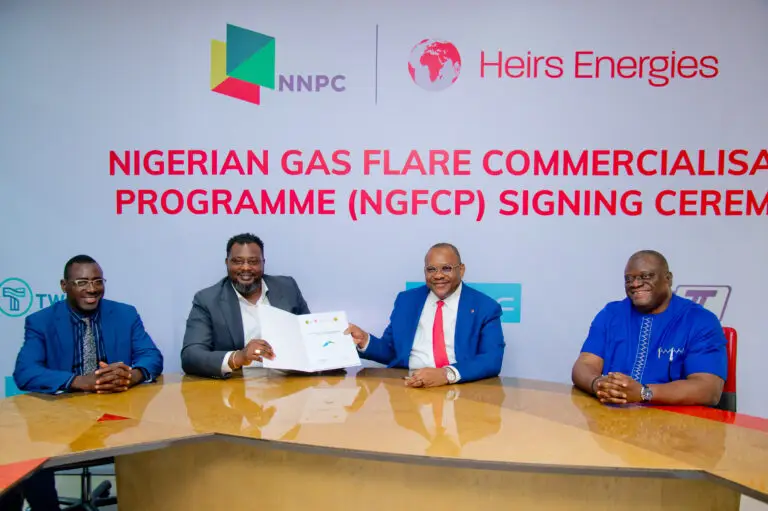
The Nigerian National Petroleum Corporation (NNPC) and Heirs Energies on Tuesday signed a Gas Flare Commercialization Agreements in a significant move to advance Nigeria’s gas commercialisation efforts.
The event, which was part of the Nigerian Gas Flare Commercialization Programme (NGFCP) and approved non-NGFCP frameworks, represents a crucial step towards Nigeria’s energy transition goals.
The signing ceremony, held at Heirs Energies headquarters in Lagos, symbolized the transition from regulatory approvals to tangible commercial execution.
Through this initiative, flare gas volumes from OML 17 will be captured and deployed for various productive uses such as power generation, industrial applications, and the production of LPG and CNG.
The agreement is expected to significantly reduce routine gas flaring and convert previously wasted resources into valuable energy for the Nigerian economy.
At the ceremony, Engr. Seyi Omotowa, Chief Upstream Investment Officer of NUIMS, representing NNPC Limited, emphasized that flare gas commercialisation was not merely a compliance measure, but a strategic pathway to enhancing energy availability, fostering gas-based industrialisation, and reinforcing Nigeria’s position as a responsible energy producer.
The Nigerian Upstream Petroleum Regulatory Commission (NUPRC), represented by Mr. Ojo Olalekan Ezekiel, Senior Manager at NUPRC, also reiterated the regulatory body’s commitment to supporting flare gas commercialisation initiatives.
Ezekiel acknowledged the partnership’s role in achieving national energy and emission reduction goals and noted that the collaboration with offtakers such as AUT Gas, Twems Energies, GPID, PCCD, and AGTC would be instrumental in advancing the project.
Heirs Energies’ CEO, Osa Igiehon, highlighted the company’s gas-led strategy, which focuses on creating long-term value for Nigeria.
“Gas sits at the heart of Nigeria’s development journey,” Igiehon said, highlighting the company’s efforts to strengthen domestic energy supply while ensuring responsible and sustainable operations.
Key highlights of the agreement:
- Increased gas deliverability: The successful completion of the flare gas commercialization agreements allows for the strategic deployment of flare gas for power generation, industrial applications, LPG, and CNG.
- Commitment to environmental stewardship: This initiative is in line with Nigeria’s energy transition objectives, which focus on reducing emissions while enhancing energy availability.
- Enhanced Partnerships: The agreement brings together NNPC, Heirs Energies, and various private sector offtakers to ensure that Nigeria’s gas resources are utilized responsibly and profitably.
- Strategic impact: The OML 17 project plays a pivotal role in advancing Nigeria’s gas-to-power initiatives, contributing to enhanced power generation across the country.
The signing ceremony reflects Nigeria’s continued commitment to improving its energy landscape and its ambition to become a leading hub for gas commercialization in Africa.
As the flare gas offtakers move into the next phase of the project, full-scale implementation is expected to begin soon, delivering economic, environmental, and social benefits for Nigeria.
Backstory
OML 17, operated by Heirs Energies, has long been a focal point for Nigeria’s gas development agenda.
Since Heirs Energies took over the joint venture in 2021, the company has made significant strides in revitalizing the asset.
Through a series of brownfield excellence interventions, Heirs Energies has turned OML 17 into a key source of both oil and gas production, with gas now being positioned as a core value stream.
The successful rigless recompletion of a key non-associated gas well in 2025 doubled the JV’s gas output, significantly improving Nigeria’s gas availability for domestic power generation and industrial use.
What you need to know
Heirs Energies Limited is a leading indigenous energy company focused on responsible oil and gas production, gas commercialization, and long-term value creation aligned with Nigeria’s development priorities.
As operator of the OML 17 Joint Venture, Heirs Energies has contributed significantly to Nigeria’s gas development strategy through brownfield excellence and strong host-community partnerships.
- In 2025, the company reached a gas production peak of 135 million standard cubic feet per day (MMscf/d) from OML 17, following the restoration of the Agbada-67 well and deployment of rigless through-tubing technology.
- This breakthrough with NNPC Limited now supplies 45 MMscf/d of gas to Nigeria’s national grid.
Heirs Energies plays a pivotal role in Nigeria’s energy security and industrial growth, with gas supply to the Eastern Domestic Gas Market more than doubling to 135 MMscf/d.
- Power generation from plants in the eastern region has surged, with TransAfam Power Plant output increasing from 50 MW to over 180 MW, and aggregate power generation rising from 100 MW to 325 MW, peaking at 455 MW.
The company is also committed to social impact, supporting host communities with healthcare, education, and skills development initiatives. These efforts align with Nigeria’s Decade of Gas initiative and long-term energy transition goals.
The successful execution of the NGFCP and Non-NGFCP flare gas commercialization agreements marks a key milestone in turning waste into opportunity.
By converting flare gas into energy, Heirs Energies supports emission reduction, strengthens energy security, and enhances industrial growth, reinforcing Nigeria’s position as a leading energy producer in Africa.
Follow us for Breaking News and Market Intelligence.




SOURCE PAGE


Islamic cleric Sheikh Ahmad Gumi has stated that Nigeria’s armed forces lack the capacity to eliminate bandit groups through military force, arguing that dialogue remains the only practical route to ending the worsening insecurity across the northwest and other affected regions.
In an exclusive interview with the BBC, Gumi asserted that modern militaries everywhere struggle against guerrilla-style fighters, and that Nigeria is facing the same challenge.
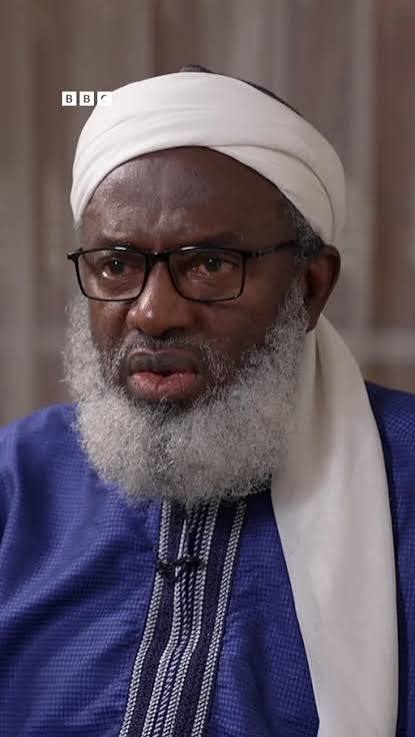 Sheikh Gumi
He said …
“But even the military says that in dealing with this civil unrest and criminality, only 25% is kinetic action; the rest depends on the government, politics, and local communities. The military cannot do everything.
“Where have you ever seen the military defeat guerrilla fighters? Nowhere.”
His comments come at a time when President Bola Tinubu’s administration is introducing sweeping security measures, including a shake-up in military leadership and a nationwide security emergency targeting the criminal networks behind widespread kidnappings, extortion, and violent rural attacks.
Addressing longstanding allegations that he maintains ties with bandit commanders, Gumi denied having any contact with them since 2021, the year the federal government officially designated the groups as terrorist organisations.
“I never went there alone
“It was in 2021 when I was trying to see how we could bring them together. But unfortunately, the government at the time, the federal government, was not interested. They declared them terrorists, and since that time we have completely disengaged from all contact with them,” he said.
Although he has faced criticism for allegedly emboldening armed groups and weakening governmental authority, Gumi maintains that engaging non-state actors in dialogue is a globally recognised conflict-resolution strategy.
“When they say we don’t negotiate with terrorists, I don’t know where they got that from,” Gumi said. “It is not in the Bible, it is not in the Quran. America had an office negotiating with the Taliban in Qatar. Everyone negotiates with outlaws if it will stop bloodshed.”
Gumi characterised the armed groups wreaking havoc across the northwest, and now spreading to other parts of the country, as predominantly Fulani herders who, in his view, are involved in what he described as an “existential war” driven by pressures and disruptions to their long-standing cattle-rearing way of life.
“They want to exist. That is their life. They know where to graze and how to care for their cattle,” he said, while emphasizing that the unrest has transformed from local farmer–herder tensions into widespread criminality.

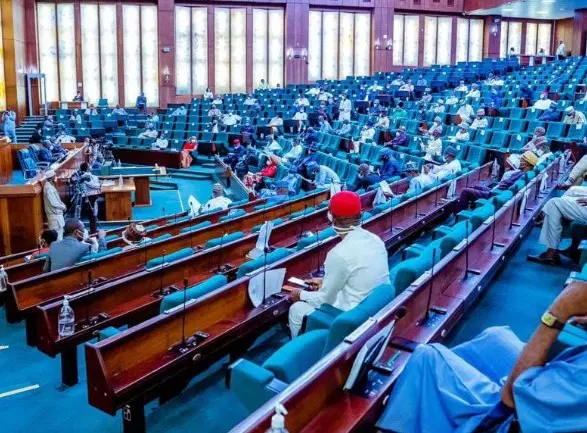
The House of Representatives on Tuesday accused commercial banks of perpetrating illegality by deducting inexplicable monies from customers without remittances.
The House Ad-hoc Committee Chairman, investigating the deduction of taxes from civil and public servants’ earnings and bank charges on customers’ accounts, Rep. Kelechi Nwogu, said this during an investigative panel in Abuja.
Nwogu reiterated the panel’s mandate to ensure that all deductions or charges by banks on accounts of customers must be deducted rightly, fined rightly and used rightly.
“Commercial banks are perpetrating illegality by deducting inexplicable charges from civil servants, public servants and other customers’ bank accounts without remittances,” he said.
The Ad-hoc Committee chairman, who affirmed their commitment to protecting Nigerians from illegal charges, said the House Committee had extended an invitation to the Ministry of Finance.
He also said that they would partner with the Office of the Accountant General of the Federation and the EFCC and commercial banks operating in Nigeria on the investigation.
The House Committee Chairman, who rejected representation of the CEOs of GT Bank, Zenith Bank, Access Bank and others, insisted that the CEOs must appear before the panel unfailingly.
He said, “You cannot appear here without an identity. We are not here on our own. We are here on the mandate of the people that elected us into parliament.
“We have resolved to meet next week Wednesday. You must submit all requested documents on or before Monday.
“We will go through all the documents, and we will put you on oath.”
The Committee, however, gave a four-day ultimatum for all the banks involved to submit all the required documents necessary for the probe.
According to the House Committee Chairman, they have given a deadline that any bank that fails to submit the requested documents on Monday will be sanctioned.
Nwogu said that the House panel was not leaving any stone unturned to unravel why the commercial banks engaged in spurious deduction of charges on their customers’ accounts. (NAN)
The post Reps accuse commercial banks of perpetrating illegal charges, deductions appeared first on Vanguard News.
NIGERIA NEWS
Tiv communities file N100b suit against Taraba govt, army over alleged forceful land seizure


Indigenous Tiv communities of Ikyaior and Jandeikyula in Wukari Local Council of Taraba have filed a N100 billion suit against the state government, Governor Agbu Kefas, Attorney-General of the state, Taraba State Geographic Information Service (TSGIS), and the Nigerian Army over the alleged forceful seizure and destruction of their ancestral lands and farmlands.
Represented by a legal team led by constitutional lawyer Professor Sebastine T. Hon (SAN), the communities claimed that soldiers and state authorities unlawfully took over an estimated eight-by-six-kilometre expanse of land without issuing any notice of acquisition, conducting an assessment, or paying compensation as required by law.
According to the suit, the disputed land includes ancestral homes, farmlands, and other property that have been passed down through generations of Tiv families.
The applicants argue that the government and the Army violated their constitutionally protected rights under Sections 43 and 44 of the 1999 Constitution, which guarantee the right to own immovable property and prohibit compulsory acquisition without due process.
The plaintiffs are seeking a court declaration that the respondents’ actions constitute a breach of their fundamental rights, alongside a perpetual injunction stopping further occupation or development of the land.
They are also demanding N50 billion in general damages and another N50 billion in exemplary damages for alleged trespass and rights violations.
When the case came up for hearing at the Federal High Court sitting in Jalingo, the presiding judge directed all respondents to appear and show cause why the reliefs sought should not be granted. Consequently, the court declined to grant the applicants’ exparte motion pending further proceedings.
The matter has been adjourned to January 19, 2026, after the court’s holiday recess.
Community members allege that shortly afterwards, soldiers occupying the land began excavating the area despite unharvested crops still standing. Women who approached the site to plead for a delay in the excavation were allegedly beaten and injured.
The case, at press time, had drawn renewed attention to long-standing conflicts over land ownership, military occupation, and the rights of indigenous communities in Taraba State.

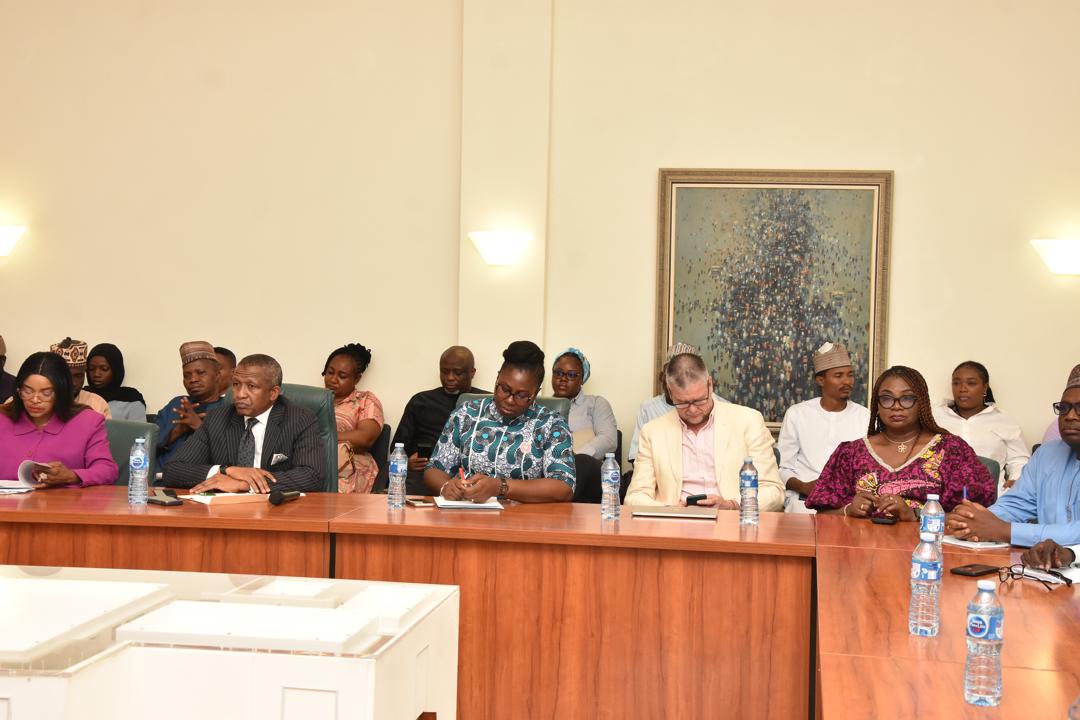
Executive Secretary of the Solid Minerals Development Fund (SMDF), Hajiya Fatima Umaru Shinkafi, has said Nigeria can only unlock its estimated $700 billion mineral wealth if it builds a strong and credible mining finance system.
Speaking at the launch of the Ore Reserve Development Forum (ORDF) in Abuja, Shinkafi, who was represented by Dr Martina Ananaba, head of minerals and project development, said the sector is gaining momentum under reforms by the Minister of Solid Minerals Development, Dr Dele Alake, with mining’s contribution to GDP rising from less than 1% to 4.6%.
But she warned that despite Nigeria’s vast resources, many mining operations remain unbankable due to poor geological data, weak reporting standards, and artisanal practices.
“The real challenge is not lack of capital. The challenge is a lack of bankable projects,” she said.
Shinkafi explained that ORDF was created after industry experts agreed in 2024 that Nigeria needs consistent ore reserve reporting, stronger technical capacity, and clear financing pathways to attract investors.
She said SMDF is already derisking early-stage projects, enforcing strict due diligence, and working with capital-market institutions to prepare credible mining companies for investment.
Highlighting recent progress, she noted that 867 mining licences issued in Q1 2025 generated ₦7 billion, signalling renewed investor confidence.
She urged stakeholders to use the workshop to design a practical Mining Finance Framework that will set standards, guide miners, and help financiers properly assess risks.
“If we build the right financing system, mining can become a true pillar of economic diversification,” Shinkafi concluded.
Chairman of the Geological Society of Nigeria, Uba Saidu Malami, said Nigeria’s mineral wealth will only translate into national wealth when the country scientifically qualifies its resources to global standards
He added that mining financing largely comes from capital markets, not banks, making internationally certified reports critical for junior mining companies.
Malami also highlighted links between natural resources and insecurity, stressing the need to mitigate risks while ensuring Nigeria assigns real value to its gold, diamonds, and transition minerals through reliable exploration and reserve reporting.
Also speaking, Mining investment expert and Mont Capital executive, Jon O’Callaghan, said Nigeria could build a mining industry bigger than oil and gas within 25 years, but only if the country attracts risk capital into exploration, not just mining.
O’Callaghan said Nigeria already has the right policies in place and the Federal Government has “done its job” by creating an enabling environment.
According to him, the missing link is investor willingness to fund exploration, which is the foundation of every successful mining industry.
“It’s not about government anymore. Without exploration, there is no mining. And without risk capital, there is no exploration,” he said.
“There’s a lot of money to be made in exploration, and investors need to understand that.”
He noted that the sector’s biggest financing challenge is building a system that allows investors to participate confidently.
“To address this, he revealed that stakeholders are now working with the Nigerian Exchange (NGX) and the Securities and Exchange Commission (SEC) to replicate global mining investment models”
He said the aim is to mirror the operational standards of the world’s top mining exchanges, the Australian Stock Exchange, Toronto Stock Exchange, and London’s AIM, to attract exploration funding into Nigeria.
“All we are doing is creating the same environment that works elsewhere in the world, to enable investors to invest,” O’Callaghan said.
He appreciated the organisers of the ORDF event and reaffirmed that with proper funding at the exploration stage, Nigeria’s mineral sector could surpass oil and gas within a generation.
The Technical Adviser to the Executive Secretary of the Solid Minerals Development Fund, SMDF, Mr Abdulmajeed Amussah, said the partnership between the Fund and the Ore Reserve Development Forum, ORDF, is designed to de-risk mining assets and move Nigeria’s mineral sector from informal operations to bankable, investment-ready projects.
He explained that although Nigeria is richly endowed with shallow deposits that artisans can easily mine, most of the assets are not developed to a level where they can attract formal financing.
Amussah noted that through its mandate, the SMDF is working to provide strategic funding and technical support that converts mineral potential into shared prosperity.
According to Amussah, a recent funding window for early-stage exploration revealed major capacity gaps, as fewer than ten applications met the required standards, despite the thousands of licenses held across the country.
ALSO READ TOP STORIES FROM NIGERIAN TRIBUNE


Vice President Kashim Shettima says President Bola Tinubu has remained steadfast in tackling security challenges across the country.
Mr Shettima stated this on Tuesday when participants of the Executive Intelligence Management Course (EIMC) 18 of the National Institute for Security Studies (NISS) visited him at the Presidential Villa, Abuja.
The participants, led by the NISS commandant, Joseph Odama and representatives of the 78 participants, were at the Presidential Villa to present the executive brief of their end-of-course report to the vice-president.
Mr Shettima, who received the report on behalf of Mr Tinubu, said the president is acting quickly and decisively to frontally address the concerns.
According to him, the Tinubu administration is determined to support the security establishment in Nigeria and beyond to discharge its responsibilities to the nation.
Regarding the programme’s significance, the vice-president said he was impressed by the composition of EIMC 18.
Shettima stated, “The security of Africa is a collective responsibility of all stakeholders, given the peculiarity of the situation.
”President Tinubu is working round the clock to address concerns in the security sector. It is absolutely essential that we fuse as one to address these issues and all hands must be on deck to salvage the situation.”
Earlier, Mr Odama told the vice-president that the 18th edition of the flagship programme, EMIC 18, commenced on February 19.
He pointed out that it had been a ten-month journey of intense intellectual discovery, strategic broadening and unparalleled professional fellowship.
He added that this year’s team comprised 78 distinguished participants, including deputy directors and above.
Mr Odama said they were meticulously drawn from the military, paramilitary, law enforcement agencies and strategic ministries, departments and agencies of both federal and state governments.
He added, ”In significant testament to our pan-African mandate, we were privileged to host five African countries, which had earlier been mentioned.
”With the graduation of the AIMC 18, the institute has proudly graduated 1,130 strategic leaders.
”These are men and women who have been rigorously equipped to think critically and act decisively, as well as proffer innovative solutions to the most complex security and developmental challenges facing our nation and the continent at large.”
The commandant expressed the institute’s deepest appreciation to Mr Tinubu and the vice-president for their visionary and pragmatic leadership.
He said that the Renewed Hope Agenda under the president’s stewardship was already manifesting in tangible progress across Africa.
Among the recommendations made by the participants was the formal harmonisation and integration of a country-based security initiative.
It is part of a broad strategy to strengthen the existing legal framework for peace and conflict resolution across Nigeria and Africa.
The high point of the occasion was the presentation of the report titled “Non-state Actors in Security Management in Africa: Issues, Challenges and Prospects for Peace and Development” by representatives of the EIMC 18 participants.
(NAN)
Related

An 18-year-old boy in Adamawa State has confessed to stealing soft drinks to mark his birthday.
The boy, Aminu Abdulazeez of Bazza community in Michika LGA, said he carted away half crates of nutri milk and Dudu mineral brand respectively to celebrate his birthday with his friends.
He landed in jail after he was trailed and apprehended while he was making further preparation for the event.
Aminu made his confession to the Adamawa State Jail Delivery Committee which was on a review visit to where he was being held at the Mubi Correctional Centre.
The Area Court I Bazza had sent him to the centre after finding him guilty and sentencing him to three months with option of a N40,000 fine.
He had gone to the centre last month after failing to pay the fine.
Reviewing his case, the Jail Delivery Committee, headed by the state Chief Judge, Justice Hafsat Abdulrahman, reduced his three months of confinement to three months of community service.
The committee ordered that he be taken back to Bazza to sweep public facility, a health centre or police station, for three months.


The Government of Adamawa State has taken action to support victims of the communal clash in the Lamurde Local Government Area by settling the medical bills of 11 persons currently receiving treatment at the specialist hospital for various degrees of injury.
Deputy Governor Professor Kaletapwa Farauta visited the hospital to identify with the victims and urged the warring factions to set aside their grievances, reminding them that development cannot take place without peace.
The Chief Medical Director of the Specialist Hospital, Dr. Dauda Wadinga, appreciated the state government’s prompt response to the situation.
Group Demands Probe Into Alleged Killing Of 12 Women
Meanwhile, a Bachama group, the Pene Da Bwatiye Development Association (PDBDA) Worldwide, has escalated the crisis by demanding a probe into the alleged killing of 12 women during a protest in the Rigangun and Waduku areas of Lamurde on July 24, 2025.
In a statement issued on Tuesday by its General Secretary, Mr. Emmanuel Pwakavi Bapatu, the association expressed grief and outrage over the incident.
The group alleged that the women, who were reportedly carrying leaves and singing peace songs, were shot by soldiers deployed to the community to maintain order. The protest was over the delayed arrival of military personnel to quell earlier violence.
The PDBDA described the incident as a “massacre,” stressing that the women were unarmed, posed no threat, and were not engaged in any violence.
The association condemned the alleged gross violation of human rights and rules of engagement and called for decisive action against the soldiers involved.
The incident is linked to earlier communal attacks that erupted on July 7 and July 17, 2025, highlighting the continued deterioration of the security situation in the area.
IGP Deploys Deputy Inspector-General to Restore Normalcy
In a separate move to address the escalating situation, the Inspector General of Police, Kayode Egbetokun, has deployed the Deputy Inspector-General of Police (DIG) in charge of Operations, DIG Bzigu Yakubu Kwazhi Dali, to the Lamurde Local Government Area.
DIG Dali appealed to the youths, who he described as the vanguard of either peace or violence, to actively and sincerely engage in dialogue and reconciliation efforts to address the root causes of the crisis.
He emphasized that the solution lies in the hands of the people, stating that security forces alone cannot resolve the situation.
The IGP called on community, religious, and traditional rulers, as well as youth drivers, to embrace peace, imploring the people of Lamurde to “eschew animosity and embrace understanding and partnership immediately.”
Deputy Governor Farauta thanked the IGP for the prompt deployment and reiterated the state government’s commitment to ensuring peace, unity, and the safety and security of its citizens.
© 2025 Naija News, a division of Polance Media Inc. Contact us via [email protected]


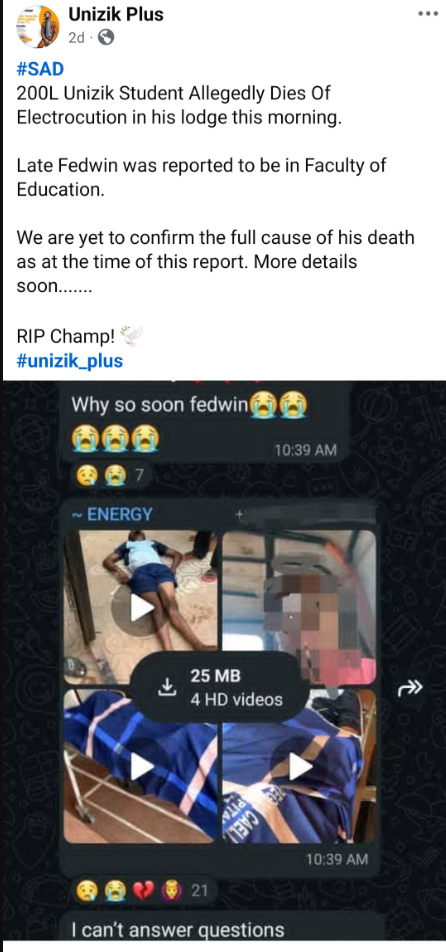
- A 200-level student of Nnamdi Azikiwe University (UNIZIK), known as Fedwin, has died after being electrocuted while ironing his clothes in his off-campus lodge.
- The incident occurred over the weekend, with distressing images and videos showing him lying motionless as roommates sought help.
- Despite being rushed to the hospital, fellow students later confirmed on Facebook that he did not survive the electrocution.

A student of Nnamdi Azikiwe University (UNIZIK), popularly known by his nickname Fedwin, has tragically passed away after being electrocuted while ironing his clothes.
The student was a 200-level undergraduate living in an off-campus lodge.
The incident occurred this past weekend when Fedwin was said to have fallen while ironing. A graphic video and photos circulated online showing him lying motionless on the floor with an iron on his chest, while his lodge mates desperately called for help.
Despite efforts to rush him to the hospital, updates posted later by fellow UNIZIK students on Facebook confirmed that Fedwin did not survive.
In other news….. A prominent cleric, Rev. Ezekiel Dachomo, has strongly instructed Christian youths in crisis-hit areas of Plateau State to arm themselves for self-defense. The order comes as a direct response to the December 2023 massacres where over 200 people were killed by armed attackers, suspected to be Fulani militias, across Bokkos and Barkin Ladi areas.
Rev. Dachomo, a regional chairman for the Church of Christ in Nations (COCIN) in Barkin Ladi, made the call in a video message on Sunday. He argued that since the government and security forces have repeatedly failed to protect the people, communities must now organize their own defense.
This advice follows an earlier warning from Dachomo two weeks ago that he had received information about planned attacks during the Christmas season.
In his urgent message, Rev. Dachomo issued a clear instruction to the youth:
“All youths, this is a command, not advice. I’m commanding you to wake up and defend the weak old people, women who are pregnant, defend the widows, and stand with their blood to defend the land.”
He added that because the government has consistently denied that a “Christian genocide” and “war of land occupation” are taking place, youths in rural communities must rise to protect their homes and lands.
The cleric emphasized that prayers are not enough. He encouraged people to take practical steps by organizing vigilante groups and providing 24-hour security for their areas.
“Yes, praying against attacks is good, but beyond that, there should be practical involvement in self-defense, even joining a local civilian-watch organization,” he added.
NIGERIA NEWS
Amnesty International decries alleged killing of nine women by military in Adamawa protest


Amnesty International has called for a transparent and impartial investigation into the killing of at least nine women protesters in Lamorde Local Government Area of Adamawa State, blaming the deaths on what it described as the military’s unlawful and excessive use of force.
In a statement posted on X on Tuesday, the rights group said the military opened fire on women who were demonstrating, using live ammunition without any warning.
“The Nigerian military’s response to a demonstration by firing live ammunition without warning is unlawful,” Amnesty said.
The organisation explained that several other women were injured after being hit by bullets in different parts of their bodies.
It described the incident as horrific and accused security forces of handling civilian protests in a dangerous and unacceptable manner.
Amnesty also criticised the government’s handling of the growing ethnic conflict between the Bachama and Chobo communities, which reportedly started from disputes over land and the theft of a motorcycle.
“The Nigerian authorities’ response to the communal violence between Bachama and Chobo tribes is totally inadequate, too slow and ineffective,” the statement said.
According to Amnesty, even in cases where security agencies responded to violence, their approach often resulted in more casualties and destruction instead of restoring peace.
“In cases where the Nigerian security agencies did respond to communal violence, as it happened in Lamorde LGA on Monday 8 December 2025, they use excessive or unlawful force resulting in even more deaths and destruction.
“The continuous failure to investigate such gross human rights violations is fueling a dangerous disdain for the sanctity of human life in Nigeria,” the group added.