
TECHNOLOGY
👨🏿🚀TechCabal Daily – Two for the Price of one


Image Source: TechCentral
After launching a smartphone brand, Salt, Mr Price’s next growth experiment is taking it to Europe.
Mr Price, the South African retail company, is buying NKD Group, a German clothing and homewares retailer, which will instantly give the South African company an additional 2,100 stores across seven European countries. Per Business Tech, Mr Price is paying R9.7 billion ($572 million) to acquire 100% of the company.
Between the lines: Mr Price is financing the deal by buying the whole holding company that owns NKD (Pegasus Group Holding), rather than just picking up a few assets, and is also taking over the shareholder loans sitting in the structure. In numbers, the deal adds up to R9.7 billion ($572 million) in enterprise value, split between €415 million ($484 million) for the shares themselves and about €38.5 million ($45 million) for those shareholder loans, all of which will be settled in cash.
The money will come from a mix of Mr Price’s own cash and new borrowing, and if all the regulatory boxes get ticked, both companies expect the transaction to close around Q2 2026.
Is this Mr Price’s first time? Before now, Mr Price has kept its retail operations local, operating mainly in South Africa, while keeping its presence lean across the rest of the continent. This home-first approach has previously led the retail giant to scale back its international expansion attempts and exit markets like Nigeria and Australia. It wanted to compete with Spar, Checkers Sixty60, and Shoprite, another retail giant scaling back its foreign operations.
However, with a planned European entry, Mr Price seems to have regained its confidence to lead foreign operations at that scale. NKD Group made around €850 million ($994 million) in sales (2024) and serves millions of customers in the value retail segment. It is a mid-sized company, but not as large as competitors like Pepco and KIK, and foreign players like H&M.
Yet the deal gives Mr Price an instant plug-and-play presence in Germany, Austria, Italy, Croatia, Slovenia, the Czech Republic, and Poland. It lifts its store count past 5,000 as it hunts for new growth verticals. Pepkor, another South African retailer, is chasing growth through finance. South African retailers are now split between staying home and spreading wide, or going abroad. Mr Price is betting it is finally ready to pull the next lever in European value retail.

A billionaire investor keen on buying TikTok’s US operations has told the BBC he has been left in limbo as the latest deadline for the app’s sale looms.
The US has repeatedly delayed the date by which the platform’s Chinese owner, Bytedance, must sell or be blocked for American users.
US President Donald Trump appears poised to extend the deadline for a fifth time on Tuesday.
“We’re just standing by and waiting to see what happens,” investor Frank McCourt told BBC News.
“But if the moment arrives, we’re prepared to move forward… we’ve raised the capital to buy it – we’ll see.”
The popular short-form video app was due to be banned or sold in the US in January in accordance with a law passed by Congress in 2024.
Lawmakers said at the time ByteDance’s links to the Chinese government threatened national security, and expressed fears Beijing could force the company to hand over data on US users.
It’s a concern TikTok and its owners have always said is unfounded.
The law was signed by President Joe Biden while he was still in office and was upheld by the Supreme Court in early 2025.
Trump and members of his administration have previously claimed a TikTok deal was done, and had the blessing of Chinese President Xi Jinping.
The president has also said “sophisticated” US investors would acquire the app, including two of his allies: Oracle chairman Larry Ellison and Dell Technologies’ Michael Dell.
Members of the Trump administration had indicated the deal would be formalised in a meeting between Trump and Xi in October – however it concluded without an agreement being reached.
Neither TikTok’s Chinese owner ByteDance nor Beijing have since announced approval of a sale, despite Trump’s claims.
This time there are no such claims a deal is imminent, leading most analysts to conclude another extension is inevitable.
Without naming Trump’s hand-selected investors, Mr McCourt told the BBC he was concerned “about a concentration of power and influence because platforms like TikTok are very influencing”.
He is part of a group of investors including Reddit co-founder Alexis Ohanian and Canadian investor Kevin O’Leary.
“My hope would be that whatever happens, that it is shut down or sold, and lands in the hands of people that comply with the law,” he said.
He said he wants to operate TikTok without any of its Chinese technology, including its powerful recommendation algorithm, and that his non-profit Project Liberty has developed other technology that could be used instead.

The robot swerved through the cafeteria of Rivian’s Palo Alto office, shelves adorned with chilled canned coffees — until it didn’t. Five minutes later, a man carefully pushed it out of everyone’s way, the words “I’m stuck” flashing yellow on the poor droid’s screen.
It was an inauspicious start to Rivian’s “Autonomy & AI Day,” a showcase for the company’s plans to make its vehicles capable of driving themselves. Rivian doesn’t make the cafeteria robot and isn’t responsible for its abilities, but there was a familiar message in its foibles: this stuff is hard.
Hours later, as I rode in a 2025 R1S SUV during my 15-minute demo of Rivian’s new self-described “Large Driving Model,” I was reminded of that message.
The EV equipped with the automated-driving software drove myself and two Rivian employees on a switchback route near the company’s campus. As we glided past Tesla’s engineering office, I noticed a Model S in front of us slow to turn into the rival company’s lot. The R1S eventually noticed this, too, braking hard just before the Rivian employee nearly intervened.
During my demo drive, there was one actual disengagement. The employee in the driver’s seat took over as we passed through a one-lane section of road due to some tree-trimming. Minor stuff overall. But it wasn’t exactly rare either; I spotted multiple other demo rides that had disengagements too.
The rest of the drive went well enough for software that is not ready to be shipped, especially when you consider that Rivian threw out its old rules-based driver assistance system and adopted an end-to-end approach — which is how Tesla developed Full Self-Driving (Supervised). It stopped at stoplights, it handled turns, it slowed for speed bumps, all without programmed rules telling it to do these things.
A quiet pivot in 2021
Image Credits:Rivian
Rivian’s old system “was all very deterministic, and it was all very structured,” CEO RJ Scaringe said in an interview Thursday. “Everything that the vehicle did was the result of a prescribed control strategy written by humans.”
Techcrunch event
San Francisco
|
October 13-15, 2026
Scaringe said that when Rivian saw transformer-based artificial intelligence taking off in 2021, he quietly “reconstituted the team and started with a clean sheet and said, let’s design our self-driving platform for an AI-centric world.”
After spending “a lot of time in the basement,” Rivian launched the new ground-up driving software in 2024 on its second-generation R1 vehicles, which use Nvidia’s Orin processors.
Scaringe said it was only recently that his company started to see dramatic progress “once the data started really pouring in.”
Rivian is betting it can train its Large Driving Model (LDM) on fleet data so quickly that it will allow the company to roll out what it calls “Universal Hands-Free” driving in early 2026. That means Rivian owners will be able to take their hands off the wheel on 3.5 million miles of roads in the U.S. and Canada (so long as there are visible painted lines). In the back half of 2026 Rivian will allow “point-to-point” driving, or the consumer version of the demo we received Thursday.
The ‘eyes off’ to ‘hands off’ challenge
By the end of 2026, after Rivian has started shipping its smaller, more affordable R2 SUVs, it will ditch the Nvidia chips and outfit those vehicles with a new custom autonomy computer unveiled Thursday. That computer, plus a lidar sensor, will eventually allow drivers to take their hands and eyes off the road. True autonomy — where a driver doesn’t have to worry about re-taking control of the vehicle — lies well beyond that and will largely depend on how fast Rivian can train its LDM.
This rollout introduces a near-term challenge for Rivian. The new autonomy computer and lidar won’t be ready until months after the R2 goes on sale. If customers want a vehicle that can handle eyes-off driving (or more), they’ll have to wait. But the R2 is a crucial product for Rivian, and the company needs it to sell well — especially in the wake of declining sales of its first-generation vehicles.
“When tech is moving as fast as it is, there’s always going to be some level of obsolescence, and so what we want to do here is to be really direct” about what’s coming, Scaringe said. The early R2s will still get Rivian’s promised “point-to-point” driving, which will be based on the new software and will be hands-off but not eyes-off.
“So [if] you’re buying an R2 and you buy it in the first nine months, it’s just going to be more constrained,” he said. “I think what will happen is some customers will say ‘that matters a lot to me, and I’m going to wait.’ And some will say ‘I want the newest, best things now, and I’m going to get the R2 now, and maybe I’ll trade it in a year or two, and I’ll get the next version later. Fortunately, there’s so much demand backlog for R2 that we think, by being upfront with this, customers can make the decision themselves.”
“In a perfect world, everything times at the same time, but the timeline of the vehicle and the timeline of the autonomy platform are just not perfectly aligned,” he said.
When I first interviewed Scaringe in 2018, before Rivian even showed what its vehicles looked like, he shared a goal that still rattles around my head. He wanted to make Rivian’s vehicles so capable of driving themselves that: “if you go for a hike, and you start at one point and you finish at another point, you have the vehicle meet you at the end of the trail.”
It was the kind of pie-in-the-sky promise about self-driving cars that was all the rage seven years ago, but it stuck with me at least because it was something that felt true to Rivian’s whole brand of aspirational adventure.
Scaringe told me Thursday he still thinks it’s possible for Rivian to enable a use case like that in the next few years. It certainly won’t happen until the company tests and builds its more-capable R2 vehicles, which is at least a year away in a best-case scenario.
“We could [do that]. It’s not been a huge focus,” he said. That could change as the company gets closer to level 4 autonomy, though, since by then the company will have its LDM trained on trickier roads without guiding features like lane lines.
“Then, it becomes a bit of a like, what’s the ODD [operational design domain]? Dirt roads, off road? Easy,” he said. Just don’t expect a Rivian driving itself up Hell’s Gate in Moab.
“We’re not putting any resources into rock crawling autonomously,” he said. “But in terms of getting to the trail head? For sure.”
Katy WatsonAustralia correspondent , Perth
 Getty Images

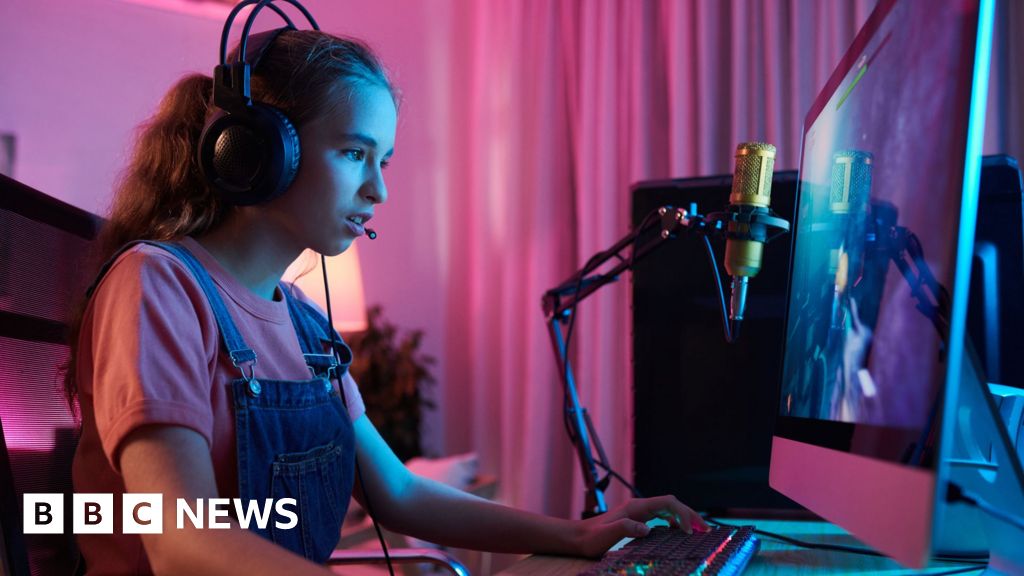
Critics say gaming platforms should be included in Australia’s ban on social media for under-16s
Wednesday afternoons have become a ritual for 15-year-old Sadmir Perviz. It’s a circuitous route from home in Perth to the Fiona Stanley Hospital – but it’s worth it, he says, to sit down for a game of Dungeons & Dragons with people he may not know but with whom he shares a great deal in common.
Sadmir and his board game companions are just some of the 300 patients at the gaming disorder clinic, Australia’s only publicly-run institution of its type, helping patients wean themselves off excessive online gaming habits.
The room where they meet is a simple space in a faceless hospital but in the corner, there’s a pile of boardgames on a chair. Jenga, Uno and Sushi Go are also popular choices at the informal group which is attended by both patients and clinicians.
It’s a bit of a departure for the 15-year-old who until a couple of months ago preferred to play games with friends online for 10 hours a day.
“It feels completely different,” says Sadmir. “You get to roll the dice instead of clicking a button. You can interact with people, so you actually know who’s there rather than just being on a call with random people.”
Dr Daniela Vecchio, the psychiatrist who set up the clinic, says that while gaming isn’t bad in itself, it can become a problem – an addiction even.
Gaming platforms and social media pose similar risks for children: excessive time spent online, and potential exposure to predators, harmful content or bullying.
So she wonders why gaming platforms have not been included in Australia’s “world-first” social media ban for under-16s.
The ban, which came into force on Wednesday, is supposed to prevent teens from having accounts on 10 social media platforms including Instagram, Snapchat and X. Children will still be able to access platforms like YouTube and TikTok, but without accounts.
For Vecchio, the omission of gaming platforms is odd.
“It doesn’t make much sense,” she says.
“Gaming and social media are so interconnected, it’s very difficult to separate.
“The individual who plays games for excessive amounts of time also spends excessive amounts of time on social media platforms where they can see other gamers or can live stream gaming, so it’s a way to connect.”
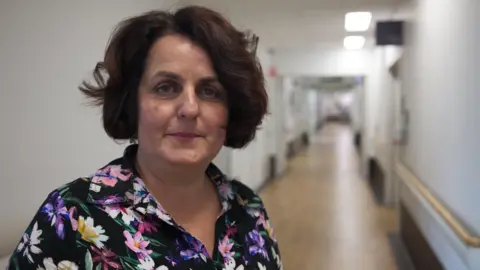
Dr Daniela Vecchio runs Australia’s only publicly funded clinic for gaming disorder clinic
Sadmir, for example, spent much of his time on the gaming platform Steam, as well as YouTube. Dr Vecchio singles out the platforms Discord and Roblox as particular worries – a concern echoed by many experts and parents the BBC has spoken to in covering the ban and its impact.
Both Roblox and Discord have been dogged by claims that some children are being exposed to explicit or harmful content through them and are facing lawsuits relating to child safety in the US.
Roblox introduced new age assurance features in Australia and two other countries weeks before the social media ban kicked in, with the checks due to be rolled out to the rest of the world in January. The checks will “help us provide positive, age-appropriate experiences for all users on Roblox”, the company said.
Discord also introduced age checks on some features earlier this year and on Wednesday said it was introducing a new “teen-by-default” setting for all Australian users.
The ‘wild west of internet usage’
Former gaming clinic patient Kevin Koo, 35, wonders whether a social media ban could have influenced the access he got at a younger age.
“I was growing up in the wild west of internet usage so, there weren’t any restrictions,” he says. “I got free rein on the internet basically. So I think that for me, the damage has already been done.”
A former quantum finance intern interested in AI, Mr Koo lost his job just before the pandemic. Living in Sydney, he had no family nearby and no regular work. He says he lost confidence and ended up consumed by online gaming, likening his experience to substance abuse.
Dr Vecchio agrees with the comparison – if she had her way, she’d be tempted not just to expand the social media ban to gaming but to raise the age to 18.
Gaming disorder is also now recognised by the World Health Organisation as an official diagnosis and, according to a 2022 Macquarie University study, around 2.8% of Australian children are affected by it. Vecchio thinks the number at risk is higher.
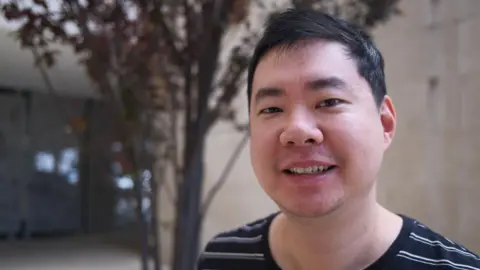
Kevin Koo, 35, wonders whether he might have benefited from a social media ban
The Australian government says its ban is about protecting kids from harmful content, cyberbullying, online grooming and “predatory algorithms” among other things – some or all of which could arguably be said to exist with gaming platforms.
The Australia Federal Police are among those who have warned chatrooms on these sites are hotbeds for radicalisation and child exploitation.
But, as the eSafety Commissioner said last month, the legislation enforcing the ban means platforms were not selected according to “safety, a harms or risk-based assessment”.
Instead, platforms have been selected according to three criteria: whether the platform’s sole or “significant purpose” is to enable online social interaction between two or more users; whether it allows users to interact with some or all other users; and whether it allows users to post.
Exceptions were made for gaming, for example, because its primary purpose is not social-media style interaction.
The law, say some experts, makes no sense.
“It’s incompetence, it’s reactionary,” says Marcus Carter, professor of human-computer interaction at the University of Sydney.
“Social interaction is not a bad thing… There are a bunch of probably legitimate concerns about these big tech platforms and what they are affording children and what they are exposing them to so as a result we’ve said we are banning social media.
“I just wish the government was trying to figure out how to help rather than put a band-aid on a bullet wound,” he says.
Watch: Australia’s social media ban explained… in 60 seconds
Tama Leaver, professor of internet studies at Curtin University and chief investigator at the ARC Centre of Excellence for the Digital Child, also says the ban on social media is too blunt a tool – instead a more nuanced approach is needed, including towards gaming platforms.
“There is such a wide spectrum of gaming from incredibly positive, nurturing, fun, creative, expressive spaces – something like Minecraft comes to mind where it’s had so many positive uses.” However, platforms like Roblox are at the other end of the spectrum, he says.
“Roblox isn’t a game. It’s a series of enabling tools for other people to make games. And we know that some of the games that have been made that clearly feel like they’re meant for adults have been accessed by very young people.”
On Professor Leaver’s desk at the university are three plushies with inbuilt ChatGPT inside them. On the box, it says they are suitable for three and above. This, he says, has also gone too far.
“I do think there needs to be age-appropriate regulation,” he says, referring to young people going online. “I do think we’re at a moment, and it’s not just Australia, you look across the EU, there is huge appetite for all sorts of regulation.”
A treatment plan, not a cure
In Mr Koo’s case, for example, his vice wasn’t just gaming. It was AI chatbots, another feature of online life that has come under scrutiny for everything from making things up to allegedly encouraging children to kill themselves.
There is evidence they are designed to manipulate users into prolonging interactions and their use has even given rise to a new phenomenon called AI psychosis, in which people increasingly rely on AI chatbots and then become convinced that something imaginary has become real.
Mr Koo also started googling his mental health issues and relying on AI to help confirm his diagnoses.
“You’re Googling stuff that you think you already know and then you kind of tick the box after that saying, oh, I’ve already done my work for today, my therapy work with ChatGPT,” he says. Mr Koo suffered a psychotic episode and after extensive therapy with a professional, he now takes a different approach.
“I might Google or ChatGPT something and then I’ll check it with my therapist in person,” he says. “I do think being able to read human emotions and having that face-to-face conversation with someone is completely different.”
The government has said it will continually review the list of banned platforms and at the end of November added Twitch, a streaming platform where people typically play video games while chatting to viewers.
Communications Minister Anika Wells also told the BBC last week that the eSafety Commissioner “definitely has her eye on Roblox”. And, she said, the social media ban “isn’t a cure, it’s a treatment plan” that will “always evolve”.
The demand for platforms to do better is growing. So too are the queues of families waiting to get help at the gaming disorder clinic, but Vecchio has to turn them away.
“[The legislation] is excluding platforms where children interact with many others and some of them can be people who harm them,” says Vecchio. “Children need to be protected, they need to be safeguarded.”


Following this week’s seizure of a sanctioned ship off the coast of Venezuela, the Trump administration says it will be targeting more oil tankers off the Venezuelan coast. This is, first and foremost, a dramatic escalation in the Trump administration’s campaign targeting Venezuela’s President Nicolás Maduro, whom the White House accuses of facilitating drug trafficking into the United States.
But it’s also the latest salvo in a campaign by Western governments to crack down on the so-called shadow fleet that has allowed countries like Venezuela, Russia, and Iran to continue participating in the global oil trade, despite international sanctions. In the past few days, there’s been yet another major escalation in this campaign, off the coast of Ukraine.
As Vox reported last year, the shadow fleet has been operating for years. Shadow fleet vessels tend to have opaque ownership; the nominal owner is often little more than a PO Box in the Seychelles or Dubai. The ships operate without standard insurance, are often older and less well-maintained than their above-board counterparts, and frequently manipulate their transponders and navigation system to avoid detection. They frequently change names and what country’s flag they sail under.
Case in point, the vessel seized by the US this week was sailing under the name Skipper and the flag of Guyana — but it had been sanctioned by the Biden administration in 2022 when it was known as the Adisa and flew the flag of Panama. As the Washington Post reported, the ship allegedly made several trips in and out of Iran last year along with stops in China and Syria, but it frequently turned off its data location transmission to prevent tracking. It had been operating off the coast of Venezuela since October, but had electronically masked its location, so it appeared to be off the coast of Guyana.
According to analysts quoted by Reuters, the Skipper was loaded with oil in Venezuela at the beginning of December and had transferred some of it to another tanker bound for Cuba shortly before it was seized. Cuba has been dependent for years on oil exports from its ideological ally Venezuela. While Cuba long relied on its own tankers for this trade, lack of maintenance has forced it to rely on the shadow fleet. Crumbling infrastructure and sanctions have taken a toll on Cuba’s energy system, and blackouts have become common. For the United States, increasing the pressure on Cuba’s economy could be seen as an added bonus of targeting the shadow fleet.
Globally, the issue has taken on a much greater prominence since Russia’s invasion of Ukraine in 2022, which triggered a range of international sanctions meant to deprive the Kremlin of energy revenue. As Atlantic Council senior fellow Elisabeth Braw told Vox, Venezuela and Iran were long the main players in the shadow fleet, but “Russia’s involvement was a sort of quantum leap that brought this economy out of the shadows.” By some estimates, shadow vessels now account for around 20 percent of the entire global oil fleet — essentially a parallel global energy market.
Officials and analysts have been concerned about the shadow fleet not only because it provides an economic lifeline to these regimes, but also because of the risk that one of these decrepit, poorly maintained ships could be involved in an environmentally devastating spill, and that there would be no insurance company or accountable owner to clean it up.
As Slate’s Fred Kaplan notes, while the Trump administration has portrayed the Skipper seizure as part of its pressure campaign against Venezuela, it’s the sort of action you could imagine being taken by any administration. (The ship was originally sanctioned by Biden, after all.) It’s also notable in that the seizure was carried out by a law enforcement agency — the Coast Guard — in accordance with a seizure warrant. That differs from the recent strikes on alleged drug boats that were carried out by the military with virtually no legal authorization.
The Caribbean is also not the only place where the shadow fleet has come under attack in recent days. In the past two weeks, Ukrainian forces have struck five shadow fleet tankers carrying Russian oil: three in the Black Sea near the Ukrainian coast, one near Turkey, and one off the west coast of Africa.
This marks a shift in strategy for the Ukrainians, who have avoided hitting Russian commercial ships in recent years. Russia and Ukraine have been operating under an effective truce in strikes on Black Sea shipping since the early days of the war. The new attacks are a high-risk strategy, since they could lead to Russia retaliating against Ukrainian ships. The shift may be a sign of increasing desperation for the Ukrainians, who have been steadily losing territory to Russia on land and are under pressure from the Trump administration to sign a ceasefire that would likely include significant concessions to Russia.
The shadow fleet strikes also show one of the contradictions of Trump’s approach to the war: Though he has been pressuring Ukraine to back down at the negotiating table, his administration has been far more permissive than Biden’s when it comes to Ukrainian attacks on Russia’s energy infrastructure. (There were fears under Biden that attacks like these could lead to a spike in oil prices.)
The timing of the US seizure in the Caribbean and the Ukrainian strikes in the Black Sea is almost certainly coincidental. This doesn’t appear to be a coordinated campaign. But both are reminders of the complex shadow economy that has sprung up in recent years in response to Washington’s increasing use of sanctions. And both may be a sign that much more aggressive measures are coming to crack down on that economy.
TECHNOLOGY
Ancient Egypt’s origin story rewritten after scientists reveal new timeline for its most powerful era


A new discovery has rewritten the timeline of Egypt’s early dynasties, placing the rise of the New Kingdom nearly a century later than previously thought.
The New Kingdom, which lasted from 1550 to 1070 BCE, was Egypt’s peak of power, wealth, and territorial expansion, the era of famous rulers like Tutankhamun.
It began with the 18th Dynasty, founded by Pharaoh Ahmose I, who reunited Egypt and expelled the Hyksos invaders, restoring central authority after a period of fragmentation.
Now, scientists have confirmed that the massive Santorini (Thera) volcanic eruption occurred before the reign of Ahmose, meaning the 18th Dynasty, and the New Kingdom itself, rose later than previously believed.
Until now, historians had often assumed the eruption might have coincided with the early New Kingdom, and some researchers even tried to link it to specific pharaohs, including Hatshepsut, Thutmose III or Ahmose I.
The breakthrough comes from radiocarbon dating of Egyptian artifacts from the 17th and early 18th Dynasties.
Researchers examined a mudbrick stamped with Ahmose’s name, a linen burial cloth, and wooden funerary figures called shabtis, all of which were directly tied to known pharaohs and their temples.
Because these objects are anchored to specific historical contexts, their ages provide a reliable snapshot of the period. The study shows that the eruption predates these artifacts, reshaping how historians understand the rise of Egypt’s most powerful period.

By reanalyzing ancient Egyptian artifacts, like a brick stamped with a pharaoh’s seal, scientists were able to change the timeline

Scientists have confirmed that the massive Santorini (Thera) volcanic eruption occurred before the reign of Ahmose, meaning the 18th Dynasty, and the New Kingdom itself, rose later than previously believed
The Santorini volcano, located about 75 miles north of Crete, is surrounded by the small islands of Thera, Therasia, and Aspronisi.
Over time, it has produced many large, explosive eruptions, but the most famous occurred during the Late Minoan IA period, around 1600 to 1480 BC.
This eruption buried the town of Akrotiri on southern Thera under thick layers of volcanic ash.
Fine ash was carried by winds and fell as far away as eastern Crete, demonstrating the eruption’s enormous regional impact.
Traditionally, the Thera eruption has been linked to Egypt’s 18th Dynasty, with scholars using it as a rough marker for dating early New Kingdom events.
However, the new radiocarbon analysis showed the eruption actually occurred earlier, during the Second Intermediate Period, a time before Egypt had fully reunited under Ahmose.
This means that previous assumptions tying the eruption directly to the early New Kingdom were incorrect.
‘This study provides the first direct radiocarbon comparison between the Thera eruption and Egyptian artifacts from this transitional period,’ said the researchers from Ben-Gurion University of the Negev and the University of Groningen.

Researchers examined a mudbrick stamped with Ahmose’s name, a linen burial cloth, and wooden funerary figures called shabtis (pictured), all of which were directly tied to known pharaohs and their temples
‘It allows us to anchor one of the most dramatic natural events in the eastern Mediterranean to Egypt’s own historical timeline for the first time.’
The findings carry broader implications for our understanding of the ancient world.
By showing that the eruption happened earlier than previously thought, historians and archaeologists can now reassess cultural and trade interactions between Egypt, Crete, and other Mediterranean regions.
This includes everything from the movement of goods and ideas to migrations prompted by natural disasters.
The research also demonstrated the power of modern science to reshape what we know about ancient history.
Even civilizations studied for thousands of years, like Ancient Egypt, can have their timelines refined through new techniques and careful analysis.
The results support the ‘low chronology’ model, which positions the start of the 18th Dynasty a bit later than previously thought.

Photograph published in 1916, showing four 12th Dynasty shabtis and one shabti attributed by him to the 17th Dynasty

Pictured is the Khufu Pyramid, also known as the Great Pyramid, in Giza Pyramid Complex.
As lead author Hendrik J Bruins put it, “Our findings indicate that the Second Intermediate Period lasted considerably longer than traditional assessments, and the New Kingdom started later.”
Although the adjustment is modest in years, it carries major historical significance.
Ahmose’s reunification of Egypt marks a critical turning point, and moving its date reshapes how scholars understand the political and cultural transformation that ushered in Egypt’s New Kingdom.
TECHNOLOGY
With iOS 26.2, Apple lets you roll back Liquid Glass again — this time on the Lock Screen


Apple is releasing another tool to dial down Liquid Glass’s transparency with its release of iOS 26.2, out now. With the update, users will be able to control the transparency of the Lock Screen’s clock. The release follows an update that introduced a slider for controlling the opacity of Liquid Glass elements through the operating system, following user complaints that the changes made their iPhone or other Apple device too hard to read.
Launched with iOS 26, the new design language for Apple devices turns various interface elements like buttons, sliders, and notifications semi-transparent. The elements also refract light, giving them the optical qualities of glass.
Meant to modernize Apple’s operating systems and potentially prepare for a world where the operating system moves to AI smartglasses, Liquid Glass received mixed reviews. Some found that the transparency made their device difficult to use, as it became tricky to read key items, like notifications or the name of an artist in Apple Music. In response to user complaints, Apple released a Liquid Glass tool in iOS 26.1 that allowed users to return their interface to a more “frosted” look, if desired.
With the slider for the Clock’s “glassiness,” Apple is again rolling back the transparency of the Liquid Glass update, but in the form of another user-controlled customization feature, instead of a global change.
Image Credits:iPhone screenshot by TechCrunch
These tweaks are notable as they telegraph that perhaps Apple isn’t standing 100% behind the design overhaul as being perfect as is.
The timing of the change is worth noting, too. Earlier this month, Apple confirmed the design executive behind the Liquid Glass makeover, Alan Dye, was leaving the company for Meta. While it didn’t appear that Dye was pushed out, Apple replaced him with longtime Apple designer Stephen Lemay.
Unlike Dye, Lemay’s career was spent in interface and interaction design — a skill set called for when it comes to fixing Liquid Glass, it can be argued.
iOS 26.2 brought other new features beyond the latest Liquid Glass tweak.
As in the betas, users can now create AirDrop codes to share with people not in their contacts, allowing them to become a “known” AirDrop contact for a 30-day period. The feature might make sense at work or in other scenarios where you need to share files or photos with someone not stored in your Contacts.
Also in iOS 26.2, the Reminders supports alarms; Apple News gains a Following tab at the bottom nav bar along with other navigation changes; Apple Music adds offline lyrics; and the Podcasts app adds AI-generated chapters for podcast episodes, a Podcast Mention feature for linking to other shows, and other changes.
Apple Watch owners will also now get a Sleep Score based on how well they slept and if they met their sleep goals.
Apple also released several important security updates across its flagship products on Friday, including iPhones, iPads, Macs, Apple TVs, and Apple Watches, to patch vulnerabilities used in an active hacking campaign.

Amazon has pulled a video recap made with artificial intelligence (AI) from its hit TV show Fallout after users said it got several facts wrong about the series.
The firm said in November it was testing the “first-of-its-kind” tool in the US to help viewers catch up on some of its shows on streaming service Prime Video – including Fallout, its adaptation of the popular video game franchise.
But it has since disappeared from the site after users highlighted mistakes in its video summarising the events of Fallout season one – including claiming one scene was set more than 100 years earlier than it was.
The BBC has approached Amazon for comment.
The move to apparently press pause on its AI-powered recaps was first reported by tech publication The Verge.
Amazon said in November the recaps would be available to users as an experimental feature, and only “for select English-language Prime Original series in the US”.
“Video Recaps use AI to summarise a show’s most pertinent plot points with a theatrical-quality video that includes narration, dialogue, and music,” it said.
But fans eagerly awaiting the release of the next series of Fallout on 17 December highlighted errors introduced in its video recap for its first series.
Users on Reddit said a clip showing The Ghoul – one of the show’s central characters, played by actor Walton Goggins – was wrongly described in the AI narration as a “1950s flashback”.
Despite the clip’s retro aesthetic, it actually depicts a scene in 2077 – something fans of the series would know instantly.
Fans also said the recap incorrectly summarised a scene between The Ghoul and protagonist Lucy MacLean, played by Ella Purnell, altering their dynamic in a way that would confuse new viewers.
It joins a long list of errors have being introduced when using generative AI tools to produce content summaries.
In early 2025, Apple suspended an AI feature summarising notifications after it drew complaints for repeated mistakes in its summaries of news headlines.
The BBC was among the groups to complain about the feature, after an alert generated by Apple’s AI falsely told some readers Luigi Mangione, who has been charged in the US with killing UnitedHealthcare chief executive Brian Thompson, had shot himself.
Google’s AI Overviews, which aim to provide concise summaries of search results, have also come under criticism and mockery for errors.

Russia’s mysterious ‘Doomsday Radio’ station has sent out another series of ominous messages, sparking fears that the nation is preparing for a secret operation.
The radio channel, known as UVB-76, broadcasted multiple transmissions in code this week, sending three signals on Monday followed by eight more on Wednesday.
Each of the cryptic messages featured a set of numbers and letters, including the code words PEPPER SHAKER, TRANSFER, PABODOLL, SPINOBAZ, FRIGORIA, OPALNY, SNOPOVY, and MYUONOSVOD.
Over the last week, as many as 15 secret messages have been heard by listeners. However, their meaning and intended recipient have remained a mystery.
On Friday, the station appeared to be broadcasting the faint sound of music and prolonged bursts of Morse code.
The Russian shortwave station, nicknamed ‘The Buzzer’ or ‘Doomsday Radio,’ has been running since the 1970s, mostly playing a constant, eerie buzzing sound like a faulty appliance.
However, experts have suggested that UVB-76 is connected to Russia’s strategic military command, possibly for sending secret orders to the nation’s armed forces or agents operating abroad.
Typically, these mysterious codes increase in their frequency during global crises, such as the war in Ukraine.
This is a breaking story. More details to follow.

A Russian ‘Doomsday’ radio station is still operational, emitting its trademark buzzing noises, but it occasionally sends out bizarre messages that no one seems to understand

The Cold War-era shortwave station UVB-76 has been broadcasting a continuous buzzing sound since the 1970s. Pictured is data collected from the broadcast
Wednesday’s massive burst of coded signals began at 1.07am ET and finished around 4.26am, according to Russian online news outlet news.ru.
Share or comment on this article:
Russia’s ‘Doomsday Radio’ blasts 15 cryptic messages at once sparking global mystery

At least 5.6 million people had their names, addresses, dates of birth, and Social Security numbers stolen in a data breach at 700Credit, a company that runs credit checks and identity verification services for auto dealerships across the United States.
In a statement on its website, the Michigan-based company blamed the October data breach on an unidentified bad actor.
According to Michigan’s attorney general, the hacker stole personal data collected from dealers between May and October 2025.
The company said it was now sending letters by mail to individuals whose information had been stolen in the data breach, which offers credit monitoring services.
“If you get a letter from 700Credit, don’t ignore it,” said Michigan attorney general Dana Nessel. “It is important that anyone affected by this data breach takes steps as soon as possible to protect their information. A credit freeze or monitoring services can go a long way in preventing fraud, and I encourage Michiganders to use the tools available to keep their identity safe.”


Anambra State reached a new milestone in its digital transformation by winning four awards at the 13th Meeting of the National Council on Communications, Innovation and Digital Economy in Jos, Plateau State. The event, held from December 8 to 12 at the Crispan Suite and Event Centre, brought together leaders from federal and state governments to review Nigeria’s progress in developing a modern digital economy.
The awards followed the States’ Innovation Peer Review Session, where each state shared the main digital reforms and technology projects they carried out in the past year. Anambra was recognised for its achievements, winning in ICT Development and ICT Human Capital Development, and earning second place in Infrastructure Development and eGovernment Implementation.
The state delegation was led by the Managing Director of the Anambra State ICT Agency, Chukwuemeka Fred Agbata (CFA), who received the technology and innovation awards on behalf of Governor Chukwuma Charles Soludo. “This recognition is another clear validation of Governor Soludo’s vision,” he said. “It reflects the hard work, collaboration, and commitment of the entire Solution Team.”
 Governor Charles Chukwuma Soludo of Anambra State
A growing digital state
The recognitions show how Anambra has steadily grown its use of digital technology, especially by improving internet access, making public services work automatically, and teaching digital skills across the state. State officials say these changes fit with Governor Soludo’s goal to build a connected and efficient system under his “Everything Technology, Technology Everywhere” plan.
For the administration, the council’s assessment gives national recognition to the changes made over the past three years, from growing technical skills to updating how the government works.
Also read: “Soludo is Building a Data-Driven Government”, Anambra ICT Agency MD says
This year’s result mirrors a similar sweep in 2023, marking the second time the state has walked away with four top categories at the NCCIDE meeting.
What it means for Anambra and other states
The result in Jos could draw more attention to how states use digital tools to improve public services. Since the peer-review model encourages comparison and learning, it may also spark healthy competition. For Anambra, these awards might speed up efforts to expand eGovernment, upgrade infrastructure, and boost digital literacy.
The recognition highlights the importance of states using technology in governance, as digital systems are key to delivering services. Officials say the council’s feedback will improve current projects and guide new ones for 2026.
Residents can expect easier access to government services, improved digital tools, and a more tech-focused public sector. As states go digital, these awards show that people want better systems, skilled workers, and faster, more reliable services across the country.