
TECHNOLOGY
The market has ‘switched’ and founders have the power now, VCs say


The way venture capitalists think about fund-raising can be a black box. But investors must think about their go-to-market strategy for raising their own funds, just as much as they think about how their portfolio companies find their market fit.
All season on Build Mode, we’ve explored how founders should approach marketing, but this week we’re exploring how VCs sell themselves to founders as trustworthy partners, and to LPs as worthwhile investments.
Isabelle Johannessen spoke with Graham & Walker’s Leslie Feinzaig and XYZ Venture’s Ross Fubini about raising their first funds and how that experience has given them empathy for the founder fundraising experience.
Feinzaig came into venture capital with very few industry connections.”It was hundreds of pitches. It was raised almost entirely from individuals. We ended up with 105 LPs,” she said. “If you don’t have a track record, then what they’re investing in is in you. Like it is basically, like, raising a gigantic angel round with no lead.”
With that outsider perspective she’s been able to position herself as the call founders make before they meet with their board to practice and discuss strategy.
Similarly, Fubini encourages the leadership teams he works with to carefully consider who they are entering into partnership with. His rubric follows three core tenets: person, firm, terms.
“You work with this person for forever. So it’s everything from like, are they fun? Do you trust them? Do they have the juice to get the deal done? It’s everything around this human,” he said.
Techcrunch event
San Francisco
|
October 13-15, 2026
Both VCs noted the change from the most recent 2022-23 bear market — where VCs held all the cards — to the current eager dealmaking atmosphere where founders have a bit more power. This makes choosing the right VCs that much more important, they say.
Fubini called this shift “thrilling” because, even though both sides still need to do their diligence and ensure they are good fit together, “you can move so quickly” compared to cautious bear markets. “I think that’s fun and joyful,” he said.
Both Feinzaig and Fubini are full of tactical advice for both VCs seeking creative ways to capture founder attention and founders seeking smartest choices for their cap tables.
The pitch deck and cold emails may not have the power they once did but creating authentic relationships and proving on execution remains the best strategies to attract the kind of people you want to work with — from both perspectives.
New episodes of Build Mode drop every Thursday subscribe to the podcast or watch on YouTube. Isabelle Johannessen is our host. Build Mode is produced and edited by Maggie Nye. Audience Development is led by Morgan Little. And a special thanks to the Foundry and Cheddar video teams.










The fintech founder had practised the pitch fifty times. Three minutes to explain why her lending platform was different. Why would it work where others failed? Why investors should care.
She delivered it perfectly at the demo day in November. The applause was polite. The questions were pointed. “How is this different from the forty other lending fintech companies?” She stumbled. Because it wasn’t, not really. Just another app promising financial inclusion without proving it could deliver.
She was competing with 499 other Nigerian fintech companies for attention from investors who had grown tired of similar promises. Only 27 would break through.
Nigerian fintech raised $230 million in 2025. On paper, that’s a 44% drop from the $410 million raised in 2024. But the real story isn’t about the money that disappeared. It’s about the question that emerged in its place.
“Smart capital is now asking whether fintechs are solving real problems that expand the economy or simply extracting rent from existing fragility,” says Kristin H. Wilson, Managing Partner at Innovate Africa Fund. It’s a brutal assessment, but one that explains why only 27 out of over 500 Nigerian fintech companies managed to raise funding of $100,000 or more this year.
The math is stark. In a country where more than 40% of tech startups are now fintech entities, only 5% could convince investors that their vision was worth backing.
Something fundamental shifted in 2025, and it wasn’t just the numbers.
When the music stopped
The party really ended when the mega deals dried up. In 2024, players like Moniepoint and Moove raised massive rounds that artificially inflated the sector’s total funding. Those outsized cheques masked an uncomfortable truth.
Very little capital was actually reaching new or experimental models that might genuinely expand economic opportunity for everyday Nigerians.
Read also: PayPal accepts defeat: now the fintech giant finally wants to play in Africa
By 2025, reality surfaced. Moniepoint raised another $90 million in October, nearly 40% of the entire year’s fintech funding. LemFi secured $53 million in January. Kredete closed $22 million. Raenest got $11 million.
Then came the smaller rounds like Carrot Credit’s $4.2 million, PaidHR’s $1.8 million, and Accrue’s $1.58 million. These deals represented the survivors. Everyone else got nothing.
Austin Okpagu, Nigeria Country Director at Verto, sees this as a correction rather than a collapse.
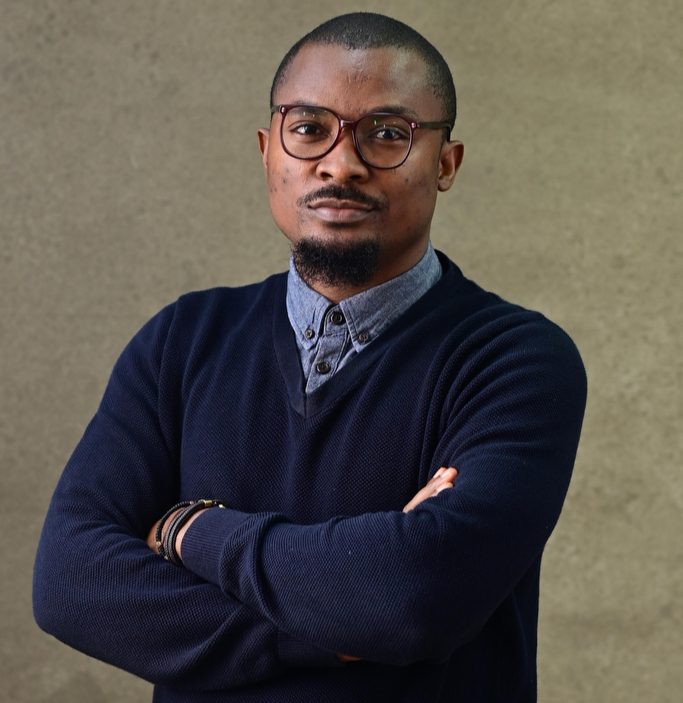 Austin Okpagu, Country Manager at Verto
“I believe the 2025 funding dip is much more about market correction rather than a definitive decline for Nigerian fintech,” he explains. “While 2024’s funding was heavily concentrated in mega deals like Moniepoint’s $110 million Series C, the current environment is forcing over 430 active fintech companies to pivot from burning cash, which used to be the norm, to generating revenue, back to basics, which is the core focus for investors nowadays.”
Read also: These 5 Nigerian fintechs achieved significant milestones in 2025
The shift from vanity metrics to profitability wasn’t optional. It was survival.
Multiple forces squeezed the sector simultaneously. The Central Bank of Nigeria imposed onboarding bans, stricter KYC enforcement, and heavy monetary penalties. Inflation hit 34.8% by December 2024.
Foreign exchange volatility made returns nearly impossible to model in naira, and capital harder to repatriate. Generalist venture capitalists either paused or significantly narrowed their exposure to Nigerian risk.
“We saw stricter CBN and FCCPC regulations serving as a filter, favouring institutional-grade startups over the high volume of smaller, non-compliant entrants,” Okpagu notes. “This appears to be the hallmark of 2025. Fewer African companies were accepted into Y Combinator when compared to previous years.”
The regulatory squeeze worked exactly as designed. It separated companies with real infrastructure from those running on borrowed time and borrowed capital. But it also raised an existential question about what Nigerian fintech had actually built.
The question nobody wanted to ask
Wilson goes further than most are willing to.
Nigerian fintech funding in 2025 likely contracted because capital finally began pricing in concentration risk, regulatory uncertainty, and a fundamental question: Are we building solutions that expand opportunity, or simply repackaging the same digital wallets?
She’s pointing at something uncomfortable. Nigeria now hosts more than 500 fintech companies, yet most are building variations of the same products. Digital wallets. Payment apps. Lending platforms that target the same thin slice of bankable consumers.

Meanwhile, productive credit for manufacturers remains scarce. Cash flow solutions for agricultural value chains are underfunded. Infrastructure that genuinely reduces the cost of doing business often goes unnoticed.
“The critical question has shifted from ‘Can we digitise existing behaviour?’ to ‘Are we creating new economic capacity?’” Wilson argues. “There were more apps, but not demonstrably more genuine financial resilience for households, productive capacity for SMEs, or expansion of economic opportunity.”
It’s harsh, but the funding numbers suggest investors agree.
Read also: New game: How CBN’s policies reshaped the Nigerian fintech landscape in 2025
Nikolai Barnwell, founder and CEO of pawaPay, has seen this movie before. “We’ve seen several bubbles and busts over the years since the birth of the mobile internet in Africa in the early 2010s. People get excited about Africa, but their attention span is short. So when there’s no immediate gratification for investors, they disappear again.”
 Nikolai Barnwell, founder and CEO of pawaPay
He’s describing a pattern that repeats every few years. A new batch of funds discovers Africa, sells the dream, raises money on the promise of the continent, and starts spraying capital everywhere. Then reality sets in. Returns take longer than expected. The next cohort of investors arrives with fresh enthusiasm and short memories.
“The key is that the future potential of the continent is immense, but we’re still in the very early days,” Barnwell says. “We often compare it to the internet in the US in the mid-1990s. Most of all, the upside is still far in the future, and it requires patience and stamina to hang on long enough to reap the benefits.”
This tells us that African fintech is still being written, not finished.
What comes next
Tomi Davies, CiC at TVCLabs, refuses to see 2025 as a failure.
What we’re seeing in 2025 is not an innovation vacuum. It’s a discipline phase. The concentration of capital in players like Moniepoint reflects maturity, not stagnation. Markets that are still forming reward experimentation. Markets that are growing up reward execution.
He believes 2026 will bring what he calls “recomposition” rather than simple consolidation. “Yes, M&A will increase, particularly mid-market acquisitions that won’t make global headlines but will matter locally. At the same time, we’ll see more layered capital stacks. Local angels, diaspora syndicates, DFIs, venture debt, and revenue-based instruments working together.”
 Tomi Davies, CiC at TVCLabs
The ecosystem that emerges, Davies argues, won’t depend on single large cheques from foreign VCs. It will blend multiple funding sources and require startups to prove value at every stage. “The ecosystems that thrive will be the ones that learn how to finance growth with multiple tools, not just one cheque size.”
Okpagu agrees the market is evolving, not dying. “The fintech sector is currently being sustained by M&A-led consolidation, as seen with Paystack’s acquisition of Brass, which allows the ecosystem to recycle talent and assets into more efficient models.“
Read also: Nigeria’s fintech regulation: Why the Senate is rewriting rules just 5 years after BOFIA 2020
The real test for Nigeria’s fintech
Nigerian fintech’s $230 million story in 2025 isn’t really about the funding gap. It’s about an industry being forced to answer harder questions about genuine value creation. The 27 companies that raised money this year presumably have answers. The other 473 are still searching.
Wilson’s question hangs in the air. Are Nigerian fintech entities expanding economic opportunity or extracting rent from existing fragility? The companies that figure out the right answer won’t just survive 2026. They’ll define what African fintech becomes for the next decade.
The future potential remains immense, as Barnwell insists. But patience and stamina aren’t enough anymore. Investors want proof that digital wallets can become economic engines. That’s the real test Nigerian fintech faces now. Not whether it can raise money, but whether it deserves to.

span { width: 5px; height: 5px; background-color: #5b5b5b; }#mailpoet_form_2{border-radius: 8px;color: #313131;text-align: left;}#mailpoet_form_2 form.mailpoet_form {padding: 0px;}#mailpoet_form_2{width: 100%;}#mailpoet_form_2 .mailpoet_message {margin: 0; padding: 0 20px;}
#mailpoet_form_2 .mailpoet_validate_success {color: #000000}
#mailpoet_form_2 input.parsley-success {color: #000000}
#mailpoet_form_2 select.parsley-success {color: #000000}
#mailpoet_form_2 textarea.parsley-success {color: #000000}
#mailpoet_form_2 .mailpoet_validate_error {color: #cf2e2e}
#mailpoet_form_2 input.parsley-error {color: #cf2e2e}
#mailpoet_form_2 select.parsley-error {color: #cf2e2e}
#mailpoet_form_2 textarea.textarea.parsley-error {color: #cf2e2e}
#mailpoet_form_2 .parsley-errors-list {color: #cf2e2e}
#mailpoet_form_2 .parsley-required {color: #cf2e2e}
#mailpoet_form_2 .parsley-custom-error-message {color: #cf2e2e}
#mailpoet_form_2 .mailpoet_paragraph.last {margin-bottom: 0} @media (max-width: 500px) {#mailpoet_form_2 {background-image: none;}} @media (min-width: 500px) {#mailpoet_form_2 .last .mailpoet_paragraph:last-child {margin-bottom: 0}} @media (max-width: 500px) {#mailpoet_form_2 .mailpoet_form_column:last-child .mailpoet_paragraph:last-child {margin-bottom: 0}}
]]>
TECHNOLOGY
Fears grow of AI bubble – and here are the pressure points that could burst it | Science, Climate & Tech News


The market seems to be content, for now at least, to keep betting big on AI.
While the value of some companies integral to the AI boom like Nvidia, Oracle and Coreweave have seen their value fall since the highs of the mid-2025, the US stockmarket remains dominated by investment in AI.
Of the S&P500 index of leading companies 75% of returns are thanks to 41 AI stocks. The “magnificent seven” of big tech companies, Nvidia, Microsoft, Amazon, Google, Meta, Apple and Tesla, account for 37% of the S&P’s performance.
Such dominance, based almost exclusively on building one kind of AI – Large Language Models is sustaining fears of an AI bubble.
Nonsense, according to the AI titans.
“We are long, long away from that,” Jensen Huang, CEO of AI chip-maker Nvidia and the world’s first $5trn company, told Sky News last month.
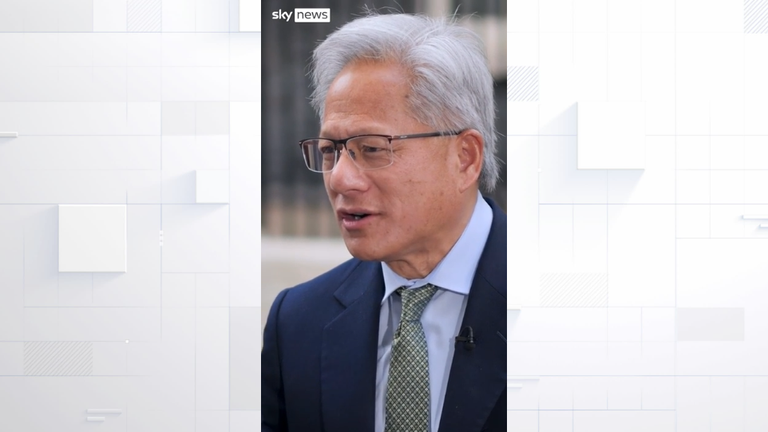
Huang speaking to Sky News last month
Not everyone shares that confidence.
More on Artificial Intelligence
Too much confidence in one way of making AI, which so far hasn’t delivered profits anywhere close to the level of spending, must be testing the nerve of investors wondering where their returns will be.
The consequences of the bubble bursting, could be dire.
“If a few venture capitalists get wiped out, nobody’s gonna be really that sad,” said Gary Marcus, AI scientist and emeritus professor at New York University.
But with a large part of US economic growth this year down to investment in AI, the “blast radius”, could be much greater, said Marcus.
“In the worst case, what happens is the whole economy falls apart, basically. Banks aren’t liquid, we have bailouts, and taxpayers have to pay for it.”
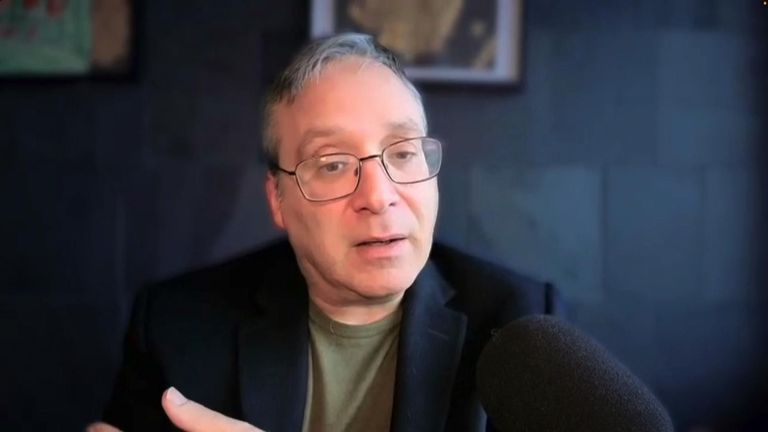
Gary Marcus
Could that happen?
Well there are some ominous signs.
By one estimate Microsoft, Amazon, Google Meta and Oracle are expected to spend around $1trn on AI by 2026.
Open AI, maker of the first breakthrough Large Language Model ChatGPT, is committing to spend $1.4trn over the coming three years.
But what are investors in those companies getting in return for their investment? So far, not very much.
Take OpenAI, it’s expected to make little more than $20bn in profit in 2025. A lot of money, but nothing like enough to sustain spending of $1.4trn.
The size of the AI boom – or bubble depending on your view – comes down to the way it’s being built.
Computer cities
The AI revolution came in early 2023 when OpenAI released ChatGPT4.
The AI represented a mind-blowing improvement in natural language, computer coding and image generation ability that grew almost entirely out of one advance: Scale
GPT-4 required 3,000 to 10,000 times more computer power – or compute – than its predecessor GPT-2.
To make it smarter, it was trained on far more data. GPT-2 was trained on 1.5 billion “parameters” compared perhaps 1.8 trillion for GPT-4 – essentially all the text, image and video data on the internet.
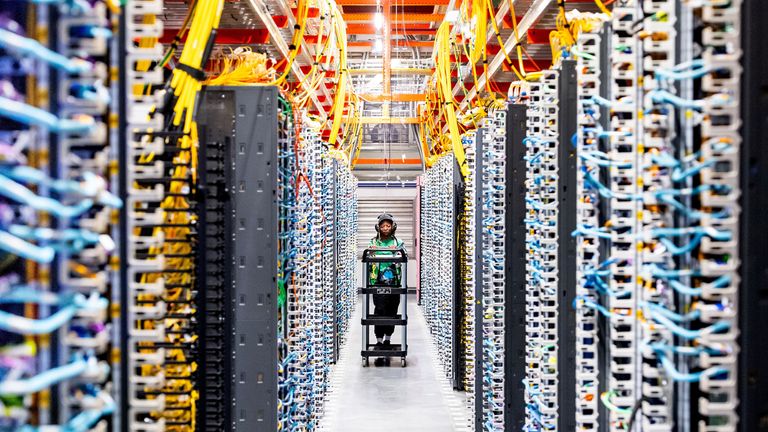
An Amazon Web Services AI data centre in the US. Credit: Noah Berger/AWS
The leap in performance was so great, “Artificial General Intelligence” or AGI that rivals humans on most tasks, would come from simply repeating that trick.
And that’s what’s been happening. Demand for frontline GPU chips to train AI soared – and hence the share price of Nvidia which makes them doing the same.
The bulldozers then moved in to build the next generation of mega-data centres to run the chips and make the next generations of AI.
And they moved fast.
Stargate, announced in January by Donald Trump, Open AI’s Sam Altman and other partners, already has two vast data centre buildings in operation.
By mid-2026 the complex in central Texas is expected to cover an area the size of Manhattan’s Central Park.
And already, it’s beginning to look like small fry.
Meta’s $27bn Hyperion data centre being built in Louisiana is closer to the size of Manhattan itself.
The data centre is expected to consume twice as much power as the nearby city of New Orleans.
Enable Cookies
Allow Cookies Once
The rampant increase in power demand is putting a major squeeze on America’s power grid with some data centres having to wait years for grid connections.
A problem for some, but not, say optimists, firms like Microsoft, Meta and Google, with such deep pockets they can build their own power stations.
Once these vast AI brains are built and switched on however, will they print money?
Stale Chips
Unlike other expensive infrastructure like roads, rail or power networks, AI data centres are expected to need constant upgrades.
Investors have good estimates for “depreciation curves” of various types of infrastructure asset. But not so for cutting-edge purpose-built AI data centres which barely existed five years ago.
Credit: NVIDIA
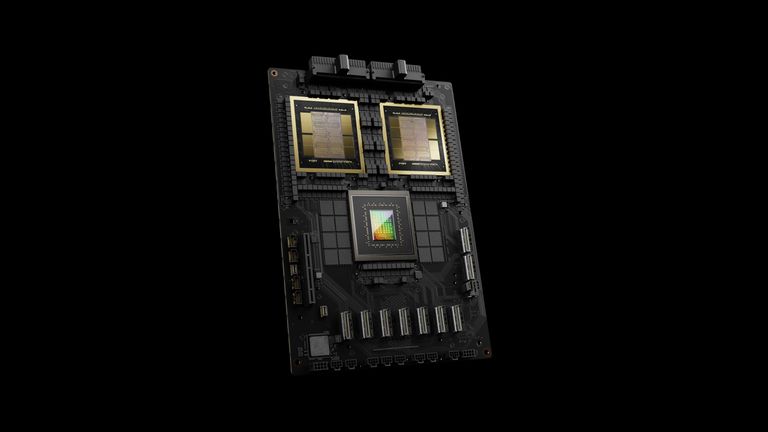
Nvidia, the leading maker of AI chips, has been releasing new, more powerful processors every year or so. It claims their latest chips will run for three to six years.
But there are doubts.

Bale playing Burry in The Big Short. Credit: Jaap Buiten/THA/Shutterstock
Fund manager Michael Burry, immortalised in the movie The Big Short, for predicting America’s sub-prime crash, recently announced he was betting against AI stocks.
His reasoning, that AI chips will need replacing every three years and given competition with rivals for the latest chips, perhaps faster than that.
Cooling, switching and wiring systems of data centres also wears down over time and is likely to need replacing within 10 years.
A few months ago, the Economist magazine estimated that if AI chips alone lose their edge every three years, it would reduce the combined value of the 5 big tech companies by $780bn.
If depreciation rates were two years, that number goes up to $1.6trn.
Factor in that depreciation and it further widens the already colossal gap between their AI spending and likely revenues.
By one estimate, the big tech will need to see $2trn in profit by 2030 to justify their AI costs.
Are people buying it?
And then there’s the question of where the profits are to justify the massive AI investments.
AI adoption is undoubtedly on the rise.
You only have to skim your social media to witness the rise of AI-generated text, images and videos.
Read more from Sky News:
Epstein victims react to partial release of files
Fears Palestine Action hunger striker will die in prison
Kids are using it for homework, their parents for research, or help composing letters and reports.
But beyond casual use and fantastical cat videos, are people actually profiting from it – and therefore likely to pay enough for it to satisfy trillion-dollar investments?
There’s early signs current AI could revolutionise some markets, like software and drug development, creative industries and online shopping,
And by some measures, the future looks promising, OpenAI claims to have 800 million “weekly active users” across its products, double what it was in February.
However, only 5% of those are paying subscribers.
And when you look at adoption by businesses – where the real money is for Big Tech – things don’t look much better.
According to the US census bureau at the start of 2025, 8-12% of companies said they are starting to use AI to produce goods and services.
For larger companies – with more money to spend on AI perhaps – adoption grew to 14% in June but has fallen to 12% in recent months.

According to analysis by McKinsey the vast majority of companies are still in the pilot stage of AI rollout or looking at how to scale their use.
In a way, this makes total sense. Generative AI is a new technology, with even the companies building still trying to figure out what it’s best for.
But how long will shareholders be prepared to wait before profits come even close to paying off the investments they’ve made?
Especially, when confidence in the idea that current AI models will only get better is beginning to falter.
Is scaling failing?
Large Language Models are undoubtedly improving.
According to industry “benchmarks”, technical tests that evaluate AI’s ability to perform complex maths, coding or research tasks show performance is tracking the scale of computing power being added. Currently doubling every six months or so.
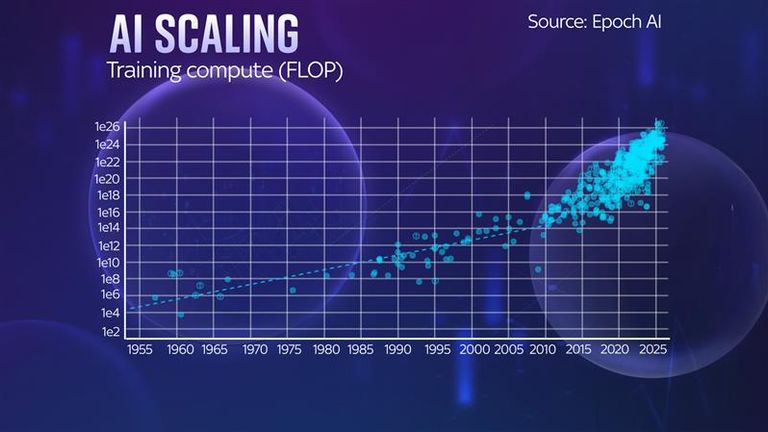
But on real-world tasks, the evidence is less strong.
LLMs work by making statistical predictions of what answers should be based on their training data, without actually understanding what that data actually “means.”
They struggle with tasks that involve understanding how the world works and learning from it.
Their architecture doesn’t have any kind of long-term memory allowing them to learn what types of data is important and what’s not. Something that human brains do without having to be told.
For that reason, while they make huge improvements on certain tasks, they consistently make the same kind of mistakes, and fail at the same kind of tasks.
“Is the belief that if you just 100x the scale, everything would be transformed? I don’t think that’s true,” Ilya Sutskever, the co-founder of OpenAI told the Dwarkesh Podcast last month.
The AI scientist who helped pioneer ChatGPT, before leaving OpenAI predicted, “it’s back to the age of research again, just with big computers”.
Will those who’ve taken big bets with AI be satisfied with modest future improvements, while they wait for potential customers to figure out how to make AI work for them?
“It’s really just a scaling hypothesis, a guess that this might work. It’s not really working,” said Prof Marcus,
“So you’re spending trillions of dollars, profits are negligible and depreciation is high. It does not make sense. And so then it’s a question of when the market realises that.”
TECHNOLOGY
Can YOU tell which of these people are sick? Take the test to see if you can detect subtle signs of illness in faces


At this time of year we’re all trying to avoid falling sick – but are you able to detect the subtle signs that someone is ill?
While coughing, sneezing and nose-blowing are obvious clues, there are faint signals that can also indicate a person is worth avoiding.
Researchers carried out a study asking participants to analyse pictures to see how well they could detect lassitude – the facial signs someone is unwell.
They were shown different images of 12 individuals, who had a photo taken when they were healthy and another taken when they had Covid, a cold or the flu.
Overall, they found that women were more accurate than men at distinguishing between a person who was sick or unwell.
This could be because women, who have historically been the primary caregiver for infants, have undergone evolutionary pressure to recognise sickness early.
‘When feeling sick, people reliably exhibit observable signs in their faces. People are, overall, sensitive to the lassitude expression in naturally sick faces,’ the team, from the University of Miami, said.
So, can you tell which of these images were taken when the individual was ill?


At this time of year we’re all trying to avoid falling sick – but can you tell which image shows an ill person? Left is picture A, right is picture B


Of these two images, which do you think shows the person when they are sick? Experts say women are better at detecting small clues. Left is picture C, right is picture D


Participants were also shown images of this individual – which do you think she looks the most ill in? Left is picture E, right is picture F
The researchers revealed some telltale clues that indicate someone is unwell.
These include red or sleepy/relaxed eyes, drooping eyelids, pale and slightly parted lips and drooping corners of the mouth.
Other indications can be clammy or puffy skin, or a red face.
From the images above, pictures A, D and F are of individuals who are sick.
Upon closer inspection, picture A shows the person appearing slightly more shiny – or clammy – than picture B, when they are healthy.
In picture D, taken when the person was unwell, the eyelids droop more and the lips appear paler than in picture C.
They also seem to have more of a reddish glow – another signal that can indicate illness.
While pictures E and F are a bit trickier, you would be correct if you said the individual is sick in picture F.


Now you know what to look for, can you tell which of these pictures shows the woman when she is sick?

The researchers found that women were able to perceive subtle signs of illness better than the men involved in the study
Subtle signs of illness
- Red or sleepy/relaxed eyes
- Drooping eyelids
- Pale/slightly-parted lips
- Drooping corners of the mouth
- Clammy or puffy skin
- A red face
In these two pictures, it is slightly easier to work out which one was taken when this woman was ill.
In the second image, she has a turned-down mouth and obviously drooping eyelids, indicating she is unwell.
She also appears paler and slightly clammy.
Writing in the journal Evolution and Human Behavior, the team said: ‘Overall, the current study found that females are better than males at recognizing facial sickness based on ratings of people’s faces.
‘This finding indicates that females may be more attuned to natural facial cues of sickness.’
The researchers said future studies will be necessary to disentangle what mechanisms may have shaped these sex differences.
‘Nonetheless, our findings suggest individual differences in the ability to perceive facial signs of lassitude, with some individuals—particularly males—potentially benefiting from support in developing this skill,’ they concluded.
This could help contribute to reducing the transmission of disease.
The UKHSA has recently shared advice on symptoms to help people determine whether they have cold, the flu or Covid.
A cold is usually characterised by a blocked or runny nose, sneezing and a sore throat, and symptoms occur gradually.
Flu signs and symptoms, meanwhile, develop very rapidly and extreme tiredness is common. Other symptoms include a fever and body aches.
While Covid symptoms have changed over time, some of the most prevalent include a change in sense of taste or smell and a particularly painful sore throat.

In just about a week, iRobot, Luminar, and Rad Power Bikes all filed for bankruptcy.
They’re very different companies — selling Roombas, lidar, and e-bikes, respectively — but as Sean O’Kane, Rebecca Bellan, and I discussed on the episode of the Equity podcast, they faced some similar challenges, including tariff pressures, major deals that fell through, and a failure to establish themselves beyond the products that first made them successful.
You can read an edited preview of our conversation below, with Sean providing an overview of each filing, Rebecca weighing in on whether she has a Roomba, and me speculating about what the popular narratives about these bankruptcies leave out.
Sean: Rad Power is big for an e-bike company, but small, I think, in most people’s minds, since that’s still a bit of a niche. They were founded a long time ago and became popular even before the pandemic, and really were thought of as an industry leader, as far as quality of the bikes that they’re making, pretty good branding and marketing and trying to connect with with customers — which is really hard to find in the world of e-bikes, where most of them are just like alphabet soup companies on Amazon.
They rode that wave in the pandemic up high as micromobility really took off, and people were really rethinking how they were getting around, they weren’t commuting into the office as much. And we get glimpses of that in the bankruptcy filings. It only shows revenue back three years, but they were pulling in well over $100 million in revenue in 2023 — like $123 million, I think that fell to about $100 [million] last year, and through the bankruptcy this year, they were only at about $63 million, so they were clearly coming down off a pretty big high. They have a pretty diverse product lineup, but they just never really found a way to establish a foothold there.
And I think you could say similar things about these other two companies. Luminar is another company that was founded in the early 2010s, came out of stealth in 2017, and its mission was essentially to take lidar sensors, which at the time were really expensive and big and really only used in, like, defense applications and aerospace. 2017 was sort of the first big hype cycle of autonomous vehicles. They wanted to apply those sensors, make them more affordable for that use case. That helped them get some deals, most notably with Volvo, and then some other deals with Mercedes Benz, and a couple other players. But they were just heavily concentrated in that, and that was one of the reasons they wound up filing this week, too.
And then iRobot [was] the most well known of these three companies — a lot of people listening probably even have a Roomba at home or something very like it. It’s just another one of these situations where iRobot became synonymous with a certain thing, and then the advances in the technology that build that product move so quickly that they wound up in a situation where they were looking for a way out. And we all saw this, they were trying to get acquired by Amazon, and that deal got blocked by the FTC and so here we are.
Techcrunch event
San Francisco
|
October 13-15, 2026
They’re very different companies, but they all ran into similar problems. Do either of you guys have a Roomba?
Rebecca: No, I don’t have a Roomba. Those freak me out, but I bought my mom a Rad Power bike years ago, and she loves it. But now, you know, they had not only this bankruptcy issue, but they also had the issue with the batteries — they weren’t able to do their recalls because they were, like, “If we have to recall these bikes, we’re going to go bankrupt.” But they’re going bankrupt anyway!
I’m curious about the tariff thing, and how much this affected everyone’s bottom lines. You hear a lot on social media, people who are pro merger, how certain FTC blockings of [mergers] leads to the companies going bankrupt, or getting acquired by a Chinese firm rather than an American firm.
Sean: iRobot represents, to me, the sort of macro global trade problem of, could you have ever built this company here in the United States with a localized supply chain over the last 15 years? Probably not. And so it makes sense that they became so heavily reliant on China — which, let’s be real, probably led to the ability for these other companies to pop up and essentially copy what they did.
That reminds me of in Trump 1, when he flipped on tariffs for Chinese imports, and we saw a bunch of startups like Boosted Boards and other ones in the micromobility space get hit. So they’re contributing factors, for sure. The battery recall with Rad Power absolutely was, I think, a bigger dagger at the end, but the tariff stuff put them on uneven footing that made it harder for them to respond to stuff like that.
Anthony: A lot of times when a company fails, there [are] larger structural issues, and then there’s maybe a more immediate proximate issue. And particularly in the case of iRobot, I think that a lot of former executives and even outside commentators are pointing to this Amazon deal that was reached a few years ago — it kind of looked like the EU was not going to allow it to go through, and there is this sense of, “Okay, well, by blocking this deal, you’ve essentially put the dagger in their heart that eventually killed the company.”
That narrative also maybe ignores the fact that there were other things that caused them to want to get acquired in the first place.
TECHNOLOGY
MIT scientist poised to upend fossil fuel industry before assassination linked to Brown University shooter

The murdered professor from the Massachusetts Institute of Technology was on the brink of revolutionizing the energy sector and upending fossil fuel use as we know it.
Nuno Loureiro, 47, was gunned down at his home in the Boston suburb of Brookline on Monday.
Authorities believe that the same alleged gunman, Claudio Neves Valente, who carried out the mass shooting at Brown University, may have assassinated Loureiro, but the investigation is still ongoing.
Before his death, Loureiro was leading MIT’s efforts to revolutionize energy production by making a game-changing clean power source that needs just a fraction of the fossil fuels current machines and vehicles use today.
His team’s research at MIT’s Plasma Science and Fusion Center (PSFC) centered on plasma physics, the study of super-hot, ionized gases, and how to apply them to fusion energy, a promising clean power source.
Fusion provides what scientists call ‘baseload electricity,’ a steady supply of power 24/7, using tiny amounts of fuel with no air pollution or climate-warming emissions, unlike carbon dioxide-producing fossil fuels.
A breakthrough in this field could disrupt the trillion-dollar fuel industry by reducing demand for oil, gas, and coal, especially for generating power and transportation. High-demand users like data centers could also switch to fusion for reliable, green energy.
‘This is a very advanced technology, and whatever nation masters it first is going to have an incredible advantage,’ Loureiro said on December 8.

Nuno Loureiro (Pictured) was shot to death at his home in Massachusetts on Monday. Investigators suspect the gunman may have been the same shooter that attacked Brown University

Pictured: Investigators at the crime scene in Boston where Nuno Loureiro was fatally shot
Authorities tied Neves Valente, the suspect in the Brown University shooting that killed two students and wounded nine on December 13, to the murder of Loureiro after matching surveillance footage from both crime scenes showing the alleged gunman in the same clothing.
The connection was further solidified by license plate reader data and video from a car rental agency tracking Valente’s gray Nissan Sentra with Florida plates, which he allegedly used to travel between both crime scenes.
Loureiro was already a respected physicist from Portugal when he joined MIT in 2016 as a professor and quickly rose to become a full-time professor by 2021.
Last year, he became the director of the MIT Plasma Science and Fusion Center, one of the university’s largest laboratories with more than 250 full-time researchers.
Loureiro specialized in theoretical physics, meaning he used math and computer simulations to figure out how plasma behaves under extreme conditions.
Plasma is the fourth state of matter, different from solids, liquids, and gases, where heat is so intense that atoms lose their electrons and create a mix of positively charged ions and free electrons – a critical component of fusion technology.
The clean energy source essentially mimics the sun’s power on Earth, smashing lighter atoms such as hydrogen together to ‘fuse’ and form heavier atoms like helium in a process that unleashes massive amounts of energy.
Until his death, Loureiro and the PSFC team were working with the company Commonwealth Fusion Systems to build SPARC, a compact fusion reactor in Massachusetts designed to produce energy from fusing atoms, with operations expected to start in 2026.

Nuno Loureiro (Pictured) was leading efforts to create fusion energy, a form of clean energy that could upend the multi-trillion-dollar fossil fuel energy

Scientists at MIT had been working under Loureiro’s leadership to build clean, fusion reactor technology (Stock Image)
They were also overseeing new projects like launching a special laboratory at PSFC to quickly test and develop tough materials that can handle the extreme heat and radiation inside future fusion reactors, helping make clean fusion power practical and safe.
Dennis Whyte, MIT’s Hitachi America Professor of Engineering, said: ‘His loss is immeasurable to our community at the PSFC, NSE [Department of Nuclear Science and Engineering] and MIT, and around the entire fusion and plasma research world.’
MIT has previously noted that more than $8billion has already been invested in the development of commercial fusion reactors, which could one day challenge the fossil fuel industry for dominance.
‘If you walked into a room of fusion scientists in 2018 or 2019 and said there were going to be fusion startups, and venture capital funding to the tune of $9 billion, you would have been laughed out of the room,’ Loureiro said in a statement two weeks ago.
Neves Valente and Loureiro previously attended the same academic program at a university in Portugal between 1995 and 2000.
Loureiro graduated from the physics program at Instituto Superior Técnico, Portugal’s premier engineering school, in 2000, according to his MIT faculty page.
That same year, Neves Valente was let go from a position at the Lisbon University, according to an archive of a termination notice from the school’s then-president in February 2000.
Neves Valente went to Brown on a student visa and eventually obtained legal permanent residence in the US in September 2017.
It was not immediately clear where he was between taking a leave of absence from the school in 2001 and getting the visa in 2017. His last known residence was in Miami.
After officials revealed the suspect’s identity, President Trump suspended the green card lottery program that allowed Neves Valente to stay in the US.
Authorities said that the suspected gunman’s original target was Loureiro, but it was unclear what his alleged motive was or what his relationship with Loureiro had been.
TECHNOLOGY
Alcohol consumption falls to a record low in Britain – so, do you drink more or less than the national average?


Alcoholism is the most severe form of alcohol abuse and involves the inability to manage drinking habits.
It is organized into three categories: mild, moderate and severe. Each category has various symptoms and can cause harmful side effects.
If left untreated, any type of alcohol abuse can spiral out of control.
Individuals struggling with alcoholism often feel as though they cannot function normally without alcohol.
This can lead to a wide range of issues and impact professional goals, personal matters, relationships and overall health.
Sometimes the warning signs of alcohol abuse are very noticeable. Other times, they can take longer to surface.
When alcohol addiction is discovered in its early stages, the chance for a successful recovery increases significantly.
Common signs of alcoholism include:
- Being unable to control alcohol consumption
- Craving alcohol when you’re not drinking
- Putting alcohol above personal responsibilities
- Feeling the need to keep drinking more
- Spending a substantial amount of money on alcohol
- Behaving differently after drinking
Short-term effects of alcohol abuse can be just as dangerous as long-term effects.
For instance, drinking can impact your reaction time, causing you to have slow reflexes and coordination.
That’s why drinking and driving is extremely dangerous. Getting behind the wheel of a car can alter your perception of speed and distance, putting yourself and others at risk.
Several short-term effects of alcohol abuse may produce:
- Slow reaction time
- Poor reflexes
- Reduce brain activity
- Lowered inhibitions
- Blurry vision
- Difficulty breathing
- Restlessness
Additionally, consuming too much alcohol can affect your long-term health. Some side effects may lay dormant for years before they surface.
Because of this, professional medical care is required for proper diagnosis and treatment.
Long-term health conditions caused by alcohol:
- Brain defects
- Liver disease
- Diabetes complications
- Heart problems
- Increased risk of cancer
- Vision damage
- Bone loss
Treatment for Alcoholism
There are different forms of treatment available based on frequency and severity of alcohol abuse.
Recovering from alcohol addiction is a process that continues long after rehab.
It takes commitment to practice and apply the techniques you learn in rehab, counseling, support groups and other types of therapy.
Although every individual will have their own recovery plan that’s tailored to their specific needs, treatment generally follows a structure.
Alcohol treatment is broken into three sections, consisting of:
Detoxification
The first stage in alcohol addiction recovery is detoxification. This phase should be completed with the help of medical professionals due to the potential for serious, uncomfortable withdrawal symptoms. Many times, individuals are given a medication to help alleviate the painful side effects of a withdrawal.
Rehabilitation
There are two types of rehabilitation that help treat alcoholism: inpatient rehab and outpatient rehab. Inpatient rehabs are intensive treatment programs that require you to check into a facility for a certain period of time, usually 30, 60 or 90 days. Outpatient rehab allows individuals to participate in a recovery program while continuing with their daily life. Talk with your doctor about treatment options to determine which form of recovery will best fit your needs.
Maintenance
The recovery process doesn’t end with the completion of rehab. Long-term sobriety requires ongoing therapy and may entail support groups, counseling and other recovery resources. These will make sure you maintain sobriety and continue on a happy, healthy path for months and years to come.
Source: Alcohol Rehab Guide

Waymo suspended its robotaxi service in San Francisco on Saturday evening after a massive blackout appeared to leave many of its vehicles stalled on city streets.
Numerous photos and videos posted to social media captured Waymo robotaxis stalled at roads and intersections as human drivers either passed them by or were stuck behind them.
Waymo said on Saturday that it had temporarily suspended service in the city due to the blackout. Spokesperson Suzanne Philion provided a similar statement to TechCrunch on Sunday morning.
“We have temporarily suspended our ride-hailing services in the San Francisco Bay Area due to the widespread power outage,” Philion said. “Our teams are working diligently and in close coordination with city officials to monitor infrastructure stability, and we are hopeful to bring our services back online soon. We appreciate your patience and will provide further updates as soon as they are available.”
The company did not provide an explanation for why the blackout had such a dramatic effect on its vehicles. One possible culprit: The blackout took down many of the city’s traffic lights. (In fact, with the blackout affecting both lights and Muni mass transit, San Francisco Mayor Daniel Lurie warned residents to stay off the roads unless they needed to travel.)
Others theorized that Waymo might have been affected by an interruption in cell service or traffic data.
The blackout appears to have been caused by a fire at a Pacific Gas & Electric substation in the city. SFGate reports that around 120,000 PG&E customers were affected by the blackout, and while the majority of them had power restored by late Saturday, 35,000 customers were still without power on Sunday morning. PG&E’s website also showed thousands of San Francisco customers still affected at that time.
Techcrunch event
San Francisco
|
October 13-15, 2026
A letter from Tiger Global Management leaked earlier this month said that Waymo is now providing 450,000 robotaxi rides per week, nearly double the amount that the Alphabet-owned company disclosed in the spring.
Nigeria’s blockchain story in 2025 is not just about price charts, policy debates, or trading volumes. It is about people. Builders, operators and advocates who stayed the course through volatility and regulation in Africa’s most complex crypto markets and still found ways to create value. This year, as adoption deepened and infrastructure matured, the human layer of Nigeria’s blockchain ecosystem came into sharper focus.
To understand who truly shaped the year, I spoke with founders, developers, investors, regulators, exchange operators and editors across the Nigerian Web3 space. Some were happy to go on record, while others preferred anonymity.
What stood out was the consistency. Across interviews with figures such as TechCabal’s Frank Eleanya, TechPoint Africa’s Bolu Abiodun, and multiple unnamed ecosystem players, the same individuals were repeatedly mentioned as having an outsized impact in 2025.
From stablecoin infrastructure to consumer exchanges, and from open-source funding to continental expansion, these five individuals stood out for the substance of their work.
And, the scale of their influence offers a human lens into how Nigeria’s blockchain sector matured this year and helps explain why 2025 felt like a turning point for blockchain in Nigeria.
So, here are the top 5 figures that shaped Nigeria’s blockchain (crypto) story in 2025
Abubakar Nur Khalil– CEO, Btrust
Abubakar represents the long game, while much of Nigeria’s crypto conversation focuses on trading and payments.
As the CEO of Btrust, an organisation that has quietly shaped the foundations and focused on funding and supporting open-source Bitcoin development in Africa, his work addressed a quiet but critical gap: talent retention.
 Abubakar Nur Khalil, CEO, Btrust
The organisation’s work around developer capacity building has helped Nigerian engineers access global funding and mentorship. In 2025, as global demand for African blockchain engineers surged, that impact became more visible.
Btrust-backed programmes helped keep skilled developers building within the continent. More Nigerian developers began contributing to core Bitcoin and Lightning projects, not just building local apps. That shift moved Nigeria from being a user market to a contributor economy.
Abubakar’s leadership was repeatedly mentioned as critical in shifting the narrative from consumption to contribution.
His influence is measured in repositories, grants and sustained developer careers. It is less visible to consumers but foundational to everything else.
2. Owenize Odia– General Manager Africa,Blockchain.com
Owenize stood out for a different reason. Global firms have long circled Africa. Few have committed deeply.
Blockchain.com’s expansion across Nigeria and other African markets in 2025 signalled renewed confidence in the region. Under her leadership, the company moved beyond surface-level presence. It invested in local partnerships, compliance engagement, and user education.
 Owenize Odia, General Manager Africa at Blockchain.com
For many stakeholders I spoke to, this expansion helped normalise crypto infrastructure at scale and reassured regulators that global players were willing to engage responsibly.
3. Charles OkaforMbah– Cloud Solutions Engineer, cNGN
The rise of cNGN was one of the most talked-about stories in Nigeria’s blockchain circles in 2025. By November, over723.2 million had been minted, with over 158,894 on-chain transactions and a total trading volume of over 46.5 billion cNGN, driven by demand for a stable, on-chain representation of the naira.
Behind those numbers were systems that had to work reliably in a volatile environment. Several experts pointed to Charles’ technical stewardship as a quiet but essential factor in cNGN’s breakout year.
He played a pivotal role in building and maintaining the cloud infrastructure that kept cNGN resilient under rapid growth. His contribution speaks to a broader shift. Nigerian blockchain projects are no longer experimental side projects.
They are production systems with uptime, security and scalability expectations.
 Charles OkaforMbah – Cloud Solutions Engineer, cNGN
cNGN’s breakout year put stablecoin infrastructure at the centre of Nigeria’s digital economy conversation. Engineers like Charles made that possible.
4. Ayotunde Alabi– CEO, Luno Nigeria
In 2025, Ayotunde represented scale and consistency. Luno has been in Nigeria longer than many exchanges; in 2025, that patience paid off. Luno expanded its African user base beyond six million, reinforcing its position as one of the continent’s leading crypto platforms.
His impact was not framed around aggressive growth alone. Sources emphasised product stability, regulatory dialogue, and a focus on everyday users navigating inflation and cross-border payments. In a market prone to shocks, that steadiness mattered.
Under Ayotunde’s leadership, Luno Nigeria doubled down on education, compliance and user experience. What stood out was not just scale but tone. Luno maintained a cautious, transparent approach in a country where crypto scepticism remains high in official circles.
That balance helped normalise crypto for everyday Nigerians, from students to small business owners.
 Ayotunde Alabi, CEO of Luno Nigeria
His impact lies in making participation feel legitimate and sustainable.
5. Benjamin Onomor– CEO, Roqqu
Benjamin, rounded out the list with a clear expansion story. Roqqu’s growth story in 2025 was defined by regional ambition. The acquisition of Flitaa expanded its footprint beyond Nigeria and signalled confidence in African-led exchanges competing at scale.
His leadership was cited as proof that Nigerian-founded platforms could compete, acquire, and scale across borders without losing local relevance.
Roqqu focused on product depth and operational maturity. It invested in compliance, customer support and cross-border functionality. That discipline paid off as users looked for reliable platforms amid market uncertainty.
 Benjamin Onomor – CEO, Roqqu
Its trajectory reflects a broader trend. African exchanges are no longer content to be local champions. They want continental relevance.
Putting it all together
This story is not an ode to any single founder but a snapshot of an ecosystem moving from improvisation to structure. People like Abubakar, Owenize, Charles, Ayotunde and Benjamin do different things. Some write code. Some build teams. Some negotiate with regulators.
Yet, together, they show how a market can professionalise in a single year.
If 2025 gave Nigeria clearer rules and deeper products, it was because these actors turned ideas into systems. That human work is the real story behind the numbers.
As Frank Eleanya observed, 2025 was shaped by tangible milestones, from cNGN’s rapid adoption to Blockchain.com’s African push, Roqqu’s acquisition strategy, and Luno’s user growth. These were not isolated wins. They reflected leadership choices.
Nigeria’s crypto future looks promising. With deliberate policy actions and this human infrastructure, now stronger than it was a year ago, we can confidently conclude that the best is yet to come.


The internet has turned fringe belief into mainstream politics and policy – from authoritarianism to vaccines. With democracy itself threatened, is it time to go back to a previous world of landlines, letters and face to-face-contact, audiotapes and Ansaphones? What would we miss about the online world that is worth the risk to liberal culture and basic freedoms? Mees Visser, Groningen, Netherlands
Post your answers (and new questions) below or send them to
SOURCE PAGE