
SCIENCE
Psychedelic treatments show promise for OCD while cannabis doesn’t, review finds | Obsessive-compulsive disorder


A recent review of alternative treatments for obsessive compulsive disorder (OCD) indicates that psychedelic treatments show promise for the disorder while cannabis does not.
Dr Michael Van Ameringen, a psychiatry professor at McMaster University in Ontario, Canada and lead author of the review published in the Journal of Psychiatric Research, said that 40-60 % of OCD patients get either partial or no relief with available treatments, including SSRIs and exposure and response prevention therapy.
While psychedelics and cannabinoids have become part of the conversation surrounding OCD – a disorder characterized by intrusive, obsessive thoughts and/or compulsive behaviors – there is a much larger body of published evidence on the efficacy of these substances for more common conditions, like depression and anxiety.
“We wanted to hone down and really understand, is there evidence for these things that have been talked about to be used as the next step treatments?” Van Ameringen explained.
Given the paucity of existing literature, Van Ameringen said he didn’t know what to expect. To make up for the lack of published information, he included conference presentations and preliminary, unpublished findings in the review paper.
Upon compiling available evidence, Van Ameringen and his team found “stronger signals” for the efficacy of psychedelics, specifically psilocybin (the psychoactive component of “magic mushrooms,”) than for cannabinoids like THC and CBD.
Van Ameringen theorizes that the difference is related to how these substances interact with areas of the brain related to OCD. While cannabinoids activate the brain’s CB1 receptors, which regulate symptoms like compulsions and anxiety, available evidence shows they don’t offer lasting relief from OCD symptoms.
Psilocybin, on the other hand, can reduce connectivity in the brain’s default mode network, which “essentially is involved in self referential thinking and rumination. The default mode network is really activated in OCD”, he says.
A difference in the methodology of cannabis and psilocybin studies might also have contributed to the different results, says Dr Mohamed Sherif, a psychiatrist and computational neuroscientist at Brown University who will lead a future clinical trial on psilocybin for OCD. Psychedelic clinical trials, like the one Sherif is planning, tend to offer patients not only medication but also encouragement to frame their experience as a therapeutic “journey”.
“This was not done in cannabinoids [studies,]” Sherif explained.
Dr Terrence Ching, a clinical psychologist at the Yale School of Medicine, similarly wondered if the way people use cannabis versus psilocybin might explain the different outcomes. While people tend to use cannabis for temporary relief, psilocybin can help facilitate actual changes in the brain and in patients’ perception of their OCD.
“One could use cannabis for the same therapeutic reason, of confronting something deeper about their OCD or their obsessive fears. But conventionally, people tend to use cannabis for an avoidance function,” Ching explained.
Preliminary results from Ching’s clinical trial on a single dose of psilocybin for OCD were included in Van Ameringen’s review paper, and showed that psilocybin was effective for OCD symptoms compared to placebo. Ching is now preparing the results of the trial for publication, and planning a second clinical trial where OCD patients will receive two doses of psilocybin at different times.
During the single dose trial, 11 patients each received psilocybin or niacin, a placebo intended to mimic some of psilocybin’s effects so that patients would be unsure which drug they’d received. During dosing sessions, patients would sit with two facilitators who would offer minimal guidance in the form of open ended questions.
Ching said his protocol included strict rules about the type of touch that was allowed if patients requested it – only a hand on the shoulder or forearm – to create unambiguous ethical limits. Past psychedelic clinical trials have generated controversy when facilitators initiated unwanted touch with participants who were under the influence.
Ching said the trial was useful not only in showing that psychedelics can improve OCD symptoms, but also in revealing more about the nature of OCD, both for clinicians and for the participants themselves.
Psilocybin is known for inducing “mystical experiences”, characterized by a specific type and intensity of psychedelic effects, according to Ching.
“What we see in OCD is more often partial mystical experiences, people are kind of pumping the brakes when they have a sense that the psilocybin wants to take them into a deeper state of experiencing,” Ching said, adding that this highlights one of the core features of the disorder – the need to be in control.
While clinicians in psychedelic trials might typically encourage patients to go deeper, Ching said that with OCD patients, it’s important to remain “non-directive and non-judgemental”.
During the trial, Ching saw patients recognize their own resistance to the drug and gain deeper insight into their need for control, saying things like: “I really realize that this is how I’ve approached unknowable things in my life, but that’s what life is. Life is full of unknowable things.”
Ching is hopeful about the future of psychedelic medications, but there are several obstacles that make researching them difficult. Psilocybin is still an illegal schedule I substance in the US, which means that researchers must take additional steps to study it, including working with a DEA liaison and using a DEA approved safe that “needs to be bolted down to the ground”, in a private windowless room.
Researchers also must deal with the issue of “functional unblinding”, or the fact that psychedelic effects can mean trial participants are able to guess whether they received psilocybin or a placebo, which could alter their perception of their own symptoms. This is especially problematic given the hype around psychedelics, Ching said.
Many participants will enter a trial expecting a “miracle cure” – a narrative Ching believes is actually harmful to psychedelic research: “What we need to do now is to seriously, to treat psychedelics seriously, as any other worthwhile medication, to investigate in a controlled, rigorous way, in a way that is ethical, that pays homage to traditional Indigenous users of psychedelics, because there are, there is great wisdom there too.”

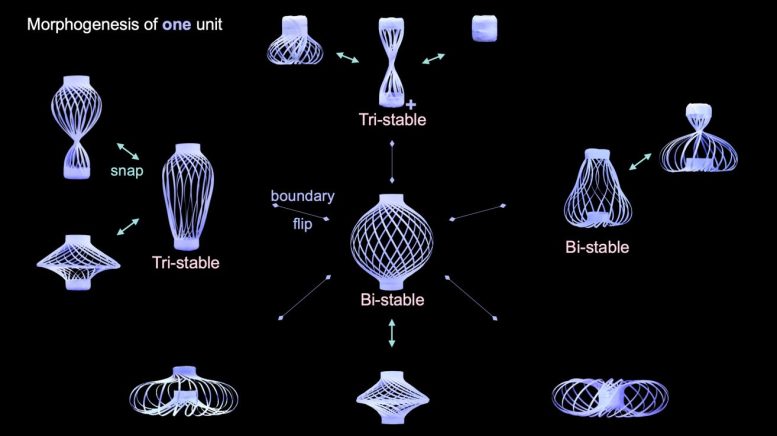
Researchers have developed a polymer structure inspired by a classic “Chinese lantern” that can change into more than a dozen curved, three-dimensional shapes when it is compressed or twisted. These quick shape transitions can also be triggered remotely with a magnetic field, which makes the design suitable for many potential uses. How the Lantern Structure […]
SOURCE PAGE
SCIENCE
Space.com headlines crossword quiz for week of Dec. 1, 2025: What is the name of December’s supermoon?



Every week, Space.com delivers the latest discoveries, launches, and cosmic curiosities from across the universe. From groundbreaking research aboard the International Space Station to dazzling new images from the James Webb Space Telescope, the stories are as vast and varied as space itself. But how closely have you been paying attention?
To celebrate the thrill of space exploration and the joy of learning, we’ve created a special crossword puzzle built entirely from this week’s top Space.com stories. It’s a fun, brain-tickling way to revisit the highlights, whether you’re a casual stargazer or a die-hard astrophysics fan.
You may like
So channel your inner astronaut, and dive into this week’s interstellar quiz. The answers are out there, you just have to connect the clues.
Try it out below and see how well you do!
SCIENCE
‘Doctor Who’ spin-offs ranked: From K-9 and Daleks! to ‘Class’, ‘The Sarah Jane Adventures’ and ‘Torchwood’

It’s famously bigger on the inside, but a single TARDIS was never going to be enough to accommodate a vast and expanding Whoniverse. New Sea Devil drama “The War Between the Land and the Sea” is just the latest in a long line of “Doctor Who” spin-offs, exploring different corners of time and space.
In order to keep things manageable, we’ve steered clear of the vast collection of Gallifrey-adjacent books, comics, and audio dramas because, well, even a Time Lord would struggle to get through them in their lifetime. We’ve got an honorable mentions section at the bottom of the list to acknowledge some of the best of these, though.
You may like
‘Doctor Who’ spin-offs ranked
9. K-9
(Image credit: Park Entertainment and Stewart & Wall Entertainment)
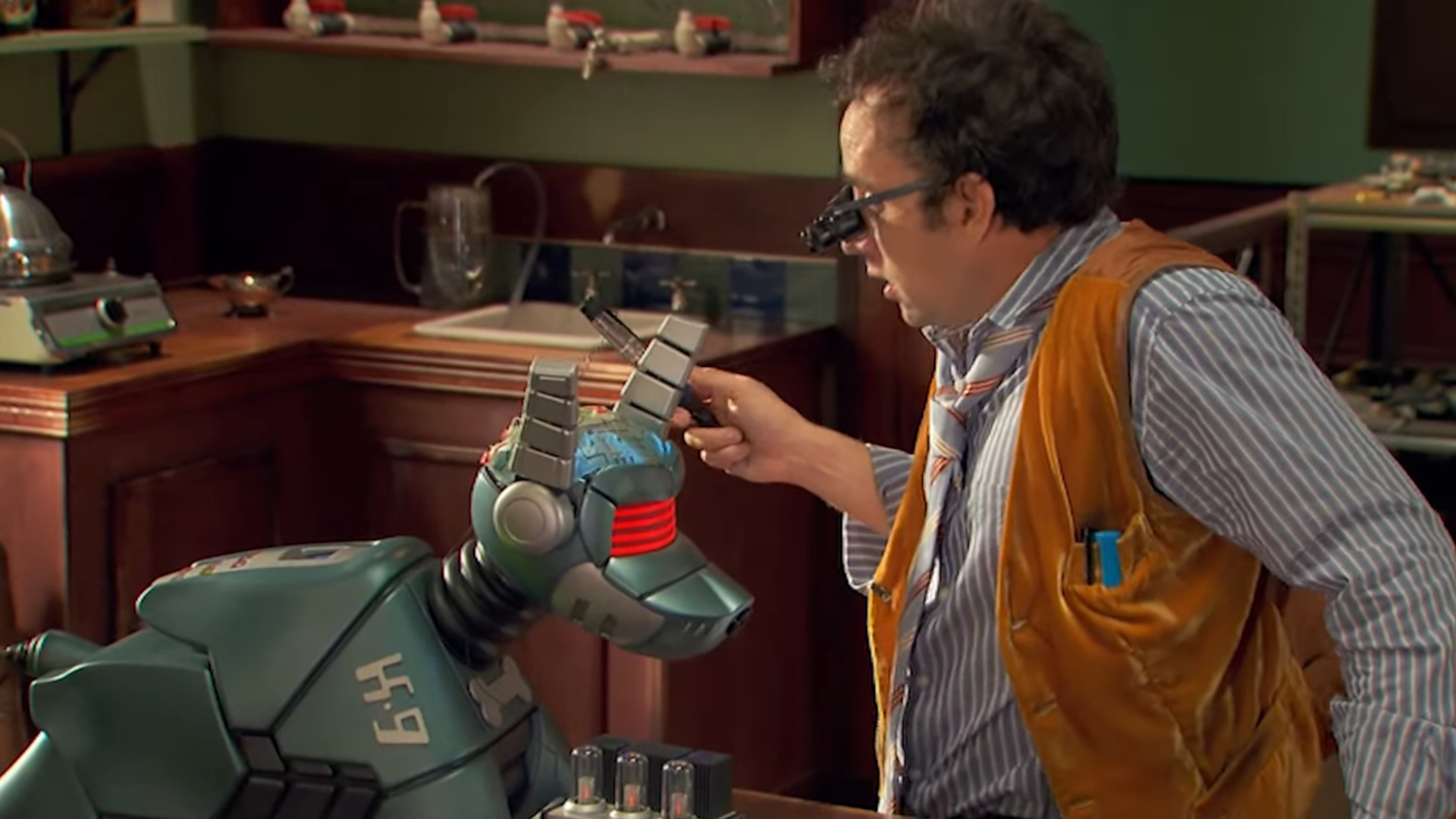
Tin dog K-9 became a superstar during Tom Baker’s TARDIS tenure, and an earlier spin-off — “K-9 and Company”, co-starring Elisabeth Sladen as Sarah Jane Smith — even made it to pilot in 1981. (You can check out the very ’80s opening titles on YouTube.)
But beyond John Leeson’s characteristic voice, this short-lived 2009 show shares little DNA with “Doctor Who” because, unlike every other show on this list, “K-9” is not a BBC production.
Having co-created the eponymous pooch, writer Bob Baker retained some of the rights to the character, but crucially not to the design or his connections to a certain Time Lord — hence the extensive makeover and the lack of references to the metal mutt’s adventures in space and time. The result is a generic, pretty forgettable kids’ show, in which the robotic hero helps a bunch of children fight off the alien Jixen in a futuristic London.
Where to watch: Currently unavailable in the UK; Roku (US)
8. Daleks!

(Image credit: BBC)
Even bad guys can be the heroes in their own stories… In “Daleks!”, “Doctor Who”‘s most famous villains get busy eye(stalk)ing up the Archive of Islos, a futuristic library boasting vast quantities of knowledge and its very own visitor center. But even without the usual Time Lord interference, the pepperpots’ usual plans for taking over the universe aren’t quite going according to plan.
Part of the multi-platform, multi-Doctor Time Lord Victorious “event”, this is one for Dalek completists rather than casual fans. While it’s always fun to watch Davros’s progeny scheming and exterminating (“Doctor Who” regular Nicholas Briggs is back on voice duties), the story is undeniably slight. The CG animation is also disappointingly rudimentary.
Where to watch: Doctor Who YouTube channel
You may like
7. The Curse of Fatal Death
(Image credit: BBC)
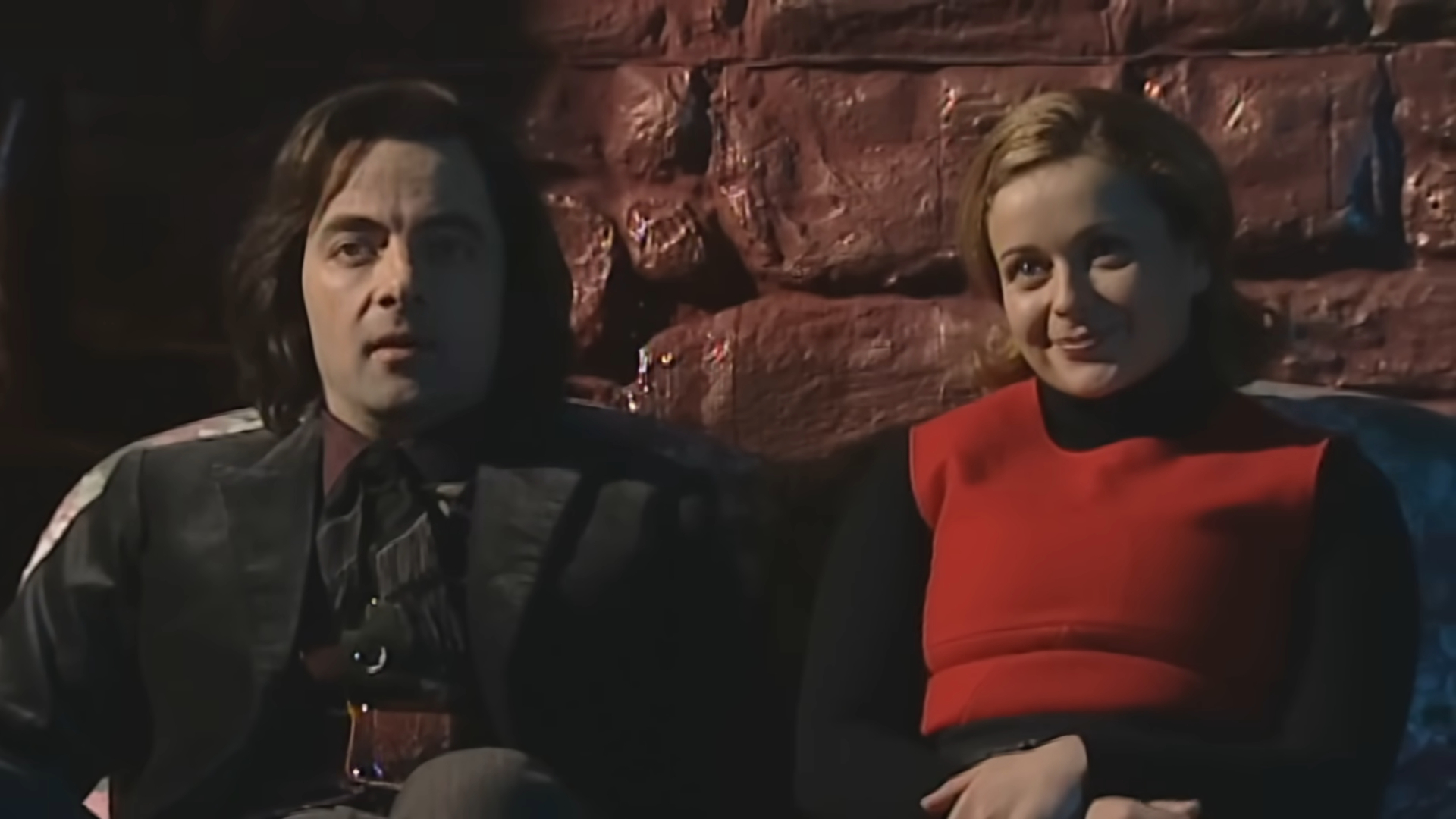
1999 was a dark time to be a “Doctor Who” fan — the TV series had been off-air for a decade, the 1996 TV movie had failed to resurrect the franchise, and Russell T Davies’s reboot was still another six years away. Luckily, charity telethon Comic Relief came to the rescue with this one-off skit, a broad, 20-minute comedy that plays a bit like “Carry On Doctor (Who)”.
Rowan Atkinson plays a Ninth Doctor ready to hang up his TARDIS keys and marry his companion (Julia Sawalha), when the Master (a scenery-chewing Jonathan Pryce) and the Daleks throw a spanner in the works.
The script (from future showrunner Steven Moffat) has plenty of laughs at “Who” clichés — at one point the Doctor complains about “all those endless gravel quarries” — while sidestepping the need for exposition with its recurring “I’ll explain later…” catchphrase. It’s an innuendo-filled, hit-and-miss affair, but it does rattle through four regenerations — including Hugh Grant, and Joanna Lumley as the first-ever female Doctor.
Where to watch: Comic Relief YouTube channel
6. Tales of the TARDIS
(Image credit: BBC)
Retired Time Lords have been returning to the TARDIS ever since 1973’s “The Three Doctors”, but the passage of time in the real world can limit a former “Who” actor’s window of opportunity. This fun series — released for the show’s 60th anniversary — gets around that problem by reuniting Doctors and companions of the past in the Memory TARDIS, a plot device that would later turn up in the Fifteenth Doctor episode “Empire of Death“.
In truth, the reminiscences are little more than bookends for truncated versions of classic “Who” tales like “Earthshock”, “The Mind Robber”, and “The Curse of Fenric”. Even so, fans of the classic series will get the warm-and-fuzzies seeing the Fifth Doctor (Peter Davison) getting nostalgic with Tegan (Janet Fielding) and the Seventh Doctor (Sylvester McCoy) with Ace (Sophie Aldred). Most importantly of all, the Sixth Doctor (Colin Baker) is — at long last — given a stylish alternative to his abomination of an outfit.
Where to watch: BBC iPlayer (UK); Available to buy on Apple (US)
5. Class
(Image credit: BBC)
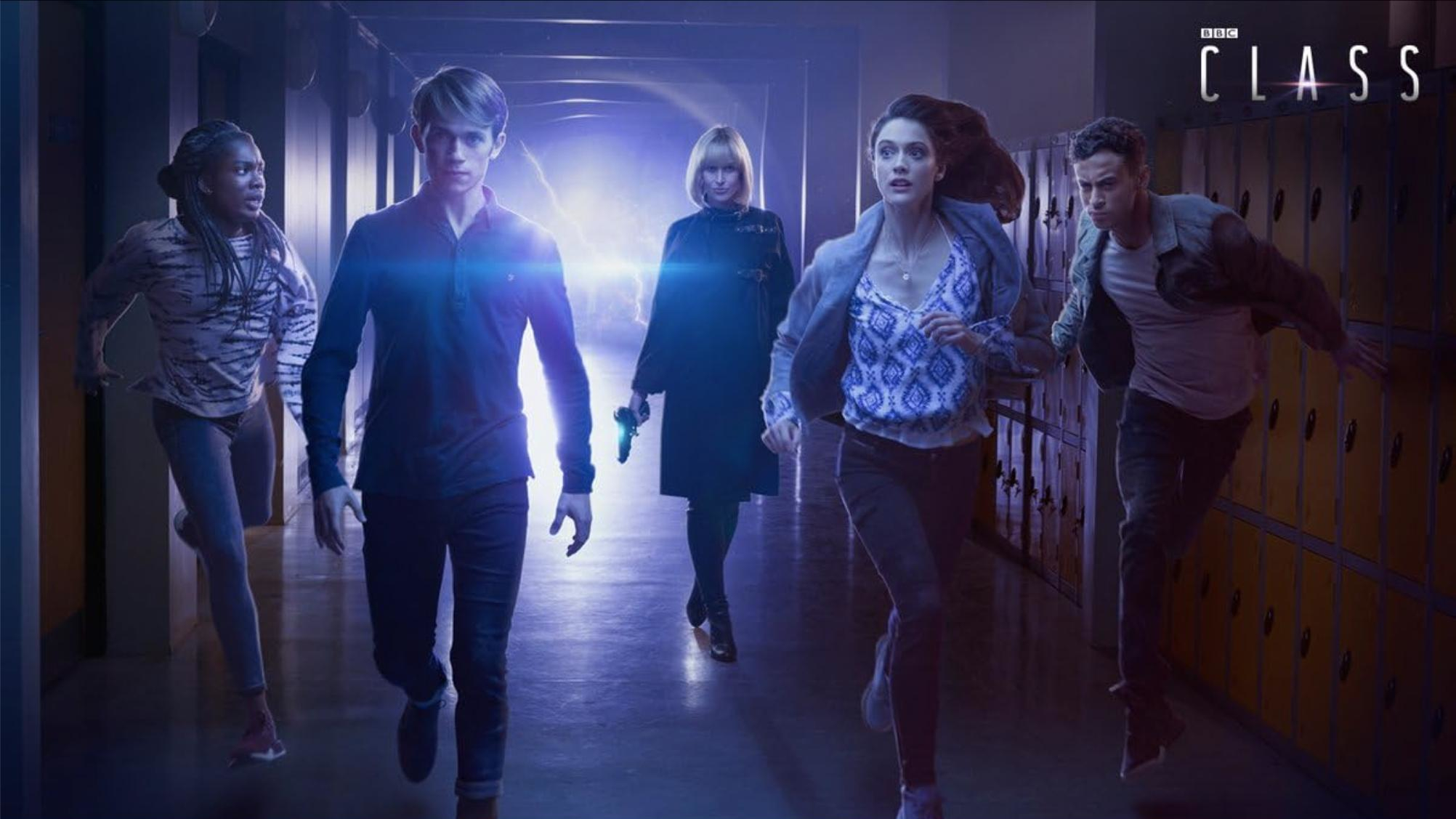
The Whoniverse got smaller after “Torchwood” and “The Sarah Jane Adventures” ended, as “Doctor Who” showrunner Steven Moffat opted to focus on the main show. There was one notable companion piece, however, as the franchise opened the doors to the school where everything started in 1963.
Coal Hill first appeared in the very first “Doctor Who” story, “An Unearthly Child”, when a pair of teachers took an interest in the Doctor’s gifted granddaughter, Susan. YA series “Class” (co-created by Patrick Ness) brings things right up to date, following the lives, loves, and close encounters of the school’s students and teachers — think “Buffy the Vampire Slayer” or “Roswell” in London.
The show’s bold tone and progressive storytelling marked new territory for the franchise, and — much like “Firefly” — “Class” could have become something great if it hadn’t been cancelled after a single season.
Where to watch: BBC iPlayer (UK); Available to buy on Apple and Amazon (US)
4. An Adventure in Space and Time

(Image credit: BBC)
This one-off, made for the show’s 50th birthday, proves that the origins of “Doctor Who” are just as noteworthy as those of its eponymous time-travelling hero. “An Adventure in Space and Time” dramatizes the show’s early days, when BBC drama boss Sydney Newman (“Succession” star Brian Cox) conceived a groundbreaking new sci-fi show for Saturday evenings.
The focal points of the story, however, are producer Verity Lambert (Jessica Raine), director Waris Hussein (future Master Sacha Dhawan), and leading man William Hartnell (David Bradley).
Regular “Who” writer Mark Gatiss turns real life into a poignant love letter to the show he adores, as Bradley (who’s since played the First Doctor in the parent show) taps into Hartnell’s delight at becoming a star in his late ’50s, before ill health prompts the powers-that-be to initiate the show’s first ever regeneration.
Where to watch: BBC iPlayer (UK); Britbox (US)
3. The Five(ish) Doctors Reboot
(Image credit: BBC)
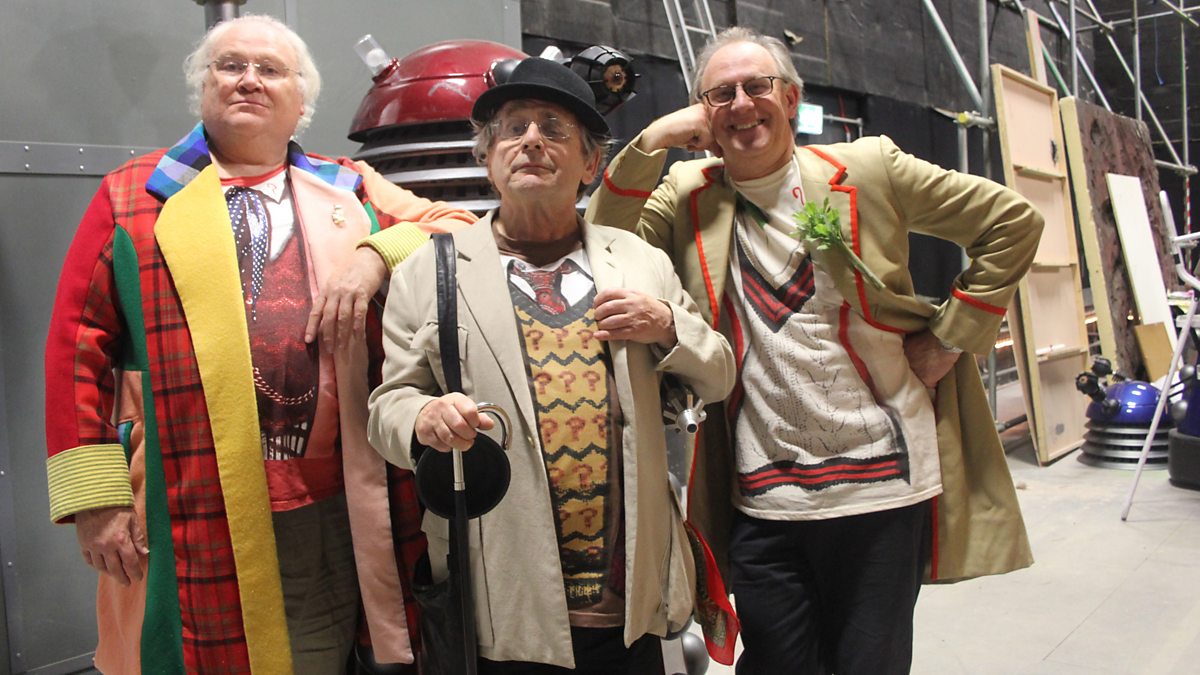
While Tom Baker had a scene-stealing cameo in official 50th anniversary episode “The Day of the Doctor”, the Fifth, Sixth, and Seventh Doctors (Peter Davison, Colin Baker, and Sylvester McCoy) only appeared in archive footage. They took center stage, however, in this entertaining, unashamedly meta one-off birthday special, written and directed by Davison.
It’s a hilarious, self-aware celebration of the show, as the three leads play fictionalized versions of themselves angling for a role in the anniversary special — they’ll operate Daleks if they have to.
The impressive roster of guest stars includes ex-Doctors David Tennant and Paul McGann, numerous former “Doctor Who” companions, showrunners Steven Moffat and Russell T Davies, and even Peter Jackson — the “The Lord of the Rings” director and long-time Whovian has made no secret of his desire to direct an episode one day.
Where to watch: BBC.co.uk (UK); Currently unavailable in the US
2. Torchwood

(Image credit: BBC)
The massive success of the 2005 “Doctor Who” reboot paved the way for executive producer Russell T Davies to craft a complex shared universe, years before the Marvel Cinematic Universe got in on the act. First out of the spin-off blocks was “Torchwood”, an adult-focused, monster-of-the-week drama series about the eponymous (but not-so-secret) organization, an alien-hunting agency given licence to operate outside the law. “Doctor Who” graduate John Barrowman was given star billing as the immortal Captain Jack Harkness, in a show that relished the opportunity to go to darker places than the parent show ever could.
“Torchwood” takes a while to find its feet, but look past the tonal inconsistency, and there are gems to be found in both of the first two seasons — nobody could ever fault “Torchwood” for a lack of ambition. But it’s the format-smashing third season, “Children of Earth”, that really earns the show its silver medal on this list of “Doctor Who” spin-offs — it’s arguably the best thing ever to come out of the Whoniverse.
Where to watch: BBC iPlayer (UK); Available to buy on Apple and Amazon (US)
1. The Sarah Jane Adventures
(Image credit: BBC)
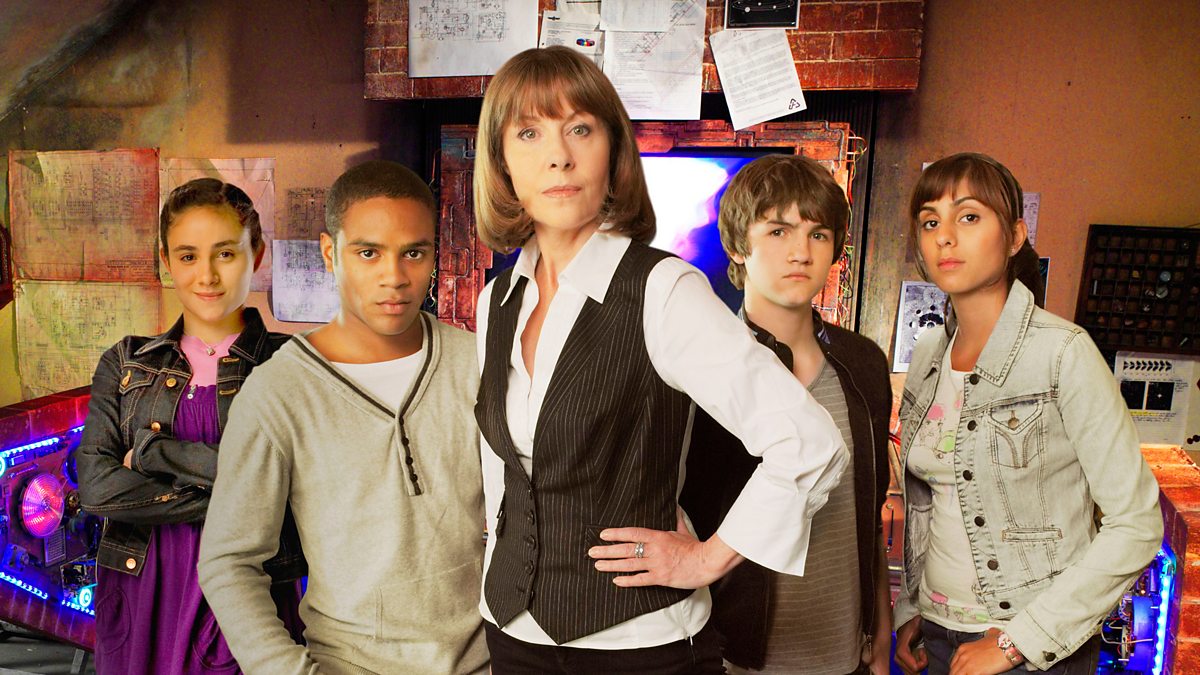
“Doctor Who” was originally conceived for children but, even in its early days, it rarely let that idea constrain its vision or ambition. ’00s spin-off “The Sarah Jane Adventures” was cut from similar cloth, a kid-friendly answer to “Torchwood” that also had plenty for the core audience’s parents (and other “Who” fans) to enjoy.
Davies’s decision to center the series on beloved former companion Sarah Jane Smith (the late Elisabeth Sladen) proves a genius move, as a character steeped in “Who” lore takes on a leadership role in the Doctor’s absence.
Armed with little more than a Sonic Lipstick and a supercomputer named Mr Smith (voiced by “Pointless” host Alexander Armstrong), she teams up with a bunch of teens (and occasionally K-9) to fight family-appropriate alien threats in London. Joyous and inventive while treating its audience with respect, this is the best “Doctor Who” spin-off of them all.
Where to watch: BBC iPlayer (UK); Available to buy on Apple and Amazon (US)
Honorable mentions
Television is just the tip of the iceberg when it comes to “Doctor Who” spin-offs. Virgin Books’ “New Adventures” series told all-new Time Lord stories in the ’90s, and was widely credited with keeping the TARDIS flame alive during the show’s decade-and-a-half away from TV. It eventually spawned a series of novels headlined by companion Bernice Summerfield.
Summerfield has since gone on to star in numerous audio dramas produced by Big Finish. Alongside numerous Doctor-centric stories, the company has also produced spin-offs centered on — among others — UNIT, the Paternoster Gang (led by the Silurian Madame Vastra), and Jago & Litefoot, a pair of Victorian investigators who first appeared in Fourth Doctor story “The Talons of Weng-Chiang”.
It could also be argued that the two Peter Cushing “Dr Who” movies from the 1960s are spin-offs, seeing as they exist in their own continuity — Cushing’s Doctor may not even be an alien.
We chose not to include David Tennant-starring animated serials “The Infinite Quest” (2007) and “Dreamland” (2009), as they’re effectively episodes of the main TV show that just happen to be in a different medium. The thirtieth anniversary cartoon “Scream of the Shalka” (2003) has undeniably become more notable in recent years, however, after the Doctor played by Richard E Grant became canon in 2024’s “Rogue“.
SCIENCE
Wes Streeting calls for ‘cross-party consensus’ on gender identity ahead of puberty blocker trial | Gender

The health secretary, Wes Streeting, has called on the Conservatives to maintain the cross-party consensus on gender identity services built before the last election in a letter to Kemi Badenoch.
Streeting wrote to opposition leader on Friday urging her to “take the heat and the ideology” out of debate amid controversy over a puberty blocker trial for children.
Both parties committed to implementing the recommendations of a report by the leading paediatrician Hilary Cass focused on gender identity services for under 18s in England, published in April 2024 when the Conservatives were in government. Cass recommended a puberty blocker trial as part of a wider research programme and supported a more “holistic” approach to care.
Badenoch and the shadow health secretary, Stuart Andrew, wrote to Streeting on 25 November, however, saying they were concerned NHS England was supporting a clinical trial involving drugs that halted natural puberty.
Cass found “remarkably weak” evidence the drugs were effective in treating gender-related distress, adding that there was no good evidenceon long-term outcomes.
She has said a trial is the only way forward in the attempt to understand if there are beneficial effects. The government has since banned the treatment for children outside clinical trials.
The new trial will study the effects of puberty blockers on more than 200 children presenting with gender identity conditions as part of a wider research project on possible treatment pathways. The £10.7m study is being carried out by researchers at King’s College London.
Streeting’s intervention came despite admitting he is “deeply uncomfortable” about medication which affects “a natural part of our human development”.
Puberty blockers stop the body from producing certain hormones, including oestrogen and testosterone. They were traditionally prescribed to children who entered puberty too early, but were later given to young people diagnosed with gender dysphoria and incongruence.
Badenoch and Andrew told Streeting the trial was based on the “discredited, yet still seemingly entrenched, belief in some quarters that a child can be ‘born in the wrong body’ or go through the ‘wrong’ puberty and a normal puberty can be ‘paused’ without causing irreparable harm to children”. They cited infertility and loss of sexual function as possible side effects.
Streeting expressed his own doubts about the trial in an LBC interview on Friday. “There’s something about the opposition to this. Medication that delays or indeed stops a natural part of our human development, which is puberty, I am deeply uncomfortable with,” he said.
He said, however, that he planned to follow clinical advice to go ahead with the trial. “It’s gone through rounds and rounds of ethical approvals to approve this kind of study. So that’s the basis on which we are proceeding,” he said.
In responding to Badenoch and Andrew, Streeting said some children were going to great lengths to source puberty blockers despite the ban and that gender incongruence was a “real and internationally recognised disorder”, but that the condition was distinct from “girls and boys experimenting with gender norms, which for many children is a normal part of growing up”.
“Only a clinical trial (and longer term follow up) can isolate which outcomes can be ascribed to these treatments, supporting evidence-based decisions for future care,” he said.
He also said the cross-party consensus on the Cass review when it was published last year was “a key moment for taking some of the heat out of what is an extremely sensitive issue without stifling debate, where the wellbeing and safety of children must remain paramount”.
“Dr Cass said, on publishing her review, that ‘toxic, ideological and polarised public debate has made the work of the review significantly harder’ and it will hamper the research that is essential to finding a way forward,” he said.
“It is incumbent on us as public representatives to take the heat and the ideology out of this issue, and make sure that children’s health is always led by evidence and medical expertise.”
Badenoch and Andrew said in their letter to Streeting that the trial would have no proper control group “creating obvious bias”.
In his reply, Streeting said that was incorrect and that a group of young people not in receipt of puberty blockers would also be studied by researchers. He said these children would be “compared to trial participants with respect to outcomes”.

This article was originally published at The Conversation. The publication contributed the article to Space.com’s Expert Voices: Op-Ed & Insights.
Scientists working with the James Webb Space Telescope discovered three unusual astronomical objects in early 2025, which may be examples of dark stars. The concept of dark stars has existed for some time and could alter scientists’ understanding of how ordinary stars form. However, their name is somewhat misleading.
You may like
Still, the name captures the essence of this phenomenon. The “dark” in the name refers not to how bright these objects are, but to the process that makes them shine — driven by a mysterious substance called dark matter. The sheer size of these objects makes it difficult to classify them as stars.
As a physicist, I’ve been fascinated by dark matter, and I’ve been trying to find a way to see its traces using particle accelerators. I’m curious whether dark stars could provide an alternative method to find dark matter.
What makes dark matter dark?
Dark matter, which makes up approximately 27% of the universe but cannot be directly observed, is a key idea behind the phenomenon of dark stars. Astrophysicists have studied this mysterious substance for nearly a century, yet we haven’t seen any direct evidence of it besides its gravitational effects. So, what makes dark matter dark?
Humans primarily observe the universe by detecting electromagnetic waves emitted by or reflected off various objects. For instance, the moon is visible to the naked eye because it reflects sunlight. Atoms on the moon’s surface absorb photons – the particles of light – sent from the sun, causing electrons within atoms to move and send some of that light toward us.
More advanced telescopes detect electromagnetic waves beyond the visible spectrum, such as ultraviolet, infrared or radio waves. They use the same principle: Electrically charged components of atoms react to these electromagnetic waves. But how can they detect a substance – dark matter – that not only has no electric charge but also has no electrically charged components?
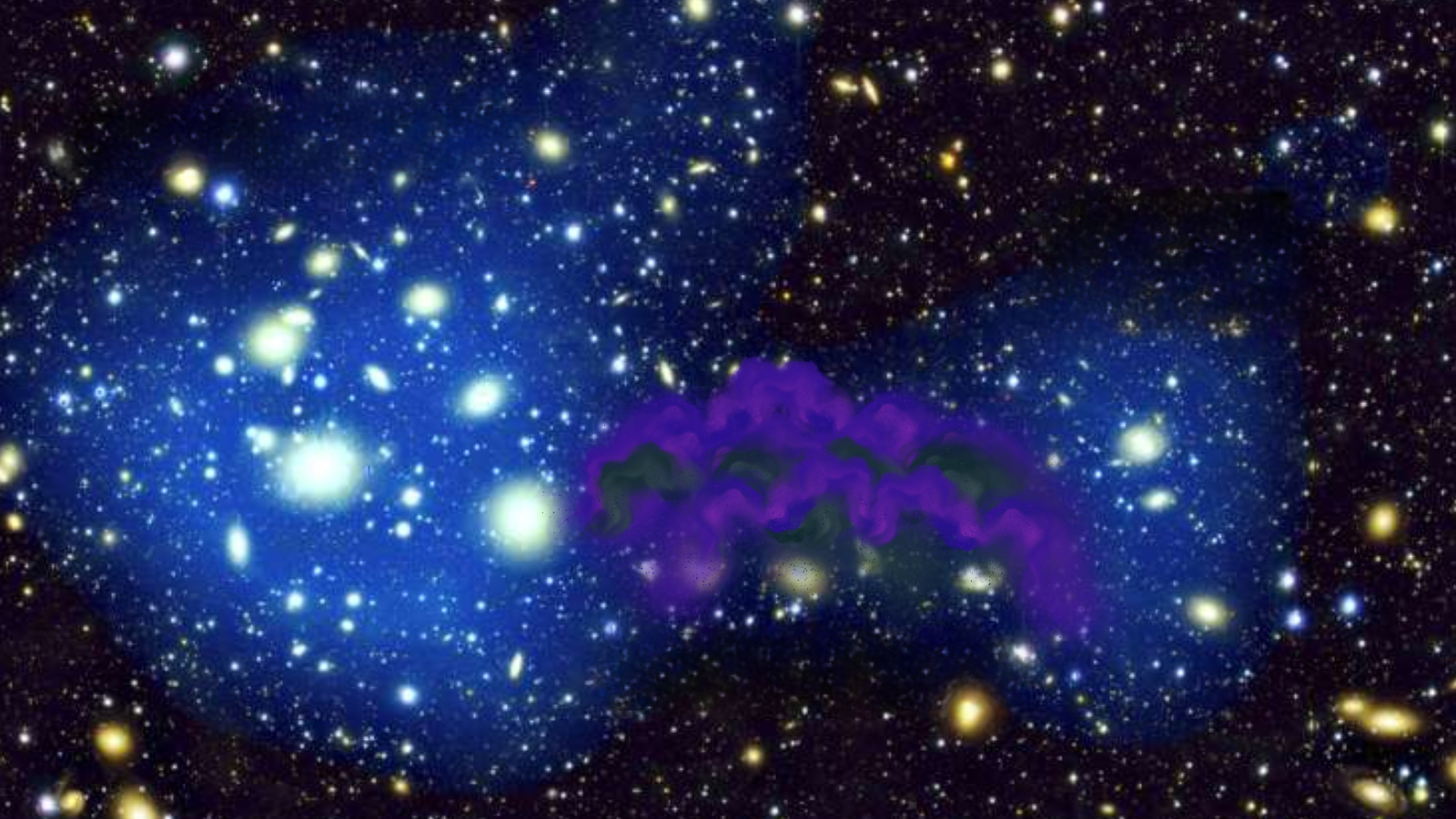
Although scientists don’t know the exact nature of dark matter, many models suggest that it is made up of electrically neutral particles – those without an electric charge. This trait makes it impossible to observe dark matter in the same way that we observe ordinary matter.
Dark matter is thought to be made of particles that are their own antiparticles. Antiparticles are the “mirror” versions of particles. They have the same mass but opposite electric charge and other properties. When a particle encounters its antiparticle, the two annihilate each other in a burst of energy.
You may like
If dark matter particles are their own antiparticles, they would annihilate upon colliding with each other, potentially releasing large amounts of energy. Scientists predict that this process plays a key role in the formation of dark stars, as long as the density of dark matter particles inside these stars is sufficiently high. The dark matter density determines how often dark matter particles encounter, and annihilate, each other. If the dark matter density inside dark stars is high, they would annihilate frequently.
What makes a dark star shine?
The concept of dark stars stems from a fundamental yet unresolved question in astrophysics: How do stars form? In the widely accepted view, clouds of primordial hydrogen and helium — the chemical elements formed in the first minutes after the Big Bang, approximately 13.8 billion years ago — collapsed under gravity. They heated up and initiated nuclear fusion, which formed heavier elements from the hydrogen and helium. This process led to the formation of the first generation of stars.
In the standard view of star formation, dark matter is seen as a passive element that merely exerts a gravitational pull on everything around it, including primordial hydrogen and helium. But what if dark matter had a more active role in the process? That’s exactly the question a group of astrophysicists raised in 2008.
In the dense environment of the early universe, dark matter particles would collide with, and annihilate, each other, releasing energy in the process. This energy could heat the hydrogen and helium gas, preventing it from further collapse and delaying, or even preventing, the typical ignition of nuclear fusion.
The outcome would be a starlike object — but one powered by dark matter heating instead of fusion. Unlike regular stars, these dark stars might live much longer because they would continue to shine as long as they attracted dark matter. This trait would make them distinct from ordinary stars, as their cooler temperature would result in lower emissions of various particles.
What could dark matter be made of? (Image credit: HyeongHan et al/Robert Lea)
Can we observe dark stars?
Several unique characteristics help astronomers identify potential dark stars. First, these objects must be very old. As the universe expands, the frequency of light coming from objects far away from Earth decreases, shifting toward the infrared end of the electromagnetic spectrum, meaning it gets “redshifted.” The oldest objects appear the most redshifted to observers.
Since dark stars form from primordial hydrogen and helium, they are expected to contain little to no heavier elements, such as oxygen. They would be very large and cooler on the surface, yet highly luminous because their size — and the surface area emitting light — compensates for their lower surface brightness.
They are also expected to be enormous, with radii of about tens of astronomical units — a cosmic distance measurement equal to the average distance between Earth and the sun. Some supermassive dark stars are theorized to reach masses of roughly 10,000 to 10 million times that of the sun, depending on how much dark matter and hydrogen or helium gas they can accumulate during their growth.
So, have astronomers observed dark stars? Possibly. Data from the James Webb Space Telescope has revealed some very high-redshift objects that seem brighter — and possibly more massive — than what scientists expect of typical early galaxies or stars. These results have led some researchers to propose that dark stars might explain these objects.
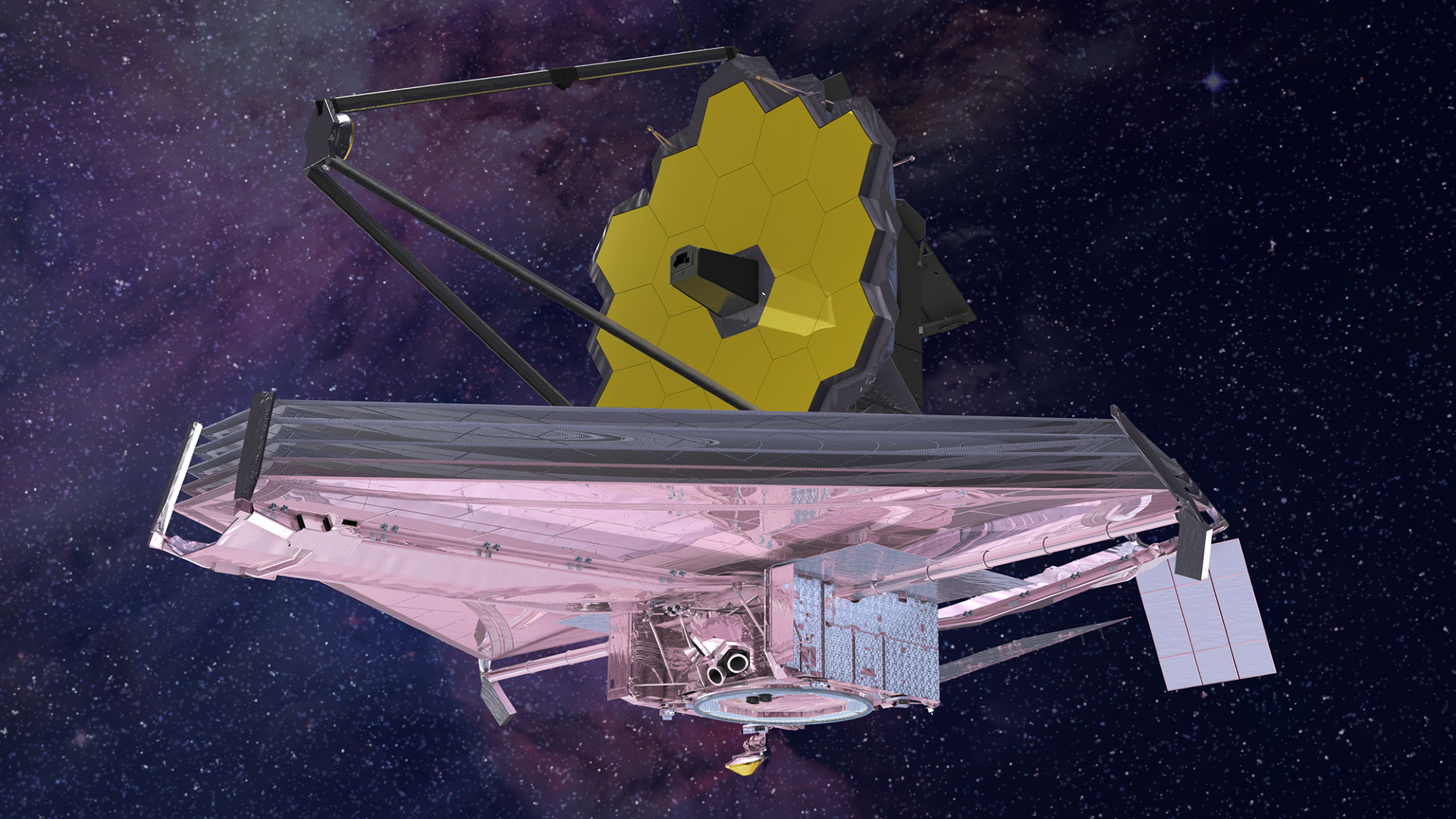
The James Webb Space Telescope may have detected some dark stars. (Image credit: NASA, ESA, CSA, Northrop Grumman)
Dark stars may explain early black holes
What happens when a dark star runs out of dark matter? It depends on the size of the dark star. For the lightest dark stars, the depletion of dark matter would mean gravity compresses the remaining hydrogen, igniting nuclear fusion. In this case, the dark star would eventually become an ordinary star, so some stars may have begun as dark stars.
Supermassive dark stars are even more intriguing. At the end of their lifespan, a dead supermassive dark star would collapse directly into a black hole. This black hole could start the formation of a supermassive black hole, like the kind astronomers observe at the centers of galaxies, including our own Milky Way.
Dark stars might also explain how supermassive black holes formed in the early universe. They could shed light on some unique black holes observed by astronomers. For example, a black hole in the galaxy UHZ-1 has a mass approaching 10 million solar masses, and is very old – it formed just 500 million years after the Big Bang. Traditional models struggle to explain how such massive black holes could form so quickly.
The idea of dark stars is not universally accepted. These dark star candidates might still turn out just to be unusual galaxies. Some astrophysicists argue that matter accretion — a process in which massive objects pull in surrounding matter — alone can produce massive stars, and that studies using observations from the James Webb telescope cannot distinguish between massive ordinary stars and less dense, cooler dark stars.
Researchers emphasize that they will need more observational data and theoretical advancements to solve this mystery.

While diving off the coast of Egypt, underwater archaeologists found the 2,000-year-old remains of a boat that may have been a luxurious “pleasure barge” for the ancient elite.
The team discovered the barge in the ancient harbor of Alexandria, the capital of Egypt during the Ptolemaic period (304 to 30 B.C.) and a major city when the Roman Empire later dominated the region.
You may like
Goddio said his team discovered the remains of the vessel in October, during underwater excavations of now-sunken ruins of a Temple of Isis. The temple once sat on the island of Antirhodos, which now lies underwater, and was within the “Portus Magnus,” or Great Harbor, used at Alexandria during the Ptolemaic period. The temple there was destroyed, probably during an earthquake in about A.D. 50, and the island sank beneath the waves between the fourth and the eighth centuries.
Goddio thinks the pleasure barge would have carried a luxuriously decorated central cabin and been propelled by oars. No remains of such a vessel have ever been found, although they were described by ancient writers and portrayed in Egyptian art.
The researchers have made a 3D model of the wreck from precise digital photographs. (Image credit: Christoph Gerigk ©Franck Goddio/Hilti Foundation)
Among the lotuses
Giant pleasure barges were popular during the Ptolemaic dynasty in Egypt and were described by the first-century-B.C. Greek geographer Strabo as ferrying the wealthy between choice spots: “… they hold feasts in cabin-boats in which they enter the thick of the cyami [Egyptian lotuses that grow in fresh water] and the shade of the leaves.”
In Strabo’s time, Alexandria was under direct Roman control — an ancient regime change that began at the Battle of Actium in 31 B.C., when naval forces commanded by Roman leader Octavian (later Augustus) defeated the navy of Cleopatra VII (the last ruler of the Ptolemaic dynasty) and her lover, the Roman rebel Mark Antony.
Exactly how the newfound vessel ended up by the island of Antirhodos is unclear.
“This intriguing shipwreck could have been used along the canals in Alexandria as Strabo described,” Goddio said in the statement. But it was found near the underwater ruins of the Temple of Isis on Antirhodos and may have been caught up in the destruction there.
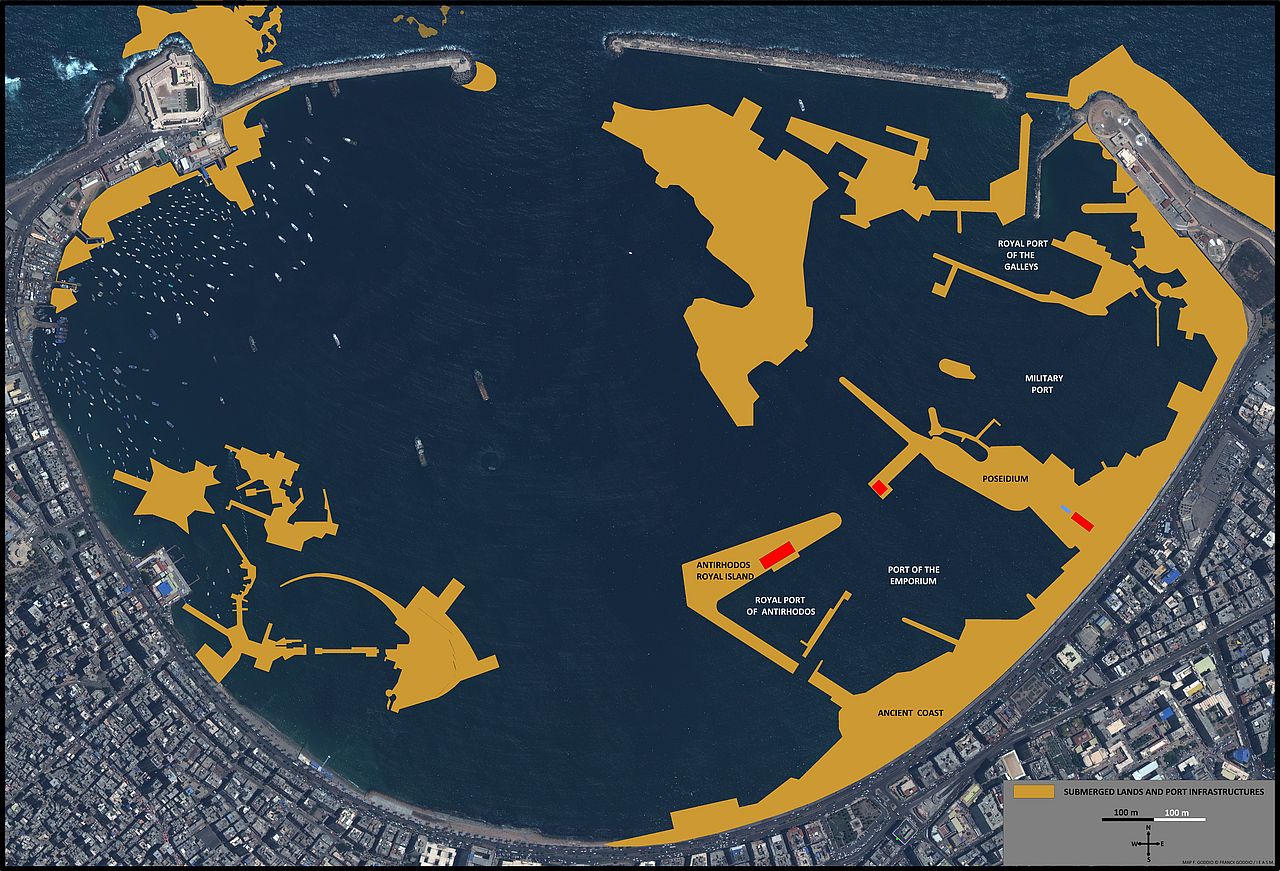
A map of the Great Harbor at Alexandria showing (in red) the areas excavated by the researchers. Antirhodos was southwest of the harbor’s center. It sank, along with many other parts of the ancient harbor, between the fourth and the eighth centuries. (Image credit: Franck Goddio ©IEASM)
As a result, the researchers suggested “a ritual use for this barge,” Goddio said. It may have been part of the “navigatio iside,” a naval ceremony held in Roman-era Alexandria when a procession celebrating Isis carried a richly decorated vessel called the “Navigium” through the streets. The mock-up boat represented the solar barque that the Egyptian gods used to navigate across the heavens. (Isis was the goddess of the sea.)
You may like
That, in turn, could mean that “this vessel was performing a yearly ritual voyage of the goddess from the Portus Magnus of Alexandria to the sanctuary of Osiris at Canopus, alongside the Canopic Channel” of the Nile, Goddio said.
Early Roman Egypt
The research into the wrecked vessel is at a very early stage, but it “promises to be a fascinating journey into life, religion, luxury and pleasure on the waterways of early Roman Egypt,” Goddio said.
The vessel is a “spectacular find,” said Timmy Gambin, a maritime archaeologist at the University of Malta whose research covers ancient vessels as well as wartime wrecks. However, it has not yet been scientifically determined if the vessel is actually a thalamagos, said Gambin, who was not involved in the discovery.
“It is yet early days to determine exactly what the vessel was used for,” he told Live Science in an email.
SCIENCE
Geminid meteor shower peaks tonight — here’s what to expect from one of the best shooting star shows of the year

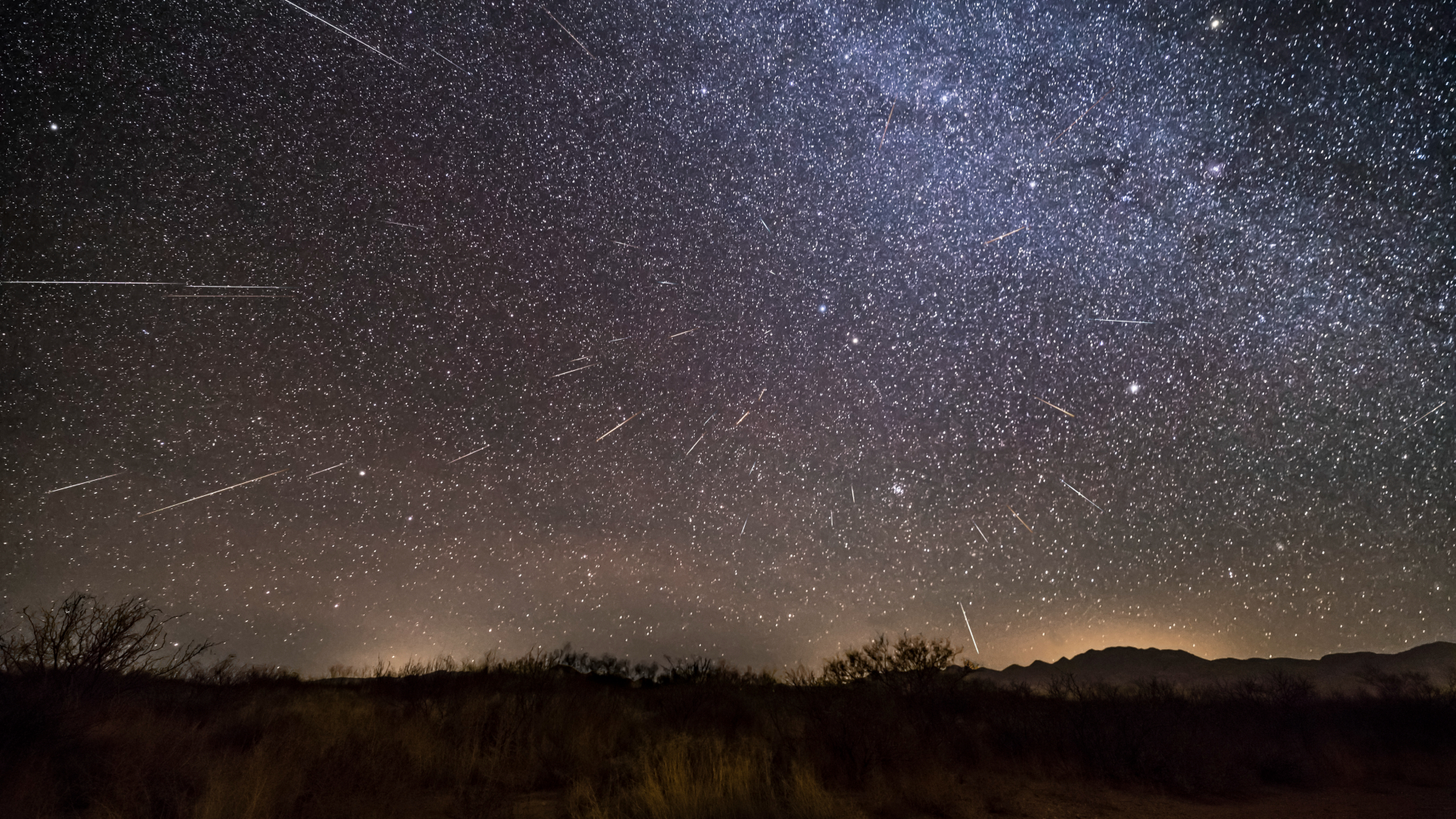
A composite view of the Geminid meteor shower taken from Arizona in the United States. (Image credit: Alan Dyer/VW Pics/UIG via Getty Images)
The Geminid meteor shower peaks overnight tonight (Dec. 13-14), bringing with it the potential for a breathtaking display of shooting stars as Earth barrels through the debris trail shed by comet 3200 Phaethon.
Shooting stars appear when particles from ancient comets and asteroids collide with Earth’s atmosphere, burning up in a magnificent display that can be easily visible to the naked eye. A particle no larger than a grain of sand has the potential to create a beautiful, short-lived meteor, while larger fragments that can exceed 1 meter (3 feet) in size create magnificent “fireballs”, which can blaze brighter than the planet Venus during their passage through the night sky.
You may like
How to see Geminid meteors
Geminid meteors appear to travel from a point of origin, or radiant, located close to the bright star Castor in the constellation Gemini, which rises above the Northern Hemisphere’s eastern horizon in the hours following sunset on Dec. 13. It is from this constellation that the shower gets its name.
It will be possible to see Geminid meteors as soon as darkness falls and the radiant is above the horizon, though only a few meteors will be visible during this early period passing low in the northern and southern sky, heading westward. “The few meteors that do appear at this time are special in the fact that they just skim the atmosphere rather than penetrate deeply,” said meteor expert Robert Lunsford in a post detailing observing tactics on the AMS website. “This allows them to last for several seconds rather than the normal sub-second duration.”
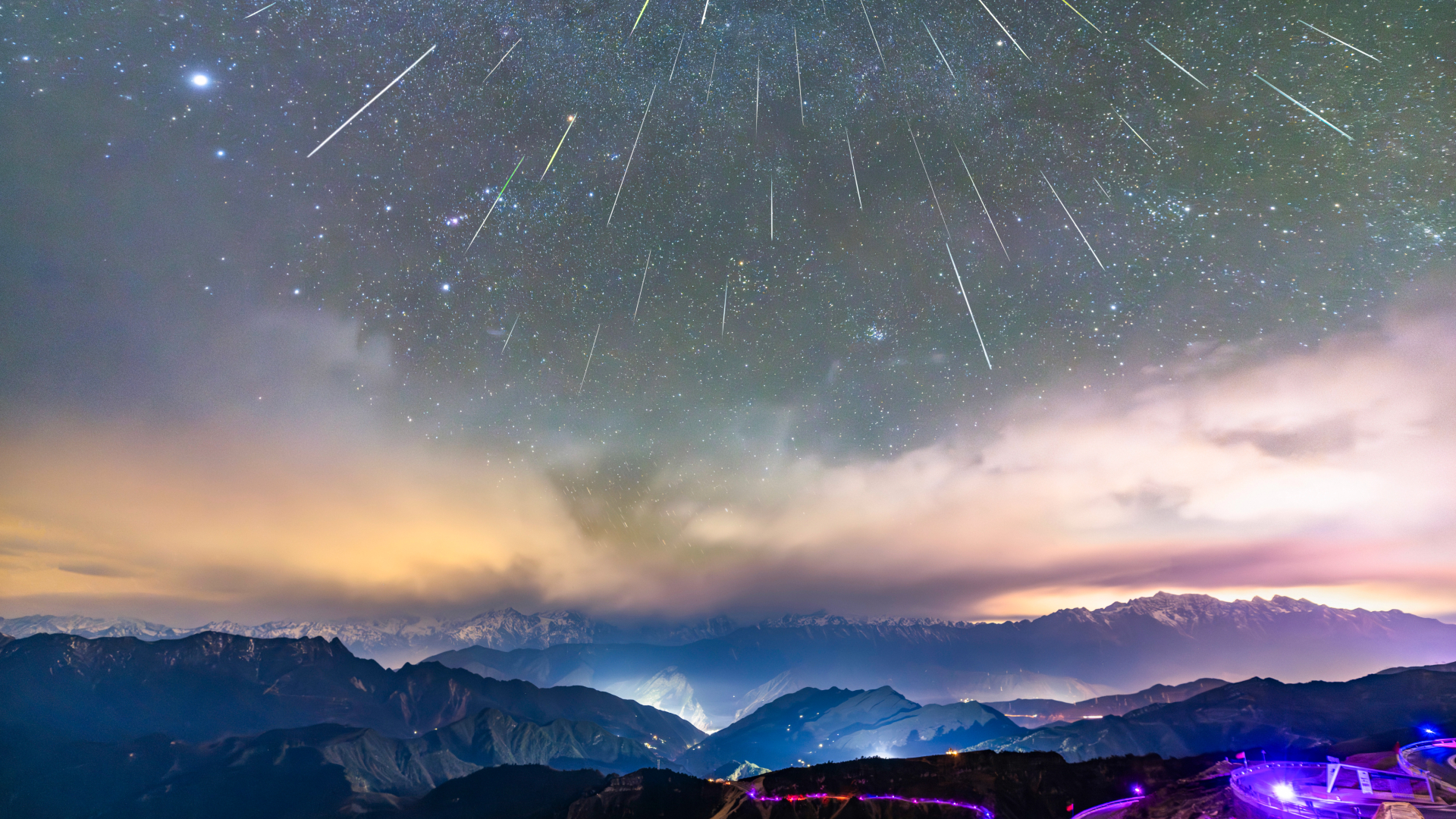
A composite view of Geminid meteors captured from the top of Niubei Mountain in the Sichuan Province of China. (Image credit: CFOTO/Future Publishing via Getty Images)
A greater number of meteors will become visible after 10 p.m. local time, when up to 30 Geminids may be seen under dark sky conditions as the radiant soars higher in the autumn sky.
To see meteors with the longest trails, first locate the radiant by finding Castor with a smartphone astronomy app. If you need help finding it, you can first look for the planet Jupiter, which can be seen shining brightly in the constellation Gemini throughout December. Next, stake out a patch of sky 30-40 degrees above Castor, where the trails of shooting stars will be at their longest. Remember, the width of your clenched first accounts for approximately 10 degrees of sky, so this would be about three or four hand widths above Jupiter.
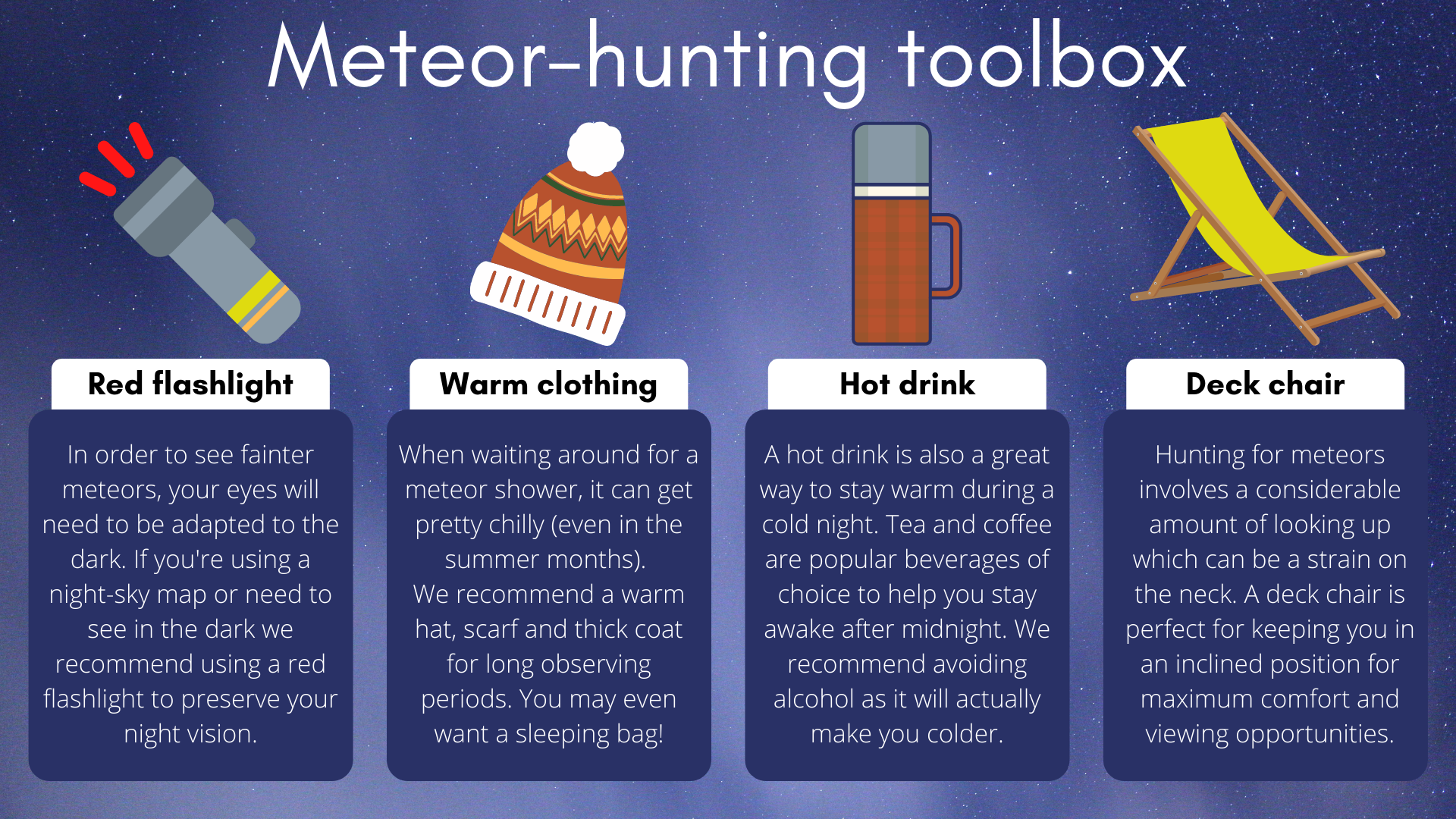
A red flashlight, warm clothing, a hot drink and a comfortable chair are useful during a night of meteor-hunting. (Image credit: Created in Canva by Daisy Dobrijevic)
Nikon Z8

(Image credit: Jason Parnell-Brookes)
Want to capture the natural splendor of the Geminid meteor shower for yourself? We rate the Nikon Z8 as the best overall camera out there! Be sure to check out our Nikon Z8 review for a more in-depth look at its capabilities.
“As each hour passes, hourly rates will increase reaching maximum near 2 a.m.,” continued Lunsford. “At this hour expect to see up to 60 Geminid meteors from dark rural sites.” Things will get a little trickier when the 25%-lit waning crescent moon rises around 2 a.m. local time. Thankfully, it will still be possible to see many shooting stars brightening the sky around this time by keeping the lunar disk out of your field of view.
When hunting meteors, It’s best to allow 30 minutes to allow your eyes to fully adapt to the dark and to use a red light where possible to preserve your night vision. Remember to dress warmly to make the experience enjoyable, and try to take a reclining chair or sleeping bag that will allow you to lie back and take in as much sky as possible in a comfortable position.
Photographers interested in capturing the shower should read our guide to imaging meteor showers, while those looking to upgrade their gear should read our roundups of the best astrophotography lenses and cameras for capturing the night sky.
Editor’s Note: If you capture an image of a Geminid shooting star and want to share your astrophotography with Space.com’s readers, then please send your photo(s), comments, name and location to spacephotos@space.com.
SCIENCE
Brutal lion attack 6,200 years ago severely injured teenager — but somehow he survived, skeleton found in Bulgaria reveals


Around 6,200 years ago, a teenage boy survived a brutal lion attack in what is now Bulgaria — although deep holes in the youngster’s skull suggest his brain was badly damaged, a new study finds.
The 16- to-18-year-old may have been hunting when he encountered the lion (Panthera leo), according to the study, which was published Nov. 30 in the Journal of Archaeological Science: Reports. Lions roamed what is now Eastern Europe in the Copper Age (4500 to 3500 B.C.), and cut marks on lion bones from prehistoric settlements on the Black Sea coast suggest humans occasionally ate them.
You may like
“The skull shows a specific pattern of puncture and compressive injuries that are inconsistent with human-made weapons or postmortem damage,” study lead author Nadezhda Karastoyanova, an archaeozoologist at the National Museum of Natural History of the Bulgarian Academy of Sciences (NMNH-BAS), told Live Science in an email. “The size, shape, depth, and spacing of the defects are compatible with trauma produced by the bite of a very large carnivore.”
To work out which carnivore was responsible for the attack, the researchers examined various skulls in the NMNH-BAS collection, including lion and bear skulls. Using a special moulding process, they compared different tooth imprints to those found on the teenager’s skull. The team also considered the distribution of large carnivores during the Copper Age and found the most likely culprit was a lion.
Prehistoric evidence of lion attacks on humans is extremely rare, but what makes this case even more exceptional is that the teenager survived the initial trauma, Karastoyanova said. There are clear signs of healing on the youngster’s skull, suggesting he received medical care after the attack. However, the stage of healing is not very advanced — only two or three months along — so it appears the teenager succumbed to his wounds.
The lion attack likely left the teenager with severe brain injuries. (Image credit: Karastoyanova et al. (2025), Journal of Archaeological Science: Reports; CC BY-NC-ND 4.0)
One wound in particular looks like it may have damaged the teenager’s meninges — the membranes that line the inside of the skull — leaving the integrity of his brain in a “questionable” state, according to the study.
The youngster’s legs and left arm also sustained deep wounds, possibly damaging his muscles and tendon attachments, Karastoyanova said. “Because the individual was seriously impaired as a result of these injuries, yet survived for a considerable period, it is highly likely that they received care and assistance from others in the community,” she said.
The teenager was buried near a prehistoric settlement called Kozareva Mogila, or “Goat Mound,” in eastern Bulgaria. Previous discoveries indicate that the inhabitants of Kozareva Mogila tried to treat diseases and performed surgeries on the skulls of living and dead individuals. This suggests they had some level of medical knowledge that may have helped the teenager survive after the attack.
But the youngster likely retained deep scars on his head, arms and legs that changed his appearance considerably, according to the study. He probably needed support for everyday movements, meaning he couldn’t do physical labor such as farming, and his neurological functions may have been severely impaired.
Archaeologists found the teenager buried in a crouched position with his hands in front of his face. Measurements indicate he was about 5 feet, 9 inches (175 centimeters) tall. No grave goods were found next to his skeleton, and his burial was deep compared with others at Kozareva Mogila, suggesting he had a low social status and was feared by his community after the attack.
“His individual life experience, possible intimidating behaviour and appearance could have made him an extraordinary and dangerous dead [person], demanding deeper deposition,” the researchers wrote in the study.

Usually, we get tattoos on purpose. But some injuries leave us with a different type of mark known as a “traumatic tattoo” — and these tattoos have nothing to do with needles or ink. So what exactly are traumatic tattoos?
Traumatic tattoos are formed when everyday materials, like graphite, dirt or gravel; or metal pieces, like shrapnel, become lodged beneath our skin, leaving a visible (and often long-lasting) mark.
“It’s when foreign particles like dirt, asphalt, metal, sand, etc become embedded into the skin’s … dermis,” Dr. Mara Weinstein Velez, a dermatologist at the University of Rochester Medical Center, told Live Science in an email. “And it happens more often than you’d think! Events like car accidents, scrapes and falls can cause this.”
You may like
These residual marks don’t always cause pain or even discomfort in the long term, but their appearances can last a lifetime. While some are born from truly traumatic events, like a motorcycle crash that ends in road rash, leaving gravel or asphalt trapped under the skin, or a gunshot wound that isn’t fully cleaned, others originate from common experiences, like the poke of a pencil in an elementary school classroom.
Sometimes the material itself becomes unlodged naturally over time, and sometimes it travels nearby within the body. For instance, one child had a pencil lead in their hand travel to their wrist. But in these cases, particles sometimes remain at the original entry spot, which is why a dark-colored scar can be left behind, under the skin.
Although the presence of an old traumatic tattoo isn’t necessarily harmful or worthy of a trip to the doctor on its own, experts say it’s best to seek medical advice when you’re first wounded. The biggest risk is usually the possibility of infection, as harmful bacteria can enter the body along with the foreign object. However, surgery may also become necessary if the object has migrated under the skin to a more risk-prone location or if it has become uncomfortable. Always consult a doctor if you experience this type of injury.
Traumatic tattoos can occur when foreign particles, like graphite from pencils, get trapped in our skin’s dermis layer. (Image credit: seamartini/Getty Images)
“It’s very important to seek medical help right away to avoid infection, since it is a foreign object,” Weinstein Velez said. “Treatments like minor surgeries, laser and dermabrasion can help safely remove the foreign matter from the skin.”
People who work in physically demanding industries, like mining and construction, are more likely to develop traumatic tattoos in the workplace, as they’re exposed to fast-moving foreign materials like silt and rock more often during their day-to-day life.
But the traumatic tattoos we’re perhaps more familiar with are small, barely noticeable scars from pencils. Pencils are made with graphite, which is a soft mineral held together with clay and wax, and is considered nontoxic and safe. However, “a doctor will probably need to see deep stab wounds that go further than the skin and any that are close to the eyes,” according to Missouri Poison Control.
Traumatic tattoos also appear frequently in the military, often from the enmeshment of gunpowder and ammunition under service members’ skin after explosions or gunshots — and even during weapon malfunctions during live drills, as seen in one study conducted by researchers with the Department of Oral and Maxillofacial Surgery at the Womack Army Medical Center in North Carolina.
Even if not otherwise treated, traumatic tattoos can be addressed from a cosmetic standpoint. To disguise or cover these marks, dermatologists employ the same types of lasers that are typically used to remove professional tattoos, matching the color of the trapped pigment to the appropriate wavelength of light. The pigment fragments into smaller pieces when targeted by these lasers. However, because some tattoo colors are able to absorb a wider range of wavelengths than others, meaning they can be broken into even smaller particles that the immune system can then target, dermatologists use different tools on different marks depending on color and placement.
The laser “breaks up the pigment, and then your body’s immune cells, called macrophages, clear out the pigments,” said Dr. Anna A. Bar, a professor of dermatology and co-director of Mohs micrographic surgery at Oregon Health and Science University. “It’s not an instant result — you have to wait like a month for the tattoo to fade.”
Even though a traumatic tattoo may take time and multiple sessions to address, because there is usually less pigment involved, “they’re often easier to remove than professional tattoos,” she added. “Usually, it’s a bit easier to remove amateur tattoos or traumatic tattoos.”
This article is for informational purposes only and is not meant to offer medical advice.


One of SpaceX’s Starlink internet satellites just dodged a bullet in orbit.
That bullet was one of the nine spacecraft that launched atop a Chinese Kinetica 1 rocket on Tuesday (Dec. 9) from Jiuquan Satellite Launch Center in the Gobi Desert. It zoomed dangerously close to a Starlink satellite, according to SpaceX, which was none too pleased with the close shave.
“As far as we know, no coordination or deconfliction with existing satellites operating in space was performed, resulting in a 200-meter close approach between one of the deployed satellites and STARLINK-6079 (56120) at 560 km altitude. Most of the risk of operating in space comes from the lack of coordination between satellite operators — this needs to change,” Michael Nicolls, vice president of Starlink engineering at SpaceX, said via X on Friday evening (Dec. 12).
You may like
Kinetica 1 is a 100-foot-tall (30 meters) solid-fuel rocket operated by CAS Space. The company, which is based in Guangzhou, responded to Nicolls’ post, saying that it did its due diligence as the launch services provider (LSP) but is looking into the incident nonetheless.
“Our team is currently in contact for more details. All CAS Space launches select their launch windows using the ground-based space awareness system to avoid collisions with known satellites/debris. This is a mandatory procedure. We will work on identifying the exact details and provide assistance as the LSP,” CAS Space said via X on Friday night.
Tuesday’s Kinetica 1 launch lofted “six Chinese multifunctional satellites, an Earth-observation satellite for the UAE [United Arab Emirates}, a scientific satellite for Egypt and an educational satellite for Nepal,” according to China Daily. Nicolls’ post did not specify which of these spacecraft zoomed close to the Starlink satellite.
The coordination that Nicolls cited is becoming more and more important, for Earth orbit is getting more and more crowded. In 2020, for example, fewer than 3,400 functional satellites were whizzing around our planet. Just five years later, that number has soared to about 13,000, and more spacecraft are going up all the time.
Most of them belong to SpaceX. The company currently operates nearly 9,300 Starlink satellites, more than 3,000 of which have launched this year alone.
Starlink satellites avoid potential collisions autonomously, maneuvering themselves away from conjunctions predicted by available tracking data. And this sort of evasive action is quite common: Starlink spacecraft performed about 145,000 avoidance maneuvers in the first six months of 2025, which works out to around four maneuvers per satellite per month.
That’s an impressive record. But many other spacecraft aren’t quite so capable, and even Starlink satellites can be blindsided by spacecraft whose operators don’t share their trajectory data, as Nicolls noted.
And even a single collision — between two satellites, or involving pieces of space junk, which are plentiful in Earth orbit as well — could spawn a huge cloud of debris, which could cause further collisions. Indeed, the nightmare scenario, known as the Kessler syndrome, is a debris cascade that makes it difficult or impossible to operate satellites in parts of the final frontier.