
TECHNOLOGY
How iRobot lost its way home


There’s something painfully American about the arc of iRobot, the company that taught your vacuum to navigate around the furniture. Founded in 1990 in Bedford, Massachusetts by MIT roboticist Rodney Brooks and his former students Colin Angle and Helen Greiner, the company filed for Chapter 11 bankruptcy on Sunday, ending a 35-year run that took it from the dreams of AI researchers to your kitchen floor and, finally, to the tender mercies of its Chinese supplier.
Brooks, the founding director of MIT’s Computer Science and Artificial Intelligence Lab and the robotics field’s resident provocateur, spent the eighties watching insects and having epiphanies about how simple systems could produce complex behaviors. By 1990, he’d translated those insights into a company that would eventually sell over 50 million robots. The Roomba, launched in 2002, became the rare gadget that transcended its category to become a verb, a meme, and, to the amusement of many, a cat-transportation device.
The money soon followed, with the company raising $38 million altogether, including from The Carlyle Group, before going public in a 2005 IPO that raised $103.2 million. By 2015, iRobot was flush enough to launch its own venture arm, prompting TechCrunch to wryly declare that “robot domination may have just taken another step forward.” The plan at the time was to invest $100,000 to $2 million in up to 10 seed and Series A robotics startups each year. It was the kind of move that marks a company’s arrival, the moment when you’re successful enough to fund the next generation’s dreams.
Then came what looked like salvation. In 2022, Amazon agreed to acquire iRobot for $1.7 billion in what would have been Amazon’s fourth-largest acquisition ever. In a press release announcing the news, Angle, who’d been CEO since the company’s inception, spoke about “creating innovative, practical products” and finding “a better place for our team to continue our mission.” It seemed like a fairy tale ending — the scrappy MIT spinoff absorbed into the Everything Store’s sprawling empire.
Except European regulators had other ideas. Indeed, amid threats they would block the deal — they believed that Amazon could foreclose rivals by restricting or degrading access to its marketplace — Amazon and iRobot agreed to kill the deal in January 2024, with Amazon paying a $94 million breakup fee and walking away. Angle resigned. The company’s shares nosedived. It shed 31% of its workforce.
What followed afterward was a slow-motion collapse. Earnings had been declining since 2021 thanks to supply chain chaos and Chinese competitors flooding the market with cheaper robot vacuums. The Carlyle Group, which provided a $200 million lifeline back in 2023, ultimately just prolonged the inevitable. (It finally sold that loan last month — presumably at a discount, though it didn’t say either way.)
Now it’s over, at least, the version of the company that existed previously. Shenzhen PICEA Robotics, iRobot’s main supplier and lender, will take control of the reorganized company. According to a release issued by iRobot on Sunday, the restructuring plan allows iRobot to remain as a going concern and “continue operating in the ordinary course with no anticipated disruption to its app functionality, customer programs, global partners, supply chain relationships, or ongoing product support.”
Techcrunch event
San Francisco
|
October 13-15, 2026
It also vowed to “meet its commitments to employees and make timely payments in full to vendors and other creditors for amounts owed throughout the court-supervised process.”
What this means for customers longer term is another question, one we’ve reached out to iRobot to ask. In its release, iRobot promises to keep supporting existing products during restructuring; at the same time, its legal disclosures acknowledge the inherent uncertainties of bankruptcy — whether suppliers stick around, whether the process goes as planned, whether the company survives at all.
As The Verge noted in a story about iRobot’s struggles last month, even if iRobot eventually collapses and takes its cloud services down with it, customers’ Roomba vacuums won’t become useless pucks. The physical controls should keep working — a Roomba owner could still jab the button to send it off to vacuum or tell it to head home.
What Roomba owners would lose is everything that make the devices feel futuristic, including app-based scheduling, the ability to tell it which rooms to clean, and voice commands barked at Alexa while sprawled on the couch.









TECHNOLOGY
A tape measure, a metal detector and a spirit level: 25 surprisingly useful things you can do with your phone | Mobile phones

Our smartphones are magical things – far more than dopamine drip providers and a way to keep in touch with friends and family. Using the built-in features and easily available additional apps, there are plenty of clever things you can do with your smartphone.
Turn your phone into a tape measure
The iPhone’s Measure app uses augmented reality and the device’s camera to calculate everything from ceiling heights to room dimensions – handy for those DIY tasks that require a quick decision. And, good news for parents, Apple also points out that you can use it to measure a person’s height: the digital equivalent of etched markings on the wall.
Become a detectorist
Metal detectors cost a pretty penny, but many modern devices have built-in magnetometers designed to help improve the accuracy of GPS within apps. Those magnetometers are also used in metal detectors, and some apps can harness that tech to detect metal. These apps are never going to be as accurate as tailor-made products, but if you are looking for a way to entertain the kids on a day at the beach, they will more than suffice in seeking out small bits of treasure.
Turn it into a remote control
Remote control … smartphones can operate your other connected media devices. Photograph: Maskot/Getty Images
Lost the television remote down the back of the sofa again? Many Android phones include an infrared blaster that can mimic the signals from your TV, set-top box or air-conditioning remote, while others can talk to smart devices over wifi or Bluetooth. Download a remote control app, point your phone at the screen, and you can adjust the volume, switch inputs or change channels. Link in smart lights, speakers and streaming sticks and your handset becomes a control centre for the whole living room … though it does make it easier for teenagers to prank you by changing channel mid-episode.
Digitise your old holiday snaps
Got a load of old photographic negatives that you never got round to having developed – or worse, lost the prints for? Apps such as FilmBox, available on iOS and Android, can turn your negatives into digital photos (provided you shine light through them). Even better, you can then use image-editing apps to fine-tune the colour balance on old, washed-out pics.
Don’t get stuck on hold to companies
Some companies now offer a callback service so you don’t have to stay on hold for ages, but if they don’t, you can use your phone to do the same thing. The Hold Assist feature, available on iPhones running iOS 26, gives you a notification when it hears a human voice on the other end of the line, so you can get back to work safe in the knowledge you won’t miss your turn.
Create 3D scans of objects
Newer iPhones and some Android handsets have depth sensors such as lidar (light detection and ranging) that can map the world in 3D. Install a scanning app, slowly walk around the object or room you want to capture, and your phone will stitch those readings into a detailed 3D model. You can then export it for 3D printing, game design or simply to keep a precise digital copy of bulky items before you sell or recycle them. It is also a neat way to document the contents of a rented flat for insurance purposes, or capture awkward corners when planning renovations.
Map and record hikes without mobile signal
If you are an outdoorsy type, phones can help keep you on key routes and out of danger. Make sure you download offline maps before you go somewhere remote, and your phone’s GPS will still work without reception. Hiking and cycling apps can track your route, elevation and distance, then save it so you can retrace your steps – or share it with friends later.
Create a stethoscope
Combined with smartwatches, smartphones have become a boon for those wanting to keep track of their health, but it’s possible to go even further. A 2022 trial to see whether a smartphone’s microphone could accurately measure heartbeats – similar to how a stethoscope works – demonstrated that “mobile technologies are a viable way of recording heart sounds”. A commercial “cardiac screening tool” app is already available in the US.
Help yourself get to sleep
Some people spend money on white noise machines and then cart them around in their suitcase when they are travelling. But it’s possible to achieve the same benefit with your iPhone. Simply go to the accessibility section in your device’s settings, then tap on audio & visual. You can then turn on a variety of sounds, from white noise to ocean waves to crackling fire, to lull you to sleep.
Match that tricky paint colour
Trying to repaint a wall without the original tin to hand can feel impossible. Instead of juggling paper swatches, use your phone’s camera and a colour-matching app to sample the shade directly from the wall, or cushion, or curtain, or whatever you like. The software will suggest the closest equivalents from major paint ranges, and some apps also let you preview those colours on a photo of your space, combining paint matching and augmented reality in one go.
Live translate menus, signs and handwriting
On a foreign holiday and not sure what to eat or where to go? Live translation capabilities in apps such as Google Translate mean that it need not all be Greek to you. A combination of image recognition and live translation tools can identify foreign symbols and transpose English-language translations over the top of them, so you should never end up with an unexpected surprise for dinner.
Identify unknown plants
Plant-spotter … apps can identify plants, animals and other objects. Photograph: Evgeniia Siiankovskaia/Getty Images
Not sure what is growing along your boundary wall, or what kind of cactus you have just bought? AI-powered insights from your smartphone’s camera lens can identify plants, animals and other objects, with surprising accuracy. Specialist apps abound for identifying plants, but the catch-all service provided by Google Lens is a surprisingly accurate way to distinguish your hydrangeas from your hosteas.
Amp up your webcam
Built-in cameras on all but the most expensive laptops and PCs are low-resolution and cope poorly in low-light conditions, meaning you’re blighted with the curse of blurry Zoom calls. Smartphone cameras are way more souped-up, and have automated processing that constantly tries to improve your image quality, making them ideal for replacing your webcam. On iPhones and Mac computers, you need to look for the Handoff feature. On Android devices and Windows, follow the instructions in the “Link to Windows” app to set it up.
Measure sound levels
If you have noisy neighbours or need to keep track of how much noise builders are subjecting you to, a slew of decibel-measuring apps are available. They are surprisingly accurate thanks to plenty of training, and some councils will even encourage complainants to download them and log intrusions if they are in dispute with neighbours.
Make an ad hoc smart home
Near-field communication (NFC) is mostly associated with tap-to-pay transactions, but cheap NFC stickers (you can get 50 for less than £10 online) can act as programmable buttons for your life. Stick one by the front door and set your phone to turn on the wifi and lights when you tap it; put another on your bedside table to start a sleep playlist and enable Do Not Disturb. With a little experimentation, you can build simple smart home routines without buying a hub.
Hang paintings straight
If you have ever hung a picture, stepped back and realised it is slightly wonky, your phone can spare you constant tinkering. Many handsets include a built-in spirit level tucked away in the compass or measurement tools. Lay your phone on the top edge of a frame or shelf and it will show when you have hit level, down to a fraction of a degree. It’s ideal, too, for levelling bookshelves, curtain poles and even sorting out a wonky table leg.
Scan documents
Buying a house or getting a mortgage often involves having to sign contracts. Some companies will let you do this digitally, but if you are someone who prefers putting pen to paper, you can still do so – with the help of your device. Even most entry-level smartphones now include functions that allow you to turn a photograph into a perfectly serviceable scan by pinpointing the corners of a document when you hover your camera over it.
Turn physical photos into animated ‘memories’
Family prints stashed in shoe boxes don’t have to remain static. Scan them into your phone and apps, including Google Photos and Apple Photos, and shots can automatically be grouped by people, places and dates, then stitched into short “memories” complete with music and transitions. Some tools even add subtle motion effects to still images, making them feel more like miniature films than dusty snapshots.
Measure your blood oxygen saturation and predict problems
Signalling issues … Sensors on your smartphone help health apps to estimate blood oxygen saturation. Photograph: Trevor Williams/Getty Images
Health apps increasingly tap into sensors on your phone or connected watch to estimate blood oxygen saturation, a useful signal for issues such as breathing difficulties or altitude sickness. While they aren’t a replacement for clinical-grade monitors, they can function as an early warning system, highlighting unusual trends over time and prompting you to seek medical advice if something looks off, rather than ignoring a nagging feeling.
Empower your PowerPoint presentations
Ditch the dodgy clickers and install the companion app for PowerPoint, Keynote or Google Slides, and you can control your presentation remotely, swiping between slides and seeing your speaker notes on your handset. Some apps turn the screen into a virtual laser pointer, letting you highlight key details on a big display while roaming the stage, instead of being tethered to a laptop. At a pinch, you can even mirror your phone’s screen to a TV or projector and present straight from the handset if your main computer misbehaves.
Share your live location to stay safe
Most phones let you share your real-time location with trusted friends or family for a set length of time through apps such as WhatsApp. It is a low-effort safety net when walking home at night, travelling alone, or meeting someone new, and beats the old “text me when you get there” ritual.
Keep track of your diet
Calorie counting … ‘Phones make food diaries far less of a faff’. Photograph: Sorrasak Jar Tinyo/Getty Images
For those who want to monitor what they are eating, phones make food diaries far less of a faff. Nutrition apps enable you to scan barcodes or search databases to log meals, automatically tallying calories and nutrients across the day. Many sync with your step counter or smartwatch, so you can see the balance between what is going in and what you are burning off, without being nose-deep in a spreadsheet. They are just as useful for people trying to eat more fibre, reduce salt or spot foods that trigger symptoms as they are for anyone counting calories.
Turn your phone into a mini podcast studio
With a cheap plug-in microphone and a basic editing app, your phone can record and trim surprisingly high-quality audio. It’s enough to start a podcast, capture interviews on the go or simply send better-than-voice-note updates to friends and family.
Control your phone with your voice
Want to take a photo just by saying “click”? You can create voice-activated commands for your iPhone in the accessibility section – although it’s not super-straightforward. Tap on voice control > commands > custom, then select “create new command”. From there, you can type in a voice trigger (such as “click”), which then takes you into a recording of your screen. Everything you tap (like jabbing where the camera button is) will then be repeated whenever you say that phrase. So now when you open your camera and say “click”, hey presto! This can be useful, for automating all manner of repetitive tasks, although it only works when voice control is activated.
Paper scribbles stuck to the fridge are no match for dedicated shopping list apps. Apps such as Bring!, AnyList or Listonic let you share a live list with housemates or partners, tick off items in real time as you walk the aisles, and even add products by scanning barcodes or importing ingredients directly from online recipes.
TECHNOLOGY
Do YOU know your Taylor Swift terms from your incel idioms? Take the test to see if you can decipher the secret languages of subcultures

If you ever overhear people’s conversations and wonder what on Earth they’re talking about, a new book may offer a lifeline.
Described as ‘a miscellany of secret languages’, Schott’s Significa by Ben Schott explores the secret words and phrases used by more than 50 modern subcultures.
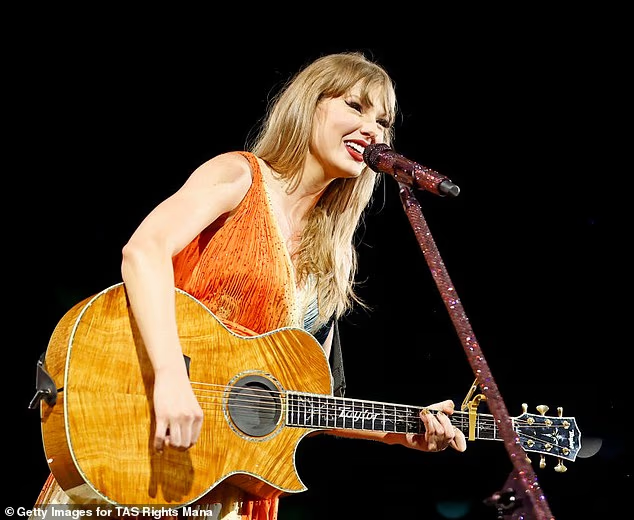
From Swifties (Taylor Swift fans), Las Vegas gamblers, bartenders, incels and dog walkers, these subdivisions of society all develop a private, secretive lexicon.
And their various words, signs, signals and oblique references are all designed to ‘bind its members closer while keeping strangers out’.
Now, the Daily Mail’s quiz presents 10 different words or phrases, each one from a subculture in Schott’s book.
For each round, you will see the word and four multiple choice options with possible definitions.
All you have to do is guess the correct definition.
So do you know your ‘donk’ from your ‘face card’? And does your ‘triskaidekaphilia’ keep you up at night? Scroll down for the answers!

From Swifties (Taylor Swift fans), Las Vegas gamblers, bartenders and dog walkers, the world is full of subcultures that have developed their own secret words and phrases – designed to keep outsiders none the wiser
1. TAYLOR SWIFT FANS
‘Triskaidekaphilia’
a) A love for friendship bracelets
b) A love for the number 13
c) A love for streaming Taylor Swift songs when asleep
d) A love for Taylor Swift songs that didn’t make the final album
2. LAS VEGAS GAMBLERS
‘Donk’
a) A player who doesn’t tip the bar staff
b) A player who can’t afford to lose money
c) An unskilled player
d) An unexperienced player

Do you know your ‘donk’ from your ‘steamer’? Las Vegas gamblers use little phrases to help speed up the process, safeguard staff and patrons and help minimise losses (file photo)
What is Schott’s Significa?
‘Schott’s Significa’ by Ben Schott reveals the secret words and phrases used by more than 50 modern subcultures, including Swifties (Taylor Swift fans), Las Vegas gamblers, bartenders and dog walkers.
These subdivisions of society have a system of private, secretive words, signs signals and oblique references – designed to ‘bind its members closer while keeping strangers out’.
Ben Schott is best known for his miscellanies published two decades ago that compiled hard-to-find but useful information.
‘Significa’ represents a continuation of the miscellanies for the internet age – as the intricacies of how people talk is one of the things even Google Search and ChatGPT struggle to answer.
3. INCELS (INVOLUNTARY CELIBATES)
‘Wizard’
a) A man who has platonic friendships with women
b) A man who has had sex more than 50 times
c) A man who is still a virgin at 30
d) A man who never marries
4. DOG WALKERS
‘Cujo’
a) A very loyal dog
b) A very exotic dog breed
c) A very aggressive dog
d) A very docile dog
5. BARTENDERS
‘Campers’
a) Patrons who take their drink outside
b) Patrons who have stopped ordering/paid but show no signs of leaving
c) Patrons who can’t walk properly because they are excessively drunk
d) Patrons who have been a long time in the toilet

Starbucks staff have evolved an oblique language system that lets them potentially bitch about customers within hearing range
6. STARBUCKS STAFF
‘Gertrude’
a) A female boss
b) A female staff member who deliberately writes the wrong names on customers’ coffee cups
c) A female customer who spills drink on the floor
d) An endlessly dissatisfied female customer
7. GRAFFITI WRITERS
‘Burner’
a) A paint product containing volatile chemicals
b) An especially impressive piece of graffiti
c) A graffiti artist that paints over existing graffiti
d) A graffiti artist that hides their painting materials when on-the-run

Schott’s Significa unlocks 53 of the most intriguing linguistic subcultures, including casinos, crypto, dog walkers, bartenders and typographers
8. LONDON BLACK CABBIES
‘Oranges and lemons’
a) Main roads
b) Multiple male passengers taking a trip together
c) Bumps in the road
d) Hailstones
9. INFLUENCERS
‘Face card’
a) The photo on an influencer’s social media profile
b) A female influencer who seeks male attention
c) An influencer whose looks are as valuable as a credit card
d) Inactive or fake social media accounts that impersonate another
10. GYM-GOERS
‘Lunk’
a) A particularly heavy dumbbell
b) Sweat left on gym equipment
c) An obnoxious, muscly gym-goer who is loud, rude and drops their weights when done
d) A member of gym staff who keeps interfering with people’s workouts
So how did you do? Correct answers below
- Triskaidekaphilia: B – A love for the number 13. Taylor Swift was born on the 13th December and her first album went gold in 13 weeks. She said: ‘Basically whenever a 13 comes up in my life, it’s a good thing’
- Donk: C – An unskilled player
- Wizard: C – A man who is still a virgin at 30
- Cujo: C – A very aggressive dog . Named after the eponymous rabid dog of the 1981 Stephen King novel of the same name
- Campers: B – Patrons who have stopped ordering/paid but show no signs of leaving
- Gertrude: D – An endlessly dissatisfied female customer. The male version is Gertdude or Gerard
- Burner: B – An especially impressive piece of graffiti. A ‘burner’ burns the competition
- Oranges and lemons: A – Main roads. Based on the respective colours of A- and B-Roads in the Geographers’ A-Z Map
- Face card: C – An influencer whose looks are as valuable as a credit card
- Lunk: C – An obnoxious, muscly gym-goer who is loud, rude and drops their weights when done
TECHNOLOGY
‘Help! I need money. It’s an emergency’: your child’s voicemail that could be a scam | Scams
The voicemail from your son is alarming. He has just been in a car accident and is highly stressed. He needs money urgently, although it is not clear why, and he gives you some bank details for a transfer.
You consider yourself wise to other scams, and have ignored texts claiming to be from him and asking for cash. But you can hear his voice and he is clearly in trouble.
However, the voicemail is the latest way in which criminals are using technology to defraud people. By taking a tiny snippet of real audio – just three seconds is enough – from a person, they can “clone” the individual’s voice using freely available AI technology. From there, they can make an recording of the synthesised voice saying exactly what they want.
The criminals can record a voice from videos on social media or by calling someone and saying nothing. A victim just needs to respond with words such as “hello, who is there?” to give them material for their hoax.
Oliver Devane, a senior researcher at the online security company McAfee, says this is a sophisticated example of spear phishing, or a personalised, targeted attack.
“Having tested some of the free and paid AI voice cloning tools online, we found in one instance, that just three seconds of audio was needed to produce a good match,” he says.
“Cybercriminals will often source this information from public social media profiles and other places online where people post about themselves, their families, their travels, and so on in an attempt to cash in.
“The cybercriminal is betting on a loved one or family member becoming worried, letting emotions take over, and sending money to help.”
What the scam looks like
A phone call or a voicemail, or even a voice note, will come through on your mobile and sound exactly like a loved one or friend.
They will have been involved in an accident or they may have been robbed or injured. They will be distressed and there will be a sense of urgency.
Whatever the circumstances, they will ask for money. They may not give details of why they need the money but they will say it is urgent. They may ask you to transfer it to an account that belongs to someone else.
What to do
As with many scams, if you get a call or voicemail that asks for money, take a moment to stop and think. Does it really sound like the person you know? Are there strange speech patterns that are not accounted for by the fact that there is an emergency.
Even if the phone number comes up as coming from one of your children, this is no assurance as the number can also be faked.
“Try to remain level-headed and pause before you take any next steps,” says Devane. “Remember that cybercriminals are betting on emotions running high. They will play on your connection to the loved one and create a sense of urgency to prompt you into action.”
Call the person who it seems left the message. They may pick up and be able to reassure you that they are OK. Remember the message has come by phone, so even if there is a real emergency they clearly can reach their device and get a signal.
To prepare for the possibility of such scams, you can set up a codeword between you and your children so you know for sure when they are in trouble.
TECHNOLOGY
The dark days are over! Winter Solstice marks the shortest day of the YEAR – with just 7.5 hours of daylight in Britain
If you’re beginning to grow weary of the dark days, there’s good news – it’s all up from here.
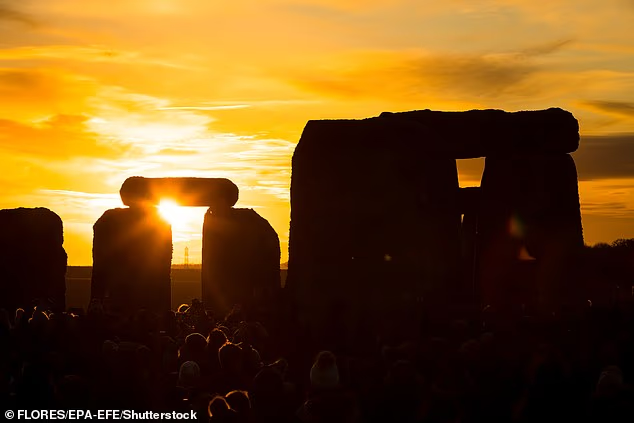
Today is the Winter Solstice, marking the shortest day of the year in the Northern Hemisphere.
At precisely 15:03 GMT, the sun will shine over the Tropic of Capricorn, making it appear to ‘standstill’ in the sky.
On average, Brits will receive just 7.5 hours of light, although the exact duration will vary based on how far north or south you are.
To put that into perspective, that’s nine fewer hours of sunshine than the summer solstice, which sees Britain enjoy over 16 hours of daylight!
While temperatures will continue to drop, thankfully the hours of sunshine will increase from today.
‘The amount of daylight is at its minimum, and the night is at its longest,’ explained Dr Shyam Balaji, an astrophysics experts at King’s College London.
‘After the December solstice, the days start to get longer in the Northern Hemisphere.’

If you’re beginning to grow weary of the dark days, there’s good news – it’s all up from here. Today is the Winter Solstice, marking the shortest day of the year in the Northern Hemisphere
The word ‘solstice’ comes from the Latin words ‘sol’ (sun) and ‘sistere’ (to stand still).
‘It refers to the point where the Sun’s apparent movement north or south pauses before reversing direction,’ Dr Balaji explained.
It occurs because our planet is tilted on its axis, by about 23.5 degrees relative to its orbit around the sun.
This tilt provides different parts of Earth with varying amounts of sunlight throughout the year.
‘During the December solstice, the Northern Hemisphere is tilted the farthest away from the Sun, resulting in the shortest day and longest night of the year for that hemisphere,’ Dr Balaji added.
Depending on how far north or south you are, the length of the day will vary.
In London, Brits will enjoy 7 hours, 49 minutes and 42 seconds of sunshine, while those further south, in Truro, will experience 8 hours, 1 minute and 55 seconds of daylight.
In contrast, people living in John O’Groats – a village on Scotland’s north–eastern tip – will have just 6 hours, 16 minutes and 54 seconds of daylight today.

At precisely 15:03 GMT, the sun will shine over the Tropic of Capricorn, making it appear to ‘standstill’ in the sky
As well as marking the shortest day of the year, today also marks the first day of winter in the astronomical calendar.
This calendar is based on the tilt of the Earth, and sees winter begin on 21 December 2025 before ending on 20 March 2026.
In contrast, the meteorological calendar always has the first day of winter as 1 December, ending on 28 (or 29 during a Leap Year) February.
When does winter start?
Astronomical winter
The astronomical calendar determines the seasons due to the 23.5 degrees of tilt of the Earth’s rotational axis in relation to its orbit around the Sun.
This year, astronomical winter begins on 21 December 2025 and ends on 20 March 2026.
Meteorological winter
Meteorological seasons consist of splitting the seasons into four periods made up of three months each.
By the meteorological calendar, the first day of winter is always 1 December; ending on 28 (or 29 during a Leap Year) February.
Share or comment on this article:
The dark days are over! Winter Solstice marks the shortest day of the YEAR – with just 7.5 hours of daylight in Britain
TECHNOLOGY
Facewatch: The controversial tech that retailers have deployed to tackle shoplifting and violence | Money News

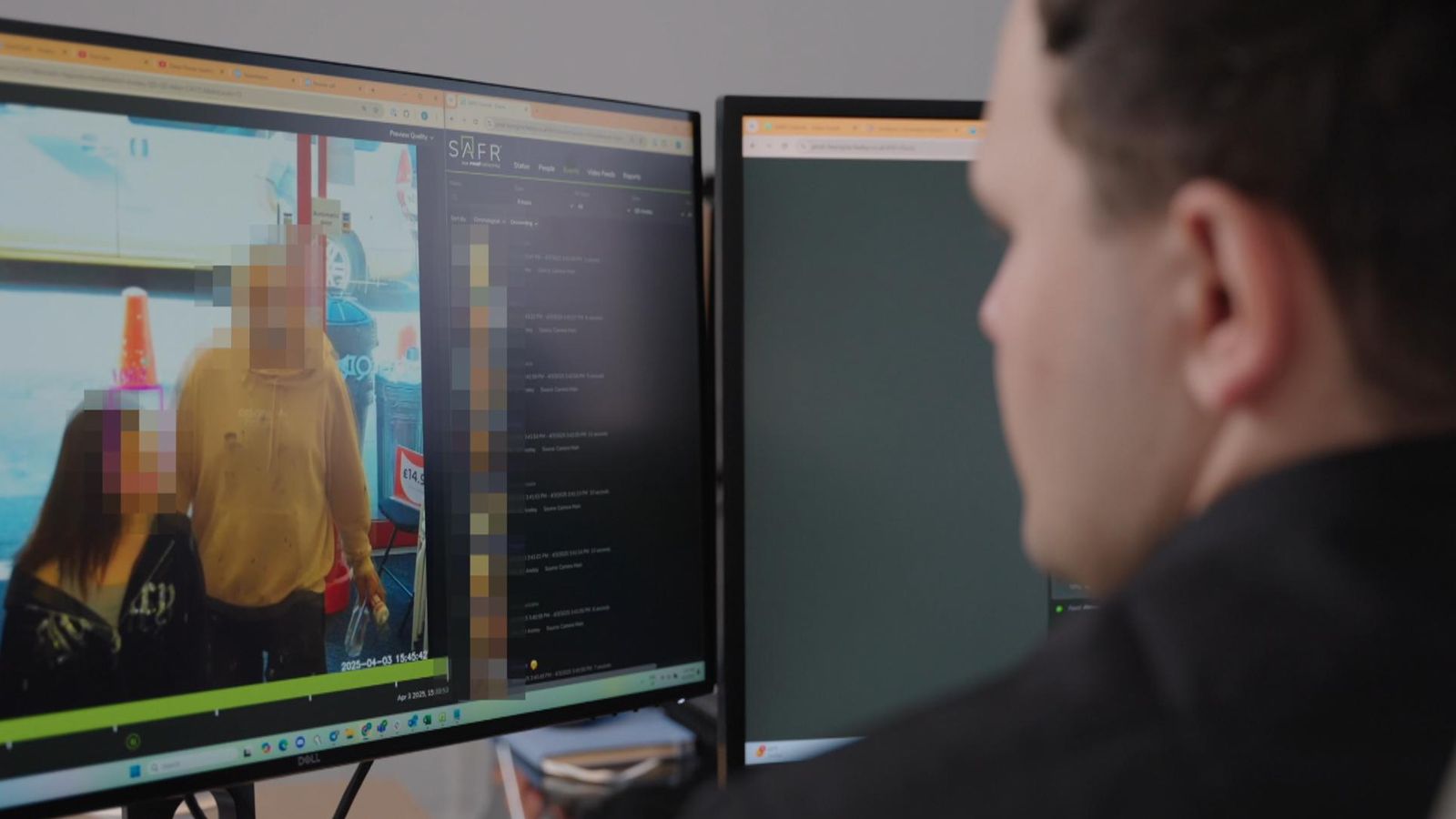
The Christmas period is upon us, and goods are flying off the shelves, but for some reason, the tills are not ringing as loudly as they should be.
Across the country, the five-finger discount is being used with such frequency that retailers are taking action into their own hands.
With concerns about the police response to shoplifting, many are now resorting to controversial facial recognition technology to catch culprits before they strike.
Sainsbury’s, Asda, Budgens and Sports Direct are among the high-street businesses that have signed up to Facewatch, a cloud-based facial recognition security system that scans faces as they enter a store. Those images are then compared to a database of known offenders and, if a match is found, an alert is set off to warn the business that a shoplifter has entered the premises.
It comes as official figures show shoplifting offences rose by 13% in the year to June, reaching almost 530,000 incidents. Figures reported in August showed more than 80% result in no charge.
At the same time, retailers are reporting more than 2,000 cases of violence or abuse against their staff every day. Faced with mounting losses and safety concerns, businesses say they are being forced to take security into their own hands because stretched police forces are only able to respond to a fraction of incidents.
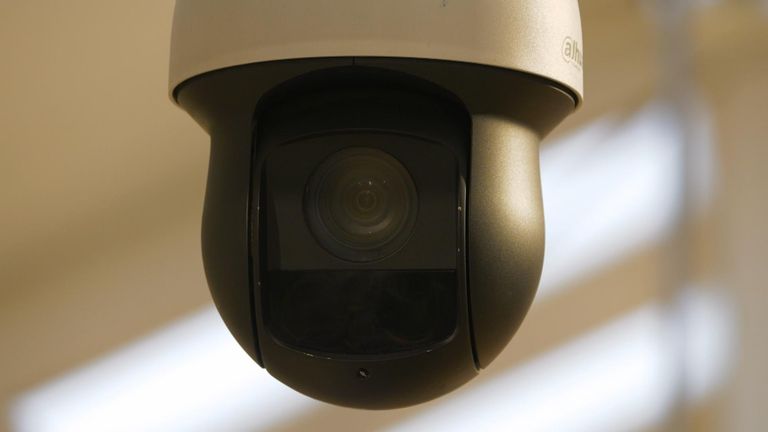
A Facewatch camera
At Ruxley Manor Garden Centre in south London, managing director James Evans said theft had become increasingly brazen and organised, with losses from shoplifting now accounting for around 1.5% of turnover. “That may sound small, but it represents a significant hit to the bottom line,” he said, pointing out that thousands of pounds’ worth of goods can be stolen in a single visit.
“We have had instances where the children get sent in to do it. They know that the parents will be waiting in the car park and they’ll know that there’s nothing that we can do to stop them.”
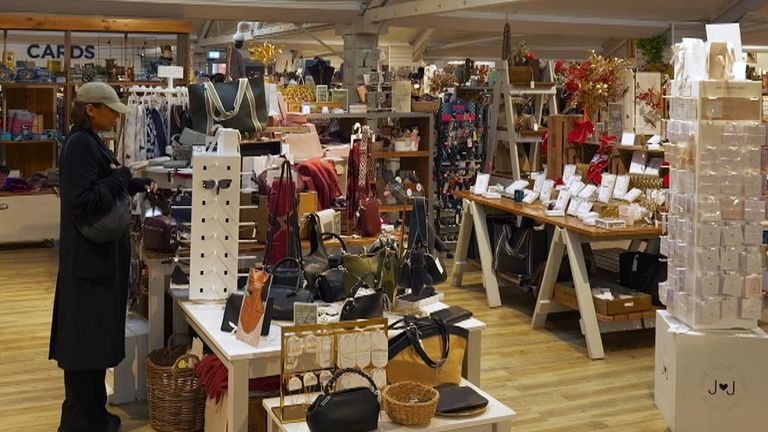
Gurpreet Narwan is seen at the garden centre while being shown how Facewatch works
Staff members here have also had their fair share of run-ins with shoplifters. In one case, employees trying to stop a suspected shoplifter were nearly struck by an accomplice in a car. “This is no longer just about stock loss,” said James, “It is about the safety of our staff.”
However, the technology is not without its critics. Civil liberties groups have warned that the expansion of this type of technology is eroding our privacy.
Silkie Carlo, director of Big Brother Watch, called it “a very dangerous kind of privatised policing industry”.
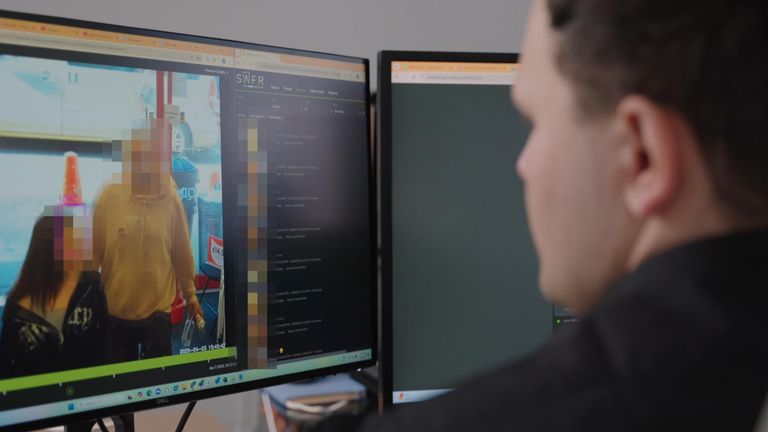
Facewatch is seen in operation as retailers look to crack down on crime.
“[It] really threatens fairness and justice for us all, because now it’s the case that just going to do your supermarket shopping, a company is quietly taking your very sensitive biometric data. That’s data that’s as sensitive as your passport, and [it’s] making a judgement about whether you’re a criminal or not.”
Silkie said the organisation was routinely receiving messages from people who said they had been mistakenly targeted. They include Rennea Nelson, who was wrongly flagged as a shoplifter at a B&M store after being mistakenly added to the facial recognition database. Nelson said she was threatened with police action and warned that her immigration status could be at risk.
Gurpreet’s profile can be seen on the Facewatch database
“He said to me, if you don’t get out, I’m going to call the police. So at that point I turned around and I was like, are you speaking to me? Then he was like yes, yes, your face set off the alarm because you’re a thief… At that point, I was around six to seven months pregnant and I was having a high-risk pregnancy. I was already going through a lot of anxiety and, so him coming over and shouting at me, it was like really triggering me.”
The retailer later acknowledged the error and apologised, describing it as a rare case of human mistake.
Read more:
Elon Musk closer to becoming first-ever trillionaire
William and George help prepare Christmas lunch for the homeless
A spokesperson for B&M said: ‘This was a simple case of human error, and we sincerely apologise to Ms Nelson for any upset caused. Reported incidents like this are rare. Facewatch services are designed to operate strictly in compliance with UK GDPR and to help protect store colleagues from incidents of aggressive shoplifting.”
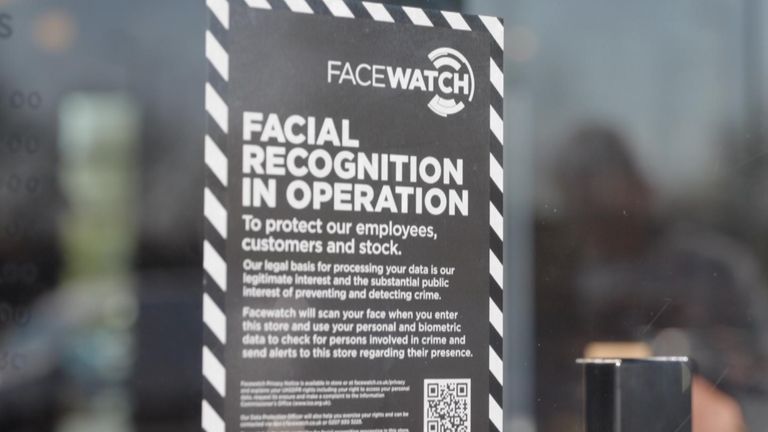
The cloud-based technology has critics who argue that it amounts to a misuse of personal data and privacy
Nick Fisher, chief executive of Facewatch, said the backlash was disproportionate.
“Well, I think it’s designed to be quite alarmist, using language like ‘dystopian’, ‘orwellian’, ‘turning people into barcodes’,” he said.
“The inference of that is that we will identify people using biometric technology, hold and store their own, store their data. And that’s just, quite frankly, misleading. We only store and retain data of known repeat offenders, of which it’s been deemed to be proportionate and responsible to do so… I think in the world that we are currently operating in, as long as the technology is used and managed in a responsible, proportionate way, I can only see it being a force for good.”
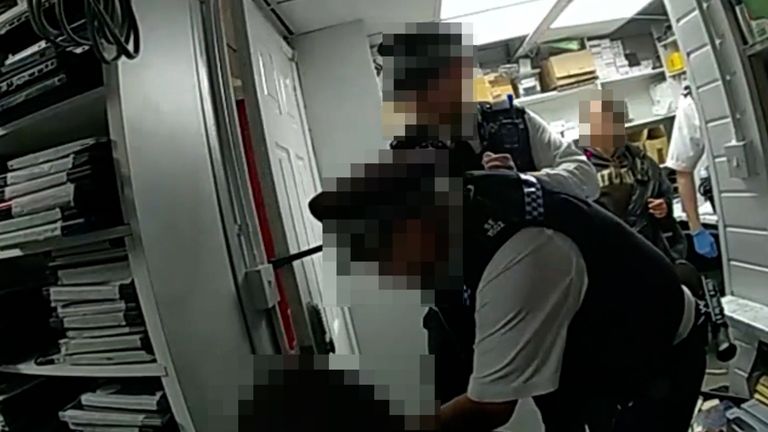
Rogue retailers exposed in shoplifting crackdown
Yet, there is obviously widespread unease, if not anger, at the proliferation of this technology. Businesses are obviously alert to it, but the bottom line is calling.
TECHNOLOGY
Last chance to see! Spectacular multi-coloured meteor shower will end in British skies tonight

Keen sky gazers will have one last shot to capture a blazing fireball from the 2025 Geminid meteor shower tonight.
The final major meteor shower is expected to dazzle the night sky with up to 150 shooting stars visible every hour.
The difference with the Geminids is that it is caused by debris from 3200 Phaethon, which is not an icy comet but rather rocky, like an asteroid.
The Royal Greenwich Observatory said: ‘The meteors of the Geminid meteor shower are very bright, moderately fast.
‘And are unusual in being multi-coloured – mainly white, some yellow and a few green, red and blue.
‘These colours are partly caused by the presence of traces of metals like sodium and calcium, the same effect that is used to make fireworks colourful.
Geminids meteor showers typically produce up to 120 and 160 meteors per hour at the peak.
And with the crescent moon at just 26 per cent of its normal brightness, keen stargazers should be in for a great view of the approaching meteors.

10 hours of photography to show the Geminids meteor shower over Stonehenge in Wiltshire over two nights

A composite of 480 stacked long-exposure images shows Geminid meteors streaking across the night sky over the Skopska Crna Gora mountain near North Macedonia

A long exposure photo shows a Geminid meteor shower over North Macedonia on December 14
The peak of the meteor shower occurred on December 14, when the shower was most active.
Because of the New Moon rising tonight, it means spectators will have a better chance of seeing the meteor compared to a full Moon, because the night sky will be darker.
This evening, the Met Office forecasts rain and strong winds moving to the southwest, Wales, then Northern Ireland, becoming slow-moving in places. Low cloud and hill fog moving north from the southeast with a little drizzle at times. Driest across Scotland. Rather mild.
Dr Shyam Balaji, of King’s College London, told The Daily Mail: The best time to view the Geminid meteor shower is around 2 am local time when the radiant point is highest in the sky.
‘However, you can start watching from mid–evening onward.’
In good conditions, viewers can expect to see upwards of 100 shooting stars an hour, or one or two every minute.
When viewing conditions are poor, you will be able to see fewer stars in the sky, so it’s important to make sure you find the right stargazing location.

A view shows the Geminids meteor shower streaking across the night sky as stargazers gather at the Valley View of Yosemite National Park in California on December 14

A meteor streaks across the northern sky during the peak of the Geminids meteor shower near Skopje, North Macedonia on December 13

Geminids meteor showers typically produce up to 120 and 160 meteors per hour at the peak
Dr Robert Massey, Deputy Executive Director at the Royal Astronomical Society: ‘With a meteor shower what you want is the widest possible view – you want to be lying down, looking up at the broad panoply of stars, and watching for meteors.
‘The best view is if you’re away from sources of light pollution, so try and get away from at least direct lights in towns and cities, ideally out in the countryside.
‘Obviously you also need a clear sky – if it’s cloudy you’re not going to see anything.’
You should soon start to see short streaks of light that last for a second or two.
Following that, keen fireball hunters will be able to catch the weaker but reliable Ursid Meteor Shower, peaking on December 22.
Share or comment on this article:
Last chance to see! Spectacular multi-coloured meteor shower will end in British skies tonight
TECHNOLOGY
Elon Musk closer to becoming first-ever trillionaire as he marks major milestone | US News

Elon Musk has just gotten even closer to being the first-ever trillionaire after a court reinstated his Tesla stock options worth billions.
According to Forbes’s billionaires index, the Tesla chief executive’s net worth climbed to $749bn (£559bn) on Friday, making Musk the first person to surpass the $700bn milestone.
He is already the world’s richest man, and around $500bn (£373bn) richer than the second-richest, Google co-founder Larry Page, the index reports.
It follows the Delaware Supreme Court’s ruling to reinstate his 2018 Tesla stock options worth $139bn (£103bn), which were rescinded last year.
That year, Musk was awarded a pay package including stocks worth $56bn (£41bn) at the time, but it was struck down in a lower court in 2024 as the compensation was “unfathomable”.
Delaware judge Kathaleen McCormick concluded after a five-day trial that Tesla’s directors were conflicted and key facts were hidden from shareholders when they voted to approve the plan.
On Friday, the state supreme court ruled that rescinding the pay package left the Tesla head “uncompensated for his time and efforts over a period of six years”, and that Ms McCormick’s verdict had been improper and inequitable.
Read more on Elon Musk:
Musk is winning the space race – and looks unstoppable
How world’s richest man is boosting the British right
Elon Musk’s race for space
As is his style, Musk has not issued a formal statement responding to the restoration of his options, but did say in a reply on his social media platform X that he was “vindicated”.
If Musk exercises all the stock options from the 2018 package, his stake in Tesla would grow from about 12.4% to 18.1% of an expanded share base.
It was Tesla’s largest ever pay package, until the electric vehicle company awarded Musk a pay plan worth up to $1trn (£747bn) this November.
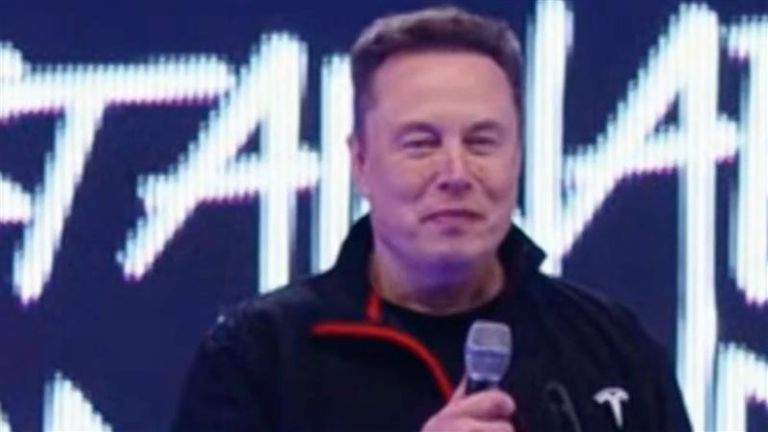
Elon Musk dances his way to $1trn
It was approved by 75% of shareholders, but to pay out in full, Mr Musk must achieve five milestones in the next decade:
• Deliver 20 million Tesla vehicles and one million robots;
• Drive 10 million subscriptions to Tesla’s self-driving feature;
• Bring one million self-driving Robotaxis into operation;
• Earn as much as $400bn in core profit;
• Lift Tesla’s market value to $8.5trn.
Under the agreement, Musk will not receive a salary, but meeting all targets would see him receive more than 400 million extra shares in Tesla.
If the company’s value is raised to the target, those would be worth around $1trn. As of writing, Tesla is valued at $1.51trn (£1.12trn).

The world’s smartest human has admitted that God not only exists, but he can prove it through math.
South Korean scientist YoungHoon Kim, 36, said he holds the current record for the world’s highest IQ at 276, an achievement recognized by the World Mind Sports Council.
Any IQ score over 140 is considered ‘genius’ level intelligence, with great thinkers such as Albert Einstein and Professor Stephen Hawking reportedly having IQs around 160.
Kim, an AI researcher and entrepreneur who holds a theology degree from Seoul’s Yonsei University, regularly posts on social media that science can prove God exists and was the starting point of our universe.
On December 11, his latest viral post on Instagram gave a simple message about the existence of God, stating: ‘God is real 100 percent and Jesus is God.’
Kim has also claimed that faith in Jesus has a direct connection to how intelligent, creative, and successful someone can become.
However, the ‘world’s highest IQ person’ has also made some controversial remarks, including that Jesus will return in 10 years and claiming homosexuality is a sin.
In one of his most viewed social media posts, Kim released a three-minute video on YouTube claiming that the existence of God could be proven mathematically with three simple facts.

YoungHoon Kim (Pictured) is allegedly the world’s smartest person, with an IQ of 276. Any score over 140 is considered ‘genius’ level intelligence
‘A line cannot start without a first point. Think about drawing a line on a piece of paper. In geometry, every line has to begin with at least one point. Without that first point, there is no line at all,’ Kim said in a September 4 video.
‘The same is true with existence. If there was never a starting point, then nothing could have ever begun. But we clearly see that life and the universe exist. So, there must have been a first point, the starting point that set everything in motion,’ Kim continued.
Kim then explained that you cannot cross an endless past, meaning that if time had no beginning and went backwards forever, we could never have reached ‘today.’
He compared it to never being able to finish counting down to zero if you started from negative infinity with no first number.
The world’s smartest man concluded by revealing that multiplication shows power must come from somewhere, meaning that if you keep multiplying by one forever, you always stay at just one and nothing new or bigger ever appears.
So, for the universe to start and grow into everything we see, a greater power must have stepped in from outside to create and multiply it all.
‘The only explanation that fits all three is a first cause starting point. Necessary, powerful, timeless, and intelligent. And this is exactly what we mean when we say God exists,’ Kim said in the video that’s been viewed over 218,000 times.
As for his latest post claiming Jesus is God, Kim has repeatedly posted that Jesus is not only God transformed into a man, but was also more intelligent than anyone else who has ever lived.

Kim has claimed that God not only exists, but Jesus is God in human form and his existence can be proven through mathematics (Stock Image)
‘No Einstein. No Newton. Only Jesus is the Smartest Man in the History of the World,’ he posted in November.
Kim was not the first highly intelligent person to claim to have knowledge of the divine.
Chris Langan, an American horse rancher who allegedly has an IQ between 190 and 210, has claimed to know what happens after we die.
The 73-year-old said created a hypothesis called the Cognitive-Theoretic Model of the Universe (CTMU), which allegedly ‘explains the connection between mind and reality.’
He believed that when people die, they transition from one form of existence to another within the computational structure of reality, meaning the consciousness, or ‘soul,’ moves to another dimension that we cannot access while living on Earth.
It’s not clear what that new dimension would look like, or what happens to the ‘soul’ once it arrives there. However, Langan said traditional views of heaven and hell were too simplistic and that the afterlife was more like a new state of being.
Kim has echoed these comments, stating that: ‘If reality is part of something bigger, then death is not the end, but a transition.’
He added that while traditional science believes the brain stops when consciousness disappears, quantum physics has suggested that information never disappears and changes in form.
‘If our consciousness is quantum information it may continue after the body is gone.’

Law firms representing Google and Apple have warned that employees who need a visa stamp to re-enter the United States should avoid leaving the country due to longer-than-usual visa processing times, according to Business Insider.
BI says it has viewed memos from BAL Immigration Law (which represents Google) and Fragomen (which represents Apple).
“Given the recent updates and the possibility of unpredictable, extended delays when returning to the U.S., we strongly recommend that employees without a valid H-1B visa stamp avoid international travel for now,” the Fragomen memo reportedly said.
A State Department spokesperson told BI that embassies are “now prioritizing thoroughly vetting each visa case above all else.”
Salon also reports that “hundreds” of Indian professionals who traveled home to renew their U.S. work visas in December have had their U.S. embassy appointments canceled or rescheduled due to new requirements for social media vetting.
TechCrunch has reached out to Google and Apple for comment. Both companies, along with other large tech employers, issued similar warnings in September when the White House announced that employers would have to pay a $100,000 fee for H-1B visa applications.

Governor Kathy Hochul has signed the RAISE Act, positioning New York as the second U.S. state to enact major AI safety legislation.
State lawmakers passed RAISE Act in June, but following lobbying from the tech industry, Hochul proposed changes to scale the bill back. The New York Times reports that Hochul ultimately agreed to sign the original bill, while lawmakers agreed to make her requested changes next year.
The bill will require large AI developers to publish information about their safety protocols and report safety incidents to the state within 72 hours. It will also create a new office within the Department of Financial Services to monitor AI development.
If companies fail to submit safety reports or make false statements, they can be fined up to $1 million ($3 million for subsequent violations).
California Governor Gavin Newsom signed a similar safety bill in September, which Hochul referenced in her announcement.
“This law builds on California’s recently adopted framework, creating a unified benchmark among the country’s leading tech states as the federal government lags behind, failing to implement common-sense regulations that protect the public,” Hochul said.
State Senator Andrew Gounardes, one of the bill’s sponsors, posted, “Big Tech thought they could weasel their way into killing our bill. We shut them down and passed the strongest AI safety law in the country.”
Techcrunch event
San Francisco
|
October 13-15, 2026
Both OpenAI and Anthropic expressed support for New York’s bill while also calling for federal legislation, with Anthropic’s head of external affairs Sarah Heck telling the NYT, “The fact that two of the largest states in the country have now enacted AI transparency legislation signals the critical importance of safety and should inspire Congress to build on them.”
Not everyone in the tech industry has been so supportive. In fact, a super PAC backed by Andreessen Horowitz and OpenAI President Greg Brockman is looking to challenge Assemblyman Alex Bores, who co-sponsored the bill with Gounardes. (Bores told journalists, “I appreciate how straightforward they’re being about it.”)
This comes after President Donald Trump signed an executive order that directs federal agencies to challenge state AI laws. The order — backed by Trump’s AI czar David Sacks — is the latest attempt by the Trump Administration to curtail states’ ability to regulate AI, and will likely be challenged in court.
We also discussed Trump’s executive order, and the role that Sacks and a16z have played in opposing state AI regulation, on the latest episode of the Equity podcast.