NIGERIA NEWS
Buhari Taught Nigerians That Being in Public Office is Trust, Not Windfall – THISDAYLIVE


Deji Elumoye in Abuja
President Bola Tinubu, yesterday, said his predecessor, the late Muhammadu Buhari, taught Nigerians, particularly politicians, that public office was a sacred trust, not a personal windfall.
Tinubu paid glowing tribute to the life and legacy of Buhari.
He spoke at the official launch of a 606-page biography, “From Soldier to Statesman: The Legacy of Muhammadu Buhari,” held at State House Conference Centre, Abuja.
The president described Buhari as a leader whose reputation for integrity, discipline and modest living endured long after leaving office.
He stressed that the true measure of Buhari’s leadership was not the offices he occupied or the privileges that came with power, but “what persists when the sirens fall silent”.
He stated that the late former president left behind a legacy defined by honesty, restraint and firm belief that leadership was anchored on service.
Tinubu, who described himself as Buhari’s brother, friend and political partner, recalled the political journey they shared together and the coalition-building efforts that culminated in the historic 2015 election victory, which unseated an incumbent government and reshaped Nigeria’s political landscape.
According to him, the alliance forged during that period has since evolved into the fastest-growing political party in Africa.
Tinubu stated, “I stand here not just as president, but as a brother, friend, and political partner who shared a journey with President Buhari through challenging times.
“Together, we built a broad coalition, campaigned across the country, and proved that Nigeria could chart a new course.
“Our movement united diverse interests and achieved a historic victory in 2015 by unseating an incumbent president, thus reshaping Nigeria’s political landscape.
“The coalition we built in 2014 is now the fastest-growing political party in Africa today. Its growth continues.”
The president said the biography served as an honest account of Buhari’s life and leadership, outlining both achievements and shortcomings.
He urged future leaders to draw lessons from history rather than rely on empty slogans.
Tinub identified humility, security, vision and social justice as the enduring pillars of Buhari’s legacy, stating that the late leader preferred simplicity over extravagance, believed in self-discipline as the foundation of governance, and prioritised national security as the bedrock of prosperity.
Tinubu also highlighted Buhari’s long-term vision for infrastructure development, including roads, railways, bridges and airports, as well as his commitment to targeted social investments aimed at protecting the poor and vulnerable.
He said Buhari’s consistent love for Nigeria and faithfulness to his oath of office earned him respect, even among critics, adding that their political experience jointly reinforced the importance of cooperation across differences in the task of nation-building.
Tinubu enumerated the lasting legacies of his predecessor in the areas of security, building of social infrastructure, and entrenching social justice, pledging his commitment to building on them.
Tinubu stated, “This book reinforces the public’s memory. It outlines achievements and flaws, as all honest histories should. It should motivate future leaders to learn lessons rather than repeat slogans.
“In that spirit, let us reflect on the enduring pillars of President Buhari’s legacy: First, humility. President Buhari preferred simplicity over ornamentation. He believed that a leader must first discipline himself before he can discipline a system. He lived modestly, and he carried the dignity of that modesty into power.
“Second, security. President Buhari recognised that security is the foundation of citizenship and prosperity. He invested in platforms and personnel, improved capacities across our armed services, and pushed for reforms that endured beyond the headlines. He understood that safety requires protecting both the state and its citizens.
“Third, vision. He understood the importance of long-term thinking — constructing bridges, restoring railways, building roads, modernising our airports, and renewing critical infrastructure —while prioritising maintenance and sustainability.
“Fourth, social justice. He believed in targeted social investments to ensure that the state did not ignore the poor and vulnerable. These are the pillars of his legacy. But a legacy is given greater meaning when those who follow choose to continue what has been started. That is my duty.”
Tinubu said, “President Buhari loved this country consistently, morning after morning, decision after decision, staying true to the oath he took. That is why even those who disagreed with him often acknowledged his honesty.
“Our political journey together taught me that cooperation across differences is not weakness; it is wisdom. Nation-building demands that we compete passionately and govern responsibly. President Buhari understood that the contest ends when the oath begins. In his memory, let us keep our politics honourable and our governance focused on results.”
Tinubu vowed that his administration would honour and build upon Buhari’s legacy, stressing that remembrance must go beyond rhetoric to the delivery of tangible results with discipline, compassion, and resolve.
He said, “To my dear brother, President Muhammadu Buhari: though you are no longer with us, your impact endures. We will honour and build upon your legacy, not just by invoking your name, but by delivering results with discipline, compassion, and resolve.”
The president commended the author of the book, Dr. Charles Omole, for enriching Nigeria’s collective memory and expressed hope that the biography would inspire young Nigerians as they reflected on leadership and public service.
Earlier, in his welcome address, Katsina State Governor, Dikko Radda, portrayed Buhari as an incorruptible strategist whose leadership was defined by integrity and a deep understanding of national security.
Radda said Buhari’s foresight in security matters and his personal discipline set him apart as a leader committed to the protection of the state and the welfare of its citizens.
He also lauded the collaboration and camaraderie that existed between the late president and his successor, Tinubu, which culminated in the victory that installed the ruling All Progressives Congress (APC) in 2015.
The governor said there could not have been a better successor to Buhari than Tinubu.
In his personal recollection, detailed in the book, on his relationship with Buhari, former Director-General of Department of State Services (DSS), Alhaji Yusuf Bichi, provided broad information on Buhari’s security philosophy.
Bichi described Buhari as a leader, who prioritised evidence, institutional restraint, and professional autonomy over political considerations.
According to him, Buhari avoided micromanaging the country’s security services, granting commanders what he described as “the freedom of the battlefield,” while demanding accountability and results.
He disclosed that Buhari consistently resisted acting on rumours or political pressure, insisting, instead, on verifiable intelligence before approving arrests, sanctions or disruptive operations.
“Where is your proof?” Bichi recalled Buhari repeatedly asking, stating that the former president believed actions not anchored on evidence would ultimately collapse under legal and public scrutiny.
The former DSS boss said that approach shaped intelligence operations during the late ex-president’s tenure, allowing security professionals to make operational decisions without fear of sudden political reversals, while also holding them responsible for outcomes.
He also recalled how Buhari backed decisive security interventions once operational logic was clearly established, including moments when intelligence chiefs acted swiftly to avert potential threats to the president himself.
In such instances, Buhari, Bichi said, validated initiative taken in good faith and urged security agencies to “sustain the pressure” where public safety was at stake.
Bichi also highlighted Buhari’s personal discipline and frugality. He said the late president was wary of converting state privileges into private comforts and often questioned the source of gifts and expenditures around him.
He said Buhari’s restraint extended to politics, where he consistently resisted suggestions to deploy state power against opponents, preferring instead to target enabling networks of violence rather than suppress dissent.
Bichi also explained why Buhari did not reverse
the decision by then Acting President, Professor Yemi Osinbajo, to remove Lawal Daura as DSS boss, and why he refused to publicly anoint a successor ahead of the 2023 polls.
According to him, Buhari’s refusal to overrule Osinbajo in his decision to sack Daura was rooted in his deep respect for institutional order and constitutional authority.
He recounted that when Osinbajo exercised executive powers as Acting President and removed Daura, there were expectations in some quarters that Buhari would overturn the decision upon his return. But Buhari declined to interfere.
Bichi stressed that Buhari believed reversing the action would undermine the legitimacy of the acting presidency and amount to an affront to the chain of command.
Having lawfully delegated authority to his Vice President, Buhari considered any attempt to countermand that decision as injurious to institutional stability, a stance that reinforced discipline within the security architecture and affirmed the principle that executive authority, once properly transferred, must be respected.
Bichi further disclosed that the episode served as an early test of Buhari’s restraint in power and his refusal to personalise governance, even when political pressure mounted.
He explained, “One of the earliest tests of Buhari’s restraint came during the removal of Lawal Daura as DG SSS, an episode that could easily have devolved into a battle of egos. When then-Vice President Yemi Osinbajo was acting president, he decided to remove Daura.
“Pressure followed for a presidential reversal. Buhari refused to interfere. He had handed executive authority to his vice president while away; to countermand Osinbajo would be, in Bichi’s words, an ‘insult to his vice,’ and an injury to institutional order.
“We can also reveal that the First Lady, Aisha Buhari, was a major instigator for the removal of the SSS boss. In a political culture where loyalty is often confused with pliancy, this mattered.
“Buhari’s stance validated the chain of command and the legitimacy of the acting presidency. It signalled to the security services that leadership transitions could be orderly; that the presidency would not bend the law to rescue allies or punish opponents for sport.
“The lesson for the SSS was clear: act within your lawful remit, and the Commander-in-Chief will stand back; step outside it, and he will not rescue you from consequences.”
The ex-DSS chief also addressed the much-debated refusal by Buhari to openly name a preferred successor during the intense intra-party contest preceding the 2023 general election.
He said Buhari’s silence was not a sign of detachment but a deliberate security decision informed by intelligence assessments at the time.
According to Bichi, Buhari privately expressed concern that publicly endorsing a successor could expose the individual to grave danger, including the risk of assassination, given the volatility and high-stakes rivalries within the political environment.
By choosing not to anoint anyone, Buhari, he said, sought to protect lives and prevent further destabilisation within his party and the broader polity, even at the cost of enduring criticism for being aloof.
Bichi said, “In those months, knives were out; politically and, as security professionals know too well, sometimes literally. To name an anointed heir would be to paint a target on a human being and to foreclose a process that, for all its imperfections, was designed to distribute risk.
“Buhari chose silence, and in doing so, absorbed the criticism that he was aloof. He was not. He was shielding a life and preserving a fragile equilibrium inside a party whose factions could as easily burn down the house as surrender the nomination they coveted.”
Earlier, author of the book, Omole, described it as the most comprehensive account of the life and legacy of Buhari, explaining that the book addressed complex questions surrounding his journey, character and leadership.
According to Omole, the book focuses not just on Buhari the public figure, but on the man himself—his guiding principles, values and personal convictions.
He stated that one of Buhari’s enduring legacies was his family, particularly his children, whom he said were raised with forthrightness, balance and strong emotional intelligence.
Speaking on behalf of the family, Buhari’s daughter, Hadiza Nana Buhari, said the biography transcended a mere historical record, capturing, instead, the rhythm of a life lived with restraint, steadiness and an abiding belief that public office is a sacred trust.
She stated that while the story was not presented as flawless, “as no human story ever is”, it challenged the next generation to build institutions strong enough to translate good intentions into lasting outcomes.
Nana Buhari urged young Nigerians to draw lessons from her father’s life by embracing integrity, moderation and patience in their pursuit of success and service to the country.
The event was graced by dignitaries from all walks of life, including President of The Gambia, Adama Barrow; members of the Buhari family, led by former First Lady, Hajiya Aisha Buhari; traditional rulers, including the Sultan of Sokoto, Muhammad Sa’ad Abubakar III, and Olu of Warri, Ogiame Atuwatse III, among others.
Equally at the event were Chairman of National Drug Law Enforcement Agency (NDLEA), Brig.-Gen Buba Marwa (rtd); former Chief of Air Force, Air Marshal Isiaka Amoo (rtd); and former Director-General of DSS, Alhaji Yusuf Bichi.
Present, too, were former Chief of Naval Staff, Vice Admiral Awwal Gambo (rtd), and former Inspector-General of Police, Mohammed Asamu.
They all spoke on their experiences with the former president.


The Nigerian Bar Association (NBA) has accused the Nigeria Police Force of contempt of court and a disregard for the rule of law over its plan to resume enforcement of the motor vehicle tinted glass permit policy.
In a statement posted on his Facebook page on Tuesday, NBA President Afam Osigwe condemned a press release by the Force Public Relations Officer, Benjamin Hundeyin, announcing the reactivation of the policy from 2 January 2026.
Mr Osigwe, who is a Senior Advocate of Nigeria (SAN), described the move as “executive recklessness” and a “disturbing disregard for the rule of law and due process.”
He said the announcement undermined the authority of the courts and suggested that the Police were prioritising revenue over citizens’ rights.
Backstory
The policy, introduced by the Inspector-General of Police in April, required motorists to obtain annual tinted glass permits via an online platform.
Enforcement, initially scheduled for 1 June and later postponed to 2 October, faced criticism over reports of harassment, extortion, and civil rights violations.
On 2 September, the NBA, through its Section on Public Interest and Development Law (NBA-SPIDEL), filed a suit (FHC/ABJ/CS/1821/2025) at the Federal High Court, Abuja, challenging the legality of the policy.
The NBA argued that the measure was based on the outdated Motor Tinted Glass (Prohibition) Act of 1991, lacked statutory authority to impose fees, and could lead to harassment and abuse by the Police.
The association also warned that the policy placed unnecessary financial burdens on Nigerians, especially as many imported vehicles already come with factory-fitted tinted glass.
The police were duly served court processes, represented by Ayotunde Ogunleye, also a SAN.
On 3 October, the Federal High Court in Warri, Delta State, in a related case, ordered the police to maintain the status quo and restrain enforcement of the tinted glass permit pending judicial determination.
Following public outcry, the IGP held a meeting with NBA representatives, resulting in a temporary suspension of the policy.
Court proceedings and NBA response
The case came up for hearing on 12 December before Judge M. S. Liman. During the hearing, the police confirmed the suspension agreement, leading the court to strike out the motion for interlocutory injunction.
Therefore, the NBA called the police’s announcement to resume enforcement “a reckless overreach” and “a serious assault on institutional integrity.”
The association urged the IGP to withdraw the statement and halt enforcement until all related court matters are determined.
It also directed its branches and the NBA Human Rights Committee to provide legal support to any motorist harassed or prosecuted over the policy.
Police justification
Mr Benjamin, who is a Chief Superintendent of Police (CSP), defended the planned resumption of enforcement, citing security concerns.
“Some individuals and organised criminal groups have exploited unauthorised tinted glass to conceal their identities and commit crimes ranging from armed robbery to kidnapping,” he said.
He added that enforcement would respect citizens’ rights and existing laws, and that the earlier suspension was intended to allow motorists to regularise their documentation.
Josephine Adeh, spokesperson for the Federal Capital Territory Police Command, had reiterated that the regulation was introduced for security reasons, not revenue generation, noting that all payments are remitted to the federal government’s Treasury Single Account (TSA).
The tinted glass permit policy has been widely criticised for enabling harassment and extortion, with civil rights groups urging the Police to respect court orders and citizens’ rights.

..Dismiss allegations against NMDPRA CEO as unfounded, misleading and a media trial
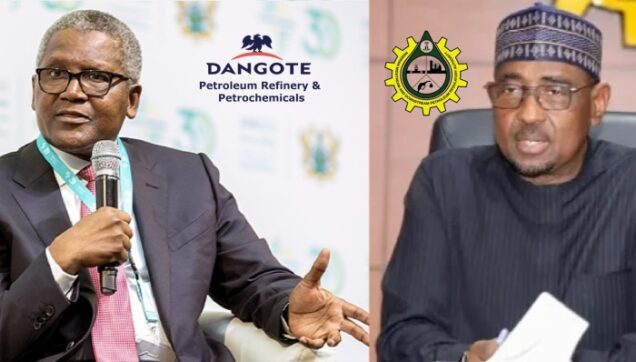
A coalition of 40 lawyers under the aegis of Lawyers in Defence of Democracy and Anti-Corruption has strongly condemned what it described as frivolous, baseless and unfounded corruption allegations levelled against the Chief Executive Officer of the Nigerian Midstream and Downstream Petroleum Regulatory Authority (NMDPRA), Engr. Farouk Ahmed, by President of Dangote Industries Limited, Alhaji Aliko Dangote.
Addressing a press conference in Abuja, the lawyers accused Dangote of engaging in a malicious media trial aimed at unjustly portraying Engr. Ahmed as guilty of corruption without recourse to due process, warning that such actions undermine democracy, the rule of law and investor confidence in Nigeria’s oil and gas sector.
The press conference was jointly addressed and the statement signed by Barrister Emeka Okafor, National Coordinator, and Barrister Mohammed Bello, Secretary, on behalf of the 40 lawyers under the Lawyers in Defence of Democracy and Anti-Corruption.
Speaking on behalf of the group, Barrister Emeka Okafor, National Coordinator of the organisation, described the allegations, including claims that Engr. Ahmed received $5 million and sponsored his children’s education in foreign institutions in Switzerland, as reckless fabrications unsupported by facts or evidence.
The lawyers pointed out that monopoly is not the best form of business, insisted that the efforts of the NMDPRA boss is in national interest and not to witch-haunt or targeted at any businessman in the petroleum industry.
“We find these allegations not only frivolous and unfounded but also dangerous to the stability and development of Nigeria’s midstream and downstream petroleum sector,” Okafor said. “This is a clear attempt at a media conviction of a public officer who has not been investigated, charged or found guilty by any competent authority.”
The lawyers emphasised that Section 36(1) of the 1999 Constitution of the Federal Republic of Nigeria (as amended) expressly guarantees the right to fair hearing, stressing that no Nigerian, regardless of status, can be declared guilty on the basis of public accusations or media narratives.
“The Constitution is clear. Every person is presumed innocent until proven guilty by a court of competent jurisdiction. What we are witnessing is a blatant violation of this sacred constitutional provision,” Okafor added.
The group further faulted Dangote for failing to channel his grievances through appropriate legal and institutional mechanisms, noting that a personality of his stature ought to understand the importance of petitions, investigations and lawful procedures rather than public sensationalism.
“If indeed there were genuine concerns, the proper course of action would have been to submit a petition to relevant anti-corruption agencies for investigation, not a trial by media,” said Barrister Mohammed Bello, Secretary of the group.
The lawyers warned that what they described as witch-hunting tactics could discourage both local and foreign investors at a critical time when President Bola Ahmed Tinubu’s Renewed Hope Agenda is focused on implementing workable policies to attract investment and revitalise the economy.
They noted that the liberalisation of the downstream petroleum sector, driven by regulatory reforms under Engr. Ahmed’s leadership at the NMDPRA, has opened up the industry, attracted new investors and dismantled monopolistic tendencies.
“Ironically, the same reforms Dangote appears to be attacking are the very policies that enabled private sector participation, including the establishment of the Dangote Refinery,” Okafor stated.
According to the lawyers, the sector has witnessed renewed investor confidence, with additional refineries beyond the Dangote Refinery already completed or nearing commissioning, a development they attributed to transparent and firm regulatory oversight by the NMDPRA.
In a similar vein, the organisation reaffirmed its opposition to monopoly in the petroleum industry, insisting that Engr. Ahmed’s regulatory stance has promoted competition, fairness and national interest.
“As a group, we state unequivocally that the Chief Executive Officer of the NMDPRA, Engr. Farouk Ahmed, has not only been committed to his statutory responsibilities but has also remained clean of corruption based on our independent findings,” the statement read.
While reiterating their commitment to accountability and good governance, the lawyers urged Nigerians to disregard the unsubstantiated allegations, calling on stakeholders to respect the autonomy of regulatory institutions and desist from actions capable of destabilising critical sectors of the economy.
They called on Nigerians to disregard the unsubstantiated allegations, urged stakeholders to respect the autonomy of regulatory institutions, and appealed to the Federal Government to continue supporting reform-driven, independent and professional leadership at the NMDPRA in the overall interest of national development.
NIGERIA NEWS
Nigerian Lady in Disbelief As Landlord’s Mother Pours Palm Oil on Tenant’s Washed Clothes


- A young lady shared a video online showing how her landlady’s son messed up some clothes washed and kept outside
- A tenant had washed the clothes and sprayed them outside on a line to dry, but came and discovered palm oil on the clothes
- A lot of social media users said they would not take such behaviour from anyone, not even the mother of their landlord
Social media users are reacting to a video of a lady who showed what her landlord’s mother did.
According to the lady, a tenant had washed some clothes and kept them outside to dry, only to come and discover that the clothes had been soiled.
 A Nigerian lady accused her landlord’s mother of pouring oil on a tenant’s clothes. Photo credit: TikTok/@just_that_girllll.
Source: TikTok
In a video posted by @just_that_girllll, the lady showed how palm oil was used to mess up almost all the clothes hung on the line to dry.
The lady said it was her landlord’s mother who used palm oil to mess up the clothes.

Read also
Lady prostrates to celebrate husband who sponsored her UK master’s degree, video melts hearts
The video is captioned:
“Your landlord’s mother struck again. I don see a lot in this house. Assuming it’s my clothes, I would have shown my shege.” A Nigerian lady shared a video of how a landlord’s mother poured palm oil on someone’s clothes. Photo credit: TikTok/@just_that_girllll.
Source: TikTok
Watch the video below:
Reactions as lady shows what landlord’s son did to her
@belleinstlye said:
“Paste location na this kind compound I Dey like live.”
@Muna Miles said:
“Silent is power with this you will forever be mercy Johnson. No loud your revenge cos who neglect signs go see wonders.”
@EMMANUEL ESEOGHENE said:
“I go pack my valuables small small first, empty my cylinder inside the room, the rest na story.”
@Eni hams the brand said:
“Hey you know those black ants?The big ones pour am for her clothes when h know she’s about to pack them …you’re welcome 🤗 also u can rub that werepe leaves that use to scratch..rub ur while the clothes are wet.”
@Annie Joel said:
“Try dey hot soak peeled unripe plantain inside for 24 if dem hang their clothes pure am put dem go testify dem go do change of wardrobe.”
Read also
Young lady displays couple’s wedding items which she found forgotten inside cab days to occasion
@CHINELO said:
“Nne which side you Dey live?, if na east i fit help you waybill AGBARA, just wear glove once you want to drop it on her clothes , sit back and enjoy the show.”
@Jollofina said:
“Wait for when they wash,open hypo sachet very tiny and do your own back.”
@NONSO!! said:
“Is this school hostel or normal tenant house?”
@Viral_Glory said:
“Them no Dey sell cane for your area? I fit waybill for you spoil the rod and spare the child. Abi no be so Una Dey talk ham?”
@VITAMIN K VIBES said:
“Some of us na landlord but we still decide stay rent bi be memes oo ..na her son first start to build house …house when you go put fire on a low people no go even suspect you.”
Lady marries landlady’s son
Earlier, Legit.ng reported that a Nigerian lady shared the story of how she met her husband and the video is trending and getting many reactions on TikTok.

Read also
Lady who posted father’s video gets message from woman claiming to be his girlfriend, displays chat
The lady said the person she married is the son of the landlady who gave her a place to stay when she was in school.
According to her, she did not know how her husband got her number but they would later fall in love and get married.
Source: Legit.ng



A young lady has sparked reactions online after recounting an awkward and emotional experience involving a man she had feelings for.
According to her, she decided to be upfront about her emotions after believing the man felt the same way. Mustering the courage to speak first, she confessed her interest, only to receive an unexpected response.
 Lady.
Lady.
The lady said the man told her that he saw her only as a “sister in Christ,” a statement that left her deeply confused, especially because she noted that she was not particularly religious at the time.
She explained that the rejection came as a shock and left her momentarily disoriented, describing how she felt overwhelmed and emotionally affected by the encounter.
Her words …
“There was one time I told this guy that I liked him. I thought he liked me back so I said lemme say it first. He was like ‘Oh, I only see you as a sister in Christ. At the time I wasn’t even in Christ. So I was very confused, so I just started losing hearing, I couldn’t see properly after that…”
Watch video below …
@anu_siwoniku
…
♬ original sound – anu_siwoniku


A member of the Ogun State House of Assembly representing Ijebu North Constituency I, Rasheed Kashamu, has defected from the Peoples Democratic Party, PDP, to the All Progressives Congress, APC.
Announcing his defection on Monday on the floor of the House, Kashamu cited irreconcilable differences and divisions that have polarised the opposition party at the state and national levels.
The Speaker of the House, Oludaisi Elemide, while reading his letter at plenary, said the lawmaker formally notified the House of his resignation from the PDP and his decision to join the APC, citing factional disputes at the national level and leadership tussles at the state level as reasons for his defection.
According to the lawmaker, he aligned his decision with his resolve to join other progressives in the state to support Governor Dapo Abiodun’s strides under the ISEYA Agenda and the Renewed Hope Agenda of President Bola Tinubu.
“After a review of the current state of affairs of the PDP at the national level, with factions and unresolved leadership crises, and as someone who rode on the pro-people legacy and support of my constituents in Ijebu North I State Constituency, I have agreed with my leaders and teeming supporters that we should move en masse into the APC.
“So, in order to bring our winning formula in Ijebu North I into the APC and fully support Mr Governor’s ISEYA Agenda, as well as the Renewed Hope Agenda of President Asiwaju Bola Ahmed Tinubu, GCFR, alongside my teeming supporters, we are now members of the APC.
“I have since joined the APC at my ward in Oke Sopen, Ijebu-Igbo, Ijebu North Local Government Area of Ogun State, and I am ready to contribute my quota to further strengthen the ruling party and entrench good governance across the state,” he said.
He informed the House that he had joined the APC at his Oke Sopen Ward, Ijebu-Igbo, Ijebu North Local Government Area, alongside his supporters from across Ijebu North.
NIGERIA NEWS
As Yilwatda Seeks Stronger Collaboration Between Nigeria and Global Partners… – THISDAYLIVE

Wale Igbintade writes that the National Chairman of the All Progressives Congress, Prof NenwateYilwatda, is seeking stronger collaboration between Nigeria and its global partners geared towards enhancing national security.
National Chairman of the All Progressives Congress (APC), Prof. NentaweYilwatda, has canvassed the the need for Nigeria and its international partners to ensure stronger collaboration to strengthen democratic institutions, enhance national security and stabilise the nation’s economy.
Speaking at an interactive session with senior journalists in Lagos, Yilwatda commended the longstanding support of the international community, noting that Nigeria’s democratic advancement has benefitted significantly from constructive engagement and mutual respect.
He also expressed appreciation to the media for their sustained commitment, stating that their work has contributed to projecting Nigeria positively on the global stage.
His words: “I want to begin by thanking you for your commitment to this country. Democracy is not negotiable, and we are all partners in nurturing and strengthening it. We are all working together to ensure our democracy grows in the way we desire”.
Yilwatda lauded Nigeria’s diplomatic posture in recent months, citing the government’s calm and strategic response to controversial remarks made by former U.S. President Donald Trump.
He said the measured statements issued in defence of Nigeria were grounded in principle and demonstrated how responsible governments should respond to external criticism.
The APC Chairman also spoke extensively on reforms within the nation’s security architecture.
According to him, President Bola Tinubu has acted on several recommendations arising from earlier consultations with the Ministry of Interior and defence stakeholders.
These reforms, he said, include changes in the leadership of security agencies and the issuance of new operational directives to improve efficiency and accountability.
Yilwatda disclosed that police personnel attached to VIPs, including senior political office holders, have been withdrawn as part of efforts to restore professionalism within the force.
Unlike in the past, he said, the withdrawal directive is now being strictly enforced.
“We took practical steps such as withdrawing police personnel from VIPs, including some of us. In the past, directives were issued but not implemented. Now, there is full enforcement”.
He added that soldiers are being redeployed from routine checkpoints into forest areas to directly confront terrorists, thereby enabling the police to assume full responsibility for checkpoint operations.
Yilwatda further noted that Nigeria is deepening its security cooperation with several foreign governments and institutions to enhance military capacity, intelligence gathering and the use of technology in counter-terrorism operations.
He acknowledged the significant financial cost of modern security tools, noting that a single surveillance drone costs about $150,000, excluding manpower, fuel and logistical needs.
Despite the heavy financial burden, Yilwatda said the government continues to prioritise security funding in recognition of the scale of threats confronting the nation.
On the economy, the APC chairman said Nigeria had been on the verge of a Venezuela-style collapse due to massive monetary financing, pre-sold crude entitlements and advance tax collections by previous administrations.
He argued that although the current reforms are difficult, they have stabilised key indicators and pulled the country back from the brink.
Yilwatda cited the recent $5 billion increase in foreign reserves, the first major rise in over six years, as well as GDP growth of about 4%, surpassing projections of below 3%.
He added that Nigeria now has a positive trade balance, with exports exceeding imports.
Yilwatda also highlighted improvements in social protection programmes saying the national social register has been expanded through the use of technology and artificial intelligence (AI), allowing the number of conditional cash transfer beneficiaries to grow from two million in a decade to six million in just 10 months.
AI tools, he explained, were used to geo-locate homes, assess structural quality and analyse spending patterns to eliminate ineligible applicants.
“If someone spends heavily on calls or lives in a house that can be mortgaged, that person cannot be classified as poor,” he said.
He added that health insurance coverage has expanded from four million to 16 million households, pregnant women now receive free malaria treatment, and cancer and tumour care initiatives have been widened to support more vulnerable citizens.
On education, Yilwatda reaffirmed the administration’s commitment to widening access.
He noted that the newly launched student loan scheme guarantees financial support for the poorest Nigerians without interest or collateral, with repayment required only after beneficiaries secure employment.
According to him, the initiative ensures that no student drops out of school due to financial hardship, adding that Nigeria’s public universities continue to produce some of Africa’s leading professionals.
Yilwatda concluded by assuring Nigerians and international stakeholders that the country remains on a path of steady progress.
“The challenges are real, but we are making progress in security, economy, social protection, healthcare and education. Slowly but steadily, things are improving,” he said.


Ondo State Governor, Lucky Aiyedatiwa, has disclosed the key reason behind the recent wave of defections by opposition governors to the All Progressives Congress (APC).
According to the governor, the performance and reforms of President Bola Tinubu since assuming office have made the ruling party more attractive, drawing in politicians from opposition parties across the country.
Aiyedatiwa made this known on Monday while addressing party members and residents during a visit to Oke-Agbe, the headquarters of Akoko North-West Local Government Area of Ondo State.
He was warmly received by traditional rulers, community leaders, and APC supporters who turned out in large numbers.
The governor praised the people of Ondo State for their continued support for the APC at both the state and federal levels. He noted that the party currently controls all elective political positions in the state, including the State House of Assembly, following successive electoral victories.
He explained that the growing strength of the APC nationwide is closely linked to what he described as visible achievements under President Tinubu’s administration.
Gov Aiyedatiwa said these achievements have convinced several opposition figures, including governors and lawmakers from the Peoples Democratic Party (PDP), to align with the ruling party.
“I am here to greet you and thank you. Some people say politicians do not return after elections. I have no election now. I only came to appreciate you all for your support of my administration,” Aiyedatiwa said.
He added that the APC’s dominance in Ondo State was a reflection of the trust reposed in the party by the electorate, stressing that the party had won elections in all local government areas and now enjoys full legislative control in the state.
“This party has recorded victories in all local government areas of the state and now has full control of the State House of Assembly,” he stated.
Aiyedatiwa further attributed the influx of opposition politicians to the APC to the infrastructural and economic reforms initiated by President Tinubu, noting that these reforms are beginning to yield tangible results across different regions of the country.
“The APC’s growing strength and infrastructural development across the country are a result of the reforms of President Tinubu, and the impact of these reforms has attracted governors from other political parties to the APC,” he said.
The governor also revealed that his visit was an opportunity to inform party members at the grassroots of a major decision taken by the APC leadership at both national and state levels regarding the 2027 general election.
According to him, President Tinubu has been adopted as the party’s preferred candidate for the 2027 presidential contest, a move he said was based on the administration’s performance so far.
He pointed to specific projects in Ondo State as evidence of the benefits of Tinubu’s reforms, citing the ongoing dualisation of the Ikare–Akungba Road as a major development boosting economic activities in the Akoko axis of the state.
Aiyedatiwa also used the occasion to call for unity among APC members, warning that internal conflicts could undermine the party’s progress ahead of future elections.
He urged party leaders and supporters to embrace tolerance and cooperation, stressing that disagreements were inevitable in politics but must be handled maturely.
“There will be no fight at the party. We will resolve all issues through dialogue, and everyone will be satisfied,” he assured.
However, APC has, in recent months, welcomed several high-profile defectors from opposition parties, a trend party leaders say signals growing confidence in the Tinubu administration as preparations gradually begin for the 2027 elections.
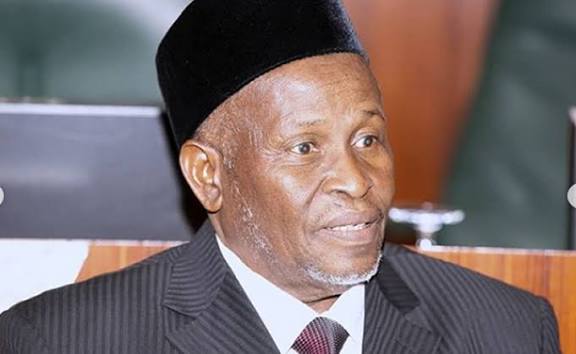
Former Chief Justice of Nigeria, Justice Ibrahim Tanko Muhammad (retd.), has passed away.
The former head of the Nigerian judiciary died in Saudi Arabia, marking the end of a long and distinguished career in public service.
Justice Muhammad reportedly died in the early hours of Tuesday at a hospital in Saudi Arabia, where he had been receiving medical attention.
News of his death has sparked widespread reactions across Nigeria, especially within legal, judicial, and religious communities.
A senior source confirmed the development, saying, “Ex-CJN Tanko Muhammad is dead. He passed away this morning at a Saudi Arabian Hospital.” The confirmation put an end to growing speculations surrounding his health.
The Nigerian Association of Muslim Law Students (NAMLAS), National Headquarters, Abuja, also confirmed the death in an official condolence message dated December 16, 2025.
The association described his passing as a major loss to the Nigerian judiciary and the nation as a whole.
“Indeed, to Allah we belong and to Him we shall return,” the statement read.
In its message titled “NAMLAS Condolence Message on the Passing of Hon. Justice Ibrahim Tanko Muhammad, GCON, Former Chief Justice of Nigeria,” the association said the former CJN’s death was deeply painful and far-reaching.
“The Nigeria Association of Muslim Law Students (NAMLAS), National Headquarters, Abuja, receives with profound sorrow the news of the passing of Honourable Justice Ibrahim Tanko Muhammad, GCON, former Chief Justice of Nigeria. His demise is a monumental loss to the Nigerian judiciary, the legal profession, the Muslim Ummah, and the nation at large.”
Justice Muhammad was described as a man of integrity, humility, and strong moral character, whose years on the Bench were guided by fairness and respect for the rule of law. His leadership as Chief Justice was marked by restraint, wisdom, and dedication to justice.
According to NAMLAS, his judicial career reflected the highest standards expected of the Bench, noting that his legacy would continue to shape and guide future generations of legal practitioners in Nigeria.
“As Chief Justice of Nigeria, he discharged his responsibilities with wisdom and restraint, leaving behind a legacy of service that will continue to guide generations of legal practitioners,” the statement added.
The association also highlighted his role as a mentor, particularly to young Muslim law students across the country. It said Justice Muhammad was approachable and supportive, offering guidance and encouragement to aspiring legal professionals.
“To NAMLAS, the late Chief Justice was more than a jurist; he was a fatherly pillar and a source of encouragement to Muslim law students across the country,” the association noted.
Condolences were extended to his family, the Nigerian judiciary, and the country at large, as NAMLAS described the loss as one felt beyond the legal profession.
“We extend our heartfelt condolences to his family, the Nigerian Judiciary, the Government and people of Nigeria, and the entire Muslim Ummah,” the statement said.
Prayers were also offered for the late jurist, with the association asking Allah to forgive his shortcomings, accept his good deeds, and grant him “the highest abode in Jannatul Firdaus.”
Justice Ibrahim Tanko Muhammad served Nigeria’s judiciary for decades and rose to the highest judicial office in the country.
His career remains one of the most significant in the nation’s legal history, leaving behind a legacy of service, discipline, and commitment to justice.


In this episode of Everyday Money Matters, host Olusegun Olugbenjo sits with Michael Akinsete, the Chief Marketing Officer and co-founder of Ecotutu, a solar power-based food preservation firm in Nigeria, to discuss the growing advantage that frozen food has over fresh food in Nigeria.
The conversation begins with Akinsete explaining that fresh food is often overrated in Nigeria noting that many people are turning to frozen food not because they prefer it, but because it makes practical and economic sense.
He goes on to explain that adopting frozen food has become a necessity for many Nigerians due to its convenience.
Furthermore, Micheal pointed out that by stocking up and freezing food ahead of high-demand periods, households can save money and make smarter financial choices, especially for those with limited resources unlike fresh food which often suffers huge losses, with 45% to 50% wasted during transportation from farms due to inadequate cooling infrastructure.
Additionally, He emphasized that freezing could safeguard both the nutritional value and safety of food, provided that proper handling procedures are followed from the start.
In conclusion, Akinsete reinforces that frozen food is a practical solution to Nigeria’s challenges in food preservation, cost, and availability. Watch the full episode

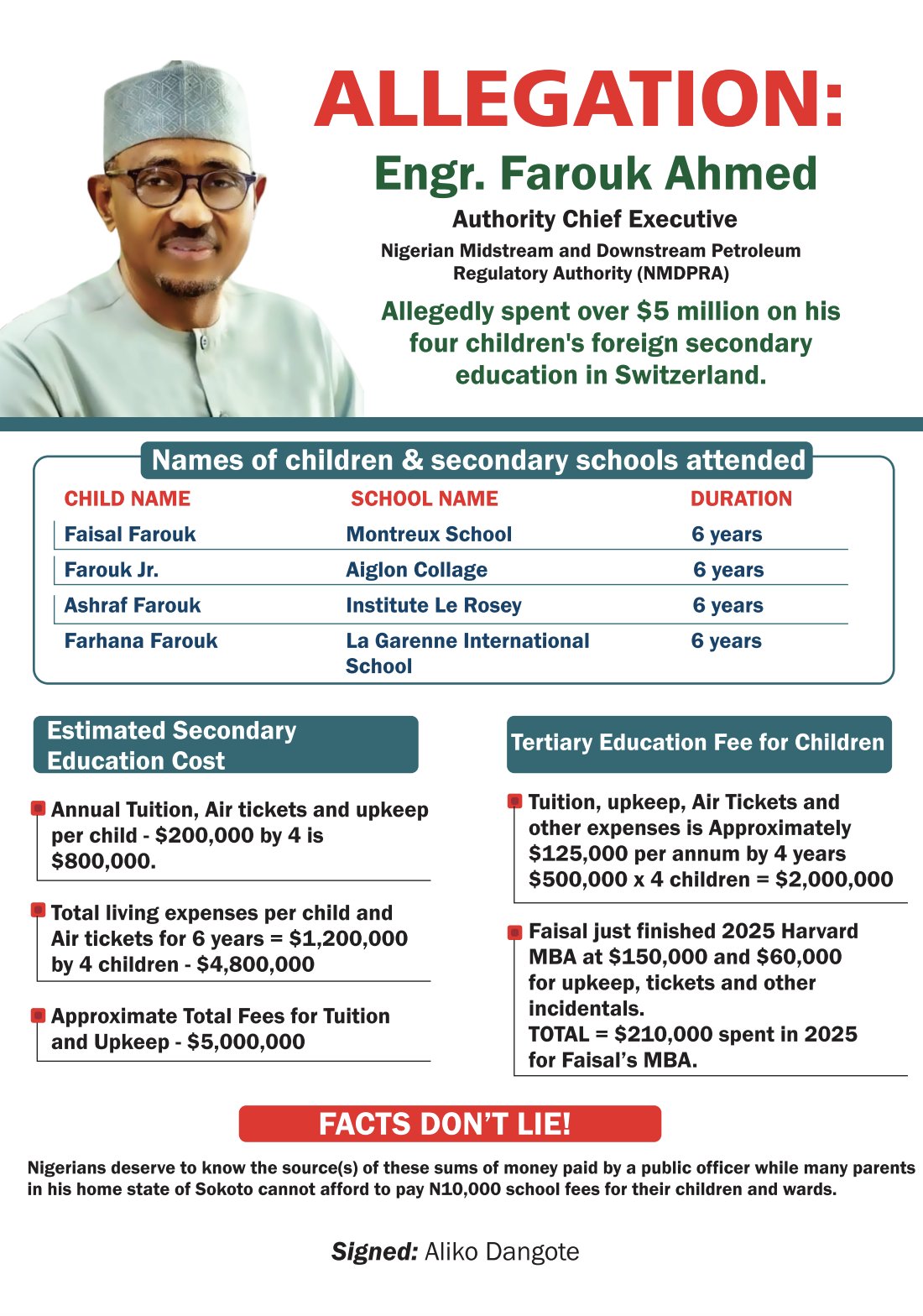
Aliko Dangote, chairman of the Dangote Group, has alleged that Farouk Ahmed, chief executive officer (CEO) of the Nigerian Midstream and Downstream Petroleum Regulatory Authority (NMDPRA), spent about $5 million on the secondary school education of his children in Switzerland.
In a paid newspaper advert published on Tuesday, the billionaire businessman claimed that the amount was paid for the education of four of Ahmed’s children over a six-year period.
Dangote had earlier raised the allegation on Monday, stating that Ahmed Farouk “paid $5 million” to Swiss secondary schools for his children’s education, an action he described as “economic sabotage and corruption”.
Providing further details in the advert, Dangote named the children as Faisal Farouk, Farouk Jr., Ashraf Farouk, and Farhana Farouk.
He also listed the schools attended by the children during the six-year period as Montreux School, Aiglon College, Institut Le Rosey, and La Garenne International School.
According to Dangote, the estimated costs covered tuition fees, living expenses, air travel, and general upkeep, calculated across four children and several years of study.
He stated that the annual cost of tuition, airfare, and upkeep per child was $200,000, bringing the total to $800,000 per year for all four children.
The businessman further explained that the combined living expenses and air travel costs per child over six years amounted to $1.2 million, translating to $4.8 million for the four children.
Overall, Dangote estimated that the total cost of tuition and upkeep for the children reached $5 million.
He also highlighted the alleged tertiary education expenses of Ahmed’s children, noting that tuition, upkeep, airfare, and other costs averaged about $125,000 per year over a four-year period.
According to Dangote, this resulted in $500,000 per child for four years, amounting to a total of $2 million for all the children.
“Faisal just finished 2025 Harvard MBA at $150,000 and $60,000 for upkeep, tickets and other incidentals. Total =$210,000 spent in 2025 for Faisal’s MBA,” Dangote said.
He added that Nigerians deserve to know the source of the money “paid by a public officer while many parents in his home state of Sokoto cannot afford to pay N10,000 school fees for their children and wards”.