
TECHNOLOGY
Do attacks in Syria and Australia mean that ISIS is back?


Australian Prime Minister Anthony Albanese today described the deadly terrorist attack at a Hanukkah celebration at Sydney’s Bondi Beach as being “motivated by Islamic State ideology.” But, this may be an understatement.
The father and son pair who carried out the attack on Sunday, killing at least 15 people and wounding 40, traveled to the Philippines last month, to an area where an Islamic State, commonly known as ISIS, affiliate is active. According to Australian media reports, the two received military training there.
That means the attack is more than just motivated by ISIS; it’s an ISIS-“directed” or at least “enabled” attack, Colin Clarke, counterterrorism analyst and executive director of the Soufan Group, told Vox. “Clearly this wasn’t just two guys sitting around reading Telegram deciding that they want to hatch a plot,” Clarke added.
The Bondi Beach massacre came a day after a gunman, believed by the Pentagon to be affiliated with ISIS, killed two US soldiers and a civilian interpreter in Syria — the first American casualties in the country since the fall of Bashar al-Assad one year ago.
The perpetrators was a member of the Syrian security forces, a grim echo of similar “green on blue” attacks in which local forces attacked the Americans they were partnered with that dominated the final years of US military operations in Afghanistan.
The two high-profile attacks in one weekend, coming at a time when western governments have largely shifted attention from jihadist violence to other threats, raise the discomfiting question: Is ISIS back?
To be sure, ISIS is not the same group it was a decade ago, when it controlled an area the size of Great Britain in Syria and Iraq and had as many as 80,000 fighters in its ranks. Now, the territorial “caliphate” has been entirely eliminated, and its numbers have probably shrunk to less than 3,000.
ISIS’s attacks and grisly beheading videos once dominated global headlines, prompting a major US military intervention in the Middle East. Now, jihadist-motivated attacks — by ISIS or other groups — are now far outnumbered by attacks by right-wing and left-wing extremists in the United States. And numbers are way down in Europe, as well.
But, the truth is that ISIS never really went away. This year began, after all, with an ISIS-inspired car attack in New Orleans that killed 15 people. Last year saw mass casualty attacks by the Afghan affiliate ISIS-K in Russia and Iran, as well as a thwarted plot targeting a Taylor Swift concert in Austria.
Most of the recent ISIS violence, however, has taken place in the countries where the group’s various affiliates are based. This includes Syria, where the number of attacks are up since Assad’s downfall and the removal of a significant number of US troops. But, the group is believed to be growing fastest in Africa, with major affiliates operating in West Africa’s Sahel region, the Democratic Republic of the Congo, and Somalia.
Little is known about ISIS’s current global “caliph” — Abu Hafs al-Hashimi al-Quraishi, who took over in 2023. According to some reports, he is based in Somalia. Even though the group is no longer a physical “state” in any sense, experts believe there’s still a high degree of centralization and coordination between its various affiliates throughout Africa, Asia, and the Middle East.
Much of ISIS’s work radicalizing and recruiting new members, though, occurs online via social media. The group has taken advantage of the global anger over Israel’s war on Gaza for recruitment purposes, which is somewhat ironic given that ISIS and Hamas are longtime enemies.
Many of the recent attacks and foiled plots in Europe do, in fact, appear to be the work of “lone wolves” radicalized online, many of them teenagers. As the French terrorism analyst Wassim Nasr told me last year, would-be attackers are often given instructions and logistical support by “cyber-coaches” they meet online, a cheaper and less risky process than bringing them to another country for training.
This makes the Australia case, in which the suspects legally purchased firearms and may have traveled to an area where ISIS operates in the Philippines despite one of them having been previously investigated for links to terrorism, all the more noteworthy.
Returning to the previous war on terror
President Donald Trump’s first campaign for the White House prominently featured his pledge to “bomb the shit” out of ISIS, but he’s since pivoted to other priorities. Trump has also expressed the wish, dating back to his first term, to remove the last US troops from Syria, where they are still working in conjunction with local Kurdish forces to fight ISIS.
ISIS may hope that attacks like last weekend will accelerate that departure — just as the surge in “green on blue” attacks helped push the US toward the exit in Afghanistan — but it could also have the opposite effect. Trump has vowed “very serious retaliation” against the perpetrators of the attack.
The shift of US attention and resources away from fighting terrorism — or, at least “terrorism” as it was typically defined in the post-9/11 years — picked up under the Biden administration, during which foreign policy emphasized “great power competition” with China and Russia. That idea has continued into Trump’s second term, where the emphasis is more on combating narcotics and migration in the Western Hemisphere, as well as, judging by the recently released National Security Strategy, culture war conflicts with Europe.
The NSS, which does not mention ISIS, warns against sustained counterterrorism campaigns, stating that “terrorist activity in an otherwise less consequential area might force our urgent attention. But leaping from that necessity to sustained attention to the periphery is a mistake.”
The shift can be overstated. The US carried out significantly more airstrikes in Somalia this year — many of them targeting ISIS — than in the Caribbean, where they got far more attention. But, when this administration invokes “terrorism,” it’s more likely referring to drug cartels, leftist governments, or antifa than al-Qaida or ISIS.
But, if ISIS deadly attacks targeting US troops or on the streets of western cities become more common again, that could change quickly.
TECHNOLOGY
Christmas cheer for Britain’s biggest chemical plant, but there are two distinct problems | Money News


You’ve doubtless heard of the National Grid, the network of pylons and electricity infrastructure ensuring the country is supplied with power. You’re probably aware that there is a similar national network of gas pipelines sending methane into millions of our boilers.
But far fewer people, even among the infrastructure cognoscenti, are even faintly familiar with the UK Ethylene Pipeline System. Yet this pipeline network, obscure as it might be, is one of the critical parts of Britain’s industrial infrastructure. And it’s also a useful clue to help explain why the government has just announced it’s spending more than £120m to bail out the chemical plant at Grangemouth in Scotland.
Ethylene is one of those precursor chemicals essential for the manufacture of all sorts of everyday products. React it with terephthalic acid and you end up with polyester. Combine it with chlorine and you end up with PVC. And when you polymerise ethylene itself you end up with polyethylene – the most important plastic in the world.
Why Grangemouth matters
Ethylene is, in short, a very big deal. Hence, why, many years ago, a pipeline was built to ensure Britain’s various chemical plants would have a reliable supply of the stuff. The pipes connected the key nodes in Britain’s chemicals infrastructure: the plants in the north of Cheshire, which derived chemicals from salt, the vast Wilton petrochemical plant in Teesside and, up in Scotland, the most important point in the network – Grangemouth.
The refinery would suck in oil and gas from the North Sea and turn it into ethane, which it would then “crack”, an energy-hungry process that involves heating it up to phenomenally high temperatures. Some of that ethylene would be used on site, but large volumes would also be sent down the pipeline. It would be pumped down to Runcorn, where the old ICI chlor-alkali plant, now owned by INEOS, would use it to make PVC. It would be sent to Wilton, where it would be turned into polyethylene and polyester.
Read more from Ed Conway:
The reality of Trump’s trade war
The reason for Trump’s Venezuela exploits
That’s the first important thing to grasp about this network – it is essential for the operation of a whole series of plants, many of them run by entirely different companies.
The second key thing to note is that, after the closure of the cracker at Wilton (now owned by Saudi company Sabic) and the ExxonMobil plant at Mossmorran in Fife, Grangemouth is the last plant standing. While the refinery no longer uses North Sea oil and gas, instead shipping in ethane from the US, it still makes its own ethylene.
So when INEOS began consulting on plans to close that ethylene cracker, officials down south in Westminster began to panic. The problem wasn’t just the 500 or so jobs that might have been lost in Grangemouth. It was the domino effect that would feed throughout the sector. All of a sudden, all those plants at the other ends of the pipeline would be affected too. In practice, the closure might have eventuated in more than a thousand job losses – maybe more.
What’s happening now?
All of which helps explain the news today – that the Department for Business and Trade is putting more than £120m of taxpayer money into the site. The bailout (it’s hard to see it as anything but) is not the first. The government has also put hundreds of millions of pounds of taxpayer money into British Steel, which it quasi-nationalised earlier this year, not to mention extra cash into Tata Steel at Port Talbot and loan guarantees to help Jaguar Land Rover after it faced an unprecedented cyber attack.
Work ground to a halt at JLR’s Wolverhampton factory after a cyber attack. Pic: PA
But while this package will undoubtedly provide Christmas cheer here in Grangemouth today, the government is left facing two distinct problems.
Reactive rather than strategic
The first is that for all that the chancellor and business secretary (who are themselves planning to visit Grangemouth today) are keen to pitch this latest move as a coherent part of their industrial strategy, it’s hard not to see it as something else. Far from appearing strategic, instead they seem reactive. To the extent that they have a coherent industrial strategy, it mostly seems to involve forking out public money when a given plant is close to closure. If they weren’t already, Britain’s industrialists will today be wondering to themselves: what would it take to get ourselves some of this money in future?
The crisis continues
The second issue is that the Grangemouth bailout is very unlikely to end the crisis spreading across Britain’s chemicals sector. A series of plants – some prominent, others less so – have closed in the past few years. The chemicals sector – once one of the most important in the economy – has seen its economic output drop by more than 20% in the past three years alone.
This is not just a UK-specific story. Something similar is happening across much of Europe. But for many chemicals companies, it simply doesn’t add up to invest and build in the UK any more – a product in part of regulations and in part of high energy costs. In short, this story isn’t over yet. There will be more twists and turns to come.


Monzo chief executive TS Anil was asked to step down by the fintech’s board amid concerns over international expansion and his post-IPO commitment, according to reporting from the Financial Times.
The FT reports that tensions built between Anil and the board before October’s somewhat unexpected announcement that former Google executive Diana Layfield would take over early next year. A key issue, apparently, was IPO timing. Anil pushed for an earlier listing than some directors wanted and signaled he might leave soon after, while board members sought more time to expand internationally and grow the company’s valuation. (Monzo was reportedly valued at $5.9 billion in an October 2024 secondary share sale backed by Singapore’s sovereign wealth fund GIC and StepStone Group.)
TechCrunch sat down with Anil in person this summer, and we discussed the possibility of Monzo going public in 2026, a timeline that now appears to have been at the center of boardroom disagreements.
Under Anil’s leadership since 2020, Monzo reportedly tripled its customer base to 13 million and posted record £60.5 million pre-tax profits. But nearly all customers remain UK-based after the company’s U.S. expansion stalled in 2021. We talked with Anil about this, too, during our sit-down.
Now Layfield, who spent nine years at Google and more than a decade at Standard Chartered (of which Anil is also an alum), will oversee Monzo’s international strategy and guide it toward its eventual public listing.
We’ve reached out to Monzo for more information.
TECHNOLOGY
Mystery as NASA probe goes dark after close encounter with interstellar visitor nearing Earth

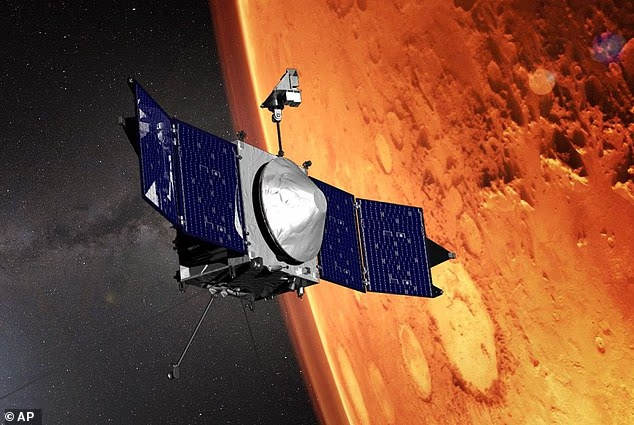
NASA has revealed shocking new details after losing contact with a Mars space probe nearly two weeks after its close encounter with interstellar object 3I/ATLAS.
On Monday, the space agency said the MAVEN spacecraft went dark on December 4 while it was observing the mysterious visitor NASA has declared a comet.
MAVEN has been orbiting Mars since 2014 and has served as a communications relay for man-made rovers exploring the Martian surface.
According to the American space agency, the probe moved behind Mars while tracking the interstellar object, then suddenly stopped transmitting and started rotating in an unusual manner as it reemerged within view of Earth.
NASA said it appears whatever happened to MAVEN on the far side of the planet has also caused the probe’s orbit around Mars to change as well.
However, without direct data from the spacecraft, NASA has been forced to analyze fragments of tracking information to figure out what’s gone wrong. They won’t know for sure how MAVEN’s orbit has changed until it starts transmitting again.
MAVEN was only 18million miles away from 3I/ATLAS in October when it reportedly took a collection of photographs as the supposed comet passed the Red Planet – images which draw widespread criticism for their poor quality.
While the NASA spacecraft has dealt with minor technical issues in the past, this is the first time in a decade that something may have actually knocked the probe offline and disrupted its orbit.

MAVEN spacecraft (Pictured) has been orbiting Mars since 2014, but NASA lost connection to the probe on December 4

3I/ATLAS (Pictured) exhibits unique features, including an anti-tail, extreme color changes, an extremely unusual course, and a massive coma
The incident has already set off wild theories on social media that the communications blackout is somehow tied to 3I/ATLAS making its closest pass by Earth on Friday.
While the ongoing problems with MAVEN are not related to 3I/ATLAS, NASA has drawn sharp public criticism after the images taken near Mars came back blurry and lacked detail, sparking claims that the ‘real’ photos were being hidden.
‘Either NASA is lying, and won’t release the images because they know what it is, or whatever is piloting 3I/ATLAS knocked MAVEN offline. Either way, NASA is lying,’ one social media user on X claimed without proof.
‘Does anyone still trust NASA? Like, is there anyone out there who really thinks MAVEN just glitched out and NASA isn’t hoarding the data in secret to make sure no new 3I/ATLAS images showing UFO sneak into the public sphere?’ another X user alleged.
Harvard Professor Avi Loeb noted that NASA previously revealed some of the photos MAVEN took during its close encounter with 3/ATLAS in October. It’s unknown how many images of the object had yet to be transmitted when the probe went dark.
While many have also claimed the interstellar object may have done something to MAVEN to knock it off its orbit, 3I/ATLAS was nowhere near the spacecraft when the malfunction occurred.
On December 19, 3I/ATLAS will pass within 170million miles of Earth, its closest pass by our planet on its journey through the solar system.
Even without MAVEN online to track the object, Loeb noted that the suspected comet will be close enough for amateurs to see it and photograph it with common telescopes, adding that any alleged cover-up won’t be possible in just days.
Join the debate
What do you think NASA isn’t telling us about MAVEN’s blackout and the mysterious 3I/ATLAS?

3I/ATLAS is projected to reach its closest point to Earth on Friday, December 19, when it gets within 170million miles of the planet

Stargazers recently captured brand new clear images of the interstellar object 3I/ATLAS using lower quality telescopes compared to those used by NASA
‘It’s not up to NASA. There are hundreds of observatories around the globe that will observe it,’ the professor explained to NEWSMAX.
Loeb added that December 19 is also the date of a new moon, meaning there won’t be any extra light to contaminate the images of 3I/ATLAS.
At the same time, over 23 nations in Europe are actively tracking the interstellar visitor as part of the largest planetary defense drill in history.
‘There are too many telescopes available to block that data.’
Loeb, the head of the Galileo Project, a research group looking for extraterrestrial life, added that scientists should be able to prove whether the object has a gaseous cometary tail or if the streams of material seen shooting out of the comet are actually thrusters from a spacecraft.
The Harvard physicist has continued to argue that there are too many factors surrounding 3I/ATLAS that scientists have yet to explain to simply dismiss the object as an ordinary comet.
Those have included a comet’s tail, which is facing in the wrong direction of the sun, known as an anti-tail, suggesting the stream is actually exhaust from an engine that’s guiding the object through space.
In total, Loeb has documented over a dozen distinct ‘anomalies’ in 3I/ATLAS, all taking place at the same time, which the scientist said would be nearly impossible if it was natural comet.
NASA and the European Space Agency (ESA) have both pushed back on this theory, concluding 3I/ATLAS is a comet from a distant solar system composed of a unique mixture of chemical elements.
An administrative law judge has ruled that Tesla engaged in deceptive marketing that gave customers a false impression of the capabilities of its Autopilot and Full Self-Driving driver assistance software, a pivotal development in a years-long case initiated by California’s Department of Motor Vehicles.
The judge agreed with the state DMV’s request to suspend Tesla sales for 30 days as a penalty for its actions, but the DMV stayed the order and is giving Tesla 60 days to modify or remove any deceptive language before implementing the suspension, according to multiple outlets. The judge also recommended suspending Tesla’s manufacturing license for 30 days, but the DMV stayed that order, too, according to Bloomberg News.
“The DMV’s decision today confirms that the department will hold every vehicle manufacturer to the highest safety standards to keep California’s drivers, passengers and pedestrians protected,” DMV director Steve Gordon said in a statement. “Tesla can take simple steps to pause this decision and permanently resolve this issue — steps autonomous vehicle companies and other automakers have been able to achieve in California’s nation-leading and supportive innovation marketplace.”
Tesla said in a post on X that: “Sales in California will continue uninterrupted.”
“This was a ‘consumer protection’ order about the use of the term ‘Autopilot’ in a case where not one single customer came forward to say there’s a problem,” the company wrote.
After the 60-day window, Tesla can appeal the decision and should Tesla comply, the suspensions will be dropped. But it’s not immediately clear what steps the DMV wants Tesla to take, beyond telling the company to “take action regarding its use of the term ‘autopilot.’” The DMV did not immediately respond to a request for clarification, or to a request regarding Tesla’s apparent plan to ignore the decision.
Tesla has faced multiple investigations from the California Attorney General, the Department of Justice, and the Securities and Exchange Commission over similar allegations that its marketing around partial autonomy systems was misleading. The company has also faced (and now settled) a number of personal civil lawsuits over crashes involving its Autopilot technology.
Techcrunch event
San Francisco
|
October 13-15, 2026
The case brought by the CA DMV has been winding through the state’s Office of Administrative Hearings for years. The agency essentially accused Tesla of making customers believe that its advanced driver assistance systems were capable of high levels of autonomy. This led to overconfidence in the systems, the DMV alleged, which has contributed to dozens of crashes and multiple deaths. Tesla refuted these claims by saying its marketing was protected speech.
A shutdown of sales in California, even temporary, could have a major impact on Tesla’s business as it remains the company’s largest market in the United States. A manufacturing suspension could also hurt Tesla’s business. While the company has constructed a massive factory in Austin, Texas (and moved its official headquarters to the same location), it still relies on its Fremont, California factory to make hundreds of thousands of vehicles, including all North American-bound Model 3 sedans.
The judge’s decision comes at a moment when Tesla is advancing its Robotaxi service test in Austin. Over the weekend, the company removed the safety monitors from its small fleet in the city. It had been offering rides to customers in the city for the last six months, but with a safety monitor either in the driver’s or passenger’s seat. Those vehicles are running a different version of Tesla’s driving software than what the automaker’s customers have in their cars, CEO Elon Musk has said.
This story has been updated to include information from the DMV’s press release and Tesla’s response.
TECHNOLOGY
2025 is the UK’s sunniest year ever – with record levels for solar power | Science, Climate & Tech News

The UK has recorded its sunniest year ever – and we are only halfway through December.
But a bumper spring and summer for sunshine have already put 2025 firmly in the top spot for sunshine hours across the UK, according to provisional Met Office statistics.
The sunny spells were driven by frequent periods of high pressure that reduced clouds and locked in sunny skies for many parts of the country.
Though it may be hard to believe, Britain’s weather has generally been getting sunnier over the past few decades – but scientists can’t yet say why.
This year, up until 15 December, the country clocked up 1,622 hours of sunshine, beating the previous sunniest year of 2003.
All that sunshine drove a record year for solar power, by a huge margin.
2025 was the UK’s sunniest year on record
Met Office senior scientist Mike Kendon said: “Spring was exceptional, and many will remember the long spells of days with largely unbroken sunshine.”
So far this year, only the months of February and October recorded below-average sunshine hours, he added.
But the bounties were not shared equally across the nations.
England enjoyed its sunniest year ever. But 2025 has likely not even made the top 10 for Northern Ireland, even though it was above average.
Scotland is on course for its second-sunniest year, and Wales its sixth, albeit with two weeks still to go.
Why is the UK getting sunnier?
The UK has broadly been getting sunnier since the 1980s, but the cause of the trend remains a mystery.
It could “simply be down to natural variability”, the Met Office said, meaning it could well change in future.
Or it may be explained by a “reduction in particulates [known as aerosols] over the UK, partly due to clean air laws introduced to combat acid rain”, said Edward Gryspeerdt, associate professor in atmospheric physics, Imperial College London.
Aerosols cause clouds to reflect less light, so fewer of them allows more sunshine down to Earth.
There is “no definitive evidence” that climate change is impacting sunshine levels, according to the Met Office.
Solar energy in the limelight
All that sunshine, combined with the build out of more solar farms and panels on roofs, meant solar power soared to record levels in 2025.
By November, solar had already generated 18Twh of electricity, far more than the 14Twh by the end of December last year.
John Marsham, professor of atmospheric science at Leeds University, said solar energy was “helping to lower prices” of electricity by breaking the link with gas prices.
The Ember thinktank also found just 2% of days in a typical year have both low wind and low sunshine, meaning 98% of the time it is either windy or sunny.
Ember analyst Frankie Mayo said: “At a national scale, solar power pairs well with wind farms which generate more in winter, when it’s less sunny.”
Read more from Sky News:
Imran Khan ‘held in death cell’
Boy arrested over girl’s murder
However, large solar farms have proved unpopular in some local communities for their impact on the landscape, such as in Lincolnshire, where several large sites recently were given the go-ahead.
Craig Dyke from the UK’s energy system operator NESO said: “It’s hard to believe how far Britain has come over the past quarter of a century, with renewables now producing around 60% of our electricity – up from just 3% in the year 2000.”

In early 2023, Luminar was riding high. After going public during the pandemic and scoring a key deal with Volvo, the company had added Mercedes-Benz and Polestar as customers of its “lifesaving” lidar sensors. Founder and CEO Austin Russell called it an “inflection point,” as Luminar prepped to have those sensors integrated into the first production vehicles.
Volvo in particular was all in on the technology. The Swedish automaker, which spent decades building a brand around the idea of making the safest cars, was the first to jump at integrating the laser-based sensors in its vehicles. Volvo initially tapped Luminar to provide 39,500 lidar sensors over the life of a deal signed in 2020. In 2021, Volvo upped that to 673,000. And in 2022, Volvo upped it again, this time to 1.1 million sensors.
Three years later, Luminar is now in bankruptcy. The company has already made a deal to sell off one subsidiary centered around semiconductors and is looking to sell its lidar business during the Chapter 11 process, which began on Monday.
The first batch of filings in the bankruptcy case shed new light on how Luminar’s cornerstone deal with Volvo came apart — and how its undoing helped push the once-promising startup over the edge.
Big promises, then big revisions
Luminar made “substantial up-front investments in equipment, facilities, and workforce” to meet the demand from Volvo back in 2022, according to a declaration written by Luminar’s newly hired chief restructuring officer Robin Chiu. It built out a manufacturing facility in Monterrey, Mexico, and spent nearly $200 million to prepare to make its Iris lidar sensors for Volvo’s EX90 SUV.
“Volvo was going to be a marquee customer, the stepping stone to introducing the company’s Iris product to the broader automotive industry,” one of Luminar’s lawyers said during the first hearing in the bankruptcy case on Tuesday.
But, according to Chiu, problems were already brewing with Volvo. The automaker delayed the EX90 SUV because it needed to do more “software testing and development,” the automaker said in 2023. And in early 2024, Luminar says Volvo reduced its expected volume for Iris sensors by 75%.
Techcrunch event
San Francisco
|
October 13-15, 2026
Luminar’s other deals started to sour, too. Polestar (a subsidiary of Volvo) quietly gave up on integrating Luminar’s lidar sensors “because the vehicle’s software ultimately could not use” the features, according to Chiu. Mercedes-Benz terminated its agreement to buy Luminar’s Iris sensors in November 2024 because the lidar-maker “failed to meet ambitious requirements,” according to Chiu.
(Mercedes-Benz struck up a new deal with Luminar in March 2025 for its next-generation Halo lidar, but Chiu wrote that Luminar has “no go-forward projects” with the German automaker at the time of bankruptcy.)
This left Luminar with Volvo as its lone flagship customer.
The company never diversified much beyond the automotive industry, shunning other applications like defense or robotics. In fact, Russell had founded Luminar in 2012 with the goal of taking lidar out of those sectors and into automotive to help accelerate the adoption of autonomous vehicles.
It wasn’t until March of this year that Russell talked about expanding beyond automotive, as Luminar signed a deal with construction equipment company Caterpillar. Just two months later, Russell abruptly resigned following an ethics inquiry from Luminar’s board of directors.
“More bad news”
By Chiu’s account, Volvo kept promising that it would meet the lifetime order of 1.1 million units despite the reduced volume in 2024. So Luminar kept pressing forward under that assumption.
But signs of stress were showing. Luminar laid off 20% of its workforce in May 2024 and outsourced more of its lidar sensor manufacturing. It deepened those cuts and restructured some of its business in September 2024. Another round of layoffs came in May 2025 after Russell resigned.
In September, “Volvo delivered more bad news,” Chiu wrote. The automaker decided to offer lidar as an option on the EX90 going forward, instead of making it a standard feature as originally planned. Volvo also told Luminar that it was shelving lidar on future vehicles “as a cost-cutting measure.”
“This change reduced Volvo’s estimated lifetime volumes by approximately 90%,” Chiu wrote.
Luminar told Volvo on October 3 that it considered this a breach of the agreement the companies had first signed in 2020. On October 31, the dispute became public, as Luminar told shareholders in a regulatory filing that it was suspending sensor shipments to Volvo. The Swedish automaker sent Luminar a letter two weeks later, terminating the agreement.
Volvo told TechCrunch in a statement Tuesday that it “made this decision to limit the company’s supply chain risk exposure and it is a direct result of Luminar’s failure to meet its contractual obligations to Volvo Cars.”
“The company’s products can deliver a high level of safety and driver support, enabled by the cars’ powerful core computing coupled with their advanced sensor set – with or without a lidar,” a Volvo spokesperson said.
Luminar, meanwhile, started selling lidar sensors meant for Volvo “to adjacent markets in an effort to recover its sunk costs,” according to Chiu’s filing, but it was too little too late.
“As its relationship with Volvo deteriorated, [Luminar] worked tirelessly to identify new customers, but was ultimately unable to enter into production with any new customers in a timely fashion,” Chiu wrote. “The public Volvo dispute also resulted in a decline in sales due to broader market concerns over Luminar’s financial future.”
Now the future of what’s left of Luminar is in the hands of its creditors and the court. It’s seeking the judge’s approval to sell the semiconductor subsidiary to Quantum Computing, Inc. for $110 million, and hopes to court a number of bidders for the lidar business.
Luminar has already had significant interest in the lidar business, according to the filing. In January, Chiu wrote, the company hired investment bank Jefferies to evaluate a sale after receiving an “unsolicited acquisition proposal.” Luminar received “additional unsolicited inbound expressions of interest to acquire the Company” through the summer and fall — including one submitted by Russell through his new AI lab in October.
As TechCrunch reported Monday, Russell plans to keep bidding on Luminar’s remains as the bankruptcy case moves forward. During Tuesday’s hearing, a lawyer for Luminar said it is “deep into the sale process” and “in negotiations with” several potential bidders.
This story has been updated with a statement from Volvo and information from Luminar’s first bankruptcy hearing.


Luno has announced a strategic partnership with AltSchool Africa to launch a free crypto education programme for 15,000 Nigerians. The beginner-friendly course will begin in March 2026, run through the year, and mark what both companies describe as Africa’s largest coordinated crypto literacy initiative to date.
Announced earlier today in Lagos, the partnership brings together Luno, a global cryptocurrency platform, and AltSchool Africa, an accredited online learning provider, to deliver a fully funded beginner course titled Demystifying Crypto for Africans.
The programme is designed to improve financial literacy, build trust in digital assets, and encourage safer participation in the rapidly expanding digital economy.
Nigeria remains one of Africa’s most active crypto markets. Around a third of the population already engages with digital assets, driven largely by a young, tech-savvy demographic seeking alternatives for savings, remittances, and global trade.
However, the speed of adoption has also exposed significant gaps in knowledge, leaving many users vulnerable to misinformation, scams, and poorly understood financial risks.
 Ayotunde Alabi, CEO of Luno Nigeria
Combining Luno’s focus on responsible crypto use with AltSchool Africa’s experience in delivering accessible digital education, the initiative aims to provide structured, practical learning grounded in African realities.
The course content is tailored to everyday use cases, rather than speculative trading alone, with a strong emphasis on safety and informed decision-making.
Luno and AltSchool are building practical crypto skills for everyday use
The programme will run from March 2026 through the end of the year and will be delivered in three cohorts of 5,000 learners each. Cohort one commences in March 2026 after applications in January and February. Cohort two starts in July 2026. Cohort three follows suit in November 2026. The organisers say the staggered approach will allow them to refine delivery and scale support.
The programme will be led by Web3 educator Abdulsamad Tiamiyu and structured as a three- to four-week course, with learners receiving up to one year of access to materials.
Participants will move through five core modules covering the fundamentals of cryptocurrency, blockchain technology, wallets, exchanges, stablecoins, and research tools such as CoinGecko and Etherscan. The curriculum blends theory with hands-on experience, allowing learners to interact directly with digital tools they are likely to encounter in real-world financial activities.
Those who complete the assessments will receive an AltSchool Africa Certificate of Completion.
 Adewale Yusuf, CEO and Co-Founder of AltSchool Africa
Ayotunde Alabi, CEO of Luno Nigeria, described the partnership as a timely intervention. He said that as crypto adoption accelerates across Africa, education must keep pace to ensure people can participate securely and sustainably. According to Alabi, the initiative reflects Luno’s long-term investment in building trust and integrity within the digital asset ecosystem, while helping users turn perceived risk into meaningful economic opportunity.
Adewale Yusuf, co-founder and CEO of AltSchool Africa, echoed the same sentiment, framing the programme as an investment in economic empowerment. He noted that access to clear, practical education is essential if Africans are to participate fully in the global digital economy and said AltSchool was proud to collaborate with a partner that prioritises clarity and measurable impact.
The programme is open to Nigerian residents aged 18 and above who can commit to completing the course within four weeks. Applicants must have, or create, a Luno account before enrolling. Applications open in January 2026 via the AltSchool Africa portal, with successful candidates notified within one week.
Also read: Luno launches first-ever crypto staking in Nigeria: What it means and how you can benefit
TECHNOLOGY
Pornhub hit by massive security breach with 200 million users’ data records and search history stolen

Pornhub is notifying more than 200 million premium users that their data and search history on the adult website may have been stolen in a security breach.
Hackers claimed they had infiltrated a third-party system that Pornhub uses to analyze site traffic, potentially exposing limited records of how some users interacted with the platform.
In an extortion demand sent to Pornhub, the cybercriminals alleged to have a massive data set of records that included email addresses, location, video titles, search keywords, activity types and timestamps for over 200 million entries, Bleeping Computer reported.
Premium users pay $14.99 a month to access millions of videos, along with more than 100,000 premium videos that non-paying users cannot view.
‘We recently learned that an unauthorized party gained unauthorized access to analytics data stored with Mixpanel, a third-party data analytics service provider, Pornhub said in a statement.
‘The unauthorized party was able to use this unauthorized access to extract a limited set of analytics events for some users.’
The adult content site added that this was not a breach of its own system, ensuring users that their passwords, credentials or government IDs were not compromised or exposed.
Pornhub added that it has since secured the affected account and stopped the unauthorized access.

Hackers claimed they had infiltrated a third-party system that Pornhub uses to track user activity, allowing them to access limited analytics data for some users
Pornhub revealed the issue on December 12, saying it stemmed from a November breach involving its analytics provider, Mixpanel.
However, the adult website noted that it has not worked with Mixpanel since 2023, meaning the stolen records are from that year and earlier, BleepingComputer reported.
Mixpanel CEO Jen Taylor said in a statement: ‘We took comprehensive steps to contain and eradicate unauthorized access and secure impacted user accounts.
‘We engaged external cybersecurity partners to remediate and respond to the incident.’
The company told BleepingComputer it was unable to verify that the Pornhub data being circulated came from the November incident.
The cybercrime group ShinyHunters claimed it was behind the intrusion, publicly offering what it described as Pornhub Premium analytics data while name-dropping tech giants among its alleged victims.
Pornhub has informed affected users and publicly warned them to be cautious of phishing attempts or suspicious messages.
A company statement said: ‘While our investigation is ongoing, we encourage all users to remain vigilant by monitoring their accounts for any suspicious emails or unusual activity.’
The platform has brought in cybersecurity experts, launched an internal investigation, and alerted authorities, emphasizing that passwords and payment information were not compromised in the incident.
Share or comment on this article:
Pornhub hit by massive security breach with 200 million users’ data records and search history stolen

Slate Auto, the electric truck startup backed by Jeff Bezos, has now collected more than 150,000 refundable reservations for its low-cost EV due out at the end of 2026.
The company shared the figure in a new Q&A video with CEO Chris Barman, where she answers questions from those reservation holders about the company’s plans for self-driving (there are none), or whether owners will be able to affix a car seat to the optional rear seats (they will).
Reservations are a somewhat helpful metric for gauging general interest in a new car, but they are by no means a signal of sure success. Time and again over the last few years, we have seen EV companies tout reservation figures only to go bust, either because they weren’t able to get through the difficult process of standing up production, or because they weren’t ready to have cars on the road.
For Slate, it’s promising that the number has continued to climb, meaning that new reservations are coming in faster than any attrition the company might be seeing. That said, Slate crossed the 100,000 reservation mark all the way back in May, right after it came out of stealth, so it took a good seven months to grow the list by 50%. And looking forward, Slate plans to make 150,000 of these EVs per year at the factory it’s refurbishing in Warsaw, Indiana, so it will need to attract far more buyers if it plans to succeed in the market.
Any continued enthusiasm for Slate’s EV has to be a reassuring sign for the company, given the state of electric trucks overall these days. Just yesterday, Ford announced it is ending production of the all-electric F-150 Lightning, the first major battery-powered pickup truck to hit the U.S. market a few years ago. (It’s being replaced by a version with a gas generator attached.) The company said the Lightning simply wasn’t making enough money — a fact exacerbated by how Ford was never able to sell more than a few thousand per quarter. Sales of other electric trucks, like Tesla’s Cybertruck and General Motors’ Silverado EV, have also struggled to stay above that mark.
Of course, the Lightning was a sort-of Frankenstein’s monster of a vehicle, with Ford shoehorning EV technology into a design that was originally meant for gas powertrains. Slate’s truck has been designed from the ground up to be an EV, and the company is hyper-focused on selling it for a price tag in the mid-$20,000 range. The decline of offerings from Ford and others may help clear the way for Slate to find early success — that is, until Ford’s real shot at a low-cost EV hits the market in 2027.

span { width: 5px; height: 5px; background-color: #5b5b5b; }#mailpoet_form_2{border-radius: 8px;color: #313131;text-align: left;}#mailpoet_form_2 form.mailpoet_form {padding: 0px;}#mailpoet_form_2{width: 100%;}#mailpoet_form_2 .mailpoet_message {margin: 0; padding: 0 20px;}
#mailpoet_form_2 .mailpoet_validate_success {color: #000000}
#mailpoet_form_2 input.parsley-success {color: #000000}
#mailpoet_form_2 select.parsley-success {color: #000000}
#mailpoet_form_2 textarea.parsley-success {color: #000000}
#mailpoet_form_2 .mailpoet_validate_error {color: #cf2e2e}
#mailpoet_form_2 input.parsley-error {color: #cf2e2e}
#mailpoet_form_2 select.parsley-error {color: #cf2e2e}
#mailpoet_form_2 textarea.textarea.parsley-error {color: #cf2e2e}
#mailpoet_form_2 .parsley-errors-list {color: #cf2e2e}
#mailpoet_form_2 .parsley-required {color: #cf2e2e}
#mailpoet_form_2 .parsley-custom-error-message {color: #cf2e2e}
#mailpoet_form_2 .mailpoet_paragraph.last {margin-bottom: 0} @media (max-width: 500px) {#mailpoet_form_2 {background-image: none;}} @media (min-width: 500px) {#mailpoet_form_2 .last .mailpoet_paragraph:last-child {margin-bottom: 0}} @media (max-width: 500px) {#mailpoet_form_2 .mailpoet_form_column:last-child .mailpoet_paragraph:last-child {margin-bottom: 0}}
]]>