
TECHNOLOGY
Musicians are deeply concerned about AI. So why are the major labels embracing it? | Music


This was the year that AI-generated music went from jokey curiosity to mainstream force. Velvet Sundown, a wholly AI act, generated millions of streams; AI-created tracks topped Spotify’s viral chart and one of the US Billboard country charts; AI “artist” Xania Monet “signed” a record deal. BBC Introducing is usually a platform for flesh-and-blood artists trying to make it big, but an AI-generated song by Papi Lamour was recently played on the West Midlands show. And jumping up the UK Top 20 this month is I Run, a track by dance act Haven, who have been accused of using AI to imitate British vocalist Jorja Smith (Haven claim they simply asked the AI for “soulful vocal samples”, and did not respond to an earlier request to comment).
The worry is that AI will eventually absorb all creative works in history and spew out endless slop that will replace human-made art and drive artists into penury. Those worries are being deepened by how the major labels, once fearful of the technology, are now embracing it – and heralding a future in which ordinary listeners have a hand in co-creating music with their favourite musicians.
AI music platforms analyse huge amounts of recorded music in order to learn its sounds, structures and expressions, and then allow users to create their own AI-generated music via text or speech prompts. You might ask for a moody R&B song about a breakup sung by a female vocalist, and it will come up with a decent approximation of one, because it’s absorbed hundreds of such songs.
Artists and labels initially saw AI as the biggest existential threat since Napster-fuelled piracy: if not a replacement for human creativity, then certainly a force that could undermine its value. Gregor Pryor, a managing partner at legal firm Reed Smith, says background music for things such as advertising, films and video games, where you’re not relating to a personality as you would in pop music, “is where the real damage will be done” first of all. “People will ask: why would I pay anyone to compose anything?”
‘New creative possibilities’ … screengrab from the Suno AI music generator. Photograph: Suno
Aware of the scale of the shift, last year the Recording Industry Association of America, representing the three major labels, initiated legal action against AI music companies Suno and Udio for copyright infringement, alleging they had trained their AI platforms on the labels’ artists without their permission. But then there was an extraordinary about-turn. They didn’t just settle the matter out of court – Universal Music Group (UMG) then partnered with Udio, and Warner Music Group (WMG) with Udio and Suno. They also have deals in place with AI company Klay, the first to get all three major labels on board, adding Sony Music (discussions with indie labels are ongoing). WMG chief executive Robert Kyncl has said these recent deals are to ensure the “protection of the rights of our artists and songwriters” and to fuel “new creative and commercial possibilities” for them, while UMG chief Lucien Grainge heralded “a healthy commercial AI ecosystem in which artists, songwriters, music companies and technology companies can all flourish and create incredible experiences for fans”.
Kyncl made another bold statement as to why these deals are taking place: “Now, we are entering the next phase of innovation. The democratisation of music creation.”
Monet maker … AI artist Xania Monet. An AI-generated image from ‘her’ Instagram account. Photograph: xania_monet
Announcing its Universal tie-in, Udio chief executive Andrew Sanchez has said Udio users will be able to “create [music] with an artist’s voice and style”: so not just create the aforementioned moody R&B song, but one with a specific existing artist’s voice. He also says Udio will allow users to “remix and reimagine your favourite songs with AI … take your favourite artists, songs or styles and combine them in novel ways. In our internal experimentation, the team has gotten some truly remarkable and unusual results that will definitely delight.”
Klay meanwhile states that “fans can mould their musical journeys in new ways”, but it’s essentially the same offering: a subscription service where you can manipulate the music of others, or create your own from it. Ary Attie, Klay’s founder and chief executive, says his company will properly compensate artists whose work is used, and won’t supplant the work of human musicians: “This technology is not going to change any of that.”
Klay is a rarity in that it signed up all three major labels before it started training its AI system on their music: “A core part of our philosophy,” Attie says. He argues that rival AI companies – he doesn’t name names – have been “acting in a way that doesn’t respect the work of artists, and then being forced into a corner”. Suno did not respond to an interview request; Udio claimed its executives were “extremely swamped” and therefore unable to answer questions. The current, and synchronised, messaging from labels and gen AI companies with licensing deals is that they all respect both art and artists and that their deals will reflect this.
They are also positioning gen AI as the single biggest democratising leap ever in remix culture, effectively enabling everyone to become musically creative. The counterargument is that, by lowering all barriers to entry and by allowing the manipulation of a song or a musician’s character at scale, it vastly devalues and negates the creative act itself.
But what do musicians actually think of the prospect of their work being used to train AI, and reworked by the general public? “Everybody should be selling or licensing their voice and their skills to these companies,” Dave Stewart of Eurythmics argued to me this week. “Otherwise they’re just going to take it anyway.” That view is directly countered by the major labels and AI companies, who have insisted artists and songwriters get to opt in to have their music made available, and if they do, get royalties when their music is used to train AI, or manipulated by users on platforms such as Udio, Suno and Klay.
Others take a grimmer view about how these companies might reshape the industry. Irving Azoff, legendarily forthright artist manager and founder of the Music Artists Coalition in the US, responded to the Universal/Udio deal with biting cynicism. “We’ve seen this before – everyone talks about ‘partnership,’ but artists end up on the sidelines with scraps,” he said. In the wake of the same deal, the Council of Music Makers in the UK accused the major labels of “spin” and called for a more robust set of artist-label agreements. And the European Composer and Songwriter Alliance says there is a disturbing “lack of transparency” around the deals (though more detail is likely to emerge on what users can do with any music they create, and any potential commercial uses of it).
‘I’m yet to be convinced’ … Catherine Anne Davies performing as the Anchoress in 2024. Photograph: TeeGeePix/Alamy
Catherine Anne Davies, who records as the Anchoress and also sits on the board of directors at the Featured Artists Coalition (FAC), has many reservations here. “Most people don’t even want their work to be used for training AI,” she says. “I’m on the dystopian side, or maybe what I call the realist side of things. I’m interested in the way that AI can be assistive in the creative process – if it can make us more efficient, if it can streamline our processes. But generative AI for me, in terms of creative output, is a big no-no at the moment. I’m yet to be convinced.”
Musician Imogen Heap feels that AI itself is not to be feared as a tool – she uses an AI she calls Mogen to listen to every aspect of her life, with a view to it being a creative partner (as explored in a recent Guardian article). To help address some of the issues, she has created Auracles, an artist-led, non-profit platform she hopes will be the place where the rights and permissions around AI are set out. It’s not enough to say you’re happy with your music being used by AI, she says – instead, what’s needed are “permissions that grow and evolve over time”.
Other companies are cropping up with similar offers. “We must protect the artists at all costs,” says Sean Power, chief executive of Musical AI, who aims to give musicians “an exact portion of the influence they’re having on all the generative outputs” – meaning compensation every time even a tiny bit of one of their songs is used by a user of Udio et al.
Terms of these deals are undisclosed, but labels are likely to be seeking settlement for any past use of their artists’ copyrights as well as an advance on future use, plus an equity stake in the platform. And while artists will be able to opt out of including their work, they probably won’t be consulted on these partnerships going ahead, with this lack of consultation being something that artist representative bodies such as FAC have been particularly critical of. “The big artists, the labels need to be nice to; those who have a platform will be consulted to some degree,” says a music licensing expert, speaking anonymously. “The very few, who as individual artists are able to make a dent on share price, will have approval.”
I approached Universal, Sony and Warner about the specific concerns raised by artists here: namely limited transparency around the deals, their commercial terms and how opt-ins work; if there is a risk of gen AI undermining existing revenue sources; and if there is significant artist refusal to assign their works for gen AI training. None of the companies would comment on the record about the specifics. Though in an internal Universal memo about AI deals, sent to all staff earlier this year and seen by the Guardian, Grainge said “we will NOT license any model that uses an artist’s voice or generates new songs which incorporate an artist’s existing songs without their consent.”
The Guardian understands that labels are currently having discussions with artists and their managers to better explain how these deals will work and why they believe they can bring in additional revenue, although they will need to convince artists that gen AI will not damage other sources of income, notably from streaming.
But it isn’t clear whether consumers will actually pay to play around with music in the way Udio and others hope they will. AI is the single biggest hype category in Silicon Valley right now, with an average of $2bn of venture capital investment going into AI companies every week in the first half of this year. Sundar Pichai, chief executive of Alphabet (parent company of Google), recently warned of the catastrophic domino effect across the tech sector if this AI bubble bursts, a concern the Bank of England also recently raised.
Reed Smith’s Gregor Pryor argues that AI music could, counterintuitively, end up being positive for human musicians. “By its nature, AI is derivative and cannot create new music,” he says. “Some investors in music catalogues that I speak to say it’s good for artists, because music ‘verified’ as created by humans will have greater value.”
Artists will frame their work as having an invaluable human essence, their music speaking entirely from the heart, but it will become incrementally more difficult for the casual listener to distinguish between music created by a human and that created by AI. The Guardian understands that radio stations and DJs are currently extremely nervous about AI-powered music slipping through their quality filters, effectively hoodwinking them and hanging question marks over how their playlists work. The example of Papi Lamour might force them to do much greater due diligence on what they put forward for airplay consideration. Or they could be the first trickles of a flood that roars through radio and streaming services as the boundaries between AI and human-created music crumble.
Davies is especially worried about artists not thinking through the long-term implications of licensing to AI services. “We cannot think of ourselves selfishly as entities that will be unaffected, because the entire ecosystem will experience a knock-on effect financially. What about your fellow composers and creators? But also what about the generations to come after? Are we fucking this completely, just to make sure that we can pay our mortgages now?”
AI’s current level of sophistication means it is really producing composites of existing music, creating a Frankenstein’s monster of melodies. However, when AGI (artificial general intelligence) finally arrives, with Anthropic co-founder Dario Amodei suggesting that could happen as soon as next year, we will be catapulted into an exhilarating and terrifying realm of uncertainty for the future and the purpose of human-created art.
“It’s literally happening under our noses,” warns Davies. “We should be so much more concerned than we are.”
TECHNOLOGY
Pornhub hit by massive security breach with 200 million users’ data records and search history stolen


Pornhub is notifying more than 200 million premium users that their data and search history on the adult website may have been stolen in a security breach.
Hackers claimed they had infiltrated a third-party system that Pornhub uses to analyze site traffic, potentially exposing limited records of how some users interacted with the platform.
In an extortion demand sent to Pornhub, the cybercriminals alleged to have a massive data set of records that included email addresses, location, video titles, search keywords, activity types and timestamps for over 200 million entries, Bleeping Computer reported.
Premium users pay $14.99 a month to access millions of videos, along with more than 100,000 premium videos that non-paying users cannot view.
‘We recently learned that an unauthorized party gained unauthorized access to analytics data stored with Mixpanel, a third-party data analytics service provider, Pornhub said in a statement.
‘The unauthorized party was able to use this unauthorized access to extract a limited set of analytics events for some users.’
The adult content site added that this was not a breach of its own system, ensuring users that their passwords, credentials or government IDs were not compromised or exposed.
Pornhub added that it has since secured the affected account and stopped the unauthorized access.

Hackers claimed they had infiltrated a third-party system that Pornhub uses to track user activity, allowing them to access limited analytics data for some users
Pornhub revealed the issue on December 12, saying it stemmed from a November breach involving its analytics provider, Mixpanel.
However, the adult website noted that it has not worked with Mixpanel since 2023, meaning the stolen records are from that year and earlier, BleepingComputer reported.
Mixpanel CEO Jen Taylor said in a statement: ‘We took comprehensive steps to contain and eradicate unauthorized access and secure impacted user accounts.
‘We engaged external cybersecurity partners to remediate and respond to the incident.’
The company told BleepingComputer it was unable to verify that the Pornhub data being circulated came from the November incident.
The cybercrime group ShinyHunters claimed it was behind the intrusion, publicly offering what it described as Pornhub Premium analytics data while name-dropping tech giants among its alleged victims.
Pornhub has informed affected users and publicly warned them to be cautious of phishing attempts or suspicious messages.
A company statement said: ‘While our investigation is ongoing, we encourage all users to remain vigilant by monitoring their accounts for any suspicious emails or unusual activity.’
The platform has brought in cybersecurity experts, launched an internal investigation, and alerted authorities, emphasizing that passwords and payment information were not compromised in the incident.
Share or comment on this article:
Pornhub hit by massive security breach with 200 million users’ data records and search history stolen


Slate Auto, the electric truck startup backed by Jeff Bezos, has now collected more than 150,000 refundable reservations for its low-cost EV due out at the end of 2026.
The company shared the figure in a new Q&A video with CEO Chris Barman, where she answers questions from those reservation holders about the company’s plans for self-driving (there are none), or whether owners will be able to affix a car seat to the optional rear seats (they will).
Reservations are a somewhat helpful metric for gauging general interest in a new car, but they are by no means a signal of sure success. Time and again over the last few years, we have seen EV companies tout reservation figures only to go bust, either because they weren’t able to get through the difficult process of standing up production, or because they weren’t ready to have cars on the road.
For Slate, it’s promising that the number has continued to climb, meaning that new reservations are coming in faster than any attrition the company might be seeing. That said, Slate crossed the 100,000 reservation mark all the way back in May, right after it came out of stealth, so it took a good seven months to grow the list by 50%. And looking forward, Slate plans to make 150,000 of these EVs per year at the factory it’s refurbishing in Warsaw, Indiana, so it will need to attract far more buyers if it plans to succeed in the market.
Any continued enthusiasm for Slate’s EV has to be a reassuring sign for the company, given the state of electric trucks overall these days. Just yesterday, Ford announced it is ending production of the all-electric F-150 Lightning, the first major battery-powered pickup truck to hit the U.S. market a few years ago. (It’s being replaced by a version with a gas generator attached.) The company said the Lightning simply wasn’t making enough money — a fact exacerbated by how Ford was never able to sell more than a few thousand per quarter. Sales of other electric trucks, like Tesla’s Cybertruck and General Motors’ Silverado EV, have also struggled to stay above that mark.
Of course, the Lightning was a sort-of Frankenstein’s monster of a vehicle, with Ford shoehorning EV technology into a design that was originally meant for gas powertrains. Slate’s truck has been designed from the ground up to be an EV, and the company is hyper-focused on selling it for a price tag in the mid-$20,000 range. The decline of offerings from Ford and others may help clear the way for Slate to find early success — that is, until Ford’s real shot at a low-cost EV hits the market in 2027.


span { width: 5px; height: 5px; background-color: #5b5b5b; }#mailpoet_form_2{border-radius: 8px;color: #313131;text-align: left;}#mailpoet_form_2 form.mailpoet_form {padding: 0px;}#mailpoet_form_2{width: 100%;}#mailpoet_form_2 .mailpoet_message {margin: 0; padding: 0 20px;}
#mailpoet_form_2 .mailpoet_validate_success {color: #000000}
#mailpoet_form_2 input.parsley-success {color: #000000}
#mailpoet_form_2 select.parsley-success {color: #000000}
#mailpoet_form_2 textarea.parsley-success {color: #000000}
#mailpoet_form_2 .mailpoet_validate_error {color: #cf2e2e}
#mailpoet_form_2 input.parsley-error {color: #cf2e2e}
#mailpoet_form_2 select.parsley-error {color: #cf2e2e}
#mailpoet_form_2 textarea.textarea.parsley-error {color: #cf2e2e}
#mailpoet_form_2 .parsley-errors-list {color: #cf2e2e}
#mailpoet_form_2 .parsley-required {color: #cf2e2e}
#mailpoet_form_2 .parsley-custom-error-message {color: #cf2e2e}
#mailpoet_form_2 .mailpoet_paragraph.last {margin-bottom: 0} @media (max-width: 500px) {#mailpoet_form_2 {background-image: none;}} @media (min-width: 500px) {#mailpoet_form_2 .last .mailpoet_paragraph:last-child {margin-bottom: 0}} @media (max-width: 500px) {#mailpoet_form_2 .mailpoet_form_column:last-child .mailpoet_paragraph:last-child {margin-bottom: 0}}
]]>
TECHNOLOGY
Egypt restores one of the most important landmarks of the ancient Egyptian civilization: Colossal statues show Amenhotep III in all his glory

More than 3,000 years after they were damaged by an earthquake, two of Egypt’s most breathtaking monuments have been handsomely restored.
The Colossi of Memnon are two giant alabaster statues on the other side of the Nile from Luxor, the historic city in Upper Egypt.
Each measuring nearly 50 feet in height, they represent Amenhotep III, the powerful pharaoh who ruled ancient Egypt from 1391 to 1353 BC.
On Sunday, authorities pulled back the curtain on the repaired statues, described as ‘one of the most important landmarks of the Egyptian civilization’.
They have been restored, reassembled and raised to their original place as part of a renovation project that’s lasted around two decades.
Amenhotep III ruled ancient Egypt at the height of its powers, was worshipped as a living god, and was the grandfather of Tutankhamun.
Michael Habicht, an archaeologist at Flinders University in Australia, said he ‘promoted peace and lived in a time of the greatest economic prosperity’.
‘He might well have been one of the richest men that ever lived, at least in his epoch,’ he said.

The giant alabaster statues, known as the Colossi of Memnon, were reassembled in a renovation project that lasted about two decades

Each measuring nearly 50 feet in height, they represent Amenhotep III, the powerful pharaoh who ruled ancient Egypt about 3,400 years ago
The Colossi of Memnon were originally built in 1350 BC, made from blocks of quartzite sandstone quarried near modern-day Cairo and transported 420 miles.
Both statues depict Amenhotep III seated with hands resting on his thighs, with their faces looking eastward toward the Nile and the rising sun.
They wear the striped ‘nemes’ headdress surmounted by the double crowns and the pleated royal kilt, which symbolizes the pharaoh’s divine rule.
Two other small statues on the pharaoh’s feet depict his wife, Tiye, while more than 100 inscriptions cover the Colossi in Greek and Latin.
In about 1200 BC, the colossi were damaged by a strong earthquake that also destroyed Amenhotep III’s nearby funerary temple.
The statues were fragmented and partly quarried away, with their pedestals dispersed.
Some of their blocks were reused in Luxor’s Karnak temple, but archaeologists brought them back to rebuild the colossi, according to the Antiquities Ministry.
The colossi are of great significance to Luxor, a city known for its ancient temples and other antiquities and one of the oldest continuously inhabited cities in the world.

The Colossi of Memnon were originally built in 1350 BC, made from blocks of quartzite sandstone quarried near modern-day Cairo and transported 420 miles

In late 1990s, an Egyptian German mission, chaired by German Egyptologist Hourig Sourouzian, began working in the temple area, including the assembly and renovation of the colossi

Pictured, visitors take photos with the two giant reassembled alabaster statues of Pharoah Amenhotep III, in the southern city of Luxor, Egypt, Sunday, December 14, 2025
Who was Amenhotep III?
Amenhotep III is one of the most important kings of the Eighteenth Dynasty who built or rebuilt many temples in the country (Luxor, Memphis, Elkab, Armant).
At Thebes he had a vast temple constructed to his own cult on the West Bank; the colossal statues (known as the Colossi of Memmon, before the entrance) are the most monumental elements still standing.
The king issued a number of scarabs with longer inscriptions describing events of his reign.
His main wife was Tiy, who seems to have played an important part in the reign. She appears on monuments more often and more prominently than virtually any queen before her.
Source: UCL
They´re also an attempt to ‘revive how this funerary temple of king Amenhotep III looked like a long time ago’, said Mohamed Ismail, secretary-general of the Supreme Council of Antiquities.
Amenhotep III, one of the most prominent pharaohs, ruled during the 500 years of the New Kingdom, which was the most prosperous time for ancient Egypt.
The pharaoh, whose mummy is showcased at a Cairo museum, ruled between 1390-1353 BC, a peaceful period known for its prosperity, prosperity and grandeur.
‘Diplomatic letters by foreign potentates begged him to send them some gold as a present, “as gold shall be abundant in Egypt as sand”,’ Dr Habicht said.
‘It’s the usual over-exaggeration for such a letter, but nevertheless hints towards extreme wealth.’
According to the academic, the pharaoh may also have been something of a womanizer, importing hundreds of foreign women to be part of his harem.
‘He was apparently very interested in women; he imported hundreds of foreign harem ladies and collected them as other people collect postal stamps,’ he said.
Amenhotep III’s reign was also known for great construction, including his mortuary temple, where the Colossi of Memnon are located, and another temple, Soleb, in Nubia.

Amenhotep III, one of the most prominent pharaohs, ruled during the 500 years of the New Kingdom, which was the most prosperous time for ancient Egypt

Unlike other monumental sculptures of ancient Egypt, the colossi were partly compiled with pieces sculpted separately, which were fixed into each statue´s main monolithic alabaster core, the ministry said
He is thought to have died between the ages of 40 and 50, leaving his successor (son Akhenaten IV) a kingdom at the height of its power and wealth.
Amenhotep IV would rebel against the powerful Amun priesthood, installing the sun god Aten as the top Egyptian deity.
He changed his name to Akhenaten – meaning ‘beneficial to Aten’ – and even moved his capital away from Thebes – the ‘city of Amun’ – to a new city honouring the sun god, Akhetaten.
But his son, Tutankhaten, would restore the cult of Amun to prominence, changing his name to Tutankhamun – meaning ‘the living image of Amun’.
Tutankhamun would become one of history’s most famous pharaohs thanks to the discovery of his tomb in 1922, which was largely intact and contained many of its original artifacts.
WERE KING TUTANKHAMUN’S PARENTS ALSO COUSINS?
The complex family arrangements of Tutankhamun has been one of the great mysteries surrounding the young king.
While his father was known to have been Pharaoh Akhenaten, the identity of his mother has been far more elusive.

DNA testing has shown that Queen Tiye, whose mummy is pictured above, was the grandmother of the Egyptian Boy King Tutankhamun
In 2010 DNA testing confirmed a mummy found in the tomb of Amenhotep II was Queen Tiye, the chief wife of Amenhotep III, mother of Pharaoh Akhenanten, and Tutankhamun’s grandmother.
A third mummy, thought to be one of Pharaoh Akhenaten wives, was found to be a likely candidate as Tutankhamun’s mother, but DNA evidence showed it was Akhenaten’s sister.
Later analysis in 2013 suggested Nefertiti, Akhenaten’s chief wife, was Tutankhamun’s mother.
However, the work by Marc Gabolde, a French archaeologist, has suggested Nefertiti was also Akhenaten’s cousin.
This incestuous parentage may also help to explain some of the malformations that scientists have discovered afflicted Tutankhamun.
He suffered a deformed foot, a slightly cleft palate and mild curvature of the spine.
However, his claims have been disputed by other Egyptologists, including Zahi Hawass, head of Egypt’s Supreme Council of Antiquities.
His team’s research suggests that Tut’s mother was, like Akhenaten, the daughter of Amenhotep III and Queen Tiye.
Hawass added that there is ‘no evidence’ in archaeology or philology to indicate that Nefertiti was the daughter of Amenhotep III.

Meta announced on Tuesday an update to its AI glasses that will allow you to better hear people talking when you’re in a noisy environment. The feature will initially become available on Ray-Ban Meta and Oakley Meta HSTN smartglasses in the U.S. and Canada, the company says. In addition, the glasses are getting another update that lets you use Spotify to play a song that matches what’s in your current view.
For instance, if you’re looking at an album cover, the glasses could play a song by that artist. Or if you’re looking at your Christmas tree with a pile of gifts, you could play holiday music. This addition is more of a gimmick, of course, but it demonstrates how Meta is thinking about connecting what people see with actions they can take in their apps.
The conversation-focus feature, meanwhile, seems more practical. First announced at Meta’s Connect conference earlier this year, the feature uses the AI glasses’ open-ear speakers to amplify the voice of the person you’re talking to. Meta says smartglasses wearers will also be able to adjust the amplification level by swiping the right temple of their glasses, or via the device settings. This will allow them to set the level more precisely to match their current environment, whether that’s a busy restaurant or bar, club, commuter train, or anything else.
How well the feature works, of course, will still need to be tested. However, the idea of using smart accessories as tools to help with hearing isn’t limited to Meta. Apple’s AirPods already offer a Conversation Boost feature designed to help you focus on the person you’re talking to, and the Pro models more recently added support for a clinical-grade Hearing Aid feature as well.
While the conversation-focus feature is limited to the U.S. and Canada, the Spotify feature is offered in English in a larger number of markets, including Australia, Austria, Belgium, Brazil, Canada, Denmark, Finland, France, Germany, India, Ireland, Italy, Mexico, Norway, Spain, Sweden, the United Arab Emirates, the U.K., and the U.S.
The software update (v21) will first become available to those who are enrolled in Meta’s Early Access Program, which requires first joining a waitlist and being approved. It will later roll out more broadly.
Techcrunch event
San Francisco
|
October 13-15, 2026
TECHNOLOGY
Earthquake swarm strikes California for FOURTH day as officials warn of 72% chance of the ‘Big One’ hitting

California has been rattled by multiple earthquake swarms over the past four days, with the latest hitting on Tuesday.
The US Geological Survey (USGS) reported a 3.1-magnitude quake at 5.53am PT (8.53am ET) near San Ramon, the epicenter of the recent seismic activity.
This tremor followed a dozen smaller quakes ranging from 1.1 to 1.6 magnitude.
Over the past four days, San Ramon has been shaken by multiple earthquakes, including magnitudes 2.9, 2.3, and 2.2 on December 13, a 2.8-magnitude quake on December 14 and 2.4 and 2.1 on December 15, along with dozens of smaller tremors.
According to USGS data, San Ramon has recorded at least 21 earthquakes ranging from magnitude 2.9 to 4.0 over the past two months. In the last month alone, the city has been shaken by at least 90 earthquakes, most of them too small to cause damage.
The uptick in seismic activity has raised concerns among some residents, with fears that the clusters of quakes could be a warning sign of a much larger earthquake. However, experts say the small tremors do not indicate that a major event is imminent.
USGS research geophysicist Annemarie Baltay said she is not unusually concerned that the recent earthquakes signal anything larger on the horizon for San Ramon.
‘These small events, as all small events are, are not indicative of an impending large earthquake,’ Baltay told Patch.
‘However, we live in earthquake country, so we should always be prepared for a large event,’ she said. ‘There is a 72 percent chance of a magnitude 6.7 or larger earthquake occurring anywhere in the Bay Area between now and 2043. So we should all be aware and be prepared.’

San Ramon in the East Bay has been the epicenter of this seismic activity, which sits on top of the Calaveras Fault, an active branch of the San Andreas Fault system

The US Geological Survey (USGS) reported a 3.1-magnitude quake at 5.53am PT (8.53am ET) near San Ramon, the epicenter of the recent seismic activity
A magnitude 6.7 earthquake on the Calaveras Fault would be classified as a major seismic event capable of causing significant damage in densely populated East Bay communities.
By comparison, the 1989 Loma Prieta earthquake, a magnitude M6.9, widely labeled ‘the Big One’ at the time, caused widespread destruction, and the USGS uses the 6.7 threshold when discussing the long-term probability of a ‘Big One’ in the Bay Area.
San Ramon lies atop the Calaveras Fault, where a network of smaller, interconnected fractures branches off the main fault line.
The Calaveras Fault is capable of producing a magnitude 6.7 earthquake, which would impact millions of people in the San Francisco Bay Area.
Scientists said movement of fluids such as water or gas through these narrow cracks can destabilize the rock, setting off clusters of minor earthquakes that strike in rapid succession.
‘It is also possible that these smaller earthquakes pop off as the result of fluid moving up through the earth’s crust, which is a normal process, but the many faults in the area may facilitate these micro-movements of fluid and smaller faults,’ Baltay told the Patch.
Records from the USGS highlighted similar swarms in 1970, 1976, 2002, 2003, 2015 and 2018.
Sarah Minson, a research geophysicist with the USGS’s Earthquake Science Center at California’s Moffett Field, told SF Gate: ‘This has happened many times before here in the past, and there were no big earthquakes that followed.

Although small quakes can sometimes whisper warnings of a looming ‘big one,’ California scientists say this swarm does not fit that script. But they noted there is a 72 percent chance of it happening from now until 2043
‘We think that this place keeps having earthquake swarms due to a lot of fluid-filled cracks, thanks to very complex fault geometry, unlike, say, the San Andreas Fault, which is this nice clean edge.’
Seismic activity in San Ramon started in early November with a 3.8 magnitude, and the tremors have not stopped since.
Scientists studying the 2015 San Ramon earthquake swarm found that the area contains several small, closely spaced faults rather than a single big one.
The quakes moved along these faults in a complex pattern, suggesting the faults interact with each other.
The study also found evidence that underground fluids may have helped trigger the tremors.
Researchers looked into other possible causes, like tidal forces, but found no clear connection.
Overall, the findings showed that the fault system under San Ramon is more complicated than previously thought, which could help explain why these earthquake swarms occur.
Roland Burgmann, a UC Berkeley seismologist who worked on that study, told SFGATE that because the first quake in November was the strongest, he believes the entire series is more than just a swarm; it’s a tense aftershock sequence, each tremor echoing the power of the one that started it all.


In September, I met the Swypt team at ETHSafari in Kenya, a week-long Ethereum conference organised by Lisk, a blockchain platform that builds and supports decentralised applications, particularly in emerging markets. The event brings together developers, startups, and investors working on blockchain infrastructure across Africa.
ETHSafari is usually loud with many product demos competing for attention from throngs of visitors. One of the booths by Swypt, a Kenyan fintech that connects merchants to stablecoin rails, was easy to miss because it did not have a lot of people around it. At the booth, co-founder and chief product officer, Stephen Gachanja, told me that Kenyan businesses were already using Swypt to sidestep shilling volatility by converting M-PESA payments into dollar-pegged stablecoins.
A few days earlier, just before we left Nairobi for Kilifi, where ETHSafari was held, I had already seen what he meant.
At Nairobi’s Westlands Mall, inside a small jewellery and fashion boutique, a customer made a payment that looked ordinary. The customer scanned an M-PESA paybill. On the phone, the transaction showed up in Kenyan shillings, but on the merchant’s end, though, the settlement arrived as USDT (Tether) in a self-custodial wallet.
That gap between what the customer sees and what the merchant receives is Swypt’s entire product.
Much of the blockchain industry tries to change user behaviour with new wallets and a promise of new rails. Swypt takes a different route because it leaves M-PESA untouched and moves the complexity underneath. Kenyans keep paying the way they already do, but stablecoins appear only after the payment clears. For now, the product spreads less through marketing and more through merchants, explaining it to each other across different towns.
The mechanics of the Swypt
Say a car rental business in Kenya, which handles local and international customers, wants to use digital assets to bypass local currency volatility. The business can convert mobile money or bank receipts into USDT, a dollar-pegged stablecoin, by routing payments through a specialised financial interface.
The car rental payment system may choose to rely on an M-PESA paybill, a central feature of Kenya’s mobile money economy.
In this context, a paybill is an M-PESA-linked business-to-business (B2B) or customer-to-business (C2B) cash collection service. Unlike a personal “send money” transaction, a paybill allows an entity to collect funds on a massive scale via a unique business number.
Swypt merchant paybill
Customers enter this business number and a specific “account number” to identify the transaction, such as a rental agreement ID or a car registration. This will then allow the business to automate reconciliation and track which customer paid for which service.
Assuming the rental business operates across three national locations, managed through a central data module (Swypt issues a free virtual POS (point of sale) terminal that allows the merchant to manage these multiple branches from a single dashboard without the need for physical card readers), the financial flow moves through four steps.
- Customers pay via M-PESA using a provided paybill, QR code, or payment link.
- The Swypt software automatically converts the shilling-denominated payment into USDT.
- Funds are pushed to a self-custodial wallet owned by the business. This ensures the service provider does not hold the merchant’s capital to cut counterparty risk.
- Staff at each respective branch receive instant transaction alerts to confirm the rental.
Once settled in digital dollars, the business can then use the liquidity for operational expenses.
Swypt supports outbound payments back into the M-PESA ecosystem, including tills (retail payment numbers) and bank accounts, to settle payroll and supplier invoices.
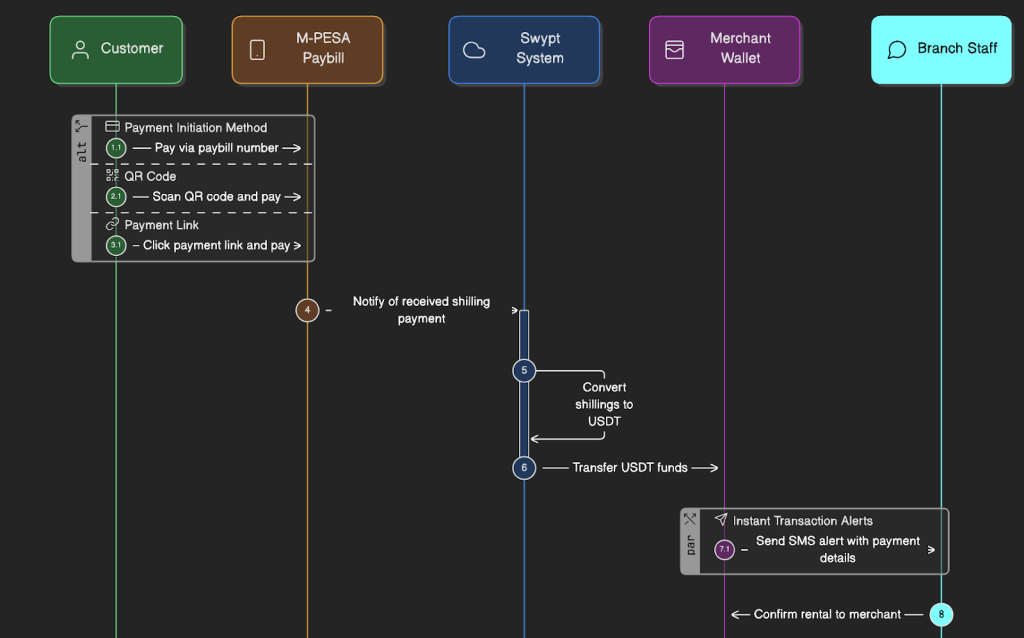 Customer journey from payment to reconciliation
However, the lack of a traditional chargeback mechanism shifts risk. Only a merchant can initiate a reversal, which eliminates the “friendly fraud” that plagues online retail but demands higher consumer trust.
The cheapest route for the business is “peer-to-peer” settlement with other merchants on the same network. Because the underlying assets are on-chain, the business can also settle international obligations with any supplier capable of receiving USDT, effectively removing the friction of traditional cross-border banking.
Swypt is stripping the complexity from self-custody by offering a decentralised bridge between USDT and KES without the traditional friction of blockchain. The platform is strictly non-custodial, meaning it never holds user keys or funds. Instead, it only interacts with a user’s wallet when authorised to settle a specific transaction.
To make the experience feel like a standard banking app, Swypt uses account abstraction that allows users to bypass the headache of seed phrases (the master key to your digital assets), accessing their wallets via email and 2FA across any device.
Why is bypassing the shilling so important?
For Kenyan merchants, the primary incentive is currency preservation. After two years of the shilling’s volatility against the US dollar, holding local currency has become a balance-sheet risk for anyone importing raw materials or finished goods.
Once funds arrive as stablecoins, merchants can move money quickly across multiple channels. They can pay international invoices in USDT, transfer assets to external wallets like Trust Wallet, or convert back to KES for local use.
Swypt claims to remove its own exposure to currency fluctuations by eliminating an “internal float” or the idle cash reserves traditional processors hold.
Lean operations
Swypt’s commercial model is aggressive since there are no upfront fees for accepting payments. Rather, costs are concentrated on the payout side. According to Gachanja, off-ramp fees typically sit below 1%, comfortably beating the spreads of black market FX exchanges or traditional wire fees. For high-volume enterprises, an over-the-counter desk handles liquidity via API.
“Swypt only applies fees on payouts and has no direct upfront fees for pay-ins (M-PESA to paybill charges apply). In comparison to market standards, our fees are majorly below 1% for all transactions,” Gachanja said.
In an era of renewed venture rounds, Swypt is an outlier. The 12-person team is entirely bootstrapped. Gachanja claims that the business has processed over $10 million in volume across 1,000 merchants.
The model is not without its dependencies because Swypt relies on the stability of third-party stablecoins and the continued openness of the M-PESA API (Daraja 3.0). Compliance is handled through providers like Sumsub to navigate Kenya’s shifting regulatory landscape.
Swypt’s edge is its cultural literacy. Most fintechs in Kenya recognise they cannot operate without integrating M-PESA, so Swypt takes advantage of that reality and addresses liquidity challenges without asking business owners to understand smart contracts.

Marley Alles started out in accounting.
She thought that her dream was to work at a big company. “And then once I got there, I was like ‘oh, that’s it,” she told TechCrunch.
Alles began fostering other passions and found herself curious about the world of startups. She would listen to every podcast and read each book, taking notes on topics that interested her.
She didn’t think much of it until one summer when so many of her friends got married, that she found herself spending thousands of dollars on bridesmaid dresses and bachelorette looks. One day, someone approached her and asked to borrow one of her dresses. “I was like ‘yeah, for sure, take it,’” she recalled. “And then I thought, ‘how can this be done on a larger scale?’”
Alles had all these expensive dresses just sitting in her closet. She didn’t want to sell it, but she knew she probably would never wear those gowns again. “That’s what led me, long story short, to create Rax,” she said.
Alles launched Rax earlier this year as a peer-to-peer clothing rental company. It functions right now as a marketplace (it does not own any clothing inventory), where users scroll through listings and connect with people who have clothing items they want to rent.
She’s bootstrapped the company so far, enough to fully code the app and officially launch it. The first few customers were her friends and family, and the rest came by word of mouth. Alles said she leaned into the idea of “building in public,” where she posted online about her adventures creating this product in hopes of amassing an engaged audience of potential customers. She has about 5,000 users on the app right now.
Techcrunch event
San Francisco
|
October 13-15, 2026
Rex is one of the first of its kind to be launched in Toronto. It’s like Rent-the-Runway, or New York’s Pickle, or Europe’s ByRotation. The idea of renting clothes — similar to buying secondhand —has been picking up steam as it is seen as a more environmentally sustainable way to consume fashion rather than buying new items for each new season.
“It’s driving the circularity of fashion,” Alles said.
But what makes Rex different from many others is that she offers long-term rentals. “On our platform, you can rent up to six months,” she said. “On competitor platforms, it’s daily rentals. So it gets really expensive if you want to rent for a couple week vacation. Or maybe you want a winter jacket for the season.”
At TechCrunch Disrupt in October, Rex announced its first foray into the U.S. market. Alles said she had been a huge fan of TechCrunch and applied for the Battlefield competition, where she later won the top consumer pitch in the competition.
Alles said she was surprised to win. “There were so many companies that had like thousands or hundreds of thousands of users; raised [like] $20 million in my category, and one [had] the lead actors from [the show] Silicon Valley,” she said.
Still, she found the experience “awesome.” Alles went up to every startup booth to introduce herself to other founders, and also attended some sessions as well as partook in networking. Actually, that was one of the biggest lessons she’s said she’s learned as a founder — the importance of in-person interaction because it helps her connect with the community better.
Now that Disrupt has passed, Alles said the company hopes to continue its expansion across New York and start building out a rental service platform to offer fashion designers and retailers looking to offer rental clothing to consumers.
“We have the technology, we have the audience,” she said, adding that brands are also looking at ways to become more sustainable, and companies like Rex let them do it. “I think things are getting better and people are becoming more aware of their impact.”


Image credit: Techloy
Ever found yourself trying to explain a tricky process on your Mac, showing someone a clever meme, or walking a friend through a step-by-step guide on WhatsApp, only to get stuck in confusing explanations? It’s frustrating when words just don’t cut it, and screenshots aren’t enough.
The good news is that WhatsApp on Mac now lets you share your screen during calls, so your friends or colleagues can see exactly what you see in real time. No more awkward pauses, repeated instructions, or back-and-forth messages, everything happens right in the call. Here’s how to share your screen on WhatsApp for Mac in a few simple steps.
How to Reset the NVRAM to Fix Common Issues on Mac
If your Mac’s acting up, with sound issues, display glitches, or startup confusion, a quick NVRAM reset might set it right.

5 steps to share your screen on a WhatsApp call on Mac
Step 1: Open WhatsApp on your Mac
Step 2: Click on the chat of the person or group you want to call, then click the video call icon to start the call.
Step 3: Once the call connects, hover over the call window. You’ll see a screen share icon (it looks like a rectangle with an arrow).
Step 4: Click the icon, then select either:
- Your Entire Screen – shares everything on your Mac.
- A Window – shares only a specific app window.
Then click Share to begin. The other person can now see your screen in real time.
Step 5: When you’re done, click the screen share icon again and select Stop Sharing to return to a regular video call.
VIDEO: How to Download Instagram Video Reels on Mac
Learn how to download Instagram Reels on your Mac in just seconds using simple, built-in tools.

Conclusion
Screen sharing on WhatsApp for Mac removes all the back-and-forth guesswork and makes helping, teaching, or collaborating much smoother. Whether you’re troubleshooting with a friend or presenting something quickly to a colleague, it’s a feature that saves time and keeps communication clear. Now that you know the steps, you can switch from explaining to showing, instantly.

December 16, 2025
Link copied!
Copy failed!
TECHNOLOGY
What creature is the Grinch? Scientist imagines DISSECTING the Christmas villain – and reveals the animals he most resembles beneath his green fur

He’s the unique grumpy green creature born from Dr Seuss’s imagination – but a scientist has now figured out which animals the Grinch resembles the most.
Despite being one of the holiday season’s most familiar icons, it’s impossible to pin him to one specific species.
With his snub nose, pot belly, yellow eyes, long fingers and bright green fur, he truly is in a league of his own.
Lucy Hyde, a lecturer in anatomy at the University of Bristol, has 14 years of experience teaching the structure of the human body.
Now, she has turned her attention to the Christmas villain, in a bid to unmask him once and for all.
‘Beneath that snarl and green fur, what kind of creature is he, really? Not even Dr Seuss really had an answer,’ she wrote on The Conversation.
‘As an anatomist, I can’t help but wonder what the Grinch would look like on the dissection table – and what his skeleton, muscles and brain can tell us about his unique origins.’
Beneath his grouchy exterior, the Grinch is actually an unusual blend of monkey, dog, cat and owl, she said.

With his snub nose, pot belly, yellow eyes, long fingers and bright green fur, the Grinch is a blend of creatures


The Grinch’s yellow eye colour is comparable to that of an owl while the constant twitching of his nose – which resembles a cat’s – might indicate a highly-attuned sense of smell
The skull
The Grinch’s skull would be quite unlike anything found on Earth or in the fictional town of Whoville, Ms Hyde explained.
‘Structurally, the Grinch’s facial skeleton would blend primate and canine traits: short broad snout, high cranium and powerful jaws,’ she said.
‘It’s a face evolved for expression, adeptly capable of sneering, gloating and ultimately smiling with genuine warmth.’
His cheekbones are broad and flared to help accommodate the large muscles needed to lift the corners of his mouth into his trademark exaggerated smirk, she explained.
A large bony canal would exist underneath his eyes, carrying nerves to his whisker-like facial hairs. ‘Like a cat’s whiskers, they’d help him sense approaching Whos,’ Ms Hyde said.
‘His teeth would be similar to a chimp’s, with sharp canines for tearing, sturdy molars for grinding tougher festive fare and incisors adapted for nibbling fruitcake or the occasional candy cane.’
Meanwhile his upper jaw would have to be ‘robust and slightly vaulted’ in order to give resonance to his infamous laugh.

His cheekbones are broad and flared to help accommodate the large muscles needed to lift the corners of his mouth into his trademark exaggerated smirk, Ms Hyde said


The Grinch’s spine would probably resemble a cross between a gibbon (left) and a cat, Ms Hyde said, while his teeth would be similar to a chimp’s (right)
What animals make up the Grinch?
Skull: A blend of primate and canine
Teeth: Similar to a chimp’s
Eyes: Owl or cat
Spine: A cross between a gibbon and a cat
The face
The Grinch’s eyes, with large, forward-facing eye sockets, suggest a crepuscular lifestyle – most active at dawn and dusk – Ms Hyde said. Meanwhile their yellow colour is comparable to the eyes of owls and cats, which are adapted to low light.
His nasal aperture – the pear-shaped, bony opening at the front of the skull – would be tall and narrow with a complex set of internal bones to warm the cold alpine air where he lives, she explained.
Meanwhile the constant twitching of his nose might indicate a highly-attuned sense of smell, while his repertoire of expressions indicates a complex set of facial muscles.
The spine
‘His spine would probably resemble a cross between a gibbon and a cat – long, flexible and sinuous,’ Ms Hyde said.
His lower back would be ‘extended and highly mobile’, allowing for the characteristic slouch and coiled posture, while his neck bones would be elongated to let him tilt and crane his head.
‘Like a cat, he’d be digitigrade – meaning he walks on the balls of his feet and toes rather than on the soles,’ Ms Hyde added. ‘This stance softens each step.’

His nasal aperture – the pear-shaped, bony opening at the front of the skull – would be tall and narrow with a complex set of internal bones to warm the cold alpine air where he lives
The brain
Judging by his behaviour, the Grinch’s frontal lobes would be on the small side, explaining his flat and small forehead, she said.
Since this region governs planning, impulse control and moral reasoning, it would explain why he lacks these abilities at the start of the story.
His temporal lobes – which process sound and memory – would be large and active, while parts of the brain that control vision, coordination and spatial awareness would also be well developed.
The heart
‘No anatomical analysis of the Grinch is complete without addressing the moment when ‘his heart grew three sizes’,’ Ms Hyde added.
‘Biologically, such a sudden expansion would be catastrophic. In humans and other mammals, an enlarged heart is a dangerous condition linked to heart failure, arrhythmias and poor pumping efficiency.’
In fact, references to his ‘growing heart’ are likely a metaphor for his brain becoming more socially attuned as the story develops, she said.
‘To anatomists, the Grinch is more than a Christmas curiosity,’ Ms Hyde concluded.
‘He’s a case study in form and function. And in his final form, anatomy and morality align.
‘The muscles that once powered a sneer now lift into a genuine smile. The hands that stole presents now carve roast beast. His limbic system now fires with satisfaction.
‘So perhaps the real message of the Grinch’s anatomy is this: change is always possible.’