
TECHNOLOGY
The giant heat pumps designed to warm whole districts

Chris BaraniukTechnology Reporter
 MVV Energie

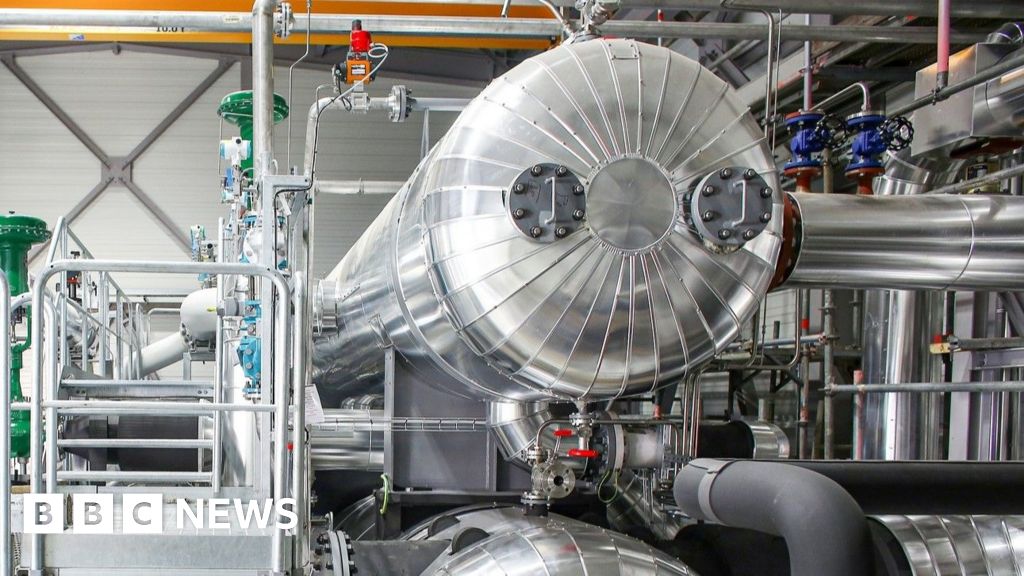
MVV Energie is building the world’s most powerful heat pump systems
The pipe that will supply the heat pump, drawing water from the River Rhine in Germany, is so big that you could walk through it, fully upright, I’m told.
“We plan to take 10,000 litres per second,” says Felix Hack, project manager at MVV Environment, an energy company, as he describes the 2m diameter pipes that will suck up river water in Mannheim, and then return it once heat from the water has been harvested.
In October, parent firm MVV Energie announced its plan to build what could be the most powerful heat pump modules ever. Two units, each with a capacity of 82.5 megawatts.
That’s enough to supply around 40,000 homes, in total, via a district heating system. MVV Energie aims to build the system on the site of a coal power plant that is converting to cleaner technologies.
The scale of the heat pumps was determined partly by limits on the size of machinery that could be transported through the streets of Mannheim, or potentially via barges along the Rhine. “We’re not sure about that yet,” says Mr Hack. “It might come via the river.”
One person well aware of the project is Alexandre de Rougemont, at Everllence (formerly MAN Energy Solutions), another German company that also makes extremely large heat pumps. “It is a competition, yeah,” he says. “We’re open about it.”
Heat pumps soak up heat from the air, ground or, in these cases, bodies of water. Refrigerants inside the heat pumps evaporate when they are warmed even slightly.
By compressing the refrigerant, you boost that heat further. This same process occurs in heat pumps designed to supply single homes, it just happens on a much larger scale in giant heat pumps that serve entire city districts.
As towns and cities around the world seek to decarbonise, many are deciding to purchase large heat pumps, which can attach to district heating networks.
These networks allow hot water or steam to reach multiple buildings, all connected up with many kilometres of pipe. Ever bigger models of heat pump are emerging to meet demand.
“There was a lot of pressure on us to change the heat generation to new sources, especially renewable sources,” explains Mr Hack as he discusses the decommissioning of coal-fired units at the Mannheim plant. The site is right by the Rhine, already has a hefty electricity grid connection, and is plugged in to the district heating network, so it makes sense to install the heat pumps here, he says.
He notes that the technology is possible partly thanks to the availability of very large compressors in the oil and gas industry – where they are used to compress fossil fuels for storage or transportation, for example.
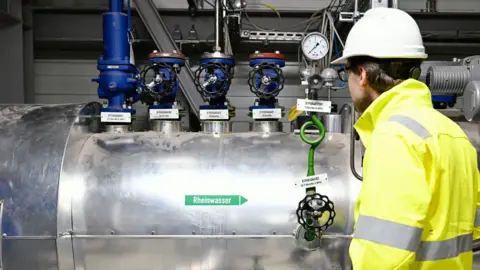 MVV Energie
The new heat pump at Mannheim will transfer heat from the Rhine
Work on the Mannheim project is due to start next year. The heat pumps – with a combined capacity of 162MW – are set to become fully operational in the winter of 2028-29. Mr Hack adds that a multi-step filter system will prevent the heat pumps sucking up fish from the river, and that modelling suggests the system will affect the average temperature of the river by less than 0.1C.
Installations such as this are not cheap. The Mannheim heat pump setup will cost €200m ($2.3m; £176m). Mr de Rougemont at Everllence says that, at his company, heat-pump equipment costs roughly €500,000 per megawatt of installed capacity – this does not include the additional cost of buildings, associated infrastructure and so on.
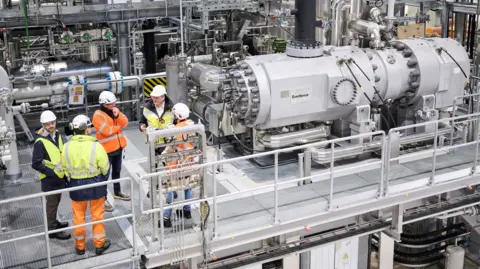 Everllence
Everllence has plans for heat pumps even bigger than this one in Esberg
Everllence is currently working on a project in Aalborg, Denmark that will be even more powerful than the system in Mannheim, with a total capacity of 176MW. It will use smaller modules, however – four 44MW units – and is due to become operational in 2027, when it will supply nearly one third of all heating demand in the town.
Those 44MW machines are actually the same ones used in a previous project, now fully operational, to the south of Aalborg in Esbjerg. There, they don’t run at maximum capacity but rather supply 35MW each.
Large hot water storage tanks, each able to hold 200,000 cubic metres of liquid, will give the system added flexibility, adds Mr de Rougemont: “When the electricity price is high, you stop your heat pump and only provide heat from the storage.”
Veronika Wilk at the Austrian Institute of Technology says, “Heat pumps and district heating systems are a great fit.” Such systems can harvest heat from bodies of water or even wastewater from sewage treatment plants.
Dr Wilk notes that, when you use multiple large heat pumps on a district heating network, you gain flexibility and efficiency. You could run two out of four heat pumps in the autumn, say, when less heat is required than during the depths of winter.
 Getty Images
Helsinki is overhauling its district heating system
All the systems mentioned so far harvest energy from water sources but, less commonly, very large heat pumps can use the air as a heat source, too. Even in a relatively cold city such as Helsinki.
“The sea in front of Helsinki is too shallow,” explains Timo Aaltonen, senior vice president of heating and cooling at Helen Oy, an energy firm. “We calculated that we would need to build a tunnel more than 20km long to the ocean, to get enough water [with a] temperature high enough.”
Helsinki is in the process of radically overhauling its district heating system. The city has added heat pumps, biomass burners and electric boilers to a 1,400km network that links up nearly 90% of buildings in the Finnish capital, adds Mr Aaltonen.
Heat pumps convert single kilowatt hours of electricity into multiple kilowatt hours of heat but electric boilers can’t do this and are therefore considered less efficient.
I ask why Helen Oy decided to install hundreds of megawatts of these boilers and Mr Aaltonen says that they are cheaper to install than heat pumps and having them also means he and colleagues don’t have to rely entirely on the air, which is limited in terms of how much heat it can provide at scale. Plus, the electric boilers can help to soak up surplus renewables and provide an electricity grid-balancing function, he says.
There are no heat pumps in the UK that rival the systems under development in Denmark, Germany and Finland. However, some new district heating networks are on the way, such as the Exeter Energy Network, which will supply the University of Exeter and other customers.
The minimum planned capacity of the network is 12MW. It will feature three 4MW air-to-water heat pumps, with the first unit due to become operational in 2028.
Keith Baker at Glasgow Caledonian University, who researches district heating systems, says the UK has opportunities to make more of this technology. Water in disused mines, which maintains a relatively stable temperature, is beginning to supply larger heat pumps here, for example.
Post-industrial and rural areas where there is adequate space to install heat pumps and heat storage tanks are “the sweet spots”, he says.
More Technology of Business
SOURCE PAGE


Hello!
Welcome back to Francophone Weekly by TechCabal, your weekly deep dive into the tech ecosystem across French-speaking Africa. Previous editions have been published on the web, but email versions of the newsletter will land directly in your inbox every Tuesday at noon. By default, this newsletter is in French—but don’t worry, you can click the button below to switch to the English version.
Avant de nous plonger dans la newsletter d’aujourd’hui, nous aimerions connaître votre avis. Préférez-vous recevoir les e-mails de Francophone Weekly en anglais ou en français ? Répondez à notre rapide sondage ici. Votre opinion compte. Aidez-nous à améliorer cette newsletter. Merci!
Remarque : Francophone Weekly fermera ses portes la semaine prochaine, le 23 décembre, et reprendra ses activités le 6 janvier 2026.
Au cours du mois dernier, nous avons abordé la question de la croissance des start-ups africaines francophones : comment le financement par emprunt peut-il favoriser la croissance au-delà du capital initial, et pourquoi les bourses locales méritent davantage d’attention en tant que sources de capitaux viables, alors que l’écosystème réduit progressivement sa dépendance vis-à-vis des capitaux étrangers.
Aujourd’hui, nous nous concentrons sur le Sénégal, le pays qui a produit la première licorne francophone d’Afrique et qui écrit actuellement un deuxième chapitre plus important. L’histoire de Dakar s’est orientée vers la construction délibérée d’une échelle de financement, conçue pour soutenir les entreprises depuis l’idée jusqu’à leur expansion.
Au cœur de cette approche se trouvent des institutions soutenues par l’État, telles que la Délégation générale pour l’entrepreneuriat rapide des femmes et des jeunes (DER) et le Fonds souverain pour les investissements stratégiques (FONSIS), qui jouent un rôle de plus en plus actif dans la réduction des risques liés à l’innovation. En absorbant les risques liés aux premières étapes, en fournissant des capitaux patients et en structurant des financements adaptés aux réalités locales, ces institutions créent un espace pour que les capitaux privés suivent. Des sociétés de capital-risque mondiales, dont Partech, participent à leurs côtés, non pas malgré la présence de l’État, mais grâce à elle.
Dans la newsletter d’aujourd’hui, nous explorons cette courbe en S pour le Sénégal, en examinant comment les capitaux publics et privés sont superposés pour construire un écosystème technologique plus résilient, inclusif et évolutif, et ce que ce modèle pourrait signifier pour le reste de l’Afrique francophone.
1. La nouvelle phase de formation de capital au Sénégal
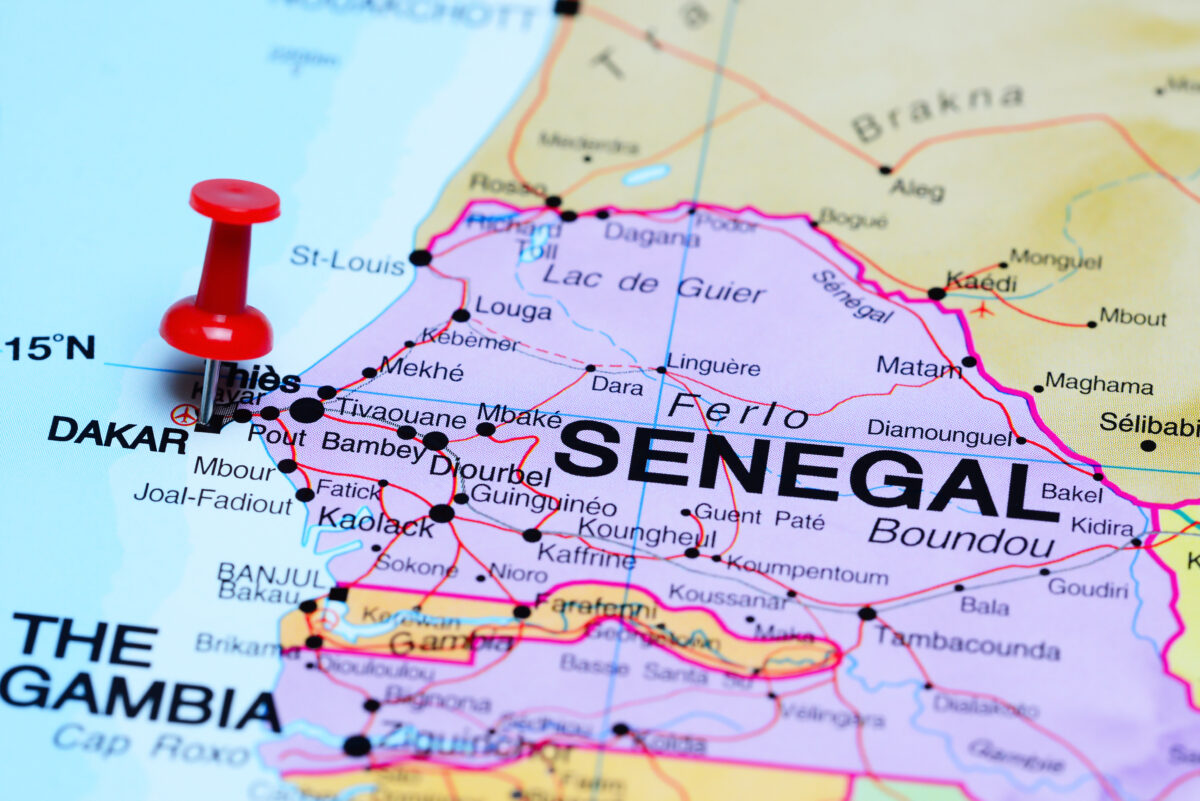
Photo du Dakar épinglé sur une carte de l’Afrique/Source de l’image : The Fintech Times
Le Sénégal occupe depuis quelques années une place croissante dans le paysage tech et PME d’Afrique francophone, portée par des success stories et l’arrivée d’acteurs d’investissement internationaux. Le cas le plus marquant reste Wave, qui a été annoncé « unicorn » après une levée majeure (Série A) annoncée en 2021 (≈ $200 million) et qui a continué à lever des dettes importantes ensuite (ex. rondes de dette reportées dans la presse en 2025). Parmi les autres opérations notables récentes figurent des tours de seed/early-stage comme Logidoo (≈ $1.55M, 2024) et plusieurs levées de scale-up et dettes pour des fintechs et plateformes logistiques sénégalaises et régionales. Ces opérations confirment une dynamique où l’écosystème commence à produire des acteurs prêts pour des séries plus importantes ou des opérations de dette structurée.
Sur le plan des montants agrégés, les rapports sectoriels montrent que l’activité de financement en Afrique a repris de la vigueur en 2023–2024 avec plusieurs vagues d’investissement et une résilience progressive des marchés VC ; pour le seul Sénégal, des bases de données d’investissements rapportent des montants équivalents à plusieurs millions de dollars levés par des start-ups locales au cours de l’année 2024 (ex. Tracxn signale 14,5 million $ d’opérations équity enregistrées sur 2024). Ces chiffres maskent toutefois une grande hétérogénéité : quelques opérations de grande taille (fintechs, logistique) concentrent une large part du capital.
Enfin, la présence d’investisseurs internationaux se renforce : Partech possède un siège africain avec activité Dakar (Partech Africa) et a clos un grand fonds Afrique (Partech Africa II) en 2024 ; d’autres acteurs et fonds locaux ou régionaux (Teranga Capital, Haskè Ventures, Brightmore Capital, Wuri Ventures, 216 Capital, Founders Factory Africa, etc.) sont actifs au Sénégal ou investissent régulièrement dans des sociétés basées au Sénégal. Cette intensification de l’offre de capital aide la maturation de la chaîne de financement locale.
2. Des institutions publiques et quasi-publiques qui structurent l’écosystème
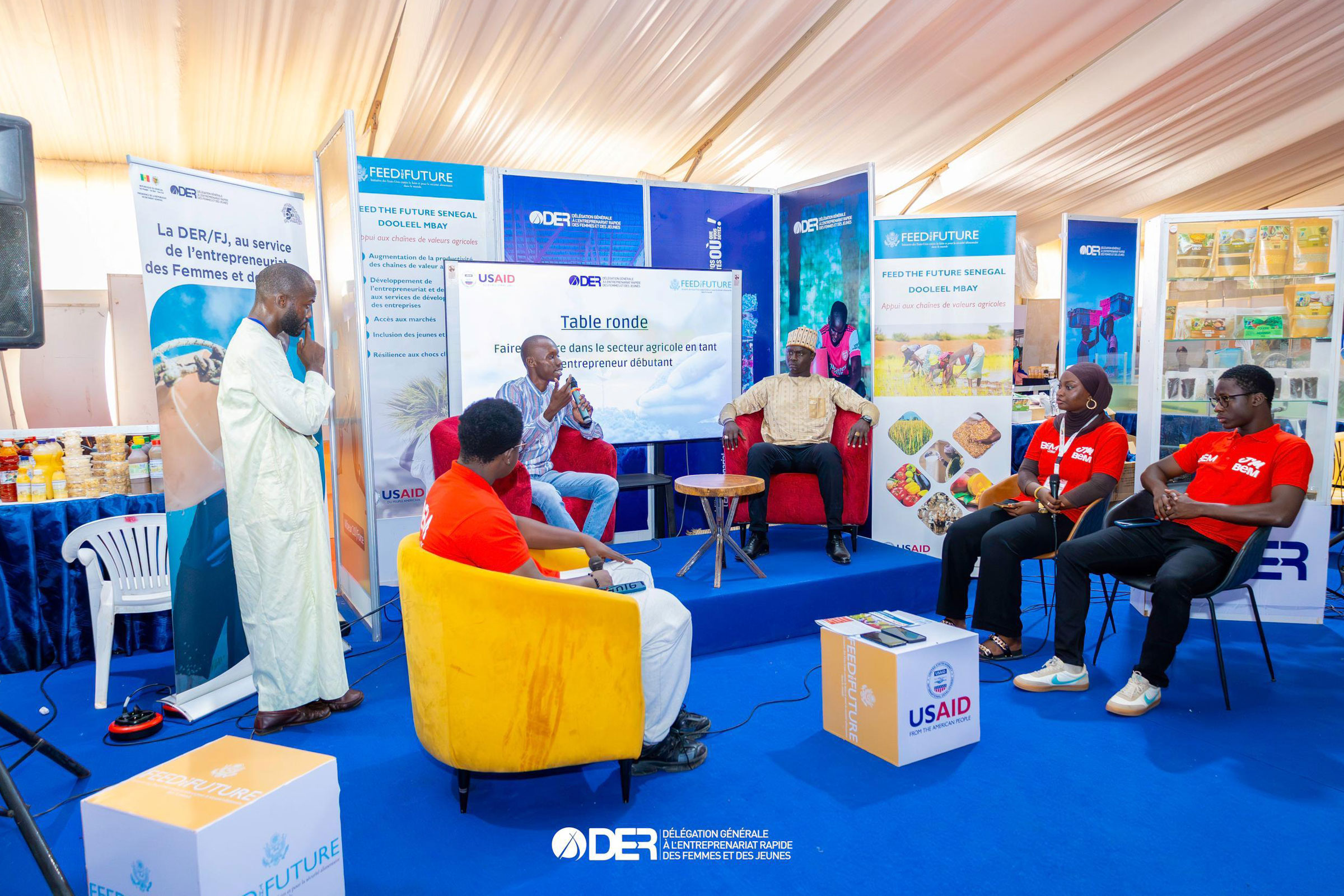
Délégation sénégalaise pour l’entrepreneuriat/Source de l’image : Winrock International
Délégation Générale à l’Entrepreneuriat Rapide des Femmes et des Jeunes — DER / DER-FJ
La DER est l’instrument public lancé par l’État pour stimuler l’entrepreneuriat des jeunes et des femmes. Créée par décret en 2017, elle combine financement direct, assistance technique et animation de l’écosystème : accompagnement d’incubation/accélération, financement de TPE/PME et programmes sectoriels (pêche, agriculture, numérique, etc.). La DER opère avec plusieurs « guichets » (autonomisation, soutien TPME, etc.) et développe des outils digitaux et plateformes pour la sélection et le suivi des bénéficiaires. Elena Dia dirige l’unité d’animation de l’écosystème au sein de la DER, où elle conçoit des programmes d’accompagnement (incubation, accélération, formation) et coordonne les partenaires locaux et internationaux.
FONSIS (Fonds souverain d’investissements stratégiques)
Le FONSIS est le fonds souverain du Sénégal, dédié à l’investissement dans des projets stratégiques. Il gère plusieurs véhicules et a lancé des fonds thématiques comme WE! Fund (focalisé sur l’autonomisation économique des femmes) et d’autres solutions capables d’apporter à la fois dette et equity. FONSIS peut jouer un rôle de « scaling » pour des projets ayant dépassé le stade d’amorçage, et la coordination DER-FONSIS est en cours d’approfondissement (DER alimente des pipelines que FONSIS peut prendre en charge pour des tickets plus élevés ou en equity).
ADEPME (Agence de Développement et d’Encadrement des PME)
L’ADEPME est l’agence étatique chargée de l’accompagnement technique et de la formalisation des PME : formation, e-rating, subventions partielles pour l’accès à des services de consultants, labellisation pour faciliter l’accès au financement bancaire. Elle agit comme bras opérationnel pour renforcer la compétitivité des PME sénégalaises.
Autres acteurs publics et instruments
Le paysage complet inclut des mécanismes de garantie et d’appui (fonds de garantie publics), des bureaux de mise à niveau industrielle, des instances de promotion des investissements, et des banques publiques ou semi-publiques partenaires (ex. BNDE, Pamecas et autres IFP cités par la DER comme partenaires de décaissement pour des tickets supérieurs). Ces acteurs travaillent en coordination — parfois de façon formelle, parfois via des tables rondes opérationnelles — pour accompagner les chaînes de valeur et les projets structurants.
3. Des programmes et produits d’accompagnement
Source de l’image : Bpifrance
Ces dernières années, plusieurs programmes structurants ont été mis en œuvre ou soutenus par la DER et ses partenaires :
Line Stack Invest, co-construit et copiloté avec l’Ambassade de France et Bpifrance, lancé pour dynamiser l’accélération tech, est un programme qui combine financement direct (un volet de financement guichet), accélération de startups, roadshows internationaux et mise en relation investisseurs via EuroQuity (BPI France). Ce programme doit son succès à la qualité du montage projet-partenaire, la rigueur des KPIs et l’effet structurant sur l’écosystème.
BE YES, programme financé par la Mastercard Foundation, vise principalement l’inclusion numérique et territoriale : création d’espaces d’innovation (FabLabs) et plateaux d’innovation dans différentes régions, mise à disposition d’équipements (imprimantes 3D, broderie numérique), et formations pratiques pour jeunes entrepreneurs hors Dakar. Ce programme répond au manque de talents InnoTech régional et développe des capacités locales.
Les guichets DER qui sont des offres structuré de financement :
- Guichet Autonomisation : tickets petits (≈ 50 000 à 2 000 000 FCFA) avec process digitalisé, scoring en ligne et décaissement via mobile money (permet l’inclusion territoriale et l’accès pour les femmes). Ce guichet évite de passer systématiquement par des comptes bancaires traditionnels pour les petits montants, ce qui accélère l’accès au financement.
- Guichet Soutien au TPME : financements plus structurants (> 2 millions de FCFA ≈ 3 500 $), où la DER structure et instruit les dossiers mais les décaissements passent par des institutions financières partenaires (BNDE, Pamecas, CMS, ASSEP, LBA, etc.). Ce modèle donne accès à des montants plus élevés mais implique une dépendance aux délais et procédures des partenaires IFPs. La DER travaille à l’interconnexion pour fluidifier le processus.
Des acteurs privés et fonds qui jouent un rôle visible
Sur le plan du capital-risque et des fonds, le Sénégal accueille désormais des équipes et véhicules locaux/régionaux : Partech Africa (avec présence Dakar), Teranga Capital (fonds centré sur le Sénégal/Gambie), Haskè Ventures (venture builder/dakar), Brightmore Capital (bureau à Dakar), ainsi que plusieurs fonds pan-africains et régionaux (Founders Factory Africa, 216 Capital, Seedstars/Seedstars Africa Ventures, etc.). Ces acteurs fournissent capital, programmes d’accompagnement et réseau d’investisseurs internationaux.

Touchez les acteurs qui font bouger l’écosystème technologique et commercial francophone. Faites de la publicité dans la newsletter hebdomadaire francophone de TechCabal et présentez votre marque aux décideurs, opérateurs, fondateurs et chefs d’entreprise qui comptent le plus pour votre croissance. Prêt à vous lancer ? Envoyez un e-mail à ads@bigcabal.com.

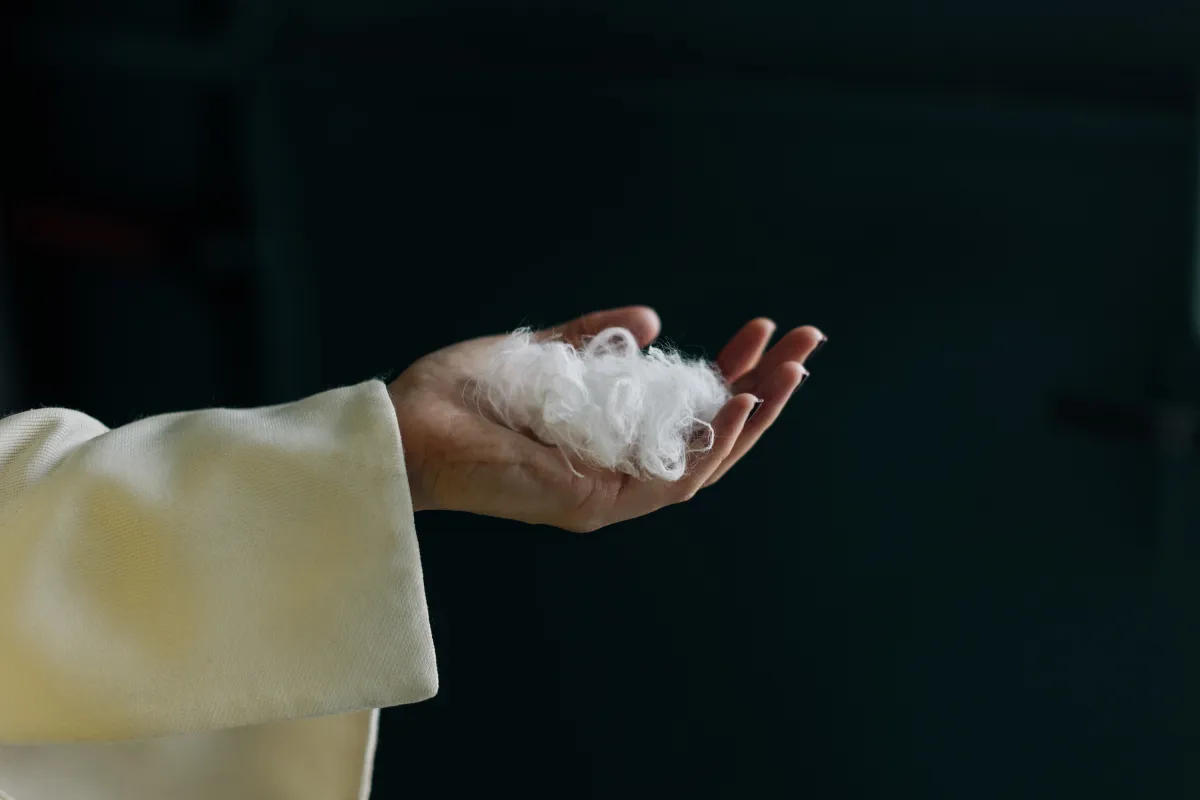
Cashmere sweaters are everywhere these days, often at unbelievably low prices. The appeal is obvious: if you’ve ever worn cashmere, you know it’s soft, light, and warm — an impressive fiber that’s hard to give up. Unfortunately, those bargain prices usually come with a catch.
Cashmere comes from the fine undercoat of a handful of goat breeds. Typically, one goat will be sheared twice a year, producing just four to six ounces (113 to 170 grams) of cashmere annually. That’s not a lot of supply for a growing market.
“The producers of raw materials are actually under a lot of stress,” Sim Gulati, co-founder and CEO of Everbloom, told TechCrunch. “What you’re seeing now, especially with the advent of $50 cashmere sweaters, is that they’re being sheared way more often. The quality of the fiber is not as good, and it’s creating unsustainable herding practices.”
Rather than try to change herding practices or convince consumers to only buy high-quality cashmere, Gulati and his team at Everbloom had a different idea. The startup, which has raised over $8 million from investors including Hoxton Ventures and SOSV, set out to create an upcycled material that’s nearly indistinguishable from the real thing.
To do this, Everbloom has created a material science AI called Braid.AI. The model can fine tune various parameters to create fibers with different qualities. Cashmere is one target, but so are other materials widely used in the textile industry.
At its core, Everbloom’s process is the same regardless of final product. To make its material, the company currently collects waste from across the fiber supply chain, including cashmere and wool farms and mills, as well as down bedding suppliers. In the future, it plans to expand to other waste sources, including feathers from the poultry industry. These waste streams share one thing in common: they’re all made of keratin, the key protein that underpins Everbloom’s process.
The company then chops the waste to size and combines it with proprietary compounds. The mix is pressed through a plastic extrusion machine (which shapes material by forcing it through a die), and the pellets that come out the other end are fed through spinning machines that are normally used to produce polyester fiber. “That equipment is used for 80% of the textile market,” Gulati said. “You have to be a drop in replacement.”
Techcrunch event
San Francisco
|
October 13-15, 2026
To transform waste into new fiber, all of the necessary chemical reactions occur within those two machines. Everbloom can create fibers that replicate everything from polyester to cashmere by using its AI to tweak the formulation and how the two machines process it.
The startup said every fiber it produces should be biodegradable, even the polyester replacement.
“All the components that we’re using are biodegradable,” Gulati said, adding that his company is currently running its products through accelerated testing to prove the hypothesis. And because Everbloom uses waste products, the environmental impact will be dramatically lower, he said.
Plus, it should be cheaper, too. “We want it to be more economically viable for brands and consumers,” Gulati said. “I don’t believe in a ‘sustainable premium’” — the idea that eco-friendly products should cost more. “In order for a material to be successful — both in the supply chain [and for] the consumer — you have to have both a product benefit and an economic benefit to everyone who touches the product. That’s what we’re aiming for.”


As of yesterday, December 15, 2025, Meta has officially discontinued the Facebook Messenger desktop client for both Windows and macOS, ending a five-year run marked by technical inconsistencies and an inability to compete with enterprise-grade rivals.
Users attempting to launch the app are now met with a redirection screen. The behavior splits by account type: users with a connected Facebook profile are sent to Facebook.com, while those using Messenger without a Facebook account are routed to Messenger.com.
The shutdown is the final step in a decline that began years ago. In 2023, Meta started reintegrating Messenger back into the main Facebook mobile app, signaling a retreat from its standalone messaging strategy.
Remember OG Facebook? Meta’s New “Friends” Tab Aims to Revive that Feeling
Meta bets on nostalgia with a new “Friends” tab design
That shift was followed by steady degradation on desktop. The app moved from Electron to React Native, then to a poorly received Catalyst port on macOS and a basic PWA wrapper on Windows, reducing performance and stripping away any native feel.
Beyond platform changes, the desktop app lagged in core functionality. It lacked seamless screen sharing, easy-to-share meeting links, and support for large video calls, leaving it uncompetitive against Zoom and Microsoft Teams.
For remaining users, the immediate concern is data preservation. Because the desktop client stored some end-to-end encryption keys locally, Meta is advising users to enable Secure Storage on the web version. Without setting up this PIN-based backup, encrypted chat histories that lived only on the desktop app could be lost permanently.
How to Disable Meta’s Activity Tracking on Facebook & Instagram
If you don’t want Meta to keep tabs on what you do outside Facebook and Instagram, here’s how to do it with a few steps.

December 16, 2025
Link copied!
Copy failed!
TECHNOLOGY
Musicians are deeply concerned about AI. So why are the major labels embracing it? | Music


This was the year that AI-generated music went from jokey curiosity to mainstream force. Velvet Sundown, a wholly AI act, generated millions of streams; AI-created tracks topped Spotify’s viral chart and one of the US Billboard country charts; AI “artist” Xania Monet “signed” a record deal. BBC Introducing is usually a platform for flesh-and-blood artists trying to make it big, but an AI-generated song by Papi Lamour was recently played on the West Midlands show. And jumping up the UK Top 20 this month is I Run, a track by dance act Haven, who have been accused of using AI to imitate British vocalist Jorja Smith (Haven claim they simply asked the AI for “soulful vocal samples”, and did not respond to an earlier request to comment).
The worry is that AI will eventually absorb all creative works in history and spew out endless slop that will replace human-made art and drive artists into penury. Those worries are being deepened by how the major labels, once fearful of the technology, are now embracing it – and heralding a future in which ordinary listeners have a hand in co-creating music with their favourite musicians.
AI music platforms analyse huge amounts of recorded music in order to learn its sounds, structures and expressions, and then allow users to create their own AI-generated music via text or speech prompts. You might ask for a moody R&B song about a breakup sung by a female vocalist, and it will come up with a decent approximation of one, because it’s absorbed hundreds of such songs.
Artists and labels initially saw AI as the biggest existential threat since Napster-fuelled piracy: if not a replacement for human creativity, then certainly a force that could undermine its value. Gregor Pryor, a managing partner at legal firm Reed Smith, says background music for things such as advertising, films and video games, where you’re not relating to a personality as you would in pop music, “is where the real damage will be done” first of all. “People will ask: why would I pay anyone to compose anything?”
‘New creative possibilities’ … screengrab from the Suno AI music generator. Photograph: Suno
Aware of the scale of the shift, last year the Recording Industry Association of America, representing the three major labels, initiated legal action against AI music companies Suno and Udio for copyright infringement, alleging they had trained their AI platforms on the labels’ artists without their permission. But then there was an extraordinary about-turn. They didn’t just settle the matter out of court – Universal Music Group (UMG) then partnered with Udio, and Warner Music Group (WMG) with Udio and Suno. They also have deals in place with AI company Klay, the first to get all three major labels on board, adding Sony Music (discussions with indie labels are ongoing). WMG chief executive Robert Kyncl has said these recent deals are to ensure the “protection of the rights of our artists and songwriters” and to fuel “new creative and commercial possibilities” for them, while UMG chief Lucien Grainge heralded “a healthy commercial AI ecosystem in which artists, songwriters, music companies and technology companies can all flourish and create incredible experiences for fans”.
Kyncl made another bold statement as to why these deals are taking place: “Now, we are entering the next phase of innovation. The democratisation of music creation.”
Monet maker … AI artist Xania Monet. An AI-generated image from ‘her’ Instagram account. Photograph: xania_monet
Announcing its Universal tie-in, Udio chief executive Andrew Sanchez has said Udio users will be able to “create [music] with an artist’s voice and style”: so not just create the aforementioned moody R&B song, but one with a specific existing artist’s voice. He also says Udio will allow users to “remix and reimagine your favourite songs with AI … take your favourite artists, songs or styles and combine them in novel ways. In our internal experimentation, the team has gotten some truly remarkable and unusual results that will definitely delight.”
Klay meanwhile states that “fans can mould their musical journeys in new ways”, but it’s essentially the same offering: a subscription service where you can manipulate the music of others, or create your own from it. Ary Attie, Klay’s founder and chief executive, says his company will properly compensate artists whose work is used, and won’t supplant the work of human musicians: “This technology is not going to change any of that.”
Klay is a rarity in that it signed up all three major labels before it started training its AI system on their music: “A core part of our philosophy,” Attie says. He argues that rival AI companies – he doesn’t name names – have been “acting in a way that doesn’t respect the work of artists, and then being forced into a corner”. Suno did not respond to an interview request; Udio claimed its executives were “extremely swamped” and therefore unable to answer questions. The current, and synchronised, messaging from labels and gen AI companies with licensing deals is that they all respect both art and artists and that their deals will reflect this.
They are also positioning gen AI as the single biggest democratising leap ever in remix culture, effectively enabling everyone to become musically creative. The counterargument is that, by lowering all barriers to entry and by allowing the manipulation of a song or a musician’s character at scale, it vastly devalues and negates the creative act itself.
But what do musicians actually think of the prospect of their work being used to train AI, and reworked by the general public? “Everybody should be selling or licensing their voice and their skills to these companies,” Dave Stewart of Eurythmics argued to me this week. “Otherwise they’re just going to take it anyway.” That view is directly countered by the major labels and AI companies, who have insisted artists and songwriters get to opt in to have their music made available, and if they do, get royalties when their music is used to train AI, or manipulated by users on platforms such as Udio, Suno and Klay.
Others take a grimmer view about how these companies might reshape the industry. Irving Azoff, legendarily forthright artist manager and founder of the Music Artists Coalition in the US, responded to the Universal/Udio deal with biting cynicism. “We’ve seen this before – everyone talks about ‘partnership,’ but artists end up on the sidelines with scraps,” he said. In the wake of the same deal, the Council of Music Makers in the UK accused the major labels of “spin” and called for a more robust set of artist-label agreements. And the European Composer and Songwriter Alliance says there is a disturbing “lack of transparency” around the deals (though more detail is likely to emerge on what users can do with any music they create, and any potential commercial uses of it).
‘I’m yet to be convinced’ … Catherine Anne Davies performing as the Anchoress in 2024. Photograph: TeeGeePix/Alamy
Catherine Anne Davies, who records as the Anchoress and also sits on the board of directors at the Featured Artists Coalition (FAC), has many reservations here. “Most people don’t even want their work to be used for training AI,” she says. “I’m on the dystopian side, or maybe what I call the realist side of things. I’m interested in the way that AI can be assistive in the creative process – if it can make us more efficient, if it can streamline our processes. But generative AI for me, in terms of creative output, is a big no-no at the moment. I’m yet to be convinced.”
Musician Imogen Heap feels that AI itself is not to be feared as a tool – she uses an AI she calls Mogen to listen to every aspect of her life, with a view to it being a creative partner (as explored in a recent Guardian article). To help address some of the issues, she has created Auracles, an artist-led, non-profit platform she hopes will be the place where the rights and permissions around AI are set out. It’s not enough to say you’re happy with your music being used by AI, she says – instead, what’s needed are “permissions that grow and evolve over time”.
Other companies are cropping up with similar offers. “We must protect the artists at all costs,” says Sean Power, chief executive of Musical AI, who aims to give musicians “an exact portion of the influence they’re having on all the generative outputs” – meaning compensation every time even a tiny bit of one of their songs is used by a user of Udio et al.
Terms of these deals are undisclosed, but labels are likely to be seeking settlement for any past use of their artists’ copyrights as well as an advance on future use, plus an equity stake in the platform. And while artists will be able to opt out of including their work, they probably won’t be consulted on these partnerships going ahead, with this lack of consultation being something that artist representative bodies such as FAC have been particularly critical of. “The big artists, the labels need to be nice to; those who have a platform will be consulted to some degree,” says a music licensing expert, speaking anonymously. “The very few, who as individual artists are able to make a dent on share price, will have approval.”
I approached Universal, Sony and Warner about the specific concerns raised by artists here: namely limited transparency around the deals, their commercial terms and how opt-ins work; if there is a risk of gen AI undermining existing revenue sources; and if there is significant artist refusal to assign their works for gen AI training. None of the companies would comment on the record about the specifics. Though in an internal Universal memo about AI deals, sent to all staff earlier this year and seen by the Guardian, Grainge said “we will NOT license any model that uses an artist’s voice or generates new songs which incorporate an artist’s existing songs without their consent.”
The Guardian understands that labels are currently having discussions with artists and their managers to better explain how these deals will work and why they believe they can bring in additional revenue, although they will need to convince artists that gen AI will not damage other sources of income, notably from streaming.
But it isn’t clear whether consumers will actually pay to play around with music in the way Udio and others hope they will. AI is the single biggest hype category in Silicon Valley right now, with an average of $2bn of venture capital investment going into AI companies every week in the first half of this year. Sundar Pichai, chief executive of Alphabet (parent company of Google), recently warned of the catastrophic domino effect across the tech sector if this AI bubble bursts, a concern the Bank of England also recently raised.
Reed Smith’s Gregor Pryor argues that AI music could, counterintuitively, end up being positive for human musicians. “By its nature, AI is derivative and cannot create new music,” he says. “Some investors in music catalogues that I speak to say it’s good for artists, because music ‘verified’ as created by humans will have greater value.”
Artists will frame their work as having an invaluable human essence, their music speaking entirely from the heart, but it will become incrementally more difficult for the casual listener to distinguish between music created by a human and that created by AI. The Guardian understands that radio stations and DJs are currently extremely nervous about AI-powered music slipping through their quality filters, effectively hoodwinking them and hanging question marks over how their playlists work. The example of Papi Lamour might force them to do much greater due diligence on what they put forward for airplay consideration. Or they could be the first trickles of a flood that roars through radio and streaming services as the boundaries between AI and human-created music crumble.
Davies is especially worried about artists not thinking through the long-term implications of licensing to AI services. “We cannot think of ourselves selfishly as entities that will be unaffected, because the entire ecosystem will experience a knock-on effect financially. What about your fellow composers and creators? But also what about the generations to come after? Are we fucking this completely, just to make sure that we can pay our mortgages now?”
AI’s current level of sophistication means it is really producing composites of existing music, creating a Frankenstein’s monster of melodies. However, when AGI (artificial general intelligence) finally arrives, with Anthropic co-founder Dario Amodei suggesting that could happen as soon as next year, we will be catapulted into an exhilarating and terrifying realm of uncertainty for the future and the purpose of human-created art.
“It’s literally happening under our noses,” warns Davies. “We should be so much more concerned than we are.”
TECHNOLOGY
The ‘three norths’ have left England! Once-in-a-lifetime alignment of true, magnetic, and grid north moves into the North Sea – three years after they combined in the country for the first time since records began


After a three-year journey together through the heart of the country, the ‘three norths’ have left England.
The historic triple alignment of ‘true’, ‘magnetic’ and ‘grid’ north – the three definitions of what north is – met on the south coast of Dorset back in November 2022 before travelling northwards.
On December 13, 2025, the alignment left England at Berwick-upon-Tweed and moved into the North Sea, say experts at the British Geological Survey (BGS).
It will reach Scotland in a few months before eventually leaving the British National Grid – but for how long exactly is unknown.
This alignment – the first here since records began – has been called a ‘once-in-a-lifetime occurrence’ as it may be several hundred years before it comes to Britain again.
‘It’s been a privilege to be able to observe this phenomenon over the past few years,’ said Dr Ciarán Beggan, geophysicist at BGS.
‘Although part of geospatial history, there is no impact for navigators, pilots and captains once the alignment leaves.’
Although the concept of ‘north’ may seem straightforward, there are actually three definitions – true north, magnetic north and grid north.
This map displays a series of locations along the alignment line, from Langton Matravers in November 2022 to Berwick-upon-Tweed this month
True north is the direction to the geographic north pole, while grid north is where the vertical blue lines shown on Ordnance Survey (OS) maps converge.
Meanwhile, ‘magnetic north’ is the direction that a compass needle points as it aligns with the Earth’s magnetic field – controlled by molten iron deep down in Earth’s core.
For just over three years, there has been a point in England where the three versions of north have aligned (as of Saturday this point has entered the North Sea).
At this location, a compass, an Ordnance Survey map and the Earth’s axis would all have been aligned with each other – and in agreement on which way was north.
The historic alignment started at Langton Matravers, west of Swanage in Dorset in November 2022 before heading up into Devizes in Wiltshire in May 2023.
It then passed through Lower Dowdeswell in Gloucestershire in September 2023, Woodgate Valley Country Park in Birmingham (January 2024), Leek in Staffordshire (May 2024) and Hebden Bridge in West Yorkshire (October 2024).
By April 2025 it reached Eggleston in the North Pennines, followed by Flotterton in Northumberland in August and Berwick-upon-Tweed, England’s northernmost town, in December.

This ‘special line’ where true north and grid north align is the 2°W longitude meridian (pictured), and it is along this line that magnetic north has coincided
The three norths
True north is the direction of the lines of longitude along the surface of the Earth that end at the location of the North Pole. It is defined by the planet’s rotation.
Magnetic north is the direction compasses point and where the Earth’s magnetic field points vertically downward. The direction of magnetic north changes continually due to natural changes in the magnetic field.
Grid north is the direction the grid lines on a map point ie. the top of the map.
However, its journey through Britain is not quite done – once it has travelled through the North Sea it will hit land again at the end of October 2026 in Drums, just south of Newburgh in Scotland.
After passing through the large village Mintlaw in Aberdeenshire, its last stop in Scotland will be Fraserburgh around mid-December 2026, before it returns to the North Sea.
Once over the North Sea, the three norths are expected to continue northwards before leaving the Ordnance Survey National Grid, also known as the British National Grid.
They will also stay in alignment for another couple of years before magnetic north separates from true north and grid north.
According to the experts, the alignment’s progress has slowed slightly since the initial predictions back in 2022.
When it crossed the coast at Berwick-upon-Tweed, it had racked up about 358 miles (576km) of travel in 1127 days.
That’s about 1,676 feet (511 metres) per day, or about 0.23-inch (5.9 mm) per second, or about 0.013 miles per hour.
Dr Beggan said the three norths combining in Britain has been ‘a once-in-a-lifetime occurrence’ largely due to the wandering magnetic north.

November 2022: The red line shows magnetic north, while the blue ‘special line’ is true north and the grid north line which are perfectly aligned as they made landfall at the village of Langton Matravers just west of Swanage, Dorset, (pictured)

Magnetic north is the direction compasses point and the location where the Earth’s magnetic field points vertically downward. The direction of magnetic north changes continually due to natural changes in the magnetic field
Magnetic north moves slowly – about 30 miles per year – so it may be several hundred years before this alignment comes around again.
‘The magnetic field is not predictable in the long term, so we don’t know how many hundreds of years it will take for this historic alignment to occur again,’ said Dr Beggan.
Earth’s magnetic field is created by the movement of liquid iron in the Earth’s outer core, some 1,800 miles below our feet.
The iron is super hot (more than 5,432 degrees Fahrenheit) and as runny as water meaning it flows very easily.
As the liquid flows, it drags the magnetic field with it – meaning the magnetic north and south poles are constantly drifting around.
The alignment began back in 2014, when magnetic north became east of grid north for some locations in Britain for the first time in more than 350 years.
This affected navigators using a compass, who needed to adjust their bearing by subtracting instead of adding the difference between magnetic and grid north.
EARTH’S LIQUID IRON CORE CREATES THE MAGNETIC FIELD
Our planet’s magnetic field is believed to be generated deep down in the Earth’s core.
Nobody has ever journeyed to the centre of the Earth, but by studying shockwaves from earthquakes, physicists have been able to work out its likely structure.
At the heart of the Earth is a solid inner core, two thirds of the size of the moon, made mainly of iron.
At 5,700°C, this iron is as hot as the Sun’s surface, but the crushing pressure caused by gravity prevents it from becoming liquid.
Surrounding this is the outer core there is a 1,242 mile (2,000 km) thick layer of iron, nickel, and small quantities of other metals.
The metal here is fluid, because of the lower pressure than the inner core.
Differences in temperature, pressure and composition in the outer core cause convection currents in the molten metal as cool, dense matter sinks and warm matter rises.
The ‘Coriolis’ force, caused by the Earth’s spin, also causes swirling whirlpools.
This flow of liquid iron generates electric currents, which in turn create magnetic fields.
Charged metals passing through these fields go on to create electric currents of their own, and so the cycle continues.
This self-sustaining loop is known as the geodynamo.
The spiralling caused by the Coriolis force means the separate magnetic fields are roughly aligned in the same direction, their combined effect adding up to produce one vast magnetic field engulfing the planet.

The smartphone industry is no stranger to incremental updates, but recent reports suggest the Samsung Galaxy S26 series may be pushing that approach too far. A new report from Android Authority has even already branded the unreleased device the “worst phone of 2026,” citing not failure, but a striking lack of ambition in a year when competitors are moving faster.
According to the report, the Galaxy S26 and S26 Plus are expected to closely mirror the 2025 Galaxy S25 lineup, with most meaningful changes reserved for the Ultra model. That leaves the base devices feeling like afterthoughts, and points to a deeper issue inside Samsung’s flagship strategy rather than a one-off conservative cycle.
That context matters, because the S26 Plus reportedly exists less by design than by circumstance. Early leaks suggested Samsung planned to replace it with a Galaxy S26 Edge, a more distinct model intended to sit between the base version and the Ultra. When that plan was scrapped late in development, Samsung appears to have defaulted to a fallback. The result is a Galaxy S26 Plus that largely reuses S25-era designs, with only minor updates such as a small wireless charging bump and a unified camera housing. It fills a slot in the lineup, but offers little reason to exist on its own.
Samsung Galaxy S26 Leaked Design (Image: Android Headline)
What makes this more consequential is the pace of change elsewhere in the Android market. Google’s upcoming Pixel 10 series is expected to push display and AI capabilities further, while manufacturers like Vivo and OPPO continue to normalize hardware Samsung still treats as premium. Faster charging and higher-resolution camera systems are no longer differentiators, they are baseline expectations, which makes Samsung’s familiar camera setup and charging speeds harder to defend.
The risk, then, isn’t that the Galaxy S26 will be unexciting, but that Samsung may be misjudging what drives upgrades heading into 2026. As highlighted in our analysis of Q3 2025 smartphone shipments, consumer spending is currently being driven by visible hardware gains and clear value, not incremental refinements. If the base Galaxy S26 models arrive as near replicas of their predecessors, Samsung risks ceding ground to rivals offering more tangible progress, including Apple, which is regaining momentum in key markets.
Even a stronger S26 Ultra may not offset that imbalance. In a year defined by aggressive competition, leaving the highest-volume models unchanged assumes loyalty will do more work than innovation. As 2026 approaches, Samsung’s challenge is not to prove it can still build a great phone, but to show it understands where the flagship bar has moved.
Samsung Galaxy S26 Leaks Reveal Possible Redesign and Specs
Here’s a rundown on some of the biggest changes to expect.

December 16, 2025
Link copied!
Copy failed!
TECHNOLOGY
Boost for artists in AI copyright battle as only 3% back UK active opt-out plan | Artificial intelligence (AI)

A campaign fronted by popstars including Elton John and Dua Lipa to protect artists’ works from being mined to train AI models without consent has received a boost after almost every respondent to a government consultation backed their case.
Ninety-five per cent of the more than 10,000 people who had their say over how music, novels, films and other works should be protected from copyright infringements by tech companies called for copyright to be strengthened and a requirement for licensing in all cases or no change to copyright law.
By contrast, only 3% of people backed the government’s initial preferred tech company-friendly option, which was to require artists and copyright holders to actively opt out of having their material fed into data-hungry AI systems.
Ministers subsequently dropped that preference in the face of a backlash. Artists who have opposed any dilution of their copyright include Sam Fender, Kate Bush and the Pet Shop Boys. Campaigners to protect artists’ copyright have voiced fears that ministers have paid too much attention to US tech companies’ interests.
The US president, Donald Trump, has said: “We have to allow AI to use that [copyrighted] pool of knowledge without going through the complexity of contract negotiations,” and warned international governments not to “make rules and regulations that … make it impossible” for AI companies to do business.
Last month Paul McCartney stepped up the campaign to protect copyright by releasing a new recording, which was almost entirely silent save for some ambient clattering in the studio as a protest against copyright theft by AI companies.
Liz Kendall, the secretary of state for science, innovation and technology, told parliament on Monday there was “no clear consensus” on the issue and the government would “take the time to get this right”, and promised to make policy proposals by 18 March 2026.
“Our approach to copyright and AI must support prosperity for all UK citizens, and drive innovation and growth for sectors across the economy, including the creative industries,” she said. “This means keeping the UK at the cutting edge of science and technology so UK citizens can benefit from major breakthroughs, transformative innovation and greater prosperity.
“It also means continuing to support our creative industries, which make a huge economic contribution, shape our national identity and give us a unique position on the world stage.”
But campaigners for copyright holders said the consultation response set a clear course for the government to take.
“This is an overwhelming show of support for the commonsense position that AI companies should pay for the resources they use, and a total rejection of the government’s ‘preferred option’ of handing AI companies the work of the UK’s creatives for free,” said Ed Newton-Rex, a composer and campaigner for copyright fairness.
“Liz Kendall should listen to the people and rule out changing copyright law to benefit AI companies.”
Owen Meredith, the chief executive of the New Media Association, urged Kendall to rule out any new copyright exception and end the uncertainty created by “this prolonged process”.
“This will send a clear message to AI developers that they must enter into licensing agreements with the UK’s media and creative copyright owners, unlocking investment and strengthening the market for the high-quality content that is the most valuable ingredient in producing safe, trustworthy AI models,” he said.
Last month, Kendall indicated she was sympathetic to artists’ demands not to have their copyrighted works scraped by AI companies without payment and wanted to “reset” the debate. “People rightly want to get paid for the work that they do,” she said, and “we have to find a way that both sectors can grow and thrive in future”.

In partnership with

Lire en Français
اقرأ هذا باللغة العربية
Good morning. 
Senegal has moved past the hype of minting its first unicorn (Wave) to achieve a more difficult feat: building a tech ecosystem that is as inclusive as it is resilient. While the headlines often focus on the massive capital influx into major players like Wave, the real story in Dakar is the deliberate construction of a “funding ladder” where state-backed heavyweights like DER and FONSIS are actively de-risking innovation in the country’s tech ecosystem, alongside global VCs like Partech.
From micro-financing female rural entrepreneurs to structuring multi-million dollar debt rounds for logistics scale-ups like Logidoo, Senegal is proving that a public-private strategy can keep the taps open even in a challenging market. We explore this S-curve shift for Senegal, analysing how the ecosystem will grow in the coming years. Read it on Francophone Weekly by TechCabal.
Subscribe to the newsletter here.

- Outage for Standard Bank customers
- Fynd finds its way to South Africa
- WIOCC’s $65M data centre push
- Cool Stuff

- World Wide Web 3
- Opportunities
Banking
Major outage for Standard Bank customers in South Africa

Image source: Zikoko Memes
When bank apps misbehave, they can quietly cripple payments in ways nobody enjoys. On Monday, that reality hit customers of Standard Bank, South Africa’s largest bank by assets, after an outage disrupted mobile and online banking, delayed transactions, and blocked new account openings.
The root cause was not a Standard Bank system failure, but a problem at Sage, the UK-based payroll, accounting, and business software provider whose platforms plug directly into bank data feeds. Sage confirmed it was experiencing a major outage in South Africa affecting its Business Cloud Accounting product and its connection to Standard Bank via Yodlee, the data-aggregation layer many fintechs rely on to pull bank information.
As a result, Standard Bank customers saw limited app functionality, slightly outdated balances, and missing features like transaction histories, airtime, and electricity purchases. New customer onboarding was also affected. Sage said its alternative Standard Bank connection was still working for some account types, but most users felt the impact. Customer reports spiked on Downdetector through the morning as payments slowed and access became patchy.
Outages like this are more than an inconvenience. When balances lag and transactions hang, customers start retrying payments, double-checking transfers, and calling support, increasing the risk of errors and reconciliation headaches across the system. In a market where digital banking is the primary rail for everyday commerce, small technical failures can ripple quickly.
Sage’s last update, posted at 11 a.m. UTC, said: “We are engaged with Standard Bank and our third-party provider, Yodlee, to resolve this issue for our customers as soon as possible.” But for Standard Bank and its customers, it was a bad day at the office.


Powering African Businesses Through the Busiest Season of the Year.
Your peak season needs fast and reliable payments. Collect, pay, and settle across Africa in the right currencies without delays. Create your Fincra account in 3 minutes.
Companies
India’s Fynd picks South Africa as its African entry point
Image source: ‘Distracted Boyfriend’ Internet Meme/Imgflip
Fynd, a Mumbai-headquartered AI-powered unified commerce platform backed by Reliance Retail Ventures, has launched in South Africa, signing the 29-year-old luxury fashion retailer with 94 boutiques across the country, Surtee Group, as its first strategic partner.
The timing makes sense: South Africa’s e-commerce market is pushing into a more mature phase, with online retail sales projected to hit nearly $7 billion in 2025, roughly 10% of total retail spend. The figure shows that the region presents a fertile ground for tech-enabled retail growth and makes it a strategic entry point into the continent.
So, what’s Fynd bringing to the table? Unification. Through its partnership with Surtee Group, the company is rolling out its full commerce stack, including digital storefronts, order management, warehouse management, and clienteling tools, to stitch together online and offline operations. The goal is real-time inventory visibility, ship-from-store fulfilment, faster order processing, and more personalised in-store engagement.
Fynd has been moving around: The move follows a steady global expansion by the company. Fynd entered the Middle East in September with a launch in the Gulf Cooperation Council and established a presence in Dubai, and then pushed into the UK in November through partnerships with Bridgehead and Incrementum, companies that help startups scale. The platform already supports more than 20,000 stores globally.
Zoom out: Fynd’s bigger play is infrastructure. As consumer expectations tilt toward seamless shopping, the company is betting that retailers need fewer and smarter tools that are stitched together properly to create a seamless customer experience.
Enjoy smooth payments while you’re home this Detty December

Coming home for Detty December? Enjoy smooth payments every day with your Paga US account. Transfer to any bank instantly. Don’t miss out, get started now.
Companies
WIOCC adds $65 million to deepen its African infrastructure push

Image Source: ‘Take my money’ internet meme/Imgflip
The West Indian Ocean Cable Company (WIOCC) Group, a digital infrastructure provider managing over 100,000 km of submarine and terrestrial fibre optic networks across Africa, has secured R1.1 billion ($65 million) in debt financing to expand its connectivity and data centre footprint across the continent.
The funding was obtained through a sustainability-linked debt facility, meaning the loan is structured around performance targets tied to environmental and social goals, and is backed by development finance institutions, including the International Finance Corporation (IFC), Proparco, and the Emerging Africa & Asia Infrastructure Fund (EAAIF).
What is WIOCC up to? Simply put, the capital will be used for network expansion, infrastructure resilience, and open-access data centres. With this new fund, we can expect deeper investments, more fibre capacity, tighter fibre to data centre integration, and growth in high-demand markets across the continent from Wiocc
The raise builds on a series of recent moves. Through its data centre arm, Open Access Data Centres (OADC), WIOCC has committed about $240 million to expand its data centre in Lagos. In January, the group also signed a $10 million MoU with Nigeria’s Federal government aimed at extending broadband access to roughly three million homes. Since 2008, Wiocc has invested more than $750 million in digital infrastructure, terrestrial fibre, submarine cables, and carrier-neutral data centres across the continent.
Stay up to date with Paystack news!

Subscribe to Paystack for a curated dose of product updates, insights, event invites and more. Subscribe here →.
COOL STUFF!
Imagine using something that is potentially life-threatening (tobacco use leads to an estimated 2.5 million deaths globally) to save lives.
This is Cape Biologix Technologies, the production subsidiary of Cape Bio Pharms (a biotech company spun out of University of Cape Town’s research unit).
The company is flipping the script on tobacco. Instead of using the plant for cigarettes, the company is using it as a “bioreactor” to grow complex proteins. These proteins are harvested from the leaves and used to build rapid diagnostic kits for diseases like HIV and Dengue. It turns out tobacco plants are incredibly efficient at producing these life-saving molecules cheaper and faster than traditional factories.
That’s cool stuff. Shout-out to the team.
CRYPTO TRACKER
The World Wide Web3
Source:

Coin Name
Current Value
Day
Month
 Bitcoin
$85,842
– 4.21%
– 10.42%
Ether
$2,922
– 6.46%
– 8.95%
GaiAI
$0.1910
+ 6.97%
+ 168.39%
Solana
$126.12
– 4.35%
– 10.92%
* Data as of 06.25 AM WAT, December 16, 2025.
Get tickets to experience Motherland this Detty December!

The Motherland journey begins on December 18 and 19. Two full days of exploring, tasting, shopping, connecting, and celebrating. From chef showcases to panels, curated marketplaces, fashion showcases, and evening parties, Motherland is a world of its own with something for everyone. You’ll need an Experience Pass to enter! December 20 is the grand finale with your favorite artists closing out the festival in a big way. You don’t want to miss a thing! Get your tickets →.
OPPORTUNITIES
- The Growth Talent Accelerator Programme (GTAP) is alGROWithm’s flagship training experience designed to turn ambitious professionals, operators, and teams into world-class Growth Engineers. If you’re an individual looking to upskill and become indispensable in 2026, or a company looking to strengthen your team, optimise operations, and increase revenue, GTAP 2026 is the right place to start. Apply for the Lite stream as an individual or nominate your team for the Pro stream.
- Every startup has a story worth hearing. My Startup in 60 Seconds by TechCabal offers founders a one-minute spotlight to share their vision, challenges, and achievements. Beyond visibility, it connects you to investors, customers, and Africa’s tech ecosystem. Apply to be featured or explore other TechCabal advertorial opportunities. This is a paid opportunity.
- Win $30 Weekly This Christmas! This December, cross-border payment company Accrue is giving away $30 weekly, and you could be one of the lucky winners! Getting started is simple: just download the Accrue app from the App Store or Google Play Store and jump right into the challenge, and maybe even snag a little holiday cash while you’re at it.

- One-click debt-trap: How product design fuels predatory lending in Nigerian fintech
- Ask an Investor: After investing £1 billion in Africa in 2024, BII’s Africa head explains the sectors driving its biggest bets
- Presidency backs Solly Malatsi in BEE reform fight
Written by: Emmanuel Nwosu and Opeyemi Kareem
Edited by: Emmanuel Nwosu & Ganiu Oloruntade
Want more of TechCabal?
Sign up for our insightful newsletters on the business and economy of tech in Africa.
- The Next Wave: futuristic analysis of the business of tech in Africa.
- Francophone Weekly by TechCabal: insider insights and analysis of Francophone’s tech ecosystem
P:S If you’re often missing TC Daily in your inbox, check your Promotions folder and move any edition of TC Daily from “Promotions” to your “Main” or “Primary” folder and TC Daily will always come to you.


Scientists have discovered what they’re calling a ‘wall demon’ on Jupiter’s icy ocean moon of Europa, one of the prime candidates for discovering life in our solar system.
The unique star-shaped pattern, which has been nicknamed ‘Damhán Alla,’ a Gaelic word for spider or wall demon, was found inside the 13-mile-wide Manannán crater on Europa by NASA’s Galileo spacecraft.
The US-based team believes this massive 1.8-mile-wide pattern is not just a set of cracks in the moon’s surface, but a preserved record of salty liquid water, or brine, that once flowed and froze on the surface.
The strange formation likely developed under the frozen surface, created by the heat of a meteor impact that formed the crater and melted part of Europa’s icy shell.
This dark, branching pattern is similar to ‘lake stars’ on Earth, which are short-lived patterns on frozen ponds and lakes formed when water pushes up through holes in the ice and spreads out, melting and refreezing snow in a unique design.
Finding the same pattern on Europa suggests that material which could harbor life in the moon’s subsurface ocean could reach or mix with undiscovered microbes on the surface, making potential life easier to find than on other worlds.
Europa’s global liquid ocean is believed to be trapped under a thick crust of ice, but may still be active to this day, making it one of the best places in our solar system to search for extraterrestrial life.
Study author Lauren Mc Keown, a physicist at the University of Central Florida, said: ‘Surface features like these can tell us a lot about what’s happening beneath the ice. If we see more of them with [the NASA space probe] Europa Clipper, they could point to local brine pools below the surface.’

Scientists have revealed a massive 1.8-mile-wide pattern on Jupiter’s moon Europa that could point to signs of life-generating conditions on the ocean world

Jupiter’s watery moon Europa, photographed by NASA’s Galileo spacecraft (Stock Image)
The brine researchers discovered came from Europa’s own icy shell and ocean, not from another planet, but its presence has made the moon one of two prime candidates within the solar system for future probes to look for aliens.
The other candidate has been Enceladus, the small icy moon of Saturn, which studies have shown contains phosphorus, a vital building block for all life on Earth.
However, the presence of salty liquid water on Europa is a major development because liquid water is the most essential ingredient for life as we know it.
Every living organism on Earth requires it, and Europa is believed to have a vast ocean of salty water hiding under its thick outer crust.
NASA believes Jupiter’s moon may have twice as much liquid water hiding under the ice as all of Earth’s oceans combined.
Moreover, that water has been able to avoid freezing because of the heat created by Jupiter’s gravitational pull, causing massive tidal forces – just like our moon affects Earth’s tides to a much lesser extent.
For life to exist in the galaxy, scientists have looked for three main things: liquid water, chemical building blocks like carbon, hydrogen, oxygen, and salts, and a source of energy.
Europa has a liquid ocean. Scientists have found traces of these building blocks in the icy surface. The final ingredient could be hiding on the moon’s seafloor, just like Earth’s deep sea has hydrothermal vents that allowed life to thrive without sunlight.

Scientists were able to recreate the conditions on Europa to prove that the wall demon seen on the moon was the same as a lake star on Earth

The researchers also went to real frozen lakes and ponds on Earth to compare the discovery
Damhán Alla was first noticed in images taken by the Galileo spacecraft in the late 1990s and early 2000s.
The new research team examined the old Galileo photos and created maps of the crater’s shape and features.
They then compared the pattern to similar ones on other worlds, such as wall demons found on Mars, which are believed to have formed because of soil erosion on the Martian surface.
This years-long project then compared the wall demons to real lake stars at two frozen ponds in Breckenridge, Colorado in 2022.
Scientists also recreated Europa-like conditions in a cold chamber cooled by liquid nitrogen at NASA’s Jet Propulsion Laboratory in California to prove this giant spider was a legitimate lake star.
The simulated lab results revealed that the brine on Europa likely came from a pocket of salty water up to 12miles wide that was sitting roughly 3.7miles below the ice.
‘Lake stars are really beautiful, and they are pretty common on snow or slush-covered frozen lakes and ponds,’ Mc Keown said in a statement, according to phys.org.
‘It is wonderful to think that they may give us a glimpse into processes occurring on Europa and maybe even other icy ocean worlds in our solar system.’

Even three years after the generative AI boom started, most AI startups are still making money by selling to businesses, not individual consumers.
Although consumers quickly adopted general-purpose LLMs like ChatGPT, most specialized consumer GenAI applications have yet to resonate.
“A lot of early AI applications around video, audio, and photo were super cool,” said Chi-Hua Chien, co-founder and managing partner at Goodwater Capital, on stage at a TechCrunch’s StrictlyVC event in early December. “But then Sora and Nano Banana came out, and the Chinese open-sourced their video models. And so, a lot of those opportunities disappeared.”
Chien compares some of those applications to the simple flashlight, which was initially a popular third-party download after the iPhone launched in 2008 but was quickly integrated into iOS itself.
He argued that, just as it took a few years for the smartphone platform to solidify before game-changing consumer apps emerged, AI platforms need a similar period of “stabilization” for lasting AI consumer products to flourish.
“I think we’re right on the cusp of the equivalent to mobile of the 2009 -2010 era,” Chien said. That period was the birth of massive mobile-first consumer businesses like Uber and Airbnb.
We could be seeing inklings of that stabilization with Google’s Gemini reaching technological parity with ChatGPT, Chien said.
Techcrunch event
San Francisco
|
October 13-15, 2026
Elizabeth Weil, founder and partner at Scribble Ventures, echoed Chien’s sentiment about the early days of GenAI, describing the current state of consumer AI applications as being in an “awkward teenage middle ground.”
What will it take for consumer AI startups to grow up? Possibly a new device beyond the smartphone.
“It’s unlikely that a device that you pick up 500 times a day but only sees 3% to 5% of what you see is going to be what ultimately introduces the use cases that take full advantage of AI’s capabilities,” Chien said.
Weil agreed that a smartphone may be too limiting for reimagining consumer AI products in large part because it is not ambient. “I don’t think we’re going to be building for this in five years,” she said, indicating her iPhone as she showed it to the audience.
Startups and incumbent tech companies have been racing to build a new personal device that can supplant smartphones.
OpenAI and Apple’s former design chief, Jonny Ive, are working on what’s rumored to be a “screenless,” pocket-sized device. Meta’s Ray-Ban smart glasses are controlled by a wristband that detects subtle gestures. Meanwhile, a number of startups are trying, with often disappointing results, to introduce a pin, pendant, or ring that uses AI in a way different from how smartphones do.
However, not every AI consumer product will be dependent on a new device. Chien suggested that one such offering could be a personal AI financial adviser customized to the user’s specific needs. Similarly, Weil anticipates that a personalized, “always-on” tutor will become ubiquitous, with its specialized tutelage delivered directly from a smartphone.
Though excited by AI’s potential, Weil and Chien expressed skepticism about the emergence of several, still-stealthy AI-powered social network startups. Chien said these companies are building networks where thousands of AI bots are interacting with the user’s content.
“It turns social into a single-player game. I’m not sure that it works,” he said. “The reason that people enjoy social networking is the understanding that there are real humans on the other side.”