
TECHNOLOGY
VCs discuss why most consumer AI startups still lack staying power


Even three years after the generative AI boom started, most AI startups are still making money by selling to businesses, not individual consumers.
Although consumers quickly adopted general-purpose LLMs like ChatGPT, most specialized consumer GenAI applications have yet to resonate.
“A lot of early AI applications around video, audio, and photo were super cool,” said Chi-Hua Chien, co-founder and managing partner at Goodwater Capital, on stage at a TechCrunch’s StrictlyVC event in early December. “But then Sora and Nano Banana came out, and the Chinese open-sourced their video models. And so, a lot of those opportunities disappeared.”
Chien compares some of those applications to the simple flashlight, which was initially a popular third-party download after the iPhone launched in 2008 but was quickly integrated into iOS itself.
He argued that, just as it took a few years for the smartphone platform to solidify before game-changing consumer apps emerged, AI platforms need a similar period of “stabilization” for lasting AI consumer products to flourish.
“I think we’re right on the cusp of the equivalent to mobile of the 2009 -2010 era,” Chien said. That period was the birth of massive mobile-first consumer businesses like Uber and Airbnb.
We could be seeing inklings of that stabilization with Google’s Gemini reaching technological parity with ChatGPT, Chien said.
Techcrunch event
San Francisco
|
October 13-15, 2026
Elizabeth Weil, founder and partner at Scribble Ventures, echoed Chien’s sentiment about the early days of GenAI, describing the current state of consumer AI applications as being in an “awkward teenage middle ground.”
What will it take for consumer AI startups to grow up? Possibly a new device beyond the smartphone.
“It’s unlikely that a device that you pick up 500 times a day but only sees 3% to 5% of what you see is going to be what ultimately introduces the use cases that take full advantage of AI’s capabilities,” Chien said.
Weil agreed that a smartphone may be too limiting for reimagining consumer AI products in large part because it is not ambient. “I don’t think we’re going to be building for this in five years,” she said, indicating her iPhone as she showed it to the audience.
Startups and incumbent tech companies have been racing to build a new personal device that can supplant smartphones.
OpenAI and Apple’s former design chief, Jonny Ive, are working on what’s rumored to be a “screenless,” pocket-sized device. Meta’s Ray-Ban smart glasses are controlled by a wristband that detects subtle gestures. Meanwhile, a number of startups are trying, with often disappointing results, to introduce a pin, pendant, or ring that uses AI in a way different from how smartphones do.
However, not every AI consumer product will be dependent on a new device. Chien suggested that one such offering could be a personal AI financial adviser customized to the user’s specific needs. Similarly, Weil anticipates that a personalized, “always-on” tutor will become ubiquitous, with its specialized tutelage delivered directly from a smartphone.
Though excited by AI’s potential, Weil and Chien expressed skepticism about the emergence of several, still-stealthy AI-powered social network startups. Chien said these companies are building networks where thousands of AI bots are interacting with the user’s content.
“It turns social into a single-player game. I’m not sure that it works,” he said. “The reason that people enjoy social networking is the understanding that there are real humans on the other side.”


In partnership with

Lire en Français
اقرأ هذا باللغة العربية
Good morning. 
Senegal has moved past the hype of minting its first unicorn (Wave) to achieve a more difficult feat: building a tech ecosystem that is as inclusive as it is resilient. While the headlines often focus on the massive capital influx into major players like Wave, the real story in Dakar is the deliberate construction of a “funding ladder” where state-backed heavyweights like DER and FONSIS are actively de-risking innovation in the country’s tech ecosystem, alongside global VCs like Partech.
From micro-financing female rural entrepreneurs to structuring multi-million dollar debt rounds for logistics scale-ups like Logidoo, Senegal is proving that a public-private strategy can keep the taps open even in a challenging market. We explore this S-curve shift for Senegal, analysing how the ecosystem will grow in the coming years. Read it on Francophone Weekly by TechCabal.
Subscribe to the newsletter here.

- Outage for Standard Bank customers
- Fynd finds its way to South Africa
- WIOCC’s $65M data centre push
- Cool Stuff

- World Wide Web 3
- Opportunities
Banking
Major outage for Standard Bank customers in South Africa

Image source: Zikoko Memes
When bank apps misbehave, they can quietly cripple payments in ways nobody enjoys. On Monday, that reality hit customers of Standard Bank, South Africa’s largest bank by assets, after an outage disrupted mobile and online banking, delayed transactions, and blocked new account openings.
The root cause was not a Standard Bank system failure, but a problem at Sage, the UK-based payroll, accounting, and business software provider whose platforms plug directly into bank data feeds. Sage confirmed it was experiencing a major outage in South Africa affecting its Business Cloud Accounting product and its connection to Standard Bank via Yodlee, the data-aggregation layer many fintechs rely on to pull bank information.
As a result, Standard Bank customers saw limited app functionality, slightly outdated balances, and missing features like transaction histories, airtime, and electricity purchases. New customer onboarding was also affected. Sage said its alternative Standard Bank connection was still working for some account types, but most users felt the impact. Customer reports spiked on Downdetector through the morning as payments slowed and access became patchy.
Outages like this are more than an inconvenience. When balances lag and transactions hang, customers start retrying payments, double-checking transfers, and calling support, increasing the risk of errors and reconciliation headaches across the system. In a market where digital banking is the primary rail for everyday commerce, small technical failures can ripple quickly.
Sage’s last update, posted at 11 a.m. UTC, said: “We are engaged with Standard Bank and our third-party provider, Yodlee, to resolve this issue for our customers as soon as possible.” But for Standard Bank and its customers, it was a bad day at the office.


Powering African Businesses Through the Busiest Season of the Year.
Your peak season needs fast and reliable payments. Collect, pay, and settle across Africa in the right currencies without delays. Create your Fincra account in 3 minutes.
Companies
India’s Fynd picks South Africa as its African entry point
Image source: ‘Distracted Boyfriend’ Internet Meme/Imgflip
Fynd, a Mumbai-headquartered AI-powered unified commerce platform backed by Reliance Retail Ventures, has launched in South Africa, signing the 29-year-old luxury fashion retailer with 94 boutiques across the country, Surtee Group, as its first strategic partner.
The timing makes sense: South Africa’s e-commerce market is pushing into a more mature phase, with online retail sales projected to hit nearly $7 billion in 2025, roughly 10% of total retail spend. The figure shows that the region presents a fertile ground for tech-enabled retail growth and makes it a strategic entry point into the continent.
So, what’s Fynd bringing to the table? Unification. Through its partnership with Surtee Group, the company is rolling out its full commerce stack, including digital storefronts, order management, warehouse management, and clienteling tools, to stitch together online and offline operations. The goal is real-time inventory visibility, ship-from-store fulfilment, faster order processing, and more personalised in-store engagement.
Fynd has been moving around: The move follows a steady global expansion by the company. Fynd entered the Middle East in September with a launch in the Gulf Cooperation Council and established a presence in Dubai, and then pushed into the UK in November through partnerships with Bridgehead and Incrementum, companies that help startups scale. The platform already supports more than 20,000 stores globally.
Zoom out: Fynd’s bigger play is infrastructure. As consumer expectations tilt toward seamless shopping, the company is betting that retailers need fewer and smarter tools that are stitched together properly to create a seamless customer experience.
Enjoy smooth payments while you’re home this Detty December

Coming home for Detty December? Enjoy smooth payments every day with your Paga US account. Transfer to any bank instantly. Don’t miss out, get started now.
Companies
WIOCC adds $65 million to deepen its African infrastructure push

Image Source: ‘Take my money’ internet meme/Imgflip
The West Indian Ocean Cable Company (WIOCC) Group, a digital infrastructure provider managing over 100,000 km of submarine and terrestrial fibre optic networks across Africa, has secured R1.1 billion ($65 million) in debt financing to expand its connectivity and data centre footprint across the continent.
The funding was obtained through a sustainability-linked debt facility, meaning the loan is structured around performance targets tied to environmental and social goals, and is backed by development finance institutions, including the International Finance Corporation (IFC), Proparco, and the Emerging Africa & Asia Infrastructure Fund (EAAIF).
What is WIOCC up to? Simply put, the capital will be used for network expansion, infrastructure resilience, and open-access data centres. With this new fund, we can expect deeper investments, more fibre capacity, tighter fibre to data centre integration, and growth in high-demand markets across the continent from Wiocc
The raise builds on a series of recent moves. Through its data centre arm, Open Access Data Centres (OADC), WIOCC has committed about $240 million to expand its data centre in Lagos. In January, the group also signed a $10 million MoU with Nigeria’s Federal government aimed at extending broadband access to roughly three million homes. Since 2008, Wiocc has invested more than $750 million in digital infrastructure, terrestrial fibre, submarine cables, and carrier-neutral data centres across the continent.
Stay up to date with Paystack news!

Subscribe to Paystack for a curated dose of product updates, insights, event invites and more. Subscribe here →.
COOL STUFF!
Imagine using something that is potentially life-threatening (tobacco use leads to an estimated 2.5 million deaths globally) to save lives.
This is Cape Biologix Technologies, the production subsidiary of Cape Bio Pharms (a biotech company spun out of University of Cape Town’s research unit).
The company is flipping the script on tobacco. Instead of using the plant for cigarettes, the company is using it as a “bioreactor” to grow complex proteins. These proteins are harvested from the leaves and used to build rapid diagnostic kits for diseases like HIV and Dengue. It turns out tobacco plants are incredibly efficient at producing these life-saving molecules cheaper and faster than traditional factories.
That’s cool stuff. Shout-out to the team.
CRYPTO TRACKER
The World Wide Web3
Source:

Coin Name
Current Value
Day
Month
 Bitcoin
$85,842
– 4.21%
– 10.42%
Ether
$2,922
– 6.46%
– 8.95%
GaiAI
$0.1910
+ 6.97%
+ 168.39%
Solana
$126.12
– 4.35%
– 10.92%
* Data as of 06.25 AM WAT, December 16, 2025.
Get tickets to experience Motherland this Detty December!

The Motherland journey begins on December 18 and 19. Two full days of exploring, tasting, shopping, connecting, and celebrating. From chef showcases to panels, curated marketplaces, fashion showcases, and evening parties, Motherland is a world of its own with something for everyone. You’ll need an Experience Pass to enter! December 20 is the grand finale with your favorite artists closing out the festival in a big way. You don’t want to miss a thing! Get your tickets →.
OPPORTUNITIES
- The Growth Talent Accelerator Programme (GTAP) is alGROWithm’s flagship training experience designed to turn ambitious professionals, operators, and teams into world-class Growth Engineers. If you’re an individual looking to upskill and become indispensable in 2026, or a company looking to strengthen your team, optimise operations, and increase revenue, GTAP 2026 is the right place to start. Apply for the Lite stream as an individual or nominate your team for the Pro stream.
- Every startup has a story worth hearing. My Startup in 60 Seconds by TechCabal offers founders a one-minute spotlight to share their vision, challenges, and achievements. Beyond visibility, it connects you to investors, customers, and Africa’s tech ecosystem. Apply to be featured or explore other TechCabal advertorial opportunities. This is a paid opportunity.
- Win $30 Weekly This Christmas! This December, cross-border payment company Accrue is giving away $30 weekly, and you could be one of the lucky winners! Getting started is simple: just download the Accrue app from the App Store or Google Play Store and jump right into the challenge, and maybe even snag a little holiday cash while you’re at it.

- One-click debt-trap: How product design fuels predatory lending in Nigerian fintech
- Ask an Investor: After investing £1 billion in Africa in 2024, BII’s Africa head explains the sectors driving its biggest bets
- Presidency backs Solly Malatsi in BEE reform fight
Written by: Emmanuel Nwosu and Opeyemi Kareem
Edited by: Emmanuel Nwosu & Ganiu Oloruntade
Want more of TechCabal?
Sign up for our insightful newsletters on the business and economy of tech in Africa.
- The Next Wave: futuristic analysis of the business of tech in Africa.
- Francophone Weekly by TechCabal: insider insights and analysis of Francophone’s tech ecosystem
P:S If you’re often missing TC Daily in your inbox, check your Promotions folder and move any edition of TC Daily from “Promotions” to your “Main” or “Primary” folder and TC Daily will always come to you.



Scientists have discovered what they’re calling a ‘wall demon’ on Jupiter’s icy ocean moon of Europa, one of the prime candidates for discovering life in our solar system.
The unique star-shaped pattern, which has been nicknamed ‘Damhán Alla,’ a Gaelic word for spider or wall demon, was found inside the 13-mile-wide Manannán crater on Europa by NASA’s Galileo spacecraft.
The US-based team believes this massive 1.8-mile-wide pattern is not just a set of cracks in the moon’s surface, but a preserved record of salty liquid water, or brine, that once flowed and froze on the surface.
The strange formation likely developed under the frozen surface, created by the heat of a meteor impact that formed the crater and melted part of Europa’s icy shell.
This dark, branching pattern is similar to ‘lake stars’ on Earth, which are short-lived patterns on frozen ponds and lakes formed when water pushes up through holes in the ice and spreads out, melting and refreezing snow in a unique design.
Finding the same pattern on Europa suggests that material which could harbor life in the moon’s subsurface ocean could reach or mix with undiscovered microbes on the surface, making potential life easier to find than on other worlds.
Europa’s global liquid ocean is believed to be trapped under a thick crust of ice, but may still be active to this day, making it one of the best places in our solar system to search for extraterrestrial life.
Study author Lauren Mc Keown, a physicist at the University of Central Florida, said: ‘Surface features like these can tell us a lot about what’s happening beneath the ice. If we see more of them with [the NASA space probe] Europa Clipper, they could point to local brine pools below the surface.’

Scientists have revealed a massive 1.8-mile-wide pattern on Jupiter’s moon Europa that could point to signs of life-generating conditions on the ocean world

Jupiter’s watery moon Europa, photographed by NASA’s Galileo spacecraft (Stock Image)
The brine researchers discovered came from Europa’s own icy shell and ocean, not from another planet, but its presence has made the moon one of two prime candidates within the solar system for future probes to look for aliens.
The other candidate has been Enceladus, the small icy moon of Saturn, which studies have shown contains phosphorus, a vital building block for all life on Earth.
However, the presence of salty liquid water on Europa is a major development because liquid water is the most essential ingredient for life as we know it.
Every living organism on Earth requires it, and Europa is believed to have a vast ocean of salty water hiding under its thick outer crust.
NASA believes Jupiter’s moon may have twice as much liquid water hiding under the ice as all of Earth’s oceans combined.
Moreover, that water has been able to avoid freezing because of the heat created by Jupiter’s gravitational pull, causing massive tidal forces – just like our moon affects Earth’s tides to a much lesser extent.
For life to exist in the galaxy, scientists have looked for three main things: liquid water, chemical building blocks like carbon, hydrogen, oxygen, and salts, and a source of energy.
Europa has a liquid ocean. Scientists have found traces of these building blocks in the icy surface. The final ingredient could be hiding on the moon’s seafloor, just like Earth’s deep sea has hydrothermal vents that allowed life to thrive without sunlight.

Scientists were able to recreate the conditions on Europa to prove that the wall demon seen on the moon was the same as a lake star on Earth

The researchers also went to real frozen lakes and ponds on Earth to compare the discovery
Damhán Alla was first noticed in images taken by the Galileo spacecraft in the late 1990s and early 2000s.
The new research team examined the old Galileo photos and created maps of the crater’s shape and features.
They then compared the pattern to similar ones on other worlds, such as wall demons found on Mars, which are believed to have formed because of soil erosion on the Martian surface.
This years-long project then compared the wall demons to real lake stars at two frozen ponds in Breckenridge, Colorado in 2022.
Scientists also recreated Europa-like conditions in a cold chamber cooled by liquid nitrogen at NASA’s Jet Propulsion Laboratory in California to prove this giant spider was a legitimate lake star.
The simulated lab results revealed that the brine on Europa likely came from a pocket of salty water up to 12miles wide that was sitting roughly 3.7miles below the ice.
‘Lake stars are really beautiful, and they are pretty common on snow or slush-covered frozen lakes and ponds,’ Mc Keown said in a statement, according to phys.org.
‘It is wonderful to think that they may give us a glimpse into processes occurring on Europa and maybe even other icy ocean worlds in our solar system.’

Chris BaraniukTechnology Reporter
 MVV Energie

MVV Energie is building the world’s most powerful heat pump systems
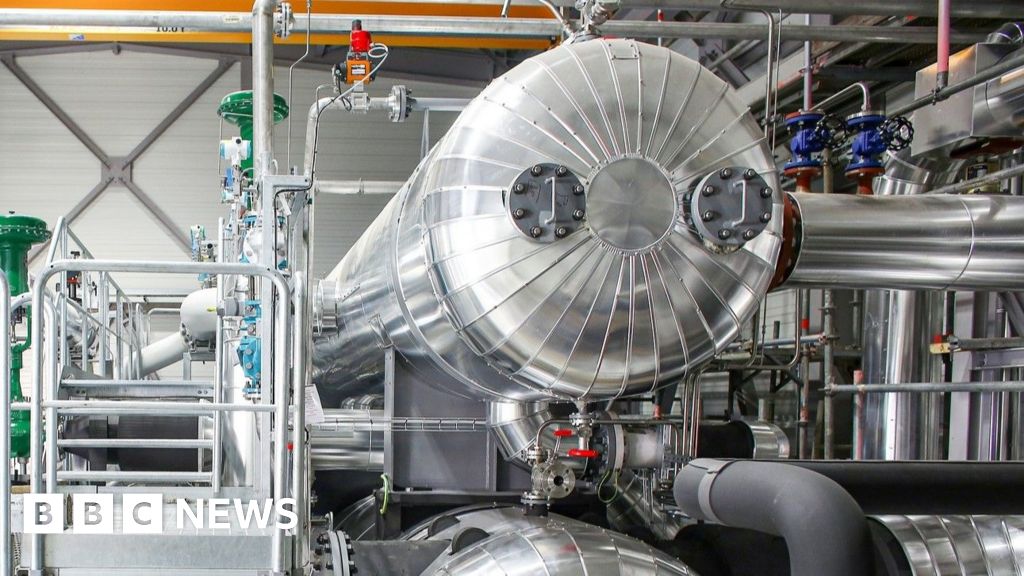
The pipe that will supply the heat pump, drawing water from the River Rhine in Germany, is so big that you could walk through it, fully upright, I’m told.
“We plan to take 10,000 litres per second,” says Felix Hack, project manager at MVV Environment, an energy company, as he describes the 2m diameter pipes that will suck up river water in Mannheim, and then return it once heat from the water has been harvested.
In October, parent firm MVV Energie announced its plan to build what could be the most powerful heat pump modules ever. Two units, each with a capacity of 82.5 megawatts.
That’s enough to supply around 40,000 homes, in total, via a district heating system. MVV Energie aims to build the system on the site of a coal power plant that is converting to cleaner technologies.
The scale of the heat pumps was determined partly by limits on the size of machinery that could be transported through the streets of Mannheim, or potentially via barges along the Rhine. “We’re not sure about that yet,” says Mr Hack. “It might come via the river.”
One person well aware of the project is Alexandre de Rougemont, at Everllence (formerly MAN Energy Solutions), another German company that also makes extremely large heat pumps. “It is a competition, yeah,” he says. “We’re open about it.”
Heat pumps soak up heat from the air, ground or, in these cases, bodies of water. Refrigerants inside the heat pumps evaporate when they are warmed even slightly.
By compressing the refrigerant, you boost that heat further. This same process occurs in heat pumps designed to supply single homes, it just happens on a much larger scale in giant heat pumps that serve entire city districts.
As towns and cities around the world seek to decarbonise, many are deciding to purchase large heat pumps, which can attach to district heating networks.
These networks allow hot water or steam to reach multiple buildings, all connected up with many kilometres of pipe. Ever bigger models of heat pump are emerging to meet demand.
“There was a lot of pressure on us to change the heat generation to new sources, especially renewable sources,” explains Mr Hack as he discusses the decommissioning of coal-fired units at the Mannheim plant. The site is right by the Rhine, already has a hefty electricity grid connection, and is plugged in to the district heating network, so it makes sense to install the heat pumps here, he says.
He notes that the technology is possible partly thanks to the availability of very large compressors in the oil and gas industry – where they are used to compress fossil fuels for storage or transportation, for example.
 MVV Energie
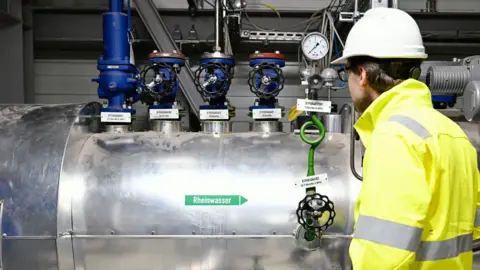
The new heat pump at Mannheim will transfer heat from the Rhine
Work on the Mannheim project is due to start next year. The heat pumps – with a combined capacity of 162MW – are set to become fully operational in the winter of 2028-29. Mr Hack adds that a multi-step filter system will prevent the heat pumps sucking up fish from the river, and that modelling suggests the system will affect the average temperature of the river by less than 0.1C.
Installations such as this are not cheap. The Mannheim heat pump setup will cost €200m ($2.3m; £176m). Mr de Rougemont at Everllence says that, at his company, heat-pump equipment costs roughly €500,000 per megawatt of installed capacity – this does not include the additional cost of buildings, associated infrastructure and so on.
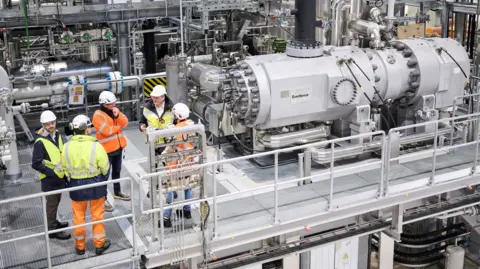 Everllence
Everllence has plans for heat pumps even bigger than this one in Esberg
Everllence is currently working on a project in Aalborg, Denmark that will be even more powerful than the system in Mannheim, with a total capacity of 176MW. It will use smaller modules, however – four 44MW units – and is due to become operational in 2027, when it will supply nearly one third of all heating demand in the town.
Those 44MW machines are actually the same ones used in a previous project, now fully operational, to the south of Aalborg in Esbjerg. There, they don’t run at maximum capacity but rather supply 35MW each.
Large hot water storage tanks, each able to hold 200,000 cubic metres of liquid, will give the system added flexibility, adds Mr de Rougemont: “When the electricity price is high, you stop your heat pump and only provide heat from the storage.”
Veronika Wilk at the Austrian Institute of Technology says, “Heat pumps and district heating systems are a great fit.” Such systems can harvest heat from bodies of water or even wastewater from sewage treatment plants.
Dr Wilk notes that, when you use multiple large heat pumps on a district heating network, you gain flexibility and efficiency. You could run two out of four heat pumps in the autumn, say, when less heat is required than during the depths of winter.
 Getty Images
Helsinki is overhauling its district heating system
All the systems mentioned so far harvest energy from water sources but, less commonly, very large heat pumps can use the air as a heat source, too. Even in a relatively cold city such as Helsinki.
“The sea in front of Helsinki is too shallow,” explains Timo Aaltonen, senior vice president of heating and cooling at Helen Oy, an energy firm. “We calculated that we would need to build a tunnel more than 20km long to the ocean, to get enough water [with a] temperature high enough.”
Helsinki is in the process of radically overhauling its district heating system. The city has added heat pumps, biomass burners and electric boilers to a 1,400km network that links up nearly 90% of buildings in the Finnish capital, adds Mr Aaltonen.
Heat pumps convert single kilowatt hours of electricity into multiple kilowatt hours of heat but electric boilers can’t do this and are therefore considered less efficient.
I ask why Helen Oy decided to install hundreds of megawatts of these boilers and Mr Aaltonen says that they are cheaper to install than heat pumps and having them also means he and colleagues don’t have to rely entirely on the air, which is limited in terms of how much heat it can provide at scale. Plus, the electric boilers can help to soak up surplus renewables and provide an electricity grid-balancing function, he says.
There are no heat pumps in the UK that rival the systems under development in Denmark, Germany and Finland. However, some new district heating networks are on the way, such as the Exeter Energy Network, which will supply the University of Exeter and other customers.
The minimum planned capacity of the network is 12MW. It will feature three 4MW air-to-water heat pumps, with the first unit due to become operational in 2028.
Keith Baker at Glasgow Caledonian University, who researches district heating systems, says the UK has opportunities to make more of this technology. Water in disused mines, which maintains a relatively stable temperature, is beginning to supply larger heat pumps here, for example.
Post-industrial and rural areas where there is adequate space to install heat pumps and heat storage tanks are “the sweet spots”, he says.
More Technology of Business
SOURCE PAGE

Disney’s three-year licensing partnership with OpenAI includes just one of exclusivity, Disney CEO Bob Iger told CNBC. The company signed the partnership with OpenAI last week that will bring its iconic characters to the AI firm’s Sora video generator. Once that exclusive year is up, Disney is free to sign similar deals with other AI companies.
The deal gives OpenAI a high-profile content partner, allowing users to draw on more than 200 characters from Disney, Marvel, Pixar, and Star Wars to create content on Sora. For now, it’s the only AI platform that’s legally permitted to do so.
For Disney, the deal offers a way to test the waters with generative AI and its intellectual property, letting the company assess how its partnership with OpenAI goes before pursuing additional agreements.
“No human generation has ever stood in the way of technological advance, and we don’t intend to try,” Iger told CNBC. “We’ve always felt that if it’s going to happen, including disruption of our current business models, then we should get on board.”
Tellingly, the same day that Disney announced its deal with OpenAI, the company sent a cease-and-desist letter to Google, alleging that the tech giant has infringed on its copyrights. Google didn’t confirm or deny Disney’s allegations but did say it will “engage” with the company.
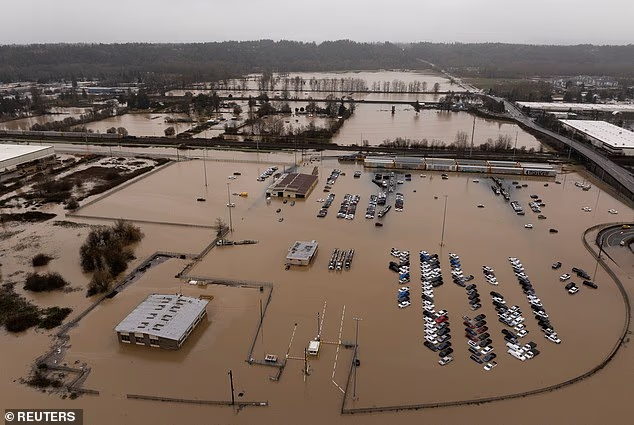
Thousands of Americans are under a life-threatening flash flood warning after a dam failed in Washington on Monday.
County dispatch reported the breach of the Green River Levee, south of Seattle, prompting the National Weather Service (NWS) to issue an alert at 11.51am PT.
A dozen counties, including Clallam, Grays Harbor, Jefferson, King, Kitsap, Lewis, Mason, Pierce, Skagit, Snohomish, Thurston and Whatcom, should brace for flooding over the next several days.
These counties cover much of the Puget Sound region and the Olympic Peninsula, placing thousands of residents on high alert.
The NWS urged locals to move to higher ground immediately, warning: ‘Turn around, don’t drown when encountering flooded roads. Most flood deaths occur in vehicles.’
Residents and businesses east of the Green River in the Orillia area in Tukwila, Renton and Kent are under a Level 3 (Go Now) evacuation notice. People in that area should go north or south, officials said.
The NWS said over 46,000 people could be impacted, along with two schools and one hospital.
Officials believe the levee failure is tied to days of intense rainfall, with another round of heavy rain expected Monday that could bring up to 12 inches in some areas.

County dispatch reported the failure of the Green River Levee. Pictured is flooding in the area on December 15

A drone view shows an area flooded by the Green River, after multiple atmospheric rivers brought rain and flooding to the Pacific Northwest, in Kent, WA
The NWS said flash flooding is already underway and described the damage threat as ‘considerable.’
‘In coordination with King County, we have issued a FLASH FLOOD WARNING for a levee breach in Tukwila, WA, near Todd Blvd. Water is likely moving north toward I-405,’ the agency said in a post on X.
According to KIRO 7, about 1,100 residents received emergency notifications urging them to move to higher ground.
The region is also being impacted by a Pineapple Express, a storm system carrying warm, moisture-laden air from near Hawaii.
AccuWeather meteorologists said steady rain will focus on higher terrain, particularly the Olympic Mountains, Coastal Range and Cascades, with two to four inches expected and a Local StormMax™ of 12 inches on windward slopes.
Additional rainfall on already saturated ground raises the risk of mudslides and worsening runoff through midweek.
Multiple rivers in western Washington are already experiencing minor to moderate flooding, with forecasts calling for further rises.
‘Several inches of additional rain this week, on top of last week’s totals, can lead to renewed major flooding,’ AccuWeather meteorologist Alex Duffus said, ‘including on rivers that recently crested at record levels.’

The dam failure was likely caused by the intense rainfall Washington has received over the last few days, as the state is experiencing another round on Monday that could see up to 12 inches

A drone view shows an area flooded by the Green River, after multiple atmospheric rivers brought rain and flooding
He added that rivers may take several days to crest even after the rain tapers off.
AccuWeather Senior Meteorologist Alex Sosnowski said: ‘Expect multiple, rapid rounds of moderate to major flooding of the short-run rivers in the higher and intermediate elevations of the Cascades this week.
‘Flooding in the higher elevations can occur in a matter of a few hours. However, where these rivers reach lower, flatter terrain just above sea level, moderate to major flooding can be delayed and longer-lasting and perhaps up to a few days. Multiple crests are likely.’
An atmospheric river is a long, narrow tract of the atmosphere that gathers moisture from the tropics and sweeps it toward the poles.
The Pineapple Express is a well-known example, originating in the tropical Pacific near Hawaii.
Meteorologist Jeff Berardelli of WFLA-TV (Tampa Bay) warned on X that the storm could deliver ‘pockets of 12–18 inches of rain and flash flooding’ across the West Coast over the next two weeks.
Residents should remain vigilant through the week, as saturated ground and rising rivers will prolong the risk of floods and landslides even after the storm moves on.

AI’s impact on our social media feeds has not gone unnoticed by one of America’s top dictionaries. Amidst the onslaught of content that has swept the web over the past twelve months, Merriam-Webster announced Sunday that its word of the year for 2025 is “slop.”
The dictionary defines the term as “digital content of low quality that is produced usually in quantity by means of artificial intelligence.”
“Like slime, sludge, and muck, slop has the wet sound of something you don’t want to touch. Slop oozes into everything,” the dictionary writes, adding that, in an age of AI anxiety, it is a term designed to communicate “a tone that’s less fearful, more mocking” of the technology.
“It’s such an illustrative word,” Merriam-Webster’s president, Greg Barlow, told The Associated Press. “It’s part of a transformative technology, AI, and it’s something that people have found fascinating, annoying, and a little bit ridiculous.”
The word “slop” has certainly been everywhere this year, as journalists and commentators have sought to describe the ways in which platforms like OpenAI’s Sora and Google Gemini’s Veo are transforming the internet. Thanks to this new breed of media generator, there are now AI-generated books, podcasts, pop songs, TV commercials—even entire movies. One study in May claimed that nearly 75 percent of all new web content from the previous month had involved some kind of AI.
These new tools have even led to what has been dubbed a “slop economy,” in which gluts of AI-generated content can be milked for advertising money. Critics worry that this trend is further polarizing digital communities, dividing them up into those who can afford paywalled, higher-quality content, and those who can only afford a digital diet of slop, which—as you might imagine—can be quite light on informational value.
But “slop” has also been used to describe AI’s impact on a large variety of fields that don’t have much to do with traditional media consumption, including cybersecurity reports, legal briefings, and the college essay, among other things. Its impact is broad, to say the least.
Relatedly, tech words have been big winners in the WOTY (word of the year) category this year. Macquarie Dictionary already beat out Merriam-Webster to make “AI slop” its annual term, while Oxford Dictionary chose “ragebait.” Collins Dictionary went with “vibe coding.”


Photo by Jakub Żerdzicki / Unsplash
AI tools entered the market with an almost irresistible promise. They would save time, reduce effort, and amplify human capability.
For a while, that promise seemed real. Teams rushed to adopt writing assistants, chatbots, image generators, and coding copilots. Productivity demos looked impressive. Adoption numbers climbed.
Then something unexpected happened.
A quiet but decisive shift is now underway. The market is moving away from standalone AI tools and toward workflow-first products. The companies that recognize this shift early will define the next phase of AI adoption.
The Move From Standalone AI Tools to Workflow-First Products
The limitation of most AI tools is not intelligence. It is isolation. They solve a task, then stop. Real work, however, does not stop at task completion. It moves forward through a sequence of steps, decisions, and handoffs.
This is where workflow-first products enter the picture.
What a workflow-first AI product actually looks like
Workflow-first products share a few defining traits. They are deeply integrated into existing tools and processes. They understand context across multiple steps. They reduce manual handoffs instead of creating new ones.
In each case, AI operates across stages, not just at the beginning.
Automation versus orchestration in AI products
Many AI tools focus on automation. They replace a specific action with a faster one. This is useful, but limited.
Workflow-first products focus on orchestration. They coordinate how multiple actions fit together. Orchestration reduces friction between steps, ensures continuity, and preserves context as work moves forward.
Why Workflow-First Products Are Winning Long Term
Workflow-first products outperform standalone tools not because they are smarter, but because they are harder to abandon. Once embedded into daily operations, they become part of how work gets done.
This creates structural advantages that go far beyond feature sets.
Stronger retention through habitual usage
Products tied to workflows are used every day by default. Users do not need reminders to open them. They appear naturally at the moment work needs to happen.
Daily usage leads to:
- Higher retention rates
- Lower churn
- Deeper user dependency
Standalone tools, by contrast, rely on conscious effort to be used. When pressure rises, they are the first to be dropped.
Compounding value over time
Workflow-first systems improve as they are used. They accumulate context, learn patterns, and adapt to real-world behavior. Each interaction strengthens the system rather than starting from scratch.
Defensibility in crowded AI markets
Features are easy to replicate. Workflows are not.
A workflow-first product touches multiple systems, teams, and decision points. Replacing it means rethinking processes, retraining users, and reconfiguring integrations. That friction becomes a natural moat.
What This Shift Means for Founders and Product Builders
Workflow-first thinking flips the priorities.
Instead of asking what a new feature can do, teams must ask where it fits in the user’s day. What triggers its use. What happens before it activates. What happens after it produces an output. These questions sound simple, but they are often ignored.
Rethinking AI product roadmaps
Feature-driven roadmaps reward speed. Workflow-driven roadmaps reward coherence.
Builders who adopt a workflow-first mindset tend to:
- Ship fewer features with clearer purpose
- Invest more in integrations and continuity
- Prioritize reliability over experimentation
This often feels slower in the short term, but it produces products users trust enough to depend on.
Designing systems instead of features
System design requires restraint. It means resisting the urge to solve every problem with a new capability. Instead, it focuses on connecting existing ones more intelligently.
Well-designed systems:
- Preserve context across steps
- Reduce manual coordination
- Anticipate what users need next
When AI products behave like systems, users stop thinking about the tool and start focusing on outcomes.
Avoiding hype-driven development cycles
AI markets reward visibility, but visibility does not equal adoption. Products built around hype often optimize for novelty, not longevity.
Workflow-first teams avoid this trap by grounding decisions in usage patterns. They watch how work actually happens, where friction persists, and where AI can remove it quietly. This discipline is increasingly separating durable products from disposable ones.
Where AI Product Strategy Is Heading Next
As workflow-first thinking becomes more common, AI product strategy is evolving in predictable ways. The next generation of successful products will not be louder or flashier. They will be more specific, more embedded, and less visible.
Vertical-specific AI workflows
Generic AI tools are reaching their limits. The future lies in products designed for specific industries and functions.
Vertical workflows allow AI chat systems to:
- Understand domain-specific rules
- Integrate with specialized tools
- Deliver clearer, more measurable value
This is why AI products tailored for healthcare, legal work, finance, and operations are gaining traction faster than broad-purpose alternatives.
Invisible AI embedded into everyday processes
The most effective AI will eventually disappear into the background. Users will not interact with it directly or label it as AI. It will simply be part of how work flows.
When AI is invisible:
- Adoption increases
- Resistance drops
- Trust improves
This is the opposite of early AI marketing, but it aligns with how mature software succeeds.
Integration as the real competitive advantage
As model quality becomes more accessible, integration becomes the differentiator. Products that connect deeply with existing systems gain a lasting edge.
APIs, connectors, and interoperability are no longer technical details. They are strategic assets. In a workflow-first world, integration depth matters more than raw intelligence.
Final Thoughts
AI tools did not fail because they lacked capability. They failed because they were built as isolated solutions in a world that runs on connected processes.
The next phase of AI adoption will not be defined by smarter models alone. It will be defined by products that understand how work actually moves from one step to the next.
In 2025, workflows are no longer a feature consideration. They are the product.

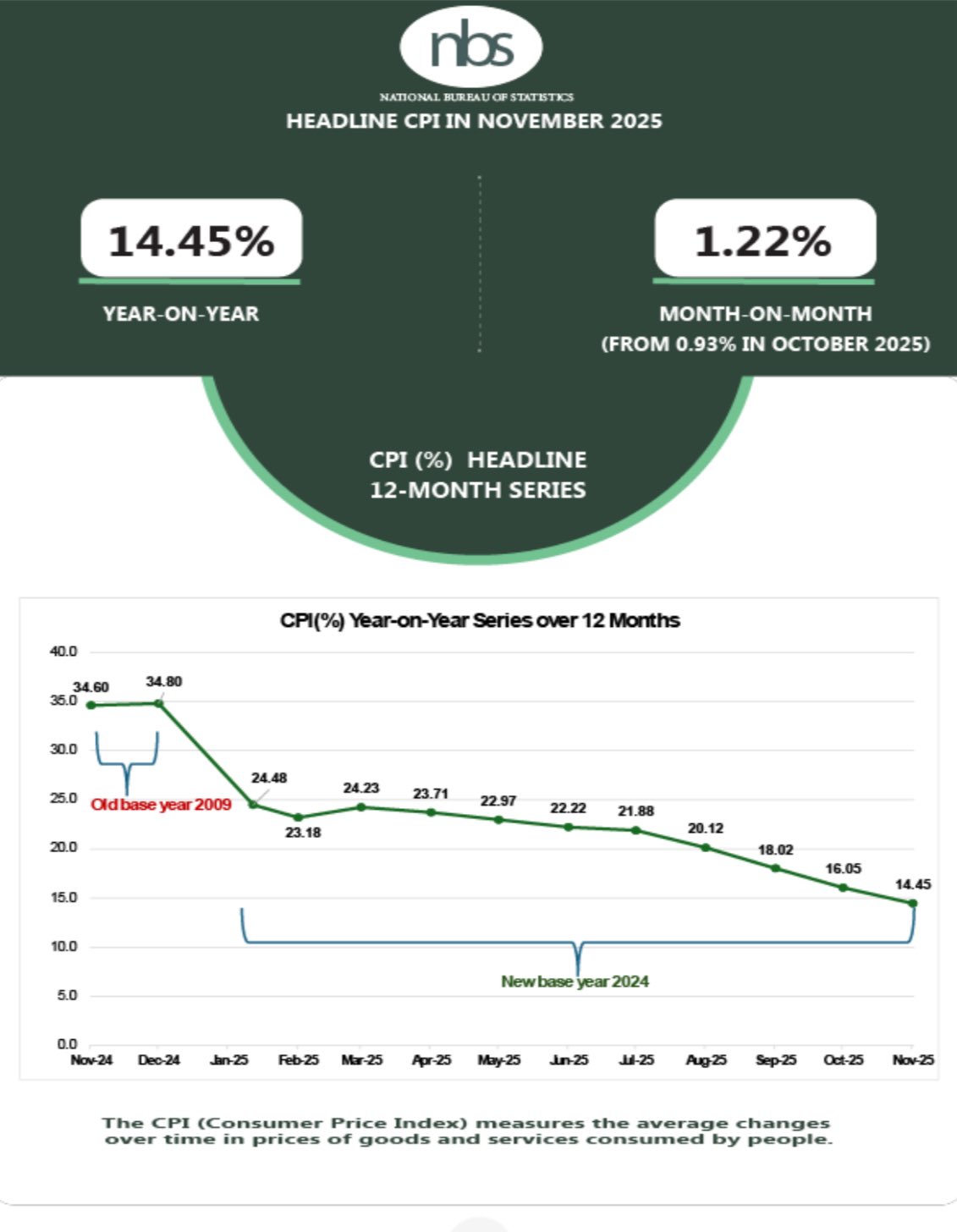
Nigeria’s inflation rate has fallen from 22.22% in June to 14.45% in November 2025, representing a 7.77 percentage point drop in just six months. It’s the steepest sustained decline the country has seen in years, and it’s quietly transforming the ₦2.1 trillion digital lending industry.
For most of 2024 and early 2025, Nigeria’s digital lenders were in survival mode. Inflation was so high that Nigerians weren’t borrowing to buy appliances or expand businesses; they were borrowing just to eat.
Food inflation had soared above 40% in late 2024, forcing millions to take loans for rice, rent, and transport. By January 2025, retail loans had surged 92.2% to ₦1.73 trillion, reflecting desperate survival borrowing rather than productive economic activity.
The problem for lenders was predictable. When people borrow out of desperation, they struggle to repay. Default rates climbed throughout the first half of 2025, with the Central Bank of Nigeria’s Q2 Credit Condition Survey reporting higher default rates for both secured and unsecured lending.

The IMF warned that rising non-performing loans in Nigeria’s fast-growing fintech sector posed potential risks to financial stability.
Then something shifted. In July, inflation dropped to 21.88%, a modest 0.34 percentage point decline, but the first sign that the worst might be over. By August, the drop accelerated to 20.12%, down 1.76 points. September brought 18.02%, another 2.10-point plunge. October delivered 16.05%, the lowest rate since March 2022. And now November’s 14.45% confirms this isn’t a blip. It’s a trend.
The most significant change has been in food inflation. From a peak above 40% in late 2024, food inflation has crashed to just 11.08% in November. This matters enormously for digital lenders because food was the primary driver of survival borrowing.
Read also: From 18.02% to 16.05%: Can fintech companies ride Nigeria’s inflation wave?
When Nigerians were spending 60-70% of their income on food alone, loan repayment became nearly impossible. Now, with food prices stabilising during harvest season and a stronger naira reducing import costs, households have more breathing room.
The National Bureau of Statistics reports that staple items like beans, garri, tomatoes, beef, and rice have shown month-on-month price decreases. This isn’t just statistical noise, it’s real relief felt in markets across Lagos, Abuja, and beyond.
How inflation is changing digital lending
The implications for digital lending are profound.
First, the nature of borrowing is shifting. When inflation was above 20%, loans were a last resort for survival. At 14.45%, borrowing can return to its more productive purpose: financing business expansion, purchasing inventory, or investing in education.
Second, repayment capacity is improving. With prices stabilising, borrowers have more disposable income left after covering essentials. The difference between 22% and 14% inflation might sound abstract, but for a household earning ₦150,000 monthly, it’s the difference between having ₦10,000 or ₦30,000 left after basic expenses. This is money that can go toward loan repayment.
Third, risk models are becoming more reliable. During periods of hyperinflation, credit scoring breaks down because everyone becomes a high-risk borrower regardless of their actual financial behaviour. As inflation stabilises, lenders can better distinguish between creditworthy and risky customers.
But the digital lending industry isn’t out of the woods yet. The Central Bank of Nigeria has held its monetary policy rate at 27%, making borrowing still expensive for most Nigerians. Until the CBN begins cutting rates, which likely won’t happen until inflation shows sustained stability below 15%, the cost of loans remains prohibitive for many potential borrowers.
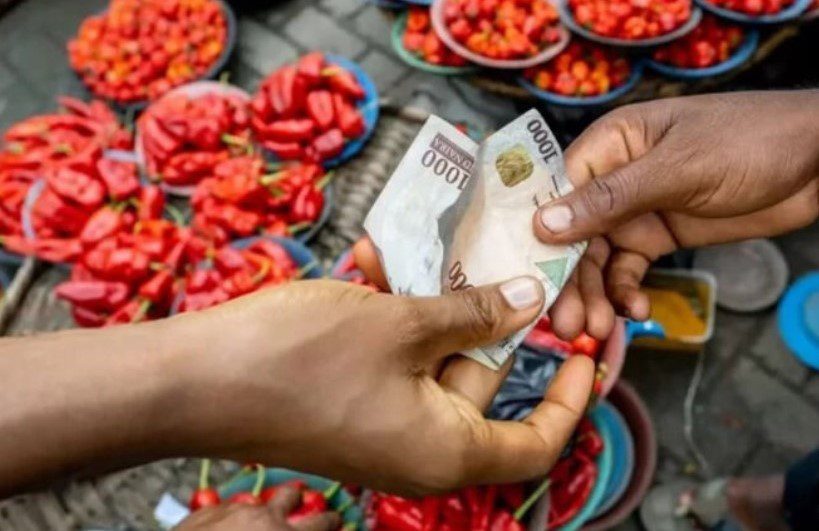
 FILE PHOTO: A man counts Nigerian naira notes in a marketplace as people struggle with the economic hardship and cashflow problems ahead of Nigeria’s Presidential elections, in Yola, Nigeria, February 22, 2023. REUTERS/Esa Alexander/File Photo
Additionally, new regulations are squeezing margins. The Digital and Electronic Lending Operations Network (DEON) Consumer Lending Regulations, which took effect in July 2025, have imposed strict compliance requirements. Industry estimates suggest compliance and legal spending now consume close to 7% of operating costs for digital lenders, more than double the 2022 level.
The sector has also grown crowded. The number of approved digital lenders surged 166% to 461 by August 2025, up from 173 in April 2023. With improving conditions, consolidation seems inevitable as stronger players acquire struggling competitors.
Looking ahead to 2026
If inflation continues its downward trajectory and the CBN begins cutting rates in early 2026, Nigeria’s digital lending industry could finally transition from crisis management to sustainable growth.
The six-month drop from 22% to 14% has created the foundation. Now, lenders are waiting to see if the structure they built on it can actually hold.

Since 2020, the British International Investment (BII) has significantly expanded its Africa portfolio. In 2021, the development finance institution (DFI) invested about £2.2 billion ($2.9 billion) in African businesses, exceeding a pledge made at the 2020 UK-Africa Investment Summit. Going forward, BII set a strategy to commit £1.5–2 billion ($2–2.6 billion) annually from 2022 to 2026, with Africa as a core focus.
That focus has allowed BII’s annual commitments to Africa to explode, despite global headwinds. In 2023, £725 million ($970 million) was invested in Africa (about 55% of BII’s total that year) before surging to £1.09 billion ($1.45 billion) in 2024, nearly a 40% increase year-on-year.
This period coincides with Chris Chijiutomi, a British-Nigerian with two decades of experience in investing across Europe, Asia, and Africa, becoming the managing director and head of Africa for BII. Now, Africa comprises roughly 60% of BII’s new investments by value in recent years, showing the continent’s priority in BII’s portfolio.
BII has also steadily expanded its exposure to early-stage ventures and technology startups in Africa, positioning venture capital as a core instrument of its development mandate. As a limited partner, it has anchored several Africa-focused funds, including TLcom Capital’s TIDE Africa Funds I and II, Sawari Ventures in North Africa, and Novastar Ventures in East and West Africa.
Alongside fund investments, BII has selectively deployed capital directly into startups like mPharma, to strengthen pharmaceutical supply chains; Moove, via structured credit to expand mobility financing for ride-hailing drivers; and equity investments in TradeDepot, Moniepoint, and Egypt’s Paymob. It has also backed off-grid energy companies such as M-KOPA and Lumos.
For this week’s Ask an Investor, I spoke with Chijiutomi to understand the firm’s increased focus on Africa, the sectors that he’s willing to invest in, BII’s sudden profitability jump, how the firm picks its startups and funds, and the sector that has provided the most returns.
This interview has been edited for length and clarity.
Is there any sector where you think your views have changed the most since you became BII’s Head of Africa?
When I started this role, I would say renewable energy—especially decentralised renewable energy—was fairly nascent. The solar panels were relatively quite expensive, including the battery, and the uptake was also quite limited. Therefore, the technical and commercial viability was still quite nascent.
But if I look at where I am now, and I remember driving from the airport to our office here, I could see a lot of solar panels on people’s rooftops. I could see solar panels on the streetlights. So I think, for me, what we call decentralised renewable energy—DRE—has been one area that has seen an absolute increase in uptake.
That’s obviously also a function of the gap that exists in a country like Nigeria in terms of electricity access. That’s one key area. And what have we been doing in this space? We invested this year in a $7.5 million facility for a company called Odyssey Energy Solutions, which is a company that’s specifically focused on energy access with renewables. We provided a facility last year—$30 million—to InfraCredit, and InfraCredit is supporting a lot of renewable energy developers in Nigeria. That’s one area that jumps out at me in terms of a key sector that has evolved.
The other one—probably more broad—is the whole venture capital space, the VC space, where people are using technology to develop solutions for their day-to-day problems in markets like Nigeria and broader West Africa. So those two areas, I would probably say, were areas where I’ve seen the most change since I took on the Head of Africa role.
Get The Best African Tech Newsletters In Your Inbox
What do you think is spurring this change?
On DRE, it’s just the fact that no country can develop without energy infrastructure. The challenge we have in Africa—and especially Sub-Saharan Africa—is the lack of energy access.
A country like Nigeria, with over 200 million people—at least that’s the last count—has less than 6,000 megawatts of electricity on the grid. Then, when you think about the rural and the peri-urban areas, a lot of them lack access to electricity. Just that failure is what’s led people to think about alternative solutions, and I think that’s where the DRE solutions come into play.
I think on the VC side, with the uptake of the internet and the uptake of telecoms, that has really driven a lot of smart young Africans to think about how to use technology to solve their day-to-day problems—be it things related to payment systems, things related to logistics, or even things related to farming and climate-related data. I think all of this is all about problems that are preventing the continent from developing and growing. Those are the reasons why I think the uptake really has kind of moved onto that next level.
Since you became Head of BII for Africa, what has been your Africa tech strategy? Has it evolved from before you took on the role, or have you maintained the same strategy at BII?
I would say it’s evolved. Prior to me taking on the Head of Africa role, we’ve been investing in the venture capital space and also the private equity space, and the two kinds of interlink. I think since I’ve taken on the role, a big focus of mine has been: How can we find local African entrepreneurs to back? How can we make sure we go deeper in this area and we look for the right type of managers to basically give them our capital and the responsibility to manage it for us?
If I look at some of the things we’ve done in this market, we’ve invested in Ventures Platform, and they’ve been investing in some really smart companies. I had a breakfast meeting this week with Aruwa Capital, a female-led VC business that’s looking to invest in a range of sectors. We have companies like CardinalStone. We have companies like Verod Capital, which are also in some of these spaces.
The other big excitement for me, in terms of companies that we’ve backed here that we continue to see as growth, is companies like Moniepoint, which is now a unicorn in terms of valuation. And also, in Southern Africa, we backed a company called TymeBank. Again, these are two fast-growing companies that are employing a lot of young, smart, diverse people.
How do you pick the fund managers that you invest in, and how do you pick companies?
The first thing for us is alignment. Alignment in understanding their strategy—what exactly are they aiming to do? How have they thought through that strategy? How have they thought through even just the execution of that strategy?
That’s important because I need to match that against our own priorities and how we think about the sectors or the subsectors we invest in. That’s the first thing that enables a deep conversation: Does the strategy align?
I think the second one is about the promoter—in terms of the sponsor or founder—and the team that they have with them. Is this a team that you can back? Do they have the track record? What’s their reputation in the market? What’s their understanding of working with a development finance institution like ourselves? What is their long-term aspiration?
It’s a lot about understanding and getting very close to the founders. But also, do they have a deep bench of a team? Because, you know, if something does happen to a founder—we call it typically a key-man event—what’s the bench of people within the organisation to actually carry on and continue to execute that?
I think the other one is really around the market that they operate in—either the country or the region. Again, is there an alignment with us? Do they really understand this, or are they just putting it there because they think that makes sense for us? Why are they focusing on a particular area? We dig deep into understanding some of that. Um, I think trust is a massive word. You are giving responsibility to these promoters with your capital. My capital is UK taxpayers’ capital. So we have a financial responsibility, and we want to make sure they too understand that.
We also look at the other partners that they might already have. Some of these founders have raised their own first money to start up. Who have they raised the money from? Are these partners that align with our values? Are there other shareholders that we believe are creating alignments—that are also looking to invest in either the direct VC companies or actually the funds?
Get The Best African Tech Newsletters In Your Inbox
How do you think about tech here in Africa, and what are the things that excite you, tech-wise?
Let me maybe go through the bits that excite me. I think the fintech space—we talked about Moniepoint and TymeBank. There are other fintech businesses that we’re looking at, which are basically really opening the inclusion story for people that are underserved—people that ordinarily would not have been able to open a bank account, or even had the time to go into a branch to try and withdraw money or move money.
The second one is the commerce space. So basically: How can you combine tech with logistics—the ability to purchase, buy, and deliver goods? We’ve seen businesses where you have—you know, let me call them market women, largely because a lot of these businesses are dominated by women—who have been able to use their app and their phone to basically order inventory that then gets delivered to them. They then use that same app to pay or get credit from suppliers that are giving them [inventory]. And I remember visiting a business in Nigeria a year ago, where we were able to talk to the store owner, and what she explained was that she now doesn’t need to shut her shop to go to Lagos Island market to buy all these goods, because everything can be done from her phone. Just the utilisation of tech to support the MSME—micro, small, medium enterprise—I think is a game changer, because the majority of businesses in Africa fall within that category.
Agritech, too, because of the size of arable land in Africa. I still say that the largest employer of people on the continent remains in the agri sector. How can we use technology to help get inputs, such as fertilisers and seeds, to farmers? How can we utilise technology to provide farmers with real-time information on the cost of their crops and how they can sell them, ensuring they are not being cheated by shifts in economics that favour those who buy them? How can you use technology to help farmers understand climate change—predicting the weather patterns, when they should plant, when they should harvest—all of this?
Agritech—and where I have seen agritech investment the most from us is in East Africa, because the farming sector there is a lot more advanced.
Climate tech is becoming an area of interest. So all things like electric vehicles—two-wheelers, three-wheelers, and at some point four-wheelers. I’ve just come back from Ghana, and I’ve started seeing people driving four-wheelers because of the challenges of fuel. In Nigeria, I was at Marina the other day, where I saw a bank that has an EV fleet (electric vehicle fleet), and they had solar panels on the top of their car parking port, and they’re using technology to determine when they now need to inject electricity for charging. I was very impressed.
I was going through your report from last year, and something that jumped out to me was a focus on profitability in the reports. I found that really interesting because I haven’t really seen that with other DFIs—talking about profitability and putting it on the front foot. What’s inspiring that focus? Because—from 2023—it was a £44 million loss, then you quickly jumped the next year to like £213 million pounds in profit. How do you guys think about profitability? How was that jump achieved?
There are different dimensions to it. When we invest, we invest with two things in mind, and all of this is really around understanding risk.
First thing is: what impact is our investment going to create, and is our money needed? Then the second thing is sustainability—what’s the return expectation? So we’re always matching the impact you create versus the return. So that’s always a balance: anytime the teams are bringing opportunities, we always have to consider the two.
Profit matters in the sense that we have to ensure that we are building businesses that can stand alone, that can grow in time without DFI capital. For that to occur, these companies, at some point, need to start returning dividends or making a profit so that they become self-sustaining.
So for me, profitability is something that’s inbuilt if you really want these businesses to grow without our capital. If we want to mobilise commercial money into these businesses—for example, a big objective for BII in the upcoming strategy is what we call capital mobilisation. How can we mobilise, in an African context, local pension funds, sovereign wealth funds, and high-net-worth individuals to invest in some of our assets? A lot of them will not invest unless these assets are making a profit. Therefore, that consideration.
Impact—which we define around inclusivity, productivity, and sustainability—is embedded in what we do, and then the commercial side is also linked. Why have we shown a result, as you’ve just indicated? A number of things.
I think one is timing. You know, there are some bets we’ve made in terms of companies we’ve invested in that are now starting to yield dividends or yield returns back to us. You know, we’re a long-term investor, so sometimes there’s an element of the cycle.
There are companies like Moniepoint—just using that as an example—when we invested, Moniepoint was nowhere near a unicorn. It’s become a unicorn. So that means some of our capital has now increased in value. Again, that flows through to our annual accounts.
We have a number of funds that we’ve invested in, which are longer-term. Some of the businesses have now matured, and then they’re starting to deliver returns. I think because our portfolio—which is just under $9 billion—there is variability in terms of when some of these investments start to return commercial value, and really that’s what’s translated into our accounts that you’ve just indicated.
You have mentioned Moniepoint a lot; how did the exit from the company happen?
There was a capital raise by Moniepoint where they wanted to bring in a number of different investors. So you had other investors coming into the company, and we realised some of our gains from that. But we still remain an investor in Moniepoint today.
So it was a partial exit?
Get The Best African Tech Newsletters In Your Inbox
Yes. When we invest equity, we sometimes have board seats. We typically invest, and we are typically a significant minority. By exception, we’ve done the majority. But what we do is we enable these companies to have the right governance structure and to have the right board composition, and with management and the board, they make the decisions. At some point in its journey, the board and the management of Moniepoint indicated that for them to continue to grow, they needed capital. The way to do that was to raise capital.
One of the kind of strong investors in Moneypoint is DPI—which is a fund manager that BII is also invested in—and they’ve worked with the company to get the company kind of ready in terms of the delivery of its business plan, in terms of the right governance structure, and in terms of the team build-out. Through that, they’ve then helped and worked with the company management and board to decide when to go out and raise capital.
It’s not something that BII exclusively drives or influences. It’s something that is driven by the management and the board of the companies we invest in. And of course, we then can vote or have a view, but ultimately it’s really a majority-led decision, driven by the governance of these companies.
Where have you seen the most returns in all your investments since you became Head of BII for Africa two years ago?
In terms of where I see returns, not in the sense of monetary, but in terms of impact, for every dollar we’ve invested, I will probably say digital infrastructure. The reason is that it includes telecom, so our telecom and technology division is because I have seen and witnessed the direct impact of technology on the continent.
From being able to video call my uncle in the village and physically see him, and the kind of impact I feel from that, to being able to transfer money to him without having to leave my base. And you can also then think about the multiple people who are able to support their direct or extended families. All of this is possible because of the technology that now exists—because of the digital infrastructure—from data centres to cables to mobile phones to towers.
So I think that is one subsector that I feel has been able to create a big impact, in terms of my vantage point, and this is across the continent.
In 2024, BII invested over £1 billion on the African continent. If you were allocating the next billion into Africa, what three themes or sectors would you bet on—and which one would you totally not touch at all?
I think about: how can we create quality jobs for Africans? How can we empower more women or those who are excluded from society? How can we develop solutions to mitigate the effects of climate change? There are quite a few various things in there, but some of our conversations so far have centred around technology. Digital infrastructure, for me, is driving a lot of growth in a lot of countries in Africa.
All things digital—be it from digital telecom infrastructure, data centres, cables, towers—anything that enables humans and businesses to ultimately communicate, store data, exchange data, and use that platform for growth.
We are a big investor in the telecom space, and I hope we will continue to find the right business opportunities to invest in.
The other one—and I think if I look at what Africa went through during COVID, during the Russia-Ukraine war, and more recently with what’s happened across the Atlantic in terms of the US pulling out USAID in a lot of countries in Africa—I think this is the right time for Africans to try and take more control of their destiny.
Africans need to think about local production. Local production enables jobs. It also prevents African companies from relying on imports, which people found during the Russia-Ukraine war, where Africa realised a lot of its wheat was coming from Ukraine and Russia.
All things local manufacturing and value addition in terms of food processing—these are big areas for us, and big areas where I would love to invest. Cobalt, copper—all of these things are raw materials in the continent, but how do we add value in processing such that we’re not just exporting raw and then paying a lot more for processed goods?
Anything to do with energy—climate-related: from energy to water, in terms of adaptation and resilience, to food systems. Africa suffers the most from the impact of climate change, either through drought or through flooding and excessive rainfall.
Those are the three categories that I would focus on: digital infra, manufacturing, and then all things related to climate/energy.
I would avoid sectors that are solely reliant on things like subsidies—100% dependent on government actions—because I think we understand that when you have a change of government, a single policy can totally unbundle some of these types of businesses. So businesses—or sectors—where subsidy is playing too much of a role are probably sectors that I would personally avoid investing in for now.
When you look at your exposure on the continent—you’re heavily invested in Nigeria, Kenya, a bit of Egypt, and several other African countries—where do you feel you are underinvested and can probably do more in this country because of what you’re seeing on the ground?
Not that I’m biased, but just if I look at the demographics, and just driving around, or when you fly over Nigeria, you see just the sheer lack of sustainable infrastructure. Nigeria, just for its size and its importance in the region, continues to be a country where I think we can invest more. I think today we’re already very heavily invested in Nigeria, but the opportunity here is huge.
As a countercyclical investor, I do believe we will continue to see the right type of opportunities to increase our exposure here, but also to diversify our portfolio. I have a great team based in Lagos—a team that has really grown our footprint and exposure here.
Another place where I want us to actually ramp up more is the French-speaking West and Central Africa. This year, we recruited a director of West African origin—French-speaking— and she’s also come from a development finance institution. She’s based in the region, and that’s one region I do believe we have the opportunity to grow. It’s not been a traditional region for BII, but in the last 12 months, we’ve invested—and I’ve been investing—in the financial services area.
We’ve just done a co-investment with an influential bank in West Africa. We are invested in another microfinance-type bank. I have just literally come back from the Democratic Republic of Congo, where we’re building a port with Dubai Ports World—that’s in DRC, a French-speaking country. We have an agro-processing business, but that’s not enough. We can absolutely do more, and the opportunities there are huge.
Another thing I noticed from the report was: Africa now takes 60% of BII’s new commitments. That’s a 40% jump from 2023. What changed—internally, or maybe it’s external conditions—that justifies that acceleration?
We are a countercyclical investor. We should be investing when things are going badly, because that’s when other capital is moving out. In the last three or so years, the continent has faced some significant challenges: the effect of COVID, Russia-Ukraine—um—all of this has had a knock-on impact. And, you know, we’re still feeling it. We increased our investment appetite during that period.
Particularly, we’ve seen a lot in climate investing. You know, a minimum of 30% of our capital has to go into climate finance transactions, and we’ve beaten that. And again, that’s been something where it’s been more targeted and very focused.
I think we’re focusing on partnerships—and those partnerships are helping us to identify the right opportunity in the frontier markets. I mentioned earlier that we have an initiative called the Africa Resilience Investment Accelerator. This is a collaboration between BII, Proparco (the French DFI), and the three of us. We’re going into countries that we all individually don’t have specific experience in—working with companies, finding the right opportunities, and investing.
That’s what’s led us to invest in Ethiopia—in a bank there. That’s what’s leading us to make some investments in Sierra Leone. Those types of initiatives have really helped us accelerate activities we’re doing.
Then mobilisation: we are now starting to originate to share, where we’re bringing other capital providers into some of our investment deals. The last one I’ll end with is: We’ve increased our presence in Africa. We have more people in our local offices who are now closer to markets, who are closer to companies, who are closer to the opportunities, and therefore we’re able to transact and invest for market-level impact better. I would say everything I’ve described—the big catalyst—has been having the right type of people in Africa to drive our investment activities.
If you look ahead to 2033, what would you count as a successful decade for Chris, being Head of BII for Africa?
I would like to continue to shift and build our volume of people in Africa. Again, I believe that having people close to the market creates a closer relationship with the companies that we’re backing, but also with the stakeholders in the markets—be it government, be it industry bodies. BII continuously having the right profile in Africa, for me, is a success.
My visit to West Africa this week—some people that I’ve spoken to are still shocked about the amount of business we’ve been doing here. Therefore, it means we need to publicise more, for me, because if you publicise more, then some of these opportunities will come knocking.
In terms of success: more people and more activity.
I think continuing to deliver on our climate target is important, because 30%—I mentioned earlier—is our target. I want us to continue to exceed that, but make sure we’re driving climate investing in Africa.
A big success for me—and I’m sure my boss will be putting this in my KPI—is how I can mobilise more African pension fund money alongside BII into new asset classes? You know, the days of just sitting there and investing in government securities, T-bills—it’s just not sustainable when you look at inflation, and when you look at some of the experiences of pension funds. You want them to invest in areas that match the liabilities and the assets that they have. So, infrastructure, maybe private credit funds.
The ability where I’m able to stand up and say I’ve been able to mobilise capital from pension funds in Africa into African assets—I think is a big one for me. And for us to continue to be seen as the lead investor in frontier markets. I think that’s the type of thing I would like to reflect on in 2033 as success measures for me in my current role.

Meta’s social network Threads is expanding the number of topics available through its newer communities feature, the company announced on Monday. This expansion might nudge people to use communities less on Reddit and X.
The platform initially launched over 100 communities in October, including those dedicated to basketball, television, K-pop, books, and more, to better compete with other social networks. With today’s expansion, Threads now has more than 200 communities, with additions that include team-specific spaces like Lakers Threads, Knicks Threads, and Spurs Threads.
The company is testing flairs within the community as well, which is also very common on Reddit. This feature lets you add a customizable label underneath your username. For instance, in the NBA community, you can show off what team you support using flair, or in the books community, you can indicate if you’re an author.
Image Credits: ThreadsImage Credits:Meta
Threads is also testing a “Champion” badge to reward members who are highly engaged in a community. The company said that it is giving badges to only a limited number of people who are highly followed in the community and who converse actively.
 Image Credits: ThreadsImage Credits:Meta
The social platform, which competes with Elon Musk’s X and startups like Bluesky, crossed 400 million users in August, two years after its launch. The company also noted this fall that more than 150 million people now visit the site daily.
To date, Threads has been focusing on engaging and retaining users with features like DMs, Group chats, and ephemeral posts, and other additions.