
NIGERIA NEWS
CBN revokes licences of Aso Savings, Union Homes

NDIC begins payment to depositors
By Babajide Komolafe and Emma Ujah
The Central Bank of Nigeria (CBN) has revoked the operational licences of Aso Savings and Loans Plc and Union Homes Savings and Loans Plc, citing persistent violations of regulatory requirements and failure to meet prudential standards governing mortgage banks in Nigeria. The CBN’s decision was part of its ongoing efforts to strengthen the mortgage sub-sector and ensure greater compliance with financial regulations.
In a statement, the Acting Director of the Corporate Communications Department at CBN, Mrs. Hakama Sidi Ali, said the revocation of licences followed significant breaches of the Banks and Other Financial Institutions Act (BOFIA) 2020 and the Revised Guidelines for Mortgage Banks in Nigeria. Both banks were found to be undercapitalised, with share capital below the minimum requirement for their licence categories, insufficient assets to meet liabilities, and failure to comply with several CBN directives.
The CBN emphasized that its actions were necessary to safeguard the financial system and protect depositors. “The CBN remains committed to its core mandate of ensuring financial system stability,” the statement read. This move signals the regulator’s zero-tolerance approach to non-compliance and its determination to rebuild confidence in Nigeria’s mortgage sector.
Following the licence revocation, the Nigeria Deposit Insurance Corporation (NDIC) has begun the liquidation process of both banks. The NDIC will pay insured depositors up to ¦ 2 million, per depositor, in line with the provisions of the Banks and Other Financial Institutions Act. Depositors with balances exceeding ¦ 2 million will receive the insured portion, while the remainder will be settled as liquidation dividends after the sale of assets and recovery of outstanding debts.
The NDIC stated that the payment of insured deposits has already begun, with depositors’ claims being processed through either online or in-person verification. For online claims, depositors are instructed to visit the NDIC claims portal, while those opting for physical verification can visit the closed banks’ branches from December 16 to 30, 2025.
To expedite the payment process, the NDIC has urged depositors to provide proof of account ownership, valid identification, and details of their alternate bank accounts, including Bank Verification Numbers (BVN). The corporation also advised depositors to enable transaction alerts to receive notifications of their payments.
The NDIC will prioritize the settlement of depositors’ claims before addressing creditors’ claims as required by law.
The post CBN revokes licences of Aso Savings, Union Homes appeared first on Vanguard News.
NIGERIA NEWS
“I Thought They Wanted to Give Us Something” – Corps Members Sent Away from PPA Without Warning


- A female NYSC corps member has sparked online debate after revealing that she and several colleagues were abruptly dismissed from their Primary Place of Assignment.
- Expecting a possible end-of-year gesture, the corps members were instead told to submit their PPA letters, which were marked “rejected” and stamped, raising questions about whether such actions comply with NYSC regulations.

A female corps member has taken to social media to express shock after she and several colleagues were suddenly dismissed from their Primary Place of Assignment (PPA).
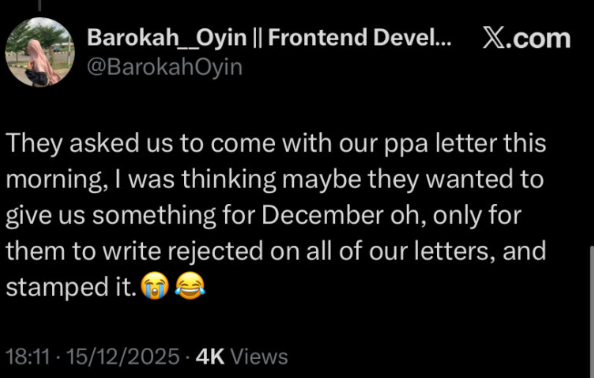
The lady, identified on X as @barokahoyin, revealed that the organization asked them to report to the office with their PPA letters. Expecting a festive gesture, she was stunned when they were all rejected instead.
“I Thought They Wanted to Give Us Something”
Recounting the confusing experience, she wrote:
“They actually just sacked all of us in my ppa, I didn’t know corp members usually get sacked. I hope we remain sacked till January ending tho. They asked us to come with our ppa letter this morning, I was thinking maybe they wanted to give us something for December oh, only for them to write rejected on all of our letters, and stamped it,”.
The sudden mass “rejection” has sparked a debate online, with many questioning if such a move aligns with NYSC regulations, while others shared similar stories of unexpected dismissals during their service year.

In other news…. Nollywood actress Doris Ogala has revealed plans to take legal action against Pastor Chris Okafor, alleging that he broke a promise to marry her and instead wed another woman.
Ogala shared her claims during a live interview with media personality Daddy Freeze, where she discussed her past relationship with the pastor and the circumstances that led to their separation.
The actress explained that her decision to pursue legal action stems from the promise of marriage she says Pastor Okafor made to her.
During the interview, she also addressed questions about her conduct while married to her former husband. Ogala admitted to having a phone-based relationship with Pastor Okafor at that time, describing it as a mistake she regrets. She clarified that their interactions did not involve any physical contact.
When asked if she could substantiate her claims, Ogala stated that she possesses chat logs, screen recordings, and a video showing the date and phone number of the recipient.
Daddy Freeze cautioned her against publicly sharing these materials, noting that doing so could breach privacy laws.
Ogala, however, remained firm, saying she had instructed her lawyer to pursue the case. She maintained that Pastor Okafor’s decision to marry another woman after allegedly promising to wed her provided sufficient grounds for legal action and that she is ready to present her evidence in court.
As of the time of reporting, Pastor Chris Okafor had not issued a public response to Ogala’s allegations.


The Chief Executive of the Nigerian Midstream and Downstream Petroleum Regulatory Authority (NMDPRA), Engr. Farouk Ahmed, has clarified that he will not engage in public disputes with Aliko Dangote, president of Dangote Refinery, over recent allegations.
In a statement issued Wednesday through NMDPRA X account, Ahmed dismissed reports claiming he had responded to Dangote’s claims, saying the purported statement “did not emanate from me.”
“My attention has been drawn to a purported response I was said to have made on the recent allegations against my person. I hereby state categorically that the so-called statement did not emanate from me,” Ahmed said.
Acknowledging the allegations and the public attention they have generated, he explained that he deliberately chose not to engage in public exchanges, citing the sensitive nature of his role as a regulator.
Ahmed noted that Dangote has submitted the matter to a formal investigative body, expressing confidence that due process will objectively examine the issues and clear his name.
“While I am aware of the wild and spurious allegations made against me and my family and the frenzy it has generated, as a regulator of a sensitive industry, I have opted not to engage in public brickbat.
“Thankfully, the person behind the allegations has taken it to a formal investigative institution. I believe that would provide an opportunity to dispassionately distill the issues and to clear my name,” he said.
DAILY POST reports that Dangote had approached the Independent Corrupt Practices and Other Related Offences Commission (ICPC) over claims that Ahmed spent $5 million on his children’s tuition.
The ICPC confirmed receipt of the petition on Tuesday.


All Progressives Congress Chieftain, Joe Igbokwe, has accused the Senator representing Abia South senatorial district, Enyinnaya Abaribe, of sponsoring attacks in the South East.
Naija News reports that Igbokwe, in a post via his Facebook page, called Abaribe a bandit of the Indigenous People of Biafra (IPOB), an ethnic bigot and a sponsor of evil.
According to Igbokwe, Abaribe has been one of the supporters of the butchers of the South East for nearly 15 years and has been silent about the killings in the South East.
He further threatened that Abaribe will not return to the Senate in 2027.
He wrote, “Please do not waste your precious gift of time on this IPOB bandit, ethnic bigot and sponsor of evil in the SE called Senator Abaribe. He is IPOB, UGM, ESN and BDF sponsor and father. He has been one of the supporters of the butchers of South East for nearly 15 years. Our people were slaughtered like goats and he kept quiet. Many towns and villages were sacked for years and Abaribe maintained a grave silence.
“He is positioning himself to return to the Senate in 2027. Not anymore. This is your last chance in the Senate after this dispensation. Just take mental notice of this. You cannot continue to go to the Senate matching on the blood of our people. The blood of the hundreds of our people killed will fight you to the end.”


President Bola Tinubu on Tuesday night held a meeting with leadership of the Nigeria Labour Congress (NLC) as concerns continue to mount over a planned nationwide protest by organised labour.
The meeting, which took place at the State House, Abuja, brought together key government and labour stakeholders to discuss the issues underpinning the proposed demonstration and seek a way forward through dialogue.
Labour leaders, led by Comrade Joe Ajaero, National President of the NLC, were received by President Tinubu alongside members of the Progressive Governors Forum (PGF) and top federal officials.
READ ALSO:
Governors in attendance included Hope Uzodimma (Chairman, PGF), Monday Okpebholo of Edo State, and Dr. Nasir Idris of Kebbi State.
The Minister of State for Labour, Nkeiruka Onyejeocha, also featured at the meeting.
The engagement signalled an attempt by the federal government to address the grievances expressed by labour unions through constructive dialogue, rather than escalation.
While details of the discussions were not immediately disclosed, the presence of state executives and labour representatives underscores the broad consultation process underway.
Comrade Ajaero and other NLC leaders were pictured alongside President Tinubu and the delegation, reflecting the seriousness with which both sides are approaching the matter.
The meeting comes amid heightened national attention on labour relations and the role of collective action in influencing government policy.
Labour protests have in the past focused on issues such as wage adjustments, cost of living, and economic reforms, topics that continue to dominate public discourse.
The outcome of this meeting is expected to shape the final decision of labour unions on whether to proceed with their planned protest.
The presence of the PGF leadership signals a shared interest among federal and state executives in resolving tensions and ensuring that governance challenges are addressed through negotiation and mutual understanding.
President Tinubu’s meeting with NLC leaders marks a critical step in government-labour relations, as both sides explore peaceful avenues for addressing labour concerns and reinforcing national stability.
Please follow and like us:


The Governor of the Central Bank of Nigeria (CBN), Olayemi Cardoso, has told international investors that Nigeria remains committed to macroeconomic stability, as the country pursues economic reforms amid global financial uncertainty and persistent domestic pressures.
Mr Cardoso spoke on Monday in Washington, DC, at the US – Nigeria Executive Business Roundtable, where he engaged senior business leaders and institutional investors on Nigeria’s economic outlook.
He said Nigeria’s reform programme was anchored on rules-based economic management, transparent markets and predictable policy frameworks, which he described as critical to restoring investor confidence.
According to him, recent changes in the foreign-exchange market, the adoption of orthodox monetary policy, ongoing banking-sector reforms and the modernisation of the payments system were aimed at stabilising the economy and enabling private-sector-led growth.
The roundtable was convened by the US Chamber of Commerce’s US-Africa Business Centre. Discussions focused on macroeconomic stabilisation, regulatory clarity and opportunities to scale bankable projects across priority sectors of the Nigerian economy, as Nigeria seeks to strengthen commercial ties with the United States.
Commenting on the discussions, the President of the US-Africa Business Centre at the US Chamber of Commerce, Kendra Gaither, said investors were increasingly focused on policy credibility and consistency.
“What investors are responding to today is clarity, clear rules, credible reforms, and a seriousness of purpose. Nigeria’s message is increasingly one of discipline and opportunity, and that matters in a global economy seeking actively for stability and predictability.”
READ ALSO: CBN targets wider agricultural lending as Cardoso unveils new ACGSF board
Nigeria has implemented a series of economic reforms over the past year, including adjustments to the foreign-exchange framework, tighter monetary policy and efforts to strengthen banking supervision, as authorities seek to rein in inflation, stabilise the naira and improve capital inflows.
The engagement in Washington comes as Nigeria competes with other emerging markets for foreign investment at a time of elevated global interest rates and tighter financial conditions.


A corps member has cried out on social media after she and other corps members were suddenly sacked from their Primary Place of Assignment (PPA) during their ongoing National Youth Service Corps (NYSC) programme.
Corps Member Shares Shocking Experience
The lady, who is currently serving under the NYSC scheme, took to X to share her experience, saying the decision came without any clear explanation.
Sudden Sack at Place of Assignment
According to her, several corps members posted to the same organisation were relieved of their duties at the same time.
She said none of them was told what led to the decision, leaving everyone confused and shocked.
Corps Member Speaks Out Online
The corps member, identified on X as @barokahoyin, revealed that she did not even know it was possible for corps members to be sacked from their PPA.
She explained that the development caught her completely off guard.
How the Incident Happened
Recounting what happened, she said they were asked to report to the office with their PPA letters.
At first, she thought it was for a positive reason, possibly a December-related gesture from the organisation.
However, things turned out differently.
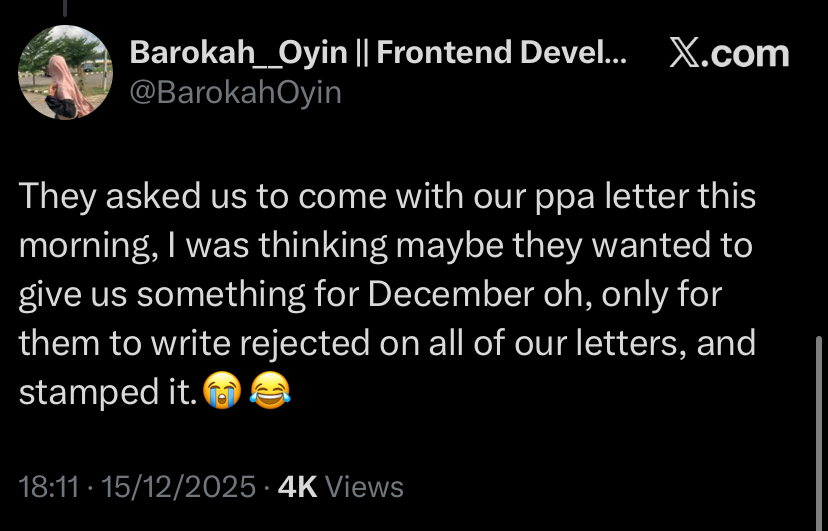
“They actually just sacked all of us in my ppa, I didn’t know corp members usually get sacked. I hope we remain sacked till January ending tho. They asked us to come with our ppa letter this morning, I was thinking maybe they wanted to give us something for December oh, only for them to write rejected on all of our letters, and stamped it,” she said.
Mixed Reactions Online
The post quickly gained attention online, with many Nigerians reacting in the comment section. While some expressed sympathy, others shared similar experiences or questioned whether corps members could be dismissed in such a manner.
As of the time of this report, the reason behind the sack remains unclear, leaving many Nigerians wondering whether such actions align with NYSC rules and regulations.
See below:


Former Minister of Transportation, Rotimi Amaechi has vowed not to deputize any presidential candidate in the 2027 general elections.
There has been speculation that the former governor would deputize ex-vice president, Atiku Abubakar, who is likely emerging as the flagbearer of the African Democratic Congress, ADC.
But speaking at an event in Abuja, Amaechi clarified that he is too presidential to be anybody’s vice.
“I will not be vice president to anybody. There are too many reasons why I won’t be vice president to anybody.
“The first reason is that I’m too presidential to be vice”, he said.
According to Amaechi, who is also eyeing the presidential ticket of the ADC, the problem with the office of vice president is not ceremonial, it is structural.
The former governor of Rivers State claimed that in Nigeria, the office of the vice president is designed to be subordinate, often powerless, and depend entirely on the temperament of the president.
“We will quarrel, instead of that, I would rather be a minister than be a vice president”, Amaechi said.
NIGERIA NEWS
Procedure and Personalities Power Game at Senate’s Ambassadorial Screening Drama – THISDAYLIVE

The screening of ambassadorial nominees is ordinarily a ritual steeped in routine, an institutional checkpoint where credentials are verified, regional balances observed and the broad outlines of Nigeria’s foreign policy ambitions quietly affirmed. But last week’s proceedings before the Senate Committee on Foreign Affairs ruptured that calm, exposing the deeper political undercurrents shaping the Bola Tinubu administration’s diplomatic reset. Sunday Aborisade reports.
What unfolded in one of the Committee rooms of the National Assembly last week was not merely a procedural disagreement; it was a vivid illustration of how personality, power, precedent and partisanship intersect in the confirmation of those who will represent Nigeria abroad.
At the centre of the storm was Reno Omokri, a high-profile non-career ambassadorial nominee whose screening triggered a heated exchange between two senior lawmakers, Senators Adams Oshiomhole and Ali Ndume.
Their confrontation, played out in raised voices and sharp procedural arguments, momentarily hijacked the session and drew national attention to what is often a perfunctory exercise.
A day earlier, another incident, this time involving a career diplomat who could not name all three senators from his home state, had already placed the competence and preparedness of nominees under a harsh spotlight.
Together, these episodes transformed the screenings into a broader conversation about standards, symbolism and the Senate’s constitutional role in shaping Nigeria’s external face.
Beyond the drama, the ambassadorial screening exercise reflects a moment of transition in Nigeria’s foreign service. President Tinubu’s submission of 65 nominees, 34 career and 31 non-career, signals an intention to recalibrate diplomatic missions after months of vacancies and acting appointments.
The list blends seasoned diplomats with political heavyweights, former governors, retired service chiefs and presidential allies, underscoring the dual character of Nigeria’s ambassadorial system: professional diplomacy on one hand and political representation on the other.
It was within this context that the Senate Committee on Foreign Affairs, chaired by Senator Mohammed Bello, a former governor of Niger State, commenced a staggered screening process.
The approach, grouping nominees and, where applicable, allowing former legislators and senior public office holders to take a bow and go, followed long-standing parliamentary convention. Yet, as events would show, convention itself can quickly become contested terrain when personalities collide and political stakes rise.
The flashpoint came during the screening of a mixed group of nominees that included four career diplomats and Omokri, a non-career nominee and widely known public commentator.
Senator Ndume, representing Borno South, moved a motion that the group be allowed to take a bow and leave, arguing that the career diplomats were already familiar to the committee and that Omokri’s public profile made further questioning unnecessary. Before the motion could be formally seconded, other senators indicated interest in speaking, prompting the chairman to recognise additional interventions.
What might have remained a minor procedural detour escalated sharply when Senator Oshiomhole was recognised to speak while Ndume insisted that no debate could proceed until his motion had been duly seconded.
Oshiomhole rejected that position, insisting that recognition by the chairman conferred the right to address the committee. The disagreement quickly degenerated into a shouting match, halting proceedings for nearly 20 minutes and forcing the chairman to repeatedly appeal for order.
At stake was not only the fate of a single motion but the authority of the chair, the interpretation of Senate rules and, implicitly, the influence individual senators wield within committee deliberations.
When calm was partially restored, Oshiomhole used his contribution to mount a spirited defence of Omokri, portraying him as a pragmatist capable of growth and national loyalty despite past criticisms of President Tinubu and the ruling party. He argued that the President’s willingness to nominate former critics demonstrated political maturity and inclusiveness, qualities he said deserved commendation rather than suspicion.
Ndume, however, maintained that the absence of any formal petition against Omokri rendered prolonged debate unnecessary.
His insistence on procedure, that a motion not seconded was dead, stood in contrast to Oshiomhole’s emphasis on discretion and political judgment. The exchange laid bare differing philosophies of legislative oversight: one rooted strictly in rules, the other in political context.
For many observers, the clash was emblematic of the Nigerian Senate itself, a chamber where procedure often masks deeper struggles over influence. Both Oshiomhole and Ndume are seasoned politicians with reputations for independence and strong personal convictions. Their confrontation, some lawmakers privately admitted, was less about the nominee in question than about who sets the tone and pace of deliberations within powerful committees.
While the episode raised concerns about decorum and efficiency, others argued that it represented democracy in action, however untidy. Parliamentary scrutiny, they noted, is rarely a sterile exercise, especially when nominees carry significant political baggage or symbolism.
If Thursday’s confrontation highlighted political tension, Wednesday’s screening underscored anxieties about competence. Emmanuel Adeyemi, a career diplomat from Ekiti State with impressive academic credentials and foreign postings, stumbled when asked to name all three senators representing his state. After correctly mentioning Senate Leader OpeyemiBamidele and Senator YemiAdaramodu, he faltered, unable to recall Senator Cyril Fasuyi. The situation worsened when a member of his delegation was seen hurriedly searching online for the missing name.
The lapse drew sharp rebukes from committee members. Senator AsuquoEkpenyong described the incident as symptomatic of a deeper malaise, warning that Nigeria’s international image could ill afford such moments of unpreparedness. Senators Oshiomhole and Seriake Dickson echoed the concern, stressing that attention to detail and political awareness were essential attributes for diplomats expected to project the country’s interests abroad. Though pleas were made for leniency, the damage had been done.
The incident exposed a paradox within the screening process. Career diplomats are presumed to possess technical expertise and institutional knowledge, yet their insulation from domestic political realities can become a liability in a system where ambassadors are also expected to navigate Nigeria’s internal political landscape with confidence.
Underlying both episodes is the enduring debate over the balance between career and non-career ambassadors. Advocates of professional diplomacy argue that training, protocol mastery and continuity are indispensable in a complex global environment.
Supporters of political appointments counter that envoys must also be trusted representatives of the President, capable of advancing political and economic interests with authority and access.
President Tinubu’s nominee list reflects an attempt to blend both approaches.
Alongside experienced diplomats such as Sulu Gambari and Maimuna Ibrahim are political figures including former governors IfeanyiUgwuanyi and Victor Ikpeazu, retired military chiefs Abdulrahman Dambazzau and Ibok-EteIbas, and outspoken political actors like Femi Fani-Kayode and Reno Omokri.
The Senate’s task, therefore, extends beyond individual vetting to ensuring that the overall composition of the diplomatic corps aligns with Nigeria’s strategic priorities.
The frequent resort to the “take a bow and go” convention also came under renewed scrutiny. While the practice is designed to expedite proceedings for former lawmakers and senior officials already known to the Senate, critics argue that it risks weakening accountability. In an era of heightened public scrutiny, even symbolic questioning, they contend, reassures citizens that no nominee is above examination.
Senate Leader, OpeyemiBamidele defended the convention, noting that many nominees had previously served in the National Assembly and were well known to their colleagues. Yet the Omokri episode demonstrated that familiarity does not always translate into consensus or calm.
Beyond the theatrics, the screenings are a prelude to a significant overhaul of Nigeria’s diplomatic missions. Years of underfunding, prolonged vacancies and shifting geopolitical realities have weakened the country’s presence abroad.
The Tinubu administration has signalled its intention to reinvigorate diplomacy as a tool for economic recovery, security cooperation and diaspora engagement. The quality, credibility and cohesion of Nigeria’s ambassadors will be central to that ambition.
In the end, the uproar in the Senate chamber was uncomfortable, at times unedifying, but ultimately revealing. It exposed the tensions inherent in Nigeria’s democratic institutions, between procedure and politics, expertise and loyalty, efficiency and debate.
For a public often shielded from the inner workings of legislative oversight, the spectacle offered a rare glimpse into how decisions shaping Nigeria’s global representation are contested and concluded.
As the Senate moves to wrap up the confirmation process, the challenge will be to rise above personality clashes and focus squarely on substance. Nigeria’s ambassadors will soon carry the nation’s flag abroad; the process that produced them must, despite its imperfections, reflect the seriousness and responsibility of that task.

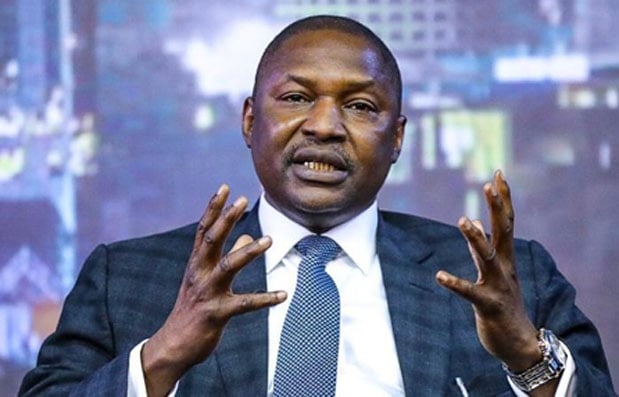
Former Attorney-General of the Federation, Abubakar Malami, mhas released excerpts of the Justice Ayo Salami judicial commission of inquiry report which he says indict the chairman of the Economic and Financial Crimes Commission (EFCC), Ola Olukoyede.
In a statement issued on Tuesday by Mohammed Bello Doka, his media aide, Malami said chapter nine of the Salami report shows a clear conflict of interest that makes the EFCC chairman’s continued involvement in matters relating to him untenable.
Malami said the Salami judicial commission of inquiry was established under his supervision to investigate allegations of corruption and abuse of office within the EFCC.
He said the current EFCC chairman served as secretary to the commission at the time.
According to the statement, chapter nine of the report examined the conduct and responsibilities of senior EFCC officials and created personal and professional exposure for individuals now exercising prosecutorial authority over Malami.
Malami said the EFCC’s actions against him could not be reasonably interpreted as neutral law enforcement but amounted to a personal vendetta rooted in unresolved issues arising from the report.
He said the law on recusal is settled and is based on the test of reasonable apprehension of bias rather than proof of actual malice.
Malami said any reasonable observer aware of the circumstances surrounding chapter nine of the Salami report would conclude that he cannot receive an impartial investigation under the current leadership of the EFCC.
The former AGF accused the commission of violating his fundamental rights through unlawful restrictions on liberty and denial of fair hearing.
He also alleged a sustained trial by media through selective leaks and public commentary aimed at securing public condemnation before judicial determination.
Malami said the pattern of conduct by the EFCC reflects an attempt to criminalise lawful policy decisions taken while he was in office.
He said he is willing to submit himself to a neutral and independent investigative process and to face trial only before a court of competent jurisdiction.
Malami demanded the immediate recusal of the EFCC chairman from all matters relating to him.
“This is not a personal dispute; it is a constitutional issue. If the EFCC is allowed to function as an instrument for the settlement of personal scores and grievances, then the rule of law itself is imperilled.
“Abubakar Malami, SAN, will continue to insist on justice according to law and due process, not persecution by power,” the statement said.
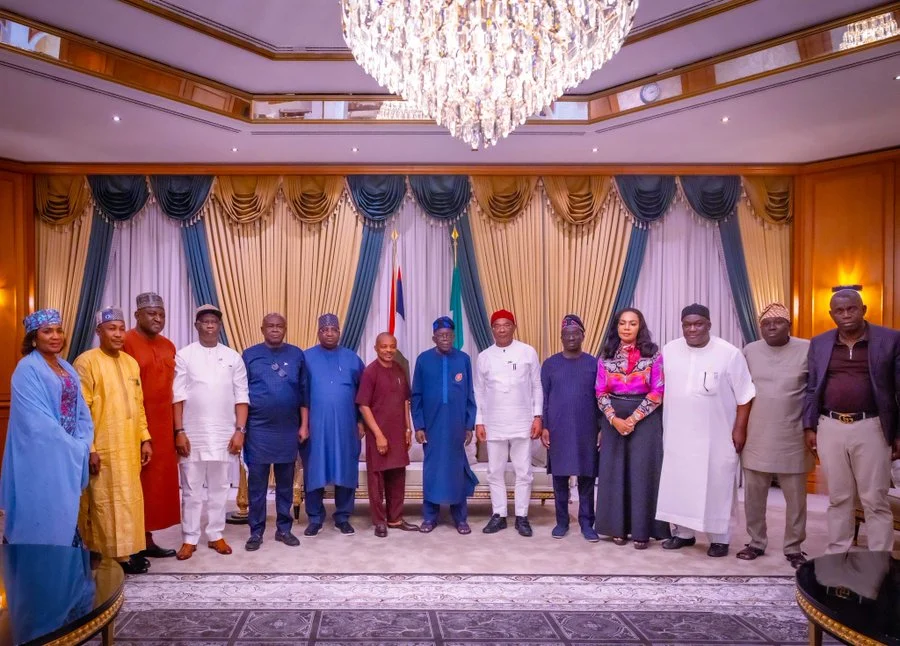
President Bola Tinubu has held a crucial closed-door meeting with leaders of organised labour as tensions rise over a planned nationwide protest by workers.
The engagement took place late Tuesday night at the State House in Abuja, amid growing concerns over unresolved labour demands and economic pressure on Nigerians.
The meeting comes at a critical moment, with the Nigeria Labour Congress (NLC) threatening mass protests across the country.
Labour leaders have accused the Federal Government of failing to fully honour earlier agreements on workers’ welfare, wage-related issues, and measures to ease the rising cost of living.
In a statement released Tuesday night, the Special Adviser to the President on Information and Strategy, Bayo Onanuga, confirmed that top government officials and governors were part of the discussions.
“President Bola Ahmed Tinubu met with the leadership of the NLC, along with the chairman of Progressive Governors Forum, Hope Uzodimma, Governor of Edo State, Monday Okpebholo and Governor of Kebbi State, Dr Nasir Idris and the Minister of State Labour, Honourable Nkeiruka Onyejeocha,” the statement partly read.
According to the statement, the Nigeria Labour Congress was represented by its national leadership at the high-level meeting.
“The chairman of the NLC, Comrade Joe Ajaero, led the labour leaders to the meeting on Tuesday night at the State House, Abuja,” it added.
The engagement followed days of heightened rhetoric from organised labour. The NLC had warned that it would mobilise workers for nationwide protests if the government failed to act on key demands.
These include concrete relief measures to cushion the impact of recent economic reforms, improved wages, and urgent intervention to address the worsening socio-economic conditions faced by workers and their families.
Labour leaders have repeatedly expressed frustration over what they describe as delays in implementing agreements reached during previous negotiations with the Federal Government.
They warned that continued inaction could lead to widespread industrial action and street protests in major cities across the country.
As of the time of filing this report, details of the discussions remain unclear. Neither the Federal Government nor the NLC leadership has issued an official statement on the outcome of the meeting or whether it has altered plans for the proposed protest.