
NIGERIA NEWS
Hold Bala Mohammed responsible if anything happens to our members – Wike’s Bauchi PDP faction


The Caretaker Committee of a faction of the Peoples Democratic Party, PDP, in Bauchi State has cried out that Governor Bala Mohammed should be held responsible should anything happen to any of their members or supporters.
Members of the factional caretaker committee, which was recently appointed by the Nyesom Wike’s camp of the PDP led by Alhaji Abdulrahman Mohammed, raised the alarm while formally accepting their appointment.
The committee affirmed its unwavering commitment to diligently discharge the responsibilities entrusted to it.
The Bauchi factional caretaker committee said it would act in accordance with the Constitution of the party and the directives of the national leadership.
Speaking in Abuja on Tuesday, members of the committee, including Jungudo Haruna Mohammed and Alhaji Safyanu Zubairu thanked the Minister of Federal Capital Territory and other members of the factional National Executive Committee NEC, and Board of Trustees, BoT, for their continuous commitment, leadership, and support towards the stability and progress of the party.
The committee said as law-abiding citizens, it will not resort to violence, as members are not products of thuggery or hooliganism, but of intellectualism, democracy, and respect for the rule of law.
“However, this stance should not be misconstrued as a sign of fear or weakness,” Haruna Mohammed said.
“The committee will therefore discharge its legal and constitutional responsibilities without any fear. Accordingly, should anything untoward happen to any member or supporter of the party, the Governor of Bauchi State, His Excellency Bala Mohammed, shall be held responsible.”
The committee further condemned the national convention which produced the Kabiru Turaki-led leadership of the party.
“They are hereby reminded that the purported convention held in Ibadan was conducted in blatant disregard of valid and subsisting court judgments and in the absence of supervision of monitoring by the Independent National Electoral Commission INEC,” Mohammed added.
The committee called on party members and the general public not to be deceived by the activities of the individuals
“Holding meetings with former governors, ministers, or members of the National Assembly can not and does not confer any form of legitimacy Legitimacy can only be derived from strict compliance with extant laws, adherence to the Constitution of the party, and obedience to valid court orders, he said.
“They cannot violate the party’s constitution and other extant laws and then turn around to blame Minister Nyesom Wike or the APC for the consequences of such actions. A similar scenario played out during the legal battle in which they attempted to forcefully remove Senator Anyanwu as National Secretary before the expiration of his tenure. They failed then, and they will fail again.
“Courts are not persuaded by social status or political influence; they are guided solely by facta, law, and compliance with constitutionalism. Claims that the Independent National Electoral Commission had recognized them amounts to nothing more than media propaganda and should be disregarded.
“Furthermore, following the decision of the Oyo State High Court striking out the name of INEC as a defendant in the matter, no-outcome, decision, or determination arising from the suit can be binding on INEC under any circumstances.
“Little wonder, therefore, that they have now hurriedly approached the Federal High Court, seeking an order to mandate or compel INEC to recognize the said convention and the individuals purportedly elected as members of the National Working Committee,” Mohammed said.
Similarly, the committee advised all “illegal” occupants of PDP secretariats across the state to immediately remove their personal belongings and vacate the premises within 14 days.
“Failure to comply with this directive will attract lawful consequences,” the committee warned.
NIGERIA NEWS
Heartbroken Lady Narrates How Boyfriend She Sponsored Abroad Dumped Her For Neighbour, Video Trends


- A heartbroken lady narrated what happened after she sponsored her boyfriend abroad and catered for him for six months
- She shared how she found out that the man, whom she fed and housed, dumped her for her neighbour, who lived down the street
- Many reacted to her viral video as the lady shared the neighbour’s reaction after she confronted her over her man
A lady based abroad opened up about her experience with a man whom she sponsored to stay with her outside the country.
She narrated how she met the man in her African country and decided to sponsor him overseas.
 Heartbroken Lady Narrates How Boyfriend She Sponsored Abroad Dumped Her For Neighbour, Video Trends
Source: TikTok
She noted that the man wasn’t working for six months, and she happily housed and fed him because she loved him.
In a video by @rhodacannella on TikTok, she shared how she found out that her man was dating their neighbour after eight months of staying with her.

Read also
Lady rages as brother’s wife gets pregnant with twins 1 month after first child: “I blocked them”
She confronted them both after finding out that the neighbour was already pregnant for the man.
Sharing their response during the confrontation, the lady said:
“She told me ‘it’s not a big deal, calculate every penny you spent on this guy and I’ll give it to you. I’ll even double it.’ My man, on the other hand, was there with this lady. And you know what this man told me? He never loved me. He was only with me because I brought him here.”
Watch the video below:
Reactions trail lady’s experience with man abroad
republicthehustler said:
Pls go have a baby , must u marry , just have a baby for urself and take care of the baby
THE COUNSELLOR said:
Hi Rhoda. I came across one of your videos and felt genuine respect for how honest and composed you are. I’m not here to rush anything I just wanted to say hello and wish you peace.
Read also
Actress Lizzy Gold warns fans to stop pressuring her about Marriage: “I waiting on God”
Truck_boss said:
you should go to jamaica 🇯🇲 you would find a man that doesn’t cheat, and very hard working, and can cook excellent, and would take excellent care of you, I promise you, try it you won’t regret it at all, jamaican man is one of the most loyalists in this entire world.
Dapheny Pierre said:
You feel like your clock is ticking because you probably feel pressure from family/society . Create your own timeline
Captain Jake said:
Please, I am from Ghana 🇬🇭 West Africa, just co.e for me. I am free here. I will love you till death depart us
BIG TOYIN said:
i understand and i can relate. but the only thing there is once biten is twice shy. u just keep trying more u never can tell but don’t invest too much
In a related story, a man returned to Nigeria after 33 years in the UK, while another nurse returned after eight years abroad.

Read also
Ned Nwoko: Amid Laila’s hangout with Regina Daniels’ children, actress’ DP gets many talking
Lady returns from UK after 2 years
Meanwhile, Legit.ng previously reported that a lady who relocated to the UK announced her return to Nigeria permanently after spending years abroad.
She mentioned why she returned permanently to Nigeria after two years of staying in the United Kingdom.
Her reason caught people’s attention, as they took to the comments section to welcome her back home.
Source: Legit.ng


A Nigerian man has taken to social media to share his experience of life in the United Kingdom, describing it as far more demanding than many people imagine.
In a video shared by a user identified as @Teniola on X, he revealed that he previously worked as a Head of Department (HOD) in Nigeria, a role that came with status, comfort, and flexible working hours.
According to him, he rarely had to wake up very early, as his senior position allowed for a structured and manageable routine.
However, after relocating to the UK, his reality changed drastically. He disclosed that he now resumes work as early as 4:30am, a schedule he described as exhausting and difficult to adjust to.
Despite having years of experience and holding a senior role back home, the man said starting afresh abroad has been challenging.
He noted that many Nigerians who relocate overseas often face the harsh reality of taking on demanding jobs while working their way up again.
His account has sparked conversations online, with many Nigerians abroad agreeing that while earnings may be higher, the workload, long hours, and lifestyle adjustments can be overwhelming.
Watch video below…
Nigerian man cries out about how hard life is in the UK after having to start work at 4:30 AM, whereas he was a HoD in Nigeria and never had to wake up that early 🙂↔️🚶♂️ pic.twitter.com/HoESCiBa71
— TENIOLA (@Teeniiola) December 17, 2025

The Peoples Redemption Party, PRP, on Wednesday conducted its Ward and Local Government Congresses in Lagos State.
DAILY POST reports that the congresses, monitored by officials of the Independent National Electoral Commission, INEC, and held in Ikorodu, produced new ward and LG executives.
Leading the PRP national delegation, Mr Wolimoh Olajide, the party National Youth Leader and Chairman of the Congresses, said that the exercise marked a milestone in the party’s reorganisation process ahead of 2027.
Olajide, who commended the peaceful conduct of party delegates, described the process as transparent and democratic.
“This process and conduct of every delegate reflects the core values upon which the PRP is founded.
“Today, our ward and local government executives, who will pilot the affairs of our party, have emerged through consensus.
“We appeal to them to work hard to sell PRP and its ideals to people at the grassroots.
“We are very sure that the future is bright for the party in Lagos State with the crop of these new party leaders,” Olajide said.
According to him, the momentum from the congresses will strengthen PRP drive to unseat the ruling party, both at the state and federal level, in 2027.
“Lagos residents and Nigerians are yearning for a credible alternative, and PRP represents that alternative,” Olajide added.

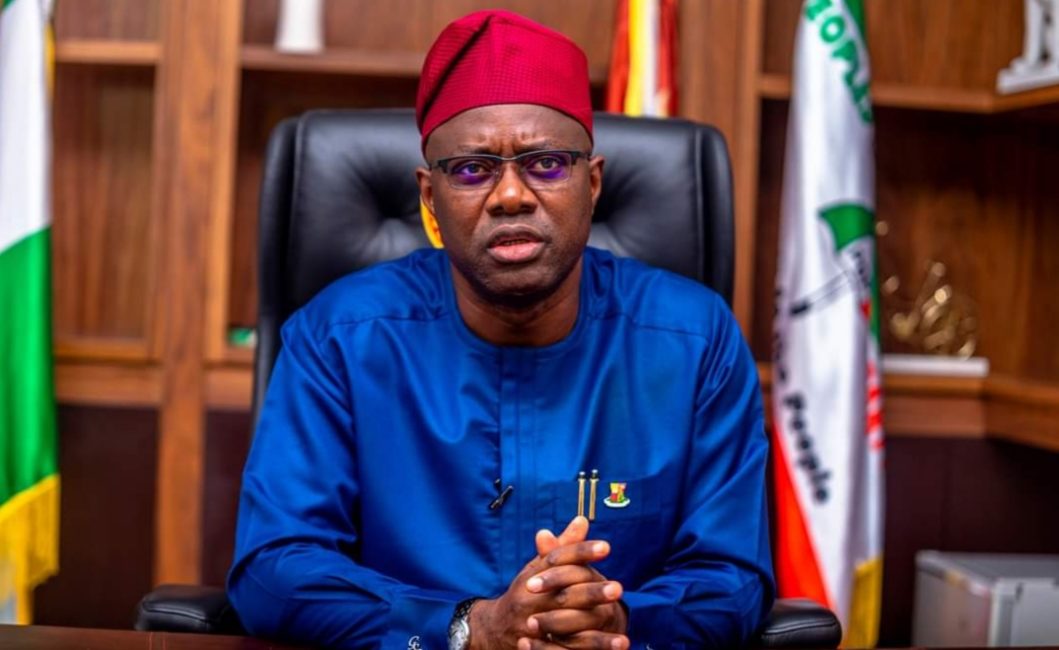
Oyo State Governor, Seyi Makinde, has reacted to rumours about a possible defection to the All Progressives Congress (APC), following recent defections of some opposition governors to the ruling party.
Makinde made the remarks on Wednesday in Abuja during the public presentation of the book Headlines and Soundbites: Media Moments that Defined an Administration, authored by former Minister of Information and Culture, Lai Mohammed.
“I am not APC, and I am not about to become APC,” the governor declared. He stressed that Nigeria’s progress depends on sincere collaboration among leaders across political divides to advance the country.
Makinde argued that the country’s growing divisions are largely driven by the ambitions of political elites rather than the will of ordinary citizens.
According to him, most Nigerians desire unity and coexistence but are often manipulated along religious, ethnic, and regional lines by politicians pursuing personal interests.
He cautioned against the “winner-takes-all” mentality in politics, noting that it fuels exclusion and undermines national cohesion.
The governor emphasised the need for an elite consensus focused on good governance and addressing contemporary challenges, rather than recycling old political fault lines.
Drawing from personal experience, Makinde noted that political success is ultimately determined by God and timing. He recounted how key political figures, including himself and former President Muhammadu Buhari, faced electoral losses before eventually attaining office years later.
Reflecting on Nigeria’s historical challenges, Makinde observed that while the nation’s early leaders were preoccupied with uniting a post-war country, today’s issues are different and require new solutions.
He called for deliberate efforts to design political and governance systems that promote fairness, inclusion, and stability.
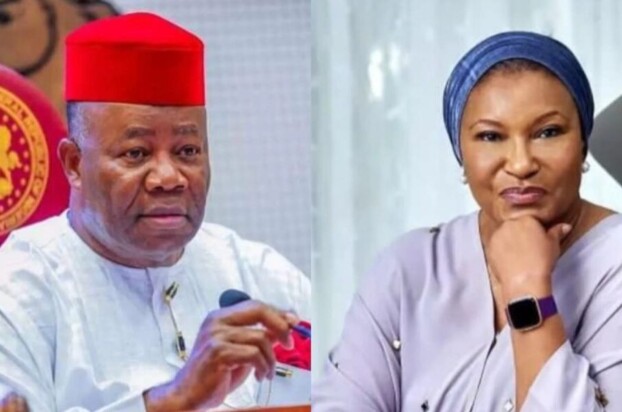
The Senate has rejected a motion sponsored by Senator Ireti Kingibe, representing the Federal Capital Territory (FCT), which sought legislative intervention on several governance challenges in Abuja.
Kingibe raised the motion under Orders 41 and 51 of the Senate Standing Rules, highlighting issues such as the worsening waste management crisis, demolitions by the Federal Capital Territory Administration (FCTA), non-payment of salaries, delays in contractor mobilisation, complications in land allocation and reallocation, and the depletion of land belonging to the University of Abuja.
However, Senate President Godswill Akpabio stated that the issues Kingibe raised differed from those previously discussed with him.
He added that the motion did not qualify as a matter of urgent national importance, especially because it combined multiple unrelated issues.
“She should withdraw the motion and bring a substantive motion to discuss the issue of waste management,” Akpabio said.
Supporting the Senate President, Tahir Monguno, Chief Whip and senator representing Borno North, said the motion failed to meet procedural requirements.
“There is nothing to discuss based on our rules. Because you can’t put something on nothing,” Monguno added.
Sunday Karimi, senator for Kogi West, criticised Kingibe further, accusing her of bringing the motion “in deceit.”
In response, Kingibe said she would comply with the Senate’s directive, stating, “I will represent it as a substantive motion on just waste management.”


The Nigerian Safety Investigation Bureau (NSIB) confirmed the crash landing of a Cessna 172 chartered aircraft operated by Skypower Express at the Sam Mbakwe International Cargo Airport, Owerri, Imo.
Four persons escaped death as the aircraft, which was en route Port Harcourt International Airport from Kaduna International Airport, made an emergency landing at the Sam Mbakwe International Cargo Airport.
This disclosure is contained in a statement signed by the Director, Public Affairs and Family Assistance, NSIB, Bimbo Oladeji, where he confirmed that there were no casualties.
Oladeji said that upon the receipt of the distress alert, the airport police patrol units, in collaboration with airport emergency response teams, were swiftly deployed to the scene, rescuing all occupants.
He said that airport emergency services were immediately activated, noting that a formal investigation has commenced in line with its statutory mandate.
What the NSIB Spokesperson is saying
Oladeji said the survivors are crew members on board at the time of the occurrence.
Two of the crew members were reported to be in stable condition, while the remaining two, who were initially unconscious, were immediately evacuated to a hospital, where they are currently receiving medical attention.
She said, “The crew declared an emergency, necessitating a diversion to Owerri, where the aircraft subsequently crash landed in the approach area of Runway 17.
“There were four people on board at the time of the accident, with no fatalities reported so far.’’
The Bureau’s Spokesperson stated that there was equally no post-crash fire, adding that the runway remained active for flight operations, with other aircraft taking off safely after the incident.
“Efforts are currently underway to coordinate the recovery and evacuation of the distressed aircraft from the crash site to allow for a detailed wreckage examination.
“The Director-General of bureau, Capt. Alex Badeh Jr., expressed his deepest sympathies to the management of Skypower Express and is glad that no fatalities were reported.
“The NSIB has activated its protocols, and our team is already coordinating with authorities to secure the site,” the statement added
What you should know
In a related incident, in December, a Nigerian Air Force (NAF) aircraft was reported to have crashed near Karabonde, a small settlement in Borgu Local Government Area of Niger State, with eyewitnesses saying that two pilots sustained injuries in the crash.
Confirming the incident in a statement, NAF Director of Public Relations and Information, Air Commodore Ehimen Ejodame, said the aircraft had taken off for a scheduled inspection test when the emergency occurred.
Ejodame explained that the pilots remained calm and demonstrated exceptional professionalism by manoeuvring the jet away from populated areas before executing a safe ejection in line with global aviation safety procedures.
Follow us for Breaking News and Market Intelligence.




SOURCE PAGE

Nigeria has introduced a wood export ban as the federal government under President Bola Tinubu moves to protect forests and strengthen national climate change action across the country.
The wood export ban was announced as a major environmental policy to curb illegal logging, halt deforestation, and safeguard Nigeria’s natural resources for future generations.
Executive Order backs wood export ban
The wood export ban is contained in a Presidential Executive Order signed by President Bola Tinubu and officially published in the Federal Republic of Nigeria Gazette on October 16, 2025.
The order is titled Presidential Executive Order on the Prohibition of Exportation of Wood and Allied Products, 2025.
It was formally unveiled by the Minister of Environment, Balarabe Abbas Lawal, during the 18th National Council on Environment meeting held in Katsina State.
Forest protection and climate goals
Lawal said Nigeria’s forests remain vital to environmental sustainability, economic livelihoods, biodiversity conservation, and climate change mitigation.
He explained that the continued export of timber weakens these benefits and makes environmental damage more severe over time.
According to the minister, the wood export ban is necessary to preserve clean air, water resources, and forest ecosystems nationwide.
Constitutional basis for policy
The government stated that the wood export ban is anchored on Sections 17(2) and 20 of the 1999 Constitution, as amended.
These sections require the state to prevent harmful exploitation of natural resources and to protect land, forests, and wildlife for public good.
The Executive Order stressed that unchecked logging and timber export conflict with Nigeria’s constitutional responsibilities.
Licences suspended nationwide
Under the wood export ban, illegal logging and uncontrolled deforestation are prohibited across all states.
All existing licences and permits previously issued for wood extraction or export have been suspended and declared invalid.
Authorities said the wood export ban will strengthen enforcement and support long-term environmental sustainability.

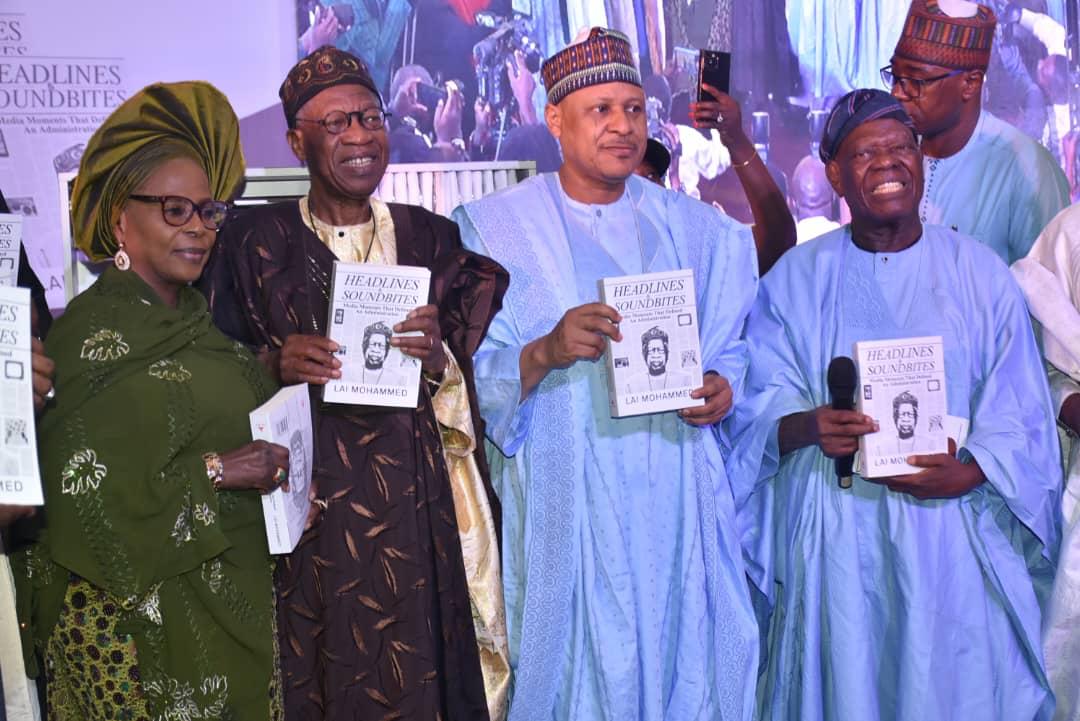
By Olusegun Adeniyi
(Text of my review of ‘Headlines & Soundbites: Media Moments That Defined an Administration,’ written by the former Minister of Information and Culture, Alhaji Lai Mohammed, at the public presentation in Abuja on 17th December 2025)
With a first degree in French before going on to read Law, Alhaji Lai Mohammed is one of a few members of the Nigeria political elite with a second address. Before politics and government, he was an established lawyer, respected media practitioner and public relations guru. And after he left government, Alhaji Lai refused to hang around. He went back to private practice by joining ‘Ballard Parters’,a global government relations firm, as Managing Partner for Africa, focusing on public relations and public policy. On a personal note, I have known Alhaji Lai Mohammed since the beginning of the Fourth Republic when he served as the Chief of Staff to then Governor Bola Tinubu of Lagos State who is now the President of Nigeria. Alhaji Lai also happens to be one of the respected elders from my state, Kwara. Athough we had no close personal relationship, when he came to my office to ask if I would accept to be the reviewer of his book, I had no choice in the matter. I actually considered it an honour.
In the opening pages of ‘Headlines & Soundbites: Media Moments That Defined an Administration,’ Alhaji Lai made an important declaration: he is a “strong advocate of Africans telling their own stories from their own perspectives.” This commitment to indigenous narration is admirable and necessary. However, as I worked through this 584-page chronicle of his nearly eight-year tenure as Nigeria’s Minister of Information and Culture under the late Buhari who would have been 83 today had he been alive, I was reminded that telling one’s own story is not the same as telling the whole story, and that perspective, no matter how privileged, is not synonymous with objectivity.
This book, ‘Headlines & Soundbites: Media Moments That Defined an Administration,’ is many things at once: historical document, policy defense, and occasionally, an extended rebuttal to both the critics of the Buhari administration and Alhaji Lai Mohammed himself.The structure is ambitious, covering everything from town hall meetings and media tours to the controversial Twitter suspension and the #EndSARS protests. What emerges is a portrait of a minister who saw himself not merely as a government spokesperson, but as a strategic communicator tasked with “changing the narrative”—a phrase that appears repeatedly throughout the text and perhaps reveals more about the administration’s approach to information management than the author intended.
There is undeniable value in the insider account provided by the former minister. His chapters on the government’s communication strategy during the COVID-19 pandemic and the protracted P&ID legal battle offer useful insights into crisis management at the highest levels. The detailed documentation of media tours to territories hitherto controlled by the Boko Haram insurgents and the account of Nigeria’s digital switchover provide important context that was often missing from real-time reporting. Of course, the minister was meticulously careful in choosing what to highlight and what to hold back.
Alhaji Lai is at his best when he abandons the defensive posture and simply describes the mechanics of government communication. His explanation of the stakeholder engagement process, the rationale behind town hall meetings, and the cultural diplomacy embedded in hosting international conferences are genuinely informative. These sections will prove valuable to students of public administration and political communication. The stories are told with the methodical thoroughness of someone who understands that history will judge his stewardship in government long after the news cycle has moved on.
The chapter on Nigeria’s fight to repatriate stolen artefacts, including the Benin Bronzes, is particularly compelling. Here, Alhaji Lai’s passion transcends his portfolio, and one senses a minister genuinely engaged with issues of cultural identity and historical justice. Similarly, his account of the National Theatre’s restoration hints at what might have been achieved if the ministry had focused less on crisis management and more on its substantive cultural mandate. But it is in Alhaji Lai Mohammed’s treatment of the most controversial episodes of his tenure that the book both fascinates and frustrates.
The Twitter suspension, which he insists was misunderstood, receives extensive treatment. He provides the government’s rationale, documents the negotiations that preceded the platform’s restoration, and argues that the concerns by the Buhari administration about social media regulation were legitimate. Unfortunately, the chapter reads less like historical documentation and more like a legal brief, comprehensive, certainly, but selective in its engagement with opposing viewpoints.
The confrontation with CNN over its #EndSARS coverage is similarly presented as a victory for truth over “skewed and poorly sourced reporting.” As a journalist, I disagree with this summation. Alhaji Lai may well have legitimate grievances about the international media’s coverage of Nigerian events. However, the righteousness with which he dismisses CNN’s journalism sits uncomfortably alongside his own acknowledgment that government communication must be “tempered by transparency”—a phrase he uses in reference to the Bring Back Our Girls campaign.
This brings us to another troubling aspect of the book: Chapter Fourteen, titled “#ENDSARS: A Massacre without Bodies.” That title alone demands scrutiny. Alhaji Lai devotes an entire chapter to arguing against what he characterizes as the myth of a massacre at Lekki Tollgate on 20th October 2020. He may believe he is correcting the record, but the framing “a massacre without bodies” ignores the grief of families who lost loved ones during those protests, regardless of the specific number or precise circumstances.The judicial panel of inquiry set up by the Lagos State Government documented deaths and injuries. To reduce this complex tragedy to a semantic argument about the definition of “massacre” is to miss the forest for the trees. As the late Dele Giwa reminded us, “One life taken in cold blood is as gruesome as millions lost in a pogrom.”
Right from the introduction, Alhaji Lai Mohammed acknowledges that one motivation for writing the book was “to dispel a number of misconceptions.” This is a worthy goal. But throughout the book, there is a troubling conflation between “misconceptions” and “disagreements.” When Nigerians questioned the Twitter suspension, were they all simply misinformed? When activists criticized the government’s response to #EndSARS, were they all perpetuating falsehoods? When journalists challenged official narratives about security operations, were they invariably biased?
To be fair, Alhaji Lai Mohammed does not shy away from documenting the challenges he faced. He acknowledges operating in a difficult environment, dealing with an opposition determined to undermine the administration, and managing a president who was often reluctant to engage with the media. Given my own experience in another life, I can understand these challenges. But my concern is that there is little self-criticism or any willingness to concede that some of the administration’s communication failures were self-inflicted.
In his tribute to Buhari (Chapter One), Alhaji Lai describes the late president as a “friend, mentor and boss,” and throughout the book, this loyalty to the administration he served is on full display. This loyalty is admirable in its consistency. But it also limits the utility of the book as a historical document. Therefore, while future researchers will find valuable raw material here—press statements, timelines, policy documents—they will need to triangulate Alhaji Lai Mohammed’s account with other sources to arrive at a fuller picture.
Chapter nine titled, ‘Before the Ballot: Inside Buhari Administration’s Scorecard Strategy’, according to the author, was necessitated by the need to counter the narrative of the opposition before the 2023 general election with a media offensive that featured prominent officials. One of them is Abubakar Malami, SAN, who was then the Attorney General and Justice Minister. No fewer than 16 quotes of Malami, splashed over eight pages, are featured in the book where he highlighted the achievements of the Buhari administration, especially in the fight against corruption. One of the quotes from Malami reads: “The EFCC could only succeed in securing 103 convictions before the advent of the current administration. However, with the implementation of the National Anti-corruption Strategy, the EFCC has secured about 3,000 convictions.”
The last time I heard from Malami, he was writing an epistle from EFCC detention, throwing the same allegation that those ‘about 3000 people convicted people’ under the Buhari administration he served were also throwing at the time. A case of whatever goes around comes around.
Before I take my seat, let me commend Alhaji Lai Mohammed for this book. ‘Headlines & Soundbites’ is an important book, though not always in the ways its author intended. It is important because insider accounts matter, especially from someone who occupied a critical position for as long as Alhaji Lai did. It is important because it documents, in granular detail, the mechanics of government communication in 21st-century Nigeria. And it is important because it reveals, perhaps inadvertently, the deep disconnect between the Buhari administration’s self-image and its public perception.
Alhaji Lai Mohammed writes that he believes this account “will form part of Nigeria’s contemporary history, at least from my vantage point.” He is right. But vantage points, by definition, offer limited views. They show us what was visible from a particular position at a particular time, but they also hide what lay beyond the sight line.
Let me also express a personal disappointment. As the founding National Publicity Secretary of the All Progressives Congress (APC) whose candidate, the late Muhammadu Buhari, went on to defeat then incumbent President Goodluck Jonathan, Alhaji Lai Mohammed played a crucial role in the months leading to that election in 2015. But there is nothing about that episode in this book. There is also no reflection to contrast the role of a government critic which he was under Jonathan and information manager that he became under Buhari. It would have been helpful had the author given us a peep into whether the view of the road remains the same after moving from the passenger’s side to the driver’s seat. That, for me, is where the narrative should have started. But while this book is not what I was expecting, it is nonetheless still an interesting read.
At the end, the book’s greatest contribution may be unintentional: it provides an unvarnished look at how the Buhari administration saw itself and its critics. The worldview that emerges is one in which the government was perpetually misunderstood, consistently undermined by enemies both domestic and foreign, and forced to combat a relentless torrent of “fake news” and “misinformation.” There is some truth to this picture, since every government faces hostile coverage and unfair criticism. But the completeness with which Alhaji Lai Mohammed adopts this victim narrative suggests a troubling inability to distinguish between unfair attacks and legitimate criticism.
However, whatever may be our misgivings about the Buhari administration, ‘Headlines & Soundbites: Media Moments That Defined an Administration,’ offers glimpses into what happened in that era. But this is Alhaji Lai Mohammed’s story, told from his perspective. It deserves to be read and engaged with seriously. But it should not be mistaken for the definitive account of the Buhari administration’s relationship with truth, transparency, and the Nigerian people. That story is still being written, and it will require many more perspectives, including from the journalists Alhaji Lai Mohammed sparred with, the activists he dismissed, and the ordinary Nigerians who lived through those eight years with rather different experiences than the one documented in these pages.
To students of political communication, government media strategy, and contemporary Nigerian history, ‘Headlines & Soundbites’ is a book I will strongly recommend. Just remember to read it critically, with full awareness that in the contest between headlines and truth, soundbites and substance, the former too often prevailed during the years this book chronicled. Whether Alhaji Lai Mohammed recognizes this irony is unclear. What is clear is that he has given us a comprehensive record of how power sees itself and that alone makes the book worth the effort.

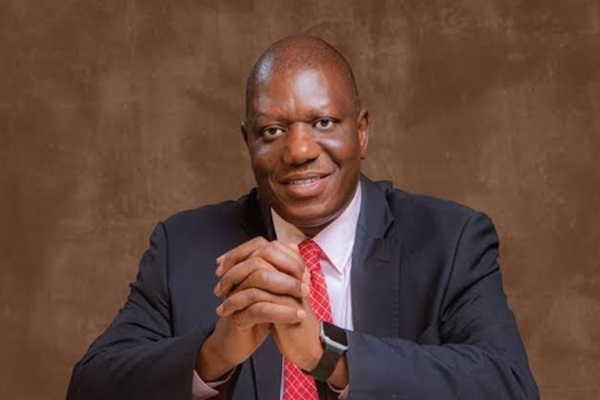
The senator representing Kaduna South Senatorial District, Sunday Katung, has dumped the Peoples Democratic Party (PDP) for the ruling All Progressives Congress (APC).
Katung’s defection letter was read at plenary on Wednesday by the President of the Senate, Godswill Akpabio.
Katung cited the prolonged leadership crisis in the PDP for his defection, saying that the platform could no longer guarantee his political destiny.
He said he decided following wide consultations with his constituents, adding that it is only the APC that can offer him the platform to continue serving his people.
He said the PDP had become “fractured” and can no longer meet the aspirations of the voters in his constituency.
He also said “evolving political realities” in Nigeria showed that hope for a secure future for himself and his constituents was with the APC.
With the latest defection, the APC now has 74 senators in the Senate; PDP 27; Labour Party four; APGA two; NNPP one; and SDP one.

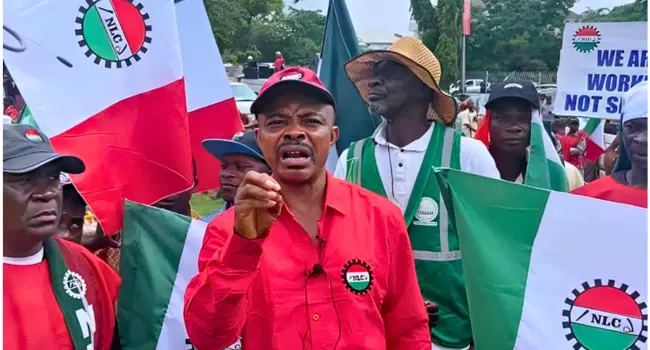
President of Nigeria Labour Congress (NLC), Mr Joe Ajaero, says the meeting held with President Bola Tinubu by organised labour on Tuesday night centred on addressing the issue of financial insecurity of Nigerian workers.
Ajaero stated this after a meeting convened by Gov. Hope Uzodimma of Imo with the NLC leadership in Abuja on Wednesday.
The News Agency of Nigeria (NAN) reports that Tinubu’s meeting with the NLC leadership at the State House on Tuesday night was part of the last-minute efforts to halt the union’s proposed nationwide protest over insecurity.
NAN recalled that the NLC had declared a nationwide protest for Dec. 17, citing what it described as the country’s “degenerating security situation.”
At the resumption of the meeting, Ajaero said that the engagement that Labour had with the Federal Government was to cancel the planned protest.
Ajaero said that workers who were poorly paid and inadequately fed were more likely to face deeper challenges than those whose welfare needs were properly met.
“The action continued this morning. We are rounding off now. We will take back whatever we discussed with them to our members.
“The attitude of meeting on the day or eve of any action is not rocket science.
However, Mr President was emphatic that the issue of insecurity will be a thing of the past very soon. He said he’s taking extra steps to take care of it.
“We equally talked about financial insecurity because a worker who is not well fed and not well paid will have even more problems than the ones that are well fed and well paid.
“Mr President said he has put Nigeria on the map of prosperity, and we agreed that we’re going to meet in January to look at some grey areas where we need to touch.
“It will equally translate into the prosperity of the working people of Nigeria,” he said.
On whether the protest had been cancelled, Ajaero said: “We are going back to our members now, and then we will get back to them.
“But today (Wednesday) is gone, and our action is not an indefinite one. It’s a protest. The issue of suspension is not there because the action was taken off this morning,” Ajaero said.
Also speaking, Gov. Uzodimma, who is Chairman, Progressives Governors’ Forum (PGF), said the president’s intervention played a key role in resolving the matter and that a channel had been opened for increased communication with labour.
He said, “President Bola Tinubu met last night with the leadership of NLC.
“They discussed issues of the Nigerian economy, issues of welfare of workers and the various reforms going on; and also issues of national security and other developments in the country, and all of them agreed.
“National unity is very critical, and our national interest is also very important. And the march towards economic prosperity by the president is a welcome idea.
“At the end of the meeting, we also discovered that there is a need for regular engagements with the Nigeria Labour Congress.
“For now, both the government and labour are on the same page to ensure that Nigeria is better protected, and more investments in the areas of security should be encouraged.
“And the president’s programmes to secure Nigeria and the entire space should also be supported.”
The governor expressed appreciation to Tinubu for the way he came out to explain to the labour leaders his programmes and activities for an improved security arrangement in the country.
“We are also very grateful to the NLC for the maturity they exhibited; for the interest they also displayed for national security and better security for Nigerians and the welfare of Nigerian workers,” he said.
Uzodimma further said that all parties had agreed to be on the same page, adding that labour was working together with other agencies of government for the interests of the country and the citizens.
“It was a very good development and all issues that were not cleared before this time had been cleared, and all the parties are also comfortable with all the explanations given,” he said.
Vanguard News
The post Protest: What we discussed with Tinubu – NLC President appeared first on Vanguard News.