
TECHNOLOGY
Krafton hikes India bet with new $670M fund


Krafton, the South Korean gaming company behind hit titles such as PUBG and Battlegrounds Mobile India (BGMI), is launching a growth investment fund focused on India, stepping up its push into the world’s largest internet user base.
Called the Unicorn Growth Fund, the investment vehicle is a collaboration between Krafton and South Korean internet conglomerate Naver, and investor Mirae Asset. It aims to deploy up to ₹60 billion (around $669.3 million) over four years, Krafton confirmed to TechCrunch.
The fund, which will be managed by Mirae Asset Venture India, is expected to be established in January and begin operations with an initial size of more than ₹30 billion (about $334.6 million). Krafton will contribute ₹12.3 billion (approximately $137.2 million) at the first close, the company said.
Naver’s capital commitment is expected to be “broadly comparable” to Krafton’s $137 million investment, a Krafton spokesperson told TechCrunch. The fund will not operate with rigid country-allocation thresholds, and typical investment sizes are expected to range between $10 million and $30 million, the spokesperson said.
Krafton said investments through the new fund would primarily be treated as financial positions rather than strategic bets, though the level of engagement with portfolio companies could vary depending on the opportunity and long-term potential of each business.
To date, Krafton has invested more than $200 million in India, backing companies in the gaming, content and fintech spaces. Recent investments include fintech Cashfree and venture fund IMM Investment, alongside earlier bets on gaming and content platforms such as Nodwin Gaming, Loco, Pratilipi, and Kuku FM. The company also launched a gaming incubator in India in 2023, and acquired a controlling stake in Indian gaming studio Nautilus Mobile for $14 million earlier this year.
Krafton’s expansion in India has not been without setbacks. New Delhi banned BGMI, the company’s flagship local title, in 2022, before allowing it to return in 2023 following a three-month trial approval. Krafton subsequently announced a $150 million investment commitment in the country.
Techcrunch event
San Francisco
|
October 13-15, 2026
BGMI, which has surpassed 240 million downloads, launched in 2021 as a revamped, localized version of PUBG Mobile, another popular title that was banned by the Indian government in mid-2020 over national security concerns. Since then, Krafton has made a series of operational changes in the country — including cutting ties with Tencent as its publisher and migrating its India servers to Microsoft’s Azure cloud — to address regulatory concerns.
With the new fund, Krafton is looking to extend its India strategy beyond gaming, channeling capital into a wider set of technology startups as it seeks to build a long-term presence in one of Asia’s fastest-growing digital markets.


With white-wired headphones endorsed by celebrities including Lily-Rose Depp, Paul Mescal, Bella Hadid and Apple Martin, a growing number of people are breaking away from wireless listening.
The Guardian’s journalism is independent. We will earn a commission if you buy something through an affiliate link. Learn more.
For inspiration, there is the Instagram account @wireditgirls, or a Balenciaga campaign featuring the model Mona Tougaard reclining bed, wired headphones in place.
Daniel Rodgers, the fashion news editor at British Vogue, is familiar with the trend. “[It says] ‘I’m very effortless. I’m very nonchalant,” he says. “It’s become a real styleable accessory.”
But in a culture where the forward march of technology is often treated as compulsory, wired headphones represent more than aesthetics. “It’s an analogue way of opting out – of both tech but also life,” says Rodgers. “They’re visible in a way that AirPods aren’t. There is a sense of ‘do not disturb’.”
Retro tech is making a comeback, with some users of wired headphones embracing tangles as part of the charm. Photograph: Tara Moore/Getty Images
That symbolism is on full display on the cover of New York magazine’s latest issue, which features celebrities riding the subway: Debbie Harry with the Geese frontman Cameron Winter, Ben Stiller with the Knicks star Karl-Anthony Towns and Macaulay Culkin with the SubwayTakes presenter Kareem Rahma. The real story, however, is not the star power but the shared accessory in each image: wired headphones.
The pictures were taken by Hannah La Follette Ryan, the Brooklyn-based photographer behind the Instagram account @SubwayTakes, which documents New Yorkers on public transport. She says: “I see the revival as an extension of digital fatigue. Who wants another glitchy expensive gadget to charge?”
Price is clearly part of the appeal of wired headphones – Apple’s EarPods cost £17 compared £99 for AirPods – but nostalgia is also a factor.
“We’re seeing retro tech come back,” says Tom Morgan-Freelander, the deputy editor of the technology magazine Stuff. “And as part of that, brands are starting to bring back wired headphones.”
He says some younger consumers are switching to wired for sound quality, which is typically better with cables. “Bluetooth became the norm, and there was an acceptance that for wireless convenience – you’re going to lose a bit of quality,” he adds.
Then there is the issue of tangles. While wireless headphones are stored neatly in a case, wired varieties are often found in a knot at the bottom of a bag.
Despite the revival of wired headphones, Bluetooth models continue to outsell them. Photograph: Blend Images/Alamy
La Follette Ryan suggests this is part of the appeal. “The tangle is inevitable,” she says. “Think of a headphone knot as a more user-friendly Rubik’s Cube. Relish the opportunity to slow down and solve a little puzzle.”
If wired headphones have become the choice of the fashion-conscious despite these inconveniences, that could change soon. AirPods remain the bestseller at Currys but the retailer reports sales of Beats Solo 4 over-ear headphones have risen by 193% since last year.
Morgan-Freelander also points to the £20 FiiO Snowsky Wind, a design that looks like the earphones worn with a Sony Walkman in the 1980s.
Rodgers still believes wired headphones have the edge. “Even though we are constantly being [sold upgrades], there’s a sort of disengagement [with wired headphones], which is always really hot, right?” he says. “You never want to look like you’re too into anything.”
La Follette Ryan, however, thinks there is room for every option. “I just bought a Discman and Sony headphones,” she says, “but I will always keep my wired headphones for sharing an earbud with a friend.”


An urgent weather alert has been issued for thousands in Wyoming and Colorado, warning of a ‘particularly dangerous situation’ expected on Friday.
The National Weather Service (NWS) said a strong wind event is ongoing across the region, with sustained winds of 40 to 50 mph and gusts up to 75 mph, creating extreme conditions for wildfires and potential property damage.
Red flag warnings have been issued, signaling that a combination of strong winds, low humidity, and dry fuels is creating a heightened risk for rapid fire growth.
Areas under threat include southern Wyoming’s Laramie Range and most of Laramie County, as well as Colorado’s Front Range foothills, nearby high plains, portions of the I-25 urban corridor, and some southern counties, all at risk through at least midnight.
The NWS designated a ‘Particularly Dangerous Situation’ for the southern Laramie Range and foothills in Wyoming, and for the Front Range foothills and adjacent lower elevations in northern and central Colorado.
That includes Boulder, Jefferson, Larimer, and parts of Douglas, Gilpin, Clear Creek and Park Counties.
The NWS warned that conditions mirror those that fueled the 2021 Marshall Fire, which destroyed more than 1,000 homes in Colorado.
Red flag warnings are also in effect in the central and western Nebraska Sandhills, the eastern Panhandle and the southwestern Texas Panhandle.

Louisville, Colorado is in Boulder County is specifically mentioned as being under the ‘Particularly Dangerous Situation.’ Pictured is a home burning in a wildfire that sparked in 2021

Red flag warnings have been issued in Wyoming, Colorado, Nebraska and Texas
‘This is a Particularly Dangerous Situation that poses a significant threat to life and property in the event of a wildfire start,’ the NWS stated regarding specific regions in Wyoming and Colorado.
‘Residents are urged to assemble an emergency supply kit and know their evacuation routes.
‘In some cases, safe and timely evacuation may not be possible should a fire approach. Have multiple ways to receive instructions from emergency services, and evacuate if ordered to or if a fire threatens.’
The Wyoming Department of Transportation has imposed travel restrictions on several key routes. Interstates 80 and 25 are closed to light and high-profile vehicles in multiple areas, including I-25 from the Colorado state line to Whitaker Road, and I-80 from Rawlins through the Laramie Valley into Cheyenne.
A cold front moving through the region tonight is expected to ease conditions by Saturday afternoon.
It could bring mountain snow, prompting a winter weather advisory for affected areas.
In Colorado, this is the first time the NWS office in Boulder has issued ‘A Particularly Dangerous Situation’ alert for northwest Jefferson and western Boulder counties due to possible wind gusts of 85 to 105 mph.
The most dangerous conditions are expected on Highway 93 into the higher foothills. Coupled with single-digit relative humidity.

The NWS warned that conditions mirror those that fueled the 2021 Marshall Fire (PICTURED), which destroyed more than 1,000 homes in Colorado
For the northern Front Range, the strongest winds are expected west of I-25, reaching into the foothills. Along and east of the I-25 corridor, including the Denver metro area, gusts could reach 40 mph with humidity dropping as low as eight percent.
Meteorologists warned that the top wind gusts could be comparable to those of a Category 2 or 3 hurricane.
Multiple Red Flag Warnings across parts of Nebraska and the Texas Panhandle, warning that critical fire weather conditions are likely on Friday afternoon.
In Nebraska, Red Flag Warnings are in effect from 10am to 5pm local time for the eastern Panhandle and western Sandhills, and from 11am to 6pm for the central and western Sandhills, including areas near the Valentine National Wildlife Refuge and Nebraska National Forest.
In Texas, warnings cover the southwestern and northwest Texas Panhandle from 10am to 6pm local time.
Forecasters said gusty west to southwest winds of 15 to 30 mph, with gusts up to 45 mph, combined with low relative humidity as low as 10 to 20 percent and temperatures climbing into the mid-60s, could cause any fires that ignite to spread rapidly and become difficult to control.
Residents are urged to avoid outdoor burning and activities that could spark fires during the warning period.


For most Nigerian content creators, staying online is often the easiest part of the job. The real struggle happens in the background: creators wrestle with erratic data connections and the daunting task of tailoring global technology to a local audience. For years, the solution was simply to work harder, but in 2025, the game changed. This year, artificial intelligence (AI) moved from a playground for the curious to the engine room for the productive.
With limited infrastructure, rising data costs, and intense competition for attention, efficiency is no longer optional but essential to survival and growth. AI offers creators practical ways to compress time, reduce costs, and compete on a global stage without expanding their teams or budgets. These tools are reshaping how Nigerian creators sustain their work, scale their output, and remain visible in an increasingly crowded creator economy.
I spoke to some top Nigerian content creators, including Fisayo Fosudo, Mercy Thaddeus, and Akunne Emmanuel, to understand how they are integrating AI into their creative workflow to improve efficiency and output, as well as the creative decisions they refuse to hand over to machines.
Scripting and narrative architecture
The most immediate impact of AI this year has been the death of the “blank page” syndrome, a common challenge where creators stare at an empty page or screen, struggling to turn ideas into structured content. For many creators, the process of moving from a raw idea to a structured narrative has been compressed from hours into a matter of minutes.
Akunne Emmanuel, the tech creator who breaks down product design to his audience on his BuildWithDudu Instagram page, often starts his creative process with a rough personal script. He uses AI to refine the angle and ensure the message flows naturally.
“Once I have an idea, I can generate a strong first-pass outline in under ten minutes, then spend my time refining tone and insight instead of staring at a blank page,” Emmanuel says.
Mercy Thaddeus, an AI content creator who breaks down Artificial Intelligence for her audience and is known as Mercythaddeus_ on Instagram, says she uses Gemini for “refining my scripts.
Refining scripts with Gemini is part of a wider shift in how creative work is being produced globally. Generative AI tools are increasingly used not just for grammar or tone, but for structuring ideas, tightening narratives, and speeding up production cycles. According to findings from research presented by Adobe MAX, which surveyed over 16,000 creators across the U.S., U.K., France, Germany, South Korea, Japan, India, and Australia to examine the mindsets, behaviours, and expectations shaping the future of creative work and the creator economy.
The study found that a significant majority of creators now integrate AI into their workflows, particularly for writing, editing, and ideation, seeing these tools as collaborators that help them work faster and push their ideas further rather than replacements for human creativity.
TechCabal’s content creator, Ayodeji Aboderin, turned to AI in 2025 to build what he calls “content engines. By feeding frameworks into models like ChatGPT, he can deconstruct complex technical topics into simple, relatable stories. Aboderin explains the shift in his process: “It makes it very, very easy to break down ideas and make [them] into simple ways the audience can understand.”
Technical prototyping and visualisation
In a market where high-quality stock footage or a dedicated design team can be prohibitively expensive, creators are using AI to “show” rather than just “tell.” Beyond the written word, AI has become a silent partner in the production of visual assets and technical demonstrations.
Thaddeus leverages her background in software engineering to use AI coding assistants to change how she presents products.
“I know how to build products, but it is time-consuming and often requires a team,” she says. “ Before, building a landing page or a simple tool would take a full day of coding. Now, I can use AI coding assistants to spin up a functional prototype or a clean UI in about 20 minutes. This allows me to show rather than just tell in my videos.”
Aboderin has adopted a similar approach for visual storytelling, noting that he no longer spends hours scouring sites like Unsplash. He now generates bespoke visual assets to illustrate specific narratives.
“It [is] easy to visualise with AI, as opposed to looking for imagery or visuals that will tell [a] story. I [don’t] have to go and search for it. I just generate it from scratch,” he says.
Research and deep exploration
Research has traditionally been the most time-consuming part of the creative cycle, but in 2025, AI agents have taken over the heavy lifting of data gathering.
Fisayo Fosudo uses tools like Gemini to explore different angles for his famous gadget reviews. Rather than relying on AI for the “news” itself, he uses it to figure out how to “attack” a topic or discover which elements of a new device are most relevant to his audience.
“We do our research [by ourselves]. We just use [AI] to explore different angles of how to tackle stuff, rather than rely on it like ‘this is the news,” Fosudo explains.
Aboderin takes this a step further by deploying AI agents to scan patterns and recurring conversations across the web. “I can automate that process and send agents on errands to learn about it while I do other stuff,” he says.
However, this efficiency comes with a caveat; Fosudo warns that AI-driven research can often present outdated information as current fact: “Websites may have an article from 2003, but the date [on the AI-researched article] says 2025, so I don’t rely on information given to me.”
Strategic outreach and monetisation
The impact of AI has also bled into the business side of content creation, specifically in how creators manage their professional relationships. While AI doesn’t replace the networking required to land a big deal, it has significantly reduced the friction of communication. Creators now use AI tools to draft outreach emails to brands, generate personalised pitch decks, and summarise long email threads for quicker follow-ups. Some also rely on AI to create meeting notes, refine proposals, or adapt the same pitch across multiple platforms, allowing them to spend more time building relationships and negotiating deals rather than wrestling with repetitive administrative tasks.
Emmanuel says he uses AI to structure outreach and follow-ups, adding that “while AI doesn’t replace relationship-building, it supports it by removing friction and delays in calculating responses.”
Thaddeus finds that AI helps her overcome writer’s block when drafting cold emails and proposals, ensuring her outreach is “professional and clear.”
Indirectly, this efficiency is driving better monetisation. Thaddeus notes that by cutting down the time spent on scripting and coding, she has more time to build actual assets: “These projects build my portfolio, which attracts high-value clients.”
The Nigerian context gap
Despite the efficiency gains, there is a clear consensus among these creators: AI is not 100% accurate.
Globally, concerns about AI accuracy, bias, and hallucinations have followed the technology as it spreads across creative, academic, and professional fields. Large language models are known to generate confident but incorrect outputs, blur facts, and reproduce gaps in the data they are trained on. As creators’ credibility depends on trust and relevance, these weaknesses are a limit. In Nigeria, where context, timing, and cultural specificity are critical, the margin for error is even thinner.
“AI typically does not understand the Nigerian context; it exaggerates,” Emmanuel says. “ Authenticity and local relevance still come from lived experience.”
Thaddeus is vocal about the fact that she never uses AI for local trends: The [AI] models often hallucinate or are outdated when it comes to hyper-local contexts.” She says she still relies on X and local news blogs to spot what’s actually happening on the ground.
Emmanuel echoes this sentiment, noting that AI systems trained on global data often miss the cultural subtext.
“Most AI systems are trained on global data, which means they don’t naturally understand local nuances, timing, or cultural subtext, especially in a market like Nigeria. That gap requires intentional human judgment. Without it, content can sound accurate but disconnected. Learning where AI helps and where it misleads has been the real work,” Emmanuel says.
The disconnection that emanates from AI use has led to a human-first research model where creators like Thaddeus do the heavy lifting manually and only use AI to refine the grammar of the facts they’ve already verified.
The human boundary
Ahead of 2026, the line in the sand for Nigerian creators is that AI cannot replicate a personal opinion or a unique personality.
Fosudo is particularly adamant about the “creepiness” of AI in certain commercial contexts, arguing that the human element is non-negotiable. “Seeing ads of food and the food is AI is weird. [Also] if your skincare brand is doing [ads], they shouldn’t use an AI [face],” he says.
Thaddeus and Emmanuel conclude that the connection with the audience is built on trust, which is fundamentally a human transaction.
As Thaddeus puts it, “AI can give me facts, but it cannot have a perspective. My experiences and my personal opinions on the industry are things AI cannot replicate.”
In the Nigerian creative space, AI is the engine, but the creator remains firmly in the driver’s seat.


Image: Techloy.com
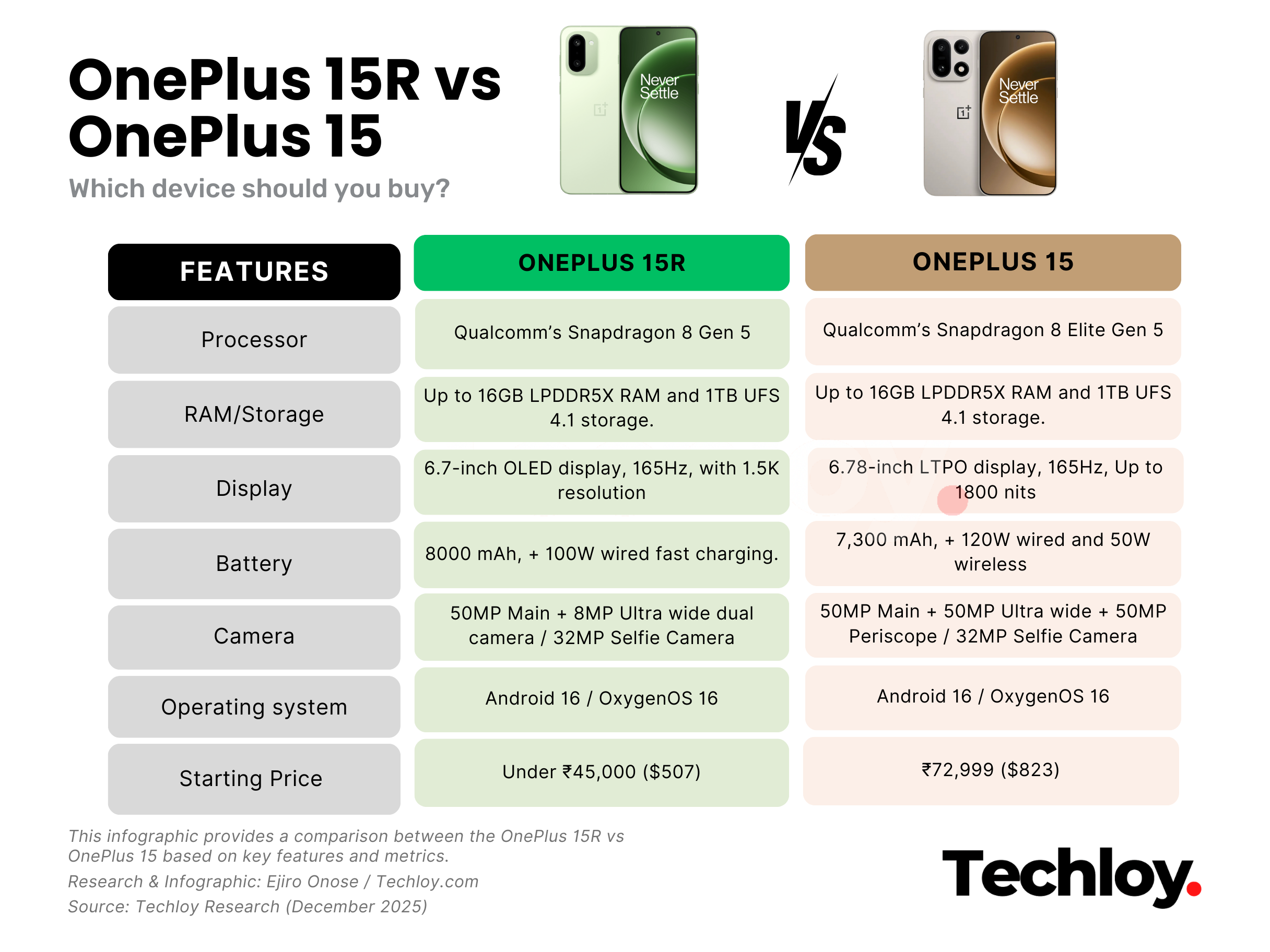
OnePlus is blurring its own lines again. With the launch of the OnePlus 15R, the company is offering flagship-class performance and massive battery life at a noticeably lower price than the OnePlus 15.
On paper, the gap between the two phones is narrower than ever, raising a familiar question for buyers: do you really need the full flagship, or does the more affordable option already give you most of what matters?
This comparison will help you decide which device fits your needs.
💡
Voting polls for the Techloy Readers’ Choice Smartphone Awards 2025 are now live across the site. You can access them by tapping the pop-up on the right.
/1. Design and Display
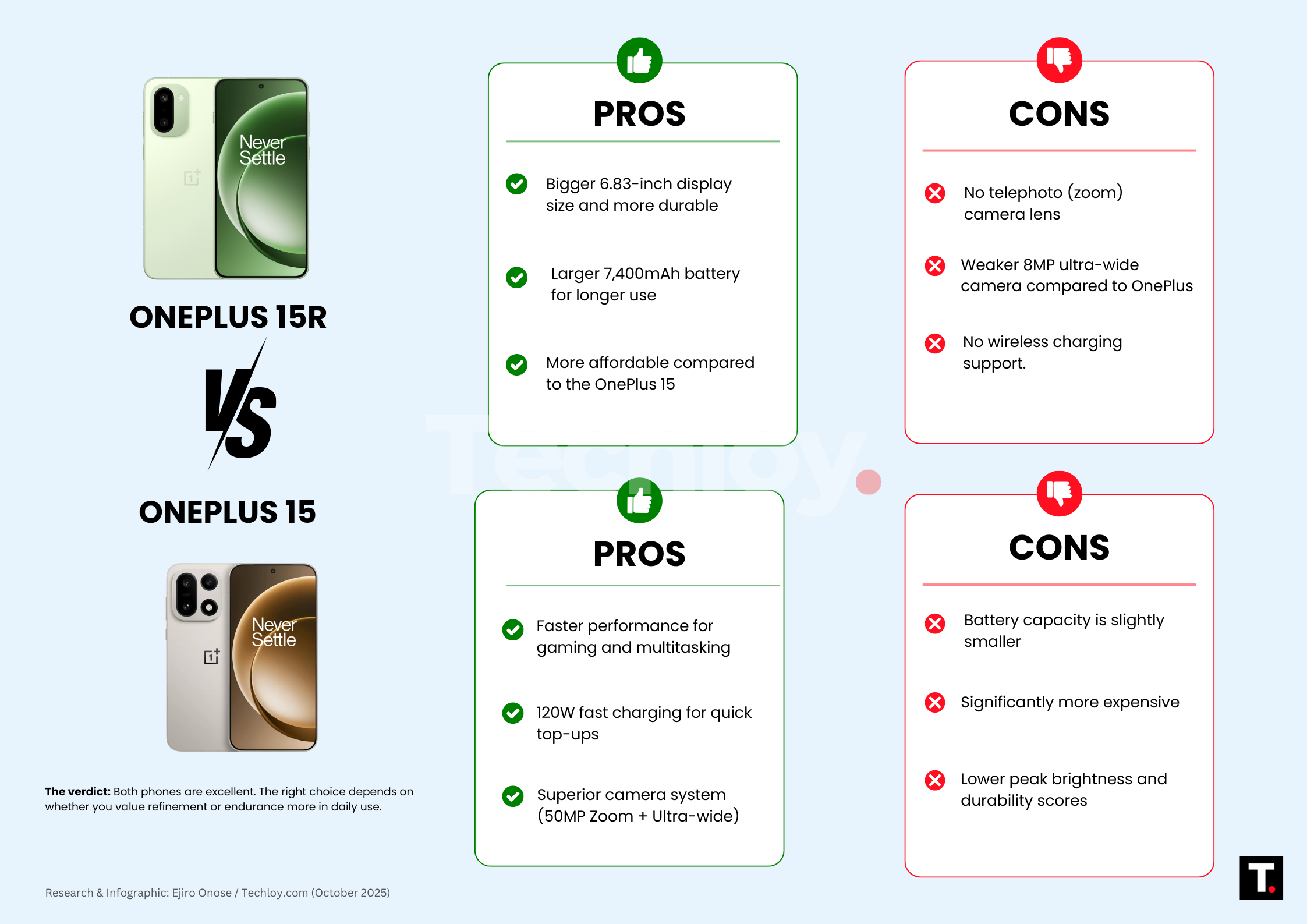
The OnePlus 15R features a slightly larger 6.83-inch AMOLED display, also operating at 165 Hz. It is very bright and responsive, making it ideal for gaming and scrolling. However, it lacks LTPO technology, meaning it runs at higher refresh rates more often, which can consume more power when the screen is static. The larger footprint and flat screen design might also feel slightly heavier and wider in one-handed use.
The OnePlus 15 sports a slightly more compact 6.78-inch LTPO AMOLED display, also peaking at 165 Hz. The key advantage here is the LTPO technology, which allows the screen to dynamically drop its refresh rate (down to 1 Hz) when you are reading or viewing static images, significantly saving battery. The panel is sharp, vibrant, and protected by premium glass, offering excellent visibility even in direct sunlight.
Both phones feature modern aesthetics with thin bezels and share robust IP68/IP69K ratings for water and dust resistance, ensuring durability in everyday mishaps.
💡
Verdict: Choose the 15 for a more refined and efficient display. Choose the 15R for a larger, faster screen.
/2. Performance
The 15R uses the Snapdragon 8 Gen 5. While it sits just a tier below the “Elite” version, it is still an absolute powerhouse. It handles high-fidelity gaming, multitasking, and daily app usage with flagship-level smoothness. For 99% of users, this chip provides more speed than they will ever need, though it may lack the extreme peak efficiency of its more expensive sibling.
The OnePlus 15 upgrades to the Snapdragon 8 Gen 5 Elite, Qualcomm’s top-tier silicon. This chipset is binned for superior sustained performance and efficiency, making it the better choice for users who push their phones to the limit with video editing, heavy AI workloads, or extended gaming sessions where thermal management is critical.
💡
Verdict: The 15 is the choice for users seeking peak performance and long-term responsiveness. The 15R offers excellent speed at a lower price point.
/3. Battery and Charging
The OnePlus 15R is built for endurance, packing a massive 7,400 mAh battery. This huge capacity ensures the phone can easily last into a second day of heavy use. It supports 80W wired charging, which is fast enough to top up the device quickly, though it sacrifices wireless charging to keep costs down and battery size up.
The OnePlus 15 includes a slightly smaller 7,300 mAh battery, which is still substantial by flagship standards. Where it pulls ahead is versatility: it supports blazing-fast 120W wired charging and adds the convenience of 50W wireless charging.
💡
Verdict: Users prioritizing battery life may prefer the 15R, while the 15 provides more charging flexibility and faster top-ups.
/4. Cameras
The OnePlus 15R features a simplified dual-camera system, comprising a 50MP main sensor and an 8MP ultrawide lens. It captures crisp, vibrant photos in daylight and handles everyday social media shots well. However, the lack of a dedicated telephoto lens limits its ability to zoom without losing quality, and the lower-resolution ultrawide camera may struggle in low-light scenarios.
The OnePlus 15 boasts a comprehensive triple-camera setup: a 50 MP main, 50 MP ultrawide, and a 50 MP periscope telephoto with optical zoom. This versatility allows you to capture stunning portraits, wide landscapes, and high-quality zoomed shots in various lighting conditions.
Both phones share a capable 32 MP front camera with autofocus, ensuring selfies look sharp on either device.
💡
Verdict: For photography enthusiasts or anyone who values camera flexibility, the 15 is the stronger option. The 15R is still capable of everyday snapshots
/5. Software and Extras
Both devices ship with OxygenOS 16 based on Android 16, offering a clean, fast, and highly customizable user interface. They both include future-proof connectivity features like Wi-Fi 7, Bluetooth 6, NFC, and ultrasonic under-display fingerprint sensors for instant unlocking.
The OnePlus 15 justifies its flagship status with subtle but meaningful extras. It supports faster USB 3.2 data transfer speeds (ideal for moving large files) and features a more premium vibration motor. The 15R sticks to USB 2.0, which is slower for data transfer but sufficient for charging and basic use.
💡
Verdict: The software experience is identical on both. Choose the 15 only if you frequently transfer files via cable or care about subtle premium haptics.
/6. Price and Value
The 15R provides better value for users who want maximum performance and battery life per dollar. The 15 is worth the extra cost for those who prioritize cameras, premium features, and the most refined display experience.
The OnePlus 15 is priced as a full flagship, reflecting its versatile camera system, wireless charging, and Elite chipset. The OnePlus 15R is priced lower while delivering almost the same performance and a slightly larger battery.
💡
Verdict: The 15R is the smart financial choice for most people. The 15 is the splurge for those who want a “no compromises” flagship experience.
Final Verdict
Choose the OnePlus 15 if you want a balanced flagship with versatile cameras, wireless charging, the efficiency of an LTPO display, and peak performance. Choose the OnePlus 15R if you prioritize battery life, strong gaming performance, and the best value for the price. Both phones are strong options. Your choice depends on which features matter most in your daily use.
Everything We Know About the OnePlus 15R So Far
With this, OnePlus might be blurring the line between its R-series and full-fledged flagships once again.

Laura Cress,Technology reporterand
Lily Jamali,North America technology correspondent, San Francisco
 Getty Images

TikTok’s Chinese owner ByteDance has signed a deal with investors to run its business in the US.
But what does this mean for the over 170 million Americans (or so the social media platform claims) who use the app?
The key may lie in how TikTok’s recommendation algorithm – the powerful system that curates the platform’s For You Page to predict content you might watch – is managed when it changes hands.
Social media industry expert Matt Navarra told the BBC the question will not be whether TikTok survives, but “what version of TikTok survives”.
‘Safer’ but ‘less relevant’
Currently, TikTok’s system depends on huge amounts of global data and feedback loops, which can change recommendations in an instant.
Under the terms of the deal TikTok’s algorithm, which will be licensed by investor Oracle, is set to be retrained on American user data.
Mr Navarra said this could leave the app feeling “safer and sturdier” but also leaving it at a risk of “becoming less culturally essential” as a result.
“TikTok’s power has always come from feeling slightly out of control – weird, niche, uncomfortable, sometimes politically sharp content for anyone else or before it goes anywhere else,” he said.
“If you start smoothing those edges, you don’t just change moderation. I think you change its relevance.”
Matching ByteDance’s algorithm
Whether the US version will differ from the TikTok so many know and use already may also depend on if it gets “all the new features, security updates and platform improvements” as soon as the international version does, tech journalist Will Guyatt told the BBC.
And computing expert Kokil Jaidka from the National University of Singapore said she expected the things that make the platform popular – such as its short videos and shopping – are likely to “stay intact” as these features are not dependent on the algorithm.
She said the changes might be more subtle and gradual, depending on if the narrower data inputs of the “siloed” US version can match the app’s global reach.
“If TikTok is operating with a licensed or partially diluted version of its recommendation algorithm, some of the system’s blind spots may start to matter more,” she said.
For users, she said this means in practice the US algorithm may “lag in personalisation” and take longer to adapt to viral content.
To experiment or behave?
Oracle is TikTok’s longtime cloud computing partner in the United States, and is chaired by Larry Ellison, an ally of President Trump.
Another foreign entity, MGX – an Abu-Dhabi government investment fund – will join it along with private equity firm Silver Lake as the main incoming investors.
Pressure from these investors may also add to the US app feeling “blander” said Mr Navarra.
“I think the real test won’t be whether the users leave,” he said.
“It will be whether TikTok still feels the place the internet goes to experiment – or if it becomes the place it goes to behave.”
Additional reporting by Peter Hoskins.


Regularly consuming high fat cream or cheeses including brie and cheddar, could slash the risk of developing dementia, research today suggested.
Swedish researchers, who monitored the health and eating habits of over 27,000 middle-aged adults, said those who regularly ate cheese or high fat cream, were less likely to have a diagnosis.
People who tucked into 20g per day of cream — roughly one and a half tablespoons — had a 16 per cent lower risk of dementia than those who consumed none, scientists found.
Eating 50g of cheese daily, meanwhile, saw their risk cut by 13 per cent, compared to those who ate less than 15g per day.
Cheese may contain certain nutrients that boost brain function, but further studies are needed to confirm the results, the scientists said.
While high in calcium and protein, currently the NHS recommend people consume no more than around 30g of cheese per day, due to its saturated fat and salt content.
Maintaining a healthy weight, not drinking too much alcohol and keeping blood pressure at a healthy level are recommended by health chiefs to reduce the risk of dementia.
Professor Emily Sonestedt, an expert in nutrition and public health at Lund University and study co-author, said: ‘For decades, the debate over high-fat versus low-fat diets has shaped health advice, sometimes categorising cheese an unhealthy food to limit.

Swedish researchers, who monitored the health and eating habits of over 27,000 middle-aged adults, said those who regularly ate cheese or high fat cream, scored better in cognitive tests
‘Our study found that some high-fat dairy products may actually lower the risk of dementia, challenging some long-held assumptions about fat and brain health.’
High fat cheeses are typically those which contain more than 20 per cent fat, such as cheddar, parmesan, stilton and brie.
In the fresh research, scientists asked participants to keep food diaries tracking how often they ate certain foods.
Over a follow-up of 25 years, they discovered 3,207 people developed dementia.

Everyone experiences dementia differently. Use this checklist to help you make a note of your symptoms before you talk to your GP.
After accounting for factors that could skew results, they also discovered that those who ate more high-fat cheese had a 29 per cent lower risk of vascular dementia—the second most common form after Alzheimer’s.
It is caused by reduced blood flow to the brain, damaging cells, while Alzheimer’s involves plaques and tangles of certain proteins.
There was also a lower risk of Alzheimer’s disease among those who ate more high-fat cheese, the scientists said.
But this was only found among those not carrying the APOE e4 gene variant — a genetic risk factor for Alzheimer’s disease.
Writing in the journal Neurology, they added that full-fat cream appeared to have a similar protective effect.
Those who consumed around 1.5 tablespoons a day, were 16 per cent less likely to develop dementia, compared to those who consumed none.
No such association, however, was found between dementia and low-fat cheese, cream, milk, butter or fermented milk products.
Experts, however, who were not involved in the research urged caution over the findings, arguing other confounding factors, aside from cheese, may explain the link.
Professor Naveed Sattar, an expert in cardiometabolic medicine at the University of Glasgow, said: ‘I do not believe there is a causal link here, as this is an observational study rather than a randomized controlled trial.
‘It is important to note that individuals who consumed more high-fat cheese and cream were, on average, better educated.
‘This raises the possibility that other “healthy” characteristics associated with higher education, rather than the cheese or cream itself, may explain the lower dementia rates observed.
‘We already know of several well-established and proven factors that reduce dementia risk, such as maintaining healthy blood pressure, managing weight, and preventing heart disease or stroke.
‘These interventions should remain the priority, given their strong evidence base, rather than focusing on unproven dietary associations.’
Professor Tara Spires-Jones, Director of the Centre for Discovery Brain Sciences at the University of Edinburgh, added: ‘ It is highly likely that diet and other lifestyle factors changed over the course of the study.
‘Strong evidence from across the field indicate that healthy diet, exercise, and cognitively stimulating activities — education, challenging jobs and hobbies — can boost brain resilience to diseases that cause dementia.

‘There is not strong evidence for any individual food protecting people from dementia.’
The condition now affects around one in 11 people over the age of 65 in the UK and claims 76,000 lives each year and is the UK’s biggest killer.
Costs to the UK economy, including that of the round-the-clock care many need as dementia takes hold, is an eye-watering £42 billion a year, according to the charity Alzheimer’s Society. That figure will double by 2040, it warns.
Earlier this month, the Daily Mail launched its Defeating Dementia campaign, in association with Alzheimer’s Society, to raise awareness of the disease, increase early diagnosis, boost research and improve care.
Scientists now believe around 45 per cent of all cases of dementia may be preventable or — at the very least — that the symptoms can be delayed, in some cases for many years, allowing everyone to live longer, healthier lives.

Startups On Our Radar spotlights African startups solving African challenges with innovation. In our previous edition, we featured seven game-changing startups pioneering healthcare, transportation, education, and artificial intelligence. Expect the next dispatch on December 26, 2025.
This week, we explore five African startups in the education, fintech, software development, and artificial intelligence sectors and why they should be on your watchlist. Let’s dive into it:
CodeFundi is turning AI agents into a software teammate for global development teams (AI, Kenya)
Felix Waweru, a software engineer with a decade of experience, founded CodeFundi in 2023 to solve the reliability and maintenance issues plaguing software development. He realised that while writing code is a part of the job, testing, documentation, debugging, and long-term maintenance are often slow, error-prone, and too complex to manage manually. CodeFundi addresses this with its all-in-one AI solution that automates coding, testing, and documentation to help teams maintain software faster and more reliably.
Rather than have users copy and paste snippets into a chatbot, CodeFundi connects directly to a team’s codebase, such as repositories hosted on GitHub, to understand an entire software project. This allows users to interact with their codebase through a conversational interface to understand complex packages or generate new features. On the backend of this conversation, CodeFundi uses multiple specialised AI agents with different roles. One conducts research and deeply analyses the code, another maintains contextual memory of the user and organisation, and a third compiles results into actionable outputs.
This setup allows the platform to automatically identify bugs, generate fixes, write tests to validate those fixes, and produce detailed technical documentation explaining how each part of the code works. The platform also includes analytics that show teams which programming languages or components dominate their projects.
CodeFundi operates on a subscription model ranging from a $5 monthly starter plan to a $1,000 monthly enterprise tier that offers on-premise hosting for data security or region-specific deployments. The startup also offers credit-based usage and an API, currently in beta testing, that allows companies to embed CodeFundi’s AI agents directly into their own products.
Why we’re watching: CodeFundi is modelling its system on how real engineering teams work. It breaks software development into discrete tasks handled by multiple collaborating AI agents, which mirrors the separation of responsibilities between frontend, backend, testing, and documentation teams. Waweru says that this approach improves reliability and reduces the forgetfulness that can occur when one AI handles everything.
The startup competes with tools focused solely on testing, such as Zof AI, and other AI product development platforms like Kasa AI and Bolt AI. They have secured partnerships with Google Cloud, Microsoft for Startups, and Cognition AI, the team behind Devin. CodeFundi claims to have acquired 5,000 users across 47 countries since its launch, and says it has crossed $1,000 in monthly recurring revenue as a bootstrapped business.
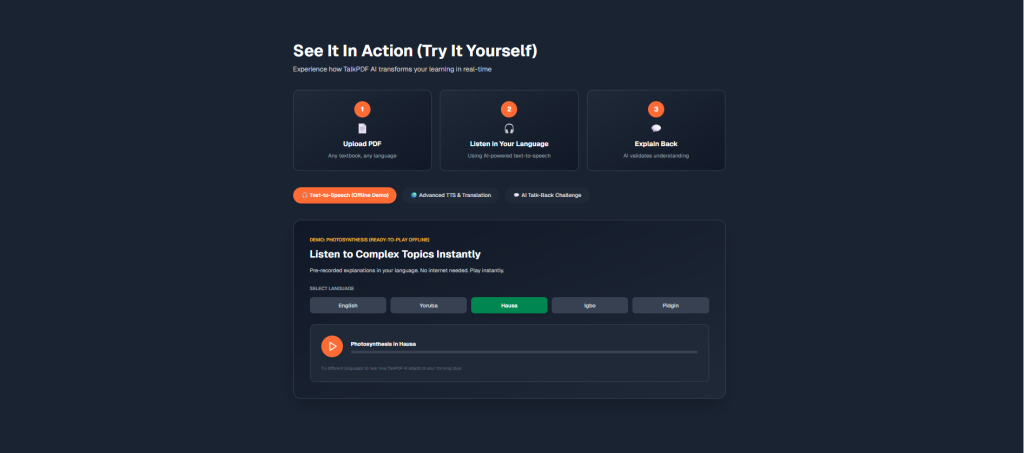
TalkPDF AI wants to turn PDFs into interactive tutors in local languages (Edtech, Nigeria)
TalkPDF AI is an AI-powered learning assistant built to help students move from regular memorisation to real understanding. The idea came when founder Lukman Abimbola saw his younger sister struggle to prepare for her West African Senior School Certificate Examination (WASSCE). Despite spending hours rereading chemistry textbooks, she could not explain basic concepts because she was memorising words instead of trying to understand the concepts. Her breakthrough came when Abimbola asked her to explain the ideas back to him in Yoruba, as if she were teaching a younger cousin.
That moment shaped Abimbola’s core insight: that many students fail because they are forced to learn complex ideas in a second language, with no way to validate whether they truly understand what they’ve studied. To solve this language-induced learning crisis, TalkPDF AI converts textbooks and PDFs into an interactive audio tutor in English, Yoruba, Hausa, Igbo, and Pidgin. A student uploads a text-based study material, and the system instantly converts it into natural-sounding audio in the learner’s preferred language.
As the student listens, the AI pauses at key concepts and activates what Abimbola calls an explain-back mode, asking the learner to explain the idea in their own words. If the student repeats textbook jargon or gives a memorised definition, the system pushes back and asks for a simpler explanation, prompting them to explain as if they were teaching a 10-year-old. Each chapter is graded with an understanding score, as users can earn bronze, silver, or gold badges. The system also schedules spaced repetition for concepts the learner has not fully mastered.
TalkPDF AI is currently in beta and has sold 43 out of 50 paid beta slots, with full launch scheduled for early 2026. The startup operates a freemium model, with a limited free tier offering five minutes of audio per day, and a Student Pro plan priced at ₦40,000 ($27.47) yearly, which includes unlimited uploads, full explain-back mode, offline downloads, and all supported languages.
Why we’re watching: TalkPDF AI stands out from competitors like uLesson, Gradely, and MyLesson for combining active learning with local-language support. By merging active validation, which refuses to let students fake understanding, with offline functionality and local language support, the startup addresses African infrastructure challenges of data costs and language barriers.
TalkPDF AI is planning B2B licensing deals with universities, the West African Examinations Council (WAEC), the Joint Admissions and Matriculation Board (JAMB), and an expansion into K–12 exam preparation. The startup is preparing a pre-seed raise to fund product development, campus ambassadors, and university pilots.
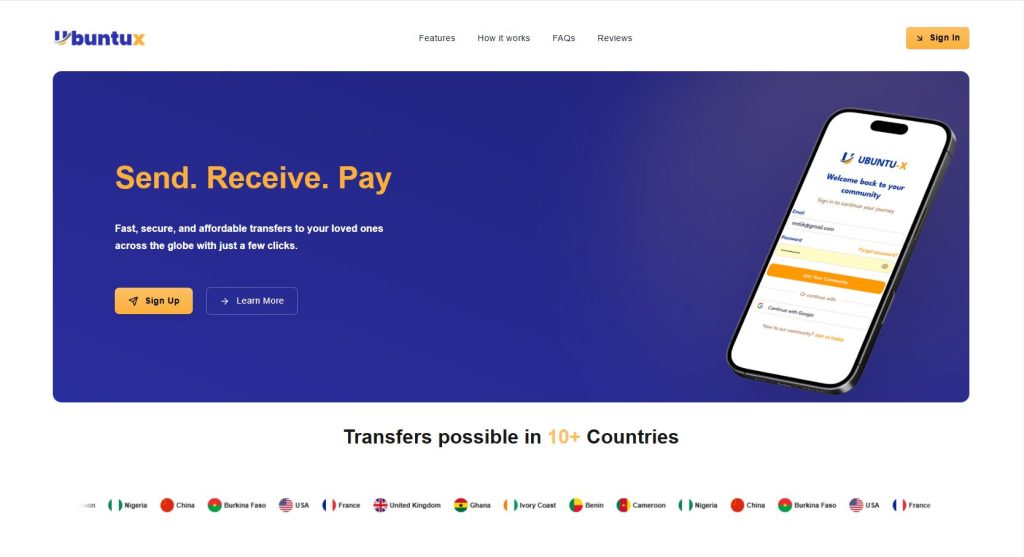
Ubuntu X wants to unlock global payments for Francophone Africa (Fintech, Cameroon)
Founded by Manuel Songfack, Njinowo Brandon, Miamo Karl, and Fitzgerald Mouliom, Ubuntu X is a Cameroon-based cross-border payments and remittance startup building infrastructure to move money seamlessly across African countries and the rest of the world. The founders observed that global transactions from the U.S. or Europe are seamless. However, sending money from Cameroon to neighbours like Nigeria or Benin or to major trade hubs like China remains slow and expensive.
Ubuntu X is building a mobile-native payment gateway that connects local payment methods across countries. Its solution is a ‘network of networks’ that connects local mobile money wallets, including MTN and Orange Money, directly to international payment endpoints such as Alipay in China and Access Bank in Nigeria. The system currently supports remittances and payments, with plans to add cryptocurrency purchases and virtual cards.
Users sign up on the web platform, complete a one-time know-your-customer (KYC) process that includes personal details, ID upload, and a selfie check. Once verified, they select their local payment method and input the receiver’s details. The founders claim that transactions are reviewed by validators and are typically completed within 5 to 10 minutes.
Ubuntu X launched operations in January 2025 and initially processed transactions manually, using stablecoins and merchant accounts in destination countries before it began automating workflows through APIs. The startup charges between 2% and 4% on remittance transactions, 1% on payments, and plans to charge 1% each on crypto purchases and virtual card issuance.
Why we’re watching: Ubuntu X is tackling the persistent problem of fragmented payment rails across African countries. While regional remittance startups like Reasy facilitate transfers to China, it requires the recipient to have a Chinese bank account, whereas Ubuntu X integrates directly with digital wallets like Alipay. Similarly, legacy players like MoneyGram rely on an agent-to-agent model that requires physical presence. The startup also positions itself against crypto platforms like Binance by promising simpler onboarding and direct mobile money integration.
Ubuntu X claims to have processed over 100 million CFA ($178,000) in remittance volume, with over 55% of transactions flowing from African countries to China. The startup is planning to raise $200,000 for product development and plans to launch virtual cards by June 2026 to further democratise online spending for users who cannot afford traditional prepaid bank cards.

SabiScholar wants to make online learning work offline for Nigerian students (Edtech, Nigeria)
Founded by Divine Iloh, a US-based data analytics manager, SabiScholar is a learning management system (LMS) for secondary schools and universities to deliver courses, resources, assignments, assessments, and results digitally. The product was born from Iloh’s insights into the limitations of digital learning platforms like the National Open University, which still requires students to take physical classes.
On the platform, schools can access an array of curriculum-aligned courses, currently covering WAEC, JAMB, and NECO subjects. Institutions can import SabiScholar’s own internal learning material or upload materials of their own. It also allows teachers to manage students, mark assignments, track results, and view performance dashboards. On the other side, students can log in, learn through video courses, complete assignments, and access school resources.
So far, the startup claims to have completed a pilot phase involving around 2,900 secondary school students across Nigeria, who used the platform to prepare for O-level exams.
Although the platform is currently online-only, SabiScholar is designing an offline delivery model built on AI. The approach uses predictive downloading to ensure that learning isn’t disrupted by poor bandwidth. This AI teacher monitors a student’s deadlines and network availability, automatically pre-downloading course materials during off-peak hours or whenever a stable connection is detected. This ensures assignments and videos are available on the device before they are due.
The platform also includes a career recommendation engine, SabiCareer, that uses student history and subject preferences to suggest career paths and universities. SabiScholar expects revenue to come from state-level and institutional partnerships, where governments and schools subscribe to deliver digital learning at scale.
Why we’re watching: SabiScholar is distinguishing itself by solving the infrastructure hurdles that limit edtech adoption in Africa, specifically bandwidth reliability. Unlike global competitors such as Coursera or Udemy, which may lack local context, SabiScholar is building for schools, empowering them with infrastructure, curriculum, content, and operations, rather than going directly to the consumer.
Get The Best African Tech Newsletters In Your Inbox
Bit68 wants to replace traditional apps with agentic AI interfaces (Software Development, Egypt)
Founded in 2014 by software engineer Ibrahim Gharbawi, Bit68 is a software services company that builds and scales products for entrepreneurs and corporate clients, with a growing focus on AI-driven and agentic interfaces. The company started as a web development firm but has expanded its services to include e-commerce, mobile applications, digital transformation, and AI-enabled solutions.
With a team of about 80 people, Bit68 operates as a consultancy rather than a product-based business, conducting brainstorming sessions with stakeholders to define solutions that automate internal processes efficiently. Bit68 interfaces with Large Language Models (LLMs), including paid, open-source, and pre-trained models, directly with a client’s database, allowing users to interact with services through a chat interface rather than standard application menus.
Why we’re watching: As more businesses move to adopt AI into their product offerings, Bit68 stands out with its approach to integrating AI into a user’s product. Instead of treating AI as a bolt-on feature, the company is actively pushing clients toward agentic interfaces that sit on top of existing databases and services. The company’s recent partnership with South Africa-based offshoring firm SoluGrowth to grow its South African presence and its expansion beyond Egypt into the MENA region suggests Bit68 is positioning itself as a cross-regional partner for AI-led digital transformation.
That’s all for today. Expect our next dispatch on December 19th. Know a startup we should feature next? Please nominate here.

OpenAI is in talks to raise up to $100 billion in a funding round that could value the ChatGPT maker at up to $830 billion, the Wall Street Journal reported Thursday, citing anonymous sources.
The company is aiming to raise the funding by the end of the calendar first quarter next year, and it may ask sovereign wealth funds to invest in the round, the WSJ reported. The Information first reported news of the deal, though it said the fundraise would land OpenAI a $750 billion price tag.
The funding would come as OpenAI commits to spend trillions of dollars and strikes deals around the world as the company tries to stay ahead in the race to develop AI technology. The cash injection would also help the company with its spending on inferencing, which seems to be funded more by cash than cloud credits, suggesting the company’s compute costs have grown beyond what partnerships and credits can subsidize.
And, as competition intensifies from rivals like Anthropic and Google, OpenAI has had to step on the gas to release new models and expand its presence in the developer and tooling ecosystem.
Meanwhile, broader sentiment around AI has recently cooled as investors start doubting whether the pace of debt-fueled investment by giants like Amazon, Microsoft, Oracle, and OpenAI itself can be maintained in the long run. It also doesn’t help that the production of chips is being constrained by shortages in the supply of memory chips, which threatens to affect the broader tech sector.
OpenAI has also been rumored to be working on an IPO as a way to raise tens of billions and fund its development efforts, which are currently said to be generating annual run-rate revenue of about $20 billion. There are also rumors that the company is courting Amazon for a $10 billion investment that would also give the AI lab access to the tech giant’s new AI computing chips.
If the fundraise happens, it would add a substantial amount to OpenAI’s coffers, which currently have more than $64 billion, according to PitchBook data. The company was most recently valued at about $500 billion in a secondary transaction.
OpenAI did not immediately return a request for comment.
Techcrunch event
San Francisco
|
October 13-15, 2026
Image: Techloy.com
If you use Snapchat or WhatsApp a lot, you would have noticed the AI assistants sitting right inside your chats. You did not download a new app or turn on a special setting. They simply showed up. On Snapchat, it is called MyAI, while on WhatsApp, it is Meta AI, built directly into the messaging experience. As these apps become central to how people talk, work, and share information every day, it is worth asking how useful these AI tools really are.
Snapchat MyAI is an AI chatbot that appears as a chat contact inside Snapchat. Users can talk to it like a friend, ask questions, get advice, or request ideas for things like trips or captions. Meta AI in WhatsApp is an AI assistant built into the WhatsApp interface itself. Instead of acting like a friend, it works more like a tool users can access while chatting. It helps answer questions, explain information, and assist with messaging tasks.
This difference in design raises an important question: which AI assistant actually helps more in everyday chats?
Snapchat partners with Perplexity in a $400 million deal to integrate AI search into Snapchat
A quick search can pull you out of Snapchat. With Perplexity built into chat, it seems Snap is trying to keep that flow unbroken.
/1. How They Work Inside the App
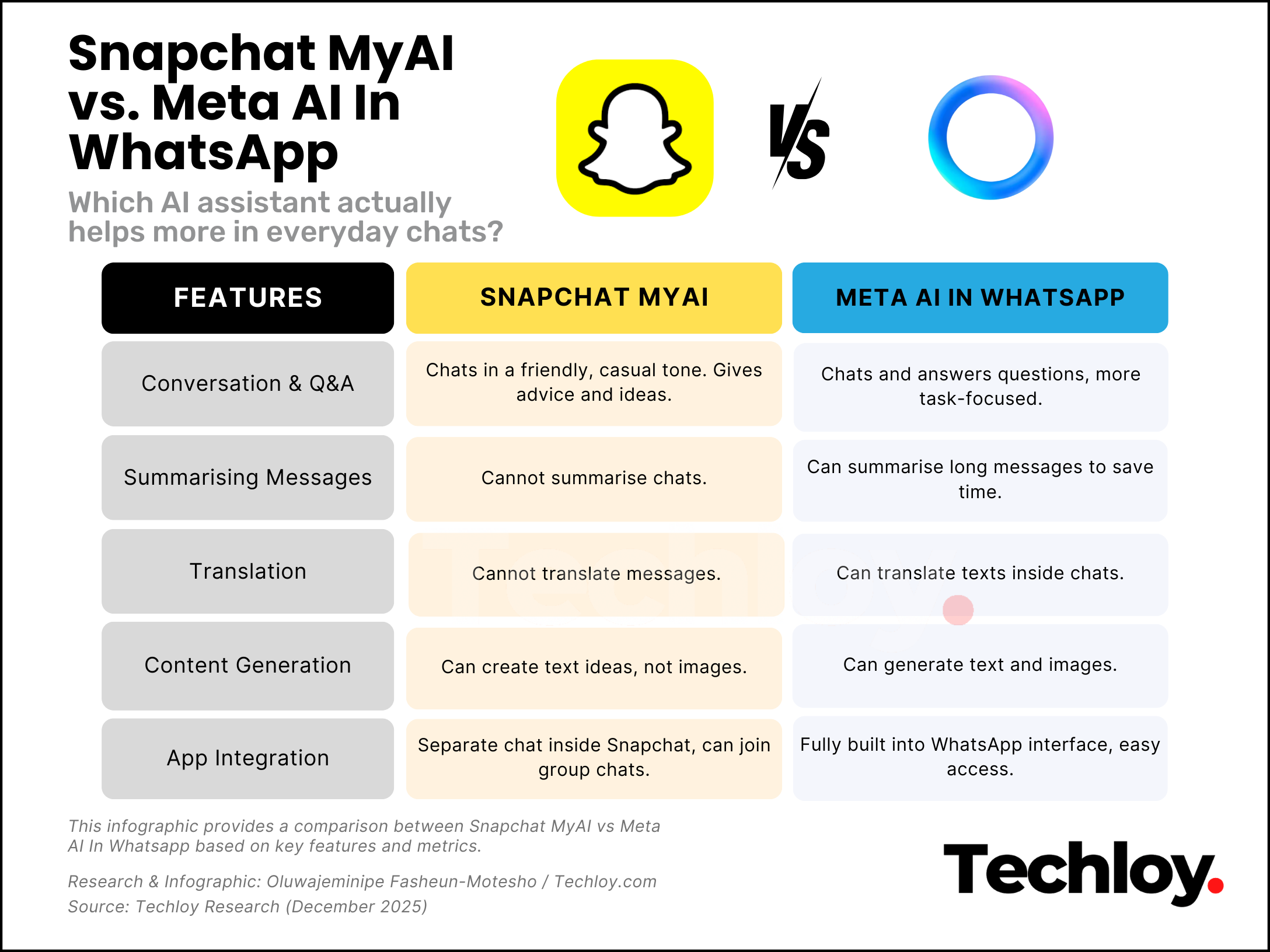
How they work inside the app matters because it affects how easily you can use the AI while chatting. Snapchat MyAI works as a separate chat. You open it, type your question, and receive a reply. The experience feels like chatting with a smart digital friend. It stays mostly in its own space, although it can be mentioned in group chats. This makes it simple but also slightly detached from other conversations.
Meta AI in WhatsApp is deeply integrated into the app. Users can access it through an AI button or inside chats without leaving their conversation. This makes it easy to use while messaging and reduces friction. It feels like part of the messaging flow rather than a separate feature.
💡
Verdict: Meta AI in WhatsApp offers a smoother and more natural experience because it blends directly into messaging, while Snapchat MyAI feels more like a standalone chat.
/2. Features and Capabilities
The features and capabilities of each AI show what they can actually do to help you during chats and how useful they are for different tasks. Snapchat MyAI focuses mainly on text based interaction. It can answer questions, give suggestions, help with writing, and offer creative ideas. However, its feature set is limited to conversation and simple assistance. It does not provide tools like chat summaries or translations.
Meta AI in WhatsApp offers more advanced features that support communication. It can summarise long chats, translate messages into different languages, explain links, and generate text or images. These tools are especially helpful in busy group chats or work related conversations where time and clarity matter.
💡
Verdict: Meta AI in WhatsApp clearly offers more powerful and useful features, while Snapchat MyAI is better suited for casual and creative conversations.
/3. Privacy and Data Handling
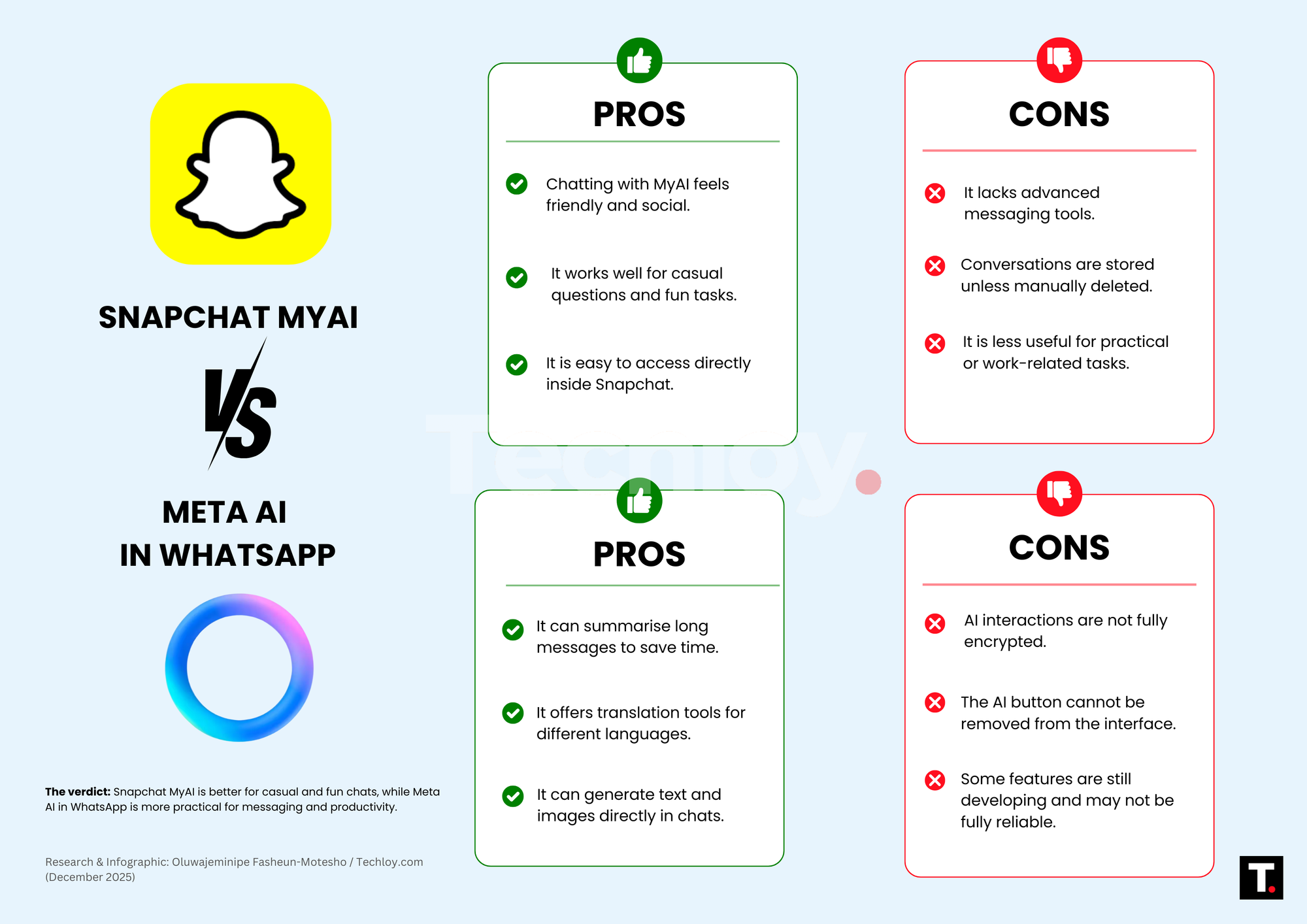
How each AI handles privacy and data matters because it affects what happens to your conversations and how secure your information is. Snapchat MyAI stores conversations until users delete them. These chats may be used to improve the AI experience and personalise responses. Because it lives inside Snapchat, the data may also influence recommendations within the app.
WhatsApp messages remain end to end encrypted, which protects normal chats. However, conversations with Meta AI are not encrypted in the same way. These interactions can be stored and used by Meta to improve the AI system. This creates a separation between private chats and AI usage.
💡
Verdict: Neither option offers full privacy for AI interactions, but WhatsApp still protects normal messages better than Snapchat protects AI chats.
/4. Ease of Use and Practical Value
An AI that feels intuitive and practical can make daily messaging smoother and more efficient. Snapchat MyAI is easy to use for people already comfortable with Snapchat. Opening a chat and talking feels natural and familiar. It works best for relaxed use and casual questions.
Meta AI in WhatsApp is designed for frequent and practical use. Because it sits inside messaging, users can access help without breaking their conversation flow. This makes it more valuable for daily communication, especially for work and group chats.
💡
Verdict: Meta AI in WhatsApp is more practical for everyday use, while Snapchat MyAI is easier for casual and social interaction.
Final Verdict
Snapchat MyAI and Meta AI in WhatsApp reflect two different approaches to AI in social apps. Snapchat MyAI focuses on friendly conversation and creative help inside a social platform. It works well for users who want an AI that feels like a chat companion. Meta AI in WhatsApp focuses on improving communication by offering tools that save time and reduce effort in messaging.
Overall, Meta AI in WhatsApp delivers more value for users who rely on messaging for work, family, and daily coordination. Snapchat MyAI remains a good option for relaxed and fun interaction. If usefulness and productivity matter most, Meta AI is the better choice. If social engagement and conversation matter more, Snapchat MyAI is worth using.
Meta Starts Mining Your AI Conversations for Ads Today — Here’s What That Actually Means
Every question you ask Meta AI is now a data point in the company’s advertising engine. And unlike past privacy changes, there’s no direct way to opt out.

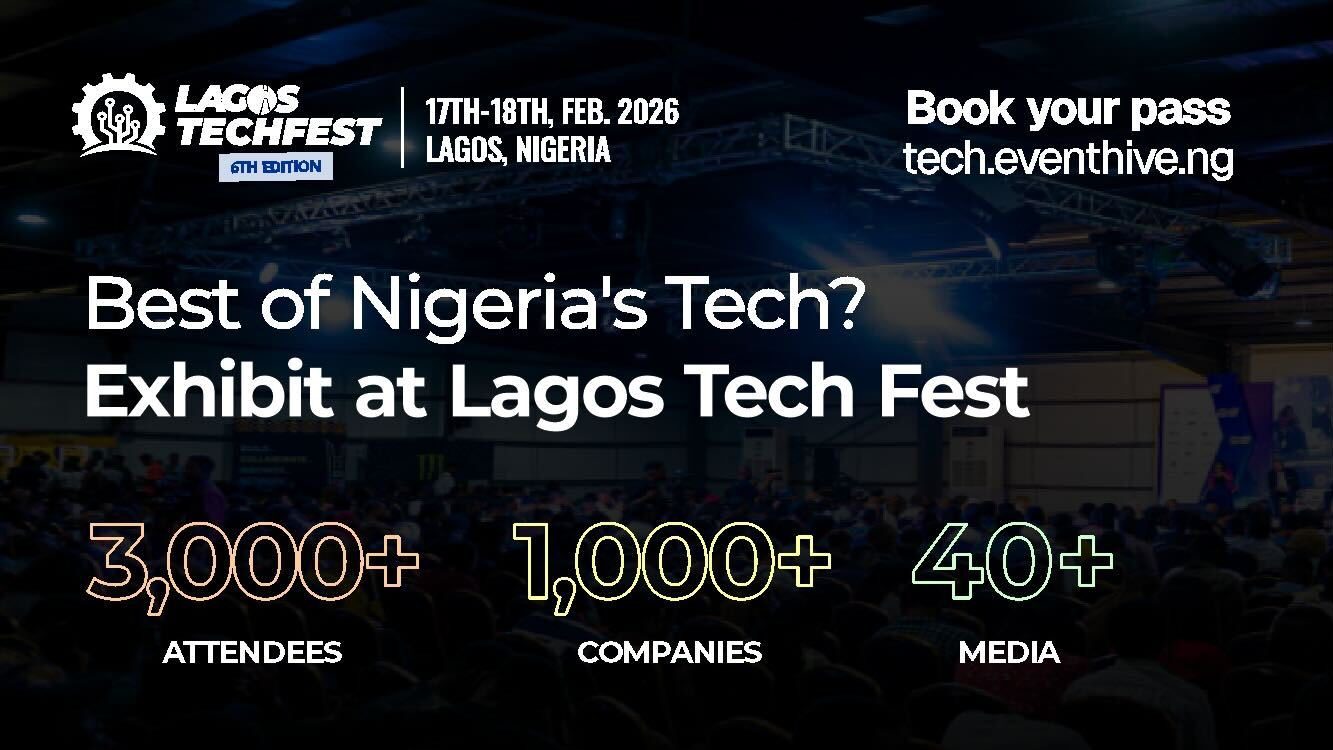
Eventhive, Africa’s leading B2B2C event servicing company with a strong portfolio across key sectors and six major cities, is thrilled to announce the sixth edition of its flagship event, the Lagos Tech Fest.
The event is part of the Africa Tech Series, Eventhive’s pan-African platform for technology and innovation dialogue, which hosts fintech-focused gatherings in Lagos, London, Nairobi, Kigali, and Johannesburg.
The Lagos Tech Fest returns to convene tech leaders, emerging startups, innovators, investors, global tech giants, and government representatives to define the future of Nigeria’s tech ecosystem, address key developments, and uncover countless opportunities within the Nigerian and African tech market.
Combining conferences, roundtables, an industry party, pitch live events, exhibitions, and networking, the event annually creates a veritable platform that seeks to drive investments into the ecosystem.
The 2026 edition promises to be the largest yet, with projections of 3,000+ attendees, 70+ industry leading speakers, and representation from 1,000+ companies across more than 25 countries, supported by over 80+ sponsors and 40+ media partners.
This year, the event will introduce four distinct stages designed to cater to diverse interests and facilitate deeper, focused discussions: the Money Stage, Off The Record Stage, Innovation Stage, and Founder Stage.
The Lagos Tech Fest 2026 is set to take place across three major venues in Lagos: Fourpoints By Sheraton and The Garden in Ikoyi/VI on February 17, 2026, and the Landmark Event Centre in Victoria Island, Lagos, on February 18, 2026.
Ahead of the main event, the annual Nigeria’s Tech Leadership Roundtable returns on February 17, 2026, bringing together strictly C-level executives and government representatives at Fourpoints By Sheraton, VI, Lagos, for exclusive, high-level engagement to chart the future of the ecosystem.
Key highlights also include the Nigeria State’s Pavilion, which will showcase the vibrant tech ecosystems across multiple Nigerian cities, and a Larger Expo focused on showcasing transformative solutions defining the next decade of Nigeria’s tech ecosystem.
An industry party, After Dark Hours, will provide a dedicated networking session at The Garden, Ikoyi, Lagos, on the evening of February 17, 2026.
Commenting on the launch of the sixth edition, Jamiu Ijaodola, CEO of Eventhive, said: “Lagos Tech Fest is the annual engine room where the blueprint for Nigeria’s digital future is drawn. As we launch our sixth edition, we are seeing unprecedented convergence of finance, talent, and innovation.
The introduction of our four focused stages will ensure every participant leaves with actionable insights and valuable connections. We are committed to not only hosting Nigeria’s best but also creating the crucial platform that drives billions of dollars in investment and collaboration needed to solidify Nigeria’s position as Africa’s undisputed tech leader.”

The 2026 edition boasts a powerhouse line-up of confirmed speakers, including, Uzoma Dozie (CEO, Sparkle), Tayo Oviosu (CEO, Paga), Olumide Balogun (Director, West Africa, Google), Tosin Faniro-Dada (Partner, Breega), Takuma Terakubo (CEO & General Partner, Uncovered Fund Inc.), Kazeem Tewogbade (CEO, Bluechip Technologies), Emeka Ajene (Founder & CEO, Afridigest), Ojoma Ochai (MD, CcHub Africa), Adedeji Olowe (Founder, Lendsqr), Napa Onwusah (Managing Partner, PlacidCode Labs), Dr. Abasi Ene-Obong (CEO, Syndicate Bio), Lexi Novitske (General Partner, Norrsken22), Victoria Fabunmi (National Coordinator, Nigerian Digital Innovation, NITDA), Olaniyi Yusuf (Managing Partner, Verraki Partners), Abdelaziz Saidu (Country General Manager, Nigeria & Ghana, Cisco), Dr Ayotunde Coker (CEO, Open Access Data Centers), Adekanbi Oluwaseun (Growth Lead, Cleva), Chichi Nwoko (CEO, What Media Group), Francis Sani (Programme Director, 3MTT), Adesuwa Omoruyi (Co-founder, Accrue), and Akpor Ikogho (Managing Partner, Mark Renee LP).
The event is made possible by the strong support of confirmed sponsors including Odoo, Open Access Data Center, Paga, Tetrad, Cleva, Keystone Bank, Accrue, Radiant Money, Radiant Digilog, and Mark Renee LP.
For more information about Lagos Tech Fest or to explore partnership opportunities, please visit https://tech.eventhive.ng/.