
WORLD NEWS
Russia investigates car bomb death of general – Europe live | Europe

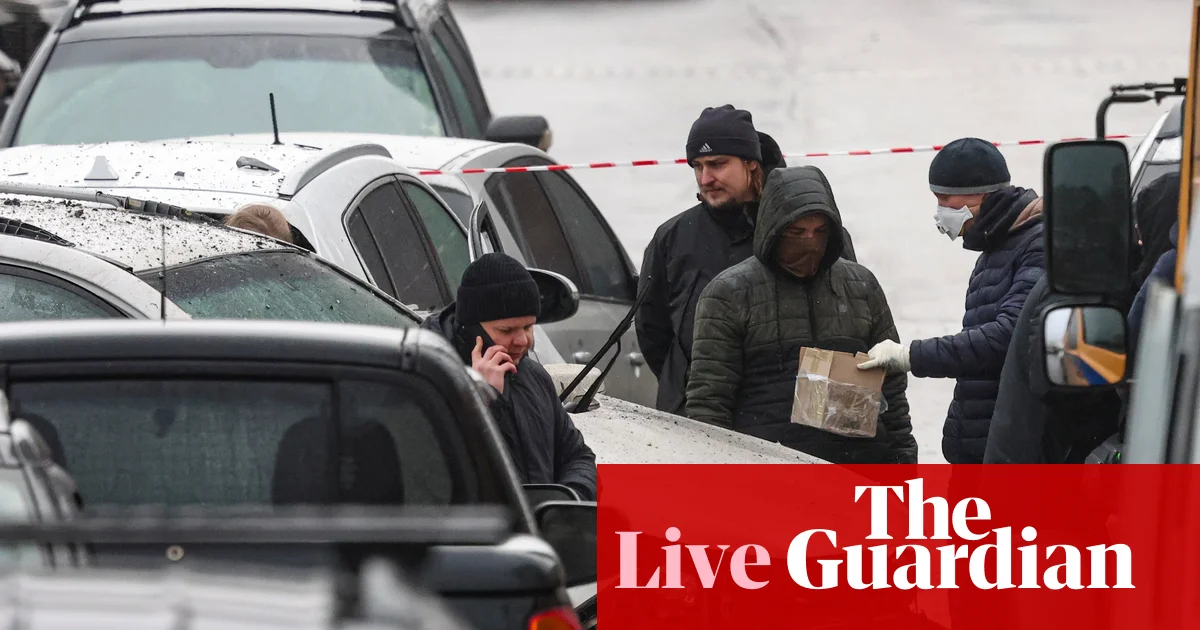
Russian general killed by car bomb in southern Moscow, investigators say
A Russian general was killed this morning after an explosive device detonated underneath his car in southern Moscow, investigators said.
Lt Gen Fanil Sarvarov, the head of the operational training directorate of the Russian armed forces’ general Staff, died from his injuries, Svetlana Petrenko, official spokesperson for Russia’s Investigative Committee, said.
“Investigators are pursuing numerous lines of inquiry regarding the murder. One of these is that the crime was orchestrated by Ukrainian intelligence services,” Petrenko said.
An investigator at the scene where Lt Gen Fanil Sarvarov was killed by a car bomb in Moscow on Monday. Photograph: Russian Investigative Committee Handout/EPA
Russian news outlets reported that a car exploded in a parking lot on Moscow’s Yaseneva Street with the driver inside at approximately 7am.
Ukraine’s security service claimed responsibility for a similar attack against a high-ranking Russian soldier in December 2024.
Lt Gen Igor Kirillov, the chief of the military’s nuclear, biological and chemical protection forces, was killed by a bomb hidden on an electric scooter outside his apartment building a day after Kyiv levelled criminal charges against him. His assistant, Ilya Polikarpov, was also killed. I will bring you all the key updates on this story – and plenty of others – throughout the day.
Share
Key events
Show key events only
Please turn on JavaScript to use this feature
Ukrainian President Voldymrr Zelenskyy has signalled that he is prepared to drop Ukraine’s desire for Nato membership if he can get robust security guarantees from the west.
This represents a huge shift for Ukraine, which has fought to join Nato as a safeguard against Russian attacks. Kyiv has so far held firm against ceding territory to Moscow.
Ukrainian President Volodymyr Zelenskyy speaks with Steve Witkoff ahead of a Ukraine summit in December 2025. Photograph: ANP/Shutterstock
Russian President Vladimir Putin has repeatedly demanded that Ukraine officially renounce its Nato ambitions and withdraw troops from approximately 10% of Donbas that Kyiv still controls. Moscow has also said that Ukraine must be a neutral country, and that no Nato troops can be stationed there.
Share
Updated at 10.59 CET
No apparent breakthrough after Ukraine talks held in Miami
US and Ukrainian envoys have said that “productive and constructive” talks have taken place in Miami, despite there being no apparent breakthrough in finding a way to end Russia’s war in Ukraine.
“Over the last three days in Florida, the Ukrainian delegation held a series of productive and constructive meetings with American and European partners,” Donald Trump’s envoy Steve Witkoff and top Ukrainian negotiator Rustem Umerov said in separate statements on X on Sunday. Witkoff posted:
“Our shared priority is to stop the killing, ensure guaranteed security and create conditions for Ukraine’s recovery, stability and long-term prosperity. Peace must be not only a cessation of hostilities, but also a dignified foundation for a stable future.”
Separate talks have been taking place in Miami between the US and the Russian envoy and businessman, Kirill Dmitriev.
There has been weeks of intense diplomatic activity sparked by the leaking of a 28-point US proposal to end the war which alarmed Kyiv and Europe as it was widely seen as favourable to Moscow (it called on Ukraine to withdraw from cities it controls in the eastern Donbas region, limit the size of its army, and not join Nato).
Negotiators for Russia, Ukraine, Europe and the US have been hashing out proposals over the last couple of weeks, but Kyiv and Moscow have been unable to agree on major issues, such as the Kremlin’s demand to keep land it has seized.
Share
Updated at 10.57 CET
Tomahawks should go to Ukraine if Putin rejects proposal to end war, Lindsey Graham says
Speaking on NBC’s Meet the Press on Sunday, US senator Lindsey Graham said the American team negotiating with Russia and Ukraine to bring an end to the war are “overestimating” Vladimir Putin’s “willingness” to end the conflict.
Graham, a South Carolina Republican and close Trump ally, suggested that Washington should intensify pressure on Moscow – including supplying Ukraine with Tomahawk cruise missiles – if Vladimir Putin refuses to accept a negotiated proposal.
Ukraine has been seeking Tomahawk missiles to carry out long-range strikes against Russia, but without them has still been able to wage a successful campaign using its own drones and missiles against Russian military and strategic targets such as oil depots and refineries. Donald Trump told reporters last month that he was “not really” considering supplying Ukraine with long-range Tomahawk cruise missiles, but said he could change his mind in the future.
In his interview with NBC, Graham said “great progress” had been made by Kyiv, Washington and European leaders to come up with a proposal to end the war, adding that he wants European troops “on the ground” and US security guarantees to Ukraine to prevent a “third invasion”.
“We are not going to evict every Russian out of Ukraine, understand that,” the Senator said. “I think Putin is going to continue to take the Donbas by force until we increase pressure.”
Graham added:
We are going to be Lucy with the football if we don’t watch it. We keep engaging Russia, we keep trying to lure Putin to the peace table and he rebuffs all of our efforts.
If (Putin) says no this time, here’s what I hope president Trump will do: Sign my bill that has 85 co-sponsors and put tariffs on countries like China who buy cheap Russian oil.
Make Russia a state sponsor of terrorism for kidnapping 20,000 Ukrainian kids. And most importantly, seize ships that are carrying sanctioned Russian oil like you’re doing in Venezuela.
Share
A Ukrainian drone attack damaged two vessels and two piers and caused a fire in a village on the Black Sea coast in Russia’s Krasnodar region, regional authorities said on Monday.
All crew on the ships at the Volna terminal on the Black Sea had been safely evacuated, the Krasnodar region’s operational headquarters said in a post on Telegram. The damage led to a fire spreading up to 1,500 sq metres, authorities said.
Share
Russian general killed by car bomb in southern Moscow, investigators say
A Russian general was killed this morning after an explosive device detonated underneath his car in southern Moscow, investigators said.
Lt Gen Fanil Sarvarov, the head of the operational training directorate of the Russian armed forces’ general Staff, died from his injuries, Svetlana Petrenko, official spokesperson for Russia’s Investigative Committee, said.
“Investigators are pursuing numerous lines of inquiry regarding the murder. One of these is that the crime was orchestrated by Ukrainian intelligence services,” Petrenko said.
An investigator at the scene where Lt Gen Fanil Sarvarov was killed by a car bomb in Moscow on Monday. Photograph: Russian Investigative Committee Handout/EPA
Russian news outlets reported that a car exploded in a parking lot on Moscow’s Yaseneva Street with the driver inside at approximately 7am.
Ukraine’s security service claimed responsibility for a similar attack against a high-ranking Russian soldier in December 2024.
Lt Gen Igor Kirillov, the chief of the military’s nuclear, biological and chemical protection forces, was killed by a bomb hidden on an electric scooter outside his apartment building a day after Kyiv levelled criminal charges against him. His assistant, Ilya Polikarpov, was also killed. I will bring you all the key updates on this story – and plenty of others – throughout the day.
Share
SOURCE PAGE












- Have YOU been affected? Email tom.lawrence@dailymail.co.uk
A major incident has been declared after a huge sinkhole opened up beneath a canal in Shropshire.
Emergency services are on the scene in the Chemistry area of Whitchurch after the gaping hole, around 50 metres by 50 metres in size, started to develop at 4.22am.
Firefighters were called to rescue occupants of three narrowboats after the section of the canal they were moored in completely drained of water.
Crews battled through ‘unstable ground and rapidly moving water’ as they began the rescue.
The crews helped rescue more than 10 members of the public.
The canal bank collapsed leaving large volumes of water escaping into the surrounding land.
Residents have been urged to avoid the area, while they respond to the incident.
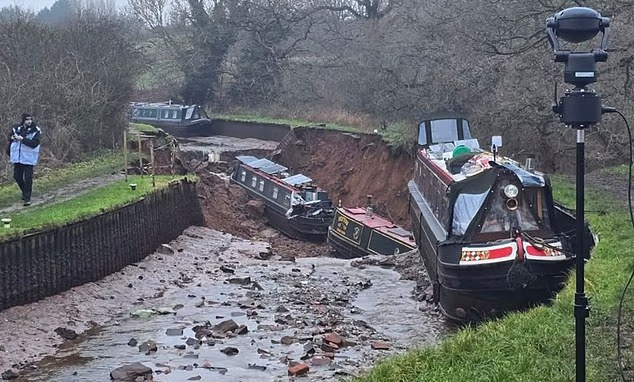
A sinkhole, 50 metres by 50 metres in size opened up in a canal in Shropshire

Firefighters rushed to rescue around 10 crew members from canal boats as the sinkhole opened up

Three boats were caught up in a section of the canal which completely drained with water
Fire crews were joined by West Mercia Police, West Midlands Ambulance Service (including HART), the Canal & River Trust, the Environment Agency, local authority emergency planning officers, and National Resilience.
A spokesperson for Shropshire Fire and Rescue Service said: ‘Firefighters have been working in challenging conditions with unstable ground and rapidly moving water, crews immediately established upstream and downstream safety sectors and began mitigating water flow using barge boards and water gate systems.’
Area Manager Scott Hurford added: ‘We can confirm no persons are believed to be on board the affected canal boats, and no injuries have been reported.
‘Approximately 12 residents from nearby moored boats are being supported and relocated to a welfare centre at the former Whitchurch Police Station.
‘A major incident was declared at 5.17am however as of 8.30am the situation was stable with water flow reduced and there is no ongoing search and rescue activity.
‘Multiagency attendance remains in place to manage the environmental impact, protect nearby properties, and ensure public safety. Please avoid the area while we continue to deal with this significant incident.’
A spokesperson for West Mercia Police said: ‘A major incident had been declared in Shropshire following reports of a sinkhole affecting a canal in the Chemistry area of Whitchurch.
‘Emergency services are currently on scene, and a multi-agency response has been set up, co-ordinated through the Shropshire Tactical Co-ordination Group (TCG).
‘There are currently no reports of any casualties, and residents are being assisted by the fire service.
‘We ask that people avoid the area and seek alternate routes. Further updates will be provided when we are able to do so.’
This is a breaking news story. More to follow
Share or comment on this article:
Major incident declared in Shropshire as huge sinkhole swallows canal


Dramatic pictures show a gaping hole in the section of canal in the Chemistry area of Whitchurch
SOURCE PAGE


NewsFeed
A Russian general was killed in Moscow on Monday when an explosive device detonated underneath his car. Authorities say they are investigating whether Ukrainian special services were involved.
Published On 22 Dec 2025
Click here to share on social media
share2
WORLD NEWS
Bondi gunmen threw explosives at start of attack and practised shooting weeks before, police allege


Helen Livingstone,Sydneyand
Emily Atkinson
 Supplied
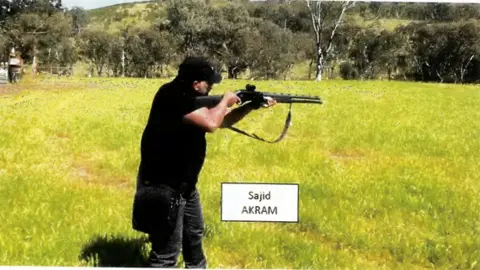
A screenshot from a video found on Naveed Akram’s phone shows his father conducting firearms training, police allege
The suspected gunmen in the Bondi Beach attack threw explosives at the start of the deadly incident and had practised shooting weeks before, according to new court documents.
They allege the pair “meticulously” planned the attack for several months and, two days prior to the shooting, visited Bondi for reconnaissance.
Fifteen people were killed and dozens more injured when two gunmen opened fire on a Hanukkah celebration on 14 December. Explosives, including a “tennis ball bomb”, failed to detonate, according to the documents.
Naveed Akram, 24, has been charged with 59 offences, including 15 counts of murder and one of terror. A second gunman – his father, Sajid Akram – was shot dead by police at the scene.
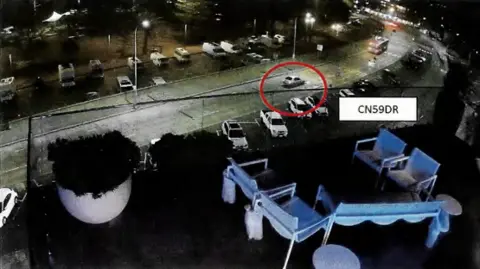 Supplied

CCTV shows the Akrams carrying out reconnaissance two days ahead of the Bondi Beach attack, police allege
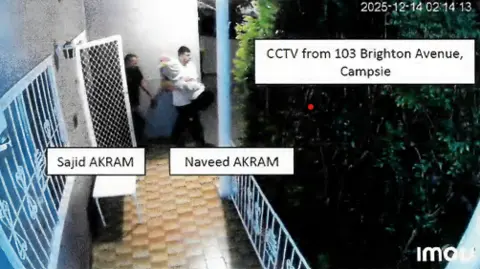 Supplied
A screenshot from CCTV shows the Akrams carrying ‘bulky items’ hours before the attacks, police allege
Last week, a temporary suppression order was made on the release of the police fact sheet to protect the identities of the survivors. It was revoked on Monday and the documents were published with some redactions.
Included are the details of several videos tracing the movements of the alleged gunmen in the months, days and hours before the attack.
One video – taken on one of their mobile phones in October – is described as showing the men sitting in front of an image of an Islamic State group (IS) flag.
They are heard making statements about their motivations for the attack and condemn “the acts of ‘Zionists'”, police say.
Naveed Akram is also “recorded appearing to recite, in Arabic, a passage from the Quran”.
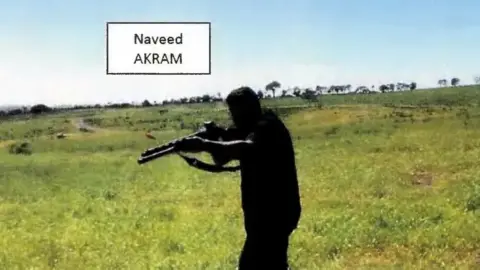 Supplied
Another screengrab that police say shows Naveed Akram conducting firearms training in a countryside location
Police said separate footage from October shows the father and son “conducting firearms training in a countryside location”, believed to be in New South Wales. They are seen “firing shotguns and moving in a tactical manner”, officials added.
CCTV footage from the evening of 12 December is said to show two males “believed to be the accused and his father” in their car next to Bondi Beach.
“The accused and his father, S Akram, are seen to exit the vehicle and walk along the footbridge, being the same position where they attended two days later and shot at members of the public,” the document states.
“Police allege that this is evidence of reconnaissance and planning of a terrorist act.”
 Supplied
Two Islamic State group (IS) flags were hung inside the gunmen’s vehicle before they launched the attack, the documents allege
At around 02:00 (15:00 GMT) on the day of the attack, two men were captured on CCTV leaving rented accommodation in the Sydney suburb of Campsie “carrying long and bulky items wrapped in blankets”, which they placed into a car.
The documents note these include two single barrel shotguns, a Beretta rifle, four improvised explosive devices (IEDs) and two IS flags.
Police say shortly after 17:00 (08:00 GMT), the men were seen leaving the rental. Separate footage captures them arriving at Bondi at 18:50 (09:50 GMT), where they parked and placed the flags on the inside of the front and rear windows.
They are then seen removing the firearms and IEDs from the car, before walking towards a footbridge, according o the documents.
It was from this location that police believe they threw the explosives – three pipe bombs and a “tennis ball bomb” – towards the crowd, though none exploded.
A short time later, they used the firearms to shoot towards the crowd, police say. Fourteen people were killed at the scene. One other died from their injuries later in hospital.
Sajid Akram was shot and killed during an exchange of fire with New South Wales Police officers.
Naveed Akram was critically injured by police fire. He was released from hospital on Monday and transferred to a prison.
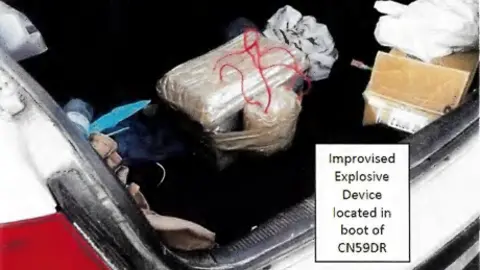 Supplied
Police allege a homemade bomb was found in the boot of the Akrams’ vehicle
 Supplied
Police say that the weapons used by the gunmen included three pipe bombs
In the week since the deadly attack, politicians have faced mounting criticism after a rise of antisemitic attacks over the past few months.
On Sunday, Australian Prime Minister Anthony Albanese was booed by sections of the crowd at a memorial event attended by tens of thousands of people.
He apologised to the Jewish community and proposed to push for new legislation against extremism and hate speech.
The attack has also sparked calls for tougher restrictions on gun ownership.
On Monday, New South Wales state recalled its parliament to debate a raft of new gun and protest laws, proposed in the wake of the shooting.
Some civil rights groups and pro-gun advocates have raised concerns that the laws will place undue restrictions on firearms and protests.
NSW Premier Chris Minns said some may feel the changes had “gone too far” but they were needed to keep the community safe.


Even in Paris’s hard-drinking intellectual circles, French philosopher and feminist icon Simone de Beauvoir found that a glass of wine hit harder than expected. De Beauvoir once joked that two glasses left her feeling quite dizzy, long before any existential debates began.
Decades later, science can explain why: Women’s bodies process alcohol differently from men’s — often faster and more intensely — and women’s brains also respond more strongly to its rewarding effects, even when drinking the same amount as men.
How alcohol moves through the body
Alcohol affects the body almost immediately. Before it hits the stomach, taste buds signal the brain, causing small changes in heart rate, blood flow, and brain chemistry to get the body ready.
When you swallow alcohol, a little is absorbed in the stomach, but most moves to the small intestine, where it quickly enters the blood.
Some of it is broken down in the stomach and liver by an enzyme called alcohol dehydrogenase (ADH), a process known as first-pass metabolism (FPM).
In 1990, researchers gave 20 men and 23 women the same amount of alcohol — adjusted for each individual’s body weight. The women drank the same amount as the men — but their bodies filtered out less alcohol early on, so more of it entered the bloodstream, resulting in higher blood alcohol levels on average.
But intoxication isn’t only about how fast alcohol enters the blood. What happens next — in the brain — also differs by biological sex.
Binge drinking — or ‘the cookie overload’
To view this video please enable JavaScript, and consider upgrading to a web browser that supports HTML5 video
Sex differences and the body weight debate
Scientists broadly agree that women, on average, feel the effects of alcohol sooner. Where they disagree is on why this is the case.
Rainer Spanagel, a German neuropharmacologist and addiction researcher, cites body weight as the dominant factor. “It’s not the enzyme,” he told DW, “it’s body weight.”
Ethanol, Spanagel explained, distributes evenly throughout the body’s so-called compartments — including the brain and organs.
Smaller bodies mean smaller compartments. “If a man drinks half a bottle of wine, and a woman drinks the same, the same amount of ethanol accumulates in a smaller body.”
But other researchers argue that weight alone does not explain everything about alcohol’s effect on women.
Beyond size: enzymes, body composition, and the brain
Alcohol starts working the moment it’s consumed and keeps influencing the body well after it hits the brain.
“Maybe not so much body weight or size, but composition has a bigger difference in sex-differences,” said Edward Scotts from Louisiana State University, who studies neurobiological mechanisms of alcohol use disorder.
Women usually have more body fat and less water than men, so alcohol becomes more concentrated in their blood.
“That’s in addition to the ADH difference,” Scotts added. ADH, he said, was a crucial early filter.
“As you drink the alcohol, it goes to your stomach first, and you have some ADH within your stomach — but men have more than women,” he said. “Therefore, men are able to metabolize it much faster at the initial stage.”
This intrinsic difference helps explain why health guidelines define binge or hazardous drinking differently for men and women.
Jill Becker, a researcher at the University of Michigan, who specializes in sex-based differences in the brain and behavior, said metabolism and absorption shape intoxication but that everyday drinking rarely accounts for this process.
“A glass of wine is the same size whether it’s a man or a woman [drinking it],” Becker said. “I don’t ask her how much she weighs and give her less.”
As a result, women often receive a higher dose relative to their bodies before the enzymes even begin to act.
Alcohol addiction in women or how alcohol affects the brain’s reward systems
Once alcohol reaches the brain, women show a phenomenon known as telescoping: a markedly faster progression from use to dependence. “They become addicted more rapidly and consume larger quantities in a shorter period of time,” said Becker.
Becker’s observation is supported by research showing that women move more quickly than men from first use to severe alcohol‑related problems and to treatment entry, often after fewer years of drinking and lower lifetime consumption.
Clinical studies in the 1980s, 1990s, and 2000s consistently found women experience shorter intervals between key drinking milestones, despite typically beginning regular use later in life than men.
Hormones play a role, too. Estradiol, the primary hormone produced by the ovaries, enhances dopamine release in the brain.
Alcohol indirectly increases dopamine — and estradiol amplifies its effect.
“During ovulation, women tend to like substances more,” Becker explained, increasing the likelihood of their drinking more alcohol.
And stress also matters. Women are more likely than men to use alcohol to self-medicate for anxiety or depression.
“Certainly, some men will self-medicate,” said Becker, “but a larger percentage of women are taking alcohol and drugs to self-medicate.”
What does the liver do?
To view this video please enable JavaScript, and consider upgrading to a web browser that supports HTML5 video
Rethinking equality at the bar
For Becker, science has social implications. “I’m a woman of the 1970s, second-wave feminism,” she said. “There was a strong belief [then] that we had the right to drink like men.”
That belief was rooted in equality — but biology can complicate equality.
“Women need to be aware that not only are they going to get drunk more rapidly if they drink shots with the guy standing next to them,” said Becker, “but that the long-term consequences can also be more devastating.”
The takeaway is not about restriction, but understanding. Alcohol does not hit harder because women are weaker drinkers. It hits harder because women’s bodies, enzymes, hormones, and brains respond differently, long before tolerance ever comes into play.
Edited by: Zulfikar Abbany


On The Ground newsletter: Get a weekly dispatch from our international correspondents
Get a weekly dispatch from our international correspondents
Get a weekly international news dispatch

A Russian general was killed in a car bombing in Moscow, investigators have said.
Lt Gen Fanil Sarvarov died on Monday morning after an explosive device detonated under a car.
Veteran officer Sarvarov, 56, was responsible for the military’s combat training and readiness in the war in Ukraine,
“Investigators are pursuing numerous lines of enquiry regarding the murder,” a spokesperson for Russia’s Investigative Committee said. “One of these is that the crime was orchestrated by Ukrainian intelligence services.”
There was no immediate comment from Ukraine.
Local media reported that a car blew up in a parking lot on Moscow’s Yaseneva Street with the driver inside at approximately 7 a.m. The vehicle reportedly drove for several metres before the explosion.
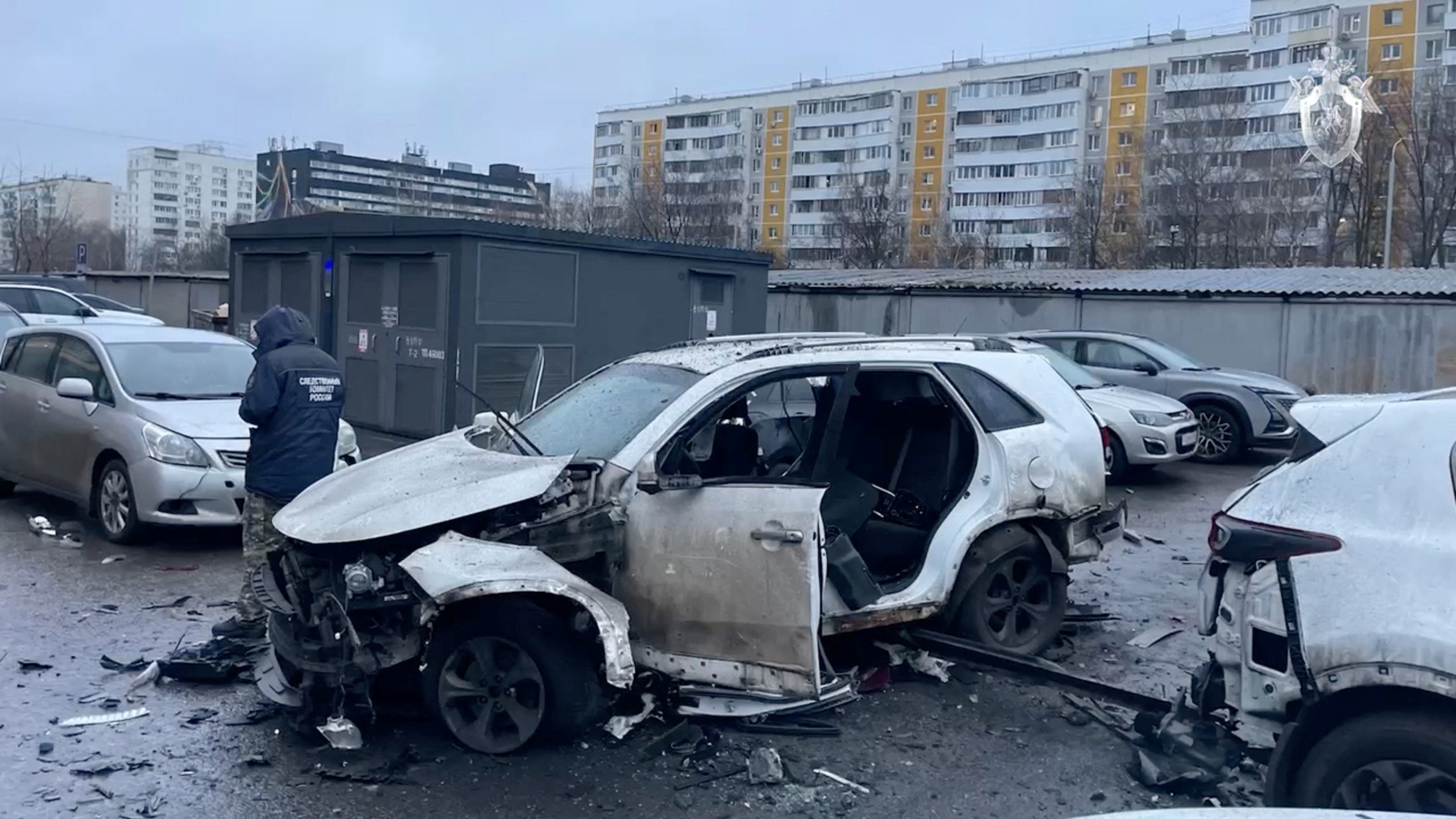
open image in gallery
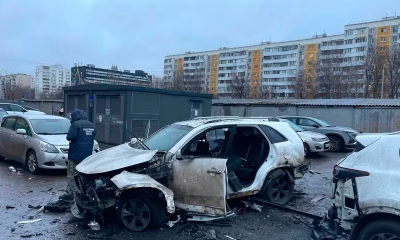
An investigator works at the scene where Lt Gen Fanil Sarvarov was killed (via REUTERS)
Sarvarov, who was the head of the operational training directorate of the Russian armed forces’ general staff, died from his injuries after being taken to hospital, officials confirmed.
Russian media said Sarvarov had also been involved in the Chechen wars in the 1990s and 2000s, and had a role in Russian operations in Syria.
Russia has blamed Ukraine for a string of similar attacks since the 2022 invasion.
Ukraine’s security service claimed responsibility for an attack against a high-ranking Russian soldier last December.
Lt Gen Igor Kirillov, the chief of the military’s nuclear, biological and chemical protection forces, was killed by a bomb hidden on an electric scooter outside his apartment building a day after Kyiv levelled criminal charges against him.
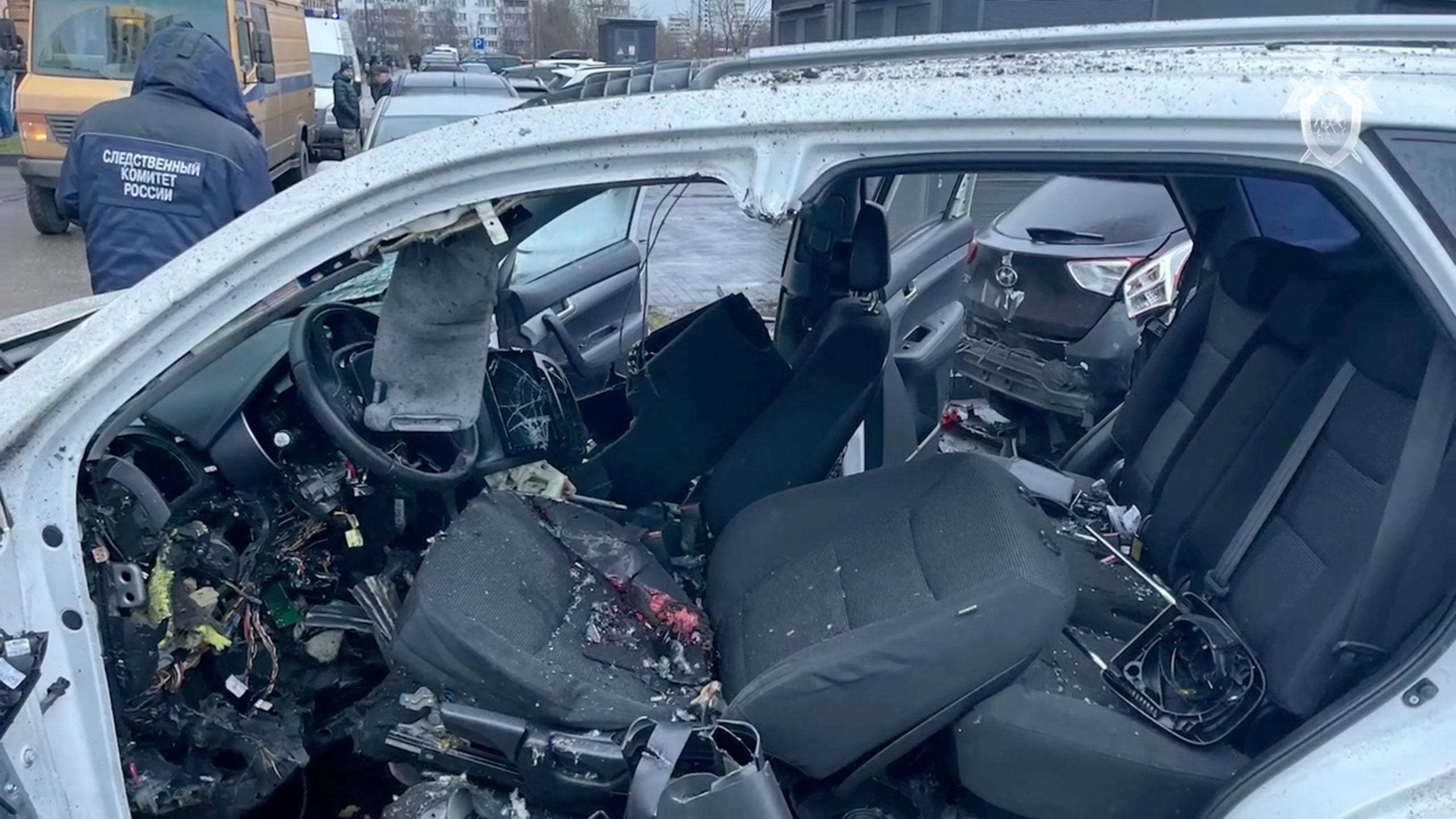
open image in gallery
The inside of a vehicle destroyed in an explosion in Moscow that killed the officer (via REUTERS)
His assistant, Ilya Polikarpov, was also killed.
Gen Yaroslav Moskalik was killed in April when a car exploded next to his house in Moscow. The Kremlin blamed Ukraine, which did not comment.
More follows on this breaking news story….


NEED TO KNOW
- Twenty years ago, an artist, who is paralyzed from the shoulders down, fell in love with a dancer, who is deaf
- Together, they’ve found a way to communicate that transcends traditional forms of communication
- Her work, which she paints by holding a brush in her mouth, is also featured in the 2026 Mouth and Foot Painting Artists calendar
In January 2005, Sara Jane Parsons was at a coffee shop in Austin for a break-dancing competition when she first saw Jimmy Turner leaning against an amp. Turner, a Tony-award-winning dancer, is deaf and had braced his body against the sound system to better “hear” the music.
“I just saw this bright, shiny person,” Parsons, a 61-year-old artist, tells PEOPLE.
Although she is unable to sign with her hands — Parsons became paralyzed from the shoulders down after a car accident when she was 20 — she quickly learned she could talk to Turner.
“I realized it’s not really different than talking to anybody else in a language that’s not English and where English isn’t their first language,” says Parsons of those initial interactions.
Sarah Jane Parsons and Jimmy Turner.
Sara Jane Parson
After bumping into each other a couple of more times, the pair began dating — and twenty years later, Turner and Parsons share a connection that transcends traditional forms of communication. In fact, they’ve created their own language.
“His language is really intuitive to me,” says Parsons of Turner, 71. He’s able to read lips and has created a unique form of communication, which Parsons describes as a mix of American Sign Language (ASL) and American Indian Sign Language (AISL).
“I like to call it JSL,” says Parsons, referencing Turner’s first name. “I try to mimic with my body and my face as much as I can the signs that he’s created.”
The painter is one of twelve artists featured in the Mouth and Foot Painting Artists 2026 calendar. Parsons, who paints by holding a brush in her mouth, says she’s honored to be selected from the hundreds of people who entered the annual competition — and she has Turner’s full support.
“You’re famous now,” she remembers Turner telling her when she shared the news.
In the summer of 1984, painting was far from Parsons’ mind.
At the time, she was a 20-year-old college student, eager to spend time with her then-boyfriend, whom she describes as her “first love.”
The pair had planned a weekend camping trip in northeast Minnesota, Parsons’ home state, with her sister and her sister’s boyfriend.
The two couples set out in the early morning hours so they could reach their destination, the Boundary Waters Canoe Area Wilderness, in time. Once they arrived at the rugged and remote wilderness, the group planned to launch their canoes in the water. From there, they’d watch the sun rise before setting up camp.
Instead, a few hours into the drive, their car was rear-ended by another vehicle.
When the crash occurred, Parsons was riding in the backseat of the hatchback with her boyfriend. She recalls drifting in and out of sleep while she sat on the floor, her head in her partner’s lap.
Sara Jane Parsons.
Sara Jane Parson
“I just remember hearing my sister say, ‘We should exit for gas,’ ” Parsons says. “And then just a huge roar and rumble and stars behind my eyes.”
She adds that she felt like “my head was going to fly off my body.”
While Parsons’ boyfriend broke a couple of ribs, she sustained a life-changing spinal cord injury.
Parsons at her easel.
Sara Jane Parson
While it took time to heal, both physically and emotionally, Parsons found new purpose and eventually graduated from the University of California, Berkeley School of Law, and passed the California bar.
Then she got a job at an AIDS service organization and practiced law until 2004.
Her life took another turn not long after, when Parsons moved from California to Austin, which is when she became fully dedicated to her artistry.
The multi-talented woman first started painting in law school. The craft is special to her because it’s one thing she didn’t have to relearn in “a new way, post-accident,” Parsons says.
“A lot of what I do is work from my memories of when I was able-bodied,” she says and many of Parsons’ winter scenes are reminiscent of the woods behind her childhood house in Minnesota.
“I think about the smells and the sounds and what it was like walking through the woods and the fall,” says the painter. “It’s almost like the light is almost golden because the leaves are all yellow. I draw a lot on good memories.”
A painting by Sara Jane Parsons.
Sara Jane Parson
Parsons praises the Mouth and Foot Painting Artists (MFPA) organization for providing a space for her creativity and fostering a sense of community. In turn, MFPA applauded her talent.
“Sara Jane’s passion, talent and charming personality are always highlighted within the beauty of her paintings,” says Jim March, Director of North American Operations at MFPA, in a statement shared with PEOPLE. “Therefore, it gave us great pride and immense pleasure to select her delightful painting of chickadees for the January page of our 2026 calendar.”
“Winter Chickadee” featured in the 2026 calendar.
Mouth and Foot Painting Artists
For Parsons, meeting Turner has been another source of happy moments.
Following their initial meet-cute, Parsons saw Turner again months later and they exchanged numbers.
Do you have a sweet story the world needs to know? Send the details to [email protected] for a chance to be featured in Real-Life Love, People.com’s series dedicated to sharing extraordinary connections and heartfelt gestures.
That same week, Turner had a neighbor call to arrange their first date on his behalf. He brought a bottle of red wine to Parsons’ house, even though he doesn’t drink. It happened to be her favorite.
“It was so sweet,” she says of the romantic gesture.
Turner and Parsons at the beach.
Sara Jane Parson
Not only do Turner and Parsons enjoy laughing together, but they also have a mutual love of animals and spending time with their family. (He has two daughters and the pair shares two godchildren.)
“We both love dancing, so that’s something that we like doing together,” says Parsons. “He makes me laugh, I make him laugh… And I just think we share a lot of foundational compatibility.”
In 2012, the couple brought their families together in Portland, Maine, to celebrate their relationship in what they describe as a “Forever Love Celebration.” For Parsons and Turner, their artistic spirits are one of the deep bonds that tie them to each other.
“We laugh about it a lot,” says Parsons of being in a relationship with another creative. “We’re like, ‘Well, we’re not both supposed to be poor artists, but here we are.’ ”

Angela Rayner has ‘done a deal’ to be Andy Burnham’s running mate if he launches a leadership bid against the Prime Minister, sources have claimed.
Labour MPs backing Mr Burnham, the mayor of Manchester, say Ms Rayner has agreed to support his bid in return for her old job as Deputy Prime Minister, plus an unspecified senior Cabinet position.
Mr Burnham has been searching for a safe Labour seat in the North to allow him to enter the Commons and challenge Sir Keir Starmer.
Last week, The Mail on Sunday reported his Commons allies as saying they have found a seat which is ‘likely to come free’ in the coming months – and which polling suggests that the so-called King Of The North should win.
The seat was not identified, but sources say Mr Burnham has been talking to MPs in safe seats in Liverpool who might be prepared to stand aside, and been keeping a close eye on the Manchester seat held by Andrew Gwynne, who has been suspended from the Labour Party for sending racist and sexist messages. Mr Gwynne has said he does not plan to stand down.
This newspaper has been told Mr Burnham held discussions with Liverpool Walton MP Dan Carden over his seat, which he holds with a 20,245 majority. But sources said yesterday that the talks ‘just didn’t go anywhere’.
Ms Rayner’s backing would be a boost for Mr Burnham as the former Deputy PM – who has not ruled out her own leadership bid – enjoys strong support from Labour members who would vote in the contest.
A Labour MP backing Mr Burnham said: ‘My understanding is that the deal has been done. Angie would go back to being deputy and get a plum Cabinet job.’
Labour MPs backing Mr Burnham (right), the Mayor of Manchester, say Ms Rayner (left) has agreed to support his bid in return for her old job as Deputy Prime Minister

It would be seen as a blow to the leadership hopes of Health Secretary Wes Streeting (pictured) after reports that his allies had made their own ‘joint ticket’ approach to Ms Rayner
Join the debate
Should politicians trade cabinet positions for support in leadership bids, or does it betray voters’ trust?
It would also be seen as a major blow to the leadership hopes of Health Secretary Wes Streeting after reports that his allies had made their own ‘joint ticket’ approach to Ms Rayner.
Some senior Labour figures worry about the ‘optics’ of the move, given that both Mr Burnham and Ms Rayner come from the North West. But that would be resolved if Ms Rayner, who is under threat from Reform in her Ashton-under-Lyne seat, decided to mount a ‘chicken run’ to a safe Labour seat in the South East, close to her new £800,000 flat in Hove.
Ms Rayner’s allies previously said she was resisting an offer by Sir Keir to bring her back as Education Secretary. Last week, Chancellor Rachel Reeves gave Mr Burnham a thinly-veiled warning, saying: ‘He said when he stood for mayor that he would serve a full term and I think that is the right thing to do.’
A spokesman for Mr Burnham dismissed reports of a deal with Ms Rayner or approaches to sitting Labour MPs as ‘rubbish’.
A source close to Ms Rayner said: ‘There is no vacancy and there is no pact.’
Share or comment on this article:
Angela Rayner ‘would get deputy PM job back in deal to be Andy Burnham’s running mate’

Traffic has been stopped on part of the M61 northbound causing major delays with a lane on the southbound carriageway also shut
SOURCE PAGE

United States President Donald Trump’s second administration has introduced a bold and unconventional strategy for the Middle East. The administration intends to recalibrate US influence in a region historically scarred by conflict, prioritising regional stability through economic strength and military consolidation by asserting a stronger, business-minded US presence.
At the centre of Trump’s ambitious goal is what the new US envoy to Iraq, Mark Savaya, described as his goal to “make Iraq great again”. This approach moves away from traditional endless war tactics towards a transactional, results-oriented diplomacy that aims to restore Iraqi sovereignty and economic vitality. It could be the “great gamble” for Trump, who seeks an Iraq that serves as a stable, sovereign regional hub rather than a battleground for foreign interests.
Trump’s primary plans and wishes for Iraq involve a twofold mission: consolidating all armed forces under the command of the legitimate state and drastically reducing the influence of malign foreign players, most notably Iran. The administration seeks to open Iraqi markets to international investment, upgrade the country’s infrastructure, and secure the independence of its energy sector. Hence, the plan is to ground a genuine partnership that respects Iraq’s unity while ensuring that it is no longer a central node for militia activity or external interference.
Militias and political gridlock
This assertive US strategy lands directly in a highly contested and fractured political environment in Iraq, which is less a single state than a patchwork of competing powers. The heart of the problem lies not just in parliament, but also in the persistent shadow influence of armed factions and militias that often operate outside the formal chain of state command. Those groups were among the biggest winners in the November 2025 elections.
Now the ongoing government negotiations have thrown a stark light on these non-state actors.
Their power raises crucial concerns for the future: How can Iraq enforce the law and, crucially, attract the foreign investment needed for revival if armed groups challenge state authority? The consolidation of the country’s armed forces under complete state control is an urgent necessity, underscored by rising regional tensions and security threats.
Moreover, the path to achieving genuine stability is severely obstructed by entrenched political interests.
For Iraq to achieve stability, it must urgently strengthen its institutional frameworks and clearly establish a separation of powers. Yet, many political parties seem more focused on maintaining control over lucrative state resources than on implementing the meaningful reforms the country desperately needs. The result is a governance model struggling to stand firm amid the crosscurrents of competing loyalties and power grabs.
Washington’s play
To achieve these high-stakes goals, Trump has bypassed traditional diplomatic channels by appointing Mark Savaya as the US special envoy to Iraq on October 19. Such an appointment signals a shift towards “deal-making” diplomacy. Savaya’s mission is to navigate the complex political turmoil following Iraq’s parliamentary elections to steer the country towards a stable transition. His job is to bridge the gap between institutional support and massive financial investment, acting as a direct representative of Trump’s business-centric foreign policy.
Savaya is an Iraqi-born, Detroit-based businessman lacking the traditional diplomatic background; his experience is rooted in the private sector in the cannabis industry, but he gained political prominence as an active supporter of Trump’s campaign in Michigan.
He played a key role in the delicate negotiations that secured the release of Elizabeth Tsurkov, the Israeli-Russian academic and Princeton University student who had been kidnapped by an Iraqi militia for more than two years.
Savaya’s communal and ethnic ties have given him significant access to Iraqi power centres that traditional diplomats often lack.
The Iran factor
Iraq’s position in a geopolitical tug-of-war is compounding the internal struggles, forced to balance its critical relationships with two giants: the US and Iran. On the one hand, Washington’s objective is clear: it wants to bolster Iraq’s sovereignty while simultaneously pushing back against the dominance of powerful, often Iran-backed, militias. The US believes that allowing these armed groups too much sway could leave the nation isolated and wreck its fragile economic stability.
But Iranian influence remains a formidable and enduring force. Tehran views Iraq not just as a neighbour but also as a crucial strategic ally for projecting its power across the entire region. The Islamic Revolutionary Guard Corps (IRGC) has been actively working to maintain unity among key Shia factions in Baghdad. This move clearly signals Iran’s deep and enduring interest in shaping Iraq’s political alignment and its future path. Iraq must therefore navigate this high-stakes balancing act to survive.
Savaya’s mission unfolds at a time when Iran’s regional “axis of resistance” is under unprecedented pressure. Having already lost their primary foothold in Syria after the fall of the Assad regime in late 2024, and seeing Hezbollah’s political and military standing in Lebanon severely decimated by the 2025 conflict with Israel, Iranian proxies now face the very real prospect of losing their grip on Iraq too.
In Lebanon, a new government is committed to regaining the state’s monopoly on the use of force, leaving Hezbollah increasingly isolated. This regional retreat means that for Tehran, maintaining influence in Baghdad is a final, desperate stand to remain a relevant regional power.
Other regional actors
The success of Trump’s gamble also depends on the roles of other regional players. Turkiye has recently recalibrated its strategy to integrate Iraq into ad hoc regional trade and security frameworks, effectively diluting Iran’s centrality. Simultaneously, Gulf monarchies such as Saudi Arabia and the United Arab Emirates are emerging as key economic and security partners for Baghdad, offering an alternative to reliance on Iran.
However, these regional actors also bring their own agendas — such as Turkiye’s focus on containing Kurdish movements — which may conflict with US objectives. If Savaya can successfully align these diverse regional interests with Trump’s plan, he may fundamentally rewrite Iraq’s turbulent future.
A realist pragmatism
The “Make Iraq Great Again” strategy reflects a pragmatic reassertion of US interests within the anarchic international system, prioritising Washington’s security and economic power over idealistic goals.
By appointing Savaya — an unconventional, business-oriented envoy — the Trump administration is employing “transactional realism”, utilising economic diplomacy and personal ties as strategic tools to pull Iraq away from Iran’s orbit. This approach views the US-Iran rivalry as a zero-sum game of power politics, where integrating Iraq’s armed forces under centralised state control is fundamental to restoring a state-centric order and sidelining non-state militias that currently feed Tehran’s regional influence.
The new US envoy to Iraq has made clear that “there is no place for armed groups in a fully sovereign Iraq”. His calls resonated with Iraqi officials and militia leaders alike – now at least three militias close to Iran have publicly agreed to disarm. However, other groups have yet to do the same, while rejecting the call from the outset.
However, this high-stakes attempt to shift the regional balance of power faces a significant “security dilemma”, as aggressive moves to diminish Iranian influence may trigger a violent defensive response from Tehran to protect its remaining strategic assets. While the strategy seeks to exploit a regional shift – leveraging the weakened state of Iranian proxies in Syria and Lebanon – it must contend with the “hybrid” power of Iraqi militias and the narrow self-interests of neighbouring players like Turkiye and the Gulf states.
The success of this gamble depends on whether the US can dismantle the shadow economies that facilitate foreign interference and establish a stable, autonomous Iraqi state capable of navigating the intense geopolitical tug-of-war between Washington and Tehran.
The stakes for Iraq’s future
Ultimately, the appointment of Savaya serves as the definitive stress test for Iraqi sovereignty, marking a high-stakes transition towards a transactional “America First” strategy aimed at “Making Iraq Great Again”. By attempting to consolidate military command under the state and dismantle the shadow economies fuelling Iranian influence, Savaya’s mission seeks to exploit the current regional weakening of Tehran’s proxies to transform Iraq into a stable, autonomous hub.
However, the success of this “Great Gamble” hinges on Savaya’s ability to overcome entrenched political opposition and reconcile the presence of US forces with the demand for national unity. If this unconventional diplomatic push can bridge internal divides — particularly between Baghdad and the semi-autonomous Kurdish region in the north — Iraq may finally secure a path towards economic independence; otherwise, the nation risks remaining a perpetual battleground caught in the geopolitical crossfire between Washington and Tehran.
The views expressed in this article are the author’s own and do not necessarily reflect Al Jazeera’s editorial stance.