
SCIENCE
Satellites reveal heat leaking from largest US cryptocurrency mining center


One of the world’s largest Bitcoin mining facilities is seen leaking heat into the environment in a new image captured from orbit by a heat-seeking satellite that was recently released by the U.K.-based company SatVu.
The image reveals the thermal footprint of a major Bitcoin-mining data center in Rockdale, Texas, which has been widely criticized for its electricity consumption and carbon footprint.
You may like
The satellite image reveals in a resolution of 11.5 feet (3.5 meters) where and how much heat leaks into the environment from the plant. SatVu thinks that the insights that could be gleaned from such images could help regulators and grid operators better understand the impact such facilities have on the environment and local power networks.
“Today’s data center buildout is moving incredibly quickly, and the world needs better ways to understand what’s actually happening on the ground,” Thomas Cobti, SatVu’s VP for Business Development, said in a statement. “Thermal data gives an objective view of operational activity as it occurs — not weeks later through reports or announcements.”
Although the image was only released on Dec. 17, it was most likely captured already in 2023, before SatVu’s HotSat-1 satellites failed in orbit in December that year. SatVu plans to launch its replacement HotSat-2 next year and is already building HotSat-3.
The thermal camera aboard these satellites is the best in class, providing an order of a magnitude better resolution than other temperature-measuring devices in orbit.
SatVu released the first HotSat-1 images in October 2023, capturing the heat trails behind locomotives and showing how heat spreads from large sun-drenched concrete parking lots in a city like Las Vegas.
With the newly released image, the company shows how satellites could keep an objective eye on a fast-growing and controversial sector.
“At a closer level, [the image] reveals which substations and cooling systems are under load — clear, physical indicators of real operational behavior,” the company said in the statement. “Together, these layers provide a grounded, evidence-based view of how major data center sites are evolving in real time.”
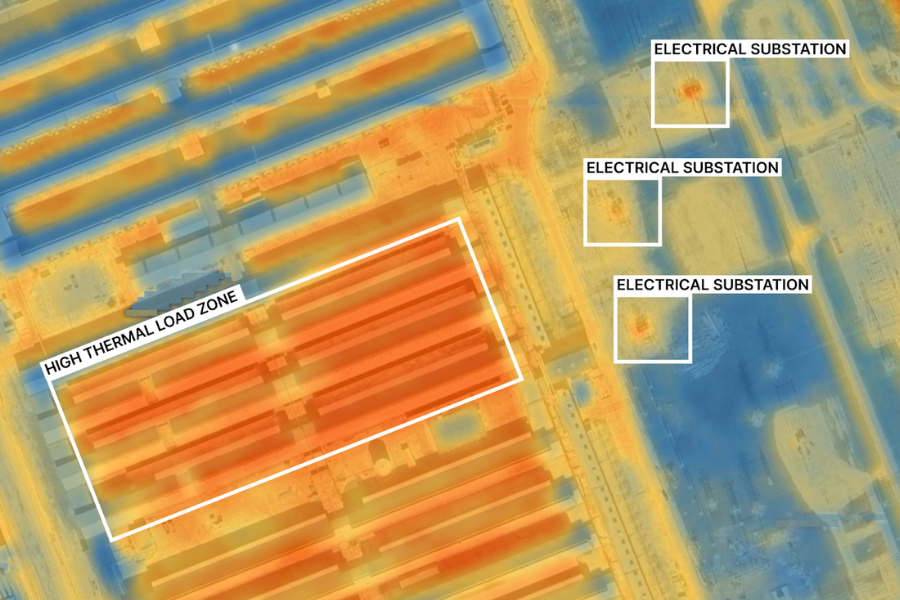
A labeled image taken from Earth satellite company SatVu. (Image credit: SatVu)
A closer inspection of the image shows “distinct thermal signatures across rooftop chillers, transformers and electrical yards, making clear which parts of the facility are active and which remain dormant,” SatVu added.
According to the McKinsey consultancy, investment into computing data centers will continue to grow, reaching more than $7 billion by 2030. Global data centers are believed to contribute by about 0.5% to the global carbon dioxide emissions. Bitcoin mining is especially energy intensive, a recent study estimated that one Bitcoin transaction generates about as much carbon dioxide as a gasoline car generates in a 1,600-mile (2,500-kilometer) drive.








The northern lights may put on another show across the U.S. tonight as speedy solar wind from an Earth-facing coronal hole is forecast to spark minor (G1) geomagnetic storm conditions, according to the National Oceanic and Atmospheric Administration’s (NOAA) Space Weather Prediction Center.
Geomagnetic activity is expected to reach minor (G1) storm levels overnight, which could be good news for aurora chasers as it raises the chance of seeing the northern lights in mid-latitudes.
You may like
Where can I see the northern lights tonight?
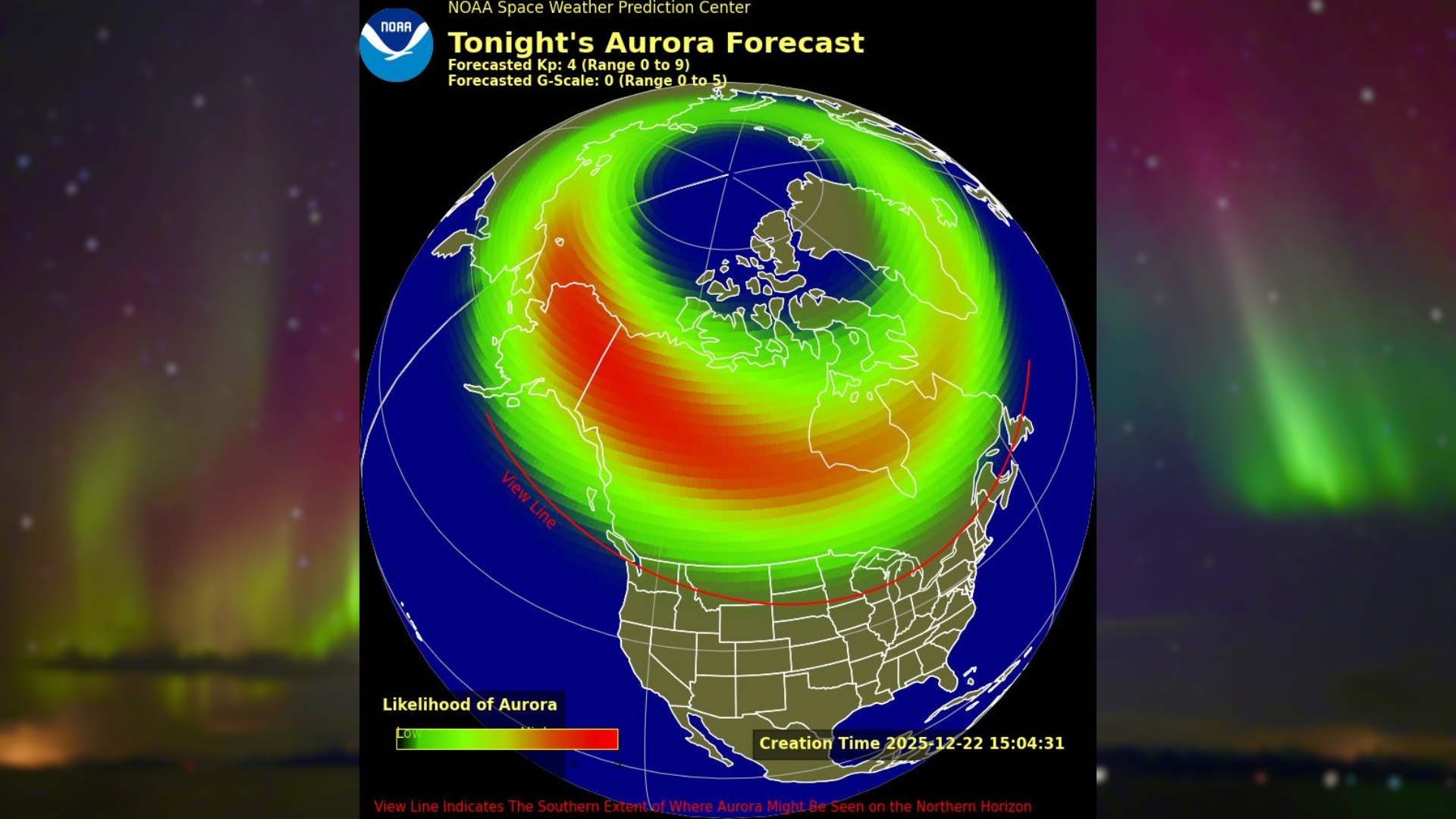
Aurora forecast for tonight courtesy of NOAA’s Space Weather Prediction Center. (Image credit: Map: NOAA Space Weather Prediction Center, background image: Daisy Dobrijevic. Graphic created in Canva Pro.)
States that could see auroras tonight
Based on the latest NOAA aurora forecast map, the following 10 U.S. states appear fully or partially above the aurora view line:
- Alaska
- Washington
- North Dakota
- Minnesota
- Montana
- Maine
- Michigan
- Wisconsin
- South Dakota
- Idaho
Remember, auroras can be fickle creatures. The list is based on current forecast data, but if conditions strengthen and skies are clear, auroras could reach much farther south than expected.
Then again, if conditions don’t align, we might end up with a “nothing burger” and no auroras at all.
Northern Hemisphere aurora forecast courtesy of the U.K. Met Office
What time should I look for the northern lights tonight?
The northern lights could be visible across 10 U.S. states tonight (Dec. 22-23) as soon as it gets dark, so it’s worth keeping an eye on the sky throughout the evening, especially in areas with clear, dark skies.
According to NOAA’s 3-day forecast, geomagnetic storm activity is expected to be best at the following times:
- 4 p.m. – 10 p.m. EST (2100-0300 GMT): Minor G1 level storming possible
How can I see the northern lights from where I live?
If you live in one of the 10 U.S. states forecasted to catch a glimpse of the northern lights tonight, there are a few things you can do to give yourself the best chance of seeing them.
- Find a north-facing vantage point with a clear view of the northern horizon, as far from light pollution as possible.
- Use your phone camera to scan the sky, as a phone camera is great at picking up faint auroras before your eyes spot them. This will give you a good idea of which direction to focus your attention.
- Try and let your eyes adapt to the dark for at least 30 minutes; this will help your night vision develop.
- Wear warm clothing! Part of the fun of aurora hunting is the chase. Be prepared to sit or stand for hours if conditions are looking promising, as you won’t want to miss the show when it starts!
We recommend downloading a space weather app that provides aurora forecasts based on your location. One option I use is “My Aurora Forecast & Alerts,” available for both iOS and Android. However, any similar app should work well.
I also use the “Space Weather Live” app, which is available on iOS and Android, to get a deeper understanding of whether the current space weather conditions are favorable for aurora sightings. Want to capture the perfect photo? Our how to photograph auroras guide can help.

For a half century, the iconic “Lucy” fossil species, Australopithecus afarensis, has held the title of being the most likely direct ancestor of all humans.
But as the list of ancient human relatives has grown and more fossils have been discovered, Lucy’s position has increasingly been called into question. Now, a key paper published last month in the journal Nature could overturn that theory entirely, some scientists say.
You may like
The proposal has revealed intense disagreements in the field. Some say A. anamensis is our direct ancestor, others argue that we don’t know which Australopithecus species we descended from, and still others say the new analysis doesn’t shake up the human family tree at all.
The new discovery is “not altering our picture of human evolution in any way, in my opinion,” Zeray Alemseged, a paleoanthropologist and professor of organismal biology and anatomy at the University of Chicago who was not involved in the new study, told Live Science.
Either way, a resolution might not come until more fossils are found.
An iconic species
Understanding the roots of the debate requires going back a century. In 1925, Raymond Dart announced the discovery of the first known Australopithecus — a skull dubbed the Taung Child unearthed in what is now South Africa that dates to around 2.6 million years ago. For the next 50 years, researchers thought that humans descended directly from the Taung Child’s species, Australopithecus africanus.
But Lucy’s discovery in 1974 at the Hadar site in Ethiopia rewrote that picture. The 3.2 million-year-old fossil became the oldest known australopithecine specimen at the time.
And researchers found her species, A. afarensis, walked upright on two legs similarly to how humans do today, yet it had a smaller brain — about the size of a modern-day chimp’s. This suggested Lucy’s kind could represent a “halfway” point in human evolution between the last common ancestor with chimps and us, making her species a good candidate for our direct ancestor among the many known hominins, the lineage that encompasses humans and our closest relatives.
The skull of a 3-year-old female Australopithecus afarensis, dated to 3.3 million years ago, discovered at the site of Dikika in Ethiopia. (Image credit: Zeresenay Alemseged)
Then, in 1979, her status as our direct ancestor was cemented: an assessment of the evolutionary relationships among hominin fossils uncovered until that point suggested Lucy’s species gave rise to the genus Homo. In that family tree, A. africanus was demoted from our ancestor to a more distant cousin.
You may like
As more australopithecines have been unearthed, the Australopithecus family tree has become bushier and more tangled, complicating the picture of who we may have descended from. But for many anthropologists Lucy’s species still reigns, eventually giving rise to the lineage from which modern humans evolved.
Then the new Nature paper was published. Researchers had unearthed new fossil fragments and tied them to a previously discovered, enigmatic 3.4 million-year-old fossil known as the “Burtele foot”.
The new tooth and jaw fragments allowed anthropologists to ascribe the foot, for the first time, to a little described and controversial species — Australopithecus deyiremeda, a tree-climbing ancient human relative that walked upright on two legs and lived alongside Lucy’s species 3.5 million to 3.3 million years ago at the Woranso-Mille site in Ethiopia.
For Fred Spoor, a professor of evolutionary anatomy at University College London who was not involved in the recent study of the Burtele foot, the new discovery was the nail in the coffin for the theory Lucy’s species was our direct ancestor.
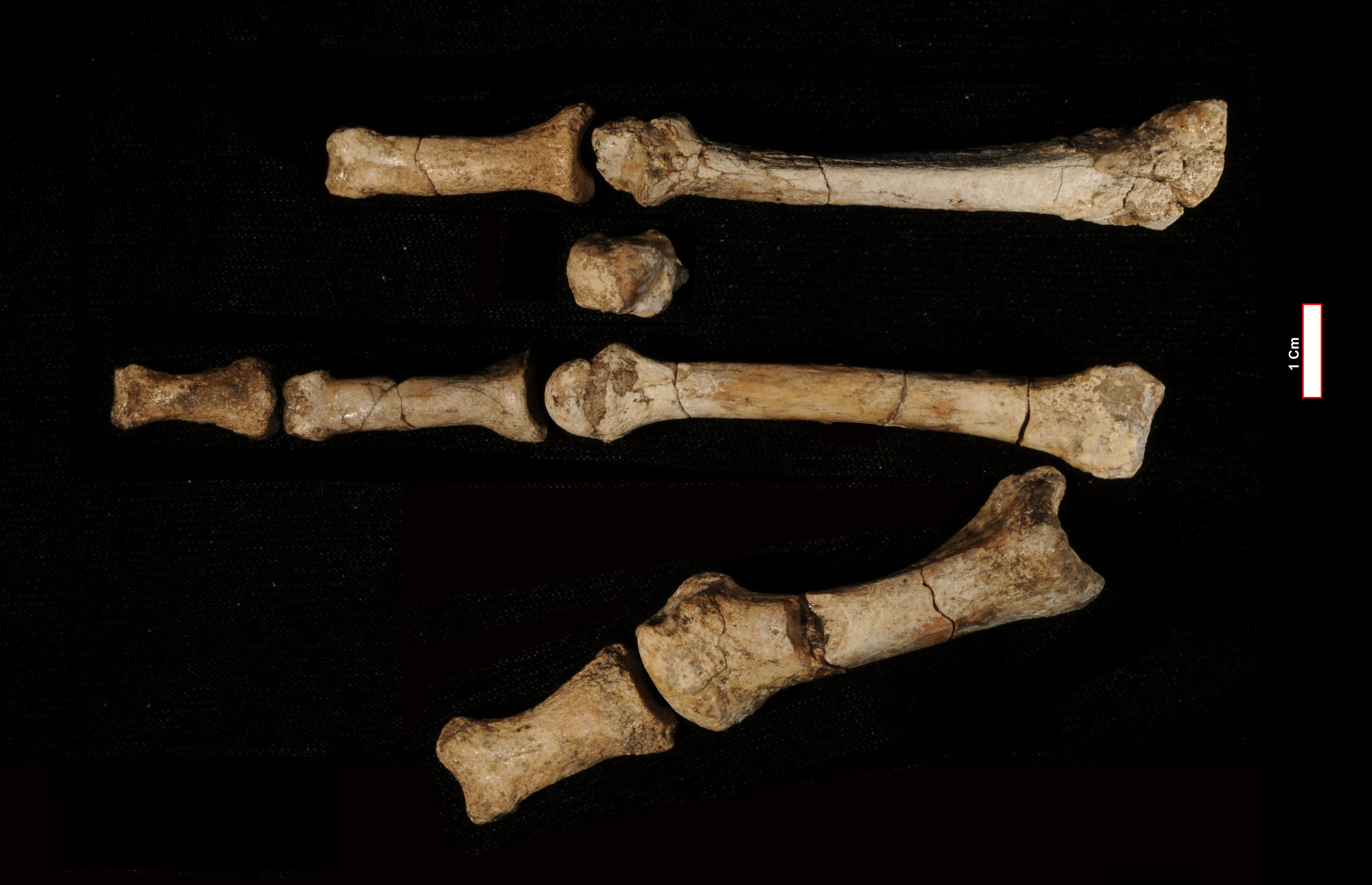
The Burtele foot is the right foot of an adult Australopithecus deyiremeda, who lived around 3.5 million to 3.3 million years ago. (Image credit: Yohannes Haile-Selassie)
That’s because the paper suggested that the species tied to the Burtele foot and the South African A. africanus were more closely related to each other than either was to Lucy’s species. By that logic, then, A. africanus may not have descended from Lucy’s species, but was rather her cousin.
So, it’s possible that both A. deyiremeda and A. africanus descended from the more ancient A. anamensis, who lived in East Africa from around 4.2 million to 3.8 million years ago.
This would also make A. anamensis the direct ancestor to humans, Spoor told Live Science in an email.
For Spoor, this finding would have huge implications. “If this is correct, A. afarensis will lose its iconic status as the ancestor of all later hominins,” probably including us, Spoor wrote in an accompanying commentary about the recent research.
A fierce debate
But other anthropologists are hotly divided on the implications of the new paper.
Some Live Science spoke to thought Spoor’s conclusions were plausible, while other experts said they were “far-fetched” and “a stretch, to put it mildly.”
Because the existing fossil record in East Africa goes much further back in time than the current South African record, many believe the Homo genus arose in East Africa.
Currently the oldest known Homo fossil is a 2.8 million-year-old jawbone from Ethiopia, but models estimate the genus would have actually emerged around 0.5 million to 1.5 million years earlier.
This is older than many of the earliest South African hominin fossils, which were found thousands of miles away. That “would make it unlikely that any of those are the direct ancestor,” Carol Ward, the Curators’ Distinguished Professor of pathology and anatomical sciences at the University of Missouri, told Live Science.
Lucy’s species is still a candidate, but no longer the candidate.
Lauren Schroeder, University of Toronto Mississauga
For many, the most likely candidate for an East African ancestor is still Lucy’s species, A. afarensis, which lived in modern-day Ethiopia, Tanzania and Kenya from around 3.9 million to 3 million years ago. This wide geographic distribution and persistence for almost a million years means it had many opportunities to give rise to other species across Africa, Alemseged said.
Scientists in the “Lucy” camp argue that A. afarensis‘ fully upright mode of walking, broad diet, use of early stone tools and wide geographic range constitute strong evidence for Lucy’s ancestral position in the human family tree.
This makes Spoor’s claim that Lucy’s species wasn’t our direct ancestor a big one. But he isn’t alone in this view.
Thomas Cody Prang, an assistant professor of biological anthropology at Washington University in St. Louis and a co-author of the Nature study, said it’s possible A. afarensis evolved human-like features completely independently of modern humans, like how bats and birds independently evolved wings. Such convergent evolution has been proposed before in our family tree: For example, Prang’s team previously found that A. afarensis and modern humans independently evolved certain body proportions.
If this is true, other species living at roughly the same time as Lucy’s kind are likely ancestors to later hominins, Prang told Live Science in an email.
Prang, for his part, thinks A. deyiremeda‘s anatomy makes the species a better candidate for our direct ancestor than Lucy. That’s because the species has a combination of ancient and new traits. What’s more, a 2015 analysis flagged A. deyiremeda as being more closely related to Homo than Lucy’s species.
Others think the Nature paper resurrects A. africanus as a plausible ancestor to Homo.
Lauren Schroeder, a paleoanthropologist at the University of Toronto Mississauga and who was not involved in the new study, said that either way, many different hominin species were evolving and intermingling across Africa during this 3.5 million to 2 million period of time. That means our evolutionary history is more like a braided stream, with species separating and then recombining, and less like a straight evolutionary line.
“Early Homo could have emerged from a broader, pan-African pool of australopith diversity. So yes, Lucy’s species is still a candidate, but no longer the candidate,” for a direct human ancestor, Schroeder told Live Science in an email.
Even the authors of the new paper disagree on its implications. While Prang supports the dethroning of Lucy’s species as our direct ancestor, the study’s lead author Yohannes Haile-Selassie, a paleoanthropologist and director of Arizona State University’s Institute of Human Origins, insists that Lucy’s species is still the best candidate for the direct ancestor to Homo.
He told Live Science in an email that the more ancient traits found in A. deyiremeda and A. africanus, like having feet adapted for climbing trees, contradict the idea that they are our direct ancestors. On the other hand, Lucy’s species had more human-like feet, which Haile-Selassie said makes A. afarensis the “more likely ancestor of those which came later.”
Of course, it’s possible the smoking gun evidence that settles the debate will never come.
“We will almost certainly never know who our direct ancestor is — and the more we learn about human evolution and how diverse our past was, the more elusive that ancestor becomes,” said Ward.
But that doesn’t mean we’ll ultimately understand less of our evolutionary past, Ward said. “Even though we may never know which one was our ancestor, we can still piece together much of what that ancestor may have been like.”

Earlier today I set you the following set of numerical challenges to celebrate the arrival of 2026.
Auld lang signs
Here is an expression equal to 26 that uses six 1s:
(1+1)×(1+1+11)
Find expressions equal to 26 using:
-
Five 9s
-
Six 8s.
-
Six 7s.
-
Six 6s.
-
Four 5s.
-
Six 4s.
-
Four 3s.
-
Four 2s.
-
a partridge in a pair tree. (Only joking)
You are only allowed the four basic operations, +, –, x, ÷, brackets, exponentiation and concatenation. (Exponentiation is when you make a digit the exponent, such as 11. Concatenation is when you join digits together, such as taking a two 1s and making 11.)
Solutions
9+9+9−(9/9)
8+8+8+((8+8)/8)
7+7+((77+7)/7)
6×6+(6−66)/6
5×5+(5/5)
4+(44×4/(4+4))
33 − 3/3
22 + 2 + 2
Good tidings to all! I’ll be back in 7+7+((77+7)/7)
Thanks to Inder Taneja, author of the website numbers-magic.com. He has many more facts about the coming year in his paper 26 and 2026 in Numbers and Magic Squares
I’ve been setting a puzzle here on alternate Mondays since 2015. I’m always on the look-out for great puzzles. If you would like to suggest one,
SOURCE PAGE
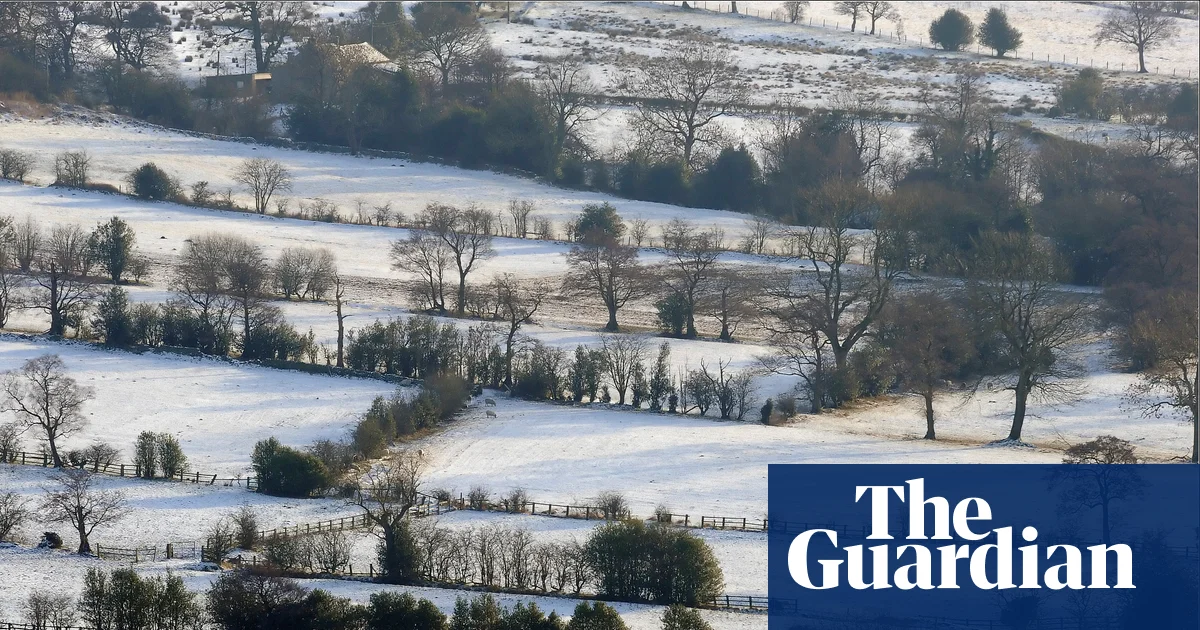
While ongoing showers might suggest this Christmas will be a washout, experts say a wintry snap is on its way and some areas of the UK might even have a white Christmas.
According to the Met Office, high pressure is building – meaning that, while some areas may experience showers, many will have drier and more settled weather.
The UK’s national meteorological service added that a strong easterly breeze would make it feel colder – although not unusually so for this time of year, with temperatures on Christmas Day expected to reach a daytime high of 7C and night-time lows at -3C or -4C. As a result, Father Christmas might be accompanied by Jack Frost.
“The south coast of England down towards South Devon and Cornwall perhaps [has] the greatest chance of seeing the odd wintry flurry if there were to be [any],” Marco Petagna, of the Met Office, told the Guardian. “Of course, for a white Christmas, technically now all we need is one flake of snow to fall anywhere in the UK. And it’s not an unusual occurrence – it’s more unusual for it to be lying snow.”
Snow in Holcombe, Greater Manchester, February 2021. Most of the UK’s snow days actually happen between January and March. Photograph: Christopher Thomond/The Guardian
According to the Royal Meteorological Society (RMetS), a snowflake has tumbled from the sky on Christmas Day 54 times over the past 66 years at least somewhere in the UK, and except for 2024, every year since 2020 has technically been deemed “white”.
In 2023, 11% of weather stations recorded snow falling on Christmas Day, and 9% in 2022, although snow was not recorded as settling in either year. Indeed, as the RMetS notes, a thick blanket of snow at Christmas has only occurred four times since 1960 – in 1981, 1995, 2009 and 2010 – with 2010 having snow on the ground at 83% of stations, the highest percentage ever recorded.
But anyone expecting festive snowball fights is likely to be in for a disappointment this year. “The chance of noteworthy snowfall is only around 10%, so nothing significant,” said Petagna.
It was not always thus: the little ice age meant that between the 16th and 19th centuries it was more common to have a harsh winter – perhaps explaining why the writings of Charles Dickens, who was born in 1812, often refer to a cold and snowy Christmas. In addition, before 1752, when the transition to the Gregorian calendar was completed in Britain, 25 December fell later in the winter.
Snow at Cheltenham racecourse, February 1963 – a particularly harsh winter. Photograph: Maeers/Getty Images
More recently, particularly harsh winters have included those of 1946–47 and 1962-63. “Much of England remained covered in snow every day from late December until early March 1963,” the Met Office has noted.
The rarity of festive snow cover today is, perhaps, not a surprise, given the climate crisis. Met Office data has revealed Decembers in the UK have become warmer in recent decades – conditions that reduce the overall chance of snowfall on Christmas day, although natural variability means cold and snowy spells can still occur.
But just because a snowy Christmas is unlikely this year, it doesn’t mean snowballs are a thing of the past: the Met Office notes that most of the UK’s snow days happen between January and March.
As the poet Sara Coleridge put it: “January brings the snow, makes our feet and fingers glow.”
SCIENCE
New EV motor invention could cut 1,000 pounds from future vehicles, making them much lighter while boosting their range


A new in-wheel motor for electric vehicles (EVs) delivers a massive amount of torque in a lightweight package, its developers say.
The motor — which was made by YASA, a subsidiary of Mercedes-Benz that also provides motors to Ferrari — weighs only 28 pounds (12.7 kilograms) but can deliver up to 1,000 horsepower at once or a sustained 469 to 536 hp for longer durations. This new mark breaks YASA’s own previous unofficial record, a 29-pound motor that yielded 738 horsepower, company representatives said in a statement.
You may like
The ability to pack so much power into such a compact, lightweight motor is due in part to YASA’s axial flux technology. Traditional radial flux motors are longer, tube-like structures, with a stator — the stationary part of a motor that creates a magnetic field used to produce motion — surrounding a cylindrical rotor. A magnetic field is passed perpendicularly to the shaft through the cylinder to spin the rotor.
By contrast, an axial flux motor is more like a pancake, with a disc-like rotor and stator. Magnetic flux passes along the axis parallel to the shaft (hence the name). The axial flux tech allows for much smaller designs than traditional radial designs, according to YASA.
Much lighter EVs in the future
The company emphasized that the design is scalable and doesn’t rely on any rare or exotic materials to function.
The design also opens up a pathway for massive weight reduction in EV design. YASA said that deploying the in-wheel motors in lieu of a traditional power and drivetrain could save around 440 pounds (200 kg). And for vehicles designed from the ground up to incorporate the new motor, the savings could be closer to 1,100 pounds (500 kg).
This is in part because the system also incorporates advanced regenerative braking, the process by which electric vehicles capture energy that would normally be lost as heat during braking and utilize it to recharge the battery.
Instead of power being shunted from the battery to spin the wheels, energy from the wheels is captured to spin the motor, which generates electricity rather than consuming it. The motor resists the rotation while generating energy, thereby slowing the car and powering up the battery. YASA says efficient regenerative braking could reduce the need for traditional friction brakes, saving both weight and space.
While the current iteration is clearly geared toward high-performance EVs and supercars, axial flux motor technology opens the door for longer-range electric vehicles capable of generating more power with fewer, lighter components. The reduction in space required for traditional powertrain components also provides manufacturers an opportunity to streamline aerodynamics or provide more interior space for cargo or passengers.

Yangang Xing had never heard of organ-tuning books, but his colleague Andrew Knight often played the pipe organ at churches as a teenager.
When the pair, who are researchers at Nottingham Trent University, set out to study how environmental conditions in churches had changed over time, Knight explained that all over the country many organs had notebooks full of data tucked away in their recesses.
“I would sit at the organ between hymns, or between weddings,” said Knight. “Quite often, the only thing to look at between services was this little red book that sat in the corner.”
Xing realised organ-tuning books were troves of data that might span decades. “We said, ‘Oh, this is a goldmine,’” he recalled.
Organ tuners make brief records of their visits and often jot down observations in the books. Photograph: The Reengineer
Organ tuners make brief records of their visits and often jot down observations, including the temperature and humidity inside the building. Materials within organs are sensitive to climatic changes, which can knock the majestic instruments out of tune.
Earlier this month, Xing, Knight and their colleague Bruno Bingley published a paper in the journal Buildings & Cities, with preliminary data gleaned from 18 organ-tuning books associated with churches in London, Nottinghamshire and Derbyshire. The records date back to 1966 and indicate a rise in average temperatures inside churches since then, during winter and summer periods.
It reflects that churches are being heated, artificially, to a greater extent today than in the past but also that these old buildings are getting warmer even in summer months when heating systems are more likely to be turned off – a “hint” of global heating, said Knight.
The average summer temperature for urban churches in the sample was 17.2C during the late 1960s. By the 2020s it had reached 19.8C.
“It quantifies what we’ve seen,” said Andrew Scott, the managing director of Harrison & Harrison, a Durham-based company that builds and services pipe organs. “A rise of internal ambient temperature through the unheated summer months due to rising temperatures outside.”
Organ-tuning records could be useful for climate studies, said Neil Macdonald, a professor of geography at the University of Liverpool. “As somebody that’s worked on a lot of historical records of climate and weather, I’ve never come across this,” he said. “I was fascinated.”
It is possible that summer temperatures in churches could be influenced by factors besides climate breakdown, he noted – perhaps some churches were ventilated more frequently in years gone by, for example.
Organ tuners care about temperature because it affects the expansion and contraction of materials such as wood and metal, commonly used in organs, Scott said.
Humidity plays a role, too. One remark left by a tuner and noted by the researchers relates to a church organ in Nottingham. Part of the instrument appeared damaged and more difficult to tune than last time. “Weather? Misty,” the tuner wrote.
While many churches are large, difficult-to-heat stone buildings – making them refuges for some during heatwaves – hot summer weather can still trouble an organ. A change of just one degree celsius may alter the pitch of one of these instruments by 0.8 hertz, said Scott.
That means if an organ is tuned at 16C, for example, and then the temperature later rises to 20C, the notes the instrument produces can be perceptibly different.
Scott’s company has tuned organs all over the world, including in Nigeria, Malaysia and India. In hot countries, keeping an organ in tune is already challenging – climate breakdown threatens to make it harder still. And besides weather, powerful heating systems in churches can affect pipe organs even more profoundly, he added.
Xing said he and his colleagues hoped to analyse more organ-tuning book data and he urged anyone who owned such records to contact him. “If we can find older ones, it would be fascinating,” he said. “I hope people realise the value of tuning books.”

What was your skywatching highlight of 2025? A comet becoming visible to the naked eye? Mars disappearing behind the moon? Or did you glimpse a “blood moon” total lunar eclipse and see the northern lights at last?
Here’s what happened in the skies in 2025, in spectacular images.
1. A Wolf Moon “eats” Mars
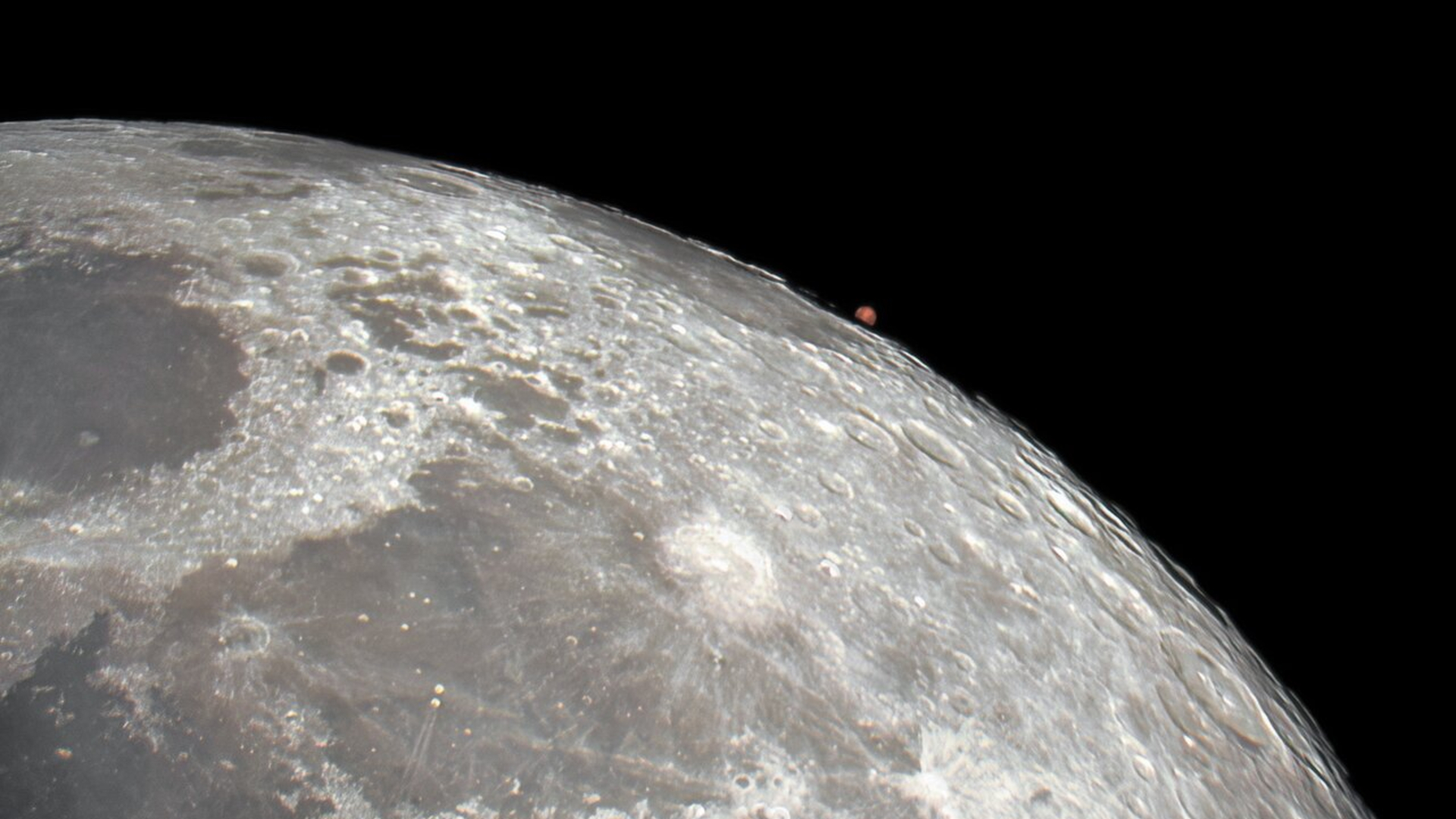
Mars rises out of a lunar occultation from Kitt Peak National Observatory in Arizona on Jan. 13, 2025. (Image credit: KPNO/NOIRLab/NSF/AURA/J. Winsky & A. Sorensen (Image credit: J. Winsky & M. Zamani (NSF NOIRLab))
Mars comes to a bright opposition in Earth’s sky only once every 26 months. But just before its big day came on Jan. 15, it grabbed skywatchers’ attention when it crossed paths with the moon. North America had a ringside seat to the full Wolf Moon’s occultation of the Red Planet, which happens just once every 14 years from a specific place on Earth’s surface.
You may like
Read more: Mars hides behind the full Wolf Moon in gorgeous photos from around the world
2. A “great comet” appears
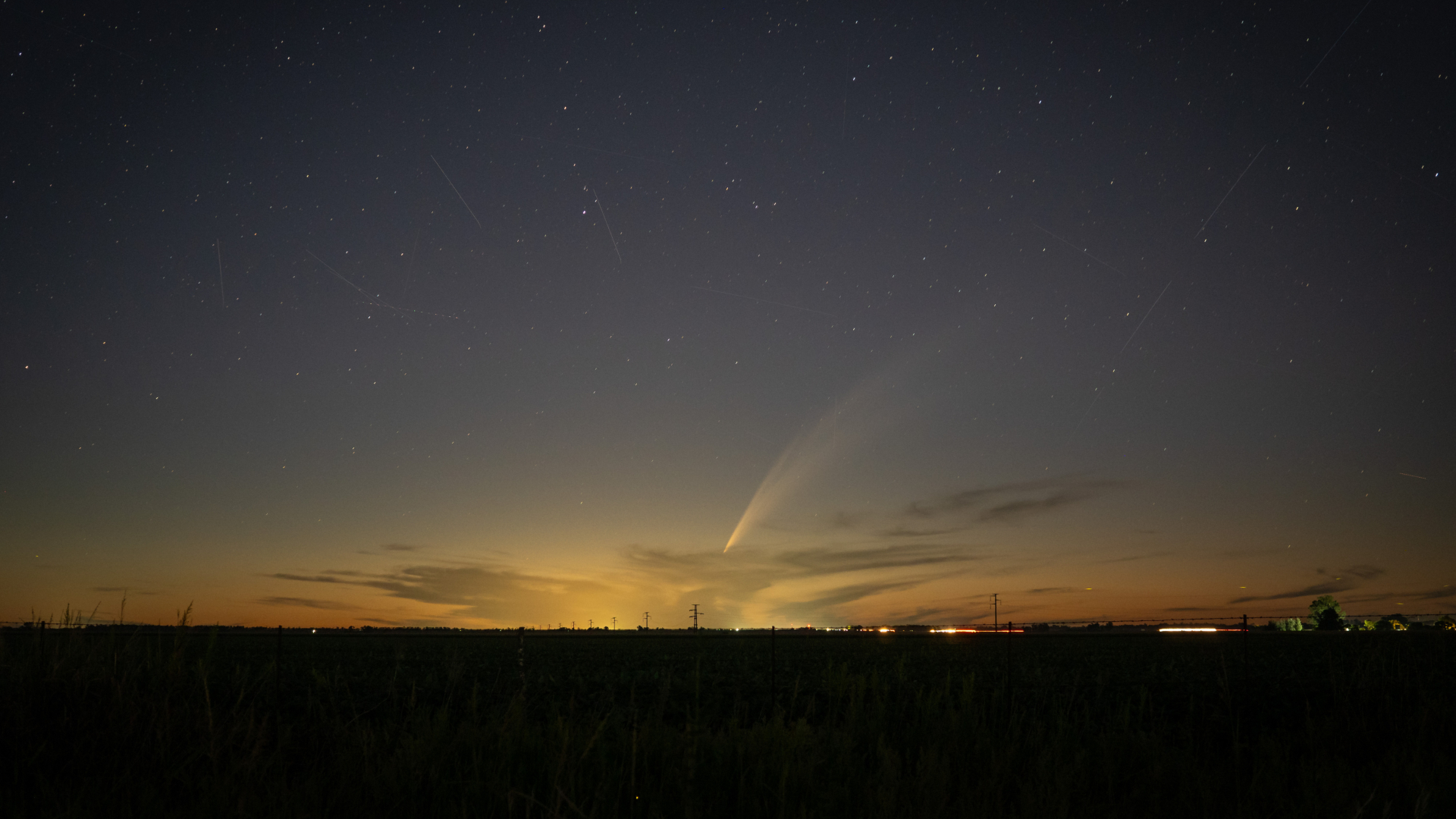
Comet C/2024 G3 (Atlas) appears in the sky over a rural area near Firmat, Argentina, on Jan. 20, 2025. (Image credit: Patricio Murphy/SOPA Images/LightRocket via Getty Images))
If you don’t remember 2025’s “great comet,” it’s probably because you’re in the Northern Hemisphere. Back in mid- to late January, Comet 2024 G3 (ATLAS) made a close pass of the sun before sprouting a bright, structured tail that delighted astrophotographers south of the equator. The comet even became bright enough to be visible in the daytime with the naked eye.
Read more: Why Comet G3 (ATLAS) will be ‘remembered as the Great Comet of 2025’ (photos)
3. “Blue Ghost” lands on the moon
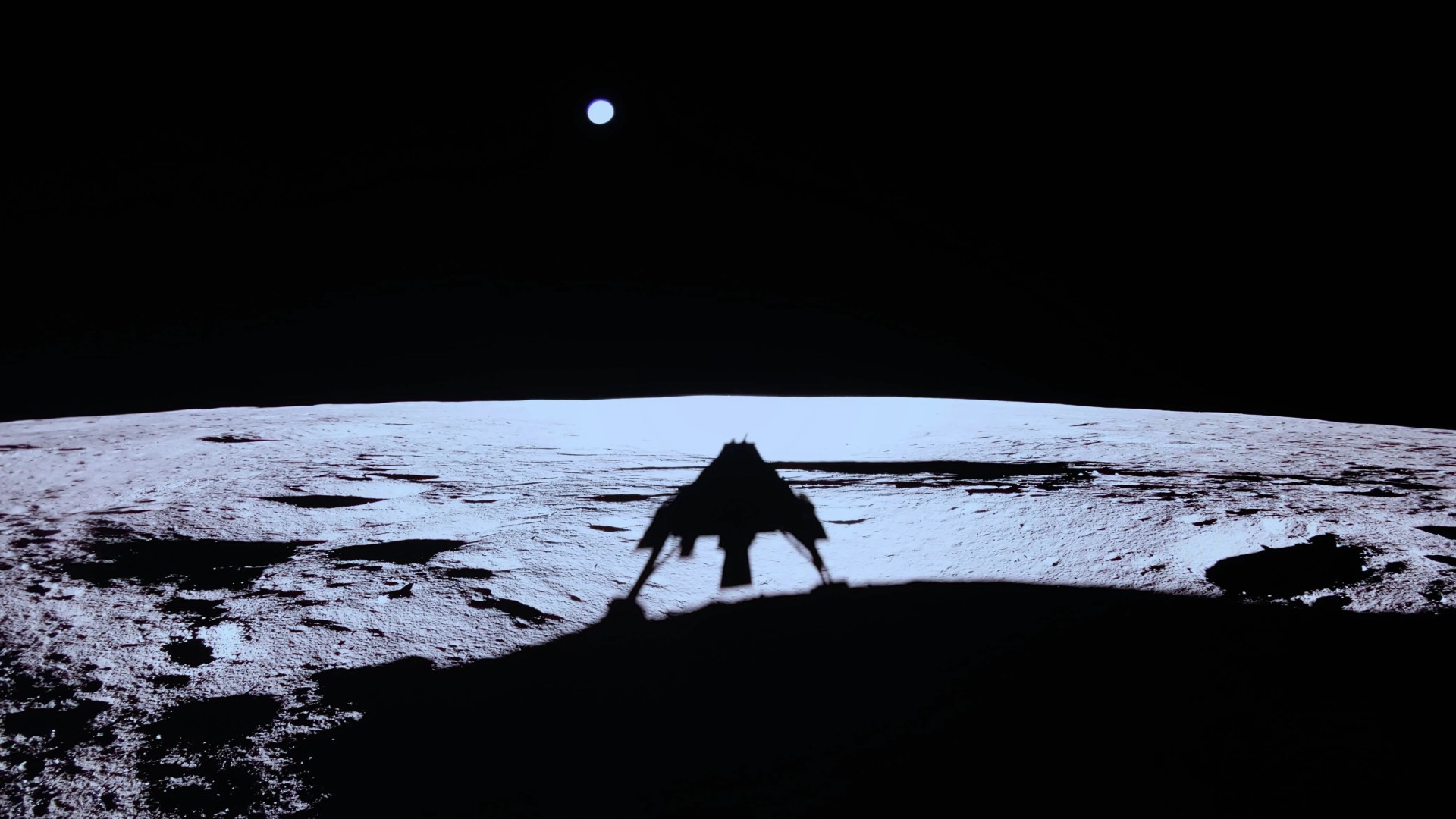
Firefly Aerospace’s Blue Ghost Mission 1 landed on the moon on March 2, 2025. (Image credit: Firefly Aerospace)
After launching atop a SpaceX Falcon 9 rocket in January, Texas-based Firefly Aerospace successfully landed its Blue Ghost spacecraft on the moon’s 300-mile-wide (500 kilometers) Mare Crisium (“Sea of Crises”) basin in early March, becoming the second private spacecraft ever to soft-land on the moon. The company shared a spectacular video showing Blue Ghost’s descent and spectacular landing, complete with its own long lunar shadow.
Read more: Touch down on the moon with private Blue Ghost lander in this amazing video
4. A star trail is visible from orbit

NASA astronaut Don Pettit captured this long-exposure view showing Earth and stars as intense streaks over time, as seen from the International Space Station. (Image credit: NASA/Don Pettit and Babak Tafreshi via X)
Between September 2024 and April 2025, NASA astronaut Don Pettit — famed for his pioneering work in astrophotography from orbit — conducted his third mission on the International Space Station. In collaboration with astrophotographer Babak Tafreshi of The World at Night on the ground, Pettit took the art form to another level, capturing dozens of mesmerizing star trails.
Read more: Astronaut takes a mind-bending trip over Earth beneath star trails: Space photo of the day
You may like
5. A “blood moon” total lunar eclipse captivates skywatchers
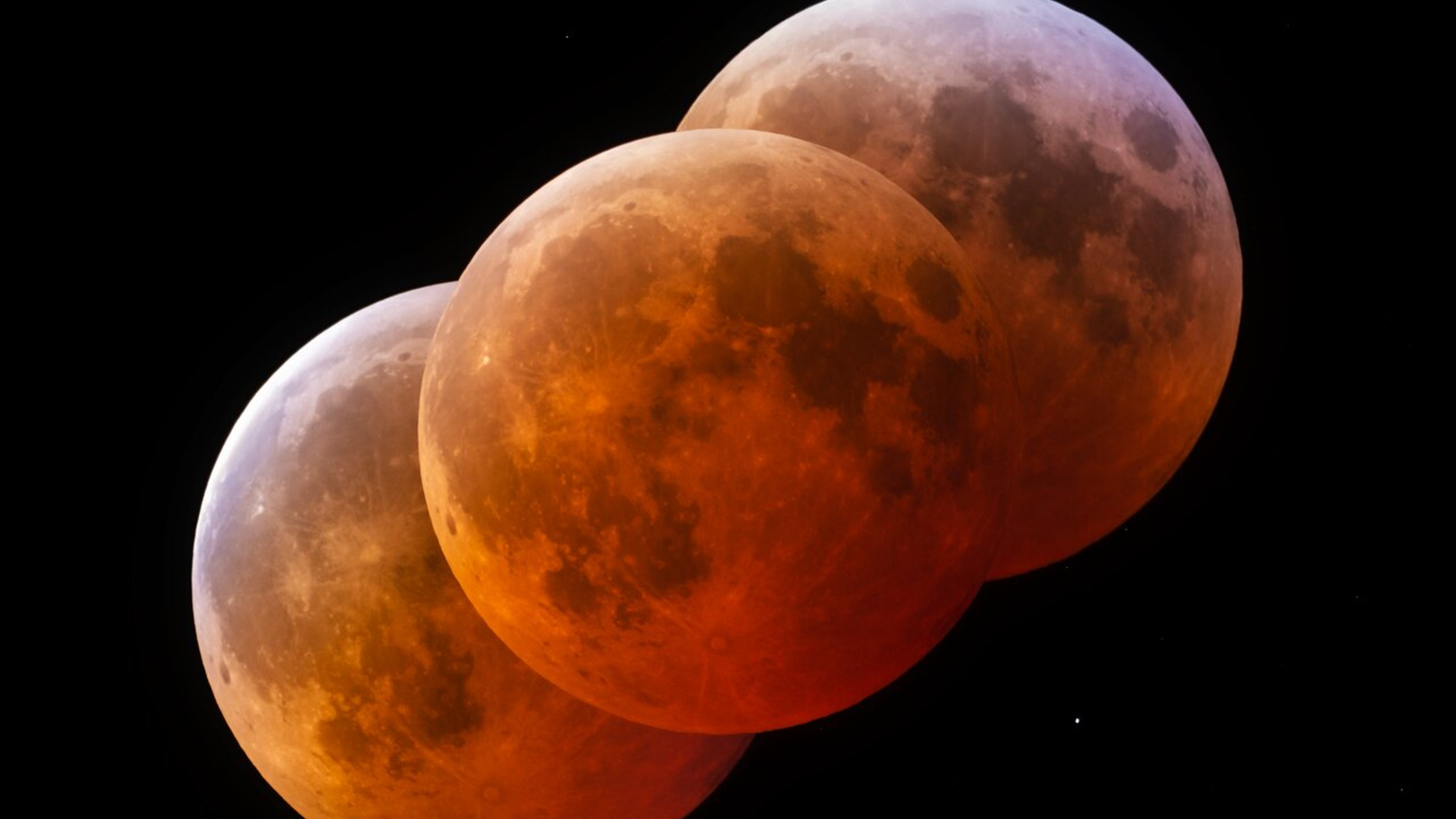
Petr Horálek, NOIRLab’s photo ambassador, captured a total lunar eclipse from the Cerro Tololo Inter-American Observatory in Chile. (Image credit: CTIO/NOIRLab/NSF/AURA/P. Horálek (Institute of Physics in Opava))
The first total lunar eclipse in three years delighted skywatchers on March 13-14, 2025, when a full Worm Moon crept through Earth’s central shadow in space for 65 minutes, making the lunar surface appear reddish-orange from our perspective on Earth. The event, visible from Earth’s nightside, was captured with a moonbow from Kentucky and with the Milky Way from Chile. Another lunar eclipse on Sept. 7-8 made for some spectacular photos, including one taken over Egypt’s White Desert.
Read more: Total lunar eclipse March 2025: Best photos of the “Blood Worm Moon”
6. Vapor tracers appear inside auroras
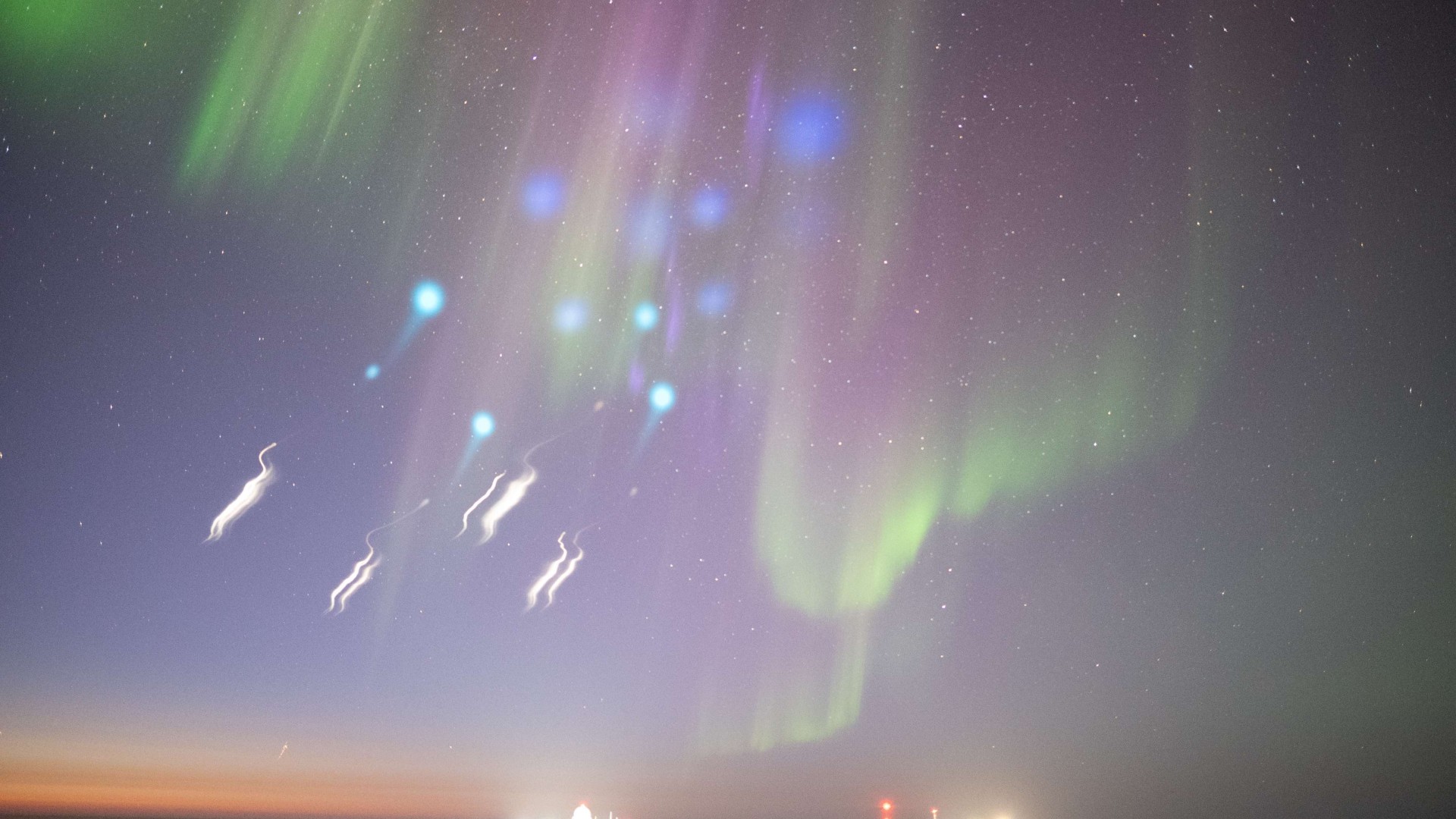
Vapor tracers light up the atmosphere over the Arctic Ocean as seen from Utqiagvik, Alaska, on March 25, 2025. (Image credit: AWESOME Mission)
Just as an aurora substorm erupted, two NASA sounding rockets poised for launch at Alaska’s Poker Flat Research Range suddenly went skyward, releasing colorful vapor tracers within the aurora borealis, or northern lights. As part of the AWESOME mission, vapor tracers were imaged using cameras across northern Alaska to track winds, particle flows and magnetic changes during the outburst.
Read more: NASA launches rockets into auroras, creating breathtaking lights in Alaskan skies (photos)
7. Perseids blast through moonlight
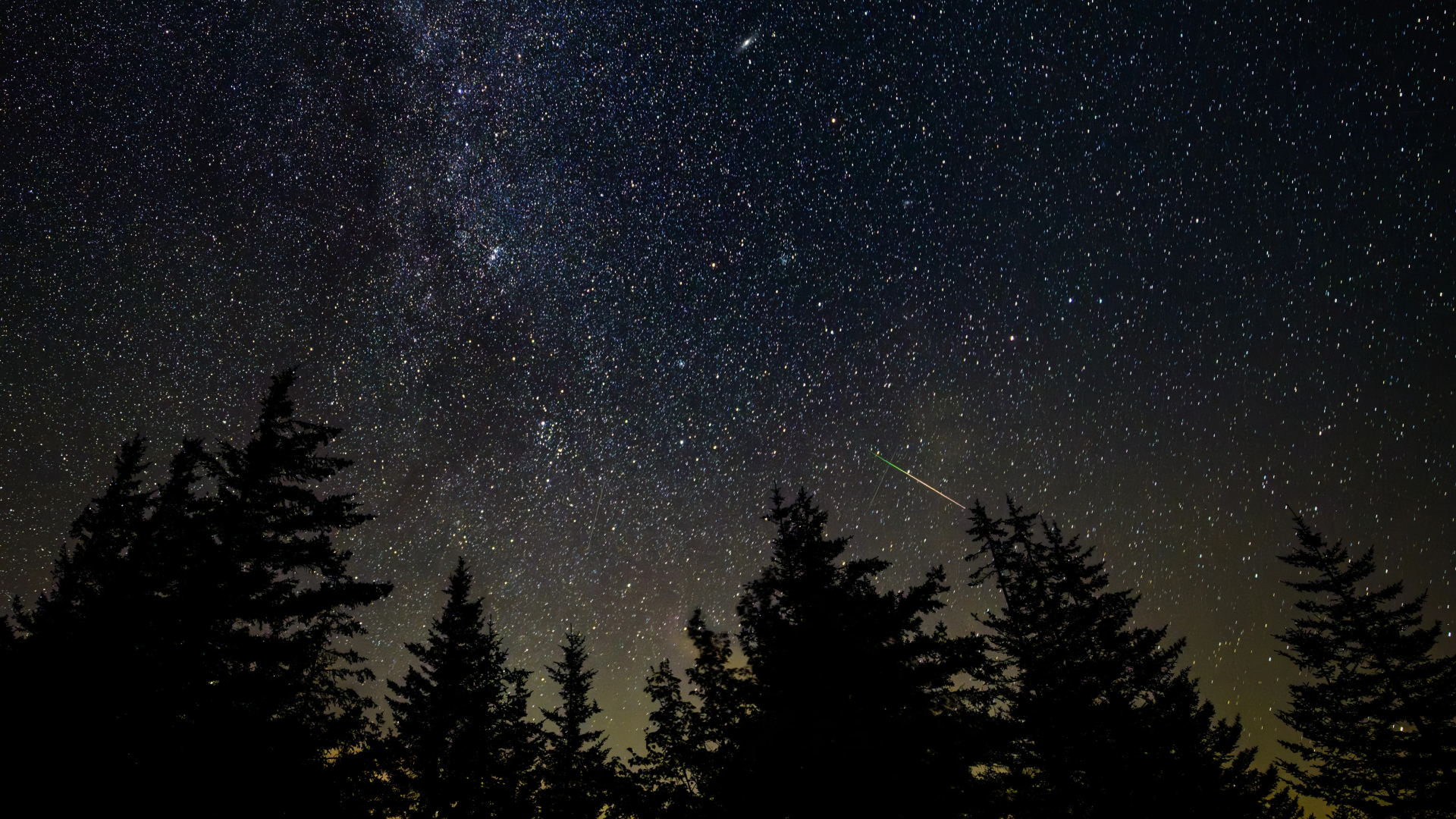
A meteor streaks across the sky over Spruce Knob, West Virginia, on Aug. 3, 2025. (Image credit: NASA/Bill Ingalls)
It may be the Northern Hemisphere’s favorite annual meteor shower, but the Perseids weren’t a classic in 2025, as they were marred by an 84%-illuminated crescent moon. However, before the peak night of the Perseid meteor shower on Aug. 12-13, there was a short window of darkness, during which a few bright meteors were seen in the predawn hours. About 10 days before the peak night, NASA photographer Bill Ingalls took this long exposure of a Perseid meteor in Spruce Knob, West Virginia.
Read more: Perseid meteor shower 2025 outshines moon to put on a spectacular show (photos)
8. An interstellar comet grows a tail

A deep image of the interstellar comet 3I/ATLAS by the Gemini South Telescope in Chile. (Image credit: International Gemini Observatory/NOIRLab/NSF/AURA/Shadow the Scientist. Image Processing: J. Miller & M. Rodriguez (International Gemini Observatory/NSF NOIRLab)/T.A. Rector (University of Alaska Anchorage/NSF NOIRLab)/M. Zamani (NSF NOIRLab).)
For comet hunters, 2025 was a landmark year, primarily because it saw the discovery of the third interstellar object ever to visit our solar system. Comet 3I/ATLAS, as it came to be known, followed in the wake of ‘Oumuamua (1I/2017 U1) in 2017 and 2I/Borisov in 2019. In late August, astronomers using the Gemini South telescope in Chile glimpsed the tail of the interstellar interloper.
Read more: Scientists capture interstellar invader comet 3I/ATLAS growing a tail
9. Solar maximum continues to deliver

The great aurora of June 1, 2025. (Image credit: VW Pics /Getty Images)
Following an incredible year in 2024, it was likely that 2025 would experience some significant geomagnetic activity, thanks to solar maximum, the peak of the 11-year solar cycle. Observers in the right place at the right time on April 14-15, June 1, June 17 and Sept. 2 (and many other dates) enjoyed spectacular auroras as G4 geomagnetic storms produced auroras at low latitudes.
Read more: Severe G4 geomagnetic storm sparks northern lights across US and beyond (photos)
10. Comet Lemmon ripens
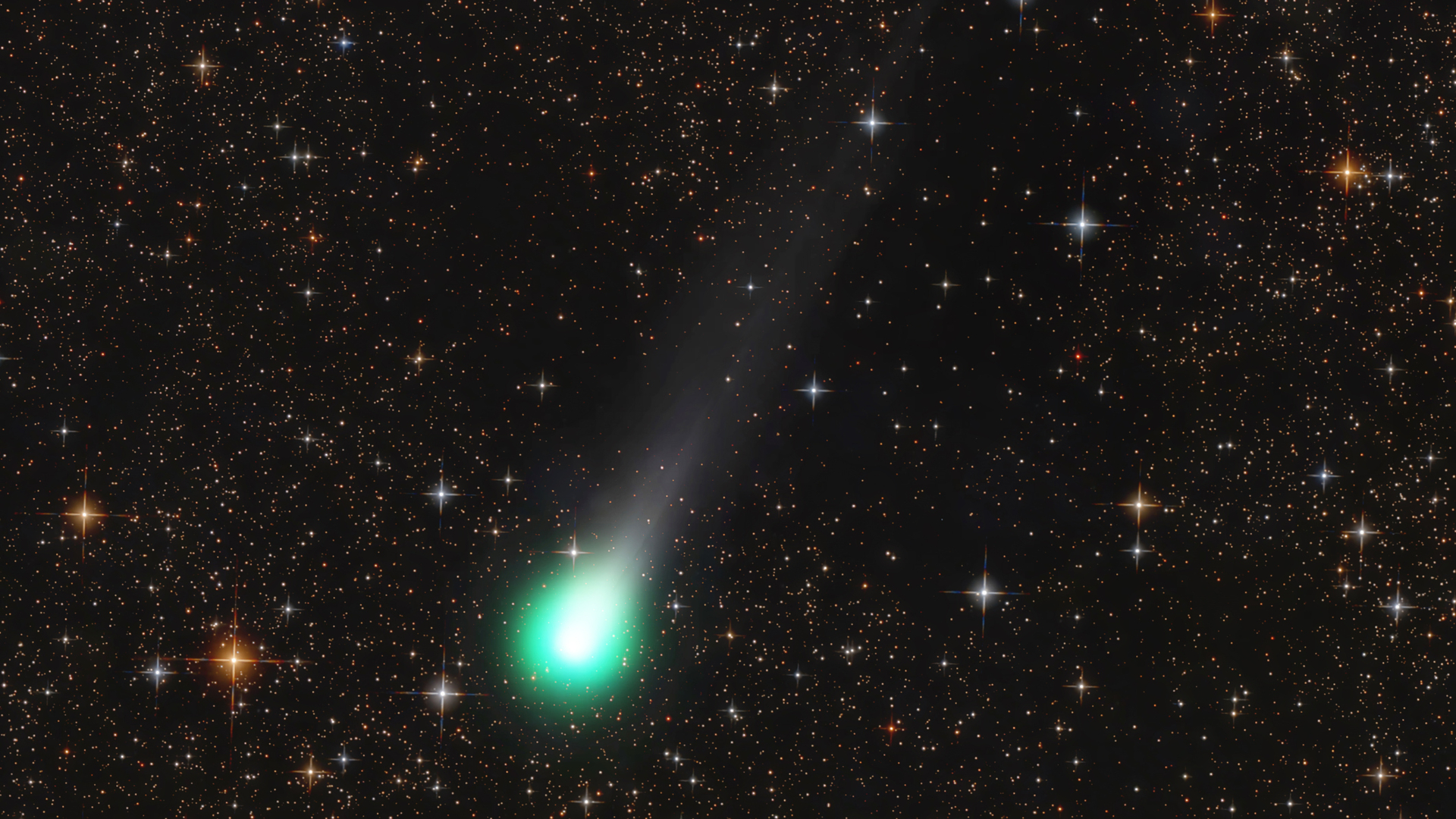
Comet C/2025 A6 (Lemmon) with a glowing green coma and visible tail as seen from Málaga, Spain, on Oct. 1, 2025. (Image credit: Javier Zayas Photography/Getty Images)
What are the chances of a naked-eye comet becoming visible on the same night as the peak of the Orionid meteor shower? Although it was only on the cusp of naked-eye visibility — and was visible only to astrophotographers in the Northern Hemisphere — Comet Lemmon (C/2025 A6) put on a show in mid- to late October. A surprise companion, Comet C/2025 R2 (SWAN), appeared in telescope images on Sept. 10. But although it was initially bright, it never got as luminous as Lemmon.
Read more: Astrophotographers capture dazzling new views of Comet C/2025 A6 (Lemmon) as it brightens for October skies

QUICK FACTS
Name: Holy Crib
What it is: Five pieces of sycamore wood
Where it is from: Jerusalem
When it was made: Circa 4 to 6 B.C.
In the 640s, Sophronius, the patriarch of Jerusalem, sent several unassuming wooden slats to Rome for safekeeping after the Muslim conquest of Jerusalem. Sophronius asked Pope Theodore I to protect the pieces of wood, which he said were the remains of the Holy Crib — Jesus’ manger.
According to Monsignor Piero Marini, who is the guardian of the Holy Crib, four of the wooden slats once formed two X’s, while the fifth slat ran down the middle to hold them together. Wooden mangers in the late first century B.C. would have been topped with straw for animals to eat. But this particular manger is much more significant: It is said to have once held the baby Jesus.
You may like
The Gospel of Luke mentions that Jesus was born in Bethlehem. Because there was nowhere for Mary and Joseph to stay in town, the newborn Jesus was laid in a manger. Many biblical scholars believe that Jesus was born between 6 and 4 B.C. And while his birth is celebrated on Dec. 25 every year, scholars are unsure of his exact birth date.
The first historical mention of the manger pieces comes from Origen, an early Christian scholar, who wrote in A.D. 220 that the crib was preserved in Bethlehem, according to Marini. Then, around A.D. 400, St. Jerome discussed the Holy Crib and many people’s pilgrimages to it in the Grotto of the Nativity in Bethlehem. Ever since the wood pieces made their way to Rome in the seventh century, the manger has remained in Santa Maria Maggiore.
In 1894, abbot Giuseppe Cozza-Luzi was the first to study the remains of the Holy Crib. His examination revealed that there are two longer pieces of wood and three shorter pieces — ranging from about 25 to 33.5 inches (64 to 85 centimeters) in length — and that all of them had been damaged over time. Several of the wooden pieces also had holes and traces of metal, suggesting they had once been constructed into a manger.
MORE ASTONISHING ARTIFACTS
Based on a microscopic analysis of a small piece of wood that had been removed in the 1600s, Cozza-Luzi concluded that the wood was a kind of hard maple, possibly sycamore. The type of wood, the form of the slats, and the evidence of construction — along with historical references — all suggested to him that the Holy Crib remains were part of an authentic ancient manger from the Jerusalem area.
In 2019, experts restored the wooden slats, and Pope Francis took the opportunity to give a small piece of the crib back to the Holy Land, with a plaque that read “Ex cunis Iesu Infantis,” meaning “From the crib of the Infant Jesus.”
Each year, many Christians visit the Holy Crib during the annual Christmas Eve mass at midnight at Santa Maria Maggiore, which is also called Santa Maria ad Praesepe (St. Mary of the Crib) and the “Bethlehem of the West” for its association with Mary and her baby’s manger.
For more stunning archaeological discoveries, check out our Astonishing Artifacts archives.
SCIENCE
Trump’s shuttering of the National Center for Atmospheric Research is Stalinist | Michael Mann and Bob Ward


The Soviet dictator Joseph Stalin would no doubt have understood and even appreciated the latest attack by the Trump administration on climate researchers and their work.
The National Center for Atmospheric Research in Boulder, Colorado, is to be dismantled after more than 50 years at the forefront of global research on climate science and monitoring.
This is the latest step in the administration’s climate Lysenkoism and its relentless purge of climate researchers who refuse to be co-opted into its quest for American energy dominance though fossil fuels.
Stalin’s embrace of the work of Trofim Denisovitch Lysenko, who wrongly believed that wheat could inherit characteristics acquired by previous generations, underpinned policies that failed to prevent crop failures and millions of deaths from famine during the 1930s.
Scientists who opposed Lysenkoism were denounced, fired, imprisoned and even executed. While Trump has not gone as far as Stalin, his administration’s persecution of climate researchers could ultimately lead to many millions of deaths from increases in extreme weather and sea level rise in the United States and across the world.
Six years ago, we warned in an op-ed for the Guardian of the dangers of climate Lysenkoism during Trump’s first presidential term. Little did we know that there would be a second term and an even more extreme war against scientific reality.
The closure of NCAR was announced on X, the Trump administration’s preferred propaganda platform, by Russell Vought, the director of the office of management and budget.
He laughably described NCAR as “one of the largest sources of climate alarmism in the country”, but it is transparently part of the Trump administration’s promotion of wilful ignorance about climate change.
We both have direct experience of the deep expertise and careful methodology of the many generations of scientists who have worked at NCAR, a stark contrast with the blatant mischaracterisation offered by Vought.
He is the architect of climate Lysenkoism during Trump’s second term, and Vought laid out his plans to eliminate all governmental knowledge and understanding of climate change in his Project 2025 manifesto during the presidential campaign.
Vought was also behind the Trump budget proposal earlier this year that proposed to end funding for most government laboratories and institutions that carry out any work related to climate change.
Fortunately, Congress rejected most of the funding cuts in the administration’s budget, but Vought will no doubt try again next year as part of the administration’s promotion of climate Lysenkoism.
While it is difficult to understand the workings of Donald Trump’s mind, his administration’s pretence that climate change does not exist is in line with his ambition to make the United States and the rest of the world more dependent on American oil, gas and coal.
Trump’s presidential campaign received at least $75m from oil and gas interests, according to media reports, and he promised to repay their investments through his administration’s support for more exploration and production.
The administration’s war on climate researchers helps to shield oil and gas executives from criticism of the damage that their industry is causing.
We are both seeing first-hand the impact of this at the annual meeting of the American Geophysical Union in New Orleans, where scientists usually gather to discuss the latest advancements in climate research.
This year, there are far fewer climate scientists taking part, with many federally funded researchers having lost their jobs or had their budgets slashed.
However, there are signs that the administration’s attempt to promote a bogus version of climate science is not advancing quite as smoothly as they’d hoped.
In July, the Department of Energy published a ludicrous report that attempted to present a revisionist account of established climate science.
The report, called A Critical Review of Impacts of Greenhouse Gas Emissions on the US Climate, was commissioned by Chris Wright, the former head of oil and gas company Liberty Energy, whom Donald Trump selected to be energy secretary and chief propagandist.
The report was written by five scientists who were obviously selected to produce a version of climate science that was aligned with the administration’s political agenda.
It was clearly intended to support an attempt by the Environmental Protection Agency, launched on the same day, to overturn the supreme court’s so-called endangerment finding, which requires the government to regulate greenhouse gas emissions.
However, a group of more than 85 climate scientists comprehensively debunked Wright’s report in September, exposing numerous fundamental errors and falsehoods. They showed that the Department of Energy report was a blatant example of policy-based evidence-making.
In addition, the highly respected and authoritative National Academy of Sciences published its own assessment in September that concluded “the evidence for current and future harm to human health and welfare created by human-caused GHGs [greenhouse gases] is beyond scientific dispute”.
It is now widely expected that the comprehensive demolition of Wright’s report means the Environmental Protection Agency will drop references to the science when it publishes in the new year its updated case for overturning the endangerment finding.
Sadly, this setback is unlikely to stop the Trump administration’s assault on researchers, and its Soviet-style campaign to prevent Americans and the rest of the world from knowing the truth about climate change.
The Trump administration continues to act as if the story of the ransacking of the library of Alexandria is a playbook instead of a cautionary tale.
-
Professor Michael Mann is the presidential distinguished professor and director of the Penn Center for Science, Sustainability and the Media at the University of Pennsylvania, and co-author with Peter Hotez of Science Under Siege; Bob Ward is policy and communications director at the Grantham Research Institute on Climate Change and the Environment at the London School of Economics and Political Science

The seventh-ever mission of Japan’s H3 rocket did not go according to plan.
The H3 launched from Tanegashima Space Center on Sunday (Dec. 21) at 8:51 p.m. EST (0151 GMT and 10:51 a.m. local Japan time on Dec. 22), carrying a navigation satellite known as Michibiki 5, or QZS-5, aloft.
“However, the second stage engine’s second ignition failed to start normally and shut down prematurely,” officials with the Japan Aerospace Exploration Agency (JAXA) said in a statement early Monay morning (Dec. 22). “As a result, QZS-5 could not be put into the planned orbit, and the launch failed.”
You may like

The H3 rises into the sky on Dec. 21, 2025. (Image credit: JAXA)
The 10,580-pound (4,800 kilograms) Michibiki 5 was supposed to be part of Japan’s homegrown Quasi-Zenith Satellite System (QZSS), a navigation network in geosynchronous orbit high above Earth.
“This system is compatible with GPS satellites and can be utilized with them in an integrated fashion,” Japanese officials wrote in a description of the QZSS project.
“QZSW can be used even in the Asia-Oceania regions with longitudes close to Japan, so its usage will be expanded to other countries in these regions as well,” they added.
The first QZSS satellite, a pathfinder, launched in September 2010. The system currently consists of four operational spacecraft, but Japan wants it to grow, as Sunday’s unsuccessful launch shows. Indeed, the network will eventually consist of 11 spacecraft, if all goes according to plan.
The two-stage H3 rocket was developed by JAXA and Mitsubishi Heavy Industries. It’s the successor to the H-2A, a workhorse launcher that retired in June after a quarter-century of orbital service.
The H3 failed during its debut launch in March 2023 but bounced back with five consecutive successes — until Sunday night. JAXA has set up a task force headed by agency chief Hiroshi Yamakawa to help get to the bottom of the Michibiki 5 launch anomaly.
“We would like to express our deepest apology to many people and entities, particularly those related to the QZS-5, local organizations and the public, who had high expectations for this project,” JAXA officials wrote in Monday morning’s update.