
TECHNOLOGY
TikTok Shop launches digital gift cards to challenge Amazon and eBay

TikTok Shop has rolled out a new feature that allows users to purchase digital gift cards, making it easier to help friends and family buy from the millions of products on the app.
The feature was strategically launched during the holiday season — a high-stakes period for the company’s shopping division as it aims to prove its value in the market. This move into digital gifting positions TikTok Shop to compete more directly with e-commerce giants like Amazon and eBay, both of which offer gift card options. TikTok Shop has also recently expanded into luxury retail, another move to solidify its footing in e-commerce.
Users can load the gift cards with anything from $10 to $500. What sets these cards apart is the ability to personalize them using a wide variety of animated designs. There are also animations for thank you cards, birthdays, weddings, and other occasions.
Gift cards are delivered via email, and recipients must have a TikTok account. Once redeemed, the card’s value is instantly credited to their TikTok Balance. Recipients can reply with a thank-you note or even send a gift card in return.
However, the gift cards can only be purchased in the U.S. for now.
Image Credits:TikTok Shop
TikTok said it plans to add features that let users personalize gift cards more. By early 2026, users will be able to record or upload video messages to attach to their digital gift cards. A company spokesperson said the experience will also include an “interactive unboxing that captures their reaction in real-time,” but declined to share further details.
The launch of digital gift cards comes on the heels of a significant milestone for TikTok Shop: Over the four days of Black Friday and Cyber Monday, the app recorded sales of more than $500 million in the U.S.
Techcrunch event
San Francisco
|
October 13-15, 2026
However, despite this achievement, TikTok Shop faces uncertainty as the sale of the app’s U.S. operations to an American investor group looms. If a sale doesn’t occur, TikTok faces a potential ban in the country. President Trump has extended the deadline to January 23, 2026, leaving the app’s future in the U.S. hanging in the balance.










Airtel Africa has announced that its Undergraduate Tech Scholarship (2025/2026) has opened applications in Nigeria. The program, championed by Airtel Africa Foundation, targets 100 undergraduate students enrolled in selected public universities.
Airtel explained that the programme is dedicated to supporting undergraduates studying ICT and technology-related courses. The mission is to help remove financial barriers and strengthen Nigeria’s future digital workforce.
“This scholarship is part of the broader Airtel Africa Tech Fellowship, a pan-African initiative focused on expanding access to STEM education for young Africans from underserved backgrounds,” it said.
The program, which will receive applications from December 18 to December 14, is open to 100-level students from the following seven public universities in Nigeria:
- University of Lagos (UNILAG).
- University of Nigeria (UNN).
- Ahmadu Bello University, Zaria (ABU).
- University of Benin (UNIBEN).
- Obafemi Awolowo University (OAU).
- University of Ilorin (UNILORIN).
- Tai Solarin University of Education (TASEUD).
Selected beneficiaries of the Airtel Africa Tech Scholarship will receive support throughout their undergraduate study. This includes tuition coverage, monthly stipends, accommodation support and study materials.
This article provides a step-by-step guide on how to apply for the scholarship.

Also Read: How to onboard and submit your final-year project on the NERD portal.
Eligibility Status
Applicants who meet the following criteria are qualified to apply for the scholarship.
- The Fellowship will only apply to students admitted into any one of the 7 participating public universities (UNILAG, UNN, ABU, UNIBEN, OAU, UNILORIN, and TASUED).
- Applicants must not be recipients of any scholarship or grant that caters to indigent students.
- Only open to 100-level students.
- The Candidate must demonstrate financial need to be eligible for the program.
- Scored a minimum of 230 in JAMB.
- Possess 5 credits, including English and mathematics, in one sitting.
- Applicants must have JAMB results and an admission letter, a School ID card and a WAEC or NECO certificate/ result to be shortlisted.
- Applicants must be pursuing any of the following STEM courses. Information Technology, Computer Science, Systems Engineering, Computer Technology, Data Science, Software engineering, Library and Information Science, Cybersecurity, Artificial Intelligence, Telecommunication Engineering, and other tech or ICT-related fields.
Documents needed
Applicants will need to upload scanned copies of the following as part of the application:
- A recent passport-sized photograph of the applicant in JPEG format (not more than 200kb).
- University admission letter
- Unified Tertiary Matriculation Examinations (UTME) result
- O-Level Result(s)/ A-Level /OND /NCE Result(s), as applicable.
How to apply
1. Onboarding
Step 1: On your device, type the URL – https://bit.ly/airtelfellowship2025– to access the scholarship portal, and click on ‘Apply Now.’
Step 2: Click on ‘Register’ to create an account.
 Airtel Africa Foundation – Onboarding
Step 3: Supply necessary details and create a strong password. Ensure the email is active. Then, click on ‘Register.’
Step 4: Verify your account via the email sent to the email address provided.
2. Application
Step 1: Locate the portal and log in with your email and password.
Step 2: Click on the four dashes at the top left-hand corner, then ‘My Account+,’ then click on ‘My Profile.’
 Airtel Africa Scholarship – Application
Step 3: Click on ‘Personal Information’ to supply the necessary biometric data, such as name, NIN, marital status, and phone number. Click on ‘Update’ to save your progress.
Step 4: Click on ‘Additional Information’ to supply personal details such as address, nationality, academic referee, next of kin and parents’ details. Click on ‘Update’ to save your progress.
Step 5: Click on ‘Passport Photograph’ to upload the picture from your device.
Note that the photograph must be in colour and of a size of 450px by 450px. The background should be a plain light colored background, and it must present a full head from the top of the hair to the bottom of the chin. Click on ‘Upload file’ to save your progress.
Tip: Click here to resize your picture to 450px by 450px online.
Step 6: Click on ‘Secondary Level’ to provide details of your secondary education status and schools attended. Save your progress by clicking on ‘Update.’
Step 7: Click on ‘O-Level Details,’ and provide details of at least 5 credits of your O-Level result. You are to type the subject name, followed by a space and the grade. For instance: Biology A1. Click on ‘Update’ to save your progress.
 Airtel Africa Scholarship – Application
Step 8: Click on ‘Undergraduate Level’ and provide details of your undergraduate education, including entry details and current status. Click on ‘Update’ to save your progress.
Step 9: Click on ‘Documents’ to upload the necessary documents for the scholarship. Documents required for uploading are university admission letter, UTME result, School ID card and O’ Level Result(s)/ ‘A’ Level /OND /NCE Result(s), as applicable.
Note that the documents are expected to be either JPEG, MS Word (.doc or .docx) or PDF format and no larger than 500kb in size.
Step 10: Click on ‘Bank Details’ to provide your bank account name and account number. Tap on ‘Add Account’.
Note: For ‘Sort Code,’ you can visit your bank branch to ask for their sort code.
 Airtel Africa Scholarship – Application
Also Read: Complete guide on how to apply for the NYSC YouthCred loan.
3. Submission
Here is where you’ll complete your Airtel Fellowship Application and review your submissions.
Step 1: On your profile, click on ‘Active Scholarships’.
Step 2: Then, click the ‘View/Apply’ beside the Airtel Africa Fellowship/2025 Airtel Fellowship Program.
Step 3: You’ll be directed to the Airtel Fellowship homepage. Click on ‘Apply Now.’
If you’re yet to supply the necessary details or upload all required documents, you’ll be asked to make adjustments. But if you’ve supplied all necessary details, you’ll see a notification with the heading ‘Profile Complete!’
 Airtel Africa Scholarship – Submission
Step 4: Tick the box to confirm the authenticity of the information supplied.
Step 5: Scroll down to review the information supplied. Once self-vetted, click on ‘Apply’ to submit your application.
What’s next after submission?
You’re advised to keep checking your profile time-to-time for the next line of action.
As in previous editions of such scholarship programs, you’ll likely be required to print an Attestation letter from your profile. This will be signed by your HOD, then re-upload the signed copy on your dashboard.
The Airtel Foundation pointed out that it will consider gender diversity as part of the selection criteria.


Chinese robotaxis could be set to hit UK roads in 2026 as ride-sharing apps Uber and Lyft announce partnerships with Baidu to trial the tech.
The two companies are hoping to obtain approval from regulators to test the autonomous vehicles in London.
Baidu’s Apollo Go driverless taxi service already operates in dozens of cities, mostly in China, and has accrued millions of rides without a human behind the wheel.
Transport secretary Heidi Alexander said the news was “another vote of confidence in our plans for self-driving vehicles” – but many remain sceptical about their safety.
“We’re planning for self-driving cars to carry passengers for the first time from spring, under our pilot scheme – harnessing this technology safely and responsibly to transform travel,” Ms Alexander said in a post on X.
Uber said in June it would bring its plans to trial UK driverless cars forward as the government sought to accelerate framework to allow pilots of small autonomous “bus and taxi like” commercial services in 2026.
“We’re excited to accelerate Britain’s leadership in the future of mobility, bringing another safe and reliable travel option to Londoners next year,” it said of its Baidu partnership on Monday.
Lyft said in August it would look to deploy driverless taxis in the UK and Germany as part of a European agreement with Baidu.
It already operates “autonomous rides” in Atlanta, US – where Uber also operates a robotaxi service through its partnership with Waymo.
Lyft chief executive David Risher said in a post on X on Monday London passengers would be “the first in the region to experience Baidu’s Apollo Go vehicles”.
But both firms still need to convince regulators.
Mr Risher said if green lit, Lyft’s initial fleet of dozens of Baidu Apollo Go cars would begin testing next year “with plans to scale to hundreds from there”.
But Jack Stilgoe, professor of science and technology policy at University College London, said driverless cars “can’t just scale up like other digital technologies”.
“There’s a big difference between having a few test vehicles using public streets as their laboratory and a fully-developed, scaled-up system that becomes a real transport option for people,” he told the BBC.
Self-driving vehicles have often been lauded as the future of transport, with some claiming they make fewer errors than human drivers.
But many people remain uneasy about the safety of taxis without a human operator.
Almost 60% of UK respondents to a YouGov poll in October said they would not feel comfortable riding in a driverless taxi under any circumstances.
Many also expressed a lack of trust in the tech, with 85% saying they would opt for a cab with a human driver if given the same price and convenience.
Instances of autonomous vehicles making mistakes, trapping passengers in cars and causing traffic jams or accidents also continue to make headlines.
Self-driving taxi operator Waymo reportedly suspended its service in San Francisco on Saturday after some of its vehicles stopped working during a power cut.
Prof Stilgoe said amid concerns about their safety, as well as privacy and the potential to add to congestion, the UK should lead in “setting standards for the technology”.
“London has been really successful at getting cars out of its city centre,” he said.
“When it comes to traffic, the only thing worse than a single-occupancy car is a zero-occupancy one.”


Uber and Lyft are both planning to launch driverless taxi trials in London in 2026, in separate partnerships with Chinese tech giant Baidu.
The move reinforces the UK‘s role as Europe’s leading testbed for commercialising robotaxis, fuelled by the Automated Vehicles Act 2024 which provides a legal framework for driverless car liability.
It also sets the scene for the competing trials between US and Chinese autonomous giants for the first time in a European capital, following Alphabet-owned Waymo’s recent start of supervised tests in London.
Lyft’s boss, revealed the trials would use Apollo Go RT6 vehicles that are “purpose-built for rideshare”. Pic: Reuters
David Risher, Lyft’s boss, revealed the company’s trials would use Apollo Go RT6 vehicles that are “purpose-built for rideshare”.
“We expect to start testing our initial fleet with dozens of vehicles next year – pending regulatory approval,” Risher said.
The company “plans to scale to hundreds from there,” he added.
Baidu is racing against rivals like Waymo, owned by Google parent Alphabet, whose cars have already been seen on London’s streets.
Fully autonomous UK trials are contingent on the government finalising driverless car regulations and giving companies the go-ahead to operate.
London-based start-up Wayve is also preparing to launch driverless trials in 2026, using investment of about $1bn (£750m) led by SoftBank Group and Uber, as it tests its “mapless” AI technology on London’s complex streets.
London’s new driverless car boom mirrors a broader global surge as Baidu and WeRide expand operations in the US, Middle East and Switzerland.
For Lyft, the UK trial serves as a cornerstone of its international expansion following its $200m (£148m) acquisition of the European taxi app FreeNow this year.

Waymo self-driving cars have been seen on London’s streets. Pic: Waymo
Driverless cars on the streets of London
London, often associated with the famous black cab, should see simultaneous tests of self-driving cars next year.
The UK’s 2024 automated vehicles act shifted legal responsibility for incidents from the person in the car to the “authorised self-driving entity.”
Self-driving taxis have become a regular feature on San Francisco’s roads and recently launched in Tokyo.
Steve McNamara, general secretary of the Licensed Taxi Driver’s Association told Sky News in October that he wasn’t currently concerned about competition with driverless taxis.
“It’s a novelty, it is a gimmick. It is the solution that we don’t need. Who needs a driverless cab?” he said.
He did not think Londoners would trust the taxis, let alone “put their kids in one to go to school”.

‘Why is this thing going in a circle? I am getting dizzy,’ says the passenger Mike Johns.
Read more from Sky News:
Trump’s new Greenland envoy intends to make territory ‘a part of the US’
Major incident declared as sinkhole drains canal and swallows narrowboats
In response, Waymo told Sky News it “provides hundreds of thousands of rides every week in the US and shared in May of this year that we’ve provided over 10,000,000 fully autonomous rides to the public”.
But releasing self-driving taxis hasn’t come without bumps in the road.
In December 2024, a “dizzy” robotaxi passenger nearly missed his flight after his cab started driving around in circles.
A 2024 study also found that while self-driving cars are safer than those driven by humans most of the time, this wasn’t the case when it is dawn, dusk, or the vehicle is turning.
During low-light conditions at dawn or dusk, they were more than five times more likely to have an accident than a car driven by a human.
TECHNOLOGY
Travel nightmare as US airspace hits maximum capacity, triggering widespread flight delays

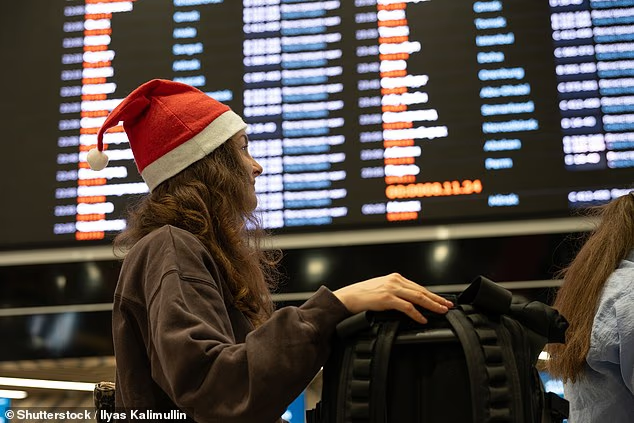
Airports throughout the US have been overwhelmed with holiday flyers, sparking nationwide delays on one of the busiest travel days of the year.
The Federal Aviation Administration (FAA) has imposed a traffic flow restriction starting Monday afternoon in 21 major air travel centers, including flights out of New York, Los Angeles, Chicago, Atlanta, Washington, Boston, Miami, and Minneapolis.
At major airports, flights will likely see a departure delay of up to two hours to space out the overwhelming volume of planes flying over the US starting at 12pm ET and lasting until 6pm Monday evening.
An hourly limit has been set up on how many flights can cross the FAA’s Flow Constrained Area (FCA) boundary, a specific zone over or around the US created by the agency marking flight routes which get too busy during certain times of year.
Between 12pm and 1pm, the FAA expects the average flight to see 25-minute delays, however, those hourly slowdowns will grow to 76 minutes between 3pm and 4pm.
Maximum delays for flights traveling through the FCA are expected to reach one hour and 57 minutes.
Federal officials have designated Monday’s FCA as FCAMA5, a region which typically includes flights traveling near the Caribbean during peak travel seasons.
The American Automobile Association (AAA) has estimated that over 122 million Americans will be traveling at least 50 miles between December 20 and January 1, 2026, a new record for the holiday season.

A holiday traveler waits for her flight amid major airport delays due to high volumes of flyers before Christmas (Stock Image)
Other major US travel regions being affected by the Monday restrictions include Salt Lake City, Houston, Jacksonville, Cleveland, Denver, Oakland, Kansas City, Memphis, and Seattle.
Eleven airports throughout Canada have also been impacted by the FAA’s holiday travel announcement, including Toronto Pearson International Airport, Montréal–Trudeau International Airport, and Vancouver International Airport.
Debbie Haas, Vice President of Travel for AAA, said: ‘Our advice is to plan ahead. Book early, allow extra time to reach your destination, and think about travel insurance if you’re flying during winter weather.’
The auto club group noted that eight million Americans are expected to fly during the final 13 days of 2025. That’s more than 180,000 more people than last holiday season.
The FAA’s FCAMA5 zone is expected to be a hotbed of activity, and major delays, this week as multiple cities in Florida rank as the most popular destinations for holiday travelers.
In their annual report, AAA revealed that Orlando, Fort Lauderdale, and Miami were the top three domestic destinations for holiday travelers this year.
Meanwhile, Cancun, Mexico and the Dominican Republic’s Punta Cana were the top travel getaways internationally this week.
Due to the overwhelming demand to reach these vacation spots, the FAA will be holding planes on the ground until their assigned slot is called to take off and enter that airspace.

The Federal Aviation Administration has imposed flight restrictions in 21 US travel centers, including JFK Airport (Pictured), causing delays on flights of up to two hours (Stock Image)
As of 10am, over 1,200 flights entering or exiting the US have been delayed, with most of these early flights coming from or flying to India, Indonesia, and Australia.
For travelers heading to the airport this week, AAA recommended flyers regularly check their flight status before leaving home and also sign up for airline alerts.
Travelers are also urged to arrive at the airport early, allowing at least two hours for domestic flights and three hours if you’re leaving the US.
Due to the massive crowded expected as airport throughout the US, passengers should also pack smart and keep any vital medications, chargers, and a change of clothes in their carry-on bags.
With delays and potential cancellations now expected throughout the day, flyers should also go over their chosen airline’s policies on rebooking flights and refunds for any cancelled trips.


Elon Musk spent Sunday being driven through Dubai’s streets by Crown Prince Sheikh Hamdan bin Mohammed. It wasn’t a joyride. The Tesla and SpaceX chief was there cementing partnerships that signal where global tech power is shifting — away from increasingly hostile Western markets and toward the Middle East’s open chequebook.
The visit included back-to-back meetings with President Sheikh Mohamed bin Zayed Al Nahyan in Abu Dhabi and Sheikh Hamdan in Dubai, focused on artificial intelligence, space exploration, and advanced technologies. According to Sheikh Hamdan’s X (formerly Twitter), the Crown Prince personally toured Musk through the city, discussing “space, technology and humanity” before ending at his majlis in Nad Al Sheba.
The timing reveals everything. Musk’s net worth hit between $648 billion, according to Bloomberg, and $749 billion, according to Forbes, this month, making him the first person to cross $700 billion. But while his wealth soars, his companies face mounting resistance elsewhere. Tesla sales collapsed 50% in Europe in April 2025 amid boycotts tied to Musk’s political alignment. In the US, the Cybertruck stumbles. Meanwhile, Dubai moves forward with the Dubai Loop.
Announced at February’s World Government Summit, the 17-kilometer underground transit system will feature 11 stations and transport over 20,000 passengers per hour at speeds up to 160 km/h. It is being developed through a partnership between Dubai’s Roads and Transport Authority and Musk’s The Boring Company. Operations are expected to begin in Q2 2026, according to UAE AI Minister Omar bin Sultan Al Olama, who attended Sunday’s meetings alongside Sheikh Khaled bin Mohamed and Sheikh Tahnoon bin Zayed.
This isn’t exploratory. It’s execution. While US and European regulators debate AI governance and antitrust actions, the UAE builds. Sheikh Hamdan emphasized that the country’s legislative frameworks, strategic partnerships, and investment in human capital continue to inspire innovation — code for “we move fast without the friction you’re facing elsewhere.”
Musk praised the UAE’s achievements in technology, AI, and space. His companies already have operational ties in the country, including space collaborations between Dubai and SpaceX and infrastructure work with The Boring Company. But this weekend’s meetings suggest both sides are doubling down. The UAE wants to cement its position as the Middle East’s undisputed tech hub. Musk wants partners who can move quickly and invest heavily while his Western markets grow complicated.
Tesla is losing the European market — here’s why
Despite, battery-electric vehicle sales across Europe growing, Tesla’s sales shrunk.
What we’re watching is geographic diversification disguised as a partnership. As regulatory environments tighten in the West and consumer sentiment shifts, the Gulf presents an alternative: less oversight, more ambition, faster timelines. Whether that produces better outcomes remains to be seen. But the capital is flowing, the projects are launching, and Musk is showing up in person.
The broader implication? The Middle East isn’t just participating in the global tech race anymore — it’s competing to host it.

December 22, 2025
Link copied!
Copy failed!
TECHNOLOGY
MPs question UK Palantir contracts after investigation reveals security concerns | Palantir


UK MPs have raised concerns about the government’s contracts with Palantir after an investigation published in Switzerland highlighted allegations about the suitability and security of its products.
The investigation by the Zurich-based research collective WAV and the Swiss online magazine Republik details Palantir’s efforts, over the course of seven years, to sell its products to Swiss federal agencies.
Palantir is a US company that provides software to integrate and analyse data scattered across different systems, such as in the health service. It also provides artificial intelligence-enabled military targeting systems.
The investigation cites an expert report, internal to the Swiss army, that assessed Palantir’s status as a US company meant there was a possibility sensitive data shared with it could be accessed by the US government and intelligence services.
British MPs have voiced concerns over the US data company in light of the report.
“Palantir … is an organisation that the British government, in terms of the NHS, in terms of contracts, should stay very far away from … I think the Swiss army is right to be suspicious,” said the Labour MP Clive Lewis.
The government “needs to undertake transparent due diligence” on the conduct of Palantir and other big tech companies, said Rachael Maskell, the MP for York Central.
“I know there were certainly questions in the NHS about Palantir’s capabilities. It’s clearly been handed a lot of money to do the federated data platform. I, as a politician, want to know that these companies are making ethical choices. And if they’re not – whether around weaponry, minerals or the climate – I think we as parliament should be given greater transparency around this.”
The UK prime minister, Keir Starmer (third from left), tours the Palantir headquarters in New York in February. Photograph: Carl Court/AFP/Getty Images
The year-long investigation is based on freedom of information requests to Swiss government departments. It details how Palantir went on a seven-year “shopping trip” trying to convince Swiss authorities to use its products and was rejected at least nine times by different agencies.
In response to a query from the Guardian, a Palantir spokesperson said: “There is no basis to the claim in the report by the Swiss army about potential access to sensitive data and no truth to it whatsoever.
“We run a business that is predicated on the trust of our customers, which means we also do everything possible – from contractual, procedural, to technical controls – to ensure that our customers are in full control of their data, their operations and their decisions when using Palantir software.”
In 2020, in the early days of the pandemic, Palantir pitched its services to Swiss health authorities – while touting its work with the NHS, which had just begun to use its tools to manage Covid-19 data.
“We are already doing this in other countries, such as Great Britain, but we feel a special obligation to Switzerland and the federal chancellor,” it wrote.
Switzerland’s Federal Office of Public Health (FOPH) ultimately chose not to work with Palantir in managing the pandemic. The exact reasons for this were redacted: it hired a competitor instead. In meeting minutes obtained by the journalists, the office stated: “Problem: Communications. FOPH demands that Palantir be questioned.”
At the same time, Palantir was trying to win contracts with the Swiss army. These meetings began in 2018. In 2020, it submitted a bid for the “IT system of the army’s intelligence service” and was rejected for unspecified reasons.
In 2024, it tried again. By this time, the UK’s Ministry of Defence had signed its first £75m contract with Palantir for data tools. After a meeting between Palantir’s European head and a Swiss army commander, the army commissioned an internal report to evaluate the products Palantir was offering.
That report, authored by army experts, concluded that it remained unclear – based on their information about Palantir’s products – whether or not US intelligence would be able to access data shared with Palantir as it was a US company, despite Palantir’s official reassurances otherwise.
The finding is “explosive”, wrote the journalists. “Firstly, because it comes from a high-ranking body of the army and, secondly, because the Swiss Federal Department of Defence (VBS) employs certified cryptologists.”
Experts in the Swiss army also found other issues with Palantir’s offerings to the military, both in terms of its cost and the fact that using Palantir’s technologies might require Palantir specialists to be permanently onsite, which could “limit the army’s ability to act in crisis situations”.
The Swiss army decided not to contract Palantir. Less than a year after it commissioned the report, the UK military would sign a £750m deal with Palantir to “boost military AI and innovation”.
WAV and Republik’s findings have generated debate across Europe, especially in Germany. The head of Germany’s domestic intelligence service, Sinan Selen, warned European security services to be cautious in any use of US software in public comments last week without naming Palantir specifically.
An activist dressed as the US president, Donald Trump, takes part in a protest against Palantir in Berlin in September. Photograph: Omer Messinger/Getty Images
Several German states including Bavaria, Hesse and Baden-Württemberg in recent months have chosen Palantir analysis software for their police forces or, as is the case with North Rhine-Westphalia, paved a legal path toward using it or comparable services.
The MP Konstantin von Notz, an intelligence expert with the opposition Greens and former head of Germany’s parliamentary oversight committee for the secret services, has been vocal in his opposition to Palantir.
In an emailed statement to the Guardian after the Swiss revelations, Von Notz underlined his view that the German interior minister, Alexander Dobrindt, who has said he is reviewing whether to allow police across the country to use the US software, “must finally say goodbye to Palantir”.
Von Notz welcomed the Swiss decision to do without the “highly controversial US company which has close ties to Donald Trump”.
TECHNOLOGY
Your last chance to see a shooting star in 2025: Ursid meteor shower peaks tonight – here’s the best time to see it

Tonight may be your last chance to see a shooting star in 2025 – and you won’t want to miss it.
The Ursid meteor shower will reach its dazzling peak this evening, sending bright fireballs flashing through the sky.
Arriving just after the Winter Solstice, this is the perfect opportunity for budding stargazers to witness the celestial action without staying up all night.
And, with the waxing crescent moon only at five per cent of its maximum illumination, there couldn’t be a better chance to see the year’s final meteor shower.
The Ursid meteor shower will continue until December 26, but it will be at its most active tonight.
It is not typically the year’s most impressive meteor shower, with around 10 shooting stars every hour.
However, the Ursids can still offer patient sky-gazers a few surprises, with rates of 25 or more meteors in good years.
Here’s everything you need to know to see the final meteor shower of the year.

Tonight will be the last chance to see shooting stars in 2025 as the Ursid Meteor shower reaches its peak. Pictured: Ursid meteors seen over Essex
What is the Ursid meteor shower
Although it looks like meteors fall to Earth, they are actually the product of Earth sweeping up debris.
As these chunks of rock and dust hit our atmosphere at speeds up to 43 miles per second (70 km/s), friction generates enough heat to vaporise them in a flash of light.
As Earth passes through big clouds of debris left by passing comets, the number of meteors we see dramatically increases in a period known as a meteor shower.
In the case of the Ursids, the meteors are caused by the debris from the comet 8P/Tuttle, a 2.8-mile-wide peanut-shaped chunk of ice and rock which orbits the sun every 13.6 years.
Jessica Lee, an astronomer at the Royal Observatory Greenwich, told the Daily Mail: ‘The Earth travels around the Sun in a fixed path each year.
‘The comet 8P/Tuttle also travels around the Sun in a fixed path, and as it comes in close to the Sun, it heats up, shedding more material and leaving a trail of debris in its wake.’
Since this cloud of debris is always in the same place relative to Earth, the shower always occurs at the same time of year.

At their peak, viewers with good conditions can expect to see as many as 10 shooting stars per hour, which may come in groups of bright fireballs like these meteors seen on Christmas Day over Essex
What are meteors?
A meteor is not technically a type of space rock, but rather the bright flash of light produced by falling space debris.
When a small space rock, known as a meteoroid, hits our atmosphere, friction and air pressure create an enormous amount of heat.
Eventually, this heat becomes so powerful that the rock is vaporised in a flash of glowing light.
When the number of meteors dramatically increases for a short period, scientists call this a meteor shower.
How to see the Ursid meteor shower
In addition to always appearing at the same time, meteor showers also always emerge from the same point in the sky, known as their radiant.
Ms Lee says: ‘They appear to originate from a point in the sky in the constellation of Ursa Minor, which is in the northern part of the sky all night long.
‘This is the constellation our north star, Polaris, is part of.’
However, the shooting stars can actually appear anywhere in the sky.
That means it is better to find a location with a wide view of the sky and keep your eyes focused on a point somewhat to the side of the radiant.
‘Travelling somewhere dark would help, with a clear view of lots of the sky,’ adds Ms Lee.
‘You’ll also need to let your eyes adjust to the dark, so don’t look at your phone or any other bright light source. The longer you wait, the better your chances, so make sure you wrap up warm.’

The Ursids will appear to emerge from the constellation Ursa Minor, but could be seen anywhere in the sky. For the best view, look to the North around midnight or in the pre-dawn hours when Ursa Minor (depicted here) is highest in the sky
Upcoming meteor showers
Ursids: 22 December, 2025
Quadrantids: 4 January, 2026
Lyrids: 22 April, 2026
Eta Aquariids: 6 May, 2026
Alpha Capricornids: 30 July, 2026
Dr Shyam Balaji, astrophysics expert at King’s College London, adds: ‘The best time to view the Ursids is during the predawn hours.
‘Since the shower occurs around the winter solstice, you’ll have long nights and plenty of dark skies to enhance visibility.’
Although they are not always the year’s best shower, the Ursids can produce unexpected peaks that go well beyond their normal limits.
Dr Balaji says: ‘The Ursids are generally a sparse meteor shower, producing about 5 to 10 meteors per hour under ideal conditions.
‘However, it has had notable outbursts in the past, such as in 1945 and 1986, when up to 100 meteors per hour were observed. This unpredictability keeps skywatchers interested.’
One of the best parts about watching a meteor shower is that you don’t need any special equipment at all to enjoy it.
In fact, any telescopes or binoculars will only restrict your field of view and make it harder to see the meteors.
Unfortunately, the Met Office weather forecast for tonight does not look exceptionally promising.


Unfortunately, the weather tonight will not be ideal for stargazing. The Met Office forecasts cloud cover (left) and some rainfall (right) around midnight

The next opportunity to see shooting stars will be on the night of January 4, when the Quadrantid meteor shower reaches its peak. Pictured: The Quadrantid Meteors over Northumberland
Fairly heavy cloud cover is forecast over the entire UK until December 24.
However, conditions should remain dry so you may be able to catch a break in the clouds for some late-night star watching.
If you do miss the Ursid meteor shower tonight, the next best opportunity will be the Quadrantids, which reach their peak on January 4.
The Quadrantids are one of the year’s best meteor showers, famous for their intense burst of bright fireballs.
However, the exceptionally short peak lasts only a few hours, making this shower the most challenging to observe.
After that, you will need to wait three months for the Lyrids to reach their peak on April 22.
These will be followed by the Eta Aquariid meteor shower, which peaks on May 6 with around 40 meteors per hour.
Explained: The difference between an asteroid, meteorite and other space rocks
An asteroid is a large chunk of rock left over from collisions or the early solar system. Most are located between Mars and Jupiter in the Main Belt.
A comet is a rock covered in ice, methane and other compounds. Their orbits take them much further out of the solar system.
A meteor is what astronomers call a flash of light in the atmosphere when debris burns up.
This debris itself is known as a meteoroid. Most are so small they are vapourised in the atmosphere.
If any of this meteoroid makes it to Earth, it is called a meteorite.
Meteors, meteoroids and meteorites normally originate from asteroids and comets.
For example, if Earth passes through the tail of a comet, much of the debris burns up in the atmosphere, forming a meteor shower.

Samsung just gave Google Gemini a new home, and it’s not on your phone. The tech giant announced today it’ll unveil kitchen appliances powered by Google’s AI at CES 2026, marking the first time Gemini will appear in home appliances. The lineup includes upgraded bespoke AI refrigerators, over-the-range microwaves, slide-in ranges, and a new AI Wine Cellar, all launching at the Las Vegas tech showcase from January 6-9.
The shift centers on what Samsung calls “AI Vision,” a camera-based system enhanced by Google Gemini and Google Cloud. Think of it as giving your refrigerator eyes and a brain. The tech currently recognizes 37 food items like fresh fruits and vegetables, but with Gemini’s help, Samsung is promising more accurate identification and broader functionality. Users can check what’s in their fridge, get recipe suggestions, and manage ingredients without manually tracking everything.
Samsung’s also betting big on wine enthusiasts. The new Bespoke AI Wine Cellar uses a top-mounted camera to recognize wine labels and track bottles automatically through the SmartThings AI Wine Manager. The system can even identify which shelf and compartment each bottle occupies, so you’re not hunting through your collection.
Which other Samsung home appliances are getting AI upgrades?
Beyond the kitchen, Samsung is rolling out a full smart home lineup. The Bespoke AI Laundry Combo gets upgraded AI Wash & Dry+ that uses multiple sensors to detect fabric types, including Outdoor and Denim, and adjust water, detergent, and drying cycles automatically.
The Bespoke AI AirDresser introduces Auto Wrinkle Care with dual steam systems for quick garment refreshing. The flagship Bespoke AI Jet Bot Steam Ultra robot vacuum, powered by a Qualcomm Dragonwing processor, now recognizes humans, pets, cables, and rugs through deep learning-based object detection.
Image credit: Samsung
Samsung’s TV lineup is also expanding. The company announced a Micro RGB display range spanning 55 to 115 inches, featuring 4K AI Upscaling Pro and Micro RGB HDR Pro for enhanced color precision across premium home viewing.
“Samsung will reach a new level of innovation through this collaboration with Google Cloud,” said Jeong Seung Moon, Executive Vice President and Head of R&D at Samsung’s Digital Appliances division.
How is LG approaching AI-powered home appliances differently?
LG is taking a different route but with the same goal. The company is marking the 10th anniversary of its SIGNATURE brand with an expanded 10-product lineup powered by AI Core-Tech. At the center is the new LG SIGNATURE refrigerator featuring conversational AI based on Large Language Model technology.
The 6.8-inch LCD display supports natural-language interactions for tailored suggestions. The AI Fresh feature even monitors temperature fluctuations based on user patterns and pre-cools the interior up to two hours before anticipated door openings.
The LG SIGNATURE Smart InstaView refrigerator goes a step further with ThinQ Food, using internal cameras to identify ingredients, suggest recipes, and offer creative substitutions. When not in use, the T-OLED InstaView panel displays elegant visuals, transforming the kitchen into an expressive space.
 Image Credit: LG
For cooking, LG’s SIGNATURE Oven Range introduces Gourmet AI, which uses an AI camera to identify more than 85 dishes and automatically applies the optimal cooking settings, including temperature, time, and mode, so you don’t have to program it manually. The AI Browning feature monitors bread as it bakes and sends a notification through the ThinQ app when it reaches the preset level of doneness. The connected smartphone features include real-time monitoring, time-lapse recaps, and easy social media sharing.
What does this mean for the future of smart homes?
Both companies are pushing AI beyond novelty into genuine utility. Samsung’s collaboration with Google and LG’s integration of conversational AI represent a broader industry shift—AI as a daily assistant rather than a standalone feature. The technology is meant to simplify meal planning, reduce food waste, and make homes smarter without requiring constant user input.
Whether consumers want AI tracking their groceries, cooking habits, and daily routines is another question. The privacy concerns in both announcements remain unaddressed for now. But if CES 2026 is any indication, the smart home market is betting they will. Visitors at both companies’ booths in Las Vegas will be the first to see these systems in action, and that’s where the real test begins.
Samsung Galaxy S26 leaks point to a risky year of stagnation for the smartphone giant
Early Galaxy S26 leaks suggest Samsung is leaning heavily on recycled designs, raising questions about whether brand loyalty alone can carry its flagship lineup into 2026.

December 22, 2025
Link copied!
Copy failed!

I love playing video games, but what interests me most as a journalist are the ways in which games intersect with real life. One of the joys of spending 20 years on this beat has been meeting hundreds of people whose lives have been meaningfully enhanced by games, and as their cultural influence has grown, these stories have become more and more plentiful.
There is another side to this, however. A couple of decades ago, video games were mostly either ignored or vilified by governments and mainstream culture, leading to an underdog mentality that has persisted even as games have become a nearly $200bn industry. As their popularity has grown, so have their political and cultural relevance. And the ways in which games intersect with real life are now coloured by the economic and political realities of our times.
When I look back on this year’s happenings in the world of games, I see a lot of positives. A theme of the past few years has been comparatively small-scale games outperforming expensive blockbusters: the best examples this year have been the now multi-award-winning Clair Obscur: Expedition 33, and Hollow Knight: Silksong, which has sold seven million copies. Despite year-long discussions over the finer points of what counts as “indie” and how many people really contribute to games made by “tiny” teams – a lot of them use contractors, who deserve to be acknowledged – the point remains that it is very possible to make brilliant and creative games to extremely high standards without a $100m budget, and that is something to be celebrated.
Smaller-scale wins … Clair Obscur: Expedition 33. Photograph: Kepler Interactive
The Nintendo Switch 2 was also (finally) announced and released this year, and has been very well received despite Trump’s best efforts to scupper its launch with tariff drama. Having a new console to enjoy tends to revive one’s enthusiasm for games, and though the Switch 2 didn’t feel enormously different from the original Switch, when I go back to my old machine now I really feel the difference.
But the broader story of 2025 is of a games industry reckoning with the same late-capitalist, techno-feudalistic forces that are threatening every creative industry. Wealth continues to concentrate at the top, while workers continue to face huge instability: more than 5,000 games industry jobs have been lost this year, and have several studios, including Monolith Productions. AI disruption is everywhere, meanwhile, as companies try to force their workforces to justify immense investments in the as-yet-unprofitable technology. AI-generated artwork and voiceovers have made their way into some of this year’s more successful games, and the pushback has been vociferous.
All this has led to much greater visibility for video game workers’ unions. In March, United Videogame Workers formed in the US and Canada, part of the Communications Workers of America. (They could be found protesting outside the Game Awards earlier this month.) In the UK, the firing of 30 staff from Rockstar Games pushed the UK’s IWGB Game Workers Union into the spotlight. Unionisation is slowly becoming more common even in the US, where there is not a strong culture of workplace organisation.
Protesters at the Rockstar Games office in Edinburgh in November. Photograph: Lesley Martin/PA
Another theme of the past few years has been consolidation: when Microsoft acquired Activision in 2023, it made me feel very uneasy about the concentration of economic power. Meanwhile, Saudi Arabia’s Public Investment Fund (PIF) has been buying its way into the games industry for years via esports partnerships and companies such as Savvy Games Group and Scopely, but this year it was kicked into high gear by a $55bn deal for EA. The Saudis also bought Niantic, makers of Pokémon Go, in March. (If you are wondering why the PIF is quite so ethically troubling, and how these video game investments form part of a strategy to whitewash the country’s image and that of its royal family, Eurogamer’s interview with Human Rights Watch from earlier this year is an essential read.)
What we see here is money and power concentrating in the video game world in the same way as in the wider world. And games have immense power to influence people’s thoughts and attitudes: the most powerful people in the world have started to realise this. (Even Elon Musk sees the value of appropriating game credibility: he was discovered to be a fake gamer in January after boasting about his Path of Exile 2 character online.) Why else would the Trump administration be tweeting AI-generated images of the president as Halo’s Master Chief? Or using Pokémon and Halo memes to recruit for ICE? Why else would rightwing agitators continue to feed culture war spats over a black samurai in Assassin’s Creed, or a non-binary actor in a PlayStation game?
Elon Musk boasted about being an elite gamer online – and turned out to be faking it Photograph: Evan Vucci/AP
I don’t pretend to be neutral on any of these things. Earlier this year, after I wrote about the Saudi acquisition of EA, I got an email from a reader asking if “some of this stuff is more editorial opinion rather than fact/news”. The answer to that is: it’s both. I will never report anything here that isn’t true, but I also won’t shy away from delivering my informed opinion on the things that go on in the gaming world. Unsurprisingly for a Guardian journalist, my values are inclusive, left-leaning and somewhat sceptical of corporate power, and of course that informs what I write in Pushing Buttons. I think that those values are vital context in these times.
Playing games is something a lot of us do for escapism, and a lot of people still react defensively if you talk about their relevance to real-world politics. Don’t we play games to get away from this stuff? Can’t we just concentrate on the hundreds of fantastic games that come out every single year, from creatively fired-up developers and artists all over the world? But games are inextricable from what’s happening in the real world. All art is. As if to symbolise this, this year’s Summer Game Fest – a showcase of forthcoming games held in LA in June – was interrupted by city-wide LA protests against ICE.
It matters, who has power. Games feel so exciting because they often give so much power to their players, to carve their own paths though their worlds. As players we leave an impression on games, and they leave an impression on us. In an ideal world, players and developers would be the people who held the power in the video games industry, too. If we enjoy video games, it is worth keeping an eye on the biggest players.


When the dust settles on a year that included a ceasefire in the brutal war in Gaza, persistent but ultimately fruitless efforts to end the war in Ukraine, and the ramp up to a potential war in Venezuela, the biggest US national security story of 2025 may turn out to be one in which not a single shot was fired: This was the year that the US tried to declare economic war on China, and China fought back.
Early this year, in its final weeks in office, the Biden administration released its most sweeping rules yet governing the international trade of the semiconductor chips used to develop artificial intelligence models. Though these rules governed chip access for every country on earth, their primary aim was keeping the highest-end chips out of China.
This was in keeping with the concern of many US officials in both parties that the US risks falling behind China in the race to develop advanced AI, and that this race would be key to the balance of power in the 21st century.
The importance of US-China competition was an area of agreement between the first Trump and Biden administrations and there was every reason to believe the aggressive posture would carry over when President Donald Trump retook the Oval Office. Indeed, in its first month in office, the Trump administration slapped a 10 percent tariff on China for its alleged failure to combat the trade in fentanyl — those tariffs were later doubled. By April, the tariff rate was up to 145 percent, with Trump citing a “national emergency” caused by unfair Chinese trading practices. Treasury Secretary Scott Bessent has described these tariffs as effectively an “embargo.”
At the end of the 2025, things are in a very different place. The US dropped its steepest tariffs after just a few weeks, despite no major concessions from the Chinese side, and were dropped down to 20 percent after Trump held what he called a “12 out of 10” meeting with Chinese leader Xi Jinping in late October. In December, Trump scrapped much of the effort to restrict China’s access to chips by approving sales of Nvidia’s advanced H200 chips in the country, despite the objections of GOP hawks on Capitol Hill. “President Xi responded very positively!” announced the president once thought of by many as a dangerously aggressive China hawk.
The events of this year could end up being viewed as the moment of a fundamental shift in the power balance between the two countries, and one that could have ramifications in conflicts to come.
“It’s been a landmark year in the US-China relationship,” said Eddie Fishman, a former State Department sanctions official who now teaches at Columbia University. Fishman suggested that the events of recent months have “fundamentally changed the balance of power. It’s made the US much more gunshy about taking aggressive steps against China.”
US officials’ optimism about their ability to play hardball with Beijing wasn’t entirely unfounded. The US has long been adept at weaponizing what Fishman calls “chokepoints” in the global economy to put pressure on adversaries. The use of the dollar in international financial transactions is one example; the fact that the most advanced semiconductor chips are designed almost exclusively by US companies and produced almost exclusively by US allies is another.
Trump’s 145 percent tariff was a blunter instrument. But in that case, US consumers were the weapon. The idea promoted by the administration was that China’s economic model, which heavily depends on exports, could not survive without selling goods to the US.
In the long run, that may be true, but in the short run, the US blinked first. The 145 percent tariffs had caused the stock market to fall and raised fears of a recession. Bessent described the policy as not sustainable.
China’s manufacturing sector had indeed taken a hit, but it was still able to negotiate tariffs down to previous levels without major concessions on any of the policies that Trump had described as “ripping off” the United States. (This is in contrast to the European Union, which agreed to a trade deal that was very favorable to the US, under pressure from Trump’s tariffs.)
China’s authoritarian political system may simply have the ability to sustain the economic impact of a trade war longer than a poll-watching US administration. Xi certainly framed it this way, saying, “For over 70 years, China’s development has relied on self-reliance and hard work…and it is not afraid of any unjust suppression.”
But China wasn’t just taking the US’s punches — it was punching back. It did this by imposing 125 percent tariffs of its own, and halted purchases of American soybeans, but more importantly, it began weaponizing a chokepoint of its own. In April, China announced it was suspending the export of a range of rare earth metals and magnets — essential materials for US automobile, electronics, and defense manufacturers — around 90 percent of which are produced in China.
This set off panic among industry leaders when it became clear they only had weeks of stock of some of these materials left, and according to the Washington Post, “provoked deep consternation at high levels of the administration,” leading to Trump’s softened tone against Beijing.
The rare earth restrictions were a “holy shit” moment, Sen. Mark Warner (D-VA) told reporters during a recent reporters’ roundtable hosted by George Washington University.
Warner believes the administration’s realization of the “enormous reliance we have on China in terms of critical minerals” contributed directly to the decision to lift restrictions on chip exports. He also believes it’s a problem we should have seen coming.
“That is not a Trump administration-only mistake,” Warner said, later adding, “This has been a 15-year problem.”
There’s a striking contrast between this response in Washington and the export controls on chips, which did not prompt any major policy changes in Beijing and have likely slowed China’s AI progress but haven’t prevented it from introducing new models this year.
China has used economic coercion against other countries before, often more informally than this. Norway’s salmon exports to China dropped precipitously after imprisoned dissident Liu Xiaobo was awarded the Nobel Peace Prize in 2013, for instance. China has also played the rare earths card before: it briefly suspended exports to Japan in 2010 during a flare-up of a long-running conflict over disputed islands in the East China Sea.
But its actions this year were different both in scale and how systematic they were. Notably, China appears to have been taking notes on how its rivals used economic chokepoints in recent years.
“China absolutely uses foreign policies as a template for its own,” said Cory Combs, head of supply chain research at the research firm Trivium China. “Its export controls very closely map US, and to some extent, EU export controls.”
A notable example is its “unreliable entities” list of foreign companies and organizations restricted from doing business with China because they had “made malicious remarks about China, and assisted foreign governments in suppressing Chinese companies,” which is modeled fairly explicitly on the US Commerce Department’s “entity list.” A new licensing regime announced in October restricting the export of equipment to foreign producers that make their own rare earths products appears modeled on the policies the US has used to prevent companies that use US equipment from selling microchips to China.
Analysts believe China began a much more concerted effort to build the tools and legal frameworks to counter what it sees as US economic coercion during the first Trump administration, when the US began targeting Chinese tech firms like Huawei and ZTE with export controls.
This was the year Beijing got the opportunity to put its new weapons to the test.
China agreed to pause its rare earths restrictions for a year after the Trump-Xi meeting in October (and resumed buying soybeans) but hasn’t scrapped them entirely, and they could always be tightened again.
“The cat is out of the bag,” says Fishman. “This is going to be part of China’s strategy from here forward.”
This has implications beyond US-China trade policy. It’s not hard to imagine a scenario where China, peeved by US weapons sales to Taiwan, a future US president meeting with the Dalai Lama, or future chip restrictions, again turns to its rare earths weapon.
Amid the recent China-friendly shift in his rhetoric, Trump has taken to referring to the two countries as the “G2,” a formulation that effectively puts China on an equal geopolitical footing to the US and also deeply irritates US allies like India.
Other countries beyond the “G2” are likely to have taken note of the dynamics this year.
“Do we really expect other countries to really stand up against China now?” said Yun Sun, director of the China program at the Stimson Center. “It sends a message to the rest of the world that everyone needs to be more careful about how to deal with China.”
The Trump administration is looking for ways to blunt China’s economic weapons. One obvious way to do this would be to reduce reliance on Chinese rare earths. Despite their name, these metals aren’t actually all that rare, but they’re difficult to mine, environmentally polluting, and come with low profit margins. Private investment in mining them is unlikely without the kind of generous incentives the Chinese government provides. The US is now responding after this year’s wakeup call: The Pentagon has taken an ownership share in the only company currently mining rare earths in the US, and the Trump administration has inked rare earths deals with Australia and Saudi Arabia.
But some experts believe it may take more than a decade before China-free supply chains can be developed. Despite Japan’s large-scale effort to diversify away from Chinese rare earth supplies after the 2010 crisis, it still buys about 60 percent of them from China. On the other side, China is working to reduce its reliance on the US and its allies for chips as well, but those efforts are also likely to take years.
The generous reading of both trends, from a US perspective, is that the two countries are caught in a kind of economic mutual assured destruction that could keep tensions from spiraling out of control. The less generous reading is that this year showed that when it comes to economic warfare, China has a higher tolerance for escalation than the US. And it may escalate again soon.