
SCIENCE
‘A huge surprise’: 1,500-year-old church found next to Zoroastrianism place of worship in Iraq


About 1,500 years ago, early Christian monks and adherents of the Persian religion Zoroastrianism lived together without conflict in northern Iraq, according to a new study.
This wasn’t the only place where Zoroastrians mingled with people of other faiths; a 2,000-year-old sanctuary discovered in modern Georgia reveals a mixture of Zoroastrian beliefs and those of other religions, another study reports.
Taken together, the finds are more evidence that Zoroastrianism — the official religion of the royal dynasties that governed the Persian empires for more than 1,000 years — often coexisted peacefully with other religions.
You may like
In the Iraq finding, a team led by archaeologists Alexander Tamm, of the Friedrich-Alexander University of Erlangen-Nuremberg, and Dirk Wicke, of Goethe University Frankfurt, examined the ruins of a building complex at the Gird-î Kazhaw site in the Kurdistan region of the country, according to a statement from Goethe University Frankfurt.
They found buried stone pillars and other architectural evidence that the building complex had been a church at the center of a Christian monastery, which was originally discovered in 2015. The monastery was built in about A.D. 500 — “a huge surprise” because it was the first Christian structure ever found there, according to the statement.
The team also unearthed buried fragments of a large jug decorated with an early Christian cross. (Crosses were rarely used as Christian symbols until the Roman Empire legalized Christianity in the fourth century.)
And yet the newly investigated Christian monastery lies only a few yards from a Sasanian Persian fortification where Zoroastrianism was practiced. The two structures’ proximity indicates that Christians and Zoroastrians were living peacefully side by side at this location, the statement said.
Buried pillars suggest there was a Christian church and monastery at the site about 1,500 years ago. (Image credit: Institute of Archaeological Sciences, Goethe University Frankfurt)
Rival empires
The archaeological team noted that in that era, Christianity was spreading beyond the borders of the Roman Empire, where it had been the official religion since the Edict of Thessalonica by Emperor Theodosius in 380.
The Romans — and, later, the Byzantines — were usually rivals of the Persians, and sometimes allies. The new religion of Christianity, however, was spreading even among the Persians. “The early dating for a church building into the fifth to sixth century AD is not unusual in the region,” the statement said. “There are comparable structures in northern Syria and northern Mesopotamia.”
“Grandiose” temple in Georgia
The finds in northern Iraq come amid new details of a roughly 2,000-year-old sanctuary within a “grandiose” temple complex at Dedoplis Gora in Georgia, less than 400 miles (600 kilometers) north of Gird-î Kazhaw in Iraq.
You may like
Dedoplis Gora was under the independent Kartli kingdom at that time. However, the region was heavily influenced by the Achaemenid Persian Empire, and there is extensive evidence that Zoroastrianism was practiced there.
According to a study in the January 2026 issue of the American Journal of Archaeology by David Gagoshidze, an archaeologist at the University of Georgia in Tbilisi, “the kings of Kartli worshiped Iranian (Zoroastrian) gods merged with local Georgian astral deities.” The study looks at three sanctuary rooms in the Dedoplis Gora palace that had different religious traditions.

Archaeologists have unearthed pottery fragments in Iraq from a large jug decorated with a Christian cross. (Image credit: Institute of Archaeological Sciences, Goethe University Frankfurt)
In one sanctuary, the rites of Zoroastrainism were practiced at an altar where “permanent residents of the palace of Dedoplis Gora offered daily sacrifices and prayed.” In another room, it appears the “noble owners of the palace” worshipped the Greek cult of Apollo, “based on the statuettes found there,” according to the study.
Finally, in a third room, in what seems to have been a “syncretic” ceremony (that is, a ceremony that combines more than one religious tradition), rituals were likely carried out for a local cult related to “fertility, agriculture and harvest.”
History of Zoroastrianism
The studies indicate the official Persian religion of Zoroastrianism was generally tolerant of other beliefs, although there were times during the late Sasanian Persian Empire when followers of rival religions like Christianity or Manicheism (a now-extinct Persian religion centered on the prophet Mani) were persecuted.
Zoroastrianism is named after the Persian prophet Zarathustra (Zoroaster in Greek), who is thought to have lived about 3,500 years ago, and it is centered on the worship of the “Wise Lord” Ahura Mazda, whose primary symbol is fire. (The phrase “Thus spake Zarathustra” is the title of a book by the 19th-century German philosopher Friedrich Nietzsche, who wasn’t Zoroastrian but used Zarathustra as a fictional mouthpiece for his ideas.)
Zoroastrianism sharply declined in Persia (now Iran) after the Islamic conquest of the Sasanian Empire in the seventh century, and now there are only about 120,000 practicing Zoroastrians worldwide.










SCIENCE
How 2025 became the year of comet — The rise of interstellar 3I/ATLAS, an icy Lemmon and a cosmic SWAN


2025 has seen stargazers look on in awe as a trio of magnificent comets barreled headlong into the inner solar system to survive a close brush with the sun, only to emerge to race back out into the blackness of space, never to be seen again.
Of these comets — the interstellar invader 3I/ATLAS, C/2025 A6 (Lemmon) and C/2025 R2 (SWAN) — not all survived their trial by solar radiation intact, while others drew the attention of a global audience thanks in part to their scientific significance and in some cases, the disinformation that swirled around them.
You may like
5 incredible moments that made 2025 the year of the comet
1. Enter interstellar comet 3I/ATLAS
Comet 3I/ATLAS was discovered on July 1, 2025, by the NASA-funded ATLAS telescope in Rio Hurtado, Chile and was quickly confirmed to be just the third interstellar visitor to our solar system, after 1I’Oumuamua and 2I/Borisov.
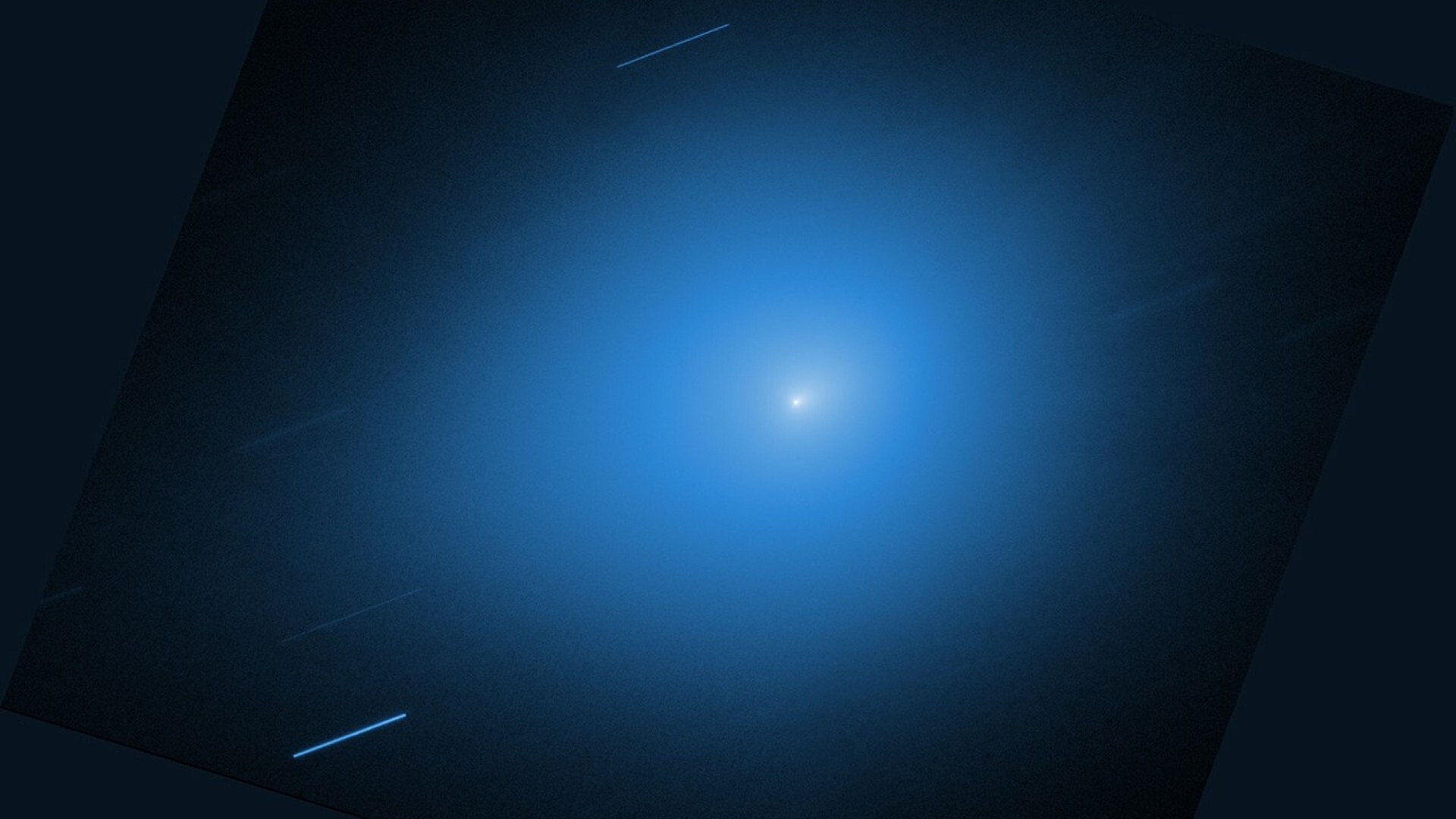
Hubble Space Telescope captured interstellar comet 3I/ATLAS in November. (Image credit: NASA, ESA, STScI, D. Jewitt (UCLA). Image Processing: J. DePasquale (STScI))
Its exotic nature quickly seized the interest of the scientific community and the imagination of the public while simultaneously sending the conspiracy-peddling community into a frenzy, some of whom claimed that 3I/ATLAS was an alien spacecraft that had voyaged to the heliosphere for reasons unknown.
Follow-up observations confirmed 3I/ATLAS to be the brightest and potentially the largest interstellar object discovered to date, measuring up to 3.5 miles (5.6 kilometers) in diameter, based on observations from the Hubble Space Telescope, according to NASA.
2. When the cosmos gives you Lemmon, make astrophotography
If 3I/ATLAS was the most scientifically riveting of the cometary trio, C/2026 A6 (Lemmon) was arguably the most dynamic and photogenic. Comet Lemmon was discovered on Jan. 3 earlier this year and swiftly became a popular target among the astrophotography community, as it brightened from +21.5 to naked eye visibility around its close approach to the sun —known as perihelion — on Nov. 8.
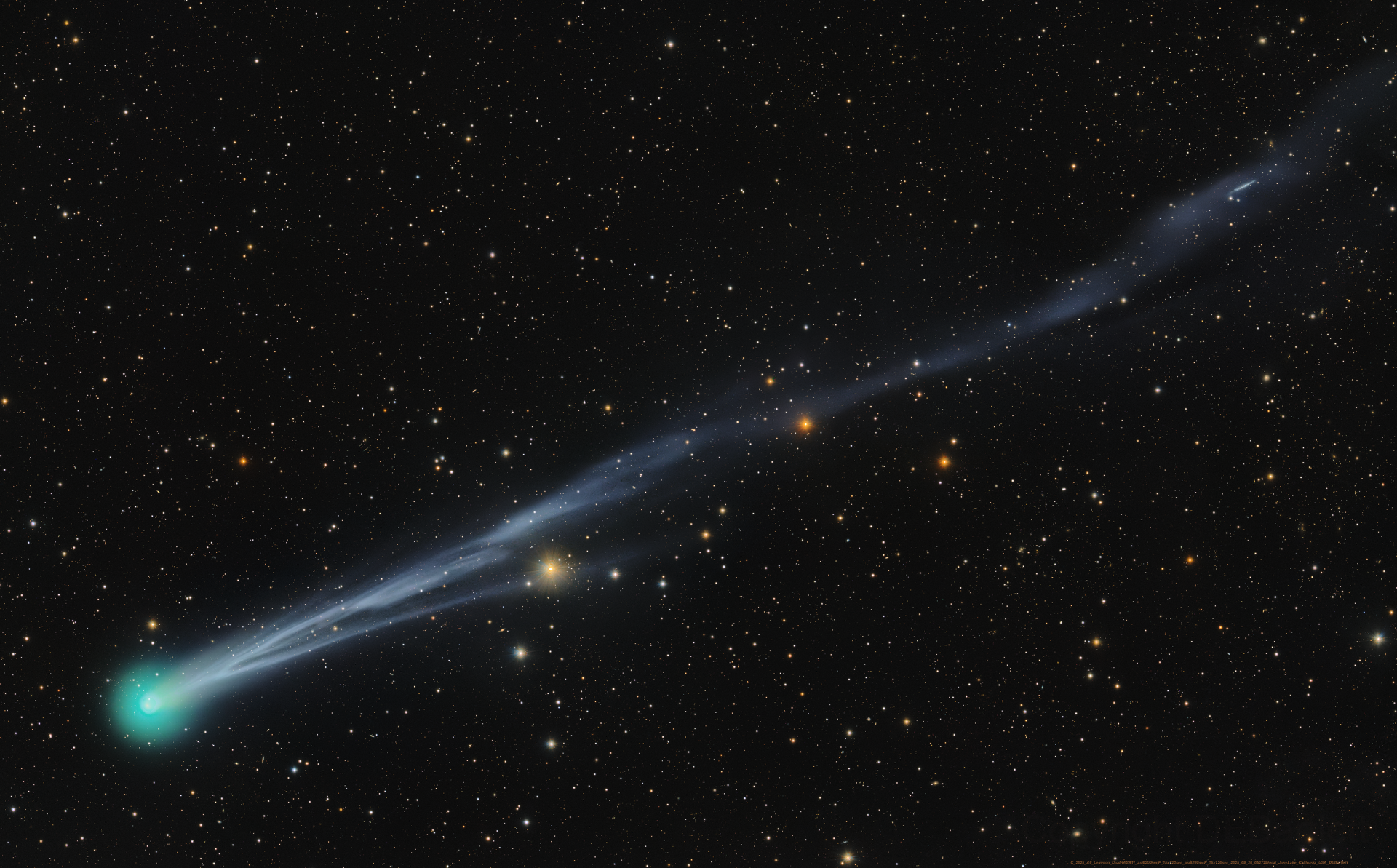
A view of Comet Lemmon on September 20th (Image credit: Dan Bartlett)
Astrophotographers kept C/2026 A6 (Lemmon) firmly locked in their field of view throughout its journey, capturing each stage of its dramatic evolution. As it approached the sun, the increase in heat radiation caused icy matter in the comet’s central nucleus to sublimate into gas, dragging dust particles with it.
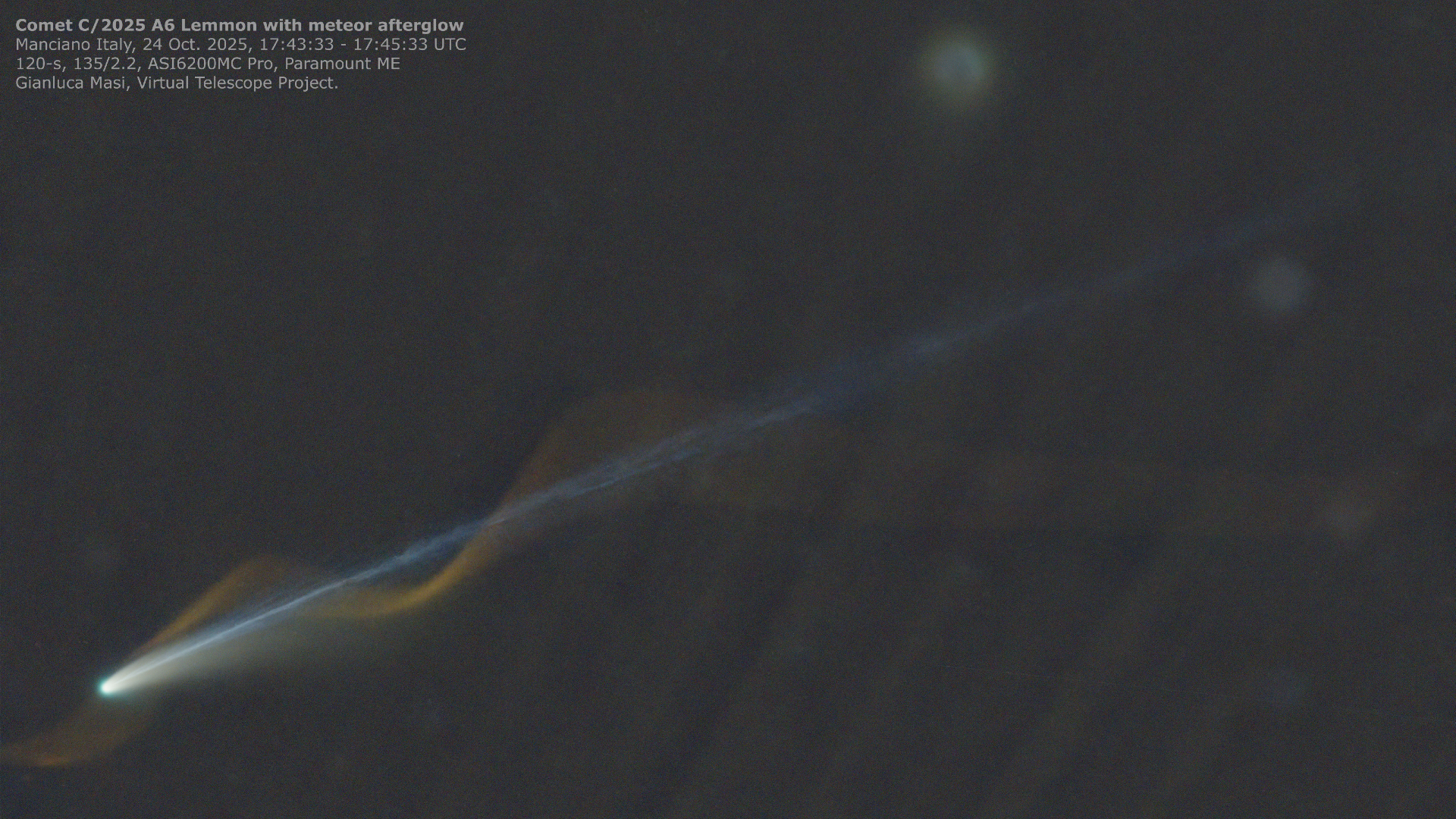
A glowing meteor trail appears to wrap around the tail of Comet Lemmon as seen by astronomer Gianluca Masi of the Virtual Telescope Project on Oct. 24. (Image credit: Gianluca Masi, Virtual Telescope Project)
The resulting cloud of cometary debris was then snatched up by the charged particles pouring out from the sun — called the solar wind — giving rise to a spectacular tail.
Astronomer Gianluca Masi captured a rare shot of the cosmic wanderer, when a glowing meteor tail in Earth’s upper atmosphere appeared to wrap itself around Comet Lemmon’s distant tail as it passed through the constellation Serpens on Oct. 24, creating a “a pure perspective miracle”.
You may like
3. Comet SWAN dives through the Eagle Nebula
While Comet Lemmon’s complex tail snagged the attention of astrophotographers worldwide, others took aim at the solar system wanderer C/2025 R2 (SWAN), which put on a magnificent show on Oct. 17, as it passed in front of the Eagle Nebula in the constellation Serpens.

Comet C/2025 R2 (SWAN) glows alongside the Eagle Nebula. (Image credit: Daniele Gasparri)
Daniele Gasparri captured a striking view of C/2025 R2 (SWAN)’s vivid green coma as it hung in the pristine skies above the Atacama Desert in Chile, with the vast emission nebula serving as a jaw-dropping backdrop for the cometary body.
The pillars of creation, vast columns of interstellar dust and gas shaped by the radiation of nearby stars and made famous by the Hubble Space Telescope, can be seen nestled in the glowing heart of the vast nebula, to the left of the comet’s glowing central nucleus.
4. Comet 3I/ATLAS reaches perihelion
Oct. 30 marked the climax of interstellar traveller 3I/ATLAS’s headlong charge into the inner solar system, as it made its closest approach to the sun, passing 125 million miles (202 million km) from our parent star at the point of perihelion.
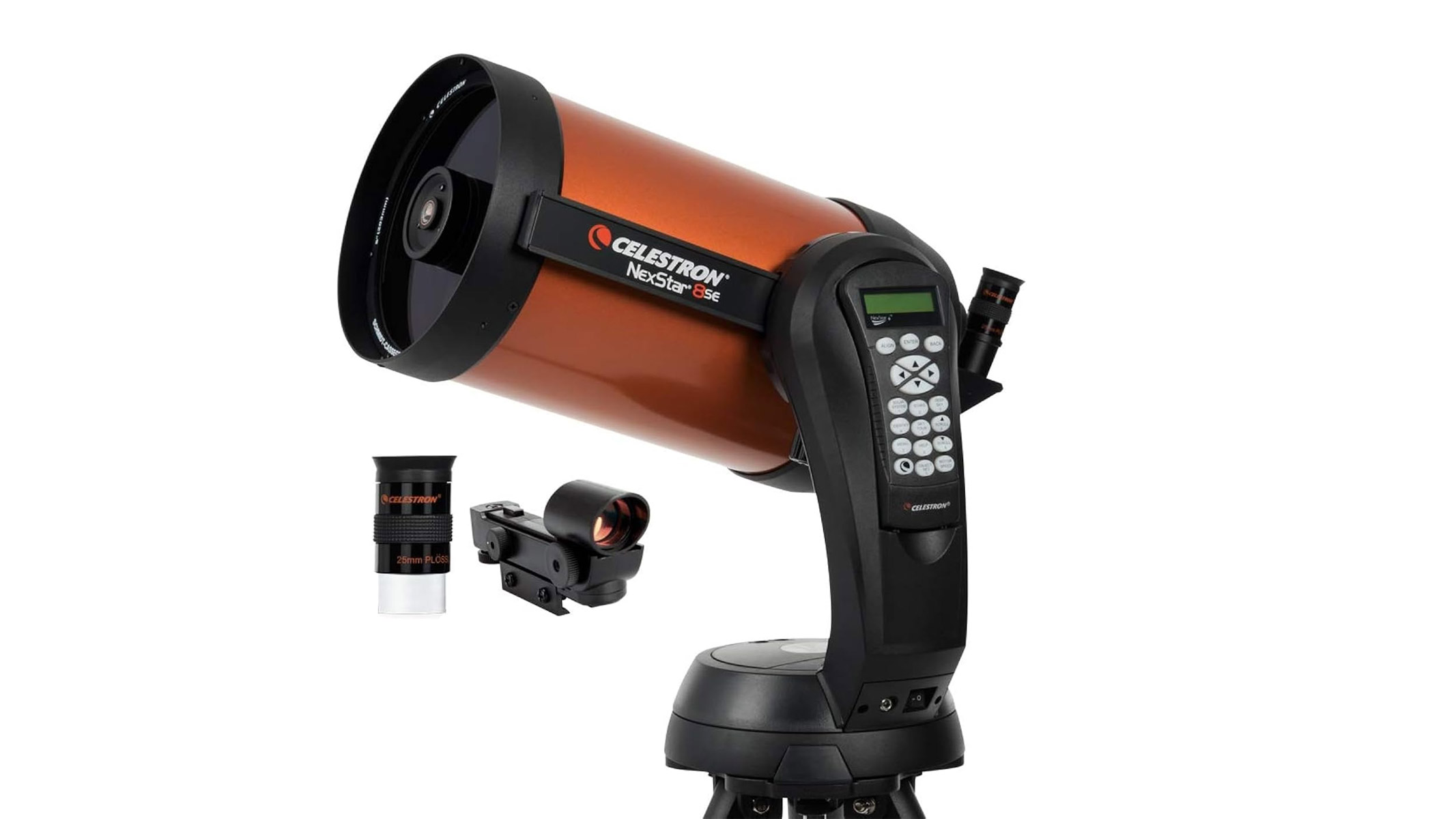
Celestron NexStar 8SE
(Image credit: Amazon)
We reckon the Celestron NexStar 8SE is the best motorized telescope out there as it’s great for astrophotography, deep-space observing and it offers stunning detailed imagery. It is a little pricey but for what you get, it’s good value. For a more detailed look, you can check out our Celestron NexStar 8SE review.
The event occurred just as 3I/ATLAS flew behind the sun from the perspective of Earth, robbing some of humanity’s most powerful observatories of the chance to analyze the comet’s chemical composition as it reached a peak of activity. Thankfully, perihelion was observed from elsewhere in the solar system by a flotilla of spacecraft orbiting Mars and travelling through interplanetary space.
3I/ATLAS finally emerged intact from behind the glare of the sun to become visible to Earthbound astronomers and skywatchers in early November, though it remained too dim to spot with the naked eye.
NASA subsequently held a press conference on Nov. 19 following the re-opening of the federal government, where it revealed several new images of the interstellar invader that documented its glowing central nucleus, sun-facing jet and growing tail. Conspiracy theorists were left somewhat broken-hearted by NASA Associate Administrator Amit Kshatriya, who noted, “It looks and behaves like a comet, and all evidence points to it being a comet”, as opposed to the technologically advanced spaceship suggested by others.
5. K1 ATLAS breakup
One of the most dramatic cometary moments of 2025 occurred on the night of Nov. 11, when astronomers tracked the solar system comet C/2025 K1 (ATLAS) as its central nucleus broke into three massive pieces, following its close pass of the sun on Oct. 8.

Comet C/2025 K1 (ATLAS) caught fragmenting by the 1.82 m Copernicus telescope at the Asiago Observatory in Italy (Image credit: F. Ferrigno/INAF/Univ. Parthenope)
The comet may have crumbled during its first visit to the inner solar system from the shell of icy material which surrounds its outer edge, known as the Oort Cloud.
The increase in heat radiation experienced during perihelion may have created a violent and sudden outflow of material from the nucleus, which could have undermined its structure, leading to the fracturing seen on Nov. 11, according to Elena Mazzotta Epifani of the Italian National Institute for Astrophysics.
Editor’s Note: If you would like to share your astrophotography with Space.com’s readers, then please send your photo(s), comments, and your name and location to spacephotos@space.com.

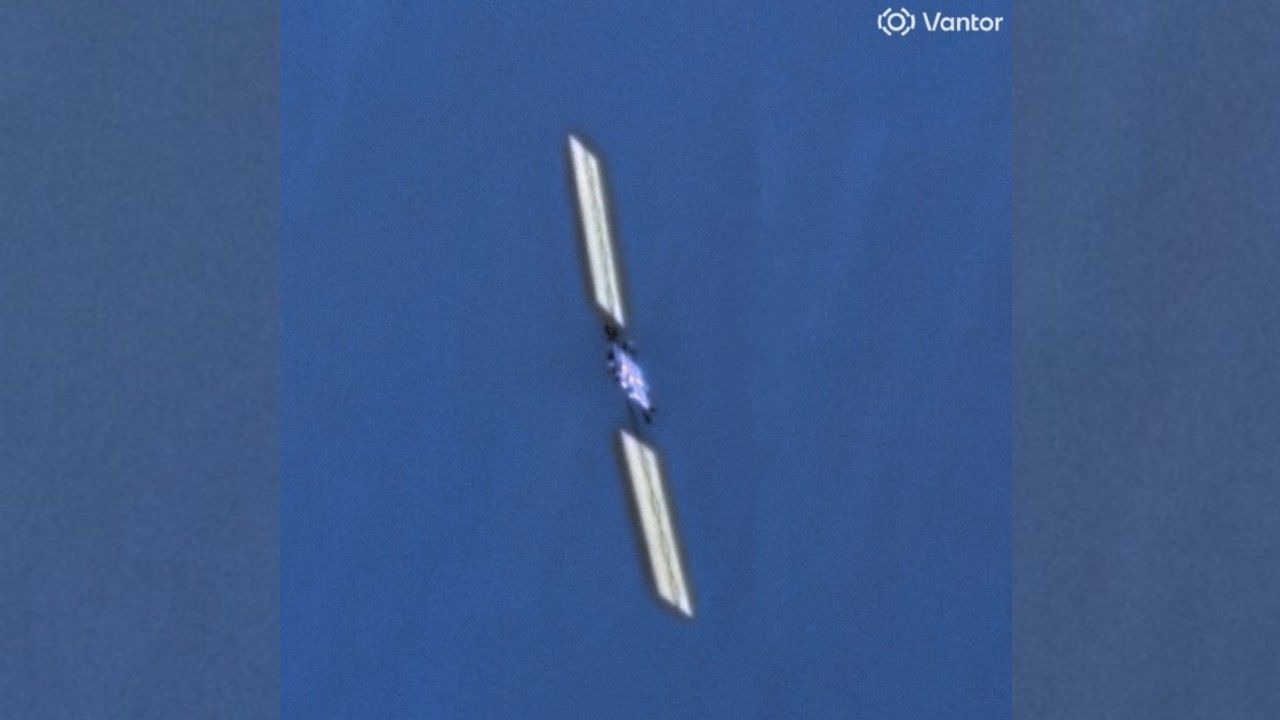
We just got a great up-close look at a SpaceX Starlink satellite in orbit, thanks to Vantor’s WorldView-3 spacecraft.
On Wednesday (Dec. 17), this particular Starlink suffered an anomaly that caused a loss of communication with the ground and an unscheduled venting of its propulsion tank. The satellite is now tumbling and headed down toward Earth’s atmosphere, where it will be incinerated in a matter of weeks, according to SpaceX.
You may like
The company used its WorldView-3 Earth-observing satellite to image the Starlink spacecraft on Thursday (Dec. 18) from a distance of 150 miles (241 kilometers).
The photo, taken while the duo were flying over Alaska, features a resolution of 4.7 inches (12 centimeters), providing SpaceX with key information about the satellite.
“Our team took advantage of the advanced capabilities of our non-Earth imaging technology and recently expanded collection capacity to move quickly and provide SpaceX with confirmation that their satellite was mostly intact,” Todd Surdey, Vantor’s executive vice president and general manager of enterprise and emerging products, said in a statement on Saturday (Dec. 20). “This rapid intelligence delivery enabled them to quickly assess possible damage to the spacecraft.”
Imagery collected by Vantor’s WorldView-3 satellite about 1 day after the anomaly shows that @starlink Satellite 35956 is largely intact. The 12-cm resolution image was collected over Alaska from 241 km away. We appreciate the rapid response by @vantortech to provide this… https://t.co/8OcTZsk5Gx pic.twitter.com/1PafjFwuRPDecember 20, 2025
There is apparently some damage: Data suggests that the satellite released a small number of debris objects as a result of the anomaly. But those pieces, and the satellite itself, shouldn’t a present a problem to other spacecraft in low Earth orbit (LEO), according to SpaceX.
“We appreciate the rapid response by @vantortech to provide this imagery. Additional data suggest that there is a small number of trackable debris objects from the event, and we expect the satellite and debris to reenter and fully demise within weeks,” Michael Nicolls, vice president of Starlink engineering at SpaceX, said in an X post on Saturday.
Starlink is by far the largest satellite constellation ever assembled. It currently consists of about 9,300 active spacecraft — about 65% of all the operational satellites in Earth orbit.
SCIENCE
Graphene supercapacitor breakthrough could boost energy storage in future EVs and other household devices

Scientists have found a new way to manipulate graphene to create a substance with record-breaking energy and power density.
When incorporated into energy storage devices called supercapacitors, this new form of graphene could be the key to high-capacity, fast-charging energy storage that could deliver power more quickly than conventional batteries, the researchers said in a statement.
You may like
Pouch cells are used in electric vehicles, drones, wearable electronics, laptops, smartphones and tablets. Building them from M-rGO could lead to improvements in total capacity, charge time and the ability to power more complex and power-hungry devices with smaller batteries, according to the research team.
Soaking up power
Whereas traditional batteries store energy in chemical bonds, supercapacitors are electrochemical capacitors that store energy as separated electric charge on electrode surfaces. They have the advantage of superior energy density — how much energy can be stored in a given space — and power density — how quickly energy can be delivered per unit volume — over traditional batteries.
Until now, however, supercapacitors have been hamstrung by one significant limitation: only a portion of the potential energy storage of the materials from which they were created was available for use.
This limitation comes from graphene’s physical makeup. While it has the advantage of allowing for denser electrodes — the solid conductors in a battery where charge is stored — it’s very inefficient at using that space. Simply stacking graphene, for instance, is inefficient because the sheets adhere too closely together and don’t leave enough space for the ions that need to move in and out to store energy.
To get around this problem, scientists built messy 3D structures similar to sponges, which provide both large amounts of storage area and pathways for ions to move. While lightweight, the downside is that these structures were large and cumbersome.
This breakthrough overcomes that issue by heating the graphene in a two-step process. This results in a tangled, curved graphene network with multiple levels of structure that still allows for the rapid movement of ions while providing lots of surface area for energy storage.
“This discovery could allow us to build fast-charging supercapacitors that store enough energy to replace batteries in many applications, and deliver it far more quickly,” said Mainak Majumder, a professor of mechanical and aerospace engineering at Australia’s Monash University, in the statement.

There are few better ways to spend the long winter nights than under a crisp, clear December sky — and between Christmas and New Year’s Eve 2025, the Northern Hemisphere night sky will be at its very best. A waxing moon will glide past Saturn, the Pleiades and Jupiter — now shining brightly in the east, right on cue, as a “Christmas Star — while deep-sky wonders like the Rosette Nebula rise high around midnight. Whether you’re trying out one of the best beginner telescopes gifted to you, you’re trying out stargazing with binoculars or you’re using only your eyes, here’s what to see in the night sky this holiday season.
If you want better views of the night sky, we have expert-led guides to the best telescopes, binoculars and cameras to view and image the heavens.
Wednesday, Dec. 24: A crescent moon
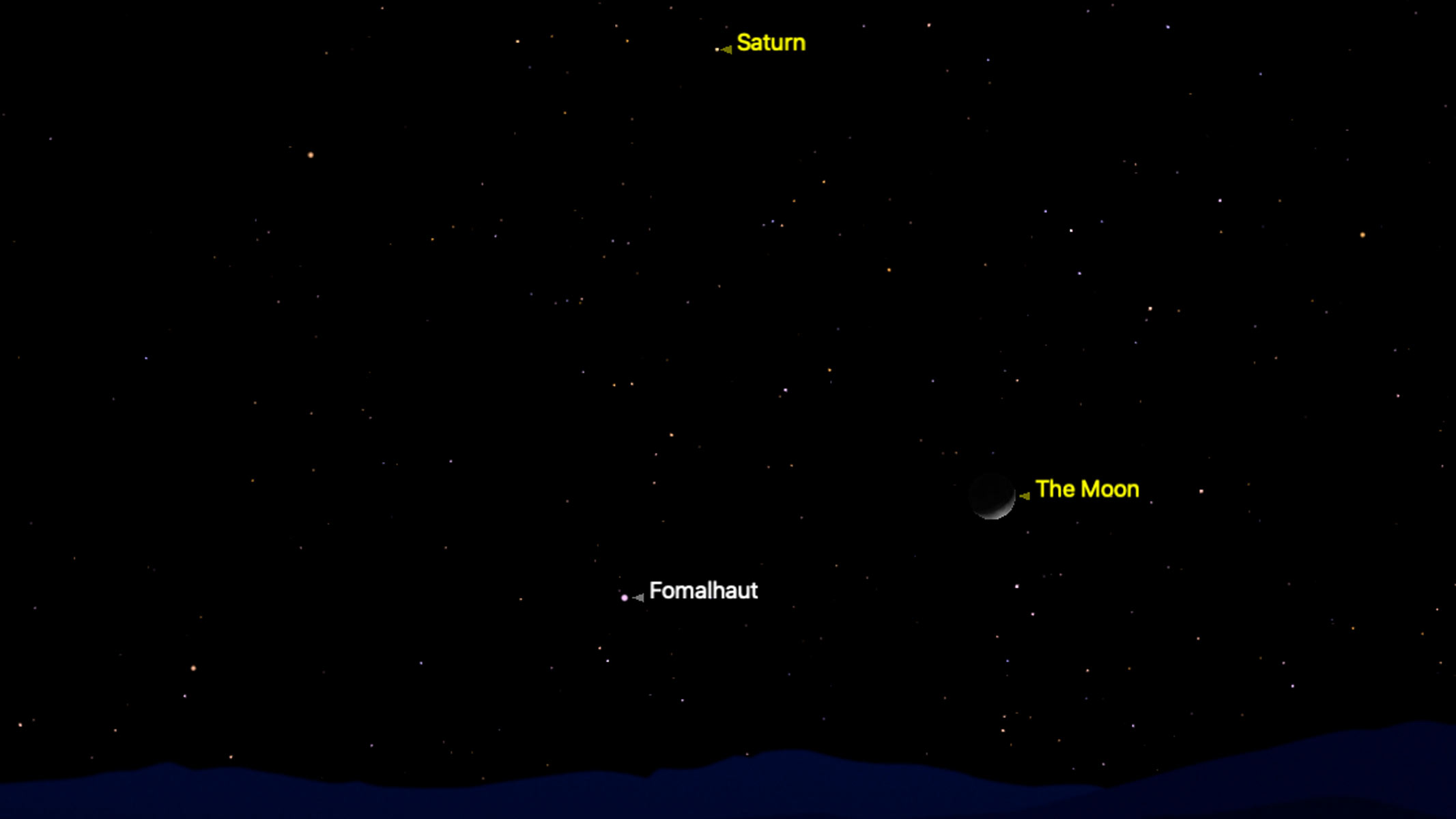
A 20%-illuminated waxing crescent moon will shine with Fomalhaut and Saturn on Christmas Eve. (Image credit: Starry Night)
If you’re looking for the quiet wonder of Christmas Eve, turn your gaze to the southwest sky as it gets dark. There, nicely illuminated, though not yet bright, will be a waxing crescent moon. A fifth of what you’ll see will be its day-side; the other four-fifths — its night-side — will be gently lit by sunlight reflected from our planet — Earthshine. If you have binoculars or a small telescope, point them at the terminator, that line between day and night, to see long shadows and craters in relief. Naked eye observers should look to the left of the moon for Fomalhaut (below) and Saturn (above).
You may like
Also read: How to choose binoculars for astronomy and skywatching
Thursday, Dec. 25: Jupiter as the ‘Star of Bethlehem’
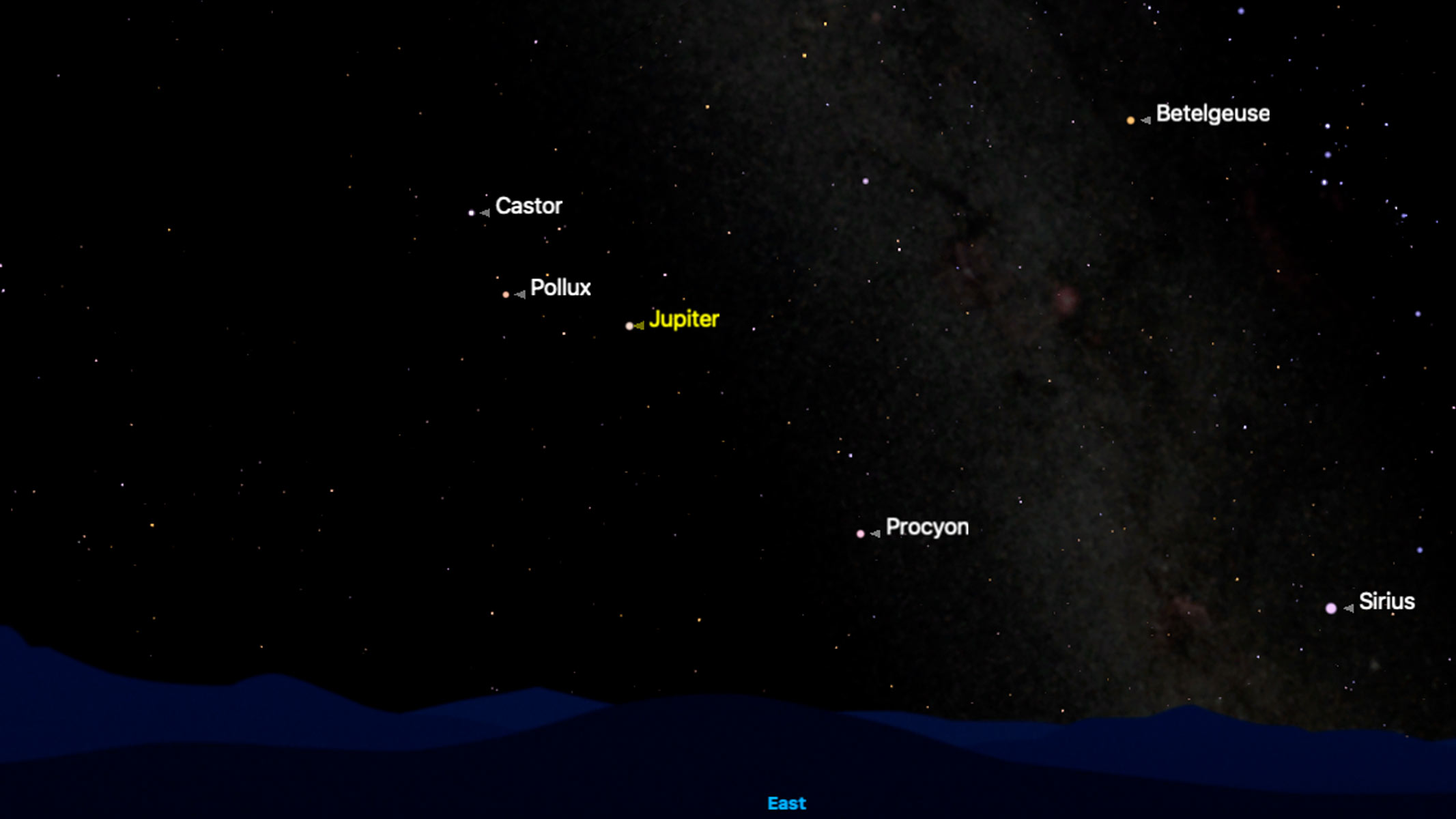
Jupiter is now just two weeks from its annual opposition, so it is as bright as it ever gets. (Image credit: Starry Night)
Christmas Day needs a “Christmas Star,” and what better candidate than Jupiter, which tonight shines at magnitude -2.5 in the constellation Gemini. Look to the east anytime after dark, and you’ll see the giant planet close to “the twins” of Gemini — the stars Castor and Pollux — as it shines brighter than anything else in the night sky, save for the moon. Now is the ideal time to observe Jupiter, which reaches its annual opposition — when Earth is between it and the sun — on Jan. 10, 2026. Typically, an outer planet is at its best for a couple of weeks either side of its opposition; any small telescope should allow a glimpse of its cloud bands, with a 6-inch telescope able to see its Great Red Spot (when it’s facing Earth).
Also read: Best telescopes for seeing planets in 2025
Friday, Dec. 26: Saturn and the moon in conjunction
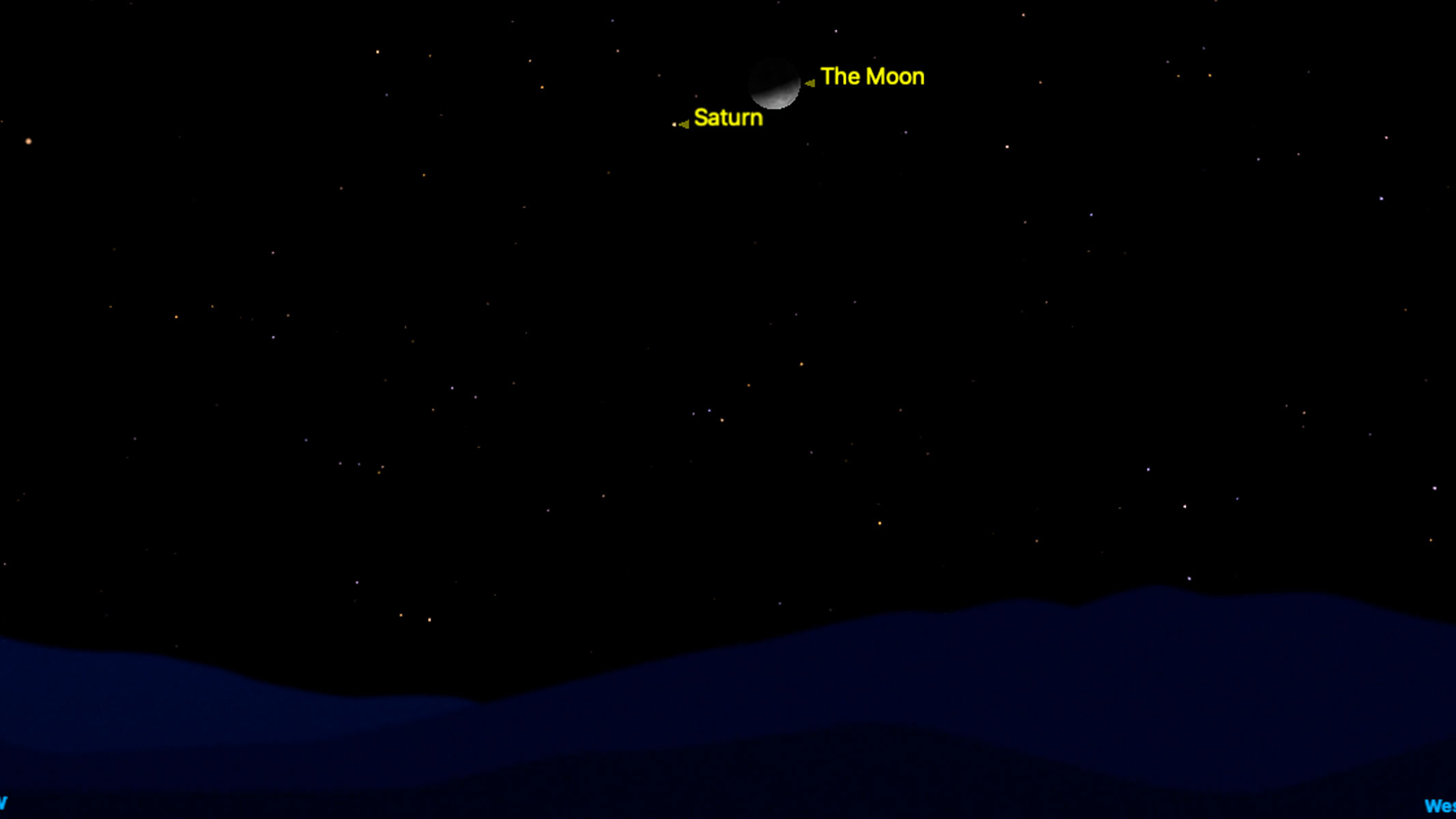
Boxing Day sees the moon meet Saturn in a close conjunction. (Image credit: Starry Night)
Get out of the house as soon as it gets dark on Boxing Day for one of the most beautiful sights of the week, a crescent moon and the planet Saturn. Now a 41%-illuminated waxing crescent, the moon will appear to curl around the sixth planet, and the two will be separated by a mere four degrees. That’s a bit less than the width of your three middle fingers held at arm’s length against the sky. Saturn will appear as a steady, golden point of light, though you’ll need a small telescope to glimpse its ring pattern.
Also read: Best beginner telescopes
Saturday, Dec. 27: Lava plains on the first quarter moon
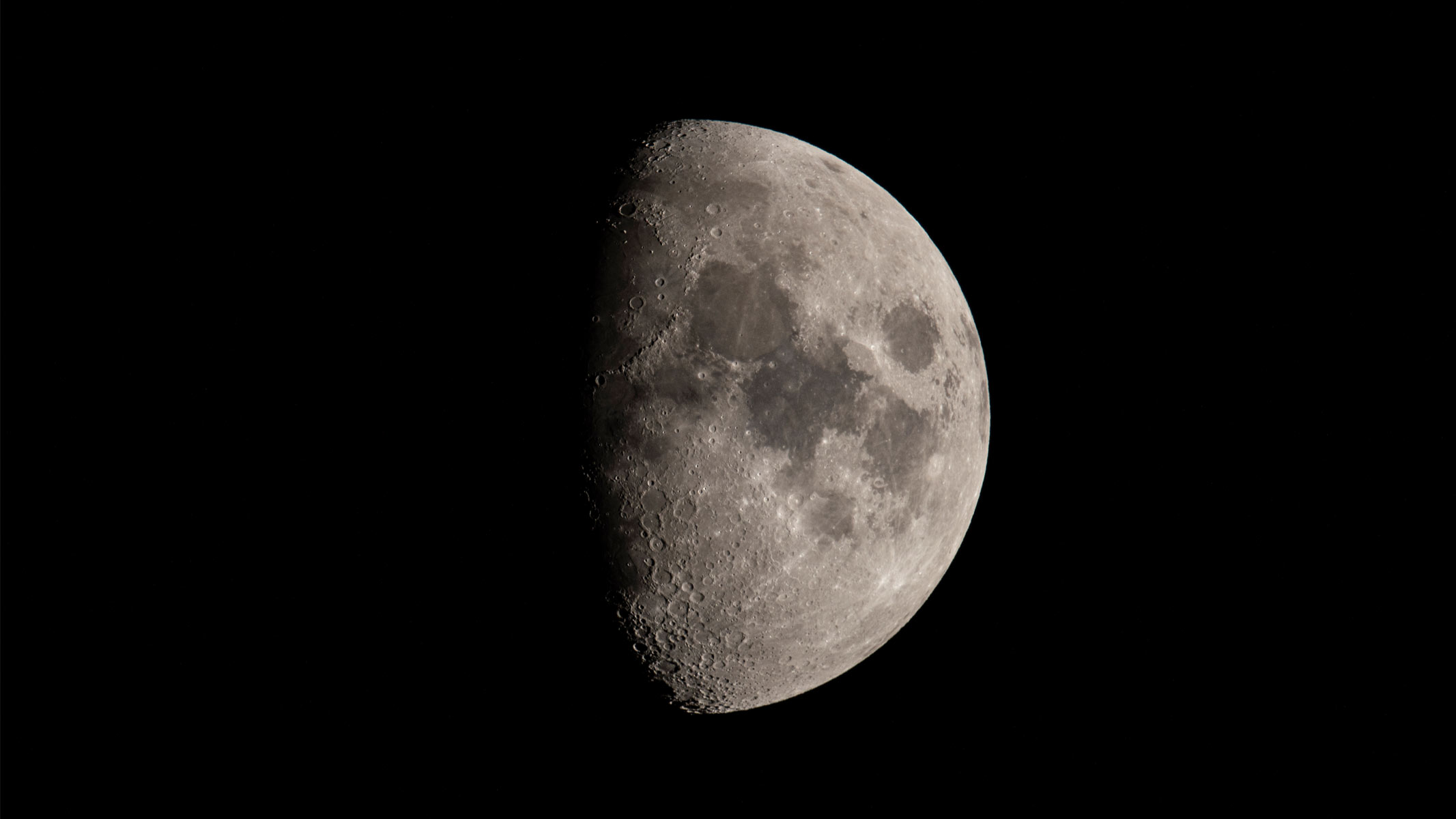
A first-quarter moon will rise on Dec. 27, 2025. (Image credit: Getty Images)
It’s half-day, half-night on the moon tonight as it reaches its first quarter phase in the southern sky. For amateur astronomers, it’s a bittersweet moment — the next week will see the moon grow in brightness as it waxes towards full, making faint star clusters, galaxies and nebulae harder to see. However, a “half-moon” is one of the best times to explore the lunar surface if you have a pair of binoculars. The line between light and dark — the terminator — cuts right down the middle tonight, causing long shadows to stretch across the lunar plains, making every bump and ridge stand out like a black-and-white relief map. The dark regions you see on the right-hand side of the moon are called maria, Latin for seas, but these are no oceans. These are vast plains of lava that solidified billions of years ago in the aftermath of asteroids slamming into the young moon.
Also read: Best telescopes for deep space
You may like
Sunday, Dec. 28: Rosette Nebula

A small telescope will allow you to view the Rosette Nebula at its best on Dec. 28, 2025. (Image credit: Getty Images)
If you have a small telescope, find the ruddy star Betelgeuse in Orion and range left to the quiet constellation Monoceros, the Unicorn, home to an open cluster of stars about 5,000 light-years from the solar system. The Rosette Nebula (also called NGC 2244 and Caldwell 49) is an emission nebula — a cloud of gas that emits its own light because it’s being energized by radiation from nearby stars — and a star-forming region. A flower-like shape, it’s visible through a pair of 10×50 or 15×70 binoculars in very dark skies, or easily in a small telescope. According to In-The-Sky.org, the Rosette Nebula is now well placed, reaching its highest in the sky around midnight local time. If you have trouble finding it, draw an imaginary line from Betelgeuse in Orion toward Procyon in Canis Minor. About one-third of the way along that line, just south of it, is the region of the Rosette Nebula. It’s about three times the diameter of the full moon.
Also read: Best smart telescopes
Monday, Dec. 29: Orion’s Snake
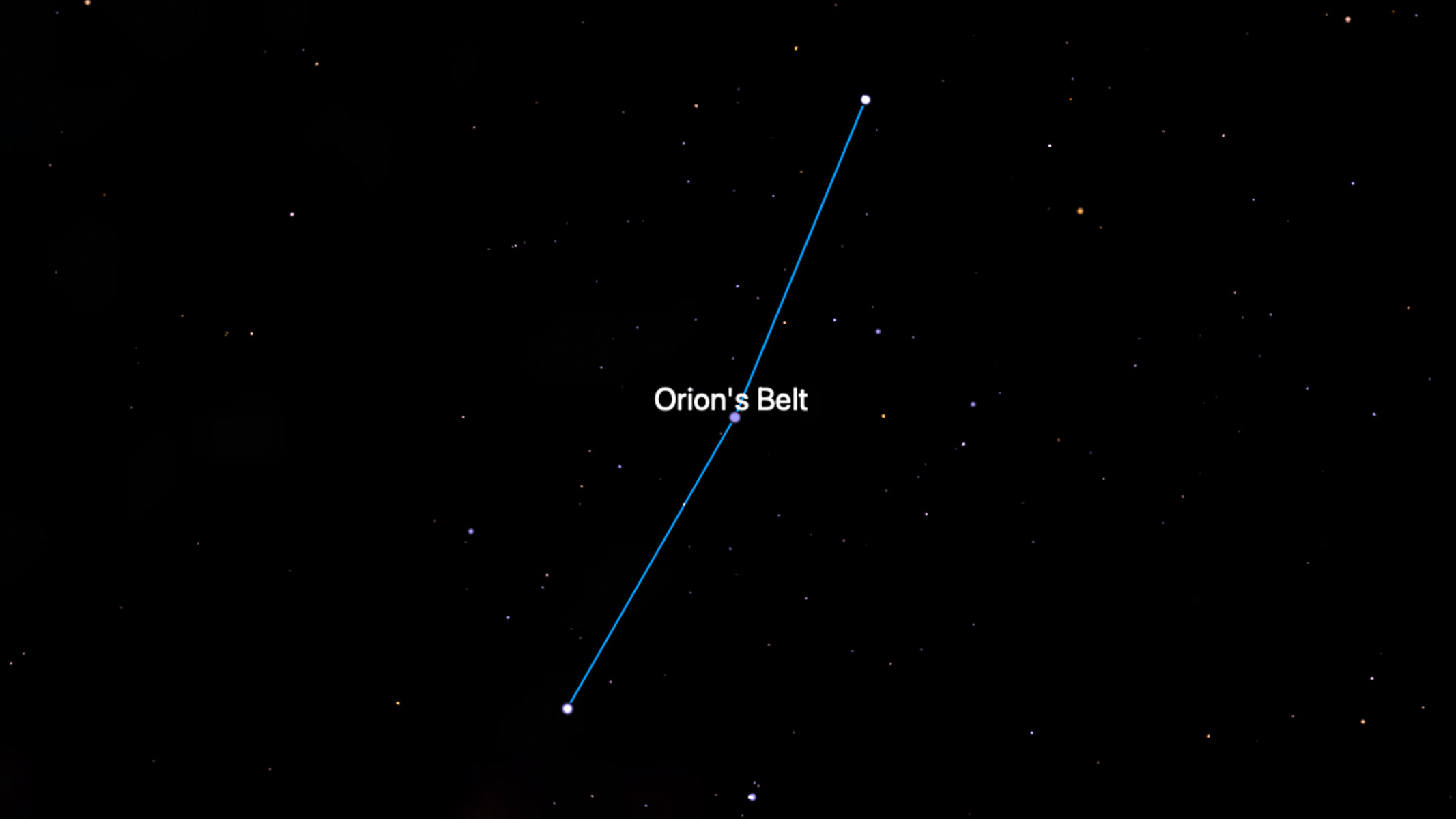
Trace an ’S’ shape of stars in Orion’s Belt on Dec. 29, 2025. (Image credit: Starry Night)
Orion’s Belt — the famous trio of stars in Orion, sometimes nicknamed the “Belt of Orion” or the “Three Kings” — is an icon of the late-December night sky. Look east tonight for Alnitak, Alnilam and Mintaka, strung out in a neat row, rising into the eastern sky as soon as it gets dark. Put a pair of binoculars on them, and you’ll discover great riches. Just to the right is, of course, the Great Nebula in Orion (also called M42). Lesser known is a delicate chain of faint stars curving across the field of view in a subtle “S” shape, running from just above Mintaka to just below Alnilam. It’s very clear through binoculars.
Also read: Best binoculars this holiday season
Tuesday, Dec. 30: Jupiter’s Galilean moons
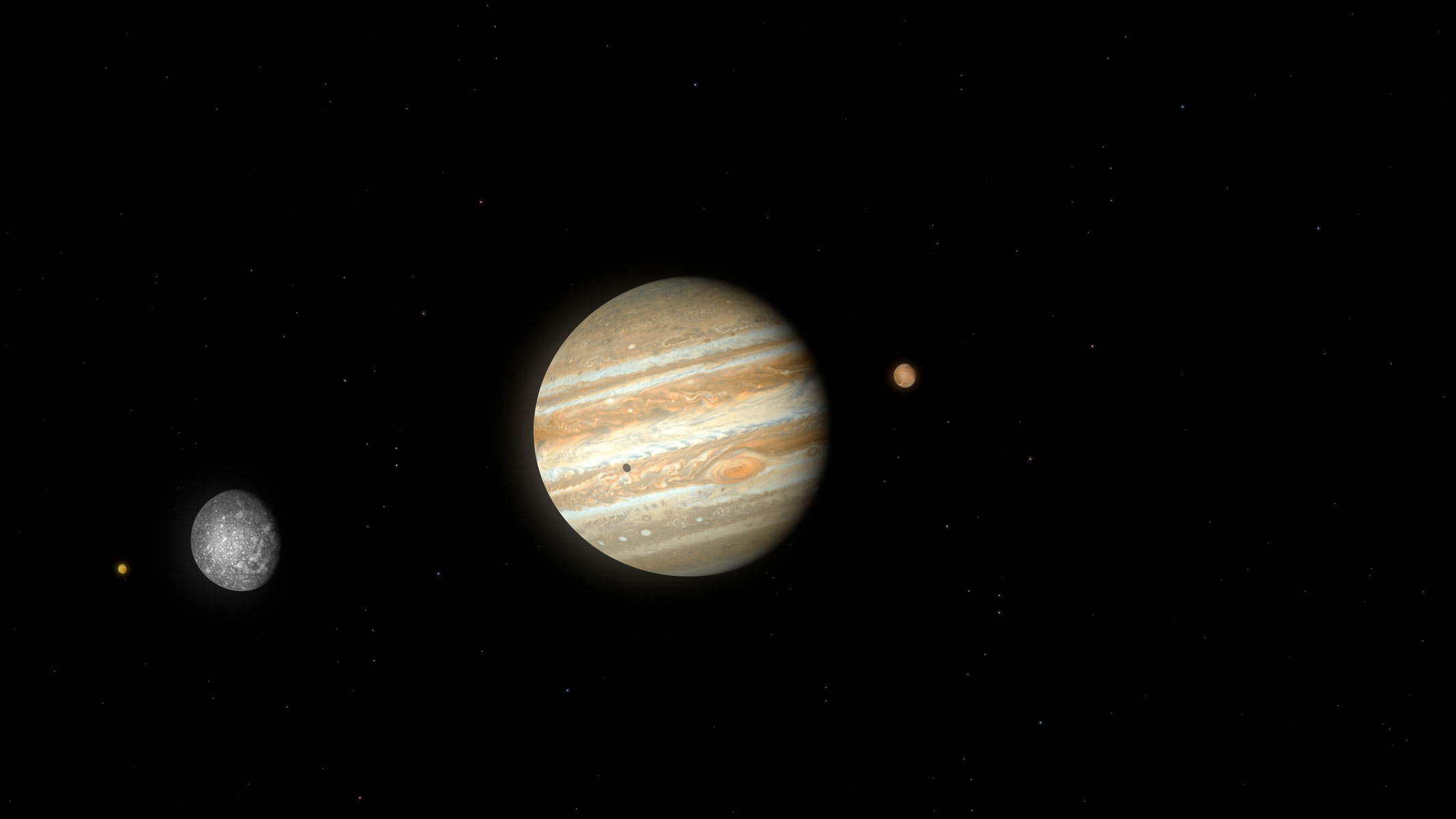
See Jupiter’s moons on Dec. 30, 2025. (Image credit: Getty Images)
Jupiter getting close to its opposition means more than it merely becoming brighter. Since it’s closest to Earth (about four Earth-sun distances), its disk is bigger in the sky, and it’s visible all night. Jupiter’s opposition is also the best time to see its largest four moons — Io, Callisto, Ganymede and Europa. These moons, called Galilean moons because they were first spotted by Italian astronomer Galileo Galilei in 1610, can be seen in any small telescope as pinpricks of light, but also in binoculars.
Also read: Best telescopes for deep space
Wednesday, Dec. 31: Pleiades and the moon in conjunction
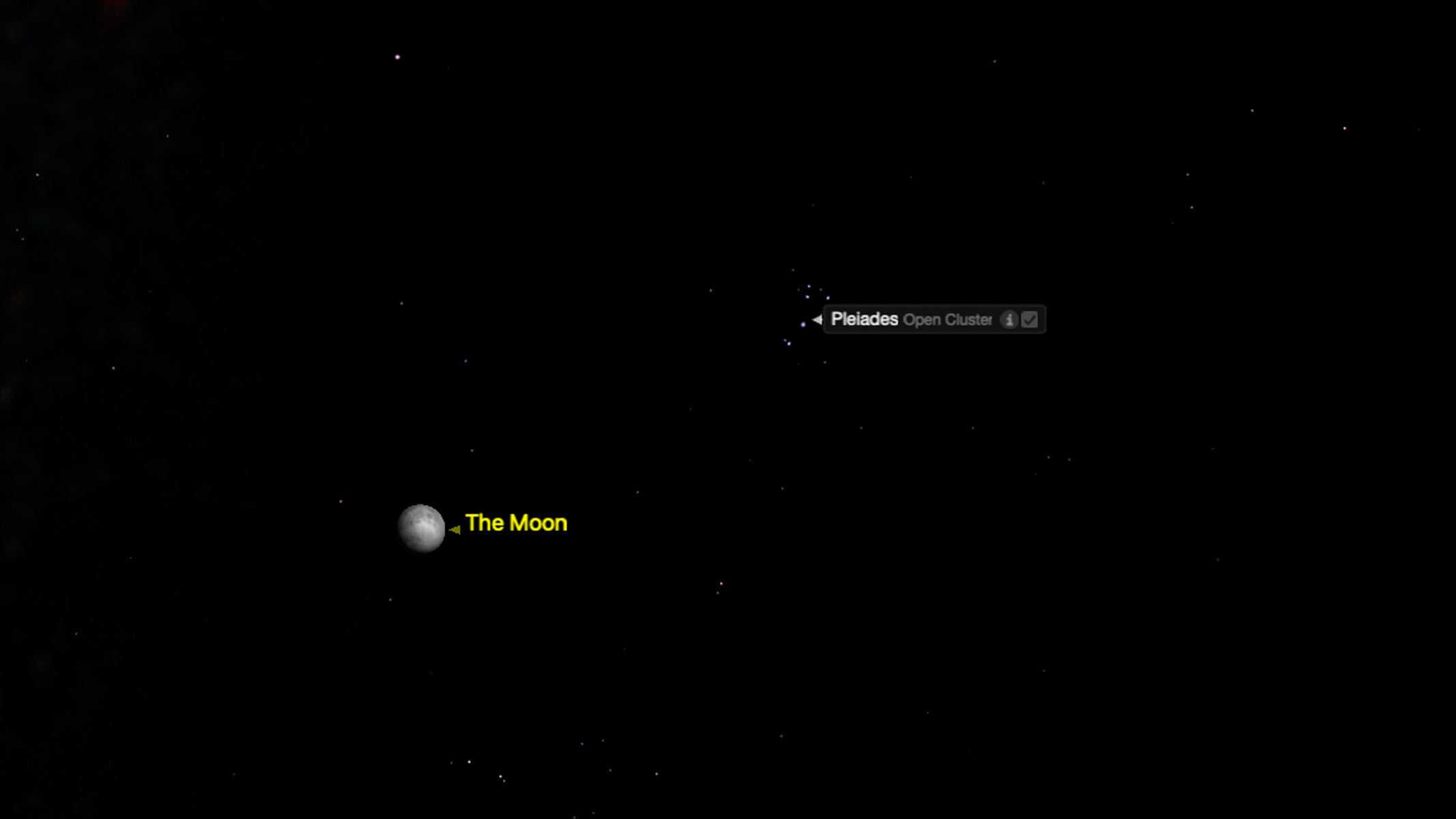
See the Pleiades and the moon close together on Dec. 31, 2025. (Image credit: Starry Night)
As your final stargazing act of the year, step outside as it gets dark and find Orion’s Belt, that iconic trio of bright stars, rising from the eastern horizon like an arrow. Trace Orion’s Belt upward, and high above it, you’ll find the moon, now 92% illuminated. Just above the moon will be the Pleiades — also known as the Seven Sisters and M45 — one of the closest open clusters of stars to the solar system. The bright moonlight may make it hard to see the Pleiades with the naked eye, but any pair of binoculars should bring them into view.
Also read: How to choose binoculars for astronomy and skywatching
SCIENCE
Rare dusting of snow covers one of the driest places on Earth and shuts down massive radio telescope — Earth from space

QUICK FACTS
Where is it? Atacama Desert, Chile
What’s in the photo? A rare dusting of snow covers parts of one of the driest places on Earth
Which satellite took the photo? Landsat 9
When was it taken? July 10, 2025
This striking satellite photo captured a rare spectacle earlier this year, when “one of the driest places on Earth” experienced a rare snowstorm. This freak event temporarily turned the barren, rocky landscape white — and briefly shut down one of the world’s most powerful radio telescopes.
The desert is also widely considered to be one of the driest places on Earth, alongside other hyperarid spots, such as Antarctica and the Sahara. Some areas currently experience as little as 0.002 inches (0.5 millimeters) of rain annually, according to Guinness World Records. Previous research has hinted that parts of the Atacama went nearly 400 years without any recorded rain, between 1570 and 1971.
You may like
On June 25, a rare snowstorm hit Atacama after a “cold-core cyclone” unexpectedly drifted down from the north, covering over half the desert with white powder, according to NASA’s Earth Observatory.
The satellite photo above shows a section of the desert in the Chajnantor Plateau, which rises to around 16,000 feet (5,000 meters) above sea level. This area is home to the Atacama Large Millimeter/submillimeter Array (ALMA) observatory — an array of more than 50 radio dishes that scour the “Dark Universe.” (ALMA itself is not visible in the aerial photo.)
Snowfall in the Atacama is very rare. This photo shows the area surrounding ALMA after a similar event in 2013. (Image credit: Ronald Patrick/Getty Images)
This area is well-suited to astronomical research because it is remote, dry and well-elevated, which reduces interference and maximizes the amount of data telescopes like ALMA can collect. But when the snow settled over the observatory, it temporarily forced ALMA into “survival mode,” meaning that the dishes were repositioned to stop them from accumulating snow, halting observations.
The icy dust may have also affected the Southern Astrophysical Research (SOAR) Telescope, located around 530 miles (850 km) southwest of ALMA, but to a lesser extent, according to Live Science’s sister site Space.com. The newly constructed Vera C. Rubin Observatory is also located in Atacama, near the SOAR telescope, but was not affected by the storm.
The snow did not last long, and most of it had disappeared by July 16. In some places, the sunlight was so intense that the snow likely sublimated, or turned directly from solid to gas, before it melted, according to the Earth Observatory.
This is not the first time that snow has fallen in the Atacama. Similar events also occurred in 2011, 2013 and 2021.
The region has also experienced several intense bouts of rain in recent years. When this happens, it can trigger deadly mudflows. In March 2015, at least 31 people were killed after heavy rainfall triggered Atacama’s largest ever flood, according to a 2016 study.
You may like
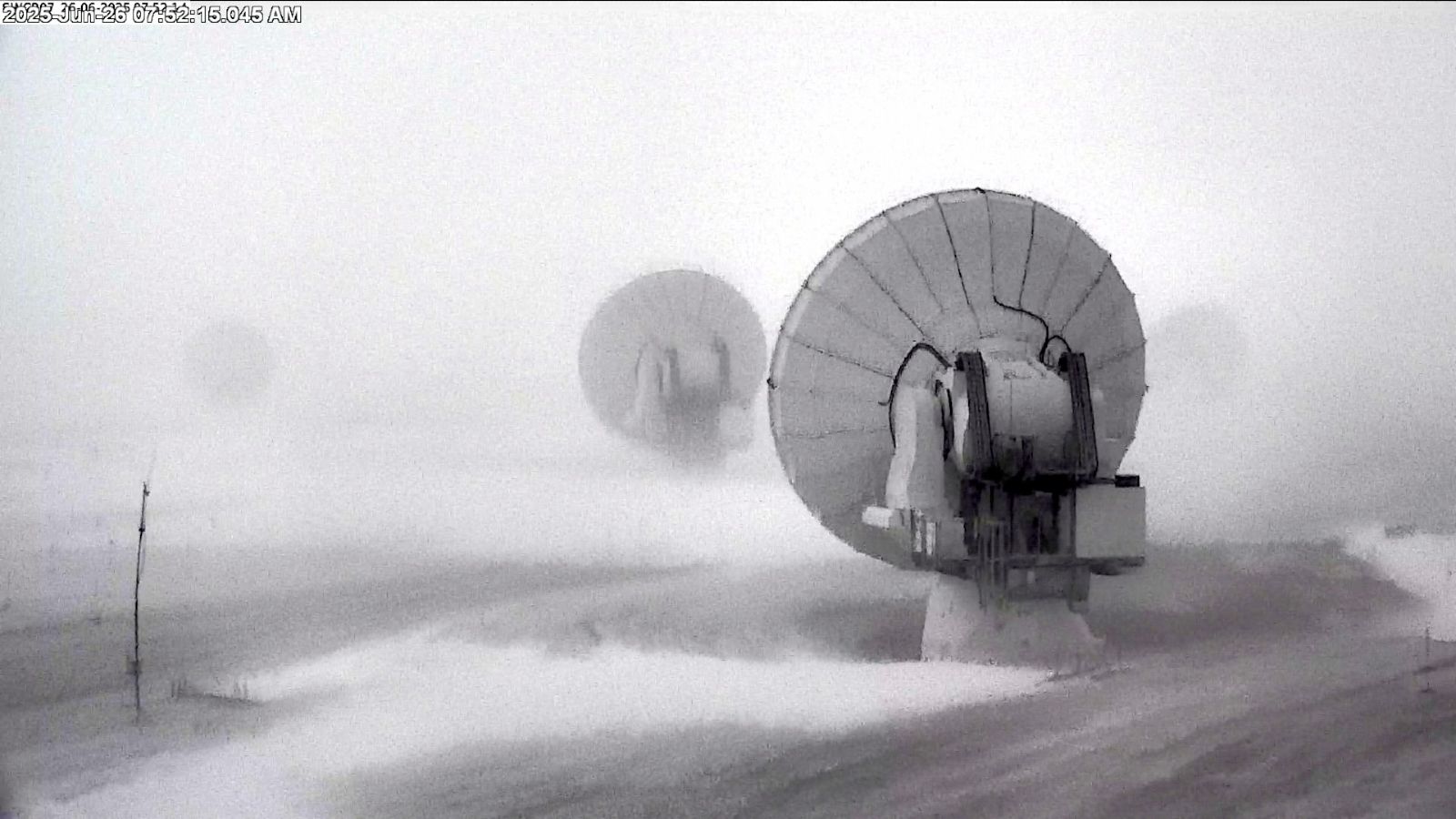
ALMA was forced into “survival mode” as snow fell on its array of radio dishes. This meant realigning the dishes to be perpendicular to the ground to stop snow gathering on them. (Image credit: ALMA)
Rain can also cause desert flowers, which normally appear in spring, to unexpectedly bloom during winter months, creating fields of vibrant petals to sprout up around the desert. This most recently happened in 2024, after a surprise rain shower caught the plants off guard.
Precipitation is rare in the Atacama for two reasons. Firstly, it sits within the “rain shadow” of the Andes, which block clouds moving in from the east. And second, cold ocean currents off the region’s western Pacific coastline prevent water from evaporating into the air over the desert. This makes Atacama inhospitable to most lifeforms, aside from hardy desert flowers and extreme microbes that live well below its dry surface.
However, the recent instances of extreme precipitation in the region could be a sign that human-caused climate change is making it more likely for snow and rain to fall there. If this continues, the Atacama may one day no longer be one of the driest places on Earth.
For more incredible satellite photos and astronaut images, check out our Earth from space archives.
SCIENCE
Science history: Anthropologist sees the face of the ‘Taung Child’ — and proves that Africa was the cradle of humanity — Dec. 23, 1924

Milestone: “Taung Child” skull revealed
Date: Dec. 23, 1924
Where: Taung, South Africa
Who: Raymond Dart’s anthropological team
At the end of 1924, an anthropologist began chipping away rock around an old primate skull — and rewrote the story of human evolution.
The diminutive skull — about the size of a coffee mug — clearly belonged to a creature very different from us and yet also quite distinct from other apes and monkeys.
But the man credited with its discovery, Raymond Dart, a professor of anatomy and anthropology at the University of Witwatersrand in Johannesburg, hadn’t actually excavated the skull.
You may like
Rather, it came to Dart because his student had brought another skull from a quarry to his class. Local workers at the Buxton Limeworks in Taung had previously blasted a baboon skull out of the rock and had brought it to the attention of the company. From there, the baboon skull landed with Dart’s student, Josephine Salmons. She recognized it for what it was and brought it to his class.
Dart was excited about the possibility that other ancient primate fossils would be embedded in the same sediments, and he showed the baboon skull to his geologist colleague Robert Young. Young knew the quarry and made contact with the quarryman, a Mr. de Bruyn, and asked him to keep an eye out for more skulls. In late November, de Bruyn identified a brain cast in a piece of rock and set it aside for Young, who then hand-delivered the cranium to Dart.
In his 1959 memoir, “Adventures with the Missing Link,” Dart makes no mention of Young hand-delivering the skull. Instead, he implies that he had pulled the skull out of rubble in crates that were delivered from Buxton Limeworks.
In Dart’s telling, he immediately recognized what he had found.
“As soon as I removed the lid a thrill of excitement shot through me. On the very top of the rock heap was what was undoubtedly an endocranial cast or mold of the interior of the skull,” Dart recounted in his memoir. “I stood in the shade holding the brain as greedily as any miser hugs his gold … Here, I was certain, was one of the most significant finds ever made in the history of anthropology.”
On Dec. 23, “the rock parted. I could view the face from the front, although the right side was still embedded,” Dart wrote in his 1959 memoir.
Over the next 40-odd days, he feverishly analyzed the skull. In a paper published in the journal Nature on Feb. 7, 1925, he described a newfound human ancestor and named it Australopithecus africanus, or “The Man-Ape of South Africa.”
You may like
The “Taung Child” would rocket Dart to fame and confirm Charles Darwin’s hypothesis that humans and nonhuman apes shared a common ancestor that evolved in Africa.
Raymond Dart holding a replica of the Taung Child skull. (Image credit: SCIENCE SOURCE / SCIENCE PHOTO LIBRARY)
The discovery of the “Taung Child” was the first time scientists had ever found a near-complete fossil skull of an ancient human ancestor. It was longer than other primate skulls, and the molars in the skull suggested “it corresponds anatomically with a human child of six years of age,” according to the study, though later estimates would suggest the child died at around age 3 or 4. We don’t know for sure, but most researchers think the Taung Child was a girl.
Because the skull was taken out of its “context,” it was difficult to peg its age. Over the years, some researchers have estimated it to be 3.7 million years old, but more recent research suggests it was around 2.58 million years old.
For nearly 50 years, A. africanus was thought to be our direct human ancestor. Then, in 1974, scientists digging in Afar, Ethiopia, unearthed another fossil skull from a related species. This one, dated to 3.2 million years ago, was the iconic “Lucy,” and her species, Australopithecus afarensis, wound up dethroning the Taung Child as our direct common ancestor.
But there’s a twist ending to this story, as scientists found a few fossil fragments that raise the possibility that Lucy’s species isn’t our direct ancestor after all, with some even suggesting A. africanus could regain its title.


Deep-sea mining trials revealed significant but localized biodiversity loss in one of the planet’s least explored ecosystems. Global demand for critical metals is rising sharply, prompting many countries to explore the possibility of extracting these valuable resources from the ocean floor. A new international study that uncovered large numbers of previously unknown species at depths […]
SOURCE PAGE

South Korean startup Innospace failed in its bid to make history on Monday night (Dec. 22).
The company launched its Hanbit-Nano rocket from the Alcantara Space Center in Brazil on Monday at 8:13 p.m. EST (10:13 p.m. local time in Brazil; 0113 GMT on Dec. 23).
You may like
O HANBIT-NANO EXPLODIU!O foguete da empresa coreana teve uma ascensão normal, porém, apresentou uma anomalia em torno dos 50 segundos de voo e acabou explodindo, caindo de volta ao solo. pic.twitter.com/58MnY5AOU9December 23, 2025
It’s unclear at this early stage what caused the failure. Innospace did not immediately provide an update on X, and the company cut off its webcast in the wake of the incident, shortly after announcing that an anomaly had occurred.
Hanbit-Nano is a two-stage rocket whose first stage burns liquid oxygen (LOX) and paraffin. The upper stage comes in two configurations; one burns LOX and paraffin while the other employs LOX and liquid methane.
The rocket is designed to deliver up to 198 pounds (90 kilograms) of payload into a sun-synchronous orbit from Brazil. On the debut launch, the Hanbit-Nano was carrying five small satellites for customers from Brazil and India, as well as three additional technology-demonstrating payloads.

Innospace team members together with officials from the Brazilian Air Force and the Brazilian Space Agency pose with the company’s first commercial launch vehicle Hanbit-Nano at the Alcântara Space Center in Brazil. (Image credit: Innospace)
Innospace was founded in 2017. The company, which currently employs about 260 people, has developed all of its launch technology in-house, company CEO Kim Soo-jong told Space.com in October at the International Astronautical Congress in Sydney.
Innospace’s vision doesn’t end with getting Hanbit-Nano online. The company is also developing larger, more powerful rockets called Hanbit-Micro and Hanbit-Mini.
Monday’s launch was originally scheduled for Wednesday (Dec. 17), but Innospace pushed it back several times, due to a technical issue and bad weather forecasts.

Fossils can reveal far more than the shapes of ancient creatures. Molecules preserved inside old animal bones provide clues about past diseases, what those animals ate, and the climates they lived in. For the first time, researchers have examined metabolism-related molecules preserved in fossilized animal bones dating back between 1.3 and 3 million years. This […]
SOURCE PAGE

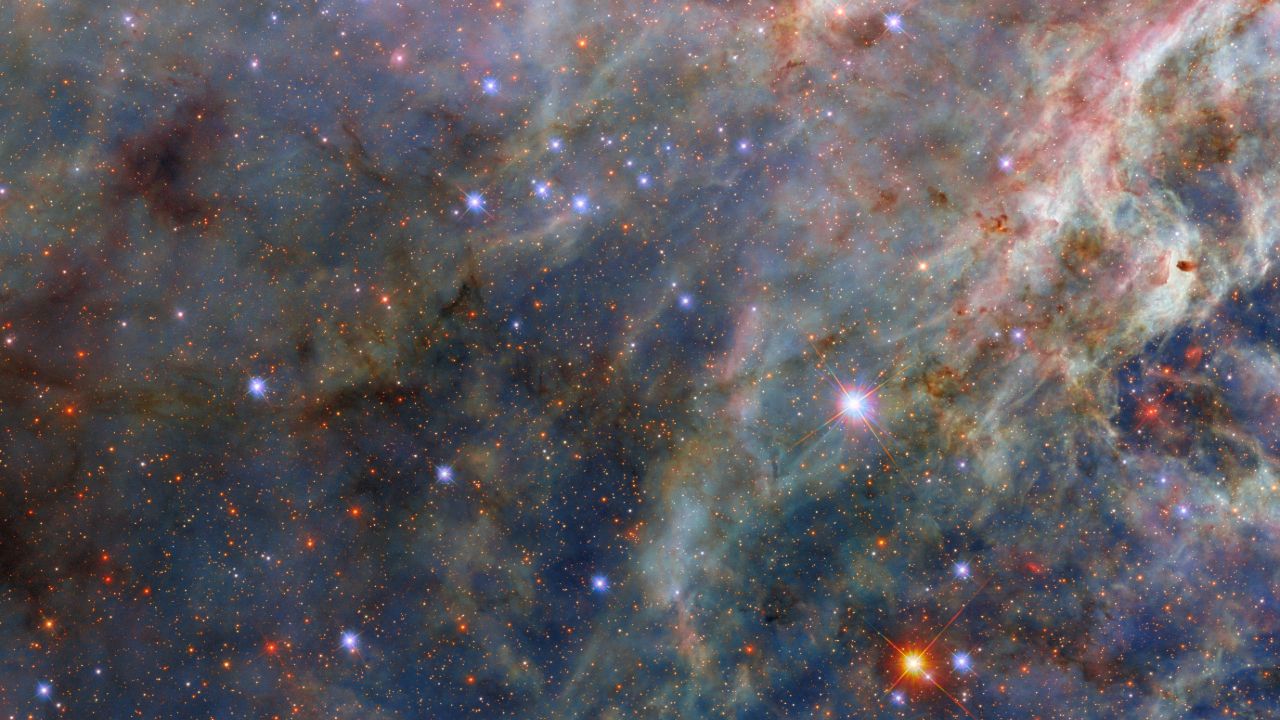
Nebulae are some of the most breathtaking sights in the universe — vast clouds of gas and dust where stars are born, or where they meet their spectacular ends. From the delicate wisps of the Veil Nebula to the fiery glow of the Orion Nebula, each one tells a story written across light‑years.
Astronomers study nebulae not just for their beauty, but for the secrets they hold about stellar evolution and the chemical makeup of galaxies. For the rest of us, they’re a reminder that the cosmos is both mysterious and magnificent, with colors and shapes that look more like art than science.
You may like
Whether you’re a seasoned stargazer or just curious about the night sky, this is your chance to prove you’re ready for a cosmic pop quiz.
See how well you score below!

While surveying a Swiss bog, two volunteer archaeologists discovered what may be two of the oldest Celtic coins ever found in the country, and they may have been offerings to ancient gods.
The two gold coins were minted almost 2,300 years ago, around the mid-third century B.C. “This makes them part of a very small group of just over 20 known examples of the oldest Celtic coins from Switzerland,” Swiss archaeologists said in a translated statement released Dec. 18.
You may like
In this case, gold staters minted during the reign of Philip II of Macedon, the father of Alexander the Great, were imitated. Both coins showcase the profile of the Greek god Apollo on the “heads” side (obverse) and a two-horse chariot on the “tails” side (reverse).
However, the two newfound coins were modified slightly from their Greek originals. For example, on the smaller one’s reverse, a triple spiral can be seen beneath the horses. This symbol, known as a triskele (also called a triskelion), appears frequently in Celtic art.
The rare coins were unearthed largely on a hunch. Between 2022 and 2023, volunteer archaeologists with Archaeology Baselland, the local archaeological department, discovered 34 Celtic silver coins found in the same area — the Bärenfels bog near the municipality of Arisdorf. This prompted Wolfgang Niederberger and Daniel Mona, also volunteer archaeologists with Archaeology Baselland, to do follow-up investigations there in spring 2025, when they discovered the two gold coins, according to the statement.
The Bärenfels bog in Switzerland has many water-filled sinkholes. The Celts often chose water-filled places like this for votive offerings. (Image credit: © Archaeology Baselland)
Offerings for the gods?
It’s possible these two coins were deposited as an offering to the gods, according to the statement.
“Experts assume that Celtic gold coins were not used for everyday transactions. They were too valuable for that,” the statement noted. Including salary payments, they may also have been used as diplomatic gifts, gifts to followers, to achieve political goals, or as dowries.
Celtic coins are frequently found near moors and bodies of water. This pattern is also evident in Arisdorf, where water-filled sinkholes form the Bärenfels bog. The Celts considered such places to be sacred and dedicated to gods, so it seems reasonable to assume that the coins were deliberately placed there as offerings, the statement noted.
Both coins will go on display together, along with the silver coins from the same site, in a special showcase in Basel starting in March 2026.
Celtic quiz: Test your knowledge about these fierce tribes once described by Julius Caesar


Cody Stylianou thought he saw a huge trout. But, skimming just below the surface, it was moving differently than a fish would.
The creature surfaced and, amazed, the Victorian fisher reached for his phone. Swimming in front of him was a pink platypus.
Stylianou regularly fishes in the Gippsland spot, which he is keeping secret to protect the rare animal. He thinks it could be the same one he saw years ago, just older and bigger.
“The bill and feet are super obviously pink,” he says. “When he did go a bit further into sunlit areas, he was easy to follow underwater, which is how I got so many videos of him surfacing.”
Stylianou had been on his first trout fishing trip of the season in September when he saw the platypus, which he has nicknamed “Pinky”. He watched it feed at the top of the tannin-stained river for about 15 minutes.
Sign up: AU Breaking News email
“I’ve seen other platypus in the same river system, just regular coloured ones,” he says. “Probably about five to eight of them over the years, from memory. Normally, they just pop up at the top of the water and then disappear once they see me.”
After Stylinaou shared footage of the monotreme, commenters online speculated that it could have been a rare albino platypus. But the biologist Jeff Williams says it is just lighter in colour than what most would expect.
“Platypus do vary a lot in colour,” the director of the Australian Platypus Conservancy says. “And this one’s at the extreme end of the light ones. It’s not one that we consider should be added to the list of albino and leucistic ones.”
Just as humans have different coloured hair or skin pigment, platypus also come in different variations, Williams says. He said the platypus captured on video was “unusual but not exceptional”.
“What I’ve seen and what every other leading platypus person has looked at, it says, is that it’s well within the sort of variation in colour that one would expect,” he says.
“Let’s put it this way, it’s cute, but it’s not a breakthrough … We think this is just one of the extreme ends. Every so often, you will get a genetic anomaly that just throws up things, just as it does with some humans, who have more freckles and so on.
“It’s somewhat unusual, but it’s nothing to get particularly excited about, we’re afraid.”
 Sniffer dogs are being trained to track down threatened platypus populations – video
The platypus is listed as near-threatened on the International Union for Conservation of Nature. There has also been a decline in Victorian populations, making them more vulnerable, Williams says.
“Platypus were in significant decline up until about the 1990s when all the impact of European settlement on our waterways was becoming apparent,” he says.
“We messed up pretty much the flow of every river we’ve got. We cleared native vegetation along most of our waterways, and, not surprisingly, that put a lot of pressure on the platypus population.”
Replanting programs along the waterways, and consideration of environmental impacts near rivers, have started to help the population come back.
“We’ve still got a way to go, and we can’t be complacent,” Williams says.
“But the good news at the moment is most of the survey work that’s being done around the place is suggesting numbers that are coming back, certainly the number of sightings in some places where there was concern.”

As the classic crooner Andy Williams once sang, “It’s the most wonderful time of the year,” and that means snowmen, reindeer, sleigh bells, mistletoe, and Good ‘Ol St. Nick.
But it also means checking off your holiday gift list with sparkling literary treats for all your geeky friends and loved ones whose tastes include superheroes, galactic adventure, roaring rockets, starry skies, human spaceflight, queries from the cosmos, and excursions to the magical galaxy far, far away. Of course, if you’re looking for last-minute gifts, you should check out our guides to the best Fallout gifts, best space stocking stuffers and 10 best gifts under $100 for kids.
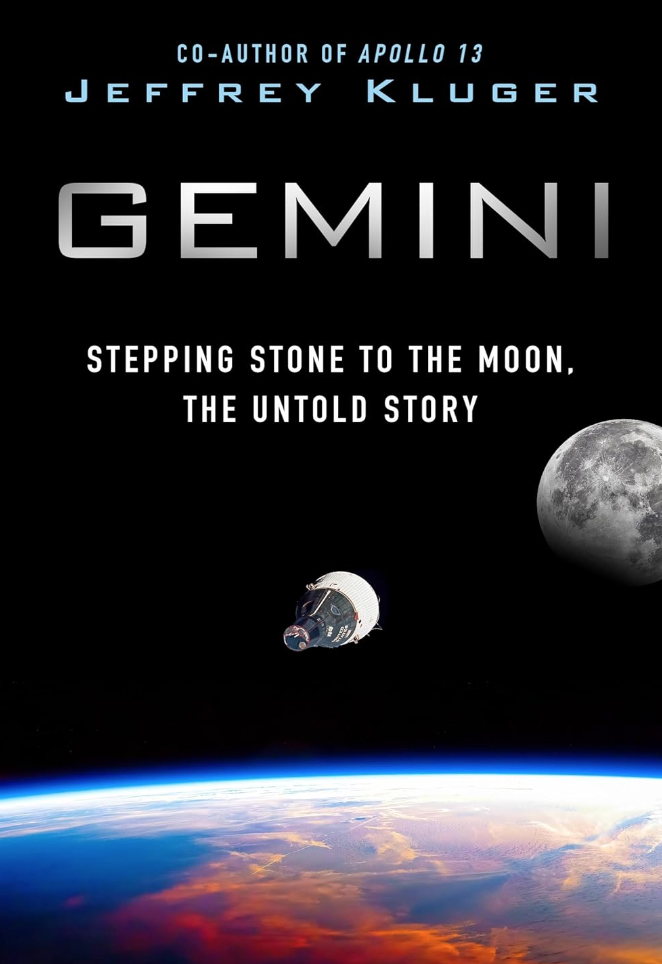
Gemini: Stepping Stone to the Moon, the Untold Story
(Image credit: St, Martin’s Press)
If it weren’t for the Gemini Program that taught NASA astronauts how to walk in space and maneuver spacecraft for docking procedures, America would never have made it to the Moon.
Told in his butter-smooth style and punctuated with expertly detailed accounts of the historic mid-’60s missions, New York Times bestselling author Jeffrey Kluger (“Apollo 13”) brings back all the guts and glory of those heady days when the final frontier was still an unexplored environment fraught with innumerable perils.
You can read our exclusive interview with Author Jeffrey Kluger on this new book.
Today’s best Gemini Stepping Stone To The Moon deals


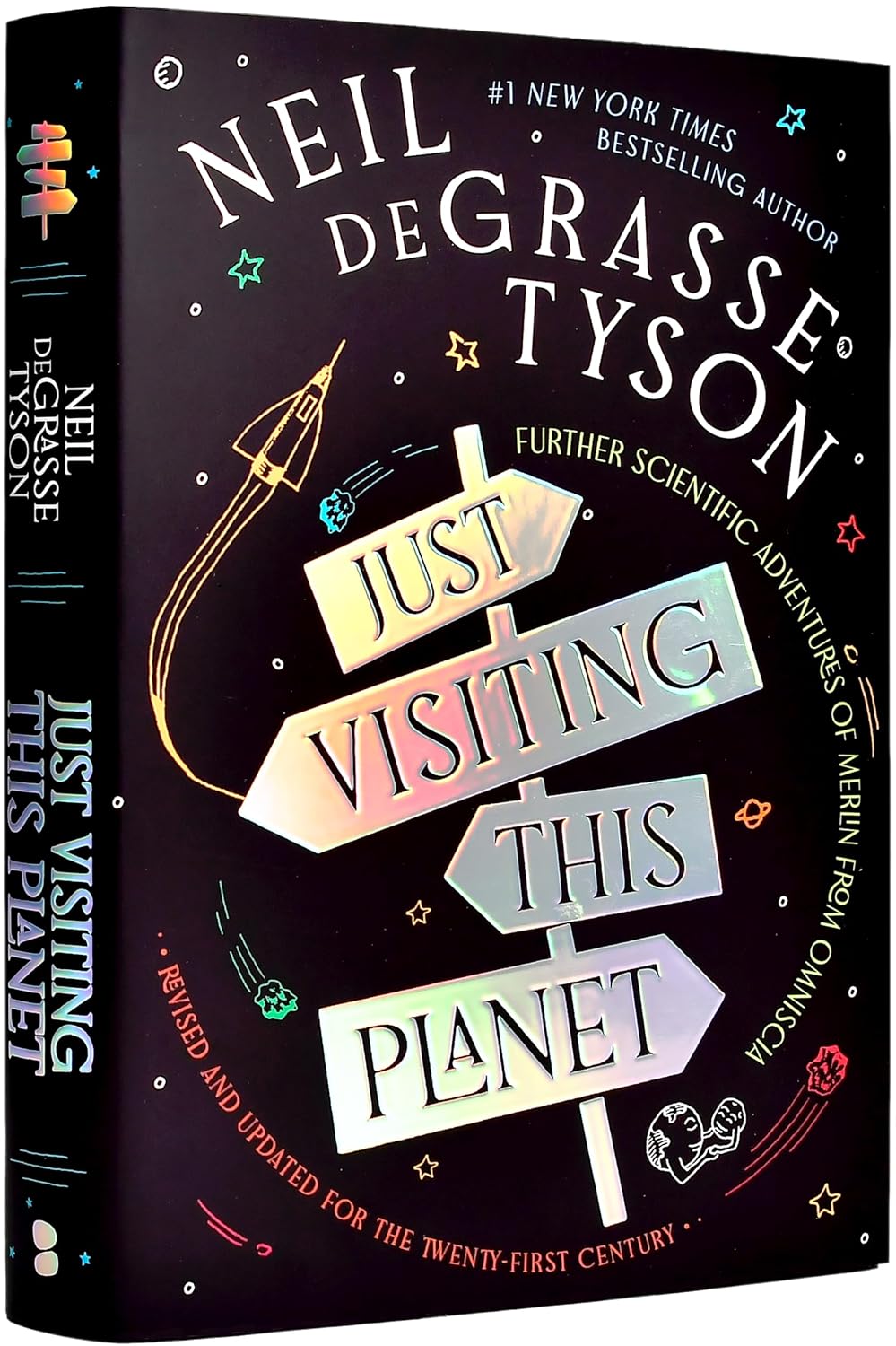
Just Visiting This Planet
(Image credit: Blackstone Publishing)
Here’s the engaging sequel to last year’s Merlin’s Tour of the Universe from celebrity astrophysicist and New York Times bestselling author Neil deGrasse Tyson, which contains 200 more space science questions and answers compiled from readers that first appeared in a column in The McDonald Observatory’s StarDate Magazine.
This newly updated 350-page hardback has been fully refreshed since it was first published in 1998, and collects a constellation of fun responses to queries about planets, stars, comets, black holes, moons, gravity, galaxies, space travel, and more, all told through the wise and wonderful Merlin, a timeless cosmic traveler from Planet Omniscia.
You can read our exclusive interview with Neil deGrasse Tyson on this book in full.
Today’s best Neil deGrasse Tyson Just Visiting This Planet deals
Final Orbit

(Image credit: Mulholland Books)
From one of the most seasoned astronauts who ever left Earth, Chris Hadfield spins an involving yarn centering around NASA flight controller Kaz Zemeckis and China’s clandestine role during the space race in the third installment of his The Apollo Murders series.
The plot unfolds in 1975 when a fresh Apollo mission blasts off to rendezvous with a Russian Soyuz spacecraft for a new era in Soviet-American friendship, when a shocking orbital accident alters the course of this cooperation. Complicating the matter is the launch of China’s first astronaut, Fang Kuo-chun, whose own flight steers him on a perilous path intersecting with the Apollo crew.
Check out our exclusive interview with author Chris Hadfield in full.
Today’s best Final Orbit The Apollo Murder Series deals
Gemini and Mercury Remastered

(Image credit: Black Dog & Leventhal)
Imaging expert and NASA historian Andy Saunders (Apollo Remastered) follows up his ambitious photographic account of our Apollo Program with this deluxe 320-page edition chronicling the Gemini and Mercury flights with hundreds of restored images curated from the archives of our storied space administration.
His newest masterwork was years in the making and delivers an insider’s peek into these vital missions that provided the foundation for the success of our later trips to the moon. Project Mercury and Project Gemini revealed key questions regarding space travel, the human condition, and the limits of their fragile spacecraft in the most hostile of environments. Saunders’ restoration process blesses us with never-before-seen photos that fully expose the mission dangers and awe-inspiring vantage points in astonishing clarity and color.
You can read our exclusive interview with the author, Andy Saunders, in full.
Today’s best Andy Saunders Gemini and Mercury Remastered deals
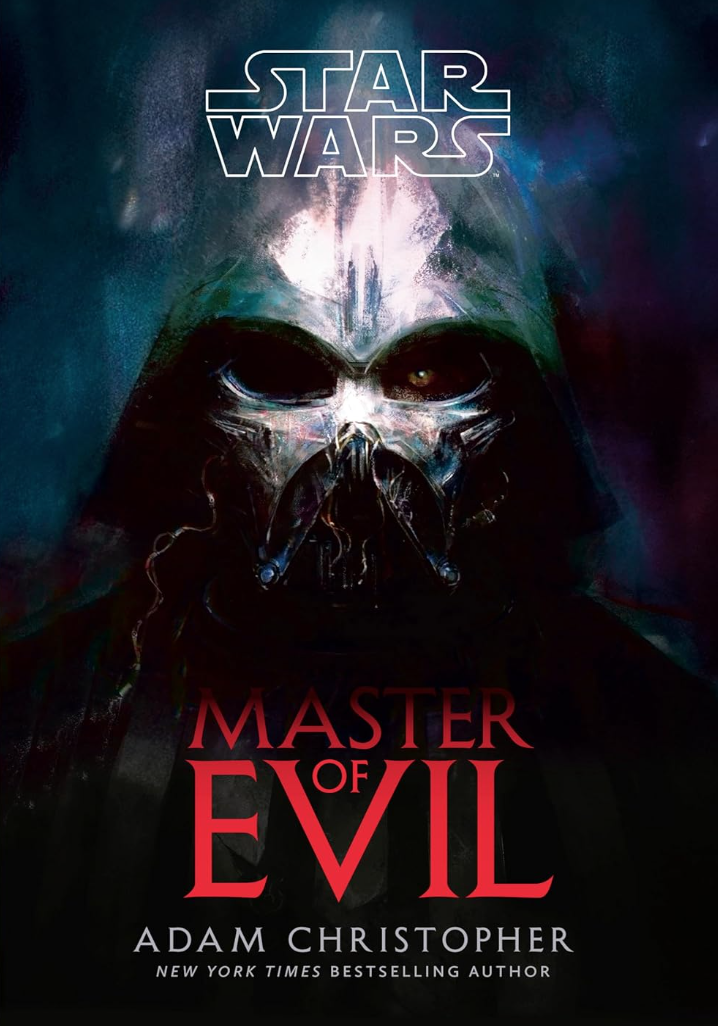
Star Wars: Master of Evil
(Image credit: random house worlds)
Veteran Star Wars author Adam Christopher spins a harrowing yarn from the events following Revenge of the Sith as a raw and vengeful Darth Vader yearns for the arcane mysteries of life and death while being scrutinized by Emperor Palpatine.
Consumed by the addictive elements of the Dark Side, Vader must make a pilgrimage to the scorching planet of Mustafar, where he endeavors to perform a necessary ritual by bleeding a kyber crystal to create his personal lightsaber. The energies unleashed in this unholy ceremony allow for a frightful glimpse into the horrors of the Force. Joined by the Emperor’s scarlet-clad Royal Guard and its leader Colonel Halland Goth, the. Sith Lord will travel to the fringes of the galaxy where a strange shaman dwells.
You can check out our recent exclusive interview with the author, Adam Christopher.
Today’s best Star Wars Master of Evil deals
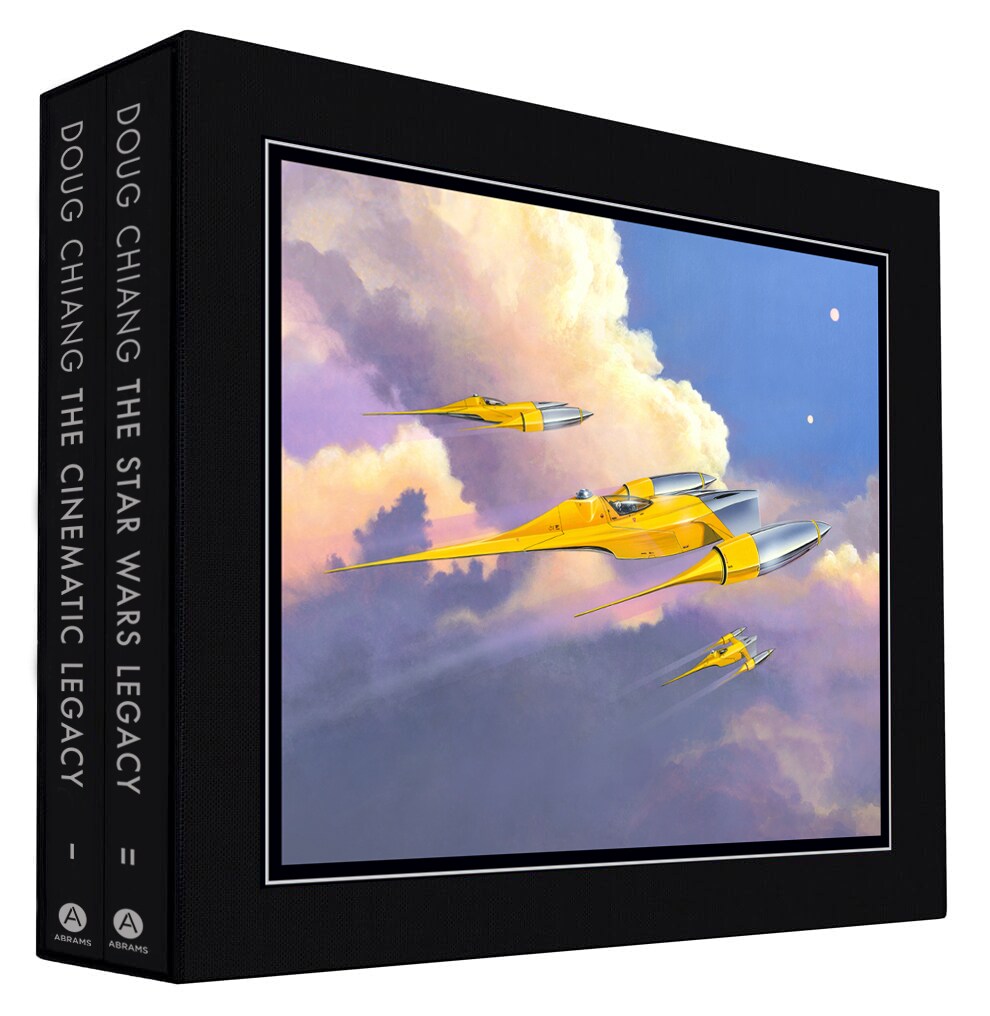
Doug Chiang: The Cinematic Legacy (Volume I) & The Star Wars Legacy (Volume II)
(Image credit: Abrams Books)
If you’re lucky enough to score this two-volume, 800-page behemoth showcasing the work of Lucasfilm’s visionary artist and designer Doug Chiang this Christmas, please drop me an email and let me know how I can join your family!
Chiang’s Oscar-winning conceptual work is a revelation and this deluxe set not only reveals his creative work on Star Wars: The Phantom Menace, but also Attack of the Clones, The Force Awakens, Rogue One: A Star Wars Story, The Last Jedi, Solo: A Star Wars Story, The Rise of Skywalker, and The Mandalorian.
Volume 1, The Cinematic Legacy, presents Chiang’s work prior to joining forces with Lucasfilm and includes designs for Back To The Future Part III, Alien 3, T2: Judgment Day, The Mask, Jumanji, and many more.
Today’s best Doug Chiang The Cinematic Legacy (Volume I) and the Star Wars Legacy (Volume II) deals
The Art of The Fantastic Four: First Steps

(Image credit: Marvel Universe)
Marvel’s First Family came wonderfully alive in full retro-futuristic style this past summer as directed by Matt Shakman and produced by Marvel Studios.
The smash movie can be fully re-experienced in this 288-page deluxe slipcase edition, delivering a bounty of imaginative concept art designs, sketches, character profiles, superhero vehicles, costumes, environments, and behind-the-scenes peeks into the movie-making process. Also included is a companion volume breaking down Reed Richards’ scientific gadgets, trinkets, toys, and inventions that make up his superpowered team.
Today’s best Marvel Studios’ The Fantastic Four: First Steps The Art of the Movie Deluxe Edition Slipcase deals
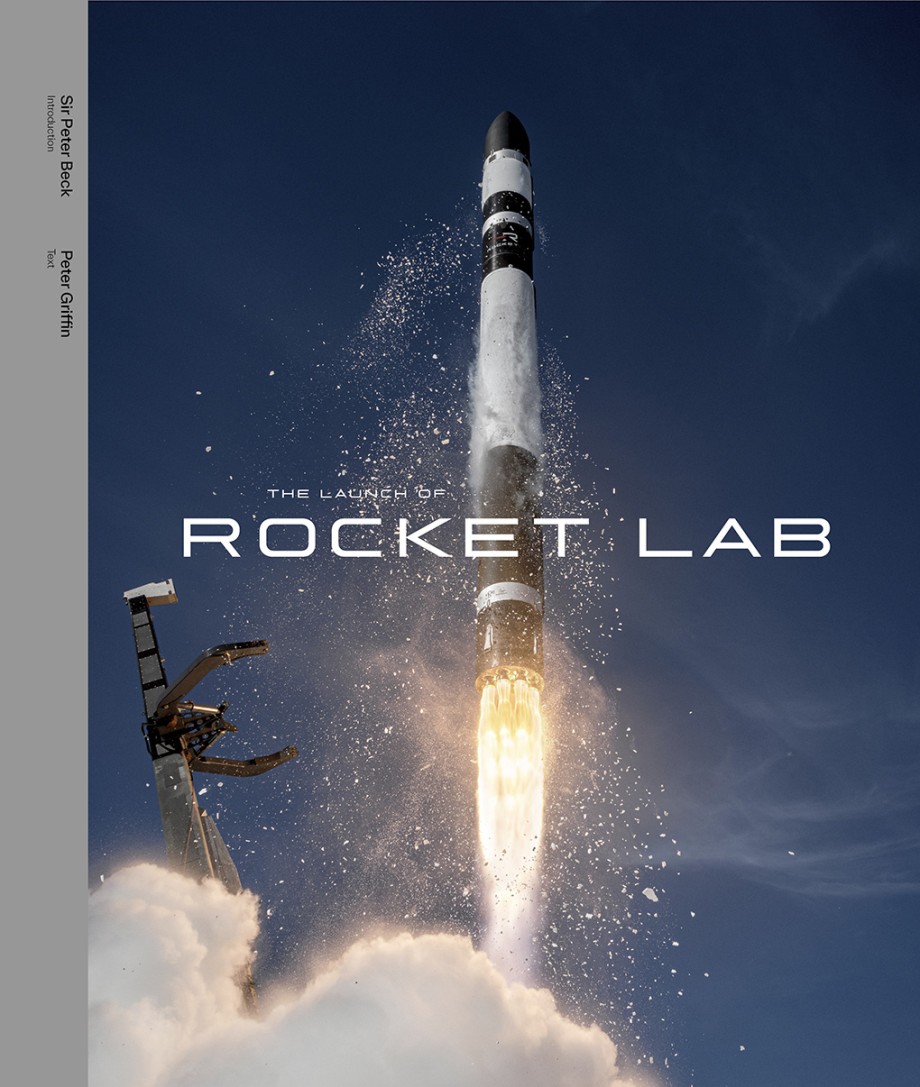
The Launch of Rocket Lab
(Image credit: Blackwell & Ruth)
This inspiring title follows Rocket Lab’s remarkable journey from tiny VC start-up to a global juggernaut in direct competition with Elon Musk’s SpaceX and Jeff Bezos’ Blue Origin.
It contains a wealth of behind-the-scenes photos and original interviews with founder Sir Peter Beck, his expert team, loyal investors, and industry experts that provide a colorful look at one of the major contenders in the current space race as they continue to grow as a force to be reckoned with.
Rocket Lab is currently the fastest company to launch 50 rockets into space, with a market cap of $13.63 billion, a planned mission to the Red Planet, and even aspirations to launch a mission to Venus someday.
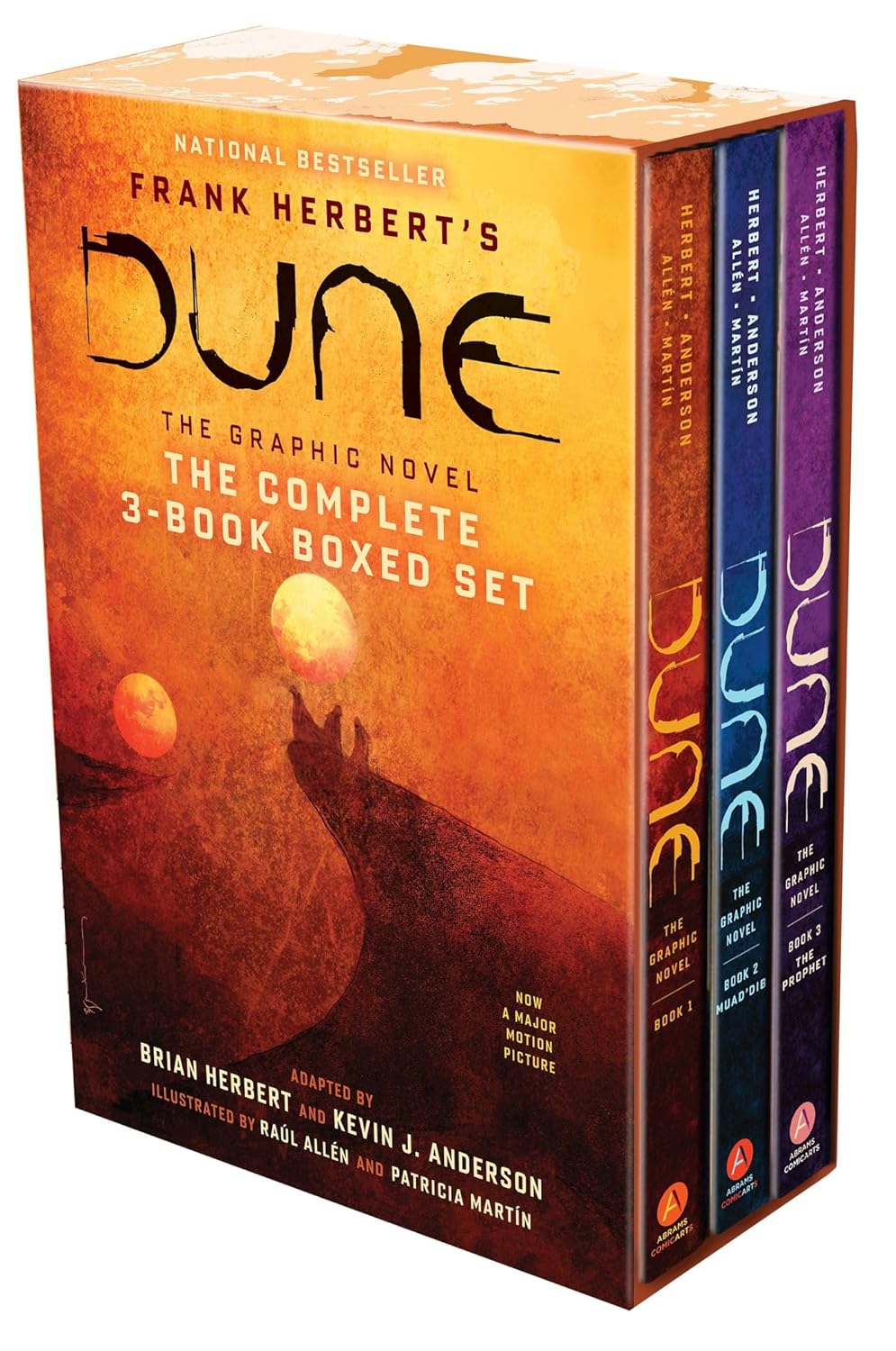
Dune: The Graphic Novel: The Complete 3-Book Boxed Set
(Image credit: Abrams ComicArts)
Just in time for some sweet sci-fi gift-giving, here’s the complete 3-book Dune graphic novel adaptation of legendary author Frank Herbert for the 60th anniversary of the book’s original publication in 1965.
This premium box set, written by Frank’s son, Brian Herbert, with collaborator Kevin J. Anderson, contains vivid illustrations by Raul Allen and Patricia Martin that perfectly capture the galactic turmoil and mysticism that’s enthralled readers for decades as one of the greatest interstellar sagas ever conceived.
You can read our exclusive interview with Kevin J. Anderson in full, too.
Today’s best Dune The Graphic Novel: The Complete 3-book boxed set deals
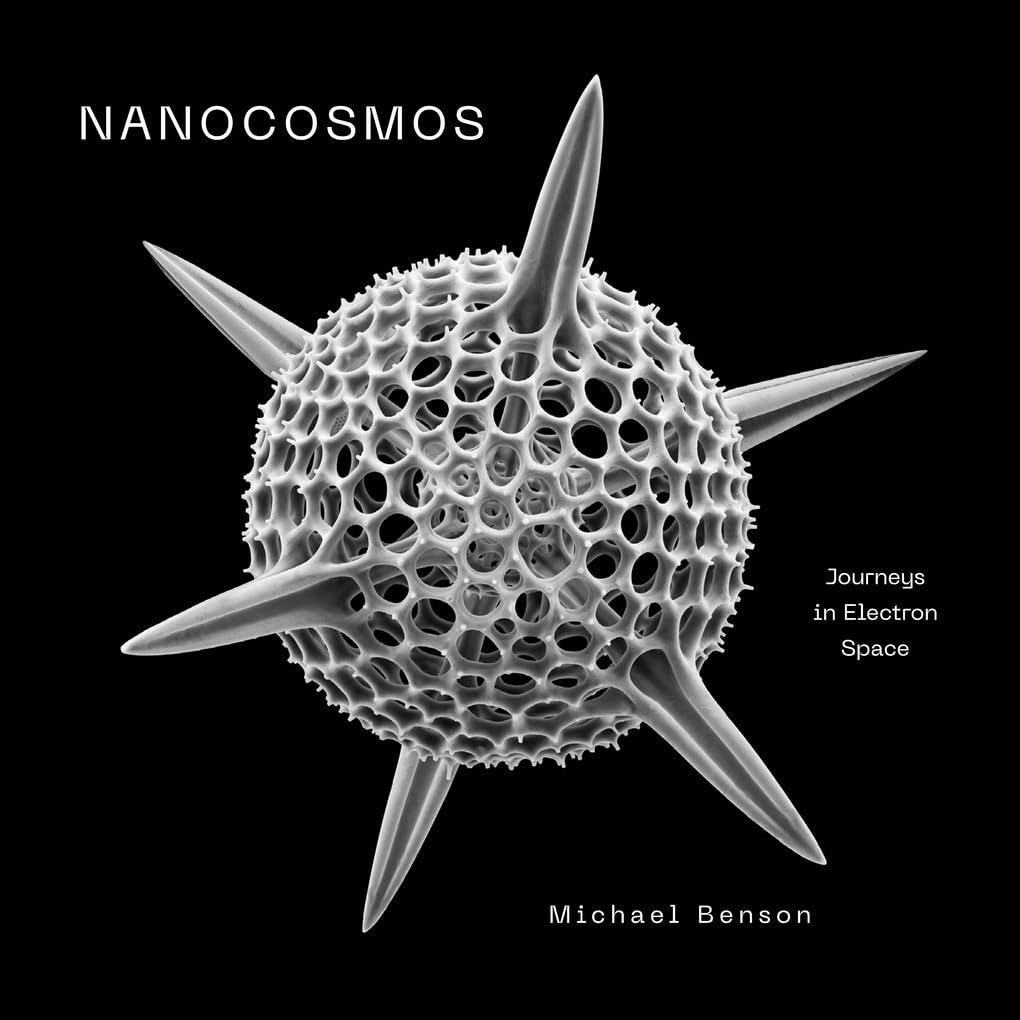
Nanocosmos: Journeys In Electron Space
(Image credit: Abrams Books)
The sublime beauty and mystery of the microscopic world are presented here by author, artist, and film historian Michael Benson. Now, in this six-pound, 320-page coffee-table book, Benson takes us all on a mindblowing trip into the realm of extreme magnification using the might of scanning electron microscope (SEM) technologies.
It’s an ideal gift for space and science lovers as it offers a shocking glimpse of these tiny worlds that surround us daily. The images were captured from SEM scans Benson took over the course of six years at the Canadian Museum of Nature in Quebec, including radiolarians, dinoflagellates, and diatoms, as well as multiple types of insects, microscopic flowers, and even lunar samples obtained from Apollo 16.
Be sure to check out our exclusive interview with author Michael Benson, too.
Today’s best Nanocosmos Journeys in Electron Space deals
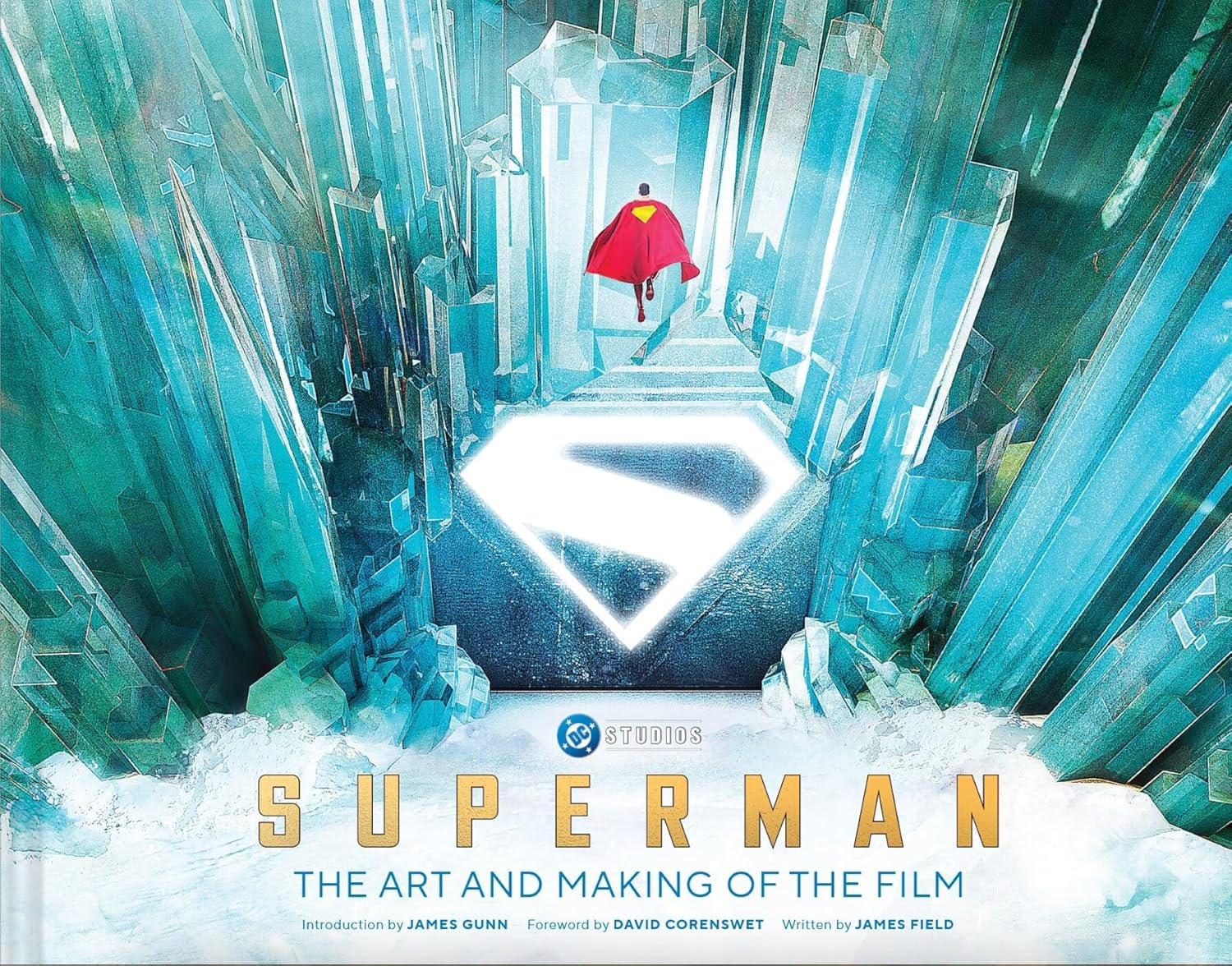
Superman: The Art and Making of the Film
(Image credit: Harry N. Abrams)
It’s up, up and away with this beautiful concept art book from director James Gunn’s Superman, which landed in theaters this past summer and raked in a comfortable $585 million.
Now, acolytes of the Man of Steel can witness how this superhero spectacle was created by a small army of Hollywood technicians and artists in this 176-page edition that whisks readers behind the scenes for DC Studios’ blockbuster.
Writer James Field (The Art of The Batman) records every stage of the movie’s production, beginning with Gunn and DC Studios co-chairman Peter Safran’s initial brainstorming chats to casting, costumes, set design, and post-production VFX. It includes an intro from writer/director James Gunn and a David Corenswet foreword.
Today’s best Superman The Art and Making of the Film deals
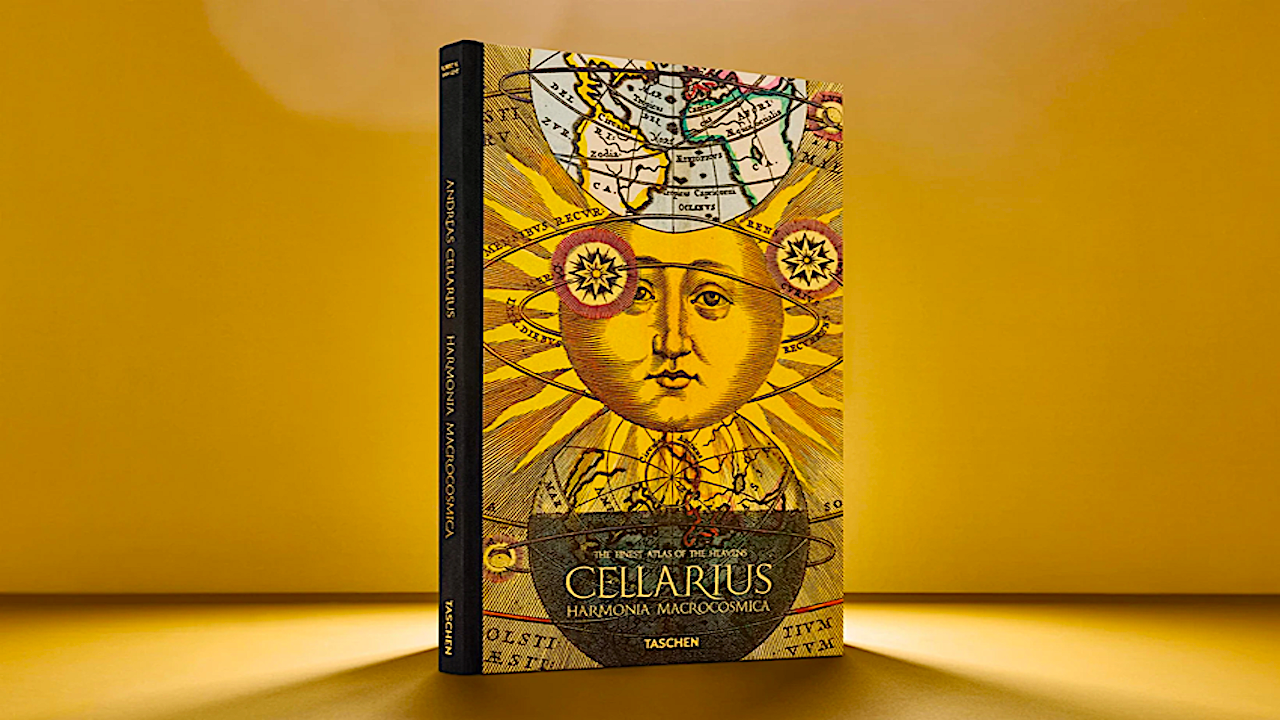
Cellarius Atlas
(Image credit: Taschen)
The wonders of the cosmos come alive in a bold new edition of the classic collection of constellation maps from famed Dutch-German mathematician and cosmographer Andreas Cellarius (c. 1596 ? 1665) that unveils these celestial atlas masterworks in unprecedented detail.
Initially published in 1660 in Harmonia Macrocosmica, this revised volume in a larger prestige format contains the complete 29 double-folio maps. These striking plates showcase sublime adorned skies, decorative borders and breathtaking constellations in this astonishing seven-pound reprint measuring 11.42 x 1.57 x 18.9 inches that restores academia’s most stunning depictions of the heavens.
Today’s best Robert Van Gent Cellarius Atlas deals

The final frontier is an unendingly beautiful expanse filled with unimaginable wonders, making it the perfect sandbox for photographers, astronomical observatories and space-based telescopes to capture incredible images that we can hardly fathom. And 2025 was no different.
This year, we covered a range of stunning space images, from an eye-catching alien comet and a planetary parade portrait to the first Vera C. Rubin photos and otherworldly animal lookalikes. Here are 10 of our absolute favorites.
Alien visitor transforms into a “cosmic rainbow”
A new timelapse photo transforms 3I/ATLAS into a giant “cosmic rainbow.” (Image credit: International Gemini Observatory/NOIRLab/NSF/AURA/K. Meech (IfA/U. Hawaii)Image Processing: Jen Miller & Mahdi Zamani (NSF NOIRLab))
The biggest space news story this year was undoubtedly the arrival of the third-ever interstellar object 3I/ATLAS, which has dominated headlines and astronomers’ attention ever since it was first spotted speeding through the solar system in early July. As a result, there has been no shortage of stunning shots of the alien comet.
You may like
Our favorite is this timelapse image captured by the Gemini North telescope on the summit of Hawaii’s Mauna Kea volcano. The image was created by combining 16 different photos using multiple colored filters to create a giant cosmic rainbow.
Read more: Interstellar comet 3I/ATLAS transforms into a giant ‘cosmic rainbow’ in trippy new telescope image
“The Fall of Icarus”

This striking photo shows a skydiver perfectly aligned with the sun’s fiery surface, around 93 million miles (150 million kilometers) from Earth. (Image credit: Andrew McCarthy/cosmicbackground.io)
One of the most unbelievable photos of 2025 was this solar spectacle, dubbed The Fall of Icarus, which perfectly captured the moment a skydiver fell directly in front of the sun.
Astrophotographer Andrew McCarthy captured this shot in early November, at a distance of around 8,000 feet (2,440 meters) from the skydiver, YouTuber Gabriel C. Brown. It took six attempts to properly line up Brown with the solar surface before the thrill-seeker leapt from a small propeller-powered craft at an altitude of around 3,500 feet (1,070 m).
“It was a narrow field of view, so it took several attempts to line up the shot,” McCarthy told Live Science. “Capturing the sun is something I’m quite familiar with, but this added new challenges.”
Read more: Astrophotographer snaps ‘absolutely preposterous’ photo of skydiver ‘falling’ past the sun’s surface
Vera C. Rubin’s stream of stars
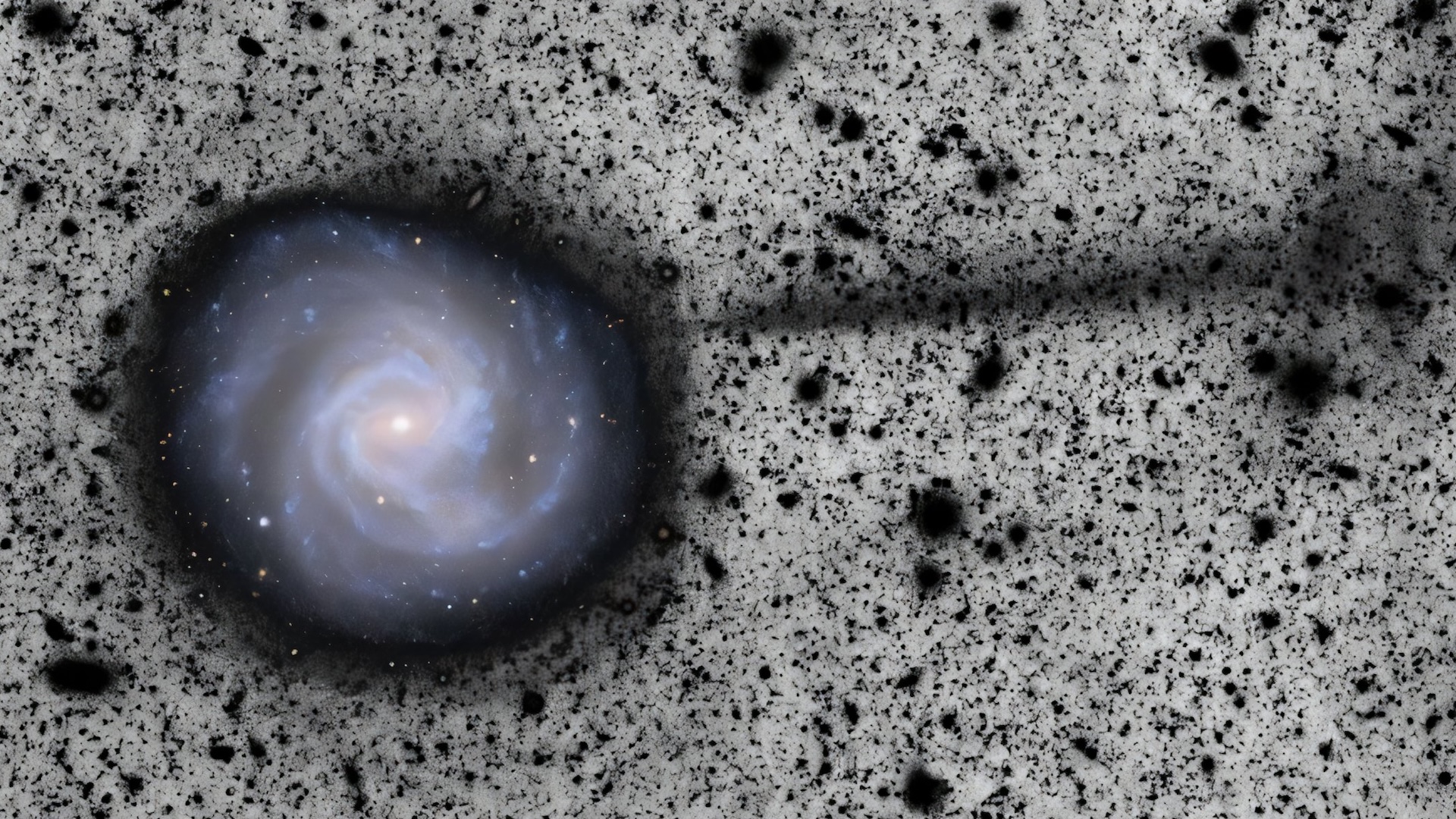
In its debut image, the Vera C. Rubin Observatory has revealed a vast stellar stream coming from the nearby galaxy M61. (Image credit: Romanowsky et al. 2025, RNAAS)
In June, the most powerful digital camera on Earth winked on. The Vera C. Rubin Observatory in Chile’s Atacama desert revealed its first-ever images in June. These debut photos were chock-full of cosmic treasures, including the spiral galaxy M61 (shown here), which researchers noticed was being trailed by a massive stellar tail around the same size as the Milky Way.
You may like
We can look forward to many more spellbinding shots from Rubin in the coming years as it begins its decade-long survey of the night sky.
Read more: First Vera Rubin Observatory image reveals hidden structure as long as the Milky Way trailing behind a nearby galaxy
Perfect planetary parade portrait
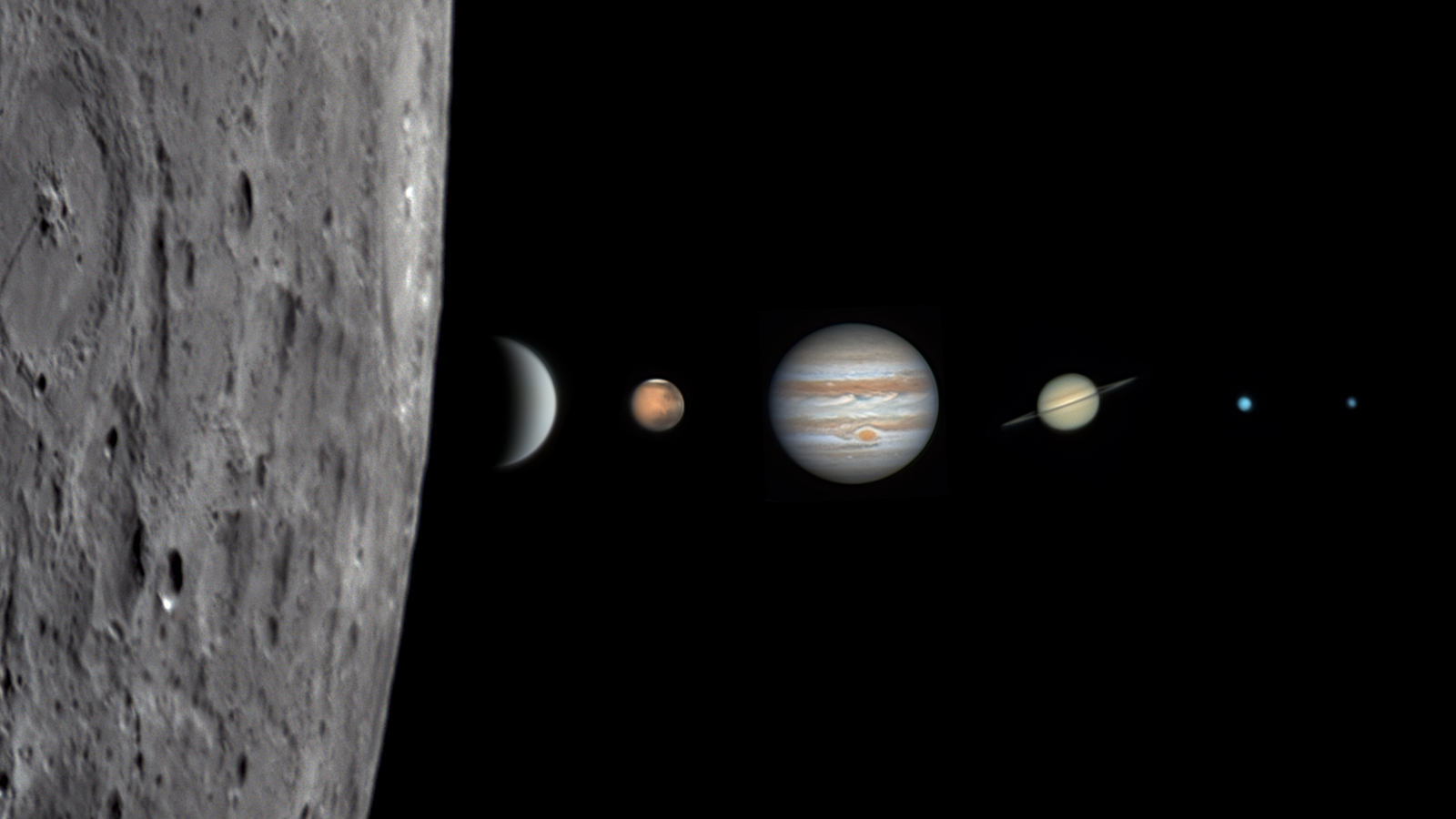
An astrophotographer captured shots of seven solar system worlds during an 80-minute period on Feb. 2 and arranged them into a straight line. (From left to right: the moon, Venus, Mars, Jupiter, Saturn, Uranus and Neptune.) (Image credit: Gwenaël Blanck)
In late January and early February, up to six of the solar system’s planets were simultaneously visible in the night sky in what astronomers refer to as a “planetary parade.” This particular parade was one of the best in recent years, allowing astrophotographers to snap several stunning pics of the event.
Our favorite pick of the bunch is this planetary portrait from French astrophotographer Gwenaël Blanck, which he digitally edited to show each planet alongside the sun in the order of distance from Earth. Blanck snapped each of the individual worlds within 80 minutes of one another.
Read more: Parisian photographer produces phenomenal, perfectly-proportioned ‘planetary parade’ portrait
Giant “diamond ring” shines in X-ray
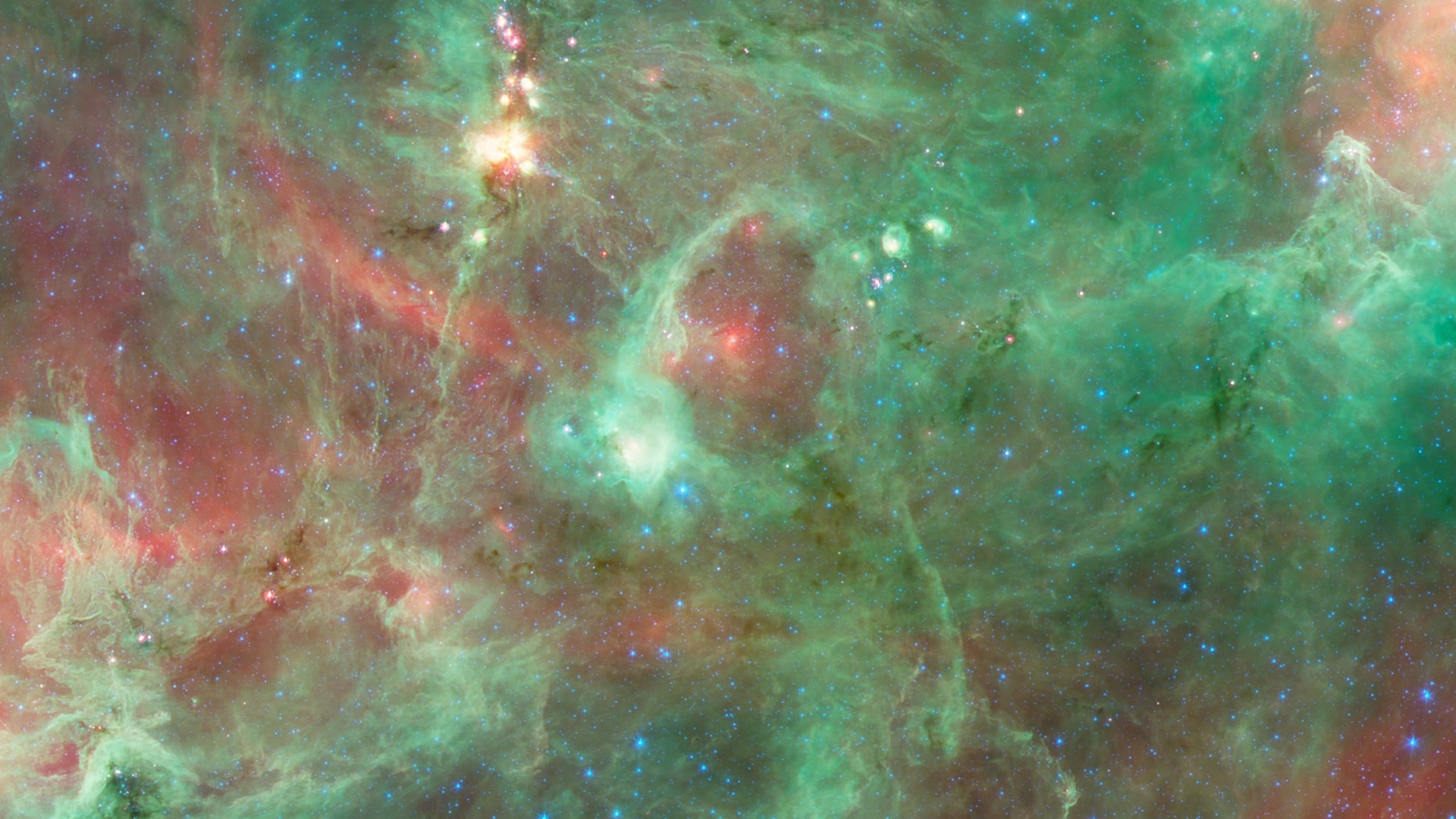
The mysterious ‘diamond ring’ in Cygnus may be the remnants of a burst bubble, new research hints. (Image credit: NASA/JPL-Caltech/Harvard-Smithsonian CfA)
All that glitters is not gold, and in this scintillating starscape, released in November, it is high-energy X-rays that sparkle like a giant ring.
This object, dubbed a “diamond ring,” is an expanding bubble of gas in a star-forming region of the Cygnus constellation. The glowing bubble is around 20 light-years across and is around 400,000 years old. It was photographed by NASA’s Stratospheric Observatory for Infrared Astronomy (SOFIA), which previously scanned the night sky from a telescope onboard a Boeing 747SP aircraft, at an altitude of more than 45,000 feet (13,700 m).
The cosmic ring is not to be confused with Einstein rings, which are rings of light created by gravitational lensing.
Read more: Giant ‘diamond ring’ sparkles 4,500 light-years away in the Cygnus constellation
A cosmic butterfly spreads its wings

A star’s planet-forming disk glows like a butterfly in this new JWST image. (Image credit: ESA/Webb, NASA & CSA, M. Villenave et al.)
The insect imposter’s shining wings are made from a mini nebula of stellar material leftover from a supernova. This nebula is bisected by a protoplanetary disk that surrounds the baby star like a cosmic cocoon, and just happens to be aligned with Earth so that the two halves of the nebula are seen from side-on. It is located around 525 light-years away, in a star-forming region, known as the Taurus Molecular Cloud.
Read more: James Webb telescope finds a warped ‘Butterfly Star’ shedding its chrysalis
Arsia Mons rises
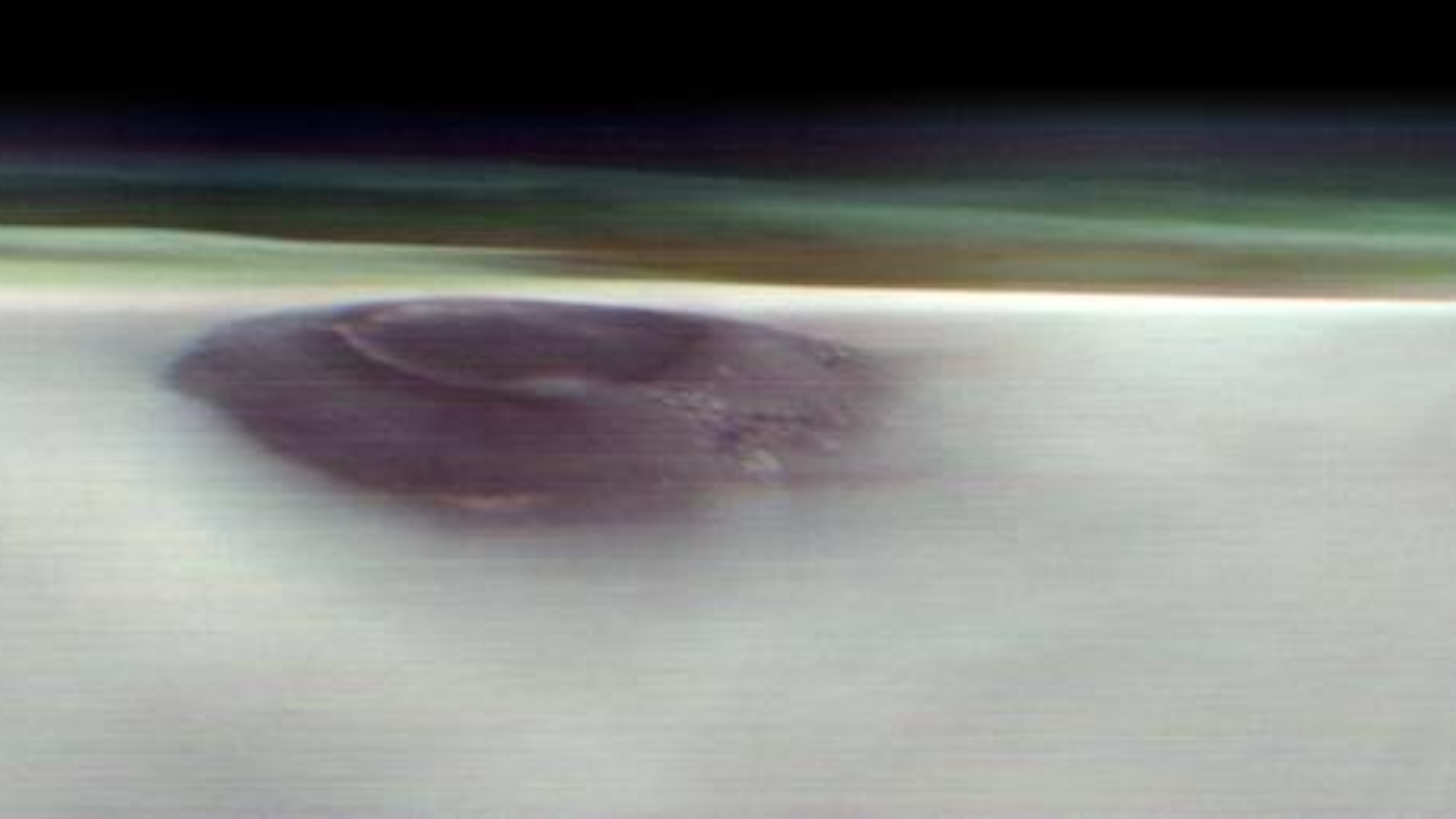
The gargantuan shield volcano Arsia Mons pierces the clouds of Mars in this new NASA orbital image. (Image credit: NASA/JPL-Caltech/ASU)
Speaking of Mars, NASA’s Mars Odyssey orbiter also captured this stunning shot of a giant dead volcano peeking above the clouds on the Red Planet, as eerie green lights dance above the Martian horizon.
The mountain in the image is Arsia Mons, which stands at more than 12 miles (19 kilometers) above the surface of the previously volcanic Tharsis plateau. The extinct volcano is more than twice as tall as Mount Everest, but around 4 miles (6 km) shorter than Mars’ tallest peak, Olympus Mons.
The green lights look like auroras. But they are actually just an effect of the image being partially captured using infrared light, which emanates from the planet’s wispy atmosphere.
Read more: NASA spots Martian volcano twice the height of Mount Everest bursting through the morning clouds
Seen by the “Eye of Sauron”
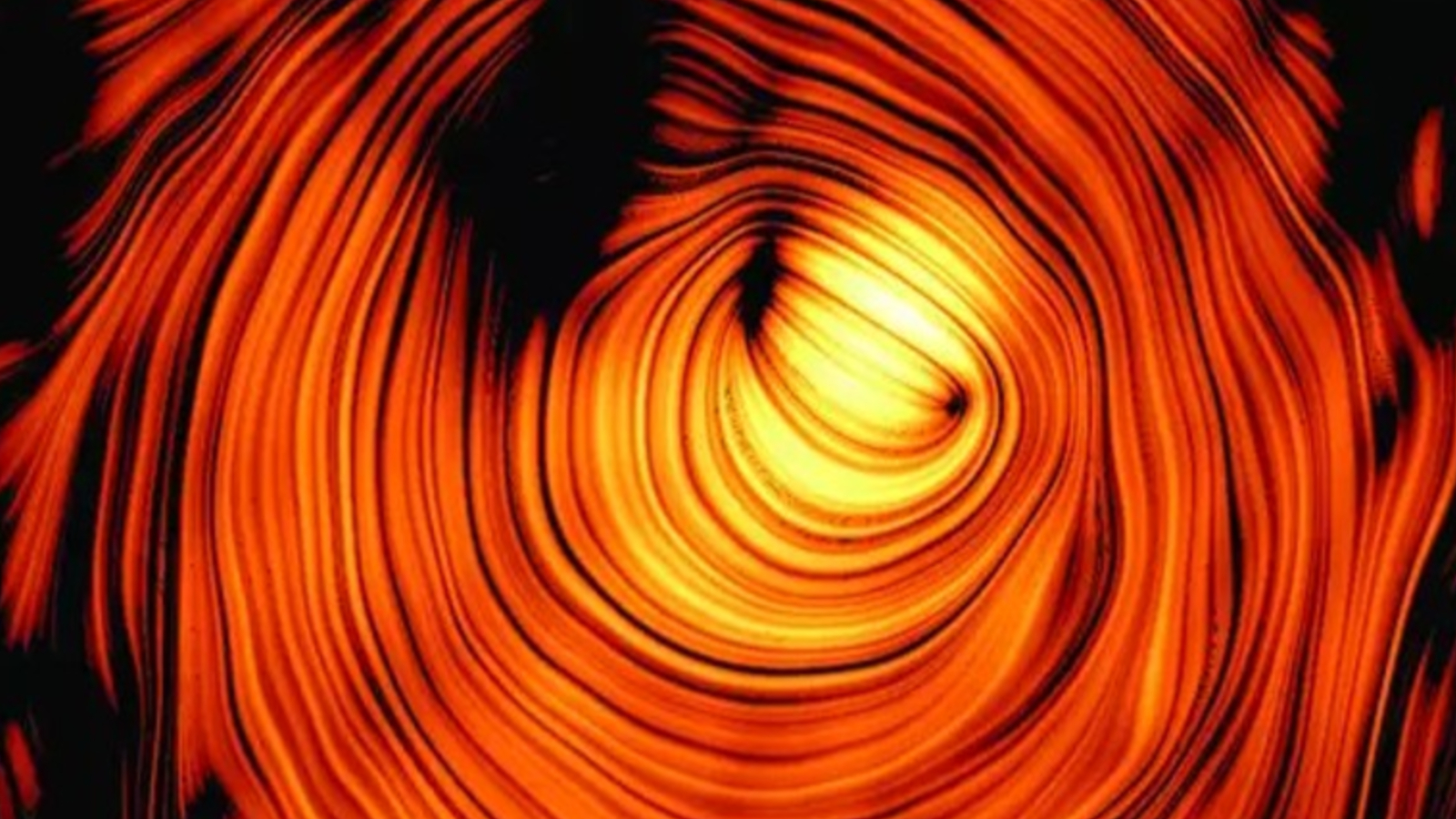
The new image, dubbed the “Eye of Sauron,” shows the complex magnetic field of a high-energy jet being shot directly at Earth by a distant blazar. (Image credit: Y.Y. Kovalev et al.)
There is no escaping the dark lord of Mordor’s malevolent gaze, even from halfway across the universe. That’s the impression given by this photo, dubbed the “Eye of Sauron,” which playfully references J. R. R. Tolkien’s fantasy epic “The Lord of the Rings.”
Read more: Giant, cosmic ‘Eye of Sauron’ snapped staring directly at us in stunning 15-year time-lapse photo
New “heavenly” pillars emerge
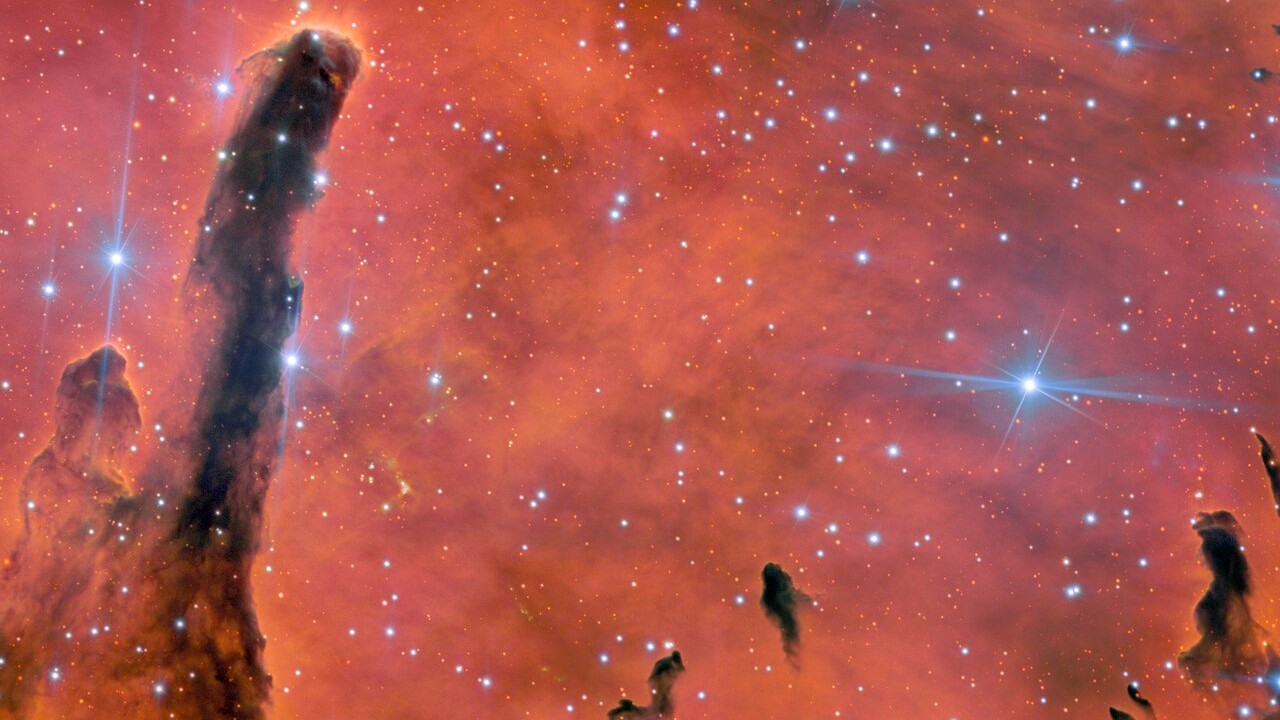
The structure called Ua ʻŌhiʻa Lani, which means the Heavenly ʻŌhiʻa Rains, echoes the legendary ‘Pillars of Creation’. (Image credit: International Gemini Observatory/ NOIRLab /NSF /AURA)
This ethereal image shows a set of stellar structures reminiscent of the famous “Pillars of Creation,” first seen by the Hubble Space Telescope in 1995. The structure is named Ua ‘Ōhi’a Lani, which means the “heavenly rains” in Hawaiin, and this image of it was taken by the Gemini North telescope.
What you are seeing is two distinct regions: the twinkling blue stars of a star cluster, named NGC 6823, overlapping the veil of red gas that comprises a more distant emission nebula, dubbed NGC 6820. The ethereal pillars are made from additional gas and dust that have been sculpted by the foreground stars’ intense radiation.
The original pillars of creation were also recently given a glow-up by JWST, which captured the iconic cosmic structures using infrared light.
Read more: ‘Heavenly rains’: Ethereal structure in the sky rivals ‘Pillars of Creation’
Astronaut snaps a giant “jellyfish” over Earth
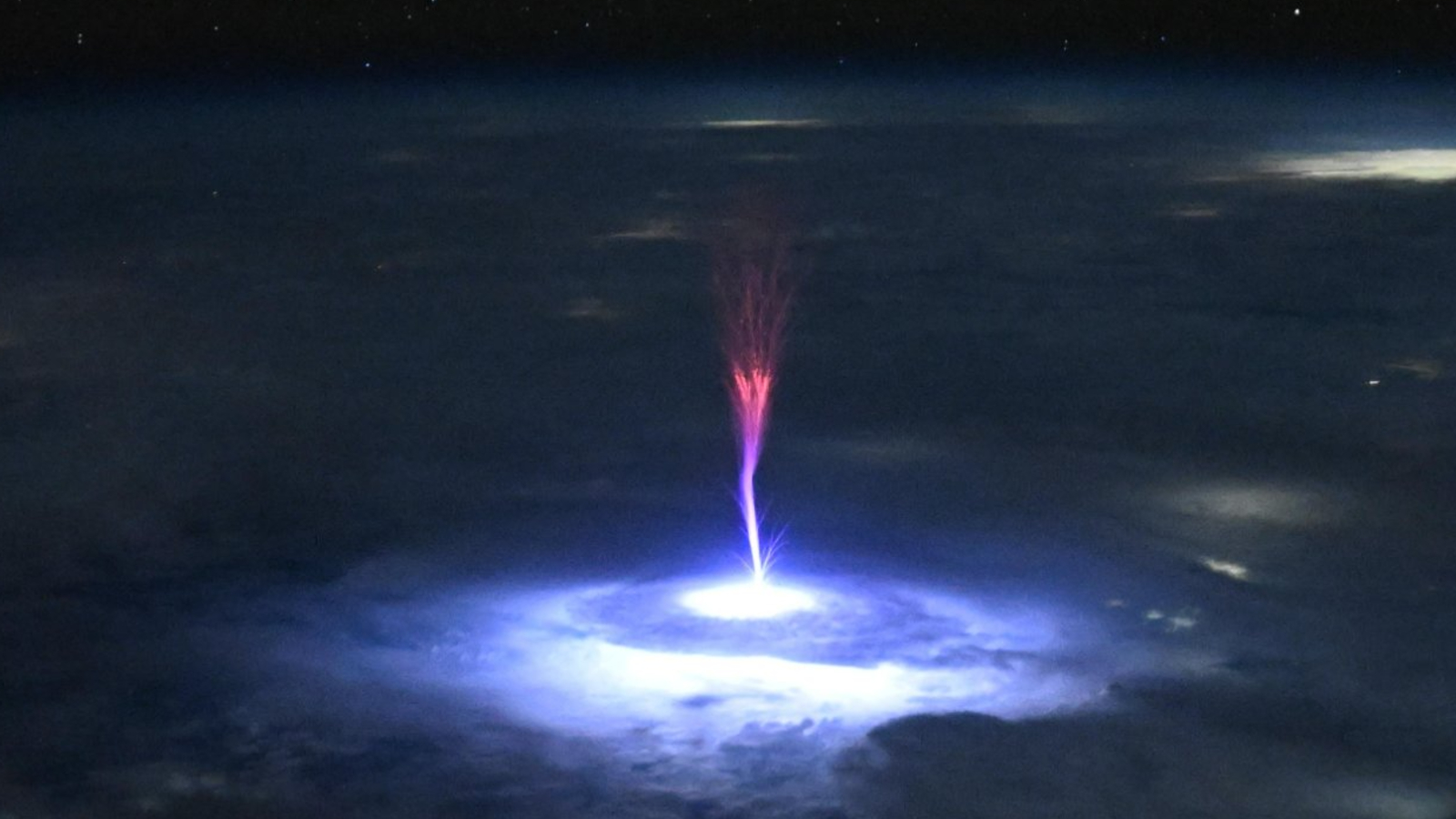
Nichole Ayers snapped a giant red sprite sprawling out over an upward-shotting bolt of lightning during a massive thunderstorm on July 3. (Image credit: NASA/ISS/Nichole Ayers)
As incredible as it is to point our cameras out into the universe, space also provides a unique angle of our own planet. And that’s exactly the case in our final photo, which shows off a giant, electrifying “jellyfish” hovering above Earth.
The luminous branching structure was snapped by NASA astronaut Nichole Ayers in July, while onboard the ISS. It shows a type of transient luminous event that researchers commonly call sprites. In this case, the red jellyfish-like sprite formed at the summit of a rare upward-shooting “gigantic jet” of lightning, up to 50 miles (80 km) above the U.S.-Mexico border.
If you liked this photo, then be sure to check out Live Science’s weekly Earth from space series for more incredible images of our planet from above.
Read more: Astronaut snaps giant red ‘jellyfish’ sprite over North America during upward-shooting lightning event
Want to see more amazing images of the cosmos?Be sure to check out Live Science’s Space Photo of the Week series, or peep our favorite space shots from 2024 or this gallery of stunning James Webb Space Telescope (JWST) images.


China is working toward the first launch of a next-generation, low-cost cargo spacecraft option for its Tiangong space station.
Qingzhou, meaning “Light Ship,” is being developed by the Innovation Academy for Microsatellites of the Chinese Academy of Sciences (IAMCAS) as a smaller, lighter and potentially lower-cost complement to China’s existing Tianzhou cargo spacecraft.
You may like
The Qingzhou spacecraft passed a design review in June and entered the initial manufacturing phase, according to a recent China Central Television (CCTV) report.
The prototype measures roughly 10.8 feet (3.3 meters) in diameter, has a launch mass of about 11,000 pounds (5,000 kilograms), and is capable of carrying up to 4,000 pounds (1,800 kg) of cargo to orbit. Its hybrid structure combines a pressurized module for crew supplies and sensitive instruments with an unpressurized aft section capable of carrying external payloads and space-exposure experiments.
“We have now conducted large-scale experiments and are currently loading and verifying the status of the remaining individual machines, as well as conducting final testing. The overall test results are quite good,” Wu Huiying, deputy chief designer of the Qingzhou cargo spacecraft, told CCTV.
Full engineering model production is scheduled to begin in early 2026, with construction expected to be completed by the end of that year. Its debut flight will follow based on the operational needs of the Tiangong station, according to Wu.
The first prototype was initially stated to fly on the debut launch of commercial rocket startup CAS Space’s Kinetica-2. That plan now appears to have been altered, with CAS Space reported to be preparing for that very launch from Jiuquan spaceport in the Gobi Desert in the near future.
Qingzhou is one of a pair of new spacecraft commissioned by China’s human spaceflight agency as the country looks to upgrade its space transportation capabilities. The other, named Haolong, is a reusable shuttle concept being developed by the Chengdu Aircraft Design and Research Institute under the state-owned Aviation Industry Corporation of China.