
SCIENCE
Last of its kind dodo relative spotted in a remote Samoan rainforest


One of the closest living relatives of the dodo has been spotted multiple times in Samoa — raising hopes that this critically endangered creature can be saved from the brink of extinction.
The Samoa Conservation Society’s (SCS) latest field survey, which took place from Oct. 17-Nov. 13, reported five sightings of the manumea (Didunculus strigirostris). Previous surveys only yielded a single sighting, if any. The last photograph of the cryptic species in the wild was taken in 2013.
You may like
“That was our worry,” said Moeumu Uili, a project coordinator focusing on manumea with SCS. “What happens if we can’t find the bird? Does that mean the manumea is no more?”
Despite confirming the manumea’s existence, the team found it difficult to photograph due to their distance from the bird, its quick movement and rainy conditions. “All of a sudden, it appears out of nowhere,” Uili told Live Science. “When we see it through the binoculars, we can see the bird.”
But by the time researchers lower their binoculars to get a camera, the bird is gone, she said.
Last of its kind
The manumea is the only living species of its Didunculus genus, which will end if the bird goes extinct. The chicken-size manumea’s scientific name, Didunculus strigirostris, means “little dodo.” Both the dodo and manumea are classified as island ground pigeons.
“The impact on manumea is certainly catastrophic,” Joe Wood, the manager of International Conservation Programs at the Toledo Zoo, told Live Science. “It seems very likely that feral cats are a major cause of decline,” said Wood, who also co-chairs a group at the International Union for Conservation of Nature that works on manumea conservation efforts. “There has to be some kind of control program.”
Saving manumea
In this fall’s latest survey, Uili’s team focused on the remote coastal rainforest of Uafato, but manumea potentially live in six additional forests in Samoa. A current invasive species management program already exists in one of those forests, Samoa’s Malololelei Recreation Reserve, Uili said. If there’s funding, SCS wants to expand the invasive species management to areas like Uafato.
You may like
If a manumea is secured, the partners working to save it said they can use biobanking to preserve biological samples to establish cultured cell lines for the bird. These cell lines will allow them to study the manumea’s genetic material and learn more about it. With more information, they can determine the best measures to take, such as potential captive breeding, to repopulate the species, experts said.
The nonprofit conservation arm of Colossal Biosciences is also supporting some manumea conservation efforts, for instance, by building an app to distinguish the manumea’s call from another bird’s in hopes of getting a more accurate estimate of the manumea’s prevalence.
Colossal has said they have plans to bring dodos back from extinction. It recently made headlines for “de-extincting” dire wolves — essentially gene editing gray wolves to include a handful of traits that make them look more like dire wolves.
But there’s a need to be wary of efforts to bring extinct species back into ecosystems that have changed since they were alive, Nic Rawlence, an associate professor and director of the Otago Palaeogenetics Laboratory in the Department of Zoology at the University of Otago in New Zealand, told Live Science.
Rawlence also said you must bring back enough species to ensure genetic diversity so they can adapt and survive, which is known as the 500-rule in conservation.
To save the manumea, Rawlence echoed Wood and stressed it’s crucial to stop invasive species and other threats to the manumea’s survival without many left.
“I think it’s still going to come down to the grunt work of predator control, habitat restoration, translocation,” he said.
Manumea conservation work in Samoa is supported by SCS, the Samoa Ministry of Natural Resources and Environment, BirdLife International, the Colossal Foundation, the Toledo Zoo, and the Waddesdon Foundation through the Zoological Society of London.
Editor’s Note: This story was produced in partnership with the Fellowship in Journalism and Health Impact through the University of Toronto Dalla Lana School of Public Health.








Exceptional performers play a central role in advancing knowledge and addressing major global challenges. Because of this, societies have a strong interest in understanding how outstanding talent develops. A new review published in the journal Science argues that many widely used approaches to gifted education and talent development are built on incorrect assumptions. For the […]
SOURCE PAGE
SCIENCE
From record warming to rusting rivers, 2025 Arctic Report Card shows a region transforming faster than expected


This article was originally published at The Conversation. The publication contributed the article to Space.com’s Expert Voices: Op-Ed & Insights.
The Arctic is transforming faster and with more far-reaching consequences than scientists expected just 20 years ago, when the first Arctic Report Card assessed the state of Earth’s far northern environment.
You may like
The past water year, October 2024 through September 2025, brought the highest Arctic air temperatures since records began 125 years ago, including the warmest autumn ever measured and a winter and a summer that were among the warmest on record. Overall, the Arctic is warming more than twice as fast as the Earth as a whole.
NOAA Arctic Report Card 2025 – YouTube
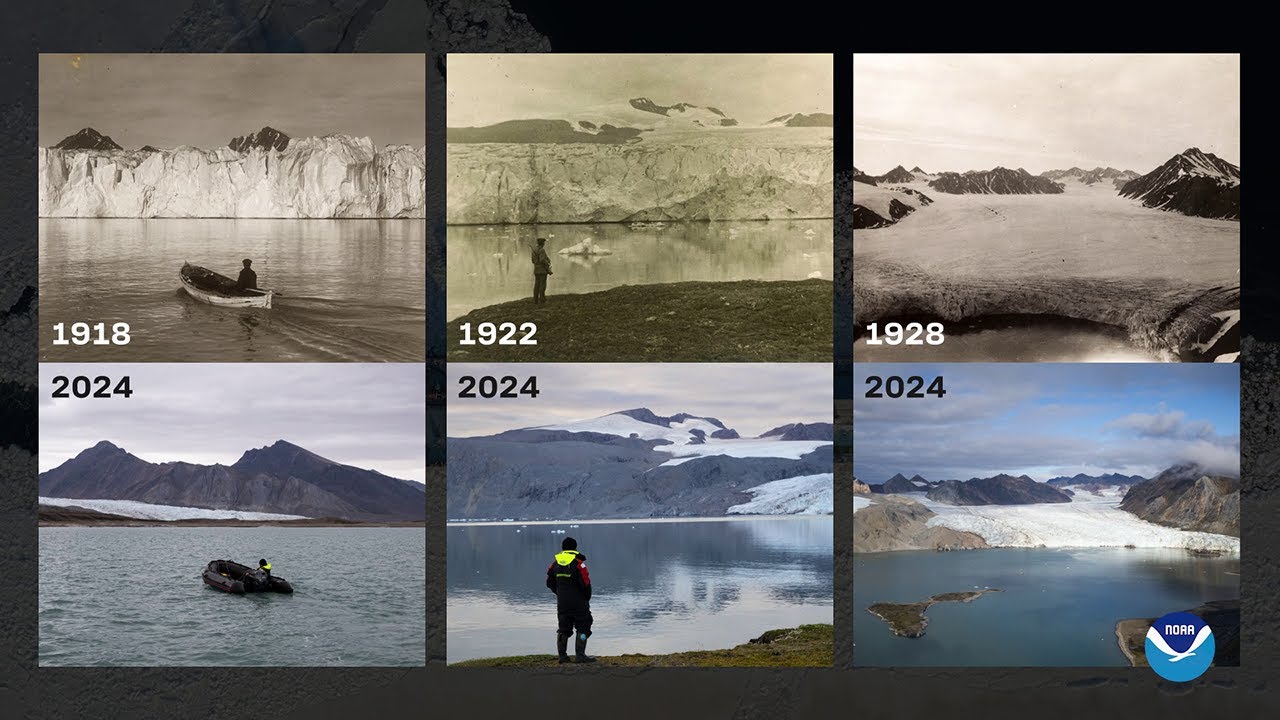
Watch On
For the 20th Arctic Report Card, we worked with the National Oceanic and Atmospheric Administration, an international team of scientists and Indigenous partners from across the Arctic to track environmental changes in the North – from air and ocean temperatures to sea ice, snow, glaciers and ecosystems – and the impacts on communities.
Together, these vital signs reveal a striking and interconnected transformation underway that’s amplifying risks for people who live there.
A wetter Arctic with more extreme precipitation
Arctic warming is intensifying the region’s water cycle.
A warmer atmosphere increases evaporation, precipitation and meltwater from snow and ice, adding and moving more water through the climate system. That leads to more extreme rainstorms and snowstorms, changing river flows and altering ecosystems.
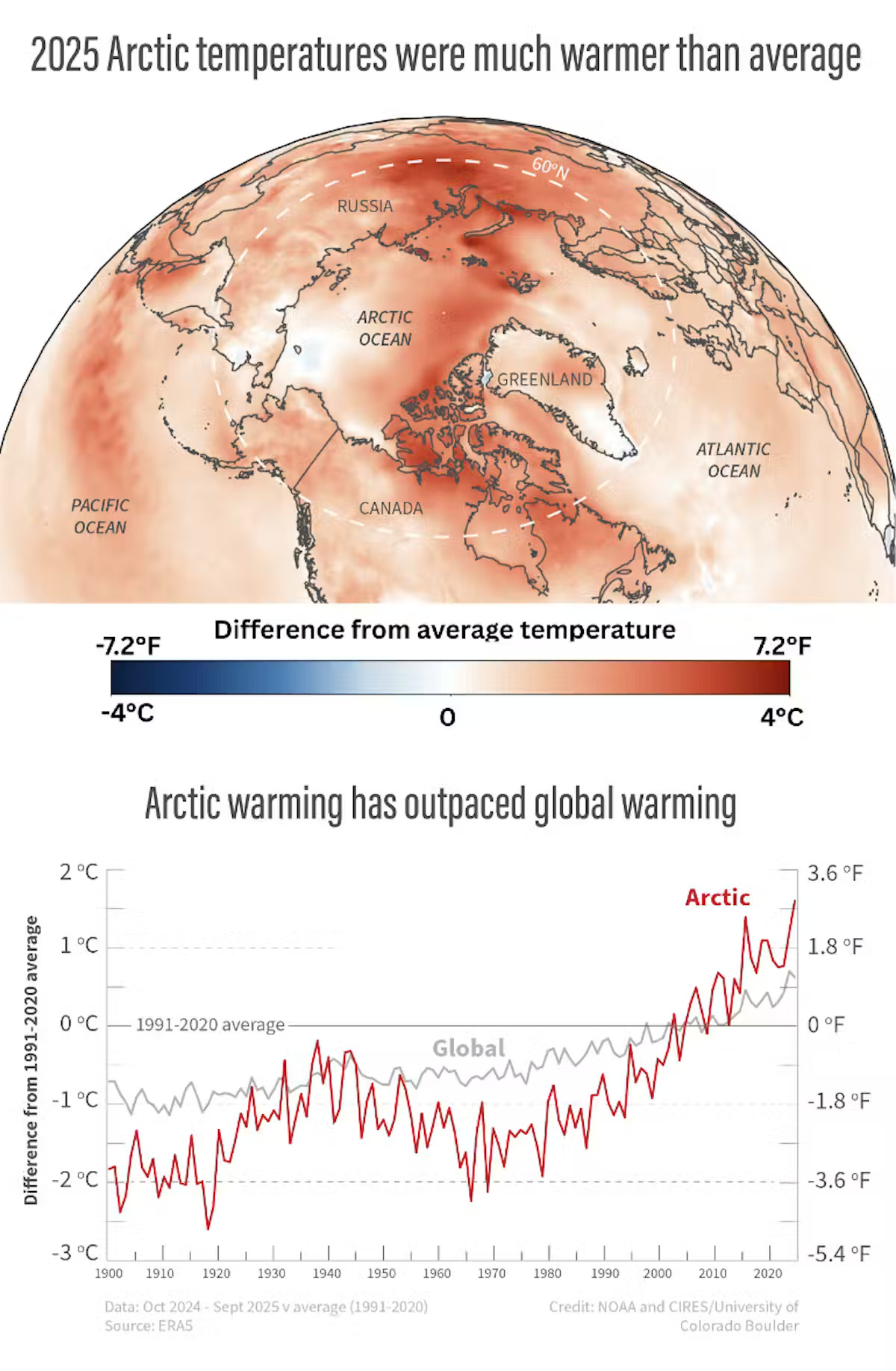
Arctic surface air temperatures are warming much faster than the global average. (Image credit: NOAA and CIRES/University of Colorado Boulder.)
The Arctic region saw record-high precipitation for the entire 2025 water year and for spring, with the other seasons each among the top-five wettest since at least 1950. Extreme weather – particularly atmospheric rivers, which are long narrow “rivers in the sky” that transport large amounts of water vapor – played an outsized role.
These wetter conditions are reshaping snow cover across the region.
You may like
Snow and ice losses accelerate warming, hazards
Snow blankets the Arctic throughout much of the year, but that snow cover isn’t lasting as long. In 2025, snowpack was above average in the cold winter months, yet rapid spring melting left the area covered by snow far smaller than normal by June, continuing a six-decade decline. June snow cover in recent years has been half of what it was in the 1960s.
Losing late spring snow cover means losing a bright, reflective surface that helps keep the Arctic cool, allowing the land instead to be directly warmed by the sun, which raises the temperature.
Sea ice tells a similar story. The year’s maximum sea ice coverage, reached in March, was the lowest in the 47-year satellite record. The minimum sea ice coverage, in September, was the 10th lowest.
Since the 1980s, the summer sea ice extent has shrunk by about 50%, while the area covered by the oldest, thickest sea ice – ice that has existed for longer than four years – has declined by more than 95%.
The thinner sea ice cover is more influenced by winds and currents, and less resilient against warming waters. This means greater variability in sea ice conditions, causing new risks for people living and working in the Arctic.
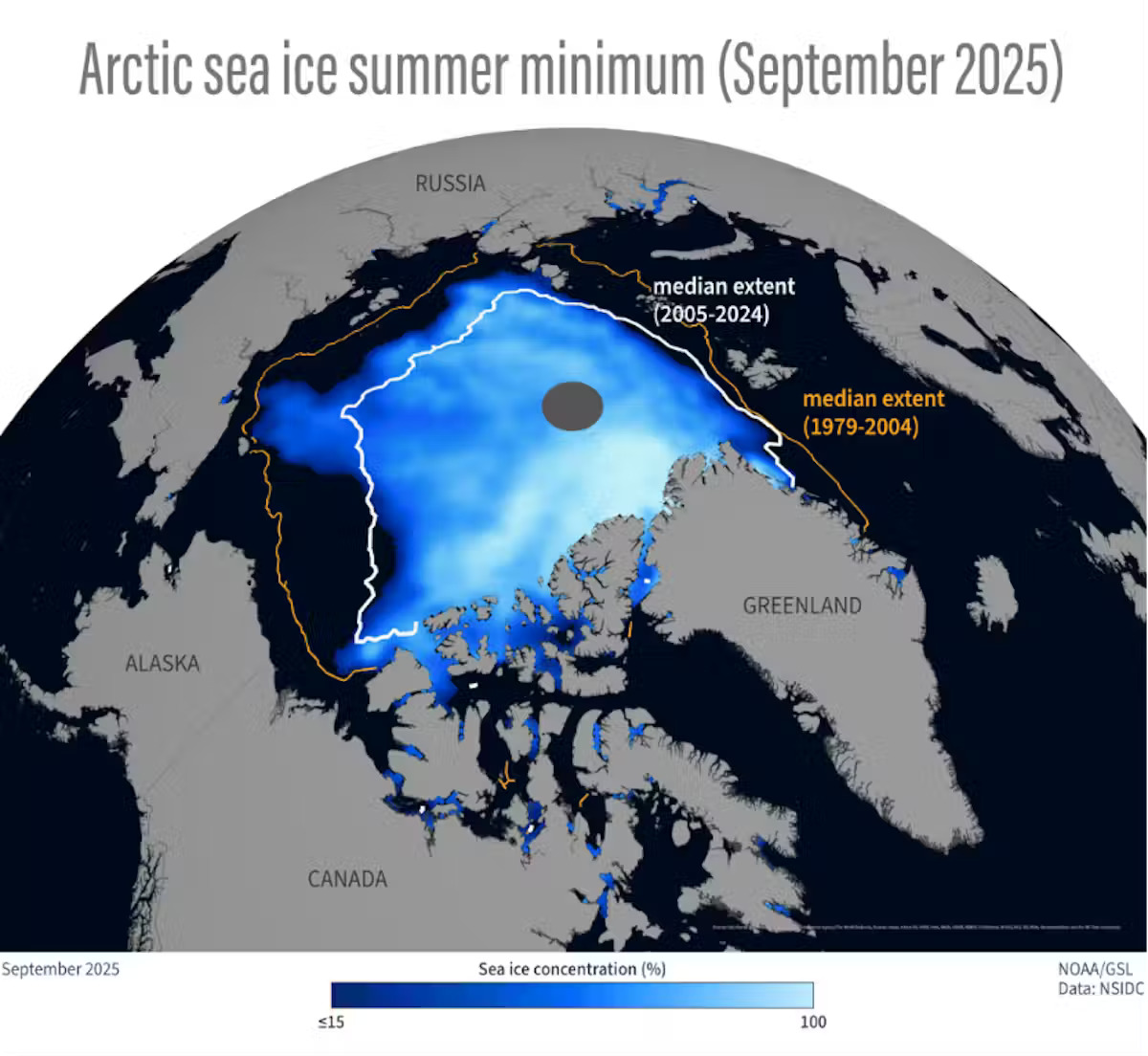
Arctic sea ice concentration in September 2025, during its annual minimum extent at the end of summer, was much smaller than the 1979-2004 median extent. The shades of blue reflect the concentration of sea ice. (Image credit: NOAA and CIRES/University of Colorado Boulder.)
The Greenland Ice Sheet continued to lose mass in 2025, as it has every year since the late 1990s. As the ice sheet melts and calves more icebergs into the surrounding seas, it adds to global sea-level rise.
Mountain glaciers are also losing ice at an extraordinary rate – the annual rate of glacier ice loss across the Arctic has tripled since the 1990s.
This poses immediate local hazards. Glacial lake outburst floods – when water that is dammed up by a glacier is suddenly released – are becoming more frequent. In Juneau, Alaska, recent outburst floods from Mendenhall Glacier have inundated homes and displaced residents with record-setting levels of floodwater.
Glacier retreat can also contribute to catastrophic landslide impacts. Following the retreat of South Sawyer Glacier, a landslide in southeast Alaska’s Tracy Arm in August 2025 generated a tsunami that swept across the narrow fjord and ran nearly 1,600 feet (nearly 490 meters) up the other side. Fortunately, the fjord was empty of the cruise ships that regularly visit.
Record-warm oceans drive storms, ecosystem shifts
Arctic Ocean surface waters are steadily warming, with August 2025 temperatures among the highest ever measured. In some Atlantic-sector regions, sea surface temperatures were as much as 13 degrees Fahrenheit (7.2 Celsius) above the 1991-2020 average. Some parts of the Chukchi and Beaufort seas were cooler than normal.
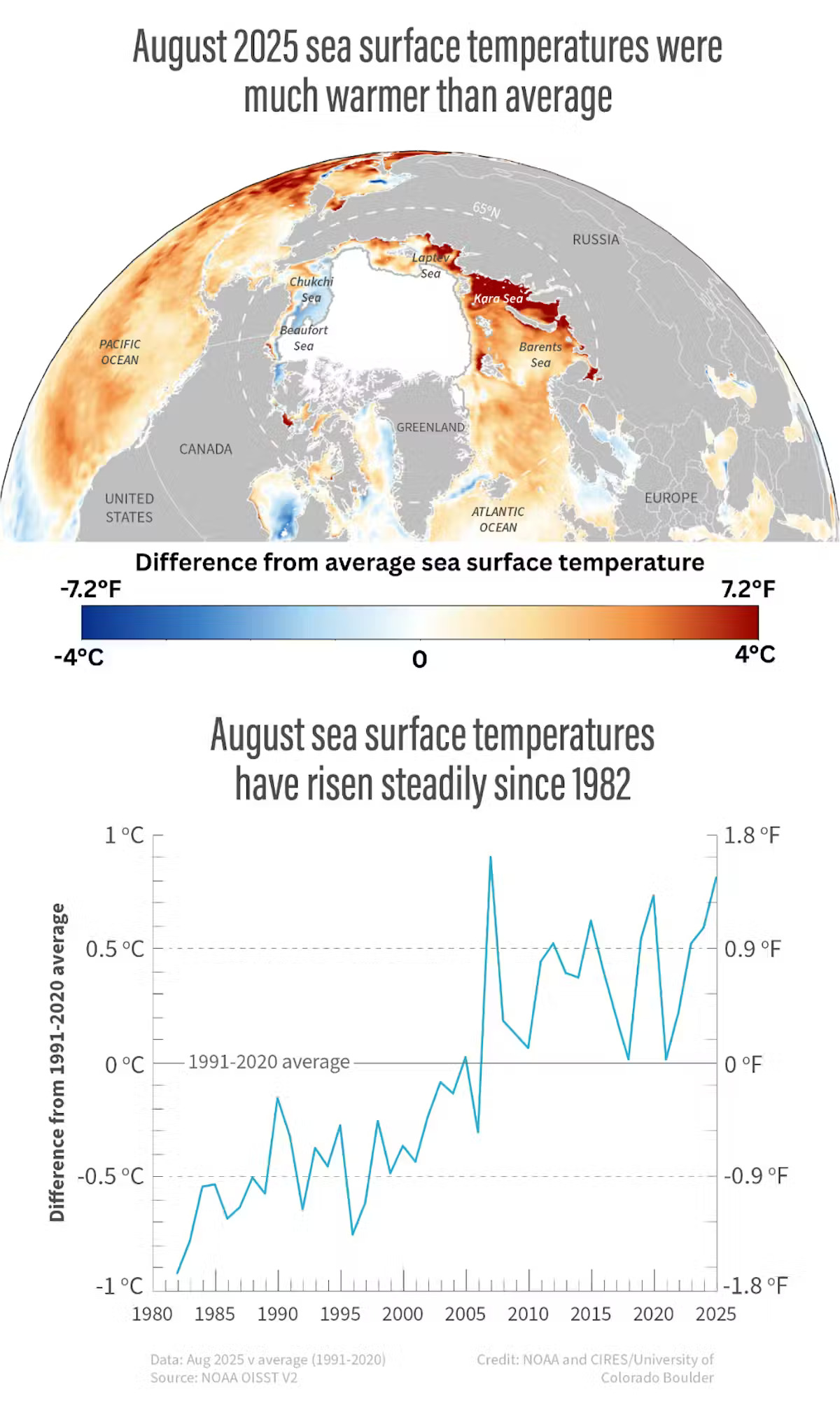
Arctic sea surface temperatures are much warmer today than in past decades, as this map and chart of August 2025 sea surface temperatures shows. (Image credit: NOAA and CIRES/University of Colorado Boulder.)
Warm water in the Bering Sea set the stage for one of the year’s most devastating events: Ex-Typhoon Halong, which fed on unusually warm ocean temperatures before slamming into western Alaska with hurricane-force winds and catastrophic flooding. Some villages, including Kipnuk and Kwigillingok, were heavily damaged.
As seas warm, powerful Pacific cyclones, which draw energy from warm water, are reaching higher latitudes and maintaining strength longer. Alaska’s Arctic has seen four ex-typhoons since 1970, and three of them arrived in the past four years.
The Arctic is also seeing warmer, saltier Atlantic Ocean water intrude northward into the Arctic Ocean. This process, known as Atlantification, weakens the natural layering of water that once shielded sea ice from deeper ocean heat. It is already increasing sea ice loss and reshaping habitat for marine life, such as by changing the timing of phytoplankton production, which provides the base of the ocean food web, and increasing the likelihood of harmful algal blooms.
From ocean “borealization” to tundra greening
Warming seas and declining sea ice are enabling southern, or boreal, marine species to move northward. In the northern Bering and Chukchi seas, Arctic species have declined sharply – by two-thirds and one-half, respectively – while the populations of boreal species expand.
On land, a similar “borealization” is underway. Satellite data shows that tundra vegetation productivity – known as tundra greenness – hit its third-highest level in the 26-year record in 2025, part of a trend driven by longer growing seasons and warmer temperatures. Yet greening is not universal – browning events caused by wildfires and extreme weather are also increasing.
Summer 2025 marked the fourth consecutive year with above-median wildfire area across northern North America. Nearly 1,600 square miles (over 4,000 square kilometers) burned in Alaska and over 5,000 square miles (over 13,600 square kilometers) burned in Canada’s Northwest Territories.
Permafrost thaw is turning rivers orange
As permafrost – the frozen ground that underlies much of the Arctic – continues its long-term warming and thaw, one emerging consequence is the spread of rusting rivers.
As thawing soils release iron and other minerals, more than 200 watersheds across Arctic Alaska now show orange discoloration. These waters exhibit higher acidity and elevated levels of toxic metals, which can contaminate fish habitat and drinking water and impact subsistence livelihoods.
In Kobuk Valley National Park in Alaska, a tributary to the Akillik River lost all its juvenile Dolly Varden and slimy sculpin fish after an abrupt increase in stream acidity when the stream turned orange.
Arctic communities lead new monitoring efforts
The rapid pace of change underscores the need for strong Arctic monitoring systems. Yet many government-funded observing networks face funding shortfalls and other vulnerabilities.
At the same time, Indigenous communities are leading new efforts.
The Arctic Report Card details how the people of St. Paul Island, in the Bering Sea, have spent over 20 years building and operating their own observation system, drawing on research partnerships with outside scientists while retaining control over monitoring, data and sharing of results. The Indigenous Sentinels Network tracks environmental conditions ranging from mercury in traditional foods to coastal erosion and fish habitat and is building local climate resilience in one of the most rapidly changing environments on the planet.
The Arctic is facing threats from more than the changing climate; it’s also a region where concerns of ecosystem health and pollutants come sharply into view. In this sense, the Arctic provides a vantage point for addressing the triple planetary crisis of climate change, biodiversity loss and pollution.
The next 20 years will continue to reshape the Arctic, with changes felt by communities and economies across the planet.

Nicoletta Lanese is the health channel editor at Live Science and was previously a news editor and staff writer at the site. She holds a graduate certificate in science communication from UC Santa Cruz and degrees in neuroscience and dance from the University of Florida. Her work has appeared in The Scientist, Science News, the Mercury News, Mongabay and Stanford Medicine Magazine, among other outlets. Based in NYC, she also remains heavily involved in dance and performs in local choreographers’ work.


Christmas may be associated with the aromas of oranges and mince pies but our towns and cities also boast special scents during the rest of the year. Now, one researcher is publishing an atlas attempting to capture these quirky “smellscapes”.
Dr Kate McLean-MacKenzie, a designer and researcher at the University of Kent, said she first became intrigued by the sense of smell 15 years ago.
“I realised that there was an enormous gap in the fact that we communicate what we see – and we can record that and we can share it via Instagram and photography and sketching – and we can record and share sounds digitally. But any way of recording and communicating smell was largely missing,” she said.
As a result, McLean-MacKenzie began mapping “smellscapes” in different locations, including many of the world’s cities.
This involves asking participants to take “smell walks” on the street – recording not only what they can smell but its intensity and duration, whether it is unexpected, whether they like it or not, and any associations the scent conjures up.
“I analyse that data and from it create visual maps and then a sort of cultural narrative about what smell tells you about those cities in response to what came out from the smell walks,” McLean-MacKenzie said. “So it’s all human interpretation, it’s largely subjective, and it’s about the stories that smells lead us to in cities.”
One man said a late-night New York walk had ‘the smell of shattered dreams’. Photograph: Charly Triballeau/AFP/Getty Images
Among the cities that have been mapped since 2011 are Glasgow, Edinburgh, Canterbury, Amsterdam, Verona, Kyiv, Kolkata and Paris, with the atlas covering 40 locations.
While humans’ sense of smell compared with that of other animals has long been derided, recent research has shown it is not to be sniffed at: among other studies, scientists have found people can tell apart smells that arise just tens of milliseconds apart.
McLean-MacKenzie said the goal of the smell walks was not to identify a scent per se. “It’s about naming it and therefore giving those smells meaning in people’s lives.”
Among the examples, McLean-MacKenzie said one participant called a particular waft “the smell of shattered dreams”.
“That was somebody in New York who basically said … the smell of shattered dreams is the smell of stale beer on the sidewalk, walking home late at night, single still,” she said.
The maps, she added, capture the ephemeral nature of smells, showing the source of the odour on the day the smell walk took place, and where the scent may be blown.
“It’s like an impressionist painting of light. It’s a moment in time and the only way that you’ll get to experience it is by going out and smelling for yourself,” she said.
McLean-MacKenzie said the maps could become a useful historical record of how cities smell now, because future generations may have different experiences – as electric vehicles proliferate, for example.
The smell of petrol on a busy London street may soon be a thing of the past. Photograph: Alamy
She hopes the atlas will encourage readers to engage with all their senses when out walking, and in a physical as well as a digital way.
“By engaging with how other people smell spaces in ways that you might not, there’s a level of acceptance, tolerance and understanding of the fact that as individuals we are all very different and we do see things in different ways,” she added.
McLean-MacKenzie said even festival-related scents could depend on where in the world someone is.
“We can say [the] smells of Christmas are mince pies and Christmas pudding and turkey and fires and all the rest of it,” she said. “But in Kolkata they’re not, they’re smells of Chhena cake and lights and different things happening and different drinks and foods around. And the smell of cold for them is 20C, whereas for us it’s sub-zero.”
Smells can even bring surprises: McLean-MacKenzie said that when a participant who recorded smells in Antarctica came across a dead seal, they found it had a pleasant, leather-like odour.
“Just because something smells doesn’t mean it’s bad, and it’s only there temporarily,” she said. “So get over yourself and go and have a whiff and see what it’s like.”

The story of astronomy begins not with satellites or space probes, but with ancient thinkers who dared to look up and wonder.
From Mesopotamian sky-watchers to Renaissance revolutionaries, early astronomers laid the groundwork for everything we know about the universe today. Their tools were rudimentary, but their insights were profound.
You may like
Whether you’re a seasoned stargazer or just dipping your toes into the cosmic unknown, this puzzle is your launchpad into the brilliant legacy of early astronomy.
Try it out below and see how well you score!
SCIENCE
Archaeological artifacts should not be for sale in thrift shops. But putting them in a museum is harder than it sounds.

An unusual email arrived in the inbox of a faculty member at the department of archeology at Simon Fraser University in the spring of 2024.
This email was from a thrift shop, Thrifty Boutique in Chilliwack, B.C. — unlike the many queries archeologists receive every year to authenticate objects that people have in their possession.
You may like
Eclectic collection
The disparities between the two objects, suggesting different time periods, make it unlikely they’re from the same hoard. We expect they were assembled into an eclectic collection by the unknown person (as of yet) who acquired them prior to their donation to Thrifty Boutique.
With the exciting revelation that the objects may be authentic ancient artifacts, the thrift store offered to donate them to SFU’s archeology museum. The museum had to carefully consider whether it had the capacity and expertise to care for these objects in perpetuity, and ultimately decided to commit to their care and stewardship because of the potential for student learning.
Officially accepting and officially transferring these objects to the museum took more than a year. We grappled with the ethical implications of acquiring a collection without known provenance (history of ownership) and balanced this against the learning opportunities that it might offer our students.
As archeology faculty, we analyzed these objects with Babara Hilden, director of Museum of Archaeology and Ethnology at Simon Fraser University, after the store arranged to bring the items to the museum.
Our initial visual analysis of the objects led us to suspect that, based on their shapes, designs and construction, they were ancient artifacts most likely from somewhere within the boundaries of what was once the Roman Empire. They may date to late antiquity (roughly the third to sixth or seventh century) and/or the medieval period.
The initial dating was based largely on the decorative motifs that adorn these objects. The smaller medallion appears to bear a Chi Rho (Christogram), which was popular in the late antiquity period. The larger medallion (or belt buckle) resembles comparable items from the Byzantine Period.
You may like
One of the ancient medallions. (Image credit: SFU/Sam Smith)
The disparities between the two objects, suggesting different time periods, make it unlikely they’re from the same hoard. We expect they were assembled into an eclectic collection by the unknown person (as of yet) who acquired them prior to their donation to Thrifty Boutique.
With the exciting revelation that the objects may be authentic ancient artifacts, the thrift store offered to donate them to SFU’s archeology museum. The museum had to carefully consider whether it had the capacity and expertise to care for these objects in perpetuity, and ultimately decided to commit to their care and stewardship because of the potential for student learning.
Officially accepting and officially transferring these objects to the museum took more than a year. We grappled with the ethical implications of acquiring a collection without known provenance (history of ownership) and balanced this against the learning opportunities that it might offer our students.
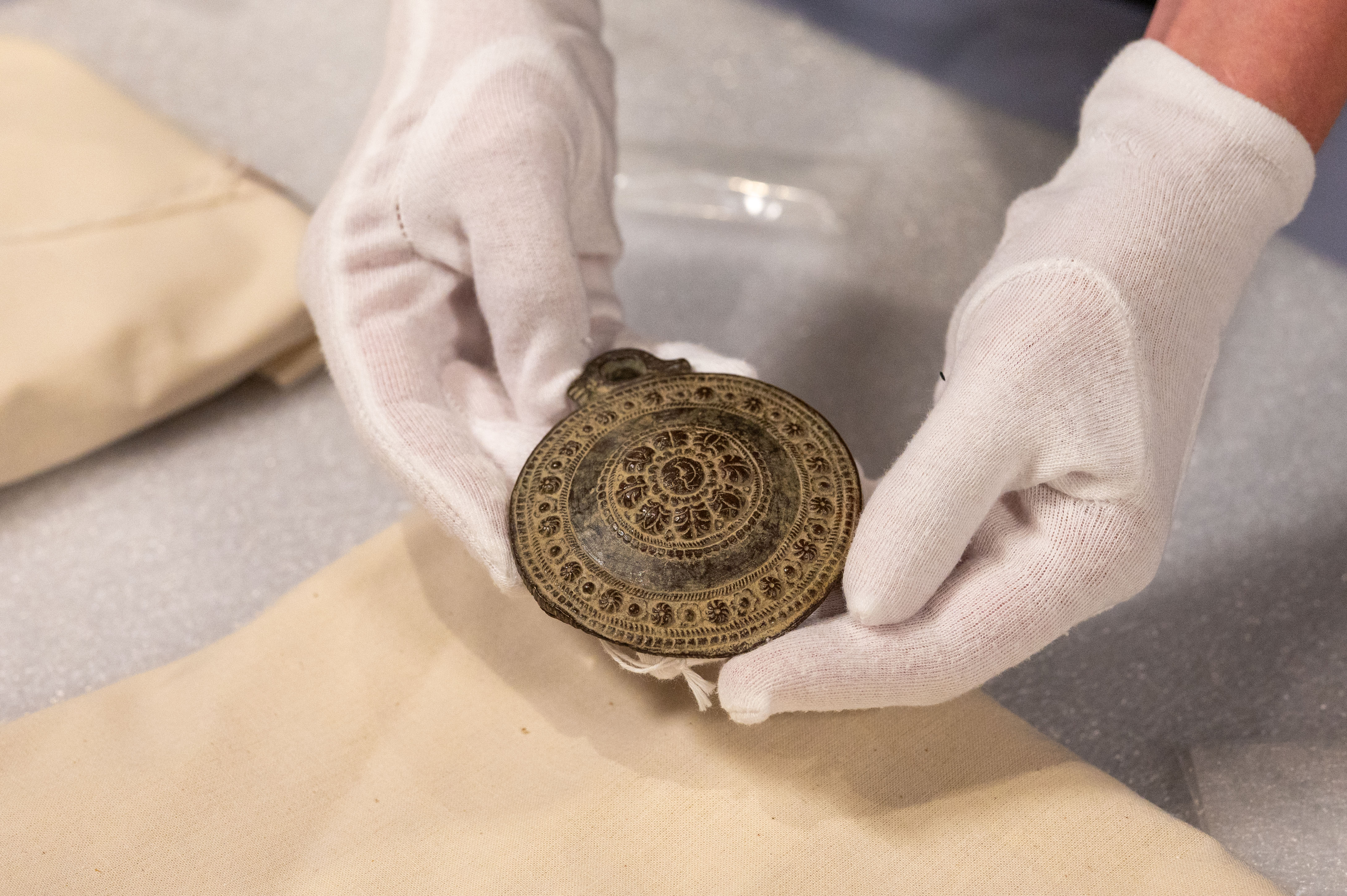
A researchers handles a medallion with care. (Image credit: SFU/Sam Smith)
Ethical and legal questions
Learning to investigate the journey of the donated objects is akin to the process of provenance research in museums.
In accepting items without known provenance, museums must consider the ethical implications of doing so. The Canadian Museums Association Ethics Guidelines state that “museums must guard against any direct or indirect participation in the illicit traffic in cultural and natural objects.”
When archeological artifacts have no clear provenance, it is difficult — if not impossible — to determine where they originally came from. It is possible such artifacts were illegally acquired through looting, even though the Canadian Property Import and Export Act exists to restrict the importation and exportation of such objects.
We are keenly aware of the responsibility museums have to not entertain donations of illicitly acquired materials. However, in this situation, there is no clear information — as yet — about where these items came from and whether they are ancient artifacts or modern forgeries. Without knowing this, we cannot notify authorities nor facilitate returning them to their original source.
With a long history of ethical engagement with communities, including repatriation, the Museum of Archaeology and Ethnology is committed to continuing such work. This donation would be no different if we’re able to confirm our suspicions about their authenticity.
Archeological forgeries
Archeological forgeries, while not widely publicized, are perhaps more common than most realize — and they plague museum collections around the world.
Well-known examples of the archeological record being affected by inauthentic artifacts are the 1920s Glozel hoax in France and the fossil forgery known as Piltdown Man.
Other examples of the falsification of ancient remains include the Cardiff Giant and crystal skulls, popularized in one of the Indiana Jones movies.
Various scientific techniques can help determine authenticity, but it can sometimes prove impossible to be 100 per cent certain because of the level of skill involved in creating convincing forgeries.
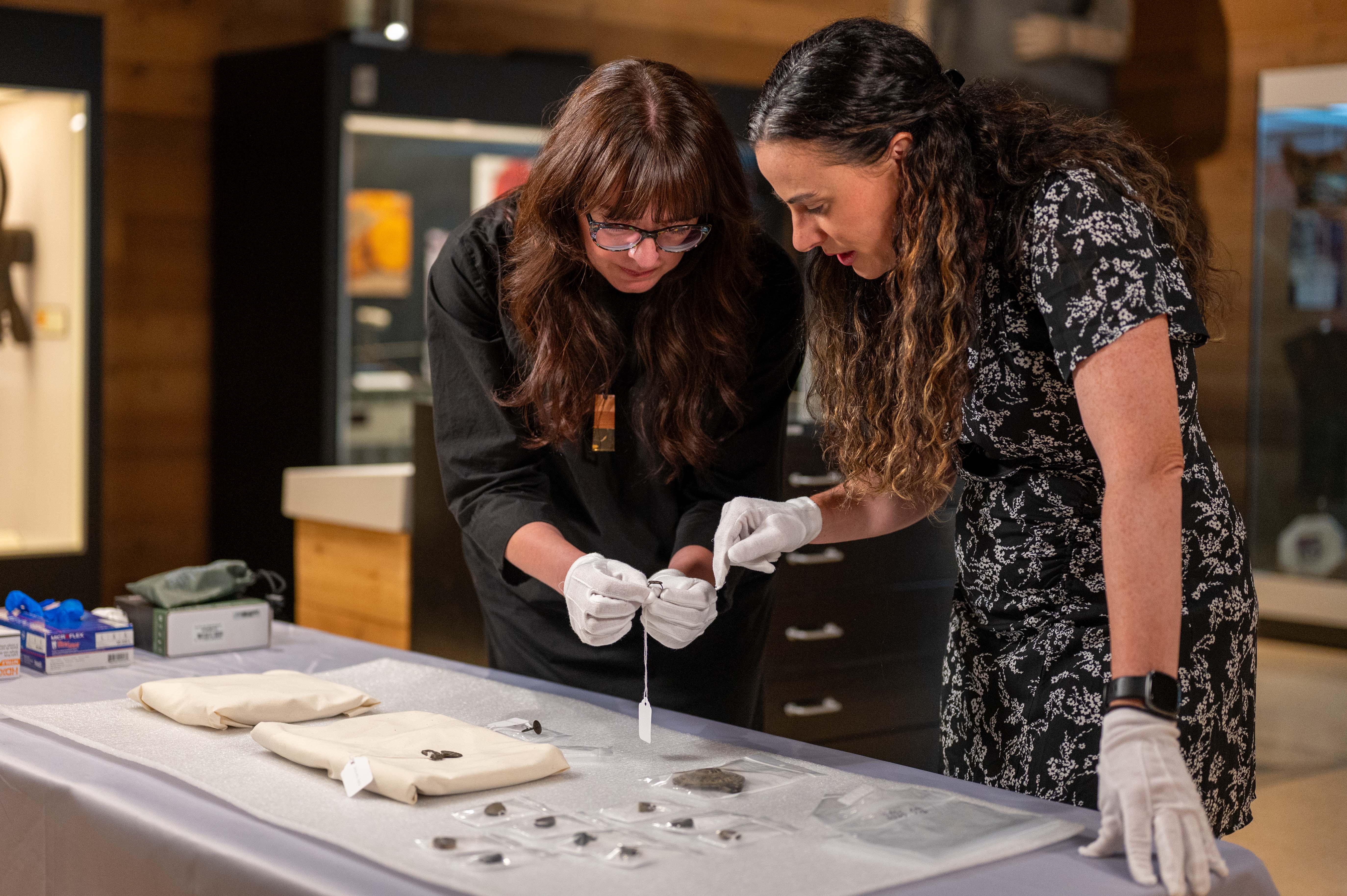
SFU researchers examine the donated artifacts. (Image credit: SFU/Sam Smith)
Copies of ancient artefacts
Other copies of ancient artifacts exist for honest purposes, such as those created for the tourist market or even for artistic purposes. Museums full of replicas still attract visitors, because they are another means of engaging with the past, and we are confident that the donation therefore has a place within the museum whether the objects are authentic or not.
By working closely with the objects, students will learn how to become archeological detectives and engage with the process of museum research from start to finish. The information gathered from this process will help to determine where the objects may have been originally uncovered or manufactured, how old they might be and what their original significance may have been.
Object-based learning using museum collections demonstrates the value of hands-on engagement in an age of increasing concern about the impact of artificial intelligence on education.
New course designed to examine items
The new archeology course we have designed, which will run at SFU in September 2026, will also focus heavily on questions of ethics and provenance, including what the process would look like if the objects — if determined to be authentic — could one day be returned to their country of origin.
The students will also benefit from the wide-ranging expertise of our colleagues in the department of archeology at SFU, including access to various technologies and avenues of archeological science that might help us learn more about the objects.
This will involve techniques such as X-ray fluorescence, which can be used to investigate elemental compositions of materials and using 3D scanners and printers to create resources for further study and outreach.
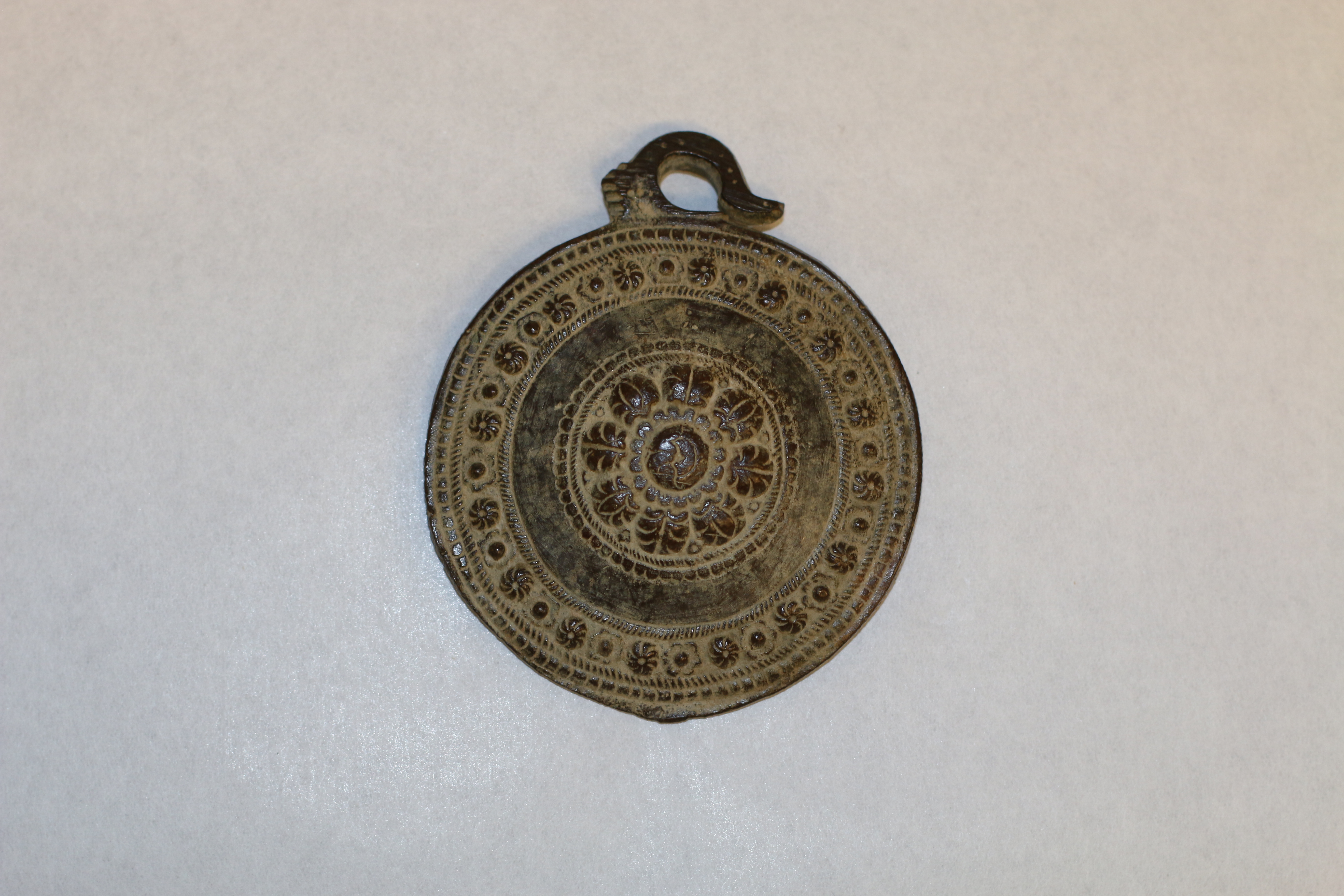
The artifacts were being sold for $30 at a Chilliwack thrift shop. (Image credit: SFU/ Museum of Archaeology & Ethnology)
Mentoring with museum professionals
Local museum professionals have also agreed to help mentor the students in exhibition development and public engagement, a bonus for many of our students who aspire to have careers in museums or cultural heritage.
Overall, the course will afford our students a rare opportunity to work with objects from a regional context not currently represented in the museum while simultaneously piecing together the story of these items far from their probable original home across the Atlantic.
We are excited to be part of their new emerging story at Simon Fraser, and can’t wait to learn more about their mysterious past.
This edited article is republished from The Conversation under a Creative Commons license. Read the original article.

In a scene that feels more like a midnight vigil than a routine inspection, NASA engineers and scientists gathered in near darkness inside a pristine cleanroom. Armed with flashlights and ultraviolet lamps, members of the Nancy Grace Roman Space Telescope team carefully examined the observatory’s primary mirror, searching for even the smallest trace of contamination.
The eerie green glow illuminating the cleanroom wasn’t festive lighting but the result of a long exposure combined with a small indicator lamp on the wall, an unassuming signal that the airflow in the room was just right.
You may like
What is it?
The Roman Space Telescope is one of NASA’s next great observatories, designed to explore some of the biggest questions in modern astronomy. From probing the mysterious nature of dark energy to discovering thousands of new exoplanets, Roman will survey the universe with a wide-field view far beyond what previous space telescopes have achieved.
To do this science, Roman will employ extraordinarily sensitive optics, especially its primary mirror. Even microscopic dust particles or residues can scatter light and degrade observations. That’s why inspections take place in cleanrooms that are cleaner than hospital operating theaters, under lighting conditions carefully chosen to reveal what the naked eye might otherwise miss.
Ultraviolet light causes certain contaminants to fluoresce, making them easier to spot. The team’s slow, methodical work under flashlights and UV lamps ensures that the mirror meets the strict standards required for spaceflight. It’s meticulous, patient labor — more “silent night” than spotlight moment — but it is essential to the telescope’s future success.
Where is it?
This image was taken at NASA’s Goddard Space Flight Center in Greenbelt, Maryland.
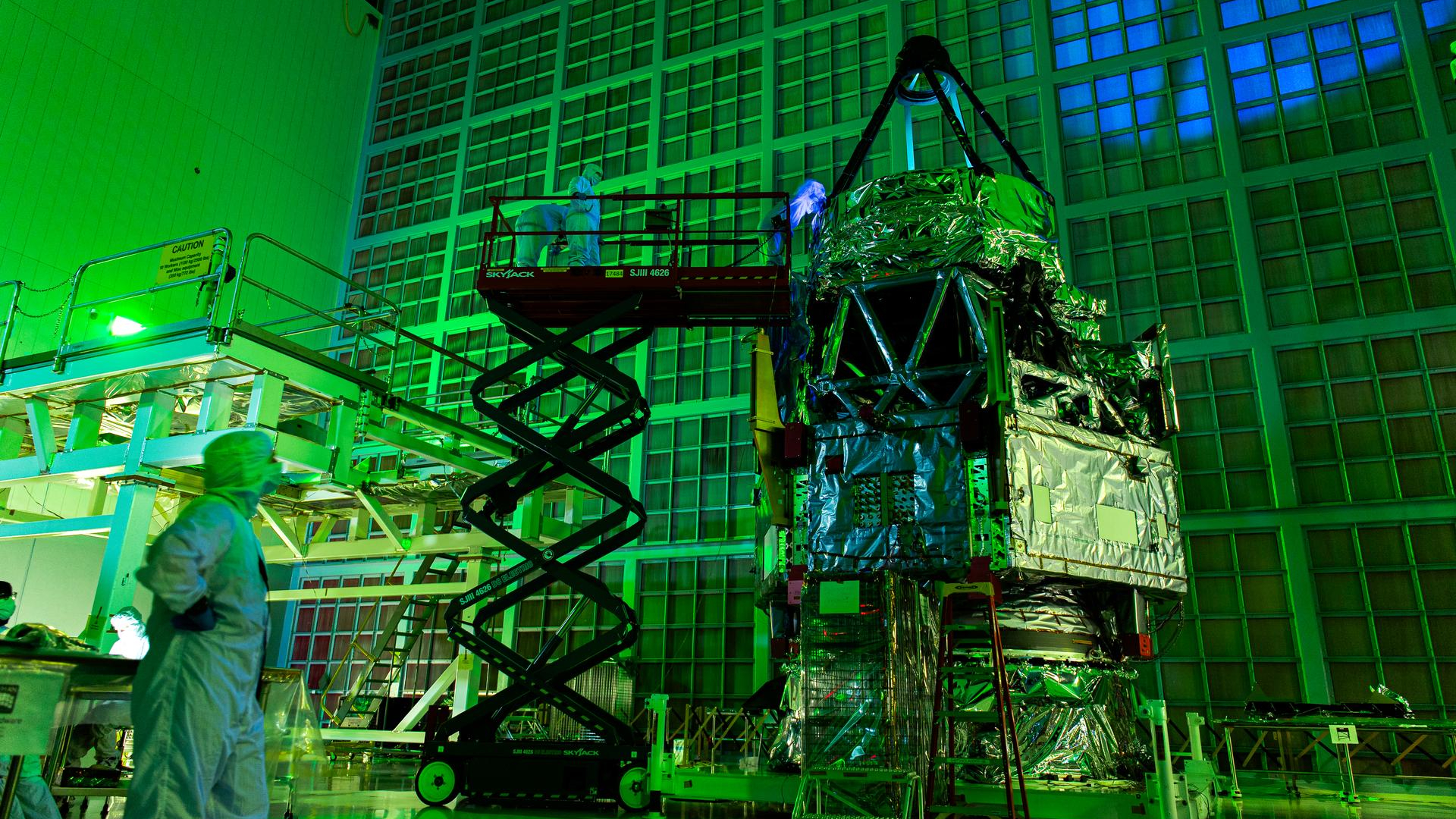
The Roman Space Telescope gets carefully inspected for contaminants. (Image credit: NASA/Michael Guinto)
Why is it amazing?
Once Roman launches in late 2026 or early 2027, there will be no opportunity to wipe down a mirror or redo an inspection. Every careful check on Earth protects years of future science.
As Roman moves closer to launch, images like this remind us that the science of space telescopes starts in cleanrooms, with flashlights, UV light and people dedicated to making sure humanity’s next window on the universe is as clear as possible.
Want to learn more?
You can learn more about the Roman Space Telescope and astronomy.

Scientists are developing a simple blood test to predict who is most at risk from the world’s most common inherited heart condition.
Millions of people worldwide have hypertrophic cardiomyopathy (HCM), a disease of the heart muscle where the wall of the heart becomes thickened. It is caused by a change in one or more genes and mostly passed on through families.
Some feel fine most of the time and have few or no symptoms. But others can suffer complications, such as heart failure and abnormal heart rhythms, which can lead to a cardiac arrest.
The problem is there is no cure. Doctors also do not know which patients with the genetic condition are most at risk from deadly complications.
But now a team of scientists from universities including Harvard and Oxford have found a way to forecast risk for people living with HCM.
The blood test could identify those patients most in danger of complications, enabling them to be monitored more closely or receive life-saving treatment.
In a landmark study, the team measured the levels of a protein, N-terminal Pro-B-type natriuretic peptide (NT-Pro-BNP), in the blood of 700 HCM patients.
NT-Pro-BNP is released by the heart as part of normal pumping. But high levels are a sign the heart is working too hard. Those with the highest levels had poorer blood flow, more scar tissue and changes in their heart which could lead to atrial fibrillation or heart failure.
A blood test measuring NT-Pro-BNP could transform the care of millions of people with the world’s most common inherited heart condition.
The study leader, Prof Carolyn Ho, the medical director of the cardiovascular genetics centre at Harvard medical school, said the test could help “target the right therapies to the right patients at the right time”.
She added: “Continued studies on blood biomarkers will lead to better understanding of HCM so that, in future, we can offer our patients a blood test to identify who is at high versus low risk of experiencing serious consequences of the disease.
“People with the highest risk could be targeted for potentially life-saving treatments as they stand to receive the greatest benefit, while those at lowest risk could avoid unnecessary treatment.”
Lara Johnson, 34, from Southampton in the UK, is one of many who could benefit.
Eight years ago, she began experiencing breathlessness and fatigue. After being referred by her GP for hospital tests, she was diagnosed with HCM. Several relatives on her father’s side were subsequently also diagnosed with the condition.
“One of the hardest parts of living with HCM is the constant uncertainty, never knowing what might change next,” Johnson said. “A simple blood test, which could help identify future risks earlier, would take away so much of that anxiety.”
She added: “It could give people like me a chance to prepare and adjust our lifestyles as needed, and help us to feel more in control. That kind of clarity wouldn’t only help me, it would make a world of difference for my whole family.”
Prof Bryan Williams, the chief scientific and medical officer of the British Heart Foundation, which funded the research, said the test “could benefit patients around the world”.
“After a diagnosis of HCM, patients and their families want to know what the future holds. This study shows that measuring various proteins circulating in the blood could help predict how the heart is functioning and future risk of complications from heart disease.
“This new method may also provide insights in the evolution of the structure and function of the heart in people with HCM that could point to new ways of treating this condition to reduce future risk.”

Christmas is a wonderful time for those who celebrate and once the turkey dinner is done and the wrapping paper has been tidied away, there’s always one last treat that we all can share — the majesty of the winter night sky.
So, gather your friends and family and join us on a Christmas night sky tour featuring glistening constellations, bright planets and, of course, where to find the moon on this silent night.
You may like
What to look out for in the Christmas night sky
The hours following sunset on Dec. 25 offer a wealth of naked-eye astronomy targets that can put even the most glitzy Christmas lights to shame, especially when viewed from a dark sky location.
Look to the southwestern horizon soon after nightfall to find the delicate 35%-lit waxing crescent moon shining low in the winter sky. Saturn shines nearby as a bright “evening star” less than 15 degrees to the moon’s upper left. For reference, the width of your fist held at arm’s length accounts for roughly 10 degrees of sky, while the span of your three middle fingers is approximately 5 degrees.
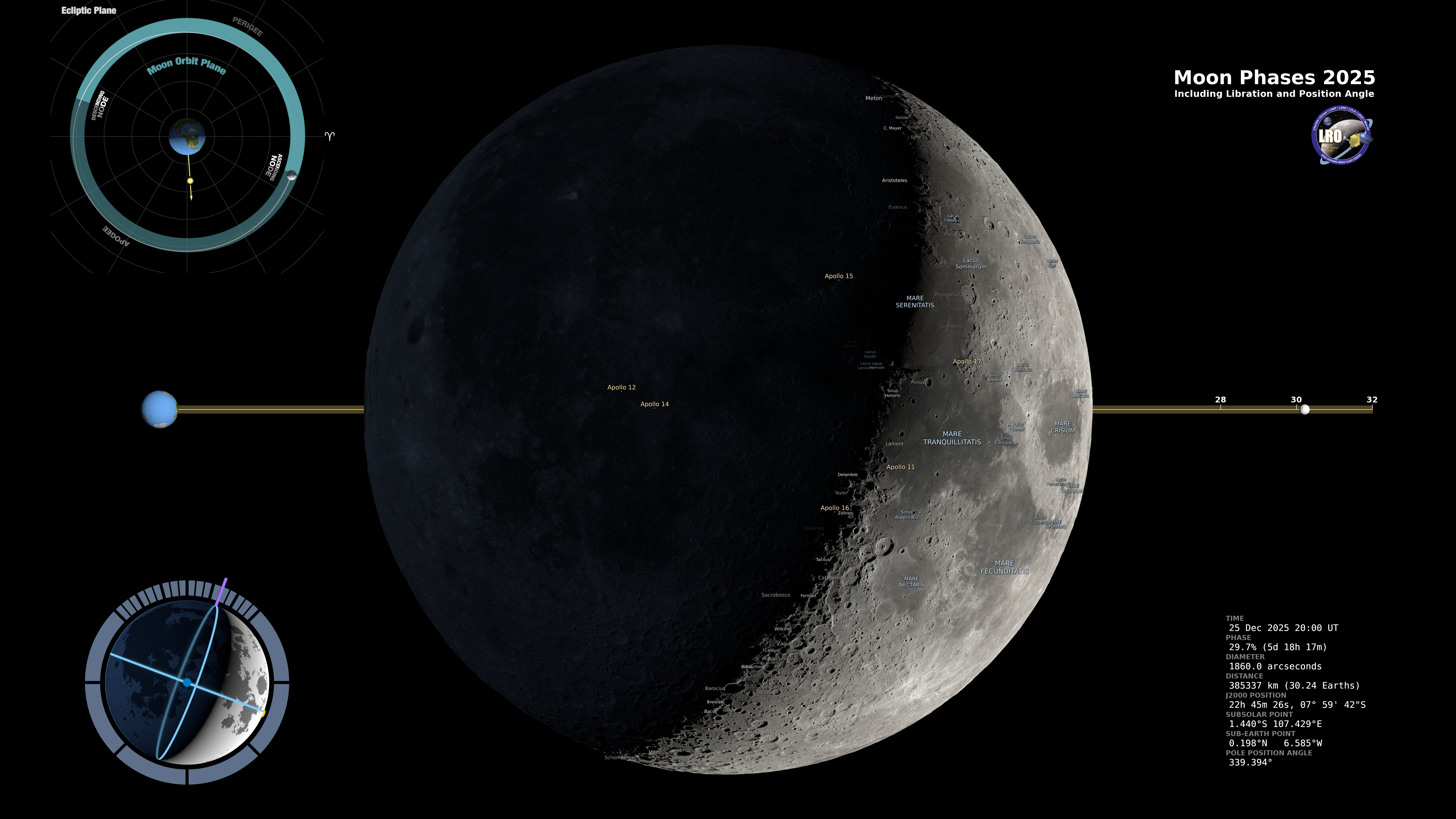
A NASA graphic showing key lunar features visible on Dec. 25. (Image credit: NASA Scientific Visualization Studio)
A 6-inch telescope will help reveal several of Saturn’s largest moons, including Rhea, Titan, Tethys and Dione. Sadly, the gas giant’s sweeping ring system will appear as little more than a thin line, thanks to its current edge-on alignment with Earth following a ring plane crossing in March earlier this year.
The moon’s thickening crescent will appear beautiful to the unaided eye, while a telescope will allow you to explore the vast, smooth expanses of Mare Crisium and Mare Fecunditatis — two prominent solidified lava plains that scar the moon’s Earth-facing side.
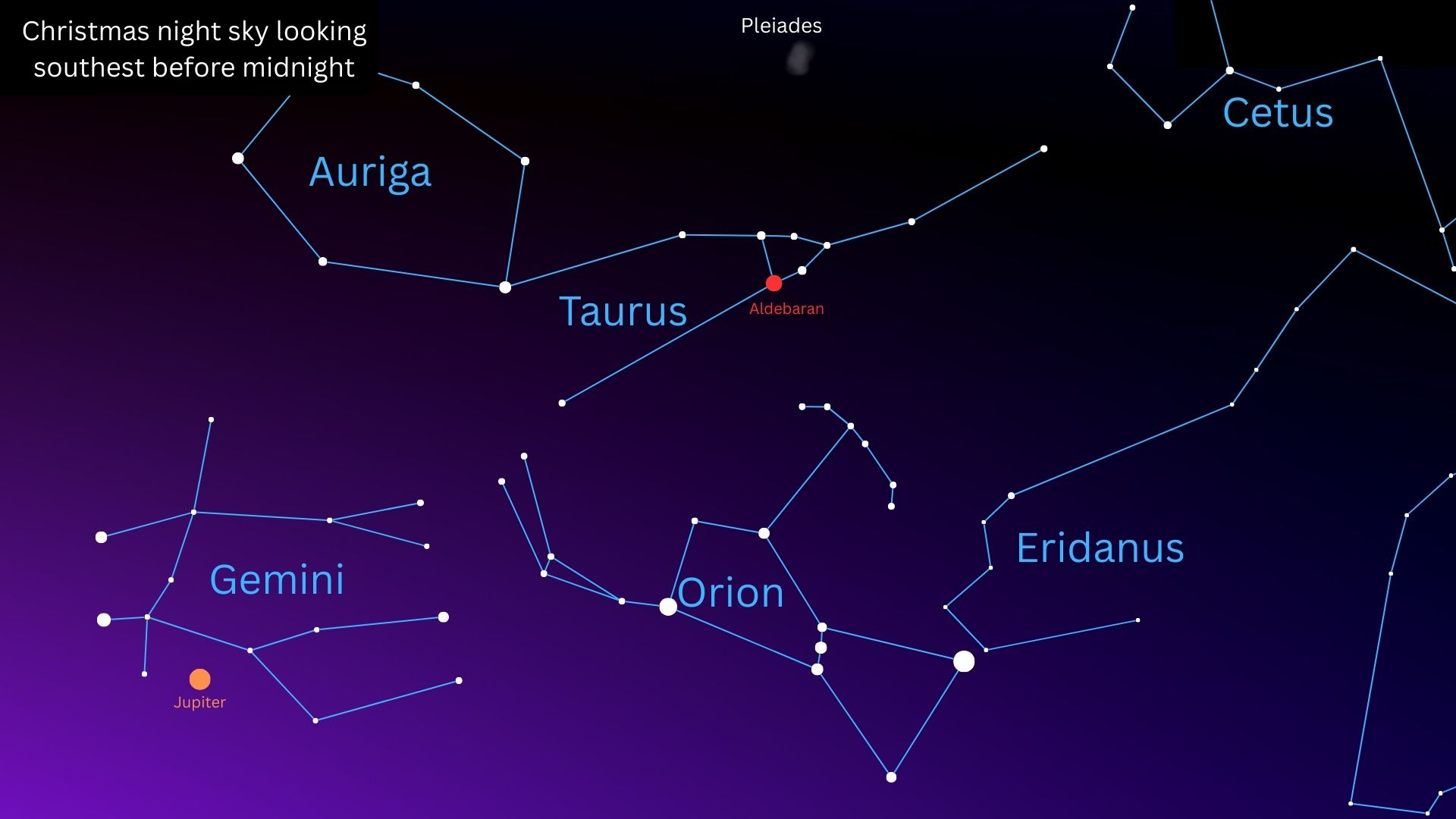
The Christmas night sky looking southeast before midnight. (Image credit: Created by Anthony Wood in Canva.)
Both Saturn and the moon will set shortly after 11 p.m. local time for viewers in the U.S.
Next, turn your gaze to the eastern sky to find mighty Jupiter shining among the stars of the constellation Gemini, close to Castor and Pollux — which represent the heads of the twin brothers depicted in the celestial formation.
Jupiter will be the second brightest object in the night sky on Dec. 25 — after the moon — and so will be easy to spot as it makes its way overhead east to west over the course of the night. The famous constellation Orion will be visible twinkling to its right throughout, with the stars of the Hyades and Pleiades open star clusters visible above in the constellation Taurus, the bull.
You may like
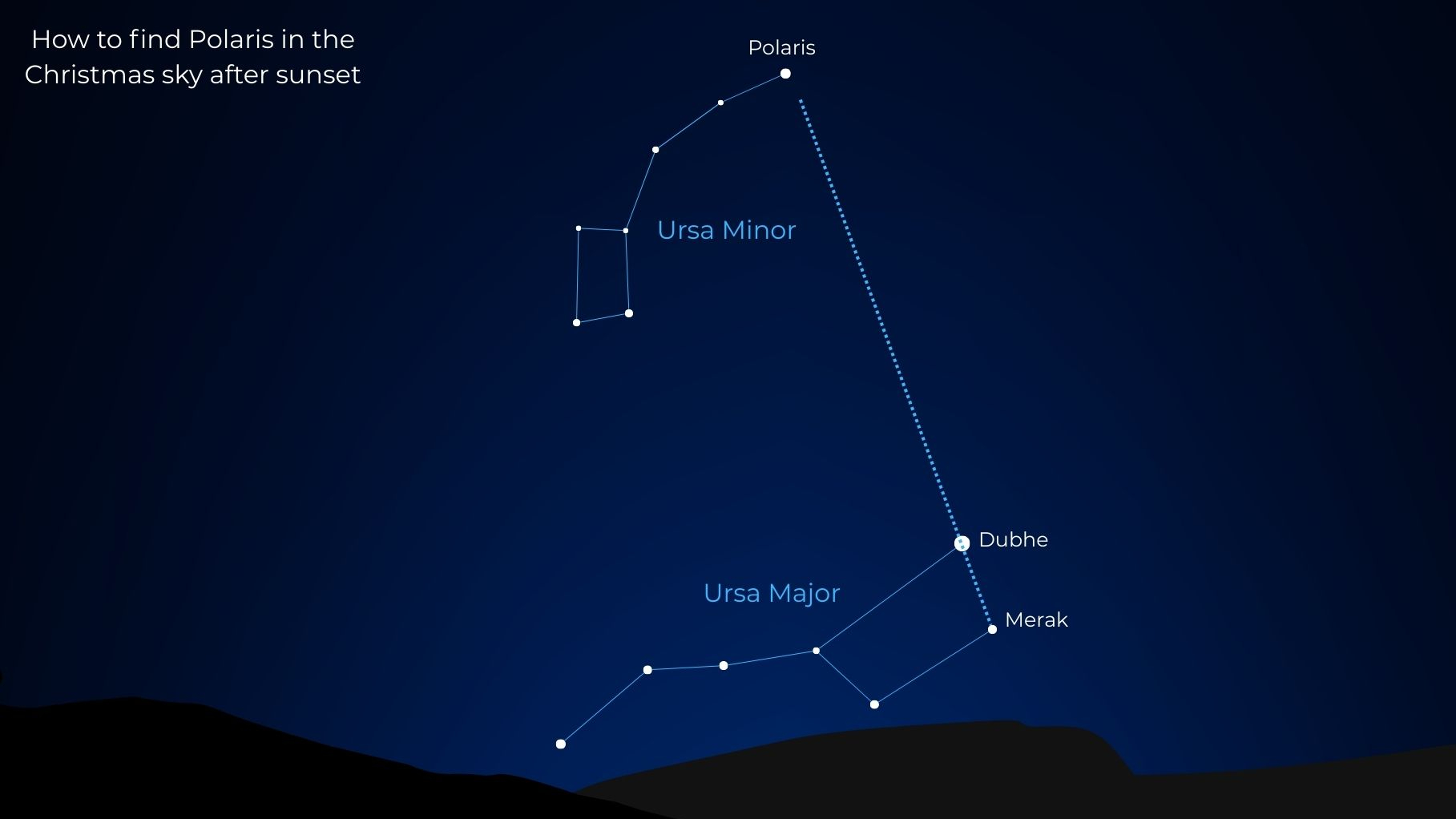
How to find Polaris using the “Big Dipper” asterism. (Image credit: Created by Anthony Wood in Canva)
Finally, turn your eyes north to find Polaris — the “North Star” — shining roughly 40 degrees above the horizon (its altitude matches your latitude, so it will appear lower or higher depending on where you are). You can pinpoint Polaris using your smartphone astronomy app, or by finding one of the most recognizable asterisms in the night sky, the Big Dipper, and using it as a guide to point the way.
First, locate the “pan” of the Big Dipper in the constellation Ursa Major, which sits low on the northern horizon after sunset. Next, draw a line from the star representing the outer base of the pan, known as Merak, up through the star representing the pouring lip, which astronomers call Dubhe. Follow that line out into space and the next bright star you find will be the North Star!
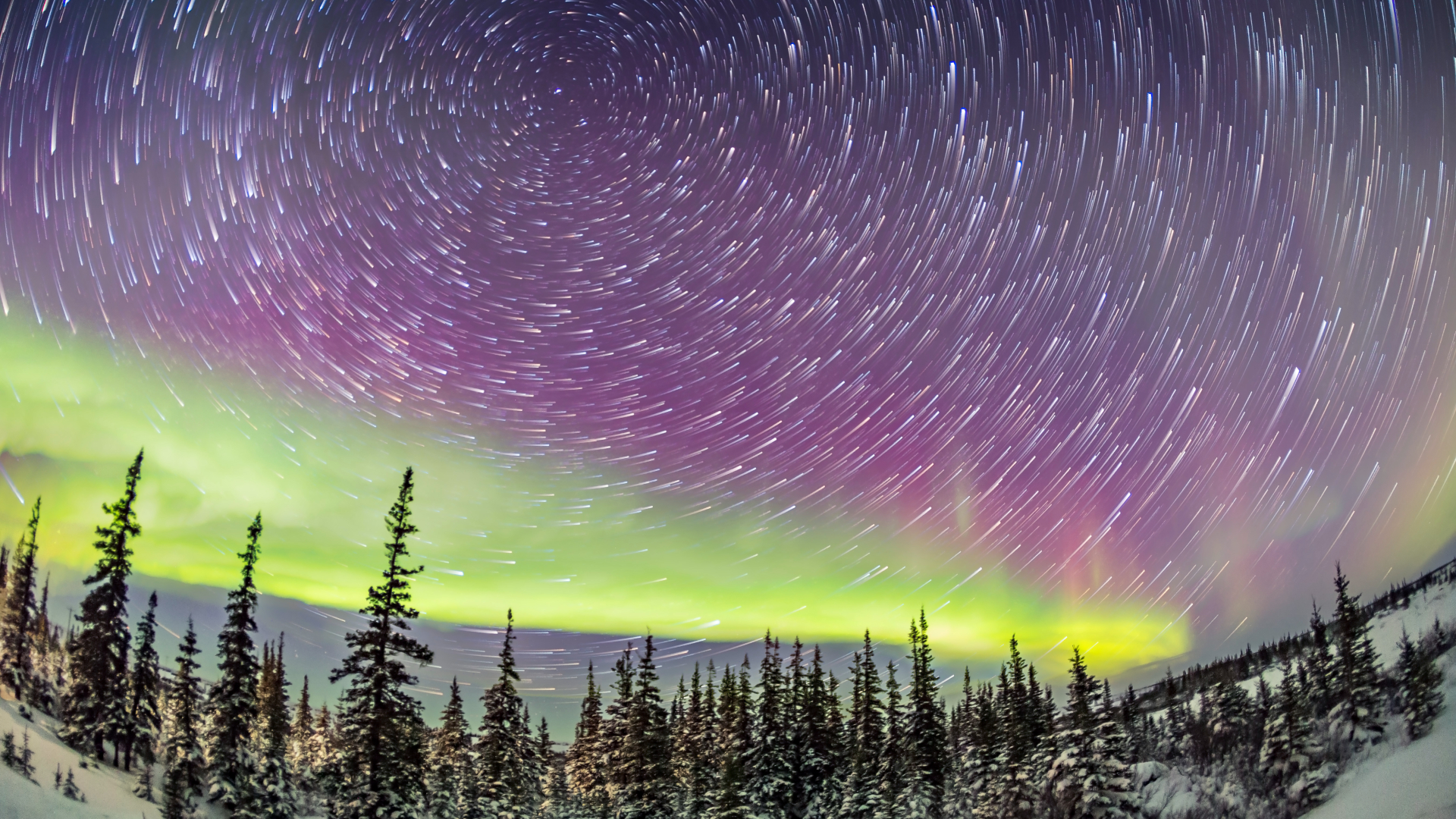
Star trails circle Polaris in the skies over Canada. (Image credit: Alan Dyer /VW PICS/Universal Images Group via Getty Images)
The entire sky will appear to revolve around this one point of light as the night plays out, presenting a stunning anchor for anyone hoping to capture a time-lapse “star-trail” portrait of the Christmas sky.
We hope you enjoyed this short tour of the night sky and from everyone at Space.com, we wish you a merry Christmas!
Editor’s Note: If you would like to share your astrophotography with Space.com’s readers, then please send your photo(s), comments, and your name and location to spacephotos@space.com.
SCIENCE
Science history: James Webb Space Telescope launches — and promptly cracks our view of the universe — Dec. 25, 2021

Milestone: James Webb Space Telescope launches
Date: Dec. 25, 2021
Where: Guiana Space Centre, Kourou, French Guiana
Who: NASA, European Space Agency and Canadian Space Agency scientists
On a cloudy winter’s day, in the Amazon jungle, a shuttle blasted off into space — and changed our view of the universe forever.
You may like
JWST has been so pivotal in part because it can peer back to the “cosmic dawn,” a period a few hundred million years after the Big Bang, when the first stars were winking on.
“The James Webb Space Telescope has proven itself capable of seeing 98% of the way back to the Big Bang,” Peter Jakobsen, an affiliate professor of astrophysics at the University of Copenhagen in Denmark, previously told Live Science in an email.
Yet Webb, which was first conceived at Lockheed Martin in the late 1990s, almost didn’t launch at all. The now-iconic, $10 billion project was catastrophically over budget, plagued by years’ worth of delays and snarled by “stupid mistakes.”
That was in part because, when it launched, it was by far the most complex telescope ever built.
It took more than 20,000 engineers and hundreds of scientists to design, build and launch the eye in the sky. That 21.3 feet (6.5 meter) mirror had to be folded into a honeycomb shape to be lofted on a rocket, then unfolded once in space. Yet despite being foldable, it also had to be so smooth that if it were as big as a continent, “it would feature no hill or valley greater than ankle height,” according to Quanta Magazine.
This stunning image of the Cosmic Cliffs was the first one released by JWST. In it, you can see a profusion of stars in their earliest stages of star formation, a frenetic period which lasts between 50,000 and 100,000 years. (Image credit: NASA, ESA, CSA, and STScI)
To see the earliest epochs of cosmic history, Webb needed infrared vision. That’s because ancient light has been stretched, or red-shifted, into infrared wavelengths as it travels across space-time. On Earth, humans and every other living thing give off heat in the form of infrared radiation, and that would drown out the faint infrared signals from the most distant, ancient starlight. So JWST needed to be lofted into the cold dark of outer space to use its infrared instruments.
Once JWST started imaging the cosmos, it promptly began breaking our existing models of the universe. It rapidly confirmed the Hubble tension — the discrepancy between the universe’s expansion rates depending on where and what astronomers measure. It has found hints of potentially life-sustaining atmospheres shrouding distant exoplanets. And it has spotted shockingly bright galaxies and seemingly “impossible” black holes at the dawn of time. All these clues are pointing to new understandings of the universe.
Some of the questions JWST is raising, such as whether other planets harbor life, it will probably not be able to answer in its planned 10-year lifespan. But future telescopes — such as the currently operational Vera C. Rubin Observatory, meant to create a real-time “movie of the universe”; the recently completed Nancy Grace Roman Telescope, set to launch in 2027 and resolve questions about dark matter and energy; the Extremely Large Telescope, set to turn on in 2029; or the recently announced Habitable Worlds Observatory, which may come online in the 2030s — could start to answer the questions that Webb is raising.

Psychologists have typically believed that we become less curious as we age, but recent research has shown curiosity actually becomes more targeted and specific in our later years. In this episode from September, Madeleine Finlay hears from Dr Mary Whatley, an assistant professor of psychology at Western Carolina University, and Dr Matthias Gruber of Cardiff University’s Brain Research Imaging Centre to find out why we change in this way, and how maintaining broad curiosity into older age can help keep our brains young
SCIENCE
‘Gospel stories themselves tell of dislocation and danger’: A historian describes the world Jesus was born into

Every year, millions of people sing the beautiful carol Silent Night, with its line “all is calm, all is bright”.
We all know the Christmas story is one in which peace and joy are proclaimed, and this permeates our festivities, family gatherings and present-giving. Countless Christmas cards depict the Holy Family – starlit, in a quaint stable, nestled comfortably in a sleepy little village.
However, when I began to research my book on the childhood of Jesus, Boy Jesus: Growing up Judaean in Turbulent Times, that carol started to sound jarringly wrong in terms of his family’s actual circumstances at the time he was born.
You may like
The Gospel stories themselves tell of dislocation and danger. For example, a “manger” was, in fact, a foul-smelling feeding trough for donkeys. A newborn baby laid in one is a profound sign given to the shepherds, who were guarding their flocks at night from dangerous wild animals (Luke 2:12).
Take King Herod, for example. He enters the scene in the nativity stories without any introduction at all, and readers are supposed to know he was bad news. But Herod was appointed by the Romans as their trusted client ruler of the province of Judaea. He stayed long in his post because he was – in Roman terms – doing a reasonable job.
Jesus’ family claimed to be of the lineage of Judaean kings, descended from David and expected to bring forth a future ruler. The Gospel of Matthew begins with Jesus’ entire genealogy, it was that important to his identity.
But a few years before Jesus’ birth, Herod had violated the tomb of David and looted it. How did that affect the family and the stories they would tell Jesus? How did they feel about the Romans?
A time of fear and revolt
As for Herod’s attitude to Bethlehem, remembered as David’s home, things get yet more dangerous and complex.
When Herod was first appointed, he was evicted by a rival ruler supported by the Parthians (Rome’s enemy) who was loved by many local people. Herod was attacked by those people just near Bethlehem.
You may like
He and his forces fought back and massacred the attackers. When Rome vanquished the rival and brought Herod back, he built a memorial to his victorious massacre on a nearby site he called Herodium, overlooking Bethlehem. How did that make the local people feel?
Bethlehem (in 1898-1914) with Herodium on the skyline: memorial to a massacre. (Image credit: Matson Collection via Wikimedia Commons)
And far from being a sleepy village, Bethlehem was so significant as a town that a major aqueduct construction brought water to its centre. Fearing Herod, Jesus’ family fled from their home there, but they were on the wrong side of Rome from the start.
They were not alone in their fears or their attitude to the colonisers. The events that unfolded, as told by the first-century historian Josephus, show a nation in open revolt against Rome shortly after Jesus was born.
When Herod died, thousands of people took over the Jerusalem temple and demanded liberation. Herod’s son Archelaus massacred them. A number of Judaean revolutionary would-be kings and rulers seized control of parts of the country, including Galilee.
It was at this time, in the Gospel of Matthew, that Joseph brought his family back from refuge in Egypt – to this independent Galilee and a village there, Nazareth.
But independence in Galilee didn’t last long. Roman forces, under the general Varus, marched down from Syria with allied forces, destroyed the nearby city of Sepphoris, torched countless villages and crucified huge numbers of Judaean rebels, eventually putting down the revolts.
Archelaus – once he was installed officially as ruler – followed this up with a continuing reign of terror.
A nativity story for today
As a historian, I’d like to see a film that shows Jesus and his family embedded in this chaotic, unstable and traumatic social world, in a nation under Roman rule.
Instead, viewers have now been offered The Carpenter’s Son, a film starring Nicholas Cage. It’s partly inspired by an apocryphal (not biblical) text named the Paidika Iesou – the Childhood of Jesus – later called The Infancy Gospel of Thomas.
THE CARPENTER’S SON | OFFICIAL TRAILER | IN CINEMAS NOW | ON DIGITAL DEC 22 | Altitude Films – YouTube

You might think the Paidika would be something like an ancient version of the hit TV show Smallville from the 2000s, which followed the boy Clark Kent before he became Superman.
But no, rather than being about Jesus grappling with his amazing powers and destiny, it is a short and quite disturbing piece of literature made up of bits and pieces, assembled more than 100 years after the life of Jesus.
The Paidika presents the young Jesus as a kind of demigod no one should mess with, including his playmates and teachers. It was very popular with non-Jewish, pagan-turned-Christian audiences who sat in an uneasy place within wider society.
The miracle-working Jesus zaps all his enemies – and even innocents. At one point, a child runs into Jesus and hurts his shoulder, so Jesus strikes him dead. Joseph says to Mary, “Do not let him out of the house so that those who make him angry may not die.”
Such stories rest on a problematic idea that one must never kindle a god’s wrath. And this young Jesus shows instant, deadly wrath. He also lacks much of a moral compass.
But this text also rests on the idea that Jesus’ boyhood actions against his playmates and teachers were justified because they were “the Jews”. “A Jew” turns up as an accuser just a few lines in. There should be a content warning.
The nativity scene from The Carpenter’s Son is certainly not peaceful. There is a lot of screaming and horrific images of Roman soldiers throwing babies into a fire. But, like so many films, the violence is somehow just evil and arbitrary, not really about Judaea and Rome.
It is surely the contextual, bigger story of the nativity and Jesus’ childhood that is so relevant today, in our times of fracturing and “othering”, where so many feel under the thumb of the unyielding powers of this world.
In fact, some churches in the United States are now reflecting this contemporary relevance as they adapt nativity scenes to depict ICE detentions and deportations of immigrants and refugees.
In many ways, the real nativity is indeed not a simple one of peace and joy, but rather one of struggle – and yet mystifying hope.
This edited article is republished from The Conversation under a Creative Commons license. Read the original article.


How do you search for invisible hypothetical particles? One way is to see how quickly they could kill white dwarfs — the dense, leftover cores of dead stars.
In recent years, astronomers have become increasingly interested in a theoretical particle known as the axion, which was concocted decades ago to solve a challenging problem with the strong nuclear force. After initial attempts to find it in particle collider experiments turned up empty, however, the idea sunk into the background.
You may like
Just because this little particle would be largely invisible, it doesn’t mean it would go completely unnoticed in the universe. In a pre-print paper published in November 2025 in the open access server arXiv, researchers reported a way to test axion models using old archival data from the Hubble Space Telescope. Although they didn’t find any evidence for axions, they beat other attempts and gave us a much clearer picture of what is and isn’t allowed in this universe.
The targets for this study were white dwarfs — the dense, dim cores of dead stars. A single white dwarf can pack the mass of the sun into an object smaller than Earth, making white dwarfs among the most exotic objects in the universe. Crucially, white dwarfs support themselves against collapse through something called electron degeneracy pressure, in which a huge sea of free-floating electrons resists collapse because, according to quantum mechanics, electrons can never share the same state.
Some models of how axions might behave say these particles could be created by electrons: If an electron were moving quickly enough, it would trigger the formation of an axion. And because the electrons deep inside a white dwarf are moving very, very quickly — at nearly the speed of light — as they buzz around in their tight confines, they could produce a lot of axions.
The axions would then go speeding off, leaving the white dwarf altogether. This production of escaping axions would rob the white dwarf of energy. And because white dwarfs don’t produce energy on their own, this would cause them to cool off faster than they would otherwise.
The researchers fed this model of axion cooling into a sophisticated software suite that can simulate the evolution of stars and how their temperature and brightness change as their interiors evolve.
This model allowed the researchers to predict the typical temperature of a white dwarf, given its age, both with and without axion cooling. With the results in hand, they turned to data of the globular cluster 47 Tucanae collected with Hubble. Global clusters are crucial because all of the white dwarfs in them were born at roughly the same time, giving the astronomers a large sample to study.
In short, the researchers found no evidence for axion cooling in the white dwarf population. But their results did give brand-new constraints on the ability for electrons to produce axions: They can’t do it more efficiently than once every trillion chances.
This result doesn’t rule out axions entirely, but it does say it’s unlikely that electrons and axions directly interact with each other. So, if we’re going to keep searching for axions, we’re going to have to find even more clever ways to look.
SCIENCE
60,000 feet above Earth, NASA is hunting for the minerals that power phones, EVs and clean energy

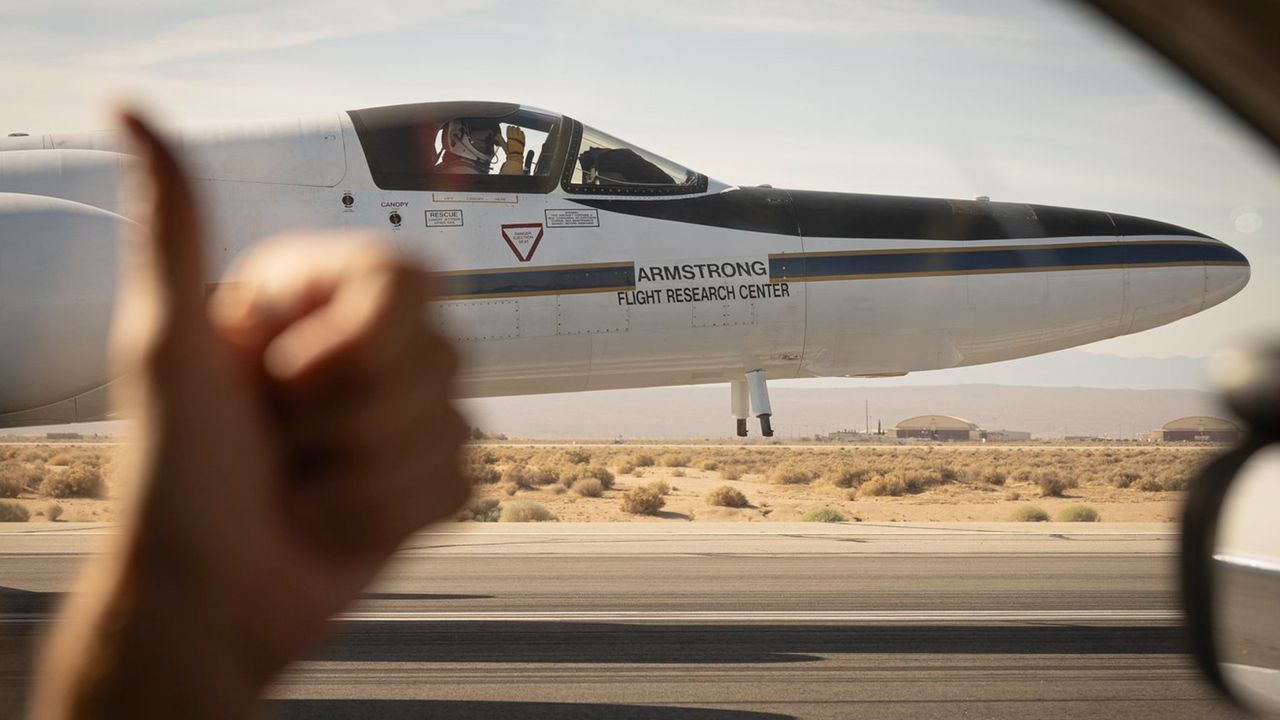
NASA has a new high-tech sensor to help the search for critical minerals in the American West.
The sensor is called AVIRIS-5 (Airborne Visible/Infrared Imaging Spectrometer-5), and it comes from technology developed by NASA’s Jet Propulsion Laboratory (JPL) back in the 1970s. About the size of a microwave, AVIRIS-5 fits inside the nose of one of NASA’s ER-2 high-altitude research aircraft. The sensor’s first iteration was employed in 1986, and JPL has worked to improve it ever since.
You may like
GEMx is an ongoing project. One of the reasons why deserts are an ideal spot for mineral spectroscopy is because few trees grow there. Since 2023, the joint team has covered more than 366,000 square miles (950,000 square kilometers) in the vast expanse of the American West.
Many of the minerals that the GEMx project is trying to find have “unique chemical structures,” that reflect different wavelengths of light. By detecting this reflected light, AVIRIS-5 is able to uncover the “spectral fingerprints” that are specific to the critical minerals.
The USGS defines critical minerals as those that have “significant consequences for the economic or national security of the U.S.” These include aluminum, lithium, zinc, graphite, tungsten and titanium. Minerals such as these are used in the manufacturing supply chains for crucial technologies such as semiconductors, solar electricity systems or electric vehicle batteries.
In March 2025, the White House issued an Executive Order to boost the production of these minerals “to the maximum possible extent,” stating that American national and economic security are “now acutely threatened by our reliance upon hostile foreign powers’ mineral production”
Aside from helping hunt for critical minerals, spectrometers similar to AVIRIS-5 that JPL has designed over the years have also been used on spacecraft to help NASA scientists understand more about planets in our solar system, like Mars, Mercury, and Pluto.
“One is en route to Europa, an ocean moon of Jupiter, to search for the chemical ingredients needed to support life,” a JPL spokesperson wrote in a statement.
Dana Chadwick, a JPL Earth system scientist, envisions many more uses for the new sensor besides hunting minerals in the desert.
“The breadth of different questions you can take on with this technology is really exciting, from land management to snowpack water resources to wildfire risk,” Chadwick said in a statement. “Critical minerals are just the beginning for AVIRIS-5.”

China is rounding off what has been a year of big progress in space, including major crewed lunar landing tests, new rockets and booster landing attempts, a new deep space mission and even successfully resolving its first human spaceflight emergency.
The country has already smashed its previous record for launches in a calendar year (68, set in 2024), amassing more than 80 orbital launch attempts at time of reporting, with a couple of weeks still to go. Two of these launches ended in failure, both from commercial launch providers, but the venerable Long March rocket series continued a long, failure-free run dating back to 2020.
You may like
Chinese space successes in 2025
Driving some of this growth in launches are the country’s two megaconstellations: the national Guowang project and the Shanghai-backed Thousand Sails constellation, both of which are to consist of more than 10,000 satellites each. These are China’s response to SpaceX’s Starlink and other Western low Earth orbit communications constellations. There were 15 launches this year for Guowang alone, but expect launches for these projects to increase in 2026.
One area of major progress for China in 2025 was its crewed lunar program. The country aims to land a pair of its astronauts on the moon before 2030 and this year saw some of the first major hardware tests for the ambitious project. Key tests included testing a shortened stage of the new moon rocket, a liftoff and landing test in simulated lunar conditions for the Lanyue crew lander, and a pad abort test for the crew spacecraft. This progress has contributed to concerns in the U.S. that China will land its astronauts on the moon before America can return to the lunar surface with Artemis 3.
China also made a launch to deep space, with the Tianwen 2 near-Earth asteroid sample return mission launching in May and now on its way to the mysterious asteroid Kamo’oalewa. The spacecraft is expected to reach the asteroid in July 2026, providing us with images and eventually samples of another new world. Tianwen 2 is China’s second deep space exploration mission, following the 2020 Tianwen 1 Mars rover and orbiter. Incidentally, the orbiter for that mission is still active and in October, captured images of interstellar comet 3I/ATLAS; one of the major space events of the year.

A series of photos of the interstellar comet 3I/ATLAS, captured from Mars orbit by Tianwen 1 in early October 2025. (Image credit: CNSA)
Closer to Earth, China also appeared to have completed a pioneering satellite refueling in geostationary orbit, high above the equator. The test could mark a breakthrough for extending spacecraft lifetimes, reducing debris, and bringing strategic flexibility.
China resolves 1st spaceflight emergency
Not everything went according to plan for China in 2025. The country planned three missions to its Tiangong space station in 2025: the crewed Shenzhou 20 and Shenzhou 21 missions, which launched in April and October respectively, and the Tianzhou 9 cargo spacecraft in July.
These plans were upended, however, when routine checks found an external crack in a Shenzhou 20 spacecraft viewport window on Nov. 5, likely caused by space debris, just before it was due to carry its three astronauts back to Earth. The spacecraft was deemed not to be safe to carry astronauts through the heat of reentry, meaning emergency protocols were initiated.
The Shenzhou 20 astronauts instead returned to Earth in the recently-arrived Shenzhou 21 spacecraft, while the Shenzhou 22 spacecraft — on standby for just a scenario at Jiuquan spaceport — was readied in 16 days and launched to Tiangong uncrewed to provide a lifeboat for the Shenzhou 21 astronauts. The incident was the first major human spaceflight emergency for China, with its orderly response quickly solving the crisis.
You may like
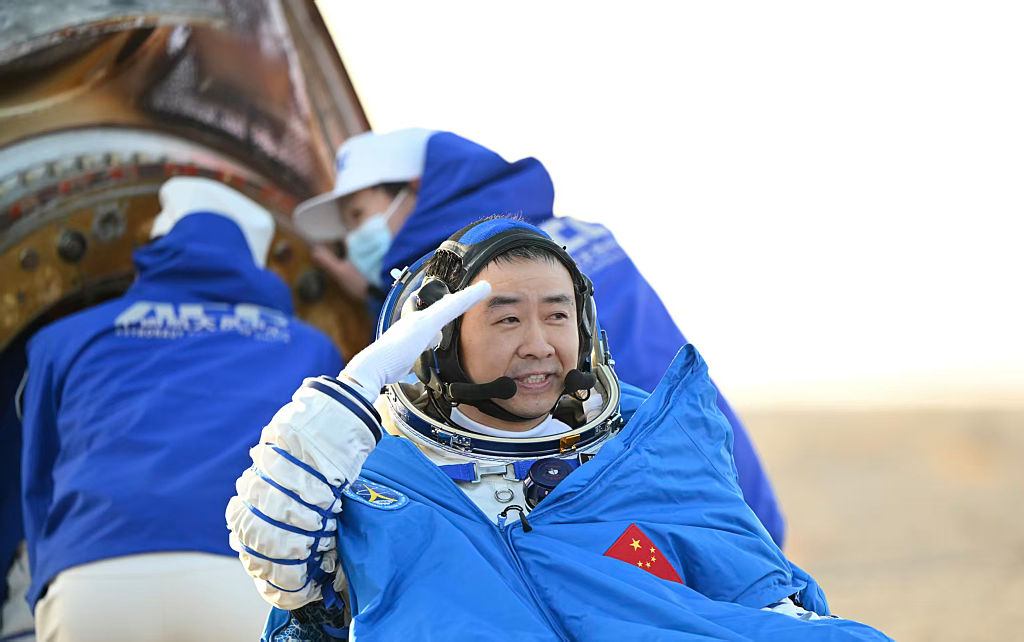
Astronaut Chen Dong, who was the commander of China’s Shenzhou-20 mission, salutes a crowd. (Image credit: VCG/Getty Images)
The year ahead for Chinese space missions
China’s already accelerating launch rate is only likely to increase in 2026, with further reusable rocket test flights and landing attempts, megaconstellation launches, and the continued expansion of its spaceports, particularly in Jiuquan in the Gobi Desert, the Hainan commercial launch pads, and the maritime spaceport in the Eastern province of Shandong.
There will also be flagship missions. The second half of the year will see the launch of the Chang’e 7 robotic lunar mission, which will target a landing at the lunar south pole and aim to seek out water-ice. There will also be a joint space weather mission, named SMILE, from the Chinese Academy of Sciences and the European Space Agency (ESA), launching in the spring.
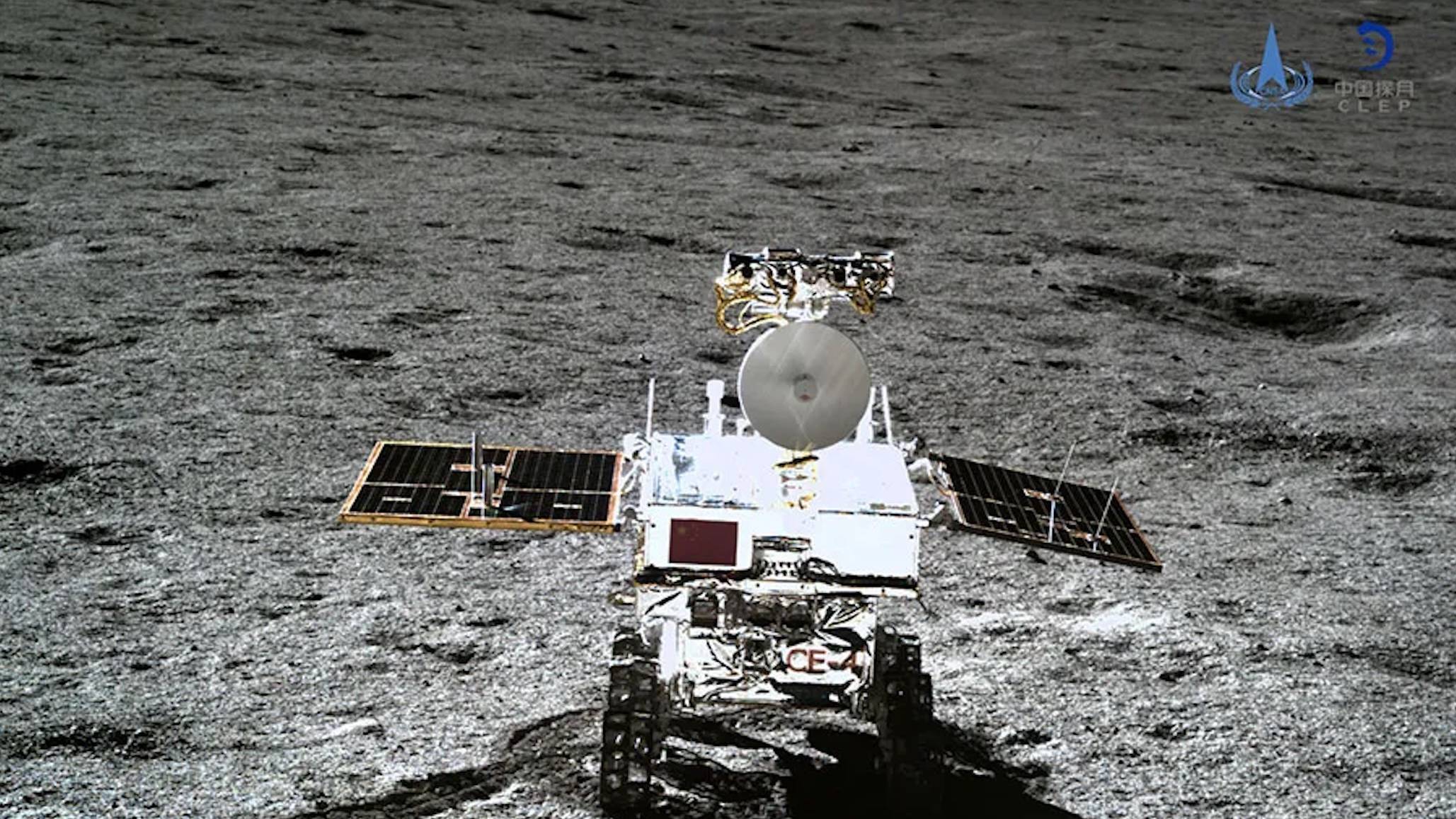
China’s Yutu 2 lunar rover, as seen by the Chang’e 4 lander, on the far side of the moon. The 2026 Chang’e 7 mission will also feature a large rover, as well as a lander and a small hopper that will explore lunar craters. (Image credit: CNSA)
China will also take new steps in human spaceflight in 2026. The country will send a pair of missions to Tiangong, namely Shenzhou 23 and Shenzhou 24. One of these is expected to carry the first International astronaut from Pakistan to the space station. The stay is expected to be short, launching on a Shenzhou as part of a three-person crew, and returning days later with two Chinese astronauts returning to Earth after their six-month-long stay in orbit. That will leave one Chinese astronaut from the completed mission to stay in orbit for a further six months, becoming the first Chinese astronaut to spend an entire year in orbit continuously.
Maybe the most closely watched and consequential missions will be related to China’s crewed moon plans. China plans debut flights for its Long March 10 rocket and the Mengzhou spacecraft in 2026, with success being crucial to achieving its goal of landing its astronauts on the moon before 2030.