TECHNOLOGY
FAA issues nationwide travel alerts triggering hours-long delays for thousands of holiday flyers


Tens of thousands of airline passengers are being warned to brace for major delays as federal officials say US airports have been overwhelmed by the holiday travel rush.
The Federal Aviation Administration (FAA) has issued eight separate airspace flow restrictions on Friday, which affect nearly every major air traffic control center in the US, including New York, Los Angeles, Chicago, Atlanta, Boston, Dallas, and Miami.
The widespread series of Airspace Flow Programs (AFPs) will impact almost any major airport in the US or Canada flying to Florida or the Caribbean on Friday, one of the busiest travel days of the year, with some delays reaching over six hours.
Specifically, the FAA is slashing the number of planes allowed to take off and enter certain busy sections of airspace to prevent any dangerous situations of overcrowding as hundreds of flights all head to the same destinations.
Hourly limits have been set on how many flights can cross the FAA’s Flow Constrained Area (FCA) boundaries, specific zones over or around the US created by the agency marking flight routes which they expect to be too busy with holiday travel.
Friday’s zones include flight routes over the Atlantic Ocean and Caribbean Sea leading to southern Florida, Jamaica, Puerto Rico, Turks and Caicos, St Lucia, Aruba region, Mexico, and San Diego.
Between 3pm and 6pm, the FAA expects the average delays to be the worst, with some routes over Mexico and the Dominican Republic expecting peak delay times exceeding three hours.
Maximum delays for flights traveling through the FCA over Florida will reach a staggering 398 minutes, or more than six and a half hours Friday afternoon.

A holiday traveler waits for her flight amid major airport delays due to high volumes of flyers during the Christmas travel week (Stock Image)

Travelers at San Francisco International Airport stand in long lines waiting for flights. Over eight million people are expected to fly during the final two weeks of December
Most of the travel restrictions began Friday morning and are scheduled to last until between 6pm and 10pm ET tonight.
Other major US travel regions being affected by the Monday restrictions include Salt Lake City, Houston, Jacksonville, Cleveland, Denver, Oakland, Kansas City, Memphis, Minneapolis, and Seattle.
Several major airports throughout Canada have also been impacted by the FAA’s holiday travel announcement, including Toronto Pearson International Airport, Montréal–Trudeau International Airport, and Vancouver International Airport.
Contributing to the overcrowding over Florida are the record 122million Americans who were expected to travel during the final two weeks of December. Over 8million of those holiday travelers will be flying, according to the American Automobile Association (AAA).
In their annual report, AAA revealed that Orlando, Fort Lauderdale, and Miami were the top three domestic destinations for holiday travelers this year.
Meanwhile, Cancun, Mexico and the Dominican Republic’s Punta Cana were the top travel getaways internationally this week.
As of 12pm, over 3,600 flights entering or exiting the US have been delayed. Over 1,300 have been cancelled, with some forced to postpone due to a major winter storm expected to slam the US East Coast Friday night.
The FAA has also issued ground delays at Aspen/Pitkin County and Eagle County Regional Airports in Colorado, Witham Field in Florida, and Southwest Florida International Airport due to issues with ‘volume,’ or overcrowding.

Hundreds of flights to Florida and the Caribbean have been delayed Friday due to overcrowding at airports throughout the US and Canada heading to these destinations (Stock Image)
For travelers heading to the airport on Friday, AAA recommended flyers regularly check their flight status before leaving home and also sign up for airline alerts.
Travelers are also urged to arrive at the airport early, allowing at least two hours for domestic flights and three hours if you’re leaving the US.
Due to the massive crowds expected at airports throughout the US, passengers should also pack smart and keep any vital medications, chargers, and a change of clothes in their carry-on bags.
With delays and potential cancellations now expected to increase throughout the day, flyers should also go over their chosen airline’s policies on rebooking flights and refunds for any cancelled trips.















Two girls are pictured behind an armed soldier in the small village, that was destroyed by Boko Haram on December 19, 2022, in Ngarannam, Nigeria. | Florian Gaertner/Photothek via Getty Images
President Donald Trump rang in Christmas Day by ordering airstrikes against two ISIS camps in Nigeria. The strikes, involving more than a dozen Tomahawk missiles fired from a Navy ship, came shortly after Trump vowed retaliation against ISIS, which allegedly carried out deadly attacks against US troops and civilians around the world last week.
But Trump has been talking about military action in Nigeria, specifically, since November, when he vowed on social media to go “guns-a-blazing” into the country if its government failed to prevent the persecution of Christians.
In his post announcing the strikes on Christmas, Trump accused ISIS of “targeting and viciously killing, primarily, innocent Christians at levels not seen for many years, and even Centuries!”
It’s the latest example of how the Nobel Peace Prize aspirant and advocate of “America First” foreign policy is more than willing to use military force to accomplish his foreign policy goals, and to interfere in the domestic affairs of other countries, when doing so aligns with his domestic political priorities.
In this sense, the actions in Nigeria are similar to the ongoing military build-up around Venezuela, where military strikes on land may still take place in the immediate future. In both cases, the president appears to be contradicting his frequently expressed opposition to military interventionism, but these are interventions linked to the priorities of his political base: in one case, keeping drugs and migrants out of the US. In another, protecting Christians.
As we get deeper into Trump’s second term, it’s becoming increasingly clear that MAGA is not immune from the temptation to go abroad in search of monsters to destroy.
What is actually happening in Nigeria?
The problem Trump is talking about here is a real one. The hardline Islamist terror group known as Boko Haram and its offshoots have waged a brutal insurgency against the Nigerian state in the northern part of the country since 2009, committing numerous high-profile massacres and kidnappings, including the 2014 Chibok schoolgirl abduction that attracted a global media campaign. A Boko Haram splinter group has been fighting under the ISIS banner since around 2016.
This isn’t the only religious conflict going on. Recent years have also seen a wave of clashes and attacks between predominantly Muslim herders and predominantly Christian farming communities in Northwest and Northcentral Nigeria. The Nigerian military has been fighting the insurgency for years, but President Bola Ahmed Tinubu has been accused of ignoring the plight of Christians, in particular, and the military campaign has been hampered by widespread corruption and alleged human rights abuses.
In addition, several Nigerian states have some of the world’s most draconian blasphemy laws, which critics say are disproportionately enforced against Christians. Atheists and members of minority Muslim sects have been persecuted as well, though.
Trump’s sudden interest in Africa’s most populous country was likely motivated less by any particular event there — these are all longstanding issues — than by developments in Washington. Though it doesn’t get a ton of mainstream media attention, the plight of Christians in Nigeria has been a galvanizing issue for evangelical Christians in the US in recent years. When I went to see former Nigerian President Muhammadu Buhari speak in Washington in 2022, the event was repeatedly interrupted by protesters. On Truth Social, Trump has cited numbers from a report from the international Christian rights NGO Open Doors stating that of the 4,476 Christians killed for their faith globally in 2024, 3,100 were in Nigeria.
This also isn’t the first time Trump has taken an interest in the issue. When Buhari visited the White House during Trump’s first term in 2020, the president pointedly asked him, “Why are you killing Christians in Nigeria?” During Trump’s first term, the US added Nigeria to the State Department’s list of Countries of Particular Concern for violations of religious freedom. The Biden administration controversially removed Nigeria from the list in 2021, just before a visit by Secretary of State Antony Blinken to the country, which is viewed by the US as both an important counterterrorism partner and a major political and economic player in Africa.
So it was not surprising to see Trump’s initial Truth Social post in November that he was returning Nigeria to the CPC list.
The bipartisan US Commission on International Religious Freedom (USCIRF), a bipartisan federal watchdog appointed by Congress and the White House, had been urging him to do so, as had recent legislation introduced by Sen. Ted Cruz. (R-Tex.), who has been consistently outspoken on the issue.
Mohamed Elsanousi, one of the USCIRF commissioners, told Vox that the commission welcomed Trump’s announcement and his highlighting of the killing of Christians, but added, “there are also violations and killings of Muslims and African traditional religion practitioners. So we would have loved for the President to mention all the other communities that are facing the same kind of persecutions as well.”
Humanitarian intervention, MAGA style
Trump suggested there may be more strikes, tweeting, “MERRY CHRISTMAS to all, including the dead Terrorists, of which there will be many more if their slaughter of Christians continues.”
Still, an extended counterinsurgency campaign in Nigeria seems unlikely. While hardly a pacifist, Trump prefers quick interventions that promise decisive victories and carry little risk of quagmire or US casualties. None of that applies in Nigeria. It’s probably relevant that the Nigerian government is not viewed particularly favorably by the Trump administration for a number of reasons, including its refusal to accept deported migrants from the US and its criticism of Israel over the war in Gaza.
It’s notable that despite Trump’s earlier threats and allegations targeting Nigeria’s government, these strikes were carried out in coordination with that government, according to statements from both capitals. This is, therefore, more in keeping with the “over-the-horizon” counterterrorist strikes the US regularly carries out in coordination with allies in various countries rather than the invasion by force of Nigeria that Trump’s statements last fall suggested.
US troops have been involved in training and assistance missions with Western African countries, including Nigeria, for two decades now. Though the future of those missions is uncertain as more countries in the region turn toward security partnerships with Russia and as US foreign aid cuts hamper US efforts to try to stabilize countries where insurgencies are thriving.
It’s worth pointing out that in August, the administration approved $346 million in arms sales to the government it is now accusing of allowing the wholesale killing of Christians and of perpetrating its own human rights abuses. There are very good reasons to suggest the US should rethink a strategy of security assistance to Nigeria — it has plainly failed to put down Boko Haram’s insurgency — but little reason to believe US airstrikes will be much more effective.
Trump’s own statements suggest that he also believes this. In his speech in Saudi Arabia in May, he criticized past administrations for “intervening in complex societies that they did not even understand themselves.” Addressing military commanders in Quantico in September, he vowed to restore “the fundamental principle that defending the homeland is the military’s first and most important priority” and argued that “Only in recent decades did politicians somehow come to believe that our job is to police the far reaches of Kenya and Somalia, while America is under invasion from within.”
And yet now he’s putting the US military into the middle of a dizzyingly complex ethnic conflict in an African country that few in the US really understand.
It’s yet more evidence that for all his America First messaging, Trump is essentially a globalist: someone who believes the US plays an indispensable role on the world stage, and should play a role in solving global crises, including those with little relevance to America’s narrowly defined national security interests. But the big difference between Trump and the liberal internationalists or neoconservatives who came before him is the degree to which his foreign interventions are aligned with his domestic political priorities.
That can mean throwing US economic might behind a MAGA-friendly party in an Argentinian election or the trial of an ally in Brazil. It can mean revamping US refugee policy so that it predominantly helps white South Africans. It may soon mean a regime change campaign in Venezuela couched in the rhetoric of drug and migration policy. And in the case of Nigeria, it means reviving the supposedly discredited notion of humanitarian military intervention — but only in a case where it aligns with the priorities of one of Trump’s important constituencies.
In previous years, the grisly scenes emerging from El Fasher, Sudan in recent months, might have prompted a debate about the necessity of American military intervention. Don’t count on it in today’s Washington.
Update, December 26, 2025, 12:10 pm: This article was originally published in November after President Donald Trump made his initial comments threatening military action in Nigeria, and was updated to reflect the airstrikes on December 25.


In recent years, people have been increasingly looking for new ways to form platonic connections, as loneliness and social isolation have become more prevalent.
In 2023, the U.S. Surgeon General went so far as to label this issue a public health crisis. Remote workers, who miss the everyday interactions found in an office, and younger individuals eager to create their adult social circles based on shared interests and hobbies, are among those seeking meaningful friendships.
Thanks to online dating apps, the stigma associated with finding connections online has largely faded away. This has welcomed a new wave of apps focused on fostering friendships and building local communities.
According to estimates from Appfigures, over a dozen local-focused friendship apps have collectively generated approximately $16 million in consumer spending in the U.S. so far this year. Some notable examples include Timeleft, Meet5, and Bumble’s BFF. Additionally, these apps have garnered approximately 4.3 million downloads thus far in 2025.
The apps aim to provide a less awkward solution than, for instance, approaching a stranger at the gym or local café and trying to strike up a conversation. These platforms clearly indicate that everyone using the app is looking for the same thing — friendship, not romance — making it much less intimidating to initiate conversations.
From major players like Meetup to newer ones like 222, there are plenty of apps that cater to the growing demand for meaningful friendships. We’ve compiled a list of them for you to try out.
222
Image Credits:222 (screenshot)
The app 222 is an iOS-only social events platform that facilitates in-person meetups by pairing a group of strangers based on their personality test results. The app sends invitations to nearby public social events, such as wine bars and comedy clubs. There is then a vetting process, and selected participants are notified on the day of the event. A bonus for those who feel socially anxious: You’re allowed to bring a plus-one.
Techcrunch event
San Francisco
|
October 13-15, 2026
The service charges a $22.22 curation fee or a monthly subscription for the same price.
BFF
 Image Credits:Bumble
Dating giant Bumble is among the more established players to enter the friendship space, launching its friend-finding feature in 2016, which then spun out into a stand-alone app in 2023. The friend-making app has recently undergone a significant redesign, with an increased emphasis on facilitating group meetups, catering to users’ desires to grow their social circles.
BFF is available for free download on iOS and Android devices.
Clyx
 Image Credits:Clyx
Clyx is another emerging app in the group-based social networking landscape, with a strong focus on discovering local events. The social platform helps users find community events by integrating data from platforms like Ticketmaster and TikTok. Additionally, Clyx allows users to upload their contact lists, helping them see which events their friends plan to attend. The app also includes a feature that recommends other users to connect with at these events.
As of now, Clyx operates exclusively in two cities: Miami and London. However, it has plans to expand to additional areas in the near future, with New York City and São Paulo at the top of the list. The app is available on the App Store and Google Play Store.
Les Amís
 Image Credits:Les Amis
Les Amís is a friendship app tailored for women, transgender, and LGBTQ+ individuals that leverages AI to match users based on similar interests and encourages participation in local events, such as pottery classes, book clubs, and wine tastings. Matches are made every Monday, allowing users to chat and plan meetups later in the week.
Available on iOS and Android, Les Amís serves cities across Europe, including Amsterdam, Barcelona, Berlin, Madrid, Paris, and Stockholm. In the U.S., the app is available in Austin and New York, with plans to expand to Boston, Miami, and Los Angeles.
The app uses a paid membership model that varies by city, with fees of $70 in New York and €55 in Amsterdam.
Meetup
 Image Credits:Meetup
The local event-discovery platform has been around since 2002, helping millions of users connect with others who share similar interests. Users can RSVP to events; join groups that cater to a variety of hobbies, professions, or social causes; and create their own groups and events. They can also chat with group members and post updates and photos from gatherings.
Meet5
 Image Credits:Meet5
This European community-building app recently launched in the U.S., targeting users over 40 who want to meet new people in their area and participate in group activities such as picnics, concerts, and hiking. Notably, in a short time, there have been around 777,000 U.S. downloads so far across the App Store and Google Play Store, according to Appfigures estimates.
Pie
 Image Credits:Pie
Pie is another one of the newer social apps on the market. It features an AI-driven quiz designed to predict which users are most likely to be compatible with each other. Each person who RSVPs to a Pie event takes a brief personality assessment, and the algorithm organizes attendees into groups of six, who are then added to a group chat within the Pie app, allowing them to interact with each other before the event.
Currently, the app is only available in Austin, Chicago, and San Francisco. Users can download Pie from the App Store and Google Play Store.
Timeleft
 Image Credits:Timeleft
Timeleft is a relatively new platform that helps you organize weekly dinner dates with groups of strangers. The app uses a special algorithm to match you with others, taking into account your age, gender, and personality. Users are matched with four other people, but they only learn minor details about them the night before, including their occupations and zodiac signs.
Dinners take place at a selected restaurant on Wednesday evenings at 7:00 p.m. To help everyone break the ice, the app offers a game with conversation starters. After dinner, there is an after-party at a local bar.
Users can book dinners online or through the app. In terms of pricing, it varies depending on the country and restaurant. Users pay for a ticket up front and are responsible for covering their own dinner and drinks.
Wyzr Friends
 Image Credits:Wzyr Friends
Wyzr Friends is an activity-based friendship app designed for adults 40 and older, catering to empty nesters, those who are divorced, and other users seeking to connect with like-minded individuals. Users can thumbs up or down potential friends and arrange in-person activities based on shared interests, such as going to the movies or hiking.
It’s available on iOS and Android devices in the U.S., Canada, Australia, Ireland, the Philippines, Singapore, and Mexico.
Mmotion
 Image Credits:Mmotion (Image has been modified)
Mmotion is a newly launched friendship app that blends location tracking with social discovery to help users connect with people nearby and explore new bars and restaurants in their area. Upon joining, users can participate in interest-based groups—such as hiking, basketball, or art—view a map of active users, and send messages to those nearby. The app also highlights new places on the map, making it easy to find a restaurant or venue to try.
Mmotion is currently only available to users in New York City on iOS and Android devices. Users must first submit an application to be considered.
This story was updated after publication.


Trust Wallet has pledged to cover roughly $7 million in customer funds lost in a Christmas Day exploit, its founder, Changpeng Zhao, confirmed on the social platform X. The sudden breach has rattled part of the crypto community. Still, Zhao’s swift assurance aims to steady nerves and restore confidence in the popular self-custodial wallet.
The incident unfolded on December 25, when a compromised version of the Trust Wallet browser extension was used to drain assets from users’ wallets.
Early investigations suggest the malicious code was active in version 2.68 of the extension, prompting unauthorised transfers across multiple blockchains, including Ethereum, Bitcoin and Solana. Within hours, on-chain data showed funds being siphoned away to unknown addresses, with losses quickly approaching $7 million.
In a post on X on Friday, Zhao emphasised that “user funds are SAFU,” using the popular crypto industry acronym for Secure Asset Fund for Users. He said Trust Wallet will reimburse affected users for their losses. The team is continuing to investigate exactly how the attackers were able to upload and distribute the compromised extension.
 Chinpeng Zao
The wallet provider also described the breach as limited to the browser extension. Trust Wallet urged users to disable the compromised version immediately and update to the fixed release, version 2.69, available via the official Chrome Web Store.
Mobile app users and those using other extension versions were reportedly not affected.
How the Trust Wallet exploit played out
Security researchers and on-chain analysts have begun piecing together a timeline of the attack. Initial signs of preparation by the threat actors date back to early December, according to cybersecurity firm SlowMist. Their reporting indicates that malicious code was embedded into the extension build before going live, suggesting a carefully planned exploit rather than a simple automated attack.
Once live on Christmas Day, the compromised extension collected sensitive user data, including seed phrases, and transmitted it to a remote server controlled by the attackers. Victims who imported a seed phrase into the extension saw their wallets drained in a matter of minutes, even if they had followed common security practices.
Across the crypto community, on-chain sleuths flagged hundreds of wallets affected by the breach. The rapid movement of assets through mixing services complicated efforts to trace stolen funds, making recovery efforts challenging.
The broader market felt the shock of the news, coming at a time when crypto prices were already under pressure. Despite the relatively modest size of the loss compared with massive exchange hacks this year, the incident has drawn fresh scrutiny to browser-based wallet infrastructure and supply chain security.

Meanwhile, Zhao’s public promise to cover the losses was intended to reassure users that the incident would not result in personal financial loss. His message emphasised that affected funds will be reimbursed from Trust Wallet’s reserves, and that the issue appears to be confined to the compromised extension.
Some industry observers have raised questions about how the malicious version passed through review and was distributed via official channels.
There are early suggestions that the breach may involve a supply chain compromise or even insider knowledge, given how the altered code was able to slip into the official release. These suggestions have sparked debate across forums and social platforms, with some users voicing concerns about internal controls and review processes.
Trust Wallet has responded by prioritising the release of the patched extension and asking users to update immediately. It has also been recommended that those affected generate new seed phrases and migrate assets to secure environments.

Naware founder Mark Boysen first tried killing weeds with drones and a 200-watt laser.
He’d been noodling on ideas for a startup with some friends, and thinking about how his family in North Dakota had lost three members to cancer, something they suspected may be related to chemicals in the groundwater. Finding a chemical-free way to kill weeds seemed like a solid option.
But the laser was a dead end. There’s too much risk of starting a fire, he told TechCrunch in an interview. After a lot of trial-and-error prototyping with ideas like cryogenics. The solution he settled on — which he showed off earlier this year at TechCrunch Disrupt 2025 — is steam.
Boysen’s company has developed a system that uses computer vision to spot weeds in lawns and fields and golf courses, and kill them with nothing but vaporized water. It can be attached to mowers, or tractors, or even ATVs. At the moment, Naware is flexible, and Boysen is visibly eager for his idea to spread fast — much like the weeds he’s trying to kill.
In a world of agentic AI and billion-dollar software companies, Naware stands out as a classic garage startup story. Boysen said his team first tested the use of steam by ordering a “rinky dink” garment steamer off of Amazon. After that, they ordered seven more.
“They’re not real industrial,” Boysen said he quickly realized. “And so there’s a lot of research helping to develop that, to get to the point of: ‘how do we make this effective and make it repeatable so it can scale?’”
Developing the steamer tech was one challenge, but the bigger one may have been identifying the weeds, Boysen said. It’s well-established that artificial intelligence software can be trained to accurately recognize objects or patterns, but the “green-on-green” problem was tough, he said — especially because the software has to recognize the weeds in real-time while the rig is prowling over a lawn. (And yes, it’s using Nvidia GPUs.)
Techcrunch event
San Francisco
|
October 13-15, 2026
He thinks they’ve gotten there, though. He said Naware is targeting companies that do lawn care for athletic fields and golf courses, and claims his company can save customers like that “anywhere from $100,000 to $250,000 on chemicals alone.”
On top of that, he said customers will save money by not having to pay for people whose only job is to spray those chemicals. Naware has been doing paid pilots to test and dial in the product, but Boysen’s pitch has already attracted prospective partners, he said.
“We’re going after the strategic partnerships. We’re in discussions with $5 billion companies that do equipment manufacturing that are interested in our product. And we’re a couple conversations into that — I can’t say their name, but you’ll figure it out,” he laughed.
Success, Boysen said, will take three things: those partnerships, securing patents, and funding. Boysen has been bootstrapping Naware for now, but said he’ll open its first fundraising round in the coming months.
“I’ve got to get a funding round that just crushes anybody else trying to think about it” he said. “I’ve got to deliver the promise that I can kill weeds, and it’s effective. And we’ll make it work. I’m not concerned about that.”


💡
We need your feedback about the Techloy Weekly newsletter. Please take 3 minutes to tell us what you think.
A few days ago, I was watching a friend of mine play Genshin Impact when I saw a loading screen pop up. The art was beautiful, to be honest, almost to the point of it looking fake. So I asked him if it was AI-generated, and he responded: ‘Nah, this isn’t Expedition 33‘.
If you know Clair Obscur: Expedition 33, you know it recently won big at the Indie Game Awards – until it got disqualified this week for using generative AI despite a strict ban. Rules are rules, but it does make you wonder: if AI can slip into a space built on human originality and even win awards, how long before everyone quietly adopts it?
🌐 Nigeria might be getting a new subsea cable
Nigeria is in talks with Google to build a new subsea cable, and if it happens, it could finally ease the country’s long-standing internet fragility. Combined with the recently launched 2Africa cable, the pressure is now on other infrastructure players to step up. It’s not flashy, but it could quietly make Nigeria more resilient and easier to plug into the global digital economy.
💡
We need your feedback about the Techloy Weekly newsletter. Please take 3 minutes to tell us what you think.
📱Apple will allow third-party app stores on iOS in Brazil
For what feels like the umpteenth time this year, Apple’s walled garden is getting chipped at – this time in Brazil. The company now allows third-party app stores and alternative payments, giving users more choice and developers a fairer shot. It’s a quiet shift, but one that keeps nudging the iPhone toward a more open and competitive app ecosystem.
🕵🏾♀️ Crypto theft hit a record high in 2025

Crypto theft hit a record $2.7 billion in 2025, with North Korean hackers behind some of the biggest breaches, including a $1.4 billion heist at Bybit. Investors and platforms are now facing the reality that even mainstream exchanges aren’t immune, forcing a rethink of security and trust in digital assets.
💡
We need your feedback about the Techloy Weekly newsletter. Please take 3 minutes to tell us what you think.
🚀
Techloy Weekly is our flagship newsletter that brings you the most important technology news and insights across the world’s largest emerging markets from trusted sources. If you are looking for deeper insights into the technology industry, with data-led startup news and funding deals, engaging charts, and career data, become a Techloy premium member today to access all of our coverage. This week’s edition was written by Louis and edited by Kelechi.
❤️
Please forward this newsletter to your friends, family, and colleagues, and follow @techloy across all social media platforms!

December 26, 2025
Link copied!
Copy failed!
Latest industry data by the Nigerian Communications Commission (NCC) has revealed that Nigerian internet subscribers used 1.2 million terabytes of data in November 2025.
According to the data, internet usage increased by 1,085 terabytes to 1,236,544.10 terabytes from 1,235,459.47 terabytes of data in October 2025. The figure illustrates the increasing surge in internet adoption and the amount of time Nigerians spend online.
However, the reason is not far-fetched. The data revealed that as data usage increases, Nigerian internet subscribers are also surging.
As of November 2025, the subscriber base stood at 144.8 million, representing a 1.5% increase from the 142.6 million subscribers reported as of October 2025. Breakdown shows that 144.2 million are connected via mobile, 313,713 via ISP, 238,496 via Voice over IP (VoIP), while 83,417 are connected via fixed wired.
The scenario presents a mixed situation for Nigerian internet subscribers. For many in 2025, the network has often marked by slow data speeds and dropped calls, leading to frustrations and a negative impact on daily activities.

Meanwhile, the Quality of Experience (QoE) and performance report recently launched by the NCC aims to give Nigerians an overall perception of the network that works in their environment.
Broadband penetration crossed 50%, though still short of the target
On a positive note, broadband subscribers and penetration continue to increase, signalling improved telecoms infrastructure. In November 2025, the data showed that broadband penetration stood at 50.58% from 49.89% in October.
While this has now crossed the halfway mark, it’s still short of the 70% broadband penetration target set under the National Broadband Plan (NBP 2020-2025).
Also, broadband subscribers increased from 108.6 million in October to 109.7 million in November.
In terms of broadband penetration, the federal government has been making moves to improve telecoms Infrastructure and drive quality networks. For instance, the Project Bridge, an initiative to deploy a 90,000-kilometre fibre optic backbone, aims to revolutionise Nigeria’s digital infrastructure.

In another recent development, Kashifu Inuwa Abdullahi, Director General and Chief Executive Officer of the National Information Technology Development Agency (NITDA), revealed that Nigeria is in talks with Google to lay a new subsea cable. It signals the government’s intent to drive digital infrastructure.
While the investment seeks to strengthen the digital and connectivity backbone, it’s needed to help transform Nigeria into a digital hub in Africa and support the vision for a $1 trillion digital economy.
Also Read: Nigeria has 177.4 million telecoms subscribers as of November 2025.
Despite tariff adjustments, internet data usage increased in Nigeria
Internet usage has witnessed a significant surge in Nigeria following the adjustment of telecom tariffs by 50%. This, in turn, saw mobile network operators (MNOs) increase both voice and data prices. MTN, Airtel and Globacom rolled out new data subscription prices. They also increase voice call prices from N11 per minute to a range of about N15.40 to N16.50 per minute.
The data revealed that since April 2025, when MNOs adjusted their data plans, internet usage has increased month-on-month from 983k+ in April to 1.2 million in November 2025.

Also for MNOs, the adjustment has seen their voice and data revenue gain weight.
For instance, MTN Nigeria, in its financial statement for the nine months ending September 2025, revealed that active data users rose 12.8% to 51.1 million. Its data traffic expanded by 36.3% while average usage per user increased by 20.8% to 13.2 GB per month.
In Airtel Nigeria’s H1 2025 financial report, its voice revenue grew by 34.7% in constant currency to $268 million, driven by voice average revenue per user (ARPU) growth of 25.7%. Data revenue grew by 62.4% to $357 million from $229 million, fueled by the surge in data customers and data ARPU growth of 12.2% and 46.6%, respectively.
For telecoms operators, the tariff adjustment raised their earnings and was also pushed by an increase in internet subscribers and broadband penetration, despite a shift in voice and data prices.


A British anti-disinformation campaigner told by the Trump administration that he faces possible removal from the US has said he is being targeted by arrogant and “sociopathic” tech companies for trying to hold them to account.
Imran Ahmed, the chief executive of the Center for Countering Digital Hate (CCDH), is among five European nationals barred from the US by the state department after being accused of seeking to push tech firms to censor or suppress American viewpoints.
Ahmed lives lawfully in Washington DC with his American wife and daughter, meaning he is at risk of deportation. Late on Thursday a court granted him a temporary restraining order to block any attempt to remove him from the US or detain him.
Ahmed told the Guardian he believed he had been singled out for his work seeking greater accountability and transparency for social media and AI firms, which has led to Elon Musk’s X unsuccessfully suing CCDH.
Ahmed, who is a friend of Morgan McSweeney, Keir Starmer’s chief of staff, said it was another attempt to deflect accountability and transparency.
“This has never been about politics,” he said, adding that his organisation had worked successfully with the first Trump administration and would do so again if asked.
“What it has been about is companies that simply do not want to be held accountable and, because of the influence of big money in Washington, are corrupting the system and trying to bend it to their will, and their will is to be unable to be held accountable,” he said.
“There is no other industry, that acts with such arrogance, indifference and a lack of humility and sociopathic greed at the expense of people.”
The former European internal market commissioner Thierry Breton is among those to have been hit with a visa ban. Photograph: Bloomberg/Getty Images
As well as Ahmed, the state department has barred the former EU commissioner Thierry Breton. It accused the five people of leading “organised efforts to coerce American platforms to censor, demonetise and suppress American viewpoints they oppose”.
Sarah Rogers, an official at the state department, posted on X: “Our message is clear: if you spend your career fomenting censorship of American speech, you’re unwelcome on American soil.”
The sanctions are being seen as the latest attack on European regulations that target hate speech and misinformation. Campaigners in the UK have said the British government could be targeted further if the Trump administration steps up its attacks on tech regulation.
Ahmed, who began his career working with Labour politicians in Westminster, said he had not yet formally received any notification from the US government, and that he believed its case against him was unfounded. “I’m very confident that our first amendment rights will be upheld by the court,” he said.
The next court hearing, due on Monday, is expected to confirm the protective order that prevents the US government from detaining him, said Ahmed, who spent Christmas away from his wife and infant daughter amid the legal battle.
He said this was “a rational thing for us to do, given that in every other case to date where someone has had a green card withdrawn in the last few months, they have been arrested and detained and often spirited hundreds or thousands of miles away from their friends, family and support networks.”
The CCDH has previously angered Musk over reports chronicling the rise of racist, antisemitic and extremist content on X since he took it over. Musk tried unsuccessfully to sue the CCDH last year before calling it a “criminal organisation”.
More recently, the CCDH released a report warning about harmful answers produced by the latest version of ChatGPT when asked about suicide, self-harm and eating disorders.
“We’ve seen that social media and AI companies are increasingly under pressure as a result of organisations like mine,” Ahmed said. “No one likes being exposed as mendacious or hypocritical, but they call their friends in government or they call their pitbull litigation lawyers and start suing.”
Ahmed said it was particularly jarring to be targeted given that hate speech and misinformation was increasingly a bipartisan issue, raised as a concern by some Republican politicians as well as Democrats.
He said he was nonetheless ready to respond with a swift legal response when he heard the news. “When you take on the world’s biggest corporations and when you’ve had the experiences we’ve had, being sued by the world’s richest man, you dissociate and compartmentalise immediately.”
There had been a cost already, he said. “Nothing I’m going through compares to any of the parents I sit with who’ve lost their children,” Ahmed said. “I chose to take on the biggest companies in the world, to hold them accountable, to speak truth to power. There is a cost attached to that. My family understands that.
“The only time I felt any sadness at all is last night when my wife told me that our child said her sixth word, and then I cried a bit.”

Every year, TechCrunch’s Startup Battlefield pitch contest draws thousands of applicants. We whittle those applications down to the top 200 contenders, and of them, the top 20 compete on the big stage to become the winner, taking home the Startup Battlefield Cup and a cash prize of $100,000. But the remaining 180 startups all blew us away as well in their respective categories and compete in their own pitch competition.
Here is the full list of the cybersecurity Startup Battlefield 200 selectees, along with a note on why they landed in the competition.
AIM Intelligence
What it does: AIM offers enterprise cybersecurity products that both protect against new AI-enabled attacks and use AI in that protection.
Why it’s noteworthy: AIM uses AI to conduct penetration tests of AI-optimized attacks and to protect corporate AI systems with customized guardrails, and it offers an AI safety planning tool.
Corgea
What it does: Corgea is an AI-driven enterprise security product that can scan code for flaws as well as find broken code intended to implement security measures such as user authentication.
Why it’s noteworthy: The product allows the creation of AI agents that can secure code and works with, it says, any popular language and their libraries.
CyDeploy
What it does: CyDeploy offers a security product that automates asset discovery and mapping of all the apps and devices on a network.
Techcrunch event
San Francisco
|
October 13-15, 2026
Why it’s noteworthy: Once the assets are mapped, the product creates digital twins to sandbox testing and allows security orgs to use AI to automate other security processes as well.
Cyntegra
What it does: Cyntegra offers a hardware-plus-software solution that prevents ransomware attacks.
Why it’s noteworthy: By locking away a secure backup of the system, ransomware doesn’t win. It can restore the operating system, apps, data, and credentials in the minutes after an attack.
HACKERverse
What it does: HACKERverse’s product deploys autonomous AI agents to implement known hacker attacks against a company’s defenses in “isolated battlefield.”
Why it’s noteworthy: The tool tests and verifies that vendor security tools actually work as advertised.
Mill Pond Research
What it does: Mill Pond detects and secures unmanaged AI.
Why it’s noteworthy: As employees adopt AI to assist them in their jobs, this tool can detect AI tools that are accessing sensitive data or otherwise creating potential security issues in the organization.
Polygraf AI
What it does: Polygraf AI offers small language models tuned for cybersecurity purposes.
Why it’s noteworthy: Enterprises use the Polygraf models to enforce compliance, protect data, detect unauthorized AI usage, and spot deepfakes, among other examples.
TruSources
What it does: TruSources can detect AI deepfakes, be they audio, video, images.
Why it’s noteworthy: This tech can work in real time for areas like identity authentication, age verification, and identity fraud prevention.
ZEST Security
What it does: AI-powered enterprise security platform that helps infosec teams detect and solve cloud security issues.
Why it’s noteworthy: Zest helps teams speedily keep up with and mitigate known but unpatched security vulnerabilities and unifies vulnerability management across clouds and apps.

Photo by Fahim Muntashir / Unsplash
Just like the human brain, the development and strengthening of neural connections in AI models requires a stream of information. Data amplifies or attenuates signals, thereby training AI models and enabling them to make accurate predictions. That is why the quality of the data directly impacts the performance of AI tasks.
News APIs enable a continuous supply of trustworthy data during the training process. This can be both real-time data that is constantly changing and structured historical data. In this regard, the Web Search API acts as a powerful pump, ensuring seamless data transfer for custom AI models. It accelerates AI model development by using pre-built features that deliver data in a machine-readable format.
Why Custom AI Models Need News Data
Building effective training data ecosystems is one of the key tasks in machine learning. No matter how vast the datasets you use, without news content, such AI models can become outdated even during development. This is especially true for AI-based software designed for trading, business, marketing, journalism, and other industries where real-world situations are constantly changing.
In contrast, unhindered access to news allows AI to update data in real time and make effective decisions. This will also enable AI-based chatbots to send alerts to consumers on a variety of important events.
Key Features to Look for in a News API
Custom AI models are developed for various business needs, so choosing a News API requires careful consideration. Thus, if you’re developing AI models for healthcare, tourism, finance, and other market niches, they should take into account industry-specific nuances. News APIs should deliver content relevant to different industries from a wide range of reputable sources. Still, there are general guidelines you should consider when choosing a News API:
- Broad news coverage. A Web Search API should definitely deliver news from major global outlets, but that’s not enough. It should also provide data from smaller, authoritative sources in their niches.
- Global reach. If your AI models need to take into account country-specific issues, your API must deliver news in multiple languages.
- Efficient filtering system. Working with large databases will be faster and more efficient if the API allows filtering data by multiple criteria, such as date, location, keywords, author, etc.
- The extent of news coverage. Some APIs only provide access to headlines and snippets, which is insufficient for training AI models. Ensure that the news API provides access to full-text articles, videos, infographics, etc.
- Complete documentation. To get the most out of your News API, documentation should be comprehensive and easy to follow. This will also give you more independence from the API’s developer and the ability to resolve any issues that arise quickly.
Integrating News API into ML Pipelines
If you want to develop a robust solution for analyzing real-world data, your custom AI models should be trained on large data sets. Integrate News APIs in several steps to optimize machine learning processes:
- Choose the best News API that provides access to a large volume of current and historical news content.
- Integrate this News API with your AI model.
- Select news categories that are relevant to your AI model.
- Configure additional filters, such as keywords, data, location, etc.
- Train your AI models on the preprocessed dataset, providing them with challenging tasks.
- Evaluate AI performance based on various metrics, such as F1-Score, Accuracy, Precision, Recall, etc.
The performance of your AI model will depend on the quality, reliability, and representativeness of the news data. So, if you want to refine training results, choose news APIs with global coverage and deep content.
Challenges in Using News Data (and How to Solve Them)
Despite the obvious benefits of using news to train custom AI models, there are technical and ethical challenges that must be addressed:
- News APIs provide access to a wide range of content, which developers use to train and refine their AI models. However, publishers’ copyright can be violated, especially if this information is subsequently used without providing attribution to the authors of the content. One possible compromise solution in this case is to link to the website that served as the source of information.
- There’s also the problem of remuneration for websites that provide news information. Custom AI models are used by businesses to increase their profits, but should they share this profit with news outlets? As a compromise, they can provide links to websites they use for the extraction of information. This can help increase their traffic and conversion.
- Technical challenges can also arise if the data supplied by a News API is not normalized for use in AI models. The solution to this situation is to select more effective and proven News APIs.
Conclusion
A news API performs many more tasks than simply searching for and presenting news to train AI models. It also implements analytical functions, helping to classify and structure information. Furthermore, it improves and preprocesses data to ensure its format is suitable for machine learning. That is why Web Search APIs are indispensable when developing custom AI-based software. They not only simplify the work of developers and facilitate faster time-to-market for models, but also reduce the cost of creating custom AI models.

December 26, 2025
Link copied!
Copy failed!

A winter storm warning has been issued to over 20 million people in the Northeast on Friday as several areas could see their largest snow totals in over three years.
The National Weather Service (NWS) has warned that residents in New York, New Jersey, Pennsylvania, and Connecticut are in the direct path of the storm that is expected to slam the region starting around 4pm ET.
Parts of Massachusetts, Rhode Island, Maryland, Delaware, Virginia, and West Virginia have also been placed under a winter weather advisory and could see snow this weekend.
New York is expected to take the brunt of the storm, with four to eight inches of snow predicted in the heart of the city.
According to Matt Brickman of NBC 4 New York, Friday’s storm could deliver the most snow New York has seen since January 2022.
Up to a foot of snow has been predicted for northeastern Pennsylvania and parts of upstate New York.
AccuWeather Senior Meteorologist Tyler Roys warned: ‘This fast-moving storm will pack a punch in the Northeast right after Christmas. Holiday travelers should prepare for major slowdowns on roads and at airports.’
Travelers in the New York area have already been impacted by the storm as over 200 flights have been cancelled at John F Kennedy, LaGuardia, and Newark Liberty International Airports Friday morning.
This is a breaking story. More details to follow.

The National Weather Service has issued a winter storm warning for the Northeast, including New York City, where four to eight inches of snow may fall Friday night

New York City has not seen this much snow since January 2022 according to meteorologists (Stock Image)
The Federal Aviation Administration (FAA) has already announced that an official ground stop or delay may be issued at all three major airports in the New York City area starting at 4pm.
A record 122million Americans were expected to travel at least 50 miles during the final two weeks of December. Nearly 110million of those holiday travelers will be driving, according to the American Automobile Association (AAA).
AccuWeather meteorologists have forecasted that the Tri-State Area, including New York City, New Jersey, and Connecticut could see nine inches of snow fall by Saturday afternoon.
The fast-moving storm is expected to clear out by 1pm on Saturday, but not before impacting millions of post-Christmas travelers returning home this weekend.
Before the storm reached the East Coast, the AccuWeather team noted that travel disruptions due to icy roads are also expected to hit the Great Lakes region, West Virginia, Virginia, and Maryland.
‘Travel plans could be delayed or disrupted for millions of people trying to visit loved ones or returning home after Christmas. The busy period for shopping, gift exchanges and returns after Christmas may also be impacted,’ Roys added in a statement.
NWS has also issued an ice storm warning throughout central and western Pennsylvania, potentially causing blackouts as ice weighs down local power lines and causing dangerous road conditions.
‘Freezing rain, sleet, and snow are all on the table for this system. Travel will become treacherous after the onset of precipitation,’ NWS officials in State College, Pennsylvania posted on Facebook Friday morning.

The National Weather Service has issued winter storm warnings (Pink), winter weather advisories (Blue), and ice storm warnings (Purple) throughout the Northeast on Friday

Friday night’s snowstorm is expected to impact millions of holiday travelers driving and flying this weekend (Stock Image)
Share or comment on this article:
Major winter storm to pummel millions with the most snow since 2022


When Nigeria’s currency began stabilising this year after months of volatility, many observers were cautious about calling it a turning point. But for Itana, a privately-run digital special economic zone designed to attract tech startups, services companies, and foreign investors, the shift became a timely catalyst for investor commitment.
“Once someone decides to come into the country to find out for themselves, that’s one of the greatest signals,” says Nkechi Oguchi, Itana’s chief community officer. Over the past year, she says, interest has shifted from casual inquiries to founders and investors physically visiting Lagos to evaluate the ecosystem. Improvements in visa processing have helped; so has a more predictable FX regime.
Touted as Nigeria’s first fully operational digital free trade zone, Itana’s growing pull offers a contrast to many other zones across the country that remain underdeveloped or inactive. It emerges as a reference point for what policy certainty and execution can unlock in Nigeria’s broader free zone experiment.
Itana, which says it now hosts about 50 companies since it began operations in September 2023, is positioning itself as the 21st-century successor to Nigeria’s traditional free zones—structures that have historically catered to oil, gas, logistics, and heavy manufacturing. Itana seeks to serve digital businesses that prioritise seamless onboarding, virtual company formation, flexible capital movement, and a policy environment aligned with tech-driven scaling.
Itana’s users echo this sentiment. “Overall, it has been a very positive experience for us,” says Varun Giridhar, CEO and founder of Circular Energy, a sustainable energy solutions company that focuses on Battery-as-a-Service, which moved to Itana in 2025. “The Itana team has been beneficial and responsive. It makes a big difference when you feel like there are real people on the other side trying to help you get things done rather than slow you down.”
A zone designed for new economy companies
Nigeria has between 42 and 52 licenced free economic zones, but only around 22 are active. Many, such as the Abuja Technology Village Free Zone (2007), Olokola Free Trade Zone (Ondo & Ogun States, 2004), and Centenary Economic City (FCT, 2014), were launched during periods of strong economic growth but now face challenges such as stalled infrastructure, low activity, or weak governance. Between 2000 and 2014, Nigeria’s economy grew at an average real GDP rate of 6–7% annually, with some years even reaching double-digit expansion, creating the optimistic environment in which these projects were initially conceived. This history raises a common question: Is Itana another flash in the pan?
Oguchi acknowledges the concerns but says comparing Itana to older zones misses the point.
“Most of the regular special economic zones were designed for traditional businesses like oil and gas, manufacturing, and heavy industry,” she explains. “Itana is designed for a different set of businesses: startups and service-based companies that need intentionality in building an environment that is suitable for them.”
Itana’s model is particularly advantageous for companies like Circular Energy, Giridhar notes. Though his company is registered in the zone, it is not required to operate physically from it. “We run most of our day-to-day work from Lagos Island,” he says. “In a city like Lagos, that makes life a lot easier and saves huge amounts of time on commuting.”
Nkechi Oguchi explains that while Itana is privately owned, it operates under a 35-year-old Nigeria Export Processing Zones Authority (NEPZA) framework, which has endured through multiple administrations and cannot be easily overturned by any government.
What’s driving the surge in interest
Itana’s growing appeal is being driven by a surge of interest from three key groups: African diaspora founders, foreign founders and investors, and local Nigerian startups seeking more predictable operating conditions. According to Oguchi, nearly half of the companies in the zone are owned by members of the diaspora, while roughly a quarter are led by foreign founders or investors.
“People leave, but people are also coming back,” Oguchi says. “They are seeing signs of stability and projections for what Africa could be.”
Foreign companies like Circular Energy say the structure addresses friction that typically deters investment. “From a business point of view, the forex access and repatriation framework is a big plus for us,” Giridhar says. “We are deploying dollar capital into Nigeria. It gives our investors more comfort and removes a lot of the uncertainty around moving money in and out.”
Itana has amplified this momentum through its “Doing Business in Africa” tours, which bring investors into Lagos for curated deep-dive sessions. The first tour welcomed a single visitor, while the most recent in October—organised as part of Moonshot by TechCabal—hosted 15 participants, with another group scheduled for December.
The tours are already yielding real outcomes, according to Oguchi. She disclosed that one foreign investor who attended hired Nigerians to make up 80% of his global team after seeing the quality and cost efficiency of talent firsthand.
Inside Itana’s incentive stack
One of the key incentives Itana offers is its FX flexibility. Companies operating in the zone can legally hold multicurrency accounts, collect revenue in dollars or any currency they prefer, retain capital for as long as they choose, and repatriate 100% of their investment when exiting. In an ecosystem where startups are often constrained by FX shortages, these provisions are highly significant.
“You can collect your revenue in USD, keep it in USD, and repatriate your capital when you need to,” Oguchi explains. “It makes companies more attractive to investors.”
Businesses operating within the zone benefit from a suite of corporate tax reliefs and exemptions from selected federal and state levies, lowering operating costs and improving long-term viability. These incentives typically include waivers on:
- the standard 30% Companies Income Tax (CIT),
- the 7.5% Value Added Tax (VAT) on goods and services—including imports into the customs territory,
- withholding tax (WHT) of about 2.5–10% on payments such as services, rent, interest, and dividends,
- the 10% Capital Gains Tax (CGT) on asset disposals, federal stamp duties, and
- the 3% tertiary education tax on assessable profits.
They can also import equipment and tools duty-free, a boost that improves cash flow and makes early-stage scaling less capital-intensive. These incentives help create a more predictable and supportive environment for growth-oriented digital companies.
In Nigeria’s broader business landscape, founders often have to navigate a maze of regulatory bodies—from the Corporate Affairs Commission and Federal Inland Revenue Service to immigration services, the Central Bank of Nigeria, National Information Technology Development Agency, and several others. Itana simplifies this complexity by centralising these interactions into a single interface.
“You only need to engage with Itana,” Oguchi explains. “We take the operational headaches and deal with the agencies to ensure you’re compliant.” This streamlined process is particularly beneficial for fintech companies, many of which require numerous licences that typically take months—sometimes over a year—to obtain. Itana says it is actively advocating for policy reforms to shorten regulatory approval timelines.
The zone is also developing a physical district designed to offer the infrastructure essential for modern, high-performance businesses. This district aims to provide stable power, high-speed internet, security, and a community-focused layout that supports collaboration and growth. Oguchi likens the vision to what made Silicon Valley successful: a deliberate mix of strong educational roots, reliable infrastructure, and a concentration of skilled people. “That is what we’re trying to build,” she says.
Can the Itana model outperform traditional zones?
Nigeria’s free zones have attracted more than $30 billion (₦43.5 trillion) in investment and delivered ₦650 billion ($448 million) in government revenue. They contribute meaningfully to industrial output, but their impact remains largely confined to manufacturing and oil-driven activity.
Two startup founders, who requested anonymity to speak freely, argue that the manufacturing focus is precisely the concern: free zones are optimised for capital-heavy industries—export factories, refineries, and logistics hubs—not for startups whose core assets are laptops, talent, and cloud infrastructure.
“It’s very ambitious,” said one of the founders. “I’ve not seen it work anywhere before, and I don’t know how Nigeria/Lagos holds up to such promises, especially when a change of government (in Lagos) will happen in 2027.”
They also point to Itana’s location, noting that commute times could become a deterrent for workers whose companies choose to operate from the district.
Babatunde Akin-Moses, co-founder and CEO of Sycamore, a peer-to-peer lending platform, echoes this view, suggesting that free zones were never built with digital-first companies in mind.
“The free zone concept was originally meant to encourage exports,” he says. “For digital companies, it feels counterintuitive.”
While he acknowledges the tax advantages on offer, he questions whether the broader incentives translate into meaningful value.
“The FX benefits are not very clear. It’s still the same CBN—it’s not like the zone has its own central bank,” he explains. “And when you factor in the cost of setting up there, your tax bill has to be big enough for the relief to matter. Otherwise, the incentives don’t feel tangible.”
Akin-Moses adds that many Nigerian tech workers already operate remotely for foreign employers without relying on any free-zone structure.
“For physical businesses, free zones make a lot of sense—close to a port, lower duties, fewer levies,” he says. “But for digital businesses, the benefits are not yet clear or well-communicated. And individuals still pay personal income tax unless the zone says otherwise.”
His concerns reflect a broader sentiment among some founders: until the incentives become usable, verifiable, and cost-efficient, widespread adoption will remain limited.
Giridhar offers a contrasting perspective grounded in his company’s capital-intensive model. Circular Energy builds distributed energy-storage and battery-as-a-service systems for telecoms, data centres, cold-chain logistics, and healthcare. Nigeria’s unreliable electricity supply, he says, makes the country an ideal environment for innovation.
“Being based on the ground in Nigeria allows us to design solutions that actually work here,” he notes. “And the digital free-zone structure lets us raise capital and structure the business in a way that also works for international investors.”
Oguchi argues that Itana is being built around metrics that matter in a digital economy—revenue growth, job creation, talent export, and improved startup survival rates.
“We want your chances of survival to be better in Itana than anywhere else,” she says. “Funding should be easier, licences faster, partnerships more accessible.”
She adds that Itana is designed as a live–work–build district that supports a more balanced lifestyle for teams based on the site.
“For people choosing to commute from other parts of the city, there are options,” Oguchi says. “And ongoing upgrades to the road network will significantly cut travel times.”
Risk mitigated, not eliminated
Oguchi is clear-eyed about the limits of what Itana can control. When asked which risks the zone can genuinely eliminate, she is quick to clarify that no business environment is entirely risk-free.
“No risk can be eliminated, but they can be reduced,” she says. Regulatory uncertainty, for instance, is softened by Itana’s grounding in NEPZA’s decades-old framework and by the zone’s ongoing engagement with government stakeholders. Infrastructure-related risks are being addressed through the development of the Itana District, which is designed to provide reliable power, connectivity, and secure facilities. Currency exposure is mitigated by allowing companies to operate multicurrency accounts and repatriate capital freely, while operational risks are reduced through Itana’s one-stop compliance model, which removes much of the administrative burden from founders.
Still, Oguchi acknowledges that some challenges remain firmly outside Itana’s reach. Policy shifts, economic volatility, and fluctuations in global tech funding cycles continue to shape the broader business landscape. These are risks the zone can help cushion but not eliminate.
Traditional FTZs often operated as enclaves with weak domestic linkages. Itana insists its model is different.
“There are no restrictions,” Oguchi says. “Companies in the zone can do business with anyone in Nigeria.”
Ultimately, Itana’s success will be judged not by ambition or headlines, but by whether it can turn stability into durable company survival, capital inflows, and jobs, while embedding digital firms into Nigeria’s wider economy rather than isolating them from it.

Photo by Justin Morgan / Unsplash
For years, Gmail users have been stuck with the email address they chose on day one. Unlike many third-party email services, Google never allowed users to edit or update an @gmail.com address once it was set. That long-standing limitation now appears to be changing.
According to an updated Google support page, the company is gradually rolling out the ability to change a Google Account email address even if it ends in @gmail.com. The change lets users pick a new Gmail username while keeping their existing Google account and its history intact.
When the feature becomes available, it will appear under Personal info → Email in your Google Account settings. If you see a “Change email address” option, you’ll be able to choose a new Gmail ID, as long as it isn’t already tied to another Google Account.
Google wants you to stop using passwords for Gmail — here’s what to use instead
Phishing is up, password reuse is rampant, and now Google’s pushing passkeys as the safer, smarter way to log in.

Google says the update doesn’t affect account data. Emails, photos, Drive files, messages, and other content remain unchanged after the address is updated. There are, however, clear limits. After changing your Gmail address, you won’t be able to change or delete it again for 12 months. Each account is also capped at three changes in total, allowing up to four Gmail addresses over the lifetime of the account.
The rollout appears to be gradual. The updated wording currently shows up in select regions and languages, suggesting Google is testing the feature before making it widely available. Not every account will see the option immediately.
For users stuck with outdated, awkward, or regret-filled Gmail usernames, this is a meaningful shift. It doesn’t reinvent Gmail, but it finally removes a frustration many users assumed would never be fixed.
Gmail is adding a Purchases Tab to keep track of your orders
It should help put all your order receipts, shipping updates, and delivery estimates in one place.

December 26, 2025
Link copied!
Copy failed!

So, how was 2025 for your household? Was it really all as good as you pretended it was on Facebook? Full of A-grades for the kids and riotous themed fancy dress birthday parties for the grownups? Or was it a sea of disappointment with only occasional fun flotsam? And was any of it actually real, or are we all now seven-fingered AI slop beings with Sydney Sweeney’s teeth?
I have gathered my thoughts (and the Diamond household) together, whether they wanted to or not, to reflect on the most important thing in any given year: which video games we enjoyed the most. Without further ado:
Game eldest daughter played the most: Just Dance 2024/Horizon Zero Dawn/Pikmin
“Can’t you pick just one?”
“It’s not my games column.”
On her phone, meanwhile, she’s been playing Cityscapes and “trying to find decent healthcare”.
“In the game?”
“In real life.”
Overwatch … respect. Photograph: MJB/Blizzard
Game middle son played the most: Overwatch
“I don’t play games on my phone.” He was offended that I even asked him that question. I respect that.
Resident Evil Biohazard. Photograph: PR Company Handout
Game youngest daughter played the most: Resident Evil Biohazard
She is trying to get into theatre school, but when she wasn’t singing, she was playing Resident Evil. She also went on in great detail about her achievements on The Sims, where the Shark has a thriving utopia with infinitely better healthcare than her big sister has in real life.
‘A marathon’ … Crash Bandicoot: It’s About Time. Photograph: Activision Publishing
Game the wife played the most: Crash Bandicoot: It’s About Time
She started the year at 60% completion and ended it at 82%. It’s a marathon not a sprint for her. On her phone: something called Woodle, where you have to unscrew pins.
Never too old … Minecraft. Photograph: Microsoft
Game I laughed at my kids for still playing: Minecraft
Any time I see my 21-year-old son playing Minecraft, I set about him like a cross between Steve Martin with that guy in the pub in Roxanne, and Joe Pesci with Spider in Goodfellas. When he complains, I reply that I am doing this to toughen him up so he can be a man and play games for grownups. It’s a very Scottish father/son relationship.
A winner … Just Dance 2024. Photograph: Ubisoft
Most impressive gaming family member 2025: Eldest daughter on Just Dance 2024
There was no contest for this one. She is a machine. Even better than I was at the Cure’s Lovecats on Dancing Stage MegaMix in my prime.
Game I played the most: Marvel Snap
Nothing came close to the hours I spent on this insanely well-crafted deck building wizard’s poker, with its constantly evolving range of cards and game variations.
‘Love turned to hate’… Marvel Snap. Photograph: Marvel
Game I wish I had played less: Marvel Snap
The worst thing about games that constantly evolve their range of cards and variations is you wake up one day and realise it is all just an attempt to suck you into fomo-fuelled microtransactions. So love turned to hate halfway through the year and it went into the bin.
‘A classic’ … Doom: The Dark Ages. Photograph: Bethesda
Game I wish I had played more: Doom: The Dark Ages
Glorious reinvention of a classic. Immersive atmosphere from the off. I wish I could eviscerate my demons so effectively in real life.
‘Beautiful and unique’ … Blue Prince. Photograph: Raw Fury
Game I wish I had played more (cerebral edition): Blue Prince
I refuse to rush this beautiful, unique game and I just didn’t have the time or headspace to give it what it deserved earlier this year. My mother is staying with us over Christmas and the New Year, so I will be playing this in the wee small hours after I have prosecco’d her into oblivion.
‘The high-water mark of gaming’ … Balatro. Photograph: LocalThunk/Playstack
Game that saved my soul when I needed It: Balatro
I know Balatro was 2024’s breakout game, but I was late to it. And it is remarkable. It just gets every single thing right. Crazy Poker is a wonderful concept, but the powers behind the different joker cards are so imaginative it has become a game I literally would play any time of the day or night. Throw in the wittiness of the card design, and this is an absolute high-water mark of gaming. I dream of being stuck in a broken-down lift for hours just so I have nothing to do but play it.
‘A gargantuan gaming achievement’ … Outer Worlds 2. Photograph: Obsidian Entertainment
Game I got the most criticism for criticising: Outer Worlds 2
I experienced a minor pile-on when I wrote about how the Paintress boss battle bug in Clair Obscur ruined the whole game for me, but it’s still a gargantuan gaming achievement in terms of art, sound, acting, battle gameplay and ambition – which I appreciated even more after slogging through Outer Worlds 2. So thank you to the reader who took the time to email me personally, through my website, to say that my Outer Worlds 2 review was “bitter, confused resentment because YOU DON’T GET THE GAME OLD MAN and your son is an idiot as well sorry to inform you.” I present that in the exact way it was written, because I appreciate the effort, and he is obviously an excellent judge of character where my son is concerned.
‘Not a gaming experience I want in my mid-fifties’ … Hollow Knight: Silksong. Photograph: Team Cherry
Game everybody loved that I just didn’t get: Hollow Knight: Silksong
Sure. Give me a bastard-hard Metroidvania-esque thing and don’t tell me what I am supposed to be doing, except “explore”. Great fun. I get that it looks ace and is perfection if you are into this kind of thing, but I cannot think of a gaming experience I want less of in my mid-fifties. I was around back when all games were like this, and I’ve had enough. It was fine when I was a kid, but so was polyester.
Biggest gaming scandal of 2025: Toss-up between EA getting in bed with Jared Kushner and the Saudis, and Outer Worlds 2 costing £70. Both morally indefensible and repugnant.
Clair Obscur. Photograph: Sandfall Interactive
Games I would name my children after, if I was ever stupid enough to have more: Clair Obscur, Despelote and Bananza would all sound good bellowed from the doorstep at tea time.
Part of my body that aches most from gaming: Right thumb joint. Seriously. I don’t know if it’s because of video games or doomscrolling on my phone, but it burns like the mines of sulphur in the mornings now. I knew I should have got my thumbs insured back in the 90s.
Game I am looking forward to the most in 2026: GTA 6.
And it will come out in 2026, even if we have to make 2026 last until the heat death of the universe.
Game I am looking forward to the most in 2036: The Witcher 4.
TECHNOLOGY
Are YOU funny? Scientists say there are four key humour styles – take the test to see if you have what it takes to be the next big comedian
From Jim Carrey to Ricky Gervais, there are some people who are just plain funny.
But do you have what it takes to be the next big comedian?
Scientists say there are four key humour styles – and have even come up with a test to reveal which ones you possess.
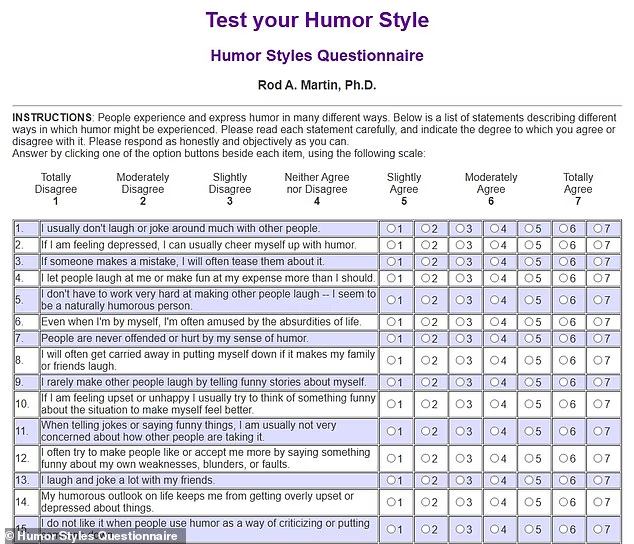
The test, called the Humor Styles Questionnaire, includes 32 questions to assess your levels of affiliative humour, self–enhancing humour, aggressive humour, and self–defeating humour.
If you score highly for affiliative humour, this suggests you love cracking jokes and engaging in spontaneous witty banter.
A high score for self–enhancing humour indicates you have a generally humorous outlook on life.
Aggressive humour relates to the use of sarcasm, teasing, and ‘put–downs’, while self–defeating humour involves excessively self–disparaging humour.
So, what’s your humour style? Take the test to find out.

The test, called the Humor Styles Questionnaire, includes 32 questions to assess your levels of affiliative humour, self–enhancing humour, aggressive humour, and self–defeating humour

If you score highly for affiliative humour, this suggests you enjoy sharing humour with other people – much like Michael McIntyre
The Humor Styles Questionnaire was created back in 2003 by researchers from the University of Western Ontario.
‘The Humor Styles Questionnaire assesses four dimensions relating to individual differences in uses of humor,’ the team, led by Rod A. Martin explained in their study, published in the Journal of Research in Personality.
‘These are: relatively benign uses of humor to enhance the self (Self–enhancing) and to enhance one’s relationships with others (Affiliative), use of humor to enhance the self at the expense of others (Aggressive), and use of humor to enhance relationships at the expense of self (Self–defeating).’
The questionnaire includes 32 statements, describing different ways in which humour might be experienced.
Participants are asked to read each statement carefully, and indicate the degree to which they agree or disagree with it.
The statements include things like: ‘I usually don’t laugh or joke around much with other people,’ ‘I laugh and joke a lot with my friends’, and ‘I enjoy making people laugh’.
At the end of the test, you’ll be given your score for each of the four humour styles, and told how that compares against the rest of the population.
If you score highly for affiliative humour, this suggests you enjoy sharing humour with other people – much like Michael McIntyre.

People like Greg Davies who score highly for self–enhancing humour, tend to maintain a humorous outlook on life, even during difficult times
The 4 humour styles
- If you score highly for affiliative humour, this suggests you love cracking jokes and engaging in spontaneous witty banter.
- A high score for self–enhancing humour, indicates you have a generally humorous outlook on life.
- Aggressive humour relates to the use of sarcasm, teasing, and ‘put–downs.
- Self–defeating humour involves self–disparaging humour.
‘They often tell jokes and funny stories to amuse others and make them laugh, and they enjoy laughing along with others,’ the researchers explained.
‘They do not take themselves too seriously, and can laugh about their mistakes without feeling too badly about them.
‘Research shows that those who are high on affiliative humor tend to be cheerful, outgoing and friendly, and tend to have enjoyable relationships with others.’
People like Greg Davies who score highly for self–enhancing humour, tend to maintain a humorous outlook on life, even during difficult times.
‘They always look on the funny side of things and use humor to cheer themselves up,’ the researchers explained.
‘Even when they are alone, they are often amused by the absurdities of life.
‘Research indicates that those who are high on self–enhancing humor tend to be emotionally well–adjusted, and do not easily become discouraged, anxious, or depressed. They cope well with stress and tend to be optimistic.’
Meanwhile, people like Jimmy Carr who are high on aggressive humour often tease, put down, and manipulate other people.

People like Jimmy Carr who are high on aggressive humour often tease, put down, and manipulate other people

People like Nish Kumar who score highly for self–defeating humour can be quite funny, but often go too far in making jokes at their own expense
‘Although they may be very witty, their humor tends to involve ridicule or sarcasm,’ the researchers said.
‘They like to tell racist or sexist jokes, and are not concerned about how their humor might be hurtful to others.
‘Making fun of others is a way they try to enhance their own self–esteem.
‘Research indicates that people who are high in this humor style tend to be generally aggressive and insensitive to others.
‘Their levels of self–esteem and emotional well–being are no higher or lower than the average person.
‘Those who are low on this humor style tend to have more satisfactory relationships.’
Finally, people like Nish Kumar who score highly for self–defeating humour can be quite funny, but often go too far in making jokes at their own expense.
‘They tend to laugh along with others when being ridiculed or made fun of,’ the researchers explained.
‘They try to make other people accept them more by allowing themselves to be the butt of others’ humor.
‘They also tend to use humor to hide their true feelings from others, putting on a happy face even when feeling unhappy inside.
‘According to research findings, people who are high in this style of humor tend to have low self–esteem, and are often unhappy and anxious.
‘They are often dissatisfied with their relationships.’
Worst offenders: 20 punny ‘dad jokes’ guaranteed to elicit groans and shaking heads
- Elevators terrify me… I’m taking steps to avoid them.
- I got an e–mail saying ‘At Google Earth, we can even read maps backwards’, and I thought… ‘That’s just spam…’
- What do you call a man with no shins? Tony.
- Me and my friends put a band together, we named it 999 megabytes. Still don’t have a gig though.
- I got into a fight with 1, 3, 5, 7 and 9. The odds were against me.
- I had a dream the ocean was filled with orange soda. It was a Fanta Sea.
- Just got hospitalized due to a peekaboo accident. They put me in the ICU.
- In college I was so broke I couldn’t afford the electricity bill. Those were the darkest days of my life.
- I went to the Doctor with hearing problems. He said ‘Can you describe the symptoms?’ I said: ‘Homer’s a fat dude and Marge has blue hair.’
- I said to my wife: ‘When I die I’d like to die having sex.’ She replied: ‘At least it’ll be quick.’
- I’ve decided I want a pet termite. I’m going to call him Clint. Clint Eatswood.
- So many people these days are too judgmental. I can tell just by looking at them.
- How many tickles does it take to make an octopus laugh? 10–tickles.
- ‘Dad, can you tell me what a solar eclipse is?’ No sun.
- I figured out why Teslas are so expensive. It’s because they charge a lot.
- Guess who I bumped into on my way to get my glasses fixed? Everybody.
- My wife blocked me on Facebook because I post too many bird puns. Well, toucan play at that game.
- Did you hear about the new Origami Porn channel? It’s paper view only.
- I was really angry when I ran into my friend Mark who stole my dictionary. I said, ‘Mark, my words!’
- I used to make loads of money clearing leaves from gardens. I was raking it in.
Courtesy of @dadsaysjokes on Twitter.

Big banks are paying closer attention to crypto again. Not because of hype, but because their biggest clients are asking for it. As rules around digital assets start to look clearer in the US, institutions that once stayed cautious are reassessing what they offer. That shift helps explain why JPMorgan is now exploring crypto trading for its institutional customers.
JPMorgan Chase is looking at what its markets division could realistically support, including direct crypto trading and possibly crypto derivatives. These talks are still early, and nothing has been officially launched, but the fact that the conversation is happening at all marks a notable change for one of the world’s most influential banks.
The interest is coming largely from clients. As regulations in the United States begin to settle, large investors are asking their banks for clearer access to crypto markets through familiar, regulated channels. JPMorgan is weighing whether there is enough demand, whether the risks can be managed, and whether the current regulatory environment allows it to move forward without exposing the bank to unnecessary trouble.
Algeria bans crypto use, exchange and mining of the digital asset
This isn’t the North African country’s first attempt to clamp down on crypto.
For a long time, banks avoided crypto trading because the rules were vague and enforcement was unpredictable. That has started to change. In recent months, US regulators have taken steps that make it easier for banks to act as intermediaries for crypto assets. The Office of the Comptroller of the Currency has clarified that banks can support certain crypto activities, and new stablecoin laws have added more structure to the market.
Jamie Dimon’s evolving stance on crypto
JPMorgan’s interest in crypto is especially notable given CEO Jamie Dimon’s past comments. He has repeatedly criticized Bitcoin, once calling it a “pet rock.” But in recent years, his tone has softened. While he still questions the value of cryptocurrencies, he has made it clear that clients should be free to buy and use them if they choose.
That more pragmatic approach is now shaping how the bank operates. JPMorgan has already been active in blockchain technology through projects like JPM Coin and Onyx. It has also arranged blockchain based bond settlements and plans to allow institutional clients to use Bitcoin and Ether as collateral for loans. Adding crypto trading would be another step in treating digital assets as a service to be managed, not an idea to be dismissed.
Stripe reintroduces crypto payments with USDC
The news comes six years after the payments company ceased Bitcoin transactions due to its volatility.

JPMorgan’s exploration of crypto trading is part of a broader shift across global finance. Standard Chartered recently launched spot Bitcoin and Ether trading for institutional clients in the UK. Goldman Sachs has run a crypto derivatives desk for years. BlackRock now manages tens of billions of dollars through its Bitcoin exchange traded fund. Even traditionally conservative European banks have begun buying and holding Bitcoin through in house trading desks.
JPMorgan has not committed to a launch timeline, and it may still decide not to move forward if demand or regulatory clarity falls short.
If JPMorgan does move ahead, it could make crypto trading feel more familiar and accessible to large investors who prefer trusted banks over standalone crypto platforms. More broadly, it signals that crypto’s next phase may be less about hype and more about infrastructure, compliance, and long term integration into global finance.
PayPal rolls out one-time payment links with crypto support on the way
It could make sending or requesting money as effortless as dropping a text.