
TECHNOLOGY
Major winter storm to pummel millions with the most snow since 2022


A winter storm warning has been issued to over 20 million people in the Northeast on Friday as several areas could see their largest snow totals in over three years.
The National Weather Service (NWS) has warned that residents in New York, New Jersey, Pennsylvania, and Connecticut are in the direct path of the storm that is expected to slam the region starting around 4pm ET.
Parts of Massachusetts, Rhode Island, Maryland, Delaware, Virginia, and West Virginia have also been placed under a winter weather advisory and could see snow this weekend.
New York is expected to take the brunt of the storm, with four to eight inches of snow predicted in the heart of the city.
According to Matt Brickman of NBC 4 New York, Friday’s storm could deliver the most snow New York has seen since January 2022.
Up to a foot of snow has been predicted for northeastern Pennsylvania and parts of upstate New York.
AccuWeather Senior Meteorologist Tyler Roys warned: ‘This fast-moving storm will pack a punch in the Northeast right after Christmas. Holiday travelers should prepare for major slowdowns on roads and at airports.’
Travelers in the New York area have already been impacted by the storm as over 200 flights have been cancelled at John F Kennedy, LaGuardia, and Newark Liberty International Airports Friday morning.
This is a breaking story. More details to follow.

The National Weather Service has issued a winter storm warning for the Northeast, including New York City, where four to eight inches of snow may fall Friday night

New York City has not seen this much snow since January 2022 according to meteorologists (Stock Image)
The Federal Aviation Administration (FAA) has already announced that an official ground stop or delay may be issued at all three major airports in the New York City area starting at 4pm.
A record 122million Americans were expected to travel at least 50 miles during the final two weeks of December. Nearly 110million of those holiday travelers will be driving, according to the American Automobile Association (AAA).
AccuWeather meteorologists have forecasted that the Tri-State Area, including New York City, New Jersey, and Connecticut could see nine inches of snow fall by Saturday afternoon.
The fast-moving storm is expected to clear out by 1pm on Saturday, but not before impacting millions of post-Christmas travelers returning home this weekend.
Before the storm reached the East Coast, the AccuWeather team noted that travel disruptions due to icy roads are also expected to hit the Great Lakes region, West Virginia, Virginia, and Maryland.
‘Travel plans could be delayed or disrupted for millions of people trying to visit loved ones or returning home after Christmas. The busy period for shopping, gift exchanges and returns after Christmas may also be impacted,’ Roys added in a statement.
NWS has also issued an ice storm warning throughout central and western Pennsylvania, potentially causing blackouts as ice weighs down local power lines and causing dangerous road conditions.
‘Freezing rain, sleet, and snow are all on the table for this system. Travel will become treacherous after the onset of precipitation,’ NWS officials in State College, Pennsylvania posted on Facebook Friday morning.

The National Weather Service has issued winter storm warnings (Pink), winter weather advisories (Blue), and ice storm warnings (Purple) throughout the Northeast on Friday

Friday night’s snowstorm is expected to impact millions of holiday travelers driving and flying this weekend (Stock Image)
Share or comment on this article:
Major winter storm to pummel millions with the most snow since 2022












Every year, TechCrunch’s Startup Battlefield pitch contest draws thousands of applicants. We whittle those applications down to the top 200 contenders, and of them, the top 20 compete on the big stage to become the winner, taking home the Startup Battlefield Cup and a cash prize of $100,000. But the remaining 180 startups all blew us away as well in their respective categories and compete in their own pitch competition.
Here is the full list of the cybersecurity Startup Battlefield 200 selectees, along with a note on why they landed in the competition.
AIM Intelligence
What it does: AIM offers enterprise cybersecurity products that both protect against new AI-enabled attacks and use AI in that protection.
Why it’s noteworthy: AIM uses AI to conduct penetration tests of AI-optimized attacks and to protect corporate AI systems with customized guardrails, and it offers an AI safety planning tool.
Corgea
What it does: Corgea is an AI-driven enterprise security product that can scan code for flaws as well as find broken code intended to implement security measures such as user authentication.
Why it’s noteworthy: The product allows the creation of AI agents that can secure code and works with, it says, any popular language and their libraries.
CyDeploy
What it does: CyDeploy offers a security product that automates asset discovery and mapping of all the apps and devices on a network.
Techcrunch event
San Francisco
|
October 13-15, 2026
Why it’s noteworthy: Once the assets are mapped, the product creates digital twins to sandbox testing and allows security orgs to use AI to automate other security processes as well.
Cyntegra
What it does: Cyntegra offers a hardware-plus-software solution that prevents ransomware attacks.
Why it’s noteworthy: By locking away a secure backup of the system, ransomware doesn’t win. It can restore the operating system, apps, data, and credentials in the minutes after an attack.
HACKERverse
What it does: HACKERverse’s product deploys autonomous AI agents to implement known hacker attacks against a company’s defenses in “isolated battlefield.”
Why it’s noteworthy: The tool tests and verifies that vendor security tools actually work as advertised.
Mill Pond Research
What it does: Mill Pond detects and secures unmanaged AI.
Why it’s noteworthy: As employees adopt AI to assist them in their jobs, this tool can detect AI tools that are accessing sensitive data or otherwise creating potential security issues in the organization.
Polygraf AI
What it does: Polygraf AI offers small language models tuned for cybersecurity purposes.
Why it’s noteworthy: Enterprises use the Polygraf models to enforce compliance, protect data, detect unauthorized AI usage, and spot deepfakes, among other examples.
TruSources
What it does: TruSources can detect AI deepfakes, be they audio, video, images.
Why it’s noteworthy: This tech can work in real time for areas like identity authentication, age verification, and identity fraud prevention.
ZEST Security
What it does: AI-powered enterprise security platform that helps infosec teams detect and solve cloud security issues.
Why it’s noteworthy: Zest helps teams speedily keep up with and mitigate known but unpatched security vulnerabilities and unifies vulnerability management across clouds and apps.


Photo by Fahim Muntashir / Unsplash
Just like the human brain, the development and strengthening of neural connections in AI models requires a stream of information. Data amplifies or attenuates signals, thereby training AI models and enabling them to make accurate predictions. That is why the quality of the data directly impacts the performance of AI tasks.
News APIs enable a continuous supply of trustworthy data during the training process. This can be both real-time data that is constantly changing and structured historical data. In this regard, the Web Search API acts as a powerful pump, ensuring seamless data transfer for custom AI models. It accelerates AI model development by using pre-built features that deliver data in a machine-readable format.
Why Custom AI Models Need News Data
Building effective training data ecosystems is one of the key tasks in machine learning. No matter how vast the datasets you use, without news content, such AI models can become outdated even during development. This is especially true for AI-based software designed for trading, business, marketing, journalism, and other industries where real-world situations are constantly changing.
In contrast, unhindered access to news allows AI to update data in real time and make effective decisions. This will also enable AI-based chatbots to send alerts to consumers on a variety of important events.
Key Features to Look for in a News API
Custom AI models are developed for various business needs, so choosing a News API requires careful consideration. Thus, if you’re developing AI models for healthcare, tourism, finance, and other market niches, they should take into account industry-specific nuances. News APIs should deliver content relevant to different industries from a wide range of reputable sources. Still, there are general guidelines you should consider when choosing a News API:
- Broad news coverage. A Web Search API should definitely deliver news from major global outlets, but that’s not enough. It should also provide data from smaller, authoritative sources in their niches.
- Global reach. If your AI models need to take into account country-specific issues, your API must deliver news in multiple languages.
- Efficient filtering system. Working with large databases will be faster and more efficient if the API allows filtering data by multiple criteria, such as date, location, keywords, author, etc.
- The extent of news coverage. Some APIs only provide access to headlines and snippets, which is insufficient for training AI models. Ensure that the news API provides access to full-text articles, videos, infographics, etc.
- Complete documentation. To get the most out of your News API, documentation should be comprehensive and easy to follow. This will also give you more independence from the API’s developer and the ability to resolve any issues that arise quickly.
Integrating News API into ML Pipelines
If you want to develop a robust solution for analyzing real-world data, your custom AI models should be trained on large data sets. Integrate News APIs in several steps to optimize machine learning processes:
- Choose the best News API that provides access to a large volume of current and historical news content.
- Integrate this News API with your AI model.
- Select news categories that are relevant to your AI model.
- Configure additional filters, such as keywords, data, location, etc.
- Train your AI models on the preprocessed dataset, providing them with challenging tasks.
- Evaluate AI performance based on various metrics, such as F1-Score, Accuracy, Precision, Recall, etc.
The performance of your AI model will depend on the quality, reliability, and representativeness of the news data. So, if you want to refine training results, choose news APIs with global coverage and deep content.
Challenges in Using News Data (and How to Solve Them)
Despite the obvious benefits of using news to train custom AI models, there are technical and ethical challenges that must be addressed:
- News APIs provide access to a wide range of content, which developers use to train and refine their AI models. However, publishers’ copyright can be violated, especially if this information is subsequently used without providing attribution to the authors of the content. One possible compromise solution in this case is to link to the website that served as the source of information.
- There’s also the problem of remuneration for websites that provide news information. Custom AI models are used by businesses to increase their profits, but should they share this profit with news outlets? As a compromise, they can provide links to websites they use for the extraction of information. This can help increase their traffic and conversion.
- Technical challenges can also arise if the data supplied by a News API is not normalized for use in AI models. The solution to this situation is to select more effective and proven News APIs.
Conclusion
A news API performs many more tasks than simply searching for and presenting news to train AI models. It also implements analytical functions, helping to classify and structure information. Furthermore, it improves and preprocesses data to ensure its format is suitable for machine learning. That is why Web Search APIs are indispensable when developing custom AI-based software. They not only simplify the work of developers and facilitate faster time-to-market for models, but also reduce the cost of creating custom AI models.

December 26, 2025
Link copied!
Copy failed!


When Nigeria’s currency began stabilising this year after months of volatility, many observers were cautious about calling it a turning point. But for Itana, a privately-run digital special economic zone designed to attract tech startups, services companies, and foreign investors, the shift became a timely catalyst for investor commitment.
“Once someone decides to come into the country to find out for themselves, that’s one of the greatest signals,” says Nkechi Oguchi, Itana’s chief community officer. Over the past year, she says, interest has shifted from casual inquiries to founders and investors physically visiting Lagos to evaluate the ecosystem. Improvements in visa processing have helped; so has a more predictable FX regime.
Touted as Nigeria’s first fully operational digital free trade zone, Itana’s growing pull offers a contrast to many other zones across the country that remain underdeveloped or inactive. It emerges as a reference point for what policy certainty and execution can unlock in Nigeria’s broader free zone experiment.
Itana, which says it now hosts about 50 companies since it began operations in September 2023, is positioning itself as the 21st-century successor to Nigeria’s traditional free zones—structures that have historically catered to oil, gas, logistics, and heavy manufacturing. Itana seeks to serve digital businesses that prioritise seamless onboarding, virtual company formation, flexible capital movement, and a policy environment aligned with tech-driven scaling.
Itana’s users echo this sentiment. “Overall, it has been a very positive experience for us,” says Varun Giridhar, CEO and founder of Circular Energy, a sustainable energy solutions company that focuses on Battery-as-a-Service, which moved to Itana in 2025. “The Itana team has been beneficial and responsive. It makes a big difference when you feel like there are real people on the other side trying to help you get things done rather than slow you down.”
A zone designed for new economy companies
Nigeria has between 42 and 52 licenced free economic zones, but only around 22 are active. Many, such as the Abuja Technology Village Free Zone (2007), Olokola Free Trade Zone (Ondo & Ogun States, 2004), and Centenary Economic City (FCT, 2014), were launched during periods of strong economic growth but now face challenges such as stalled infrastructure, low activity, or weak governance. Between 2000 and 2014, Nigeria’s economy grew at an average real GDP rate of 6–7% annually, with some years even reaching double-digit expansion, creating the optimistic environment in which these projects were initially conceived. This history raises a common question: Is Itana another flash in the pan?
Oguchi acknowledges the concerns but says comparing Itana to older zones misses the point.
“Most of the regular special economic zones were designed for traditional businesses like oil and gas, manufacturing, and heavy industry,” she explains. “Itana is designed for a different set of businesses: startups and service-based companies that need intentionality in building an environment that is suitable for them.”
Itana’s model is particularly advantageous for companies like Circular Energy, Giridhar notes. Though his company is registered in the zone, it is not required to operate physically from it. “We run most of our day-to-day work from Lagos Island,” he says. “In a city like Lagos, that makes life a lot easier and saves huge amounts of time on commuting.”
Nkechi Oguchi explains that while Itana is privately owned, it operates under a 35-year-old Nigeria Export Processing Zones Authority (NEPZA) framework, which has endured through multiple administrations and cannot be easily overturned by any government.
What’s driving the surge in interest
Itana’s growing appeal is being driven by a surge of interest from three key groups: African diaspora founders, foreign founders and investors, and local Nigerian startups seeking more predictable operating conditions. According to Oguchi, nearly half of the companies in the zone are owned by members of the diaspora, while roughly a quarter are led by foreign founders or investors.
“People leave, but people are also coming back,” Oguchi says. “They are seeing signs of stability and projections for what Africa could be.”
Foreign companies like Circular Energy say the structure addresses friction that typically deters investment. “From a business point of view, the forex access and repatriation framework is a big plus for us,” Giridhar says. “We are deploying dollar capital into Nigeria. It gives our investors more comfort and removes a lot of the uncertainty around moving money in and out.”
Itana has amplified this momentum through its “Doing Business in Africa” tours, which bring investors into Lagos for curated deep-dive sessions. The first tour welcomed a single visitor, while the most recent in October—organised as part of Moonshot by TechCabal—hosted 15 participants, with another group scheduled for December.
The tours are already yielding real outcomes, according to Oguchi. She disclosed that one foreign investor who attended hired Nigerians to make up 80% of his global team after seeing the quality and cost efficiency of talent firsthand.
Inside Itana’s incentive stack
One of the key incentives Itana offers is its FX flexibility. Companies operating in the zone can legally hold multicurrency accounts, collect revenue in dollars or any currency they prefer, retain capital for as long as they choose, and repatriate 100% of their investment when exiting. In an ecosystem where startups are often constrained by FX shortages, these provisions are highly significant.
“You can collect your revenue in USD, keep it in USD, and repatriate your capital when you need to,” Oguchi explains. “It makes companies more attractive to investors.”
Businesses operating within the zone benefit from a suite of corporate tax reliefs and exemptions from selected federal and state levies, lowering operating costs and improving long-term viability. These incentives typically include waivers on:
- the standard 30% Companies Income Tax (CIT),
- the 7.5% Value Added Tax (VAT) on goods and services—including imports into the customs territory,
- withholding tax (WHT) of about 2.5–10% on payments such as services, rent, interest, and dividends,
- the 10% Capital Gains Tax (CGT) on asset disposals, federal stamp duties, and
- the 3% tertiary education tax on assessable profits.
They can also import equipment and tools duty-free, a boost that improves cash flow and makes early-stage scaling less capital-intensive. These incentives help create a more predictable and supportive environment for growth-oriented digital companies.
In Nigeria’s broader business landscape, founders often have to navigate a maze of regulatory bodies—from the Corporate Affairs Commission and Federal Inland Revenue Service to immigration services, the Central Bank of Nigeria, National Information Technology Development Agency, and several others. Itana simplifies this complexity by centralising these interactions into a single interface.
“You only need to engage with Itana,” Oguchi explains. “We take the operational headaches and deal with the agencies to ensure you’re compliant.” This streamlined process is particularly beneficial for fintech companies, many of which require numerous licences that typically take months—sometimes over a year—to obtain. Itana says it is actively advocating for policy reforms to shorten regulatory approval timelines.
The zone is also developing a physical district designed to offer the infrastructure essential for modern, high-performance businesses. This district aims to provide stable power, high-speed internet, security, and a community-focused layout that supports collaboration and growth. Oguchi likens the vision to what made Silicon Valley successful: a deliberate mix of strong educational roots, reliable infrastructure, and a concentration of skilled people. “That is what we’re trying to build,” she says.
Can the Itana model outperform traditional zones?
Nigeria’s free zones have attracted more than $30 billion (₦43.5 trillion) in investment and delivered ₦650 billion ($448 million) in government revenue. They contribute meaningfully to industrial output, but their impact remains largely confined to manufacturing and oil-driven activity.
Two startup founders, who requested anonymity to speak freely, argue that the manufacturing focus is precisely the concern: free zones are optimised for capital-heavy industries—export factories, refineries, and logistics hubs—not for startups whose core assets are laptops, talent, and cloud infrastructure.
“It’s very ambitious,” said one of the founders. “I’ve not seen it work anywhere before, and I don’t know how Nigeria/Lagos holds up to such promises, especially when a change of government (in Lagos) will happen in 2027.”
They also point to Itana’s location, noting that commute times could become a deterrent for workers whose companies choose to operate from the district.
Babatunde Akin-Moses, co-founder and CEO of Sycamore, a peer-to-peer lending platform, echoes this view, suggesting that free zones were never built with digital-first companies in mind.
“The free zone concept was originally meant to encourage exports,” he says. “For digital companies, it feels counterintuitive.”
While he acknowledges the tax advantages on offer, he questions whether the broader incentives translate into meaningful value.
“The FX benefits are not very clear. It’s still the same CBN—it’s not like the zone has its own central bank,” he explains. “And when you factor in the cost of setting up there, your tax bill has to be big enough for the relief to matter. Otherwise, the incentives don’t feel tangible.”
Akin-Moses adds that many Nigerian tech workers already operate remotely for foreign employers without relying on any free-zone structure.
“For physical businesses, free zones make a lot of sense—close to a port, lower duties, fewer levies,” he says. “But for digital businesses, the benefits are not yet clear or well-communicated. And individuals still pay personal income tax unless the zone says otherwise.”
His concerns reflect a broader sentiment among some founders: until the incentives become usable, verifiable, and cost-efficient, widespread adoption will remain limited.
Giridhar offers a contrasting perspective grounded in his company’s capital-intensive model. Circular Energy builds distributed energy-storage and battery-as-a-service systems for telecoms, data centres, cold-chain logistics, and healthcare. Nigeria’s unreliable electricity supply, he says, makes the country an ideal environment for innovation.
“Being based on the ground in Nigeria allows us to design solutions that actually work here,” he notes. “And the digital free-zone structure lets us raise capital and structure the business in a way that also works for international investors.”
Oguchi argues that Itana is being built around metrics that matter in a digital economy—revenue growth, job creation, talent export, and improved startup survival rates.
“We want your chances of survival to be better in Itana than anywhere else,” she says. “Funding should be easier, licences faster, partnerships more accessible.”
She adds that Itana is designed as a live–work–build district that supports a more balanced lifestyle for teams based on the site.
“For people choosing to commute from other parts of the city, there are options,” Oguchi says. “And ongoing upgrades to the road network will significantly cut travel times.”
Risk mitigated, not eliminated
Oguchi is clear-eyed about the limits of what Itana can control. When asked which risks the zone can genuinely eliminate, she is quick to clarify that no business environment is entirely risk-free.
“No risk can be eliminated, but they can be reduced,” she says. Regulatory uncertainty, for instance, is softened by Itana’s grounding in NEPZA’s decades-old framework and by the zone’s ongoing engagement with government stakeholders. Infrastructure-related risks are being addressed through the development of the Itana District, which is designed to provide reliable power, connectivity, and secure facilities. Currency exposure is mitigated by allowing companies to operate multicurrency accounts and repatriate capital freely, while operational risks are reduced through Itana’s one-stop compliance model, which removes much of the administrative burden from founders.
Still, Oguchi acknowledges that some challenges remain firmly outside Itana’s reach. Policy shifts, economic volatility, and fluctuations in global tech funding cycles continue to shape the broader business landscape. These are risks the zone can help cushion but not eliminate.
Traditional FTZs often operated as enclaves with weak domestic linkages. Itana insists its model is different.
“There are no restrictions,” Oguchi says. “Companies in the zone can do business with anyone in Nigeria.”
Ultimately, Itana’s success will be judged not by ambition or headlines, but by whether it can turn stability into durable company survival, capital inflows, and jobs, while embedding digital firms into Nigeria’s wider economy rather than isolating them from it.

Photo by Justin Morgan / Unsplash
For years, Gmail users have been stuck with the email address they chose on day one. Unlike many third-party email services, Google never allowed users to edit or update an @gmail.com address once it was set. That long-standing limitation now appears to be changing.
According to an updated Google support page, the company is gradually rolling out the ability to change a Google Account email address even if it ends in @gmail.com. The change lets users pick a new Gmail username while keeping their existing Google account and its history intact.
When the feature becomes available, it will appear under Personal info → Email in your Google Account settings. If you see a “Change email address” option, you’ll be able to choose a new Gmail ID, as long as it isn’t already tied to another Google Account.
Google wants you to stop using passwords for Gmail — here’s what to use instead
Phishing is up, password reuse is rampant, and now Google’s pushing passkeys as the safer, smarter way to log in.

Google says the update doesn’t affect account data. Emails, photos, Drive files, messages, and other content remain unchanged after the address is updated. There are, however, clear limits. After changing your Gmail address, you won’t be able to change or delete it again for 12 months. Each account is also capped at three changes in total, allowing up to four Gmail addresses over the lifetime of the account.
The rollout appears to be gradual. The updated wording currently shows up in select regions and languages, suggesting Google is testing the feature before making it widely available. Not every account will see the option immediately.
For users stuck with outdated, awkward, or regret-filled Gmail usernames, this is a meaningful shift. It doesn’t reinvent Gmail, but it finally removes a frustration many users assumed would never be fixed.
Gmail is adding a Purchases Tab to keep track of your orders
It should help put all your order receipts, shipping updates, and delivery estimates in one place.


December 26, 2025
Link copied!
Copy failed!

So, how was 2025 for your household? Was it really all as good as you pretended it was on Facebook? Full of A-grades for the kids and riotous themed fancy dress birthday parties for the grownups? Or was it a sea of disappointment with only occasional fun flotsam? And was any of it actually real, or are we all now seven-fingered AI slop beings with Sydney Sweeney’s teeth?
I have gathered my thoughts (and the Diamond household) together, whether they wanted to or not, to reflect on the most important thing in any given year: which video games we enjoyed the most. Without further ado:
Game eldest daughter played the most: Just Dance 2024/Horizon Zero Dawn/Pikmin
“Can’t you pick just one?”
“It’s not my games column.”
On her phone, meanwhile, she’s been playing Cityscapes and “trying to find decent healthcare”.
“In the game?”
“In real life.”
Overwatch … respect. Photograph: MJB/Blizzard
Game middle son played the most: Overwatch
“I don’t play games on my phone.” He was offended that I even asked him that question. I respect that.
Resident Evil Biohazard. Photograph: PR Company Handout
Game youngest daughter played the most: Resident Evil Biohazard
She is trying to get into theatre school, but when she wasn’t singing, she was playing Resident Evil. She also went on in great detail about her achievements on The Sims, where the Shark has a thriving utopia with infinitely better healthcare than her big sister has in real life.
‘A marathon’ … Crash Bandicoot: It’s About Time. Photograph: Activision Publishing
Game the wife played the most: Crash Bandicoot: It’s About Time
She started the year at 60% completion and ended it at 82%. It’s a marathon not a sprint for her. On her phone: something called Woodle, where you have to unscrew pins.
Never too old … Minecraft. Photograph: Microsoft
Game I laughed at my kids for still playing: Minecraft
Any time I see my 21-year-old son playing Minecraft, I set about him like a cross between Steve Martin with that guy in the pub in Roxanne, and Joe Pesci with Spider in Goodfellas. When he complains, I reply that I am doing this to toughen him up so he can be a man and play games for grownups. It’s a very Scottish father/son relationship.
A winner … Just Dance 2024. Photograph: Ubisoft
Most impressive gaming family member 2025: Eldest daughter on Just Dance 2024
There was no contest for this one. She is a machine. Even better than I was at the Cure’s Lovecats on Dancing Stage MegaMix in my prime.
Game I played the most: Marvel Snap
Nothing came close to the hours I spent on this insanely well-crafted deck building wizard’s poker, with its constantly evolving range of cards and game variations.
‘Love turned to hate’… Marvel Snap. Photograph: Marvel
Game I wish I had played less: Marvel Snap
The worst thing about games that constantly evolve their range of cards and variations is you wake up one day and realise it is all just an attempt to suck you into fomo-fuelled microtransactions. So love turned to hate halfway through the year and it went into the bin.
‘A classic’ … Doom: The Dark Ages. Photograph: Bethesda
Game I wish I had played more: Doom: The Dark Ages
Glorious reinvention of a classic. Immersive atmosphere from the off. I wish I could eviscerate my demons so effectively in real life.
‘Beautiful and unique’ … Blue Prince. Photograph: Raw Fury
Game I wish I had played more (cerebral edition): Blue Prince
I refuse to rush this beautiful, unique game and I just didn’t have the time or headspace to give it what it deserved earlier this year. My mother is staying with us over Christmas and the New Year, so I will be playing this in the wee small hours after I have prosecco’d her into oblivion.
‘The high-water mark of gaming’ … Balatro. Photograph: LocalThunk/Playstack
Game that saved my soul when I needed It: Balatro
I know Balatro was 2024’s breakout game, but I was late to it. And it is remarkable. It just gets every single thing right. Crazy Poker is a wonderful concept, but the powers behind the different joker cards are so imaginative it has become a game I literally would play any time of the day or night. Throw in the wittiness of the card design, and this is an absolute high-water mark of gaming. I dream of being stuck in a broken-down lift for hours just so I have nothing to do but play it.
‘A gargantuan gaming achievement’ … Outer Worlds 2. Photograph: Obsidian Entertainment
Game I got the most criticism for criticising: Outer Worlds 2
I experienced a minor pile-on when I wrote about how the Paintress boss battle bug in Clair Obscur ruined the whole game for me, but it’s still a gargantuan gaming achievement in terms of art, sound, acting, battle gameplay and ambition – which I appreciated even more after slogging through Outer Worlds 2. So thank you to the reader who took the time to email me personally, through my website, to say that my Outer Worlds 2 review was “bitter, confused resentment because YOU DON’T GET THE GAME OLD MAN and your son is an idiot as well sorry to inform you.” I present that in the exact way it was written, because I appreciate the effort, and he is obviously an excellent judge of character where my son is concerned.
‘Not a gaming experience I want in my mid-fifties’ … Hollow Knight: Silksong. Photograph: Team Cherry
Game everybody loved that I just didn’t get: Hollow Knight: Silksong
Sure. Give me a bastard-hard Metroidvania-esque thing and don’t tell me what I am supposed to be doing, except “explore”. Great fun. I get that it looks ace and is perfection if you are into this kind of thing, but I cannot think of a gaming experience I want less of in my mid-fifties. I was around back when all games were like this, and I’ve had enough. It was fine when I was a kid, but so was polyester.
Biggest gaming scandal of 2025: Toss-up between EA getting in bed with Jared Kushner and the Saudis, and Outer Worlds 2 costing £70. Both morally indefensible and repugnant.
Clair Obscur. Photograph: Sandfall Interactive
Games I would name my children after, if I was ever stupid enough to have more: Clair Obscur, Despelote and Bananza would all sound good bellowed from the doorstep at tea time.
Part of my body that aches most from gaming: Right thumb joint. Seriously. I don’t know if it’s because of video games or doomscrolling on my phone, but it burns like the mines of sulphur in the mornings now. I knew I should have got my thumbs insured back in the 90s.
Game I am looking forward to the most in 2026: GTA 6.
And it will come out in 2026, even if we have to make 2026 last until the heat death of the universe.
Game I am looking forward to the most in 2036: The Witcher 4.
TECHNOLOGY
Are YOU funny? Scientists say there are four key humour styles – take the test to see if you have what it takes to be the next big comedian
From Jim Carrey to Ricky Gervais, there are some people who are just plain funny.
But do you have what it takes to be the next big comedian?
Scientists say there are four key humour styles – and have even come up with a test to reveal which ones you possess.
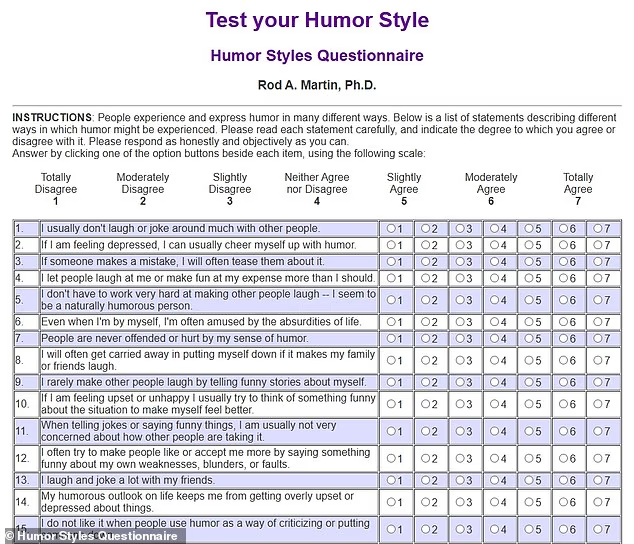
The test, called the Humor Styles Questionnaire, includes 32 questions to assess your levels of affiliative humour, self–enhancing humour, aggressive humour, and self–defeating humour.
If you score highly for affiliative humour, this suggests you love cracking jokes and engaging in spontaneous witty banter.
A high score for self–enhancing humour indicates you have a generally humorous outlook on life.
Aggressive humour relates to the use of sarcasm, teasing, and ‘put–downs’, while self–defeating humour involves excessively self–disparaging humour.
So, what’s your humour style? Take the test to find out.

The test, called the Humor Styles Questionnaire, includes 32 questions to assess your levels of affiliative humour, self–enhancing humour, aggressive humour, and self–defeating humour

If you score highly for affiliative humour, this suggests you enjoy sharing humour with other people – much like Michael McIntyre
The Humor Styles Questionnaire was created back in 2003 by researchers from the University of Western Ontario.
‘The Humor Styles Questionnaire assesses four dimensions relating to individual differences in uses of humor,’ the team, led by Rod A. Martin explained in their study, published in the Journal of Research in Personality.
‘These are: relatively benign uses of humor to enhance the self (Self–enhancing) and to enhance one’s relationships with others (Affiliative), use of humor to enhance the self at the expense of others (Aggressive), and use of humor to enhance relationships at the expense of self (Self–defeating).’
The questionnaire includes 32 statements, describing different ways in which humour might be experienced.
Participants are asked to read each statement carefully, and indicate the degree to which they agree or disagree with it.
The statements include things like: ‘I usually don’t laugh or joke around much with other people,’ ‘I laugh and joke a lot with my friends’, and ‘I enjoy making people laugh’.
At the end of the test, you’ll be given your score for each of the four humour styles, and told how that compares against the rest of the population.
If you score highly for affiliative humour, this suggests you enjoy sharing humour with other people – much like Michael McIntyre.

People like Greg Davies who score highly for self–enhancing humour, tend to maintain a humorous outlook on life, even during difficult times
The 4 humour styles
- If you score highly for affiliative humour, this suggests you love cracking jokes and engaging in spontaneous witty banter.
- A high score for self–enhancing humour, indicates you have a generally humorous outlook on life.
- Aggressive humour relates to the use of sarcasm, teasing, and ‘put–downs.
- Self–defeating humour involves self–disparaging humour.
‘They often tell jokes and funny stories to amuse others and make them laugh, and they enjoy laughing along with others,’ the researchers explained.
‘They do not take themselves too seriously, and can laugh about their mistakes without feeling too badly about them.
‘Research shows that those who are high on affiliative humor tend to be cheerful, outgoing and friendly, and tend to have enjoyable relationships with others.’
People like Greg Davies who score highly for self–enhancing humour, tend to maintain a humorous outlook on life, even during difficult times.
‘They always look on the funny side of things and use humor to cheer themselves up,’ the researchers explained.
‘Even when they are alone, they are often amused by the absurdities of life.
‘Research indicates that those who are high on self–enhancing humor tend to be emotionally well–adjusted, and do not easily become discouraged, anxious, or depressed. They cope well with stress and tend to be optimistic.’
Meanwhile, people like Jimmy Carr who are high on aggressive humour often tease, put down, and manipulate other people.

People like Jimmy Carr who are high on aggressive humour often tease, put down, and manipulate other people

People like Nish Kumar who score highly for self–defeating humour can be quite funny, but often go too far in making jokes at their own expense
‘Although they may be very witty, their humor tends to involve ridicule or sarcasm,’ the researchers said.
‘They like to tell racist or sexist jokes, and are not concerned about how their humor might be hurtful to others.
‘Making fun of others is a way they try to enhance their own self–esteem.
‘Research indicates that people who are high in this humor style tend to be generally aggressive and insensitive to others.
‘Their levels of self–esteem and emotional well–being are no higher or lower than the average person.
‘Those who are low on this humor style tend to have more satisfactory relationships.’
Finally, people like Nish Kumar who score highly for self–defeating humour can be quite funny, but often go too far in making jokes at their own expense.
‘They tend to laugh along with others when being ridiculed or made fun of,’ the researchers explained.
‘They try to make other people accept them more by allowing themselves to be the butt of others’ humor.
‘They also tend to use humor to hide their true feelings from others, putting on a happy face even when feeling unhappy inside.
‘According to research findings, people who are high in this style of humor tend to have low self–esteem, and are often unhappy and anxious.
‘They are often dissatisfied with their relationships.’
Worst offenders: 20 punny ‘dad jokes’ guaranteed to elicit groans and shaking heads
- Elevators terrify me… I’m taking steps to avoid them.
- I got an e–mail saying ‘At Google Earth, we can even read maps backwards’, and I thought… ‘That’s just spam…’
- What do you call a man with no shins? Tony.
- Me and my friends put a band together, we named it 999 megabytes. Still don’t have a gig though.
- I got into a fight with 1, 3, 5, 7 and 9. The odds were against me.
- I had a dream the ocean was filled with orange soda. It was a Fanta Sea.
- Just got hospitalized due to a peekaboo accident. They put me in the ICU.
- In college I was so broke I couldn’t afford the electricity bill. Those were the darkest days of my life.
- I went to the Doctor with hearing problems. He said ‘Can you describe the symptoms?’ I said: ‘Homer’s a fat dude and Marge has blue hair.’
- I said to my wife: ‘When I die I’d like to die having sex.’ She replied: ‘At least it’ll be quick.’
- I’ve decided I want a pet termite. I’m going to call him Clint. Clint Eatswood.
- So many people these days are too judgmental. I can tell just by looking at them.
- How many tickles does it take to make an octopus laugh? 10–tickles.
- ‘Dad, can you tell me what a solar eclipse is?’ No sun.
- I figured out why Teslas are so expensive. It’s because they charge a lot.
- Guess who I bumped into on my way to get my glasses fixed? Everybody.
- My wife blocked me on Facebook because I post too many bird puns. Well, toucan play at that game.
- Did you hear about the new Origami Porn channel? It’s paper view only.
- I was really angry when I ran into my friend Mark who stole my dictionary. I said, ‘Mark, my words!’
- I used to make loads of money clearing leaves from gardens. I was raking it in.
Courtesy of @dadsaysjokes on Twitter.

Big banks are paying closer attention to crypto again. Not because of hype, but because their biggest clients are asking for it. As rules around digital assets start to look clearer in the US, institutions that once stayed cautious are reassessing what they offer. That shift helps explain why JPMorgan is now exploring crypto trading for its institutional customers.
JPMorgan Chase is looking at what its markets division could realistically support, including direct crypto trading and possibly crypto derivatives. These talks are still early, and nothing has been officially launched, but the fact that the conversation is happening at all marks a notable change for one of the world’s most influential banks.
The interest is coming largely from clients. As regulations in the United States begin to settle, large investors are asking their banks for clearer access to crypto markets through familiar, regulated channels. JPMorgan is weighing whether there is enough demand, whether the risks can be managed, and whether the current regulatory environment allows it to move forward without exposing the bank to unnecessary trouble.
Algeria bans crypto use, exchange and mining of the digital asset
This isn’t the North African country’s first attempt to clamp down on crypto.
For a long time, banks avoided crypto trading because the rules were vague and enforcement was unpredictable. That has started to change. In recent months, US regulators have taken steps that make it easier for banks to act as intermediaries for crypto assets. The Office of the Comptroller of the Currency has clarified that banks can support certain crypto activities, and new stablecoin laws have added more structure to the market.
Jamie Dimon’s evolving stance on crypto
JPMorgan’s interest in crypto is especially notable given CEO Jamie Dimon’s past comments. He has repeatedly criticized Bitcoin, once calling it a “pet rock.” But in recent years, his tone has softened. While he still questions the value of cryptocurrencies, he has made it clear that clients should be free to buy and use them if they choose.
That more pragmatic approach is now shaping how the bank operates. JPMorgan has already been active in blockchain technology through projects like JPM Coin and Onyx. It has also arranged blockchain based bond settlements and plans to allow institutional clients to use Bitcoin and Ether as collateral for loans. Adding crypto trading would be another step in treating digital assets as a service to be managed, not an idea to be dismissed.
Stripe reintroduces crypto payments with USDC
The news comes six years after the payments company ceased Bitcoin transactions due to its volatility.

JPMorgan’s exploration of crypto trading is part of a broader shift across global finance. Standard Chartered recently launched spot Bitcoin and Ether trading for institutional clients in the UK. Goldman Sachs has run a crypto derivatives desk for years. BlackRock now manages tens of billions of dollars through its Bitcoin exchange traded fund. Even traditionally conservative European banks have begun buying and holding Bitcoin through in house trading desks.
JPMorgan has not committed to a launch timeline, and it may still decide not to move forward if demand or regulatory clarity falls short.
If JPMorgan does move ahead, it could make crypto trading feel more familiar and accessible to large investors who prefer trusted banks over standalone crypto platforms. More broadly, it signals that crypto’s next phase may be less about hype and more about infrastructure, compliance, and long term integration into global finance.
PayPal rolls out one-time payment links with crypto support on the way
It could make sending or requesting money as effortless as dropping a text.

TECHNOLOGY
Our king, our priest, our feudal lord – how AI is taking us back to the dark ages | Joseph de Weck


This summer, I found myself battling through traffic in the sweltering streets of Marseille. At a crossing, my friend in the passenger seat told me to turn right toward a spot known for its fish soup. But the navigation app Waze instructed us to go straight. Tired, and with the Renault feeling like a sauna on wheels, I followed Waze’s advice. Moments later, we were stuck at a construction site.
A trivial moment, maybe. But one that captures perhaps the defining question of our era, in which technology touches nearly every aspect of our lives: who do we trust more – other human beings and our own instincts, or the machine?
The German philosopher Immanuel Kant famously defined the Enlightenment as “man’s emergence from his self-imposed immaturity.” Immaturity, he wrote, “is the inability to use one’s understanding without guidance from another”. For centuries, that “other” directing human thought and life was often the priest, the monarch, or the feudal lord – the ones claiming to act as God’s voice on Earth. In trying to understand natural phenomena – why volcanoes erupt, why the seasons change – humans looked to God for answers. In shaping the social world, from economics to love, religion served as our guide.
Humans, Kant argued, always had the capacity for reason. They just hadn’t always had the confidence to use it. But with the American and later the French Revolution, a new era was dawning: reason would replace faith, and the human mind, unshackled from authority, would become the engine of progress and a more moral world. “Sapere aude!” or “Have courage to use your own understanding!, Kant urged his contemporaries.
Two and a half centuries later, one may wonder whether we are quietly slipping back into immaturity. An app telling us which road to take is one thing. But artificial intelligence threatens to become our new “other” – a silent authority that guides our thoughts and actions. We are in danger of ceding the hard-won courage to think for ourselves – and this time, not to gods or kings, but to code.
ChatGPT was launched only three years ago, and already one global survey, published in April, found that 82% of respondents had used AI in the previous six months. Whether deciding to end a relationship or who to vote for, people are turning to machines for advice. According to OpenAI, 73% of user prompts concern non work-related topics. Even more intriguing than our dependence on AI’s judgment in daily life is what happens when we let it speak for us. Writing is now among the most common uses of ChatGPT, second only to practical requests such as DIY or cooking advice. The American author Joan Didion once said: “I write entirely to find out what I am thinking.” What happens when we stop writing? Do we stop finding out?
Worryingly, some evidence suggests that the answer might be yes. A study by the Massachusetts Institute of Technology used electroencephalography (EEG) to monitor the brain activity of essay writers given access to AI, search engines like Google, or nothing at all. Those who could rely on AI showed the lowest cognitive activity and struggled to accurately quote their work. Perhaps most concerning was that over a couple of months, participants in the AI group became increasingly lazy, copying entire blocks of text in their essays.
The study is small and imperfect, but Kant would have recognised the pattern. “Laziness and cowardice,” he wrote, “are the reasons why so great a proportion of men … remain in lifelong immaturity, and why it is so easy for others to establish themselves as their guardians. It is so easy to be immature.”
Sure, AI’s appeal lies in its convenience. It saves time, spares effort and – crucially – offers a new way to offload responsibility. In his 1941 book, Escape from Freedom, the German psychoanalyst Erich Fromm argued that the rise of fascism could be explained in part by people preferring to surrender their freedom in exchange for the reassuring certainty of subordination. AI offers a new way of surrendering that burden of having to think and decide for yourself.
AI’s greatest allure is that it can do things our minds can’t – sift through oceans of data and process it at unprecedented speed. Sitting in the car in Marseille, this was, after all, why I chose to trust the machine instead of my friend in the passenger seat (a decision she took as an insult). With access to all the data, surely the app must know best – or so I thought.
The problem is that AI is a black box. It produces knowledge, but without necessarily deepening human understanding. We don’t really know how AI reaches its conclusions – even the programmers admit as much. Nor can we verify its reasoning against clear, objective criteria. So when we follow AI’s advice, we are not guided by reason. We are back in the realm of faith. In dubio pro machina: when in doubt, trust the machine – that may become our future guiding principle.
AI can be a formidable ally to humans in rational inquiry. It can help us invent drugs, or free us from “bullshit jobs”, or doing our taxes – tasks that demand little thought and offer little satisfaction. All the better. But Kant and his contemporaries did not plead the case of reason over faith just so humans could build better shelves or have more spare time. Critical thinking was not just about efficiency – it was a practice of freedom and human emancipation.
Human thinking is messy and full of errors, but it forces us to debate, to doubt, to test ideas against one another – and to recognise the limits of our own understanding. It builds confidence, both individually and collectively. For Kant, the exercise of reason was never just about knowledge; it was about enabling people to become agents of their own lives, and resist domination. It was about building a moral community grounded in the shared principle of reason and debate, rather than blind belief.
With all the benefits AI brings, the challenge is this: how can we harness its promise of superhuman intelligence without eroding human reasoning, the cornerstone of the Enlightenment and of liberal democracy itself? That may be one of the defining questions of the 21st century. It is one we would do well not to delegate to the machine.

Across Africa, 2025 added new scale and texture to an already active tech ecosystem. Long-running conferences returned with bigger ambitions, while newer festivals carved out space for focused conversations around artificial intelligence (AI), data, policy, and startup growth.
From government-backed summits outlining national digital strategies to developer-led gatherings exploring frontier tools, tech conversations moved fluidly between policy rooms, pitch stages, and community workshops. Cities like Marrakech, Lagos, Algiers, Kigali, and Cape Town played host to events that reflected the state of Africa’s tech ecosystem and its future.
Here are some of the major tech events across the continent in 2025.
1. Africa Tech Summit Nairobi (Nairobi, Kenya, February 12–13)
The 7th Africa Tech Summit, held in Nairobi, brought together over 2,000 tech leaders at the Sarit Expo Centre and was organised around four distinct pillars: the Africa Money & DeFi Summit, the Africa Climate Tech & Investment Summit, the Africa Startup Summit, and the Africa Mobile & App Summit.
Around 80 exhibitors showcased their solutions while 65 speakers took to the stage, creating a dynamic environment where mobile operators rubbed shoulders with crypto founders, investors scouted for the next big opportunity, and regulators engaged directly with innovators. The summit’s Investment Showcase became a hub for deal-making, with fireside chats and masterclasses running throughout the event.
2. Lagos Tech Fest (Lagos, Nigeria, February 19–20)
For its fifth year, Lagos Tech Fest convened more than 2,000 participants at multiple venues across Lagos, including Four Points by Sheraton, Club House, and the Landmark Event Centre. The two‑day festival, headlined by Mastercard, combined a welcome party, Nigeria’s Tech Leadership Roundtable, and the main conference program to spotlight opportunities across fintech, venture capital, crypto and DeFi, payments and banking, e‑commerce, and digital infrastructure.
3. GITEX Africa (Marrakech, Morocco, April 14–16)
The third edition of GITEX Africa returned to Marrakech under the theme “Accelerating Africa’s Digital Transformation,” drawing over 45,000 visitors from more than 130 countries and featuring around 1,400 exhibitors showcasing innovations in AI, cloud computing, fintech, cybersecurity, smart cities, healthtech, agritech, and connectivity.
4. Africa AI Festival (Lagos, Nigeria, May 31)
The Africa AI Festival convened one of the continent’s largest gatherings focused on AI and its role in African markets and society. Held under the theme “AI for Africa: Scaling Innovation and Inclusion,” the event drew over 5,000 attendees from more than 20 countries, including founders, investors and industry leaders.
The festival featured over 50 speakers and startup exhibitors, covering practical AI applications in healthcare, finance, education, and enterprise services, while sessions on ethical AI, data infrastructure, and investment models highlighted the continent’s unique challenges and opportunities.
Side discussions, workshops, and networking sessions facilitated direct engagement between startups and investors, with the Founder Showcase and Investor Lounge providing platforms to translate AI concepts into scalable African solutions.
5. Kids Tech Fest 2025 (Lagos, Nigeria, June 14)
Africa’s first large-scale AI summit for children and parents took place at the Landmark Event Centre in Lagos, drawing over 5,000 attendees. Organised by Digital Equity Africa, the summit aimed to introduce young learners to AI through interactive sessions, hands-on workshops, and family-focused learning experiences.
The event covered practical and socially relevant AI topics, including how AI works, ethical considerations, digital safety, and responsible technology use. Separate tracks for parents and educators explored how to support children in developing AI literacy and navigating the digital world safely.
The summit also served as a launch platform for two educational initiatives. Bud AI, a child-safe AI learning companion with parental oversight, and the Future Minds Online AI Learning Community, designed for children aged 6 to 16, were introduced to provide ongoing learning opportunities beyond the event.
6. AI Summit for Africa (Victoria Falls, Zimbabwe, August 17–20)
The AI Summit for Africa convened technology leaders, policymakers, academics, and industry experts in Victoria Falls under the theme “AI‑Powered Transformation: Unlocking New Frontiers for Sustainable Socio‑Economic Growth.”
The multi‑day event focused on how AI can drive inclusive development across Africa’s key sectors, including healthcare, education, agriculture, and financial services.
The summit also served as a platform for Zimbabwe’s government to outline progress on its National AI Strategy, highlighting initiatives to strengthen digital skills, expand connectivity, and promote responsible AI adoption.
7. GITEX Nigeria (Abuja & Lagos, September 1–4)
GITEX debuted in Nigeria with the theme “Forging the Rise of Digital Nigeria,” bringing together policymakers, enterprise executives, founders and investors across two of the country’s most strategic cities.
The opening day in Abuja focused on the Government Leadership & AI Summit, where discussions centred on building and future-proofing digital infrastructure, scaling AI responsibly in public services, and upskilling talent for research and innovation.
In Lagos, the Tech Expo & Future Economy Conference served as West Africa’s largest tech “super‑connector” event, convening more than 3,000 professionals and over 100 exhibitors to explore how technologies such as artificial intelligence, fintech, cybersecurity, and Internet of Things solutions are shaping national and regional markets. The conference’s executive track examined enterprise digital transformation, frontier cybersecurity strategies, and future networks, while investment‑oriented sessions discussed new funding paradigms for entrepreneurial innovation and growth, diaspora engagement in local scaling, and strategies for building homegrown unicorns.
Running alongside the Tech Expo, the GITEX Nigeria Startup Festival showcased over 1,000 curated startups and more than 300 investors, featuring pitch opportunities, matchmaking programmes, and the Supernova Challenge, which offered founders visibility and potential funding connections.
8. Seamless Africa (Johannesburg, South Africa, September 8–9)
The conference aimed to explore the world of digital commerce. The premier event, which was held at the Sandton Convention Centre in Johannesburg, focused on financial services, banking, retail and e-commerce across all sectors on the African continent, with almost 6000 participants in attendance.
9. Africa FinTech Summit (Accra, Ghana, October 8–10)
The fintech event gathered Africa’s finest investors, innovators, entrepreneurs, and regulators to shape the future of financial services across the continent. It was held in Kempinski Hotel Gold Coast City, Accra, Ghana and featured conversations spanning topics such as the future of cross-border payments in Africa, Web3 and Blockchain, the rise of mobile money and investment trends in African fintech.
10. AgentCon Accra (Accra, Ghana, October 9)
AgentCon Accra 2025, themed “Agents of Change: Building Ghana’s Intelligent Future,” offered a developer‑focused forum on autonomous AI agents, positioning Ghana as a hub for practical AI innovation. Part of the AgentCon 2025 World Tour, the one-day event brought together engineers, researchers, and creators to explore the design, deployment, and scaling of autonomous software systems capable of performing tasks with minimal human intervention.
Sessions and workshops focused on agentic workflows, integration of AI agents into real-world systems, open-source frameworks, and tools for building intelligent assistants and autonomous services.
11. Moonshot by TechCabal (Lagos, Nigeria, October 15–16)
Lagos came alive in October when Moonshot by TechCabal hosted its third edition at the Eko Convention Centre, under the theme “Building Momentum.” The two-day event brought together over 4,000 founders, investors, creatives, and policymakers from more than 15 countries, creating a vibrant hub for dialogue, collaboration, and deal-making.
With more than 140 speakers and nine content tracks spanning AI, climate tech, the creative economy, and emerging sectors, Moonshot blended the structure of a summit with the energy of a festival. Participants engaged in workshops, hands-on sessions, and fireside chats that focused on practical strategies for scaling startups, attracting investment, and leveraging technology for measurable impact.
Deal rooms were abuzz as investors connected with promising founders, while curated sessions highlighted emerging trends and showcased innovative solutions across African markets.
12. DataFest Africa (Lagos, Nigeria, October 18)
DataFest Africa 2025, themed “AI in Africa: Solving Today’s Problems, Building Tomorrow’s Systems,” brought together over 4,000 attendees, 50 speakers, and more than 30 sponsors and exhibitors in Lagos for a one-day festival focused on practical applications of AI and data science. The event highlighted how data-driven technologies can address challenges in finance, healthcare, agriculture, and public governance across Africa.
Sessions and workshops explored agent-based systems, AI for social good, data governance, and ethical AI, providing participants with hands-on opportunities to experiment with real-world solutions.
The event also showcased ecosystem initiatives, including efforts by the Nigeria AI Collective to develop national AI repositories, curated datasets, and platforms for research and innovation. Attendees engaged in hackathons, product demonstrations, and practical workshops, turning AI potential into actionable, scalable solutions.
13. Mobile World Congress Kigali (Kigali, Rwanda, October 21–23)
The third edition of Mobile World Congress Kigali, held at the Kigali Convention Centre, brought together over 3,000 delegates from 109 countries, including government officials, telecom executives, regulators, and technology leaders. The event ran under the theme “Converge, Connect, Create,, positioning connectivity, policy, and emerging technologies as central to Africa’s digital growth agenda.
The event’s programming was focused on four core areas. Connected Continent sessions examined broadband rollout, spectrum policy, and infrastructure financing. The AI Future explored responsible AI adoption, data readiness, and the development of African language models. Fintech discussions centred on mobile money, digital payments, and regulatory alignment, while Africa’s Digital Frontier highlighted technology applications across public services, health, education, and entertainment.
14. Blockchain Africa Conference (Johannesburg, South Africa, October 22)
The 11th annual Blockchain Africa Conference convened practitioners, innovators, and industry leaders in Johannesburg under the theme “Ready for Business.” The one-day event drew around 270 attendees from 10 countries and featured 27 speakers, focusing on practical applications of blockchain and digital assets across African markets.
Sessions explored finance, digital banking, enterprise adoption, tokenisation, and regulatory frameworks. Panel discussions addressed topics such as stablecoin adoption, institutional digital asset infrastructure, and operational challenges in blockchain implementation, offering actionable insights for businesses, regulators, and developers.
15. Africa Tech Festival (Cape Town, South Africa, November 11–13)
The 28th edition of Africa Tech Festival transformed Cape Town into a continental tech hub, drawing 15,000 attendees, 450 speakers, and over 300 exhibitors to the Cape Town International Convention Centre. The festival combined four major events into one integrated programme: AfricaCom, focused on telecoms and connectivity; AfricaTech, highlighting enterprise innovation; AfricaIgnite, championing startups; and The AI Summit Cape Town, exploring commercial AI applications.
16. Cairo ICT (Cairo, Egypt, November 16–19)
The 29th edition of Cairo ICT brought together governments, multinational tech companies, startups, and investors under the theme “AI Everywhere.” The four-day event was held at the Egypt International Exhibition Centre in New Cairo, featuring over 500 exhibitors and attracting over 160,000 participants from across Africa, the Middle East, and beyond.
The summit included multiple specialised tracks, including PAFIX for digital payments and financial inclusion, AIDC for AI, data centres, and cloud computing, Connecta for youth and entertainment technologies, Innovation Arena for creative solutions, and Cyber Zone for cybersecurity engagement.
Over the four days, the event featured 96 panel discussions with 491 speakers, covering AI applications, cybersecurity, 5G and connectivity, digital identity, cloud computing, and smart infrastructure. Connecta hosted 84 sessions focused on youth innovation and entertainment tech, while other areas showcased digital education initiatives and startup exhibitions.
17. African Startup Conference (Algiers, Algeria, December 6–8)
The fourth African Startup Conference brought together more than 25,000 participants from across Africa and beyond. The three‑day event ran under the theme “Raising African Champions,” convening entrepreneurs, investors, policymakers, and ecosystem builders to explore how African startups can scale, compete globally, and contribute to economic growth.
Organised by the Algerian Ministry of Knowledge Economy, Startups, and Micro‑Enterprises, with support from Algeria Venture, the conference featured over 200 exhibitors, 150 investors, and more than 300 international experts showcasing solutions in fintech, AI, climate tech, creative industries, and enterprise applications.
The conference concluded with the Algiers Declaration, a commitment by ministers and ecosystem stakeholders to promote fair, secure, and responsible digital platforms across Africa.
18. Google Devfest (Lagos, Nigeria, November 18-22, 2025)
Google’s DevFest is an annual developer conference organised by Google Developers Groups (GDGs) across the world. The 2025 edition in Lagos featured over 100 speakers and tech professionals from across all stages of their careers. The first day featured a ‘student day’ for students and aspiring tech professionals; other tech categories, such as AI & cloud, Web 3 and design, were allocated to other days.
On all five days, the event concluded with networking, an opportunity for tech enthusiasts to build community.
19. Tech in Ghana (Kumasi, Ghana, December 4-5)
Tech in Ghana, a UK-Ghana platform, held one edition of its annual conference on the African continent. Organised twice annually, in London and Accra, the conference seeks to empower the country’s tech talent to create impact on a global stage. The 2025 conference, held at the Jubilee Hall, Manhyia Palace in Kumasi, spanned over two days.
The ‘Royal’ edition, which was one of its kind, took place at His Royal Majesty Otumfuo Osei Tutu II’s Jubilee Hall to explore how traditional industries, including manufacturing, education, and agriculture, are evolving with cutting-edge technologies.
20. AfricArena Grand Summit (Cape Town, South Africa, December 2–3)
Acting as the grand finale of a year-long world tour, the AfricArena Grand Summit took place at the Cape Town International Convention Centre (CTICC). Beginning with five hybrid events across four regions, acting as semi-finals to scout the continent’s top talent, it culminated in the Grand Summit in Cape Town on December 2–3, 2025.
At the Grand summit, over 50 startups pitched over two days, from seed to growth-stage founders, paired with insights from the top minds shaping Africa’s tech and investment landscape.

Photo by Fredrick Tendong / Unsplash
Gamers trying to log on to Steam on December 24 ran into trouble starting around 1 PM ET. The popular digital storefront and its online services, including the Steam Store, Steam Community, and Web APIs, experienced a major outage that disrupted both purchasing and gameplay. Valve has yet to publicly comment on the outage, but SteamDB’s unofficial status page confirmed that multiple parts of the platform were offline.
At its peak, DownDetector received over 6,000 reports of problems, and users couldn’t access Steam through PC, mobile, or Mac. The outage also affected online services for Valve’s games, including Team Fortress 2, Dota 2, and Counter-Strike 2. Players were left unable to browse the store, check their friends list, or even log into some online games.
Why Millions of Players Can’t Log Into Fortnite Right Now
Players are currently logged out of PS5, Xbox, PC, Nintendo Switch, and mobile devices.

By around 4 PM ET, the platform began to recover, and by 6 PM ET, most Steam clients were broadly functional, though occasional errors and sluggish performance persisted. Some online games were still partially down. By the early morning of December 25, all services, including the Web API, Store, Community, and online games, had been fully restored.
Steam isn’t new to outages. In October, the store and online services went down for an hour, and earlier in September, the launch of Hollow Knight: Silksong caused temporary crashes across Steam, the Xbox Store, and Nintendo’s eShop as millions of users tried to download the game simultaneously.
The takeaway
For gamers, the timing of this outage right on Christmas Eve was frustrating, cutting into peak holiday gaming hours and potentially delaying Winter Sale purchases. The incident also highlights how reliant players are on Steam not just for buying games, but for connecting online and enjoying multiplayer experiences. While services have been restored, this outage is a reminder that even the largest digital game platforms are vulnerable to technical disruptions.
Steam Machine clue sets Half-Life 3 fans alight as speculation hits new high
Valve’s new Steam Machine, codenamed Fremont, has Half-Life fans buzzing with renewed hope for Half-Life 3.


December 26, 2025
Link copied!
Copy failed!

span { width: 5px; height: 5px; background-color: #5b5b5b; }#mailpoet_form_2{border-radius: 8px;color: #313131;text-align: left;}#mailpoet_form_2 form.mailpoet_form {padding: 0px;}#mailpoet_form_2{width: 100%;}#mailpoet_form_2 .mailpoet_message {margin: 0; padding: 0 20px;}
#mailpoet_form_2 .mailpoet_validate_success {color: #000000}
#mailpoet_form_2 input.parsley-success {color: #000000}
#mailpoet_form_2 select.parsley-success {color: #000000}
#mailpoet_form_2 textarea.parsley-success {color: #000000}
#mailpoet_form_2 .mailpoet_validate_error {color: #cf2e2e}
#mailpoet_form_2 input.parsley-error {color: #cf2e2e}
#mailpoet_form_2 select.parsley-error {color: #cf2e2e}
#mailpoet_form_2 textarea.textarea.parsley-error {color: #cf2e2e}
#mailpoet_form_2 .parsley-errors-list {color: #cf2e2e}
#mailpoet_form_2 .parsley-required {color: #cf2e2e}
#mailpoet_form_2 .parsley-custom-error-message {color: #cf2e2e}
#mailpoet_form_2 .mailpoet_paragraph.last {margin-bottom: 0} @media (max-width: 500px) {#mailpoet_form_2 {background-image: none;}} @media (min-width: 500px) {#mailpoet_form_2 .last .mailpoet_paragraph:last-child {margin-bottom: 0}} @media (max-width: 500px) {#mailpoet_form_2 .mailpoet_form_column:last-child .mailpoet_paragraph:last-child {margin-bottom: 0}}
]]>
TECHNOLOGY
Magic elves of Alaska REVEALED: As new photo emerges, indigenous filmmaker reveals truth of 4-foot tall beings… with superhuman strength

As the great grandson of one of the last legendary Inuit storytellers, James Dommek Jr knew he had a good story. But he wasn’t sure it should be told.
It was a wild tale, blending a ‘modern-day Alaskan survival story’ with local legend and true crime. It had an attempted murder, mythical sprites and a man lured from his remote Alaskan home.
But it also revealed some of his community’s sacred beliefs about sprites, or ‘Inukun’ that many thought should be kept secret. So, Dommek sought, and received, approval from the elders to proceed.
‘It’s just a different world in the north,’ said Dommek, speaking to the Daily Mail from his Anchorage home. ‘I don’t expect people from very metropolitan places to understand what I’m talking about, because I don’t think they’ve ever sat in true wilderness.’

James Dommek Jr, a Native Alaskan filmmaker, said he does not expect most people to believe his story of ‘Inukuns’, or Little People

Dommek’s story is set in the Brooks Range – a vast wilderness 500 miles north of Anchorage

Pictured: Eskimos at Cape Prince in Wales, Alaska in 1925
Dommek’s documentary, Blood and Myth, was released on Hulu this fall.
It describes how a celebrated local actor Teddy Kyle Smith was found near the cabin where his 74-year-old mother lay dead, in 2012, then ran off into the vast forest surrounding his hometown of Kiana, an Arctic Circle village of 400 people, 500 miles north of Anchorage.
Smith, 45 at the time, was known to have issues with alcohol, but insists to this day his mother died of natural causes.
Alone in the Alaskan wilds, he spent 10 days in the unforgiving terrain before encountering two hunters, who he shot and critically wounded. Arrested, Smith told police the Inukun made him to do it – and claimed he had seen them with his own eyes.
‘I finally got to see them,’ he said during his interrogation. ‘There was a lot of them out there.’
Smith told the police: ‘I didn’t want to shoot them. I had to go along with what they wanted me to do.’
The officer asked: ‘Who’s that?’
‘The wild people out there,’ Smith replied.

Teddy Kyle Smith was arrested and charged with attempting to kill two hunters in 2012

An ‘Inukshuk’, or cairn, created by Inupiat in Alaska. The land is dotted with the arrangements
Dommek believes him. And he believes in the Inukun, or ‘Little People’, as they are otherwise known. Since making the film, he has been inundated with calls and messages from others who claim, like Smith, to have actually encountered the Inukun, but have been too scared or embarrassed to admit it.
‘I’ve had so many people reach out to me – respectable, sane, intelligent, college-educated people – who have said, I’ve had this encounter, I’ve never been able to talk about it, I don’t want to lose my job, don’t use my name,’ said Dommek. ‘They’ve sent me photos.’
One particular photo, shown to the Daily Mail on the agreement not to publish it, shows a small spec of a creature in otherwise empty tundra. Dommek said it was sent to him by a family of Inupiaq, as his tribe is called, who spotted the strange sight while on their annual month-long caribou hunt in the far reaches of the Brooks Range, and took a photo with their iPhone through their rifle scope.
Dommek also spent years researching historical accounts of Inukun sightings, catalogued by outsiders who could not believe their own eyes. Europeans, lured by whaling and gold prospecting, did not arrive in Inupiaq land until the late 1880s, and to this day the region remains one of the least understood and documented of all the US.
‘I found these journals from missionaries, who are talking about the Inukun in the late 1800s,’ said Dommek. ‘I’m finding these accounts of white bush pilots who are flying these little planes. They land in the village, and they say, I saw something I can’t explain. There’s even military accounts of having encounters with, in their words, little wild men in the hills, shooting arrows at us.
‘And so my thing is: They all can’t be lying.’

Dommek, after years of trying, finally gets Smith to speak to him inside Wasilla prison

The Franklin Mountains, part of the Brooks Range, are pictured: where the Inukun may live
For over 10,000 years before the first Europeans arrived, Native Alaskan people – and their Inuit cousins in Canada, Greenland and Siberia – have told stories of the Inukun.
Known by different names among different tribes, the Inukun, as the Inupiaq call them, are said to live in cave dwellings in extremely remote reaches of the territory, but occasionally interact with modern humans.
Some claim they possess superhuman strength, and the ability to move at lightning speed. Dommek was told they are ‘shorter than a bow’ – around four feet tall.
Pygmy tribes are well documented in central Africa: a letter written by an Egyptian Pharoah, Pepi II, in 2276 BC referenced a ‘dancing dwarf of the god from the land of spirits’, and a 2016 study by researchers from University College London, Manchester Metropolitan University and the University of Malaga concluded that around 920,000 live across nine countries.
Most pygmy men are around 4ft 9 tall while the women are around three inches shorter according to an Italian geneticist, Luigi Luca Cavalli-Sforza, who spent time in the Congo Basin in the 1960s.
Dommek, for his documentary, spoke to a tribal liaison officer, Mary Black, who was helping federal Bureau of Land Management officials survey the Brooks Range for a possible new road through the area. She says she and two colleagues saw from their helicopter evidence of Inukun residences, and told the team to turn back and leave them alone – fearing the fate of uncontacted tribes in the Amazon. She refuses to say where exactly the spot was.
Dommek doesn’t worry about hoardes of tourists turning up in Kiana, hoping to catch sight of the Inukun. For one thing, he said, it’s extremely remote and expensive to get to. For another, most people would die while wandering the wilderness.
His film, he insisted, is not to convince anyone of the Inukun’s existence – even though he himself is certain. It is more to open people’s eyes to Native stories, and storytellers.
And it is bordering on arrogance, Dommek says, for us to assume everyone looks the same.
‘It almost is a genetic memory of our culture,’ he said. ‘Because at one point on this earth, there were things that were like us, but not us. I’m talking about Denisovian, I’m talking about Neanderthals.
‘A lot of the belief depends on materialism. You need material evidence. That is the Western model: I’ll believe it when I see it. The Indigenous mindset is different. We realize that there are parts of this world we do not understand all the way.
‘And we allow for that mystery.’
TECHNOLOGY
Got a ‘know-it-all’ friend? Wine show-offs are likely complete novices when it comes to tasting, study reveals

Is there anything more annoying than a ‘know-it-all’ who thinks they’re a wine expert?
While you’re happily sipping your merlot, they might insist they can taste hints of pepper, plum or even pencil shavings in their glass.
But they likely have no clue what they’re talking about, scientists have revealed.
A study has found that novice wine reviewers tend to have high levels of confidence, which then dip when they actually start to properly learn about vino.
Researchers looked at wine reviews from an online website and followed around 30,000 users through each tasting note that they posted online between 2003 and 2012.
They tracked descriptive terms and measured confidence via the language used.
Analysis revealed that as people gained more experience drinking wine, they tended to waver in their assertions.
While they started off being sure of their tasting notes, over time their language began to dip in confidence, integrating phrases like ‘I’m not sure’ or ‘It could be’.

A study has found that novice wine reviewers tend to have high levels of confidence, which then dip when they actually start to properly learn about vino
‘They start to realise, ‘This is more complex, more nuanced than I thought’,’ author Matt Rocklage, from Northeastern University in Boston, said.
‘There are more things I need to know than I thought I needed to know. That’s when you see language start to dip in confidence.’
Eventually, that confidence ‘rebounds’ and people started to use more definitive language like ‘I definitely taste this’, he explained.
So, unless they’re a certified connoisseur, it’s likely your ‘expert’ friend is calling your bluff.
The study was published in the Journal of Marketing Research.
‘There is a U-shaped relationship between experience and confidence,’ the researchers wrote.
‘While gaining initial experiences decreases confidence, eventually, with more experience, confidence rebounds.’
The team said they also observed the same U-shaped confidence trajectory among consumers of beer and cosmetics.

You might have a friend who claims to know a lot about wine – but unless they’re a connoisseur it’s likely their confidence is misplaced, experts revealed (stock image)
Earlier this year, an expert warned it’s only safe to drink one glass of wine every 12 months.
The human body can only safely consume one ‘large’ glass of wine every year because it is too ‘toxic’, according to Professor David Nutt, a leading drug researcher at Imperial College London.
He says that if alcohol was invented today it would fail modern food safety standards because of how harmful it is to our bodies.
Studies on the toxicology of alcohol – the adverse effects chemicals have on living organisms – reveal that the ‘maximal recommended amount’ per year is just one large glass of wine, according to the expert.
WHAT’S THE BEST WAY TO TASTE WINE PROPERLY?
When it comes to drinking wine, there a few things that can make all the difference.
Australian wine-connoisseur Caitlyn Rees offers how to taste wines like an expert
Step 1: See
Before you even down that first sip, you first need to take a look at the wine in your glass.
‘See refers to the appearance of the wine. This is where you can check the clarity, intensity and colour.
‘If the wine is hazy it could be faulty but more likely unfiltered.’
Step 2: Swirl
You’ve probably seen wine drinkers swirl the wine in their glass before taking a sip.
The reason is to allowed the wine to ‘open up’ and reveal the maximum amount of aroma, flavour and intensity.
‘Swirling releases the aroma particles that make the next step, smell, more helpful.’
Step 3: Smell
Smelling wine serves two purposes. It helps you detect scents and flavours as well as providing a way to check for faults.
Step 4: Sip and savour
Once you’ve taken in the full aroma of the wine, now it’s time to sip.
Step 5: Spit or swallow
Unless the wine you are tasting has gone bad, the final step in the process of wine tasting is to swallow.
The trick though isn’t to gulp it down.
It’s more to let it drift down over the back of your tongue to allow your taste buds to pick up the intensity of the flavour.
Share or comment on this article:
Got a ‘know-it-all’ friend? Wine show-offs are likely complete novices when it comes to tasting, study reveals

The identities of the Three Wise Men may have finally been revealed by a biblical researcher who claims they may not have been three kings from the East after all.
Research by the Associates for Biblical Research has come to the conclusion that the Three Wise Men, who were written to have followed a star to the birth of Jesus, were most likely priests or astrologers who served in an ancient Middle East kingdom.
The Bible never named them or confirmed there were actually three travelers, but the details suggesting that the Three Kings, or magi, brought gifts of gold, frankincense, and myrrh were added centuries later through Christian stories and traditions.
In a recent YouTube video, researcher Bryan Windle explained that the word magi actually may have meant magician, and only appeared in the Gospel of Matthew, one of the four biographical accounts of Jesus’ life in the Christian Bible.
‘That word Wise Man is often used in modern translations. Magi is maybe the older word we use,’ Windle said.
Windle added that the supposed kings were left unnamed in Matthew’s gospel, with their alleged names coming from a fifth century Armenian text, which suggested they were Melkon, King of Persia; Kaspar, King of India; and Balthasar, King of Arabia.
After reexamining the Bible and comparing it to historical records of the time, Windle believed the Three Wise Men were likely advisors who served in one of the ancient kingdoms that sat in the modern-day Middle East.
Biblical scholars have suggested that they could have either been from the court of the Nabatean kingdom, an ancient Arab kingdom covering modern-day Jordan, Syria, and nearby areas southeast of Jesus’ birthplace, or to the east in the Parthian Empire in modern-day Iran.

The Adoration of the magi by Georg Pencz, painted in the 16th century: Many of the details we associate with the Three Wise Men come from post-Gospel texts

A carving from Persepolis shows King Darius on the throne with Xerxes standing behind him and a magi behind Xerxes
Windle said that there are clues in the Gospel of Matthew, which may include parts of the story that came directly from Mary, the mother of Jesus.
In the Gospel of Matthew, it states: ‘After Jesus was born in Bethlehem of Judea in the days of King Herod, behold, wise men from the East came to Jerusalem, asking, ‘Where is the child who has been born king of the Jews? For we observed his star at its rising, and have come to pay him homage.’
‘When they saw that the star had stopped, they were overwhelmed with joy. On entering the house, they saw the child with Mary, his mother, and they knelt and paid him homage. Then, opening their treasure chests, they offered him gifts of gold, frankincense, and myrrh.’
Wilder noted that the biblical text did not specify that there were three magi, just that they came from the east and left three gifts to honor Jesus’ birth. Some have suggested they were Babylonians, Persian priests, or even Chinese mystics.
However, Wilder explained that the Babylonian astrologer or Persian priest theory would be ‘out of sync’ with what we know of history at the time, as both empires had already ended by the time of Jesus’s birth.
Historical texts have also suggested that the word ‘Magi’ may have been also used as an ethnic term, not just a word for ancient priests and magicians.
Herodotus, an ancient Greek historian from the fifth century BCE, wrote: ‘Deioces, then, united the Median nation by itself and ruled it. The Median tribes are these: the Busae, the Paretaceni, the Struchates, the Arizanti, the Budii, and the Magi. Their tribes are this many.’
In the episode entitled Who Were The Magi? Digging for Truth, Wilder said the meaning may have shifted so that it referred to an order of Persian priests, who started from the tribe of the magi and then became priests.

The Adoration of the Kings is a large oil-on-oak painting by Jan Gossaert in 1510 AD which featured the magi
Xenophon, another ancient Greek historian and soldier from the fourth century BCE, wrote that the founder of the vast Persian Empire, Cyrus the Great, would call upon the magi to perform sacrifices before battle.
By the time of the New Testament, the word had become generally used for magicians of any kind, and various New Testament texts refer to magi, with early Christian missionaries Paul and Barnabas encountering magi in the New Testament book of Acts.
‘Scholars believe the magi came from the area of ancient Babylon or Persia that was now under Parthian control when Christ was born. This would satisfy the criteria of the magi coming from the east,’ Windle said.
Adding to the possibility that the Three Wise Men came from the kingdom of Nabatea, Windle noted that King Herod’s mother was Nabatean, and Nabateans traveled considerable distances, so they would have had a grasp of astrology.
They were also renowned traders who traded frankincense and myrrh, making the case that they were priests or astrologers who served as ‘wise men’ in territories once held by the Babylonians and Persians.
However, this assumes magi still held honored roles in the Parthian courts that their caste had earlier filled for the Persian kings.
‘I also believe the idea of Nabataean magi has merit and needs to be studied in further detail,’ Windle concluded.
After 33 years, Bernardo Quintero decided it was time to find the person who changed his life — the anonymous programmer who created a computer virus that had infected his university decades earlier.
The virus, called Virus Málaga, was mostly harmless. But the challenge of defeating it sparked Quintero’s passion for cybersecurity, eventually leading him to found VirusTotal, a startup that Google acquired in 2012. That acquisition brought Google’s flagship European cybersecurity center to Málaga, transforming the Spanish city into a tech hub.
All because of a small malware program created by someone whose identity Quintero had never known.
Moved by nostalgia and gratitude, Quintero launched a search earlier this year. He asked Spanish media outlets to amplify his quest for tips. He dove back into the virus’s code, looking for clues his 18-year-old self might have missed. And he eventually solved the mystery, sharing the bittersweet resolution in a LinkedIn post that went viral.
The story begins in 1992, when a young Quintero was prompted by a teacher to create an antivirus for the 2610-byte program that had spread across the computers of Málaga’s Polytechnic School. “That challenge in my first year at university sparked a deep interest in computer viruses and security, and without it my path might have been very different,” Quintero told TechCrunch.
Quintero’s search was aided by his programmer instincts. Earlier this year, he stepped down from his team manager role to “go back to the cave, to the basement of Google.” He didn’t leave the company; instead, he went back to tinkering and experimenting without managerial duties.
That tinkering mindset also led him to reexamine Virus Málaga and look for details that his 18-year-old self would have missed. First, he found fragments of a signature, but thanks to another security expert, he discovered a later variant of the virus with a much clearer cue: “KIKESOYYO.” “Kike soy yo” would translate to “I am Kike,” a common nickname for “Enrique.”
Around the same time, Quintero received a direct message from a man who is now the general digital transformation coordinator for the Spanish city of Cordoba and who claimed he witnessed one of his Polytechnic School classmates created the virus. Many details added up, but one stood out in particular: he knew that the virus’s hidden message — called a payload, in cybersecurity terms — was a statement condemning the Basque terrorist group ETA, a fact that Quintero had never disclosed.
Techcrunch event
San Francisco
|
October 13-15, 2026
The tipster then gave Quintero a name — Antonio Astorga — but also shared the news that he had passed away.
This hit Quintero like a ton of bricks; now, he would never be able to ask Antonio about “Kike.” But he kept following the thread, and the plot twist came from Antonio’s sister, who revealed that his first name was actually Antonio Enrique. To his family, he was Kike.
Cancer took away Antonio Enrique Astorga before Quintero could thank him in person, but the story doesn’t stop here. Quintero’s LinkedIn post sheds new light to the legacy of “a brilliant colleague who deserves to be recognized as a pioneer of cybersecurity in Málaga” — and not just for helping Quintero discover his vocation.
According to his friend, Astorga’s virus had no other goal than spreading his anti-terrorist message and proving himself as a programmer. Mirroring Quintero’s path, Astorga’s interest in IT endured, and he became a computing teacher at a secondary school that named its IT classroom after him in his memory.
Astorga’s legacy also lives on beyond these walls, and not just through his students. One of his sons, Sergio, is a recent software engineering graduate with an interest in cybersecurity and quantum computing — a meaningful connection for Quintero. “Being able to close that circle now, and to see new generations building on it, is deeply meaningful to me,” Quintero said.
For Quintero, who suspects their paths will cross again, Sergio is “very representative of the talent being formed in Málaga today.” This, in turn, is a result of VirusTotal forming the root of what eventually became the Google Safety Engineering Center (GSEC) and spearheading collaborations with the University of Málaga that made the city a true cybersecurity talent hub.