
TECHNOLOGY
Best Apple Watch apps for boosting your productivity


The Apple Watch helps people track their health and fitness, but it can also be a great tool to help people stay productive and get work done. This is especially true for people who get easily distracted by their phone.
Although the Apple Watch comes with simple built-in productivity apps like Reminders and Calendar, it’s worth exploring some third-party apps that are designed to boost productivity by offering additional functionality.
Todoist
Image Credits:Todoist
Todoist is a great app for managing tasks on your Apple Watch when you don’t want to pull out your iPhone. The app lets you create and manage tasks, organize these tasks into projects, mark them as complete, and also set reminders. You can add tasks via voice command or the keyboard.
The app is great for people who prefer to quickly glance at their wrist instead of pulling out their phone when doing things, like looking at a grocery list at the store or jotting down a quick note or reminder.
You can stay updated on the progress of your tasks for the day straight from your Apple Watch’s face. For instance, you can choose to have your next task or the completed percentage of tasks for the day displayed.
Todoist is free and offers a $4 monthly subscription if you want additional features like custom task reminders, an AI assistant, a calendar layout, and more.
Drafts
 Image Credits:Drafts
Since the Apple Watch doesn’t have a Notes app, Drafts is a good app for those who want a digital notepad without a phone. You can capture notes through voice command, the watchOS Scribble feature, or the keyboard.
Techcrunch event
San Francisco
|
October 13-15, 2026
Your drafts inbox syncs from your iPhone and displays the number of drafts you have, while also showing the number of flagged drafts, so you can quickly access important ones.
The app defaults to a blank note to give you a place to quickly enter an idea without interrupting your thought process. You can file notes into a folder to organize your thoughts or just have a free-flowing canvas.
The app is free and offers a $1.99 monthly subscription if you want access to additional functionality, such as themes and the ability to send your emails to the app.
Focus
 Image Credits:Focus
Focus is a good app for people who want a productivity timer to help them get work done and like to complete tasks one at a time. The app is designed to break down your work time into smaller chunks, which it calls “Focus Sessions.” By working in sessions, you can stay focused on the task at hand before moving on to the next task.
By using your Apple Watch instead of your phone to stay focused, you can minimize distractions. You can quickly glance at your wrist to see how much time is left in your Focus Session and then get right back to work. Focus will also encourage you to take breaks between your sessions.
The app is available for $7.99 per month.
AutoSleep
 Image Credits:AutoSleep
AutoSleep is one of the most popular Apple Watch apps for tracking your sleep, and that’s for good reason. The app gives you an informative look at your sleep quality, heart rate, sleep consistency, and more. It can help you track the time it takes you to fall asleep and measure the efficiency of your sleep.
AutoSleep shows you all of this data through a clock view with sleep rings to give you a quick overview of your stats in a way that’s similar to your Watch’s Activity Rings. You can see if you’re getting enough sleep or if you need to try to sleep more.
The app also shows you a “readiness” score that estimates how mentally and physically ready you are for the day ahead based on how you slept, which resembles how the Oura Ring’s app tackles the same metric. It can also suggest the best time for you to go to bed to ensure you catch up on sleep.
You can get access to the app for a one-time fee of $5.99.
Streaks
 Image Credits:Streaks
Streaks is a good app for people who want to form good habits and track their progress. Each day that you complete a task, your streak is extended. If you break the chain, your streak resets to zero. You can track up to 24 habits, such as flossing your teeth, practicing a new language, and eating healthy.
The app also lets you track tasks that aren’t meant to occur every day, too. For instance, you may want to set a task of walking to work from Monday to Friday, going to the gym three days a week, or avoiding junk food over the weekend.
A quick glance at your Apple Watch lets you quickly see which tasks you still need to complete for the day, see your progress, and mark tasks as completed.
The app is available for a one-time fee of $5.99.
Fantastical
 Image Credits:Fantastical
Fantastical is a great calendar app that can help you stay organized right from your Apple Watch. You can use the app to create events and set reminders that you can view with a quick glance.
The Apple Watch app has three views that you can choose from. The “Up Next” view gives you a quick overview of your next appointment alongside the current weather. The “List” view shows you any events and tasks that you have coming up over the next few days, alongside the expected weather forecast. The “Tasks” view compiles all of your tasks into one view and allows you to check them off with a quick tap.
The app also lets you receive alerts for upcoming events and tasks. If you want this information on your watch face, Fantastical’s Smart Stack widget gives you a quick peek at your calendar.
Fantastical costs $4.99 per month.
Things 3
 Image Credits:Things 3
Things 3 is a great productivity manager that can help you create to-do lists, manage projects, and track progress toward your goals. It can be used to organize your personal, work, financial, and other aspects of your life into special “Areas.”
The app features reminders, a calendar integration, widgets, tags to categorize your to-do lists, and more. Things 3 also lets you automatically repeat to-dos on a schedule you set and has a special place for evening plans under the “This Evening” section.
As the day goes on, you can quickly check off things from your wrist and add new ones on the go.
You can get Things 3 for a one-time payment of $9.99.
Structured
 Image Credits:Structured
Structured is a simple app that helps you plan your day by combining your calendar, to-do list, habit tacker, reminders, and routines into a single timeline.
You can navigate through your structured timeline on your wrist to see your upcoming tasks and stay on top of your routine without having to pull out your phone. The app lets you store thoughts and quickly capture notes in your Inbox to sort them later. You can also break down bigger projects with “sub-tasks.”
Structured also lets you personalize your different tasks with various icons and colors to visually organize your to-do list. Structured syncs with your Mac, iPhone, and iPad as well.
Structured’s basic features are available for free, but you can pay a $6.49 monthly fee to unlock additional features, such as the ability to use AI to draft and plan tasks.










India’s startup ecosystem raised nearly $11 billion in 2025, but investors wrote far fewer checks and grew more selective about where they took risk, underscoring how the world’s third most-funded startup market is diverging from the AI-fueled capital concentration seen in the U.S.
The selective approach was most evident in deal-making. The number of startup funding rounds fell by nearly 39% from a year earlier, to 1,518 deals, according to Tracxn. Total funding slipped more modestly — down just over 17% to $10.5 billion.
That pullback was not uniform. Seed-stage funding fell sharply to $1.1 billion in 2025, down 30% from 2024, as investors cut back on more experimental bets. Late-stage funding also cooled, slipping to $5.5 billion, a 26% decline from last year, amid tougher scrutiny of scale, profitability, and exit prospects. However, early-stage funding proved more resilient, rising to $3.9 billion, up 7% year-over-year.
Image Credits:Tracxn
“The capital deployment focus has increased towards early-stage startups,” said Neha Singh, co-founder of Tracxn, pointing to growing confidence in founders who can demonstrate stronger product–market fit, revenue visibility and unit economics in a tighter funding environment.
The AI quest
Nowhere was that recalibration clearer than in AI, as AI startups in India raised just over $643 million across 100 deals in 2025, a modest 4.1% increase from a year earlier, per Tracxn data shared with TechCrunch. The capital was mainly spread across early and early-growth stages. Early-stage AI funding totaled $273.3 million, while late-stage rounds raised $260 million, reflecting investor preference for application-led businesses over capital-intensive model development.
This was in sharp contrast to the U.S., where AI funding in 2025 surged past $121 billion across 765 rounds, per Tracxn, a 141% jump from 2024, and was overwhelmingly dominated by late-stage deals.
“We don’t yet have an AI-first company in India, which is $40–$50 million of revenue, if not $100 million, in a year’s time frame, and that is globally happening,” said Prayank Swaroop, a partner at Accel.
Techcrunch event
San Francisco
|
October 13-15, 2026
India, Swaroop told TechCrunch, lacks large foundational model companies and will take time to build the research depth, talent pipeline, and patient capital needed to compete at that layer — making application-led AI and adjacent deep-tech areas a more realistic focus in the near term.
This pragmatism has shaped where investors are placing longer-term bets outside core AI. Venture capital is increasingly flowing into manufacturing and deep-tech sectors. These are some of the areas where India faces less global capital competition and has clear advantages in talent, cost structures, and customer access.
While AI now absorbs a significant share of investor attention, capital in India arguably remains more evenly distributed than in the U.S., with substantial funding still flowing into consumer, manufacturing, fintech, and deep-tech startups. Swaroop noted that advanced manufacturing in particular has emerged as a long-term opportunity, with the number of such startups increasing nearly tenfold over the past four to five years — an area he described as a clear “right to win” for India given lower global capital competition.
Rahul Taneja, a partner at Lightspeed, said AI startups accounted for roughly 30–40% of deals in India in 2025, but pointed to a parallel surge in consumer-facing companies as changing behaviour among India’s urban population creates demand for faster, more on-demand services — from quick commerce to household services — categories that play to India’s scale and density rather than Silicon Valley–style capital intensity.
India versus the U.S.
Data from PitchBook shows a stark divergence in capital deployment between India and the U.S. in 2025. U.S. venture funding surged to $89.4 billion in the fourth quarter alone, according to PitchBook data up to December 23, compared with about $4.2 billion raised by Indian startups over the same period.
 Image Credits:Jagmeet Singh / TechCrunch
However, that gap does not tell the whole story.
Lightspeed’s Taneja cautioned against drawing direct parallels between India and the U.S., arguing that differences in population density, labour costs, and consumer behaviour shape which business models can scale. Categories such as quick commerce and on-demand services have found far greater traction in India than in the U.S., reflecting local economics rather than any lack of ambition among founders or investors.
Recently, Lightspeed raised $9 billion in fresh capital with a strong focus on AI, but Taneja said the move does not signal a wholesale shift in the firm’s India strategy. The U.S. fund, he noted, is geared toward a different market and maturity cycle, while Lightspeed’s India arm will continue backing consumer startups alongside selectively exploring AI opportunities shaped by local demand rather than global capital intensity.
Nuances in India’s startup ecosystem
India’s startup ecosystem also saw funding for women-led startups tighten. Capital invested in women-founded tech startups held relatively steady at about $1 billion in 2025, down 3% from a year earlier, according to Tracxn’s report. Still, that headline figure masked a sharper pullback beneath the surface. The number of funding rounds in women-founded startups fell by 40%, while their first-time funded counterparts declined by 36%.
 India’s women-led startups saw a 3% dip in funding in 2025Image Credits:Tracxn
Overall, investor participation narrowed sharply as selectivity increased, with about 3,170 investors taking part in funding rounds in India this year, a 53% drop from roughly 6,800 a year earlier, according to Tracxn data shared with TechCrunch. India-based investors accounted for nearly half of that activity, with around 1,500 domestic funds and angels participating — a sign that local capital played a more prominent role as global investors turned cautious.
Activity also became more concentrated among a smaller group of repeat backers. Inflection Point Ventures emerged as the most active investor, participating in 36 funding rounds, followed by Accel with 34, Tracxn data shows.
The Indian government’s participation in the startup ecosystem became more visible in 2025. New Delhi announced a $1.15 billion Fund of Funds in January to expand capital access for startups, followed by a ₹1 trillion ($12 billion) Research, Development, and Innovation scheme aimed at areas such as energy transition, quantum computing, robotics, space technology, biotech, and AI, using a mix of long-term loans, equity infusions and allocations to deep-tech funds.
That push has begun to catalyze private capital as well. The government’s growing involvement helped spur a nearly $2 billion commitment from U.S. and Indian venture capital and private equity firms, including Accel, Blume Ventures, and Celesta Capital, to back deep-tech startups — an effort that also brought Nvidia on board as an adviser and drew Qualcomm Ventures. Furthermore, the Indian government also co-led a $32 million funding for quantum computing startup QpiAI earlier this year — a rare federal move.
This growing state involvement has helped ease a risk long flagged by investors: regulatory uncertainty. “One of the biggest risks you don’t want to underwrite is what happens if regulation changes,” said Taneja of Lightspeed.
As government entities become more familiar with the startup ecosystem, Taneja added, policy is more likely to evolve alongside it — reducing uncertainty for investors backing companies with longer development cycles.
Exits in India
The reduced uncertainty has already started to show up in exit markets to some extent. India saw a steady pipeline of technology IPOs over the past two years, with 42 tech companies going public in 2025, up 17% from 36 in 2024, per Tracxn. Much of the demand for those listings has come from domestic institutional and retail investors, easing long-standing concerns that Indian startup exits depend too heavily on foreign capital. M&A activity also picked up, with acquisitions rising 7% year-over-year to 136 deals, Tracxn data shows.
Swaroop of Accel said investors had long worried that India’s public markets were mainly sustained by foreign capital, raising questions about exit durability during global downturns. “This year has disproven that,” he said, pointing to the growing role of domestic investors in absorbing technology listings — a shift that has made exits more predictable and reduced reliance on volatile overseas flows.
 Image Credits:Tracxn
India’s unicorn pipeline in 2025 also reflected that shift toward restraint. While the number of new unicorns remained flat year over year, Indian startups reached $1 billion valuations with less capital, fewer funding rounds, and a smaller pool of institutional investors, pointing to a more measured path to scale compared with both previous years and global peers.
Challenges remain as India heads into 2026, particularly around how it positions itself in the global race for AI and whether late-stage funding can deepen without relying on outsized capital inflows.
Even so, the shifts seen in 2025 point to a startup ecosystem that is maturing rather than retreating — one where capital is being deployed more deliberately, exits are becoming more predictable, and domestic market dynamics increasingly shape its growth. For investors, India is emerging less as a substitute for developed markets and more as a complementary arena with its own risk profile, timelines, and opportunities.

Six influencers recently announced that they are leaving esports group FaZe Clan following unsuccessful contract negotiations with new management.
Bloomberg reports that influencers known as Adapt, Jason, Ronaldo, Lacy, Rage, and Silky — the entire roster on the FaZe Clan website — all announced that they are leaving the group.
Adapt wrote on X that he’d spent 14 years as part of FaZe Clan: “Over half of my life, I’d be lying if I said this didn’t hurt, but it had to be done.”
Another FaZe Clan member who left in August had described the situation as one where the influencers felt they had “no control, and it’s like we’re puppets.”
The influencers had reportedly been negotiating with Faze Clan investor HardScope and its CEO Matt Kalish for the past half year. Kalish plans to continue the group without the departed influencers.
“My best guess is they’re all good kids and have a lot of people in their ear and are confused,” he told Bloomberg. He also claimed that the group’s current financial structure is “unsustainable.”
FaZe Clan went public in 2022, but the company was acquired by GameSquare for $17 million the following year, and its CEO was fired.
Techcrunch event
San Francisco
|
October 13-15, 2026

What does it take to raise Series A in today’s market?
The goalposts have moved, the stakes are higher, and investors seem pickier than ever as the AI boom reshapes the industry. At TechCrunch Disrupt, three investors — Thomas Green of Insight Partners, Moxxie Ventures’ Katie Stanton, and GV’s Sangeen Zeb — broke down what they’ll be looking for in the new year.
The numbers tell a clear story. Fewer rounds are getting funded but deal sizes have grown, said Green citing a study.
“It has never been easier to start a company, and it has never been harder to build something that is defensible,” Stanton said.
For Zeb, GV uses a specific formula to evaluate companies. The firm analyzes whether startups have achieved product-market fit, examining demand patterns to ensure every quarter outperforms the last. “That sequence should be happening consistently,” he said.
Stanton echoed this priority. “Can you prove that you can repeatedly sell? Can you prove that you can repeatedly grow in a big and growing market?”
But Green cautioned that not every company should pursue venture-scale growth. “It’s not worth even taking this money unless you think it can be a really big business, right?” he said. “Most companies should not [pursue] venture scale. They should not take hundreds of millions of dollars.”
Techcrunch event
San Francisco
|
October 13-15, 2026
Beyond metrics, all three investors emphasized founder quality. Stanton said she is looking for passionate founders who can endure the long journey of building a company. Zeb agreed. “Passion is still the most important thing,” he said.
The panel inevitably turned to AI. Green assured non-AI companies: “Just because you’re not AI doesn’t mean you don’t have a very attractive asset, intrinsic quality to you,” he said.
For AI companies trying to differentiate in a crowded market, Green returns to first principles. “We try to understand, if it’s a market with a lot of competition — [including] both incumbents and next-gen competitors and platform players — what is going to be the standout path?”
Stanton said she looks founders who combine industry and technical expertise, while Zeb prioritizes relentless drive, seeking founders who are constantly asking how to move faster than the competition.
Despite market fluctuations, the panel suggested that core investor priorities remain consistent. “The bar is high, but if the outcome can be impossibly huge, we’ll take that [bet],” Green said.
TECHNOLOGY
From shrimp Jesus to erotic tractors: how viral AI slop took over the internet | Artificial intelligence (AI)


In the algorithm-driven economy of 2025, one man’s shrimp Jesus is another man’s side hustle.
AI slop – the low-quality, surreal content flooding social media platforms, designed to farm views – is a phenomenon, some would say the phenomenon of the 2024 and 2025 internet. Merriam-Webster’s word of the year this year is “slop”, referring exclusively to the internet variety.
It came about shortly after the advent of popular large language models, such as ChatGPT and Dall-E, which democratised content creation and enabled vast swathes of internet denizens to create images and videos that resembled – to varying degrees – the creations of professionals.
In 2024, it began to achieve peak cultural moments. Notable among these was shrimp Jesus, a viral trend in which Facebook was briefly flooded with AI-generated images of the deity fused with crustaceans. Shrimp Jesus was quickly followed by hallmarks of the AI slop genre: videos of old women claiming to celebrate their 122nd birthday, and mini soap operas about the dramatic lives of cats.
In 2025, the flood continued, growing more uncanny and more explicitly copyright-violating. This spring saw the advent of Ghiblification – that is, a trend in which users from Nayib Bukele to the White House rendered images, including of deportations, in the style of Hayao Miyazaki’s Studio Ghibli. This particular moment was enabled by OpenAI’s release of an image generator powered by GPT-4o; Sam Altman, OpenAI’s chief executive, jumped on the trend by Ghiblifying his X profile and writing the rather remarkable post:
>be me
>grind for a decade trying to help make superintelligence to cure cancer or whatever
>mostly no one cares for first 7.5 years, then for 2.5 years everyone hates you for everything
>wake up one day to hundreds of messages: “look i made you into a twink ghibli style haha”
— Sam Altman (@sama) March 26, 2025
Miyazaki, the chief architect of Studio Ghibli’s distinctive, hand-drawn animation style, has elsewhere said, on the subject of artificial intelligence: “I would never wish to incorporate this technology into my work at all. I strongly feel this is an insult to life itself.”
Other AI slop moments followed: a spate of videos of AI-generated obese people participating in the Olympics, pressure cookers exploding, more cats. Ibrahim Traoré, the leader of the military junta in Burkina Faso, became the centrepiece of an AI slop cult featuring videos of Justin Bieber singing on the streets of Ouagadougou.
In some ways, AI slop has improved. Gone – mostly – are the days of six-fingered hands and missing limbs that characterised the output of early image generators. In some ways, though, AI slop has hardly changed at all. It is still uncanny and contextless, still aimed directly at the amygdala, still chasing virality by virtue of having the lowest barriers to entry imaginable: no plot, no exposition, surreal imagery and cats, cats, cats.
Describing this flood of unreality as solely a technological phenomenon misses one of the main drivers of AI slop. In one view it is the endpoint of an algorithmically determined internet optimised for engagement and turbocharged with new, powerful tools. It won’t change as long as the platforms and their algorithms don’t.
But it is also the product of an underlying global economy – one that is everywhere, increasingly dependent on a few powerful technology companies and a few powerful platforms, one which appears to offer dwindling returns for real work, but lavish fortunes for the lucky, viral few.
AI slop creator is, after all, a profession. They come from everywhere – from the US to India to Kenya to Ukraine. In some ways, it can be argued that AI tools have enabled a strange globalisation of content, says Arsenii Alenichev, who studies the production of images in global health. Earlier this year, Alenichev noticed a flood of “AI poverty porn” on major stock photo sites. Many of the creators of the images, he said, appeared to have eastern European usernames.
“I wouldn’t be surprised if these are just artists that are trying to generate extreme images of everything, hoping that someone would buy them,” he said.
Making it in AI slop isn’t easy. Oleksandr, an AI YouTube creator based in Chernivtsi, Ukraine, estimates that only the top 5% of creators ever monetise a video, and only 1% make a living from it.
Oleksandr began his business in 2024, after retiring from being a professional volleyball player. He was deep in debt, he said, and at a low point in his life: his girlfriend had left him, his parents were living in occupied Mariupol. He started to join Telegram channels and watch YouTube videos on how to make money from YouTube.
His first efforts were music channels, playing AI-generated music over images of sexy AI girls. He had seven: retrowave, rock, jazz and more. At first he put a great deal of effort into each video, he said, but he realised quickly that that didn’t matter on YouTube. “It was a conveyor belt, with fairly low quality.”
His videos got attention, standing out from hundreds of other similar channels, even to the point where a Japanese film-maker contacted him to license one of his pieces for a short movie.
Then he expanded. At the high point of his business, he had a team of 15 people operating 930 channels, 270 of which he successfully monetised. They cleared up to $20,000 (£15,000) a month at one point, although YouTube often blocked or took down his channels – including the sexy AI girls – for unclear reasons.
His content evolved. One fruitful niche he found was life stories – long anecdotes written by ChatGPT or Gemini, overlaid with visuals, which were extremely popular: “Grandparents listen to it before bed, or while walking in the park.”
Another niche, he said, was videos on “vulgar adult themes” – such as erotic tractors – which were in great demand, but bordering on what YouTube allows. These channels were riskier to produce, but at times were easier to monetise, because they had less competition.
With “erotic ones it’s easier, because they are blocked more often, so not many people want to bother and periodically recreate channels”, he said. “I saw the opportunity, and other people saw the difficulty.”
Now, the work has shrunk somewhat: YouTube has become more aggressive with its takedowns of content, meaning he has to recreate channels. He and his team now take in closer to $3,000. But Oleksandr credits the platform – and the videos he watched – with changing his life, allowing him to resolve his debts and build a career he (somewhat) loves.
It is not a site for artistic aspirations, though. A fair amount of the work involves adding nearly naked AI women to videos of tractors.
“To make money here, you need to spend as little as possible,” he said. “YouTube is basically just clickbait and sexualisation, no matter how morally sad it is. Such is the world and the consumer.”
A YouTube spokesperson said: “Generative AI is a tool, and like any tool it can be used to make both high- and low-quality content. We remain focused on connecting our users with high-quality content, regardless of how it was made. All content uploaded to YouTube must comply with our community guidelines, and if we find that content violates a policy, we remove it.”

Every year, TechCrunch’s Startup Battlefield pitch contest draws thousands of applicants. We whittle those applications down to the top 200 contenders, and of them, the top 20 compete on the big stage to become the winner, taking home the Startup Battlefield Cup and a cash prize of $100,000. But the remaining 180 startups all blew us away as well in their respective categories and compete in their own pitch competition.
Here is the full list of the clean tech and energy Startup Battlefield 200 selectees, along with a note on why they landed in the competition.
AraBat
What it does: AraBat has developed a recycling technology that recovers critical metals like nickel, cobalt, and others from spent lithium‑ion batteries.
Why it’s noteworthy: The company’s process is bio-based, using plant waste like citrus peels rather than toxic chemicals.
Aruna Revolution
What it does: Aruna Revolution has developed a compostable natural fiber menstrual pad from agricultural by-products.
Why it’s noteworthy: Aruna has redesigned the menstrual pad into a product that works well yet still decomposes quickly and avoids plastic and harmful chemicals.
CarbonBridge
What it does: CarbonBridge builds bioreactors for microbial gas fermentation that transforms waste gases like methane and CO₂ into valuable molecules.
Techcrunch event
San Francisco
|
October 13-15, 2026
Why it’s noteworthy: CarbonBridge says its technology is more efficient than other methods to synthesize molecules.
Carbon Negative Solutions
What it does: Carbon Negative uses an AI-powered platform to turn industrial wastes and minerals into cement.
Why it’s noteworthy: The company says its cement can be used with standard equipment, making it affordable, yet its process transforms this major building material to become carbon negative.
COI Energy
What it does: COI Energy runs a marketplace where enterprises can buy and sell excess energy capacity, as well as get better, predictive insights into their energy needs.
Why it’s noteworthy: By letting enterprise campuses share their reserved energy allotments with each other, the company instantly optimizes grid usage.
Coral
What it does: Coral offers an AI-powered carbon accounting management platform.
Why it’s noteworthy: It automates data collection and reporting of the energy footprint and uses the blockchain to trace, and stay accountable for, carbon credits.
Emobi
What it does: Emobi offers an AI-powered cloud platform for universal electric vehicle charging.
Why it’s noteworthy: The company’s service supports secure automatic charging for EV charging networks, even on legacy hardware.
EnyGy Limited
What it does: EnyGy has invented a line of higher performance ultracapacitors, an energy storage device that rests somewhere between a conventional capacitor and a battery.
Why it’s noteworthy: The company makes its ultracapacitors by melding activated carbon electrodes with a state-of-the-art electrolyte and claims this boosts energy densities up to double the capacity of alternatives, while remaining cost-effective.
Ganiga Innovation
What it does: Ganiga offers an AI- and robotics-powered garbage bin called Hoooly that recognizes and sorts recyclables.
Why it’s noteworthy: Ganiga is selling Hoooly to enterprise campuses and industrial sites like airports to boost recycling rates, offering analytics that assist with ESG reporting.
Gemini Energy
What it does: Gemini has developed a fuel cell technology that can generate power on-site, converting gas into electricity without combustion, it says.
Why it’s noteworthy: The company is marketing its clean tech power generator at data centers and says its systems can be deployed in months versus the years needed to upgrade a conventional power grid.
Helix Earth
What it does: Helix Earth has created products for earth from liquid-gas chemistry designed for spacecraft, including ultra-efficient HVAC and carbon capture systems.
Why it’s noteworthy: The company says its processes are far more energy-efficient while being more affordable and can be retrofitted to commercial rooftops.
HKG Energy
What it does: HKG energy has created a next-generation silicon material for lithium-ion batteries.
Why it’s noteworthy: HKG says its tech increases battery performances by 80% yet costs up to 40% less than those using conventional materials.
HomeBoost
What it does: HomeBoost offers a do-it-yourself energy assessment system that helps homeowners identify leaky windows and find rebate opportunities and other ways to cut their energy bills.
Why it’s noteworthy: It ships to homeowners custom hardware that, coupled with a smartphone app, scans the home and then home energy experts review and produce the report.
HyWatts
What it does: HyWatts supplies modular systems that generate energy on-site for industrial uses.
Why it’s noteworthy: It calls its system Power-Plant-in-a-Box, which integrates hydrogen storage and reversible fuel cells for, it says, zero-emission, off-grid electricity at far lower costs than battery storage.
Kaio Labs
What it does: Kaio Labs develops CO2 conversion technologies to transform waste carbon dioxide into valuable chemicals like carbon monoxide, formic acid, and ethylene.
Why it’s noteworthy: Kaio uses an AI-powered workflow to automate discovery, with the goal being to extract these chemicals in a cost-competitive way.
MacroCycle Technologies
What it does: MacroCycle has invented a patented polyester textiles recycling technology.
Why it’s noteworthy: The company promises to make recycled plastic as inexpensive as virgin material through tech that separates the desirable synthetic fibers from waste textiles.
Namu Robotics Corporation
What it does: Namu Robotics provides tree-planting robots geared toward re-forestry projects.
Why it’s noteworthy: The world doesn’t have the resources to replant trees fast enough between the labor involved and the terrain, so Namu’s tech promises to automate the process.
Naware
What it does: Naware offers an AI-powered robotic weed killer that attaches to lawn-mowing equipment to kill weeds as the lawn is mowed.
Why it’s noteworthy: Not only does it auto-detect weeds, but it also uses hot steam to kill them, rather than toxic herbicides.
Segura
What it does: Segura offers a proprietary method to test water quality that delivers nearly instant results without the need to hire testing experts.
Why it’s noteworthy: Segura has invented a test strip that is reminiscent of those used for diabetes monitoring and is as easy to use.
ShellVive
What it does: ShellVive has created a method to filter water by repurposing oyster shells.
Why it’s noteworthy: ShellVive solutions take an abundant agricultural waste product, discarded oyster shells, and turns them into an affordable, eco-friendly water filtration material.
Whisper Energy
What it does: Whisper Energy is developing an AI-native sensor to improve energy efficiency in commercial buildings.
Why it’s noteworthy: The company is targeting small to midsized buildings with its easy-to-install sensors and system as an affordable alternative to large-scale energy automation solutions.
Xatoms
What it does: Xatoms has created a photocatalyst — a light-activated chemical — that can remove bacteria, viruses, chemicals, and heavy metals from polluted water.
Why it’s noteworthy: The company is using AI and quantum chemistry to find new water-treatment chemicals.


span { width: 5px; height: 5px; background-color: #5b5b5b; }#mailpoet_form_2{border-radius: 8px;color: #313131;text-align: left;}#mailpoet_form_2 form.mailpoet_form {padding: 0px;}#mailpoet_form_2{width: 100%;}#mailpoet_form_2 .mailpoet_message {margin: 0; padding: 0 20px;}
#mailpoet_form_2 .mailpoet_validate_success {color: #000000}
#mailpoet_form_2 input.parsley-success {color: #000000}
#mailpoet_form_2 select.parsley-success {color: #000000}
#mailpoet_form_2 textarea.parsley-success {color: #000000}
#mailpoet_form_2 .mailpoet_validate_error {color: #cf2e2e}
#mailpoet_form_2 input.parsley-error {color: #cf2e2e}
#mailpoet_form_2 select.parsley-error {color: #cf2e2e}
#mailpoet_form_2 textarea.textarea.parsley-error {color: #cf2e2e}
#mailpoet_form_2 .parsley-errors-list {color: #cf2e2e}
#mailpoet_form_2 .parsley-required {color: #cf2e2e}
#mailpoet_form_2 .parsley-custom-error-message {color: #cf2e2e}
#mailpoet_form_2 .mailpoet_paragraph.last {margin-bottom: 0} @media (max-width: 500px) {#mailpoet_form_2 {background-image: none;}} @media (min-width: 500px) {#mailpoet_form_2 .last .mailpoet_paragraph:last-child {margin-bottom: 0}} @media (max-width: 500px) {#mailpoet_form_2 .mailpoet_form_column:last-child .mailpoet_paragraph:last-child {margin-bottom: 0}}
]]>
TECHNOLOGY
The deals aren’t done yet: 25 of the best after-Christmas sales in the US | Life and style

The eggnog’s kicked, the tree is dropping its needles and distant family members have vacated your guest bedroom. Time to recycle your gift wrap, compost your tree and donate to a cause you care about.
Then reward yourself by buying what you really wanted for Christmas.
While Black Friday remains the uncontested king of shopping holidays, those who held off on some purchases will find their patience rewarded. Retailers are motivated to slash prices: seasonal items including Christmas decor are no longer in demand, winter apparel has a dwindling shelf life, and this year’s electronics are about to become last year’s electronics when new models arrive at the world’s biggest tech expo in January.
But it’s still good stuff, and it’s all on sale for a limited time. So our expert staff rounded up the best after-Christmas sales for the eight most popular categories. Nick Mokey, Filter editor
How we selected these best after-Christmas sales
Our recommendations are based on items tested and loved by our contributors and staff, and you’ll find many of them in our other buying guides. These are products we believe are worth purchasing year-round – the discount is just a bonus.
The very best after-Christmas sales at a glance
Now $6 monthly, originally $10 monthlyNow $99, originally $150 at CanopyNow $19.00, originally $39.99 at AmazonNow $29.99, originally $39.99 at AmazonNow $32, originally $40 at AnydayNow $64.98 for four, originally $99 at AmazonNow $48.99 annually, originally $69.99Now $175, originally $250 at Aritzia
More of the best after-Christmas streaming sales
Deals curated by Nick Mokey, the Filter US editor.
MasterClass
Photograph: Bloomberg/Getty ImagesNow $6 monthly, originally $10 monthly
If you’ve been gorging on reality TV all holiday season and need some leafy greens for the mind, that’s MasterClass. Learn writing from Malcolm Gladwell, filmmaking from James Cameron or conservation from the late Dr Jane Goodall through video classes and workshops. But be quick – the sale ends tonight.
Photograph: Courtesy of DirecTV
DirecTV Entertainment bundle
$49.99 for one month of DirecTV, originally $79.99
This price is only good for one month, but that is also all you need to catch college football playoffs on the included ESPN package, plus AMC, Bravo, CNN and more than 85 other channels.
Disney+, Hulu and ESPN Unlimited bundle
Photograph: Sopa Images/LightRocket/Getty Images$29.99 monthly for one year, originally $35.99 monthly
Here’s an even cheaper way to get ESPN: bundle it with Disney+ and Hulu for $29.99 monthly. Unlike the DirecTV promo, this one is good for 12 months. Just keep in mind all three services have ads at this level – but you can dispense with them for another $9 a month.
More of the best after-Christmas home sales
Deals curated by Lauren Gould, the Filter US editorial coordinator.
Brooklinen super-plush bath towel
Photograph: Courtesy of BrooklinenNow $84.15, originally $99 at Brooklinen
Recently, seasoned consumer journalist Jon Chan tested 10 different bath towels to find the very best on the market, and he found this one was the best value. “It’s the kind of towel I’d drape over my towel rack and proudly point to when guests come over – if I had a towel rack,” Chan wrote.
Canopy showerhead filter
Photograph: Courtesy of CanopyNow $99, originally $150 at Canopy
A shower filter can help remove chemicals and minerals that can dry out your skin and hair. This filter, crowned as the winner in our quest to find the best, is on sale for over 30% off. Author Stephen Treffinger favored the Canopy for “delivering the best showering experience”, noting it was one of the only models he tested where he noticed a difference in his skin.
Papier favorite pet planner
Photograph: Courtesy of PapierNow $28.80, originally $36 at Papier
This adorable planner from Papier was a reader favorite in 2025, and after receiving the Damson Madder edition for Christmas, I’m with them. Originally recommended as part of our holiday mega gift guide, this planner is a stylish way to kickstart your 2026 planning. If you aren’t a dog person, it also comes in a ton of other beautiful patterns and designs.
More of the best after-Christmas kitchen sales
Deals curated by Karen Yuan, the Filter US commissioning editor.
Le Creuset Signature Petite Cocotte
Photograph: Courtesy of Sur La TableNow $21.96, originally $31.95 at Sur La Table
This cocotte – an 8oz, petite bowl-sized pot – from the heritage French cookware brand was one of this year’s most-bought items by Filter readers, and thankfully, it’s still on sale. Home and kitchen writer Megan Wahn called it perfect for “roasting garlic, serving dips and small batches of soup, or even making baked eggs”.
Anyday Two-Cup Glass Round Dish Multipack
Photograph: Courtesy of AnydayNow $32, originally $40 at Anyday
Food writer Emily Farris called these glass food storage containers from Anyday “a game changer” for keeping and reheating leftovers. The microwave-safe and oven-safe container can release steam through its silicone vent. “After using them for just a few months, I noticed my family was wasting less food – and I was doing fewer dishes,” she wrote.
Vitamix 5200 Blender
Photograph: Courtesy of VitamixNow $449.95, originally $499.95 at Vitamix
Look, we know it’s not the biggest discount at $50 off, but any sale is a golden opportunity to snag one of these iconic blenders. A Vitamix 5200 is “a legend for a reason”, as food writer Marian Bull put it in her review of this buy-it-for-life blender beloved by chefs and smoothie shops.
More of the best after-Christmas travel sales
Deals curated by Karen Yuan, Filter US commissioning editor.
Anker Nano Travel Power Adapter
Photograph: Courtesy of AmazonNow $19.99, originally $25.99 at Amazon
Tiny and lightweight but mighty, this travel adapter can charge four USB devices at once and works with 11 different wall outlets, covering 200 countries. It has been recommended by multiple Guardian contributors traveling all over the world.
Spanx Scuba Micro Flare Legging
Photograph: Courtesy of SpanxNow $59, originally $118 at Spanx
Comfy enough for a long flight and more stylish than athletic leggings, thanks to an elevated scuba fabric. (No polyester here!) Plus, the shaping waistband gives “just the right amount of support without being constrictive”, travel writer Lydia Mansel reports.
Apple AirTags
Photograph: Courtesy of AmazonNow $64.98 for four, originally $99 at Amazon
These nifty AirTags were some of this year’s bestsellers among Filter readers. Imagine putting one of these on your keys, one in your wallet, one in your purse or backpack and one in your luggage. Feel that immense peace of mind just wash over you? It could be reality with this pack of four, which is still full price on Apple’s website but 34% off on Amazon and Walmart.
Away Softside Bigger Carry-On Suitcase
Photograph: Courtesy of AwayNow $171, originally $245 at Away
After trying at least 10 other suitcases, travel writer Lydia Mansel firmly believes that Away’s Bigger Carry-On holds more than any other carry-on out there. She has used this carry-on bag for years, and you can too, after snagging it for 30% off during Away’s end-of-year sale.
More of the best after-Christmas tech sales
Deals curated by Nick Mokey, the Filter US editor.
Roku Streaming Stick Plus
Photograph: Courtesy of AmazonNow $19.00, was $39.99 at Amazon
One of the most intuitive streaming platforms is now also one of the cheapest. The Roku Streaming Stick Plus packs Netflix, Hulu and every other service you could imagine into a stick no bigger than your finger, so you can hide it behind your TV for zero clutter. The HD version is on sale for $15.99, but for an extra $3 you definitely want this Plus model, which supports 4K resolution. You will notice the difference.
Roborock Qrevo Edge S5A
Photograph: Courtesy of RoborockNow $599.99 was $999.99 at Roborock
Pet owners, thank me later. I used to review robot vacuums, and Roborock makes the best, many of which are now up 50% off. The maddening naming scheme can make it tough to identify the model you want, but the Qrevo Edge S5A has all the main features you want: mopping and a self-emptying, self-cleaning dock so you don’t need to maintain your robot every day. If you really want to take advantage of the sale, the flagship Saros Z70 has a mechanical arm that picks up stray socks, and it’s discounted $1,300. Yes, really.
Amazon Echo Spot
Photograph: Courtesy of AmazonNow $44.99, was $79.99 at Amazon
This is my favorite of about half a dozen Echo smart speakers I own, and it’s now at its lowest price ever. The vivid screen dims to a level that won’t keep you awake at night if you use it as an alarm clock, and the audio quality is shockingly robust for a device this tiny. Buy two and connect them for stereo sound, or pair it with some smart light bulbs (like these TP-Link models also on sale – for under $5 apiece) and you’ll never need to climb out of bed to flick off the lights again.
More of the best after-Christmas wellness sales
Deals curated by Lauren Gould, Filter US editorial coordinator.
Headspace subscription
Photograph: Sopa Images/LightRocket/Getty ImagesNow $48.99 annually, originally $69.99
If you’re looking to bring mindfulness into 2026, meditation is a great place to start. After testing dozens of meditation apps, Filter US contributor Jason R Rich ruled Headspace as the best for beginners. With minutes-long tutorials and myriad guided meditation sessions, “Headspace offers the smoothest path to get started,” he wrote.
Nike Metcon sneakers
Photograph: Courtesy of NikeNow $116.25, originally $155 at Nike (Discount in cart)
In our 2025 fitness gift guide, Filter US contributor Juno DeMelo recommended Nike’s Metcon workout shoes. She loves them so much, she is now on her fifth pair. “The versatile 10s are my favorite Metcons yet: they’re grippy and stable enough for heavy squats,” she wrote.
Lululemon swiftly tech long sleeve
Photograph: Courtesy of LululemonNow $54, originally $78 at Lululemon
Lululemon’s swiftly tech long-sleeved shirt has been a staple in my winter running wardrobe for years. It acts as a perfect base layer for my morning runs, and I adore its comfy fit and sweat-wicking material.
More of the best after-Christmas sleep sales
Deals curated by Karen Yuan, Filter US commissioning editor.
Mzoo Luxury Sleep Mask
Photograph: Juno DeMelo/The GuardianNow $29.99, originally $39.99 at Amazon
Our Filter US readers sure are a sleepy bunch because this sleep mask was our bestselling item all year. Lifestyle writer Juno DeMelo tested 24 sleep masks and declared the Mzoo “the Goldilocks of masks”, turning to it night after night. It blocks light, doesn’t budge and feels comfortable even for side sleepers – and it’s 25% off.
Coop Original Pillow
Photograph: Courtesy of CoopNow $71.20, originally $89 at Coop Sleep Goods (Discount in cart)
It’s a pillow! Possibly the perfect pillow? Guardian contributor Kori Perten can confirm it after testing multiple styles. She has used this sleep coach-approved pillow for five years, during which time her partner kept stealing it, too. (She has since bought a second one for him.) You can add or remove its memory-foam filling to perfectly align your head and neck with your spine for proper support.
Manta Sound Sleep Mask
Photograph: Courtesy of Manta SleepNow $127.20, originally $159 at Manta (Discount in cart)
This is the final boss of sleep masks. It ensures total darkness (DeMelo says she couldn’t tell whether lights were on or off with a Manta sleep mask on) and zero noise disturbances, thanks to its built-in Bluetooth speakers. If it doesn’t work for you, Manta offers a 60-day money-back guarantee.
More of the best after-Christmas fashion sales
Deals curated by Lauren Gould, the Filter US editorial coordinator.
Aritzia Super Puff coat
Photograph: Courtesy of AritziaNow $175, originally $250 at Aritzia
Hate on puffer coats all you want, but I credit my Aritzia Super Puff jacket with getting me through the last three winters. It’s designed with 800+ fill-power premium down that keeps me warm, and is both wind- and water-resistant. If you’re on the hunt for a coat that can withstand frigid temperatures (as cold as -22F), the durable Superpuff is a solid option.
Damson Madder hooded scarf
Photograph: Courtesy of Damson MadderNow $70, originally $98 at Damson Madder
If you’re as chronically online as I am, you have probably seen someone sporting the semi-viral, reversible trench coat from Damson Madder. If you’re looking for a more affordable introduction to the brand, this stylish hooded scarf, recommended in our fashion gift guide by content creator Reni Balogun, is on sale for 15% off.
Birkenstock shearling clogs
Photograph: Courtesy of BirkenstockNow $149.96, originally $199.95 at Birkenstock
I don’t think I will ever be over the Birkenstock’s trendy Boston Clogs. If you’re looking for a wintry version, I adore this comfy pair, made with cozy teddy shearling. I also love the gold buckle, which adds a chic finishing touch. And if you’re lucky enough to live somewhere warm year-round, Birkenstock’s suede Boston Clog is currently on sale at Revolve for more than 30% off.
Every year, TechCrunch’s Startup Battlefield pitch contest draws thousands of applicants. We whittle those applications down to the top 200 contenders, and of them, the top 20 compete on the big stage to become the winner, taking home the Startup Battlefield Cup and a cash prize of $100,000. But the remaining 180 startups all blew us away as well in their respective categories and compete in their own pitch competition.
Here is the full list of the space and defense tech Startup Battlefield 200 selectees, along with a note on why they landed in the competition.
Airbility
What it does: Airbility is creating two-seat manned electric vertical take-off and landing (eVTOL) aircraft.
Why it’s noteworthy: Its aircraft uses a unique fixed-wing-based VTOL technology combined with a distributed electric fan-jet propulsion system that makes them light, maneuverable, and versatile.
Astrum Drive Aerospace
What it does: Astrum has developed a propellantless, electricity-only space propulsion system.
Why it’s noteworthy: The company says its patented tech eliminates the need to carry fuel onboard, which can extend the lifespans of crafts and lower costs and could enable deep space exploration.
Charter Space
What it does: Offers a fintech-esq risk analysis platform for spacecraft that enables them to obtain insurance coverage.
Techcrunch event
San Francisco
|
October 13-15, 2026
Why it’s noteworthy: The company’s goal is to use insurability as a springboard to power new forms of credit for the space industry.
Endox
What it does: Endox offers AI systems that help inspect and maintain systems and equipment for the U.S. military.
Why it’s noteworthy: Endox is combining its own proprietary data capture systems with robotics tech.
Hance
What it does: Hance is building an AI neural network specifically to process and enhance real-time audio.
Why it’s noteworthy: Hance’s audio AI is designed to handle the unpredictable nature of live audio with its background noises, room reverb, and uncontrolled environments, such as those encountered by the military.
Skylark Labs
What it does: Skylark has created a self-learning AI specifically designed to be used by machines and in safety applications.
Why it’s noteworthy: Skylark is attempting to solve the technical issues with physically embodied AI, such as speedily processing information at the edge.
Skyline Nav AI
What it does: Has created navigation software not dependent on GPS.
Why it’s noteworthy: Skyline uses AI to quickly recognize a scene without expensive GPUs and is effective in combating GPS jamming tech.


CHKDSK is an old yet effective disk repair utility that has been integrated into nearly every version of Windows. However, when you run it, you may encounter a frustrating error message:
“The type of the file system is RAW. CHKDSK is not available for RAW drives.”
When this happens, the drive becomes inaccessible, and Windows may repeatedly prompt you to format it. But don’t worry—this error doesn’t necessarily mean your drive is permanently damaged or that your data is gone. Here, we’ll briefly explain why this dread error appears and show you how to safely repair a RAW drive. Stay with us!
Overview of CHKDSK Is Not Available for RAW Drives
What Is a RAW Drive and Why CHKDSK Cannot Run on It?
Before a storage device can be used, it must have a file system—such as NTFS, FAT32, exFAT, or APFS—created on it. If your drive’s file system is missing or corrupted, the operating system will not be able to access it. In this state, the drive is referred to as a RAW drive.
CHKDSK, on the other hand, relies on a valid file system to repair disk errors. This is why you may see the message: “CHKDSK is not available for RAW drives.”
Common Causes of a RAW Drive
Several factors can cause a drive to enter a RAW state, including:
- Virus or malware infection
- Abrupt ejection during formatting or file transfer
- Physical damage or wear on the drive
- Improper removal of external drives, sudden power loss, or system crashes
- Corrupted partition table or MBR
- Driver conflicts
Now, let’s take a closer look at how to fix the ‘CHKDSK is not available for RAW drives Windows 10’ issue!
How Do I Fix CHKDSK Is Not Available for RAW Drives?
Step 1: Check the Drive for Physical Problems
So, how can you fix the “Check Disk not available for RAW drives” error? On some occasions, RAW drive errors are caused by faulty cables, ports, or hardware failures rather than file system corruption.
Start by ensuring the drive is properly connected to your computer. Inspect the USB or SATA cable for any visible damage, and try using a different port or cable to eliminate connection issues. It’s also helpful to connect the disk to another Windows machine to see if it’s detected. For hard drives, pay attention to unusual noises, such as clicking or grinding, which may indicate mechanical failure.
If physical damage is suspected, stop using the drive immediately and seek professional assistance. Any DIY repairs, such as formatting or running disk health monitoring tools, could potentially cause further damage.
Step 2: Rescue Data from the RAW Drive
When you encounter the “CHKDSK is not available for RAW drives SD card” error, the very first thing to do is to perform data recovery. Tenorshare 4DDiG is a powerful data recovery software, especially effective at extracting files from drives that are unreadable, inaccessible, or in a RAW state. It works with over 2,000 types of storage devices, including USB sticks, memory cards, HDDs, SSDs, etc. Here’s more details about this tool:
- Supports recovery of multiple data types.
- Offers a high recovery rate with fast scanning speed.
- Provides a free trial for Windows users.
- Requires no technical knowledge; user-friendly interface.
- Allows inspection of files before performing recovery.
- Offers disk image recovery.
Here’s an example of how to recover data from a RAW drive with the aid of 4DDiG:
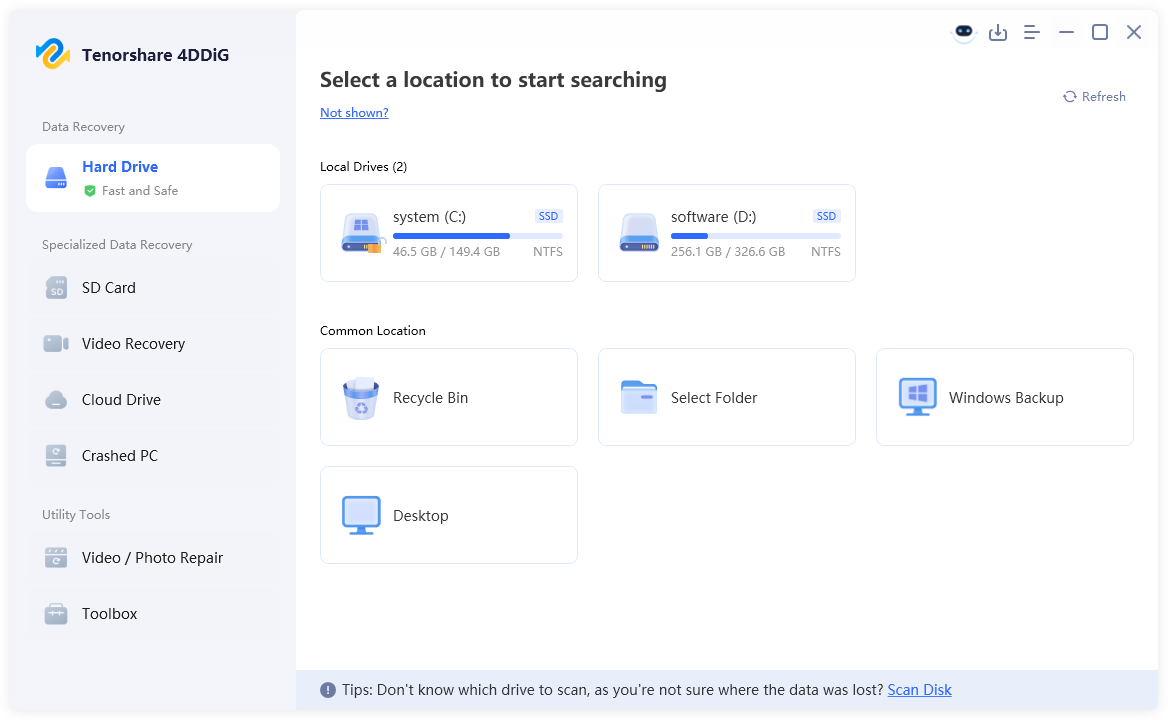
- First, install and run the Tenorshare 4DDiG data recovery tool on your Windows computer. From the list of detected storage devices, select the RAW drive from which you want to recover data, then click on “Scan” to begin the process.
- 4DDiG will perform a comprehensive scan of the RAW drive. Once the scan is complete, the software will display a list of recoverable files. You can use the built-in filters or the search box to quickly locate the files you are looking for.
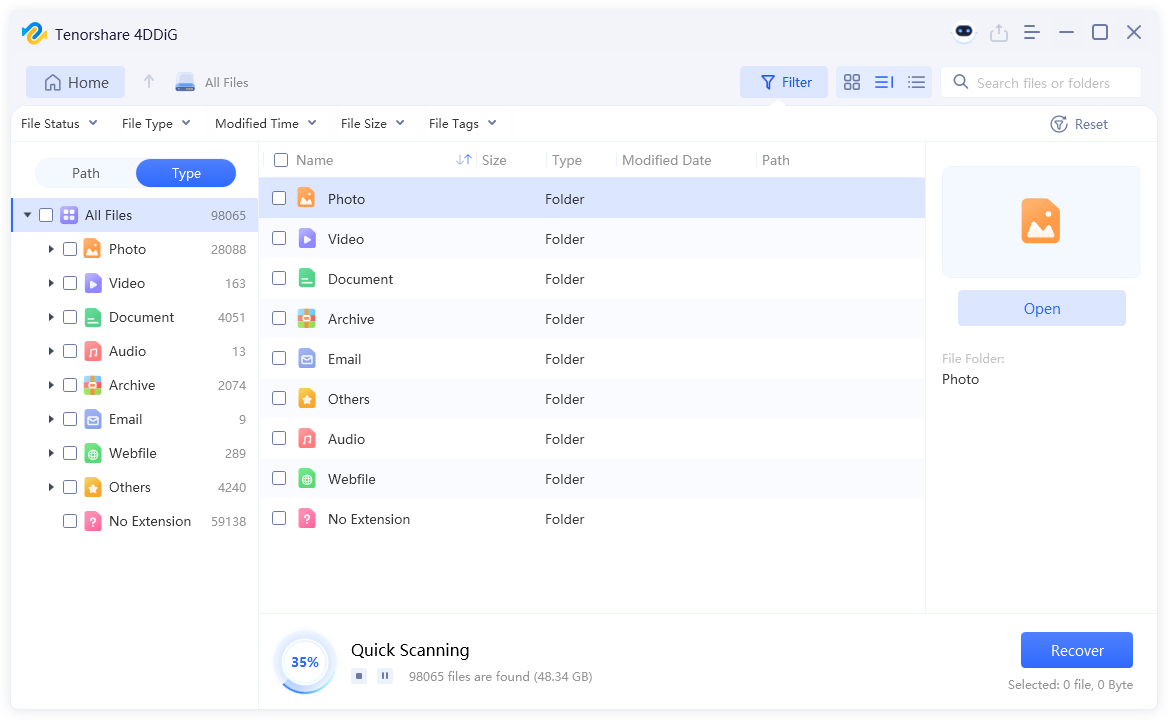
- Plus, you can use the preview feature to verify the integrity of the desired files. After confirming, select the target files and click the “Recover” button in the bottom-right corner. When choosing a recovery location, consider saving the files to a cloud storage service or another separate drive to avoid overwriting any remaining data on the RAW drive.
Step 3: Reformat the RAW Drive
Once your data has been safely recovered, it’s time to create a new, recognizable file system on the RAW drive. Fortunately, Windows offers several built-in tools to help you get the job done. Here’s how to convert your RAW drive to a normal one:
Use Disk Management
- Press Win + R, write diskmgmt.msc, and hit the Enter key. Then, locate the RAW drive in the list.
- If the drive shows as RAW, right-click it and select “Format.” Choose a proper file system, assign a drive letter, and confirm.
- However, if the drive appears as unallocated, right-click the unallocated space and pick “New Simple Volume.” Next, follow the wizard to create a new partition.
- Once completed, re-run CHKDSK on the problematic drive to check if the “CHKDSK is not available for RAW drives Windows 10” issue has been resolved.
Use DiskPart
- Start by running Command Prompt as an administrator.
- Type diskpart and press Enter to launch the tool.
- List all disks by typing list disk.
- Select the RAW drive using select disk X (replace X with the proper disk number).
- Clean the drive with clean.
- Afte that, run the create partition primary command.
- Type format fs=ntfs quick (or replace NTFS with exFAT) and hit enter.
- Finally, input exit to close DiskPart.
Final Words
Now you should no longer need to worry about the error message “The type of the file system is RAW. CHKDSK is not available for RAW drives.” By following the steps outlined in this post—checking for physical issues, recovering data, and restoring a new file system using Windows tools—you can safely regain access to your drive. Plus, remember to always back up your data regularly to avoid future surprises.

December 27, 2025
Link copied!
Copy failed!
TECHNOLOGY
You’re using your microwave wrong! Expert reveals why you should NEVER store items on top of the kitchen appliance


Whether it’s reheating a meal or popping some popcorn, many of us use our microwaves on a daily basis.
But it turns out you’ve probably been using your microwave wrong this whole time.
Many people store items on top of the kitchen appliance – including fruit bowls, paper towels, or cookbooks.
However, experts from Cookology have warned that this could prove dangerous.
‘If you’re in a smaller kitchen with limited surface space and a countertop microwave, it might be tempting to use the top of it for additional storage,’ they explained.
‘However, this can block the vents, causing them to overheat, leading to potential damage or even creating a fire hazard.’
To help ensure you’re using your microwave properly, Cookology has revealed the everyday mistakes you’re probably making.
From forgetting to stir to sealing containers too tightly, here are the top blunders – and how to prevent them.

Many people store items on top of the kitchen appliance – including fruit bowls, paper towels, or cookbooks. However, experts from Cookology have warned that this could prove dangerous (stock image)
‘Microwaves are brilliant tools when used properly, but we see the same mistakes again and again,’ said Andrew Wright, founder of Cookology.
‘People often treat them like a one–button solution, but a little know–how goes a long way in improving results and extending the life of the machine.’
1. Using unsafe containers
We all know that you can’t microwave anything with metal on it.
However, Cookology explains that it’s not just foil trims or twist ties that you need to keep an eye out for.
‘Microwaving plastic can also be a problem,’ the experts explained.
‘Plastic tubs that aren’t microwave–safe can leak chemicals into food, especially when heating fatty or oily dishes.’
2. Forgetting to stir or rotate

It’s essential to cover your food in the microwave – both for even cooking and to avoid messy splatters. However, make sure you don’t go to the other extreme and seal your containers too tightly (stock image)
While most microwaves now feature turntables, they don’t always heat food evenly.
That’s why it’s important you regularly pause the applicance to give your food a quick stir.
‘Stirring halfway through or rotating the dish ensures safer, more consistent results, especially important when reheating rice, meat or leftovers,’ Cookology said.
3. Sealing containers too tightly
It’s essential to cover your food in the microwave – both for even cooking and to avoid messy splatters.
However, make sure you don’t go to the other extreme and seal your containers too tightly.
‘It’s just as important to leave a small gap for steam to escape,’ Cookology explained.
‘Fully sealed lids can cause pressure to build up, which may lead to the container warping or the lid popping off.

Cleaning the microwave is a chore that many people dread. But according to the experts at Cookology, it’s essential for both hygiene and efficiency (stock image)
‘Even microwave–safe containers can become damaged if the lid is fastened too tightly.
‘For best results, cover your food loosely to keep heat and moisture in, but allowing it to safely vent.
4. Ignoring cleanliness
Cleaning the microwave is a chore that many people dread.
But according to the experts at Cookology, it’s essential for both hygiene and efficiency.
‘A dirty microwave absorbs more energy and cooks less efficiently,’ they explained.
‘Food splatters also increase the risk of unpleasant smells and smoke.’
However, it’s best to avoid cleaners containing bleach or other ammonia-based solutions.
‘In an enclosed space like your microwave, these can leave behind toxic fumes that can contaminate your food,’ Cookology added.
TIPS FOR AVOIDING GETTING FOOD POISONING
1. Keep a clean work space
Germs can survive across all of the different surfaces in the kitchen, so it’s essential to keep the cooking area and your hands clean.
2. Avoid cross-contamination
Raw meat, poultry, seafood and eggs can spread germs to ready-to-eat foods if not kept separate.
The CDC recommends using separate cutting boards and plates when handling these ingredients.
They should also be stored separately in the fridge.
3. Use a thermometer
To cook food safely, the internal temperature must get high enough to kill the germs that could cause food poisoning.
The correct internal temperature varies by ingredient, and only sure-fire way to tell if food is safely cooked is to use a food thermometer.
4. Store food properly
Storing food properly is essential to combating harmful bacteria.
Perishable food should be refrigerated within two hours of when it was purchased, and the refrigerator should be set to below 40°F.
5. Don’t rely solely on expiration dates
Expiration dates aren’t the only indication of when a food item should be thrown away.
If something seems to have a strange smell or colour, it’s probably better to be safe and pitch it.
6. Don’t thaw frozen food on the counter
Thawing frozen foods on the counter allows bacteria to multiply quickly in the outer parts as they reach room temperature.
Frozen foods should be thawed in the refrigerator, in cold water, or in the microwave.
TECHNOLOGY
‘It brings you closer to the natural world’: the rise of the Merlin birdsong identifying app | Birds

When Natasha Walter first became curious about the birds around her, she recorded their songs on her phone and arduously tried to match each song with online recordings. After a friend recommended Merlin Bird ID, a free app, she tried it in her London garden and was delighted to discover the birds she assumed were female blackbirds – “this is how bad a birder I was” – were actually song thrushes and mistle thrushes.
“I’m obsessed with Merlin – it’s wonderful and it’s been a joy to me,” says Walter, a writer and human rights activist. “This is what AI and machine-learning have been invented for. It’s the one good thing!”
Screenshots of the Merlin app in action. Composite: cornell.edu
Merlin is having a moment. The app, developed by the Cornell Lab of Ornithology in New York, which listens for birdsong and identifies the species singing, has been downloaded 33m times, in 240 countries and territories around the world. Britain has the second highest total number of users – more than 1.5 million in 2024, an 88% increase from 2023. Every month, there has been a 30% increase in new users of the app, whose sound identification function was launched in 2021.
Merlin has been trained to identify the songs of more than 1,300 species around the world, with more birds added twice a year. Different songs make distinct patterns on spectrograms and Merlin is trained to recognise these different shapes and attribute them to a species.
For latecomers to birding, or those lacking a knowledgeable friend, the app has become their teacher. “My fear at first was I wouldn’t actually learn because I’m outsourcing my understanding of birds to this app,” says Walter. “But that hasn’t come to pass. It’s helped me continue my journey of learning.” Nowadays, she guesses, and uses Merlin to confirm her hunches. “It’s wonderful if you’re coming to bird-watching late and don’t really have a mentor,” she says.
Angela Townsend from Bedfordshire began using Merlin after going on a nightingale walk one spring and being overwhelmed by the range of bird-voices in the evening chorus. She has found it has steadily built up her bird knowledge. “Warblers were just little brown jobbies but I can now recognise Cetti’s warblers and willow warblers when I’m out without having to put the app on,” she says.
Mary Novakovich, author of My Family and Other Enemies, is another recent adopter. She has found it particularly useful when travelling across Croatia, where her parents are from. “I love putting a name to a face and a name to the sound,” she says. “It really brings you closer to the natural world, rather than it being disconnected from your life. It’s part of what makes life a joy.”
Merlin is not flawless, however. The first time Kasper Wall, 12, tried it in his Norfolk garden, it detected a northern cardinal and a brown-headed cowbird – North American species not found in Britain.
“I think it was figuring out where we live,” says Wall, who enjoys using it even though he is now an extremely knowledgeable birder. “A couple of weeks ago we were looking at a large group of goldcrest and it came up with a firecrest. I thought, ‘Oh, there must be a firecrest in here too’ and 30 seconds later we saw one, which was the first I’d ever seen. I like it and it’s very good but I wouldn’t say that it’s better than the best people at identifying bird-calls like [the naturalist] Nick Acheson. It can definitely be fooled.”
Wall enjoys fooling Merlin with his uncanny impressions of a curlew, barn owl and greenshank.
Acheson doesn’t use Merlin. He welcomes it, but points out it can replace learning. “Anything that gets people out, thinking about and reacting to nature is a great thing,” he says. “But there’s certainly a risk that people don’t learn and just abdicate responsibility for learning to Merlin.”
He has noticed a glitch where Merlin interprets a certain type of chaffinch call as a redstart, leading to people being absolutely adamant that there is a rare bird in their garden. “There’s no substitute for a real person explaining to you how a birdsong feels and encouraging someone to engage with it emotionally,” he says.
John Williamson, who works as a guide for Norfolk Wildlife Trust, has found Merlin repeatedly identifying high-pitched calls as a spotted flycatcher, a bird that is very unlikely to be found in the middle of Hickling Broad nature reserve’s large reedbeds. “Merlin can’t do habitat,” he says.
Merlin has also excited visitors by identifying a golden oriole, a very occasional rare migrant, in Hickling woods, but no one has actually seen the species. Williamson is convinced it is misinterpreting a fairly unusual “catcall” of a female jay, a common woodland bird.
That said, Williamson finds it a “good tool” and welcomes how it is encouraging new people to enjoy birdsong, and particularly its mental health benefits. He knows one person who suffers from acute anxiety but Merlin has got him out into the world again and into nature, providing a focus for calming trips outdoors. “I find it impressive that an app can empower people to go out into nature,” he says.
Research has found that birdsong is particularly beneficial to mental health, and has a lasting positive impact on wellbeing. For millions around the globe, that’s exactly what Merlin is doing.
“It reminds you that there are birds knitted into your daily life,” says Walter. “It’s not about, ‘now I’m going to do a bit of birdwatching’, you may simply be walking through the park and you hear something and it gives you a sense that these birds are singing away all the time, even in London.”
TECHNOLOGY
Eat a burger a week to help save the planet, scientists say in ‘vegan-annoying announcement’- because ‘some meat is environmentally good’

Scientists have found eating one burger a week – rather than cutting meat out of people’s diets altogether – could be ‘environmentally good’ for the planet.
Academics at the University of Edinburgh found that cutting meat consumption down by a whopping 90 per cent in the UK would dramatically reduce harmful greenhouse gases produced by raising cattle.
But giving meat up altogether could have a negative impact on the UK’s biodiversity – because insect and butterfly populations, needed to feed birds and bats, are greatly sustained by cow dung.
Researchers found for example that the manure produced by a single 700kg cow can nurture enough insects to feed 30 swallows.
Alfy Gathorne-Hardy at the University of Edinburgh told The Times: ‘The normal way we look at meat production is saying, “how much can we afford within our environmental limits?”
‘And what we’ve been realising is some meat has a really clear positive role to play.
‘That’s why we’re trying to change the narrative from “how much can we afford” to “how much do we need”.
Mr Gathorne-Hardy admitted the finding that ‘some meat is environmentally good’ would be ‘annoying’ to vegans.

Scientists have found eating one burger a week – rather than cutting meat out of people’s diets altogether – could be ‘environmentally good’ for the planet

Researchers found that the manure produced by a single 700kg cow can nurture enough insects to feed 30 swallows
He also risked the ire of farmers by suggesting 4million of the current 13million hectares used for beef production could be used to grow beans instead, in a bid to reduce levels of methane, a greenhouse gas emitted by cows and sheep.
His research aimed to discover the optimum number of cow pats needed to sustain biodiversity.
The research also found that bats – which were recorded on infra-red cameras during night hours – were four times more likely to feed in fields with cow dung than in cow-free fields.
They were 12 times more likely to visit the field if cows were also present.
The University of Edinburgh’s findings add to a body of research that supports the argument consuming smaller quantities of meat could have environmental benefits.
Share or comment on this article:
Eat a burger a week to help save the planet, scientists say in ‘vegan-annoying announcement’- because ‘some meat is environmentally good’


In 2025, we published 37 editions of the Digital Nomads column. We spoke to diasporan African professionals across tech, finance, law, privacy, venture capital, and a growing class of location-independent workers who move frequently.
The internet often describes the world as a ‘global village.’ In practice, borders are less fluid, limiting movement for many in the Global South. Job applications still filter by geography. At embassies, in job interviews, Africans still need to make a painstaking case for why they deserve access and opportunities to build a life away from home.
If 2025 taught us anything, it’s not that the system has become fairer, but that Africa’s workforce have become more deliberate. Mobility requires planning, capital, loads of paperwork, and trade-offs. The location-independent lifestyle rarely happens by chance, especially for average earners.
If you’re thinking about global mobility in 2026, here are a few rules and lessons to keep in mind as you plan:
Rule 1: Nobody just travels
Movement begins long before the airport. It starts with sorting visa hassles, flight routing, and housing math. It involves choosing where to be based not on aesthetics, but on access.
Many African founders we spoke to moved abroad with a clear purpose. In our reporting on first-time African founders going global, two founders relocated to cities where investors, accelerators, and partners were concentrated, while keeping teams and markets rooted on the continent. In that instance, travel became directional, not exploratory.
Amaka Amaku’s experience shows how intentional this can be. By securing a Benin passport, the Nigerian travel content creator unlocked visa-free movement across several French-speaking countries in West Africa and parts of Europe. That single document changed how easily she could move, who she could meet, and which opportunities were worth pursuing. Mobility was no longer constrained by Nigerian passport limitations. It became a tool she could deploy.
Other nomads structured their lives around hubs. One digital nomad we reported on used Dubai as a base to explore other regions in Southeast Asia. The city’s residency options, flight connectivity, and tax structure made it a practical launchpad for frequent work and pleasure trips, he told us in September. In 2025, travel still requires budgeting and planning, but having a stable base reduces friction.
Get The Best African Tech Newsletters In Your Inbox
Rule 2: Visas are career infrastructure
The most ambitious professionals we encountered plan visas the way others plan promotions. Skilled worker permits. Digital nomad visas. Investor pathways. Each option comes with constraints that quietly shape careers.
Skilled worker visas across several countries open a clear path to residency abroad, but some of them can also be distressing. Our reporting captured this through the experience of a tech worker who relocated to the UK from Rwanda after securing a role at a global tech company. When he was laid off in early 2025, his job loss immediately became an immigration emergency. His visa was tied to his employer. Without a new sponsor, he had 60 days to leave the UK.
After weeks of interview runs and crippling uncertainty, he eventually secured a job and another sponsor.
Several other visa types also opened access to career upgrades. The most common one we saw was the student visa. Several African nomads, including Mark Irozuru (a UK-based DevOps engineer), Motunrayo Adebayo (a US-based tech privacy analyst), Oghenerukevwe Odjugo (an Australia-based equity analyst), and Jephte Ioudom Foubi (a tech consulting business owner in Portugal), all of whom we spoke to, relied on these visa types to access global markets. These visas became launchpads for their global careers.
Digital nomad visas also became more sought-after, especially in countries like South Africa. In countries rolling out these visas and adjacent entrepreneurship programmes, location-independent workers could live legally without employer sponsorship, provided they meet income thresholds. It unlocked Western influx into countries like South Africa and opened access to East African countries, such as Kenya and Rwanda, attracting tech workers from other countries on the continent.
Investor mobility routes served yet another purpose. Founders and investors tapped business-grade visas to access global markets like the US.
Rule 3: Remote work did not erase inequality
Global hiring specialists told us plainly that location still plays a major role in how Africa-based remote workers are paid and levelled. Remote roles may be global, but compensation bands often remain regional. Africans working remotely from the continent frequently earn less than peers doing identical work elsewhere, though a few still break through the ceiling.
Migration does not automatically fix this. Several recruiters noted that it is common for African professionals relocating abroad to accept lower titles or pay cuts to re-enter competitive markets. For example, a senior developer taking mid-level roles, or a DevOps specialist stepping back, because their experience does not yet include large-scale AI infrastructure or hyperscale cloud systems common in Western firms.
African tech professionals who break through these ceilings, either working remotely from Africa or migrating abroad, do so by stacking scarce skills, building visible track records, or positioning themselves in roles where credibility outweighs location. Others combine migration with targeted upskilling, accepting short-term regressions to unlock longer-term mobility. The ceiling exists, but it is not absolute.
Rule 4: Less-crowded paths unlock new careers
Everyone doesn’t compete in the same lane.
As global tech roles became saturated, some professionals deliberately moved sideways into emerging or underserved fields. Tech privacy is one such path. Evolving regulatory complexity, compliance demands, and jurisdictional nuance created a space for specialists who could operate across borders.
Motunrayo Adebayo’s career illustrates this shift. Her move into tech privacy was not about escaping inequality or competing harder. It was about choosing a lane where demand outpaced supply. As privacy regulations tightened globally, her expertise became portable. The work travelled easily across jurisdictions, and her career expanded with it.
In 2025, two global recruiters told us that niche roles in demand are great relocation opportunities for skilled African professionals willing to specialise, particularly in markets like site reliability engineering (SRE), cloud and AI systems, and other unique roles in growing sectors, like pet-tech.
Rule 5: Africa remains the market
Leaving home does not mean disengaging.
Founders building for African markets quickly learned that distance creates blind spots. Cultural nuance, regulatory interpretation, and user behaviour cannot be fully abstracted. Successful operators built structures to stay close.
Oluwaleke Fakorede’s approach with GoWagr, a startup that allows users to predict real-life outcomes and earn money, made this explicit. Fakorede moved to the US on the H-1B visa before transferring to the O-1, setting him on a path to permanent residency. Yet while operating from the US, leadership remained split across geographies. Decision-making stayed anchored in Nigeria through his co-founders, who understood local behaviour, payments, and regulatory ambiguity.
The goal was not to return permanently, but to remain informed continuously.
Get The Best African Tech Newsletters In Your Inbox
Milton Tutu, whose marketing career led him to settle in three African countries within five years, emphasises this. Tutu set up the groundwork for Selar’s expansion into Kenya in 2024 and relocated to the country in the same year. He says, “There is nothing as good or better than being present in the markets that you want to expand to.”
You can change countries as a nomadic African founder, but you cannot outsource context. The same is true when investing in Africa, especially as a foreign investor coming to the market. Global mobility plays a huge role in how these firms invest, and several investors who spoke to us said they only commit capital after spending significant time on the ground, building local relationships, and understanding regulatory nuances that cannot be learned from pitch decks or short visits.
For them, mobility is not about flying in and out. It is about being present long enough to see how deals actually work, who makes decisions informally, and where risks and opportunities really sit in Africa’s tech ecosystem.
Rule 6: The goal is choice
Across these stories, one pattern held. Global mobility is about control and stacking up choices for longterm careers, lifestyle, and access.
Some people moved to access opportunities. Others moved so they could decide when not to. Digital nomad visas, investor routes, second passports, and hybrid careers expanded the menu of options, but none removed the need for planning.
Adebayo Aderohunmu’s journey reflected this clearly. His mobility was slow, intentional, and designed around sustainability rather than speed. Travel supported his work. It did not replace it.
Mobility today is not an identity. It is a hedge. A way to reduce dependence on a single labour market, passport, or system.
For Africans building global careers now, the work is not about being everywhere. It is about being able to choose where to be and when.
We would love to hear what you think about this edition of Digital Nomads and stories you’d love to see us explore. Share your thoughts and ideas with us here.

Apple is seeking to overturn a landmark £1.5bn court ruling on behalf of millions of UK customers, which found the company overcharged them for years in its App Store.
The iPhone maker has applied to the court of appeal to challenge a verdict that campaigners heralded as the start of a “tidal shift against big tech”.
It is one of a cluster of cases heading towards trial in 2026 as consumers realise the mounting cost of paying up to 30% commission – what campaigners call the “Apple tax” – on apps and in-app purchases, which more people rely on for activities from fitness to dating.
The appeal, if allowed, involves one of several class action suits against Apple and Google in which consumers, small businesses and entrepreneurs are demanding over £6bn in combined compensation. The class action cases use an opt-out system that means millions of people can be represented at once in claims of breaches of competition law.
“It’s definitely a tipping point,” said Dr Rachael Kent, an academic at King’s College London who won the £1.5bn case against Apple on behalf of 36 million UK consumers. “People are pushing back against the harms from digital worlds, which they have to be living in and through every day and the financial implications of that,” she said.
Apple said most apps are subject to a 15% commission, and the App Store helps drive the UK’s digital economy. Photograph: Jakub Porzycki/NurPhoto/Shutterstock
Kent added that the win in October still felt “a bit pinch me”. If Apple’s appeal fails, every person in the UK who made App Store purchases between 2015 and 2024 could be entitled to a payout.
In the suite of class action cases, Apple and Google are accused of overcharging British consumers and developers in their app stores and, in the case of Apple, of “trapping” and overcharging customers with its iCloud data storage service.
Instead of up to 30%, Apple should be charging commission of 17.5% when selling apps and 10% on in-app purchases, while app developers should pay 10%, the competition appeal tribunal found in Kent’s case.
Another of the cases is being brought by Barry Rodger, a law professor at the University of Strathclyde, on behalf of more than 2,000 app developers who he argues are collectively entitled to up to £1bn in compensation.
“Small and medium-sized app developer businesses have suffered as the result of excessive profiteering by the App Store and Google Play,” he said. His case alleges Google Play has charged “excessive, arbitrary and discriminatory commissions” against developers, with the makers of dating and games apps particularly affected.
His suit is expected to reach trial at the competitions appeal tribunal in October 2026, and will be jointly managed with a claim for about £1bn on behalf of 19 million Google Play customers, who are alleged to have been overcharged. That case is being brought by the consumer activist Liz Coll and accuses Google of “excluding competition and/or charging an unlawfully high level of commission on digital purchases”, breaching competition law.
Coll said: “These types of large collective proceedings are new in the UK, but I’m really excited about the potential of the Kent decision to not only make people aware they were paying too much for apps through opaque commission but also that there is now a clear route to getting that put right. Where we need consumers to get really active now is in claiming back the money they’re owed.”
A Google spokesperson said: “Android provides more choice than any other platform and our fees are the lowest of any major app platform. We’ll defend these cases vigorously.”
A class action has also been brought on behalf of Google Play customers. Photograph: Issei Kato/Reuters
Google argues that the class action cases seek to upend a system that has lowered prices and increased choice and that, if successful, would make downloading and using apps on Android phones more complicated and less safe.
And in the largest of all the claims, November saw the consumer campaign group Which? announce a £3bn claim against Apple over its iCloud services, claiming it is “trapping” customers with Apple devices into using it.
Apple called the Which? claims unfounded and said no customers are required to use iCloud. The company said it strongly disagrees with the ruling in Kent’s case over the App Store, and the tribunal took a flawed view of the “thriving and competitive app economy”, with other platforms providing “vigorous competition”. It said most apps are subject to a 15% commission, and the App Store helps drive the UK’s digital economy, facilitating billings and sales of over $55bn (£41bn) in the UK in 2024.
Kent said that people are “waking up to the harms of digital life and how it can be detrimental mentally, physically and financially”.
“There is a tidal shift that is happening against big tech,” she said. “Consumers are looking at all of the tools that they have to use every day. Covid really accelerated our reliance on technology and many of us went from using five apps in a week to perhaps 10 apps in a day to manage food shopping, food delivery, retail, fitness and diet tracking, keeping in close communication with friends and family, much more social media, increased screen time.
“A big part of the last six years working the case has been about educating people that this is actually happening. That’s what tech giants and marketeers like Apple are so brilliant at. It’s creating an ecosystem where we are foreclosed into decision making and we don’t even realise that this is actually how it’s happening.”
TECHNOLOGY
Is this proof that Noah’s Ark really did exist? Pottery fragments found near last resting place of biblical boat suggest region WAS settled by humans at time of Great Flood
Ceramic fragments found near a site believed to be the last resting place of Noah’s Ark could prove the biblical boat really did exist.
Prof. Dr Faruk Kaya of Agri Ibrahim Cecen University said the pieces were found close to the alleged Ark outline at the Dogubayazit site on Turkey’s Mount Ararat, according to Turkish media.
The fragments were uncovered during road construction near the Durupinar Formation in Agri province, a boat-shaped geological structure that has been at the centre of Noah’s Ark claims for decades.
Academics involved in the research said the ceramic material points to human activity in the region during the Chalcolithic period, roughly between 5500 BC and 3000 BC, a timeframe that some scholars and believers associate with the era traditionally linked to the Biblical figure of Noah.
Prof Dr Kaya said: ‘The ceramic fragments show that there was human activity in this region during the Chalcolithic period, between 5500 and 3000 BC.’
The fresh revelations have also prompted renewed calls for the site to be formally protected, amid concerns that visitors are removing stones and fragments as souvenirs.
Prof Dr Kaya said: ‘This formation and its surroundings must be protected, and the removal of stones, rocks or similar material from the site must be prevented.’
He warned that tourists had been taking material from the area, including stones bearing markings, potentially damaging what researchers believe is an important archaeological and religious heritage site.

Ceramic fragments found near a site believed to be the last resting place of Noah’s Ark could prove the region was settled by humans at the time of the Great Flood

The fragments were uncovered near the Durupinar Formation in Agri province, a boat-shaped geological structure that has been at the centre of Noah’s Ark claims for decades

Prof Dr Faruk Kaya (pictured), of Agri Ibrahim Cecen University, said the pieces were found close to the alleged Ark outline at the Dogubayazit site on Turkey’s Mount Ararat, according to Turkish media
The Durupinar Formation was first identified on 11th September 1959, by Captain Ilhan Durupinar, a Turkish surveying engineer who spotted the structure while mapping eastern Anatolia from an aircraft operated by the Turkish Armed Forces.
Heavy rain and earthquakes later eroded surrounding earth, exposing more of the formation’s outline.
The structure has long drawn attention because of its boat-like shape and its proximity to Mount Ararat, Turkey’s highest peak, which has been associated with the Ark in Christian tradition for centuries.
The Bible’s Book of Genesis states that Noah’s Ark came to rest on the ‘mountains of Ararat’ after a flood that submerged the Earth for 150 days.
Biblical measurements describe the Ark as 300 cubits long, 50 cubits wide and 30 cubits high, dimensions that some researchers argue broadly correspond to the scale of the Durupinar site.
Prof Dr Kaya said the dating of the pottery broadly aligned with traditional estimates of Noah’s lifetime.
He said: ‘This period roughly coincides with the time in which Prophet Noah is believed to have lived.’
Scientific interest in the area has intensified in recent years.
The Mount Ararat and Noah’s Ark Research Team was formally established in 2022 through a collaboration between Agri Ibrahim Cecen University and Istanbul Technical University, bringing together experts in geophysics, chemistry and geoarchaeology.
Rock and soil samples collected from the formation were analysed in laboratories at Istanbul Technical University.
Researchers said the results indicated that sustained human life in the region was possible from the Chalcolithic period onwards, adding further basis to the claim that it could be the real-life Biblical site.
The pottery fragments discovered during the recent roadworks are being viewed as a notable development, as ceramics are widely regarded by archaeologists as one of the clearest indicators of human settlement.
Prof Dr Kaya said: ‘There is no other structure like this identified anywhere else in the world,’ describing the formation as unique in both scale and shape.
He also raised concerns about natural threats to the site, warning that landslides – particularly during spring rains – were eroding both sides of the formation and accelerating damage.
As part of wider preservation efforts, Prof Dr Kaya suggested that a dedicated Noah’s Ark museum or research centre should be established near Mount Ararat, arguing that similar themed attractions already exist in countries such as the United States, the Netherlands and Hong Kong.
MOUNT ARARAT
Many believe that Turkey’s Mount Ararat, the region’s highest point, is where the Noah’s Ark and its inhabitants came aground thousands of years ago.
In 2010, a group of Chinese and Turkish evangelical explorers set out on an expedition to explore the region and find the vessel’s remains.
After a few weeks, they claimed to have found wooden specimens from an ark-like structure 4,000m (13,000 ft) up the mountain.
The team claimed they carried out carbon dating on the wood, which proved it was 4,800 years old, around the time the Ark is said to have been afloat.
Although considered a historical event, most scholars and archaeologists do not believe in a literal interpretation of the Ark story.
Nicholas Purcell, a lecturer in ancient history at Oxford University told MailOnline the claims were the ‘usual nonsense’.
‘If floodwaters covered Eurasia 12,000ft [3,700 metres] deep in 2,800BC, how did the complex societies of Egypt and Mesopotamia, already many centuries old, keep right on regardless?’
Talking back in 2010 when the claims were first made, Mike Pitt, a British archaeologist, said the evangelical explorers had yet to produce compelling evidence.
He said: ‘If there had been a flood capable of lifting a huge ship 2.5 miles [4km] up the side of a mountain 4,800 years ago, I think there would be substantial geological evidence for this flood around the world. And there isn’t.’