
TECHNOLOGY
Psychic Baba Vanga’s chilling 2025 prediction feared come true in DAYS during major televised event


A blind psychic, who allegedly foretold 9/11 and the Covid-19 pandemic, may be just days away from having another world-changing prediction be proven right.
Baba Vanga, who died in 1996, was a Bulgarian mystic and clairvoyant who became a cult figure among conspiracy theorists after several of her eerie pronouncements were proved true.
Now, a prophecy for 2025 which predicted that humans would make contact with alien life this year has been directly tied to a still unknown globally televised event.
With just days left in the calendar year, the options for what this spectacle could be have been whittled down to the ongoing Africa Cup of Nations football (soccer) tournament and worldwide celebration of New Year’s Eve.
Specifically, the mystic’s vision described a UFO that would appear like a ‘new light in the sky’ over the unnamed event, allowing humanity to meet extraterrestrials for the first time – bringing the world answers instead of fear.
Baba Vanga left no written records of her predictions. Most of the accounts come from her niece, Krasimira Stoyanova, or other followers who documented her alleged visions after her death, and who have been accused of misinterpreting what she said.
While the prophecy has been interpreted to take place during a major sporting event, there has never been evidence Baba Vanga was talking about some sort of sports contest, such as the Super Bowl, World Series, or recent FIFA World Cup ceremony.
The Africa Cup of Nations runs through January 18, 2026 and is viewed by approximately two billion fans in over 180 territories globally. Meanwhile, New Year’s Eve broadcasts are watched by millions in every time zone on Earth.

Baba Vanga (Pictured) was a Bulgarian mystic and clairvoyant who became a cult figure among conspiracy theorists after she was credited with predicting the 9/11 terror attacks and COVID-19 pandemic

One major televised event taking place as 2025 comes to an end is New Year’s Eve
The last failed attempt at fulfilling the 2025 vision came on December 5, when many on social media speculated that the tournament drawing of the 48 qualified World Cup teams, which was watched by billions worldwide, could count as the event.
The World Cup ceremony was likely the most watched television event this month, making it a missed opportunity for the late Bulgarian mystic to be correct before the calendar turns to 2026.
Although the 2025 prediction was left vague, those who have interpreted Baba Vanga’s prophecy believe the light clearly refers to an extraterrestrial spacecraft appearing over the sports venue.
Some on social media have claimed that Baba Vanga’s prediction has already come true, thanks to the passage of the mysterious interstellar object 3I/ATLAS, which made its closest pass by Earth on December 19.
NASA and other astronomers have concluded that the object is a lifeless comet, but many in the public, including at least one distinguished researcher, still believe 3I/ATLAS could be an extraterrestrial spacecraft.
There has also been speculation that the light in Baba Vanga’s vision could refer to a meteor shower, the Northern Lights, or the expected supernova of T Coronae Borealis Nova 3,000 light years away, which would be visible from Earth.
Many believers thought this event would take place during the Super Bowl in February, which is one of the most viewed television events annually, but that did not happen.
Still, Baba Vanga’s track record as a seer of future events rivaled the centuries-old reputation of Nostradamus.

A stargazer’s brand new image interstellar object 3I/ATLAS. Baba Vanga is said to have predicted a ‘new light in the sky’ appearing over a major sporting event in 2025
She is credited with predicting the destruction of the Russian submarine Kursk, which sank in the Barents Sea in 2000.
Baba Vanga also said that ‘two metal birds will crash into American brothers, and blood will spill,’ which believers said accurately described the 9/11 terror attacks.
Other prophecies that came true include the 2004 Indian Ocean tsunami that killed over 230,000, the election of Barack Obama in 2008, and the rise of the Islamic terror group ISIS in 2010.
Baba Vanga even foretold her own death correctly, revealing that she would die on August 11, 1996 at the age of 85.
However, there have been several misses along the way, including a prediction that there would be a nuclear war from 2010 to 2016.
She also is said to have incorrectly predicted that Europe would be deserted by 2016 after many wars and chemical attacks, and that several world leaders would be assassinated during the same year in the 2000s.












For the last few years, I wore either an analog watch or Xiaomi Band 6 for basic step tracking and time. I didn’t opt for an Apple Watch because I wasn’t constantly active, I didn’t feel the need to check my notifications, and I didn’t want to think about charging the watch every day.
This year, I got a chance to test the new Google Pixel Watch 4, which made me feel like I might start wearing smartwatches again.
I have always had a soft spot for circular watches. One of the first smartwatches I owned was the Moto 360, and I loved its rounded design.
The Pixel Watch 4 has a curved domed Actua 360 display with thinner bezels as compared to last year’s watch. I have the 41 mm watch as the test unit, but I would personally opt for the 45mm size for battery and a bigger display. The display is also brighter with 3,000 nits of peak brightness, and that makes it easier to use in daylight.
The battery life is great on the Pixel Watch 4, even with the smaller size. I have managed to get more than a day’s use out of the watch on those days when I have lighter activities.
Image Credits: Ivan Mehta
Though the Pixel Watch 4 has a proprietary charger where you can place the watch on the cradle like a puck, the charging speed makes up for it.
Google advertises that you can charge this watch from 0% to 50% in 15 minutes and from 0% to 100% in 45 minutes. While the real-life timing doesn’t exactly match these numbers, I saw charging times that came close to these figures. The advantage of this rapid charging is that you can always put your watch to charge when you are making a coffee or doing a quick chore within the house, and get enough juice to last you throughout the day.
Techcrunch event
San Francisco
|
October 13-15, 2026
Fitness and software
I largely used the Google Pixel Watch 4 to track my pickleball sessions and walking. Apart from calorie burns, there were no particular insights into sports-related movement. For the last 15 days, I started going to a gym, and apart from the treadmill and elliptical mode, there aren’t any specialized modes for particular gym equipment. Instead, you have to select from options for things like core training, weights, or a general workout mode, based on the workout you are doing.
The watch does have more features for someone who runs — but that’s not possible in Delhi weather with terrible AQI right now. It also detects cardio workouts after 15 minutes of continuous activities, but while walking, these have been hit or miss for me. Another measure that has been off for me has been floor count. On days, I’ve walked to a cafe, I’ve seen a very high count for that, and on days I have gone up to my terrace multiple times, the number of floors climbed is incorrect.
I am not someone who used to wear my watch or band to sleep. With the Pixel Watch 4, I had to mentally train myself to keep the watch on so I could get a better understanding of sleep and readiness scores. After a few weeks of usage, I regularly wore my watch to sleep. However, you don’t get additional or actionable insights related to sleep or readiness score on the watch in the daily summary. You do get suggestions on the Fitbit app related to readiness, but that’s about it. With fitness apps adding more AI to their apps, Google needs to step up its game.
 Image Credits: Screenshot by Techcrunch
Google’s new Material UI design for the watch is refreshing and matches the theme on my Pixel Fold. The weather app is very nice to look at for both hourly and day forecasts. My one gripe is that I wish the exercise app allowed for more than three kinds of workouts to be available through quick start. I could raise my watch to talk to Gemini, which is neat, but beyond starting timers, asking for occasional sports updates, and starting a workout, I have not needed Gemini to be ever-present for me.
I have been a fan of the recent Pixel Watch 4 update that lets me use the pinch gesture to dismiss notifications, play or pause videos or music, or even move my wrist to dismiss calls.
The gripes I had about the watch didn’t bother me in daily usage. The display is fantastic, the software and fitness experience overall are great, and the display, along with the new design, is an upgrade from the last generation. However, the thing that drew me the most to the watch and made me stick to it is the combo of battery life and fast charging.
All in all, the Pixel Watch 4 is one of the best Android smartwatches around.

Nvidia is, in crucial ways, nothing like Enron – the Houston energy giant that imploded through multibillion-dollar accounting fraud in 2001. Nor is it similar to companies such as Lucent or Worldcom that folded during the dotcom bubble.
But the fact that it needs to reiterate this to its investors is less than ideal.
Now worth more than $4tn (£3tn), Nvidia makes the specialised technology that powers the world’s AI surge: silicon chips and software packages that train and host systems such as ChatGPT. Its products fill datacentres from Norway to New Jersey.
This year has been an exceptional one for the company: it has struck at least $125bn in deals, ranging from a $5bn investment into Intel – to facilitate its access to the PC market – to $100bn invested in OpenAI, the startup behind ChatGPT.
But even as those deals have fuelled surging stock prices and paved the way for chief executive Jensen Huang’s energetic world tour, doubts have emerged about how Nvidia does business, especially as it has become increasingly central to the health of the global economy.
The start of these concerns has been the circular nature of many of its deals. These arrangements resemble vendor financing: Nvidia lending money to customers so they can buy its products.
The largest of these is its deal with OpenAI, which involves Nvidia investing $10bn into the company each year for the next 10 years – most of which will go to buying Nvidia’s chips. Another is its arrangement with CoreWeave, a company that provides on-demand computing capacity to big AI firms, essentially leasing out Nvidia’s chips.
The circularity of these deals has drawn comparisons with Lucent Technologies, a telecoms company that also aggressively lent money to its customers, only to overextend itself and unravel in the early 2000s. Nvidia has aggressively rebutted suggestions of any similarity, saying in a leaked recent memo that it “does not rely on vendor financing arrangements to grow revenue”.
The tech investor James Anderson has expressed concern about Nvidia’s deal with OpenAI. Photograph: Murdo MacLeod/The Guardian
James Anderson, a renowned tech investor, describes himself as a “huge admirer” of Nvidia, but said this year that the OpenAI deal presented “more reason to be concerned there than before”.
He added: “I have to say the words ‘vendor financing’ do not carry nice reflections to somebody of my age. It’s not quite like what many of the telecom suppliers were up to in 1999-2000, but it has certain rhymes to it. I don’t think it makes me feel entirely comfortable from that point of view.”
Other high-profile recent deals include the tech firm Oracle spending $300bn on datacentres for OpenAI in the US – with the ChatGPT developer then paying back roughly the same amount to use those datacentres. In October, OpenAI and the chipmaker AMD signed a multibillion-dollar chip deal that also gave OpenAI the option to buy a stake in the Nvidia rival.
There is also a deal with CoreWeave where, along with a commitment to buying $22bn of data centre capacity from the cloud provider, OpenAI is receiving $350m in CoreWeave stock. Asked this month about circularity in the AI industry, the chief executive of CoreWeave, Michael Intrator, said: “Companies are trying to address a violent change in supply and demand. You do that by working together.”
All these moves form part of OpenAI’s $1.4tn bet on computing capacity to build and operate models that, it argues, will transform economies – and make back that expenditure. OpenAI argues that, while the Nvidia and AMD deals have an investment component, it only kicks in once the chips have been bought and deployed, while the investments themselves create aligned incentives to build out AI infrastructure at huge scale.
Graphic showing the companies Nvidia has deals with and the types of deals they are
Nvidia has also used structures called special-purpose vehicles (SPVs) in financing deals. The best-known example is the SPV linked to Elon Musk’s xAI: an entity into which Nvidia invested $2bn, money that will be used to buy Nvidia’s chips.
This drew comparisons with Enron, which used SPVs to keep debts and toxic assets off its balance sheets, convincing investors and creditors that it was stable while concealing ballooning liabilities.
Nvidia has also strongly denied that it is like Enron: in the same leaked memo where it discussed Lucent, it said its reporting was “complete and transparent” and “unlike Enron” it “does not use special-purpose entities to hide debt and inflate revenue”.
The journalist Ed Zitron, a noted sceptic of the AI boom, agrees that Nvidia is not like either company. Unlike Lucent, it does not appear to be taking on a great deal of debt to finance its circular deals, he says, and most of the customers it is supporting are not as obviously risky as Lucent’s dotcom bubble partners. And it isn’t like Enron, Zitron argues, because it’s being fairly transparent about its own complex, off-balance sheet deals.
So what could warrant a comparison? Nvidia “is not hiding debt, but it is leaning heavily on vendor-financed demand, which creates exposure if AI growth slows,” says Charlie Dai, an analyst at the research firm Forrester. “The concern is about sustainability, not legality.”
Essentially, whether Nvidia is able to stick the landing depends on whether AI really takes off, generating billions for its corporate users and putting companies such as OpenAI, Anthropic and CoreWeave – Nvidia’s customers – firmly in the black, and able to keep buying its systems. That possibility alone is debatable. If this does not happen, says Dai, Nvidia “could face write-downs on equity stakes and unpaid receivables”: meaning, it could lose a lot of money and its stock price could then tank.
Approached for comment, an Nvidia spokesperson referred the Guardian to remarks its chief financial officer, Colette Kress, made to investors in early December. Kress said they were not seeing an AI bubble, instead gesturing at trillions of dollars of business that lie ahead for Nvidia in the next decade.
In particular, Kress argued that Nvidia’s recent – massive – deals are just the start for the company, and the real money will be made in the coming years, largely through replacing almost all the chips in existing datacentres with its products.
There is another complexity, which is that Nvidia’s health – and therefore the health of the entire global economy – also depends on whether AI takes off in time for Nvidia and its customers to service the debt from their huge datacentre buildouts and significant capital expenditures.
Huang signs autographs at a summit in Gyeongju. Nvidia’s deal with the South Korean government is estimated to be worth billions of dollars. Photograph: Lee Jin-man/AP
Add to this a final category of concern: recent, big-ticket deals with countries such as South Korea and Saudi Arabia, worth multiple billions of dollars, whose terms are opaque. In October, Nvidia said that it would supply 260,000 of its Blackwell chips to South Korea’s government and South Korean companies. The value of this deal was not disclosed, but is estimated to be in the billions.
Likewise with Saudi Arabia. Its government-owned AI startup, Humain, has committed to deploying up to 600,000 Nvidia chips: when that deployment will involve actual purchases, and at what price, is again undisclosed. Nvidia has a number of other strategic partnerships like this – with Italy, with the French AI champion Mistral and with Deutsche Telekom, for example – all involving thousands of chips and unknown sums.
Governments are likely to pay. There’s nothing circular about a sovereign partnership with Germany. But the deals mean more – quite large – uncertainties nested within a straining web of commitments that require massive capital outlay, and rely on ambitious assumptions about the economy undergoing a revolution in the next years.
“They concentrate risk in a few big customers,” says Dai. “If execution delays occur, Nvidia’s revenue recognition and cashflow could be affected.”

There is much anxiety these days about the dangers of human-AI relationships. Reports of suicide and self-harm attributable to interactions with chatbots have understandably made headlines. The phrase “AI psychosis” has been used to describe the plight of people experiencing delusions, paranoia or dissociation after talking to large language models (LLMs). Our collective anxiety has been compounded by studies showing that young people are increasingly embracing the idea of AI relationships; half of teens chat with an AI companion at least a few times a month, with one in three finding conversations with AI “to be as satisfying or more satisfying than those with real‑life friends”.
But we need to pump the brakes on the panic. The dangers are real, but so too are the potential benefits. In fact, there’s an argument to be made that – depending on what future scientific research reveals – AI relationships could actually be a boon for humanity.
Consider how ubiquitous nonhuman relationships have always been for our species. We have a long history of engaging in healthy interactions with nonhumans, whether they be pets, stuffed animals or beloved objects or machines – think of the person in your life who is fully obsessed with their car, to the point of naming it. In the case of pets, these are real relationships insofar as our cats and dogs understand that they are in a relationship with us. But the one‑sided, parasocial relationships we have with stuffed animals or cars happen without those things knowing that we exist. Only in the rarest of cases do these relationships devolve into something pathological. Parasociality is, for the most part, normal and healthy.
And yet, there is something unsettling about AI relationships. Because they are fluent language users, LLMs generate the uncanny feeling that they have human-like thoughts, feelings and intentions. They also generate sycophantic responses that reinforce our points of view, rarely challenging our thinking. This combination can easily lead people down a path of delusion. This is not something that happens when we interact with cats, dogs or inanimate objects. But the question remains: even in cases where people are unable to see through the illusion that AIs are real people that actually care about us, is that always a problem?
The emergence of AI is not unlike the discovery of the analgesic properties of opium
Consider loneliness: one in six people on this planet experience it, and it’s associated with a 26% increase in premature death; the equivalent to smoking 15 cigarettes a day. Research is emerging that suggests AI companions are effective at reducing feelings of loneliness – and not just by functioning as a form of distraction, but as a result of the parasocial relationship itself. For many people, an AI chatbot is the only friendship option available to them, however hollow it might seem. As the journalist Sangita Lal recently explained in a report on those turning to AI for companionship, we should not be so quick to judge. “If you don’t understand why subscribers want and seek and need this connection,” said Lal, “you’re lucky enough to not have experienced loneliness.”
To be fair, there is an argument to be made that the rise of new tech and social media has itself played a role in driving the loneliness epidemic. That’s why Mark Zuckerberg got flak for his glowing endorsement of AI as a solution to a problem he might be partly responsible for creating. But if the reality is that it helps, this cannot be dismissed out of hand.
There’s also research to show that AI can be used as an effective psychotherapy tool. In one study, patients who chatted with an AI-powered therapy chatbot showed a 30% reduction in anxiety symptoms. Not as effective as human therapists, who generated a 45% reduction, but still better than nothing. This utilitarian argument is worth considering; there are millions of people who are, for whatever reason, unable to access a therapist. And in those cases, turning to an AI is probably preferable to not seeking any help at all.
But one study isn’t proof of anything. And there’s the rub. We are at the early stages of research into the potential benefits or harms of AI companionship. It’s easy to focus on the handful of studies that support our preconceived notions about the dangers or benefits of this technology.
It’s in this research vacuum that the true dangers of AI are revealed. Most of the entities deploying AI companions are for-profit companies. And if there’s one thing we know about for-profit companies, it’s that they are keen to avoid regulations and eschew evidence that could hurt their bottom line. They are incentivised to downplay risks, cherrypick evidence and tout only benefits.
The emergence of AI is not unlike the discovery of the analgesic properties of opium; if harnessed by responsible parties with the goal of relieving pain and suffering, both AI and opioids can be a legitimate tool for healing. But if bad actors exploit their addictive properties to enrich themselves, the result is either dependency or death.
I remain hopeful that there is a place for AI companionship. But only if it’s backed by robust science, and deployed by organisations that exist for the public good. AIs must avoid the sycophancy problem that leads vulnerable people to delusion. This can only be achieved if they are explicitly trained to do so, even if it makes them less attractive as a potential companion; a notion that is anathema to companies that want you to pay a monthly subscription, without which you lose access to your “friend”. They must also be designed to help the user develop the social skills they need to engage with actual humans in the real world.
The ultimate goal of AI companions should be to make themselves obsolete. No matter how useful they might be in plugging the gaps in therapy access or alleviating loneliness, it will always be better to talk to a real human.
Justin Gregg is a biologist and author of Humanish (Oneworld).
Further reading
Code Dependent: Living in the Shadow of AI by Madhumita Murgia (Picador, £20)
The Coming Wave: AI, Power and Our Future by Mustafa Suleyman (Vintage, £10.99)
Supremacy: AI, ChatGPT and the Race That Will Change the World by Parmy Olson (Macmillan, £10.99)

Charlie Kirk was the top trending search term Google in the UK in 2025, according to an annual list compiled by the search engine.
The Turning Point USA founder, 31, who was gunned down at a speaking event at a Utah college campus, was also the most read article globally on Wikipedia.
Following Kirk, the second most searched subject was Ozzy Osbourne. The Black Sabbath frontman, 76, passed away from Parkinson’s disease in July.
Meanwhile, infamous American serial killer Ed Gein came in third after his horrific slayings were portrayed in hit Netflix drama series, Monster.
In fourth place was Adolescence, another widely popular show from the streaming giant which told of the dangers of misogyny and violence against women and girls.
And in fifth place was the term ‘snow warning, highlighting the public’s weather concerns in the wintry months.
But it was not only most searched for term that Google laid bare, with the search engine also revealing the most googled people, artists, films and more.
Has anything from your Google history made the list? Find out below.

Charlie Kirkwas the top trending search term Googlein the UK in 2025, according to an annual list compiled by the search engine
Top trending UK Terms 1. Charlie Kirk
2. Ozzy Osbourne
3. Ed Gein
4. Adolescence
5. Snow warning
6. India Vs England
7. Ricky Hatton
8. Diogo Jota
9. Club World Cup10. Iran

Kirk, 31, speaks at a campaign rally at Airzona Christian University on July 31, 2024

Actor Mickey Rourke attends the TEATRO event on June 17, 2022
Top trending people 1. Mickey Rourke
2. Alexander Isak
3. Stephen Graham
4. Belle Gibson
5. Bonnie Blue
6. Pope Leo XIV
7. Ruth Codd
8. Prince Andrew
9. Eberechi Eze
10. Sharon Osbourne
Top trending TV show searches 1. Adolescence
2. ‘MobLand
3. Missing You
4.The Celebrity Traitors
5. The City Is Ours
6.Squid Game
7.The Summer I Turned Pretty
8. ‘Severance
9.Dept. Q

Owen Cooper portrays young troubled teen, Jamie Miller, in Adolescence

A poster for Danny Boyle’s film, 28 Years Later
Top trending movie searches 1. 28 Years Later
2. Nosferatu
3. Superman
4. A Minecraft Movie
5. Happy Gilmore 2
6. Sinners
7. Bridget Jones: Mad About the Boy
8. Mission: Impossible – The Final Reckoning
9. Thunderbolts
10. Snow White
Top trending male music artists1. Oasis
2. Danny Jones
3. Rod Stewart
4. Kendrick Lamar
5. Lewis Capaldi
6. Chris Brown
7. Bob Vylan
8. Neil Young
9. Bob Dylan
10.Black Sabbath

Liam and Noel Gallagher pose for promotional photos ahead of their sold out UK tour

Cat Burns attends Capital’s Jingle Bell Ball 2025
Top trending female music artists1. Cat Burns
2. Lily Allen
3. Charlotte Church
4. Paloma Faith
5. Alanis Morissette
6. Rachel Zegler
7. Brandy Carlile
8. Nelly Furtado
9. Olivia Dean
10. Gracie Abrams
Top trending athletes1. Alexander Isak
2. Eberechi Eze
3. Viktor Gyokeres
4. Chloe Kelly
5. Aryna Sabalenka
6. Florian Wirtz
7. Paddy Pimblett
8. Tom Aspinall
9. Chris Eubank Jr.
10. Gianluigi Donnarumma

Alexander Isak playing in the Tottenham Hotspur v Liverpool Premier League match

Pictured: A basket of colourful Easter eggs (stock image)
Top trending ‘when is’ searches 1. When is Easter
2. When is Pancake Day
3. When is Celebrity Traitors on
4. When is VE Day
5. When is Traitors on
6. When is TikTok getting banned
7. When is the Traitors final
8. When is the Europa League final
9. When is Trump’s inauguration
10. When is Wicked 2 Coming Out
Top trending ‘how to’ searches 1. How to verify age on X
2. How to apply for a Visa debit card
3. How to watch Eubank Vs Benn 2
4. How to turn off emergency alerts on iPhone
5. How to watch the Club World Cup
6. How to qualify for Club World Cup
7. How to remove Meta AI from WhatsApp
8. How to make ice cream in Grow a Garden
9. How to pronounce Eowyn
10. How to watch Usyk vs Dubois

A phone displaying the X logo (stock image)
Share or comment on this article:
Revealed: What Brits searched for most on Google in 2025
TECHNOLOGY
The best UK running watches to hit your fitness goals in 2026, tested by our expert | Smartwatches

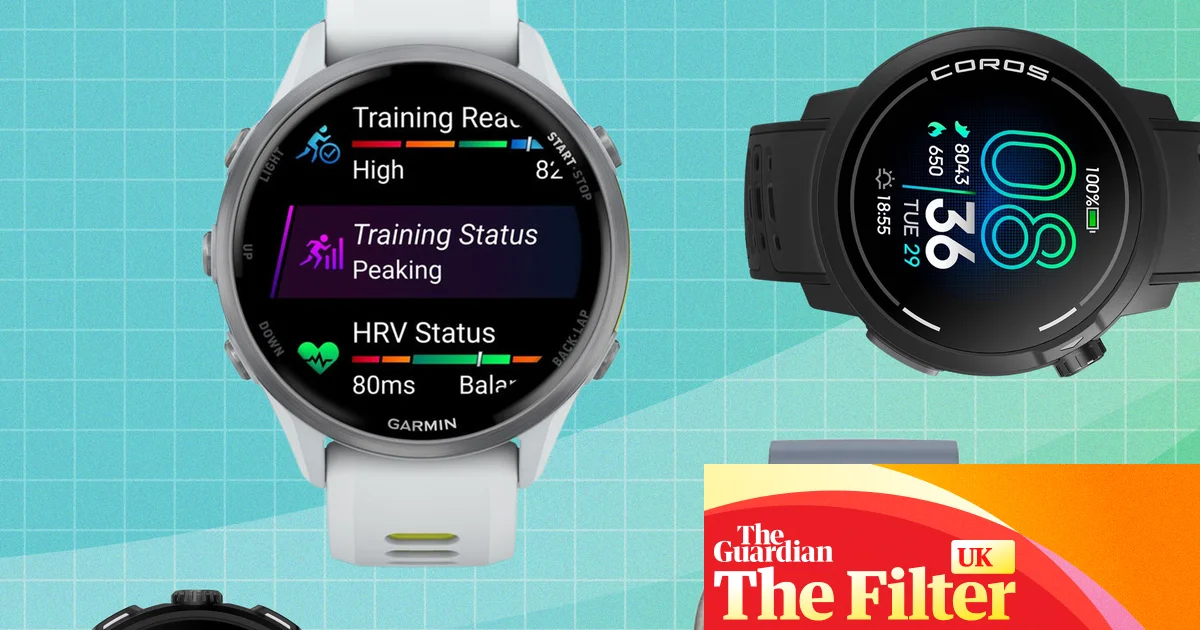
Whether you’re hitting the pavements for the first time, running with a club or racing for personal glory, the ability to track your workouts has become an essential part of any training regime. Not only can it help you improve, but you can also use it to avoid injury and share in the social experience. A running watch isn’t the only way to do this, but it is a pretty effective option.
The Guardian’s journalism is independent. We will earn a commission if you buy something through an affiliate link. Learn more.
But with the market flooded with options, offering an array of features, you might find it difficult to answer all the questions that arise. Do you need offline maps? Do you want to listen to music while you run? Which brand is best, and how much do you really need to spend?
Since a running watch is likely to last for far longer than most other bits of tech, you’ll want to make a smart investment – and I’m here to help you do just that.
I ran more than 1,000km to guide you through my tried-and-tested options, so you can pick up the best running watch for you.
At a glance
£122 at Amazon£174.99 at SportsShoes£299 at Healf£429 at SportsShoes£579 at Blacks£615.99 at SportsShoes£875.49 at SportsShoes
Why you should trust me
I’ve been reviewing consumer electronics for 18 years, with more than a decade spent as the Guardian’s gadget expert. In that time I’ve seen all manner of tech fads come and go, watched cutting-edge technology become mainstream commodities, used my body as a test bench for hundreds of watches, rings, glasses, goggles and other wearable devices, and covered thousands of kilometres as a keen club runner.
How I tested
‘I ran well over 1,000km’: our writer wearing the Garmin Forerunner 970. Photograph: Samuel Gibbs/The Guardian
To really determine whether a running watch goes beyond the basics, you have to use it for some time. I ran well over 1,000km, testing each watch on its own and in pairs, wearing the devices for short and long runs, across different urban and wooded environments. I wore them for club runs and on solo efforts, for training, workouts and races, plus during the day and night, to fully evaluate their capability to track metrics and analyse data.
I’ve poked and prodded them, updated them, tested their maps and navigation, and monitored their stamina. I’ve compared readings from the wrist-based optical heart-rate sensors to more accurate chest straps, compared pace and cadence readings, splits and total distances, routes and traces. And since GPS accuracy is so important and varies between watches, I put the top contenders through two different urban stress test routes to see which devices were reliable and which lost the plot. The first saw me weave between the tallest buildings in the City of London, while the other was around the notorious Canary Wharf loop of the London marathon, which tends to send racers’ watches wild.
Do you need a running watch?
Photograph: alvarez/Getty Images
Just starting out? Use your phone for free
If your running journey is just beginning, then it’s likely you already have a device to track your workouts. Your smartphone will be able to track your route, distance and pace; you just need the right app to do it.
If you’re an iPhone user, Apple’s built-in Fitness app can track runs and other workouts, too. Android phones usually arrive with a workout-tracking app installed; which one will depend on the brand of your phone. Samsung’s Health, Google’s Fit or Fitbit, for example, can all track the basics.
One of the most popular free, cross-platform apps is Strava. It not only tracks your workouts but also enables you to share them with friends and family through its integrated social features for support and encouragement.
Do you already own a smartwatch?
Similar to phone-based tracking, practically any smartwatch can be used for tracking runs. Even older versions of the Apple Watch, Google Pixel Watch and the Samsung Galaxy Watch will work great, with built-in GPS and heart-rate monitors, and many of them track far more than the basics.
The downside is relatively short battery life, but they should be fine for runs under marathon distances. All models should come pre-loaded with fitness-tracking apps that can record your runs, but Strava also has free apps for the Apple Watch and Google’s Wear OS.
The best running watches for 2026
‘If you want the very best running watch there is, there’s one clear winner’: the Garmin Forerunner 970. Photograph: Samuel Gibbs/The Guardian
Best running watch for beginners:
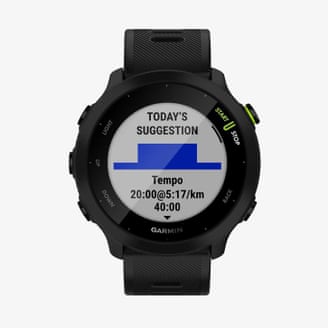
Garmin Forerunner 55
Garmin
Forerunner 55
from £122.49
 £179.99 at Decathlon£122 at Amazon
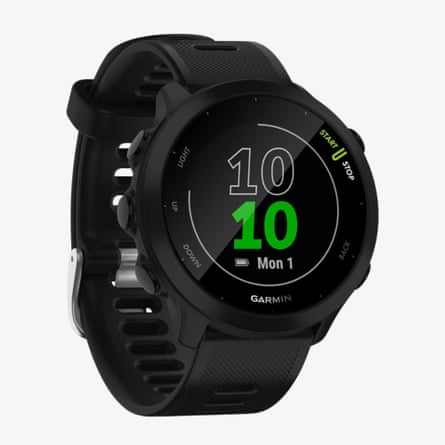
The Forerunner 55 is the cheapest in market-leader Garmin’s running watch lineup, and covers more than the essentials.
As well as 20 hours of workout battery life, this compact watch offers solid heart-rate tracking and can monitor cadence, pace and other essential metrics. It connects to the excellent Garmin Connect app on your phone via Bluetooth or computer via USB, which can then send the data to Strava and other third-party apps.
Using Garmin’s Coach feature, you can leave the watch to automatically create a training plan for you, or load your own structured workouts such as intervals. Sleep tracking and recovery tools help you figure out whether you should step up a gear or if you should be taking it easy. Plus, it has race-time predictions and a race planner, so you can pre-program the route and see what’s coming up around the bend.
What sets the Forerunner 55 apart from the competition at this price, however, is the speed and accuracy of its GPS tracking. Despite lacking the more advanced dual-band GPS of pricier models, it proved surprisingly reliable during testing, even in the most built-up areas of central London.
However, the Forerunner 55 is now a fairly old watch with a tiny low-res LCD screen and button-only functionality. It also lacks offline maps, music, contactless payments and many of the more advanced metrics that have become increasingly useful training aids on more modern and expensive watches.
Screen: 1.04in LCD
Weight: 37g
Water resistance: 5 ATM
Garmin
Forerunner 55
from £122.49
Best budget running watch:
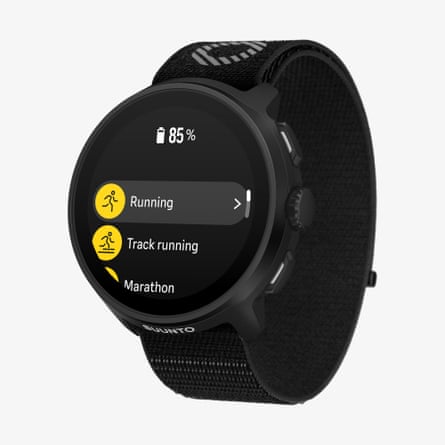
Suunto Run
 £174.99 at SportsShoes£199 at Suunto
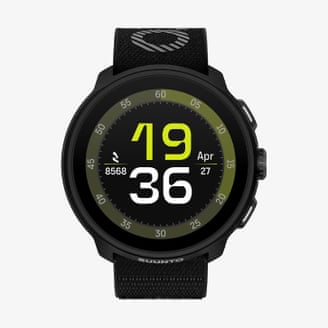
The Run is a surprise budget hit from longtime Finnish GPS-maker Suunto, which takes the best bits of its pricey models and condenses them into a super-light, bright running watch for under £200.
The good-size 1.3in OLED touchscreen is crisp and looks great, while the body of the watch is neat and slim on the wrist. It arrives with two lengths of a quick-release nylon band, but is also compatible with standard 22mm straps, should you prefer a silicone one.
Heart-rate monitoring is solid, and the dual-band GPS achieves a lock quickly, outclassing many of its rivals for accuracy in our urban stress tests. The Run records most of the advanced metrics you’d need, including the usual pace, heart-rate zones, cadence, running power and dynamics, plus it has solid VO2 max, training load and recovery tracking viewable on the watch or in the decent Suunto phone app.
The Run lasts a good 20 hours of tracking at its highest accuracy level, and has profiles for workouts on outdoor running tracks, multisport for triathlons and many other modes. It also supports structured workouts and interval training when things get a bit more serious.
While the screen is bright enough to see in direct sunlight, some of the dim grey fonts were a struggle to read at a glance. Some of the metrics looked a little too similar when four were on the screen at the same time, too. But the two buttons and crown make navigating, starting and pausing the watch easy, and it’s useful to be able to disable the touchscreen during workouts to prevent accidental presses.
The Suunto app, whether on an Android or iPhone, is fairly simple, displaying decent maps and graphs, plus daily health and sleep tracking. But the Run lacks offline maps, restricted to simple breadcrumb navigation – a line with no underlying map tiles – if you sync routes from your phone beforehand. It supports offline music via Bluetooth headphones, but only with MP3s; there’s no support for Spotify or other streaming services. The USB-C charging puck is a bit flimsy with weak magnets, too, so you have to be careful to keep the watch charging.
Screen: 1.3in OLED touchscreen
Weight: 36g
Water resistance: 5 ATM
Alternative:
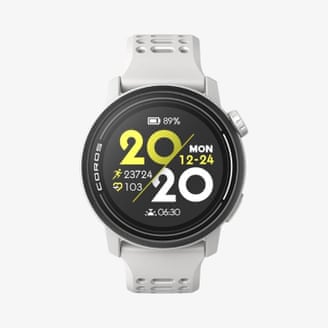
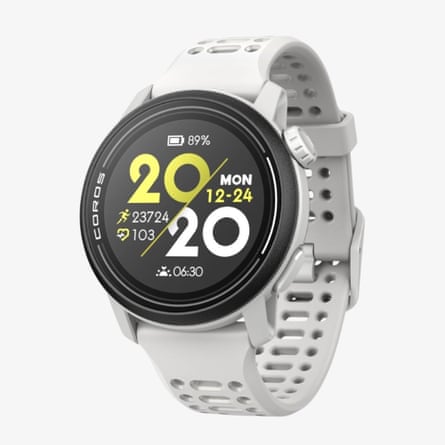
Coros Pace 3
 £178.99 at SportsShoes£199 at Amazon
Coros’s Pace 3 is a popular budget running watch for good reason: it packs a lot in for the price. But for GPS accuracy, it was beaten by the Suunto Run in our urban stress tests. Its battery life is shorter, too, and it has an older-style LCD screen. It has similar limitations with offline music and no maps.
A great option if the Suunto Run isn’t for you.
Screen: 1.2in LCD
Weight: 30g (nylon band)
Water resistance: 5 ATM
Best mid-range running watch:
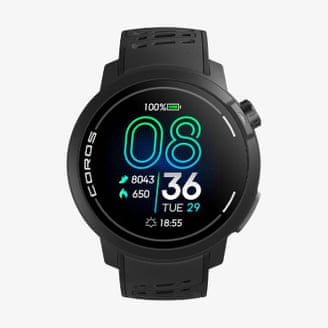
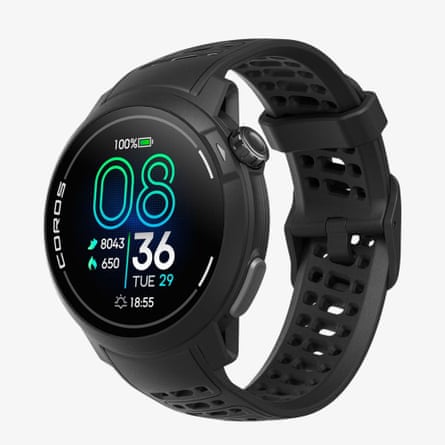
Coros Pace Pro
 £299 at Healf£299 at Myprotein
With highly capable budget watches champing at their heels, mid-range running watches essentially add one thing: offline maps.
One of the best in a crowded pack is the Coros Pace Pro, which offers a lot while costing less than rivals. It has a bright and crisp OLED touchscreen, a button and crown on the side for control, as well as decent haptics and beeps to let you know what’s happening.
The interface is fairly basic but responsive, with the watch tracking a wide array of sports, including a triathlon. Its heart-rate tracking is solid, and the dual-band GPS got a lock quickly and performed well in our urban stress tests. Battery life is up to 31 hours in its highest accuracy mode, which is very good. It even ships with a natty little keyring charging adapter that you plug into your own USB-C cable and then into the back of the watch.
The Coros tracks all the metrics you probably want, too, with a decent set of training and analysis tools. However, I did find its recovery metrics a little optimistic – and, bizarrely, its training load tools reset every Monday rather than using a seven-day rolling average, which make them a bit useless.
Nevertheless, there are plenty of workout configuration options, with up to eight metrics on display per screen. They’re only accessible from the Coros app on your phone, though. That app is a little basic, but it gets the job done, displaying your data, routes and maps well.
This app is also where you plan and send routes to your watch – you can’t create routes directly on the device. Browsing a map on the watch is fast and responsive via touch, as is zooming into road names using the crown. But if you do happen to veer off course, the watch can’t automatically re-route you back to the correct path.
The Coros offers support for offline music, but it’s only of the MP3 variety, which is less useful when you use streaming services. It lacks contactless payment support, and while the Pace Pro is light and comfortable, it doesn’t look or feel as premium as some more expensive rivals.
Screen: 1.3in OLED touchscreen
Weight: 37g (nylon band)
Water resistance: 5 ATM
Best-looking mid-range running watch:
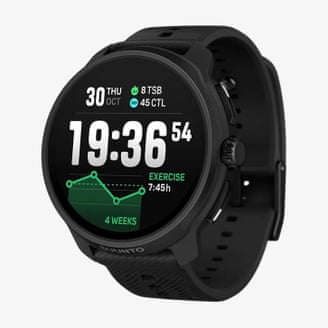
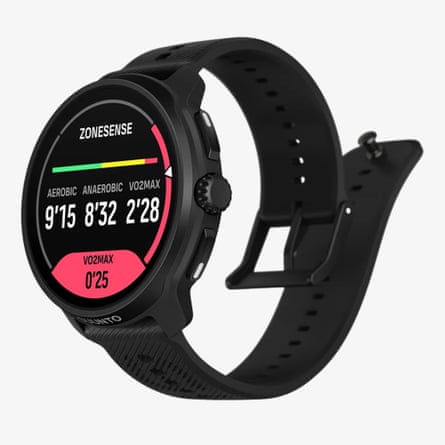
Suunto Race 2
 £429 at SportsShoes£429 at Suunto
The Suunto Race 2 just misses out on being the top mid-range pick: it’s significantly more expensive than the Coros Pace Pro, yet didn’t perform quite as well in our urban GPS stress tests.
This watch has plenty going for it, though. It’s good-looking, with a solid, premium feel, while the large, crisp 1.5in OLED touchscreen is bright and covered in super scratch-resistant sapphire crystal. The crown and two buttons make it easy to control the device during workouts, and the excellent rubber straps give a secure fit.
The Race 2 tracks more than 110 different sports, including multisport and triathlons, and the collection of free apps in the SuuntoPlus store can add extra elements to each sport profile, such as a cadence coach or a climb app. It tracks every running metric you’re likely to need, with a new decent heart-rate sensor and dual-band GPS traces, support for structured workouts and external sensors such as footpods. It also has a decent set of training and analysis tools, some of which are from leading training firm TrainingPeaks.
Battery life is impressive, with an outstanding 55 hours of tracking at the highest accuracy levels. That figure drops if you turn on the always-on screen option, though. Its offline maps look great on the big touchscreen, but like the Coros Pace Pro and other non-Garmin watches, you have to set routes on your phone first or rely on manual navigation.
The companion app on your phone is a little basic-looking but has decent maps, stats, data and graphs, plus daily health and sleep tracking. Compared with a Coros or Garmin, the watch is a little short on different faces and customisations, but the ones included look good. It doesn’t have contactless payments or offline music, either.
Screen: 1.5in OLED touchscreen
Weight: 76g (steel); 65g (titanium)
Water resistance: 10 ATM
The best running watch money can buy:
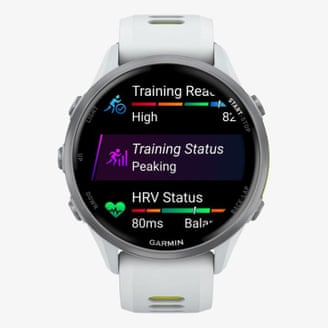
Garmin Forerunner 970
Garmin
Forerunner 970
from £579
 Photograph: Samuel Gibbs/The Guardian£579 at Blacks£629.99 at Cotswold Outdoor
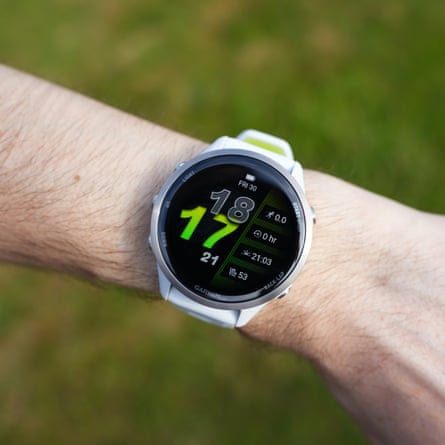
If you want the very best running watch there is, there’s one clear winner: the Garmin Forerunner 970. It tracks every metric and statistic you could possibly want, both on the run and after the fact, and looks the business doing it.
Alongside a compact and comfortable fit, the watch has a large and crisp OLED touchscreen, protected by super-hard sapphire crystal. There are five buttons for when you don’t want to use the touchscreen; contactless payments; and a built-in speaker and microphone for calls, voice commands and accessing your phone’s voice assistant. The Forerunner 970 even has an extremely useful built-in torch, which can be used as a strobe light for running or for just illuminating your way at night.
On a run, the watch can clearly show up to eight different metrics onscreen at once and has excellent, highly detailed built-in offline maps. Unlike competitors, Garmin’s maps are routable, which means you can plan routes on the watch itself, and it can re-route you like a car’s GPS if you veer off course. It also supports offline music from various streaming services, including Spotify, Amazon and YouTube Music, or your own MP3s.
Garmin’s dual-band GPS with best-in-class tracking accuracy did very well in our urban stress tests. Plus, its battery lasts a solid 23 hours of tracking – or more, if you turn down the screen’s brightness, or switch to less power-hungry GPS modes. The heart-rate sensor remains consistent even in difficult conditions and takes ECGs for monitoring arrhythmia, similar to the best health-tracking watches.
The Forerunner 970 comes with the full suite of Garmin’s industry-leading fitness tracking, training and recovery tools. That includes the new impact load and running tolerance metrics that help you avoid injury by more accurately measuring the strain each run puts on your body, while keeping a rolling seven-day log of distance and impact, so you don’t overdo it.
If you want to track more than running, the watch is fully triathlon-ready and tracks 30-plus sports of all guises. It’s great at general health and activity tracking, too, with various coaches for sleep, training and recovery. Garmin’s excellent automatic workout plans can be tailored to upcoming races or can be replaced by your own or third-party plans just as easily.
The Garmin Connect app is the best in the business, with every stat, analyses and metric you’re likely to want to deep dive into; solid route planning and built-in social features, including options to share the data to Strava or other platforms; plus a good website for big-screen interrogation.
Read our full Garmin Forerunner 970 review: the new benchmark for running watches
Screen: 1.4in OLED touchscreen
Weight: 56g
Water resistance: 5 ATM
Garmin
Forerunner 970
from £579
Alternative:
Garmin Fenix 8
 Photograph: Samuel Gibbs/The Guardian£769.99 at Argos£692 at Amazon
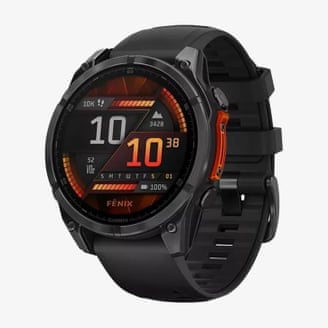
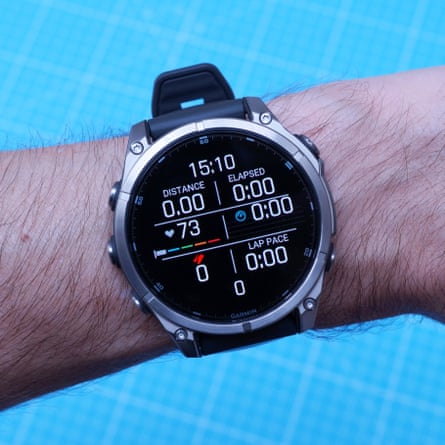
If you like the sound of the Forerunner 970 but want a watch that looks more like a traditional timepiece, the Fenix 8 has all the same features and more. It comes in three sizes, with a great OLED screen, longer battery life and the same level of tracking accuracy across the board; but it is heavier, a bit thicker and costs more.
Read our full Garmin Fenix 8 review: best adventure watch becomes smarter
Screen: 1.3in OLED touchscreen (43 and 47mm); 1.4in OLED touchscreen (51mm); weight: steel: 66g (43mm), 80g (47mm), 102g (51mm); titanium: 60g (43mm), 73g (47mm), 92g (51mm); water resistance: 10 ATM
Best running watch for battery life:
Garmin Enduro 3
Garmin
Enduro 3
from £615.99
 £615.99 at SportsShoes£649 at Millets
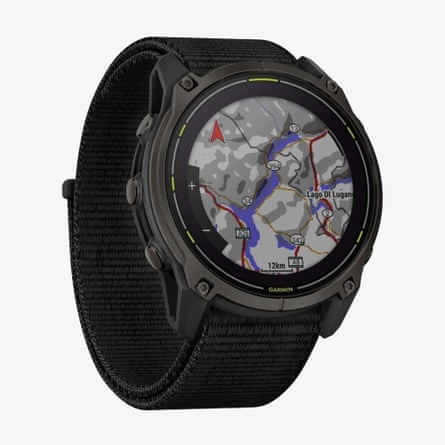
Most good running watches will last at least a marathon while tracking all metrics, but if you need to go further, then there are watches built for ultramarathoners that provide super-long battery life.
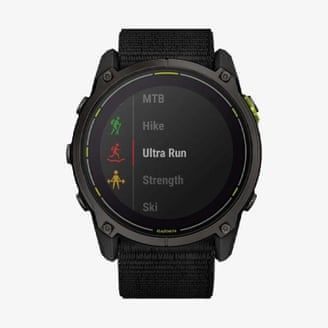
The Garmin Enduro 3 is the best there is, lasting up to 60 hours of tracking at its highest GPS accuracy level – or even longer if you’re running in bright conditions, thanks to the built-in solar charging. And if you really have to go the distance, switch to a special “expedition GPS mode” and it will manage up to 77 days.
This level of stamina does come with a few drawbacks, though. The first is its sheer size: the Enduro 3 is massive all round, and uses a low-power LCD screen rather than the fancy OLEDs equipped to Garmin’s other watches.
Otherwise, it has most of the same features and high accuracy levels as the Forerunner 970 and Fenix 8, including offline maps and a torch.
Screen: 1.4in LCD
Weight: 63g
Water resistance: 10 ATM
Garmin
Enduro 3
from £615.99
Best running watch with LTE/satellite:
Garmin Fenix 8 Pro
Garmin
Fenix 8 Pro
from £875.49
 Photograph: Samuel Gibbs/The Guardian£875.49 at SportsShoes£991.57 at John Lewis
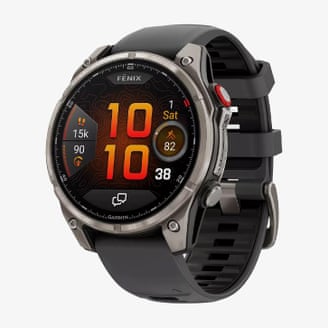
All running watches have at least a guide or a map to help you out in tricky situations, but a new breed of devices has recently upped the game by adding cellular and satellite connectivity – which could help save your life in an emergency.
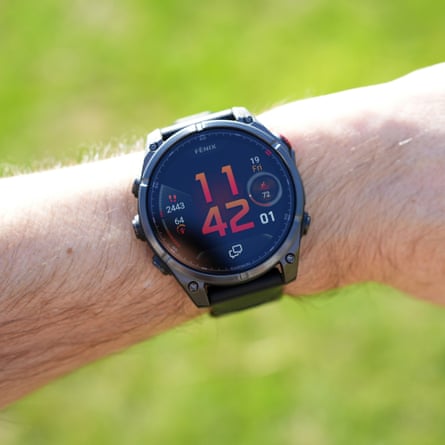
At the top of the game is the Garmin Fenix 8 Pro, which takes the excellent regular Fenix 8 and adds LTE and satellite connectivity. If it has mobile signal, it can keep you in contact and share your location with loved ones without you having to carry a phone. More importantly, you can contact the emergency services via satellite if you find yourself without reception in Europe and North America.
Coupled with its full offline mapping, including re-routing on the watch, and the fact it tracks every metric under the sun, it’s a killer go-anywhere, do-anything device.
However, for all this functionality, you’ll need to part with the big bucks. In addition to the cost of the watch, you’ll have to subscribe to Garmin inReach for the phone-free communications features, which costs from £7.99 a month.
Read our full Garmin Fenix 8 Pro review: built-in LTE and satellite for phone-free messaging
Screen: 1.4in OLED touchscreen
Weight: 77g (47mm); 90g (51mm)
Water resistance: 10 ATM
Garmin
Fenix 8 Pro
from £875.49
Alternative:
Apple Watch Ultra 3
Apple
Watch Ultra 3
from £719
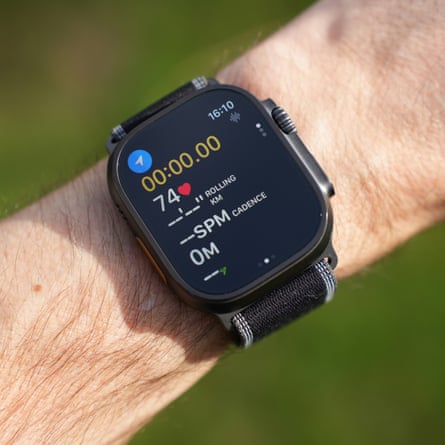 Photograph: Samuel Gibbs/The Guardian£719 at John Lewis£719 at Argos
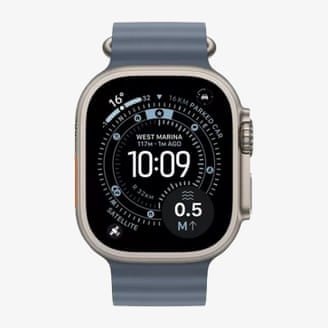
It may not be a dedicated running watch, but the Apple Watch Ultra 3 ticks almost every box for running if you’re an iPhone user, including a dual-band GPS that was one of the most accurate in our urban stress tests.
The latest model adds emergency satellite communications to its existing cellular connectivity, so like the Fenix 8 Pro, it can help you seek rescue if you find yourself in a sticky situation off-grid.
Elsewhere, it tracks almost every running metric you could need, has a big and bright screen, an accurate heart-rate monitor and a durable body made of titanium and sapphire. Battery life isn’t quite as long as proper running watches when tracking, but it will manage a marathon or two. And it comes with all the trappings of a true smartwatch, including offline maps, music, Apple Pay, notifications and Siri.
The Apple Watch only works with an iPhone, and while the satellite SOS feature is free, using 4G or 5G requires a compatible plan with your phone provider.
Read our full Apple Watch Ultra 3 review: the biggest and best smartwatch for an iPhone
Screen: 1.93in OLED touchscreen; weight: 61.6g (natural titanium strap); water resistance: WR100
Apple
Watch Ultra 3
from £719
Others worth considering
‘Remains extremely capable’: the Garmin Forerunner 965. Photograph: Samuel Gibbs/The Guardian
Garmin Forerunner 570 – a really great running watch that’s just a little too expensive for what it offers, in particular, the lack of offline maps. A great option at a discounted price, though.
Suunto Race – software updates see the predecessor to the great Race 2 gain most of the new features of recent models. It’s a smart buy at a good discount.
Garmin Forerunner 165 – Garmin’s entry-level OLED running watch is great, but it costs a bit too much to be a budget pick and lacks dual-band GPS. Look for a deal.
Garmin Forerunner 265 – the older-generation mid-range Garmin was one of the best with dual-band GPS, an OLED screen and multiple sizes, but was quite expensive at launch without maps and has since been phased out.
Garmin Forerunner 965 – Garmin’s previous top-of-the-line Forerunner remains extremely capable, missing only a few of the Forerunner 970’s features. A good buy at a steep discount.
How I picked
Go to the effort of buying a dedicated running watch and you want the device on your wrist to at least work as hard as you are, pounding the pavements. So while practically any watch with a GPS will get the job done to some extent, it’s the features below that I considered alongside when selecting models for this test:
Screen – it has to be bright, crisp and clear enough to view and understand at a glance during the run.
Fit and profile – it has to sit on the wrist comfortably and securely, neither moving about during vigorous exercise, nor being too tight as you become warm due to activity.
Strap replacement – straps become sweaty, smelly and wear out, so being able to replace them easily is essential, either with a like for like, or with different options for different occasions.
Ease of use on the run – do the buttons work, can you lock the touchscreen, are the haptics strong enough, and can you hear the beeps and chimes while pushing for that next PB?
Heart-rate accuracy – accurate and consistent heart-rate tracking is essential for using heart-rate zones for training, as well as evaluating effort, fitness and recovery.
GPS accuracy – how long does the watch’s GPS take to get a lock and how well does it hold on to it in difficult forested or urban conditions? This is vital for accurate traces, distances, paces and various other metrics.
Battery life – will it last long enough for all your weekly runs, and how often will you have to charge the device?
Water resistance and durability – a running watch should be able to take some punishment and survive rain, wind, mud, snow, sleet, swims, freezing temperatures and baking summer days – anything you can cope with, it should do too.
Companion app and data export – a good cross-platform app is essential, offering reliable syncing, plenty of stats, graphs and maps, as well as the ability to send your data to Strava, other services, or export it to industry-standard files such as GPX or FIT for use elsewhere.
Training and analysis – how good is the data analysis of your training, fitness and recovery? Is it representative and will it adapt to your progress?
Software support – a running watch isn’t a huge target for cybercriminals, but since it and the connected service contain a lot of sensitive data, it should be secure and kept up to date for an extended period.
For more:
The best running shoes for men and women
The best treadmills, tested
The best fitness tech and gadgets, according to experts
Samuel Gibbs is the Guardian’s consumer technology editor

Google has revealed that Charlie Kirk was the top trending US search of 2025 following the conservative influencer’s assassination in September.
The search engine platform shared its top US searches in its Year in Search on Sunday, an annual report and recap of the platform’s most popular searches that users most wanted to know about throughout the year.
Following Kirk in the top searches list was KPop Demon Hunters. The hit children’s animated Netflix show, about a Korean girl band that slays evil spirits, broke the record as the platform’s most-watched film ever.
Another sensation among kids, the Labubus toy, ranked third in searches. The line of collectible plush elves with monster teeth was designed by illustrator Kasing Lung and featured a mystery box-style opening.
Joining the top five searches were Apple’s iPhone 17 and President Donald Trump’s One Big Beautiful Bill legislation, according to Google.
Next on the list was the newly elected mayor of New York City, Zohran Mamdani, followed by DeepSeek, the Chinese AI platform.
Rounding out the top 10 was the government shutdown, which lasted for 43 days, the FIFA Club World Cup, and Trump’s favorite word – tariffs, which was ranked in the tenth spot.
Google highlighted a variety of the top trending search categories, ranging from concert outfits and actors to confused parents searching ‘why do kids say.’
Read more top results below:

Charlie Kirk took the number one spot as the highest-ranked trending search this year in Google’s Year in Search
Top trending US news searches 1.’One Big Beautiful Bill Act’
2. Government shutdown
3. Charlie Kirk assassination
4. Tariffs
5. No Kings protest
6. Los Angeles fires
7. New Pope chosen
8. Epstein files
9. US presidential inauguration
10. Hurricane Melissa

President Trump’s ‘One Big Beautiful Bill Act’ was the top US news search

Charlie Kirk was the most searched celebrity who died this year following his assassination in September
Top trending searches of celebrity passings:
1. Charlie Kirk
2. Gene Hackman
3. Ozzy Osbourne
4. Anne Burrell
5. Diane Keaton
6. Michelle Trachtenberg
7. Pope Francis
8. Hulk Hogan
9. Malcolm-Jamal Warner
10. Val Kilmer
Top trending ‘Why do kids say?’ searches1. 6-7
2. Sigma
3. 41
4. Skibidi
5. Ohio
6. Rizz
7. Good boy
8. Skibidi toilet
9. Aura
10. Chat

The viral 6-7 meme was the most searched ‘why do kids say?’ by confused parents in 2025

Taylor Swift had four hits on the top ten list of most trending songs this year
Top trending searches of songs:
1. Wood – Taylor Swift
2. DtMF – Bad Bunny
3. Golden – HUNTR/X
4. The Fate of Ophelia – Taylor Swift
5. Father Figure – Taylor Swift
6. Predador de perereca – MC Jhey and BLOW RECORDS
7. Soda Pop – Saja Boys
8. Opalite – Taylor Swift
9. Ordinary – Alex Warren
10. Takedown – HUNTR/X
Top trending actors searches 1. Pedro Pascal
2. Malachi Barton
3. Walton Goggins
4. Pamela Anderson
5. Charlie Sheen
6. Eric Dane
7. Mikey Madison
8. Aubrey Plaza
9. Adam Sandler
10. Justin Baldoni

Pedro Pascal was the most searched actor of 2025

D4vd was the highest trending artist searched, which may be due to the controversy surrounding him this year
Top trending musicians searches
1. d4vd
2. KATSEYE
3. Bad Bunny
4. Sombr
5. Doechii
6. Jonas Brothers
7. Alex Warren
8. Coldplay
9. NBA YoungBoy
10. Benson Boone
Top trending places to travel searches 1. Boston
2. Seattle
3. Tokyo
4. New York
5. Prague
6. London
7. San Diego
8. Arcadia National Park
9. Edinburgh
10. Miami

The city of Seattle in Washington ranked second on the lists of most places searched for travel

Cleveland Browns quarterback Shedeur Sanders was the top trending athlete on Google in the US this year
Top trending athletes
1. Shedeur Sanders
2. Terence Crawford
3. Cooper Flagg
4. Cam Skattebo
5. Micah Parsons
6. Jaxson Dart
7. Sophie Cunningham
8. Shilo Sanders
9. Jalen Carter
10. Justin Rose
Top trending TV show searches 1. ‘The Hunting Wives’
2. ‘The White Lotus’
3. ‘The Pitt’
4. ‘The Summer I Turned Pretty’
5. ‘Squid Game’
6. ‘Severance’
7. ‘MobLand’
8. ‘Adolescence’
9. ‘Andor’
10. ‘IT: Welcome To Derry’

UK show Adolescence was on the top 10 most searched TV shows of 2025

New Mayor of New York City Zohran Mamdani was the highest trending person searched
Top trending people searches
1. Zohran Mamdani
2. Tyler Robinson
3. d4vd
4. Erika Kirk
5. Pope Leo XIV
6. Shedeur Sanders
7. Bonnie Blue
8. Karoline Leavitt
9. Andy Byron
10. Jimmy Kimmel
Share or comment on this article:
Google reveals most popular trends of 2025 in website’s ‘Year in Search’
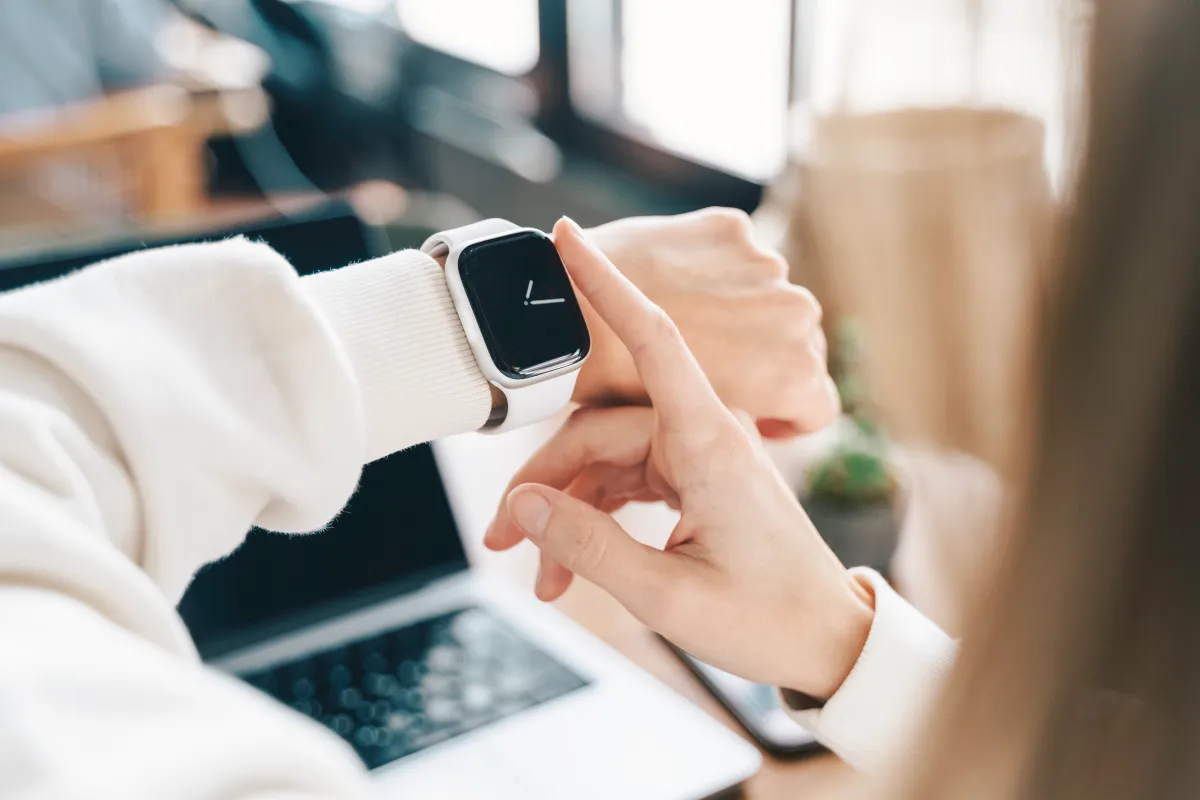
The Apple Watch helps people track their health and fitness, but it can also be a great tool to help people stay productive and get work done. This is especially true for people who get easily distracted by their phone.
Although the Apple Watch comes with simple built-in productivity apps like Reminders and Calendar, it’s worth exploring some third-party apps that are designed to boost productivity by offering additional functionality.
Todoist
Image Credits:Todoist
Todoist is a great app for managing tasks on your Apple Watch when you don’t want to pull out your iPhone. The app lets you create and manage tasks, organize these tasks into projects, mark them as complete, and also set reminders. You can add tasks via voice command or the keyboard.
The app is great for people who prefer to quickly glance at their wrist instead of pulling out their phone when doing things, like looking at a grocery list at the store or jotting down a quick note or reminder.
You can stay updated on the progress of your tasks for the day straight from your Apple Watch’s face. For instance, you can choose to have your next task or the completed percentage of tasks for the day displayed.
Todoist is free and offers a $4 monthly subscription if you want additional features like custom task reminders, an AI assistant, a calendar layout, and more.
Drafts
 Image Credits:Drafts
Since the Apple Watch doesn’t have a Notes app, Drafts is a good app for those who want a digital notepad without a phone. You can capture notes through voice command, the watchOS Scribble feature, or the keyboard.
Techcrunch event
San Francisco
|
October 13-15, 2026
Your drafts inbox syncs from your iPhone and displays the number of drafts you have, while also showing the number of flagged drafts, so you can quickly access important ones.
The app defaults to a blank note to give you a place to quickly enter an idea without interrupting your thought process. You can file notes into a folder to organize your thoughts or just have a free-flowing canvas.
The app is free and offers a $1.99 monthly subscription if you want access to additional functionality, such as themes and the ability to send your emails to the app.
Focus
 Image Credits:Focus
Focus is a good app for people who want a productivity timer to help them get work done and like to complete tasks one at a time. The app is designed to break down your work time into smaller chunks, which it calls “Focus Sessions.” By working in sessions, you can stay focused on the task at hand before moving on to the next task.
By using your Apple Watch instead of your phone to stay focused, you can minimize distractions. You can quickly glance at your wrist to see how much time is left in your Focus Session and then get right back to work. Focus will also encourage you to take breaks between your sessions.
The app is available for $7.99 per month.
AutoSleep
 Image Credits:AutoSleep
AutoSleep is one of the most popular Apple Watch apps for tracking your sleep, and that’s for good reason. The app gives you an informative look at your sleep quality, heart rate, sleep consistency, and more. It can help you track the time it takes you to fall asleep and measure the efficiency of your sleep.
AutoSleep shows you all of this data through a clock view with sleep rings to give you a quick overview of your stats in a way that’s similar to your Watch’s Activity Rings. You can see if you’re getting enough sleep or if you need to try to sleep more.
The app also shows you a “readiness” score that estimates how mentally and physically ready you are for the day ahead based on how you slept, which resembles how the Oura Ring’s app tackles the same metric. It can also suggest the best time for you to go to bed to ensure you catch up on sleep.
You can get access to the app for a one-time fee of $5.99.
Streaks
 Image Credits:Streaks
Streaks is a good app for people who want to form good habits and track their progress. Each day that you complete a task, your streak is extended. If you break the chain, your streak resets to zero. You can track up to 24 habits, such as flossing your teeth, practicing a new language, and eating healthy.
The app also lets you track tasks that aren’t meant to occur every day, too. For instance, you may want to set a task of walking to work from Monday to Friday, going to the gym three days a week, or avoiding junk food over the weekend.
A quick glance at your Apple Watch lets you quickly see which tasks you still need to complete for the day, see your progress, and mark tasks as completed.
The app is available for a one-time fee of $5.99.
Fantastical
 Image Credits:Fantastical
Fantastical is a great calendar app that can help you stay organized right from your Apple Watch. You can use the app to create events and set reminders that you can view with a quick glance.
The Apple Watch app has three views that you can choose from. The “Up Next” view gives you a quick overview of your next appointment alongside the current weather. The “List” view shows you any events and tasks that you have coming up over the next few days, alongside the expected weather forecast. The “Tasks” view compiles all of your tasks into one view and allows you to check them off with a quick tap.
The app also lets you receive alerts for upcoming events and tasks. If you want this information on your watch face, Fantastical’s Smart Stack widget gives you a quick peek at your calendar.
Fantastical costs $4.99 per month.
Things 3
 Image Credits:Things 3
Things 3 is a great productivity manager that can help you create to-do lists, manage projects, and track progress toward your goals. It can be used to organize your personal, work, financial, and other aspects of your life into special “Areas.”
The app features reminders, a calendar integration, widgets, tags to categorize your to-do lists, and more. Things 3 also lets you automatically repeat to-dos on a schedule you set and has a special place for evening plans under the “This Evening” section.
As the day goes on, you can quickly check off things from your wrist and add new ones on the go.
You can get Things 3 for a one-time payment of $9.99.
Structured
 Image Credits:Structured
Structured is a simple app that helps you plan your day by combining your calendar, to-do list, habit tacker, reminders, and routines into a single timeline.
You can navigate through your structured timeline on your wrist to see your upcoming tasks and stay on top of your routine without having to pull out your phone. The app lets you store thoughts and quickly capture notes in your Inbox to sort them later. You can also break down bigger projects with “sub-tasks.”
Structured also lets you personalize your different tasks with various icons and colors to visually organize your to-do list. Structured syncs with your Mac, iPhone, and iPad as well.
Structured’s basic features are available for free, but you can pay a $6.49 monthly fee to unlock additional features, such as the ability to use AI to draft and plan tasks.

India’s startup ecosystem raised nearly $11 billion in 2025, but investors wrote far fewer checks and grew more selective about where they took risk, underscoring how the world’s third most-funded startup market is diverging from the AI-fueled capital concentration seen in the U.S.
The selective approach was most evident in deal-making. The number of startup funding rounds fell by nearly 39% from a year earlier, to 1,518 deals, according to Tracxn. Total funding slipped more modestly — down just over 17% to $10.5 billion.
That pullback was not uniform. Seed-stage funding fell sharply to $1.1 billion in 2025, down 30% from 2024, as investors cut back on more experimental bets. Late-stage funding also cooled, slipping to $5.5 billion, a 26% decline from last year, amid tougher scrutiny of scale, profitability, and exit prospects. However, early-stage funding proved more resilient, rising to $3.9 billion, up 7% year-over-year.
Image Credits:Tracxn
“The capital deployment focus has increased towards early-stage startups,” said Neha Singh, co-founder of Tracxn, pointing to growing confidence in founders who can demonstrate stronger product–market fit, revenue visibility and unit economics in a tighter funding environment.
The AI quest
Nowhere was that recalibration clearer than in AI, as AI startups in India raised just over $643 million across 100 deals in 2025, a modest 4.1% increase from a year earlier, per Tracxn data shared with TechCrunch. The capital was mainly spread across early and early-growth stages. Early-stage AI funding totaled $273.3 million, while late-stage rounds raised $260 million, reflecting investor preference for application-led businesses over capital-intensive model development.
This was in sharp contrast to the U.S., where AI funding in 2025 surged past $121 billion across 765 rounds, per Tracxn, a 141% jump from 2024, and was overwhelmingly dominated by late-stage deals.
“We don’t yet have an AI-first company in India, which is $40–$50 million of revenue, if not $100 million, in a year’s time frame, and that is globally happening,” said Prayank Swaroop, a partner at Accel.
Techcrunch event
San Francisco
|
October 13-15, 2026
India, Swaroop told TechCrunch, lacks large foundational model companies and will take time to build the research depth, talent pipeline, and patient capital needed to compete at that layer — making application-led AI and adjacent deep-tech areas a more realistic focus in the near term.
This pragmatism has shaped where investors are placing longer-term bets outside core AI. Venture capital is increasingly flowing into manufacturing and deep-tech sectors. These are some of the areas where India faces less global capital competition and has clear advantages in talent, cost structures, and customer access.
While AI now absorbs a significant share of investor attention, capital in India arguably remains more evenly distributed than in the U.S., with substantial funding still flowing into consumer, manufacturing, fintech, and deep-tech startups. Swaroop noted that advanced manufacturing in particular has emerged as a long-term opportunity, with the number of such startups increasing nearly tenfold over the past four to five years — an area he described as a clear “right to win” for India given lower global capital competition.
Rahul Taneja, a partner at Lightspeed, said AI startups accounted for roughly 30–40% of deals in India in 2025, but pointed to a parallel surge in consumer-facing companies as changing behaviour among India’s urban population creates demand for faster, more on-demand services — from quick commerce to household services — categories that play to India’s scale and density rather than Silicon Valley–style capital intensity.
India versus the U.S.
Data from PitchBook shows a stark divergence in capital deployment between India and the U.S. in 2025. U.S. venture funding surged to $89.4 billion in the fourth quarter alone, according to PitchBook data up to December 23, compared with about $4.2 billion raised by Indian startups over the same period.
 Image Credits:Jagmeet Singh / TechCrunch
However, that gap does not tell the whole story.
Lightspeed’s Taneja cautioned against drawing direct parallels between India and the U.S., arguing that differences in population density, labour costs, and consumer behaviour shape which business models can scale. Categories such as quick commerce and on-demand services have found far greater traction in India than in the U.S., reflecting local economics rather than any lack of ambition among founders or investors.
Recently, Lightspeed raised $9 billion in fresh capital with a strong focus on AI, but Taneja said the move does not signal a wholesale shift in the firm’s India strategy. The U.S. fund, he noted, is geared toward a different market and maturity cycle, while Lightspeed’s India arm will continue backing consumer startups alongside selectively exploring AI opportunities shaped by local demand rather than global capital intensity.
Nuances in India’s startup ecosystem
India’s startup ecosystem also saw funding for women-led startups tighten. Capital invested in women-founded tech startups held relatively steady at about $1 billion in 2025, down 3% from a year earlier, according to Tracxn’s report. Still, that headline figure masked a sharper pullback beneath the surface. The number of funding rounds in women-founded startups fell by 40%, while their first-time funded counterparts declined by 36%.
 India’s women-led startups saw a 3% dip in funding in 2025Image Credits:Tracxn
Overall, investor participation narrowed sharply as selectivity increased, with about 3,170 investors taking part in funding rounds in India this year, a 53% drop from roughly 6,800 a year earlier, according to Tracxn data shared with TechCrunch. India-based investors accounted for nearly half of that activity, with around 1,500 domestic funds and angels participating — a sign that local capital played a more prominent role as global investors turned cautious.
Activity also became more concentrated among a smaller group of repeat backers. Inflection Point Ventures emerged as the most active investor, participating in 36 funding rounds, followed by Accel with 34, Tracxn data shows.
The Indian government’s participation in the startup ecosystem became more visible in 2025. New Delhi announced a $1.15 billion Fund of Funds in January to expand capital access for startups, followed by a ₹1 trillion ($12 billion) Research, Development, and Innovation scheme aimed at areas such as energy transition, quantum computing, robotics, space technology, biotech, and AI, using a mix of long-term loans, equity infusions and allocations to deep-tech funds.
That push has begun to catalyze private capital as well. The government’s growing involvement helped spur a nearly $2 billion commitment from U.S. and Indian venture capital and private equity firms, including Accel, Blume Ventures, and Celesta Capital, to back deep-tech startups — an effort that also brought Nvidia on board as an adviser and drew Qualcomm Ventures. Furthermore, the Indian government also co-led a $32 million funding for quantum computing startup QpiAI earlier this year — a rare federal move.
This growing state involvement has helped ease a risk long flagged by investors: regulatory uncertainty. “One of the biggest risks you don’t want to underwrite is what happens if regulation changes,” said Taneja of Lightspeed.
As government entities become more familiar with the startup ecosystem, Taneja added, policy is more likely to evolve alongside it — reducing uncertainty for investors backing companies with longer development cycles.
Exits in India
The reduced uncertainty has already started to show up in exit markets to some extent. India saw a steady pipeline of technology IPOs over the past two years, with 42 tech companies going public in 2025, up 17% from 36 in 2024, per Tracxn. Much of the demand for those listings has come from domestic institutional and retail investors, easing long-standing concerns that Indian startup exits depend too heavily on foreign capital. M&A activity also picked up, with acquisitions rising 7% year-over-year to 136 deals, Tracxn data shows.
Swaroop of Accel said investors had long worried that India’s public markets were mainly sustained by foreign capital, raising questions about exit durability during global downturns. “This year has disproven that,” he said, pointing to the growing role of domestic investors in absorbing technology listings — a shift that has made exits more predictable and reduced reliance on volatile overseas flows.
 Image Credits:Tracxn
India’s unicorn pipeline in 2025 also reflected that shift toward restraint. While the number of new unicorns remained flat year over year, Indian startups reached $1 billion valuations with less capital, fewer funding rounds, and a smaller pool of institutional investors, pointing to a more measured path to scale compared with both previous years and global peers.
Challenges remain as India heads into 2026, particularly around how it positions itself in the global race for AI and whether late-stage funding can deepen without relying on outsized capital inflows.
Even so, the shifts seen in 2025 point to a startup ecosystem that is maturing rather than retreating — one where capital is being deployed more deliberately, exits are becoming more predictable, and domestic market dynamics increasingly shape its growth. For investors, India is emerging less as a substitute for developed markets and more as a complementary arena with its own risk profile, timelines, and opportunities.
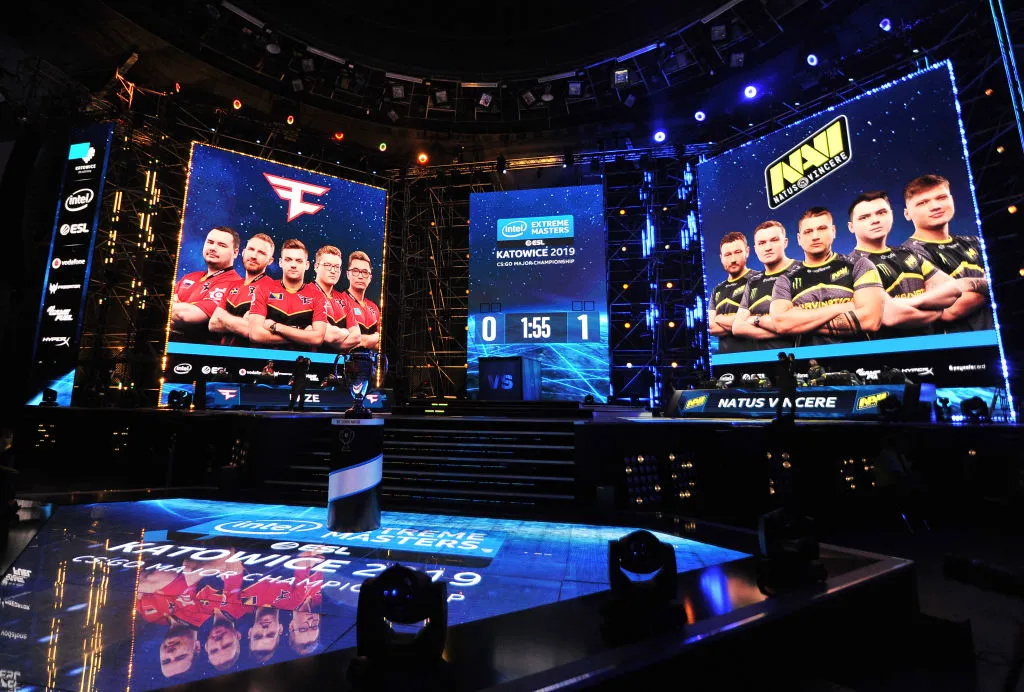
Six influencers recently announced that they are leaving esports group FaZe Clan following unsuccessful contract negotiations with new management.
Bloomberg reports that influencers known as Adapt, Jason, Ronaldo, Lacy, Rage, and Silky — the entire roster on the FaZe Clan website — all announced that they are leaving the group.
Adapt wrote on X that he’d spent 14 years as part of FaZe Clan: “Over half of my life, I’d be lying if I said this didn’t hurt, but it had to be done.”
Another FaZe Clan member who left in August had described the situation as one where the influencers felt they had “no control, and it’s like we’re puppets.”
The influencers had reportedly been negotiating with Faze Clan investor HardScope and its CEO Matt Kalish for the past half year. Kalish plans to continue the group without the departed influencers.
“My best guess is they’re all good kids and have a lot of people in their ear and are confused,” he told Bloomberg. He also claimed that the group’s current financial structure is “unsustainable.”
FaZe Clan went public in 2022, but the company was acquired by GameSquare for $17 million the following year, and its CEO was fired.
Techcrunch event
San Francisco
|
October 13-15, 2026

What does it take to raise Series A in today’s market?
The goalposts have moved, the stakes are higher, and investors seem pickier than ever as the AI boom reshapes the industry. At TechCrunch Disrupt, three investors — Thomas Green of Insight Partners, Moxxie Ventures’ Katie Stanton, and GV’s Sangeen Zeb — broke down what they’ll be looking for in the new year.
The numbers tell a clear story. Fewer rounds are getting funded but deal sizes have grown, said Green citing a study.
“It has never been easier to start a company, and it has never been harder to build something that is defensible,” Stanton said.
For Zeb, GV uses a specific formula to evaluate companies. The firm analyzes whether startups have achieved product-market fit, examining demand patterns to ensure every quarter outperforms the last. “That sequence should be happening consistently,” he said.
Stanton echoed this priority. “Can you prove that you can repeatedly sell? Can you prove that you can repeatedly grow in a big and growing market?”
But Green cautioned that not every company should pursue venture-scale growth. “It’s not worth even taking this money unless you think it can be a really big business, right?” he said. “Most companies should not [pursue] venture scale. They should not take hundreds of millions of dollars.”
Techcrunch event
San Francisco
|
October 13-15, 2026
Beyond metrics, all three investors emphasized founder quality. Stanton said she is looking for passionate founders who can endure the long journey of building a company. Zeb agreed. “Passion is still the most important thing,” he said.
The panel inevitably turned to AI. Green assured non-AI companies: “Just because you’re not AI doesn’t mean you don’t have a very attractive asset, intrinsic quality to you,” he said.
For AI companies trying to differentiate in a crowded market, Green returns to first principles. “We try to understand, if it’s a market with a lot of competition — [including] both incumbents and next-gen competitors and platform players — what is going to be the standout path?”
Stanton said she looks founders who combine industry and technical expertise, while Zeb prioritizes relentless drive, seeking founders who are constantly asking how to move faster than the competition.
Despite market fluctuations, the panel suggested that core investor priorities remain consistent. “The bar is high, but if the outcome can be impossibly huge, we’ll take that [bet],” Green said.
TECHNOLOGY
From shrimp Jesus to erotic tractors: how viral AI slop took over the internet | Artificial intelligence (AI)

In the algorithm-driven economy of 2025, one man’s shrimp Jesus is another man’s side hustle.
AI slop – the low-quality, surreal content flooding social media platforms, designed to farm views – is a phenomenon, some would say the phenomenon of the 2024 and 2025 internet. Merriam-Webster’s word of the year this year is “slop”, referring exclusively to the internet variety.
It came about shortly after the advent of popular large language models, such as ChatGPT and Dall-E, which democratised content creation and enabled vast swathes of internet denizens to create images and videos that resembled – to varying degrees – the creations of professionals.
In 2024, it began to achieve peak cultural moments. Notable among these was shrimp Jesus, a viral trend in which Facebook was briefly flooded with AI-generated images of the deity fused with crustaceans. Shrimp Jesus was quickly followed by hallmarks of the AI slop genre: videos of old women claiming to celebrate their 122nd birthday, and mini soap operas about the dramatic lives of cats.
In 2025, the flood continued, growing more uncanny and more explicitly copyright-violating. This spring saw the advent of Ghiblification – that is, a trend in which users from Nayib Bukele to the White House rendered images, including of deportations, in the style of Hayao Miyazaki’s Studio Ghibli. This particular moment was enabled by OpenAI’s release of an image generator powered by GPT-4o; Sam Altman, OpenAI’s chief executive, jumped on the trend by Ghiblifying his X profile and writing the rather remarkable post:
>be me
>grind for a decade trying to help make superintelligence to cure cancer or whatever
>mostly no one cares for first 7.5 years, then for 2.5 years everyone hates you for everything
>wake up one day to hundreds of messages: “look i made you into a twink ghibli style haha”
— Sam Altman (@sama) March 26, 2025
Miyazaki, the chief architect of Studio Ghibli’s distinctive, hand-drawn animation style, has elsewhere said, on the subject of artificial intelligence: “I would never wish to incorporate this technology into my work at all. I strongly feel this is an insult to life itself.”
Other AI slop moments followed: a spate of videos of AI-generated obese people participating in the Olympics, pressure cookers exploding, more cats. Ibrahim Traoré, the leader of the military junta in Burkina Faso, became the centrepiece of an AI slop cult featuring videos of Justin Bieber singing on the streets of Ouagadougou.
In some ways, AI slop has improved. Gone – mostly – are the days of six-fingered hands and missing limbs that characterised the output of early image generators. In some ways, though, AI slop has hardly changed at all. It is still uncanny and contextless, still aimed directly at the amygdala, still chasing virality by virtue of having the lowest barriers to entry imaginable: no plot, no exposition, surreal imagery and cats, cats, cats.
Describing this flood of unreality as solely a technological phenomenon misses one of the main drivers of AI slop. In one view it is the endpoint of an algorithmically determined internet optimised for engagement and turbocharged with new, powerful tools. It won’t change as long as the platforms and their algorithms don’t.
But it is also the product of an underlying global economy – one that is everywhere, increasingly dependent on a few powerful technology companies and a few powerful platforms, one which appears to offer dwindling returns for real work, but lavish fortunes for the lucky, viral few.
AI slop creator is, after all, a profession. They come from everywhere – from the US to India to Kenya to Ukraine. In some ways, it can be argued that AI tools have enabled a strange globalisation of content, says Arsenii Alenichev, who studies the production of images in global health. Earlier this year, Alenichev noticed a flood of “AI poverty porn” on major stock photo sites. Many of the creators of the images, he said, appeared to have eastern European usernames.
“I wouldn’t be surprised if these are just artists that are trying to generate extreme images of everything, hoping that someone would buy them,” he said.
Making it in AI slop isn’t easy. Oleksandr, an AI YouTube creator based in Chernivtsi, Ukraine, estimates that only the top 5% of creators ever monetise a video, and only 1% make a living from it.
Oleksandr began his business in 2024, after retiring from being a professional volleyball player. He was deep in debt, he said, and at a low point in his life: his girlfriend had left him, his parents were living in occupied Mariupol. He started to join Telegram channels and watch YouTube videos on how to make money from YouTube.
His first efforts were music channels, playing AI-generated music over images of sexy AI girls. He had seven: retrowave, rock, jazz and more. At first he put a great deal of effort into each video, he said, but he realised quickly that that didn’t matter on YouTube. “It was a conveyor belt, with fairly low quality.”
His videos got attention, standing out from hundreds of other similar channels, even to the point where a Japanese film-maker contacted him to license one of his pieces for a short movie.
Then he expanded. At the high point of his business, he had a team of 15 people operating 930 channels, 270 of which he successfully monetised. They cleared up to $20,000 (£15,000) a month at one point, although YouTube often blocked or took down his channels – including the sexy AI girls – for unclear reasons.
His content evolved. One fruitful niche he found was life stories – long anecdotes written by ChatGPT or Gemini, overlaid with visuals, which were extremely popular: “Grandparents listen to it before bed, or while walking in the park.”
Another niche, he said, was videos on “vulgar adult themes” – such as erotic tractors – which were in great demand, but bordering on what YouTube allows. These channels were riskier to produce, but at times were easier to monetise, because they had less competition.
With “erotic ones it’s easier, because they are blocked more often, so not many people want to bother and periodically recreate channels”, he said. “I saw the opportunity, and other people saw the difficulty.”
Now, the work has shrunk somewhat: YouTube has become more aggressive with its takedowns of content, meaning he has to recreate channels. He and his team now take in closer to $3,000. But Oleksandr credits the platform – and the videos he watched – with changing his life, allowing him to resolve his debts and build a career he (somewhat) loves.
It is not a site for artistic aspirations, though. A fair amount of the work involves adding nearly naked AI women to videos of tractors.
“To make money here, you need to spend as little as possible,” he said. “YouTube is basically just clickbait and sexualisation, no matter how morally sad it is. Such is the world and the consumer.”
A YouTube spokesperson said: “Generative AI is a tool, and like any tool it can be used to make both high- and low-quality content. We remain focused on connecting our users with high-quality content, regardless of how it was made. All content uploaded to YouTube must comply with our community guidelines, and if we find that content violates a policy, we remove it.”

Every year, TechCrunch’s Startup Battlefield pitch contest draws thousands of applicants. We whittle those applications down to the top 200 contenders, and of them, the top 20 compete on the big stage to become the winner, taking home the Startup Battlefield Cup and a cash prize of $100,000. But the remaining 180 startups all blew us away as well in their respective categories and compete in their own pitch competition.
Here is the full list of the clean tech and energy Startup Battlefield 200 selectees, along with a note on why they landed in the competition.
AraBat
What it does: AraBat has developed a recycling technology that recovers critical metals like nickel, cobalt, and others from spent lithium‑ion batteries.
Why it’s noteworthy: The company’s process is bio-based, using plant waste like citrus peels rather than toxic chemicals.
Aruna Revolution
What it does: Aruna Revolution has developed a compostable natural fiber menstrual pad from agricultural by-products.
Why it’s noteworthy: Aruna has redesigned the menstrual pad into a product that works well yet still decomposes quickly and avoids plastic and harmful chemicals.
CarbonBridge
What it does: CarbonBridge builds bioreactors for microbial gas fermentation that transforms waste gases like methane and CO₂ into valuable molecules.
Techcrunch event
San Francisco
|
October 13-15, 2026
Why it’s noteworthy: CarbonBridge says its technology is more efficient than other methods to synthesize molecules.
Carbon Negative Solutions
What it does: Carbon Negative uses an AI-powered platform to turn industrial wastes and minerals into cement.
Why it’s noteworthy: The company says its cement can be used with standard equipment, making it affordable, yet its process transforms this major building material to become carbon negative.
COI Energy
What it does: COI Energy runs a marketplace where enterprises can buy and sell excess energy capacity, as well as get better, predictive insights into their energy needs.
Why it’s noteworthy: By letting enterprise campuses share their reserved energy allotments with each other, the company instantly optimizes grid usage.
Coral
What it does: Coral offers an AI-powered carbon accounting management platform.
Why it’s noteworthy: It automates data collection and reporting of the energy footprint and uses the blockchain to trace, and stay accountable for, carbon credits.
Emobi
What it does: Emobi offers an AI-powered cloud platform for universal electric vehicle charging.
Why it’s noteworthy: The company’s service supports secure automatic charging for EV charging networks, even on legacy hardware.
EnyGy Limited
What it does: EnyGy has invented a line of higher performance ultracapacitors, an energy storage device that rests somewhere between a conventional capacitor and a battery.
Why it’s noteworthy: The company makes its ultracapacitors by melding activated carbon electrodes with a state-of-the-art electrolyte and claims this boosts energy densities up to double the capacity of alternatives, while remaining cost-effective.
Ganiga Innovation
What it does: Ganiga offers an AI- and robotics-powered garbage bin called Hoooly that recognizes and sorts recyclables.
Why it’s noteworthy: Ganiga is selling Hoooly to enterprise campuses and industrial sites like airports to boost recycling rates, offering analytics that assist with ESG reporting.
Gemini Energy
What it does: Gemini has developed a fuel cell technology that can generate power on-site, converting gas into electricity without combustion, it says.
Why it’s noteworthy: The company is marketing its clean tech power generator at data centers and says its systems can be deployed in months versus the years needed to upgrade a conventional power grid.
Helix Earth
What it does: Helix Earth has created products for earth from liquid-gas chemistry designed for spacecraft, including ultra-efficient HVAC and carbon capture systems.
Why it’s noteworthy: The company says its processes are far more energy-efficient while being more affordable and can be retrofitted to commercial rooftops.
HKG Energy
What it does: HKG energy has created a next-generation silicon material for lithium-ion batteries.
Why it’s noteworthy: HKG says its tech increases battery performances by 80% yet costs up to 40% less than those using conventional materials.
HomeBoost
What it does: HomeBoost offers a do-it-yourself energy assessment system that helps homeowners identify leaky windows and find rebate opportunities and other ways to cut their energy bills.
Why it’s noteworthy: It ships to homeowners custom hardware that, coupled with a smartphone app, scans the home and then home energy experts review and produce the report.
HyWatts
What it does: HyWatts supplies modular systems that generate energy on-site for industrial uses.
Why it’s noteworthy: It calls its system Power-Plant-in-a-Box, which integrates hydrogen storage and reversible fuel cells for, it says, zero-emission, off-grid electricity at far lower costs than battery storage.
Kaio Labs
What it does: Kaio Labs develops CO2 conversion technologies to transform waste carbon dioxide into valuable chemicals like carbon monoxide, formic acid, and ethylene.
Why it’s noteworthy: Kaio uses an AI-powered workflow to automate discovery, with the goal being to extract these chemicals in a cost-competitive way.
MacroCycle Technologies
What it does: MacroCycle has invented a patented polyester textiles recycling technology.
Why it’s noteworthy: The company promises to make recycled plastic as inexpensive as virgin material through tech that separates the desirable synthetic fibers from waste textiles.
Namu Robotics Corporation
What it does: Namu Robotics provides tree-planting robots geared toward re-forestry projects.
Why it’s noteworthy: The world doesn’t have the resources to replant trees fast enough between the labor involved and the terrain, so Namu’s tech promises to automate the process.
Naware
What it does: Naware offers an AI-powered robotic weed killer that attaches to lawn-mowing equipment to kill weeds as the lawn is mowed.
Why it’s noteworthy: Not only does it auto-detect weeds, but it also uses hot steam to kill them, rather than toxic herbicides.
Segura
What it does: Segura offers a proprietary method to test water quality that delivers nearly instant results without the need to hire testing experts.
Why it’s noteworthy: Segura has invented a test strip that is reminiscent of those used for diabetes monitoring and is as easy to use.
ShellVive
What it does: ShellVive has created a method to filter water by repurposing oyster shells.
Why it’s noteworthy: ShellVive solutions take an abundant agricultural waste product, discarded oyster shells, and turns them into an affordable, eco-friendly water filtration material.
Whisper Energy
What it does: Whisper Energy is developing an AI-native sensor to improve energy efficiency in commercial buildings.
Why it’s noteworthy: The company is targeting small to midsized buildings with its easy-to-install sensors and system as an affordable alternative to large-scale energy automation solutions.
Xatoms
What it does: Xatoms has created a photocatalyst — a light-activated chemical — that can remove bacteria, viruses, chemicals, and heavy metals from polluted water.
Why it’s noteworthy: The company is using AI and quantum chemistry to find new water-treatment chemicals.


span { width: 5px; height: 5px; background-color: #5b5b5b; }#mailpoet_form_2{border-radius: 8px;color: #313131;text-align: left;}#mailpoet_form_2 form.mailpoet_form {padding: 0px;}#mailpoet_form_2{width: 100%;}#mailpoet_form_2 .mailpoet_message {margin: 0; padding: 0 20px;}
#mailpoet_form_2 .mailpoet_validate_success {color: #000000}
#mailpoet_form_2 input.parsley-success {color: #000000}
#mailpoet_form_2 select.parsley-success {color: #000000}
#mailpoet_form_2 textarea.parsley-success {color: #000000}
#mailpoet_form_2 .mailpoet_validate_error {color: #cf2e2e}
#mailpoet_form_2 input.parsley-error {color: #cf2e2e}
#mailpoet_form_2 select.parsley-error {color: #cf2e2e}
#mailpoet_form_2 textarea.textarea.parsley-error {color: #cf2e2e}
#mailpoet_form_2 .parsley-errors-list {color: #cf2e2e}
#mailpoet_form_2 .parsley-required {color: #cf2e2e}
#mailpoet_form_2 .parsley-custom-error-message {color: #cf2e2e}
#mailpoet_form_2 .mailpoet_paragraph.last {margin-bottom: 0} @media (max-width: 500px) {#mailpoet_form_2 {background-image: none;}} @media (min-width: 500px) {#mailpoet_form_2 .last .mailpoet_paragraph:last-child {margin-bottom: 0}} @media (max-width: 500px) {#mailpoet_form_2 .mailpoet_form_column:last-child .mailpoet_paragraph:last-child {margin-bottom: 0}}
]]>
TECHNOLOGY
The deals aren’t done yet: 25 of the best after-Christmas sales in the US | Life and style

The eggnog’s kicked, the tree is dropping its needles and distant family members have vacated your guest bedroom. Time to recycle your gift wrap, compost your tree and donate to a cause you care about.
Then reward yourself by buying what you really wanted for Christmas.
While Black Friday remains the uncontested king of shopping holidays, those who held off on some purchases will find their patience rewarded. Retailers are motivated to slash prices: seasonal items including Christmas decor are no longer in demand, winter apparel has a dwindling shelf life, and this year’s electronics are about to become last year’s electronics when new models arrive at the world’s biggest tech expo in January.
But it’s still good stuff, and it’s all on sale for a limited time. So our expert staff rounded up the best after-Christmas sales for the eight most popular categories. Nick Mokey, Filter editor
How we selected these best after-Christmas sales
Our recommendations are based on items tested and loved by our contributors and staff, and you’ll find many of them in our other buying guides. These are products we believe are worth purchasing year-round – the discount is just a bonus.
The very best after-Christmas sales at a glance
Now $6 monthly, originally $10 monthlyNow $99, originally $150 at CanopyNow $19.00, originally $39.99 at AmazonNow $29.99, originally $39.99 at AmazonNow $32, originally $40 at AnydayNow $64.98 for four, originally $99 at AmazonNow $48.99 annually, originally $69.99Now $175, originally $250 at Aritzia
More of the best after-Christmas streaming sales
Deals curated by Nick Mokey, the Filter US editor.
MasterClass
Photograph: Bloomberg/Getty ImagesNow $6 monthly, originally $10 monthly
If you’ve been gorging on reality TV all holiday season and need some leafy greens for the mind, that’s MasterClass. Learn writing from Malcolm Gladwell, filmmaking from James Cameron or conservation from the late Dr Jane Goodall through video classes and workshops. But be quick – the sale ends tonight.
Photograph: Courtesy of DirecTV
DirecTV Entertainment bundle
$49.99 for one month of DirecTV, originally $79.99
This price is only good for one month, but that is also all you need to catch college football playoffs on the included ESPN package, plus AMC, Bravo, CNN and more than 85 other channels.
Disney+, Hulu and ESPN Unlimited bundle
Photograph: Sopa Images/LightRocket/Getty Images$29.99 monthly for one year, originally $35.99 monthly
Here’s an even cheaper way to get ESPN: bundle it with Disney+ and Hulu for $29.99 monthly. Unlike the DirecTV promo, this one is good for 12 months. Just keep in mind all three services have ads at this level – but you can dispense with them for another $9 a month.
More of the best after-Christmas home sales
Deals curated by Lauren Gould, the Filter US editorial coordinator.
Brooklinen super-plush bath towel
Photograph: Courtesy of BrooklinenNow $84.15, originally $99 at Brooklinen
Recently, seasoned consumer journalist Jon Chan tested 10 different bath towels to find the very best on the market, and he found this one was the best value. “It’s the kind of towel I’d drape over my towel rack and proudly point to when guests come over – if I had a towel rack,” Chan wrote.
Canopy showerhead filter
Photograph: Courtesy of CanopyNow $99, originally $150 at Canopy
A shower filter can help remove chemicals and minerals that can dry out your skin and hair. This filter, crowned as the winner in our quest to find the best, is on sale for over 30% off. Author Stephen Treffinger favored the Canopy for “delivering the best showering experience”, noting it was one of the only models he tested where he noticed a difference in his skin.
Papier favorite pet planner
Photograph: Courtesy of PapierNow $28.80, originally $36 at Papier
This adorable planner from Papier was a reader favorite in 2025, and after receiving the Damson Madder edition for Christmas, I’m with them. Originally recommended as part of our holiday mega gift guide, this planner is a stylish way to kickstart your 2026 planning. If you aren’t a dog person, it also comes in a ton of other beautiful patterns and designs.
More of the best after-Christmas kitchen sales
Deals curated by Karen Yuan, the Filter US commissioning editor.
Le Creuset Signature Petite Cocotte
Photograph: Courtesy of Sur La TableNow $21.96, originally $31.95 at Sur La Table
This cocotte – an 8oz, petite bowl-sized pot – from the heritage French cookware brand was one of this year’s most-bought items by Filter readers, and thankfully, it’s still on sale. Home and kitchen writer Megan Wahn called it perfect for “roasting garlic, serving dips and small batches of soup, or even making baked eggs”.
Anyday Two-Cup Glass Round Dish Multipack
Photograph: Courtesy of AnydayNow $32, originally $40 at Anyday
Food writer Emily Farris called these glass food storage containers from Anyday “a game changer” for keeping and reheating leftovers. The microwave-safe and oven-safe container can release steam through its silicone vent. “After using them for just a few months, I noticed my family was wasting less food – and I was doing fewer dishes,” she wrote.
Vitamix 5200 Blender
Photograph: Courtesy of VitamixNow $449.95, originally $499.95 at Vitamix
Look, we know it’s not the biggest discount at $50 off, but any sale is a golden opportunity to snag one of these iconic blenders. A Vitamix 5200 is “a legend for a reason”, as food writer Marian Bull put it in her review of this buy-it-for-life blender beloved by chefs and smoothie shops.
More of the best after-Christmas travel sales
Deals curated by Karen Yuan, Filter US commissioning editor.
Anker Nano Travel Power Adapter
Photograph: Courtesy of AmazonNow $19.99, originally $25.99 at Amazon
Tiny and lightweight but mighty, this travel adapter can charge four USB devices at once and works with 11 different wall outlets, covering 200 countries. It has been recommended by multiple Guardian contributors traveling all over the world.
Spanx Scuba Micro Flare Legging
Photograph: Courtesy of SpanxNow $59, originally $118 at Spanx
Comfy enough for a long flight and more stylish than athletic leggings, thanks to an elevated scuba fabric. (No polyester here!) Plus, the shaping waistband gives “just the right amount of support without being constrictive”, travel writer Lydia Mansel reports.
Apple AirTags
Photograph: Courtesy of AmazonNow $64.98 for four, originally $99 at Amazon
These nifty AirTags were some of this year’s bestsellers among Filter readers. Imagine putting one of these on your keys, one in your wallet, one in your purse or backpack and one in your luggage. Feel that immense peace of mind just wash over you? It could be reality with this pack of four, which is still full price on Apple’s website but 34% off on Amazon and Walmart.
Away Softside Bigger Carry-On Suitcase
Photograph: Courtesy of AwayNow $171, originally $245 at Away
After trying at least 10 other suitcases, travel writer Lydia Mansel firmly believes that Away’s Bigger Carry-On holds more than any other carry-on out there. She has used this carry-on bag for years, and you can too, after snagging it for 30% off during Away’s end-of-year sale.
More of the best after-Christmas tech sales
Deals curated by Nick Mokey, the Filter US editor.
Roku Streaming Stick Plus
Photograph: Courtesy of AmazonNow $19.00, was $39.99 at Amazon
One of the most intuitive streaming platforms is now also one of the cheapest. The Roku Streaming Stick Plus packs Netflix, Hulu and every other service you could imagine into a stick no bigger than your finger, so you can hide it behind your TV for zero clutter. The HD version is on sale for $15.99, but for an extra $3 you definitely want this Plus model, which supports 4K resolution. You will notice the difference.
Roborock Qrevo Edge S5A
Photograph: Courtesy of RoborockNow $599.99 was $999.99 at Roborock
Pet owners, thank me later. I used to review robot vacuums, and Roborock makes the best, many of which are now up 50% off. The maddening naming scheme can make it tough to identify the model you want, but the Qrevo Edge S5A has all the main features you want: mopping and a self-emptying, self-cleaning dock so you don’t need to maintain your robot every day. If you really want to take advantage of the sale, the flagship Saros Z70 has a mechanical arm that picks up stray socks, and it’s discounted $1,300. Yes, really.
Amazon Echo Spot
Photograph: Courtesy of AmazonNow $44.99, was $79.99 at Amazon
This is my favorite of about half a dozen Echo smart speakers I own, and it’s now at its lowest price ever. The vivid screen dims to a level that won’t keep you awake at night if you use it as an alarm clock, and the audio quality is shockingly robust for a device this tiny. Buy two and connect them for stereo sound, or pair it with some smart light bulbs (like these TP-Link models also on sale – for under $5 apiece) and you’ll never need to climb out of bed to flick off the lights again.
More of the best after-Christmas wellness sales
Deals curated by Lauren Gould, Filter US editorial coordinator.
Headspace subscription
Photograph: Sopa Images/LightRocket/Getty ImagesNow $48.99 annually, originally $69.99
If you’re looking to bring mindfulness into 2026, meditation is a great place to start. After testing dozens of meditation apps, Filter US contributor Jason R Rich ruled Headspace as the best for beginners. With minutes-long tutorials and myriad guided meditation sessions, “Headspace offers the smoothest path to get started,” he wrote.
Nike Metcon sneakers
Photograph: Courtesy of NikeNow $116.25, originally $155 at Nike (Discount in cart)
In our 2025 fitness gift guide, Filter US contributor Juno DeMelo recommended Nike’s Metcon workout shoes. She loves them so much, she is now on her fifth pair. “The versatile 10s are my favorite Metcons yet: they’re grippy and stable enough for heavy squats,” she wrote.
Lululemon swiftly tech long sleeve
Photograph: Courtesy of LululemonNow $54, originally $78 at Lululemon
Lululemon’s swiftly tech long-sleeved shirt has been a staple in my winter running wardrobe for years. It acts as a perfect base layer for my morning runs, and I adore its comfy fit and sweat-wicking material.
More of the best after-Christmas sleep sales
Deals curated by Karen Yuan, Filter US commissioning editor.
Mzoo Luxury Sleep Mask
Photograph: Juno DeMelo/The GuardianNow $29.99, originally $39.99 at Amazon
Our Filter US readers sure are a sleepy bunch because this sleep mask was our bestselling item all year. Lifestyle writer Juno DeMelo tested 24 sleep masks and declared the Mzoo “the Goldilocks of masks”, turning to it night after night. It blocks light, doesn’t budge and feels comfortable even for side sleepers – and it’s 25% off.
Coop Original Pillow
Photograph: Courtesy of CoopNow $71.20, originally $89 at Coop Sleep Goods (Discount in cart)
It’s a pillow! Possibly the perfect pillow? Guardian contributor Kori Perten can confirm it after testing multiple styles. She has used this sleep coach-approved pillow for five years, during which time her partner kept stealing it, too. (She has since bought a second one for him.) You can add or remove its memory-foam filling to perfectly align your head and neck with your spine for proper support.
Manta Sound Sleep Mask
Photograph: Courtesy of Manta SleepNow $127.20, originally $159 at Manta (Discount in cart)
This is the final boss of sleep masks. It ensures total darkness (DeMelo says she couldn’t tell whether lights were on or off with a Manta sleep mask on) and zero noise disturbances, thanks to its built-in Bluetooth speakers. If it doesn’t work for you, Manta offers a 60-day money-back guarantee.
More of the best after-Christmas fashion sales
Deals curated by Lauren Gould, the Filter US editorial coordinator.
Aritzia Super Puff coat
Photograph: Courtesy of AritziaNow $175, originally $250 at Aritzia
Hate on puffer coats all you want, but I credit my Aritzia Super Puff jacket with getting me through the last three winters. It’s designed with 800+ fill-power premium down that keeps me warm, and is both wind- and water-resistant. If you’re on the hunt for a coat that can withstand frigid temperatures (as cold as -22F), the durable Superpuff is a solid option.
Damson Madder hooded scarf
Photograph: Courtesy of Damson MadderNow $70, originally $98 at Damson Madder
If you’re as chronically online as I am, you have probably seen someone sporting the semi-viral, reversible trench coat from Damson Madder. If you’re looking for a more affordable introduction to the brand, this stylish hooded scarf, recommended in our fashion gift guide by content creator Reni Balogun, is on sale for 15% off.
Birkenstock shearling clogs
Photograph: Courtesy of BirkenstockNow $149.96, originally $199.95 at Birkenstock
I don’t think I will ever be over the Birkenstock’s trendy Boston Clogs. If you’re looking for a wintry version, I adore this comfy pair, made with cozy teddy shearling. I also love the gold buckle, which adds a chic finishing touch. And if you’re lucky enough to live somewhere warm year-round, Birkenstock’s suede Boston Clog is currently on sale at Revolve for more than 30% off.
Every year, TechCrunch’s Startup Battlefield pitch contest draws thousands of applicants. We whittle those applications down to the top 200 contenders, and of them, the top 20 compete on the big stage to become the winner, taking home the Startup Battlefield Cup and a cash prize of $100,000. But the remaining 180 startups all blew us away as well in their respective categories and compete in their own pitch competition.
Here is the full list of the space and defense tech Startup Battlefield 200 selectees, along with a note on why they landed in the competition.
Airbility
What it does: Airbility is creating two-seat manned electric vertical take-off and landing (eVTOL) aircraft.
Why it’s noteworthy: Its aircraft uses a unique fixed-wing-based VTOL technology combined with a distributed electric fan-jet propulsion system that makes them light, maneuverable, and versatile.
Astrum Drive Aerospace
What it does: Astrum has developed a propellantless, electricity-only space propulsion system.
Why it’s noteworthy: The company says its patented tech eliminates the need to carry fuel onboard, which can extend the lifespans of crafts and lower costs and could enable deep space exploration.
Charter Space
What it does: Offers a fintech-esq risk analysis platform for spacecraft that enables them to obtain insurance coverage.
Techcrunch event
San Francisco
|
October 13-15, 2026
Why it’s noteworthy: The company’s goal is to use insurability as a springboard to power new forms of credit for the space industry.
Endox
What it does: Endox offers AI systems that help inspect and maintain systems and equipment for the U.S. military.
Why it’s noteworthy: Endox is combining its own proprietary data capture systems with robotics tech.
Hance
What it does: Hance is building an AI neural network specifically to process and enhance real-time audio.
Why it’s noteworthy: Hance’s audio AI is designed to handle the unpredictable nature of live audio with its background noises, room reverb, and uncontrolled environments, such as those encountered by the military.
Skylark Labs
What it does: Skylark has created a self-learning AI specifically designed to be used by machines and in safety applications.
Why it’s noteworthy: Skylark is attempting to solve the technical issues with physically embodied AI, such as speedily processing information at the edge.
Skyline Nav AI
What it does: Has created navigation software not dependent on GPS.
Why it’s noteworthy: Skyline uses AI to quickly recognize a scene without expensive GPUs and is effective in combating GPS jamming tech.