
SCIENCE
The best sci-fi Blu-rays to own if you don’t want streaming subscriptions


 Star Wars: The Skywalker Saga (4K UHD + Blu-ray)
All the movies, all in one placeRead more▼ Star Trek: The Complete Original Series (Blu-ray)
Similarly priced to one year’s subscription of Paramount PlusRead more▼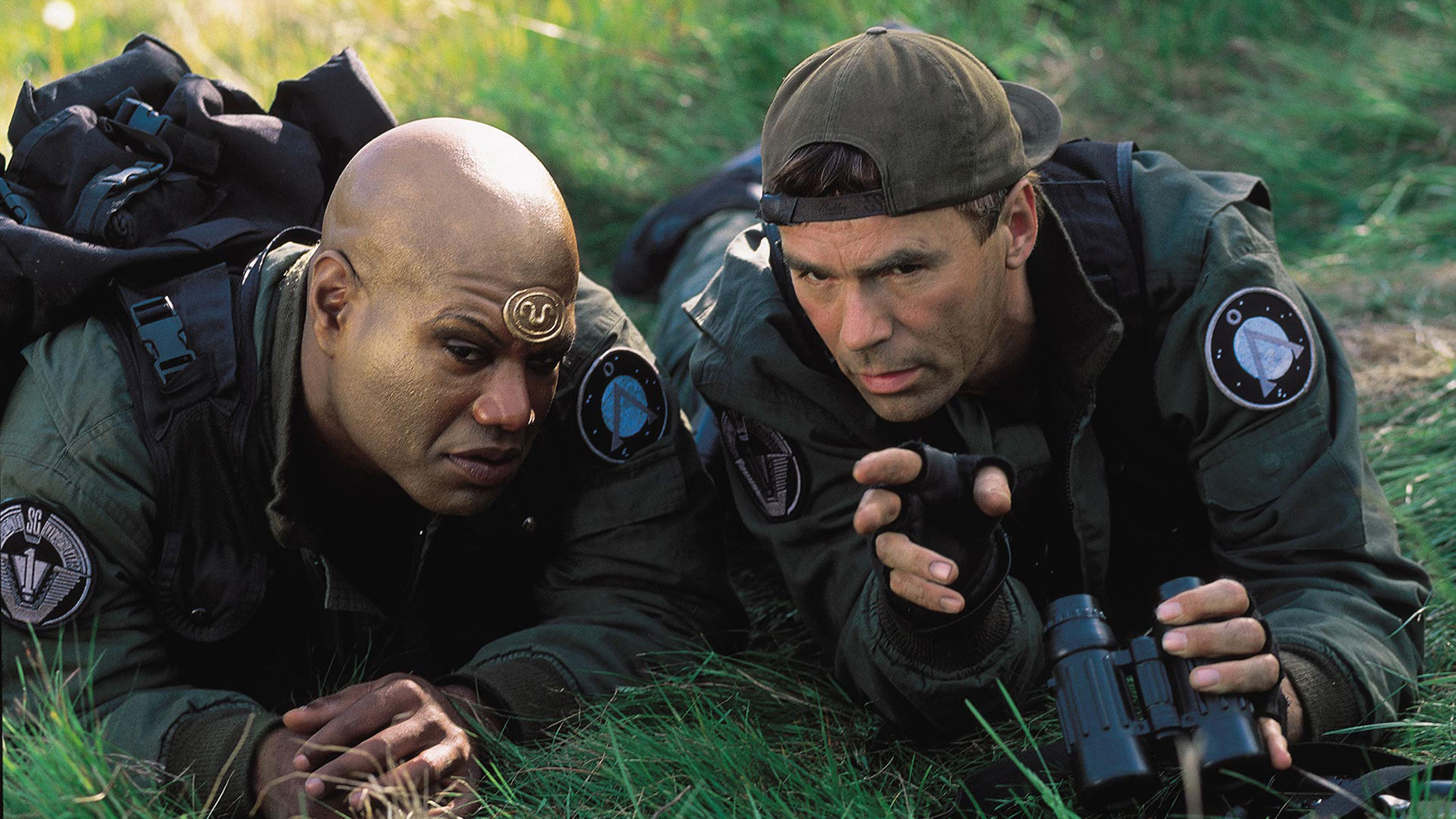 Stargate: The Blu-ray Collection (Blu-ray)
Over 300 hours of run timeRead more▼ Predator 4-Movie Collection (Blu-ray)
Four movies with great upscaling workRead more▼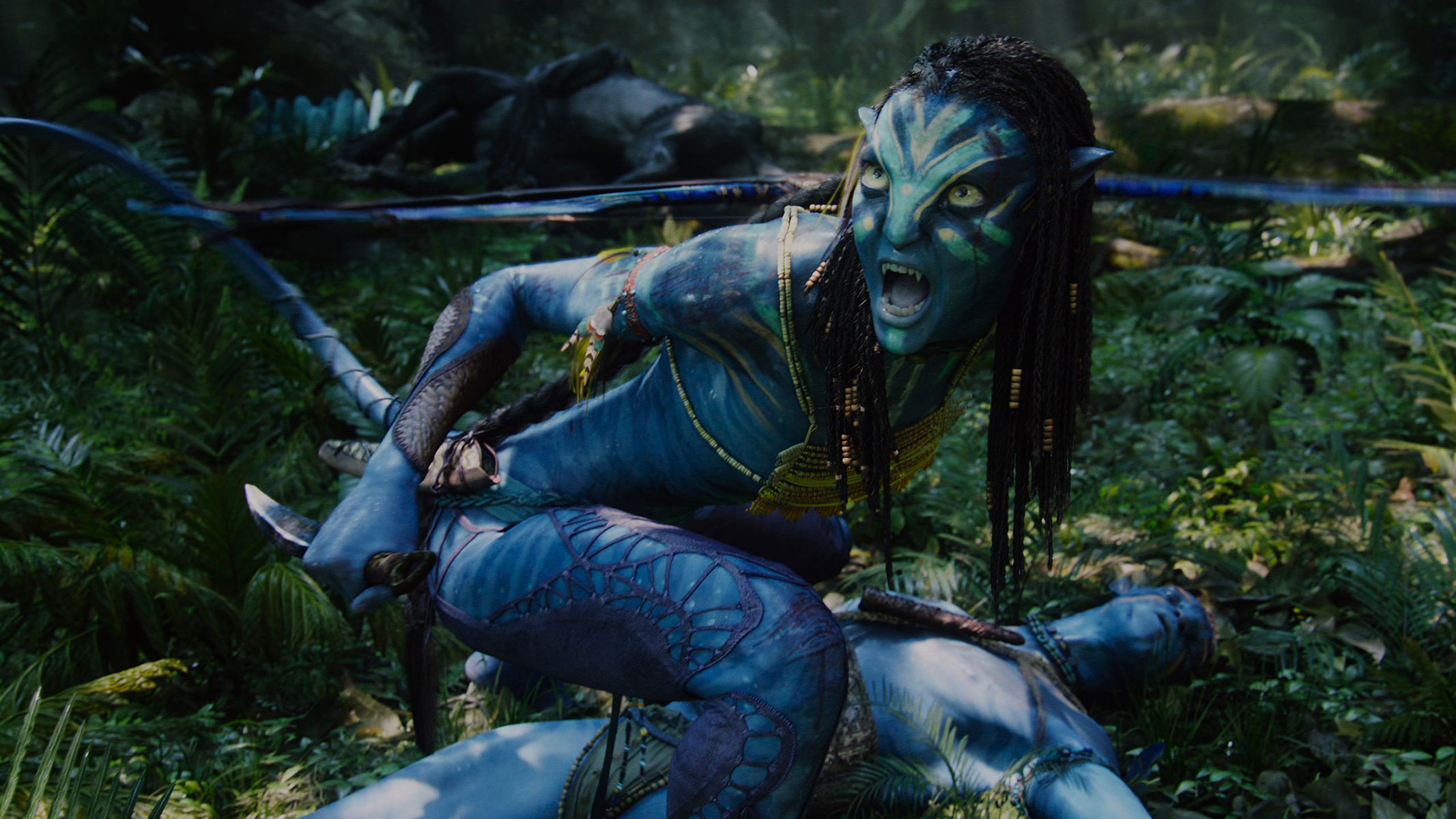 Avatar – Collector’s Edition (4K UHD + Blu-ray)
Multiple versions of the movieRead more▼
The streaming revolution has its perks, but it’s annoying when you want to watch the best sci-fi movies of all time and none of your subscriptions cover them, which is why Sci-Fi DVDs and Blu-rays are still worth chasing.
Renowned movie franchises like Star Wars are easy to stream on Disney Plus, sure, but the Force isn’t with fans who seek hours of extras, too. If you’re really into a long movie series, standalone classics and/or some of the best sci-fi TV shows ever made, physical media won’t leave you hanging. We’re also using this opportunity to dig up some killer box sets and limited editions you can still grab if you’re fast, so this guide is pretty solid for your Christmas and/or birthday gift needs.
Star Wars: The Skywalker Saga
Image 1 of 2
If you’re a Star Wars fan, you’ll want the Skywalker Saga 4K UHD Blu-rays.(Image credit: LucasFilm)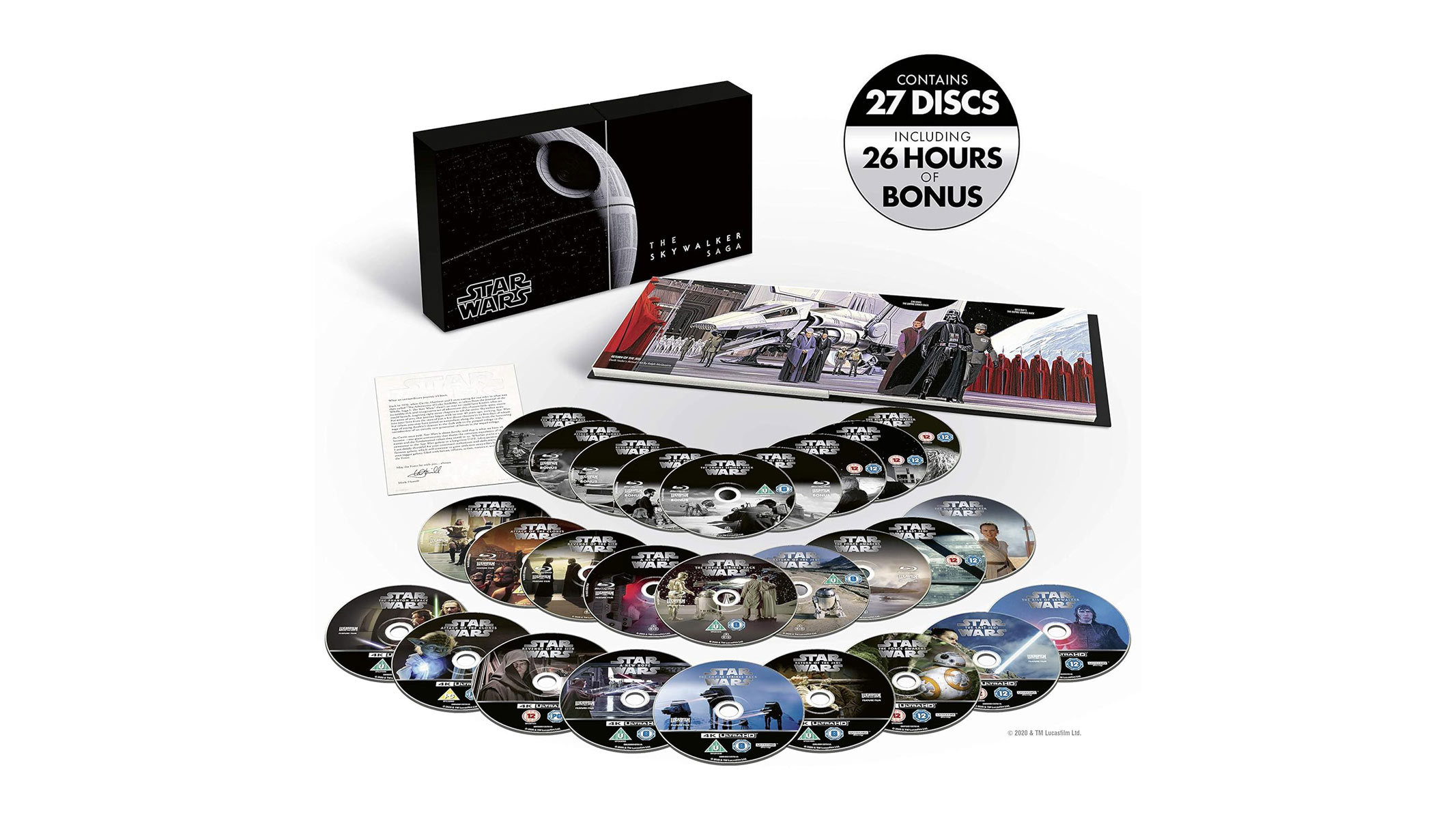 If you’re a Star Wars fan, you’ll want the Skywalker Saga 4K UHD Blu-rays.(Image credit: Amazon)
Star Wars: The Skywalker Saga (4K UHD + Blu-ray)
The most iconic of Sci-Fi franchises. All the movies, all in one place.
Specifications
Cast: Mark Hamill, Hayden Christensen, Daisy Ridley
Run time: 20 hours 38 minutes (movies only)
Number of discs: 27
Reasons to buy
+
All the movies, all in one place
+
Loaded with extras
Whether you loved the entire ride or would rather forget about the sequels, the complete Star Wars movie experience is worth embarking on, especially for newcomers. With the absolutely massive Skywalker Saga 4K UHD box set released in 2020, the path of a Jedi has never been more complete.
The nine-movie ride alone is over 20 hours long, and the incredible offering of extras runs for even longer than that. Disney and Lucasfilm really went all out with this one, and Star Wars fanatics who aren’t strict purists won’t find a better box set right now.
The whole saga and all the extras are spread across 27 discs, including 1080p Blu-rays, with stunning interior art pieces based on each trilogy and concept art, and a ‘digibook’ design which makes it feel extra special. Considering the high price tag on this one (it’s only gone up due to scarcity of stock), it’s only for the biggest collectors around, but we think it’ll be a good while before Disney puts out a Star Wars box set as complete.
Today’s best Star Wars The Skywalker Saga deals


Star Trek: The Complete Original Series (Blu-ray)
Image 1 of 2
 If you’re a Star Trek fan, the complete original series is up there with the best Blu-ray options you can buy.(Image credit: Paramount Pictures)
 If you’re a Star Trek fan, the complete original series is up there with the best Blu-ray options you can buy.(Image credit: Amazon)
Star Trek: The Complete Original Series (Blu-ray)
Owning a physical copy of the original series means your affinity with Star Trek will live long and prosper.
Specifications
Cast: William Shatner, Leonard Nimoy, Nichelle Nichols
Run time: 67 hours 42 minutes
Number of discs: 20
Reasons to buy
+
Similarly priced to one year’s subscription of Paramount Plus
+
Nearly 70 hours of content
Reasons to avoid
–
A little pricey for just one TV show
Much less pricey than the Star Wars entry above is the Blu-ray (1080p) release of the complete Star Trek original series, which runs for over 67 hours and is spread across 20 discs.
Considering it’s still selling at around $70, it’s one hell of a deal, no matter if this is your first attempt to get into Star Trek or you’re a longtime fan looking to secure a clean and straight-to-the-point Blu-ray edition.
This release isn’t just an ‘enhanced for 1080p’ remaster of the show as it was either. It also features ‘enhanced visual effects’ (purists may not enjoy this) and a 7.1 surround sound option on top of the preserved original mono audio tracks. As for special bonus content, the ‘special features’ run for over 9 hours, though the box clearly states that they’re not presented in high definition. It may not be the definitive treatment for the series that started it all, but it’s more than enough to boldly go where no man has gone before.
Today’s best Star Trek The original series (Blu-ray) deals
Stargate: The Blu-ray Collection (Blu-ray)
Image 1 of 2
This Stargate Blu-ray collection has over 300 hours of content, spread across nearly 70 discs.(Image credit: Amazon MGM Studios)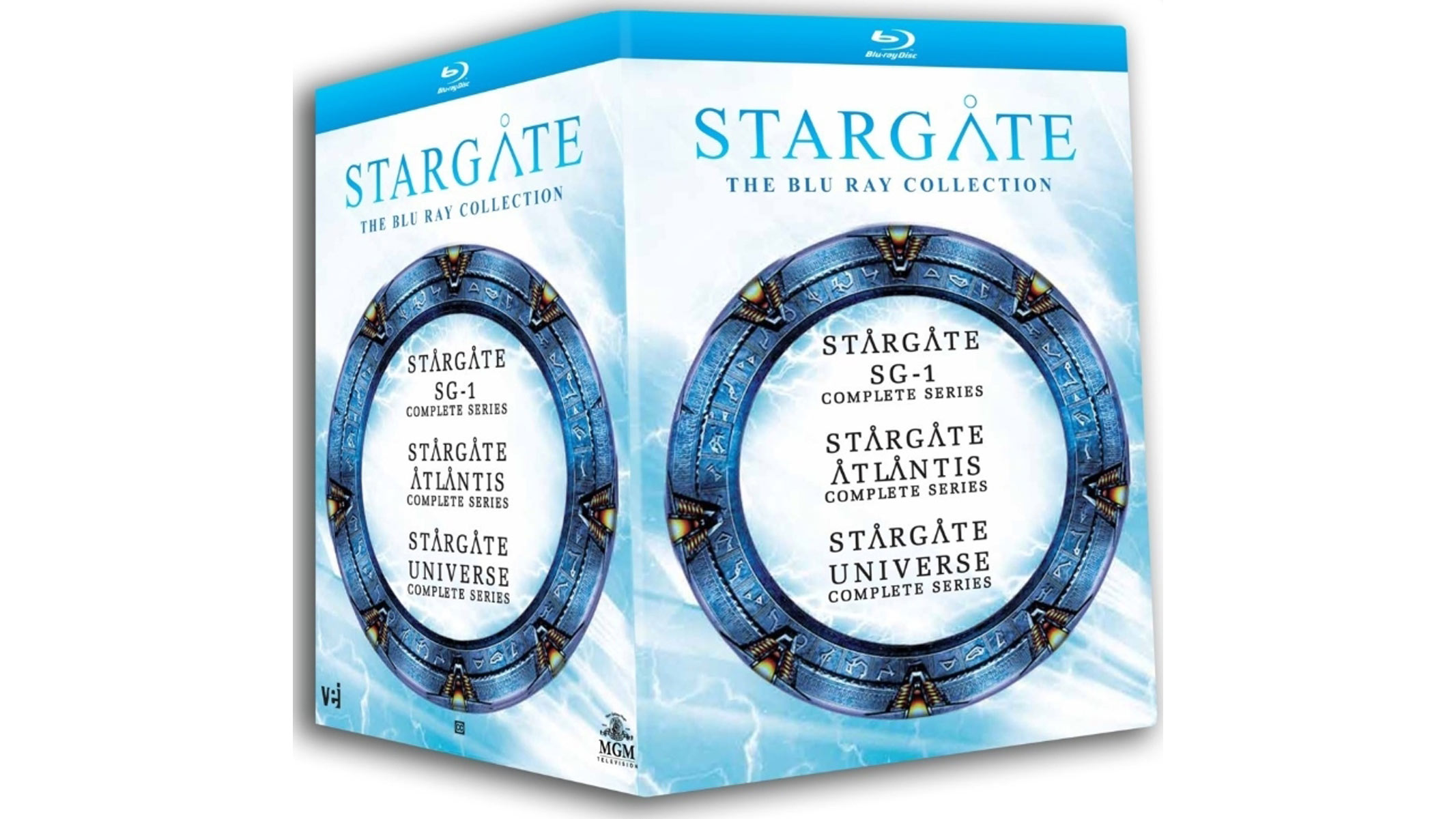 This Stargate Blu-ray collection has over 300 hours of content, spread across nearly 70 disks.(Image credit: Amazon)
Stargate: The Blu-ray Collection (Blu-ray)
Over 300 hours and nearly 70 discs worth of television show makes this a box set worth getting.
Specifications
Cast: Richard Dean Anderson, Amanda Tapping, Christopher Judge
Run time: 309 hours
Number of discs: 69
Reasons to buy
+
Over 300 hours of run time
+
Nearly 70 discs in total
+
You get a lot for your money
The absolute largest (but not priciest) Sci-Fi Blu-ray collection we’ve found so far is the complete Stargate collection, which includes Stargate SG-1, Atlantis and Universe. In total, you’re looking at over 300 hours of old-fashioned TV goodness with this one.
It’s safe to say you won’t be rewatching the whole box set often, but you get a lot of content for your money. Only 1080p and English language in this one, but you’re getting a lot of bang for your buck, especially as bonus features are included.
With Amazon MGM Studios now in ownership of the IP, we’ve been banging the drum of “Stargate should return” for a while now. If you only watched the original movie and would like to learn what the heck all the praise and online noise is all about, buckle up, prepare accordingly and enjoy a lengthy but delightful journey through TV shows that did a lot with minimal budgets. Just make sure to input the right coordinates when you make each space-bending trip…
Predator 4-Movie Collection (Blu-ray)
Image 1 of 2
The Predator 4-movie pack is perfect for fans of the predator franchise. (Image credit: 20th Century Studios)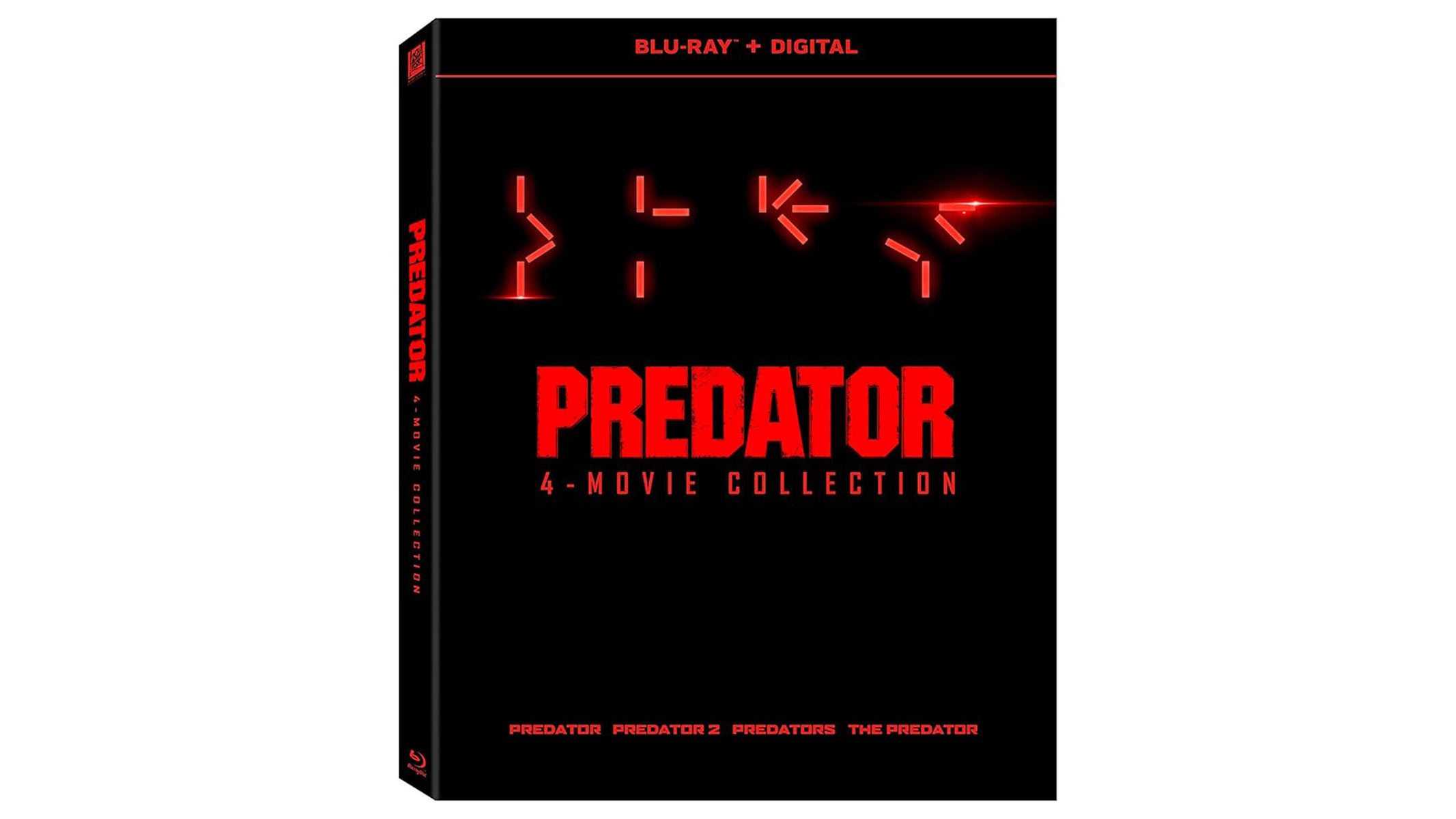 The Predator 4-movie pack is perfect for fans of the predator franchise. (Image credit: Amazon)
Predator 4-Movie Collection (Blu-ray)
Experience the journey that is the first four Predator movies, all in one box set
Specifications
Cast: Arnold Schwarzenegger, Danny Glover, Adrien Brody
Run time: 7 hours 9 minutes
Number of discs: 4
Reasons to buy
+
Four movies with great upscaling work
+
Great to catch up before the more recent releases
+
inexpensive compared to others
Before recent Dan Trachtenberg-directed entries like Prey and Predator: Badlands, the Predator movie series wasn’t in super great shape, but the Predator 4-Movie Collection released in late 2018 packs Predator 1 & 2 (classics), Predators (a fairly underrated one) and The Predator (the one that nearly killed the franchise).
For roughly $30, it’s a pretty great deal if you want to catch up with the series before the more recent installments or want to surprise a hardcore Yautja fanatic.
Of course, not everyone was a fan of the upscaling work done on the two older movies when they first made the jump to 1080p and above, but the following releases improved the image quality without sacrificing most of the original texture. While we believe the 4K UHD version of this 4-disc set is a bit too expensive considering it’s not loaded with extras, the regular Blu-ray version is a fantastic deal. Additionally, you’re also getting a digital copy of each movie.
Today’s best Predator 4-movie collection deals
Avatar – Collector’s Edition (4K UHD + Blu-ray)
Image 1 of 2
This Avatar Blu-ray is the best option for collectors. (Image credit: 20th Century Studios)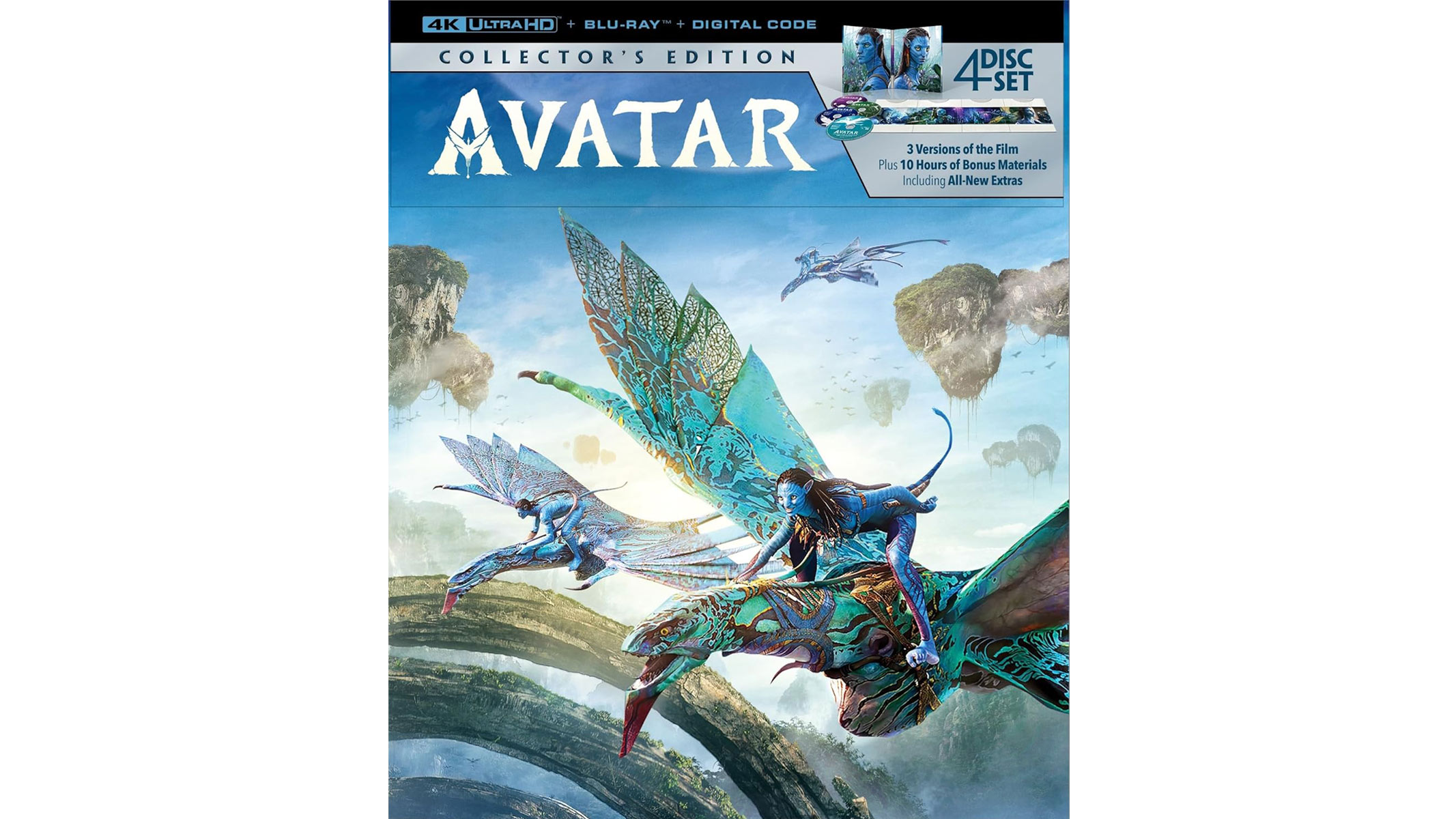 This Avatar Blu-ray is the best option for collectors. (Image credit: Amazon)
Avatar – Collector’s Edition (4K UHD + Blu-ray)
Return to Pandora with hours and hours of bonus content and different versions of the record-breaking movie.
Specifications
Cast: Sam Worthington, Zoe Saldaña, Stephen Lang
Run time: 3 hours and 15 minutes
Number of discs: 4
Reasons to buy
+
Multiple versions of the movie
+
Over 10 hours of bonus content
+
Most complete version of the movie yet
Avatar: Fire and Ash is upon us, which means both Na’vi diehards and folks planning a more casual trip to Pandora might be looking to grab the first two movies in the sharpest possible quality.
Disney and 20th Century Studios have always been well aware of how much money these movies make in the domestic market, too, so it comes as no surprise we’ve seen countless different editions of the 2009 original released over the years.
At the time of writing, the late-2023 re-release of Avatar, dubbed ‘Collector’s Edition’ is the most complete you can find if you’re really into James Cameron’s industry-shaking phenomenon. The delightful pack includes the movie in 4K UHD, 1080p Blu-ray and digital. It’s also the first time the Special Edition and Collector’s Extended Cut have been available to watch in 4K, plus two entire discs are dedicated to bonus materials. While we’re expecting Disney to milk Eywa until it’s dry in the future, this is the best Avatar Blu-ray deal money can buy at the moment.
Today’s best Avatar Collector’s Edition deals
Alien – 40th Anniversary (4K UHD + Blu-ray)
Image 1 of 2
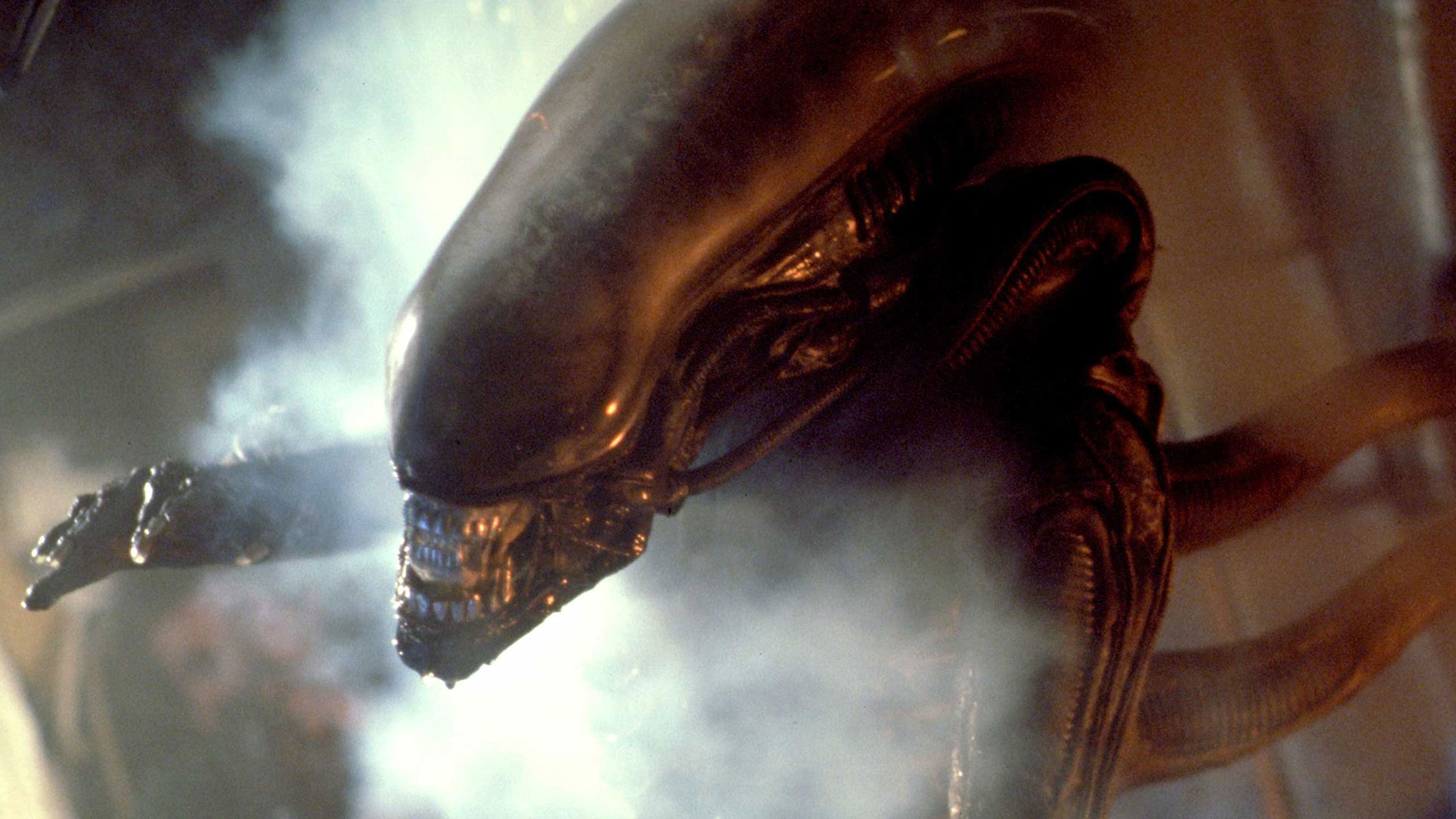 This Blu-ray option is the best for fans of the movie, and the franchise, Alien.(Image credit: 20th century studios)
 This Blu-ray option is the best for fans of the movie, and the franchise, Alien.(Image credit: Amazon)
Alien – 40th Anniversary (4K UHD + Blu-ray)
Experience one of the most iconic Sci-Fi movies with upgraded visuals and effects
Specifications
Cast: Sigourney Weaver, Ian Holm, Tom Skerritt
Run time: 1 hour 57 minutes
Number of discs: 2
Reasons to buy
+
Inexpensive compared to the other entries
+
Bonus material
+
Improved visuals and effects
Reasons to avoid
–
Just one movie, not a box set
We’ve had plenty of physical media releases of Alien (1979) worth purchasing over the years, so it was unsurprising to see the 40th Anniversary Edition released in 2019, being a fantastic refresh of both cuts of the movie (theatrical and director’s cut), which remains available due to continued success. That stylish cover is killer, and the no-BS approach to the overall presentation is exactly what you want out of a revisited classic.
At home, everyone can hear you scream, especially if you’re easily startled; the crisp audio (DTS, DTS-HD and Dolby 5.1 options) pops alongside the sharper 4K image quality, and the high dynamic range’s extra sauce (if you have a TV prepared for the full experience) is exactly what the Nostromo needed to come to life like never before. Not as impressive are the special features, but with great audio commentary by Ridley Scott and cast and crew members, plus a bunch of deleted scenes, the basics are covered.
Today’s best Alien 40th Anniversary Edition deals
Dune 2-Film Collection (4K UHD)
Image 1 of 2
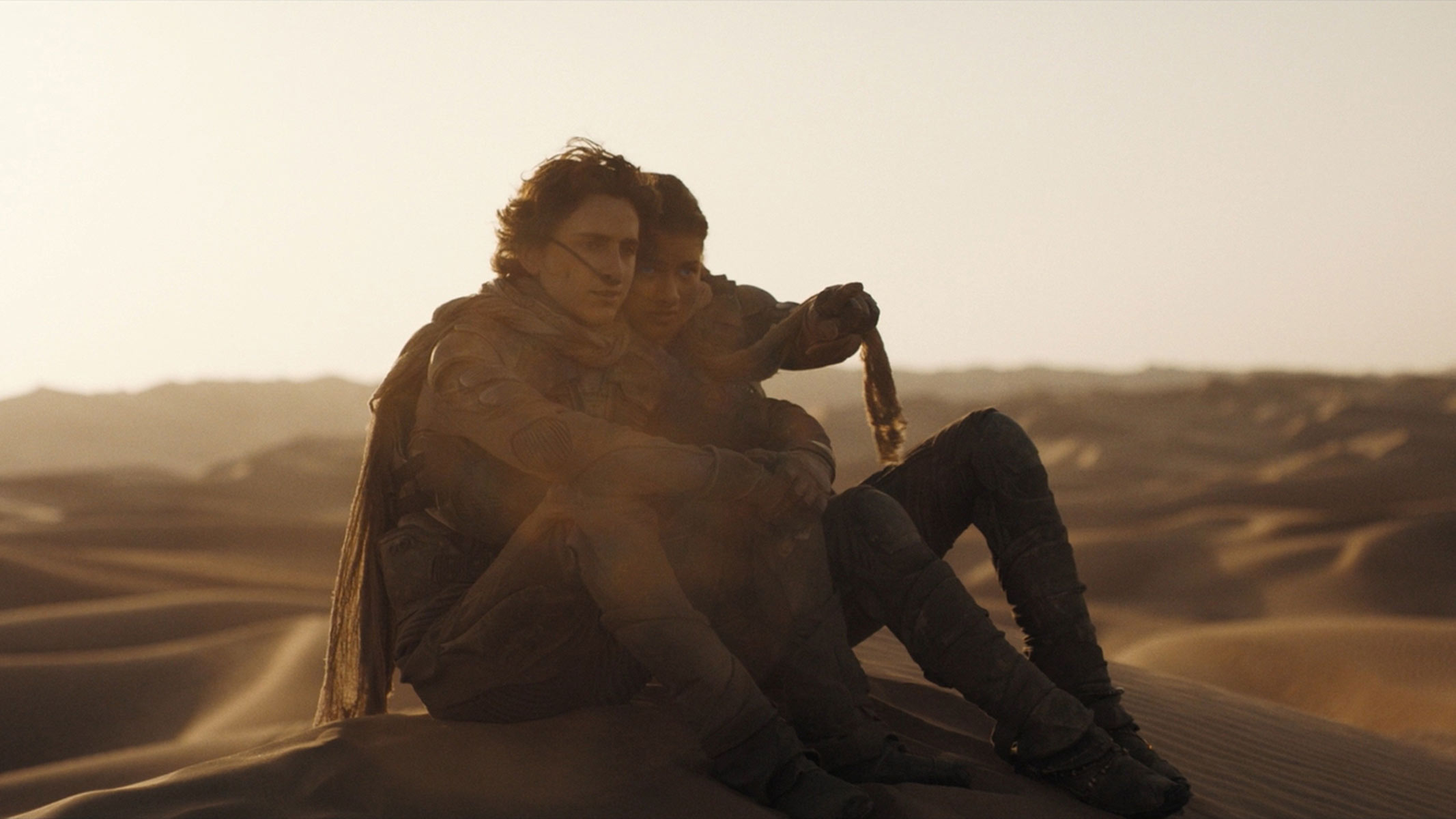 This two-film collection is the best Blu-ray option for Dune fans.(Image credit: Warner Bros. Pictures)
 This two-film collection is the best Blu-ray option for Dune fans.(Image credit: Amazon)
Dune 2-Film Collection (4K UHD)
A must for Dune fans looking to watch the movies with maximum visual effects.
Specifications
Cast: Timothée Chalamet, Zendaya, Oscar Isaac
Run time: 5 hours 21 minutes
Number of discs: 2
Reasons to buy
+
4K UHD
+
Bonus material
+
Great visual output
Reasons to avoid
–
A little light on extra content
Denis Villeneuve’s two-part adaptation of Frank Herbert’s Dune somehow managed to please most fans while also captivating millions of casual moviegoers with no previous knowledge of the (admittedly dense) source material. That’s no small feat, and such a wondrous Sci-Fi epic deserves the biggest 4K screen you can fit inside your house. For now, our favorite domestic release of the two movies is the 2-Film Collection released in 2024.
As usual in Warner Bros. Pictures’ domestic releases, the 4K UHD image and sound (Dolby 5.1, 7.1 and Atmos audio) quality is astonishing, making Arrakis’ sights and sounds pop like in cinemas, which is exactly what you want from a 4K release of big Sci-Fi epics.
Sadly, this pack doesn’t include regular 1080p Blu-ray discs like similar boxes, so it’s a no-no for those still rocking a regular Blu-ray player but looking to future-proof their collection. The bonus features are also on the lighter side, but if you’re looking to catch up ahead of Dune: Messiah while adding fantastic modern Sci-Fi classics to your physical media collection, it’s an easy yes.
Today’s best Dune 2-film collection deals
Blade Runner: The Final Cut (4K UHD + Blu-ray)
Image 1 of 2
 Blade Runner: The final cut is the best Blu-ray option for fans of Blade Runner.(Image credit: Warner Bros. Pictures)
 Blade Runner: The final cut is the best Blu-ray option for fans of Blade Runner.(Image credit: Amazon)
Blade Runner: The Final Cut (4K UHD + Blu-ray)
As well as the original movie, over 7 hours of extra material, across 4 discs, make this a must.
Specifications
Cast: Harrison Ford, Sean Young, Rutger Hauer
Run time: 1 hour 58 minutes
Number of discs: 4
Reasons to buy
+
Great in 4K
+
Lots of bonus material
We thought it’d be weird to write this recap without searching for a great edition of the original Blade Runner, and we quickly came across the 4K UHD re-release of the Final Cut, regular Blu-ray and digital copy included.
It’s yet another ‘lean and mean’ winner re-release from Warner Bros. and with a gorgeous cover to boot. Just make sure to buy it for the 4K UHD disc, as the encoding of the 1080p disc isn’t the greatest, sadly.
When it comes to special features, it packs an introduction by Ridley Scott, three audio filmmaker commentaries, an entire documentary on the making of the movie and other extra bits (over 7 hours in total). Despite releasing in 2017 ahead of Blade Runner 2049, this release also has pretty great HDR support for the 4K disc; there’s a good reason it’s still kicking around. Ahead of the Blade Runner 2099 series, there’s never been a better time to revisit the beginning of it all.
Today’s best Blade Runner [4K UHD] [Blu-ray] [2017] deals
Event Horizon – Limited Edition Steelbook (4K UHD + Blu-ray)
Image 1 of 2
 This Event Horizon Blu-ray option is the best steelbook option out there.(Image credit: Paramount Pictures)
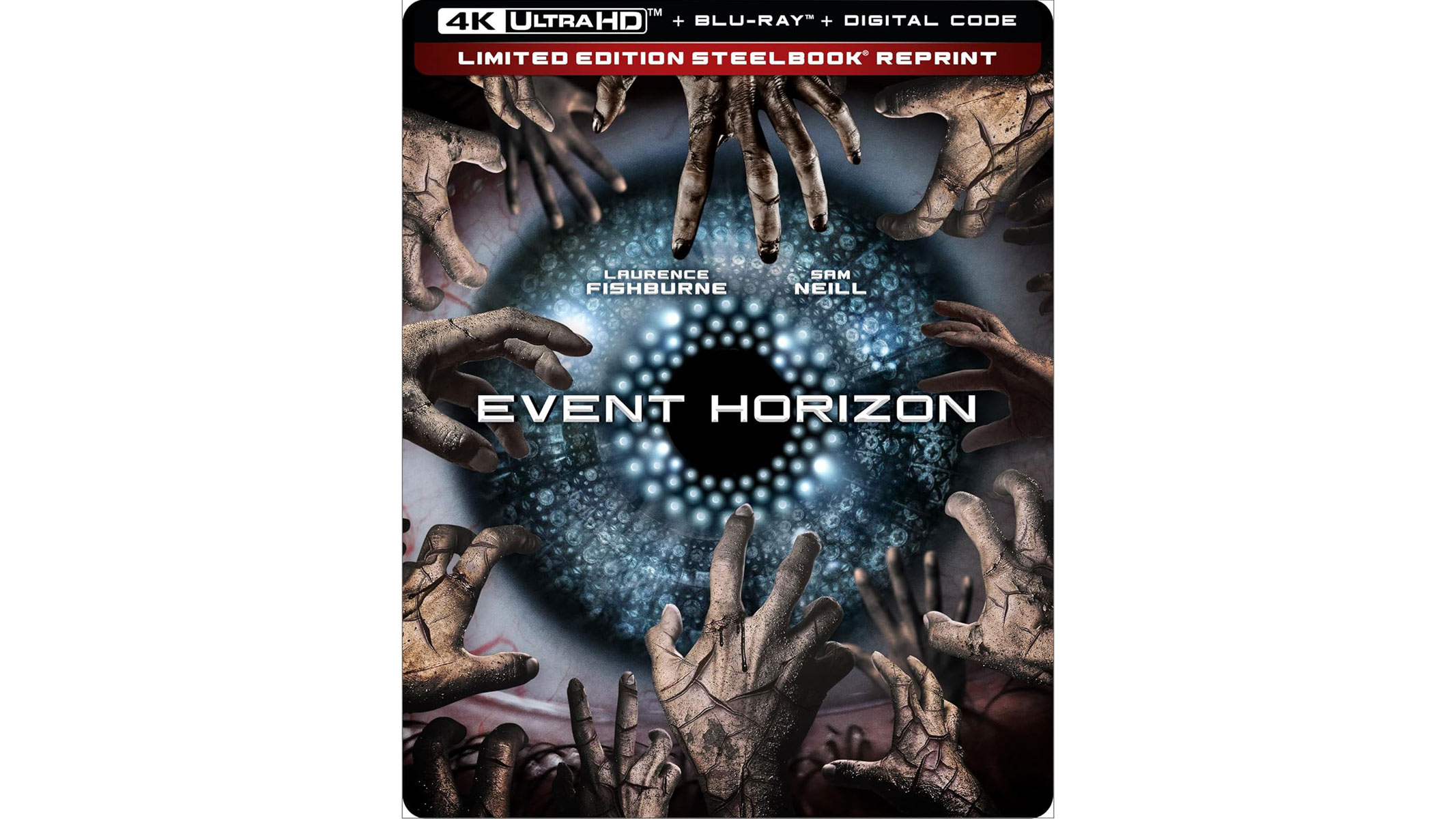 (Image credit: Amazon)
Event Horizon – Limited Edition Steelbook (4K UHD + Blu-ray)
This stunning remaster offers the best steelbook option out there
Specifications
Cast: Kathleen Quinlan, Laurence Fishburne, Sam Neill
Run time: 1 hour 35 minutes
Number of discs: 2
Reasons to buy
+
Aesthetically great physical copy
+
4K UHD
+
Great for fans of the movie
Reasons to avoid
–
Not great if you’re not a fan of the movie
2024’s Limited Edition reprint of the 4K steelbook release of Event Horizon is amazing. There have been many versions of this space horror cult classic dropping over the years despite the mixed reception it got back in 1997, but its 4K UHD restoration was a huge one for fans, and the 25th Anniversary Edition was a killer package with a disturbing new cover to boot. It vanished quickly, which is why Paramount was pressed to push out a re-release last year. At the time of writing, you can still get it, but don’t wait too long.
What if a spaceship vanished during its maiden voyage because the wormholes it used to cover great distances of space sent it through literal Hell? While all the potential of such an amazing (and horrifying) pitch wasn’t realized in Paul W.S. Anderson’s sci-fi horror flick, it remains a fascinating watch with a unique vibe and some of the gnarliest horror imagery in a wide theatrical science fiction release. We may never see all of the long-lost uncensored footage, but after all these years, this vision of Hell is still worth your time and money. You won’t need eyes to see…
Today’s best Event Horizon Steelbook 4K UHD deals
Star Wars: Andor – Season 1 (4K UHD)
Image 1 of 2
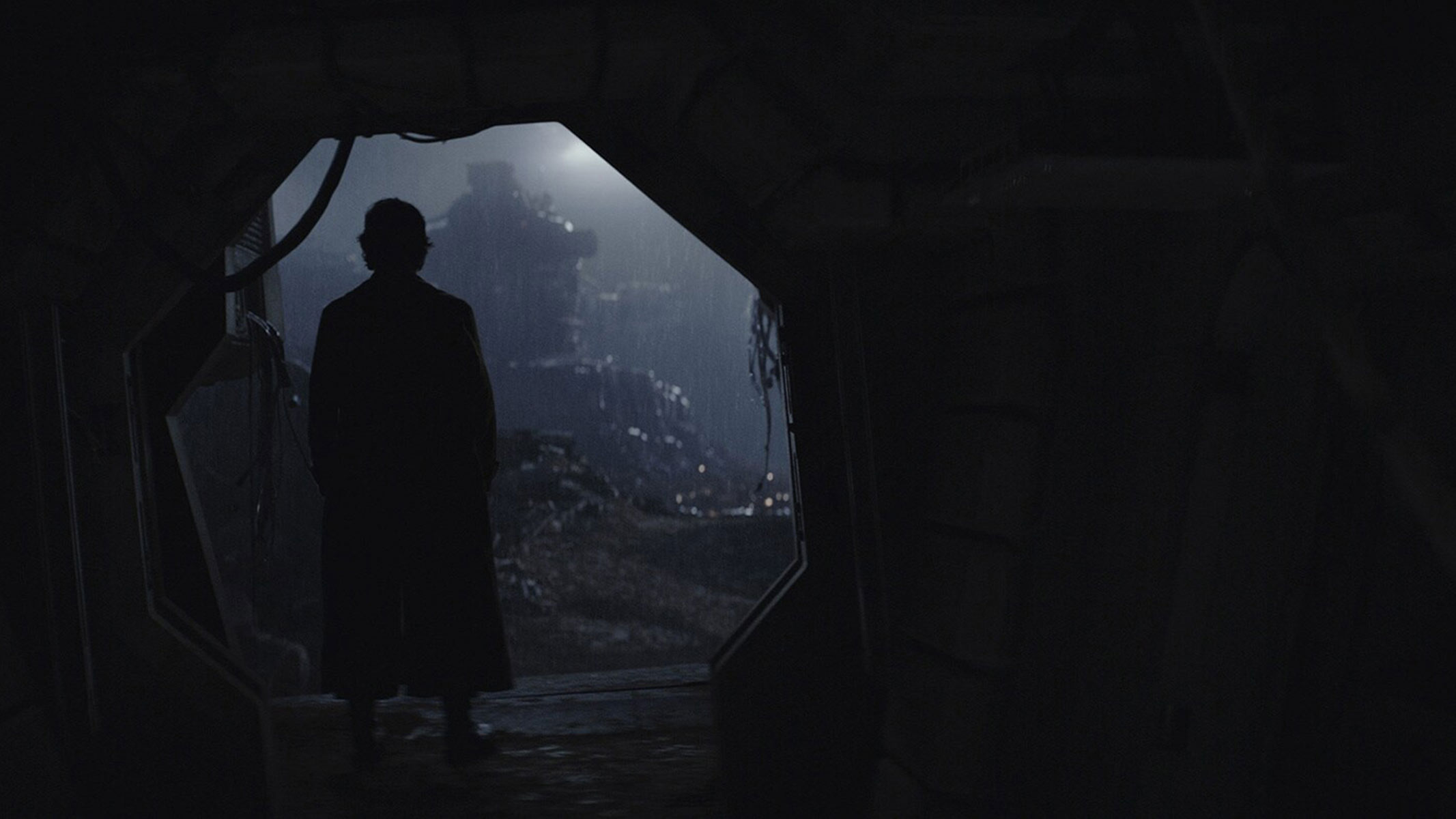 Andor Season one 4K UHD is the best option for fans of the Star Wars TV Shows.(Image credit: LucasFilm)
 (Image credit: Amazon)
Star Wars: Andor – Season 1 (4K UHD)
This hit Star Wars TV show comes with 3 discs and a bunch of bonus content.
Specifications
Cast: Diego Luna, Kyle Soller, Genevieve O’Reilly
Run time : 9 hours 42 minutes
Number of discs: 3
Reasons to buy
+
Plenty of bonus content
+
Concept art cards
+
4K UHD
Reasons to avoid
–
Very expensive for just one season of a show
Even if you haven’t watched Andor yet, you might’ve heard the Tony Gilroy-created live-action series is among the best Star Wars TV shows. We totally agree; it really feels deep and textured in a way nothing else in the franchise has been.
If you’re planning to grab one of the excellent physical releases of Star Wars series, Andor Season 1 in 4K UHD (no regular Blu-rays included in this one) is the absolute best credits can buy.
We’d read, watched and played through many takes on the Rebel Alliance’s origins, but none captured the Empire’s reign of terror in the way Andor does. The best praise we can give to spinoffs coming out of long-running franchises is that they feel like great original stories that happen to take place in established universes, and Andor is exactly that. Sure, this isn’t exactly kid-friendly Star Wars, but as a more adult take on the IP, which fits in perfectly nonetheless, we couldn’t have asked for anything better. Sadly, Season 2 hasn’t locked a physical media release yet, but we’d be shocked if it didn’t.












Primates — the mammalian group that includes humans — are found pretty much everywhere on Earth, from equatorial rainforests to scientific research stations in Antarctica. This hugely diverse order appeared before the dinosaurs went extinct, with wild populations of non-human primates evolving to live in niches across three continents — Asia, Africa and Central/South America.
Primates don’t just live in lots of places; there are also hundreds of species and subspecies. In fact, the order primates is the fourth most biodiverse mammal order in the animal kingdom — yet the majority (62.6%) of primates are threatened with extinction.
You may like
- Bird quiz: How much do you know about our feathered friends?
- Big cats quiz: Can you get the lion’s share of these questions right?
- Snake quiz: How much do you know about the slithering reptiles?

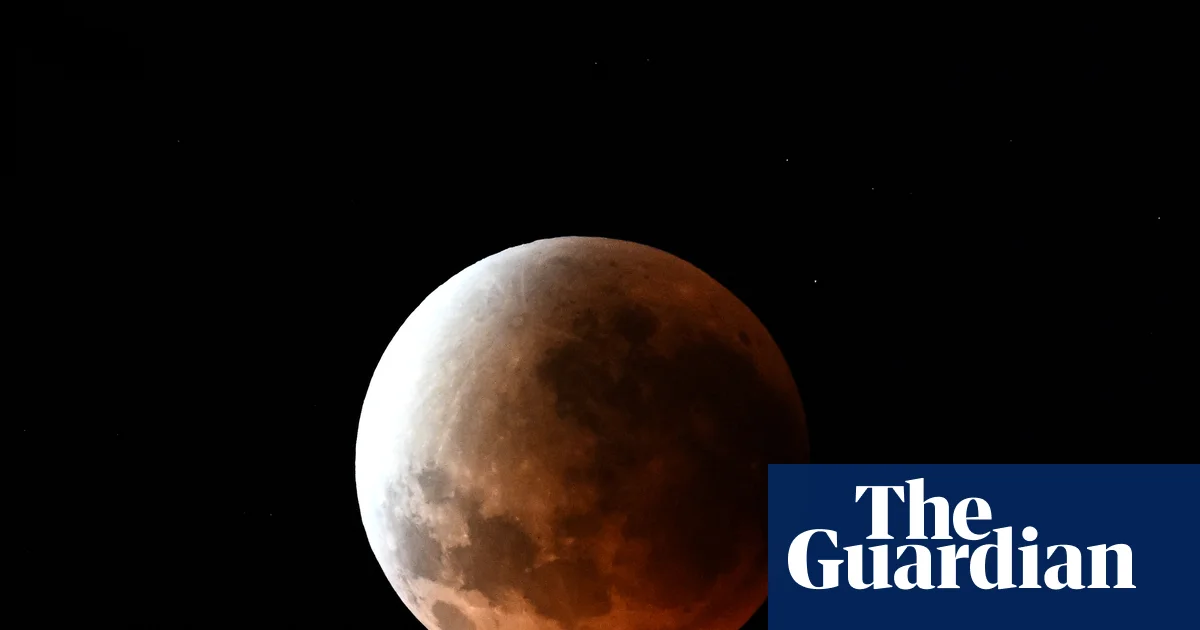
I do hope countries agree to use the Jules Verne crater on the far side of the moon as a spacecraft graveyard to crash defunct equipment as they use Point Nemo in the South Pacific Ocean as a spacecraft cemetery (Patches of the moon to become spacecraft graveyards, say researchers, 22 December).
Kartar Uppal
Streetly, West Midlands
In the 1980s, at the time of the nuclear incident in Ukraine, I was driving to the Suffolk coast, passing through Leiston, the nearest town to the Sizewell power station, upon whose town sign some wag had scrawled “Twinned with Chernobyl” (Letters, 26 December).
Margaret Philip
Scole, Norfolk
We laughed when John Prescott said that the green belt was “a Labour achievement, and we mean to build on it”. We are not laughing now (Sport stars ‘deeply concerned’ playing fields will be lost under planning reforms, 22 December).
Jude Carr
London
All over the country, volunteer fundraisers have been collecting to the music of Chris Rea (Obituary, 22 December). Thanks, Chris – enjoy the drive home.
Hilary Alder
Woking, Surrey
I want to know why some choose a hill on which to die while others make their last stand in a ditch (The hill I will die on: Being late can be the height of good manners and decorum, actually, 24 December). Is it just geography?
Peter Gray
Chesterfield, Derbyshire
“Trump class”? Now there’s an oxymoron (Trump announces plans for new navy warships to be known as ‘Trump-class’, 22 December).
Adrian Riley
Sheffield
Thank you for your moving obituary of Muriel Manning in the print edition this week (Other lives, 22 December). This sort of article is why I read the Guardian.
Nigel Linford
Eastbourne, East Sussex
Have an opinion on anything you’ve read in the Guardian today? Please email us your letter and it will be considered for publication in our letters section.
SCIENCE
Lower-cost space missions like NASA’s ESCAPADE are starting to deliver exciting science – but at a price in risk and trade‑offs

This article was originally published at The Conversation. The publication contributed the article to Space.com’s Expert Voices: Op-Ed & Insights.
After a yearslong series of setbacks, NASA’s Escape and Plasma Acceleration and Dynamics Explorers, or ESCAPADE, mission has finally begun its roundabout journey to Mars.
Launched on Nov. 13, 2025, aboard Blue Origin’s New Glenn rocket, ESCAPADE’s twin probes will map the planet’s magnetic field and study how the solar wind – the stream of charged particles released from the Sun – has stripped away the Martian atmosphere over billions of years.
You may like
When I was a doctoral student, I helped develop the VISIONS camera systems onboard each of ESCAPADE’s spacecraft, so I was especially excited to see the successful launch.
But this low-cost mission is still only getting started, and it’s taking bigger risks than typical big-ticket NASA missions.
ESCAPADE is part of NASA’s Small Innovative Missions for Planetary Exploration, or SIMPLEx, program that funds low‑cost, higher‑risk projects. Of the five SIMPLEx missions selected so far, three have failed after launch due to equipment problems that might have been caught in more traditional, tightly managed programs. A fourth sits in indefinite storage.
ESCAPADE will not begin returning science data for about 30 months, and the program’s history suggests the odds are not entirely in its favor. Nonetheless, the calculus goes that if enough of these missions are successful, NASA can achieve valuable science at a reduced cost – even with some losses along the way.
Lower cost, higher risk
NASA classifies payloads on a four‑tier risk scale, from A to D.
Class A missions are the most expensive and highest priority, like the James Webb Space Telescope, Europa Clipper and the Nancy Grace Roman Space Telescope. They use thoroughly proven hardware and undergo exhaustive testing.
ESCAPADE is at the other end. It’s a class D mission, defined as having “high risk tolerance” and “medium to low complexity.”
You may like
Of the 21 class D missions that have launched since the designation was first applied in 2009, NASA has not had a single class D mission launch on schedule. Only four remained under budget. Four were canceled outright prior to launch.
ESCAPADE, which will have cost an estimated US$94.2 million by the end of its science operations in 2029, has stayed under the $100 million mark through a series of cost‑saving choices. It has a small set of key instruments, a low spacecraft mass to reduce launch costs, and extensively uses generic commercial components instead of custom hardware.
NASA also outsourced to private companies: Much of the spacecraft development went to Rocket Lab and the trajectory design to Advanced Space LLC, with tight contract limits to make sure the contractors didn’t go over budget.
Additional savings came from creative arrangements, including the university‑funded VISIONS camera package and a discounted ride on New Glenn, which Blue Origin wanted to fly anyway for its own testing objectives.
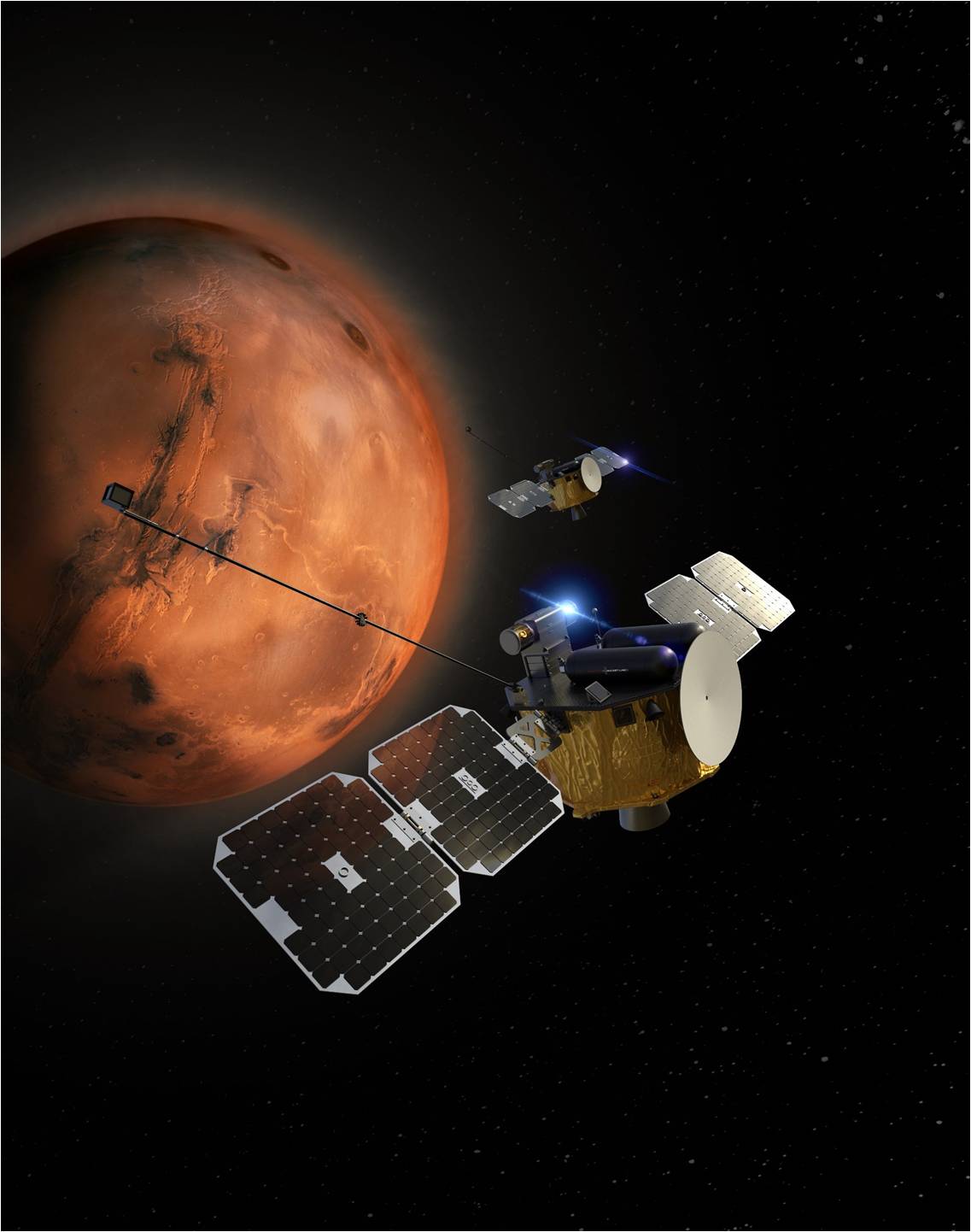
An illustration from Rocket Lab of the Escapade mission with Rocket Lab’s key designs. (Image credit: Rocket Lab)
Commercial space
ESCAPADE launched at a moment of transition in space science.
NASA and other science agencies are facing the steepest budget pressures in more than 60 years, with political winds shifting funding toward human spaceflight. At the same time, the commercial space sector is booming, with long-imagined technologies that enable cheap space travel finally entering service.
That boom has, in part, led to a resurgence in NASA’s “faster, better, cheaper” push that originated in the 1980s and ’90s – and which largely faded after the 2003 Columbia disaster.
In theory, leaner NASA oversight, greater use of off‑the‑shelf hardware and narrower science goals can cut costs while launching more missions and increasing the total science return. If ESCAPADE succeeds in delivering important science, it will be held up as evidence that this more commercial, risk-tolerant template can deliver.
The trade-offs
A concept put forward by Jared Isaacman, the Trump administration’s nominee to lead NASA, is that 10 $100 million missions would be better than one $1 billion flagship – or top-tier – mission. This approach could encourage faster mission development and would diversify the types of missions heading out into the solar system.
But that reorganization comes with trade-offs. For example, low‑cost missions rarely match flagship missions in scope, and they typically do less to advance the technology necessary for doing innovative science.
With a narrow scope, missions like ESCAPADE are unlikely to produce the most transformative discoveries about, for instance, the origins of life or the nature of dark matter, or the first chemical analyses of oceans on a new world. Instead, they focus on more specific questions.
Early in ESCAPADE’s development, my role was to help create a planning document for the VISIONS cameras called the Science Traceability Matrix, which defines an instrument’s scientific goals and translates them into concrete measurement requirements.
My colleagues and I systematically asked: What do we want to learn? What observations prove it? And, critically, how precisely does the instrument need to work to be “good enough,” given the budget? Loftier goals usually demand more complex instruments and operations, which drive up costs.
ESCAPADE’s broader goals are to create a clearer picture of Mars’ magnetic field, how the solar wind interacts with it, and figure out what that process does to Mars’ atmosphere. That is valuable science. But it is more modest than the $583 million predecessor mission MAVEN’s more extensive scope and richer suite of instruments. It was MAVEN that determined how and when Mars lost its once-dense atmosphere in the first place.
Both ESCAPADE and MAVEN are dwarfed again by the open‑ended potential of an operation like the James Webb Space Telescope, which observes a limitless slate of astronomical objects in the infrared light spectrum with a higher resolution than any combination of prior smaller telescopes.
Flagship missions like the James Webb Space Telescope push the state of the art in new technologies and materials. These innovations then filter into both future missions and everyday life. For example, the Webb telescope advanced the medical tools used in eye exams. Smaller missions rely more heavily on existing, mature technologies.
And when systems are built by private companies rather than NASA, those companies keep tight control over the patents rather than openly spreading the technology across the scientific community.
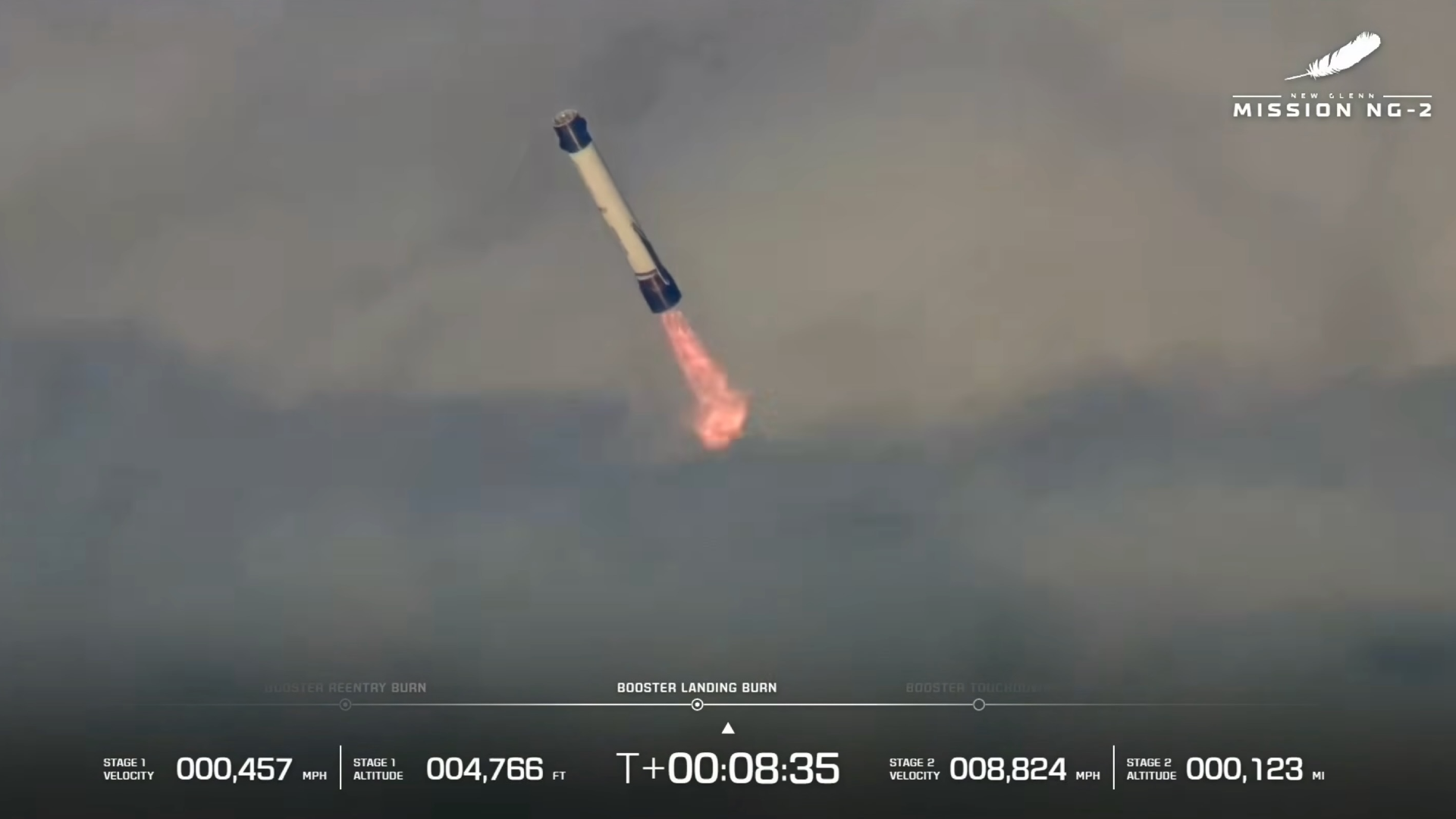
An image from Blue Origin’s New Glenn ESCAPADE launch. (Image credit: Blue Origin)
A tense road to launch
ESCAPADE’s principal investigator, Rob Lillis, has joked that it is the mission with 11 lives, having survived 11 near‑cancellations. Problems ranged from being late in reaching the technology readiness levels that helped ensure the probes wouldn’t malfunction after launch, to the loss of its original free ride, with NASA’s Psyche mission.
In 2024, ESCAPADE received support from NASA to ride on New Glenn’s maiden flight, only to face delays as Blue Origin worked through technical hurdles. At last, in October 2025, ESCAPADE reached the launchpad.
I traveled to Cape Canaveral for the launch and felt the tension firsthand. The first window was scrubbed by bad weather and issues with ground equipment. Then a strong solar storm — ironically, a key driver of the very processes ESCAPADE will study — shut down the second window.
Concurrently, the Federal Aviation Administration imposed new launch restrictions due to the government shutdown that would have postponed the launch further if not for a last-minute exemption.
Finally, on Nov. 13, after repeated setbacks, New Glenn lifted off to cheers around the country. ESCAPADE reached orbit, and after a nervous few hours of receiver misalignment, mission controllers established communication with the spacecraft.
What’s next
While in Florida, I also watched another milestone in commercial spaceflight: the record-breaking 94th launch from Cape Canaveral in 2025, marking the most launches from Florida in a single year. It was a SpaceX Falcon 9 carrying Starlink satellites.
Like New Glenn, SpaceX’s Falcon 9 saves money by landing and reusing rockets. If multiple providers like SpaceX and Blue Origin compete to keep launch prices low, the economics of small science missions will only improve.
If ESCAPADE’s twin spacecraft reach Mars and deliver new insights as planned, they will demonstrate how minimalist, commercial-forward approaches can expand the planetary knowledge base.
But even then, a string of future SIMPLEx successes would likely not be a substitute for the uniquely capable, technology‑advancing flagship missions that answer the most far‑reaching questions. ESCAPADE can instead help test whether a broader mix of small missions – leaning on commercial partners and a few big, ambitious flagships – can together sustain planetary science in an era of tight budgets.
For now, that balance remains an open experiment, and only time will tell whether ESCAPADE is a lone bright spot or the start of a real shift.
SCIENCE
Year in review: The standout health stories of 2025, from measles outbreaks to AI-made viruses


Groundbreaking medical treatments; mysteries of fundamental biology; the impacts of health policy upheavals. Live Science covered all these topics and more in 2025 — and you can catch up on some of our best Health channel long-reads from the year below. The following list includes interviews, book excerpts and news analyses, as well as entries from our Science Spotlight series, which highlights how science is transforming the world as we know it.
1. Secrets of the world’s oldest woman
The supercentenarian Maria Branyas Morera on her 117th birthday on March 4, 2024. (Image credit: Arxiu de la família Branyas Morera, (CC0 1.0 UNIVERSAL Deed), via Wikimedia Commons)
Maria Branyas Morera, once the world’s oldest woman, died in 2024 at age 117. Live Science took a deep look at a study that examined Branyas’ biology and uncovered key traits that may have protected her from disease in old age. Could lessons from the study help others lead longer, healthier lives?
2. What makes us human?
Many consider the brain to be a central feature of what makes us human — but how did the remarkable organ come to be? In an interview, science communicator Jim Al-Khalili discussed what he learned from shooting the new BBC show “Horizon: Secrets of the Brain,” which tells the story of how the human brain evolved. And in a book excerpt and interview with Live Science, neuroscientist Nikolay Kukushkin described the evolutionary forces he believes were key to the formation of the human brain and consciousness as we know it.
You may like
3. Could lab-grown brains gain consciousness?
Miniature models of the human brain can be grown from stem cells in the lab, and they’re getting more and more advanced. Some scientists have raised concerns that these “minibrains” could become conscious and feel pain. We investigated experts’ concerns and hopes for future regulation of the research.
4. The promise of mRNA medicine
mRNA may be best known for forming the basis of the first COVID-19 vaccines, but it could also be used in revolutionary cancer therapeutics, immune-reprogramming treatments and gene therapies. The promise of these emerging mRNA medicines is staggering, but due to the politicization of COVID-19 shots in the U.S., mRNA research and development — even unrelated to vaccines — now hangs in precarious uncertainty. A Science Spotlight feature described emerging mRNA technologies and their wobbly status under the second Trump administration.
5. Cancer in young people

Certain types of cancer, including breast and colorectal cancers, are becoming more prevalent in people under 50. A combination of factors may be at play. (Image credit: Morsa Images via Getty Images)
You may have heard that more young people are being diagnosed with cancer. But which types of cancer are driving this trend? And why are the rates going up in the first place? We looked at what may be driving this pattern, from underlying cancer triggers to better techniques for early detection.
6. Male vs female brains
Is there really a difference between male and female brains? And do we even have the data required to answer that question? A Science Spotlight explored the existing research on sex differences in the brain, finding the results murkier than one might expect. Headlines often proclaim that male and female brains are “wired differently,” and that may be true in some subtle ways. But the biological consequences of those differences remain unclear, even to experts in the field.
7. AI is designing viruses
Artificial intelligence can now be used to design brand-new viruses. Scientists hope to use these viruses for good — for example, to treat drug-resistant bacterial infections. But could the technology usher in the next generation of bioweapons? An analysis probed this dual-use problem and what can be done to safeguard our biosecurity.
8. When pandemics are a “certainty,” how do we prepare?
In a book excerpt, epidemiologist Dr. Seth Berkley explained how he and other health leaders orchestrated a massive vaccine rollout to poor countries during the COVID-19 pandemic, so that the shots wouldn’t exclusively be hoarded by wealthy nations. Live Science also spoke with Berkley about the lessons learned from the pandemic and the ongoing fight for vaccine equity.
9. USAID cuts

HIV medications must be taken consistently to suppress the virus. Major cuts to HIV funding have threatened people’s access to the medicines. (Image credit: Marco Di Lauro via Getty Images)
The United States Agency for International Development (USAID), once the world’s largest foreign aid agency, was hit by massive funding cuts under the second Trump administration. A few of its functions will reportedly continue, under the control of the Department of State. We looked at the predicted and devastating effects that the loss of USAID will likely have on HIV care worldwide. And in an interview with author John Green, who published a book on tuberculosis (TB) this year, we explored what the cuts could mean for TB patients.
You may like
10. Microplastics on the brain
A study went viral after suggesting that healthy human brains may contain a similar amount of plastic as the average plastic spoon. But should we really be concerned? Our analysis broke down what we know and what we don’t about microplastics in the brain.
11. Dodging early Alzheimer’s disease
A man genetically guaranteed to develop early Alzheimer’s disease is still disease-free in his 70s. We explored the details of the man’s case, digging into his genetic profile and the broader lessons it could teach scientists about dementia.
12. Mental health after weight-loss surgery
Weight-loss surgeries often come with improvements in mental health — but research revealed that this effect is less tied to the weight loss itself and more connected to the relief from stigma that people often experience post-procedure. We examined this finding and what it can tell us about the profound impact of weight stigma on people’s health and well-being.
13. Measles makes a comeback

The U.S. is at risk of losing its “measles elimination status” very soon, as the infection continues to spread via various outbreaks. (Image credit: Natalya Maisheva/Getty Images)
In 2000, the United States hit a public health milestone by eliminating measles. But now, there’s been a sustained resurgence of the highly infectious disease, putting the country on the brink of losing that precious elimination status. This story explained how we got here and what’s at stake. And in an opinion piece, several experts called out the anti-vaccine movement that drove down measles vaccination rates — a movement that health secretary Robert F. Kennedy Jr. has been spearheading for years.
14. Is America losing the war on cancer?
In a book excerpt, Nafis Hasan argued that the United States has been employing the wrong strategies to fight cancer for decades. While hyperfocusing on finding treatments for individuals with cancer, America has largely ignored population-level strategies that could help drive down cancer rates and cancer deaths across the board, he argued.
15. Threats to fetal tissue research
The U.S. federal government is threatening to restrict research conducted with human fetal tissue. In an opinion piece, cell biologist, geneticist and neuroscientist Lawrence Goldstein dispelled widespread myths and misinformation about this type of research.
16. “The Big One,” a disaster to dwarf COVID-19
Epidemiologist Michael Osterholm predicts that the next pandemic could be even worse than COVID-19. In a book excerpt and interview with Live Science, Osterholm described the lessons we should have taken away from the coronavirus pandemic, and how recent changes in U.S. policy may have destroyed our capacity to handle serious outbreaks.
17. Climate change may drive up hyponatremia
As the planet warms, a dangerous condition called hyponatremia may be on the rise. The condition causes a dramatic decline in sodium in the body, which can potentially cause seizures, coma and death. A Live Science exclusive looked at the emerging trend.
18. Baby-making robots?
A viral story suggested that researchers in China were working on a “pregnancy robot” that could gestate a human baby from conception to birth. It turns out that the story was complete fiction — but, in theory, could such a technology be realized? Experts weighed in on the sci-fi-sounding idea and discussed whether, eventually, it could be feasible to build a bona fide pregnancy robot.

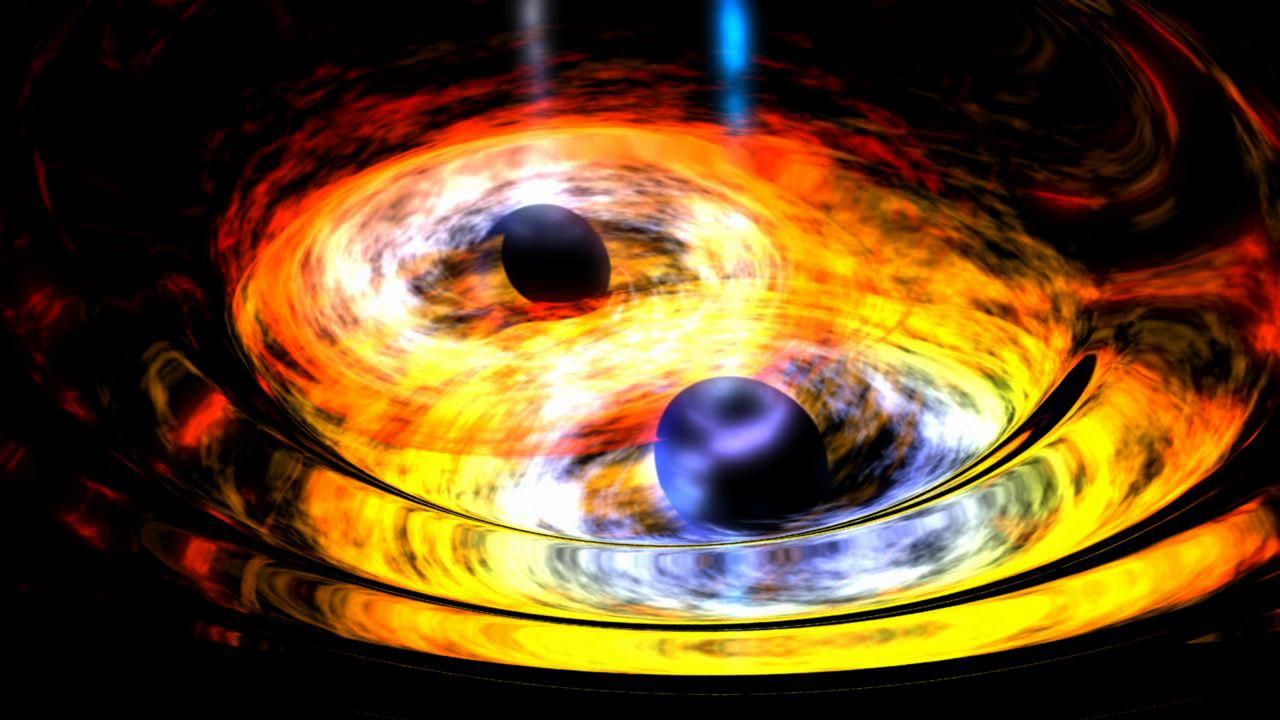
Black holes are among the most fascinating and enigmatic objects in the universe. Born from collapsed stars and governed by the laws of general relativity, these cosmic beasts warp spacetime, trap light, and challenge our understanding of physics itself.
But how well do you know the vocabulary that surrounds them?
You may like
So sharpen your focus, channel your inner astrophysicist, and get ready to decode the dark. The black hole word search awaits and it’s pulling you in.
See how well you score below!

A new telescope can be a doorway to the universe — that is, until you actually take it outside and nothing looks the way you imagined it. Telescopes aren’t necessarily difficult to use, but they do require a little preparation, a bit of patience and an understanding of how the night sky moves.
If your first few sessions have been more frustrating than awe-inspiring, you’re not alone. Here are five of the most common mistakes, plus how to avoid them so you can spend less time fiddling and more time actually enjoying the view.
1. Neglecting the planning stage
Sky maps and star charts help with the planning process. (Image credit: Stellarium)
Many beginners grab their telescope on a whim, head outside and hope for magic. The problem is that astronomy doesn’t work on impulse — it works on timing. Moon phases affect how bright the sky is, and local light pollution can wash out fainter objects. Even the time of year dictates what’s actually visible.
You may like
Before heading out, take a moment to observe what’s above the horizon, when the moon rises and whether your sky conditions are cooperating. Free apps make this easy — Stellarium is a favorite of ours — and a quick look at a cloud forecast can save you a wasted session.
Planning isn’t a chore; it’s the difference between hunting blindly and having a solid target list. When you know when are where to look, observing the sky with a telescope becomes far more rewarding.
2. Expecting Hubble-like views

Unfortunately, you won’t see Hubble-like views through a standard telescope. (Image credit: Getty Images)
It’s completely normal to hope for swirling nebulas and razor-sharp galaxies like the images you see online. Unfortunately, those are long-exposure photographs taken by spacecraft or huge professional observatories. A backyard telescope shows the real sky, and it’s much more subtle.
But that doesn’t mean it’s disappointing. The moon looks incredible through even a small telescope, Jupiter and Saturn show details and star clusters sparkle beautifully. What tends to trip people up is expecting colors and drama rather than appreciating the delicate, natural brightness of what can be seen with the eye.
Think of visual observation as seeing the universe with your own eyes, and once you adjust your expectations, you start to notice far more. If you do want to experiment with imaging space, you can mount one of the best astrophotography cameras directly onto your telescope, or invest in one of the best smart telescopes.
Another thing that often catches beginners out is that not all telescopes excel at the same targets. Not only are there different types of telescopes, but some designs are better suited to deep-space objects like galaxies and nebulas, while others are better suited for crisp planetary and lunar viewing.
Wide aperture, low focal-ratio scopes (like Dobsonians) gather lots of light, making faint objects easier to spot. On the other hand, longer focal length telescopes naturally deliver higher magnification, which is perfect for observing the details on Jupiter, Saturn or the moon’s craters.
You may like
For more impressive views
3. Not letting the telescope acclimate
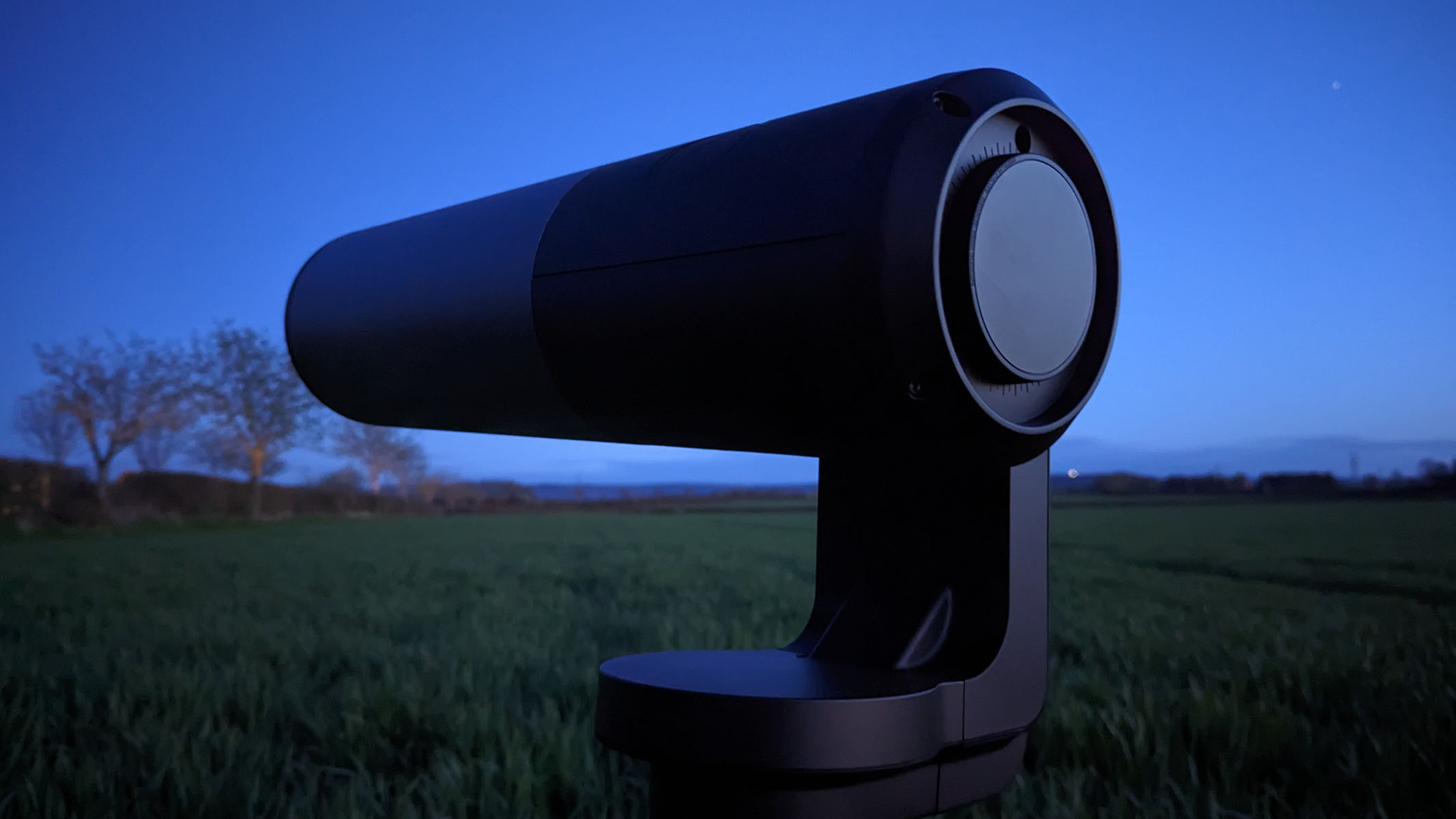
You need to let your telescope acclimatize to the outside temperature. (Image credit: Jason Parnell-Brookes)
One of the least glamorous but most important steps is simply letting your telescope cool down (or warm up) to match the outdoor temperature. If you take a scope from a warm living room out into the cold night, turbulent air currents swirl inside the tube, softening the view. The result looks like your optics suddenly went blurry.
Give your telescope 20-40 minutes outside before you start observing — maybe even a bit longer for bigger scopes. During this time, you can align your finderscope, set up a star chart or choose your targets.
Once the air settles inside the tube, things improve dramatically. Planets snap into focus, double stars separate cleanly and lunar details show the crisp edges it’s meant to. Acclimation isn’t sexy or exciting, but it’s one of the easiest ways to upgrade your observing without spending a dime.
Quick and easy setup

4. Choosing the wrong eyepiece or magnification
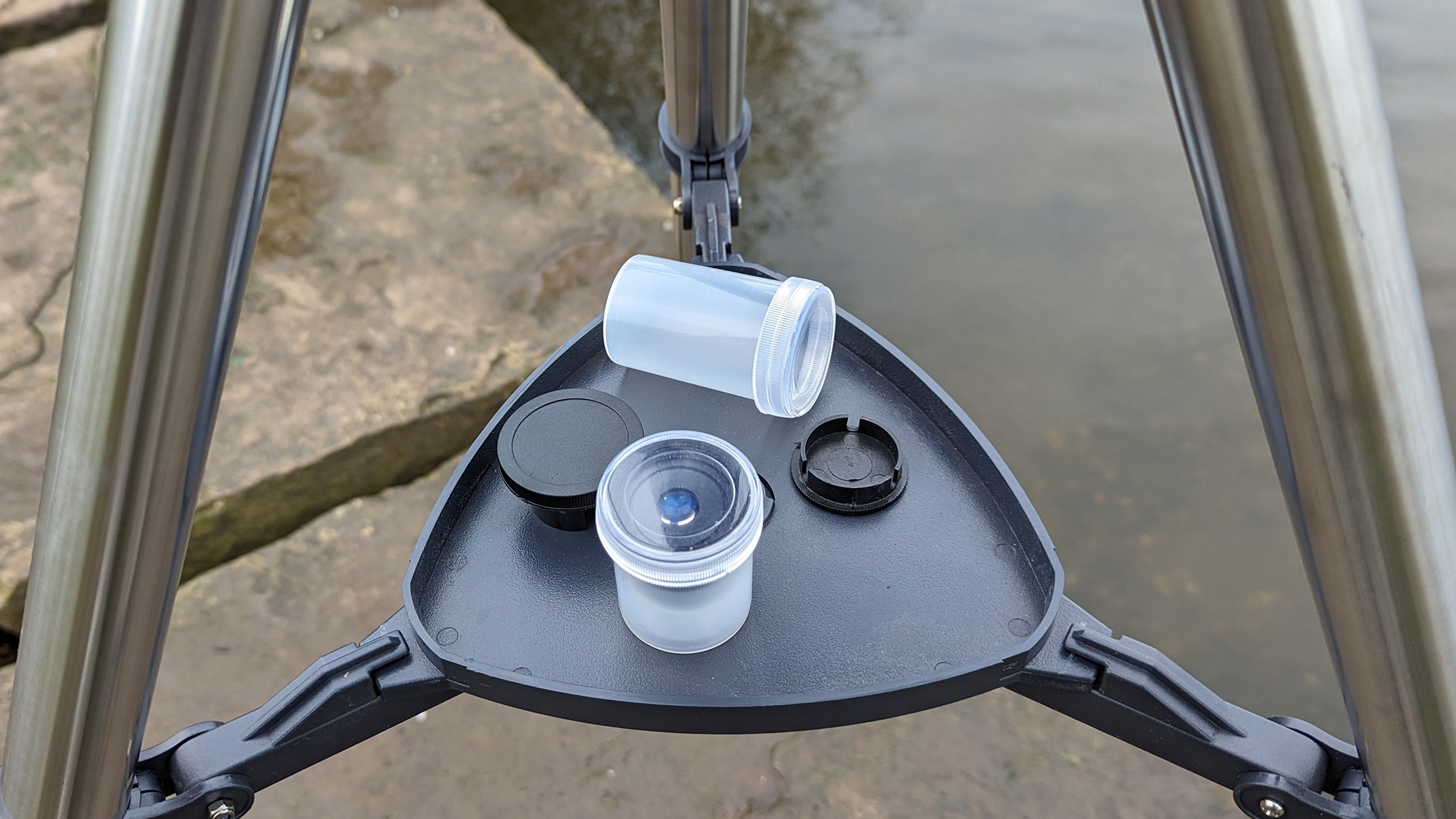
Eyepieces can make or break your viewing experience. (Image credit: Russ Swan)
A common assumption is that more magnification automatically means better views. In reality, pushing the zoom too high will result in a dim, wobbly image.
Every telescope has a highest useful magnification. This is essentially the upper limit where the view will still look sharp, and it’s determined by the scope’s aperture and the viewing conditions. The general rule of thumb is that the highest useful magnification is roughly 50x its aperture in inches, although this does depend on the overall quality of your telescope. For example, a 6-inch telescope will have a highest useful magnification of around 300x.
Start with a low-power eyepiece, like the 20mm which typically comes with beginner telescopes. This will give you a wider field, making objects a lot easier to find and track. Only once you’ve centered your target should you then switch to a higher-power eyepiece — and even then, it’s best to increase in small steps. On nights with poor viewing conditions, high magnification will just make objects look blurrier.
To determine the magnification of an eyepiece, divide the telescope’s focal length by the measurement of the eyepiece. For example, on a 1,000mm scope, a 20mm eyepiece will provide 50x magnification. Over time, you’ll instinctively know which eyepiece works best for the moon, planets and deep-sky objects.
When magnification is chosen well, everything suddenly becomes sharp, steady and a lot more impressive.

SCIENCE
James Webb telescope spies a monstrous molecular cloud shrouded in mystery — Space photo of the week

JWST’s view of the Sagittarius B2 region in near-infrared light. (Image credit: NASA, ESA, CSA, STScI, Adam Ginsburg (University of Florida), Nazar Budaiev (University of Florida), Taehwa Yoo (University of Florida); Image Processing: Alyssa Pagan (STScI))
QUICK FACTS
What it is: Sagittarius B2 molecular cloud
Where it is: Roughly 26,000 light-years from Earth,, in the constellation Sagittarius
When it was shared: Sept. 24, 2025
But this giant star-forming region is shrouded in a mystery: how it has managed to produce 50% of the stars in the region, despite containing just 10% of the galactic center’s gas.
You may like
Astronomers observed this super-efficient stellar factory using the James Webb Space Telescope (JWST), in the hope of finding some clues about its unusual productivity. This spectacular image is the telescope’s mid-infrared view, captured by JWST’s Mid-Infrared Instrument (MIRI).
In the image, the clumps of dust and gas in the molecular complex glow in shades of pink, purple and red. These clumps are seen surrounded by dark areas. Dark does not mean that these regions are empty or emit nothing; instead, light in these areas is blocked by dense dust that the instrument cannot detect.
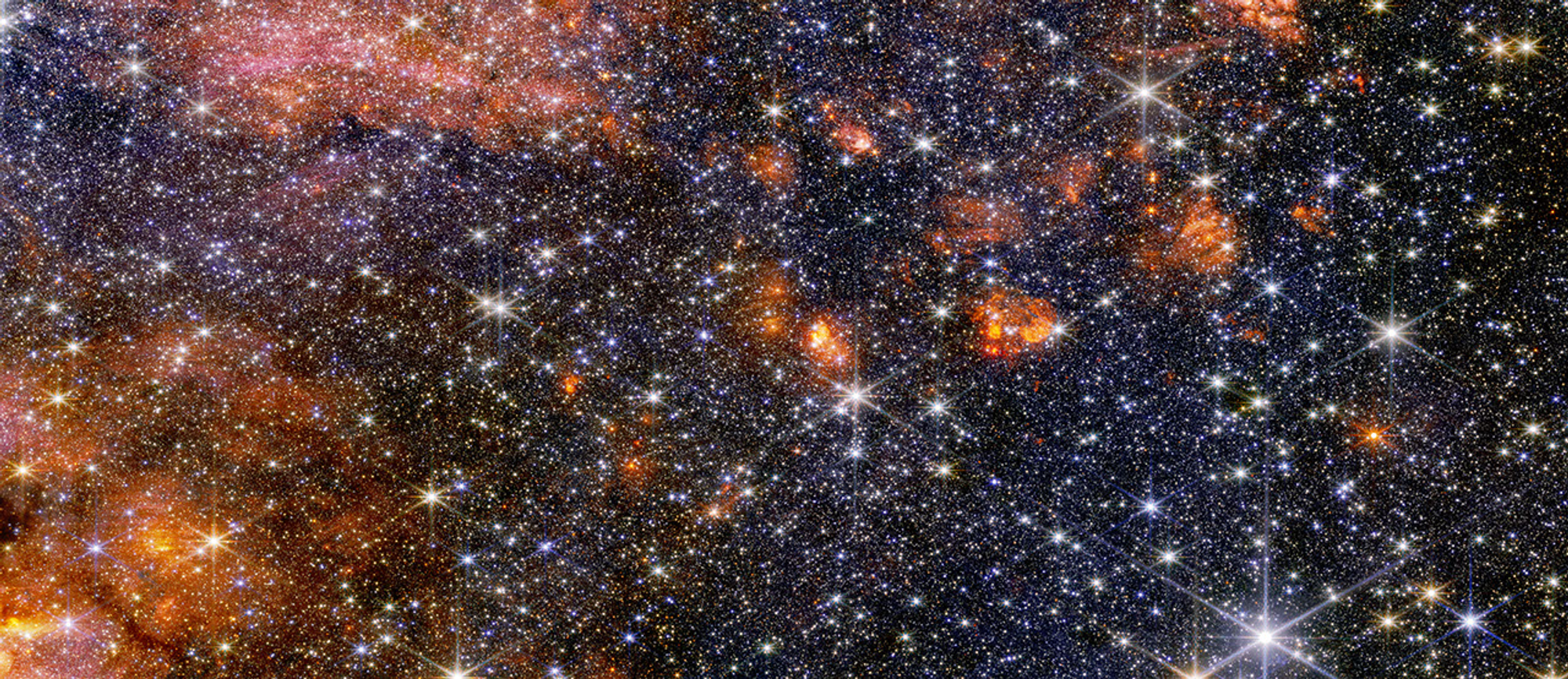
JWST’s view of the Sagittarius B2 region in near-infrared light (Image credit: NASA, ESA, CSA, STScI, Adam Ginsburg (University of Florida), Nazar Budaiev (University of Florida), Taehwa Yoo (University of Florida); Image Processing: Alyssa Pagan (STScI))
In star-forming regions like this one, warm dust and gas and only the brightest stars emit in the mid-infrared. This contrasts with the near-infrared image captured simultaneously by JWST’s Near-Infrared Camera (NIRCam), which reveals an abundance of stars because stars emit more strongly in the near-infrared light.
In this MIRI image, the clumps on the right that appear redder than the rest of the cloud complex correspond to one of the most chemically complex areas known, as revealed by previous observations using other telescopes. Astronomers think this unique region may hold clues to why Sgr B2 is more efficient at star formation than the rest of the galactic center.
Additionally, an in-depth analysis of the masses and ages of the stars in this stellar factory could reveal further insight into the star-forming mechanisms in the Milky Way’s center.
For more sublime space images, check out our Space Photo of the Week archives.

2025 was an exciting year for astronomical discoveries. Scientists got the best evidence yet for past life on Mars, discovered an interstellar comet zooming through our solar system, found clues of possible nearby exoplanets, and much more. Here are eight of the most spectacular space stories from the past 12 months.
1. A new interstellar comet
The Chilean component of the Asteroid Terrestrial-impact Last Alert System spotted the interstellar interloper sneaking among the stars of the constellation Sagittarius on July 1, and it quickly became apparent that its trajectory was severely hyperbolic. Rather than orbiting the sun like comets native to our solar system do, it was just passing through — and it was moving faster than any comet ever seen. Its abnormally high velocity of 36 miles per second (58 kilometers per second) told us that the speedy object, which became known as 3I/ATLAS, had probably been wandering interstellar space and receiving gravitational nudges from nearby stars since before our solar system even existed.
You may like
By September, 3I/ATLAS was moving behind the sun, making it impossible for Earth-based telescopes to track its movements until it reappeared in mid-November. Instead, NASA and the European Space Agency turned to their fleets of spacecraft that had better views of the comet during solar conjunction.
So far, we’ve learned that 3I/ATLAS is a comet and that all of its features have been seen on comets before. Its chemistry is broadly similar to the solar system’s own comets, which is a profound discovery in its own right. There are a few differences, though — specifically, a slightly higher carbon-dioxide-to-water ratio, and a little more nickel than iron, which reflect the chemical composition of its star system of origin.
Besides a regular comet’s tail, 3I/ATLAS has also sprouted an “anti-tail” — a short tail pointed toward the sun. Often, anti-tails are an optical illusion, but 3I/ATLAS’ is real.
Astronomers will continue to track 3I/ATLAS into 2026 in the hope of learning more about its composition, but one thing is clear: It is a comet, not a spaceship.
Read more: New interstellar object 3I/ATLAS: Everything we know about the rare cosmic visitor
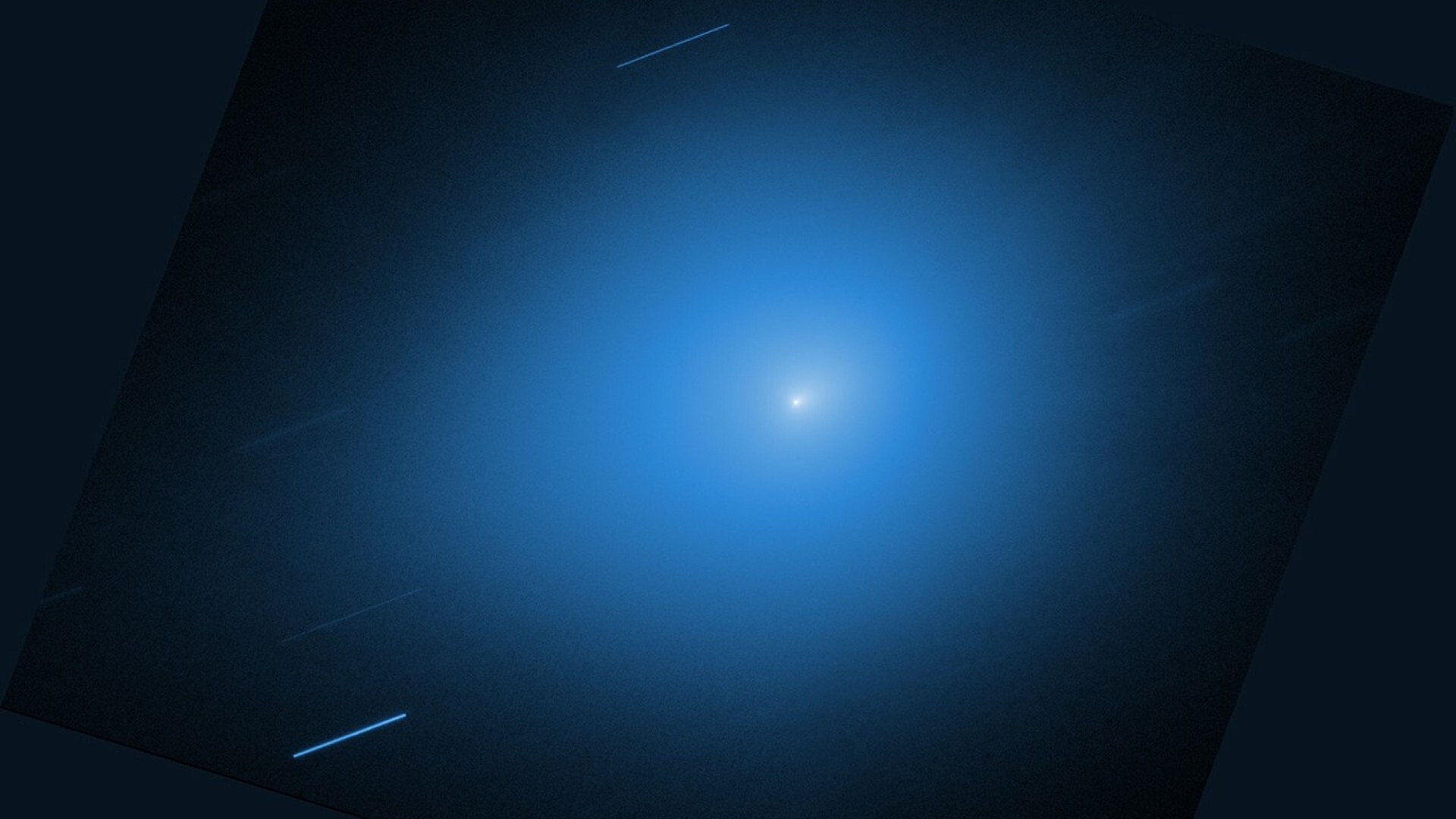
An image of 3I/ATLAS captured by the Hubble Space Telescope on Nov. 30, 2025. The telescope is tracking with the comet, which is why the fixed stars are trails. (Image credit: NASA, ESA, STScI, D. Jewitt (UCLA). Image Processing: J. DePasquale (STScI))
2. The birth of supermassive black holes
As soon as the James Webb Space Telescope (JWST) began taking deep images of the cosmos in 2022, it quickly started finding “little red dots” in the background. Astronomers didn’t know what they were. At first they thought the dots could be dwarf galaxies or dense star clusters in the very early universe, but they were so luminous that the standard model of cosmology couldn’t explain how they could have formed, prompting critics to suggest cosmology was broken.
However, the spectra of the little red dots didn’t look like those of stars. In September, astronomers proposed an answer: The little red dots are “black hole stars” — supermassive black holes being born inside a huge, dense cloud of gas less than a billion years after the Big Bang.
You may like
These burgeoning supermassive black holes could have formed either by the direct gravitational collapse of a humongous gas cloud or from the merger of myriad stellar-mass black holes produced by the core collapse of massive stars in a dense stellar cluster hidden inside a gas cloud.
Nobody ever expected that those black holes would be produced by a whole new breed of object, so it’s a crucial development in our understanding of black holes, the galaxies that eventually formed around them, and the early universe in general.
Read more: Are ‘little red dots’ seen by the James Webb Space Telescope actually elusive ‘black hole stars’?
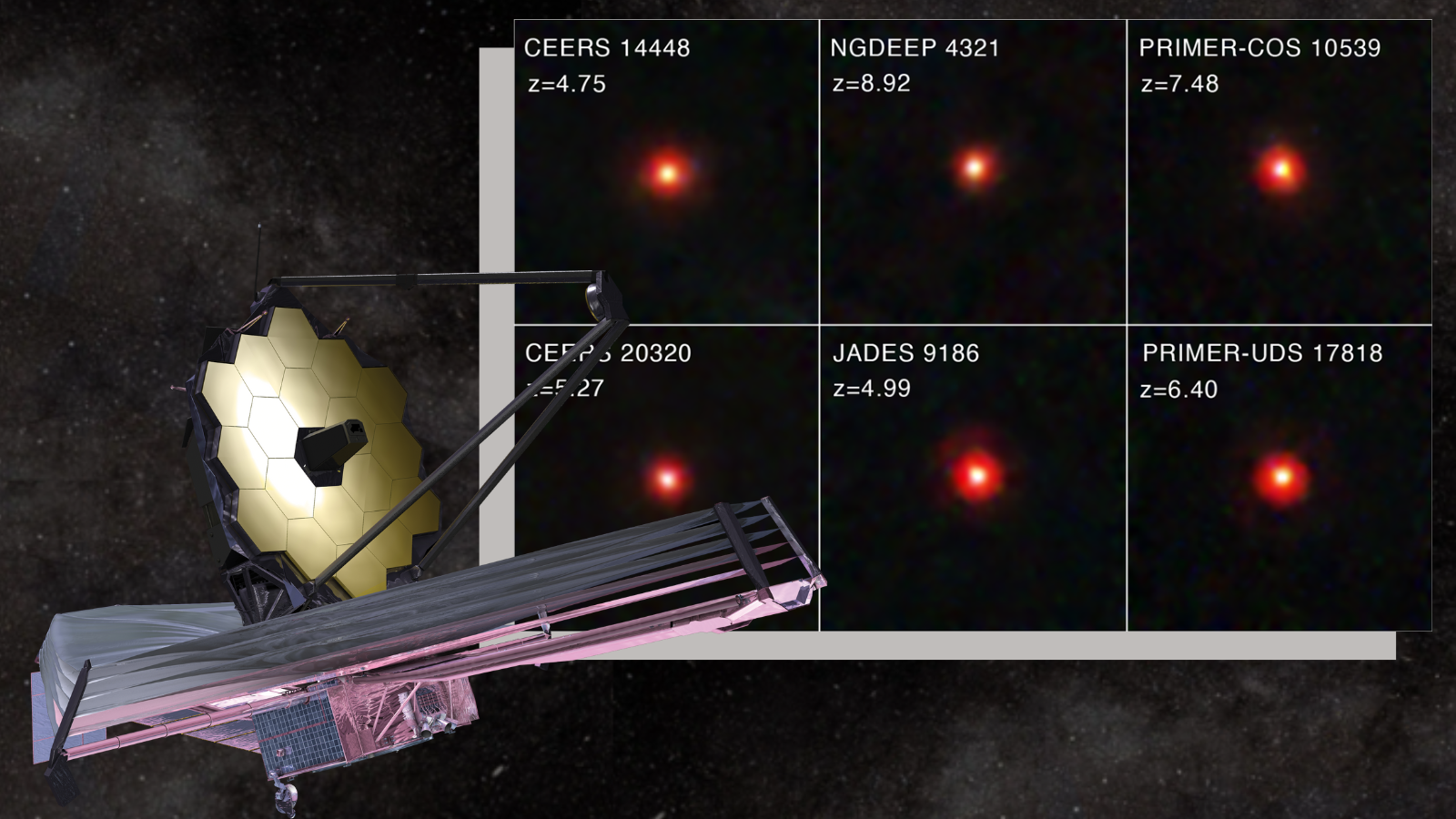
An illustration shows the JWST in space next to its observations of some of the earliest galaxies ever seen, the so-called “little red dots.” (Image credit: NASA, ESA, CSA, STScI, Dale Kocevski (Colby College)/ Robert Lea (created with Canva))
3. Weakening dark energy
The first full data release from the Dark Energy Spectroscopic Instrument (DESI), a state-of-the-art device on the Mayall Telescope at Kitt Peak in Arizona, came with shocking news: Dark energy, which is responsible for accelerating the expansion of the universe, seems to be weakening.
This was a direct contradiction of the leading hypothesis, which was that dark energy was the cosmological constant and, therefore, unchanging. While the new findings are not yet at the level of confidence required for astronomers to be sure the results are correct, they are significantly intriguing.
In 2024, some preliminary results from DESI pointed toward the strength of dark energy changing over time. Then, in March 2025, the DESI collaboration released data from the instrument’s first three years of observations, spanning 13.1 million galaxies, 1.6 million quasars and about 4 million stars in relatively nearby galaxies, forming the largest and most accurate 3D map of the universe ever made.
The results showed that 4.5 billion years ago, dark energy seemed to begin weakening. Furthermore, during the previous 9 billion years, dark energy was stronger than anyone expected. This superpowered dark energy, dubbed phantom dark energy, invokes exotic physics. Why phantom dark energy would have transitioned into a weakening form two-thirds of the way into the universe’s history is a complete mystery. Assuming the findings from DESI are correct, it would transform the way we view the past and future of the cosmos. For now, it deepens the mystery of dark energy.
Read more: Dark energy is even stranger than we thought, new 3D map of the universe suggests. ‘What a time to be alive!’ (video)
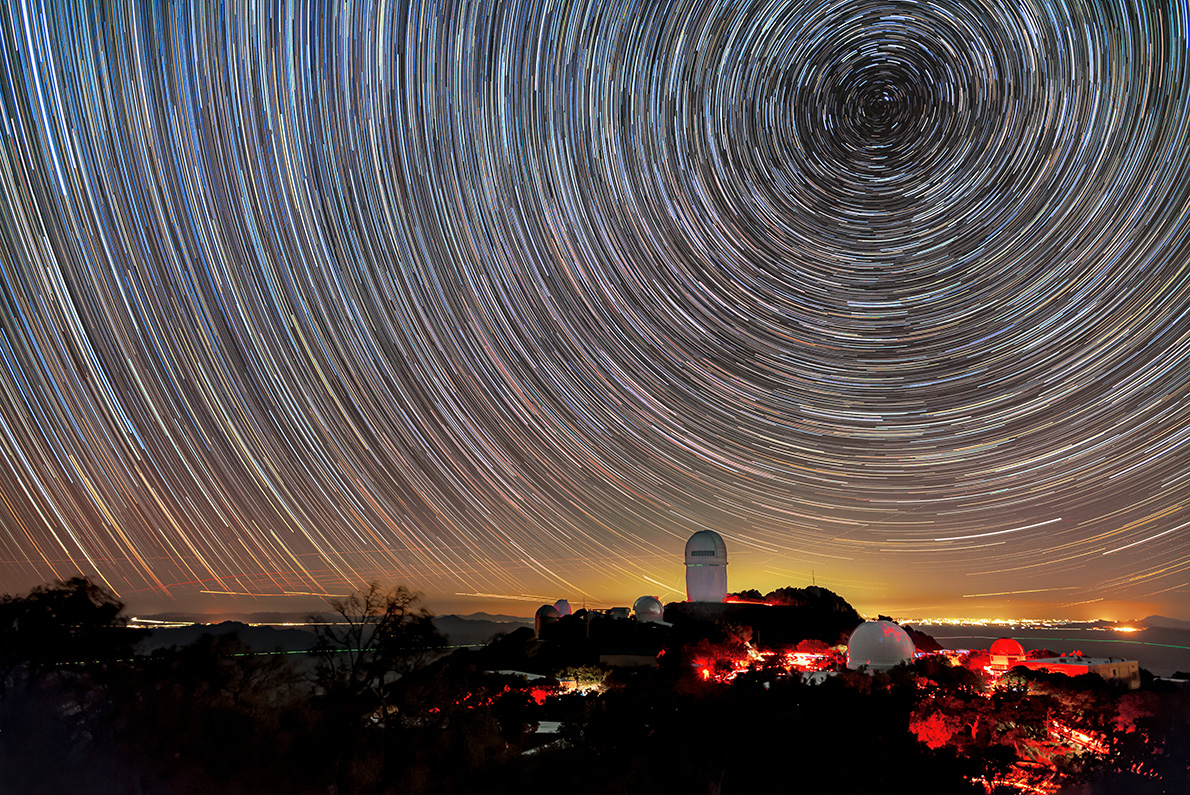
Star trails over the Mayall Telescope, which houses DESI on Kitt Peak in Arizona. (Image credit: KPNO/NOIRLab/NSF/AURA/Babak Tafreshi)
DESI Galaxy Flight with captions – YouTube
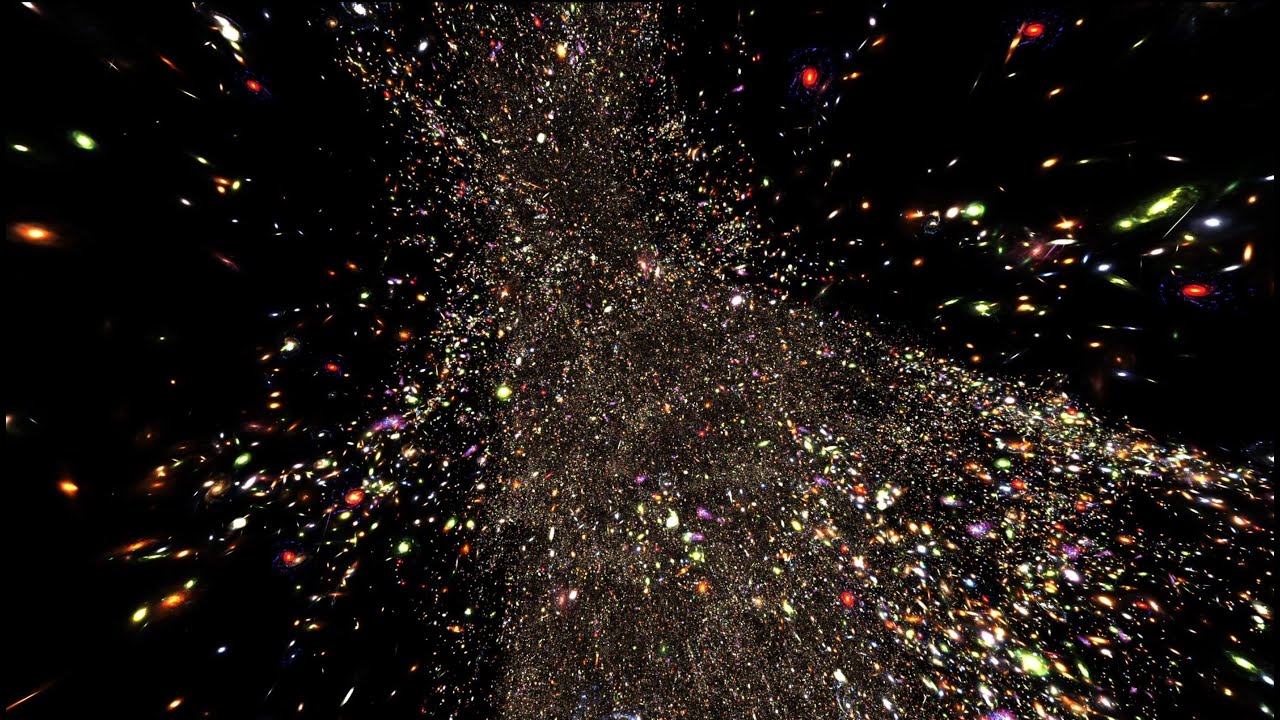
Watch On
4. A year of biosignatures
Some of the most intriguing and controversial signs that we are not alone in the universe came to light in 2025, with discoveries on planets both near and far.
The best evidence yet for past life on Mars surfaced in September 2025, courtesy of NASA’s Perseverance rover. That evidence was in the form of some light-red spots ringed by dark material. These “leopard spots” are not uncommon on rocks on Earth, and they typically form in one of two ways: either when exposed to hot, acidic conditions that have not been present in that part of Jezero crater, or through biological action. Organic molecules were also discovered in clay sediments within the rock, although Perseverance was unable to identify these molecules. The discovery is the most compelling evidence yet that microbial life could have existed in Jezero crater 3.5 billion years ago.
A more recent biosignature was potentially found on the exoplanet K2-18b by astronomers using JWST. In 2023, a team found signs of the gas dimethyl sulfide, alongside methane and oxygen. The team thinks this finding suggests K2-18b is a “hycean” planet — a world with an incredibly deep global ocean of water, surrounded by a thick, hydrogen-rich atmosphere. The team predicted that dimethyl sulfide could be a biosignature on a hycean world, as it can be on Earth, but the initial detection was very tentative. In March 2025, JWST produced stronger evidence for dimethyl sulfide’s existence on K2-18b.
Even so, many astronomers are still skeptical of the discovery. Some argue against the concept of hycean worlds, point out that the signal is very weak, and raise the possibility that dimethyl sulfide can also form abiotically.
Read more: Did NASA’s Perseverance rover find evidence of ancient life on Mars? The plot thickens

This artist’s illustration shows the planet K2-18 b, its host star and an accompanying planet in this system. K2-18 b is now the only super-Earth exoplanet known to host both water and temperatures that could support life. (Image credit: ESA/Hubble, M. Kornmesser)
5. New exoplanetary neighbors
This year, astronomers made major steps in adding to the exoplanet inventory around the nearest stars, Alpha-Proxima Centauri and Barnard’s Star.
Astronomers had previously thought they’d found planets in both systems, but each time, the evidence didn’t hold up. Then, in 2024, a strong candidate for a small, rocky planet orbiting Barnard’s Star was revealed in data from the Very Large Telescope in Chile. In March 2025, this observation was confirmed to be real, along with those of three smaller exoplanets. The most massive of the quartet has one-third the mass of Earth, while the smallest is one-fifth the mass of our planet. Unfortunately, none reside in the habitable zone, but further planets in more temperate regions have not been ruled out.
Then, in August, observations by JWST produced the most convincing evidence yet for a planet orbiting Alpha Centauri A. The exoplanet is estimated to have a mass similar to that of Saturn and, therefore, expected to be a gas giant. Intriguingly, if this world is real, it must have a highly elliptical orbit that may result from its inclusion in a binary system.
Read more: 4 rocky exoplanets found around Barnard’s Star, one of the sun’s nearest neighbors
James Webb Space Telescope spots a potential new exoplanet just 4 light-years away from Earth
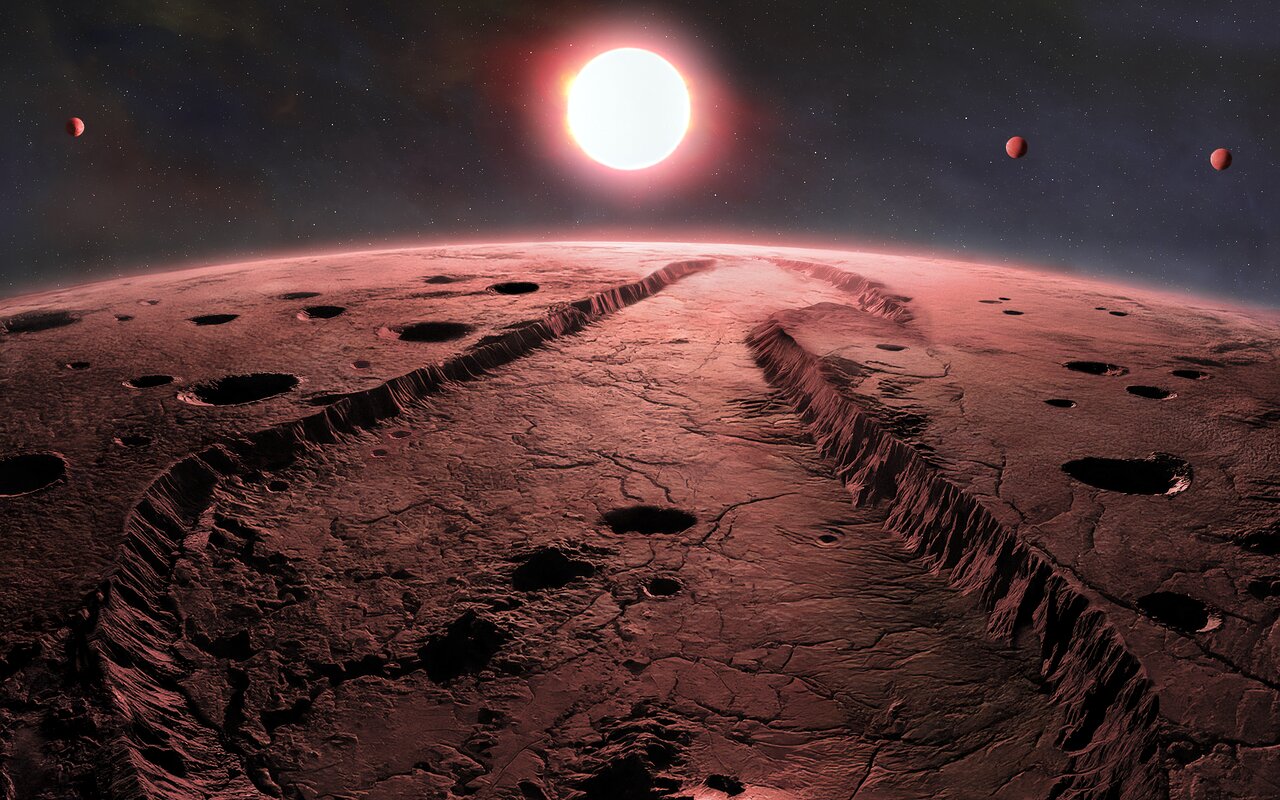
An artist’s impression of the Barnard’s Star system, from the surface of one of its planets. (Image credit: International Gemini Observatory/NOIRLab/NSF/AURA/P. Marenfeld)
6. The Milky Way and Andromeda’s uncertain future
The Milky Way and Andromeda galaxies might not crash into each other in the next 10 billion years after all. New research published this year finds that there is a 50-50 chance that the two galaxies will miss each other.
By considering the way the Large Magellanic Cloud’s gravity pulls on the Milky Way and how the gravity of the Triangulum Galaxy pulls on Andromeda, researchers refined how close Andromeda and the Milky Way galaxies will get by running a multitude of simulations.
They found that the critical distance is 650,000 light years. If they pass closer than that, the two galaxies will collide at some point in the next 10 billion years. If their closest approach is greater than 650,000 light years, they won’t make contact. According to the simulations, both possibilities are equally likely.
Read more: The Milky Way may not collide with neighboring galaxy Andromeda after all: ‘From near-certainty to a coin flip’
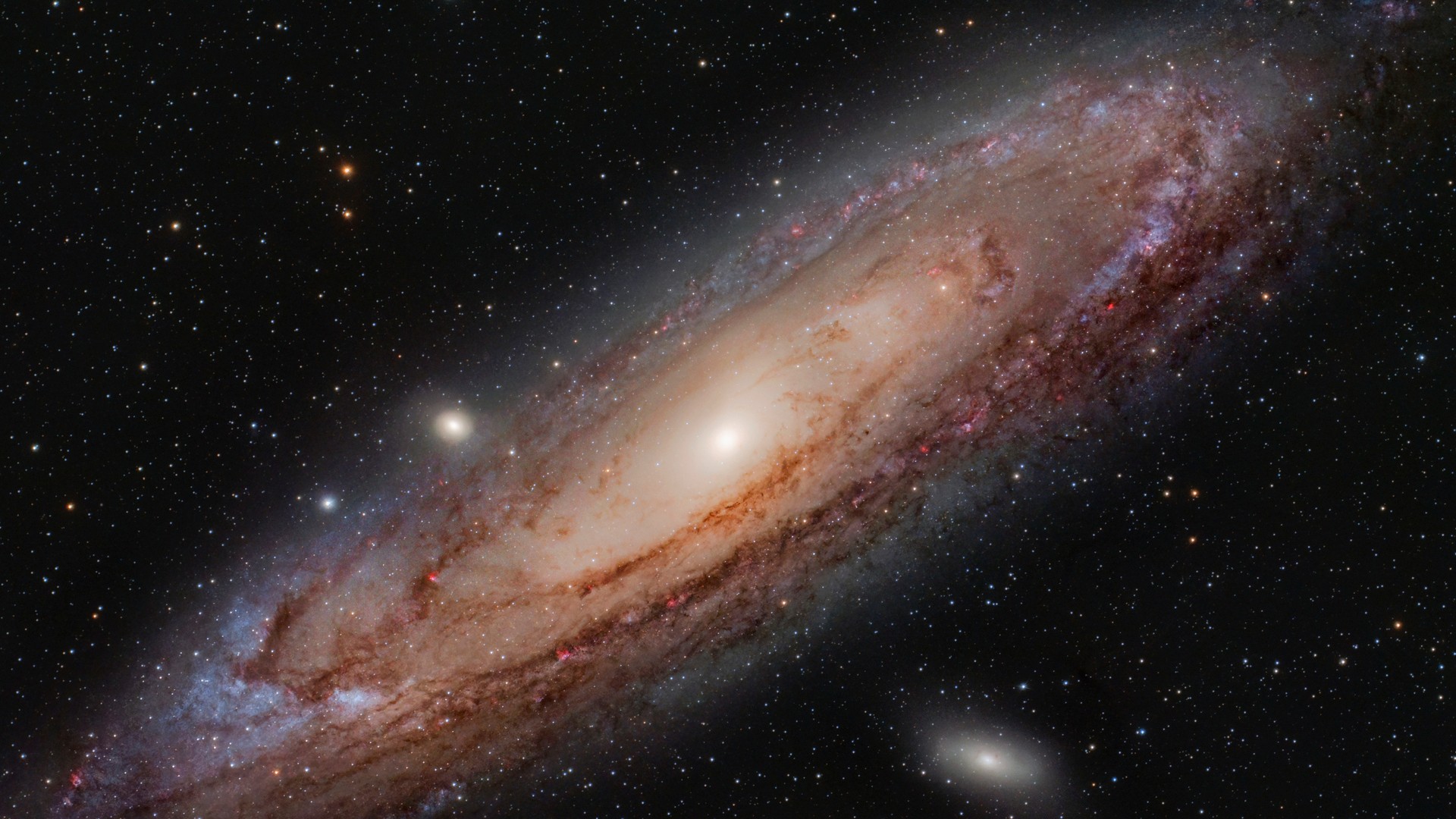
The Andromeda galaxy may avoid an imminent collision with the Milky Way. (Image credit: Westend61/Getty Images)
7. The most massive black hole ever seen?
In 2025, astronomers may have discovered the most massive black hole ever seen. This ultra-massive black hole, which tips the scales at 36 billion solar masses, resides at the heart of one of the most massive galaxies in the universe, called the Cosmic Horseshoe because it acts as a gravitational lens that bends the light of a more distant galaxy into an Einstein ring sporting a horseshoe shape.
More massive black holes have been claimed, but the authors of the new research pointed out that those other black holes had their masses measured indirectly, so their masses are just guesses. The mass of the black hole in the Cosmic Horseshoe, on the other hand, has been measured directly and more accurately by tracking the motion of groups of stars around it, pulled by the black hole’s gravity. It certainly puts our 4.1 million-solar mass supermassive black hole, Sagittarius A*, in the shade.
Read more: The biggest black hole ever seen? Scientists find one with mass of 36 billion suns
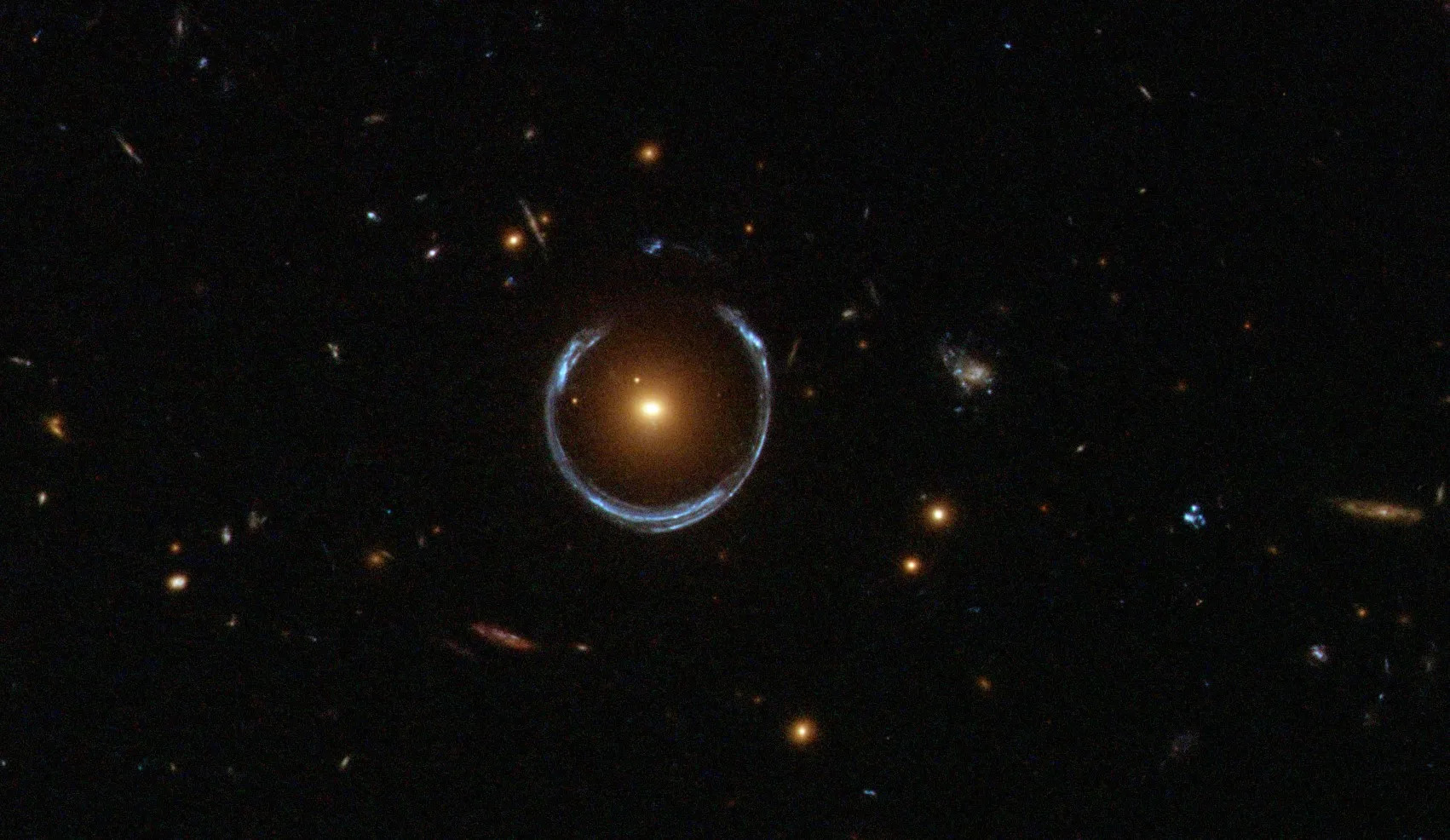
The Cosmic Horseshoe may host the most massive black hole ever measured. (Image credit: NASA/ESA)
8. First light for the Vera C. Rubin Observatory
After more than a quarter century of planning and over 10 years of construction, the Vera C. Rubin Observatory in Chile, armed with its 8.4-meter (27.6 feet) Simonyi Survey Telescope, saw first light in the summer of 2025 — and its images of the heavens were exquisite.
The telescope is designed for high-resolution surveys, with studies of dark matter and dark energy in mind. Two areas of the sky were targeted for first light to demonstrate the telescope’s prowess. One was the mighty Virgo Cluster, whose member galaxies had never been seen so clearly across such a wide expanse of space, and with 10 million faint galaxies in the background to boot. The other image was of the Trifid and Lagoon nebulas, two star-forming regions in the Milky Way.
Each night, the telescope will capture 20TB of data with its 3.2-gigapixel CCD camera — the largest ever built — and issue 10 million alerts daily for asteroids, variable stars, tidal disruption events and supernovas. Over the course of its initial 10-year Legacy Survey of Space and Time, the observatory will accumulate 60 petabytes (60,000TB) of information. With all that data, the Rubin Observatory may deliver a tsunami of unprecedented astronomical discoveries.
Read more: Vera C Rubin Observatory reveals 1st stunning images of the cosmos. Scientists are ‘beyond excited about what’s coming’
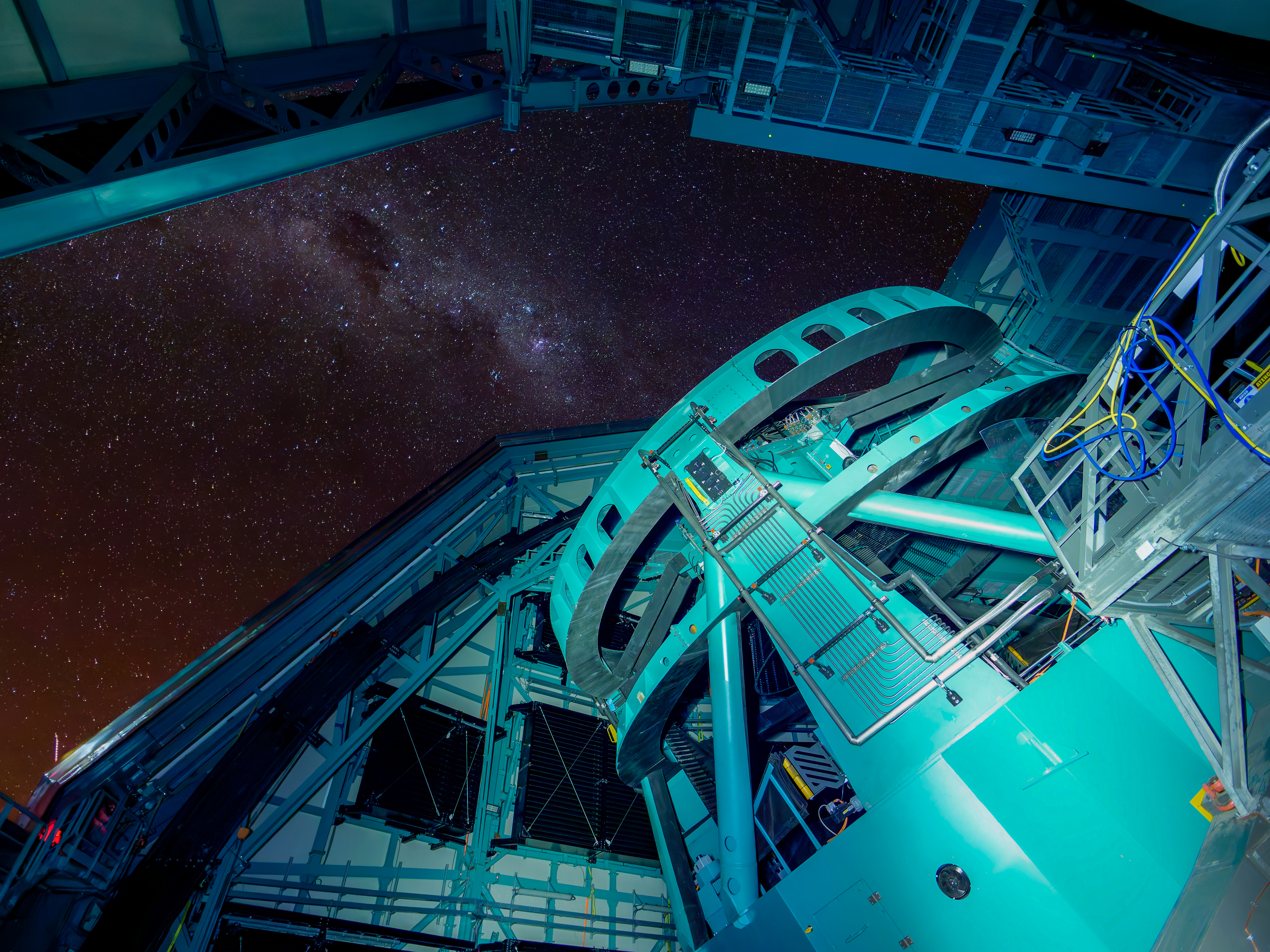
The Rubin Observatory’s 8.4-meter telescope is ready for action. (Image credit: RubinObs/NSF/DOE/NOIRLab/SLAC/AURA/W. O’Mullane)

Key details
- Price: $399.99/£349.99
- Model number: #10356
- Number of pieces: 3600
- Dimensions: H: 11″ (27cm), W: 19″ (48cm), D: 24″ (60cm)
- Recommended age: 18+
Move over, Star Wars, and get out of here, Marvel, because there is finally an official Star Trek Lego set… and what a set. The first Star Trek Lego set was always going to be some variation of the USS Enterprise, but as a massive The Next Generation stan, I’m glad that it was my beloved: the U.S.S. Enterprise NCC-1701-D.
It’s also a hefty $400 — a price point that will make you yearn for the moneyless society of the show. So, was it worth the wait, and is it worth the money? Let’s head into the review at warp seven and find out.
Today’s best Lego Star Trek USS Enterprise deals
Lego U.S.S. Enterprise NCC-1701-D: Build
Image 1 of 4
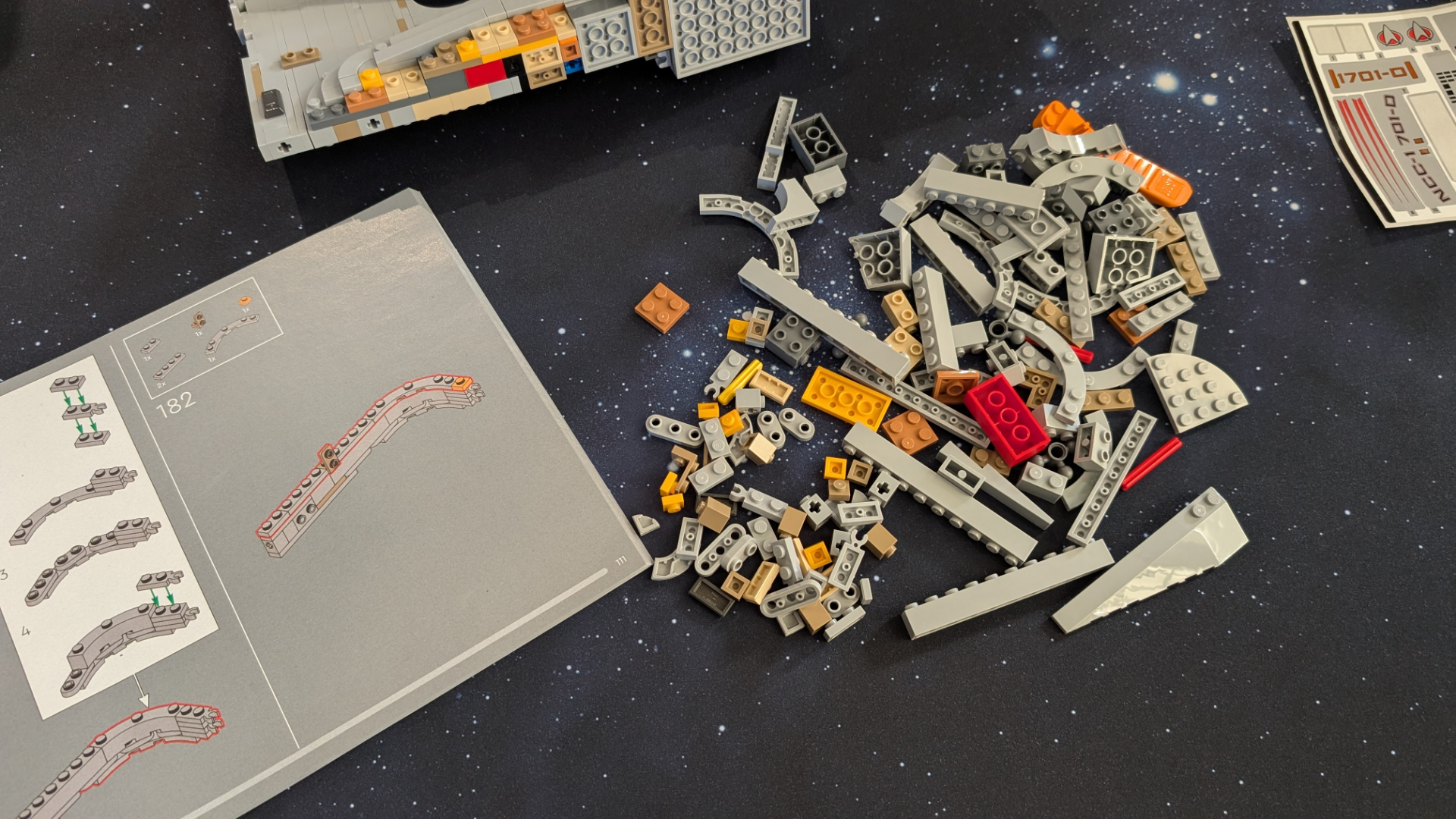 Some of the Lego pieces included in the new U.S.S. Enterprise NCC-1701-D set.(Image credit: Ian Stokes / Future)
 Some of the Lego pieces included in the new U.S.S. Enterprise NCC-1701-D set.(Image credit: Ian Stokes / Future)
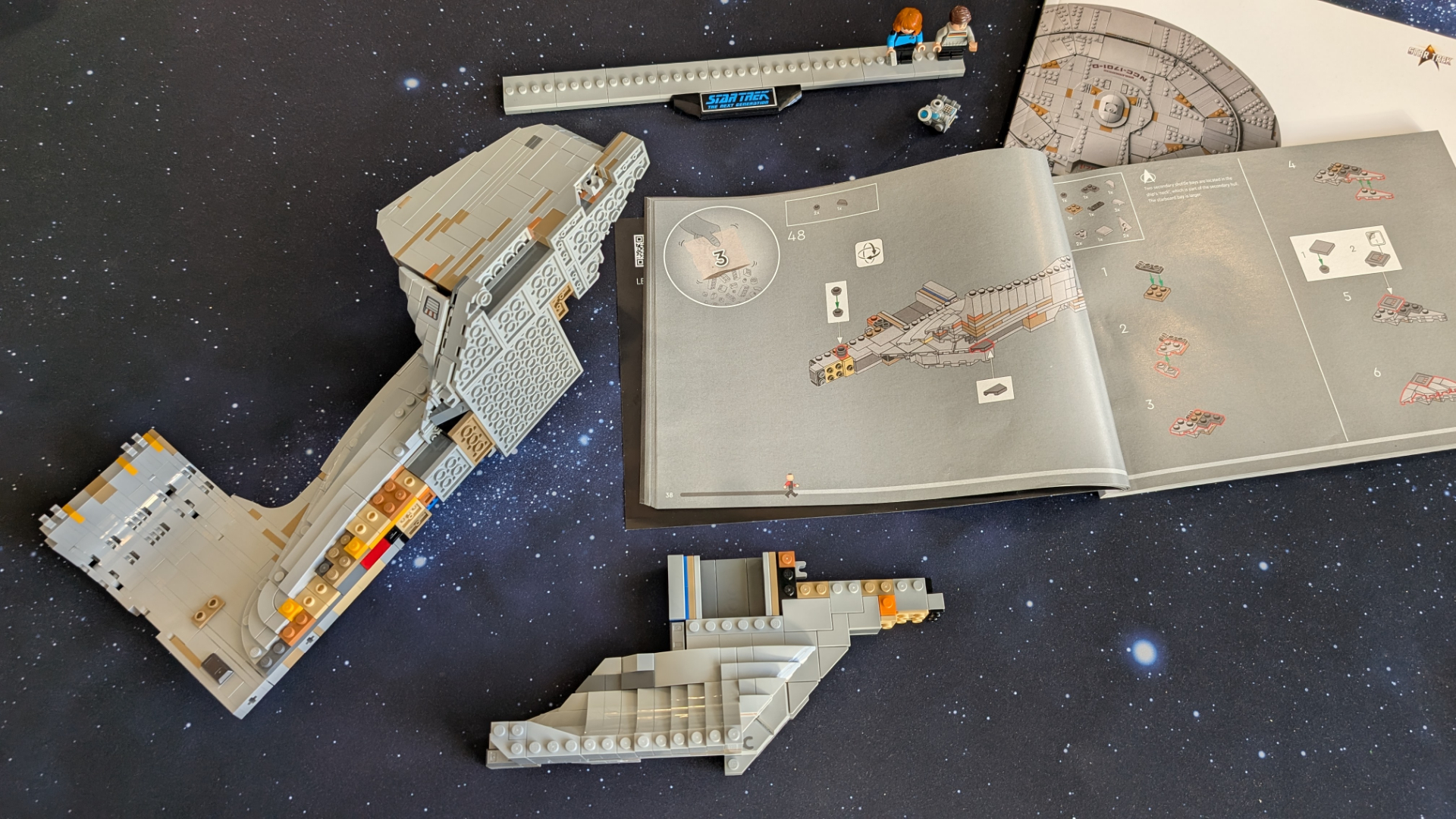
 The new Lego U.S.S. Enterprise NCC-1701-D set starting to take shape.(Image credit: Ian Stokes / Future)
 Lego pieces and booklet instructions for the new U.S.S. Enterprise NCC-1701-D set.(Image credit: Ian Stokes / Future)
- Body constructed with two mirrored halves
- 3600 pieces
- Some easy-to-apply stickers and printed pieces
The Lego Star Trek: U.S.S. Enterprise NCC-1701-D is made from 3600 pieces, split across 30 different bags and two instruction books. The first book covers the ship’s main body and the flight stand, while the second book is devoted to the saucer section.
To make it so, the build starts with the main body and wings that hold the nacelles (aka the ship’s warp engines). You actually construct the body from two mirror halves, which are then attached using several long cross-axle pieces (the long plus-shaped bars). I was especially impressed with how the designers crafted the main deflector array — that blue oval on the front of the ship that’s always firing off tractor beams and tachyon pulses — which is made from two, custom-printed cockpit windscreen pieces that you invert, creating the concave shape of the array.
With the body constructed, it’s time for a quick detour to assemble the flight stand, as the fixed position it offers makes attaching the engines much easier.
Image 1 of 4
 A look at the new Lego U.S.S. Enterprise NCC-1701-D set in the building process.(Image credit: Ian Stokes / Future)
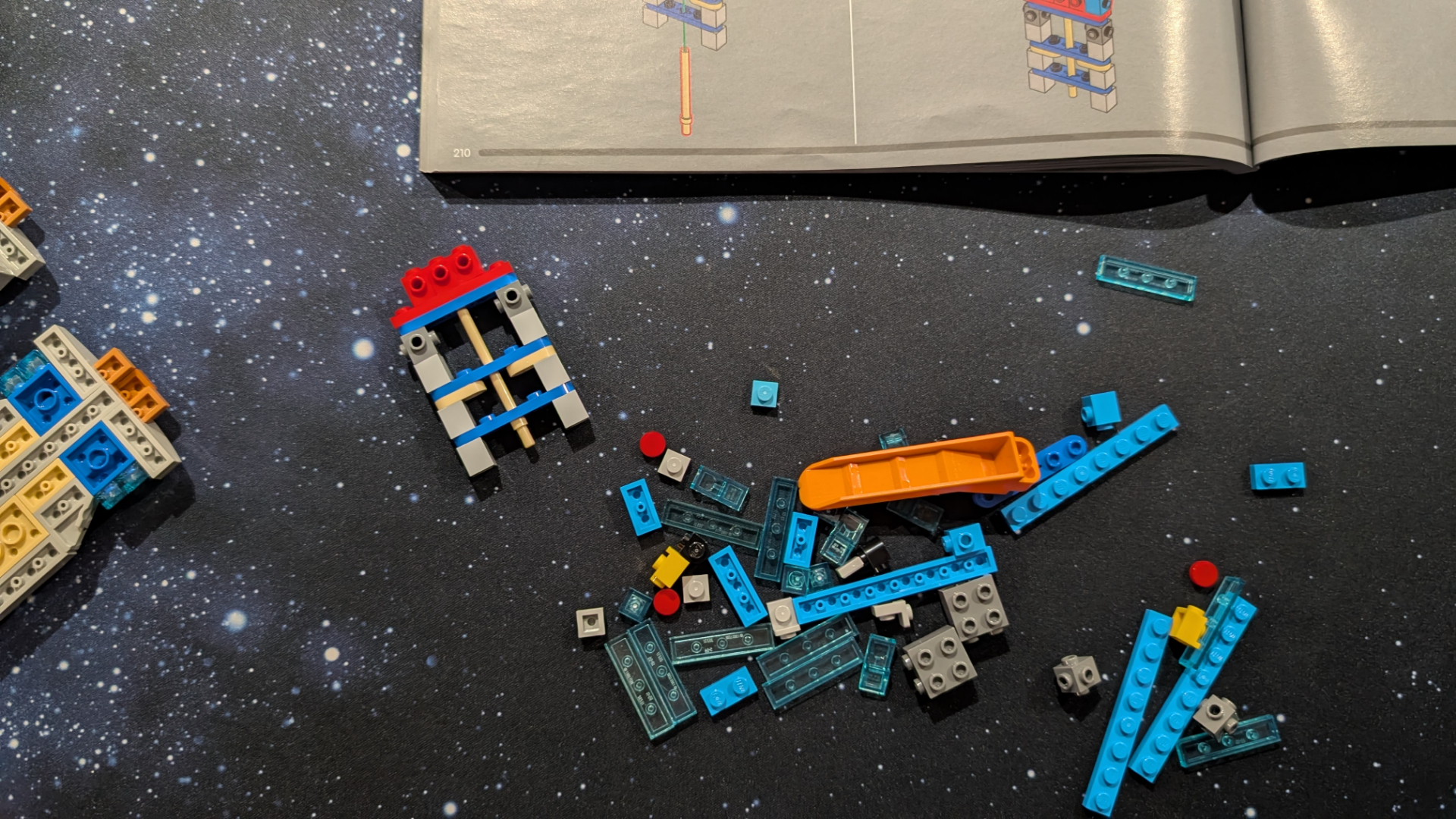 A look at the new Lego U.S.S. Enterprise NCC-1701-D set in the building process.(Image credit: Ian Stokes / Future)
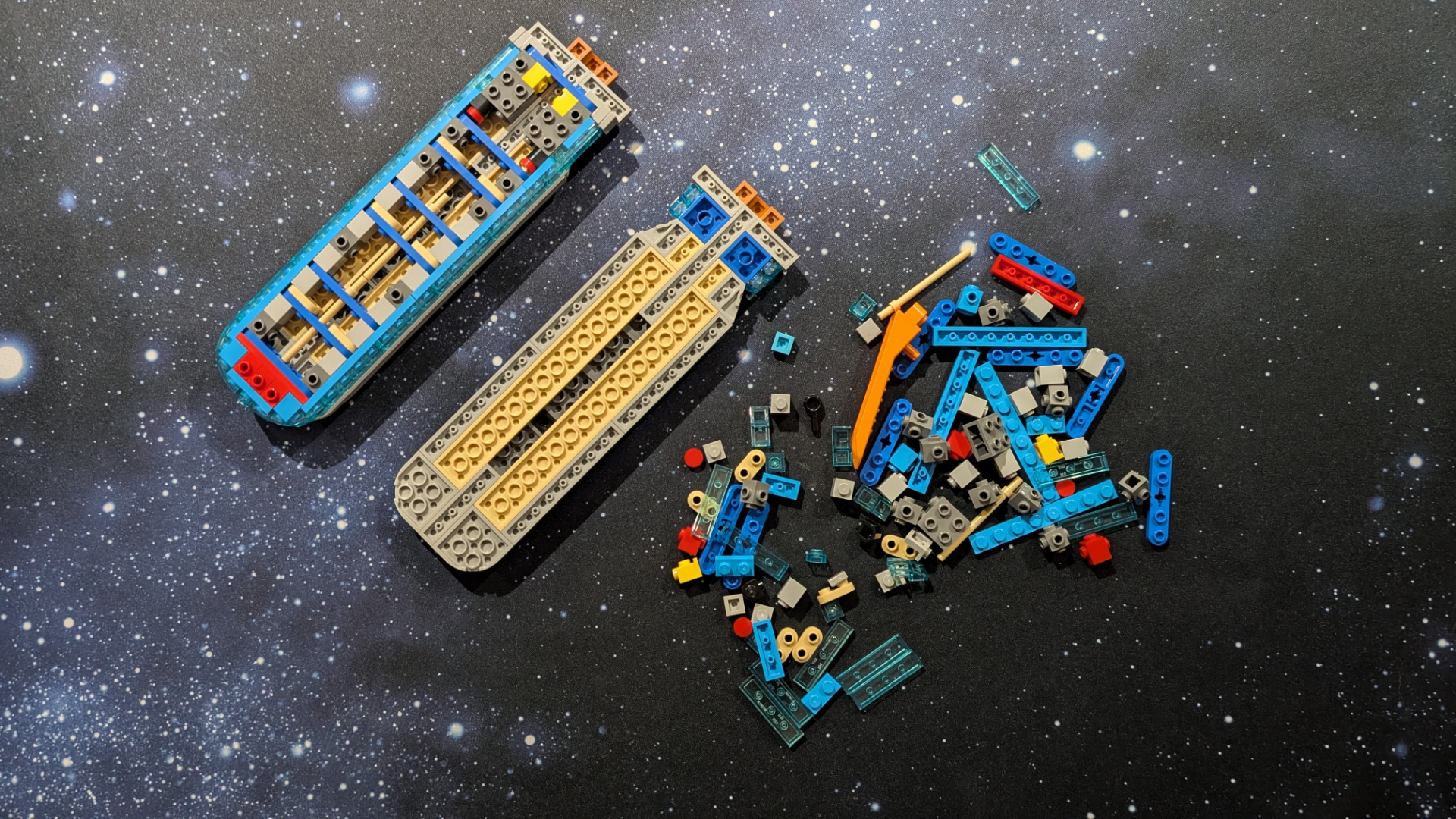 A look at the new Lego U.S.S. Enterprise NCC-1701-D set in the building process.(Image credit: Ian Stokes / Future)
 A look at the new Lego U.S.S. Enterprise NCC-1701-D set in the building process.(Image credit: Ian Stokes / Future)
Speaking of which, you’ll move on to building the nacelles themselves, which make good use of blue and red transparent pieces to recreate the iconic look of the ship’s glowing engines. Once assembled, the nacelles slot into place nicely, and by this point, you’ve got a working ship… as long as you don’t mind commanding your daft-looking ship from the battle bridge.
The back half of the build is a lot more technical, as you’re building a larger circular disc out of square and rectangular Lego pieces. This feat is achieved by first constructing a central frame, similar to the spokes of a wheel, and then attaching it to the main body. I ran into an issue here, as I discovered I’d made a mistake in section 1 that only reared its ugly head here. A single piece was rotated 90 degrees in the wrong direction, and it stopped the saucer from slotting in. Fortunately, I was able to repair it without disassembling the entire thing, but my heart did stop for a second when I discovered my mistake.
Once the frame is in place, you then attach the top panels, which use angled pieces and hinge attachments, slotting together into a damn impressive approximation of a circle.
Image 1 of 2
 The new Lego U.S.S. Enterprise NCC-1701-D set is coming along nicely in the building process.(Image credit: Ian Stokes / Future)
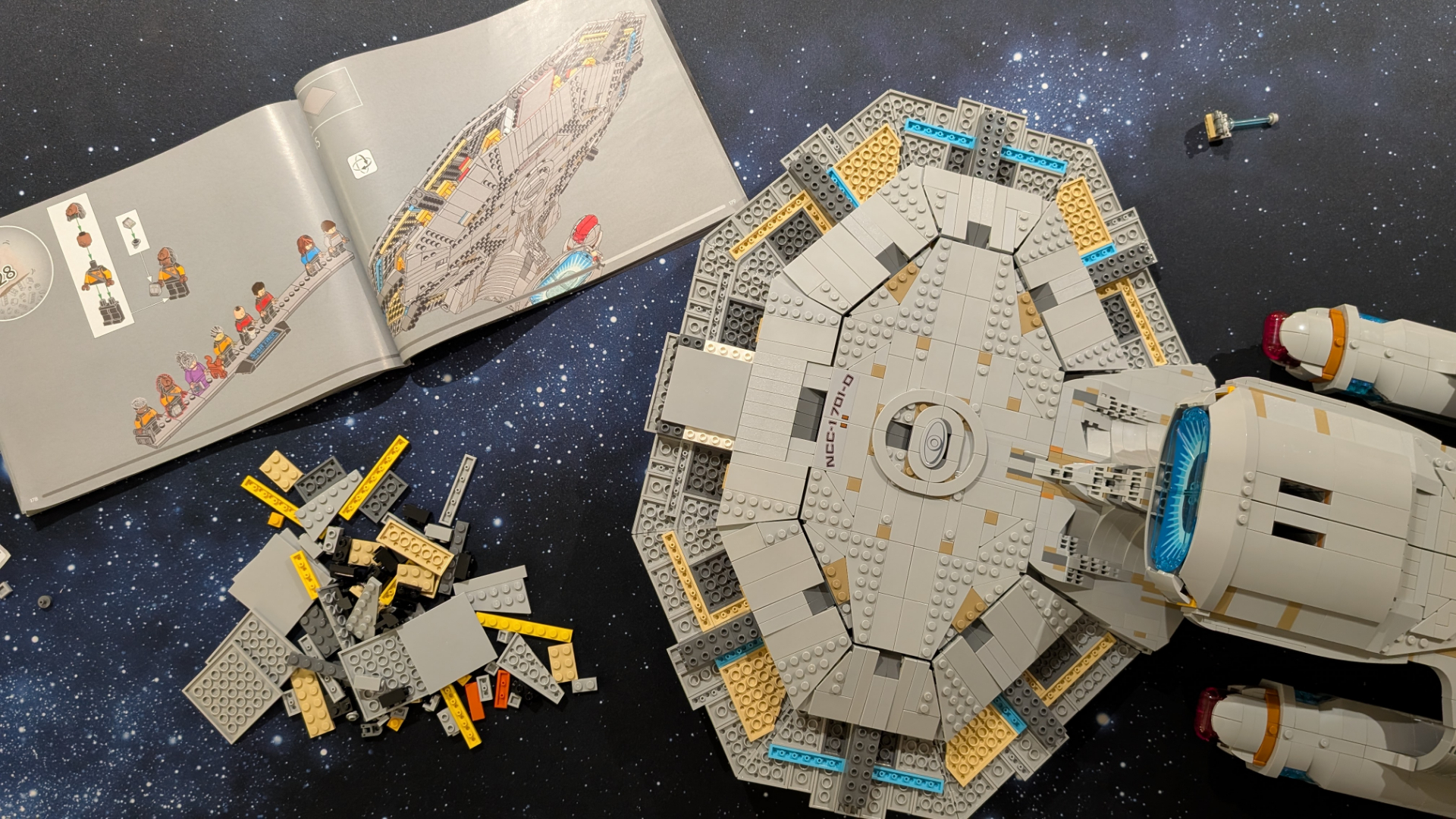 The new Lego U.S.S. Enterprise NCC-1701-D set is coming along nicely in the building process.(Image credit: Ian Stokes / Future)
Things get trickier from here, though, as the final stretch has you repeating this process on the underside of the ship. The instruction book seems to imagine that you’ve got infinite room to work underneath the ship while doing this, but in practice, it’s quite tricky. I gave up in the end and just flipped the whole thing over, which felt very sketchy, and I ended up knocking a few random pieces off during the operation.
Despite my brief (and self-inflicted) cardiac episode, I had a fantastic time building the Enterprise. The nine minifigures are scattered throughout the build, providing a nice palette cleanser as you work through this sizeable build. They’re all simple to construct as you’d expect, though Riker’s trombone is an impressive — and rickety — piece of engineering.
Some mirror sections effectively call for you to build the same thing twice, but the fact that it’s mirrored — and not identical — keeps you on your toes. There are some special printed pieces, along with some stickers scattered throughout the build, but they’re all easy enough to apply.
Lego U.S.S. Enterprise NCC-1701-D: Design
Image 1 of 4
 The new Lego U.S.S. Enterprise NCC-1701-D set is a seriously impressive display piece.(Image credit: Ian Stokes / Future)
 The new Lego U.S.S. Enterprise NCC-1701-D set is a seriously impressive display piece.(Image credit: Ian Stokes / Future)
 The new Lego U.S.S. Enterprise NCC-1701-D set is a seriously impressive display piece.(Image credit: Ian Stokes / Future)
 The new Lego U.S.S. Enterprise NCC-1701-D set is a seriously impressive display piece.(Image credit: Ian Stokes / Future)
- Great display model
- Comprehensive collection of minifigures
- Can be a little fragile to handle when completed
I’ve been waiting a very long time for a Lego Star Trek set, and I’m thrilled to say the U.S.S. Enterprise NCC-1701-D was worth the wait. The design team has perfectly replicated the iconic starship in exquisite detail — no small feat given its awkward size and shape. I was skeptical of how the circular saucer section would look when built out of flat-edge pieces, but it looks stunning.
Some easter eggs are hiding around the ship that fans will appreciate, including the dedication plaque that emblazons the back wall of the Enterprise’s bridge (complete with a hilarious typo). Sadly, this set isn’t big enough to have a minifig scale bridge hidden inside it, so the plaque lives in a hidden compartment instead.
Speaking of minifigures, the collection included here is comprehensive, with almost all of your favorite characters from the show (bad luck to the Tasha Yar and Chief O’Brien stans out there). They all look wonderful, each with their own unique accessories ranging from Worf’s phaser through to Riker’s ridiculous trombone.
Image 1 of 4
 A closer look at the new Lego U.S.S. Enterprise NCC-1701-D set.(Image credit: Ian Stokes / Future)
 A closer look at the new Lego U.S.S. Enterprise NCC-1701-D set.(Image credit: Ian Stokes / Future)
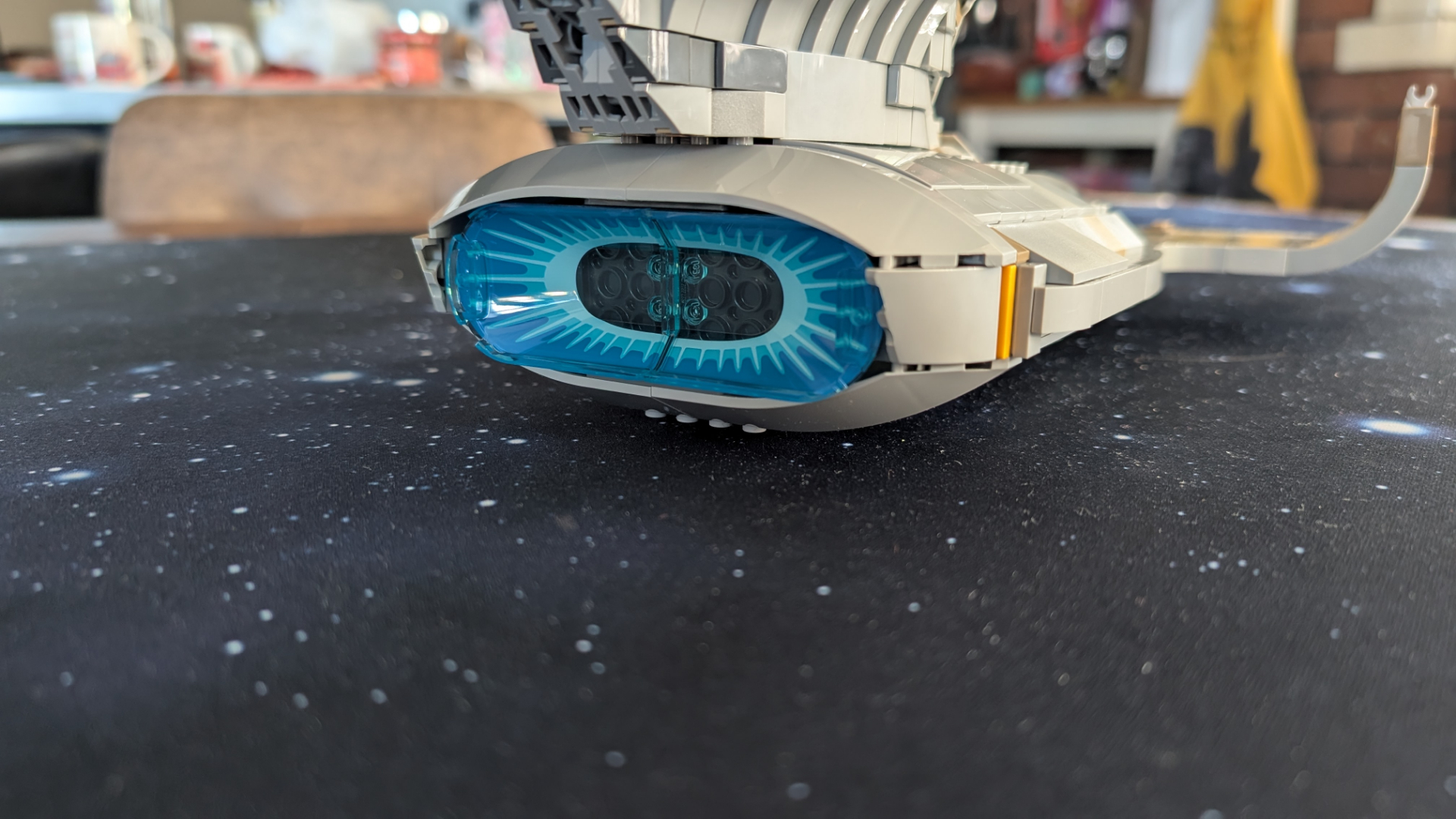 A closer look at the new Lego U.S.S. Enterprise NCC-1701-D set.(Image credit: Ian Stokes / Future)
 The display plaque from the new Lego U.S.S. Enterprise NCC-1701-D.(Image credit: Ian Stokes / Future)
There are some unique Lego pieces used here, too, including Worf’s “hair” and Guinan’s flamboyant headpiece. There is a platform to store the minifigs on, and a printed display piece with cool facts and figures about the Enterprise on it, too.
Another neat touch is the “pin” that locks the saucer section in place, which is cleverly disguised as a shuttlecraft approaching the shuttlebay. It’s a cute piece of design, though the detachable saucer section itself is — much like in the show — a gimmick that you’ll rarely use.
The model is too fragile to handle (since completing it, I knocked a piece off while showing it off on webcam and can not for the life of me find where it came from). Beyond that, there is no display stand to hold the saucer section on its own, so unless you’re recreating the end of Star Trek: Generations, it’s not worth detaching.
Should you buy the Lego U.S.S. Enterprise NCC-1701-D?
The new Lego U.S.S. Enterprise NCC-1701-D is an awesome set and we would recommend it for serious Star Trek and Lego fans. (Image credit: Ian Stokes / Future)
If you’re a Star Trek fan and a Lego collector, of course, you should buy this set. And by the looks of it, a lot of you already did because the Lego U.S.S. Enterprise NCC-1701-D sold almost immediately out on launch day. If you missed the first wave, don’t worry, because we’re sure it’ll be back in stock at warp speed.
The Enterprise is a brilliant set to build and a gorgeous display piece when it’s done. It’s expensive, as you’d expect from a 3,600-piece Lego set, but I think it’s well worth the price of admission for Trekkies. Your wallet’s shields never stood a chance.
Other Lego sets to consider
As we said in the intro, the Lego U.S.S. Enterprise NCC-1701-D is the first and only Star Trek Lego set out there for now (unless you count the Type-15 Shuttlepod that came with the pre-order), so we don’t have any other Trekkie sets to recommend to you.
If you’re agnostic in the Trek vs Wars divide, there are plenty of amazing Star Wars Lego sets to consider, though. My personal favorite is the Venator-Class Republic Attack Cruiser, an enormous 5,374-piece monster that dwarfs even the Enterprise.
If the $649.99/£559.99 price tag on that set has triggered a red alert from your bank, there are some cheaper sets we love too; namely, the Mos Espa Podrace Diorama and the adorable Grogu with Hover Pram, both of which can be had for under $100.
Today’s best Lego Star Trek USS Enterprise deals
SCIENCE
Space.com headlines crossword quiz for week of Dec. 22, 2025: Which NASA observatory just completed its first sky map?


Every week, Space.com delivers the latest discoveries, launches, and cosmic curiosities from across the universe. From groundbreaking research aboard the International Space Station to dazzling new images from the James Webb Space Telescope, the stories are as vast and varied as space itself. But how closely have you been paying attention?
To celebrate the thrill of space exploration and the joy of learning, we’ve created a special crossword puzzle built entirely from this week’s top Space.com stories. It’s a fun, brain-tickling way to revisit the highlights, whether you’re a casual stargazer or a die-hard astrophysics fan.
You may like
So channel your inner astronaut, and dive into this week’s interstellar quiz. The answers are out there, you just have to connect the clues.
Try it out below and see how well you do!

Images of faces generated by artificial intelligence (AI) are so realistic that even “super recognizers” — an elite group with exceptionally strong facial processing abilities — are no better than chance at detecting fake faces.
People with typical recognition capabilities are worse than chance: more often than not, they think AI-generated faces are real.
You may like
“I think it was encouraging that our kind of quite short training procedure increased performance in both groups quite a lot,” lead study author Katie Gray, an associate professor in psychology at the University of Reading in the U.K., told Live Science.
Surprisingly, the training increased accuracy by similar amounts in super recognizers and typical recognizers, Gray said. Because super recognizers are better at spotting fake faces at baseline, this suggests that they are relying on another set of clues, not simply rendering errors, to identify fake faces.
Gray hopes that scientists will be able to harness super recognizers’ enhanced detection skills to better spot AI-generated images in the future.
“To best detect synthetic faces, it may be possible to use AI detection algorithms with a human-in-the-loop approach — where that human is a trained SR [super recognizer],” the authors wrote in the study.
Detecting deepfakes
In recent years, there has been an onslaught of AI-generated images online. Deepfake faces are created using a two-stage AI algorithm called generative adversarial networks. First, a fake image is generated based on real-world images, and the resulting image is then scrutinized by a discriminator that determines whether it is real or fake. With iteration, the fake images become realistic enough to get past the discriminator.
These algorithms have now improved to such an extent that individuals are often duped into thinking fake faces are more “real” than real faces — a phenomenon known as “hyperrealism.”
As a result, researchers are now trying to design training regiments that can improve individuals’ abilities to detect AI faces. These trainings point out common rendering errors in AI-generated faces, such as the face having a middle tooth, an odd-looking hairline or unnatural-looking skin texture. They also highlight that fake faces tend to be more proportional than real ones.
You may like
In theory, so-called super recognizers should be better at spotting fakes than the average person. These super recognizers are individuals who excel in facial perception and recognition tasks, in which they might be shown two photographs of unfamiliar individuals and asked to identify if they are the same person or not. But to date, few studies have examined super recognizers’ abilities to detect fake faces, and whether training can improve their performance.
To fill this gap, Gray and her team ran a series of online experiments comparing the performance of a group of super recognizers to typical recognizers. The super recognizers were recruited from the Greenwich Face and Voice Recognition Laboratory volunteer database; they had performed in the top 2% of individuals in tasks where they were shown unfamiliar faces and had to remember them.
In the first experiment, an image of a face appeared onscreen and was either real or computer-generated. Participants had 10 seconds to decide if the face was real or not. Super recognizers performed no better than if they had randomly guessed, spotting only 41% of AI faces. Typical recognizers correctly identified only about 30% of fakes.
Each cohort also differed in how often they thought real faces were fake. This occurred in 39% of cases for super recognizers and in around 46% for typical recognizers.
The next experiment was identical, but included a new set of participants who received a five-minute training session in which they were shown examples of errors in AI-generated faces. They were then tested on 10 faces and provided with real-time feedback on their accuracy at detecting fakes. The final stage of the training involved a recap of rendering errors to look out for. The participants then repeated the original task from the first experiment.
Training greatly improved detection accuracy, with super recognizers spotting 64% of fake faces and typical recognizers noticing 51%. The rate that each group inaccurately called real faces fake was about the same as the first experiment, with super recognizers and typical recognizers rating real faces as “not real” in 37% and 49% of cases, respectively.
Trained participants tended to take longer to scrutinize the images than the untrained participants had — typical recognizers slowed by about 1.9 seconds and super recognizers did by 1.2 seconds. Gray said this is a key message to anyone who is trying to determine if a face they see is real or fake: slow down and really inspect the features.
It is worth noting, however, that the test was conducted immediately after participants completed the training, so it is unclear how long the effect lasts.
“The training cannot be considered a lasting, effective intervention, since it was not re-tested,” Meike Ramon, a professor of applied data science and expert in face processing at the Bern University of Applied Sciences in Switzerland, wrote in a review of the study conducted before it went to print.
And since separate participants were used in the two experiments, we cannot be sure how much training improves an individual’s detection skills, Ramon added. That would require testing the same set of people twice, before and after training.

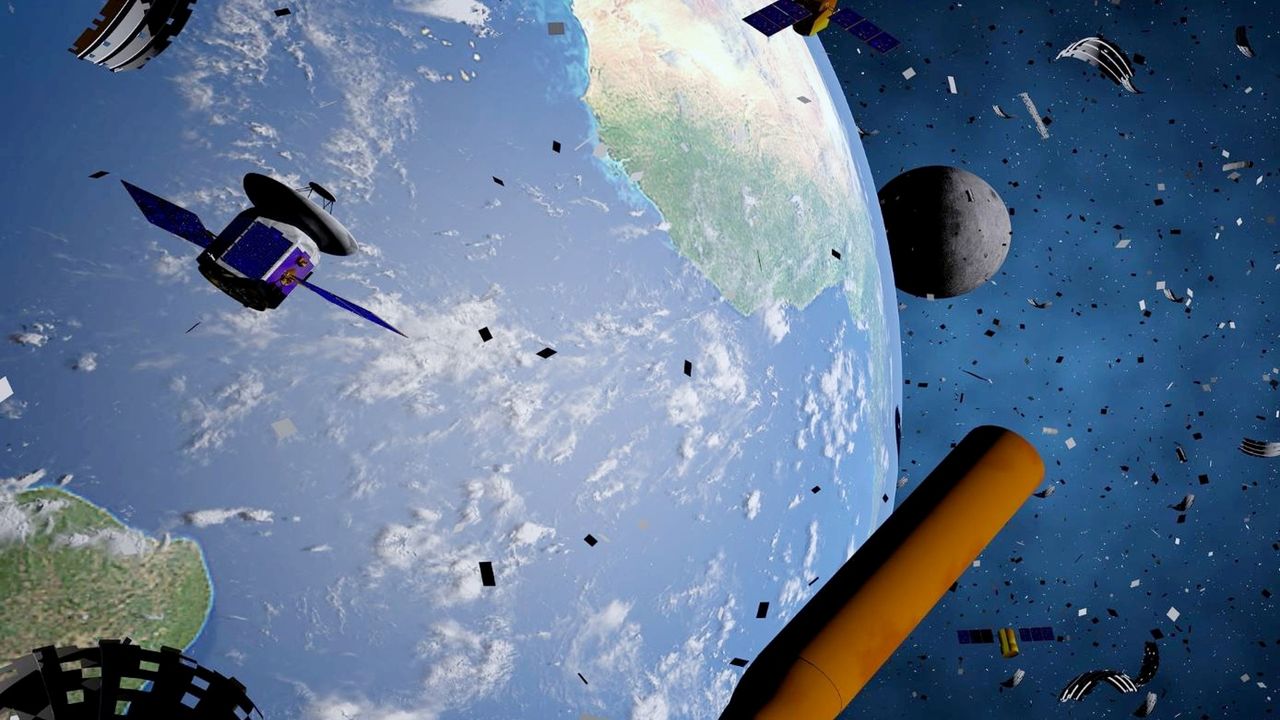
This article was originally published at The Conversation. The publication contributed the article to Space.com’s Expert Voices: Op-Ed & Insights.
China routinely sends astronauts to and from its space station Tiangong. A crew capsule is about to undock from the station and return to Earth, but there’s nothing routine about its journey home.
You may like
Space journalist Andrew Jones explained how experts on the ground had studied images of the damage and concluded that a piece of debris smaller than 1mm (roughly 1/25th of an inch) had penetrated from the outer to inner layers of the glass.
Simulations and tests confirmed a low probability that the window could fail during the high-temperature re-entry through Earth’s atmosphere. Although a worst-case scenario, it was one that officials deemed unacceptable. A rescue mission – Shenzhou-22 – was launched to bring the astronauts back from the station.
A tiny crack in a spacecraft window triggered China’s first-ever emergency launch to Tiangong space station. A CCTV article reveals what happened over 20 intense days, and why a piece of space debris smaller than 1 mm forced the emergency response. https://t.co/w8BqnhkH6MDecember 1, 2025
Experts have been warning about the threat posed by space debris for years. The ever-growing number of space programmes by states and private entities is now contributing to an increasingly congested environment in orbit.
The European Space Agency estimates that there are more than 15,100 tonnes of material in space that has been launched from Earth. There are 1.2 million debris objects between 1cm and 10cm, and 140 million debris objects between 1mm and 1cm.
In low orbit they will be travelling around 7.6 km/s (roughly 17,000 miles per hour), damaging anything they hit. This is how a piece less than 1mm in size was able to penetrate the thick glass of Shenzhou-20’s capsule.
Given the mounting number of objects in orbit, this is likely to be a more regular occurrence. It’s costly in terms of damage to equipment, and increasingly a threat to life. When a piece of debris hits another object in space, it can also create more space debris, adding to the problem.
A number of countries are able to track what’s in space, but given that these may include classified satellites, there is a reluctance by states to share details. China’s space programme is overseen by its military, in line with a view that space is inherently linked to national security. This only adds to the geopolitical tensions between states around the use of space.
You may like
Treaties and responsibilities
A total of 117 states are parties to the treaty, yet while efforts are ongoing to develop new norms around space governance, including the creation of the Inter-Agency Space Debris Coordination Committee, the organisation may offer a platform for cooperation and research but does not result in binding decisions for state action. The lack of any global agreement on space debris, and more importantly repercussions, makes tackling the problem of space debris even harder.
Technology is being developed to address space debris – but this generally appears as concept mission plans with only a few trial tests being launched anywhere globally. Examples include the idea of a harpoon to collect large pieces – although the recoil of such an instrument means the spacecraft that deploys it could become a new piece of debris.
An alternative is the highly technological approach of a big net. This will work in the sense that if you can slow the debris down, it will fall into the atmosphere and burn up.
The problem with these methods is the lack of sustainability, sending one satellite up to bring only a few pieces down uses up fuel, which is adding to climate variation. An appropriate and efficient solution would be a constellation of satellites that stay in orbit and bring debris down. The process, of course, is still something to be researched.
A ground-based solution is the laser broom, which uses laser pulses to slow down objects orbiting Earth, potentially allowing them to re-enter the atmosphere and burn up. However, it is yet to be tested and comes with its own potential problems such as atmospheric warming and missing its target.
Yet without addressing the geopolitics of space governance, the removal of space debris is moot as a focus on national interests, security concerns, and the increasing presence of the private sector means that pollution in Earth orbit is happening faster than we can clean it up.
Any collisions cause many more pieces to be produced than can be collected, some notable examples include the destruction in 2007, by China, of its own Fengyun-1C satellite as part of an anti-satellite weapon test. This added an estimated 3,500 pieces in orbit.
In 2009, a Russian satellite called Kosmos 2251 collided with an Iridium communications satellite, generating roughly 2,400 pieces of debris. In 2021, Russia carried out its own anti-satellite missile test, destroying the Kosmos 1408 satellite and generating a further 1,787 pieces. These mostly came back through the atmosphere, but 400 pieces were left in orbit.
Whether such an anti-satellite weapon could be repurposed for space debris removal is unlikely but has potential.
It will require concerted global cooperation and effort to not only indicate what spacecraft states and private companies have in space, but to commit to de-orbiting every future spacecraft at the end of its life, reducing future debris.
The current space debris mitigation standards by the European Space Agency highlight that any satellites must be de-orbited within 25 years of the end of operations. While this also is intended to apply to miniature “cubesats” – the process of bringing them back down has yet to demonstrated.
Ultimately this debris will cause problems for all space launch agencies and private companies, as there is a limit to our ground-based tracking and warning abilities. This makes addressing the global governance of space critical. However, it may take several high-cost satellites being taken out of commission, or potentially loss of life, for this issue to be taken seriously.

As the year 2025 winds down and we pop the cork on a fresh 2026, it’s a time-honored tradition to reflect back on the past 12 months to consider what Hollywood had to offer. In this era of diminished theatrical releases and streaming’s continued rise to power and influence, these sci-fi hits showed us that Tinseltown has still got it where it counts.
Honorable Mention: Avatar: Fire & Ash

(Image credit: Disney)
James Cameron’s “Avatar: Fire and Ash” just came out, but at the time of writing, we haven’t had the opportunity to watch it and form a real opinion yet.
So, we’ll have to leave out anything taking place on the planet Pandora for now, though we’re sure it will be a breathtaking sensation that will top the charts and wow global viewers.
Some awkward missteps didn’t make the cut, including the interesting but occasionally irritating “Mickey 17,” Disney’s animated astro-flick, “Elio,” and the head-scratching aberration of Ice Cube’s Prime Video debacle, “War of the Worlds.” And as for “The Astronaut”, all we can say is WTF.
You may like
But for every thorn we’ve mentioned, there’s a blossoming rose. They may not all be at the top of the box office bean counters’ ledger sheet, but these twelve movies offered artistry and imagination that delivered exceptional audience experiences in a variety of cinematic forms.
Let’s dive right into Space’s best sci-fi movies of 2025. ranked.
12. Tron: Ares
Tron: Ares | Official Trailer – YouTube

Watch On
Cast: Jared Leto, Greta Lee, Evan Peters, Jodie Turner-Smith | Director: Joachim Rønning | Watch on: Disney+
We had to have one sacrificial lamb to anchor this list, and “Tron: Ares” more than qualifies for that role to kick us off.
Released in a strange mid-October launch period and carrying with it the legacy of a 43-year-old sci-fi franchise whose last installment, “Tron: Legacy,” landed back in 2010, “Tron: Ares” was a financial burden on Disney and appeared dead-on-arrival.
It could be that the execution of the film failed to ignite audience interest in a tale of the digital realm intruding on our real world, or maybe that no one wanted to see an AI Jared Leto. Regardless, director Joachim Rønning’s $220 million neon pic is still a spectacular visual feast with a killer Nine Inch Nails score.
11. The Electric State
The Electric State | Official Trailer | Netflix – YouTube

Watch On
Cast: Millie Bobby Brown, Chris Pratt, Ke Huy Quan, Jason Alexander | Director: Anthony Russo, Joe Russo | Watch on: Netflix
You may like
Produced for a stratospheric $320 million and starring Chris Pratt and Millie Bobby Brown, this Netflix blockbuster was directed by The Russo Brothers of the “Avengers: Infinity War” and “Avengers: Endgame” fame. “The Electric State” takes its source material from a surreal graphic novel of the same name by acclaimed Swedish illustrator Simon Stalenhag.
Years after a catastrophic robot rebellion, which humanity won, two lost souls traverse a broken American wasteland with a robot named Cosmo to try and find the consciousness behind this lost droid.
The visual effects by Industrial Light & Magic are cutting-edge, and they should be for the money! Woody Harrelson’s robotic Mr. Peanut is a showstopper, and while the movie seems disjointed at times, just consider it a fun cartoonish romp, and you’ll have a good time..
10. The Gorge
The Gorge — Official Trailer | Apple TV – YouTube
Watch On
Cast: Miles Teller, Anya Taylor-Joy, Sigourney Weaver | Director: Scott Derrickson | Watch on: Apple TV+
This sci-fi horror feature from Apple TV slots into our roundup because of its pure entertainment value and captivating performances from Miles Teller and Anya Taylor-Joy.
This should have been given a full theatrical release, but we don’t make those decisions and can only gently complain about them. The handsome pair of actors play sniper specialists from enemy countries who must each take a long shift on opposite sides of a massive trench where some unnatural monsters apparently lurk below.
While guarding this mysterious gorge, these good-looking sharpshooters inevitably fall in love and join forces to contain the marauding creatures. Director Scott Derrickson (“Doctor Strange”) delivers a good old-fashioned action fright flick that is both charming and rewarding on a particular level that doesn’t demand much heavy lifting.
9. Lilo & Stitch
Lilo & Stitch | Official Trailer | In Theaters May 23 – YouTube

Watch On
Cast: Sydney Elizebeth Agudong, Billy Magnussen, Hannah Waddingham, Chris Sanders | Director: Dean Fleischer Camp | Watch on: Disney+
One of the most massive hits of 2025, pulling in over $1 billion and only recently surpassed by “Zootopia 2” as the top box office performer of the year, “Lilo & Stitch” is a delightful live-action sci-fi adventure adapted from the beloved 2002 Disney animated feature.
This makeover movie stays pretty true to the original and revolves around Lilo (Maia Kealoha), a six-year-old, hula-loving Hawaiian surfer girl who adopts a furry blue alien creature named Stitch, who was created as a biological weapon. Agents from the United Galactic Federation soon arrive to retrieve their test subject, and some wacky island mischief ensues.
Director Dean Fleischer Camp keeps things cute and charming, and the result is a successful remake that also stands on its own. Actor Chris Sanders also adds to the finished product by reprising his role voicing Stitch!
8. Bugonia
BUGONIA – Official Trailer [HD] – Only in Theaters October 24 – YouTube
![BUGONIA - Official Trailer [HD] - Only in Theaters October 24 - YouTube](https://img.youtube.com/vi/bd_5HcTujfc/maxresdefault.jpg)
Watch On
Cast: Emma Stone, Jesse Plemons, Aidan Delbis, Stavros Halkias | Director: Yorgos Lanthimos | Watch on: Peacock
The Human Resistance kidnaps a corporate hotshot played by Emma Stone, believing she’s an extraterrestrial residing on Earth and masquerading as a powerful Big Pharma CEO.
The pair of beekeeping conspiracy nuts played by Jesse Plemons and Aidan Delbis are insistent that she’s alien royalty from the Andromeda galaxy and try to prevent her from contacting her mothership. What follows is an engrossing battle of wits that leads to some shocking revelations about the fractured reality of humanity.
Director Yorgos Lanthimos offers viewers a quirky, delirious descent into the troubled minds of conspiracy theorists and makes you question the real truth, no matter how outlandish it might seem.
7. Lost in Starlight
Lost in Starlight – Official Trailer (English Dub) – YouTube

Watch On
Cast: Kim Tae-ri, Hong Kyung, Sharon Kwon, Ahn Young-mi | Director: Han Ji-won | Watch on: Netflix
The second animated feature on this compilation, Lost in Starlight is a touching romantic sci-fi fable from Korea that might have been unfairly overlooked if not for it debuting on Netflix.
South Korean director Han Ji-Won presents an uplifting cosmic story of star-crossed lovers that is a refreshing diversion deserving of the added attention for the holidays and beyond. This engaging tale of the scientist astronaut Nan-young and a struggling musician named Jay becomes a heart-wrenching drama when Nan-young joins a mission to Mars, and their long-distance bond is tested.
The film also delivers a catchy soundtrack of original K-pop songs courtesy of CIFIKA, Meego, John Park, Wave to Earth’s Kim Daniel, and many more.
6. Superman
Superman | Official Trailer | DC – YouTube
Watch On
Cast: David Corenswet, Rachel Brosnahan, Nicholas Hoult, Edi Gathegi | Director: James Gunn | Watch on: HBO Max
As one of the most-anticipated installments of the summer, director James Gunn delivers a perfectly respectable superhero blockbuster that introduced the world to a very Henry Cavill-looking David Corenswet as the Man of Steel. And you know what? We dig it.
Stuffed to the breaking point with an inspired cast and a brighter message of hope, “Superman” sports many of the hallmarks we’ve come to love in Gunn’s “Guardians of the Galaxy” movies. At times, there are simply too many characters flitting about the production, and it often lacks the edge of Zack Snyder’s “Man of Steel.”
Nevertheless, there’s a lot to love here, especially Edi Gathegi’s Mister Terrific, Rachel Brosnahan’s Lois Lane, Anthony Carrigan’s Metamorpho, and, of course, the super-pup Krypto.
5. 28 Years Later
28 YEARS LATER – Official Trailer (HD) – YouTube

Watch On
Cast: Jodie Comer, Aaron Taylor-Johnson, Jack O’Connell, Alfie Williams | Director: Danny Boyle | Watch on: Netflix
Zombies are back, baby (well, sort of!) and just as ferocious as ever when director Danny Boyle and screenwriter Alex Garland returned to the franchise they created back in 2002 with “28 Days Later.”
An underrated sequel, “28 Weeks Later,” followed in 2007, but the sci-fi horror property lay fallow until the creative duo brought it back to life. The plot unfurls 30 years after the Rage Virus spread through England as a boy and his dad travel from the safe harbor of their remote island for a perilous hunting mission.
Starring Jodie Comer, Alfie Williams, Aaron Taylor-Johnson, and Ralph Fiennes, 28 Years Later opens the gates for a whole new trilogy and its dash of British folk horror paired with the evolutionary existence of a new “Alpha” breed of the infected. The trailer alone, with its vintage 1915 recital of Rudyard Kipling’s “Boots” poem, is simply chilling!
4. Predator: Killer of Killers/Predator: Badlands
Predator: Killer of Killers | Official Trailer | Hulu – YouTube

Watch On
Predator: Badlands | Official Trailer – YouTube

Watch On
Cast: (Killer of Killers) Lindsay LaVanchy, Louis Ozawa, Rick Gonzalez/ (Badlands) Elle Fanning, Dimitrius Schuster-Koloamatangi, Reuben de Jong | Director: Dan Trachtenberg | Watch on: Hulu
For this pick, we’re giving you a combo pack of pure Predator goodness from director Dan Trachtenberg that provides two great Predator projects that taste great together.
Hulu’s animated anthology, “Killer of Killers,” gives fans more of the savage intensity and bloodlust that the classic sci-fi franchise has traditionally been known for. “Badlands” is a different creature altogether and operates as a slightly humorous buddy pic with a runt Yautja warrior being tested on a hunting expedition on a dangerous planet and a chatty Weyland-Yutani android tagging along on its back due to its limb loss.
Together, these titles provide a good dose of the new Predator property as imagined by the Disney braintrust at 20th Century Studios… for better and perhaps for worse, depending on your preference.
3. Ash
ASH | Official Trailer | Shudder | RLJE – YouTube

Watch On
Cast: Eiza González, Aaron Paul, Iko Uwais, Kate Elliott | Director: Flying Lotus | Watch on: Shudder
With its evolving Lovecraftian sci-fi nightmares, this phantasmagoric indie entry directed by filmmaker and hip-hop artist Flying Lotus is a must-watch for any serious genre fan.
Set on a hostile exoplanet where an alien species has already staked a terraforming claim, it’s a stylish horror tale of a doomed rescue mission that often defies traditional linear narratives.
The striking color-splashed visuals alone are worthy of a serious viewing, and Fly-Lo’s retro synthwave score sets the dreamy mood perfectly. It carries an infectious grindhouse appeal and dark video game-inspired scares that lingers with you long after the end credits roll!
2. The Fantastic Four: First Steps
The Fantastic Four: First Steps | Final Trailer | Only in Theaters July 25 – YouTube

Watch On
Cast: Pedro Pascal, Vanessa Kirby, Ebon Moss-Bachrach, Joseph Quinn | Director: Matt Shakman | Watch on: Disney+
With “The Fantastic Four: First Steps”, we have finally broken the decades-old curse of Marvel’s First Family having terrible movies.
Director Matt Shakman and a spirited cast inhabit a colorful, retro-futuristic New York City of the 1960s, as Mr. Fantastic, the Invisible Woman, The Thing, and The Human Torch combat the planet-munching entity called Galactus and his shimmery herald, the Silver Surfer.
Beautifully balanced with humor and heart, this Fantastic Four might not have lit up the box office or incited critics to gush over its many merits, but it’s a solid step in the right direction as Marvel Studios regroups on its way to next year’s “Avengers: Doomsday” with Robert Downey as the diabolical Marvel Comics villain, Victor von Doom.
1. Frankenstein
Frankenstein | Guillermo del Toro | Official Trailer | Netflix – YouTube

Watch On
Cast: Oscar Isaac, Jacob Elordi, Mia Goth, Christoph Waltz | Director: Guillermo del Toro | Watch on: Netflix
While some sci-fi fans might balk at the inclusion of director Guillermo del Toro’s “Frankenstein” on this diverse parade of winners, the subject matter and source material do fall squarely into a broad definition of the science fiction genre.
Isaac Asimov once explained it as being related to Humankind and its relationship to speculative technology and alternative science. Mary Shelley’s 1818 novel fuses Gothic horror with unholy scientific experiments, and in del Toro’s hands, the graphic details of Oscar Isaac’s mad creation are on full display.
The elegant sets and lavish costume designs are stunning, as is Jacob Elordi’s multi-faceted performance as the intelligent wretch stitched together from corpses. It’s a haunting epic, both romantic and tragic, with enough atmosphere and artistic touches to satisfy the most discriminating of tastes.

It has been a whirlwind year for space science, to say the least.
The Trump administration only entered office at the beginning of this year, but has already shaken up the world of academic research and the structure of major science organizations such as NASA and the National Oceanic and Atmospheric Administration. An interstellar comet strayed into our solar system and scientists have been rushing to study this sample from beyond ever since (even during a government shutdown).
Satellites are crowding Earth orbit, the northern lights are suddenly visible to people who would never normally expect to see them, and we even went through one of the shortest days in history. We saw black holes devouring stars in new ways, witnessed experts fight over whether an exoplanet called K2-18b is actually exhibiting signs of life right before NASA’s Perseverance rover found a possible biosignature of its own, and waited patiently for a new observatory to drop its first images — and that barely scratches the surface of it.
You may like
But I was curious about something. With so many massive cosmic stories competing for attention, which ones resonated the most? What space questions were people Googling? What sounded too good to miss?
To find out, I dug into our metrics and searched for the 12 most read stories of 2025. Here’s what I found.
12. China reached out to NASA to avoid a potential satellite collision in 1st-of-its-kind space cooperation

Space debris continues to be a growing problem for space exploration. (Image credit: NASA Goddard Space Flight Center)
Possible satellite accidents and surprising international space cooperation kick off this list; At number 12, is a story that perhaps offered a glimpse of a more collaborative future in orbit that can drown out our Kessler Syndrome worries.
This year, officials with the Chinese National Space Agency did something unexpected: They reached out to NASA after detecting a potential satellite traffic collision, suggesting NASA hold its satellite still while they figure out a maneuver. While NASA has sent such alerts to China before, the reverse hadn’t happened until now.
On one hand, there’s something to be said here about how many satellites are traversing Earth orbit (so many that space traffic control is moving toward normalcy!) and, on the other, it shows China’s space capabilities may have leveled up once more. Detecting and tracking potential collisions requires sophisticated space situational awareness, something long dominated by the U.S.
Read the full article here.
11. Big lake in Quebec suddenly disappears, satellite finds

Lac Rouge suddenly disappeared in Quebec. (Image credit: NASA Earth Observatory/images by Wanmei Liang, using Landsat data from the U.S. Geological Survey.)
The headline of this Space Photo of the Day from August is certainly worth a double-take, so I’m not terribly shocked it’s on this list.
You may like
The short explanation for what happened here is that the land surrounding a lake in Quebec collapsed inward on itself, causing the lake’s water to drain suddenly and triggering landslides with little to no warning. Families with the Cree First Nation of Waswanipi, an Indigenous community in Quebec, were devastated by the loss of their traditional hunting, fishing and campgrounds.
Read the full article here.
10. James Webb Space Telescope takes 1st look at interstellar comet 3I/ATLAS with unexpected results
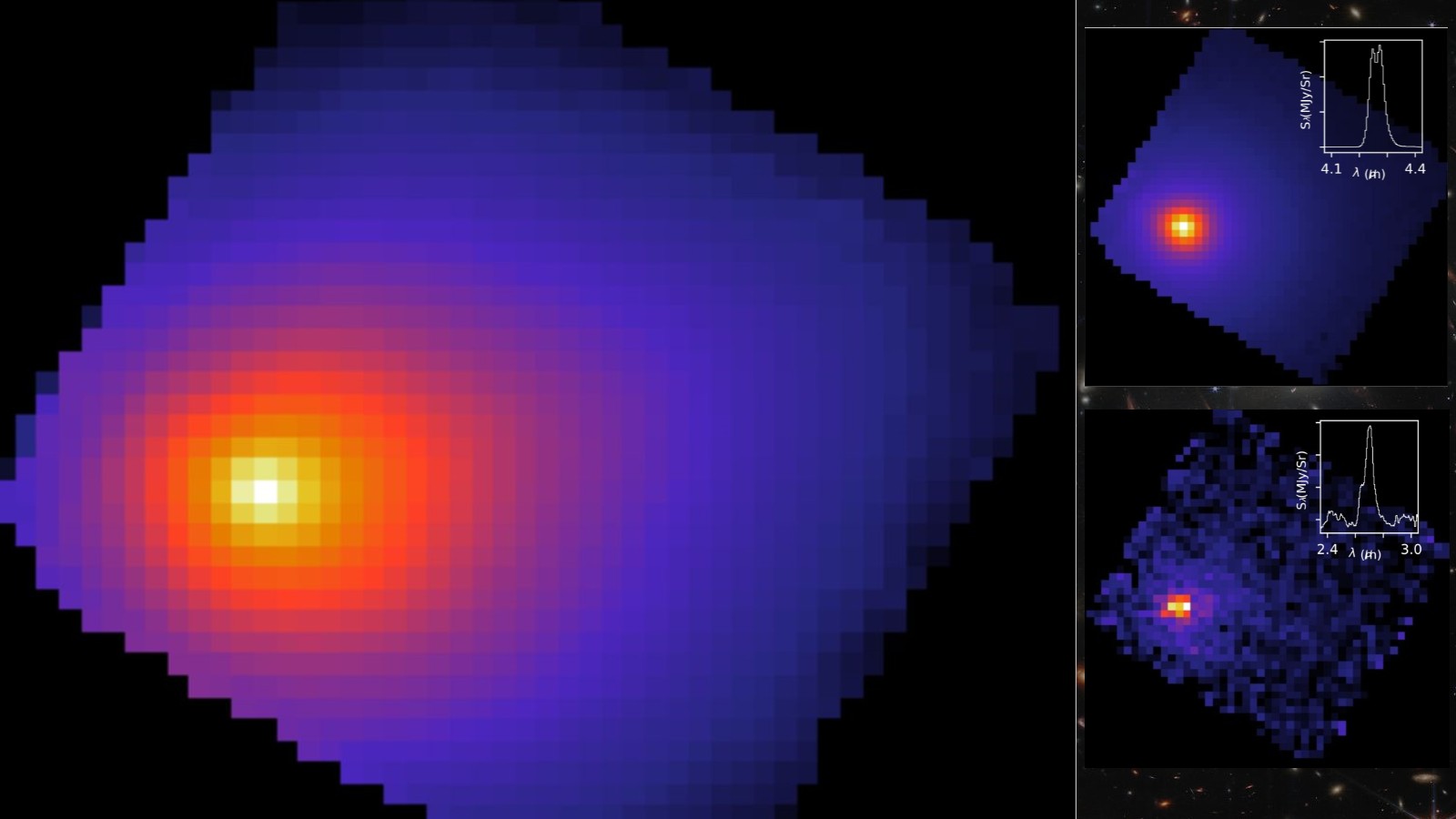
The James Webb Space Telescope turned its eye on interstellar comet 3I/ATLAS, resulting in these images. (Image credit: NASA/James Webb Space Telescope)
Of course comet 3I/ATLAS had to make this list. It’s one of the most fascinating cosmic serendipities to happen in recent memory.
Comets are very cool in and of themselves, but what’s special about 3I/ATLAS is that it came from beyond our solar system — hence, its “interstellar” title – and it’s only the third confirmed object to enter our corner of the cosmos from elsewhere. Scientists are trying to learn as much as possible about this so-called “invader” before it leaves forever, and in this article, you can see data about the comet captured by the James Webb Space Telescope — a highly revered, infrared-light-catching instrument that launched on Christmas Day in 2021.
Read the full article here.
9. Earth will spin faster today to create 2nd-shortest day in history

The second shortest Earth day occurred this summer. (Image credit: joecicak/Getty Images)
The second shortest day on record took place this year on July 22, but it was only 1.34 milliseconds shorter. The record didn’t last long; it was broken again on Aug. 5.
What causes these variations? Well, Earth’s rotation isn’t perfectly constant because of variables like the gravitational pull of the moon on our planet, masses on our planet itself shifting (like its liquid core) and seasonal changes. And even though we can’t actually feel the difference in rotation, it’s maybe nice to know that forces beyond the context of our reality are shifting and aligning to keep our clocks ticking and our journey through the universe a healthy cruise.
Read the full article here.
8. Failed Soviet Venus lander Kosmos 482 crashes to Earth after 53 years in orbit
A streak against the dark sky shows Kosmos 482 landing back on Earth (Image credit: Gianluca Masi/The Virtual Telescope Project)
It was a bittersweet moment on May 10 this year, when a Soviet-era spacecraft, Kosmos 482, plunged back to Earth after more than five decades in orbit.
Kosmos 482’s destiny was to ride the tides around Venus, but because of a failure during launch, the spacecraft never made it past our planet’s orbit. And for the last five decades, it had remained in limbo there, unable to continue its journey or return home, until gravity closed the chapter.
At last, it’s home.
Read the full article here.
7. Russian ‘Noah’s Ark’ satellite carrying 75 mice and 1,500 flies lands back on Earth

The landing spot of Russia’s Bion-M No. 2 descent module, on the steppes of the Orenburg region. (Image credit: Roscosmos/Ivan Timoshenko)
Speaking of in-orbit objects that returned home, so did a spherical Russian spacecraft carrying 75 mice, 1,500 flies, microorganisms and plant seeds spent 30 days in orbit, exposing its living cargo to cosmic radiation and microgravity before returning to Earth.
While 10 mice died and some flies didn’t survive, most of the animals came back alive, giving scientists valuable insight into how living organisms cope with spaceflight.
Read the full article here.
6. Cosmonaut removed from SpaceX’s Crew 12 mission for violating national security rules: report
In early December, an investigative report from Russian news site The Insider revealed that cosmonaut Oleg Artemyev was removed from SpaceX’s Crew 12 mission after allegedly leaking confidential SpaceX documentation and photos.
This mission, scheduled to launch to the International Space Station as early as February, now lists cosmonaut Andrei Fedyayev as Artemyev’s replacement on the four-person crew.
Read the full article here.

Cosmonaut Oleg Artemyev was removed from the SpaceX Crew 12 mission. (Image credit: NASA/Bill Ingalls)
5. Scientists analyze 76 million radio telescope images, find Starlink satellite interference ‘where no signals are supposed to be present’

An astronomical image marred by trails caused by satellites of SpaceX’s Starlink megaconstellation. (Image credit: Victoria Girgis/Lowell Observatory)
And on the note of SpaceX, the rise of satellite megaconstellations spearheaded by Elon Musk’s company continues to make headlines for the negative impact it has on astronomy observations. Though other satellites are contributors to the issue of signal interference in night sky images — notably AST SpaceMobile’s Bluewalker 3 — SpaceX’s Starlink internet satellites are quite the polluters in this domain. There are over 10,000 deployed satellites, with more on the way.
This article is one of several that investigate how bad the Starlink effect is on astronomy, and how much worse it could get. A new study from this month, for instance, suggests satellite constellations like Starlink could obscure most space telescope observations by the late 2030s.
Read the full article here.
4. What time is Sept. 7 blood moon total lunar eclipse?
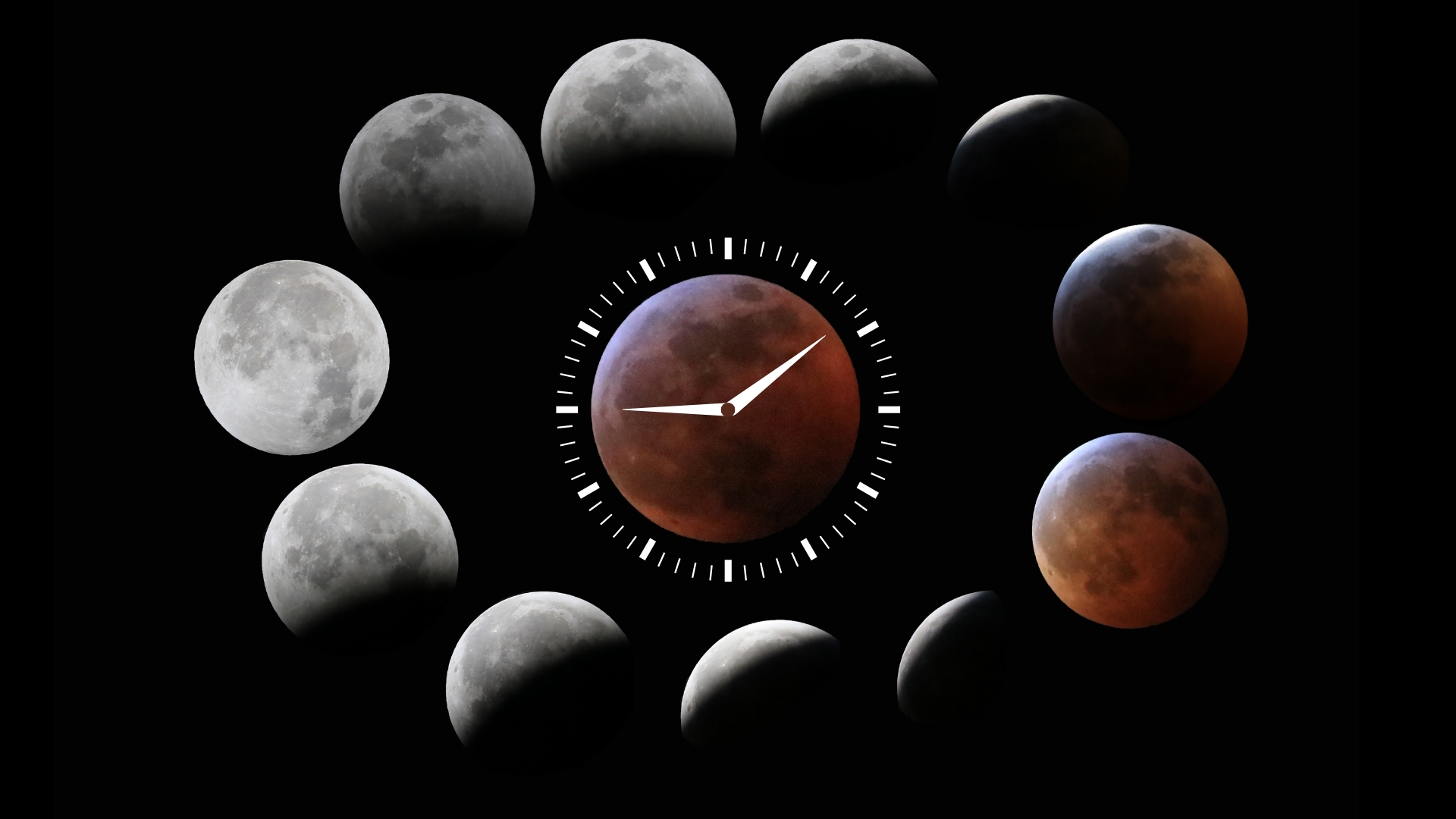
The total lunar eclipse happened on Sept. 7-8, 2025. (Image credit: Created in Canva Pro by Daisy Dobrijevic)
Number four on this list represents several blood moon stories from this year, as humanity’s desire to view our lunar friend became quite clear to me while we searched through our most-read stories.
The blood moon, for context, happened because a total lunar eclipse was visible across Asia and Europe overnight from Sept. 7 through Sept. 8. The moon’s deep red hue appeared as it passed through Earth’s shadow, with the exact shade shaped by conditions in Earth’s atmosphere — a process explained in detail through an accompanying infographic.
It’s also hard to forget how much the 2024 total solar eclipse captivated the world; it would seem space traffic is just as mesmerizing as space traffic control to us.
Read the full article here.
3. NASA’s Perseverance rover hits the Mars rock gold mine: ‘It has been all we had hoped for and more’
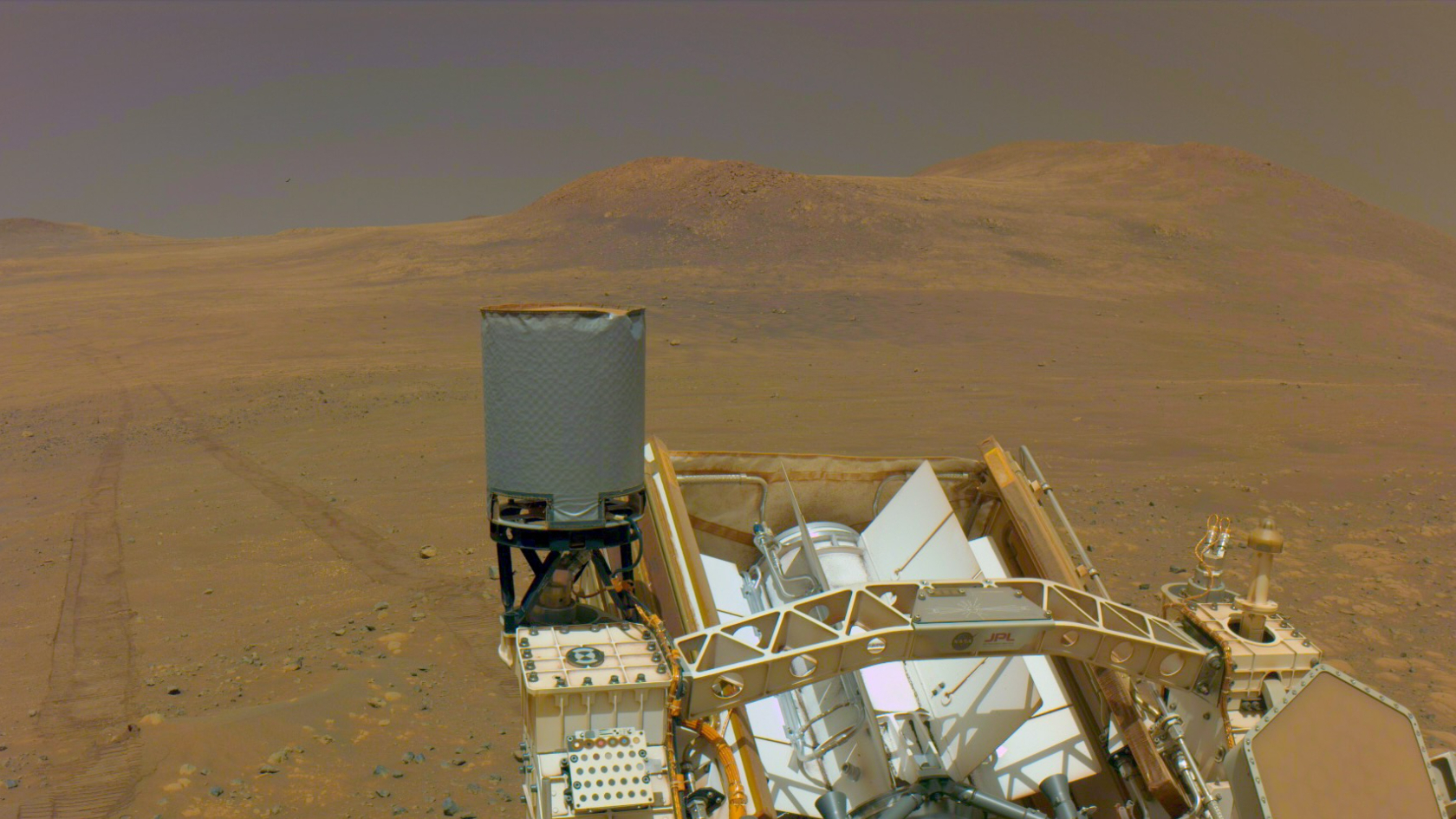
One of the navigation cameras on NASA’s Perseverance captured the rover’s tracks coming from an area called “Witch Hazel Hill,” on May 13, 2025, the 1,503rd Martian day, or sol, of the mission. (Image credit: NASA/JPL-Caltech)
The Perseverance rover had some major wins this year while scouring the Martian surface for clues about the history of the Red Planet. One of them is the absolute bounty of peculiar rocks it found at a spot near Jezero Crater called “Witch Hazel Hill.”
While exploring the region, the rover uncovered intriguing specimens, including once-molten rocks and, for the first time, material from the crater rim itself. One particularly prized sample, dubbed Silver Mountain, captivated scientists with its unusual textures — and will likely remain a highlight of the mission for years to come.
Read the full article here.
2. Northern lights may be visible in these 23 US States June 1

The northern lights put on a spectacular display in 2025. (Image credit: Noppawat Tom Charoensinphon via Getty Images)
Similar to the deal with the blood moon conglomerate, this article represents all the northern lights stories that were running off the charts this year.
The current solar cycle has been kind enough to allow humans across the world to see the northern lights right in their backyards, even if they don’t live in the frigid polar areas of our globe. And after getting a taste of what it’s like to see these surreal light shows, it appears to have become a chase for many.
What’ll happen when a solar cycle doesn’t treat us this well in the future? Hello darkness my old friend?
Read the full article here.
1. Trump’s signing of ‘One Big Beautiful Bill’ includes $85 million to move space shuttle Discovery from Smithsonian to Texas

The future of Space Shuttle Discovery is questionable. (Image credit: Space.com/Chris Daniels)
Welcome to our number one most-read story this year: A rundown of how the Trump administration’s “Big Beautiful Bill” allocated money to move the iconic space shuttle Discovery (currently located at the Smithsonian National Air and Space Museum in Washington D.C.) to Space Center Houston, the official visitor center for NASA’s Johnson Space Center in Texas.
This idea has been met with much disdain from experts, in part because it would entail sort of chipping up Discovery into different pieces. Not to mention, it’d be pretty hard to complete the task — and the money involved could theoretically be used for other stuff.
It’s fitting to have this story at our top spot because of how science has been flipped upside down this year due to changes implemented by the Trump administration. Several of Space.com’s stories in 2025 have been dedicated to peeling back the layers of how the administration — since taking office at the start of this year — has led to mass layoffs of scientists, language changes on scientific websites, an increase in quiet censorship and arguably illegal moves from major organizations like NASA.
Considering the amount of dramatic news we see on this list alone, both directly and indirectly, it will be interesting to see what our 2026 “most read stories” list will look like.
Read the full article here.
SCIENCE
Tooth-in-eye surgery, ‘blood chimerism,’ and a pregnancy from oral sex: 12 wild medical cases we covered in 2025

Each week, Live Science highlights an intriguing case report from the medical literature, where we explore unusual symptoms, rarely seen diagnoses and out-of-the-box treatments. Through this “Diagnostic Dilemma” series, we describe how doctors work to ultimately discover the cause of a patient’s ailment. In complex cases, this diagnostic process can be quite arduous. That’s part of why doctors share case reports: to help other medical professionals who might be facing the same puzzle.
Here are 12 of our most intriguing Diagnostic Dilemmas from the past year. (If descriptions of medical symptoms and procedures make you squeamish, proceed with caution.)
1. Boy spoke foreign language after surgery
A Dutch teenager got knee surgery to treat a soccer injury, and upon waking up from anesthesia, he spoke only English — a language he’d previously spoken only in language classes at school. He kept insisting he was in the U.S., did not recognize his parents, and could not speak or understand spoken Dutch, his native language. Exams turned up no neurological abnormalities, and the doctors didn’t initiate any specific treatment to address the language issue. Within 18 hours of surgery, the boy could understand some Dutch but not speak it without struggling. But then suddenly, he could both understand and speak it as normal. The doctors described the event as a strange case of “foreign language syndrome.”
You may like
2. Woman with no vaginal opening gets pregnant via oral sex
3. Man stabbed by huge fish
A man was brought to a hospital by boat and helicopter after incurring an injury while fishing. He’d caught a white marlin (Kajikia albida) — a large fish with a long, pointy “bill” — and when he leaned over the edge of his boat to release his hook from the fish, it jumped up and struck him. At the hospital, doctors found a fragment of the fish’s bill lodged in the man’s throat, spinal canal and base of his skull. With an emergency surgery and antibiotics to prevent infections, the man survived the encounter without any long-term symptoms.
4. Acupuncture led to joint injury
An X-ray of the front (A) and side (B) of the patient’s left knee. The lines are the tiny golden threads. (Image credit: The New England Journal of Medicine ©2013.) (Image credit: The New England Journal of Medicine ©2013.)
A woman with osteoarthritis of the knee began getting acupuncture regularly when her pain medications started causing bad stomach issues. But her knees then became very sore, and she went to a hospital to be examined. X-rays revealed areas of her joints and shinbones where the bone tissue had thickened and spurs had formed. Additionally, hundreds of tiny flecks could be seen around both knee joints. It turned out that the woman’s acupuncturists had left golden threads inside her knees on purpose as part of her treatment. In other cases, these threads have caused cysts and tissue damage, which can happen when they migrate through the body.
5. Man experiences rare meat allergy
A man in Michigan went to an ER with swollen eyelids and an itchy rash, and he noted that he’d also been experiencing cramps, nausea, abdominal pain and vomiting over the preceding days. When doctors examined the patient, they uncovered signs of anaphylaxis, a severe allergic reaction, and his condition quickly progressed to shock. The medical team successfully stabilized the patient, but a few days later, his condition worsened again. At that point, the doctors spotted a pattern: The symptoms arose when the man ate red meat. An allergy to meat, a condition called alpha-gal syndrome, can be triggered by the bite of certain tick species. It turned out that the man was an avid deer hunter who likely encountered an adult tick or tick larvae while hunting, his doctors concluded.
6. Woman had XY chromosomes in her blood
A woman had her chromosomes checked following a pregnancy loss to see if there might have been an underlying genetic reason for the miscarriage. The test revealed that, at least in the woman’s blood, her chromosomal profile (or karyotype) was 46,XY — the typical karyotype among males. Further tests revealed that across the rest of her tissues, her karyotype was 46,XX, the typical chromosomal profile of a female. The woman had a fraternal twin, so in this case of “chimerism,” the doctors concluded that the XY chromosomes likely came from her brother in the womb but somehow assimilated them only into her blood cells. The doctors suspected the “veins and arteries of the two children became intertwined in the umbilical cord” at some point. The woman had no overt symptoms tied to carrying these chromosomes in her blood and later went on to carry a pregnancy that resulted in the birth of a baby boy.
7. Woman injects herself with black widow venom
A woman visited an emergency room with a headache, severe cramps and muscle pain, as well as an elevated pulse, breathing rate and blood pressure. She told doctors she’d attempted to get high by injecting a ground-up black widow spider (Latrodectus) into her veins in a suspension of distilled water. The doctors suspected the injected dose of black-widow venom was likely much higher than one would get from a bite, and its effects may have been exacerbated by the patient’s allergic reaction to proteins in the venom. After the patient had been treated for several days in an intensive care unit, her symptoms resolved and she was discharged.
8. Nut allergy was triggered by ejaculate
A woman developed hives, swelling under her skin and trouble breathing after having sex with her partner. While receiving treatment at a hospital, she reported having a known allergy to Brazil nuts. She said that her partner ate them a few hours prior to sex but that he’d taken a bath and washed his hands thoroughly before intercourse. When the doctors conducted a skin-prick allergy test, using samples of the partner’s semen, before and after he ate Brazil nuts, they found that the allergy triggers could indeed pass through the semen and set off the woman’s allergy.
You may like
9. Rash mysteriously migrated

A man’s red rash appeared to be “migrating” across his skin, doctors found. (Image credit: The New England Journal of Medicine ©2022)
Following a cancer treatment, a man developed a red rash that started out near the anus and then spread rapidly to the trunk and limbs. The rash, which looked like wavy lines all over the patient’s body, appeared to migrate, with the lines starting out in one spot and later moving across the skin. A stool test revealed Strongyloides stercoralis, a parasite that can cause an infection called strongyloidiasis in humans. These worms were migrating under the man’s skin, and the infection likely arose because the patient’s immune system was stunted by glucocorticoids used in his cancer treatment.
10. Rare tooth-in-eye surgery performed
A rare autoimmune disorder injured a man’s corneas and extensively impeded his sight. To restore vision in one eye, doctors attempted an osteo-odonto-keratoprosthesis, or “tooth-in-eye surgery.” The procedure involves removing one of the patient’s teeth and implanting it in their eye socket, where it serves as a platform for a transparent, plastic lens. The lens stands in for the injured cornea and enables light to enter the eye. The man’s successful procedure was the first of its kind in Canada.
11. “Muscle-plumping” injections cause calcium spike
A man went to a hospital because he was experiencing weakness and vomiting. There, tests revealed that his kidneys were failing and the calcium in his blood was too high. Physical exams and scans revealed abnormalities in his upper-arm and chest muscles — namely, areas of superdense calcification. It turned out that the man had previously gotten injections of silicone-like, oil-based substances to “plump” up the look of his muscles. In this case, the injections triggered a persistent foreign-body reaction, resulting in extensive scarring and calcification of the muscle that leached calcium into the bloodstream.
12. Scientist catches plague from defanged bacteria
A lab worker came down with an infection that, despite medical treatment, ended up being fatal. His doctors were informed that the patient had worked with a weakened strain of Yersinia pestis, the bacterium that causes the plague. This weakened form of the germ was thought to be noninfectious, but nonetheless, the man contracted it. Further tests revealed that the man had unusually high levels of iron in his blood. One way the plague bacteria had been weakened was that its key gene for absorbing iron had been removed — but the man’s blood, which was chock-full of iron, may have enabled the germ to overcome this weakness and establish a deadly infection.
For more intriguing medical cases, check out our Diagnostic Dilemma archives.
This article is for informational purposes only and is not meant to offer medical advice.