
TECHNOLOGY
Facebook slow to act on posts celebrating Bondi beach massacre, anti-hate group says | Facebook


Facebook hosted terrorist propaganda that celebrated the murder of Jews and praised Islamic State, a leading anti-hate group has alleged.
The posts included celebrations of the Bondi beach massacre that the Community Security Trust says Facebook has been too slow to take down. The posts were still on Facebook on 16 December, two days after the attack, and received shares and likes.
Some accounts are Britain-based and those have been reported to counter-terrorism police in the UK as a matter of urgency.
One post shows video of the aftermath of the Bondi beach attack, which was allegedly carried out by a father and son who were IS supporters, and says: “Allah is the greatest and praise to Allah.” It has clearly been viewed, with more than 100 likes, 27 comments and four shares recorded.
Fifteen people were killed as they celebrated the Jewish festival of Hanukah in Sydney on 14 December. One of the attackers also died.
Another post shows a photo of one of the Bondi beach gunmen and says: “The coming years of art and hell,” and contains praise for an IS leader. This had 12 shares and more than 300 likes.
Facebook said it was in the process of removing some of the posts after being contacted by the Guardian, and said some had already been spotted and removed.
Dave Rich, the director of policy for the CST, which works to keep Jewish people safe from attack, said: “The sheer volume of IS-supporting accounts promoting terrorist content on Facebook is deeply alarming, and the posts celebrating the Bondi terrorist attack are utterly nauseating.
“Yet again, social media companies are incapable of meeting even their most basic of responsibilities and are putting all of us in danger as a result. This simply should not be happening any more. We will be calling on Ofcom to urgently investigate Meta’s failings and to take strong action where possible.”
Ofcom, the media regulator, said: “If a post is reported to a platform now, the platform must decide whether the content is illegal under UK law, and take it down swiftly if it is. Our job is to make sure sites and apps have appropriate measures in place to comply with their duties.”
It said it had received “evidence that suggests terrorist content and illegal hate speech is persisting on some of the largest social media sites”.
A spokesperson for Meta, which owns Facebook, declined to answer a series of questions but said: “The content was removed for violating our policies around dangerous organisations and individuals.”
A Home Office spokesperson said: “Social media content promoting terrorism or violence against communities is absolutely unacceptable, and will not be tolerated. The law is clear: social media platforms must take action to prevent illegal content on their sites, including terrorist and violent material.”
The focus on pro-IS material on popular social media sites comes amid concern about an increase in terrorist efforts to target Jewish people across the west.
Two men were convicted on 22 December of a plot to get machine guns and shoot Jewish people around the north-west of England. In that plot and the Sydney massacre, both sets of terrorists’ approaches had a degree of sophistication.
Though neither was “directed” by IS, the Sydney attackers visited the Philippines and the north-west England machine-gun plotters had contact with an IS person overseas and were sophisticated enough to try to bypass Jewish community security and infiltrate a Facebook group, giving them details of potential Jewish targets.
Rich said of the English plot: “This is an even more serious plot than the attack on the synagogue in Heaton Park and indicates a much greater level of training and sophistication.”
Vicki Evans, the senior national coordinator for counter-terrorism policing, told the Guardian: “The terrorist threats we face do not stand still and we rarely confine them to history. Instead, they flex in intensity and risk over time – and so does our response.
“Recent attacks in Manchester and Australia are clear reminders of the range of threats we face, and we continue to ask the public to … report any concerns they see in their real-world or online communities.”











In September, NVIDIA agreed to purchase $5 billion worth of Intel shares. On Monday, the deal finally became official, with NVIDIA buying 214 million shares at $23.28 per share, giving it a 4.4% ownership stake in one of the most consequential companies in semiconductor history.
Since the initial agreement, the value of NVIDIA’s stake has already risen to $7.5 billion, as Intel shares closed at $36.68 on Monday. But focusing only on the immediate gains misses the bigger picture of why this deal matters right now.
On 18 December, the transaction cleared a major regulatory hurdle when the U.S. Federal Trade Commission approved the purchase after months of scrutiny over whether NVIDIA’s dominance in AI chips, combined with a stake in Intel, could raise antitrust concerns. The FTC ultimately ruled that the 4.4% stake was small enough to move forward.
What NVIDIA And Intel Are Actually Building Together
Beyond the financials, NVIDIA and Intel are planning to co-develop multiple generations of chips for data centres and computing platforms.
At the heart of this partnership is NVIDIA’s NVLink technology, which will connect Intel and NVIDIA chips at extremely high speeds. With bandwidth reaching 1.8 TB/s, NVLink enables far tighter CPU-GPU integration than traditional PCIe connections, removing the bottlenecks that increasingly slow down AI workloads.
NVIDIA founder and CEO Jensen Huang described the partnership as: “This historic collaboration tightly couples NVIDIA’s AI and accelerated computing stack with Intel’s CPUs and the vast x86 ecosystem — a fusion of two world-class platforms.”
Intel CEO Lip-Bu Tan echoed the sentiment, saying: “Intel’s x86 architecture has been foundational to modern computing for decades — and we are innovating across our portfolio to enable the workloads of the future.”
In practical terms, Intel will manufacture NVIDIA-custom x86 CPUs for data centres that integrate directly into NVIDIA’s AI architecture. For consumer and enterprise PCs, Intel plans to build system-on-chips that combine x86 CPUs with NVIDIA RTX GPU chiplets, blurring the traditional lines between processor roles.
A Lifeline For Intel
This deal comes at a critical moment for Intel. The company reported an $18.8 billion loss in 2024, its first annual loss since 1986, after years of strategic missteps, fierce competition, and heavy spending on manufacturing expansion.
NVIDIA’s investment will not fix those problems overnight, but it offers Intel something it urgently needs: time and credibility — a lifeline that could help stabilise the company while it attempts to reinvent itself.
NVIDIA’s Spending Spree Continues
For NVIDIA, the Intel stake is part of a much broader investment campaign that has already topped $120 billion, including its planned $100 billion investment in OpenAI and its recently announced $20 billion Groq deal.
Although NVIDIA officially labelled the Groq deal a non-exclusive licensing agreement rather than a full acquisition, it still underscores how aggressively the company is positioning itself across the AI value chain.
Nvidia’s $20 billion Groq Deal Opens a New Front in the Fight Over Faster AI
Officially, Nvidia had labelled this deal as a non-exclusive licensing agreement and not as an acquisition.
The Geopolitical Layer
The deal also fits neatly into a growing global AI race. In August, the U.S. government took a $10 billion stake in Intel, citing national security and supply-chain resilience.
NVIDIA’s move aligns with that strategy, reinforcing the US ambition to become a dominant AI chip production powerhouse, especially as competition with China intensifies.
Why This Matters
For NVIDIA, the upside is control and optionality. For Intel, it is a rare chance at reinvention. As demand for AI computing continues to surge, this partnership could help define who shapes the next era of semiconductors — and who struggles to survive it.
TECHNOLOGY
Behind The Scenes becomes first Nollywood movie to gross N100m+ each in 4 consecutive days


Behind The Scenes (BTS), a film by popular Nollywood Actress Funke Akindele, has set another milestone by grossing over N100 million each in four consecutive days. The development has seen the project become the first Nollywood film to reach that mark.
According to a breakdown released by the Nigeria Box Office (NBO) on Monday, Behind The Scenes capitalised on the festive period and its continued acceptance to set new records. While the movie grossed N103.6 million on Christmas Day, it recorded N130.1 million on Boxing Day, becoming the highest single-day gross of all time.
Behind The Scenes continued the fine run by grossing N105.4 million on 27 December and N121.6 million on 28 December, becoming the first Nollywood film to rake in over N100 million each in four consecutive days, and still counting.
Aside from these, Funke Akindele’s latest feature also set several records.
Behind the Scenes, with the accumulation of its daily returns since launch, has now surged past N1.1 billion to become the fastest film in West Africa to cross N1 billion within 19 days after its release. The figure also made Funke Akindele Nollywood’s highest-grossing producer of all time.

While confirming the new record, FilmOne Entertainment, the film’s distributor, said that Funke Akindele is now the only filmmaker to surpass N1 billion three separate times. In addition, she is also the first to rake in N1 billion+ in three consecutive projects within a single calendar year.
The distributor tagged the ongoing turnout at cinemas as “another history made,” and also acknowledged the audience for continuing to show up, filling cinemas and “carrying this story with love.” It had previously described Funke Akindele as the “Queen of Box Office for a reason” after the film set its first record two weeks ago.
Recall that earlier this month, Behind The Scenes became the first Nollywood film to hit the N200 million mark on its opening weekend in 2025. The film was described as a five-time box office opening weekend record holder and the biggest weekend admissions of 2025. It also recorded the biggest weekend admission (34,548) of 2025.
While the film continues to rake in revenue, the cost of production also attracts attention. Funke Akindele had earlier disclosed in a video that the production budget exceeded N1 billion, highlighting the scale of investment involved in the film production.
 Funke Akindele
Also Read: Behind The Scenes becomes first Nollywood movie to hit N200m on opening weekend in 2025.
About Behind The Scenes
Behind The Scenes features Scarlet Gomez in the lead role, alongside Iyabo Ojo, Funke Akindele, Destiny Etiko, and Tobi Bakre. Others are Uche Montana, Uzor Arukwe, Ini Dima-Okojie, Adebowale ‘Mr Macaroni’, Ibrahim Chatta, Kamo State, and reality TV stars Handi and Wanni Danbaki, among others.
The film is a comedy-drama that spotlights the chaos, ego clashes, and hidden struggles in Nollywood film production and focuses on themes of pressure, healing, and hidden truths. It lights up an ambitious young filmmaker navigating betrayal, ambition, and on-set drama.
In addition, Behind The Scenes touches on broader societal issues like ‘black tax’ and self-sacrifice through characters such as successful entrepreneur Aderonke “Ronky-Fella” Faniran.


Cybersecurity breaches remained a persistent thorn in the side of African companies in 2025, but the major highlights from the year weren’t the headline attacks. Institutions lost the luxury of keeping breaches quiet as cyberattacks became harder to hide.
Several African countries tightened the breach-reporting guidelines for operators. Chief among them is Algeria, which mandated a 5-day window for companies to report breaches or pay heavy fines. Kenya and South Africa also made significant strides in forcing organisations to treat breaches as public events rather than private IT problems.
In Kenya, operators that discover a potential breach are now expected to alert data controllers within 48 hours, and controllers are pushed to file a preliminary report to the Office of the Data Protection Commissioner (ODPC) within 72 hours—even if the full facts are not yet in. Late notifications must be justified, and new guidance from the regulator ties weak security and poor reporting directly to fines, sanctions, and even the risk of losing the right to process data. For Kenyan firms, that means the old instinct to “wait until we know more” now carries regulatory risk of its own.
South Africa also overhauled its breach‑reporting process. While the Protection of Personal Information Act (POPIA) had long required organisations to notify both the regulator and affected people after a “security compromise,” in 2025, the Information Regulator tightened how that duty works in practice. In April, it mandated companies to log breaches through an online reporting portal using a form, forcing operators to spell out what happened, what data was involved, what they are doing to contain it, and what individuals should do to protect themselves.
According to South Africa’s Information Regulator, there were 2,374 reported breaches in the 2024/25 financial year, with 82% of them occurring after April 2025. The number pointed to an acceleration, but also hinted that disclosure was becoming unavoidable.
Elsewhere, Zambia chose to treat cybersecurity as a critical‑infrastructure issue rather than a back‑office concern. In April 2025, the country split its cyber law into two: a Cyber Security Act governing security service providers and critical information infrastructure, and a Cyber Crimes Act dealing with offences and penalties. Operators in sectors such as energy, banking and finance, health, transport, pensions and insurance, ICT, education, mining, and other designated public‑sector services can now be classified as controllers of “critical information” or “critical information infrastructure,” bringing them under a tighter supervisory net.
That designation comes with hard obligations: controllers must register with the new Zambia Cyber Security Agency, keep designated critical information hosted in Zambia unless expressly authorised to store it elsewhere, and promptly notify the agency of any perceived or actual cybersecurity incident affecting those systems or connected networks. They are also required to undergo annual audits, file cybersecurity situational-awareness reports, and participate in national cyber-exercises, with non-compliance punishable by fines of up to ZMW 1.2 million ($48,000) and, in serious cases, prison terms that can extend up to 10 years.
These regulatory shifts forced the disclosure of some of the most consequential breaches in 2025. At a new scale, they made visible how intrusions disrupt everyday customer services in very public ways.
Get The Best African Tech Newsletters In Your Inbox
Exposure as a strategy
If 2024 gave us the unfortunate breach at South Africa’s National Health Laboratory Service (NHLS), the biggest healthcare incident in 2025 was Kenya’s M-TIBA breach in October. Like a trophy showcase, hackers published the siphoned data on public Telegram channels, a pattern used to force organisations to comply with ransom demands. Organisations that hold sensitive customer data remained heavily targeted businesses in 2025.
Telecom firms, once assumed to be resilient by virtue of scale, became some of the most lucrative targets. Telecom Namibia, a state-owned provider, was quietly crippled by a ransomware attack in December 2024, with a public fallout that continued in January 2025. When the company refused to pay, attackers leaked sensitive billing data belonging to senior government officials in an attempt to force compliance.
On January 8, hackers hit mobile operator Cell C with a cybersecurity breach, with reports stating that perpetrators, RansomHouse, had “unlawfully disclosed the incident” and published stolen customer data on the dark web, exposing them to fraud and extortion.
In April, MTN Group disclosed a data breach affecting its South African subscribers. In Ghana, at least 5,700 MTN customers were directly affected in a breach reported on April 28. In South Africa, the breach escalated into a criminal investigation. The message to the industry was unmistakable: Telecoms had become identity vaults, and those vaults were being tested.
Hackers maintained their exhibitionist posture, and several other sensitive data organisations were hit. In January 2025, a cyberattack on the South African Weather Service (SAWS) knocked key systems offline, disrupting the delivery of aviation and marine forecasts and limiting access to critical weather information at home and across the region. In July, the municipal systems of Otjiwarongo, a quiet town in central Namibia, were knocked offline. Residents were blocked from accessing basic services as officials struggled to explain what had happened.
The year’s most consequential infrastructure breach involved South Africa’s Eskom, the state-owned power company, and it became a crowning moment of the exposure era—one that attached a clear financial cost to a cyber incident.
In December 2024, the power utility detailed how its Online Vending System (OVS)—the platform used to generate prepaid electricity tokens—had been breached the previous year, after a forensic investigation linked large “non-technical” losses to fraud on the system.
The breach itself occurred in 2024, but only surfaced publicly in December, when Eskom acknowledged that criminals had exploited weaknesses in its vending platform to generate large volumes of fraudulent yet technically valid tokens. MyBroadBand, a local media publication, reported in November 2025 that Eskom employees, either acting as colluders or as orchestrators of the scheme, took advantage of the compromised system to create and sell fake power tokens, allegedly stealing between R657 million and R1.1 billion ($39.5 million–$66 million) from the company.
By September 2025, Eskom reported that fraud linked to the OVS breach had been reduced to “very low levels of activity.” The incident did something damaging: it made internal failure, financial loss, and delayed disclosure visible at once, underscoring how difficult it had become for institutions to keep breaches quiet.
Espionage?
State‑linked groups such as Salt Typhoon, associated with China, have targeted telecommunications providers—including at least one in South Africa, according to researchers at Recorded Future—seeking access not to cause disruption but to observe. Metadata, call records, network access—the architecture of daily life—proved more valuable than any single database.
These attacks rarely produced headlines. They did not need to. Their success lay in remaining largely invisible.
In South Africa, allegations surfaced in September that the State Security Agency (SSA) had been breached by a suspected Chinese-linked group known as RedNovember. Officials denied the intrusion, saying they investigated the claims and found no evidence of such a breach. Yet the matter remains a public spectacle on how espionage could be the objective for RedNovember, a group notorious for targeting high-profile governments and intergovernmental organisations (IGOs). RedNovember did not issue any statement on the alleged SSA breach.
At the same time, ransomware groups turned toward infrastructure: ports, utilities, logistics systems. In South Africa alone, ransomware- and cybercrime-related losses were estimated at $120 million annually.
Elsewhere on the continent, Senegal’s tax authority was hit by ransomware that threatened to erase and leak sensitive fiscal records. On October 2, Senegal’s Directorate General of Taxes and Domains (DGID), a department of the Ministry of Economy, Finance, and Planning—responsible for tax and land policies and administration in the country—issued a statement denying the alleged attack, and framing it as a temporary technical glitch; with that move, the government opted for quiet containment and recovery. Yet the episode exposed the fragility of digital tax systems that underpin state revenue.
Similar pressures were visible across East Africa. Kenya’s national incident response team recorded over 842 million attempted cyber intrusions in Q3 2025, most targeting government login portals and internet service providers. In Ethiopia and several other countries in the region, repeated distributed denial of service (DDoS) attacks aimed at telecom infrastructure remained a persistent thorn. These attacks were stress tests on states digitising faster than they could defend.
Get The Best African Tech Newsletters In Your Inbox
The new confidence trick
In 2025, people also stopped trusting voices.
AI-driven social engineering matured quickly. The fear of finance managers receiving calls that sounded exactly like their CEOs or video meetings featuring faces that blinked and nodded with unsettling accuracy increased. Traditional warning signs—bad grammar, strange domains—no longer apply.
West Africa’s long-running role as a hub for Business Email Compromise (BEC) hardened into something more industrial. Crime syndicates like Black Axe ran operations that were transnational, disciplined, and lucrative. Reports of digital sextortion—often involving AI-generated images used to blackmail victims—also surged.
Nigeria illustrated how cybercrime blended with insider abuse. At Access Bank, the country’s biggest bank by assets, investigators alleged that staff colluded to divert ₦826 million ($569,345) through a fake internal revenue account. It was not a breach in the conventional sense, but it underscored another reality of 2025: the most damaging compromises also came from willing, and even unwitting insiders.
Arrests, laws, and the theatre of response
There were moments of resolve. In a coordinated operation, INTERPOL arrested 1,209 cybercriminals across 18 African countries. Regulators also began flexing their muscles. The Nigeria Data Protection Commission (NDPC), the country’s data privacy regulator, fined MultiChoice, the South African multinational media company, ₦766 million ($528,000) for failing to adequately protect consumer data. It signalled to African organisations that poor data stewardship would carry real financial consequences.
In North Africa, a wave of cyber incidents unfolded over several weeks in April. The sequence began when Moroccan-linked hackers allegedly compromised the X account of Algeria’s state news agency. TechCabal’s checks showed that the account was taken over in April and renamed to ‘Sahara Marocain,’ in what appeared to be a deliberate attempt to provoke.
On April 8, pro-Algerian group Jabaroot hit back. It reportedly hacked Morocco’s National Social Security Fund, directly framing it as retaliation. The disclosed breach exposed tens of thousands of files containing personal and financial information of nearly 2 million citizens.
While officials disputed some of the leaked material, large portions of the data reportedly appeared on public Telegram channels. Soon after, the hacktivist group Jabaroot defaced Morocco’s Ministry of Labour website, citing retaliation for online attacks against Algerian media. The escalating tit-for-tat of digital reprisals underscored how cyber operations have become weapons of digital skirmishes, leaving civilians’ data as collateral damage.
Get The Best African Tech Newsletters In Your Inbox
What 2025 left behind
Between 2019 and 2025, Africa lost more than $3 billion to cybercrime, according to INTERPOL. The figure only captures money and not lost confidence following such attacks. The agency also noted that detection and response capabilities across the continent remain limited, lagging behind the pace and scale of emerging threats, and signalling an investment gap.
According to INTERPOL’s Africa Cyberthreat Assessment report, 90% of African businesses operate without adequate cybersecurity protocols in place. The same report notes that only 30% of African countries have an incident reporting system, underscoring persistent underreporting and structural gaps in how cyber incidents are captured.
Across much of Africa, cybersecurity spending has tended to cluster around basic perimeter tools and compliance-driven controls, while more advanced capabilities—continuous monitoring, threat hunting, assessments, testing, and controls—remain underdeveloped in many sectors outside large banks and telecom operators.
A report by PwC, a global consulting firm, showed that only 28% of South African organisations are spending significantly more on proactive measures than reactive measures (such as incident response, fines, recovery). Globally, that figure is closer to 70%, yet most African organisations are not close to that mark.
Without stronger defences, the threats will spill over to 2026. Hackers are timing, striking when systems are already strained. Global blockchain startups are also discovering that smart contracts, accounting for $29 million in damages, fail just as human ones do. Information security analysts have become some of the most sought-after professionals on the continent.
As the year draws to a close, we learned that breaches are no longer the thing African institutions fear most. What they fear is being seen as unprepared, evasive, and ordinary in the face of a problem they once believed could be managed quietly.

At a time when everyday conversations about money are starting to feel heavier, rising prices, growing government debt, and questions about long-term stability, Bitcoin is again being pulled into the center of a much bigger debate. This time, the argument isn’t about replacing the U.S. dollar, but about whether Bitcoin can quietly make the system stronger. Coinbase CEO Brian Armstrong believes it can.
Speaking in December, Armstrong said Bitcoin acts as healthy competition for the U.S. dollar. Not as an enemy, and not as a substitute, but as an alternative that keeps policymakers on their toes. In his view, when people have a credible exit option, governments are forced to be more careful with how they manage money.
Armstrong explained that Bitcoin works more like a market signal than a political weapon. When inflation rises or government spending grows too fast, confidence in traditional money starts to weaken. People don’t wait for official reforms. They simply look for safer places to store value. Bitcoin, in that sense, reflects stress in the system rather than causing it.
He pointed out that moderate inflation can work if the economy grows at the same pace. The problem begins when inflation runs ahead of growth. Over time, that gap chips away at trust in the dollar, especially for global investors who rely on it as a store of value. Bitcoin’s existence, Armstrong argued, forces institutions like the Federal Reserve and lawmakers to think harder about the long-term impact of their decisions.
What $14B crypto forfeiture says about the U.S. bitcoin strategy
A massive Bitcoin seizure tied to a global scam could push America’s holdings past $36 billion and reveal how its approach to digital assets is changing.
Does Bitcoin actually weaken the U.S. dollar or hold it accountable?
This argument becomes more serious when viewed alongside America’s rising debt. The U.S. national debt has climbed to historic levels and continues to grow rapidly.
For Armstrong, Bitcoin introduces an unusual form of accountability. If confidence breaks down, people can move capital elsewhere. That possibility alone creates pressure. From this perspective, Bitcoin does not weaken the dollar. It quietly encourages better discipline to protect it.
Armstrong is not alone in framing Bitcoin this way. BlackRock CEO Larry Fink has previously described Bitcoin as a hedge against currency debasement, particularly for countries that struggle with fiscal control. Hedge fund manager Paul Tudor Jones has compared Bitcoin to digital gold, saying it serves as protection in an era of aggressive money printing. Even Federal Reserve officials have acknowledged that crypto reflects public concerns about inflation and trust, even if they disagree on its role.
Across these views, the comparison is consistent. Bitcoin is not positioned as a new national currency, but as a parallel system that highlights weaknesses in existing ones.
How Stablecoins Are Becoming a Global Macroeconomic Force
As stablecoin use explodes past $9 trillion in annual transactions, the question becomes how long before they reshape global finance.

What role do stablecoins play in the future of the U.S. dollar?
While Bitcoin often grabs headlines, Armstrong and others have noted that dollar-backed stablecoins may be doing more to extend U.S. influence globally. Stablecoins allow people around the world to use digital dollars for everyday payments, savings, and transfers, often without touching the traditional banking system.
When the U.S. economy shows strength, confidence tends to flow back into dollar-based assets. In those moments, Bitcoin does not always rise. Stablecoins, however, gain traction by making the dollar easier to use across borders. Some industry leaders argue that this quietly reinforces dollar dominance in the digital economy.
Taken together, Bitcoin and stablecoins play very different roles. Bitcoin applies pressure by offering an alternative during times of instability. Stablecoins extend the reach of the dollar when confidence is high. Armstrong’s core argument is that this balance ultimately benefits the U.S., not by eliminating the dollar, but by forcing it to remain credible.
In that sense, Bitcoin’s most important impact may not be its price or volatility, but the uncomfortable questions it keeps raising. And for policymakers, those questions are becoming harder to ignore.
How the GENIUS Act Impacts Stablecoins and Crypto Adoption
With this implementation, stablecoins gain legal clarity, greater institutional trust, and a clear path toward real-world adoption at scale.


Between the slash-and-burn US government reboot led by a dank meme fan and the relentless pushing of AI by venture capital-backed blowhards, 2025 has felt like peak obnoxious tech bro. Fittingly, jargon-spouting, self-regarding digital visionaries also became Hollywood’s go-to baddies this year in everything from blockbusters to slapstick spoofs. Spare a thought for the overworked props departments tasked with mocking up fake Forbes magazine covers heralding yet another smirking white guy as “Master of the Metaverse” or whatever.
With such market saturation, the risk is that all these delusional dudes blend into one smarmy morass. It felt reasonable to expect that Stanley Tucci might sprinkle a little prosciutto on The Electric State, Netflix’s no-expense-spared alt-history robot fantasia. As Ethan Skate – creator of the “neurocaster” technology that quashed an AI uprising then turned the general populace into listless virtual-reality addicts – Tucci certainly looked the part: bald and imperious in retro Bond villain wardrobe. But even the great cocktail-maker couldn’t squeeze much out of sour existential proclamations such as: “Our world is a tyre fire floating on an ocean of piss.”
Hall-of-mirrors feel … Nicholas Hoult as Lex Luthor in Superman. Photograph: Jessica Miglio/© 2025 Warner Bros. Ent. All Rights Reserved. TM & © DC
There was more baldness in Superman, where Nicholas Hoult’s Lex Luthor embodied the worst kind of wannabe paradigm-changer: one desperate to appear on talkshows. Incensed that the world seemed to be ignoring his genius in favour of a flying alien do-gooder, the LuthorCorp founder spent a fortune to rig social media, deploying an army of vivisected monkey cyborgs to swamp platforms with anti-Superman hashtags and memes. That the film itself was met with farmed outrage about perceived wokeness added a disconcerting hall-of-mirrors feel to what was essentially an overstuffed crowdpleaser. Hoult’s Lex was also a distractingly hot tech CEO, which pushed the film further into the realm of fantasy.
Is it more appealing when these self-regarding douchebags are funny? In the heightened world of killer doll action thriller M3gan 2.0, Jemaine Clement was sleazily overconfident as Alton Appleton, a high-functioning billionaire whose latest wheeze was pushing an unwanted neural implant on the masses. Seduced by an impassive fembot assassin, Alton was humiliated in his final moments, his signature Altwave tech effortlessly hacked, his weird prosthetic six-pack coming unstuck. It was pathetic but humanising. As the movie trundled on, you actually began to miss him.
If Clement nailed tech bro obliviousness, Danny Huston had to remain deadpan opposite Liam Neeson’s blathering Frank Drebin Jr in The Naked Gun reboot. Huston’s Richard Cane was a hybrid Jeff Bezos/Elon Musk-esque blowhard who used the galactic profits from his online retail and electric car empires to make a Primordial Law of Toughness device . His master plan was to zap the general public back to a prehistoric mindset, violently culling the herd and ushering in a new age for humankind (or at least his zillionaire class). Cane was obsessed with men’s sperm counts, building luxury bunkers for the super-rich and Black Eyed Peas. In other words: truly psychotic.
Truly psychotic … Danny Huston in The Naked Gun. Photograph: Paramount Pictures/AP
In the goopy, grungy world of The Toxic Avenger reboot, Kevin Bacon’s floppy-haired biotech baddie Bob Garbinger stood out simply because he looked so pale and pampered. While it’s not a great sign when a self-proclaimed “healthstyle” guru gets Sisyphus and syphilis mixed up, Garbinger’s habit of going shirtless while flogging “proprietary cutting-edge bio-boosters” in TV ads felt like a timely skewering of immortality-seeking biohackers such as Bryan Johnson.
In 2022, Evan Peters played the lead in Netflix’s ghoulish Monster: The Jeffrey Dahmer Story. Did that influence his casting as a second-generation nepo baby in Tron: Ares? To be fair, his Julian Dillinger – grandson of David Warner’s boardroom bully from the original 1982 Tron – seemed more neurotic than psychotic: a baby-faced tech huckster with crappy circuit board sleeve tattoos whose audacious move into 3D-printing wicked neon war machines and digital commandos was only slightly scuppered by the fact that they imploded within 30 minutes. A wildly expensive, resource-intensive, essentially useless product? Intentionally or not, it felt like an appropriate metaphor for the AI bubble.
Pale and pampered … Kevin Bacon in The Toxic Avenger
But why stop at just one douchey tech bro? Jesse Armstrong’s jagged satire Mountainhead took the bold step of making every single character the absolute worst of the “move fast, break stuff” billionaire mindset, isolating them – and the viewer – in a remote, repellently deluxe ski lodge while the spectre of possible Armageddon encroached. As the Musk-alike owner of a social media app spreading dangerous AI-augmented misinformation, Cory Michael Smith captured the glib, morality-agnostic tone of someone richer than God who views the world as their plaything.
As Venis (Smith), silverback investor Randall (Steve Carell), canny algorithm tamer Jeff (Ramy Youssef) and would-be wellness app supremo Souper (Jason Schwartzman) relentlessly needled each other, there was the illicit thrill of dialling into the combative quartet’s inside-baseball repartee of boasting, toasting and roasting. But as the globe lurched further into chaos, watching these four nominal thought leaders clumsily workshop how best to exploit the situation was depressing, not least because it seemed so plausible. We have all been forced to absorb the pathologies of our tech overlords due to their disproportionate influence in the real world. As a new cinema year looms, is it too much to ask that we don’t have to keep doing it at the movies too?
TECHNOLOGY
Nessie, is that you? Loch Ness Monster has been ‘spotted’ FIVE times this year, official records show


The Loch Ness Monster was ‘spotted’ five times in 2025, official records have revealed.
The mythical creature has been a staple feature of Scottish folklore for centuries, but gained worldwide attention in 1933, when the first photo was snapped.
Since then, 1,165 sightings have been recorded by The Official Loch Ness Monster Sightings Register.
The five sightings of the creature, nicknamed Nessie, took place across just an eight-month period.
The first was on 22 March, when a couple visiting from London spotted a mysterious ‘hump’ in the water.
Two months later, in May, a visitor reported a ‘long and thin’ creature in a boat’s wake.
In August, a ‘long time local’ reported a sighting, before two visitors claimed to spot Nessie within weeks of each other in October.
Here’s a closer look at the five sightings, and exactly what was seen.

In May, a visitor viewing the loch from a high vantage point at around 15:40 spotted a small motor boat entering the bay
22 March
At around 7pm on 22 March, a couple visiting from London heard a ‘quiet splash’ at Fort Augustus.
‘We were right at the point where the River Taff connects to Loch Ness, on the north bank,’ one of them said.
‘At first I noticed a very quiet splash sound as if something was cutting stealthily into the water and this drew my attention to the south side of the water.
‘There I saw something moving through the water, between 130 and 160 feet away from us.
‘It was paler than the jet-black water around it, but in the gloom it was impossible to determine a hue.’
The couple described the sighting as a ‘hump’, adding that it was ‘large and alive’.
‘Kind of like if a large seal or walrus was swimming in the water but for some reason it’s head was hidden, like just it’s back was exposed,’ they explained.

The mythical creature has been a staple feature of Scottish folklore for centuries, but gained worldwide attention in 1933, when the first photo was snapped

In late August, a long time local resident shot a two-minute video of something under the water near Lochend
While it was too dark to pick up on details like texture, the couple soon realised that there was a second mass in its wake.
‘It was roughly the same size and shape as the leading mass but perhaps lower in the water,’ they added.
‘There was maybe 1.5 to 2 meters gap between the humps from my line of sight. I think until I saw the second hump I was thinking it was a seal that was behaving strangely.’
The creature soon left the area, moving towards the deeper part of the loch, before disappearing.
‘Later when we talked about it, my partner told me that from her vantage point it was clear that the two humps were on one creature, that it was one long creature,’ the viewer added.
23 May
In May, a visitor viewing the loch from a high vantage point at around 15:40 spotted a small motor boat entering the bay.
Using binoculars, he peered at the boat’s wake, and spotted something ‘long and thin’ pop up.

On 15 October, Peter Hoyle was visiting the Loch from Moray, when he spotted a dark shape sticking out of the water
While the object vanished a few times, he managed to catch it on film, with the entire sighting lasting just five minutes.
29 August
In late August, a long time local resident shot a two-minute video of something under the water near Lochend.
Filmed at 09:15 during ‘calm clear conditions’, the footage shows an unusual disturbance pattern on the surface of the water.
Despite living in the area for 30 years, the resident said they had ‘never seen anything like this before.’
15 October
On 15 October, Peter Hoyle was visiting the Loch from Moray, when he spotted a dark shape sticking out of the water.
The shape was moving from the right side of the loch to the left, travelling ‘fairly quickly, but not boat speed’.

Finally, Mishawn Mielke, a tourist from Texas, was visiting Urquhart Castle when she reported seeing a black head in the water at 14.45
Within 30 seconds, the shape had disappeared into the depths of the water – although Mr Hoyle did manage to capture footage of the short sighting.
28 October 2025
Finally, Mishawn Mielke, a tourist from Texas, was visiting Urquhart Castle when she reported seeing a black head in the water at 14.45.
‘I first saw it and was like wow, that looks just like images I saw from the sightings website,’ she said.
‘It didn’t look like a wave, it actually looked like the head of something popping up. it made a distinct pattern in the water I couldn’t see anywhere else, kind of like its own wake. And than it was gone.
‘From that distance I’d say the water pattern was at least 3m long.’
Webcam images
Four sightings were also reported via webcam images in 2025, although these are listed separately.
‘Over the past few years, and especially during the Covid crisis, many images that we receive come from the Loch Ness Webcam,’ The Official Loch Ness Monster Sightings Register explains on its website.
‘For reasons outwith the control of the camera operators, the resolution of some of the images from the camera has at times been less than ideal.
‘As such, it has been more difficult to identify what some images submitted.
‘Given they are still “unexplained” though, we decided that from 2021 onwards, such images would be listed separately from those that are reported by people who saw something while physically at the loch.’
What IS the Loch Ness Monster?
Rumours of a strange creature living in the waters of Loch Ness have abounded over the decades, yet scant evidence has been found to back up these claims.
One of the first sightings, believed to have fuelled modern Nessie fever, came in May 2, 1933.
On this date the Inverness Courier carried a story about a local couple who claim to have seen ‘an enormous animal rolling and plunging on the surface’.
Another famous claimed sighting is a photograph taken in 1934 by Colonel Robert Kenneth Wilson.
It was later exposed as a hoax by one of the participants, Chris Spurling, who, on his deathbed, revealed that the pictures were staged.
Other sightings James Gray’s picture from 2001 when he and friend Peter Levings were out fishing on the Loch, while namesake Hugh Gray’s blurred photo of what appears to be a large sea creature was published in the Daily Express in 1933.

Robert Kenneth Wilson, a London physician, captured arguably the most famous image of the Loch Ness Monster. The surgeon’s photograph was published in the Daily Mail on April 21, 1934 – however it was later proven to be a fake
The first reported sighting of the monster is said to have been made in AD565 by the Irish missionary St Columba when he came across a giant beast in the River Ness.
But no one has ever come up with a satisfactory explanation for the sightings – although in 2019, ‘Nessie expert’ Steve Feltham, who has spent 24 years watching the Loch, said he thought it was actually a giant Wels Catfish, native to waters near the Baltic and Caspian seas in Europe.
An online register lists more than 1,000 total Nessie sightings, created by Mr Campbell, the man behind the Official Loch Ness Monster Fan Club and is available at www.lochnesssightings.com.
So what could explain these mysterious sightings?
Many Nessie witnesses have mentioned large, crocodile-like scutes sitting atop the spine of the creature, leading some to believe an escaped amphibian may be to blame.
Native fish sturgeons can also weigh several hundred pounds and have ridged backs, which make them look almost reptilian.
Some believe Nessie is a long-necked plesiosaur – like an elasmosaur – that survived somehow when all the other dinosaurs were wiped out.
Others say the sightings are down to Scottish pines dying and flopping into the loch, before quickly becoming water-logged and sinking.
While submerged, botanical chemicals start trapping tiny bubbles of air.
Eventually, enough of these are gathered to propel the log upward as deep pressures begin altering its shape, giving the appearance of an animal coming up for air.

Meta has acquired Singapore-based AI startup Manus for billions of dollars, closing the deal in just over ten days—a speed that shocked even the startup’s own investors.
“At first, we almost doubted whether this was a fake offer,” said Liu Yuan, partner at ZhenFund and an early investor in Manus, describing the extremely short negotiation timeline. The deal marks Meta’s third-largest acquisition ever, behind only WhatsApp and Scale AI.
But here’s what makes this urgent: Manus launched only in March 2025. Eight months later, Meta paid billions to own it. That timeline tells you everything about how fast the AI landscape is moving and how seriously tech giants now view the gap between talking and doing.
Meta Spent Billions on AI. Its Next Big Models Still Aren’t Ready
The Chief AI Officer told employees that its two most important AI models won’t ship until next year.
The Shift From Chatbots to Workers
The difference between current AI tools and what Manus built comes down to execution. Most AI—ChatGPT, Claude, Gemini—can answer questions, write text, and suggest next steps. Manus goes further: it completes entire workflows autonomously without constant supervision.
Want a 40-page market research report? Manus researches, analyses, structures, and delivers it while you’re in another meeting. Need to screen hundreds of job applications? It reads them, scores candidates, and presents recommendations. Looking for a two-bedroom apartment in a specific neighbourhood? It searches listings, compares options, and builds a shortlist with pricing breakdowns.
This isn’t about generating better responses. It’s about AI that finishes tasks from start to end, the way you’d hand work to a colleague and expect them to handle it completely.
Manus achieved $100 million in annual recurring revenue just eight months after launch, reportedly the fastest any startup globally has hit that milestone. The company processed more than 147 trillion tokens this year and created over 80 million virtual computers while serving millions of users worldwide.
Those metrics explain why Meta moved so quickly.
Behind the acquisition is a recognition that Meta has fallen behind in a critical area. While the company has invested heavily in AI infrastructure and model development, it struggled to translate that into consumer products that feel genuinely transformative.
Apple has reportedly explored acquiring Perplexity AI. Microsoft continues deepening its OpenAI partnership. Google is pushing agents across its product suite. The window for acquiring proven autonomous agent technology is closing fast as the best companies either get bought or become prohibitively expensive.
Manus was in the middle of raising a new funding round at a $2 billion valuation when Meta approached. Instead of letting competitors make offers or waiting for the price to climb higher, Meta closed the deal in days. Mark Zuckerberg and several Meta executives were already using Manus themselves, which likely accelerated the decision.
“Joining Meta allows us to build on a stronger, more sustainable foundation without changing how Manus works or how decisions are made,” said Xiao Hong, Manus CEO, who will now serve as Vice President at Meta while continuing to run the company from Singapore.
Meta plans to keep operating Manus as a standalone service while integrating its technology into Meta AI, Facebook, Instagram, WhatsApp, and its AI-powered glasses. That means autonomous agent capabilities could soon reach billions of users across Meta’s platforms.
What This Means for Users
The acquisition signals a fundamental shift in how AI will work in everyday apps. Instead of typing prompts into a chatbot and reviewing its suggestions, you’ll be able to assign complete tasks and walk away.
Book a vacation itinerary? The AI researches flights, hotels, activities, and presents a complete plan. Analyse your investment portfolio? It pulls data, identifies trends, flags risks, and creates a summary report. Draft a presentation deck? It builds slides, adds relevant data visualizations, and structures the narrative.
The integration timeline isn’t clear yet, but Meta’s urgency suggests the company wants these capabilities live quickly. The competitive pressure from Apple, Google, and Microsoft is intensifying, and autonomous agents represent the next major platform shift—similar to how mobile apps transformed what phones could do a decade ago.
Manus currently operates on a subscription model: a free tier with one daily task, a $39/month Starter plan, and a $199/month Pro plan. How Meta adapts that pricing when integrating Manus into its free platforms remains to be seen, but the company has historically preferred advertising-supported models over direct subscriptions.
 Image Credit: Manus
The China Factor and Strategic Independence
There’s another layer here. Manus was created by Butterfly Effect, a Chinese company that recently relocated its headquarters to Singapore. The startup raised $75 million from U.S. venture firm Benchmark in April, which drew scrutiny from lawmakers concerned about backing an AI company with Chinese origins.
Meta says Manus will sever all ties to Chinese investors and will not operate in China following the acquisition. That’s a significant condition, especially as U.S.-China tech tensions continue shaping corporate strategy in AI development.
The company will continue operating independently from Singapore, maintaining its existing team and decision-making structure. That autonomy matters—Manus built its technology by aggressively combining and optimizing existing AI models from Anthropic and Alibaba rather than developing everything from scratch. Keeping that team intact and independent preserves the execution speed that made them valuable in the first place.
The Bigger Picture
Meta’s acquisition reveals how the AI industry is entering a new phase. The era of impressing people with clever text generation is over. The fight now centres on which companies can deliver AI that executes real work reliably and repeatedly.
Manus achieved something most startups don’t: product-market fit at scale in record time. The company’s rapid revenue growth and global user adoption proved that people will pay for AI that actually completes tasks, not just assists with them.
Whether Meta can maintain that momentum while integrating Manus into its vastly larger ecosystem is the open question. The company has a mixed record on acquisitions—Instagram and WhatsApp thrived, while others faded. But the speed of this deal and Zuckerberg’s personal involvement suggest Meta understands the stakes.
For now, the message is clear: autonomous agents that execute tasks from start to finish are the next battleground in AI. And Meta just paid billions rather than risk building too slowly on its own.
IBM Acquires Confluent for $11 Billion to Power Real-Time AI Data
The deal highlights a growing trend of tech giants investing heavily in data infrastructure to ensure AI systems can make decisions instantly.


Nigeria’s National Assembly has initiated an institutional review of the legislative handling of Nigeria’s controversial tax reform laws, following discrepancies between versions passed by lawmakers and those published in the Official Gazette.
A seven-member ad hoc committee has been constituted to establish what went wrong in the passage of four critical tax bills that have generated significant public attention.
According to a press statement from the House spokesman, Rep. Akin Rotimi, the committee will examine the sequence of events surrounding the Nigeria Tax Act 2025, the Nigeria Tax Administration Act 2025, the Joint Revenue Board of Nigeria (Establishment) Act 2025, and the Nigeria Revenue Service (Establishment) Act 2025.
The review will focus on identifying lapses, irregularities, or external interferences that may have contributed to the confusion between the harmonised bills passed by both chambers and the versions subsequently gazetted.
The House raised the matter under a Point of Order on Privileges, suggesting possible concerns about the integrity of the legislative process.

Similar: How the new tax law will affect POS agents
Tax committee tasked with examining discrepancies
The ad hoc committee, working alongside other relevant National Assembly committees and management, has been tasked with conducting a comprehensive examination of how documents were transmitted for presidential assent and why discrepancies emerged in the final gazetted versions.
Leadership under Senate President Godswill Obot Akpabio and House Speaker Abbas Tajudeen has directed the Clerk to the National Assembly to regazette the Acts and issue Certified True Copies reflecting the actual legislative decisions made by both chambers.
This administrative correction is meant to authenticate what lawmakers genuinely passed, addressing concerns that the published versions may not accurately represent the National Assembly’s intentions.
The press release emphasises that the review will be conducted within constitutional boundaries, examining compliance with the Acts Authentication Act, Standing Orders of both chambers, and established parliamentary practice.
However, the statement carefully notes that this does not constitute an admission of any defect in legislative authority, maintaining that the exercise is strictly procedural.
 Taiwo Oyedele, chairman of the presidential committee on fiscal policy and tax reforms
What remains unclear is how long Nigerians must wait for both processes to conclude. The regazetting appears to be an administrative function that could be executed relatively quickly once discrepancies are identified and corrected.
Yet, the committee’s investigative work presents a different timeline challenge. Institutional reviews of this nature typically require thorough documentation review, witness interviews, and examination of administrative procedures at multiple levels of the legislative bureaucracy.
Read also: Banks, fintechs mandated to generate Tax IDs for account holders from January
The silence surrounding the committee’s progress suggests work may only be beginning – or not.
Parliamentary investigations often take weeks or months, particularly when examining complex legislative processes involving multiple stakeholders. The committee must trace the bills’ journey from harmonisation through authentication, presidential assent, and final gazette publication to identify where things went wrong.
Beyond procedural corrections, the review must determine whether irregularities resulted from administrative error, systemic failures, or deliberate interference.
The reference to examining “external interferences” in the press statement raises questions about whether forces outside the National Assembly may have influenced the final gazetted versions.

Establishing culpability for any breach of legislative procedure or authentication laws will require careful investigation and could have significant consequences for individuals or institutions found responsible.
It bears noting that the France-FIRS partnership arrangement continues to generate questions, and the public has yet to see the Memorandum of Understanding governing this relationship. This lack of transparency compounds existing concerns about the tax reform process.
The National Assembly urges Nigerians to avoid speculation while institutional processes unfold, but the extended silence and unclear timelines inevitably fuel public anxiety.


Mark Zuckerberg has struck again.
Meta Platforms is acquiring Manus, a Singapore-based AI startup that’s become the talk of Silicon Valley since it materialized this spring with a demo video so slick it went instantly viral. The clip showed an AI agent that could do things like screen job candidates, plan vacations, and analyze stock portfolios. Manus claimed at the time that it outperformed OpenAI’s Deep Research.
By April, just weeks after launch, the early-stage firm Benchmark led a $75 million funding round that assigned Manus a post-money valuation of $500 million. General partner Chetan Puttagunta joined the board. Per Chinese media outlets, some other big-name backers had already invested in Manus at that point, including Tencent, ZhenFund, and HSG (formerly known as Sequoia China) via an earlier $10 million round.
Though Bloomberg raised questions when Manus started charging $39 or $199 a month for access to its AI models (the outlet noted the pricing seemed “somewhat aggressive . . . for a membership service still in a testing phase,”) the company recently announced it had since signed up millions of users and crossed $100 million in annual recurring revenue.
That’s when Meta started negotiating with Manus, according to the WSJ, which says Meta is paying $2 billion — the same valuation Manus was seeking for its next funding round.
For Zuckerberg, who has staked Meta’s future on AI, Manus represents something new: an AI product that’s actually making money (investors have grown increasingly twitchy about Meta’s $60 billion infrastructure spending spree).
Meta says it’ll keep Manus running independently while weaving its agents into Facebook, Instagram, and WhatsApp, where Meta’s own chatbot, Meta AI, is already available to users.
Techcrunch event
San Francisco
|
October 13-15, 2026
There is one wrinkle, however, which is that Manus, which launched eight months ago, has Chinese founders who founded parent company Butterfly Effect in Beijing in 2022 before decamping to Singapore in the middle of this year. Whether that raises flags in Washington remains to be seen, but Senator John Cornyn already dragged Benchmark for its investment in the company, asking back in May on X who thought it was “a good idea for American investors to subsidize our biggest adversary in AI, only to have the CCP use that technology to challenge us economically and militarily? Not me.”
Cornyn, a Texas Republican and senior member of the Senate Intelligence Committee, has long been one of Congress’s most vocal hawks on China and technology competition, but he’s hardly alone. Being tough on China has become one of the genuinely bipartisan issues in Congress.
Unsurprisingly, Meta has already told Nikkei Asia that after the acquisition, Manus won’t have any ties to Chinese investors and will no longer operate in China. “There will be no continuing Chinese ownership interests in Manus AI following the transaction, and Manus AI will discontinue its services and operations in China,” a Meta spokesperson told the outlet.


Osmond ChiaBusiness reporter
 Getty Images

China has proposed strict new rules for artificial intelligence (AI) to provide safeguards for children and prevent chatbots from offering advice that could lead to self-harm or violence.
Under the planned regulations, developers will also need to ensure their AI models do not generate content that promotes gambling.
The announcement comes after a surge in the number of chatbots being launched in China and around the world.
Once finalised, the rules will apply to AI products and services in China, marking a major move to regulate the fast-growing technology, which has come under intense scrutiny over safety concerns this year.
The draft rules, which were published at the weekend by the Cyberspace Administration of China (CAC), include measures to protect children. They include requiring AI firms to offer personalised settings, have time limits on usage and getting consent from guardians before providing emotional companionship services.
Chatbot operators must have a human take over any conversation related to suicide or self-harm and immediately notify the user’s guardian or an emergency contact, the administration said.
AI providers must ensure that their services do not generate or share “content that endangers national security, damages national honour and interests [or] undermines national unity”, the statement said.
The CAC said it encourages the adoption of AI, such as to promote local culture and create tools for companionship for the elderly, provided that the technology is safe and reliable. It also called for feedback from the public.
Chinese AI firm DeepSeek made headlines worldwide this year after it topped app download charts.
This month, two Chinese startups Z.ai and Minimax, which together have tens of millions of users, announced plans to list on the stock market.
The technology has quickly gained huge numbers of subscribers with some using it for companionship or therapy.
The impact of AI on human behaviour has come under increased scrutiny in recent months.
Sam Altman, the head of ChatGPT-maker OpenAI, said this year that the way chatbots respond to conversations related to self-harm is among the company’s most difficult problems.
In August, a family in California sued OpenAI over the death of their 16-year-old son, alleging that ChatGPT encouraged him to take his own life. The lawsuit marked the first legal action accusing OpenAI of wrongful death.
This month, the company advertised for a “head of preparedness” who will be responsible for defending against risks from AI models to human mental health and cybersecurity.
The successful candidate will be responsible for tracking AI risks that could pose a harm to people. Mr Altman said: “This will be a stressful job, and you’ll jump into the deep end pretty much immediately.”
If you are suffering distress or despair and need support, you could speak to a health professional, or an organisation that offers support. Details of help available in many countries can be found at Befrienders Worldwide: www.befrienders.org.
In the UK, a list of organisations that can help is available at bbc.co.uk/actionline. Readers in the US and Canada can call the 988 suicide helpline or visit its website.
TECHNOLOGY
A snapshot of the universe at work: Incredible image shows ‘star-making factory’ inside a Large Magellanic Cloud

A new picture from NASA’s Hubble Space Telescope has revealed a beautiful ‘star making factory’ deep in the universe this week.
This picture focuses in on a piece of space 160,000 light years from Earth in the Large Magellanic Cloud.
That means it takes light 160,000 years to travel the distance to this ‘star factor’, so this is actually what it looked like 160,000 years ago.
Here on Earth, Neanderthals were extinct only 40,000 years ago, so would still be roaming our planet for another 120,000 years after this light was emitted from the factory.
This is an unfathomably gigantic scale the telescope has revealed, with the full width of this factory being 150 light years across too.
Thick clouds of cold hydrogen – star fuel – twist over the giant area, glowing deep red where baby stars are forming, burning.
Some erratic stars have blasted their surroundings with powerful stellar winds which carve out giant bubbles in the gas.
The Large Magellanic Cloud is a nearby dwarf irregular galaxy which is a satellite of our Milky Way, slowly orbiting our galaxy. The Milky Way itself is 100,000 light years across.
It is visible in the southern hemisphere of Earth in the constellations of Dorado and Mensa, showing as a large misty cloud, easily seen by the naked eye in dark skies.
The Hubble Space Telescope has been in a low Earth orbit for the past three decades and has been revealing far away pieces of space for all that time. It is a joint project between NASA and the European Space Agency (ESA).

This new picture from the Hubble Space Telescope shows a ‘star factory’ at work in the Large Magellanic Cloud
Share or comment on this article:
A snapshot of the universe at work: Incredible image shows ‘star-making factory’ inside a Large Magellanic Cloud
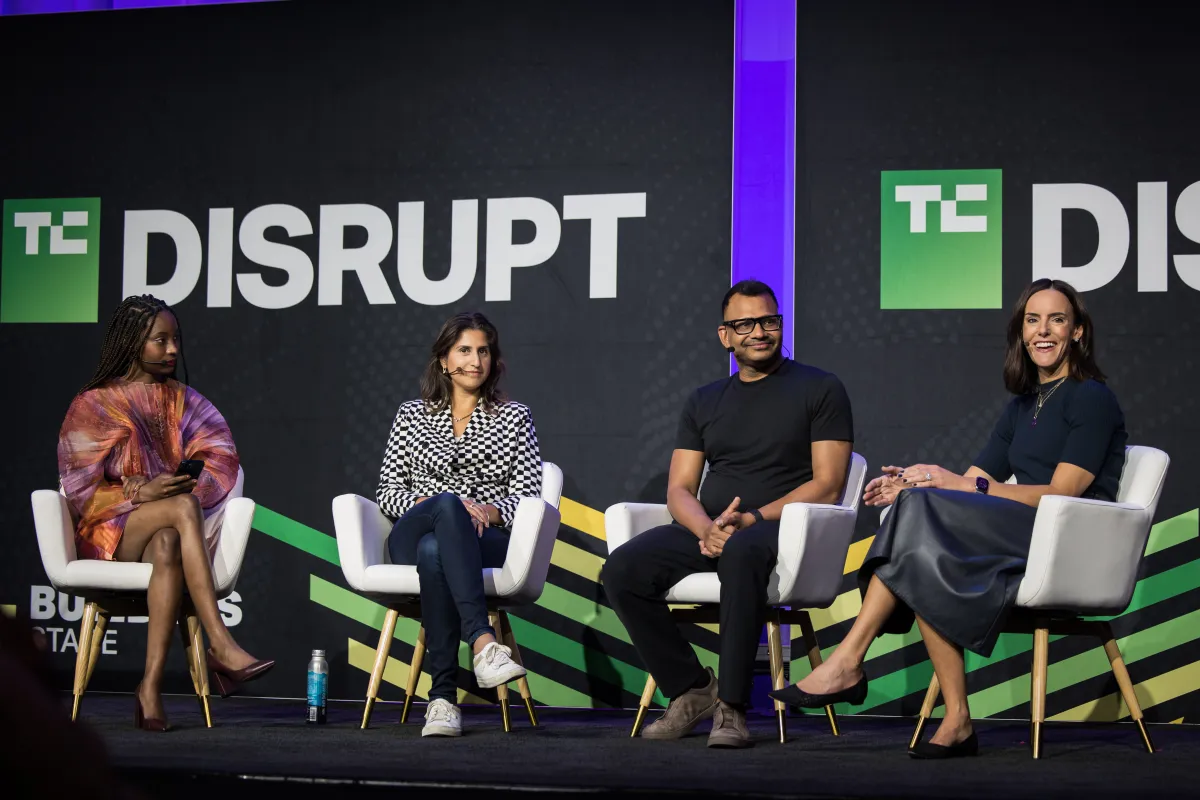
At TechCrunch Disrupt, three investors took the stage to dissect what makes — and breaks — a pitch deck. Jyoti Bansal, a founder-turned-investor; Medha Agarwal of Defy; and Jennifer Neundorfer of January Ventures shared with the crowd their candid views on what works in a pitch deck — and what doesn’t.
Their biggest pet peeve? Buzzword overload.
The more a founder says AI in the pitch, Agarwal said, the less AI the company likely uses. “The people who are doing things that are really innovative, they’ll talk about it, and it’s built in, but it’s not the core of their pitch,” she told the audience.
Bansal, who built and sold multiple companies before becoming an investor, distilled investor expectations into three core questions. First, he asks whether there is a large enough market to tackle. Does the founder’s idea have the potential to become a huge company? And is the problem he or she is solving actually worth solving?
The second thing investors want to know is why this founder is the one who should be building the company. “There has to be something unique about you,” Bansal told the crowd, adding that this included having special members on the founding team or having special skills. “Why would you win? If the problem is interesting, there will be 20 other companies trying to solve it, so why would you win and what’s your opportunity?”
The third thing investors want to see, Bansal said, is some validation. “Traction with customers,” he said. “Validation could be initial customer feedback, revenue, something, but some kind of validation.”
These three questions, Bansal noted, all lead to the ultimate litmus test: Could this become a billion-dollar company?
Techcrunch event
San Francisco
|
October 13-15, 2026
The panel also addressed how AI startups can differentiate themselves as the space becomes saturated. Bansal emphasized the importance of domain expertise and a clear competitive strategy. Neundorfer said the companies that catch her attention are those enabling new behaviors rather than simply improving an existing process incrementally.
Agarwal offered more tactical advice to founders, saying they should explain how AI technology enables their product; articulate clear go-to-market strategies; and demonstrate how their business will be more efficient than incumbents.
It’s also very important to be honest about what competitors are out there, she added. Some of you have “lost some credibility with me because you didn’t have it on your slide,” she told the founders in the audience.
Finally, the investors shared advice for navigating the rapidly evolving landscape. Agarwal urged founders to stay on top of industry developments. Neundorfer recommended staying connected to founder networks to share tools and insights.
Bansal’s advice was simpler: “Focus on building your product.”
TECHNOLOGY
US military tests revolutionary long-range strike system from attack helicopters as WW3 fears mount

The US Marine Corps has tested a groundbreaking long-range strike system for its attack helicopters just days after President Donald Trump issued a WWIII warning.
Over the Atlantic Test Range, the Marines launched the cutting-edge Red Wolf weapon from an AH-1Z Viper helicopter, striking a sea-based target with pinpoint precision.
Developed by L3Harris, Red Wolf is a modular, high-subsonic missile that can relay targeting data and engage distant targets, giving helicopters capabilities once reserved for much larger platforms.
Current helicopter-fired weapons, like the AGM-114 Hellfire and the Joint Air-to-Ground Missile–Medium Range, are limited to roughly 21 miles and 10 miles, respectively, while Red Wolf can reach approximately 230 miles at low altitudes.
The successful test marks a major leap forward in the Marine Corps’ Long Range Attack Missile (LRAM) program, demonstrating a next-generation system that dramatically extends helicopter strike range.
In a potential Pacific conflict, the system could temporarily disrupt a warship’s sensors, opening a window for follow-on strikes by larger weapons such as the Long-Range Anti-Ship Missile or the Joint Strike Missile.
Earlier this month, Trump warned that the ongoing Russia-Ukraine war could spiral into a world war.
‘Things like this end up in a third world war,’ he told reporters on December 11. ‘Everybody keeps playing games like this, you’ll end up in a third world war, and we don’t want to see that happen.’
This is a developing story… More updates to come.

Over the Atlantic Test Range, the Marines launched the cutting-edge Red Wolf weapon from an AH-1Z Viper helicopter, striking a sea-based target with pinpoint precision
Trump’s warning casts a spotlight on the precarious state of negotiations in the ongoing war in Ukraine, which erupted when Russia launched a full-scale invasion on February 24, 2022.
Efforts to reach a peace settlement have been stalled by sharply divergent goals on both sides.
The president’s caution about a potential worldwide escalation highlights the conflict’s far-reaching implications, involving NATO, European allies, and other global powers as tensions enter another year.
While the Marines’ test of the new weapon was not in response to Trump’s warning, it does mark a breakthrough for the US military.
President at L3Harris’ Space and Airborne Systems Ed Zoiss said: ‘This test validated Red Wolf’s advanced tracking and targeting capabilities, further demonstrating its ease of use and integration across platforms.
‘We’ve now proven our launched effects vehicles will help provide our warfighters the asymmetrical advantage they need to handle increasingly sophisticated threats without the need to enter into adversary weapon engagement zones.’
The turbojet-powered vehicle measures around six feet in length and features fold-out fins for stability and control.
It can also carry payloads weighing up to 25 pounds, according to The Defense Post.

Over the Atlantic Test Range, the Marines launched the cutting-edge Red Wolf weapon from an AH-1Z Viper helicopter, striking a sea-based target with pinpoint precision
Share or comment on this article:
US military tests revolutionary long-range strike system from attack helicopters as WW3 fears mount

As social media becomes increasingly reliant on algorithmic feeds, creators are navigating a new normal: Just because you post something doesn’t mean your followers will see it.
“I think that 2025 was the year where the algorithm completely took over, so followings stopped mattering entirely,” LTK CEO Amber Venz Box told TechCrunch.
This isn’t news to creators – Patreon CEO Jack Conte has ardently banged this drum for years – but throughout the year, the industry at large has reacted to this phenomenon in different ways, from the influencers to the streamers.
According to the executives that TechCrunch spoke to about the near future of the creator economy, creators are finding new ways to harness and cultivate their relationships with their followers – some acting as a salve to AI slop, while others are flooding the zone with a new form of slop themselves.
Box’s company, LTK, connects creators with brands through affiliate marketing, where creators earn commissions on products they recommend. Since this business model is centered around affiliate marketing, it only works if people retain trust in individual creators. It could be an existential threat if the relationship between creators and their audiences continues to fragment.
But through a study commissioned from Northwestern University, LTK found that trust in creators increased 21% year-over-year, which was a pleasant surprise to Box.
“If you asked me at the beginning of 2025, ‘Hey, is trust in creators going to go up or down?’ I would have probably said down, because people understand it’s an industry – they understand how it’s working,” she said. “But actually, AI pushed people to kind of rotate trust to real humans that they know have real life experiences.”
Techcrunch event
San Francisco
|
October 13-15, 2026
By that, Box means that consumers are more likely to go out of their way to see content from the creators they know and trust. According to the study, 97% of chief marketing officers intend to grow influencer marketing budgets in the new year.
That doesn’t mean that owning these relationships is straightforward. LTK creators, who rely on affiliate income, are betting this AI-induced skepticism will drive people toward more direct relationships through paid fan communities or less algorithmic platforms like LTK itself. For other kinds of creators, such as streamers, video podcasters, and short filmmakers, the strategy for owning their audience can more closely resemble growth hacking.
Teenage clipping armies
As Sean Atkins, CEO of short-form video production company Dhar Mann Studios, put it, “In a world that’s driven by AI and algorithms, where people trust another human being more in this micro atomization of attention, how do you market when you sort of can’t control that?”
According to Eric Wei, cofounder of Karat Financial, a financial services company for creators, creators have a new secret weapon: armies of teenagers on Discord who creators pay to make clips of their content, which those same teenagers post en masse on algorithmic platforms.
“That’s been going on for a bit,” Wei explained. “Drake does it. A lot of the biggest creators and streamers in the world have been doing it – Kai Cenat [a top Twitch streamer] has done it – hitting millions of impressions… If it’s algorithmically determined, clipping suddenly makes sense, because it can come from any random account that just has really good clips.”
Wei thinks that clipping is going to become even more popular this year, since it’s a reaction to this fragmentation in social media relationships. Even the biggest creators are finding it hard to reach their fans directly, which is why they turn to clipping. While going viral on these algorithmic feeds is certainly easier if you have a ton of followers, you don’t need any track-record on a platform for it to decide that your video should be distributed more broadly. So, if these “clippers” post a short highlight from certain creators’ streams, they can earn money based on how many views the video gets.
“Clipping feels like an evolution of meme accounts,” Glenn Ginsburg, president of QYOU Media, which produces content for young audiences, told TechCrunch. “It’s become a race among many creators to try and take this content and push it out far and wide, almost competing to see who can get the most views on the same IP.”
Reed Duchscher – founding CEO of Night, the talent management company that represents Kai Cenat and other top creators – masterfully coaches creators through maximizing their virality. As MrBeast’s former manager, Duchscher helped cultivate the fast-paced, attention-grabbing style that transformed MrBeast from a YouTuber to an empire. He’s also behind Kai Cenat’s clipping strategy, though Duchscher isn’t quite as enthusiastic about its broader potential as Wei.
“Clipping is important if you’re a creator, because you do need to flood the zone with content, and it’s a good way to get your face out there,” Duchscher told TechCrunch. “It’s also very hard to get to scale, because there’s only so many clippers on the internet, so to spend large media budgets… there’s just a lot of complications.”
Perhaps clipping only works now because the technique has not yet become so prevalent that it’s seen as spam.
“The creator wins because they get more of their content out,” Wei said. “The clippers win because now this army of teenagers are getting paid. Everybody wins, except that if you take this to its logical conclusion, we just get lots and lots of slop.”
The more niche, the better
The prevalence of slop on social media has become enough of a threat that Merriam-Webster called slop its word of the year.
“Over 94% of people are saying that social media is no longer social, and over half of them are rotating time elsewhere into smaller niche communities that they know are real and that they can talk to and interact with,” Box said, pointing to platforms like Strava, LinkedIn, and Substack.
As the relationship between a creator and their audience becomes more difficult to maintain, Duchscher predicts that creators with more specific niches will succeed – he thinks that “macro creators” like MrBeast, PewDiePie, or Charli D’Amelio, who amass hundreds of millions of followers, will become even harder to emulate.
Pointing to success stories like like Alix Earle or Outdoor Boys, who have millions of followers but not necessarily mass appeal, Duchscher adds, “Algorithms have gotten so good at giving us exactly the content we want. It’s much harder for a creator to break out into every niche algorithm.”
Atkins agrees, arguing that the creator economy extends far beyond entertainment. “The creator economy generally is viewed through this lens of entertainment. I think that’s a mistake, because thinking about the creator economy is a little bit like thinking about the internet or AI – it’s going to affect everything.”
Atkins mentions the gardening creator brand Epic Gardening as an example. What started as a YouTube channel has created a real, tangible presence in the world of gardening.
“Epic Gardening bought the third largest seed company in the United States, so now he’s the third largest seed company [owner], as a content creator,” he said.
Though the creator economy is in flux, it’s a resilient industry – one that’s accustomed to navigating the whims of the algorithm, persisting onward for decades, even if the uninitiated may see it as a brand new realm.
Creators are “literally impacting everything,” Atkins said. “I bet you there’s a creator who’s an expert at cement mixing for skyscrapers.”

Automated trading is possible in any market, including Forex, crypto, stocks, options, futures, and more. However, given Forex’s appeal to a wide range of traders, automated trading is in the most significant demand here. The best expert advisors for Forex have proven their effectiveness, which is why their use has grown significantly in recent years. Still, the young yet rapidly developing crypto market has also quickly integrated automated trading.
If you’re unsure which market is best suited for trading bots, study their key features. This will help you choose the option that requires less involvement and offers the highest returns from automated trading.
What is a Forex Robot (Expert Advisor)
Forex robots are customizable software for automated trading of fiat currency pairs on the Forex market, primarily through MT4 and MT5. Forex robots or Expert Advisors (EAs) have basic settings that determine their algorithm. However, traders can easily customize them to suit their trading strategies, even without programming knowledge.
Moreover, if you’re well-versed in IT, you can even create your own trading robot. MT4 and MT5 trading platforms have a built-in programming language (MQL4 and MQL5, respectively), which allows you to develop and test your own trading bots.
However, traders most often prefer to use proven Forex robots with basic and advanced settings, such as:
- Indicators, such as Moving Averages, Oscillators, etc.;
- Order management;
- Trade entry/exit conditions;
- Risk management (Stop Loss and Take Profit functions);
- Spread control;
- Signal filtering, etc.
What is a Cryptocurrency Trading Bot?
A cryptocurrency trading bot is specialized software for automated trading, but for a different asset class. It is only suitable for trading cryptocurrencies, which exist in the digital realm free from strict regulation by national governments or banking systems.
Unlike Forex robots, their customization is not as easy and, therefore, requires specialized knowledge. Their functionality is more complex, so if you want more room for experimentation with a trading bot, you should start with Forex robots. But if trading crypto is your primary focus, you will be more dependent on automated software developers.
Core Differences: Market, Technology, and Risk
While Forex EAs and crypto trading bots have many similarities, trading with each will offer a completely different experience. This is due to the fundamental differences between fiat and cryptocurrencies, regulatory certainty/uncertainty, and the technologies that support their circulation.
Market
Cryptocurrency prices fluctuate much more than those of fiat currencies. Normal daily price movements for cryptocurrencies are around 20%, and during periods of turbulence, they can reach as high as 80%. Meanwhile, the typical daily fluctuations of popular currencies such as the USD or EUR are only 1-2%, and during significant crises, they can reach 4-7%.
This difference in volatility makes trading in the crypto market more risky and unpredictable. Therefore, completely refusing to monitor the performance of crypto trading bots can lead to significant losses. At the same time, the comparative stability of the fiat currency market allows traders to devote less attention to monitoring the performance of Forex bots.
Technology
Forex trading is more centralized because it relies on traditional banking infrastructure and its familiar operating rhythms. Meanwhile, the crypto market is accessible 24/7 since it uses decentralized blockchain technology. Trading in this market bypasses banks and brokers, which play a crucial role in the Forex financial infrastructure. At the same time, when trading in the crypto market, you will need centralized or decentralized exchanges (CEX/DEX), crypto wallets, P2P platforms, and other elements of the digital currency ecosystem.
Risks
In addition to the high volatility of cryptocurrencies, trading in the crypto market carries other significant risks. Forex trading, for example, is much safer in comparison with cryptocurrency trading because of regulatory protection. Traders on Forex can rely on dispute resolution mechanisms, legal requirements for brokers, account insurance schemes, and other mechanisms to mitigate trading risks. In contrast, the crypto market’s regulatory uncertainty makes this asset riskier for investors.
Furthermore, the potential high profitability of cryptocurrencies and high returns from speculation make this market attractive to scammers. Even experienced investors can make mistakes and invest their money in scammy crypto projects.
Conclusion
The choice between a Forex robot and a crypto trading bot depends on many factors: risk tolerance, the time you’re willing to devote to trading, your interest in new technologies, etc. Thus, if you want to profit from significant price fluctuations, automated crypto trading is a better choice. However, it will require substantial involvement on your part, even when using crypto trading bots.
If you prefer long-term trading strategies, Forex robots are a better choice. They can deliver excellent results even with minimal involvement. However, the profits won’t be as enormous as those from successful crypto trading.
Therefore, make your choice based on your priorities and trading style. Automated trading technologies are sufficiently advanced for both markets. They will support your decision, no matter what choice you make.