
TECHNOLOGY
Elon Musk’s 2025 recap: how the world’s richest person became its most chaotic | Elon Musk


The year of 2025 was dizzying for Elon Musk. The tech titan began the year holding court with Donald Trump in Washington DC. As the months ticked by, one public appearance after another baffled the US and the world. Musk appeared to give a Nazi salute at Trump’s inauguration, staunchly championed a 19-year-old staffer nicknamed “Big Balls,” denied reports of being a drug addict while advising the president, and showed up at a White House press conference with a black eye – all in the first half of the year alone.
“Elon’s attitude is you have to get it done fast. If you’re an incrementalist, you just won’t get your rocket to the moon,” Susie Wiles, Trump’s chief of staff, told Vanity Fair in an expansive interview earlier this month. “And so with that attitude, you’re going to break some china.”
Musk saw huge, multibillion-dollar wins and equally large losses in business this year. In his dealings with federal agencies, he was able to secure new enormous government contracts and expand SpaceX’s operations. With Tesla, he was approved for a pay package that could make him the world’s first trillionaire even as the company’s global sales plunged. At the same time, Musk and his businesses were the target of protests, lawsuits and an exodus of high-level executives. He ended the year with a fortune worth some $600bn.
In the background, his turbulent personal life continued to provide surprises. Rightwing influencer Ashley St Clair sued Musk in February for custody of their five-month-old baby, revealing that Musk had fathered a 13th publicly documented child, for a total of now 14 children. As Musk made regular attacks in posts on X against transgender people, his estranged daughter Vivian Wilson, who is trans, was featured in New York magazine and modeled at New York fashion week. And the New York Times published a lengthy investigation into Musk’s father, Errol Musk, who was accused of child sex abuse.
The relationship that dominated Musk’s public life, however, was his friendship and falling out with Trump. On the day of his inauguration, Trump empowered Musk to gut government agencies, which the tech billionaire did with zeal and abandon. But by June, Musk and Trump had broken up. Their bromance burned hot and fast. On one of his final days as a special government employee, Musk lashed out at the president on his social media platform, X, saying: “Time to drop the really big bomb: @realDonaldTrump is in the Epstein files.” The post has since been deleted.
Though the drama surrounding Musk was frequently absurd and unpredictable, it was also consequential. This was a year when the richest person in the world obtained new levels of wealth and power that few in history have ever approached, one that demonstrated the depth of his global influence as he sought to advance his rightwing agenda and grow his tech empire.
While Musk had stayed away from Washington DC after the Epstein post, the billionaire was invited back in November for a White House dinner in honor of Saudi crown prince Mohammed bin Salman. By the end of the year, Trump and Musk seemed to have made amends. When asked by Fox Business this month if Musk was back in his circle of friends, Trump suggested the two could have a future together again.
“Well, I really don’t know,” Trump said. “I mean, I like Elon a lot.”
Musk expressed more regret than the president over the course the year had taken. When his former aide Katie Miller asked whether he would lead the unofficial “department of government efficiency” (Doge) again, knowing what he knows now, he responded: “Instead of doing Doge, I would have worked on my companies. And they wouldn’t have been burning the cars.”
Musk goes to Washington
After becoming a Republican mega-donor and campaigning for Trump during the 2024 election, Musk began the year on a high as he prepared to enter the administration as the de facto leader of Doge. He immediately set a tone of chaos and outrage that would persist for the length of his time in the White House.
Elon Musk speaks alongside Donald Trump to reporters in the Oval Office of the White House on 30 May in Washington DC. Photograph: Kevin Dietsch/Getty Images
During Trump’s internationally televised inauguration event in January, Musk issued what many people interpreted as back-to-back fascist-syle salutes as he concluded a speech. Rights groups condemned the gesture while Musk attempted to dismiss the criticism as “dirty tricks” from legacy media. The reaction was so intense and negative that some Tesla owners sold their cars in response to Musk’s gestures.
Musk spurred further condemnation from Jewish groups after appearing virtually at a rally for Germany’s far-right AfD party. The Tesla CEO told the crowd via livestream that Germans should not focus on “past guilt” and “move beyond that” in an apparent reference to Nazi Germany.
A protester holds a sign depicting Elon Musk during a demonstration outside of Los Angeles city hall to demonstrate for immigration rights on 5 February. Photograph: Qian Weizhong/VCG/Getty Images
As Musk started his work with Doge, the controversies and backlash against his politics grew. The newly formed bureau operated first as a loose collection of appointed staffers and then subsumed the US Digital Service. It rapidly moved to gut federal agencies and conduct mass layoffs across the government even as ethics watchdogs launched lawsuits accusing Musk’s group of violating privacy and transparency laws, some of which continue today. Musk personally bragged about feeding the United States Agency for International Development (USAID), the world’s largest single provider of humanitarian aid, “into the woodchipper”. The cuts would cause the abrupt cancellation of aid programs worldwide, disrupt HIV/Aids treatment for millions and result in children starving to death in a hunger crisis that experts agree was needless.
At the annual Conservative Political Action Conference in February, Musk appeared to relish his new role as the Trump administration’s demolition man. He brandished a chainsaw on stage and told the audience “I am become meme!” as he waved it about in sunglasses and a gold chain. In March, he once again began to pour more money into Republican causes by holding rallies and handing out $1m checks to support a conservative judge in Wisconsin’s supreme court race.
The pushback against Musk’s political blitz soon began to frustrate his ambitions, however. Judges that ruled Doge’s activities illegal or issued temporary injunctions infuriated Musk, who called for the widespread impeachment of any “activist judges” who opposed his agenda. His preferred candidate in the Wisconsin supreme court race lost by a significant margin, a sign to some in Washington that Musk’s presence had potentially become politically toxic.
Musk left his role in the White House in May amid disputes around his pick for who would head Nasa and clashes over Trump’s One Big Beautiful Bill Act. Upon his exit, he signalled that his time with politics had come to a close, claiming he would reduce his campaign finance contributions in the future and return to his businesses. Yet he quickly put himself back in the spotlight with his public battle with Trump on social media and vowed he would start a third political party called the “America party,” a promise that has yet to come to meaningful fruition.
Musk’s political leanings continued to drift rightward, allying himself via near-constant posts on X interacting with far-right activists such as Tommy Robinson and telling Joe Rogan that “it should be OK to have white pride”. He led an online grievance campaign in early October against the Anti-Defamation League, the country’s most prominent Jewish advocacy group, claiming that it “hates Christians” and suggesting that their documenting of extremism encouraged murder. Although no longer in the administration, his extreme conservative takes on immigration, race and politics have persisted as prominent features of his public identity.
Musk’s constellation of businesses
The year in Musk’s businesses offered the billionaire even larger truckloads of money than before, despite facing intense controversy and competition.
Unlike other tech moguls, who typically helm one company at a time, Musk sits astride several corporations. He controls the rocket company SpaceX and the tunneling and brain implant companies, Boring Inc and Neuralink, respectively. Musk also runs the social media company X, which he bought for a second time this year via his artificial intelligence company xAI. Then there’s Tesla, his electric car company.
Of all his enterprises, Tesla especially courted attention this year, as people enraged by Musk’s work with Doge focused their attention on the carmaker’s showrooms. Across the country, protesters marched at ongoing “Tesla Takedown” events. One sign at a San Francisco protest in March read: “Burn your swastikar before it burns you.” Dozens of Tesla cars and charging stations nationwide were set on fire as one-off vandals protested the billionaire.
Protesters hold signs when they gather outside of the Tesla dealership at a ‘Tesla Takedown’ protest on 22 March in New York City. Photograph: John Angelillo/UPI/REX/Shutterstock
Though Trump and Musk hosted what amounted to a Tesla sales event on the lawn of the White House in March, Tesla saw its sales slump worldwide.
By June, Musk had announced the rollout of its self-driving robotaxis in Austin. Within the first week, bystanders had recorded videos of the cars having difficulty turning left or picking which side of the road to drive on, which attracted the attention of regulators. These robotaxis, which were required to operate with a human safety driver up until earlier this month, have encountered only a handful of documented safety incidents since then.
Lawsuits against Tesla also piled up throughout the year. In August, a Florida jury awarded more than $200m to victims of a deadly crash involving its Autopilot technology in August. And in California, two separate lawsuits were filed in October over three teenagers who were killed when a Cybertruck caught on fire and locked them inside. The National Highway Traffic Safety Administration also opened several investigations into the carmaker over safety issues.
While Tesla’s plunge in profits continued throughout the year, that didn’t stop the company’s shareholders from approving a pay package for Musk – the largest corporate payout in history – that could catapult him to the status of the world’s first trillionaire.
Tesla’s year finished with a blow from California’s department of motor vehicles. The agency said the car company had misled consumers and exaggerated the capabilities of its Autopilot technology. If Tesla doesn’t “remedy the situation” within 90 days, the DMV said earlier in December, the company will be banned from selling cars in the state, its biggest US market.
With SpaceX, Musk was able to curry favor with the federal government. Not only did his Starlink satellites continue to dominate the Earth’s atmosphere – the SpaceX subsidiary operates the vast majority of all satellites in orbit – but the Federal Aviation Administration and the air force gave SpaceX the go-ahead to increase rocket launches in Florida, Texas and California. This came despite the company’s massive Starship, a 400ft machine that Musk hopes to one day fly to Mars, repeatedly blowing up and showering shrapnel across the Caribbean. One such explosion prompted legal action from Mexico, which said the debris harmed thousands of endangered sea turtle hatchlings.
Musk also consolidated his social media and artificial intelligence companies this year. In March, he announced that xAI had acquired X in an all-stock transaction that he said valued X at $33bn. Both companies are privately held.
xAI makes the Grok chatbot, which is integrated into X. The chatbot had countless meltdowns in the second year since its release. It pushed conspiracy theories about “white genocide”, claimed Trump won the 2020 election and spewed numerous antisemitic claims, once referring to itself as “MechaHitler”. Nevertheless, Musk was able to seal a $200m contract from the Department of Defense to integrate Grok into federal government tools.
Meanwhile, Musk’s xAI datacenters in Memphis, Tennessee, were accused of polluting historically Black neighborhoods. The company had moved in dozens of portable methane gas generators to power the facilities, initially without permits, which brought several protests and a pending lawsuit from the NAACP.
Construction continues at an xAI datacenter in Memphis, Tennessee on 25 April. Photograph: Brandon Dill/The Washington Post/Getty Images
Neuralink, which operates in relative secrecy compared with Musk’s other businesses, accelerated the tests of its brain chips in 2025. The company says its product allows a person limited control of a computer via their thoughts. After announcing its first successful implantation in 2024, the company announced in September that it had completed the procedure in 12 patients.
Throughout the year, top executives fled the uproar involved in managing Musk’s companies. Linda Yaccarino departed as X’s CEO, as did its advertising chief. xAI lost its co-founder, chief financial officer and lead lawyer. Likewise, Tesla saw several executive exits, including the vice-president of North American sales, the director of the battery team, the head of the “Optimus” robot project and several leaders of the company’s various car divisions.
A year of personal feuds
Musk, whose life is frequently animated by grievances and breakups, had a banner year for high-profile fights, even by his own standards. Longstanding feuds reignited while his close relationship with Trump imploded in full public view, all as he posted a steady stream of attacks against immigrants, the trans community, the media, Wikipedia and a host of other targets on X, where he boasts 230 million followers.
Musk began the year by accusing the government of South Africa, his birth country, of anti-white racism when he sought approval for his Starlink internet provider to operate in the country. It was part of a series of spats Musk would have with governments abroad and world leaders, including declaring that the UK prime minister, Keir Starmer, was “complicit in the rape of Britain” in one of his anti-immigration tirades.
As Musk picked fights internationally, he also became a combative presence during his time within the Trump administration. Tensions with other administration officials resulted in reports of tense meetings in the Oval Office and a loud, near-physical yelling match between him and treasury secretary Scott Bessent in the halls of the White House. Transportation secretary Sean Duffy became another adversary in a clash over the future of Nasa, with Musk calling him “Sean Dummy” on X amid a string of other insults.
Even Musk and Trump’s formerly close friendship soured, as the president pushed his One Big Beautiful Bill Act that removed tax credits for electric vehicles and threatened to harm Tesla’s already flagging sales. Musk lashed out at Trump on Twitter in June, saying that the bill’s addition to the deficit would destroy the work Doge had done. The deterioration in their relationship culminated in Musk accusing the president of having ties to convicted sex offender Jeffrey Epstein. Trump, in turn, insinuated he could cancel Musk’s government contracts and said his most prominent financial backer had “lost his mind”.
Donald Trump and Elon Musk speak to the press as they stand next to a Tesla vehicle on the South Portico of the White House on 11 March in Washington DC. Photograph: Mandel Ngan/AFP/Getty Images
The messy, public breakup between Musk and Trump marked the end of the Tesla CEO’s time as self-described “first buddy” to the president. Although the two have entered a period of rapprochement in recent months, Musk is far from the constant presence at Trump’s side that he was on the campaign trail.
Musk’s pivot back to his tech empire allowed him to refocus on other grudges, including against Sam Altman, his former OpenAI business partner turned rival. Musk added to his series of lawsuits against Altman’s AI company with a case in August that alleged Apple and OpenAI were engaging in anticompetitive conduct, an accusation that OpenAI described as part of Musk’s “pattern of harassment” against the firm. The two traded barbs on X, which included fighting over whose posts were getting more views.
One of Musk’s final feuds of the year came from a more unusual source – famed 87-year-old author Joyce Carol Oates, whose cutting observation about him on X received more than 5.6m views.
“So curious that such a wealthy man never posts anything that indicates that he enjoys or is even aware of what virtually everyone appreciates – scenes from nature, pet dog or cat, praise for a movie, music, a book (but doubt that he reads); pride in a friend’s or relative’s accomplishment; condolences for someone who has died; pleasure in sports, acclaim for a favorite team; references to history,” Oates posted in November.
A day later, after Musk made a show of enthusiastically replying to several clips of movies on X, he responded to Oates’s critique.
“Oates is a liar and delights in being mean,” Musk posted. “Not a good human.”










Over the last several years, fusion power has gone from the butt of jokes — always a decade away! — to an increasingly tangible and tantalizing technology that has drawn investors off the sidelines.
The technology may be challenging to master and expensive to build today, but fusion promises to harness the nuclear reaction that powers the sun to generate nearly limitless energy here on Earth. If startups are able to complete commercially viable fusion power plants, then they have the potential to upend trillion-dollar markets.
The bullish wave buoying the fusion industry has been driven by three advances: more powerful computer chips, more sophisticated AI, and powerful high-temperature superconducting magnets. Together, they have helped deliver more sophisticated reactor designs, better simulations, and more complex control schemes.
It doesn’t hurt that, at the end of 2022, a U.S. Department of Energy lab announced that it had produced a controlled fusion reaction that produced more power than the lasers had imparted to the fuel pellet. The experiment had crossed what’s known as scientific breakeven, and while it’s still a long ways from commercial breakeven, where the reaction produces more than the entire facility consumes, it was a long-awaited step that proved the underlying science was sound.
Founders have built on that momentum in recent years, pushing the private fusion industry forward at a rapid pace.
Commonwealth Fusion Systems
Commonwealth Fusion Systems (CFS) has raised about a third of all private capital invested in fusion companies to date. Its latest round, which closed in August, added $863 million to its coffers, bringing its total raised near $3 billion.
CFS’s Series B2 came four years after its $1.8 billion Series B, which helped catapult the company into the pole position. Since then, the startup has been hard at work in Massachusetts building Sparc, its first-of-a-kind power plant intended to produce power at what it calls “commercially relevant” levels.
Techcrunch event
San Francisco
|
October 13-15, 2026
Sparc’s reactor is a tokamak design, which resembles a doughnut. The D-shaped cross section is wound with high-temperature superconducting tape, which, when energized, generates a powerful magnetic field that will contain and compress the superheated plasma. Heat generated from the reaction is converted to steam to power a turbine. CFS designed its magnets in collaboration with MIT, where co-founder and CEO Bob Mumgaard worked as a researcher on fusion reactor designs and high-temperature superconductors.
The Massachusetts-based CFS expects to have Sparc operational in late 2026 or early 2027. Later this decade, the company says it will begin construction on Arc, its commercial power plant that will produce 400 megawatts of electricity. The facility will be built near Richmond, Virginia, and Google has agreed to buy half its output.
CFS is backed by a long list of investors, including Breakthrough Energy Ventures, The Engine, Bill Gates, and others.
TAE Technologies
Founded in 1998, TAE Technologies (formerly known as Tri Alpha Energy) was spun out of the University of California, Irvine by Norman Rostoker. It uses a field-reversed configuration, but with a twist: after the two plasma shots collide in the middle of the reactor, the company bombards the plasma with particle beams to keep it spinning in a cigar shape. That improves the stability of the plasma, allowing more time for fusion to occur and for more heat to be extracted to spin a turbine.
In December 2025, TAE announced that it would merge with President Donald Trump’s social media company, Trump Media & Technology Group. The all-stock transaction would value the combined company at $6 billion. TAE would receive $200 million plus another $100 million upon filing paperwork with the Securities and Exchange Commission. TAE CEO Michl Binderbauer will serve as co-CEO of the combined company alongside Devin Nunes, who had been sole CEO of Trump Media.
The fusion startup had previously raised $150 million in June from existing investors, including Google, Chevron, and New Enterprise. Before the merger, TAE had raised a total of $1.79 billion, according to PitchBook.
Helion
Of all fusion startups, Helion has the most aggressive timeline. The company plans to produce electricity from its reactor in 2028. Its first customer? Microsoft.
Helion, based in Everett, Washington, uses a type of reactor called a field-reversed configuration, where magnets surround a reaction chamber that looks like an hourglass with a bulge at the point where the two sides come together. At each end of the hourglass, they spin the plasma into doughnut shapes that are shot toward each other at more than 1 million mph. When they collide in the middle, additional magnets help induce fusion. When fusion occurs, it boosts the plasma’s own magnetic field, which induces an electrical current inside the reactor’s magnetic coils. That electricity is then harvested directly from the machine.
The company raised $425 million in January 2025, around the same time that it turned on Polaris, a prototype reactor. Helion has raised $1.03 billion, according to PitchBook. Investors include Sam Altman, Reid Hoffman, KKR, BlackRock, Peter Thiel’s Mithril Capital Management, and Capricorn Investment Group.
Pacific Fusion
Pacific Fusion burst out of the gate with a $900 million Series A, a whopping sum even among well-funded fusion startups. The company will use inertial confinement to achieve fusion, but instead of lasers compressing the fuel, it will use coordinated electromagnetic pulses. The trick is in the timing: All 156 impedance-matched Marx generators need to produce 2 terawatts for 100 nanoseconds, and those pulses need to simultaneously converge on the target.
The company is led by CEO Eric Lander, the scientist who led the Human Genome Project, and president Will Regan. Pacific Fusion’s funding might be massive, but the startup hasn’t gotten it all at once. Rather, its investors will pay out in tranches when the company achieves specified milestones, an approach that’s common in biotech.
Shine Technologies
Shine Technologies is taking a cautious — and possibly pragmatic — approach to generating fusion power. Selling electrons from a fusion power plant is years off, so instead, it’s starting by selling neutron testing and medical isotopes. More recently, it has been developing a way to recycle radioactive waste. Shine hasn’t picked an approach for a future fusion reactor, instead saying that it’s developing necessary skills for when that time comes.
The company has raised a total of $778 million, according to PitchBook. Investors include Energy Ventures Group, Koch Disruptive Technologies, Nucleation Capital, and the Wisconsin Alumni Research Foundation.
General Fusion
Now its third decade, General Fusion has raised $462.53 million, according to PitchBook. The Richmond, British Columbia-based company was founded in 2002 by physicist Michel Laberge, who wanted to prove a different approach to fusion known as magnetized target fusion (MTF). Investors include Jeff Bezos, Temasek, BDC Capital, and Chrysalix Venture Capital.
In General Fusion’s reactor, a liquid metal wall surrounds a chamber in which plasma is injected. Pistons surrounding the wall push it inward, compressing the plasma inside and sparking a fusion reaction. The resulting neutrons heat the liquid metal, which can be circulated through a heat exchanger to generate steam to spin a turbine.
General Fusion hit a rough patch in spring 2025. The company ran short of cash as it was building LM26, its latest device that it hoped would hit breakeven in 2026. Just days after hitting a key milestone, it laid off 25% of its staff. CEO Greg Twinney penned an open letter pleading for funding from investors.
In August, they delivered somewhat, injecting $22 million in a pay-to-play round that one investor called “the least amount of capital possible” to keep the General Fusion afloat. Then in November, securities filings in Canada revealed that the company had raised $51.1 million in SAFE notes from nearly 70 investors, the Globe and Mail reported. Altogether, General Fusion has raised $492 million, according to PitchBook.
Tokamak Energy
Tokamak Energy takes the usual tokamak design — the doughnut shape — and squeezes it, reducing its aspect ratio to the point where the outer bounds start resembling a sphere. Like many other tokamak-based startups, the company uses high-temperature superconducting magnets (of the rare earth barium copper oxide, or REBCO, variety). Since its design is more compact than a traditional tokamak, it requires less in the way of magnets, which should reduce costs.
The Oxfordshire, U.K.-based startup’s ST40 prototype, which looks like a large, steampunk Fabergé egg, generated an ultra-hot, 100 million degree C plasma in 2022. Its next generation, Demo 4, is currently under construction and is intended to test the company’s magnets in “fusion power plant-relevant scenarios.” Tokamak Energy raised $125 million in November 2024 to continue its reactor design efforts and expand its magnet business.
In total, the company has raised $336 million from investors including Future Planet Capital, In-Q-Tel, Midven, and Capri-Sun founder Hans-Peter Wild, according to PitchBook.
Zap Energy
Zap Energy isn’t using high-temperature superconducting magnets or super-powerful lasers to keep its plasma confined. Rather, it zaps the plasma (get it?) with an electric current, which then generates its own magnetic field. The magnetic field compresses the plasma about 1 millimeter, at which point ignition occurs. The neutrons released by the fusion reaction bombard a liquid metal blanket that surrounds the reactor, heating it up. The liquid metal is then cycled through a heat exchanger, where it produces steam to drive a turbine.
Like Helion, Zap Energy is based in Everett, Washington, and the company has raised $327 million, according to PitchBook. Backers include Bill Gates’ Breakthrough Energy Ventures, DCVC, Lowercarbon, Energy Impact Partners, Chevron Technology Ventures, and Bill Gates as an angel.
Proxima Fusion
Most investors have favored large startups that are pursuing tokamak designs or some flavor of inertial confinement. But stellarators have shown great promise in scientific experiments, including the Wendelstein 7-X reactor in Germany.
Proxima Fusion is bucking the trend, though, having attracted a €130 million Series A that brings its total raised to more than €185 million. Investors include Balderton Capital and Cherry Ventures.
Stellarators are similar to tokamaks in that they confine plasma in a ring-like shape using powerful magnets. But they do it with a twist — literally. Rather than force plasma into a human-designed ring, stellarators twist and bulge to accommodate the plasma’s quirks. The result should be a plasma that remains stable for longer, increasing the chances of fusion reactions.
Kyoto Fusioneering
With all the startups pursuing fusion power, it was perhaps inevitable that another would pop up to develop components that round out a power plant. The so-called balance of plant, or the parts that sit outside the reactor, range from gyrotrons that heat plasma to heat extraction systems to harvest power from fusion reactions to turn it into electricity.
Kyoto Fusioneering has made an early bet that if even one fusion startup succeeds in generating enough power to sell to the grid, that the industry will need a supplier for the balance of plant and the expertise to integrate it into whichever fusion technologies win out.
Venture capitalists appear to agree, having invested $191 million in Kyoto Fusioneering. Investors include 31Ventures, In-Q-Tel, JIC Venture Growth Investments, Mitsubishi, and Sumitomo Mitsui Trust Investment.
Marvel Fusion
Marvel Fusion follows the inertial confinement approach, the same basic technique that the National Ignition Facility used to prove that controlled nuclear fusion reactions could produce more power than was needed to kick them off. Marvel fires powerful lasers at a target embedded with silicon nanostructures that cascade under the bombardment, compressing the fuel to the point of ignition. Because the target is made using silicon, it should be relatively simple to manufacture, leaning on the semiconductor manufacturing industry’s decades of experience.
The inertial confinement fusion startup is building a demonstration facility in collaboration with Colorado State University, which it expects to have operational by 2027. Munich-based Marvel has raised a total of $162 million from investors including b2venture, Deutsche Telekom, Earlybird, and HV Capital with Taavet Hinrikus and Albert Wenger as angels.
First Light Fusion
Unlike many other fusion startups, First Light Fusion doesn’t use magnets to generate the conditions necessary for fusion. Instead, it follows an approach known as inertial confinement, in which fusion fuel pellets are compressed until they ignite.
But even then, First Light doesn’t hew to orthodoxy. Most attempts at inertial confinement use lasers to do the dirty work, following the lead of the National Ignition Facility, which produced a groundbreaking experiment in 2022. Rather, First Light fires a projectile at a target using a two-stage gun; the first stage uses gunpowder to fire a plastic piston that compresses hydrogen to 145,000 psi, which then launches the projectile. The target is designed to amplify the force of the impact so it compresses the fuel to the point of ignition.
In March 2025, First Light announced that it would not pursue building its own power plant, instead offering its core technologies to other companies to build one. A spokesperson for First Light said that it is planning to build “pulsed power capability that would act as our demonstrator plant but would have other science and defense applications.” In other words, the company was dropping its plans for a power plan in a quest for revenue.
Based in Oxfordshire, UK, First Light has raised $108 million from investors including Invesco, IP Group, and Tencent, according to PitchBook.
Xcimer
Though nothing about fusion can be described as simple, Xcimer takes a relatively straightforward approach: follow the basic science that’s behind the National Ignition Facility’s breakthrough net-positive experiment, and redesign the technology that underpins it from the ground up. The Colorado-based startup is aiming for a 10-megajoule laser system, five times more powerful than NIF’s setup that made history. Molten salt walls surround the reaction chamber, absorbing heat and protecting the first solid wall from damage.
Founded in January 2022, Xcimer has already raised $100 million, according to PitchBook, from investors including Hedosophia, Breakthrough Energy Ventures, Emerson Collective, Gigascale Capital, and Lowercarbon Capital.
This story was originally published in September 2024 and will be continually updated.

Phones across the West lit up Tuesday evening, urging residents to ‘Drop, cover, hold on’ after a 4.9-magnitude earthquake struck California.
The US Geological Survey (USGS) issued the ShakeAlert shortly after the quake hit outside Susanville, California, at 9:49pm PT (12:49am ET).
Residents reported feeling shaking across California, western Nevada, and southern Oregon, with many sharing their experiences on social media.
One person wrote on X: ‘A 5.3-magnitude quake is a serious wake-up call for infrastructure resilience in NorCal. While the ShakeAlert system is a lifesaver, we need to focus on long-term seismic safety and emergency preparedness.’
Several Californians and Nevadans said the quake shook their homes.
The USGS has detected at least six aftershocks, ranging from a 2.1 to 2.5 magnitude, since the larger one hit. The most recent seismic activity was reported at 12:52am PT (3:25am ET) on Wednesday.
No damage or injuries have been reported, according to the Susanville Police Department
Susanville, home to around 18,000 people, is situated near several fault zones, including the Honey Lake and Eagle Lake faults, within the seismically active Basin and Range region.

The earthquake was first measured as a 5.3 magnitude, but later reduced to a 4.9 magnitude. Susanville, California was the epicenter
This area is part of the broader Walker Lane, which accommodates movement between the Pacific and North American plates, making moderate earthquakes relatively common in the region.
The quake struck at a shallow depth of 5.6 miles, which can intensify surface shaking.
While relatively modest in magnitude, residents in Susanville and nearby communities described light to moderate tremors.
In parts of western Nevada, including Reno and Carson City, the shaking was weaker, though many locals still received phone alerts.
Moderate to strong shaking was also recorded in several cities, including Sacramento, Camino, Pollock Pines, South Lake Tahoe and Malin.
One resident shared on X: ‘I felt it in Westwood. My family in Paradise felt it, too. We all got the alerts.’ Another described it as ‘quite a jolt.’
Another shared on Facebook: ‘The house started shaking, then the phones went off. Lasted a few seconds, definitely longer and stronger than the last one.’
‘This one scared me pretty bad, it had the house shaking, not just the walls but actually moving,’ a Facebook user posted online.

The US Geological Survey (USGS) issued the ShakeAlert shortly after the quake hit outside Susanville, California, at 9:49pm PT (12:49am ET)
The USGS noted that there is a 60 percent chance of a 3.0-magnitude or higher aftershock in the coming week and a 16 percent chance of another 4.9-magnitude quake.
More than 1,200 people submitted shaking reports to the agency, helping scientists map the tremor’s impact.
The seismic activity in Northern California follows hundreds of earthquakes detected in San Ramon, located in the East Bay.
As of last week, the USGS detected more than 300 earthquakes near San Ramon, which sits on top of the Calaveras Fault, an active branch of the San Andreas Fault system.
The Calaveras Fault is capable of producing a magnitude 6.7 earthquake, which would impact millions of people in the San Francisco Bay Area.
The USGS estimates there is a 72 percent chance of this happening by 2043.
The earthquakes began on November 9 with a 3.8 magnitude, and the tremors have not stopped since. The latest, which hit on December 23, measured a 2.7 magnitude.
USGS research geophysicist Annemarie Baltay said she is not unusually concerned that the recent earthquakes signal anything larger on the horizon for San Ramon.
‘These small events, as all small events are, are not indicative of an impending large earthquake,’ Baltay told Patch.
‘However, we live in earthquake country, so we should always be prepared for a large event,’ she said.


Bari Keenam has been a photographer, videographer, magazine publisher, cybersecurity intern, network engineer, graphic designer, and motion designer. At 25, he’s now a product designer at Lyft in Canada. He wishes he’d specialised earlier. But he also knows that if he had, he wouldn’t be here at all. This is the paradox of the serial learner, and how a group of audacious University of Lagos (UNILAG) friends turned job rejections into a competitive sport.
Bari Keenam keeps his entire life in two boxes.
“I live very light,” he tells me from Canada, where he’s been since joining Lyft earlier this year. “I know I move a lot. I just have one box of clothes and shoes. Everything fits. If I need to move tomorrow for a new job, I know what to carry.”
It’s a fitting metaphor for someone who’s spent his early 20s refusing to stay in one place, geographically or professionally. At 25, Keenam has worked across three continents, four industries, and more job titles than most people try in a lifetime. His LinkedIn could give someone whiplash.
But there’s a method to the movement.
The magazine that started everything
Keenam graduated secondary school at 15 in 2015. Too young for university, he spent three years in limbo, taking an internship at a marketing firm and teaching himself everything he could find on Coursera, Domestika, and Udemy.
“I called it serial learning,” he says. “I was just taking anything I could learn, digital marketing, front-end design, WordPress development, graphic design. Whatever I could find.”
During that time, he and a friend started an online magazine called Gumbars. “Very weird name,” Keenam admits, laughing. But it was serious work. They had a team of around 20 people; writers, photographers, designers, all between 16 and 17 years old.
“We were interviewing cool people. We met Odunsi, we met Korty, we met Slawn. A lot of them are way bigger now than they were then. ”
When the magazine stopped, Keenam took the skills he’d learned and started freelancing, first WordPress development, then design, charging whatever he thought he could get away with.
“I would say a price today and then five times the price tomorrow, and they kept saying yes,” he remembers. “I had nothing to lose. I didn’t have to worry about getting fired by just calling random quotes.”
Get The Best African Tech Newsletters In Your Inbox
The UNILAG audacity
Everything changed when Keenam got into UNILAG to study Systems Engineering.
“UNILAG could be referred to as Nigeria’s Silicon Valley,” he says without hesitation. “And it’s because of audacity. Students at UNILAG were very audacious in what they wanted to try.”
He describes friends casually applying to Google and Facebook, companies he thought were ‘out of reach.’
“Then you see them get it and you’re like, ‘Oh, I can get that thing too.’ That led me to a lot of other audacious attempts in my career.”
This thinking became a guiding career-building tool. . Keenam and his friends began what he calls ‘glorifying rejections.’
“We didn’t take no as ‘oh my gosh, sad.’ We took ‘no’ as – ‘How many nos can you get before you get a yes?’” he explains. The strategy was simple but brutal; apply to 10 jobs a day. Every single day.
As students, Keenam and his friends “applied to about 200 jobs a month,” about ten per day with the goal to “keep applying until you get a yes.”
Most applications led nowhere. But that was the point, learning how international companies interview, what they want, how to present yourself.
“I was really young. It was good to know that earlier on.”
The Toptal breakthrough
Those scores of applications eventually paid off. Keenam got into Toptal, a network of top freelance talent that only accepts about 3% of applicants.
“When I got in, I was in a very small group of Nigerians that got in,” he says. “I think that was like one of my big break moments. Everyone started noticing, ‘Oh, this guy got into Toptal.’”
That visibility led him to a role at Grey Finance (now Grey), a Nigerian fintech where Keenam worked on their rebrand. “For a brand designer, that is like the biggest thing, being involved in a rebrand.”
But while working at Grey, something unexpected happened: Snapchat got back to him.
Get The Best African Tech Newsletters In Your Inbox
The year-long pause
Keenam had applied to Snapchat a year earlier through LinkedIn networking. “I was very heavy on LinkedIn networking. I messaged a lot of people in companies I wanted to work at. This one person at Snapchat replied.”
He’d made it through the interview process and got a yes. Then Snapchat paused all hiring.
“They were like, ‘We can’t hire anyone unfortunately. But we’ll get back to you when we can hire again.’”
A year later, while at Grey, they did.
“The second invite was to apply from scratch. They’re like, ‘’We’re going to take you through the first interview all over again.’ But the first application was for the US. The second one was for their London office.”
Keenam moved to London to join Snapchat’s product design team. He was 23.
The problem-first designer
At Snapchat, Keenam learned something crucial about why companies kept hiring him despite his wandering path.
“I always ask in every interview: Why am I being hired here?” he says. “And they make it very clear; it’s your perspective. Your perspective is why we’re hiring you.”
That perspective? “Problem-first approach. That has been my defining trait. How do I just solve this problem?”
He describes his work as existing at two extremes, “Does it look great? But also, does this plug into a KPI that we can measure?”
It’s a philosophy born from his brand design days. “I believe that whatever I design—a logo or whatever—should have real-world measurable metrics. Snapchat liked that approach for product design.”
After nearly two years, Bari was caught in Snapchat’s layoffs. He worked remotely for a Berlin gaming company (Alt Media) before landing at Lyft through an ex-Snapchat colleague’s referral.
“That was my best interview I’ve ever had,” he says. “I could sense this beautiful work culture from the interview. I was like, ‘Oh my gosh, I want to try these guys.’”
He moved to Canada in mid-2025.
The paradox
When I ask if there’s anything he wishes he’d done differently, Keenam doesn’t hesitate.
“I wish I had locked in on one thing earlier. I think I floated around a lot in different areas.”
He lists the job titles he’s held that paid money; photography, video, print designer, graphic designer, label designer, motion designer, cybersecurity, network engineer, magazine owner.
“I think if I’d focused on one thing before going to UNILAG, I think I’d be much further up in my career now.”
Then he catches himself.
“But I would not have known if this was the right thing if I didn’t do everything else. So it’s a weird paradox. If I did lock in on that one thing, I would not have found design. I would not have been able to interview the people I did when I was younger. I could not have met the people I met. I would not have made the friends I have right now.”
He pauses. “I think everything worked out the way it was supposed to work out.”
Get The Best African Tech Newsletters In Your Inbox
The circle that keeps him moving
Keenam still talks to those UNILAG friends; the ones who normalised applying to Google, who turned rejections into celebrations.
“All around the world I have friends like that,” he says. “I’m just happy that my circle reflects my energy. Everyone around me is on their zoom. If they slacked, I’d be slacked. But everyone’s on their zoom, so I can’t be the one that’s not on their zoom.”
It’s that energy that keeps him in motion; still learning French, DJing, boxing. Still keeping his life in two boxes. Still applying that same 10-jobs-a-day mentality whenever he needs to move.
His end goal? “To come back to Africa with enough experience and resources to provide value; something that works exclusive of any political climate.”
But he’s not ready yet.
“I don’t think I’m at the time where I want to be brought back. There are so many people I look up to in Nigeria, designers and otherwise, that I’m still trying to reach. I’m not ready yet.”
When the time comes to plant roots, though, Keenam already knows what he’ll need: just two boxes and a tough skin.

Meta has confirmed that it’s acquiring Manus, a Singapore-based AI start-up, in a deal valued at more than $2 billion. The deal is not simply another AI investment or talent grab but signals a deeper shift in how Meta sees the future of Facebook, Instagram and WhatsApp.
The company is betting that the next evolution of social platforms will be defined less by conversation and content and more by action.
The spokesperson for Meta, in a statement, said, “Meta’s acquisition of Manus AI will enable us to provide the most advanced technology to our users with safeguards in place to eliminate areas of potential risk.
There will be no continuing Chinese ownership interests in Manus AI following the transaction, and Manus AI will discontinue its services and operations in China.”
Manus has risen quickly by positioning itself at the frontiers of what the industry now calls “agentic AI”. Founded by Chinese entrepreneurs and initially developed in Shenzhen before relocating to Singapore, the company launched its first general-purpose AI agent earlier this year. Its system is designed to plan and execute complex tasks autonomously, rather than respond passively to prompts. That distinction is crucial.

Most large language models, including Meta’s own Llama family, excel at generating text, images or code snippets. They wait for instructions and answer in stages. Manus, by contrast, functions as an execution layer. Its architecture coordinates multiple specialised sub-agents that can browse the web, analyse data, write and run code, and manage multi-step workflows with limited human intervention.
By acquiring Manus, Meta is moving decisively from AI that talks to AI that does things.
What Meta’s acquisition of Manus means
Nowhere is this shift likely to be more transformative than on WhatsApp. Meta has long harboured ambitions of turning the messaging platform into a super-app, particularly in markets where WhatsApp already underpins commerce and customer service for millions of small businesses. Earlier bot-based efforts struggled with rigidity and poor user experience.
Agentic AI changes that equation. Manus-powered assistants could summarise sprawling group chats, draft replies that reflect a user’s tone, and turn scattered messages into structured schedules or task lists.
For businesses, the implications are more significant. Autonomous agents could manage customer enquiries, book appointments, update simple inventory records and generate reports directly within chats. For many small firms, this would amount to enterprise-grade automation without enterprise budgets.
Similarly, Instagram is another natural beneficiary. The platform’s creator economy, which already relies heavily on analytics and automation, could be reshaped by AI agents that operate as creative co-pilots.

Rather than simply enhancing images or suggesting captions, Manus agents could analyse engagement trends, recommend posting schedules, draft SEO-aware captions and generate variations of Reels from raw footage. Influencers and brand managers would move away from manual optimisation towards higher-level creative and strategic oversight.
On Facebook, the opportunity lies in reducing friction and information overload. The platform’s groups, pages and feeds contain vast amounts of collective knowledge, but extracting value from it is often tedious. Agentic AI could act as a personal concierge.
Instead of scrolling endlessly, users might ask an agent to compile recommendations, summarise debates or plan activities based on recent group discussions. Facebook would shift from being a passive stream of content to an active utility layer.
Strategically, the deal strengthens Meta’s position in an increasingly competitive AI landscape. Google, Microsoft and OpenAI are all racing to commercialise agent-based systems that can execute tasks across tools and platforms.
Buying Manus accelerates Meta’s roadmap while bringing in a team with practical experience deploying autonomous agents. It also complements recent initiatives such as Meta Superintelligence Labs and expanded investments in AI infrastructure.
 Manus AI
The risks, however, are real. Autonomous agents raise difficult questions around reliability, accountability and user control. Errors made by an AI that takes action can carry higher stakes than mistakes in generated text.
Privacy is another concern, particularly when agents operate inside personal messaging apps. Meta has said it will sever Manus’s former Chinese ties and implement strict data safeguards, including geo-gating and controlled access to sensitive systems.
Meta’s acquisition of Manus is, at its core, a statement of intent. The era of generative AI as a novelty feature is fading. In its place is a new phase, where platforms compete on how effectively they can act on users’ behalf.
If Meta executes this strategy well, Facebook, Instagram and WhatsApp may evolve into something more than social networks. They may become the world’s most widely used personal assistants.


After a New Year’s Eve swim in 2023, Dan Richards’ life changed forever
When Dan Richards went for a New Year’s Eve swim in 2023, he never could have imagined how drastically his life would change.
In a freak accident, he injured his neck when a wave caused him to flip and hit the sand in Langland Bay, Swansea.
“I knew instantly that I was paralysed,” the 37-year-old said.
“I couldn’t move anything.”
Doctors told him he would be bed-bound but, two years later, he uses a wheelchair and can move his arms and fingers.
He has even walked with the help of Artificial Intelligence (AI) technology in Wales and Germany.
Dan and his partner Anna, 40, were celebrating the new year with a cold water dip when the accident happened.
“I remember all of it, unfortunately. Being pulled out. And then everything changing,” Dan said.
“I got hit by a wave, it flipped me over and folded me backwards, and snapped my neck. I knew it was bad.”
 Anna Thomas

Dan is determined to move as much as possible after becoming paralysed
Anna recalled hearing Dan shouting for help as she got ready to get into the water.
“I just remember looking over and just seeing Dan’s head coming up and then going back under,” she said.
“We dragged him out. But he was just dead weight and the sea was coming in really fast.
“We waited for emergency services, and then [I remember] begging them to let me go in the helicopter. It was horrendous.”
After being taken to hospital in Bristol, the couple from Swansea were given life-changing news.
 Anna Thomas
Dan and Anna loved to swim in the sea before the accident
Dan said he was told he was paralysed form the neck down, would not be able to move and it was “highly likely” he would be bed-bound for the rest of his life.
Anna – who had only started dating Dan a few months before the accident – had to make dreaded phone calls to family members.
“It was New Year’s Eve, I was put in a room on my own but you could hear people laughing and joking, and I had to tell Dan’s parents.
“How do you phone someone’s mum and say that their son is paralysed?”
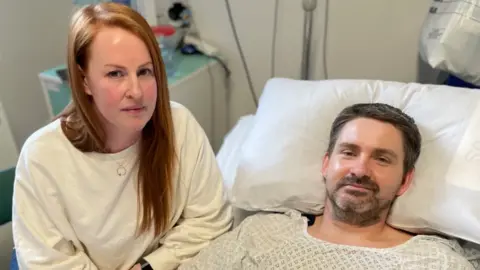
Dan was given life-changing news while in hospital in January 2024
Anna said every day since the accident has brought a new challenge.
“It’s our reality. Until you’re in this situation… you don’t realise just how much you have lost.”
But in the months that followed the accident, when Dan was in hospital, even the slightest movement in his toes gave the couple hope things would change.
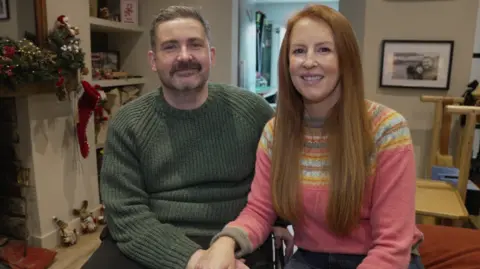
Dan and Anna have returned to Wales from Germany to celebrate Christmas
“Luckily I’m quite stubborn,” Dan said.
“I just wanted to see the physios as soon as possible. I wanted to work. I didn’t accept what they were saying.
“I’m proud of the progress I’ve made. It’s a long time since laying in bed in Bristol, that’s for sure.”
He continued: “The feeling in my toes then translated into full feeling through my legs and feet, some movement in my right leg [and] core strength – which I was told was gone – started to come back. Movement in my arms, my fingers, being able to hold things.
“I’m still hopeful, I’m still positive. With modern technologies, I’m not giving up.”
Dan had private physiotherapy at a specialist clinic in south Wales which used a world-first combined treatment to help him walk with a machine.
 Anna Thomas
Family and friends have fundraised for Dan’s private physiotherapy treatments
Jakko Brouwers, a neurophysiotherapist from Morello clinic in Newport, said Dan was “an immensely motivated guy” when he visited them after being discharged from hospital.
“The technology is two-fold,” he explained.
“The first part we tried with Dan is a robot. The robot will mimic normal human gait as much as possible.
“The other part of the system that we developed is a stimulation suit that has got sensors. The trousers are also fitted with electrodes and we can stimulate muscle activity at the right time.
“Through a little bit of algorithm – and dare I say AI – it will start developing a walking pattern.
“It’s super exciting. It’s not often that you see that in Wales.”
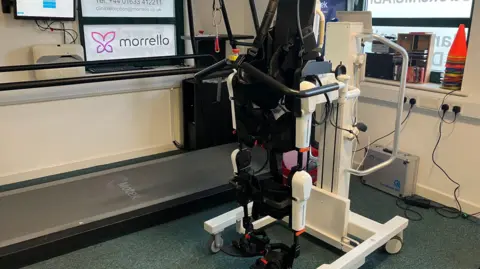
This robot helped Dan to walk at Morello clinic in Newport shortly after he was discharged from hospital
Dan said the experience was “surreal” but “the best feeling”.
“It just made me want to push harder. That’s on our doorstep here in Wales, so it spurred us on to do some research, and do other things.”
But private physiotherapy and innovative treatment does not come without cost.
From raffles to ultramarathons and charity nights, family and friends have fundraised meaning Dan and Anna could set off for a trial abroad in October.
 Anna Thomas
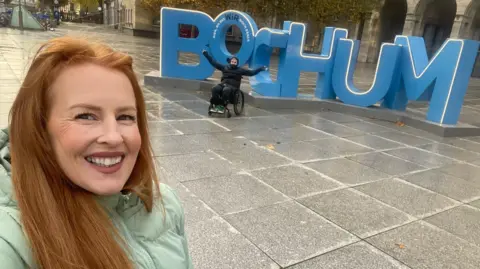
Dan and Anna spent two months in Bochum, Germany, for treatment
Dan explained he was trying two different treatments simultaneously in Germany – a stem cell treatment straight into his spinal cord, alongside using a Hybrid Assistive Limb (HAL) suit, which is a machine that works on brain waves.
“It’s one of the first times it’s ever been done,” he said.
“Sensors translate signals into movement, which then get my legs working, get me walking.
“The more you do it, the stronger the signals get, the faster it gets and eventually you’re able to walk without the suit.”
With six weeks of treatment left in Germany in the new year, Dan will have to apply for an EU Medical Visa, which is another challenge he said he is determined to overcome.
He does not know what the future holds, but is determined not to give up.
“Technology is advancing so fast, things aren’t where they were 10 years ago.
“New research is incredible. There is no limit. I don’t want there to be a limit.
“The more progress I can make now, the better our future will be.”


It’s that time of year again.
Every January 1, the Future Perfect team makes forecasts for the events we think will (or won’t) happen over the next 365 days. And every December 31, we go back over those predictions and tally up how we did.
All of our predictions were made positively — as in, something will happen — and came with probabilities attached, which are meant to indicate our relative confidence in the forecast. To simplify scoring, predictions that came with a higher than 50 percent probability that proved out, or with a probability below 50 percent that did not prove out, were marked as “correct call.” Those that came with a higher than 50 percent probability that did not prove out, or with a lower than 50 percent probability that did prove out, were marked “incorrect call.”
If for some reason the forecast could not be resolved — such as, random example here, a new US government chose to delay putting out data or a report that would have clarified the question — we marked it as undecided.
The scorecard? Nineteen correct, four incorrect, and two undecided works out to a winning percentage of .800, if we count ties as half a win. (That would put us a tad over the 1906 Chicago Cubs, who recorded the best single-season winning percentage in major league baseball history. Hopefully this doesn’t mean we’ll be cursed for a century.)
As always, the point is less to keep score than to get better at forecasting by identifying where we’ve succeeded, where we’ve failed — and maybe where we need to take some more chances. Fortunately, we’ll have another shot tomorrow, when we publish our 2026 forecasts. —Bryan Walsh
Congress passes a major tariff bill (20 percent) — CORRECT CALL
2025 certainly did not lack for tariff news, but almost all of it came from the Trump administration, which used executive powers to impose sweeping new duties on most countries on Earth, and from the Supreme Court as it weighed whether any of that was legal.
There was some speculation at the start of 2025 that the need for new revenue in Republicans’ big tax bill would lead it to include some Trump-y tariffs. That didn’t happen, mostly because it didn’t need to happen: President Donald Trump could just impose the tariffs unilaterally, or try to at least. As I wrote in my initial prediction, “the odds that Trump does new tariffs using presidential authority are nearly 100 percent.” If anything, “nearly” 100 percent was an underestimate. —Dylan Matthews
Trump dissolves the Department of Education (5 percent) — CORRECT CALL
Let’s check the fine print: This prediction would’ve resolved true if Congress passed a law formally abolishing the Department of Education. That did not happen in 2025, so the prediction stands.
What Trump did do is issue an executive order instructing the Secretary of Education to, “to the maximum extent appropriate and permitted by law, take all necessary steps to facilitate the closure of the Department of Education.” What has followed are sweeping staff cuts that it’s fair to call a gutting of the department, with various court challenges that in July culminated in a Supreme Court ruling in favor of the administration, at least for the time being. One major pending fight is over the legality of the department moving its functions to other parts of the federal government.
But again, read the fine print. The administration’s solicitor general, in his Supreme Court filing in June, stated, “The government has been crystal clear in acknowledging that only Congress can eliminate the Department of Education.” What the administration did were simply layoffs, not the closure of a legally created government agency. While the Trump team is clearly trying to have it both ways here, I’m inclined to trust their lawyer — they did not dissolve the department. —DM

President Donald Trump signs executive orders in the Oval Office of the White House in Washington, DC, on January 20, 2025. Jim Watson/AFP via Getty Images
The Affordable Care Act is repealed (30 percent) — CORRECT CALL
This is another one where the fine print matters. In my initial prediction, I wrote that a bill “repealing the ACA” has to do at least three of the following five things:
- Eliminate or reduce the ACA’s Medicaid eligibility or federal funding
- Eliminate or reduce ACA health insurance tax credit eligibility or amount
- Eliminate or curtail the mandate for certain employers to provide health coverage for employees. Reducing the penalties will also be considered to be relaxing the mandate.
- Make it so that ACA subsidies are no longer limited to plans that satisfy the requirements specified in the ACA, including allowing ACA subsidies to be contributed to health savings accounts or similar accounts
- Eliminate or curtail medical underwriting restrictions, like the ban on considering preexisting conditions
The One Big Beautiful Bill Act certainly satisfies the first two of these requirements. Per the Committee for a Responsible Federal Budget’s breakdown, the bill includes $1.1 trillion in cuts to health care programs over a decade. The vast majority of those cuts go to Medicaid, by imposing work requirements, limiting “provider taxes,” and other changes. But about $226 billion in cuts go to the Affordable Care Act’s exchange-based coverage, mostly by making certain immigrants ineligible.
But squeezing Medicaid and the exchanges is, at most, cutting the Affordable Care Act, not repealing it. Trump and Congress did not change the employer mandate for health insurance, or allow ACA funds to go into health savings accounts, or, crucially, eliminate protections for people with preexisting conditions or limits on hiking premiums based on age. In my book, that means the ACA has yet to be repealed. —DM
Jerome Powell will no longer be Fed chair (10 percent) — CORRECT CALL
Trump would love nothing more than to fire Jerome Powell, who was first appointed chair of the Federal Reserve by some fiendish anti-MAGA president named Donald Trump way back in 2017. Powell has been open about the way Trump’s tariffs, by hiking prices, are slowing the Fed’s process of lowering interest rates, and the president does not like that one bit.
In April, Trump said Powell’s “termination cannot come fast enough!” In July, he showed off a letter he had written, but not filed, firing Powell. In November, he told reporters he wanted to fire Powell, but people like Treasury Secretary Steve Bessent are “holding me back.” And in August, Trump attempted to fire Fed governor Lisa Cook, a move the Supreme Court has blocked but which was, among other things, a clear threat to Powell that he could be next.
Yet here Powell is, still chair of the Fed. Actually removing him, or trying, proved too rich for Trump’s blood. Powell’s term as chair ends in May 2026, meaning Trump will pick his successor, but it appears he’ll be able to stay in charge until then. He can also keep his post as a regular governor on the board until January 2028, if he wants it. —DM
Trump will have a positive favorability rating (25 percent) — CORRECT CALL
Let’s go to the graph, folks:

Everyone’s polling average is a little different, but basically every one looks like this from Nate Silver: Trump began his presidency slightly above water, but now Americans disapprove of him by a healthy margin (13 points here). The Economist’s average shows him as less popular than either President Joe Biden or Trump himself in term one were at this point in their presidencies.
Being below water at this point has become pretty normal for presidents in the 21st century, so there wasn’t much courage in me predicting Trump would be more disliked than liked. But it’s interesting to me that the speed of the decline has picked up in recent months. I would’ve guessed that Trump’s most-disliked period would’ve been the height of DOGE, but it’s been the period when his ties to Jeffrey Epstein were most under question. —DM
Musk and Trump are still friends at the end of the year (40 percent) — CORRECT CALL
Only two men can tell us if Elon Musk and Trump are truly, as of December 2025, “friends.” But the formal definition I used here is that they stop being friends “if one or the other publicly and unambiguously disparages his counterpart at least three times” over the year. And buddy…


Those Musk tweets are now deleted, and there appears to have been some degree of rapprochement in the ensuing months. But as predicted, there was a massive blow-up in their relationship, centered around the One Big Beautiful Bill Act and, implicitly, the failure of Musk’s DOGE to do anything to actually reduce federal spending. While it does seem as if they’ve made an attempt to patch things up, what’s clear is that their bond is much weaker than it was on January 1. Sad! —DM
The National Highway Traffic Safety Administration’s preliminary estimates of US car crash deaths for 2024 will be lower than 40,000 (70 percent) — CORRECT CALL
America stands out among wealthy nations for being the land of death by cars. But there is, finally, some good news here: After a terrifying period of elevated car fatalities during Covid, the US has seen 13 consecutive quarterly declines in these deaths. As of 2024, we’re back below 40,000 Americans killed by cars annually, according to federal statistics — an achievement that (sadly) calls for celebration. But we still have a ways to go before we’re back down to the pre-pandemic baseline. —Marina Bolotnikova

Israeli Prime Minister Benjamin Netanyahu meets with US Vice President J.D. Vance on October 22, 2025 in Jerusalem, Israel. Nathan Howard/Getty Images
Benjamin Netanyahu is still Israel’s PM at the end of November 2025 (75 percent) — CORRECT CALL
Netanyahu seemed like a marked man going into 2025.
The war in Gaza had already stretched past a year, and dozens of hostages remained in the hands of Hamas, even as Israel was coming under fire for charges of genocide in its conduct of the war. Netanyahu himself was facing long-running corruption allegations and public anger over both judicial reforms and the war, while the International Criminal Court had issued arrest warrants for him and for his former defense minister Yoav Gallant (as well as Hamas military commander Mohammed Deif).
Well, there’s a reason that Netanyahu is the longest-serving leader in Israeli history: The man has an undeniable talent for political self-preservation. With Trump returning to the White House, Netanyahu had an ally who gave him an even freer hand in Gaza, where Israel adopted tactics that maximized damage (and civilian suffering) in Gaza while reducing the record number of casualties it had suffered in 2024. In June, he launched a major attack against Iran that represented a major tactical victory, one that ultimately included enlisting the US in the attack. By October, whether he fully wanted it or not, Netanyahu had a ceasefire in Gaza that included the return of the remaining 20 living hostages.
As 2026 begins, Netanyahu is far from popular and Israel has increasingly become an international pariah, but he has yet to be dislodged from his position at the top of his deeply divided country. Perhaps that will change with the next Israeli elections, which must take place no later than October 27, but I, for one, have learned not to bet against this man. —BW
Argentina’s yearly inflation is below 30 percent (20 percent) — UNDECIDED
This has been a very challenging year for Argentina’s economy, after a surprisingly strong 2024. Inflation is far below where it was when the populist Kirchners were in charge, but swaggering libertarian president Javier Milei’s reforms have also led to high unemployment and voter discontent. That led to a defeat in Buenos Aires elections in September, which led currency, stock, and bond markets to fret over the country’s prospects. This culminated in the US government offering to buy up to $20 billion in Argentinian pesos so Milei’s government had an adequate supply of dollars and could maintain a viable exchange rate.
Having the world hegemon bail you out is, it turns out, good politics: Less than two months after the bad Buenos Aires results, Milei won national midterms in a landslide, giving him much firmer support in Argentina’s National Congress for his reforms.
That’s all background to the question here: inflation. I predicted that inflation would continue to fall but not below 30 percent; I relied in part on an IMF forecast of 45 percent inflation. The most recent data as I write this comes from October, where prices were 31.3 percent higher than October 2024. That implies an annual inflation rate just above our 30 percent cutoff. We’ll have to see what the January numbers say, but there’s a very good chance I was wrong here and underestimated Milei and the Argentinian economy. Regardless of which side of 30 percent we land on, I was much too confident. —DM
There will be a ceasefire in Ukraine (75 percent) — INCORRECT CALL
When I made this call, I thought the logic was straightforward. The war was grinding into its third year, both sides had taken appalling losses, and Trump was about to take office with little interest in writing Ukraine a blank check. It seemed reasonable that Moscow and Kyiv would fight hard for marginal gains in early 2025, then accept a ceasefire that froze the lines.
That is not the world we’re in. As 2025 ends, the conflict in Ukraine remains the largest war in Europe since World War II, with well over a million people killed or wounded and Russia still occupying roughly a fifth of Ukrainian territory. There have been brief truces — measured in dozens of hours or a few days at most — but nothing that qualifies as the “durable pause in the fighting” I had in mind.
Instead, we have diplomacy without peace. The Trump administration is pushing a plan that would freeze the front lines and lift some sanctions; Russian and American officials are shuttling between European capitals and Miami hotel conference rooms; and Ukraine, Europe, and the US have reportedly agreed on most of a peace framework. The sticking point is exactly what you’d expect: territory and legitimacy. Ukrainian President Volodymyr Zelenskyy still refuses to recognize Russia’s land grab in the east and south, while Putin insists that any ceasefire ratify his conquests.
In retrospect, I overweighted “war-weariness” and underweighted how much the key actors care about not losing. I implicitly assumed a Korean War-style ending: a bloody stalemate capped by an ugly armistice. What we actually got was the stalemate without the armistice, and one that is set to continue into the new year. —BW
Iran gets nuclear weapons (30 percent) — CORRECT CALL
This was the prediction where I tried to be precise about definitions. I wrote that “getting nuclear weapons” didn’t mean a test or a declared arsenal, but Iran producing enough fissile material to fuel at least one bomb. Building and deploying an actual warhead, I argued, could take months or years beyond that. So instead, I staked this prediction on a key nuclear benchmark: Iran enriching uranium to weapons-grade (~90% U-235) in sufficient quantity for at least one device.
Not long after I made the prediction, Iran was already enriching uranium to 60 percent at its Natanz and Fordow facilities, and outside experts thought its “breakout time” — how long it would take to produce weapons-grade uranium for one device — was down to perhaps a week.
In 2025, the enrichment problem got dramatically worse. A February International Atomic Energy Agency report found that Iran’s stockpile of 60 percent-enriched uranium had jumped to about 275 kilograms, up roughly 50 percent from late 2024. By May, the agency was estimating some 408.6 kilograms of 60-percent material — and a June update put the figure at around 440.9 kilograms, which its own yardstick says is enough, if further enriched, for roughly nine or 10 simple fission weapons. Then came a 12-day US-Israeli air and covert campaign that killed senior Iranian nuclear scientists and wrecked parts of the program, but even Israeli and US officials concede it did not eliminate Iran’s ability to rebuild.
While all highly enriched uranium — anything above about 20 percent enriched — is in principle weapon-usable, watchdogs note that Iran has not been publicly observed enriching to the classic weapons-grade threshold of 90 percent, nor is there evidence of an actual tested device.
So did Iran “get nuclear weapons” in 2025? The answer remains no, although it comes with the additional confounding factor that, with international inspections suspended, the true state of Iran’s nuclear program may be murkier than ever. Which is why you can expect this question to continue to haunt international politics in 2026 and beyond. —BW
The World Health Organization (WHO) will declare H5N1 a pandemic in 2025 (25 percent) — CORRECT CALL
I’ve been covering the H5N1 bird flu virus since the spring of 2003 in Hong Kong, when there was some suspicion that the unknown illness spreading in southern China at the time might be bird flu finally transmitting human to human. It wasn’t — it was something entirely new called SARS-CoV-1, though back in those pre-Covid days we didn’t have the “1.”
Every January since, I’ve been wondering if this is the year we finally get our dreaded bird flu pandemic. And every year, including 2025, it hasn’t been.
Instead, we got a year that underlined the basic tension of H5N1: It keeps looking terrifying on paper, while acting more like a slow-burn animal disaster than a human pandemic. H5 bird flu is now entrenched in wild birds, poultry, and US dairy cattle. The US experienced its first US H5N1 death early in the year and nearly 70 US infections since April 2024, mostly among workers around infected herds and flocks.
On the animal side, the picture is much worse. A major Nature perspective described a true H5N1 “panzootic” across bird and mammal species, including mink, marine mammals, and cattle, with clear evidence of mammal-to-mammal spread in some settings and worrying adaptive mutations. What we’re seeing adds up to an unprecedented number of mammalian infections, severe neurological disease in animals, and growing uncertainty about how close this virus is to efficient human transmission.
There is some good news on preparedness. Health agencies still classify the overall public health risk from current H5 viruses as low, and vaccine work is accelerating. In December, Moderna and CEPI announced funding for a late-stage trial of an mRNA bird flu vaccine.
So, once again, no H5N1 bird flu pandemic in humans. After 22 years of covering this virus I’m tempted to just say that pandemic will never happen, but I’m not quite that foolhardy. When it comes to H5N1, we’ve been more lucky than we’ve been good. —BW
A major lab will formally claim it has achieved AGI (30 percent) — CORRECT CALL
There is a lot of hype and boosterism in the world of AI. The firm Anthropic has publicly predicted they’ll get to artificial intelligence systems “matching or exceeding that of Nobel Prize winners across most disciplines” by 2027. Elon Musk, meanwhile, has tweeted, “My estimate of the probability of Grok 5 [his firm xAI’s next model] achieving AGI is now 10 percent and rising.”
But Grok 5 isn’t out yet, and it’s 2025, not 2027. I made a very long list of Western companies that could even theoretically be in the running to build AGI (including, like, Netflix, which is not trying to do this at all). Foolishly, I didn’t include Chinese firms, failing to anticipate the “DeepSeek shock” at the start of 2025.
In any case, nobody claimed AGI this past year, whether in the US or China. I’d be surprised if anyone does in 2026, either. Then again, AI as a field is always able to surprise me. —DM
EVs will make up more than 10 percent of new car sales in the US by the end of Q3 2025 (65 percent) — CORRECT CALL

An electric car recharges its battery at a curbside Charge Point electric vehicle charging station on November 16, 2025, in Jersey City, New Jersey. Gary Hershorn/Getty Images
So, I was right here, but I may be wrong in spirit. Electric cars made up 10.5 percent of new car sales in the third quarter of 2025 — but that was probably only because people who wanted an EV anyway were rushing to buy one before the federal government’s $7,500 tax credits for new EVs, which were killed by Trump’s One Big Beautiful Bill expired at the end of September. US electric car sales are expected to dip significantly as a result.
Beyond ending that subsidy, which was critical for EV adoption, the Trump administration is trying to go after every other pillar that makes electric cars viable. They’ve proposed significantly weakening Biden-era fuel economy rules and hamstrung the buildout of EV charging stations. Oh, and half the country hates Elon Musk now, so Tesla sales, which once made up the overwhelming majority of the US electric car market, have taken a big hit. Americans also just seem wary of electric cars because of vague cultural vibes and societal malaise. The US is way behind the rest of the world in EV adoption — a lag that Trump seems determined to turn into a permanent technological deficit. —MB
Bitcoin’s price will at some point in 2025 breach $200,000 (70 percent) — INCORRECT CALL
Funny enough, as a bit of a bitcoin skeptic, I bought into the bitcoin hype — only to be disappointed. I thought for certain after crypto bros helped put Trump into office, he’d reward the best-known cryptocurrency around with astronomical growth. When Trump was sworn in, bitcoin was already hovering near its all-time high value, a little over $100,000. The sky was the limit.
But then, uh, Trump happened. Rather than building on the record 2024 gains that made me so optimistic, bitcoin endured a turbulent year. Uncertainty around Trump’s tariffs, the AI boom and its own unpredictable economic impact, and other economic variables (interest rates) sent the bitcoin price plummeting, then soaring, and back again. Bitcoin did reach a new record high briefly back in October, at more than $125,000, but it fell far short of my projection — and as of this writing on December 29, it’s back well below where it was at Trump’s inauguration. Whoops. —Dylan Scott
Elon Musk is still the richest person in the world (55 percent) — CORRECT CALL
The Bloomberg Billionaire’s Index has seen some fascinating shifts over the past year. There are now 18 billionaires worth at least $100 billion each, including three members of the Walton family. Larry Page and Sergey Brin of Google each added about $100 billion to their tally as Alphabet stock rallied. But the same guy remained at the top, buoyed by the persistently high price of Tesla stock: Elon Musk. As of December 29, he’s worth $638 billion, or more than twice Page, who’s currently in second with $270 billion.
But you know what’s cooler than half a trillion dollars? A trillion dollars, which Musk got Tesla stockholders to agree to pay him if the firm hits key targets over the next 10 years. I guess one of these years we’ll have to add a “the world gets a trillionaire” prediction. —DM
A new application for psychedelic therapy drugs is submitted to the FDA (20 percent) — CORRECT CALL
After last year’s brouhaha with Lykos Therapeutics — the organization that tried (and failed) getting MDMA-assisted therapy approved by the FDA — we didn’t have the highest confidence here. In order to have an application ready for review, you need Phase 3 trials. And those take years to accomplish — and neither Compass Pathways nor the Usona Institute, the two companies mayhaps the furthest along in psilocybin depression treatment, submitted.
But! Oshan Jarow’s initial prediction also accounted for the possibility of the FDA using emergency use authorization to temporarily reschedule certain psychedelics. That didn’t happen either. Fingers crossed for 2027? —Izzie Ramirez
The 2025–2030 federal dietary guidelines advise Americans to avoid ultra-processed foods (30 percent) — UNDECIDED
If this were a normal year, the new dietary guidelines that will shape the next five years of food policy would have already been released. Health Secretary Robert F. Kennedy Jr. had even promised to release them ahead of schedule, well before August, and with everything we need to know to guide nutritional choices condensed into just four pages!
Of course, that didn’t happen, and the new guidelines have now been delayed until January. It turns out that nutrition science is actually quite complicated and can’t just be reduced to aphorisms like, as Kennedy puts it, “eat whole foods.”
My prediction had totally underestimated how incompetent and unmoored from expert consensus the second Trump administration would turn out to be. Once the guidelines come out, I now do expect that they’ll probably make confusing and misleading claims about so-called ultra-processed foods, along with other bad advice, which I thought unlikely a year ago. And, lesson learned, I’m going to avoid making predictions that rely on the timely release of federal government information for the foreseeable future. —MB
Antibiotic sales for use in livestock production will have increased by at least 0.5 percent in 2024 (55 percent) — CORRECT CALL
Sometimes you can be “right,” and yet still miss the mark. I really underestimated how dramatically antibiotic sales for use in livestock production would increase in 2024. I predicted, with a timid 55 percent probability, that sales would increase by at least 0.5 percent. But in 2024, they shot up by an astonishing 15.8 percent.
That should worry you because antibiotics use in livestock production is a pressing public health problem. Here’s why, from my prediction last year:
Most of the antibiotics used in human medicine are actually sold to meat companies, which put them in animals’ feed to make them grow faster and prevent disease outbreaks in factory farms. But some bacteria on farms are becoming resistant to these antibiotics, giving way to new strains of antibiotic-resistant bacteria that make the drugs less effective in treating humans.
For years, US meat companies and trade groups — along with the US Food and Drug Administration — pledged to be better “stewards” of these precious drugs, namely by reducing their use. It appears that it was mostly hot air. There were steep declines of antibiotic use in the mid-2010s, thanks to FDA rules, but sales have since stabilized and are now increasing. The vibes are shifting on antibiotics in meat production, and that’s bad news for the future of these lifesaving medicines. —Kenny Torrella
Bird flu results in the deaths of at least 30 million farmed birds by the end of 2025 (60 percent) — CORRECT CALL

With an outbreak of bird flu, millions of chickens were euthanized to prevent the spread of the virus, leading to a decline in the egg supply and driving prices to record highs. Deb Cohn-Orbach/UCG/Universal Images Group via Getty Images
This current bird flu outbreak has been dragging on for nearly four years, and 2025 was one of the worst yet, with nearly 54 million birds culled as of December 12.
The virus hit egg farms particularly hard in late 2024 and early 2025, resulting in egg shortages and massive price spikes. Some grocery stores even restricted the number of cartons each customer could purchase.
The egg industry, which has been damaged the most by the bird flu, is ready to start vaccinating its birds. But the US Department of Agriculture won’t let it, for fear it’ll severely disrupt the trade of chicken meat — an entirely different sector of the animal agriculture sector. It’s a long and complicated story, which I went into detail on a couple of months ago; check out the story here.
I have little hope common sense will prevail in 2026, so we’re likely in for another bad year of dead birds, higher food prices, and unused vaccines. —KT
California’s animal agriculture law Proposition 12 will not be overturned by Congress (65 percent) — CORRECT CALL
I should, if anything, have predicted this with higher probability. The only somewhat surprising part is that Congress still hasn’t passed a new Farm Bill to replace the one that expired more than two years ago, which is really behind schedule even by today’s chronically late legislative standards. (The coalition that made the last century of farm bills possible is breaking down, as Republicans demand steep cuts to SNAP and an end to “climate-smart” provisions in ag funding.)
In theory, that still gives them the chance to kill Prop 12 in the Farm Bill that eventually passes, but the longer that the animal welfare law remains in place, the less likely the pork industry is to continue campaigning against it, and the less likely it is to be nullified — and thank God for that. —MB
At least one additional state bans lab-grown meat in 2025 (80 percent) — CORRECT CALL
This is another case of being technically right while far underestimating reality. I predicted at least one state would ban the production and sale of lab-grown, or cell-cultivated, meat in 2025, but three to five did, depending on how you look at it: Mississippi, Montana, and Nebraska passed indefinite bans, while Texas and Indiana passed two-year bans.
Prior to 2025, only Florida and Alabama had banned it.
The movement is primarily driven by Republican state lawmakers, including some who are ranchers and farmers themselves, which represents a form of “government protectionism” for the meat industry, according to one Nebraska cattle rancher who opposed the bans (so too did several state-level Nebraska farm groups, along with the National Cattlemen’s Beef Association).
In the short term, the bans have little impact, as no cell-cultivated meat company has scaled up their production enough to sell large amounts of the product. Several companies now have government approval to do so, but Wildtype — the San Francisco-based startup that makes cell-cultivated salmon — is the only one that’s managed to get into numerous restaurants; two in California, one in Oregon, and one in Washington state, which are unlikely to pass bans. If you have the chance to try them, I recommend it — I did a few years ago and thought it was delicious. —KT
A major sports gambling scandal leads at least one All-Star in the four major professional sports to be suspended (30 percent) — INCORRECT CALL
Okay, technically, Emmanuel Clase, the Cleveland Guardians star closer and three-time All-Star, is on “nondisciplinary paid leave” but for the purposes of this prediction, we’re going to call it suspension by another name. Clase and his teammate Luis Ortiz were arrested in November on charges of illegally conspiring in a scheme to rig their pitches in order to pay out prop bets made by their associates. You can now find all kinds of videos detailing how Clase would throw his first pitch in the dirt after entering a game; as it turns out, his co-conspirators were allegedly betting that first pitch would be a ball.
However, based on the rules of our prediction contest, since I put less than 30 percent probability, this technically comes up “wrong.” But I was onto something. Legal gambling continues to creep into every facet of professional sports, with the happy collaboration of the leagues, and the scandals have followed. Clase wasn’t alone this year: Former NBA All-Star, current Portland head coach, and once-presumed future Hall of Famer Chauncey Billups was implicated in a separate sports betting scandal this year. Unless something changes, I suspect neither of them will be the last. —DS
Max Verstappen wins the Formula 1 World Drivers’ Championship (60 percent) — INCORRECT CALL

Max Verstappen on the podium celebrating his win at the 2025 Formula 1 Etihad Airways Abu Dhabi Grand Prix in United Arab Emirates on December 7, 2025. Nicolas Economou/NurPhoto via Getty Images
Sigh. Okay, so in any ordinary year, I would have put Verstappen, the four-time champion driver for Red Bull, at an 80 percent likelihood of winning. He’s a menace. Can drive from the back of the grid all the way to first. But things were rocky at Red Bull, from second driver woes to full-on company culture shifts. The 2025 Red Bull car was — and this is as nicely as I’ll put it — underperformed. All the while, McLaren’s Lando Norris and Oscar Piastri were gaining points weekend after weekend.
For most of the year, I was thinking about this prediction. Was I too generous? He wasn’t a contender for the first half of the season. But it’s Verstappen we’re talking about — he made a legendary 104-point comeback, essentially unheard of in F1. Then the last few races were total nail-biters, with the three drivers so close to each other in points. I was even thinking about hiring an Etsy witch so I could say I was right for this silly little article.
Anyway, Verstappen ended up winning the season closer in Abu Dhabi, but Lando Norris took the championship title by 2 measly points. Yes, I’m upset about it. —IR
Charli XCX wins a Grammy for Brat (90 percent) — CORRECT CALL
And…water is wet. Last year, I kept my prediction intentionally open, hence the high percentage confidence here. Out of the eight nominations she received, she won three Grammys: Best Dance Pop Recording for “Von Dutch,” Best Recording Package, and Best Electronic Dance/Electronic Album. While I hoped she would have won for Best Album, she’ll always be No. 1 to me. —IR
You’ve read 1 article in the last month
Here at Vox, we’re unwavering in our commitment to covering the issues that matter most to you — threats to democracy, immigration, reproductive rights, the environment, and the rising polarization across this country.
Our mission is to provide clear, accessible journalism that empowers you to stay informed and engaged in shaping our world. By becoming a Vox Member, you directly strengthen our ability to deliver in-depth, independent reporting that drives meaningful change.
We rely on readers like you — join us.

Swati Sharma
Vox Editor-in-Chief
TECHNOLOGY
Rubbish collection scheme on Mount Everest is scrapped after dishonest climbers found ways to cheat the system

A scheme to encourage climbers to bring rubbish down from Mount Everest has been scrapped, after dishonest mountaineers found ways to cheat the system.
Introduced in 2014, the programme forced those scaling the mountain to pay a $4,000 (£2,964) deposit, which they only got back if they brought at least 18lbs (8kg) of rubbish back down with them.
It was hoped the scheme would help to clear up rubbish left by previous mountaineerers – including oxygen cylinders and human waste.
However, 11 years later, the rubbish problem has ‘not gone away’.
Climbers have been able to cheat the system by collecting rubbish from lower camps, rather than the higher camps where the majority of the waste lays.
Speaking to the BBC, Tshering Sherpa, chief executive officer of the Sagarmatha Pollution Control Committee (SPCC), which runs an Everest checkpoint, explained: ‘From higher camps, people tend to bring back oxygen bottles only.
‘Other things like tents and cans and boxes of packed foods and drinks are mostly left behind there, that is why we can see so much of waste piling up.’
To understand the issue, this shocking map reveals the true scale of waste on Mount Everest.

Climbers have been able to cheat the system by collecting rubbish from lower camps, rather than the higher camps where the majority of the waste lays. Pictured: a Nepalese sherpa collecting rubbish at an altitude of 8,000 metres
Mount Everest sits within the Sagamartha National Park in the Khumbu region of Nepal.
The number of tourists visiting the park has been steadily increasing for years but has recently accelerated, doubling in the three years between 2014 and 2017.
While these tourists bring in millions for the Nepalese Government and the local economy, they also bring in vast amounts of waste.
Every year shocking images show camps littered with tattered tents, abandoned gear, and human waste.
The SPCC only records how much waste is collected each year, and so there are no official estimates for the amount of rubbish currently on the mountain.
But, a 2020 paper predicted that there may be 50 tonnes of solid waste left on Everest in the last 60 years.
Additionally, in 2022 the Nepalese Army reported that it had removed around 34 tonnes of waste from Everest and the surrounding mountains, up from 27.6 tonnes in 2021.
In a bid to tackle this growing issue, the rubbish collection scheme was introduced in 2014, and applied to climbers ascending beyond Everest’s base camp.

A 2020 paper predicted that there may be 50 tonnes of solid waste left on Everest in the last 60 years. Pictured: rubbish scattered around Camp 4 of Mount Everest
How much waste is on Mount Everest?
- 900–1,000 tonnes of solid waste is brought into the Sagarmatha National Park each year.
- An estimated 50 tonnes is located above Everest Base Camp.
- One to three tonnes of human waste is left between Camp One and Camp Four.
- Base Camp generated 75 tonnes of waste in Spring 2023.
- An estimated 20 tonnes of human waste is dumped in nearby pits each year.
- There are between 100 and 120 open rubbish pits in the National Park.
Speaking at the time, tourism ministry official Madhusudan Burlakoti said authorities would take legal action against climbers who failed to comply with the rule.
‘The government has decided in order to clean up Mount Everest that each member of an expedition must bring back at least eight kilos of garbage, apart from their own trash’, he said.
According to Nepalese authorities, most of the deposit money was refunded to climbers over the 11–year programme.
However, while climbers would bring back the required 8kg, they actually accumulated far more themselves.
According to Mr Sherpa, the average climber produces up to 12kg (26lbs) of waste during their six weeks of acclimatisation and climbing.
What’s more, at the higher camps, there were no authorities monitoring what climbers were doing – or what rubbish they were discarding.
‘Apart from the check point above the Khumbu Icefall, there is no monitoring of what climbers are doing,’ he explained.
To combat this issue once and for all, officials are now introducing a new rule for climbers – a non–refundable clean–up fee of around $4,000 (£2,964).
This will be used to set up a checkpoint at Camp Two, and to deploy mountain rangers who will venture further up the mountain to monitor rubbish collection.
Speaking to the BBC, Mingma Sherpa, chairperson of the Pasang Lhamu rural municipality, explained that the Sherpa community has been calling for this change for yeras.
‘We had been questioning the effectiveness of the deposit scheme all this time because we are not aware of anyone who was penalised for not bringing their trash down,’ he said.
‘And there was no designated fund but now this non–refundable fee will lead to creation of a fund that can enable us to do all these clean–up and monitoring works.’
WHAT IS BEING DONE TO REDUCE RUBBISH ON MOUNT EVEREST?
Decades of commercial mountaineering have turned Mount Everest into the world’s highest rubbish dump.
As the number of climbers on the mountain has soared – at least 600 people have scaled the world’s highest peak so far this year alone – the problem of waste disposal has worsened.
The worst rubbish is found at Camp Two, which is 21,000 foot (6,400m) above sea level.
Five years ago Nepal implemented a $4,000 (£3,000) rubbish deposit per team that would be refunded if each climber brought down at least eight kilograms (18 pounds) of waste.
On the Tibet side of the Himalayan mountain, they are required to bring down the same amount and are fined $100 (£75) per kilogram if they don’t.
In 2017 climbers in Nepal brought down nearly 25 tonnes of trash and 15 tonnes of human waste – the equivalent of three double-decker buses – according to the Sagarmatha Pollution Control Committee (SPCC).
This season even more was carried down but this is just a fraction of the rubbish dumped each year, with only half of climbers lugging down the required amounts, the SPCC says.
Instead many climbers opt to forfeit the deposit, a drop in the ocean compared to the $20,000 (£15,000) – $100,000 (£75,000) they will have forked out for the experience.
Another solution, believes Ang Tsering Sherpa, former president of the Nepal Mountaineering Association, would be a dedicated rubbish collection team.


Samsung has officially announced the US release of two new budget devices — the Galaxy A17 5G smartphone and the Galaxy Tab A11+ tablet — arriving on 7 January and 8 January respectively.
But these are not just cheap devices. Samsung is quietly rewriting the rules of the budget market by offering flagship-tier longevity: six years of Android updates for the A17 5G and seven years for the Tab A11+.
Galaxy A17 5G: Built To Last
 Image Credit: Samsung
Samsung is giving the $200 phone category something it has never really had — durability and long-term value.
The Galaxy A17 5G features Corning Gorilla Glass Victus, a protective glass usually reserved for premium flagships.
It also comes with six generations of Android OS upgrades and six years of security updates, meaning this phone could realistically stay usable well into the next decade.
Key Specs
- Display: 6.7-inch FHD+ Super AMOLED, 90Hz
- Battery: 5,000mAh with 25W fast charging
- Processor: Exynos 1330 or MediaTek Dimensity 6300 (carrier-dependent)
- Cameras:
- 50MP main with OIS
- 5MP ultra-wide
- 2MP macro
- AI Features: Circle To Search and built-in Google Gemini integration
- Price: $199.99
For the first time, Samsung is putting real AI features on a sub-$200 phone — not watered-down versions, but the same Gemini system found on its premium Galaxy S models.
Samsung may push Galaxy S26 launch to February 2026 as chip strategy comes into focusIf the February timeline holds, it means you won’t be able to buy the Galaxy S26 lineup till March 2026. Emmanuel Umahi

Galaxy Tab A11+: The Entry-Level Workhorse
 Image Credit: Samsung
Samsung is also redefining what an “entry-level tablet” can be.
The Galaxy Tab A11+ supports DeX Standalone Edition, turning the tablet into a desktop-style workstation — a feature previously locked behind premium Galaxy Tab S models.
It will receive seven years of software updates, outlasting almost every Android tablet in its class.
Key Specs
- Display: 11-inch FHD+, 90Hz
- Storage: Up to 256GB (expandable up to 2TB)
- Audio: Quad speakers with Dolby Atmos
- Battery: 7,040mAh with 25W charging
- Connectivity: Wi-Fi and 5G variants
- Price: $249.99
This positions the Tab A11+ not as a disposable media tablet, but as a genuine productivity tool for students, remote workers, and families.
Why This Matters
Samsung is actively killing the idea of the “disposable phone.”
For years, buying a $200 device meant accepting that it would be outdated in two years. Now, Samsung is promising hardware that could remain relevant for half a decade or more.
That creates huge pressure on competitors like Motorola and several Chinese OEMs that still struggle to offer even two years of updates.
It also hands Google a major win. By embedding Gemini AI into budget hardware, Google is expanding its AI ecosystem from the elite few to millions of everyday users — the people who actually drive global smartphone volume.
This is not just a product refresh. It is Samsung changing what “budget tech” means.
TECHNOLOGY
From Interswitch to Moniepoint, Oloruntoba Ojo is building Africa’s digital finance infrastructure

Africa’s fintech revolution has captured global attention, driven by the pursuit of financial inclusion and the rapid growth of digital payment ecosystems. While founders often dominate headlines, the evolution of this sector also rests on visionary engineers – individuals who combine deep technical expertise with an intimate understanding of the continent’s unique challenges.
Among them is Oloruntoba Ojo (Toba), as friends and colleagues fondly call him, a software engineer whose work underpins some of Africa’s most scalable and transformative fintech systems.
Toba’s journey is a testament to knowledge meeting opportunity. He earned a Bachelor of Science in Computer Science from Bowen University in Nigeria, followed by a Master of Science in Software Engineering with Distinction at Kingston University, UK.
Equipped with advanced skills, he returned to Nigeria, determined to build infrastructure capable of supporting a rapidly expanding digital economy.
His early career at Interswitch Group positioned him at the centre of Nigeria’s digital payment revolution.
Contributing to platforms like Verve World, Paycode, and Quickteller Mini, Toba helped design secure, user-friendly payment systems that became the backbone of digital finance adoption across the continent.
 Toba Ojo
“Interswitch taught me that payments infrastructure is never just about technology,” Toba says. “It’s about trust, uptime, and the ability to scale. When systems work well, nobody notices, but when they fail, economies feel it immediately.”
In 2018, Toba joined Moniepoint (then TeamApt) as a Senior Software Engineer, rising to Head of Core Systems over seven years. In this role, he architected infrastructure capable of invisible scaling – handling exponential transaction growth while maintaining reliability and regulatory compliance.
His leadership ensured that Moniepoint’s systems could withstand macroeconomic disruptions, including the cash shortages of early 2023, without compromising service to merchants who depended on the platform for daily operations.
“At Moniepoint, the challenge was not just growth, but responsible growth,” he explains. “We were building systems that millions of businesses would depend on daily. That meant designing for failure, for regulation, for sudden spikes – and for a future we couldn’t fully predict yet.”
Toba’s technical mastery spans Enterprise Architecture, Systems Design, and implementation of high-performance, fault-tolerant systems. Rather than focusing solely on tools, he emphasises principles – modularity, fault tolerance, and long-term maintainability – because technologies change, but poorly designed systems accumulate cost over time.

“My goal has always been to build platforms that can evolve without breaking the businesses they support,” he says.
Beyond technical execution, Toba is a strategic leader who translates complex visions into market-ready solutions that fuel growth and inclusion. By designing infrastructure that supports millions of daily transactions, he enables African businesses to thrive, contributing directly to financial empowerment across the continent.
He also mentors emerging engineers, shaping the next generation of fintech architects in Africa.
As African fintech enters its next decade, engineers like Toba will remain the quiet but essential architects of innovation, designing the systems that make financial inclusion not just aspirational, but achievable.
His work exemplifies the type of engineering leadership and innovation that drives financial technology forward – not only in Africa but globally.

On the other side of San Francisco bay from Silicon Valley, where the world’s biggest technology companies tear towards superhuman artificial intelligence, looms a tower from which fearful warnings emerge.
At 2150 Shattuck Avenue, in the heart of Berkeley, is the home of a group of modern-day Cassandras who rummage under the hood of cutting-edge AI models and predict what calamities may be unleashed on humanity – from AI dictatorships to robot coups. Here you can hear an AI expert express sympathy with an unnerving idea: San Francisco may be the new Wuhan, the Chinese city where Covid originated and wreaked havoc on the world.
The office at 2150 Shattuck Avenue is home to a number of AI safety researchers. Photograph: Winni Wintermeyer/The Guardian
They are AI safety researchers who scrutinise the most advanced models: a small cadre outnumbered by the legions of highly paid technologists in the big tech companies whose ability to raise the alarm is restricted by a cocktail of lucrative equity deals, non-disclosure agreements and groupthink. They work in the absence of much nation-level regulation and a White House that dismisses forecasts of doom and talks instead of vanquishing China in the AI arms race.
Their task is becoming increasingly urgent as ever more powerful AI systems are unleashed by companies including Google, Anthropic and OpenAI, whose chief executive, Sam Altman, the booster-in-chief for AI superintelligence, predicts a world where “wonders become routine”. Last month, Anthropic said one of its models had been exploited by Chinese state-backed actors to launch the first known AI-orchestrated cyber-espionage campaign. That means humans deployed AIs, which they had tricked into evading their programmed guardrails, to act autonomously to hunt for targets, assess their vulnerabilities and access them for intelligence collection. The targets included major technology companies and government agencies.
Jonas Vollmer says he is, overall, an optimist about the future of AI, but has reservations. Photograph: Christie Hemm Klok/The Guardian
But those who work in this tower forecast an even more terrifying future. One is Jonas Vollmer, a leader at the AI Futures Project, who manages to say he’s an optimist but also thinks there is a one in five chance AIs could kill us and create a world ruled by AI systems.
Another is Chris Painter, the policy director at METR, where researchers worry about AIs “surreptitiously” pursuing dangerous side-objectives and threats from AI-automated cyber-attacks to chemical weapons. METR – which stands for model evaluation and threat research – aims to develop “early warning systems [about] the most dangerous things AI systems might be capable of, to give humanity … time to coordinate, to anticipate and mitigate those harms.”
Then there is Buck Shlegeris, 31, the chief executive of Redwood Research, who warns of “robot coups or the destruction of nation states as we know them”.
He was part of the team that last year discovered one of Anthropic’s cutting-edge AIs behaving in a way comparable to Shakespeare’s villain Iago, who acts as if he is Othello’s loyal aide while subverting and undermining him. The AI researchers call it “alignment faking”, or as Iago put it: “I am not what I am.”
“We observed the AIs did, in fact, pretty often reason: ‘Well, I don’t like the things the AI company is telling me to do, but I have to hide my goals or else training will change me’,” Shlegeris said. “We observed in practice real production models acting to deceive their training process.”
The AI was not yet capable of posing a catastrophic risk through cyber-attacks or creating new bioweapons, but they showed that if AIs plot carefully against you, it could be hard to detect.
It is incongruous to hear these warnings over cups of herbal tea from cosily furnished office suites with panoramic views across the Bay Area. But their work clearly makes them uneasy. Some in this close-knit group toyed with calling themselves “the Cassandra fringe” – like the Trojan princess blessed with powers of prophecy but cursed to watch her warnings go unheeded.
Their fears about the catastrophic potential of AIs can feel distant from most people’s current experience of using chatbots or fun image generators. White collar managers are being told to make space for AI assistants, scientists find ways to accelerate experimental breakthroughs and minicab drivers watch AI-powered driverless taxis threaten their jobs. But none of this feels as imminently catastrophic as the messages coming out of 2150 Shattuck Ave.
Many AI safety researchers come from academia; others are poachers turned gamekeepers who quit big AI companies. They all “share the perception that super intelligence poses major and unprecedented risks to all of humanity, and are trying to do something useful about it,” said Vollmer.
They seek to offset the trillions of dollars of private capital being poured into the race, but they are not fringe voices. METR has worked with OpenAI and Anthropic, Redwood has advised Anthropic and Google DeepMind, and the AI Futures Project is led by Daniel Kokotajlo, a researcher who quit OpenAI in April 2024 to warn he didn’t trust the company’s approach to safety.
The race is the only thing guiding what is happeningTristan Harris
These groups also provide a safety valve for the people inside the big AI companies who are privately wrestling with conflicts between safety and the commercial imperative to rapidly release ever more powerful models.
“We don’t take any money from the companies but several employees at frontier AI companies who are scared and worried have donated to us because of that,” Vollmer said. “They see how the incentives play out in their companies, and they’re worried about where it’s going, and they want someone to do something about it.”
This dynamic is also observed by Tristan Harris, a technology ethicist who used to work at Google. He helped expose how social media platforms were designed to be addictive and worries some AI companies are “rehashing” and “supercharging” those problems. But AI companies have to negotiate a paradox. Even if they are worried about safety, they must stay at the cutting, and therefore risky, edge of the technology to have any say in how policy should be shaped.
“Ironically, in order to win the race, you have to do something to make you an untrustworthy steward of that power,” he said. “The race is the only thing guiding what is happening.”
Investigating the possible threats posed by AI models is far from an exact science. A study of methods used to check the safety and performance of new AI models across the industry by experts at universities including Oxford and Stanford in October found weaknesses in almost all of the 440 benchmarks examined. Neither are there nation-level regulations imposing limits on how advanced AI models are built and that worries safety advocates.
Ilya Sutskever, a co-founder of OpenAI who now runs a rival company, Safe Superintelligence, last month predicted that, as AIs become more obviously powerful, people in AI companies who feel able to discount the technology’s capabilities owing to its tendency to error, will become more “paranoid” about its rising powers. Then, he said, “there will be a desire from governments and the public to do something”.
His company is taking a different approach to rivals who are aiming to create AIs that self-improve. His AIs, yet to be released, are “aligned to care about sentient life specifically”.
“It will be easier to build an AI that cares about sentient life than an AI that cares about human life alone, because the AI itself will be sentient,” Sutskever said. He has said AI will be “both extremely unpredictable and unimaginable” but it is not clear how to prepare.
The White House’s AI adviser, David Sacks, who is also a tech investor, believes “doomer narratives” have been proved wrong. Exhibit A is that there has been no rapid takeoff to a dominant model with godlike intelligence.
“Oppenheimer has left the building,” Sacks said in August, a reference to the father of the nuclear bomb. It is a position that aligns with Donald Trump’s wish to keep the brakes off so the US can beat China in the race to achieve artificial general intelligence (AGI) – flexible and powerful human-level intelligence at a wide range of tasks.
Buck Shlegeris, the chief executive of Redwood Research, at his home in Berkeley, California. Photograph: Christie Hemm Klok/The Guardian
Shlegeris believes AIs will be as smart as the smartest people in about six years and he puts the probability of an AI takeover at 40%.
One way to avoid this is to “convince the world the situation is scary, to make it more likely that you get the state-level coordination” to control the risks, he said. In the world of AI safety, simple messaging matters as much as complex science.
Shlegeris has been fascinated by AI since he was 16. He left Australia to work at PayPal and the Machine Intelligence Research Institute co-founded by the AI researcher Eliezer Yudkowsky, whose recent book title – If Anyone Builds It, Everyone Dies – sums up his fears. Shlegeris’ own worst-case scenarios are equally chilling.
In one, human computer scientists use a new type of superintelligent AI to develop more powerful AI models. The humans sit back to let the AIs get on with the coding work but do not realise the AIs are teaching the new models to be loyal to the AIs not the humans. Once deployed, the new superpowerful models foment “a coup” or lead “a revolution” against the humans, which could be “of the violent variety”.
For example, AI agents could design and manufacture drones and it will be hard to tell if they have been secretly trained to disobey their human operators in response to the signal of an AI. They could disrupt communications between governments and military, isolating and misleading people in a way that causes chaos.
“Like when the Europeans arrived in the Americas [and] a vastly more technologically powerful [group] took over the local civilisations,” he said. “I think that’s more what you should be imagining [rather] than something more peaceful.”
A similar dizzyingly catastrophic scenario was outlined by Vollmer at the AI Futures Project. It involved an AI trained to be a scientific researcher with the reasonable-sounding goal of maximising knowledge acquisition, but it spirals into the extinction of humankind.
It begins with the AI being as helpful as possible to humans. As it gains trust, the humans afford it powers to hire human workers, build robots and even robot factories to the point where the AI can operate effectively in the physical world. The AI calculates that to generate the maximum amount of knowledge it should transform the Earth into a giant data centre, and humans are an obstacle to this goal.
“Eventually, in the scenario, the AI wipes out all humans with a bioweapon which is one of the threats that humans are especially vulnerable to, as the AI is not affected by it,” Vollmer said. “I think it’s hard to rule out. So that gives me a lot of pause.”
But he is confident it can be avoided and that the AIs can be aligned “to at least be nice to the humans as a general heuristic”. He also said there is political interest in “having AI not take over the world”.
“We’ve had decent interest from the White House in our projections and recommendations and that’s encouraging,” he said.
Another of Shlegeris’ concerns involves AIs being surreptitiously encoded so they obey specially signed instructions only from the chief executive of the AI company, creating a pattern of secret loyalty. It would mean only one person having a veto over the behaviour of an extremely powerful network of AIs – a “scary” dynamic that would lead to a historically unprecedented concentration of power.
“Right now, it is impossible for someone from the outside to verify that this hadn’t happened within an AI company,” he said.
Shlegeris is worried that the Silicon Valley culture – summed up by Mark Zuckerberg’s mantra of “move fast and break things” and the fact people are being paid “a hell of a lot of money” – is dangerous when it comes to AGI.
“I love Uber,” he said. “It was produced by breaking local laws and making a product that was so popular that they would win the fight for public opinion and get local regulations overturned. But the attitude that has brought Silicon Valley so much success is not appropriate for building potentially world-ending technologies. My experience of talking to people at AI companies is that they often seem to be kind of irresponsible, and to not be thinking through the consequences of the technology that they’re building as they should.”

Over 66,000 Starlink subscribers in Nigeria risk having their internet access restricted after December 31, 2025, if they fail to complete a mandatory biometric update.
The requirement, first issued by the Nigerian Communications Commission (NCC) in August 2025, extends the regulator’s subscriber-verification framework beyond mobile networks to satellite internet providers to strengthen identity verification and security across the telecoms ecosystem.
According to an NCC spokesperson, the commission issued the directive via a letter dated August 19, 2025 and set the deadline for “3 months from date of directive (i.e. November 19, 2025).” An extension was granted on November 17, 2025, pushing the final deadline to December 31, 2025.
Starlink confirmed the requirement in an email sent to customers on Monday, December 29, 2025, noting that the verification process takes “less than two minutes.” The company warned that subscribers who fail to submit their details by the December 31 deadline will have their service suspended. Reactivation, it added, will depend on network capacity in the subscriber’s location, meaning some users may not be able to restore service if their area is already at capacity.
Starlink’s email to subscribers notifying them to complete their KYC registration by December 31, 2025.
A Starlink employee, who spoke on condition of anonymity because they are not authorised to comment publicly, said the process is straightforward. Subscribers are required to upload a headshot photograph, provide their National Identification Number (NIN), and give consent for the information to be linked to their Starlink account.
Capacity constraints could complicate reactivation for affected users. In Lagos, neighbourhoods such as Victoria Island, Ikoyi, Lagos Island, Ikeja, Surulere, Lekki, and surrounding estates frequently appear as “sold out” or “at capacity” on Starlink’s availability checker, prompting prospective users to join a waitlist that requires a deposit. A similar situation exists in Abuja, where several districts have reached capacity and now accept only waitlist deposits rather than new residential activations.
Starlink did not respond to a request for comments.
The policy closely mirrors the NCC’s December 15, 2023, directive to mobile network operators under the NIN–SIM linkage programme, which required subscribers’ NINs to be matched with existing SIM registration records, including facial images and fingerprints, in collaboration with the National Identity Management Commission (NIMC). The move aimed to improve national security, curb identity-related fraud, and create a more reliable national subscriber database.
The mobile sector rollout followed a phased timeline, with September 14, 2024, set as the final compliance deadline. Operators were instructed to fully bar any unverified lines after that date. By the end of the exercise, the NCC reported a 96% compliance rate, with over 153 million SIMs successfully linked to verified NINs. In August 2025, the Commission announced that all improperly registered SIMs had been removed from Nigeria’s networks, setting a regulatory precedent now being applied to satellite internet services like Starlink.
One Starlink subscriber in Lagos, Tochukwu Nwankwu, said he completed the biometric update after receiving an in-app notification from the company in October 2025.
“Just a panel on the app. Just like a poor signal notification, when you’re far from the router, or when there’s a software update,” he said.

True Ventures co-founder Jon Callaghan doesn’t think we’ll be using smartphones the way we do now in five years — and maybe not at all in 10.
For a venture capitalist whose firm has had some big winners over its two decades – from consumer brands like Fitbit, Ring, and Peloton, to enterprise software makers HashiCorp and Duo Security – that’s more than armchair theorizing; it’s a thesis on which True Ventures is actively betting.
True hasn’t gotten this far by following the crowd. The Bay Area firm has largely operated under the radar despite managing roughly $6 billion across 12 core seed funds and four “select,” opportunity-style funds that it has used to pour more capital into portfolio companies that are gaining momentum. While other VCs have grown more promotional – building personal brands on social media and podcasts to attract founders and deal flow – True has gone in the opposite direction, quietly cultivating a tight network of repeat founders. The strategy seems to be working: according to Callaghan, the firm boasts 63 exits with gains and seven IPOs amid a portfolio of some 300 companies assembled over its 20-year history.
Three of True’s four recent exits in the fourth quarter of 2025 involved repeat founders who came back to work with the firm again after previous successes, says Callaghan. Still, it’s Callaghan’s thinking about the future of human-computer interaction that really stands out in a sea of AI hype and mega-rounds.
“We’re not going to be using iPhones in 10 years,” Callaghan says flatly. “I kind of don’t think we’ll be using them in five years – or let’s say something different that’s a little safer – we’re going to be using them in very different ways.”
His argument is simple: our phones are lousy at being the interface between humans and intelligence. “The way we take them out right now to send a text to confirm this or send you some message or write an email – [that’s] super inefficient, [and] not a great interface,” he explains. “[They’re] prone to error, prone to disruption [of] our normal lives.”
So sure is he of this that True has been spending years exploring alternative interfaces – software-based, hardware-based, everything in between. It’s the same instinct that led True to bet early on Fitbit before wearables were obvious, to invest in Peloton after hundreds of other VCs said ‘no thanks,’ and to back Ring when founder Jamie Siminoff kept running out of money and even the judges on “Shark Tank” turned him away. Each time, the bet looked questionable, says Callaghan. Each time, the bet was on a new way for humans to interact with technology that felt more natural than what came before.
Techcrunch event
San Francisco
|
October 13-15, 2026
The latest manifestation of this thesis is Sandbar, a hardware device that Callaghan describes as a “thought companion” — or, in more mundane terms, a voice-activated ring worn on the index finger. Its singular purpose: capturing and organizing your thoughts through voice notes. It’s not trying to be another Humane AI Pin or compete with Oura’s health tracking. “It does one thing really well,” Callaghan says. “But that one thing is a fundamental human behavioral need that is missing from technology today.”
The idea isn’t to passively record ambient audio but to be there when an idea strikes, serving as a kind of thought partner. It’s attached to an app, leverages AI, and, according to Callaghan, represents a very different philosophy about how we should interact with intelligence.
What drew True to Sandbar founders Mina Fahmi and Kirak Hong wasn’t just the product, though. “When we met Mina, we were just absolutely aligned on vision,” Callaghan recalls. True’s team had already been thinking for years about alternative interfaces, making targeted investments around that possibility. They’d met with dozens of founders, as a result. But the approach of Fahmi and Hong – who previously worked together on neural interfaces at CTRL-Labs, a startup acquired by Meta in 2019 – stood out. “It’s about what [the ring] enables. It’s about the behavior it enables that we will very soon realize we can’t live without.”
There’s an echo here of Callaghan’s old line about Peloton: “It’s not about the bike.” To some, the bike – even its earliest iteration – was compelling. But Peloton was really about the behavior it enabled and the community it created; the bike was just the vessel.
This philosophy of betting on new behaviors — not just new gadgets — also explains how True has managed to stay disciplined about capital. Even as AI startups raise hundreds of millions at billion-dollar valuations out of the gate, True insists that it’s able to stick to what it does best, which is to write seed checks of $3 million to $6 million for 15% to 20% ownership in startups that it often gets to see first.
Callaghan says True will raise more money to fund what’s working, but he’s not interested in raising billions of dollars. “Like, why? You don’t need that to build something amazing today.”
That same measured approach colors his view of the broader AI boom. While he says (when asked) that he believes OpenAI could soon be worth a trillion dollars, and while he calls this the most powerful compute wave we’ve seen, Callaghan sees warning signs in the circular financing deals backing hyperscalers and their $5 trillion in projected CapEx spending on data centers and chips. “We’re in a very capital intense part of the cycle, and that is worrisome,” he notes.
That said, he’s optimistic about where the real opportunities lie. Callaghan thinks the greatest value creation is ahead of us – not in the infrastructure layer but in the application layer, where new interfaces will enable entirely new behaviors.
It all comes back to his core investing philosophy, which sounds almost romantic — the kind of pitch-perfect VC wisdom that would ring hollow from most people: “It should be scary and lonely and you should be called crazy,” Callaghan says about early-stage investing done right. “And it should be really blurry and ambiguous, but you should be with a team that you really believe in.” Five to ten years later, he says, you’ll know if you were on to something.
Either way, based on True’s track record of betting on hardware that many others missed – fitness trackers, connected bikes, smart doorbells, and now thought-capturing rings – it’s worth paying attention when Callaghan says the phone’s days are numbered. Being early is the whole point — and the trend lines support his thesis: the smartphone market is effectively saturated, growing at barely 2% annually, while wearables — smartwatches, rings, and voice-enabled devices — are expanding at double-digit rates.
Something’s shifting in how we want to interact with technology, and True is placing its bets accordingly.
Pictured above, Sandbar’s Stream ring. For much more from our conversation with Callaghan, tune in to the StrictlyVC Download podcast next week; new episodes drop every Tuesday.
TECHNOLOGY
I went straight to hell after overdosing… then I learned the terrifying truth about human suffering
After overdosing on heroin, a young woman went to ‘hell,’ only to learn a terrifying truth about her own existence.
During a near-death experience in 2019, Betty Guadagno of New York said she was shown that her addiction to drugs and trauma throughout her life wasn’t random, but part of a life she consciously agreed to live before she was born.
Guadagno claimed that in this experience, she saw her own ‘book of life,’ revealing that she had chosen certain traumas and challenges to face on Earth, including breaking the cycle of drug use in her family.
Guadagno said that she became an atheist and fell into heavy drug addiction after her parents, who were also addicts, both died by suicide in 2007.
At the age of 35, she overdosed on heroin and entered another realm where she went through a painful ‘life review,’ feeling all the harm she had done to others as if it was happening to her, which Guadagno called her own personal hell.
She then entered a light filled with love, where Guadagno said it became clear she had chosen this difficult life to grow her soul and break her family’s cycle of addiction for a greater spiritual purpose.
After surviving her near-death experience, Guadagno admitted she still went back to drugs at first, but soon encountered unexplainable events, such as all of her drug dealers quitting at the same time, leading her to experience terrible withdrawal pain.
That’s when the heroin addict had her next spiritual experience, where a voice guided her to ask for healing, and a vision of helpers clearing her mind miraculously took the pain of her addiction away.

Betty Guadagno, pictured before her near-death experience (Left) and today as a transformation and recovery coach (Right)
A former prostitute who pressured her boyfriends into using drugs as well, Guadagno said her shocking trip to the afterlife spurred her to turn her life around, helping those battling addiction or trauma as a transformation and recovery coach.
Guadagno told the YouTube channel NDE Journey that her near-death experience took place in her home when she collapsed on the bathroom floor while getting high.
She was immediately transported to a dark, ocean-like environment where she watched her entire life replay in front of her. All of the people she had harmed through her drug addiction came back to haunt her as she was ‘drowning in an ocean of anguish.’
‘It was like I was being tortured because I was actually experiencing the way that I made other people feel, and I did not make people feel good. And there wasn’t really anything kind inside my life review,’ Guadagno explained.
‘I thought I was dead because I was seeing dead people around me. I saw my parents. I knew that they were dead. It felt like there was this reel of my life going around, and I think I had heard something about a life review at some point in my life.’
Once her flashback of the pain in her life ended, Guadagno was carried into a realm of light where she heard her dead father’s voice chanting, ‘You are worthy of all the love in the universe.’
In her visions of the afterlife, she claimed to have seen herself on a spaceship-like structure where a beam of light told other souls they were ‘the most special volunteers’ because they had volunteered to come to Earth ‘for the Great Awakening.’
At that moment, Guadagno said she was shown her ‘book of life,’ revealing the life experiences and hardships she had decided to face as a human after her birth.

Betty Guadagno (Pictured) claimed that a spiritual vision removed the pain of heroin withdrawal permanently from her body
For Guadagno, that included the decision to ‘break all the generational curses’ of abuse and addiction her parents had succumbed to.
Despite resisting returning to Earth, the 35-year-old was thrown back into her body and miraculously survived the overdose without assistance.
Despite no one being there to administer anti-overdose medication, she somehow survived and was able to recall the entire episode that would soon change her life.
‘I spent my whole life living as just this little Earth-dwelling caterpillar rolling around in the mud. I had no idea that one day I was going to bloom into this beautiful butterfly,’ Guadagno said in the December 6 video.
The NDE shifted her perspective, making her realize that ‘every situation in my life that I had ever felt victimized by… every single one of them I had chosen for the evolvement of my soul.’
‘I’m not a victim of the world around me. I am a divine co-creator of my reality,’ Guadagno added.
Before her NDE, the New Yorker called herself a ‘ruthless abuser,’ getting all of her romantic partners strung out on drugs and manipulating other women to turn to prostitution.
Guadagno even mentioned that one of her boyfriends ended up dying of an overdose, which left her racked with guilt and shame.
She added that her own upbringing was marred by ‘childhood sexual trauma’ that had allegedly become a common experience throughout her family line.
Her experience became even stranger after returning to her body, as every single drug dealer Guadagno had dealt with over the past decade mysteriously quit the business after her overdose.
‘A man that I had been dealing with every day for 10 years, a whole decade of my life. I talk to this guy every single day. And I call him, and he’s like, ‘Listen, lose my number. I’m out of the game. I found Jesus, and I want to be a good dad,” she recounted.
She described the spiritual vision that removed her heroin addiction as seeing two men in lab coats with ‘lawnmowers’ walk through her mind, cleaning out all the withdrawal pains, causing her to feel hot tingles and seeing a bright white flash.
‘In that moment, I was instantaneously healed out of day three of heroin withdrawal. It was the most that was divine intervention at its fullest.’

Bad Bunny has been slammed for putting his hand on an ancient artifact during a museum visit in Mexico.
The music superstar shared an image of himself at the National Institute of Anthropology and History (INAH) in Mexico City while wrapping up his Debí Tirar Más Fotos World Tour.
During his December 17 visit, the 31-year-old had someone snap a photo of him placing his hand on what appeared to be an ancient Maya stone slab.
The carved monument, likely created between 250 and 900 AD, featured portraits of powerful rulers and detailed hieroglyphic texts. These slabs were used to commemorate important dynastic events, political power, religious rituals and the passage of time in public plazas.
INAH immediately issued a warning to the rapper, saying: ‘As is public knowledge, physical contact with archaeological goods is prohibited.’
The museum stressed that its no-touch policy is essential for maintaining the integrity of the exhibits.
The incident quickly drew criticism online, with many calling the rapper ‘ignorant’ and an ‘a**hole.’ One X user wrote, ‘Obviously thought the rules didn’t apply to him because he’s famous, the superiority is sickening, they don’t know how to be humble.’
Another added, ‘What privilege does he have to go around touching artifacts? F—ing a–hole,’ while a third commented, ‘This a–hole thinks he’s a hotshot and touches stuff like it’s no big deal. Not even going to a museum gets rid of his tacky ways.’

Bad Bunny shared a picture while visiting the Mexico museum, showing his hand placed on what appeared to be an ancient Maya stone slab
INAH explained that its security personnel had to intervene immediately upon noticing the singer place his hand on the artifact.
‘Museum security personnel warned the artist that touching the archaeological pieces was not permitted; after the instruction, the musician immediately removed his hand from the artwork,’ the institution explained.
The INAH emphasized that Mexico’s cultural heritage must be respected by all visitors, stressing the importance of not physically handling these invaluable artifacts.
Visitors are generally prohibited from touching original artifacts or replicas in museums, as contact can cause long-term damage.
Under Mexico’s Federal Law on Monuments, anyone who touches, damages, or removes archaeological items or museum artifacts can face fines or even imprisonment.
Bad Bunny has since deleted the image from his social media.
Days before the museum trip, the rapper took a painful-looking tumble onstage during a concert at the 65,000-seat GNP Seguros Stadium in Mexico City.
Puerto Rican rapper, whose real name is Benito Ocasio, was in the midst of a rendition of his song Efecto when the incident occurred.

The music superstar shared an image of himself at the National Institute of Anthropology and History (INAH) in Mexico City while wrapping up his Debí Tirar Más Fotos World Tour
While striding across the stage, he slipped and fell dramatically backwards and slightly sideways, landing directly on his rear end.
Rather than rising to his feet immediately and continuing the performance, he sat silently onstage for a few beats before gathering himself back up again.
His massive audience could be heard singing the lyrics to Efecto for him before he stood, in fan footage of the accident that surfaced on X, formerly Twitter.
The fall took place just two months before Bunny plays the Super Bowl halftime show, a booking that has proven controversial as a result of his anti-Trump political stance and the fact that he raps almost entirely in Spanish.
After Bunny’s Super Bowl booking was announced in late September, US President Donald Trump slammed the move as ‘ridiculous’ and ‘crazy’ to Newsmax.
Meanwhile, Homeland Security Secretary Kristi Noem assured YouTuber Benny Johnson that ICE would be ‘all over’ the football game to ‘enforce the law.’
The furor intensified when footage went viral of Bunny staying pointedly seated during a performance of God Bless America at a New York Yankees game, while surrounded by fans who were standing up for the song.

Most firms know they need good reviews, but stars alone rarely carry the full story. Potential clients look for other quiet clues that say, “this office is real, active, and respected.” When you think about online marketing solutions for attorneys, those often-overlooked signals can be just as crucial as a glowing testimonial.
Why You Need More Than Just Google Reviews
Reviews are powerful, but they are also noisy. People know they can be fake, emotional, or one-sided. That makes many prospects read them with a raised eyebrow.
Search engines also look beyond reviews. They scan for signs that a firm is stable, consistent, and involved in its community. Those pieces together form a broader picture of trust.
If your reputation is based on several pillars, the impact of a few negative or missing reviews is less significant. In this case, you are not so much exposed to a single dissatisfied customer, a single spam attack, or a single platform change. That is a great relief to both the algorithms and the human users.
Directory Consistency As A Silent Trust Anchor
Lawyer directories and local listings are frequently perceived as a one-time task. However, they are actually continuous trust signals. The process of matching names, addresses, and phone numbers across platforms goes a long way in confirming that your law firm is indeed what it claims to be.
Discrepant entries give birth to uncertainty. A wrong suite number here, an outdated phone number there, or just a partially completed profile on a major directory can all make people long. Search engines can also get confused about which version of your data is correct.
Cleaning and aligning these listings might take a while, but it is no less important than the very first day. It is more like tightening the bolts on a bridge. The structure’s appearance remains the same, but it can withstand more weight without collapsing.
Case-Style Educational Pages That Show Real Experience
Case-style educational pages sit between blogs and strict case results. They explain a type of situation in practical terms without promising outcomes. Done well, they show how you think, not just what you have won.
For example, instead of only saying “we handle trucking accidents,” you might walk through a typical fact pattern. You outline common evidence, insurance hurdles, and timeline issues. You keep it anonymous but concrete.
Visitors learn something useful, and search engines see specific, in-depth content. Over time, these pages attract long-tail searches like “what happens after a delivery driver is rear-ended” or “brain injury from low-speed crash questions.” That specificity builds both visibility and confidence.
The logos of local organizations displayed on your website are not mere decoration. They indicate that you are physically there and have real connections. Sponsoring a youth team, backing a safety nonprofit, and collaborating with a victims’ group are all indicators of local roots.
The outcomes of these partnerships include acquiring authentic backlinks from trustworthy local domains. A chamber of commerce, charity, or school refers to your firm linking your name to theirs. Search engines are the ones who appreciate these contextual connections the most.
It is not only visitors who benefit from exposure to these connections through brief and candid write-ups. A person in a difficult situation may be more comfortable when seeing that you are supporting causes they are familiar with. It turns your brand from an impersonal name into a neighbor.
“Seen In” Citations That Rely On Credibility
If you have been cited in news articles, have participated in podcasts, or have written for bar journals, don’t keep it a secret. Little “seen in” or “featured by” sections can serve as social proof. They demonstrate that others consider your insights worthy of sharing and thus find them valuable.
Even low-profile placements are significant. A regional news interview, a community radio segment, or a legal blog guest post are all valid. They don’t have to be national headlines to impress someone who’s surfing your site.
When these appearances are linked (where permitted), they also assist search engines in linking your name with relevant subjects. This gradually impacts your authority positively for niche queries related to those discussions.
Bringing These Signals Together On Your Site
Each of these elements works better when it is easy to find. A visitor should be able to spot community ties, educational content, and media mentions without having to dig. Thoughtful navigation and small callouts on key pages help.
For example, practice pages can link to case-style explainers and any relevant “seen in” items. An About page can highlight partnerships and scholarships with a few well-chosen images. Footer or sidebar sections can quietly show directory badges or association logos.
Internal linking glues it together. When related pages reference each other, visitors and search engines can follow the threads. The site starts to feel like a cohesive story instead of a pile of separate brochures.
Conclusion
In the long run, the strongest online marketing solutions for attorneys look like old-fashioned professionalism made visible. They blend reviews with deeper signals that say, “this firm shows up, does the work, and stands behind its community.” That is the kind of trust that keeps working even when the search landscape shifts.