
TECHNOLOGY
Zohran Mamdani drops ‘insane’ list of items banned at NYC mayoral inauguration

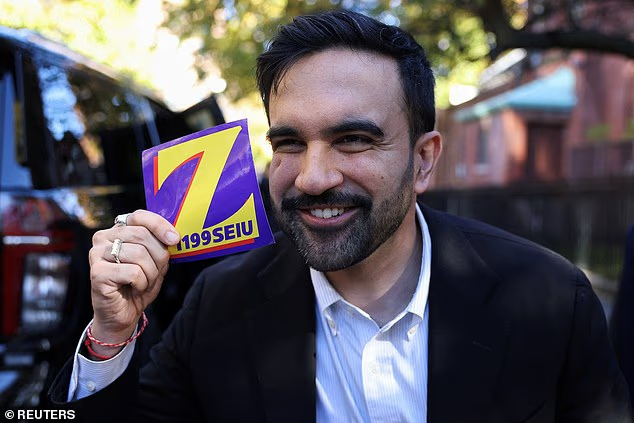
New York City mayor-elect Zohran Mamdani is set to ring in his inauguration with a public block party open to residents on January 1.
But alongside the celebration, the Democratic socialist has also released a lengthy list of items barred from the event, some expected, others raising eyebrows.
While weapons, explosives, and illegal substances are banned, the list also prohibits strollers, Flipper Zero devices and Raspberry Pis, two pieces of consumer technology that are legal and widely used.
The former is a small handheld gadget that can interact with wireless signals such as key fobs, RFID cards and Bluetooth devices, often described as a Swiss Army knife for hacking.
A Raspberry Pi, meanwhile, is a tiny, low-cost computer commonly used for coding, electronics projects and basic software.
Both devices feature programmable input-output pins that could, in theory, be connected to external components and misused to interfere with equipment or cause harm.
However, tech experts noted that explicitly banning these niche devices is unusual, especially given that laptops, which are far more powerful and versatile, are not restricted.
The ban list has since flooded social media, leaving many users stunned. One wrote: ‘According to Zohran Mamdani, the following items all belong in the same category: Illegal substances, weapons, explosives and Raspberry Pi.’
Another added: ‘The stroller is the most insane to me as it looks like he’s anti-baby.’

New York City mayor-elect Zohran Mamdani is set to ring in his inauguration with a public block party open to residents on January 1
Mamdani set up a website dedicated to the event, providing FAQs to help attendees.
One section, ‘What should I wear and what should I bring,’ lists the prohibited items.
Attendees are encouraged to check the weather forecast and dress warmly, with hats, scarves, gloves, and hand and toe warmers strongly recommended.
Small bags or backpacks containing personal items will be permitted, though all bags are subject to search, and large bags or backpacks are not allowed.
Guests may bring thermoses filled with warm, non-alcoholic beverages as well as snacks, and are urged to show respect for fellow New Yorkers.
The prohibited items list includes large bags and backpacks, weapons, fireworks or explosives, drones or other remote-controlled aerial devices, strollers, coolers, chairs, blankets, umbrellas, bicycles or scooters, alcoholic beverages, illegal substances, pets other than service animals, large items that could obstruct spectators’ views, laser pens, bats or batons, as well as Flipper Zero devices and Raspberry Pi computers.
One X user commented on the list, posting: ‘The inauguration of Zohran Mamdani has banned… Raspberry Pis. Not a joke. For all of you who were hoping to bring your small, Linux-powered ARM computer to the New York City mayoral inauguration… Zohran says, “Not so fast! No Raspberry Pi for you!”‘
Another shared: ‘Going from the ban list, it’s the lamest party ever. Why even bother?’
Mamdani is set to be officially sworn in as mayor at midnight on New Year’s Eve in a small ceremony inside the old abandoned City Hall subway station.
The event will be attended by his family and New York State Attorney General Letitia James, who will administer the oath of office.

But alongside the celebration, Mamdani has also released a lengthy list of items barred from the event, some expected, others raising eyebrows
Mamdani won the election with 50.78 percent of the vote, a margin of over 9.4 percentage points over his closest opponent, Andrew Cuomo.
The city Board of Elections reported that 735,317 ballots were cast during early voting, more than five times the turnout seen in 2021, with voters aged 55 and younger accounting for 56 percent of early ballots.
That was a notable shift from the opening days of early voting, which had been dominated by Gen X and Baby Boomer voters.
In the eyes of the Gen-Z population, Mamdani’s promises have potential to go far, but for long-time New Yorkers, it all feels a bit too similar to the crime-ridden city they knew in the 1970s and 1980s.
He promised to freeze rent hikes for all stabilized tenants and triple the city’s stock of publicly subsidized, permanently affordable, union-built, rent-stabilized homes.
He’s also committed to building 200,000 new units over ten years at an estimated cost of $100 billion.
Mamdani, who has lived in NYC most of his life after moving there from Uganda with his family, has pledged to make city buses free to New Yorkers.

While weapons, explosives, and illegal substances are banned, the list also prohibits strollers, Flipper Zero devices (PICTURED), and Raspberry Pis, two pieces of consumer technology that are legal and widely used

A Raspberry Pi is a tiny, low-cost computer commonly used for coding, electronics projects, and basic software
Similarly, residents are excited for the government-run grocery stores that Mamdani has promised would be ‘focused on keeping prices low, not making a profit.’
Eliminating bus fares would strip billions in revenue and could degrade service quality, leaving more room for crime and chaos.
City-run supermarkets would rely on subsidies and undercut private grocers, echoing the inefficiency of other government-run services.
Additionally, taxpayers would foot the bill for a loss-making bureaucracy, not cheaper food.
Mamdani is also threatening to fund his lavish promises by imposing a two percent income tax increase on New Yorkers earning over $1 million annually.
He says he will also raise the top corporate rate from 7.25 to 11.5 percent.
Opponents predict a wealth exodus as a result.
High earners, who already account for half of the city’s income tax revenue, would flee to low-tax states like Florida and Texas, collapsing the city’s finances.
Companies would follow, triggering job losses and an economic tailspin that makes every promise unaffordable.









It’s Louis here. I cover products at Techloy, and I’ve been working with Emmanuel to produce this newsletter. As we close out the year, we wanted to share a quick update about the future of Insight Loop.
When we launched this newsletter three months ago, we wanted to offer meaningful data to help you make the best decision about the tech that you consume. In so many ways, we achieved this. By scrubbing the internet for every single data either on phone sales or funding, we were able to help readers make smarter decisions.
As the year draws to a close, we have been doing a lot of internal thinking on how we can serve you in an even more meaningful way, and finally we have something to share. While Insight Loop in the coming years would continue to be the destination for insight, we would like to return back to our roots — consumer tech — and help answer the biggest question about the products that we use and how they shape our lives. This would be the place that the most avid tech nerds would gather around to discuss the post-smartphone world, the new frontier in consumer AI, and what in God’s name happened to the crypto boom in Africa.
We have already started work investigating some of the ambitious stories that we want to tell in the coming years.
As we prepare for this new, ambitious phase of Insight Loop, we won’t be sending out a full edition this December. Instead, we’re using this moment as part of our process of regrouping and rethinking our format to give the newsletter a well-deserved makeover.
We’re excited to bring you a fresher, more insightful, and more structured experience starting in January.
Thank you for reading, sharing, and being part of our community this year. Your support made it easier for us to consistently break down the data, trends, and stories shaping the tech industry.
Enjoy the holidays, and expect a brand-new edition in your inbox next month.
See you in 2026, and happy New Year.
Best,
Louis Eriakha
🔗 Other Stories You Might Like
TECHNOLOGY
The ₦500B ultimatum: Inside Nigeria’s banking recapitalisation race and why some won’t survive


Nigerian banks are racing to meet new capital requirements that jumped as much as tenfold, but fresh data from the Central Bank reveals a problem that could complicate their plans.
Non-performing loans have climbed to 7 per cent, well above the 5 per cent regulatory limit, even as banks try to raise what could be the largest amount of capital in the industry’s history.
The CBN’s 2026 macroeconomic outlook confirms that a “substantial number of banks” have met the new thresholds. But substance is not all. Some banks are still scrambling, and the document warns that “investor fatigue” could make it harder for late movers to raise money.
Under the recapitalisation programme announced in 2024, banks with international licences must increase their minimum capital from 50 billion naira to 500 billion naira. That is a tenfold jump. National banks must go from 25 billion to 200 billion naira, an eightfold increase.
Regional banks face a fivefold increase to 50 billion naira, and merchant banks must reach 50 billion naira, up from 15 billion.
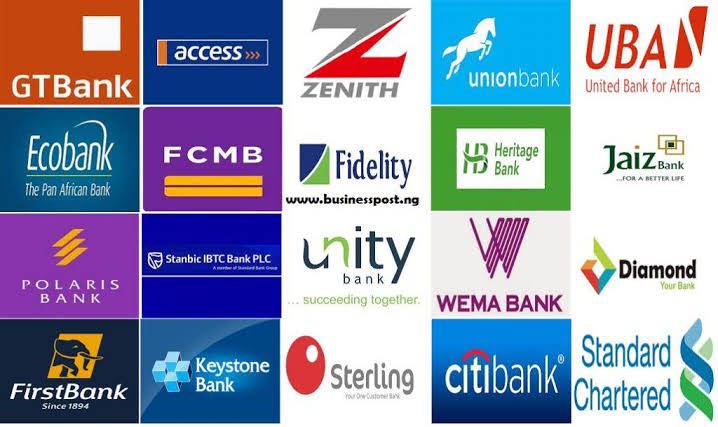 Nigerian Banks
The CBN says the exercise is necessary to create banks big enough to “underwrite big-ticket loans required to finance transformative infrastructure, energy, and large-scale manufacturing projects” as Nigeria pursues its goal of becoming a one trillion-dollar economy.
But raising capital becomes much harder when your loan book is deteriorating.
The bad loan problem banks cannot hide
The CBN reports that non-performing loans stood at an estimated 7 per cent as of the end of 2025, compared to the 5 per cent regulatory ceiling. The central bank attributes this to “the withdrawal of the regulatory forbearance granted to banks during the COVID-19 pandemic.”
In plain terms, banks were allowed to hide problem loans during the pandemic. That grace period is over, and the true state of their loan books is now visible.
The outlook warns bluntly that “rising NPLs pose a direct threat to banks’ profitability, credit availability, and overall risk-bearing capacity.” It adds that “a significant rise in non-performing loans could impair asset quality and weaken banks’ balance sheets, thereby posing systemic risk.”
To make matters more challenging for banks hoping to conceal problems, the CBN is rolling out new tools. It plans to implement “automation of comprehensive stress testing and asset quality reviews across banks to enhance the identification of hidden impairments and sectoral vulnerabilities.”
These automated reviews will make it significantly harder for banks to manipulate their numbers or delay recognising bad loans. When those problems surface, the banks trying to raise capital will face tougher questions from investors about asset quality and loan loss provisions.

The capital market has been on fire, which should help. The All Share Index rose 42.82 per cent in 2025, reaching 147,000 points, up from 102,926 points in 2024. Market capitalisation grew 36.36 per cent to 149 trillion naira, “driven by strong momentum in Industrial, Banking and Consumer Goods sectors.”
Trading activity exploded. Equity turnover hit 8.38 trillion naira in 2025 compared to just 2.60 trillion naira the previous year. The CBN notes this was “primarily driven by heightened activity surrounding the banking sector’s recapitalisation efforts.”
But here is the problem. The market’s capacity is not infinite.
The CBN warns that “despite the bullish momentum, the capital market could face higher concentration risk from the banking sector, as the ongoing recapitalisation could trigger investor fatigue and crowd out other issuers.”
‘Investor fatigue’ is a polite way of saying the market might run out of appetite for bank shares. Early movers who raised capital in 2024 and early 2025 likely got the best terms. Banks that waited, or that are still working through the process, may find investors less enthusiastic and more demanding about valuations.
This is especially true for banks with high NPL ratios or weak asset quality. Why would an investor pay a premium for a bank that still needs to clean up its loan book?
Despite these challenges, the banking system’s overall financial soundness indicators remain within regulatory bounds. The liquidity ratio stood at 65 per cent, significantly above the 30 per cent minimum and up from 48.94 per cent in December 2024. The capital adequacy ratio was 11.6 per cent, above the 10 per cent regulatory floor.
But these are system-wide averages. Individual banks vary widely, and the ones struggling to recapitalise are unlikely to be the strongest performers, dragging the averages up.
 Olayemi Cardoso, CBN governor
The macroeconomic environment is improving, which should help. GDP growth is projected at 4.49 per cent in 2026, up from 3.89 per cent in 2025. Inflation is expected to fall sharply to 12.94 per cent. The exchange rate should stabilise around 1,400 naira to the dollar.
Read also: From 22% to 14%: How 6 months of falling inflation is reshaping Nigeria’s digital lending industry
But the outlook also lists risks that could derail the banking sector’s plans. If inflation does not fall as expected and monetary policy has to tighten again, loan growth would slow, and NPLs could rise further. Disruptions to oil production would hurt banks exposed to the oil and gas sector. Any return of foreign exchange volatility would hit banks with large FX exposures.
The CBN is betting that bigger, better capitalised banks will be able to finance Nigeria’s infrastructure needs and support economic transformation. But first, those banks have to get through the recapitalisation process.
And with NPLs at 7 per cent, automated asset reviews coming, and investor fatigue looming, the banks that have not yet finished the race face a narrowing window and potentially worse terms than those that moved early.
The data suggests a divide is emerging.
Banks that recapitalised quickly, with clean loan books and strong franchises, are positioned to dominate the next phase of Nigerian banking. Those still struggling to raise capital, especially those with high NPLs, face a much tougher road.
Some may not make it to the finish line in their current form.
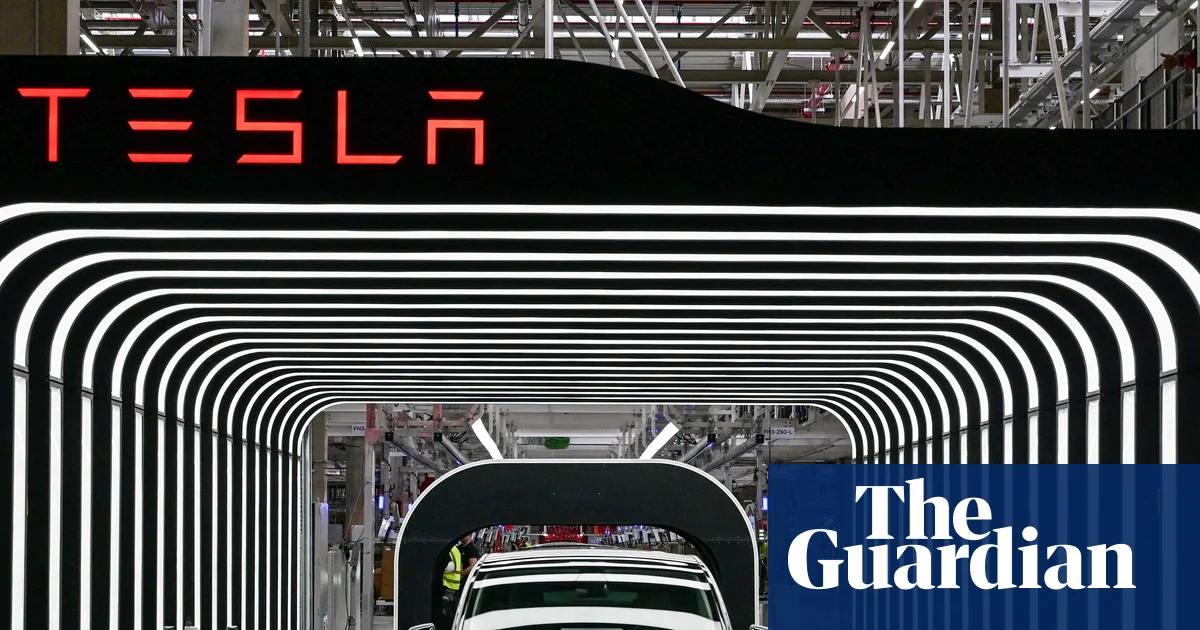
Tesla has taken the unusual step of publishing sales forecasts that suggest 2025 deliveries will be lower than expected and future years’ sales will be well below targets set by its chief executive, Elon Musk.
The US electric vehicle maker published figures from analysts suggesting it will announce 423,000 deliveries during the fourth quarter of 2025, in a new “consensus” section on its investor website. That would represent a 16% decline from the final quarter of 2024.
The estimates suggested that Tesla would deliver 1.64m cars in 2025 as a whole, down from 1.79m in 2024. Deliveries are then estimated to rise to 1.75m in 2026 and 3m in 2029.
Musk claimed at a shareholder meeting in November that the company was aiming to produce 4m cars a year by the end of 2027.
Tesla’s shares are valued at $1.4tn (£1.04tn), making it worth more than the next 30 carmakers combined despite its output being less than a fifth of that of Japan’s Toyota. Musk’s Tesla shares, as well as his stake in the rocket company SpaceX, have made him by far the world’s richest man, with a fortune estimated at $623bn, according to Bloomberg.
However, much of Tesla’s valuation has been based on shareholder hopes that Musk will lead the carmaker to become the global leader in self-driving technology and robotics more generally.
When it comes to actual sales, Tesla has endured a tough year in part thanks to distaste among some consumers for Musk’s embrace of rightwing politics.
In 2024, Musk was the biggest donor to the election campaign of Donald Trump and then launched an effort to cut government spending with the Department of Government Efficiency (or Doge). His alliance with the US president did not survive the summer, with Trump instead scrapping buyer subsidies worth $7,500 a vehicle and slashing supportive regulations for electric cars.
The estimates published by Tesla this week are lower than other compilers have suggested. An average of forecasts by investment banks compiled by Bloomberg suggested that Tesla would deliver 440,907 vehicles in the fourth quarter.
Investment banks often publish sales and profit forecasts for large companies in order to judge the prospects for share price movements. “Missing” consensus forecasts often result in share price declines, and vice versa for a “beat”.
The forecasts for later years are also far below Musk’s stated targets. In November, Musk said the carmaker was trying to increase production by 50% by the end of 2026, and to produce 4m cars by the end of 2027, according to a transcript compiled by AlphaSense, a data company. However, the forecasts suggest the carmaker will hit the 3m mark only in 2029.
Tesla shareholders in November approved a $1tn compensation plan for Musk, in part on the basis of Tesla delivering 20m cars. Of those cars, 10m will have to have active subscriptions for “full self-driving”, its autonomous software, in order for Musk to qualify for the payment.

After more than 70 years, a scientist has finally decoded one of the last undeciphered writing systems among the Dead Sea Scrolls.
The breakthrough centers on the so-called Cryptic B manuscripts, two heavily damaged fragments labeled 4Q362 and 4Q363 that were long considered ‘impossible’ to read because they used an unfamiliar alphabet.
Researcher Emmanuel Oliveiro of the University of Groningen in the Netherlands determined that each cryptic symbol corresponded consistently to letters in Hebrew.
Once deciphered, the fragments revealed familiar biblical phrases and themes about the end of days, including divine judgment, the coming of a Messiah and the ultimate destiny of Israel.
Among the phrases is Yisrael (meaning ‘Israel’), along with references to Judah, Jacob, and Elohim (meaning ‘God’).
The manuscripts were produced by the Qumran, a Jewish sect that lived near the Dead Sea more than 2,000 years ago. Known for preserving religious texts, the Qumran community’s writings shed light on early Jewish beliefs, ritual practices and prophetic traditions.
The Dead Sea Scrolls, uncovered in caves near the West Bank between 1947 and 1956, include some of the oldest surviving biblical manuscripts, written in Hebrew, Aramaic, and occasionally Greek.
While Cryptic A was successfully deciphered in 1955, Cryptic B remained a mystery for decades. Its strange symbols, inconsistent handwriting, and tiny surviving fragments made it exceptionally difficult to decode.

The Dead Sea Scrolls, uncovered in caves near the West Bank between 1947 and 1956, include some of the oldest surviving biblical manuscripts, written in Hebrew, Aramaic, and occasionally Greek
Only two manuscripts, 4Q362 and 4Q363, use this cipher exclusively, and many pieces of these texts are damaged, with some fragments measuring just a few millimeters across.
The surviving fragments are tiny, fragile and worn. The leather is cracked, darkened or frayed, and some pieces show margins, stitching holes or wrinkles.
Letters were written in black ink using fine- or medium-tipped pens, but their shapes, proportions, and spacing are inconsistent, with occasional corrections or double-tracing.
Overall, the manuscripts show significant variation both within each fragment and between the two texts, highlighting the irregular scribal execution of Cryptic B.
The content of 4Q362 appears religious in nature, employing several biblical idioms.
Fragment 21 references ‘Elohim’ and ‘your glory,’ while fragment 18 mentions ‘the tents of Jacob,’ echoing phrases found in Jeremiah 30:18 and Malachi 2:12.
In these passages, Judah also plays a role. Jeremiah 30:18, for instance, promises the restoration of Israel after judgment, with God bringing back their fortunes and rebuilding their cities, signaling hope and future renewal.
Malachi 2:12 warns against unfaithfulness in marriage, emphasizing the importance of remaining loyal to the Hebrew community.

The breakthrough centerson the so-called Cryptic B manuscripts, two heavily damaged fragments labeled 4Q362 and 4Q363 that were long considered ‘impossible’ to read because they used an unfamiliar alphabet. Pictured are pieces Pieces of Dead Sea Scroll with Cryptic B

Among the phrases is Yisrael, meaning ‘Israel’,’ (PICTURED) along with references to Judah, Jacob, and Elohim (meaning ‘God’)
While 4Q362 does not directly quote these passages, its idiomatic language and thematic focus suggest an affinity with prophetic judgments and eschatological promises in biblical traditions.
The fragments also included references to dates and rulers.
For example, the use of ‘the second year’ and ‘the fifth month’ may reflect specific historical or prophetic dating conventions, similar to those found in other biblical and sectarian texts.
One of the most enigmatic features of 4Q362 is the mention of a grave in fragments 2 and 14.
While graves appear elsewhere in the Bible, none match the details described here. Oliveiro suggested that the word for ‘signposts’ in fragment 14 could also mean a tombstone, hinting at a possible connection.
4Q363 is even more fragmentary and difficult to interpret, as a repeated phrase appears twice, though it is unclear whether it refers to ‘her daughters’ or ‘her villages.’
A common name, Benayahu, also appears, but its frequency in other texts prevents a precise identification.

Pictured is a fragments of 4Q363
The reason these messages were encoded remains uncertain, but Oliveiro proposed that the unusual scripts may have served a symbolic or ritual purpose.
By writing in an unfamiliar alphabet, the scribes could indicate that the content was intended for a select audience, such as priestly elites or scribal initiates, enhancing the text’s sacred status without altering its meaning.
The complexity of Cryptic B lies less in the cipher itself, which is relatively simple, and more in the deliberate distortion of letter shapes, which made it appear undecipherable for decades despite containing no hidden or mystical messages.


Concerns about how AI will affect workers continue to rise in lockstep with the pace of advancements and new products promising automation and efficiency.
Evidence suggests that fear is warranted.
A November MIT study found an estimated 11.7% of jobs could already be automated using AI. Surveys have shown employers are already eliminating entry-level jobs because of the technology. Companies are also already pointing to AI as the reason for layoffs.
As enterprises more meaningfully adopt AI, some may take a closer look at how many employees they really need.
In a recent TechCrunch survey, multiple enterprise VCs said AI will have a big impact on the enterprise workforce in 2026. This was particularly interesting because the survey didn’t specifically ask about it.
Eric Bahn, a co-founder and general partner at Hustle Fund, expects to see affects on labor in 2026. He’s just not sure exactly what that will look like.
“I want to see what roles that have been known for more repetition get automated, or even more complicated roles with more logic become more automated,” Bahn said. “Is it going to lead to more layoffs? Is there going to be higher productivity? Or will AI just be an augmentation for the existing labor market to be even more productive in the future? All of this seems pretty unanswered, but it seems like something big is going to happen in 2026.”
Techcrunch event
San Francisco
|
October 13-15, 2026
Marell Evans, founder and managing partner at Exceptional Capital, predicted companies looking to increase AI spending, will pull money from their pool for labor and hiring.
“I think on the flip side of seeing an incremental increase in AI budgets, we’ll see more human labor get cut and layoffs will continue to aggressively impact the U.S. employment rate,” Evans said.
Rajeev Dham, managing director at Sapphire, agreed that 2026 budgets will start to shift resources from labor to AI. Jason Mendel, a venture investor at Battery Ventures, added that AI will start to surpass just being a tool to make existing workers more efficient in 2026.
“2026 will be the year of agents as software expands from making humans more productive to automating work itself, delivering on the human-labor displacement value proposition in some areas,” Mendel said.
Antonia Dean, a partner at Black Operator Ventures, said even if companies aren’t shifting labor budgets toward AI projects, they will likely still say AI is the reason for layoffs or a reduction in labor costs anyway.
“The complexity here is that many enterprises, despite how ready or not they are to successfully use AI solutions, will say that they are increasing their investments in AI to explain why they are cutting back spending in other areas or trimming workforces,” Dean said. “In reality, AI will become the scapegoat for executives looking to cover for past mistakes.”
Many AI companies argue their technology doesn’t eliminate jobs but rather helps shift workers to “deep work” or to higher-skilled jobs while AI just automates repetitive “busy work.”
But not everyone buys that argument, and people are worried that their jobs will be automated. According to VCs who invest in that area, it doesn’t sound like those fears will be quelled in 2026.

At the beginning of the 21st century, many companies began creating their own websites, recognizing that a digital presence is essential for operating in the market. This first generation of sites certainly transformed the world, but started facing a plethora of challenges by the 2010s. Created in the early days of website development, these projects often employed outdated architectures, making support and redesign a challenging task for their owners. 20 years later, our understanding of website design and optimal technologies for this task has evolved tremendously. What seemed possible only in science fiction is now technologically feasible. In this article, we want to discuss how to create a website that will grow with your business, being capable of almost infinite scaling after the end of the initial development cycle.
Rule 1. Use Modern Scaling-Friendly Technologies
The first step towards creating a website that will be capable of scaling infinitely with your business, without any need for long-term redesign, is choosing the right technology. The early Internet was based on programming and scripting languages that had to be developed almost in real time, together with the rest of the Internet. Today, technologies like JavaScript, Node.js, Bubble, or Webflow already have the majority of functions necessary for creating a successful website. They are a product of many years of experience, integrating frontend and backend features that had to be discovered empirically during the early days of the Internet.
All of the listed technologies do several important things for you to enable long-term scaling. Firstly, they have many internal optimizations that speed up sites, improving user experience without any need for outside intervention. You get those benefits just by using the newest versions of those technologies. Secondly, they already offer access to the most important modules necessary for creating a modern website. Bubble and Webflow provide a large number of modules for integrating maps, social media, questionnaires, and various forms. For example, top Webflow experts can create sites capable of adapting to very dynamic markets because this technology (as well as Bubble) integrates GUI-based site creation and easy-to-expand hosting, removing or automating most backend tasks.
Node.js and JavaScript require manual development, but have access to a gigantic database of user-created addons. NPM (Node.js Package Manager) is currently among the largest repositories of software for developers. It offers access to millions of user-created packages that can help implement extremely complex designs fast.
Lastly, all those technologies are created with scaling in mind. On the one hand, they have many optimizations that allow deploying large sites to massive audiences. Node.js uses various complex CPU thread technologies to ensure stability even if a relatively small website becomes popular overnight, gaining millions of daily users. Bubble offers hosting services and constant optimizations to match the changing nature of the Internet. On the other hand, those technologies are also great for scaling because they took many of the early technological problems faced by developers into consideration. Web technologies now have many integration tools that enable them to work not only with the programming languages that are popular currently, but also to integrate technologies from the future.
Rule 2. Focus on Modern Development Strategies
While modern web development technologies genuinely solve many problems for developers, they nonetheless remain only one of the “pillars” necessary for creating a scalable site. One must also correctly apply those technologies to achieve success. So, how can one do this?
Firstly, it is very important to focus on a modular design for your site. Don’t put all eggs into one basket, tying every module to the foundational code of your website. Instead, a better approach is to clearly separate the “core” of your website that is used for running servers and databases from the frontend. This practice is standard in the software development industry, but many startups (especially the ones that function outside IT) ignore it due to time pressure or lack of expertise. Why is this so important? By separating the backend and frontend (as well as other modules within them), you will be able to quickly swap certain blocks like database management technologies without needing to refactor everything else.
Secondly, development itself must be flexible. In the earliest days of the Internet, the so-called Waterfall was the go-to strategy for most IT developers. The idea behind Waterfall is simple: a development team is allocated a budget and given a clear task to develop a certain app. After that, it proceeds according to the pre-established plans without major changes. While this is great for developing apps and sites that perform a narrow set of functions that are well-known to the person who sets development tasks, this is rarely a very good strategy for most apps because market conditions are constantly shifting. Waterfall can be great for factories that require software for their internal hardware. However, if you need a site for representing a certain company or selling products, this is very unlikely to work.
Standards for sites change all the time; even within 2 or 3 months of development, markets can fluctuate significantly. More importantly, many ideas work well on paper but tend to be quite suboptimal in reality. For this reason, it is better to go for an alternative development approach: Agile. Within this approach, sites are developed in stages. After each stage, site owners can assess progress and conclude whether they are moving in the right direction or not. This allows developers to not only deliver the modular structure we mentioned before, but also to avoid a lot of unnecessary work by correcting issues before they become too costly to remove.
Lastly, we also recommend separating site design and content from the development process itself. Platforms like Figma allow you to maintain and even test site designs without developing any code. By maintaining a high-quality design in Figma and updating it, you can be relatively independent from various platforms. Once it becomes necessary to change your backend or frontend code, it will be a matter of just reimplementing existing designs in new code.
Conclusion
To summarize, by combining all practices mentioned above, you can future-proof your website, helping it achieve both scalability and longevity. There’s also one more thing you can do while creating a lasting site: ask for expert help. Many companies like Keenethics offer site development assistance. By consulting with experts, you will be able to leverage not only theoretical but also practical expertise that can take years to accumulate if one tries to establish in-house development.

A quick admission: I absolutely love an elliptical or cross trainer. They don’t always get the plaudits they deserve, but these low-impact cardio machines not only put less strain on your joints than a treadmill but also help you get an impressive, full-body workout. Whether you hop on one to warm up before an intense strength-training session or use it to gently burn calories while listening to your favourite podcast, the elliptical or cross trainer can strengthen muscle, reduce fat and improve cardiovascular fitness.
The Guardian’s journalism is independent. We will earn a commission if you buy something through an affiliate link. Learn more.
However, there is a catch in that these machines vary wildly in their design – and therefore the emphasis they place on different muscles. Traditional elliptical machines eschew moving handles, instead opting for static poles, while cross trainers usually have dynamic handles that recruit the muscles in your back, shoulders and arms. On top of this, stride length, the shape of the handles and the positioning of the footplates can make a big difference to the type of workout you’ll have.
They can vary considerably in their weight and size, but are usually bulkier and more cumbersome than, say, a compact treadmill. Home gym aficionados beware: you’ll likely need a fair amount of room for one of these. If you have enough space, though, an elliptical or cross trainer can be a valuable addition to your home training setup.
At a glance
£1,149.99 at Johnson£699.99 at Johnson£3,940 at Technogym£399 at JTX Fitness£1,499 at Amazon
Why you should trust me
I’m a keen fitness fan who does gym-based strength training and kickboxing classes, as well as outdoor trail runs, cold-water surfing, and more. As a result, I’ve often been tasked with testing fitness technology for magazines, newspapers and websites. I’ve always been one to get stuck in, whatever I’m testing, whether that means surfing in the latest smartwatch or feeling the burn to test a set of connected kettlebells.
I’m also a strong believer that you have to use new tech to get a grasp of how it fits into daily life, so I’ve always sought to test a product for as long as possible and in the correct environment. With exercise ellipticals and cross trainers, that meant getting hands-on experience, no matter how sweaty it made me.
How I tested
Most of the testing was performed in purpose-built boutiques or customer experience centres. Photograph: Leon Poultney/The Guardian
As with any modern piece of fitness equipment, the only way to ascertain whether it’s any good is to don your gym kit and get stuck in. So, after researching the newest and most popular models on the market, I set about trialling all eight of them.
Most of my testing was carried out in purpose-built boutiques or customer experience centres because accommodating so many examples of such gym equipment in my home is not easy. I did manage to squeeze a couple into my garage via short-term loans, though.
During workouts, I used a smartphone-based decibel reader to get a sense of how loud they were in use, and I also tested any connected or online features, which often meant downloading relevant apps and trialling their workout content.
Where trainers had displays, I used these to log in to apps, such as Spotify and YouTube, and I also used any built-in Bluetooth speakers (if this function was offered). For each model, I made notes on ease of use, build quality and any features, as well as the overall size of the machine. If it had transport wheels, I used these to move the trainer around, simulating how easy it would be to manoeuvre in a domestic environment.
The best cross trainers and elliptical machines to buy in 2025
‘Will have your glutes and quads burning in rapid time’: the BowFlex Max Trainer M6. Photograph: Leon Poultney/The Guardian
Best cross trainer overall:
BowFlex Max Trainer M6
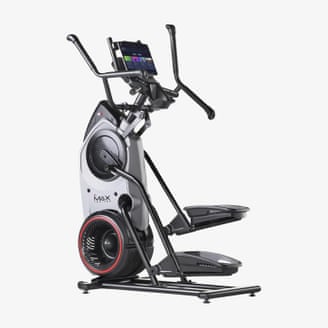
BowFlex
Max Trainer M6
from £1,149.99
What we love
Great lower-body workout and fairly compact
What we don’t love
Could be better for upper body; can’t adjust stride length
 Photograph: Leon Poultney/The Guardian£1,149.99 at Johnson£1,499 at Amazon
Being a petrolhead, I have to confess I was initially drawn to the BowFlex Max Trainer M6 because its LCD console reminds me of the dials found in a Mk3 Golf GTI. However, that’s not all that’s special about this cross trainer.
Blending the motion of a stair-stepper with that of an elliptical machine, it has relatively compact dimensions and provides 16 resistance levels, enabling it to offer punishing, connected workouts.
Those looking for powerful upper-body workouts or large, adjustable stride lengths may want to look elsewhere, but if you’re searching for a cross trainer that’ll have your glutes and quads burning in rapid time, look no further.
Why we love it
Most elliptical machines offer a gentle, calorie-burning workout, but the Max Trainer M6 is among the few that have left me fully gassed, with slightly weak legs at the end of a workout.
This is because of its combination of elliptical and stepping motion, favouring shorter strides and an emphasis on downward pressure instead of the large strides of traditional machines. The handles are also intriguing as they offer a plethora of grip options, opening up the possibility of training multiple sections of the upper body (back, biceps, triceps and so on). But they’re fairly short, not offering a great range of motion to really work the upper body.
The machine instantly connects with the BowFlex Jrny app, which is the company’s answer to Peloton, offering video-based workouts to make the experience more interactive. You’ll need an internet-connected smartphone or tablet, but the sessions are good, if limited, providing guided workouts that span all manner of fitness goals.
Small(ish), quiet and relatively easy to move around, this is one of the few ellipticals that can be put away in the corner of a garage or living room without too much impact on living space.
It’s a shame that … it doesn’t offer an adjustable stride length, and it will feel too much like a stepper for true elliptical fans.
Dimensions: 66 x 117 x 163cm (WLH)
Weight: 61.7kg
Drivetrain: front-drive with magnetic resistance (16 levels)
Stride length: 38cm
Connectivity: Bluetooth (for Jrny app access and HR tracking); USB charging port; media shelf for device placement
Folding? No
Noise level: about 45dB
Maximum user weight: 136kg
Built-in entertainment: no; burn rate dial and basic LCD, supports third-party workouts including Jrny via smartphone, tablet or laptop
BowFlex
Max Trainer M6
from £1,149.99
What we love
Great lower-body workout and fairly compact
What we don’t love
Could be better for upper body; can’t adjust stride length
Best value elliptical trainer:
Horizon EX-59
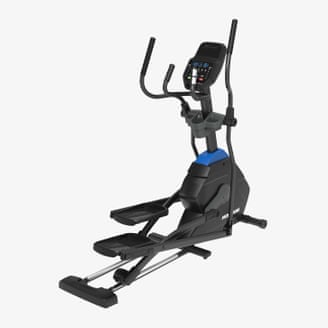
Horizon
EX-59 Elliptical
from £699.99
What we love
Great build quality; good value
What we don’t love
Resistance slow to adjust; display and speakers poor
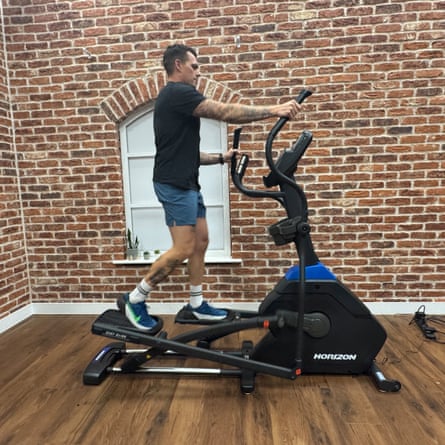 Photograph: Leon Poultney/The Guardian£699.99 at Johnson£999.99 at Decathlon
Although it’s not the cheapest elliptical trainer on this list, the Horizon EX-59 is still my top value pick thanks to its array of features, robust build quality and a relatively low price.
Why we love it
A smooth, front-mounted flywheel provides 10 levels of quiet resistance, and oversize pedals accommodate a variety of different-sized users. With a stride length of 46cm, it’s not dissimilar to the larger elliptical machines you might find at a gym – meaning it feels more natural and less intense than a stepper or cross trainer.
The EX-59 connects to third-party apps via Bluetooth, but it won’t automatically adjust the resistance like some rivals do. As with most Horizon fitness equipment, this model works with the brand’s @Zone app, which provides several high-quality on-demand workouts and training plans for free. There’s not a huge amount of content geared towards elliptical training, but most treadmill and exercise bike high-intensity interval training sessions work just as well.
To me, it’s not the prettiest fitness machine, though it certainly does the job, offering drinks holders, a place to stash your smartphone or tablet, and a built-in heart-rate monitor on the static handles.
The build quality is great, especially considering the price, although that doesn’t extend to the LCD display and console, which are basic. During testing, I found the changes to resistance inputs slow to react: not great if you’re indulging in a Hiit session and you need to spike the heart rate quickly. Similarly, the built-in Bluetooth speakers aren’t really worth the hassle of tethering a device – you’d get better sound quality out of a tin can. Instead, bring a pair of headphones, fire up the @Zone workout app and make the most of those free on-demand classes.
It’s a shame that … the Bluetooth speakers are tinny, and ECB magnetic brake resistance is slow to react to inputs.
Dimensions: 61 x 186 x 167cm (WLH)
Weight: 74.5kg
Drivetrain: front-drive with ECB magnetic resistance, electronically adjustable (10 levels)
Stride length: 46cm
Connectivity: Bluetooth speakers, device rack, USB rapid-charge port; compatible with popular fitness apps via Bluetooth FTMS
Folding? No
Noise level: about 42dB
Maximum user weight: 136kg
Built-in entertainment: no touchscreen; has Bluetooth-enabled speakers and a tablet holder for external content
Horizon
EX-59 Elliptical
from £699.99
What we love
Great build quality; good value
What we don’t love
Resistance slow to adjust; display and speakers poor
Best foldable elliptical trainer:
Technogym Elliptical

Technogym
Elliptical
£3,940
What we love
Classy, quiet and compact
What we don’t love
You need a separate device for classes
 Photograph: Leon Poultney/The Guardian£3,940 at Technogym
If money’s no object, it’s worth a visit to Technogym’s London Mayfair store, which is packed with drool-inducing fitness equipment that will make any home workout space feel like a five-star hotel.
This elliptical trainer is part of the brand’s focus on the home and, as such, it folds upright to minimise its footprint in your living room, home gym or – in my case at least – cobweb-strewn garage.
As a result, it shuns the traditional front- or rear-mounted flywheel for a suspended set of footplates and a resistance system that’s in its upright body. This helps save space but still offers a comparable, almost anti-gravity upper- and lower-body workout to other premium elliptical machines.
With 25 difficulty levels and up to 600W of electrically adjustable resistance (up to 160 strides a minute: good luck with that), the elliptical packs a mean punch – and it works perfectly with the brand’s digital workout portfolio. Having said that, although there’s a basic screen to show all the usual important data, you’ll need to bring your own device if you want any sort of guided workout.
Why we love it
Technogym’s “sessions” are up there with some of Peloton’s interactive classes, although you’ll need to provide your own tablet, smartphone or laptop. Unlike other fitness apps, there are plenty of elliptical-based classes to enjoy, which makes the experience feel much more enjoyable.
Indeed, where some elliptical trainers can send me to sleep, the instructor in Technogym’s interactive classes will have you hanging off the unit, torching your glutes and pummelling your quads. It will keep you coming back for more.
The movement itself takes a bit of getting used to: the stride isn’t quite as obvious as the larger units found in commercial gyms. I had to adapt my approach to get the most out of it, and I found it lacked the multiple grip positions and range of motion for effective upper-body focus training.
Regardless, this trainer has Technogym quality baked into its core. It offers a huge spread of resistance levels, is virtually silent, and is all wrapped up in one of the most compact, storable and classy units on test.
It’s a shame that … you have to bring a device to enjoy a workout, and Technogym’s monthly subscription fees are, predictably, expensive.
Dimensions: 65 x 162 x 160cm (WLH)
Weight: 100kg
Drivetrain: front-drive electronically adjustable magnetic resistance
Stride length: not specified
Connectivity: tablet-compatible console for use with Technogym’s apps
Folding? Yes (folds to 75cm length for compact storage)
Noise level: about 36dB
Maximum user weight: 130kg
Built-in entertainment: no built-in screen; designed for tablet use via console
Technogym
Elliptical
£3,940
What we love
Classy, quiet and compact
What we don’t love
You need a separate device for classes
Best compact cross trainer:
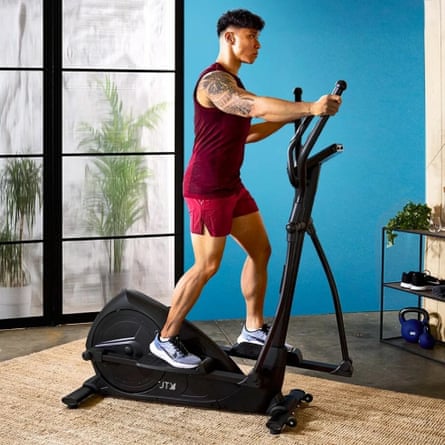
JTX Strider-X8

What we love
Super compact and affordable
What we don’t love
Small footplates won’t suit larger feet
 £399 at JTX Fitness£499 at Amazon
The JTX Strider-X8 was one of the most compact true ellipticals I got my hands on: it’s just 130cm long. The BowFlex Max Trainer M6 will fit better into tight spaces, but it doesn’t offer the same kind of traditional elliptical stride.
Why we love it
The Strider-X8 provides 41cm of glorious gliding, corralled by a 7kg inertia-enhanced flywheel at the rear. It’s quiet, although perhaps not as whisper-quiet as some rivals, and offers 16 levels of easily adjustable resistance.
However, there are a few compromises. The compact proportions restrict the maximum user height to 5ft 9in, which means even a vertically challenged individual like myself is butting up against the limits. The build quality isn’t a strong point: the console, complete with basic display, looks and feels a bit like an oversized school calculator. However, this trainer is very much at the budget end of the budget spectrum. JTX offers a two-year at-home warranty, which should give some peace of mind for those worried it may not go the distance.
Weighing 51kg, the Strider-X8 isn’t something you will want to pick up and heft around, but it’s easy to tip it on to its transport wheels and stash it somewhere convenient. Without going for a foldable, there are few cross trainers that can compete with it in terms of space-saving – and I managed to cram it into the corner of my busy garage with little stress.
The workout experience is largely fine, although the smaller footplates will be a problem for users with larger feet. It connects seamlessly with third-party apps and can even be used with virtual training software, such as Zwift.
The digital console is basic, but it all works, with a simple dial adjusting the levels of resistance. There are even 18 built-in programs for those who simply want to hop on and work out.
It’s a shame that … parts of the machine feel cheap, and the built-in heart-rate monitoring is useless.
Dimensions: 70 x 130 x 169cm (WLH)
Weight: 51kg
Drivetrain: 7kg inertia-enhanced flywheel and electromagnetic resistance
Stride length: 41cm
Connectivity: Bluetooth to fitness apps (such as Kinomap, iConsole+), built-in Polar heart-rate receiver (chest strap), hand pulse sensors
Folding? No; includes transport wheels
Noise level: about 38dB
Maximum user weight: 120kg
Built-in entertainment: no; LCD console with 18 workouts
What we love
Super compact and affordable
What we don’t love
Small footplates won’t suit larger feet
Best full-body trainer:
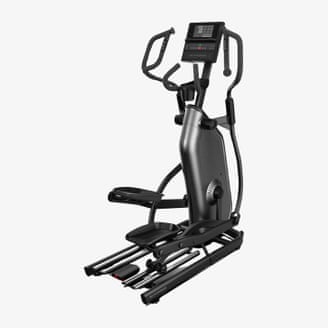
Schwinn 590 Elliptical
Schwinn
590 Elliptical
from £1,499
What we love
One of the best full-body workouts on test
What we don’t love
It’s expensive, and speakers are mediocre
 Photograph: Leon Poultney/The Guardian£1,499 at Fitness Superstore£1,499 at Amazon
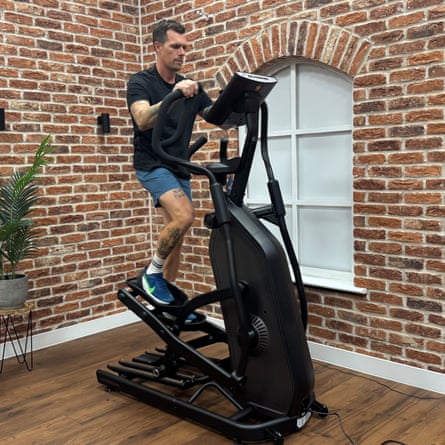
Schwinn packs a lot into its relatively compact 590 Elliptical, including the ability to electronically adjust the platforms to simulate gradients of -5% to 15%. Along with the multitude of upper-body handles, this sees it bundled into the cross-trainer category (despite its name). I found it offered one of the best full-body workouts on test.
There are built-in speakers that are of mediocre quality (they’re better than those found on the Horizon EX-59 but still not brilliant) and a 7in digital display that allows for rapid leaps in resistance.
Why we love it
There are handle-mounted controls for both the incline/decline and resistance settings, which is a welcome premium touch, and the unit is compatible with a multitude of virtual training software, including Zwift and Schwinn’s recommended Jrny app.
The 25 levels of resistance, the ability to adjust the incline and decline, and the multiple grip locations ensure the Schwinn provides one of the best and all-encompassing full-body workouts on test. With a pronated grip on the horizontal handles, I found it possible to work the big muscles of the back and the lats, while a supinated grip on the inner-most handles would place more emphasis on the shoulders and rear deltoid muscles.
It’s a similar case for the lower body, as adjusting the decline and incline places a focus on muscles in the legs that I rarely use. Start playing around with body positioning, and it offers all of the benefits of a static hold with dynamic movement.
Of course, you can adjust the intensity as you want, but I found the unit to be one of the best for working up a sweat. It all comes in one of the most compact and easy-to-store packages on this list, too.
It’s a shame that … the built-in speakers aren’t really worth the effort, and it’s an expensive machine.
Dimensions: 86 x 148 x 173cm (WLH)
Weight: 96kg
Drivetrain: front-drive with magnetic resistance, electronically adjustable (25 levels)
Stride length: 51cm
Connectivity: Bluetooth (heart-rate enabled and built-in speakers), USB charging port, tablet/media holder, Jrny and app compatibility
Folding? No; includes transport wheels
Noise level: about 32dB
Maximum user weight: 147kg
Built-in entertainment: no; a 7in full-colour LCD with workout programs and connectivity
Schwinn
590 Elliptical
from £1,499
What we love
One of the best full-body workouts on test
What we don’t love
It’s expensive, and speakers are mediocre
The best of the rest
Sole E35 elliptical cross trainer

Sole
E35 elliptical cross trainer
£1,799
What we love
Great for taller users
What we don’t love
Takes up a lot of space
 Photograph: Leon Poultney/The Guardian£1,799 at Fitness Superstore
Best for: taller users
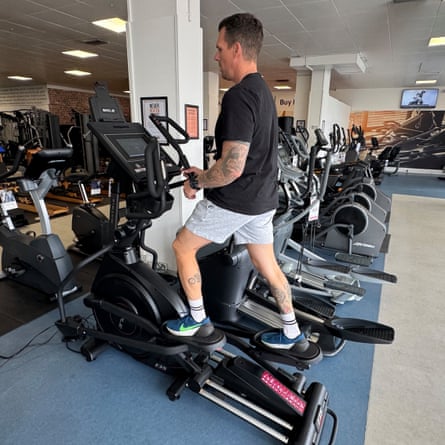
With a generous 50.8cm stride length and oversized footplates, the Sole E35 is designed for taller and larger users, offering multiple handles and grip positions for a full-body workout.
To me, it’s also one of the better-looking elliptical machines on this list, with modern styling and a sleek 10.1in touchscreen to use for a number of built-in workout sessions and longer-term fitness plans, as well as popular streaming apps, such as YouTube, Disney+ and more.
There’s a built-in fan for keeping users cool, although it’s not hugely effective, as well as a set of speakers for streaming music. These are perfectly adequate, but don’t expect room-filling sounds.
The 9kg flywheel provides plenty of resistance though, and with the FTMS protocol, it syncs up with Zwift and the brand’s own Sole+ app, offering a huge array of virtual workouts.
It didn’t make the final cut because … it’s a large and heavy machine that requires plenty of storage space.
Dimensions: 60 x 177 x 177cm (WLH); weight: 110.8kg; drivetrain: front-drive with computer-controlled magnetic ECB resistance (20 levels); stride length: 50.8cm; connectivity: Bluetooth audio speakers, USB charging port, wifi, Sole+ and Kinomap app compatibility, tablet holder, wireless charging pad; folding? No; includes front transport wheels; noise level: about 35db; maximum user weight: 158kg; built-in entertainment: 10.1in touchscreen with built-in apps (YouTube, Netflix, Disney+ and so on), wifi and screen mirroring
Sole
E35 elliptical cross trainer
£1,799
What we love
Great for taller users
What we don’t love
Takes up a lot of space
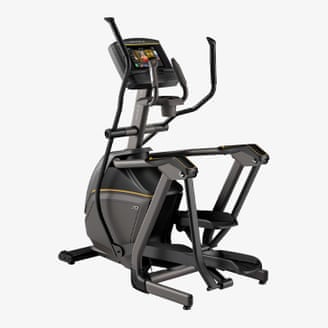
Matrix Fitness E30
Matrix Fitness
E30
from £2,249
What we love
Excellent quality
What we don’t love
The quality comes at a high price
 Photograph: Leon Poultney/The Guardian£2,879 at Fitness Superstore£2,249 at Amazon
Best for: gym quality at home
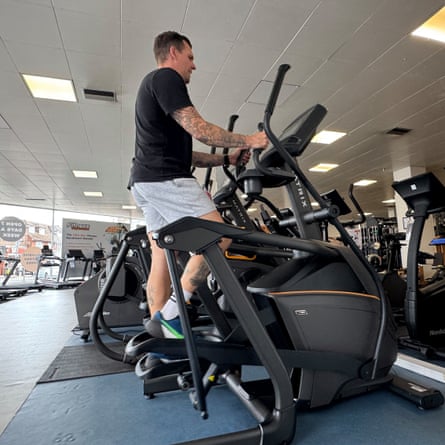
It’s a little tricky to get your head around how the Matrix E30 works. On paper, it’s one of the more compact elliptical trainers I tested, yet it still manages to offer a 51cm stride length. This is all down to the clever, and quite complex, suspension system that houses the oversized footplates and traditional elliptical handles.
Matrix kit is often found in commercial gyms and that’s pretty obvious here, as the build quality is excellent. It also sports a 10.5kg flywheel, which is one of the heaviest on test. It allows for 20 levels of resistance and is capable of a pretty hardcore workout.
An updated XER console has a crisp 10in touchscreen that takes care of most of the functionality, as well as allowing access to a handful of streaming apps and virtual training programs.
If you don’t want to pay for yet another monthly membership (Matrix suggests iFIT), it can also play nicely with whatever third-party apps you like to use and features 11 built-in workout programs.
It didn’t make the final cut because … it’s expensive, and the screen isn’t overly impressive.
Dimensions: 73x 166 x 148cm (WLH); weight: 126kg; drivetrain: suspension elliptical front-drive with ECB magnetic resistance, electronically adjustable (20 levels); stride length: 51cm; connectivity: wifi, Bluetooth, USB port and entertainment apps (YouTube, Netflix and so on); folding? No; noise level: about 38dB; maximum user weight: 147kg; built-in entertainment: 10in touchscreen with apps, media streaming, web browser (XER console)
Matrix Fitness
E30
from £2,249
What we love
Excellent quality
What we don’t love
The quality comes at a high price
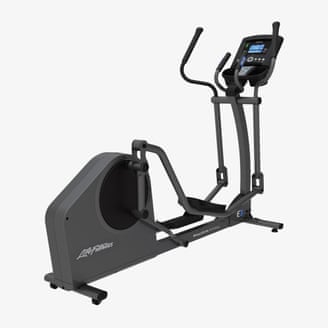
Life Fitness E1
Life Fitness
E1
from £2,145
What we love
Fuss-free and simple to use
What we don’t love
Feels basic compared with competitors
 £2,145 at Fitness Superstore£2,345 at Best Gym Equipment
Best for: build quality on a budget
Life Fitness is another brand often selected by commercial gyms for its reliability, and this also filters down into its domestic range.
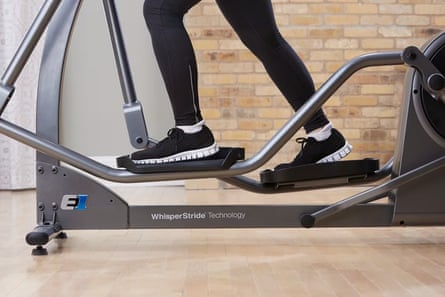
Considering how basic the E1 feels compared with some rivals, the price seems high, but this is a fuss-free elliptical with a massive fixed stride length, oversized footplates and an impressive spread of smooth and natural-feeling resistance. It’s also quiet.
The basic digital Go Console lacks the flashiness of a massive interactive touchscreen, but it has 13 workout programs that are easily accessed via large and obvious buttons, great for those not fussed about binging Netflix during a workout. During testing, I found the lack of a touchscreen quite refreshing: it was easy to hop on and work out without the faff of connecting Bluetooth-enabled devices.
Heart-rate monitoring is fairly reliable via its handles and sports the FTMS protocol for third-party app integration, but it also works perfectly well without it, and its built-in programs span hill training and fat-burning sessions.
It didn’t make the final cut because … it feels expensive for what it is and looks dated.
Dimensions: 77 x 209 x 150cm (WLH); weight: 96kg; drivetrain: front-drive with ECB magnetic resistance, electronically adjustable (20 levels); stride length: 51cm; connectivity: Go Console with LCD, Bluetooth telemetry heart-rate monitoring, 13 pre-loaded workouts; folding? No; noise level: about 32dB; maximum user weight: 182kg; built-in entertainment: no built-in media apps; simple display for workout metrics and an integrated accessory tray for external device placement
Life Fitness
E1
from £2,145
What we love
Fuss-free and simple to use
What we don’t love
Feels basic compared with competitors
What you need to know
Getting the right stride length for your height is key. Photograph: richiesd/Getty Images
What is the difference between an elliptical and a cross trainer?
The two terms are often used interchangeably, but there are subtle differences. A standard elliptical machine focuses on the forward and backward pedalling motion with fixed handles, providing a low-impact cardio workout that mimics running without the joint stress. A cross trainer typically includes moving handlebars that allow you to work your upper body as well, giving a more complete, full-body workout. In most modern home fitness equipment, “elliptical” and “cross trainer” usually describe the same type of machine.
How much should I spend?
Entry-level elliptical trainers start at about £400 and offer basic stride motion and limited resistance levels. Spending more than £1,000 typically gets you a sturdier build, smoother motion, more resistance levels and better consoles with Bluetooth or app integration. At the top end (£2,000+), you’ll find commercial-grade machines with advanced consoles, streaming services, more compact footprints, greater levels of resistance and suspension technology that greatly reduces noise and wear.
How much room do I need at home?
Ellipticals tend to be large machines, with footprints ranging from about 150cm in length and 70cm in width, all the way up to 200cm in length and 80cm in width, or more. You’ll also need to consider ceiling height – especially with front-drive machines, as pedals can lift you an additional 30-40cm off the ground.
What features should I look out for?
Stride length is a key factor: shorter strides (about 40-45cm) are suitable for smaller users, while taller users will benefit from 50cm or more. Look for adjustable resistance levels and incline options if you want to vary the intensity and muscle groups worked. Consoles with Bluetooth and app support can help track progress and keep workouts engaging, and some higher-end models include large touchscreens with streaming apps, fans, speakers and wireless charging pads. If space is a concern, compact or folding designs are worth exploring.
Are there any maintenance concerns?
Ellipticals are generally low-maintenance compared with treadmills. Most use magnetic resistance systems that don’t require ongoing adjustment as a treadmill’s belt does. Look out for manufacturer warranties that cover any wear and tear. Suspension ellipticals – which remove the traditional track and wheel system – tend to be even quieter and need virtually no lubrication.
For more ways to get fit at home:
The best treadmills, tested by our expert runner
Personal trainers on the best home exercise kit
Leon Poultney is a lifelong fitness enthusiast who can often be found trying not to kill himself on a mountain bike/surfboard/other extreme thing, often at the request of an editor. He’s been writing about consumer technology for longer than he cares to divulge. Whether he’s getting to know the latest connected kettlebells or partaking in CrossFit sessions, Leon is always putting his body on the line for great editorial
TECHNOLOGY
‘World’s craziest wave’ leaves surfers in Australia baffled – as one jokes ‘nature’s gone AI’
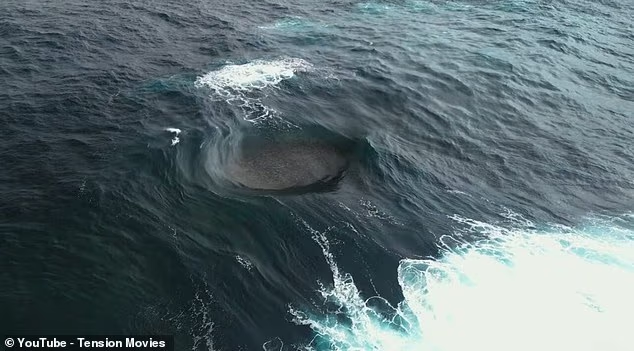
From 73ft waves off the coast of Portugal to square waves in the Aegean Sea, several strange waves have left viewers baffled through the years.
But the latest wave uncovered off the coast of Australia might be the most unusual one yet.
Surfers exploring a secret location somewhere off the coast of Australia stumbled across the bizarre phenomenon.
Aerial footage shows water approaching from four different angles in the middle of the ocean, before explosively meeting in the middle.
Chris Whitey, who first discovered it, described it as ‘the wave that shouldn’t exist’.
’25+ years hunting the wildest slabs on Earth — and then we found THE THING. Impossible shape. Impossible power. 100% real,’ he explained on Instagram.
The footage has baffled viewers, with thousands flocking to the comments on Instagram and YouTube.
‘I literally though it was Ai, unbelievable piece of reef,’ one user wrote, while another added: ‘Because the ocean isn’t scary enough, here’s two random waves smacking each other in the middle of nowhere.’

Aerial footage shows water approaching from four different angles, before explosively meeting in the middle
Mr Whitey first stumbled across the wave more than a decade ago at a location he’s keeping a secret.
He spotted waves swirling from every angle, before meeting and breaking into a huge pillar of water, stretching more than 40 metres into the sky.
‘The very first time I ever laid eyes on it, I wasn’t filming, I just had my still camera. We just randomly ended up there,’ he explained in a video posted to Tension Movies’ YouTube channel.
Ten years later, he returned to the site with his friend, Ben Allen, and was amazed to discover the wave still in action.
‘The second I saw it, I was like “that’s AI”. Even though I saw it in real life, I didn’t know it could look like that. But I can assure you, that’s not AI,’ Mr Whitey said.
After witnessing the strange wave himself, Mr Allen took the footage to Arnold Van Rooijen, an expert in coastal engineering at the University of Western Australia, to see if he could get his head around it.
‘This is a pretty unique combination of the geomorphology of the reefs and the symmetry of the water depths,’ Dr Van Rooijen said.
Dr Van Rooijen suggested that this strange wave would be a one–time occurrence.

Mr Whitey first stumbled across the wave more than a decade ago at a location he’s keeping a secret. He spotted waves swirling around a rock from every angle, before meeting and breaking into a huge pillar of water
Why does the ocean have waves?
Waves are most commonly caused by wind.
Wind–driven waves, or surface waves, are created by the friction between wind and surface water.
As wind blows across the surface of the ocean or a lake, the continual disturbance creates a wave crest.
These types of waves are found globally across the open ocean and along the coast.
Source: NOAA
However, as the surfers witnessed, it appears to be a recurring feature.
Mr Allen joked: ‘I’m pretty sure we captured it happening over and over and over again. He just didn’t believe it – and he’s meant to be one of the best oceanographers in Australia!’
The baffling footage has garnered huge attention on both YouTube and Instagram, with thousands of viewers flocking to the comments.
On YouTube, one wrote: ‘Australians: hey look another thing that can kill ya.’
Another added: ‘seeing the rock almost completely drain before two massive waves collide is insane.’
And one joked: ‘You know that things launched all kinds of fish into the sky haha.’
Meanwhile, on Instagram, one viewer said: ‘I can’t imagine any fan of the ocean not thoroughly enjoying this movie.’
The news comes shortly after Laura Crane, a British surfer from Devon, rode what could be the biggest wave ever attempted by a woman.
Ms Crane, 30, was competing at the Nazaré Big Wave Challenge in Portugal on Saturday when she took on the monstrous wall of water.
The Guinness World Records are currently assessing her latest efforts.
Maya Gabeira of Brazil holds the women’s record at 73½ft (22.4m) wave at Nazaré in February 2020, but Ms Crane is confident her wave is taller.
Ms Crane told the Times her jet ski driver warned her it was going to ‘be a bomb’ while he released her onto the wave going about 30mph.
She described the experience as ‘flying’.
WHAT CAUSES TSUNAMIS?
A tsunami, sometimes called a tidal wave or a seismic sea wave, is a series of giant waves that are created by a disturbance in the ocean.
The disturbance could be a landslide, a volcanic eruption, an earthquake or a meteorite; the culprit is most often an earthquake.
If the landslide or earthquake triggering the tsunami occurs nearby the shore, inhabitants could see its effects almost immediately.
The first wave of the tsunami can arrive within minutes, before a government or other institution has time to issue a warning.
Areas that are closer to sea level have a higher risk of being affected by the waves.

Researchers have found that a layer of the remains of microscopic organisms at the bottom of the ocean can cause tsunamis (file photo)
Those less than 25 feet from sea level are the most dangerous.
The cause of death most frequently associated with tsunamis is drowning. Additional hazards include drinking water contamination, fires and flooding.
Initial tsunami warnings are usually based on seismic information only.
Inhabitants of coastal areas that might be exposed to a tsunami are encouraged to follow evacuation routes in the event that they receive a tsunami warning.
They should seek higher ground or move inland immediately to get away from the ocean.

Over the last several years, fusion power has gone from the butt of jokes — always a decade away! — to an increasingly tangible and tantalizing technology that has drawn investors off the sidelines.
The technology may be challenging to master and expensive to build today, but fusion promises to harness the nuclear reaction that powers the sun to generate nearly limitless energy here on Earth. If startups are able to complete commercially viable fusion power plants, then they have the potential to upend trillion-dollar markets.
The bullish wave buoying the fusion industry has been driven by three advances: more powerful computer chips, more sophisticated AI, and powerful high-temperature superconducting magnets. Together, they have helped deliver more sophisticated reactor designs, better simulations, and more complex control schemes.
It doesn’t hurt that, at the end of 2022, a U.S. Department of Energy lab announced that it had produced a controlled fusion reaction that produced more power than the lasers had imparted to the fuel pellet. The experiment had crossed what’s known as scientific breakeven, and while it’s still a long ways from commercial breakeven, where the reaction produces more than the entire facility consumes, it was a long-awaited step that proved the underlying science was sound.
Founders have built on that momentum in recent years, pushing the private fusion industry forward at a rapid pace.
Commonwealth Fusion Systems
Commonwealth Fusion Systems (CFS) has raised about a third of all private capital invested in fusion companies to date. Its latest round, which closed in August, added $863 million to its coffers, bringing its total raised near $3 billion.
CFS’s Series B2 came four years after its $1.8 billion Series B, which helped catapult the company into the pole position. Since then, the startup has been hard at work in Massachusetts building Sparc, its first-of-a-kind power plant intended to produce power at what it calls “commercially relevant” levels.
Techcrunch event
San Francisco
|
October 13-15, 2026
Sparc’s reactor is a tokamak design, which resembles a doughnut. The D-shaped cross section is wound with high-temperature superconducting tape, which, when energized, generates a powerful magnetic field that will contain and compress the superheated plasma. Heat generated from the reaction is converted to steam to power a turbine. CFS designed its magnets in collaboration with MIT, where co-founder and CEO Bob Mumgaard worked as a researcher on fusion reactor designs and high-temperature superconductors.
The Massachusetts-based CFS expects to have Sparc operational in late 2026 or early 2027. Later this decade, the company says it will begin construction on Arc, its commercial power plant that will produce 400 megawatts of electricity. The facility will be built near Richmond, Virginia, and Google has agreed to buy half its output.
CFS is backed by a long list of investors, including Breakthrough Energy Ventures, The Engine, Bill Gates, and others.
TAE Technologies
Founded in 1998, TAE Technologies (formerly known as Tri Alpha Energy) was spun out of the University of California, Irvine by Norman Rostoker. It uses a field-reversed configuration, but with a twist: after the two plasma shots collide in the middle of the reactor, the company bombards the plasma with particle beams to keep it spinning in a cigar shape. That improves the stability of the plasma, allowing more time for fusion to occur and for more heat to be extracted to spin a turbine.
In December 2025, TAE announced that it would merge with President Donald Trump’s social media company, Trump Media & Technology Group. The all-stock transaction would value the combined company at $6 billion. TAE would receive $200 million plus another $100 million upon filing paperwork with the Securities and Exchange Commission. TAE CEO Michl Binderbauer will serve as co-CEO of the combined company alongside Devin Nunes, who had been sole CEO of Trump Media.
The fusion startup had previously raised $150 million in June from existing investors, including Google, Chevron, and New Enterprise. Before the merger, TAE had raised a total of $1.79 billion, according to PitchBook.
Helion
Of all fusion startups, Helion has the most aggressive timeline. The company plans to produce electricity from its reactor in 2028. Its first customer? Microsoft.
Helion, based in Everett, Washington, uses a type of reactor called a field-reversed configuration, where magnets surround a reaction chamber that looks like an hourglass with a bulge at the point where the two sides come together. At each end of the hourglass, they spin the plasma into doughnut shapes that are shot toward each other at more than 1 million mph. When they collide in the middle, additional magnets help induce fusion. When fusion occurs, it boosts the plasma’s own magnetic field, which induces an electrical current inside the reactor’s magnetic coils. That electricity is then harvested directly from the machine.
The company raised $425 million in January 2025, around the same time that it turned on Polaris, a prototype reactor. Helion has raised $1.03 billion, according to PitchBook. Investors include Sam Altman, Reid Hoffman, KKR, BlackRock, Peter Thiel’s Mithril Capital Management, and Capricorn Investment Group.
Pacific Fusion
Pacific Fusion burst out of the gate with a $900 million Series A, a whopping sum even among well-funded fusion startups. The company will use inertial confinement to achieve fusion, but instead of lasers compressing the fuel, it will use coordinated electromagnetic pulses. The trick is in the timing: All 156 impedance-matched Marx generators need to produce 2 terawatts for 100 nanoseconds, and those pulses need to simultaneously converge on the target.
The company is led by CEO Eric Lander, the scientist who led the Human Genome Project, and president Will Regan. Pacific Fusion’s funding might be massive, but the startup hasn’t gotten it all at once. Rather, its investors will pay out in tranches when the company achieves specified milestones, an approach that’s common in biotech.
Shine Technologies
Shine Technologies is taking a cautious — and possibly pragmatic — approach to generating fusion power. Selling electrons from a fusion power plant is years off, so instead, it’s starting by selling neutron testing and medical isotopes. More recently, it has been developing a way to recycle radioactive waste. Shine hasn’t picked an approach for a future fusion reactor, instead saying that it’s developing necessary skills for when that time comes.
The company has raised a total of $778 million, according to PitchBook. Investors include Energy Ventures Group, Koch Disruptive Technologies, Nucleation Capital, and the Wisconsin Alumni Research Foundation.
General Fusion
Now its third decade, General Fusion has raised $462.53 million, according to PitchBook. The Richmond, British Columbia-based company was founded in 2002 by physicist Michel Laberge, who wanted to prove a different approach to fusion known as magnetized target fusion (MTF). Investors include Jeff Bezos, Temasek, BDC Capital, and Chrysalix Venture Capital.
In General Fusion’s reactor, a liquid metal wall surrounds a chamber in which plasma is injected. Pistons surrounding the wall push it inward, compressing the plasma inside and sparking a fusion reaction. The resulting neutrons heat the liquid metal, which can be circulated through a heat exchanger to generate steam to spin a turbine.
General Fusion hit a rough patch in spring 2025. The company ran short of cash as it was building LM26, its latest device that it hoped would hit breakeven in 2026. Just days after hitting a key milestone, it laid off 25% of its staff. CEO Greg Twinney penned an open letter pleading for funding from investors.
In August, they delivered somewhat, injecting $22 million in a pay-to-play round that one investor called “the least amount of capital possible” to keep the General Fusion afloat. Then in November, securities filings in Canada revealed that the company had raised $51.1 million in SAFE notes from nearly 70 investors, the Globe and Mail reported. Altogether, General Fusion has raised $492 million, according to PitchBook.
Tokamak Energy
Tokamak Energy takes the usual tokamak design — the doughnut shape — and squeezes it, reducing its aspect ratio to the point where the outer bounds start resembling a sphere. Like many other tokamak-based startups, the company uses high-temperature superconducting magnets (of the rare earth barium copper oxide, or REBCO, variety). Since its design is more compact than a traditional tokamak, it requires less in the way of magnets, which should reduce costs.
The Oxfordshire, U.K.-based startup’s ST40 prototype, which looks like a large, steampunk Fabergé egg, generated an ultra-hot, 100 million degree C plasma in 2022. Its next generation, Demo 4, is currently under construction and is intended to test the company’s magnets in “fusion power plant-relevant scenarios.” Tokamak Energy raised $125 million in November 2024 to continue its reactor design efforts and expand its magnet business.
In total, the company has raised $336 million from investors including Future Planet Capital, In-Q-Tel, Midven, and Capri-Sun founder Hans-Peter Wild, according to PitchBook.
Zap Energy
Zap Energy isn’t using high-temperature superconducting magnets or super-powerful lasers to keep its plasma confined. Rather, it zaps the plasma (get it?) with an electric current, which then generates its own magnetic field. The magnetic field compresses the plasma about 1 millimeter, at which point ignition occurs. The neutrons released by the fusion reaction bombard a liquid metal blanket that surrounds the reactor, heating it up. The liquid metal is then cycled through a heat exchanger, where it produces steam to drive a turbine.
Like Helion, Zap Energy is based in Everett, Washington, and the company has raised $327 million, according to PitchBook. Backers include Bill Gates’ Breakthrough Energy Ventures, DCVC, Lowercarbon, Energy Impact Partners, Chevron Technology Ventures, and Bill Gates as an angel.
Proxima Fusion
Most investors have favored large startups that are pursuing tokamak designs or some flavor of inertial confinement. But stellarators have shown great promise in scientific experiments, including the Wendelstein 7-X reactor in Germany.
Proxima Fusion is bucking the trend, though, having attracted a €130 million Series A that brings its total raised to more than €185 million. Investors include Balderton Capital and Cherry Ventures.
Stellarators are similar to tokamaks in that they confine plasma in a ring-like shape using powerful magnets. But they do it with a twist — literally. Rather than force plasma into a human-designed ring, stellarators twist and bulge to accommodate the plasma’s quirks. The result should be a plasma that remains stable for longer, increasing the chances of fusion reactions.
Kyoto Fusioneering
With all the startups pursuing fusion power, it was perhaps inevitable that another would pop up to develop components that round out a power plant. The so-called balance of plant, or the parts that sit outside the reactor, range from gyrotrons that heat plasma to heat extraction systems to harvest power from fusion reactions to turn it into electricity.
Kyoto Fusioneering has made an early bet that if even one fusion startup succeeds in generating enough power to sell to the grid, that the industry will need a supplier for the balance of plant and the expertise to integrate it into whichever fusion technologies win out.
Venture capitalists appear to agree, having invested $191 million in Kyoto Fusioneering. Investors include 31Ventures, In-Q-Tel, JIC Venture Growth Investments, Mitsubishi, and Sumitomo Mitsui Trust Investment.
Marvel Fusion
Marvel Fusion follows the inertial confinement approach, the same basic technique that the National Ignition Facility used to prove that controlled nuclear fusion reactions could produce more power than was needed to kick them off. Marvel fires powerful lasers at a target embedded with silicon nanostructures that cascade under the bombardment, compressing the fuel to the point of ignition. Because the target is made using silicon, it should be relatively simple to manufacture, leaning on the semiconductor manufacturing industry’s decades of experience.
The inertial confinement fusion startup is building a demonstration facility in collaboration with Colorado State University, which it expects to have operational by 2027. Munich-based Marvel has raised a total of $162 million from investors including b2venture, Deutsche Telekom, Earlybird, and HV Capital with Taavet Hinrikus and Albert Wenger as angels.
First Light Fusion
Unlike many other fusion startups, First Light Fusion doesn’t use magnets to generate the conditions necessary for fusion. Instead, it follows an approach known as inertial confinement, in which fusion fuel pellets are compressed until they ignite.
But even then, First Light doesn’t hew to orthodoxy. Most attempts at inertial confinement use lasers to do the dirty work, following the lead of the National Ignition Facility, which produced a groundbreaking experiment in 2022. Rather, First Light fires a projectile at a target using a two-stage gun; the first stage uses gunpowder to fire a plastic piston that compresses hydrogen to 145,000 psi, which then launches the projectile. The target is designed to amplify the force of the impact so it compresses the fuel to the point of ignition.
In March 2025, First Light announced that it would not pursue building its own power plant, instead offering its core technologies to other companies to build one. A spokesperson for First Light said that it is planning to build “pulsed power capability that would act as our demonstrator plant but would have other science and defense applications.” In other words, the company was dropping its plans for a power plan in a quest for revenue.
Based in Oxfordshire, UK, First Light has raised $108 million from investors including Invesco, IP Group, and Tencent, according to PitchBook.
Xcimer
Though nothing about fusion can be described as simple, Xcimer takes a relatively straightforward approach: follow the basic science that’s behind the National Ignition Facility’s breakthrough net-positive experiment, and redesign the technology that underpins it from the ground up. The Colorado-based startup is aiming for a 10-megajoule laser system, five times more powerful than NIF’s setup that made history. Molten salt walls surround the reaction chamber, absorbing heat and protecting the first solid wall from damage.
Founded in January 2022, Xcimer has already raised $100 million, according to PitchBook, from investors including Hedosophia, Breakthrough Energy Ventures, Emerson Collective, Gigascale Capital, and Lowercarbon Capital.
This story was originally published in September 2024 and will be continually updated.
TECHNOLOGY
Elon Musk’s 2025 recap: how the world’s richest person became its most chaotic | Elon Musk


The year of 2025 was dizzying for Elon Musk. The tech titan began the year holding court with Donald Trump in Washington DC. As the months ticked by, one public appearance after another baffled the US and the world. Musk appeared to give a Nazi salute at Trump’s inauguration, staunchly championed a 19-year-old staffer nicknamed “Big Balls,” denied reports of being a drug addict while advising the president, and showed up at a White House press conference with a black eye – all in the first half of the year alone.
“Elon’s attitude is you have to get it done fast. If you’re an incrementalist, you just won’t get your rocket to the moon,” Susie Wiles, Trump’s chief of staff, told Vanity Fair in an expansive interview earlier this month. “And so with that attitude, you’re going to break some china.”
Musk saw huge, multibillion-dollar wins and equally large losses in business this year. In his dealings with federal agencies, he was able to secure new enormous government contracts and expand SpaceX’s operations. With Tesla, he was approved for a pay package that could make him the world’s first trillionaire even as the company’s global sales plunged. At the same time, Musk and his businesses were the target of protests, lawsuits and an exodus of high-level executives. He ended the year with a fortune worth some $600bn.
In the background, his turbulent personal life continued to provide surprises. Rightwing influencer Ashley St Clair sued Musk in February for custody of their five-month-old baby, revealing that Musk had fathered a 13th publicly documented child, for a total of now 14 children. As Musk made regular attacks in posts on X against transgender people, his estranged daughter Vivian Wilson, who is trans, was featured in New York magazine and modeled at New York fashion week. And the New York Times published a lengthy investigation into Musk’s father, Errol Musk, who was accused of child sex abuse.
The relationship that dominated Musk’s public life, however, was his friendship and falling out with Trump. On the day of his inauguration, Trump empowered Musk to gut government agencies, which the tech billionaire did with zeal and abandon. But by June, Musk and Trump had broken up. Their bromance burned hot and fast. On one of his final days as a special government employee, Musk lashed out at the president on his social media platform, X, saying: “Time to drop the really big bomb: @realDonaldTrump is in the Epstein files.” The post has since been deleted.
Though the drama surrounding Musk was frequently absurd and unpredictable, it was also consequential. This was a year when the richest person in the world obtained new levels of wealth and power that few in history have ever approached, one that demonstrated the depth of his global influence as he sought to advance his rightwing agenda and grow his tech empire.
While Musk had stayed away from Washington DC after the Epstein post, the billionaire was invited back in November for a White House dinner in honor of Saudi crown prince Mohammed bin Salman. By the end of the year, Trump and Musk seemed to have made amends. When asked by Fox Business this month if Musk was back in his circle of friends, Trump suggested the two could have a future together again.
“Well, I really don’t know,” Trump said. “I mean, I like Elon a lot.”
Musk expressed more regret than the president over the course the year had taken. When his former aide Katie Miller asked whether he would lead the unofficial “department of government efficiency” (Doge) again, knowing what he knows now, he responded: “Instead of doing Doge, I would have worked on my companies. And they wouldn’t have been burning the cars.”
Musk goes to Washington
After becoming a Republican mega-donor and campaigning for Trump during the 2024 election, Musk began the year on a high as he prepared to enter the administration as the de facto leader of Doge. He immediately set a tone of chaos and outrage that would persist for the length of his time in the White House.
Elon Musk speaks alongside Donald Trump to reporters in the Oval Office of the White House on 30 May in Washington DC. Photograph: Kevin Dietsch/Getty Images
During Trump’s internationally televised inauguration event in January, Musk issued what many people interpreted as back-to-back fascist-syle salutes as he concluded a speech. Rights groups condemned the gesture while Musk attempted to dismiss the criticism as “dirty tricks” from legacy media. The reaction was so intense and negative that some Tesla owners sold their cars in response to Musk’s gestures.
Musk spurred further condemnation from Jewish groups after appearing virtually at a rally for Germany’s far-right AfD party. The Tesla CEO told the crowd via livestream that Germans should not focus on “past guilt” and “move beyond that” in an apparent reference to Nazi Germany.
A protester holds a sign depicting Elon Musk during a demonstration outside of Los Angeles city hall to demonstrate for immigration rights on 5 February. Photograph: Qian Weizhong/VCG/Getty Images
As Musk started his work with Doge, the controversies and backlash against his politics grew. The newly formed bureau operated first as a loose collection of appointed staffers and then subsumed the US Digital Service. It rapidly moved to gut federal agencies and conduct mass layoffs across the government even as ethics watchdogs launched lawsuits accusing Musk’s group of violating privacy and transparency laws, some of which continue today. Musk personally bragged about feeding the United States Agency for International Development (USAID), the world’s largest single provider of humanitarian aid, “into the woodchipper”. The cuts would cause the abrupt cancellation of aid programs worldwide, disrupt HIV/Aids treatment for millions and result in children starving to death in a hunger crisis that experts agree was needless.
At the annual Conservative Political Action Conference in February, Musk appeared to relish his new role as the Trump administration’s demolition man. He brandished a chainsaw on stage and told the audience “I am become meme!” as he waved it about in sunglasses and a gold chain. In March, he once again began to pour more money into Republican causes by holding rallies and handing out $1m checks to support a conservative judge in Wisconsin’s supreme court race.
The pushback against Musk’s political blitz soon began to frustrate his ambitions, however. Judges that ruled Doge’s activities illegal or issued temporary injunctions infuriated Musk, who called for the widespread impeachment of any “activist judges” who opposed his agenda. His preferred candidate in the Wisconsin supreme court race lost by a significant margin, a sign to some in Washington that Musk’s presence had potentially become politically toxic.
Musk left his role in the White House in May amid disputes around his pick for who would head Nasa and clashes over Trump’s One Big Beautiful Bill Act. Upon his exit, he signalled that his time with politics had come to a close, claiming he would reduce his campaign finance contributions in the future and return to his businesses. Yet he quickly put himself back in the spotlight with his public battle with Trump on social media and vowed he would start a third political party called the “America party,” a promise that has yet to come to meaningful fruition.
Musk’s political leanings continued to drift rightward, allying himself via near-constant posts on X interacting with far-right activists such as Tommy Robinson and telling Joe Rogan that “it should be OK to have white pride”. He led an online grievance campaign in early October against the Anti-Defamation League, the country’s most prominent Jewish advocacy group, claiming that it “hates Christians” and suggesting that their documenting of extremism encouraged murder. Although no longer in the administration, his extreme conservative takes on immigration, race and politics have persisted as prominent features of his public identity.
Musk’s constellation of businesses
The year in Musk’s businesses offered the billionaire even larger truckloads of money than before, despite facing intense controversy and competition.
Unlike other tech moguls, who typically helm one company at a time, Musk sits astride several corporations. He controls the rocket company SpaceX and the tunneling and brain implant companies, Boring Inc and Neuralink, respectively. Musk also runs the social media company X, which he bought for a second time this year via his artificial intelligence company xAI. Then there’s Tesla, his electric car company.
Of all his enterprises, Tesla especially courted attention this year, as people enraged by Musk’s work with Doge focused their attention on the carmaker’s showrooms. Across the country, protesters marched at ongoing “Tesla Takedown” events. One sign at a San Francisco protest in March read: “Burn your swastikar before it burns you.” Dozens of Tesla cars and charging stations nationwide were set on fire as one-off vandals protested the billionaire.
Protesters hold signs when they gather outside of the Tesla dealership at a ‘Tesla Takedown’ protest on 22 March in New York City. Photograph: John Angelillo/UPI/REX/Shutterstock
Though Trump and Musk hosted what amounted to a Tesla sales event on the lawn of the White House in March, Tesla saw its sales slump worldwide.
By June, Musk had announced the rollout of its self-driving robotaxis in Austin. Within the first week, bystanders had recorded videos of the cars having difficulty turning left or picking which side of the road to drive on, which attracted the attention of regulators. These robotaxis, which were required to operate with a human safety driver up until earlier this month, have encountered only a handful of documented safety incidents since then.
Lawsuits against Tesla also piled up throughout the year. In August, a Florida jury awarded more than $200m to victims of a deadly crash involving its Autopilot technology in August. And in California, two separate lawsuits were filed in October over three teenagers who were killed when a Cybertruck caught on fire and locked them inside. The National Highway Traffic Safety Administration also opened several investigations into the carmaker over safety issues.
While Tesla’s plunge in profits continued throughout the year, that didn’t stop the company’s shareholders from approving a pay package for Musk – the largest corporate payout in history – that could catapult him to the status of the world’s first trillionaire.
Tesla’s year finished with a blow from California’s department of motor vehicles. The agency said the car company had misled consumers and exaggerated the capabilities of its Autopilot technology. If Tesla doesn’t “remedy the situation” within 90 days, the DMV said earlier in December, the company will be banned from selling cars in the state, its biggest US market.
With SpaceX, Musk was able to curry favor with the federal government. Not only did his Starlink satellites continue to dominate the Earth’s atmosphere – the SpaceX subsidiary operates the vast majority of all satellites in orbit – but the Federal Aviation Administration and the air force gave SpaceX the go-ahead to increase rocket launches in Florida, Texas and California. This came despite the company’s massive Starship, a 400ft machine that Musk hopes to one day fly to Mars, repeatedly blowing up and showering shrapnel across the Caribbean. One such explosion prompted legal action from Mexico, which said the debris harmed thousands of endangered sea turtle hatchlings.
Musk also consolidated his social media and artificial intelligence companies this year. In March, he announced that xAI had acquired X in an all-stock transaction that he said valued X at $33bn. Both companies are privately held.
xAI makes the Grok chatbot, which is integrated into X. The chatbot had countless meltdowns in the second year since its release. It pushed conspiracy theories about “white genocide”, claimed Trump won the 2020 election and spewed numerous antisemitic claims, once referring to itself as “MechaHitler”. Nevertheless, Musk was able to seal a $200m contract from the Department of Defense to integrate Grok into federal government tools.
Meanwhile, Musk’s xAI datacenters in Memphis, Tennessee, were accused of polluting historically Black neighborhoods. The company had moved in dozens of portable methane gas generators to power the facilities, initially without permits, which brought several protests and a pending lawsuit from the NAACP.
Construction continues at an xAI datacenter in Memphis, Tennessee on 25 April. Photograph: Brandon Dill/The Washington Post/Getty Images
Neuralink, which operates in relative secrecy compared with Musk’s other businesses, accelerated the tests of its brain chips in 2025. The company says its product allows a person limited control of a computer via their thoughts. After announcing its first successful implantation in 2024, the company announced in September that it had completed the procedure in 12 patients.
Throughout the year, top executives fled the uproar involved in managing Musk’s companies. Linda Yaccarino departed as X’s CEO, as did its advertising chief. xAI lost its co-founder, chief financial officer and lead lawyer. Likewise, Tesla saw several executive exits, including the vice-president of North American sales, the director of the battery team, the head of the “Optimus” robot project and several leaders of the company’s various car divisions.
A year of personal feuds
Musk, whose life is frequently animated by grievances and breakups, had a banner year for high-profile fights, even by his own standards. Longstanding feuds reignited while his close relationship with Trump imploded in full public view, all as he posted a steady stream of attacks against immigrants, the trans community, the media, Wikipedia and a host of other targets on X, where he boasts 230 million followers.
Musk began the year by accusing the government of South Africa, his birth country, of anti-white racism when he sought approval for his Starlink internet provider to operate in the country. It was part of a series of spats Musk would have with governments abroad and world leaders, including declaring that the UK prime minister, Keir Starmer, was “complicit in the rape of Britain” in one of his anti-immigration tirades.
As Musk picked fights internationally, he also became a combative presence during his time within the Trump administration. Tensions with other administration officials resulted in reports of tense meetings in the Oval Office and a loud, near-physical yelling match between him and treasury secretary Scott Bessent in the halls of the White House. Transportation secretary Sean Duffy became another adversary in a clash over the future of Nasa, with Musk calling him “Sean Dummy” on X amid a string of other insults.
Even Musk and Trump’s formerly close friendship soured, as the president pushed his One Big Beautiful Bill Act that removed tax credits for electric vehicles and threatened to harm Tesla’s already flagging sales. Musk lashed out at Trump on Twitter in June, saying that the bill’s addition to the deficit would destroy the work Doge had done. The deterioration in their relationship culminated in Musk accusing the president of having ties to convicted sex offender Jeffrey Epstein. Trump, in turn, insinuated he could cancel Musk’s government contracts and said his most prominent financial backer had “lost his mind”.
Donald Trump and Elon Musk speak to the press as they stand next to a Tesla vehicle on the South Portico of the White House on 11 March in Washington DC. Photograph: Mandel Ngan/AFP/Getty Images
The messy, public breakup between Musk and Trump marked the end of the Tesla CEO’s time as self-described “first buddy” to the president. Although the two have entered a period of rapprochement in recent months, Musk is far from the constant presence at Trump’s side that he was on the campaign trail.
Musk’s pivot back to his tech empire allowed him to refocus on other grudges, including against Sam Altman, his former OpenAI business partner turned rival. Musk added to his series of lawsuits against Altman’s AI company with a case in August that alleged Apple and OpenAI were engaging in anticompetitive conduct, an accusation that OpenAI described as part of Musk’s “pattern of harassment” against the firm. The two traded barbs on X, which included fighting over whose posts were getting more views.
One of Musk’s final feuds of the year came from a more unusual source – famed 87-year-old author Joyce Carol Oates, whose cutting observation about him on X received more than 5.6m views.
“So curious that such a wealthy man never posts anything that indicates that he enjoys or is even aware of what virtually everyone appreciates – scenes from nature, pet dog or cat, praise for a movie, music, a book (but doubt that he reads); pride in a friend’s or relative’s accomplishment; condolences for someone who has died; pleasure in sports, acclaim for a favorite team; references to history,” Oates posted in November.
A day later, after Musk made a show of enthusiastically replying to several clips of movies on X, he responded to Oates’s critique.
“Oates is a liar and delights in being mean,” Musk posted. “Not a good human.”

Phones across the West lit up Tuesday evening, urging residents to ‘Drop, cover, hold on’ after a 4.9-magnitude earthquake struck California.
The US Geological Survey (USGS) issued the ShakeAlert shortly after the quake hit outside Susanville, California, at 9:49pm PT (12:49am ET).
Residents reported feeling shaking across California, western Nevada, and southern Oregon, with many sharing their experiences on social media.
One person wrote on X: ‘A 5.3-magnitude quake is a serious wake-up call for infrastructure resilience in NorCal. While the ShakeAlert system is a lifesaver, we need to focus on long-term seismic safety and emergency preparedness.’
Several Californians and Nevadans said the quake shook their homes.
The USGS has detected at least six aftershocks, ranging from a 2.1 to 2.5 magnitude, since the larger one hit. The most recent seismic activity was reported at 12:52am PT (3:25am ET) on Wednesday.
No damage or injuries have been reported, according to the Susanville Police Department
Susanville, home to around 18,000 people, is situated near several fault zones, including the Honey Lake and Eagle Lake faults, within the seismically active Basin and Range region.

The earthquake was first measured as a 5.3 magnitude, but later reduced to a 4.9 magnitude. Susanville, California was the epicenter
This area is part of the broader Walker Lane, which accommodates movement between the Pacific and North American plates, making moderate earthquakes relatively common in the region.
The quake struck at a shallow depth of 5.6 miles, which can intensify surface shaking.
While relatively modest in magnitude, residents in Susanville and nearby communities described light to moderate tremors.
In parts of western Nevada, including Reno and Carson City, the shaking was weaker, though many locals still received phone alerts.
Moderate to strong shaking was also recorded in several cities, including Sacramento, Camino, Pollock Pines, South Lake Tahoe and Malin.
One resident shared on X: ‘I felt it in Westwood. My family in Paradise felt it, too. We all got the alerts.’ Another described it as ‘quite a jolt.’
Another shared on Facebook: ‘The house started shaking, then the phones went off. Lasted a few seconds, definitely longer and stronger than the last one.’
‘This one scared me pretty bad, it had the house shaking, not just the walls but actually moving,’ a Facebook user posted online.

The US Geological Survey (USGS) issued the ShakeAlert shortly after the quake hit outside Susanville, California, at 9:49pm PT (12:49am ET)
The USGS noted that there is a 60 percent chance of a 3.0-magnitude or higher aftershock in the coming week and a 16 percent chance of another 4.9-magnitude quake.
More than 1,200 people submitted shaking reports to the agency, helping scientists map the tremor’s impact.
The seismic activity in Northern California follows hundreds of earthquakes detected in San Ramon, located in the East Bay.
As of last week, the USGS detected more than 300 earthquakes near San Ramon, which sits on top of the Calaveras Fault, an active branch of the San Andreas Fault system.
The Calaveras Fault is capable of producing a magnitude 6.7 earthquake, which would impact millions of people in the San Francisco Bay Area.
The USGS estimates there is a 72 percent chance of this happening by 2043.
The earthquakes began on November 9 with a 3.8 magnitude, and the tremors have not stopped since. The latest, which hit on December 23, measured a 2.7 magnitude.
USGS research geophysicist Annemarie Baltay said she is not unusually concerned that the recent earthquakes signal anything larger on the horizon for San Ramon.
‘These small events, as all small events are, are not indicative of an impending large earthquake,’ Baltay told Patch.
‘However, we live in earthquake country, so we should always be prepared for a large event,’ she said.


Bari Keenam has been a photographer, videographer, magazine publisher, cybersecurity intern, network engineer, graphic designer, and motion designer. At 25, he’s now a product designer at Lyft in Canada. He wishes he’d specialised earlier. But he also knows that if he had, he wouldn’t be here at all. This is the paradox of the serial learner, and how a group of audacious University of Lagos (UNILAG) friends turned job rejections into a competitive sport.
Bari Keenam keeps his entire life in two boxes.
“I live very light,” he tells me from Canada, where he’s been since joining Lyft earlier this year. “I know I move a lot. I just have one box of clothes and shoes. Everything fits. If I need to move tomorrow for a new job, I know what to carry.”
It’s a fitting metaphor for someone who’s spent his early 20s refusing to stay in one place, geographically or professionally. At 25, Keenam has worked across three continents, four industries, and more job titles than most people try in a lifetime. His LinkedIn could give someone whiplash.
But there’s a method to the movement.
The magazine that started everything
Keenam graduated secondary school at 15 in 2015. Too young for university, he spent three years in limbo, taking an internship at a marketing firm and teaching himself everything he could find on Coursera, Domestika, and Udemy.
“I called it serial learning,” he says. “I was just taking anything I could learn, digital marketing, front-end design, WordPress development, graphic design. Whatever I could find.”
During that time, he and a friend started an online magazine called Gumbars. “Very weird name,” Keenam admits, laughing. But it was serious work. They had a team of around 20 people; writers, photographers, designers, all between 16 and 17 years old.
“We were interviewing cool people. We met Odunsi, we met Korty, we met Slawn. A lot of them are way bigger now than they were then. ”
When the magazine stopped, Keenam took the skills he’d learned and started freelancing, first WordPress development, then design, charging whatever he thought he could get away with.
“I would say a price today and then five times the price tomorrow, and they kept saying yes,” he remembers. “I had nothing to lose. I didn’t have to worry about getting fired by just calling random quotes.”
Get The Best African Tech Newsletters In Your Inbox
The UNILAG audacity
Everything changed when Keenam got into UNILAG to study Systems Engineering.
“UNILAG could be referred to as Nigeria’s Silicon Valley,” he says without hesitation. “And it’s because of audacity. Students at UNILAG were very audacious in what they wanted to try.”
He describes friends casually applying to Google and Facebook, companies he thought were ‘out of reach.’
“Then you see them get it and you’re like, ‘Oh, I can get that thing too.’ That led me to a lot of other audacious attempts in my career.”
This thinking became a guiding career-building tool. . Keenam and his friends began what he calls ‘glorifying rejections.’
“We didn’t take no as ‘oh my gosh, sad.’ We took ‘no’ as – ‘How many nos can you get before you get a yes?’” he explains. The strategy was simple but brutal; apply to 10 jobs a day. Every single day.
As students, Keenam and his friends “applied to about 200 jobs a month,” about ten per day with the goal to “keep applying until you get a yes.”
Most applications led nowhere. But that was the point, learning how international companies interview, what they want, how to present yourself.
“I was really young. It was good to know that earlier on.”
The Toptal breakthrough
Those scores of applications eventually paid off. Keenam got into Toptal, a network of top freelance talent that only accepts about 3% of applicants.
“When I got in, I was in a very small group of Nigerians that got in,” he says. “I think that was like one of my big break moments. Everyone started noticing, ‘Oh, this guy got into Toptal.’”
That visibility led him to a role at Grey Finance (now Grey), a Nigerian fintech where Keenam worked on their rebrand. “For a brand designer, that is like the biggest thing, being involved in a rebrand.”
But while working at Grey, something unexpected happened: Snapchat got back to him.
Get The Best African Tech Newsletters In Your Inbox
The year-long pause
Keenam had applied to Snapchat a year earlier through LinkedIn networking. “I was very heavy on LinkedIn networking. I messaged a lot of people in companies I wanted to work at. This one person at Snapchat replied.”
He’d made it through the interview process and got a yes. Then Snapchat paused all hiring.
“They were like, ‘We can’t hire anyone unfortunately. But we’ll get back to you when we can hire again.’”
A year later, while at Grey, they did.
“The second invite was to apply from scratch. They’re like, ‘’We’re going to take you through the first interview all over again.’ But the first application was for the US. The second one was for their London office.”
Keenam moved to London to join Snapchat’s product design team. He was 23.
The problem-first designer
At Snapchat, Keenam learned something crucial about why companies kept hiring him despite his wandering path.
“I always ask in every interview: Why am I being hired here?” he says. “And they make it very clear; it’s your perspective. Your perspective is why we’re hiring you.”
That perspective? “Problem-first approach. That has been my defining trait. How do I just solve this problem?”
He describes his work as existing at two extremes, “Does it look great? But also, does this plug into a KPI that we can measure?”
It’s a philosophy born from his brand design days. “I believe that whatever I design—a logo or whatever—should have real-world measurable metrics. Snapchat liked that approach for product design.”
After nearly two years, Bari was caught in Snapchat’s layoffs. He worked remotely for a Berlin gaming company (Alt Media) before landing at Lyft through an ex-Snapchat colleague’s referral.
“That was my best interview I’ve ever had,” he says. “I could sense this beautiful work culture from the interview. I was like, ‘Oh my gosh, I want to try these guys.’”
He moved to Canada in mid-2025.
The paradox
When I ask if there’s anything he wishes he’d done differently, Keenam doesn’t hesitate.
“I wish I had locked in on one thing earlier. I think I floated around a lot in different areas.”
He lists the job titles he’s held that paid money; photography, video, print designer, graphic designer, label designer, motion designer, cybersecurity, network engineer, magazine owner.
“I think if I’d focused on one thing before going to UNILAG, I think I’d be much further up in my career now.”
Then he catches himself.
“But I would not have known if this was the right thing if I didn’t do everything else. So it’s a weird paradox. If I did lock in on that one thing, I would not have found design. I would not have been able to interview the people I did when I was younger. I could not have met the people I met. I would not have made the friends I have right now.”
He pauses. “I think everything worked out the way it was supposed to work out.”
Get The Best African Tech Newsletters In Your Inbox
The circle that keeps him moving
Keenam still talks to those UNILAG friends; the ones who normalised applying to Google, who turned rejections into celebrations.
“All around the world I have friends like that,” he says. “I’m just happy that my circle reflects my energy. Everyone around me is on their zoom. If they slacked, I’d be slacked. But everyone’s on their zoom, so I can’t be the one that’s not on their zoom.”
It’s that energy that keeps him in motion; still learning French, DJing, boxing. Still keeping his life in two boxes. Still applying that same 10-jobs-a-day mentality whenever he needs to move.
His end goal? “To come back to Africa with enough experience and resources to provide value; something that works exclusive of any political climate.”
But he’s not ready yet.
“I don’t think I’m at the time where I want to be brought back. There are so many people I look up to in Nigeria, designers and otherwise, that I’m still trying to reach. I’m not ready yet.”
When the time comes to plant roots, though, Keenam already knows what he’ll need: just two boxes and a tough skin.

Meta has confirmed that it’s acquiring Manus, a Singapore-based AI start-up, in a deal valued at more than $2 billion. The deal is not simply another AI investment or talent grab but signals a deeper shift in how Meta sees the future of Facebook, Instagram and WhatsApp.
The company is betting that the next evolution of social platforms will be defined less by conversation and content and more by action.
The spokesperson for Meta, in a statement, said, “Meta’s acquisition of Manus AI will enable us to provide the most advanced technology to our users with safeguards in place to eliminate areas of potential risk.
There will be no continuing Chinese ownership interests in Manus AI following the transaction, and Manus AI will discontinue its services and operations in China.”
Manus has risen quickly by positioning itself at the frontiers of what the industry now calls “agentic AI”. Founded by Chinese entrepreneurs and initially developed in Shenzhen before relocating to Singapore, the company launched its first general-purpose AI agent earlier this year. Its system is designed to plan and execute complex tasks autonomously, rather than respond passively to prompts. That distinction is crucial.

Most large language models, including Meta’s own Llama family, excel at generating text, images or code snippets. They wait for instructions and answer in stages. Manus, by contrast, functions as an execution layer. Its architecture coordinates multiple specialised sub-agents that can browse the web, analyse data, write and run code, and manage multi-step workflows with limited human intervention.
By acquiring Manus, Meta is moving decisively from AI that talks to AI that does things.
What Meta’s acquisition of Manus means
Nowhere is this shift likely to be more transformative than on WhatsApp. Meta has long harboured ambitions of turning the messaging platform into a super-app, particularly in markets where WhatsApp already underpins commerce and customer service for millions of small businesses. Earlier bot-based efforts struggled with rigidity and poor user experience.
Agentic AI changes that equation. Manus-powered assistants could summarise sprawling group chats, draft replies that reflect a user’s tone, and turn scattered messages into structured schedules or task lists.
For businesses, the implications are more significant. Autonomous agents could manage customer enquiries, book appointments, update simple inventory records and generate reports directly within chats. For many small firms, this would amount to enterprise-grade automation without enterprise budgets.
Similarly, Instagram is another natural beneficiary. The platform’s creator economy, which already relies heavily on analytics and automation, could be reshaped by AI agents that operate as creative co-pilots.

Rather than simply enhancing images or suggesting captions, Manus agents could analyse engagement trends, recommend posting schedules, draft SEO-aware captions and generate variations of Reels from raw footage. Influencers and brand managers would move away from manual optimisation towards higher-level creative and strategic oversight.
On Facebook, the opportunity lies in reducing friction and information overload. The platform’s groups, pages and feeds contain vast amounts of collective knowledge, but extracting value from it is often tedious. Agentic AI could act as a personal concierge.
Instead of scrolling endlessly, users might ask an agent to compile recommendations, summarise debates or plan activities based on recent group discussions. Facebook would shift from being a passive stream of content to an active utility layer.
Strategically, the deal strengthens Meta’s position in an increasingly competitive AI landscape. Google, Microsoft and OpenAI are all racing to commercialise agent-based systems that can execute tasks across tools and platforms.
Buying Manus accelerates Meta’s roadmap while bringing in a team with practical experience deploying autonomous agents. It also complements recent initiatives such as Meta Superintelligence Labs and expanded investments in AI infrastructure.
 Manus AI
The risks, however, are real. Autonomous agents raise difficult questions around reliability, accountability and user control. Errors made by an AI that takes action can carry higher stakes than mistakes in generated text.
Privacy is another concern, particularly when agents operate inside personal messaging apps. Meta has said it will sever Manus’s former Chinese ties and implement strict data safeguards, including geo-gating and controlled access to sensitive systems.
Meta’s acquisition of Manus is, at its core, a statement of intent. The era of generative AI as a novelty feature is fading. In its place is a new phase, where platforms compete on how effectively they can act on users’ behalf.
If Meta executes this strategy well, Facebook, Instagram and WhatsApp may evolve into something more than social networks. They may become the world’s most widely used personal assistants.


After a New Year’s Eve swim in 2023, Dan Richards’ life changed forever
When Dan Richards went for a New Year’s Eve swim in 2023, he never could have imagined how drastically his life would change.
In a freak accident, he injured his neck when a wave caused him to flip and hit the sand in Langland Bay, Swansea.
“I knew instantly that I was paralysed,” the 37-year-old said.
“I couldn’t move anything.”
Doctors told him he would be bed-bound but, two years later, he uses a wheelchair and can move his arms and fingers.
He has even walked with the help of Artificial Intelligence (AI) technology in Wales and Germany.
Dan and his partner Anna, 40, were celebrating the new year with a cold water dip when the accident happened.
“I remember all of it, unfortunately. Being pulled out. And then everything changing,” Dan said.
“I got hit by a wave, it flipped me over and folded me backwards, and snapped my neck. I knew it was bad.”
 Anna Thomas

Dan is determined to move as much as possible after becoming paralysed
Anna recalled hearing Dan shouting for help as she got ready to get into the water.
“I just remember looking over and just seeing Dan’s head coming up and then going back under,” she said.
“We dragged him out. But he was just dead weight and the sea was coming in really fast.
“We waited for emergency services, and then [I remember] begging them to let me go in the helicopter. It was horrendous.”
After being taken to hospital in Bristol, the couple from Swansea were given life-changing news.
 Anna Thomas
Dan and Anna loved to swim in the sea before the accident
Dan said he was told he was paralysed form the neck down, would not be able to move and it was “highly likely” he would be bed-bound for the rest of his life.
Anna – who had only started dating Dan a few months before the accident – had to make dreaded phone calls to family members.
“It was New Year’s Eve, I was put in a room on my own but you could hear people laughing and joking, and I had to tell Dan’s parents.
“How do you phone someone’s mum and say that their son is paralysed?”

Dan was given life-changing news while in hospital in January 2024
Anna said every day since the accident has brought a new challenge.
“It’s our reality. Until you’re in this situation… you don’t realise just how much you have lost.”
But in the months that followed the accident, when Dan was in hospital, even the slightest movement in his toes gave the couple hope things would change.

Dan and Anna have returned to Wales from Germany to celebrate Christmas
“Luckily I’m quite stubborn,” Dan said.
“I just wanted to see the physios as soon as possible. I wanted to work. I didn’t accept what they were saying.
“I’m proud of the progress I’ve made. It’s a long time since laying in bed in Bristol, that’s for sure.”
He continued: “The feeling in my toes then translated into full feeling through my legs and feet, some movement in my right leg [and] core strength – which I was told was gone – started to come back. Movement in my arms, my fingers, being able to hold things.
“I’m still hopeful, I’m still positive. With modern technologies, I’m not giving up.”
Dan had private physiotherapy at a specialist clinic in south Wales which used a world-first combined treatment to help him walk with a machine.
 Anna Thomas
Family and friends have fundraised for Dan’s private physiotherapy treatments
Jakko Brouwers, a neurophysiotherapist from Morello clinic in Newport, said Dan was “an immensely motivated guy” when he visited them after being discharged from hospital.
“The technology is two-fold,” he explained.
“The first part we tried with Dan is a robot. The robot will mimic normal human gait as much as possible.
“The other part of the system that we developed is a stimulation suit that has got sensors. The trousers are also fitted with electrodes and we can stimulate muscle activity at the right time.
“Through a little bit of algorithm – and dare I say AI – it will start developing a walking pattern.
“It’s super exciting. It’s not often that you see that in Wales.”
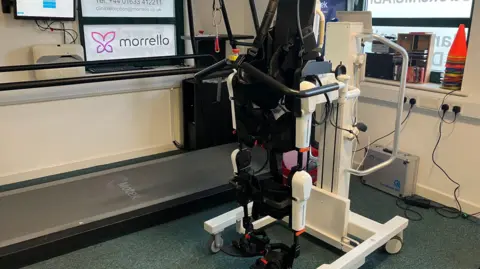
This robot helped Dan to walk at Morello clinic in Newport shortly after he was discharged from hospital
Dan said the experience was “surreal” but “the best feeling”.
“It just made me want to push harder. That’s on our doorstep here in Wales, so it spurred us on to do some research, and do other things.”
But private physiotherapy and innovative treatment does not come without cost.
From raffles to ultramarathons and charity nights, family and friends have fundraised meaning Dan and Anna could set off for a trial abroad in October.
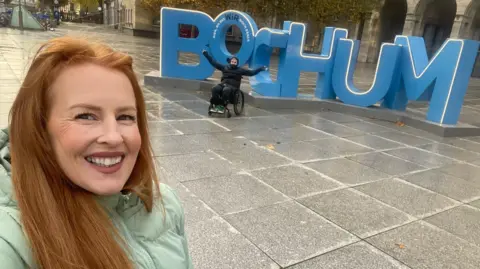 Anna Thomas
Dan and Anna spent two months in Bochum, Germany, for treatment
Dan explained he was trying two different treatments simultaneously in Germany – a stem cell treatment straight into his spinal cord, alongside using a Hybrid Assistive Limb (HAL) suit, which is a machine that works on brain waves.
“It’s one of the first times it’s ever been done,” he said.
“Sensors translate signals into movement, which then get my legs working, get me walking.
“The more you do it, the stronger the signals get, the faster it gets and eventually you’re able to walk without the suit.”
With six weeks of treatment left in Germany in the new year, Dan will have to apply for an EU Medical Visa, which is another challenge he said he is determined to overcome.
He does not know what the future holds, but is determined not to give up.
“Technology is advancing so fast, things aren’t where they were 10 years ago.
“New research is incredible. There is no limit. I don’t want there to be a limit.
“The more progress I can make now, the better our future will be.”


It’s that time of year again.
Every January 1, the Future Perfect team makes forecasts for the events we think will (or won’t) happen over the next 365 days. And every December 31, we go back over those predictions and tally up how we did.
All of our predictions were made positively — as in, something will happen — and came with probabilities attached, which are meant to indicate our relative confidence in the forecast. To simplify scoring, predictions that came with a higher than 50 percent probability that proved out, or with a probability below 50 percent that did not prove out, were marked as “correct call.” Those that came with a higher than 50 percent probability that did not prove out, or with a lower than 50 percent probability that did prove out, were marked “incorrect call.”
If for some reason the forecast could not be resolved — such as, random example here, a new US government chose to delay putting out data or a report that would have clarified the question — we marked it as undecided.
The scorecard? Nineteen correct, four incorrect, and two undecided works out to a winning percentage of .800, if we count ties as half a win. (That would put us a tad over the 1906 Chicago Cubs, who recorded the best single-season winning percentage in major league baseball history. Hopefully this doesn’t mean we’ll be cursed for a century.)
As always, the point is less to keep score than to get better at forecasting by identifying where we’ve succeeded, where we’ve failed — and maybe where we need to take some more chances. Fortunately, we’ll have another shot tomorrow, when we publish our 2026 forecasts. —Bryan Walsh
Congress passes a major tariff bill (20 percent) — CORRECT CALL
2025 certainly did not lack for tariff news, but almost all of it came from the Trump administration, which used executive powers to impose sweeping new duties on most countries on Earth, and from the Supreme Court as it weighed whether any of that was legal.
There was some speculation at the start of 2025 that the need for new revenue in Republicans’ big tax bill would lead it to include some Trump-y tariffs. That didn’t happen, mostly because it didn’t need to happen: President Donald Trump could just impose the tariffs unilaterally, or try to at least. As I wrote in my initial prediction, “the odds that Trump does new tariffs using presidential authority are nearly 100 percent.” If anything, “nearly” 100 percent was an underestimate. —Dylan Matthews
Trump dissolves the Department of Education (5 percent) — CORRECT CALL
Let’s check the fine print: This prediction would’ve resolved true if Congress passed a law formally abolishing the Department of Education. That did not happen in 2025, so the prediction stands.
What Trump did do is issue an executive order instructing the Secretary of Education to, “to the maximum extent appropriate and permitted by law, take all necessary steps to facilitate the closure of the Department of Education.” What has followed are sweeping staff cuts that it’s fair to call a gutting of the department, with various court challenges that in July culminated in a Supreme Court ruling in favor of the administration, at least for the time being. One major pending fight is over the legality of the department moving its functions to other parts of the federal government.
But again, read the fine print. The administration’s solicitor general, in his Supreme Court filing in June, stated, “The government has been crystal clear in acknowledging that only Congress can eliminate the Department of Education.” What the administration did were simply layoffs, not the closure of a legally created government agency. While the Trump team is clearly trying to have it both ways here, I’m inclined to trust their lawyer — they did not dissolve the department. —DM

President Donald Trump signs executive orders in the Oval Office of the White House in Washington, DC, on January 20, 2025. Jim Watson/AFP via Getty Images
The Affordable Care Act is repealed (30 percent) — CORRECT CALL
This is another one where the fine print matters. In my initial prediction, I wrote that a bill “repealing the ACA” has to do at least three of the following five things:
- Eliminate or reduce the ACA’s Medicaid eligibility or federal funding
- Eliminate or reduce ACA health insurance tax credit eligibility or amount
- Eliminate or curtail the mandate for certain employers to provide health coverage for employees. Reducing the penalties will also be considered to be relaxing the mandate.
- Make it so that ACA subsidies are no longer limited to plans that satisfy the requirements specified in the ACA, including allowing ACA subsidies to be contributed to health savings accounts or similar accounts
- Eliminate or curtail medical underwriting restrictions, like the ban on considering preexisting conditions
The One Big Beautiful Bill Act certainly satisfies the first two of these requirements. Per the Committee for a Responsible Federal Budget’s breakdown, the bill includes $1.1 trillion in cuts to health care programs over a decade. The vast majority of those cuts go to Medicaid, by imposing work requirements, limiting “provider taxes,” and other changes. But about $226 billion in cuts go to the Affordable Care Act’s exchange-based coverage, mostly by making certain immigrants ineligible.
But squeezing Medicaid and the exchanges is, at most, cutting the Affordable Care Act, not repealing it. Trump and Congress did not change the employer mandate for health insurance, or allow ACA funds to go into health savings accounts, or, crucially, eliminate protections for people with preexisting conditions or limits on hiking premiums based on age. In my book, that means the ACA has yet to be repealed. —DM
Jerome Powell will no longer be Fed chair (10 percent) — CORRECT CALL
Trump would love nothing more than to fire Jerome Powell, who was first appointed chair of the Federal Reserve by some fiendish anti-MAGA president named Donald Trump way back in 2017. Powell has been open about the way Trump’s tariffs, by hiking prices, are slowing the Fed’s process of lowering interest rates, and the president does not like that one bit.
In April, Trump said Powell’s “termination cannot come fast enough!” In July, he showed off a letter he had written, but not filed, firing Powell. In November, he told reporters he wanted to fire Powell, but people like Treasury Secretary Steve Bessent are “holding me back.” And in August, Trump attempted to fire Fed governor Lisa Cook, a move the Supreme Court has blocked but which was, among other things, a clear threat to Powell that he could be next.
Yet here Powell is, still chair of the Fed. Actually removing him, or trying, proved too rich for Trump’s blood. Powell’s term as chair ends in May 2026, meaning Trump will pick his successor, but it appears he’ll be able to stay in charge until then. He can also keep his post as a regular governor on the board until January 2028, if he wants it. —DM
Trump will have a positive favorability rating (25 percent) — CORRECT CALL
Let’s go to the graph, folks:

Everyone’s polling average is a little different, but basically every one looks like this from Nate Silver: Trump began his presidency slightly above water, but now Americans disapprove of him by a healthy margin (13 points here). The Economist’s average shows him as less popular than either President Joe Biden or Trump himself in term one were at this point in their presidencies.
Being below water at this point has become pretty normal for presidents in the 21st century, so there wasn’t much courage in me predicting Trump would be more disliked than liked. But it’s interesting to me that the speed of the decline has picked up in recent months. I would’ve guessed that Trump’s most-disliked period would’ve been the height of DOGE, but it’s been the period when his ties to Jeffrey Epstein were most under question. —DM
Musk and Trump are still friends at the end of the year (40 percent) — CORRECT CALL
Only two men can tell us if Elon Musk and Trump are truly, as of December 2025, “friends.” But the formal definition I used here is that they stop being friends “if one or the other publicly and unambiguously disparages his counterpart at least three times” over the year. And buddy…


Those Musk tweets are now deleted, and there appears to have been some degree of rapprochement in the ensuing months. But as predicted, there was a massive blow-up in their relationship, centered around the One Big Beautiful Bill Act and, implicitly, the failure of Musk’s DOGE to do anything to actually reduce federal spending. While it does seem as if they’ve made an attempt to patch things up, what’s clear is that their bond is much weaker than it was on January 1. Sad! —DM
The National Highway Traffic Safety Administration’s preliminary estimates of US car crash deaths for 2024 will be lower than 40,000 (70 percent) — CORRECT CALL
America stands out among wealthy nations for being the land of death by cars. But there is, finally, some good news here: After a terrifying period of elevated car fatalities during Covid, the US has seen 13 consecutive quarterly declines in these deaths. As of 2024, we’re back below 40,000 Americans killed by cars annually, according to federal statistics — an achievement that (sadly) calls for celebration. But we still have a ways to go before we’re back down to the pre-pandemic baseline. —Marina Bolotnikova

Israeli Prime Minister Benjamin Netanyahu meets with US Vice President J.D. Vance on October 22, 2025 in Jerusalem, Israel. Nathan Howard/Getty Images
Benjamin Netanyahu is still Israel’s PM at the end of November 2025 (75 percent) — CORRECT CALL
Netanyahu seemed like a marked man going into 2025.
The war in Gaza had already stretched past a year, and dozens of hostages remained in the hands of Hamas, even as Israel was coming under fire for charges of genocide in its conduct of the war. Netanyahu himself was facing long-running corruption allegations and public anger over both judicial reforms and the war, while the International Criminal Court had issued arrest warrants for him and for his former defense minister Yoav Gallant (as well as Hamas military commander Mohammed Deif).
Well, there’s a reason that Netanyahu is the longest-serving leader in Israeli history: The man has an undeniable talent for political self-preservation. With Trump returning to the White House, Netanyahu had an ally who gave him an even freer hand in Gaza, where Israel adopted tactics that maximized damage (and civilian suffering) in Gaza while reducing the record number of casualties it had suffered in 2024. In June, he launched a major attack against Iran that represented a major tactical victory, one that ultimately included enlisting the US in the attack. By October, whether he fully wanted it or not, Netanyahu had a ceasefire in Gaza that included the return of the remaining 20 living hostages.
As 2026 begins, Netanyahu is far from popular and Israel has increasingly become an international pariah, but he has yet to be dislodged from his position at the top of his deeply divided country. Perhaps that will change with the next Israeli elections, which must take place no later than October 27, but I, for one, have learned not to bet against this man. —BW
Argentina’s yearly inflation is below 30 percent (20 percent) — UNDECIDED
This has been a very challenging year for Argentina’s economy, after a surprisingly strong 2024. Inflation is far below where it was when the populist Kirchners were in charge, but swaggering libertarian president Javier Milei’s reforms have also led to high unemployment and voter discontent. That led to a defeat in Buenos Aires elections in September, which led currency, stock, and bond markets to fret over the country’s prospects. This culminated in the US government offering to buy up to $20 billion in Argentinian pesos so Milei’s government had an adequate supply of dollars and could maintain a viable exchange rate.
Having the world hegemon bail you out is, it turns out, good politics: Less than two months after the bad Buenos Aires results, Milei won national midterms in a landslide, giving him much firmer support in Argentina’s National Congress for his reforms.
That’s all background to the question here: inflation. I predicted that inflation would continue to fall but not below 30 percent; I relied in part on an IMF forecast of 45 percent inflation. The most recent data as I write this comes from October, where prices were 31.3 percent higher than October 2024. That implies an annual inflation rate just above our 30 percent cutoff. We’ll have to see what the January numbers say, but there’s a very good chance I was wrong here and underestimated Milei and the Argentinian economy. Regardless of which side of 30 percent we land on, I was much too confident. —DM
There will be a ceasefire in Ukraine (75 percent) — INCORRECT CALL
When I made this call, I thought the logic was straightforward. The war was grinding into its third year, both sides had taken appalling losses, and Trump was about to take office with little interest in writing Ukraine a blank check. It seemed reasonable that Moscow and Kyiv would fight hard for marginal gains in early 2025, then accept a ceasefire that froze the lines.
That is not the world we’re in. As 2025 ends, the conflict in Ukraine remains the largest war in Europe since World War II, with well over a million people killed or wounded and Russia still occupying roughly a fifth of Ukrainian territory. There have been brief truces — measured in dozens of hours or a few days at most — but nothing that qualifies as the “durable pause in the fighting” I had in mind.
Instead, we have diplomacy without peace. The Trump administration is pushing a plan that would freeze the front lines and lift some sanctions; Russian and American officials are shuttling between European capitals and Miami hotel conference rooms; and Ukraine, Europe, and the US have reportedly agreed on most of a peace framework. The sticking point is exactly what you’d expect: territory and legitimacy. Ukrainian President Volodymyr Zelenskyy still refuses to recognize Russia’s land grab in the east and south, while Putin insists that any ceasefire ratify his conquests.
In retrospect, I overweighted “war-weariness” and underweighted how much the key actors care about not losing. I implicitly assumed a Korean War-style ending: a bloody stalemate capped by an ugly armistice. What we actually got was the stalemate without the armistice, and one that is set to continue into the new year. —BW
Iran gets nuclear weapons (30 percent) — CORRECT CALL
This was the prediction where I tried to be precise about definitions. I wrote that “getting nuclear weapons” didn’t mean a test or a declared arsenal, but Iran producing enough fissile material to fuel at least one bomb. Building and deploying an actual warhead, I argued, could take months or years beyond that. So instead, I staked this prediction on a key nuclear benchmark: Iran enriching uranium to weapons-grade (~90% U-235) in sufficient quantity for at least one device.
Not long after I made the prediction, Iran was already enriching uranium to 60 percent at its Natanz and Fordow facilities, and outside experts thought its “breakout time” — how long it would take to produce weapons-grade uranium for one device — was down to perhaps a week.
In 2025, the enrichment problem got dramatically worse. A February International Atomic Energy Agency report found that Iran’s stockpile of 60 percent-enriched uranium had jumped to about 275 kilograms, up roughly 50 percent from late 2024. By May, the agency was estimating some 408.6 kilograms of 60-percent material — and a June update put the figure at around 440.9 kilograms, which its own yardstick says is enough, if further enriched, for roughly nine or 10 simple fission weapons. Then came a 12-day US-Israeli air and covert campaign that killed senior Iranian nuclear scientists and wrecked parts of the program, but even Israeli and US officials concede it did not eliminate Iran’s ability to rebuild.
While all highly enriched uranium — anything above about 20 percent enriched — is in principle weapon-usable, watchdogs note that Iran has not been publicly observed enriching to the classic weapons-grade threshold of 90 percent, nor is there evidence of an actual tested device.
So did Iran “get nuclear weapons” in 2025? The answer remains no, although it comes with the additional confounding factor that, with international inspections suspended, the true state of Iran’s nuclear program may be murkier than ever. Which is why you can expect this question to continue to haunt international politics in 2026 and beyond. —BW
The World Health Organization (WHO) will declare H5N1 a pandemic in 2025 (25 percent) — CORRECT CALL
I’ve been covering the H5N1 bird flu virus since the spring of 2003 in Hong Kong, when there was some suspicion that the unknown illness spreading in southern China at the time might be bird flu finally transmitting human to human. It wasn’t — it was something entirely new called SARS-CoV-1, though back in those pre-Covid days we didn’t have the “1.”
Every January since, I’ve been wondering if this is the year we finally get our dreaded bird flu pandemic. And every year, including 2025, it hasn’t been.
Instead, we got a year that underlined the basic tension of H5N1: It keeps looking terrifying on paper, while acting more like a slow-burn animal disaster than a human pandemic. H5 bird flu is now entrenched in wild birds, poultry, and US dairy cattle. The US experienced its first US H5N1 death early in the year and nearly 70 US infections since April 2024, mostly among workers around infected herds and flocks.
On the animal side, the picture is much worse. A major Nature perspective described a true H5N1 “panzootic” across bird and mammal species, including mink, marine mammals, and cattle, with clear evidence of mammal-to-mammal spread in some settings and worrying adaptive mutations. What we’re seeing adds up to an unprecedented number of mammalian infections, severe neurological disease in animals, and growing uncertainty about how close this virus is to efficient human transmission.
There is some good news on preparedness. Health agencies still classify the overall public health risk from current H5 viruses as low, and vaccine work is accelerating. In December, Moderna and CEPI announced funding for a late-stage trial of an mRNA bird flu vaccine.
So, once again, no H5N1 bird flu pandemic in humans. After 22 years of covering this virus I’m tempted to just say that pandemic will never happen, but I’m not quite that foolhardy. When it comes to H5N1, we’ve been more lucky than we’ve been good. —BW
A major lab will formally claim it has achieved AGI (30 percent) — CORRECT CALL
There is a lot of hype and boosterism in the world of AI. The firm Anthropic has publicly predicted they’ll get to artificial intelligence systems “matching or exceeding that of Nobel Prize winners across most disciplines” by 2027. Elon Musk, meanwhile, has tweeted, “My estimate of the probability of Grok 5 [his firm xAI’s next model] achieving AGI is now 10 percent and rising.”
But Grok 5 isn’t out yet, and it’s 2025, not 2027. I made a very long list of Western companies that could even theoretically be in the running to build AGI (including, like, Netflix, which is not trying to do this at all). Foolishly, I didn’t include Chinese firms, failing to anticipate the “DeepSeek shock” at the start of 2025.
In any case, nobody claimed AGI this past year, whether in the US or China. I’d be surprised if anyone does in 2026, either. Then again, AI as a field is always able to surprise me. —DM
EVs will make up more than 10 percent of new car sales in the US by the end of Q3 2025 (65 percent) — CORRECT CALL

An electric car recharges its battery at a curbside Charge Point electric vehicle charging station on November 16, 2025, in Jersey City, New Jersey. Gary Hershorn/Getty Images
So, I was right here, but I may be wrong in spirit. Electric cars made up 10.5 percent of new car sales in the third quarter of 2025 — but that was probably only because people who wanted an EV anyway were rushing to buy one before the federal government’s $7,500 tax credits for new EVs, which were killed by Trump’s One Big Beautiful Bill expired at the end of September. US electric car sales are expected to dip significantly as a result.
Beyond ending that subsidy, which was critical for EV adoption, the Trump administration is trying to go after every other pillar that makes electric cars viable. They’ve proposed significantly weakening Biden-era fuel economy rules and hamstrung the buildout of EV charging stations. Oh, and half the country hates Elon Musk now, so Tesla sales, which once made up the overwhelming majority of the US electric car market, have taken a big hit. Americans also just seem wary of electric cars because of vague cultural vibes and societal malaise. The US is way behind the rest of the world in EV adoption — a lag that Trump seems determined to turn into a permanent technological deficit. —MB
Bitcoin’s price will at some point in 2025 breach $200,000 (70 percent) — INCORRECT CALL
Funny enough, as a bit of a bitcoin skeptic, I bought into the bitcoin hype — only to be disappointed. I thought for certain after crypto bros helped put Trump into office, he’d reward the best-known cryptocurrency around with astronomical growth. When Trump was sworn in, bitcoin was already hovering near its all-time high value, a little over $100,000. The sky was the limit.
But then, uh, Trump happened. Rather than building on the record 2024 gains that made me so optimistic, bitcoin endured a turbulent year. Uncertainty around Trump’s tariffs, the AI boom and its own unpredictable economic impact, and other economic variables (interest rates) sent the bitcoin price plummeting, then soaring, and back again. Bitcoin did reach a new record high briefly back in October, at more than $125,000, but it fell far short of my projection — and as of this writing on December 29, it’s back well below where it was at Trump’s inauguration. Whoops. —Dylan Scott
Elon Musk is still the richest person in the world (55 percent) — CORRECT CALL
The Bloomberg Billionaire’s Index has seen some fascinating shifts over the past year. There are now 18 billionaires worth at least $100 billion each, including three members of the Walton family. Larry Page and Sergey Brin of Google each added about $100 billion to their tally as Alphabet stock rallied. But the same guy remained at the top, buoyed by the persistently high price of Tesla stock: Elon Musk. As of December 29, he’s worth $638 billion, or more than twice Page, who’s currently in second with $270 billion.
But you know what’s cooler than half a trillion dollars? A trillion dollars, which Musk got Tesla stockholders to agree to pay him if the firm hits key targets over the next 10 years. I guess one of these years we’ll have to add a “the world gets a trillionaire” prediction. —DM
A new application for psychedelic therapy drugs is submitted to the FDA (20 percent) — CORRECT CALL
After last year’s brouhaha with Lykos Therapeutics — the organization that tried (and failed) getting MDMA-assisted therapy approved by the FDA — we didn’t have the highest confidence here. In order to have an application ready for review, you need Phase 3 trials. And those take years to accomplish — and neither Compass Pathways nor the Usona Institute, the two companies mayhaps the furthest along in psilocybin depression treatment, submitted.
But! Oshan Jarow’s initial prediction also accounted for the possibility of the FDA using emergency use authorization to temporarily reschedule certain psychedelics. That didn’t happen either. Fingers crossed for 2027? —Izzie Ramirez
The 2025–2030 federal dietary guidelines advise Americans to avoid ultra-processed foods (30 percent) — UNDECIDED
If this were a normal year, the new dietary guidelines that will shape the next five years of food policy would have already been released. Health Secretary Robert F. Kennedy Jr. had even promised to release them ahead of schedule, well before August, and with everything we need to know to guide nutritional choices condensed into just four pages!
Of course, that didn’t happen, and the new guidelines have now been delayed until January. It turns out that nutrition science is actually quite complicated and can’t just be reduced to aphorisms like, as Kennedy puts it, “eat whole foods.”
My prediction had totally underestimated how incompetent and unmoored from expert consensus the second Trump administration would turn out to be. Once the guidelines come out, I now do expect that they’ll probably make confusing and misleading claims about so-called ultra-processed foods, along with other bad advice, which I thought unlikely a year ago. And, lesson learned, I’m going to avoid making predictions that rely on the timely release of federal government information for the foreseeable future. —MB
Antibiotic sales for use in livestock production will have increased by at least 0.5 percent in 2024 (55 percent) — CORRECT CALL
Sometimes you can be “right,” and yet still miss the mark. I really underestimated how dramatically antibiotic sales for use in livestock production would increase in 2024. I predicted, with a timid 55 percent probability, that sales would increase by at least 0.5 percent. But in 2024, they shot up by an astonishing 15.8 percent.
That should worry you because antibiotics use in livestock production is a pressing public health problem. Here’s why, from my prediction last year:
Most of the antibiotics used in human medicine are actually sold to meat companies, which put them in animals’ feed to make them grow faster and prevent disease outbreaks in factory farms. But some bacteria on farms are becoming resistant to these antibiotics, giving way to new strains of antibiotic-resistant bacteria that make the drugs less effective in treating humans.
For years, US meat companies and trade groups — along with the US Food and Drug Administration — pledged to be better “stewards” of these precious drugs, namely by reducing their use. It appears that it was mostly hot air. There were steep declines of antibiotic use in the mid-2010s, thanks to FDA rules, but sales have since stabilized and are now increasing. The vibes are shifting on antibiotics in meat production, and that’s bad news for the future of these lifesaving medicines. —Kenny Torrella
Bird flu results in the deaths of at least 30 million farmed birds by the end of 2025 (60 percent) — CORRECT CALL

With an outbreak of bird flu, millions of chickens were euthanized to prevent the spread of the virus, leading to a decline in the egg supply and driving prices to record highs. Deb Cohn-Orbach/UCG/Universal Images Group via Getty Images
This current bird flu outbreak has been dragging on for nearly four years, and 2025 was one of the worst yet, with nearly 54 million birds culled as of December 12.
The virus hit egg farms particularly hard in late 2024 and early 2025, resulting in egg shortages and massive price spikes. Some grocery stores even restricted the number of cartons each customer could purchase.
The egg industry, which has been damaged the most by the bird flu, is ready to start vaccinating its birds. But the US Department of Agriculture won’t let it, for fear it’ll severely disrupt the trade of chicken meat — an entirely different sector of the animal agriculture sector. It’s a long and complicated story, which I went into detail on a couple of months ago; check out the story here.
I have little hope common sense will prevail in 2026, so we’re likely in for another bad year of dead birds, higher food prices, and unused vaccines. —KT
California’s animal agriculture law Proposition 12 will not be overturned by Congress (65 percent) — CORRECT CALL
I should, if anything, have predicted this with higher probability. The only somewhat surprising part is that Congress still hasn’t passed a new Farm Bill to replace the one that expired more than two years ago, which is really behind schedule even by today’s chronically late legislative standards. (The coalition that made the last century of farm bills possible is breaking down, as Republicans demand steep cuts to SNAP and an end to “climate-smart” provisions in ag funding.)
In theory, that still gives them the chance to kill Prop 12 in the Farm Bill that eventually passes, but the longer that the animal welfare law remains in place, the less likely the pork industry is to continue campaigning against it, and the less likely it is to be nullified — and thank God for that. —MB
At least one additional state bans lab-grown meat in 2025 (80 percent) — CORRECT CALL
This is another case of being technically right while far underestimating reality. I predicted at least one state would ban the production and sale of lab-grown, or cell-cultivated, meat in 2025, but three to five did, depending on how you look at it: Mississippi, Montana, and Nebraska passed indefinite bans, while Texas and Indiana passed two-year bans.
Prior to 2025, only Florida and Alabama had banned it.
The movement is primarily driven by Republican state lawmakers, including some who are ranchers and farmers themselves, which represents a form of “government protectionism” for the meat industry, according to one Nebraska cattle rancher who opposed the bans (so too did several state-level Nebraska farm groups, along with the National Cattlemen’s Beef Association).
In the short term, the bans have little impact, as no cell-cultivated meat company has scaled up their production enough to sell large amounts of the product. Several companies now have government approval to do so, but Wildtype — the San Francisco-based startup that makes cell-cultivated salmon — is the only one that’s managed to get into numerous restaurants; two in California, one in Oregon, and one in Washington state, which are unlikely to pass bans. If you have the chance to try them, I recommend it — I did a few years ago and thought it was delicious. —KT
A major sports gambling scandal leads at least one All-Star in the four major professional sports to be suspended (30 percent) — INCORRECT CALL
Okay, technically, Emmanuel Clase, the Cleveland Guardians star closer and three-time All-Star, is on “nondisciplinary paid leave” but for the purposes of this prediction, we’re going to call it suspension by another name. Clase and his teammate Luis Ortiz were arrested in November on charges of illegally conspiring in a scheme to rig their pitches in order to pay out prop bets made by their associates. You can now find all kinds of videos detailing how Clase would throw his first pitch in the dirt after entering a game; as it turns out, his co-conspirators were allegedly betting that first pitch would be a ball.
However, based on the rules of our prediction contest, since I put less than 30 percent probability, this technically comes up “wrong.” But I was onto something. Legal gambling continues to creep into every facet of professional sports, with the happy collaboration of the leagues, and the scandals have followed. Clase wasn’t alone this year: Former NBA All-Star, current Portland head coach, and once-presumed future Hall of Famer Chauncey Billups was implicated in a separate sports betting scandal this year. Unless something changes, I suspect neither of them will be the last. —DS
Max Verstappen wins the Formula 1 World Drivers’ Championship (60 percent) — INCORRECT CALL

Max Verstappen on the podium celebrating his win at the 2025 Formula 1 Etihad Airways Abu Dhabi Grand Prix in United Arab Emirates on December 7, 2025. Nicolas Economou/NurPhoto via Getty Images
Sigh. Okay, so in any ordinary year, I would have put Verstappen, the four-time champion driver for Red Bull, at an 80 percent likelihood of winning. He’s a menace. Can drive from the back of the grid all the way to first. But things were rocky at Red Bull, from second driver woes to full-on company culture shifts. The 2025 Red Bull car was — and this is as nicely as I’ll put it — underperformed. All the while, McLaren’s Lando Norris and Oscar Piastri were gaining points weekend after weekend.
For most of the year, I was thinking about this prediction. Was I too generous? He wasn’t a contender for the first half of the season. But it’s Verstappen we’re talking about — he made a legendary 104-point comeback, essentially unheard of in F1. Then the last few races were total nail-biters, with the three drivers so close to each other in points. I was even thinking about hiring an Etsy witch so I could say I was right for this silly little article.
Anyway, Verstappen ended up winning the season closer in Abu Dhabi, but Lando Norris took the championship title by 2 measly points. Yes, I’m upset about it. —IR
Charli XCX wins a Grammy for Brat (90 percent) — CORRECT CALL
And…water is wet. Last year, I kept my prediction intentionally open, hence the high percentage confidence here. Out of the eight nominations she received, she won three Grammys: Best Dance Pop Recording for “Von Dutch,” Best Recording Package, and Best Electronic Dance/Electronic Album. While I hoped she would have won for Best Album, she’ll always be No. 1 to me. —IR
You’ve read 1 article in the last month
Here at Vox, we’re unwavering in our commitment to covering the issues that matter most to you — threats to democracy, immigration, reproductive rights, the environment, and the rising polarization across this country.
Our mission is to provide clear, accessible journalism that empowers you to stay informed and engaged in shaping our world. By becoming a Vox Member, you directly strengthen our ability to deliver in-depth, independent reporting that drives meaningful change.
We rely on readers like you — join us.

Swati Sharma
Vox Editor-in-Chief