
TECHNOLOGY
China leads global crypto mining ranking as US dominance grows


A recent November 2025 report from ApeX Protocol offers a fresh snapshot of the global geography of crypto mining. According to the study, the world’s top ten mining nations continue to shape the bulk of global production, with surprising findings about energy efficiency, mining pressure on power grids and potential room for growth.
At the top of the ranking is China, producing 21.11 per cent of the global monthly hashrate. What stands out is the country’s efficiency. China reportedly uses just 0.33 per cent of its total electricity capacity for mining operations.
Even compared to overall national electricity production, crypto mining consumes a paltry 0.75 per cent, despite China having the highest total electricity generation in the study. With a final “ApeX index” score of 96.2, China remains the world’s leading crypto producer and, according to the report, has room to expand further without overtaxing its grid.
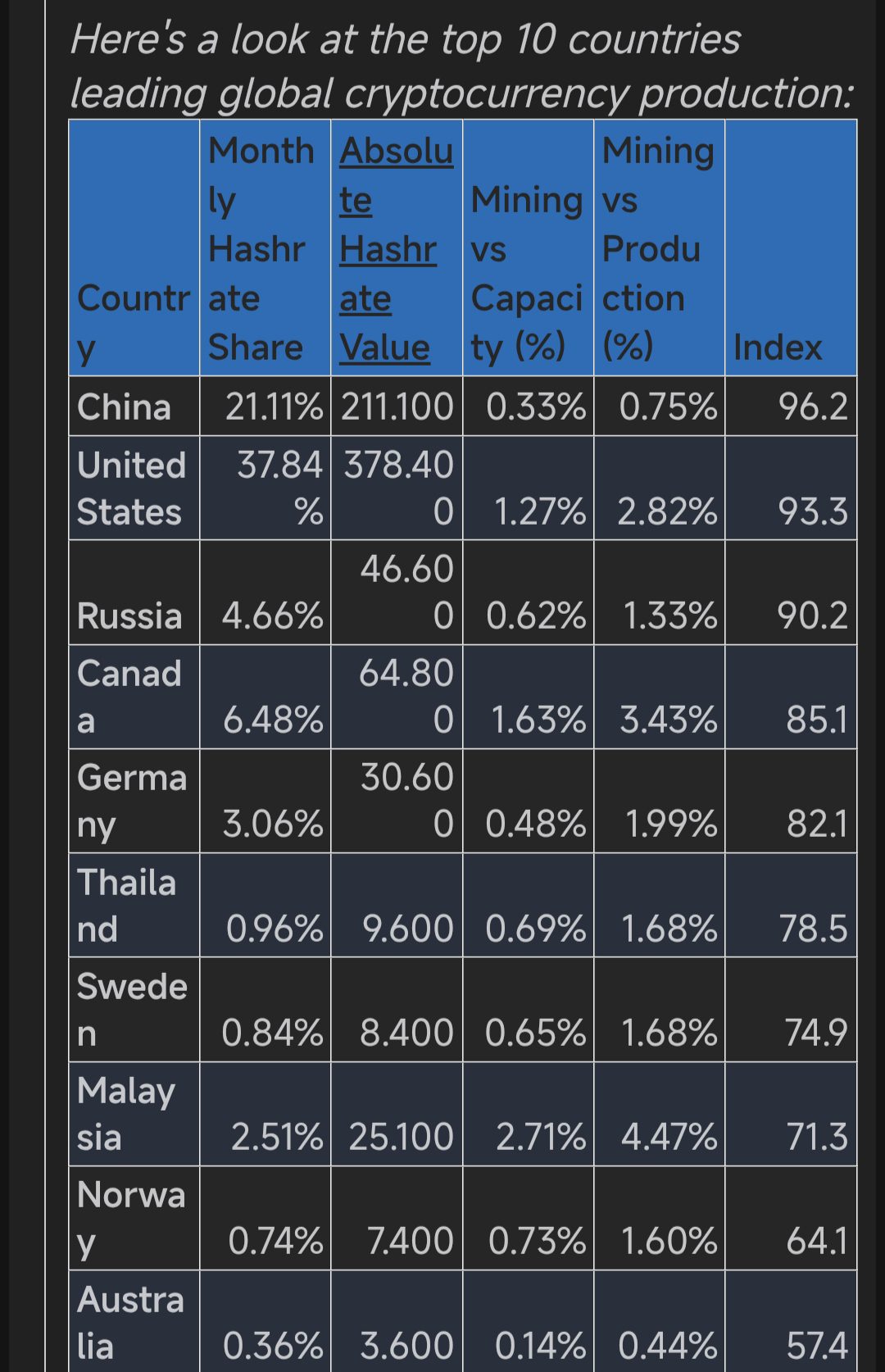 Top ten crypto-producing countries
Closely behind is the United States, responsible for 37.84 per cent of the global monthly hashrate share, more than a third of all global crypto mining activity. That makes the US the biggest crypto-mining nation in absolute terms.
However, this comes with a heavier impact on electricity systems: mining in the US accounts for 1.27 per cent of electricity capacity and 2.82 per cent of total power production. With a final index score of 93.3, the US remains a powerhouse, but the strain on infrastructure is clearly higher than China’s.
Also read: Crypto mining: Africa is missing out on a key pillar of the global digital economy
Other players: Russia, Canada, Germany and more
Russia takes third place with 4.66 per cent of global crypto mining output. Russian operations consume only 0.62 per cent of total electricity capacity, or 1.33 per cent of production, yielding an index score of 90.2.
Canada ranks fourth, contributing 6.48 per cent of the global hashrate while using 1.63 per cent of its electrical capacity, equal to 3.43 per cent of its total power production. That produced a score of 85.1.
In Europe, Germany leads with a 3.06 per cent share of global mining. German miners use just 0.48 per cent of the country’s electricity capacity, representing 1.99 per cent of national production. The country attained an index score of 82.1, cementing its place as the continent’s most efficient mining hub.

Beyond the top five, the report highlights several emerging or efficient mining nations. Malaysia, for instance, devotes nearly 5 per cent of its electricity production to mining, among the highest rates globally.
With 2.51 per cent of the global hashrate, Malaysia earned a 71.3 index score, showing how smaller economies can attract mining activity through heavy energy dedication. Other countries in the top ten include Sweden, Thailand, Norway and Australia, each with modest hashrate shares but varying energy-use patterns and grid impact.
What the data reveal, and why it matters
The study by ApeX Protocol evaluated countries across four metrics: share of global mining activity; total computing (hash) power; electricity-use efficiency; and stress on national power grids.
The final index reflects each country’s ability to balance large-scale production with grid stability. Under that lens, China’s mining machine stands out. Producing over a fifth of global crypto while using only a fraction of its power capacity gives it a clear edge.
The United States, while the largest in absolute mining terms, seems to carry a greater energy and infrastructure burden. Russia and Canada offer mixed models, combining decent output with moderate energy consumption.
Meanwhile, smaller or emerging mining nations such as Malaysia show how mining can take root in unexpected places, though their high proportion of energy production dedicated to mining raises questions about sustainability and grid stress.
 Crypto mining by location
Apex Protocol’s spokesperson noted that crypto mining “has become a serious economic sector that governments can’t ignore anymore.” The study underscores how even relatively small countries can influence the global mining landscape if they channel sizeable portions of their energy grids toward mining operations.
Yet that kind of energy dedication inevitably pushes up pressure on national power infrastructures, making it imperative for regulators to keep systems of checks and balances in place.
At a moment when energy policy, climate concerns and geopolitics increasingly shape the future of crypto, this report offers a clear barometer. It reveals where large-scale mining thrives, where it risks overburdening systems, and where there may still be room for growth, setting the stage for fresh competition among mining hubs and fresh scrutiny by regulators.


Spinny, an Indian online marketplace for used cars, is raising around $160 million as it moves to acquire car services startup GoMechanic, TechCrunch has learned.
The Series G round, which includes a mix of primary and secondary transactions, would value the 10-year-old startup at about $1.8 billion post-money, three people familiar with the matter said, broadly in line with its previous valuation.
Nearly $90 million of the round is primary, people said; Existing investor Accel has already wired about $44 million of that amount, with some details of the investment appearing in regulatory filings in India this week, which Indian outlet Entrackr first reported. A new investor is participating in the remaining portion of the primary, but TechCrunch could not confirm its specifics.
WestBridge Capital is doubling down in the new round with a check of a similar size to its previous investment, the people said. The firm invested about $35 million to $40 million in Spinny’s Series F round earlier this year.
Much of the secondary portion of the transaction is being sold by Indian VC firm Fundamentum, according to the people, while Blume Ventures is also expected to pare part of its stake.
Accel, Fundamentum, and Blume Ventures did not respond to requests for comments. WestBridge Capital declined to comment.
In March, Spinny raised $131 million in the first part of its Series F round led by Accel, with participation from Fundamentum, before expanding the raise to about $170 million in June to include WestBridge Capital. Those funds were earmarked to scale Spinny’s core used-car business.
Techcrunch event
San Francisco
|
October 13-15, 2026
However, the new round is being raised specifically to finance the acquisition of GoMechanic and invest in its platform, without drawing on the startup’s existing cash reserves, the people said. Earlier reports suggested Spinny could buy GoMechanic for around ₹4.5 billion (approximately $49.70 million) in a cash-and-stock deal.
A consortium led by Lifelong Group acquired GoMechanic in 2023 after the startup admitted to “grave errors” in its financial reporting. The startup had previously been backed by high-profile investors, including Sequoia Capital, Tiger Global, and SoftBank.
For Spinny, acquiring GoMechanic would deepen its control across the used-car value chain. The Gurugram-based startup has built a large consumer-facing business, selling about 13,000 used cars a month, primarily directly to buyers and, to a lesser extent, to dealers through its auction platform. Spinny operates its own large reconditioning centers to refurbish vehicles before sale and relies on third-party service shops for after-sales servicing of customer cars — a gap GoMechanic could bring in-house.
GoMechanic would also act as a “two-way” funnel for Spinny, a person familiar with the matter said. The platform would service vehicles bought or sold through Spinny, and help attract car owners who may not yet be customers. That could help expand Spinny’s vehicle supply without significantly increasing customer acquisition costs.
The acquisition comes as India’s used-car market is projected to grow at a compound annual growth rate of about 10% to roughly 9.5 million units by 2030, from nearly 6 million units today, per a recent report by Mahindra First Choice and Volkswagen Pre-owned Certified.
The GoMechanic deal would mark Spinny’s latest move to broaden its footprint in India’s automotive market. In recent months, the startup has expanded beyond used-car sales by acquiring auto publications Autocar India, Autocar Professional and What Car? India from London-based media group Haymarket, and by launching a non-banking finance company, Spinny Capital, to offer vehicle loans to customers.
Spinny co-founder and CEO Niraj Singh declined to comment.
TECHNOLOGY
Quick-hitting storm to dump up to 3 inches of snow on NYC as weather warnings issued for East Coast


A winter storm is coming to the Northeast starting on Saturday night and is set to blanket New York City and surrounding areas with the first measurable snowfall of the season.
Snow totals will be anywhere from one to three inches in the tri-state area, according to meteorologists.
Areas further north, including most of Connecticut, Massachusetts and Rhode Island, will likely see less than one inch of snow. In South Jersey, Delaware and Maryland, totals could range from three to five inches.
Precipitation will start as rain and move westward across the United States, NBC Weather reported. Across much of the region, Saturday temperatures will be above freezing before nightfall.
But by midnight, forecasters expect temperatures to drop to below freezing, which is when the rain will turn to snow.
Rain is expected to start at around 9pm ET and change over to snow by 12am. The storm will last for seven to eight hours and by 10am on Sunday, it will have likely moved over the Atlantic Ocean.
New York City, which usually gets its first major snowfall by this time of year, issued a weather alert through Sunday and has urged residents to be careful on the roads.
‘The winter season is in full swing, including all the winter weather that comes with it,’ Mayor Eric Adams said in a statement. ‘All New York City agencies are prepared for this system, and we continue to monitor conditions closely.’

A winter storm is set to descend on the Northeast. The storm will from the western United States throughout Saturday. New York City is expected to get its first snowflakes by 9pm ET Pictured: Central Park after a snowfall

New York City is expected to get two to two-and-a-half inches of snow across all five boroughs A file photo shows birds on a patch of snow in Central Park on February 12, 2025

The fountain of the World War II Memorial in Washington, DC freezed over during a cold snap earlier this month

The snowfall expectations for various regions in the Northeast and Central US
‘New Yorkers should all prepare too – avoid driving and give yourself extra travel time with public transit if you do need to travel, stay alert to changing conditions, and sign up for Notify NYC for real-time information updates,’ the mayor added.
The National Weather Service said an advisory is in effect for New York from 10pm Saturday until 1pm on Sunday.
New York City is expected to get two to two-and-a-half inches of snow across all five boroughs, and neighboring New Jersey could see anywhere from one to five inches.
‘While the location of any 5+ inch amounts is less certain, the greatest chance for this is across the I-95 corridor and immediately to the southeast in southern N.J.,’ the NWS said.
The latest storm comes after the central and eastern US experienced a significant cold snap for the first two weeks of December.
States south of New Jersey and New York are gearing up for tough travel day on Sunday.
Northern West Virginia and areas bordering it could see snow accumulation of five to nine inches overnight, according to an NWS alert.
‘Persons should consider delaying all travel. If travel is absolutely necessary, drive with extreme caution. Consider taking a winter storm kit along with you, including such items as tire chains, booster cables, flashlight, shovel, blankets and extra clothing,’ the alert said.
‘Also take water, a first aid kit, and anything else that would help you survive in case you become stranded.’
Ohio and western Pennsylvania could see four to seven inches.
Lake-effect snow warnings are in effect for central and western New York through at least Sunday afternoon.
Share or comment on this article:
Quick-hitting storm to dump up to 3 inches of snow on NYC as weather warnings issued for East Coast

A woman is facing felony charges in Evansville, Indiana over a DoorDash delivery in which she allegedly sprayed the food with a substance that made the customers vomit.
In a press release, the Vanderburgh County Sheriff’s Office said that it was contacted on December 7 by a man who said that he and his wife vomited and experienced a burning sensation in their mouth, nose, throat, and stomachs after eating fast food ordered through DoorDash.
The man told NBC News that he noticed something red had been sprayed on the delivery bag, so he checked footage from their doorbell camera. According to the sheriff’s department, the footage shows that after dropping off the food and taking a photo, the woman appeared to spray a substance towards the food from a small aerosol can attached to her keychain.
The sheriff’s department said that using DoorDash records, detectives identified the woman as Kourtney Stevenson of Kentucky, who told local police in a phone call that she had been working for DoorDash while visiting her father, and that she’d used pepper spray to spray a spider. But the department also said that with an overnight low of 35 degrees Fahrenheit, “outdoor spiders in Indiana are not active and would not be capable of crawling on exposed surfaces.”
When Stevenson allegedly declined to come in for an interview, detectives obtained a warrant to arrest her for battery resulting in a moderate injury and consumer product tampering. She is now awaiting extradition to Indiana.
A DoorDash spokesperson said in a statement that Stevenson has been banned from the platform.
“We have absolutely zero tolerance for this type of appalling behavior,” the spokesperson said. “The Dasher’s access to the platform has been permanently removed, and our team is supporting law enforcement with their investigation.”
Techcrunch event
San Francisco
|
October 13-15, 2026
The New York Times and NBC News both report that it’s not clear if Stevenson has a lawyer who can comment on her behalf.


YouTube channels spreading fake, anti-Labour videos have amassed more than a billion views this year, as opportunists attempt to use AI-generated content to profit from political division in the UK.
More than 150 channels have been detected in the last year that promote anti-Labour narratives, as well as outright fake and inflammatory accusations about Keir Starmer.
A study seen by the Guardian has found the channels have accumulated 5.3m subscribers and have created more than 56,000 videos, with a total of almost 1.2bn views in 2025. The network of anonymous channels includes alarmist rhetoric, AI scripts and British narrators to attract hits.
Starmer is personally targeted. The prime minister was either named in the video title or description 15,600 times.
Reset Tech, the non-profit group that produced the research, said the channels were part of a global trend to produce synthetic propaganda on the platform. It pointed to the proliferation of cheap AI tools that could be deployed to make a quick profit from divisive topics.
One channel called Britain News-night talked about Starmer and Reeves facing arrest. Another, TheUKPoliticalBrief, touted videos on the “explosive truth” about immigrant crime and marches on Westminster.
The UK NewsCore channel focused on how Nigel Farage was ousting Starmer, and claimed the prime minister was “sacked live” and thrown out of parliament.
Other videos featured bizarre, fabricated stories about a row between the royal family and the government. One channel, Gold Up!, said the dispute had left Starmer “melting down on live TV”.
Some of the videos and channels were removed by YouTube’s checks. However, all 150 were taken down when the platform was approached by the Guardian. Reset Tech said some channels had created tens or hundreds of similar videos without being deplatformed.
The research found similar channels operating in German, French, Spanish and Polish, targeting other politicians or political issues. In total, it mapped 420 problematic channels operating in Europe. Reset Tech said Russian-speaking creators operate some of the channels.
It is believed channels aimed at the UK were being driven by opportunistic creators trying to monetise political division over issues like immigration, rather than overseas political actors. However, it said their presence still posed a risk to public trust.
The content has caused concern inside Labour. “The rise of fake news online is a serious threat to our democracy,” a spokesperson said. “The public will be rightly alarmed that democratically elected leaders and institutions are being undermined by bad faith foreign state actors and those seeking to profit from misinformation.
“We’ve already seen attempts from overseas to influence fair elections and manipulate public opinion both here and abroad.
“The government is stepping up its efforts to work with online platforms to tackle this scourge on free and fair democracy. But it’s important that tech bosses take this threat seriously and live up to their obligations to remove this type of content wherever it’s found.”
Dylan Sparks, UK director of Reset Tech, called for YouTube to take swifter action. “Malicious actors are permitted by YouTube to spread synthetic ‘news’ that disrupts political debate in the UK, while also earning revenue from it,” he said. “This AI-generated, low cost content spreads across the platform undetected, revealing clear weaknesses in YouTube’s monetisation and content moderation systems.
“This specific network focuses on the prime minister and Labour government, but the same loopholes could be exploited by any hostile actor to push an agenda. Because social media platforms profit from engagement, their business model creates an in-built tension between enforcing their own policies and reducing the spread of malicious content that drives revenue.
“The rapid spread of AI has also introduced new risks to the online environment, and platforms need to move faster and invest more to address them.”
A YouTube spokesperson said: “Spam and deceptive practices that try to take advantage of the YouTube community are not allowed on the platform, which is why the channels flagged by the Guardian have all been removed.
“We enforce our policies consistently, regardless of political viewpoint expressed, or how the content is generated. Our teams work around the clock to monitor for harmful content, taking swift action as needed.”
YouTube is now working with Reset Tech over its findings. The platform said its systems prominently feature authoritative news content on the YouTube homepage, in search results, and through recommendations. It has removed more than 2.1m channels for violating its community guidelines.
Ministers have already formed an online advertising taskforce to see what action can be taken to address the advertising-based monetisation of harmful and misleading content.
TECHNOLOGY
Ancient lake that vanished 100,000 years ago RETURNS to California due to record rainfall

An ancient lake that disappeared from a California national park more than 100,000 years ago has dramatically returned following record-breaking rainfall.
The massive Ice Age lake roughly 100 miles long and 600 feet deep dried up between 128,000 and 186,000 years ago as the climate warmed in present-day Death Valley National Park, according to Los Angeles Times.
However last week the National Park Service (NPS) revealed the area had its wettest fall season on record, resulting in a rare return of the body of water.
‘These fall storms brought more rain than Death Valley typically receives in an entire year,’ the agency wrote in a news release.
Badwater Basin, one of the hottest places on Earth and the lowest point in North America at 282 feet below sea level, recorded 2.41 inches of rain in just three months.
Death Valley shattered a nearly century-old record in November, receiving 1.76 inches of rain and eclipsing the 1.70-inch mark set in 1923.
‘It’s an attraction, but it’s not really a lake,’ Katt, an employee at the Death Valley Inn, told the LA Times.
‘It’s the size of a lake but it’s not deep,’ she added. ‘It’s more like a very, very large riverbed without the flow – a wading pool maybe.’

Tourists have flocked to visit the newly returned body of water, informally known as Lake Manly, which has sprung up in Badwater Basin, one of the hottest places on Earth, following record-breaking rainfall

A massive Ice Age lake roughly 100 miles long and 600 feet deep which dried up between 128,000 and 186,000 years ago as the climate warmed in present-day Death Valley National Park, California has returned

Last week, the National Park Service (NPS) revealed the area had its wettest fall season on record, resulting in a rare return of the body of water
The lake reappeared more than two years after its last return in 2023, when Hurricane Hilary hit the state and dumped more than 2.2 inches of rain on the valley.
Then, in February 2024, the normally dry basin filled as Hilary’s remnants combined with 1.5 inches of rainfall from an atmospheric river.
Thanks to the continuous rainfall, the basin stayed deep enough for kayaking for several weeks. NASA measured the water at between 1.5 and three feet over six weeks in February and March of last year.
Videos showed visitors strolling through the lake’s shallow waters and reaching down to touch the basin.
Now, the lake – informally known as Lake Manly – has transformed into a smaller and shallower version of the one that formed after Hurricane Hilary swept through the park.
Nevertheless, the phenomenon has boosted business in Death Valley from 20 to 30 percent since the lake reappeared, the inn employee told The Times.
The staffer said that when the lake last returned in 2023, the inn was fully booked for several nights. Following recent storms, the inn has once again seen an increase in visitors, as it is only about seven miles from the park’s entrance.
She recently explored the newly formed lake and noted that in certain spots, the water came up to her knees.

It is not the first time the lake has returned, in February last year after the remnants of a hurricane combined with an atmospheric river to deluge the site. Pictured: Tourists wade in the lake in on February 18, 2024

The lake reappeared more than two years after its last return in 2023, when Hurricane Hilary hit the state and dropped more than 2.2 inches of rain on the valley. Pictured: People relax by the water’s edge during the lake’s last appearance in 2024

Thanks to the continuous rainfall, the basin stayed deep enough for kayaking for several weeks in 2024 before vanishing again
Officials have cautioned that no one can say how long the lake will persist before vanishing again and that it is unlikely to stick around for long.
The lake’s fate hinges on three things: how windy Death Valley gets, how warm it becomes and whether more rain arrives soon.
At such a low elevation, rainfall in the valley typically evaporates almost immediately due to the intense heat.
However, due to recent cooler temperatures, Death Valley park ranger Nichole Andler told the LA Times that visitors can expect to see the lake into the new year and possibly longer.
‘Some of the best views of the lake are from Dante’s View, and sunrise is a great time to see it,’ she added.
Long before the water dried up, hundreds of thousands of years ago, ice cloaked the Sierra Nevada while the vast lake stretched across what is now the Mojave Desert.
Today, the towering Sierra Nevada range blocks moisture from the Pacific, causing most of the rain to fall on the mountains’ western side.
But thanks to mountain rain shadows, Death Valley now averages roughly two inches of rain annually.

Now, the lake – informally known as Lake Manly – has transformed into a smaller and shallower version of the one that formed after Hurricane Hilary swept through

At such a low elevation, rainfall in the valley typically evaporates almost immediately due to the intense heat. Pictured: Visitors walk under the sun at Badwater Basin in Death Valley National Park, near Furnace Creek, during a heatwave impacting Southern California on July 7, 2024.
The recent storms have caused road closures throughout the park, with debris covering paved roads and making them impassable, according to the National Park Service.
Some of the park’s most popular sites – including Zabriskie Point, Dante’s View, Badwater Basin and Mesquite Sand Dunes – remain open and accessible.
‘If traveling on backcountry roads, visitors should proceed with caution,’ the agency wrote.
‘The water is about a mile from the Badwater parking lot and in most places, would not rise above the tops of your shoes,’ the release added.
‘Be prepared to self-rescue and always check current conditions before visiting.’
The National Park Service did not immediately respond to Daily Mail’s request for comment.

As we wrap up 2025 across the tech space, Technext decided to conduct a review of the Nigerian fintech ecosystem.
With that, this article seeks to chronicle outstanding milestones attained by Nigerian fintech startups during the year 2025.
For our methodology, we initially identified the top 20 fintechs in Nigeria in 2025 and tracked their activities throughout the year. While it was a tough pick, we arrived at the top 5 using. the. volume of the noted metrics and the perceived impact on Nigerians.
To add, we spoke to some founders and stakeholders. from the highllighted fintech startups to provided insights on what these milestones mean to their operations and what to expect. in the coming year, 2026.
1. Moniepoint
For Moniepoint, 2025 has been the year of accelerated growth built on the trust it has earned in the last 4 years.
Early in the year, the company processed over 1 billion transactions processed monthly. The number demonstrated rapid growth from the 800 million figure in October 2024, the month it raised $110M Series C funding and achieved a unicorn status.
Speaking with Technext on the milestone, Edidiong Uwemakpan, Vice President, Corporate Affairs, Moniepoint Inc, explained that the company has grown in the number of businesses it serves, which is reflected in its numbers. She added that Monipoint’s goal “is to ensure that we maintain that level of reliability as we get into the new year.”
If the exchange rate has been fair, the fintech’s monthly roundup would be much similar to what Safaricom’s M-Pesa does monthly.
 , Edidiong Uwemakpan, Vice President, Corporate Affairs, Moniepoint Inc
Edidiong mentioned that when businesses adopt Moniebook, it will help the company to “reliably serve them better, help them record their sales better and provide efficient bookkeeping and inventory management.”
With a surge in transactions facilitated per month and other milestones, Moniepoint is focused on growing its customer base, revenue and credit product in 2026.
“We’re giving to a lot more businesses around Nigeria, because we believe that’s the one way that Nigeria’s economy can really grow. If we have more people taking credits, expanding their business, and just boosting production as a whole,” Edidiong added.
Further proof of how the fintech company is its use of digital payment to drive financial inclusion. A recent report indicates that 7 in 10 fuel stations now use Moniepoint’s POS terminals.
You can read the full report here.
MILESTONES IN 2025
1. Now processing about 1 billion transactions in a month, worth N1 trillion.
2. Now serving 7 million businesses per month and 10 million active customers every month.
3. 7 in 10 POS nationwide use the Moniepoint POS terminal.
4. 20% or revenue comes from Credit offering.
5. Raised $90 million in a Series C funding round, pushing its valuation above $1 billion.
6. Launched Moniebook to help businesses manage daily operations.
2. Kuda Nigeria
In its Q1 2025 results, announced in July 2025, Kuda Nigeria recorded a milestone in its history.
The fintech company saw 300 million transactions worth N14.3 trillion ($9.3 billion) across its retail and business banking arms that quarter. In breakdown, retail banking accounted for N8.5 trillion ($5.5 billion), while business users processed N5.8 trillion ($3.7 billion).
 Kuda bank imposes charges of N50 on deposits above N10,000 or above
While its cross-border payment offering had earlier failed, the company relaunched the cross-border remittance with a multi-currency wallet that allows Kuda users outside Nigeria to send money directly to Nigerian bank accounts. The company earlier paused its remittance offering to strengthen its product in-house with Kuda’s core banking application.
In the same period, Kuda saw its paid transfers surpass free transfers for the first time. For free transfers, the fintech company processed almost N1 trillion in transfers, while it facilitated N3 trillion on non-free transfers.
In addition to its key milestone in Q1 2025, Kuda Nigeria saw rapid customer base expansion and successful funding rounds. As of mid-2024, the company reported 7.5 million users.
MILESTONES IN 2025
1. Processed over 300 million transactions worth N14.3 trillion in Q1 2025
2. Witnessed steady growth in transactions on the app.
3. Recorded more paid transfers than free transfers.
4. Relaunched cross-border remittance with a multi-currency wallet
3. Middleman
Earlier in the year, TechNext spotlighted 10 Nigerian startups to watch out for in 2025. And, Middleman made the list. So, it is no surprise the startup has done so much so far.
From an increase in user base to the launch of Middleman AI and the Version 2 (V2) rollout, the fintech company has witnessed tremendous growth in 2025. Its most popular offering, ‘Remit by Middleman’, is a channel for e-commerce entrepreneurs who import from China and pay their suppliers in RMB – Renminbi (China’s currency),
Speaking with Technext, Adeola Owosho, Co-founder of Middleman, noted that a shift from payments to doing more was a major game changer for Middleman in 2025.
“We soon learned that our customers wanted more than just payments. They wanted an end-to-end procurement platform that offers more in terms of factory checks, customisations, consolidation, packing, shipping and so on,” he said.
 Adeola Owosho, Co-founder at Middleman
At that point, the company upped the game by building an end-to-end stack. It also launched an AI sourcing assistant that provides customers with a more intelligent system on Chinese marketplaces.
Another milestone, according to Adeola, is that its procurement service raised the company’s gross margin from 2% to around 7%. “We’ve seen tremendous growth this month, and we’re pretty excited about our future,” he added.
Going into 2026, Middleman pictures an increased growth. “Next year is going to see us doubling down on our procurement service, building our agent network and also moving our procurement service fully in-app so that our users can have a more seamless experience,” Adeola said.
MILESTONES IN 2025
1. Rebranded and Launched procurement service.
2. Now processed almost ₦2 billion ($1.38 million) in total transactions.
3. Launch of Middleman AI with API integration
4. Crossed N2 billion in Gross Merchandise Volume (GMV)
5. Getting backed by Google
6. Now serving 12,000 users.
4. LemFi
The Nigerian-based Fintech company has had its hands full in 2025, including a lineup of new product launches and partnerships.
The startup kicked off the year with a $53 million Series B fundraise in January, bringing its total funding to over $86 million. It deepened its operation outside the shores of Africa, expanding to India, China, Pakistan, Brazil, and Mexico. With its acquisition and expansion in 2025, LemFi now operates in Europe, North America, Africa, and Asia.
In another notable partnership, LemFi collaborated with GCash to offer instant transfers for millions of Filipinos. The move saw LemFi connect the Filipino diaspora in North America and Europe to a trusted local financial tool.

LemFi processes $1 billion monthly, up from $2 billion in 2023, driven by $160 million monthly in its Asian corridor, which grew by 30 % month‑on‑month in its first year.
To wrap up 2025, the fintech company launched a “Global Accounts” product for Nigerians, enabling users to operate real USD and GBP accounts directly within the LemFi app and receive international payments.
MILESTONES IN 2025
1. Expanded to Egypt and Europe.
2. Secured $53 million in a Series funding round.
3. Acquired Pillar, a UK Credit Card Issuer.
4. Secured 14 U.S. State Money Transmitter Licenses (MTLs).
5. Now in 27 send-from markets and 20 send-to countries.
5. Palmpay
In 2025, Palmpay continued its driving force by topping its user base, which surpassed over 15 million in Q1. The fintech company has crossed 35 million subscribers, with each user doing about 50 transactions monthly.
The fintech company also announced a N4 billion interest payout to users of its PalmPay Wealth Product, signalling the increased trust and usage rate among customers.
 PalmPay
In March 2025, the company also launched Debit Cards, extending its digital banking ecosystem beyond the mobile app. Four months later, Palmpay received notable recognition, making CNBC’s top global fintechs for the second year in a row.
As the fintech company heads into its 7th year in 2026, it will be looking to increase its numbers and fuel its expansion plans into more African countries.
MILESTONES IN 2025
1. Crossed 40 million users while daily transaction volumes surpassed 15 million in Q1 2025.
2. Completed the first live transaction with Wema Bank on the Nigeria Inter-bank Settlement System (NIBSS) National Payment Stack (NPS).
4. Named in CNBC and Statista’s “Top 300 Global Fintech Companies” list for the second consecutive year.
5. Launched physical debit cards in partnership with Verve and AfriGo.
Honestly, if we were to select the top 10 Nigerian fintechs, we wouldn’t have exhausted the initial list. With respect to other fintechs, the above have excelled to merit the slot.

The ink was barely dry on Donald Trump’s artificial intelligence executive order when Gavin Newsom came out swinging. Just hours after the order went public Thursday evening, the California governor issued a statement saying the presidential dictum, which seeks to block states from regulating AI of their own accord, advances “grift and corruption” instead of innovation.
“President Trump and David Sacks aren’t making policy – they’re running a con,” Newsom said, referencing Trump’s AI adviser and crypto “czar”. “Every day, they push the limits to see how far they can take it.”
Trump’s executive order is a major victory for tech companies that have campaigned against legislative barriers to developing and deploying their AI products. It also sets up a clash between state governments and the White House over the future of AI regulation. The immediate backlash from groups including child safety organizations, unions and state officials has highlighted the deeply contentious nature of the order and diverse range of interests it affects.
Several officials and organizations have already questioned the legality of the executive order, stating that Trump does not have the power to undermine state legislation on AI and denouncing the decree as the result of tech industry lobbying. California, home to some of the world’s most prominent AI companies and one of the most active states legislating AI, has been a locus for pushback against the order.
“This executive order is deeply misguided, wildly corrupt, and will actually hinder innovation and weaken public trust in the long run,” California Democratic representative Sara Jacobs said in a statement. “We will explore all avenues – from the courts to Congress – to reverse this decision.”
After a draft version of Trump’s order leaked in November, state attorney general Rob Bonta said that his office would “take steps to examine the legality or potential illegality of such an executive order”, teeing up a precedent-setting duel between California and the White House.
Legislative loggerheads
In September, Newsom signed a landmark AI law that would compel developers of large, powerful AI models known as “frontier models” to provide transparency reports and promptly report safety incidents or face fines up to $1m. The governor touted the Transparency in Frontier Artificial Intelligence act as an example for how to regulate AI companies nationwide.
“Our state’s status as a global leader in technology allows us a unique opportunity to provide a blueprint for well-balanced AI policies beyond our borders,” Newsom said in an address to the California state senate. “Especially in the absence of a comprehensive federal AI policy framework and national AI safety standards.”
The September bill and more California legislation could be in Trump’s crosshairs. Thursday’s executive order calls for an AI litigation taskforce that would review state laws that do not “enhance the United States’ global AI dominance” and then pursue legal action or potentially withhold federal broadband funding. The taskforce will also consult with the administration’s AI and crypto “czar” to determine which laws to target.
Although Trump has framed the executive order as a means of streamlining legislation and removing onerously patchwork regulation, critics have alleged that the government has never provided any comprehensive federal framework for regulating AI to replace state laws. The order follows attempts to include similar AI moratoriums in bills earlier this year, which failed due to bipartisan backlash. Instead, opponents view the order as a gift to major tech companies that have cozied up to the administration over the course of the year.
“President Trump’s unlawful executive order is nothing more than a brazen effort to upend AI safety and give tech billionaires unchecked power over working people’s jobs, rights and freedoms,” AFL-CIO president, Liz Shuler, said in a statement.
Nationwide backlash
Within hours of Trump signing the order, opposition loudened among lawmakers, labor leaders, children’s advocacy groups and civil liberties organizations that decried the policy. Other California Democratic leaders said the executive order was an assault on state rights and the administration should instead focus on federal agencies and academic research to boost innovation.
“No place in America knows the promise of artificial intelligence technologies better than California,” said Alex Padilla, a senator for California. “But with today’s executive order, the Trump administration is attacking state leadership and basic safeguards in one fell swoop.”
Similarly, Adam Schiff, another California senator, emphasized: “Trump is seeking to preempt state laws that are establishing meaningful safeguards around AI and replace them with … nothing.”
Lawmakers from Colorado to Virginia to New York also took issue with the order. Don Beyer, a Virginia congressmember called it a “terrible idea” and said that it would “create a lawless Wild West environment for AI companies”. Likewise, Alex Bores, a New York state assemblymember, called the order a “massive windfall” for AI companies, adding that “a handful of AI oligarchs bribed Donald Trump into selling out America’s future”.
Even Steve Bannon, Trump loyalist and former adviser, criticized the policy. In a text message to Axios, Bannon said Sacks had “completely misled the President on preemption”. Mike Kubzansky, the CEO of Omidyar Network, a philanthropic tech investment firm that funds AI companies, similarly said “the solution is not to preempt state and local laws” and that ignoring AI’s impact on the country “through a blanket moratorium is an abdication of what elected officials owe their constituents”.
Blowback against the order has also included child protection organizations that have long expressed concerns over the effects of AI on children. The debate over child safety has intensified this year in the wake of multiple lawsuits against AI companies over children who died by suicide after interacting with popular chatbots.
“The AI industry’s relentless race for engagement already has a body count, and, in issuing this order, the administration has made clear it is content to let it grow,” said James Steyer, the CEO of child advocacy group Common Sense Media. “Americans deserve better than tech industry handouts at the expense of their wellbeing.”
A group of bereaved parents and child advocacy organizations have also spoken out. They have been working to pass legislation to better protect children from harmful social media and AI chatbots and released a national public service announcement on Thursday opposing the AI preemption policy. Separately, Sarah Gardner, the CEO of Heat Initiative, one of the groups in the coalition, called the order “unacceptable”.
“Parents will not roll over and allow our children to remain lab rats in big tech’s deadly AI experiment that puts profits over the safety of our kids,” Gardner said. “We need strong protections at the federal and state level, not amnesty for big tech billionaires.”
TECHNOLOGY
You’ve been drying your clothes wrong! Experts reveal the correct way to hang out your washing – and why you should NEVER put damp items on radiators

When the temperature drops, drying clothes can be a nightmare.
What might take 24 hours to dry in the summer months can take days in the winter – especially when it comes to thick jumpers and jeans.
You might be tempted to turn to the quickest fix – putting damp clothes on a warm radiator.
However, experts have warned against this hack.
Placing wet clothes on radiators can create hidden problems for your home, your heating system and your health, according to Plumbworld.
‘Drying clothes on radiators may feel convenient, but the hidden downsides — from extra moisture to reduced heating efficiency — make it a habit worth limiting,’ a spokeswoman said.
‘With a few simple changes, homeowners can protect their property, their health, and their heating system.’
As moisture evaporates from the clothes it raises indoor humidity, encourages condensation and increases the risk of mould – especially in small or poorly ventilated rooms.

You might be tempted to turn to the quickest fix – putting damp clothes on a warm radiator. However, experts have warned against this hack
Extra moisture and damp
Wet clothes release water into the air, which can settle on windows, walls, and ceilings. Over time, this may cause damp patches, peeling paint, and damaged plaster, Plumbworld said.
Musty smells can develop and linger, and the higher humidity creates the perfect environment for mould growth, particularly in colder corners of the home.
Impact on health
Increased humidity can irritate allergies, and people with asthma or other respiratory conditions may feel the effects more quickly.
Children, older adults, and those with pre–existing breathing problems are most at risk, the company warned.
Wasted heat and higher bills
Clothes covering a radiator block heat from spreading properly. This forces the heating system to work harder to warm the room, using more energy and increasing bills. Over time, trapped heat can reduce radiator efficiency and put extra strain on the boiler and heating components.

Safer ways to dry clothes indoors include using a clothes airer positioned near, but not directly on, a radiator, Plumbworld suggest
How to safely dry clothes in winter
- Use a clothes airer positioned near, but not directly on, a radiator
- Open windows briefly to let moisture escape
- Use a dehumidifier to reduce damp and speed up drying
Safety concerns
Synthetic or heat–sensitive fabrics placed on very hot radiators could become a hazard, and moisture near thermostatic radiator valves (TRVs) may affect how reliably they work.
Fabrics in direct contact with a heat source can overheat. Although modern radiators are designed with safety in mind, the risk increases if the radiator is old or if clothes are left unattended for extended periods.
Poor indoor air quality
As damp laundry heats up, it releases moisture along with small traces of detergent and fabric conditioner.
In homes with limited ventilation, this can make the air feel stuffy and uncomfortable.
So, what should you do instead?
Thankfully, there are other methods that can help remove moisture from your clothes quickly – with less of a risk.
Safer ways to dry clothes indoors include using a clothes airer positioned near, but not directly on, a radiator, Plumbworld suggest.
Its experts also suggest opening windows briefly to let moisture escape, and using a dehumidifier to reduce damp and speed up drying.
Over–radiator drying racks are safer as they let warm air circulate freely, while checking boiler pressure occasionally can help the system run efficiently.
Finally, keeping radiators clear and bleeding them if the top feels cold will boost their effectiveness.
The company has previously issued advice on how often to wash a commonly–overlooked item – the bath mat.
Giving it a clean once or twice a year simply isn’t enough, it said, adding that they should be washed weekly on a hot cycle.
How often should you wash clothes?
Underwear: 1 wear
Socks: 1 wear
Bras: 2-3 wears
Jeans: 6-10 wears
T-shirt: 1-2 wears
Sweatshirt: 5-6 wears
Workout gear: 1 wear
Pyjamas: 3-4 wears
Whites: 1-2 wears
Skirts: 5-7 wears
Dresses: 1-3 wears
Coats: 1-2 washes per season
Swimwear: 1 wear
Hats & gloves: 2-3 washes per season
TECHNOLOGY
Revealed: What your character in the Nativity play says about you – and it’s bad news if you were cast as a donkey

Whether you took the lead as Mary or Joseph or were relegated to the back as sheep number three, the school Nativity play is a rite of passage for many British children.
But how you were cast in your Christmas performance might reveal a surprising amount about your personality.
Psychologists say that the personality differences that make one child an excellent angel and another a perfect shepherd can shape our entire lives.
And it’s bad news if you ended up playing the donkey.
According to experts, children who end up as the donkey are usually the ‘class clown’ and like to make others laugh.
However, these positive traits can also be signs of a need for attention and recognition from others.
If you ended up as Mary or Joseph, on the other hand, psychologists say you are likely to be a natural leader who would make a ‘potential future Prime Minister’.
So, what does your Nativity play role say about you?

The school Nativity play is a rite of passage for many British children. Now, psychologists have revealed what your role says about your personality (stock image)
Mary and Joseph
With these characters taking the centre stage in the drama of the Nativity, any child able to meet the challenge will need to have plenty of confidence.
Dr Sheila Redfern, clinical psychologist and author of ‘Reflective Parenting: Raising Emotionally Healthy Children’, told Daily Mail: ‘The child who gets picked to be Mary is likely to be bold and confident and a potential future Prime Minister.’
‘They are probably the most popular girl in their class and always get invited to parties.’
Similarly, any boy willing to step up into the role of Joseph will need similar leadership abilities.
‘To embody a lead role, a young child needs to feel self-assured and confident in themselves,’ says Dr Redfern.
‘He’s also likely to be the popular boy in the class and will be confident and self-assured.’
She adds that people who played Joseph in school likely went on to be head boy or to take on other leading positions.

As the lead characters, anyone who was cast as Mary or Joseph is likely confident and popular. These roles may go on to succeed in politics and are the most likely to become a future Prime Minister (stock image)
What your Nativity play role says about you
Mary: Confident, popular, and the most likely to become Prime Minister
Joseph: Self-assured, confident, the most popular in their class
Narrator: Engaging, trustworthy and smart. Likely to do well in business
Innkeeper: A natural-born leader who is used to commanding respect
Wiseman: Serious-minded and focused. May be drawn to an interest in psychology
Angel: Fearless, self-assured, and doesn’t care what others think
Donkey: Likely the class clown. Keen to make others laugh and happy to laugh at themselves
Shepherd: Quietly confident and secure in their own ego
Sheep: Shy and uninterested in fame, but with great potential to develop
However, psychologists also say that there may be more behind a child’s desire to take the leading role than a love of performance.
Dr Kirsten Antoncich, a child psychologist from Birmingham City University, told Daily Mail: ‘We learn from a young age how to recruit love, attention and praise from our parents.
‘When we have parents who really want their children to be front and centre on stage, children can quickly pick up on this and internalise it as their own wishes.
‘For the child taking the lead role, it could very well be their own creativity that drives them… or it could be a way of ensuring parental praise and recognition.’
Narrator
Besides the holy family itself, one of the most important roles in the Nativity is that of the narrator.
This role requires great memory to recall plenty of lines and a natural flair for the dramatic.
If you took on this role in school, you likely went on to use those skills to go far in your career.

People who took on the role of narrator in their Nativity play are interesting, engaging, and smart. These people may go on to become actors in the future. Pictured: David Tennant (left) and Mark Wootton (right) in Nativity 2
Dr Redfern says: ‘The narrator needs to hold everyone’s attention and so above all, they must be interesting, engaging, smart and trustworthy enough to remember all those lines.
‘The personality of a good narrator is likely to be someone who is a great organiser of others. The narrator will go far in life and be trusted and respected by others.’
However, with this much natural charisma, Dr Redfern says that narrators are much more likely to end up as aspiring actors than accountants.
Innkeeper
The innkeeper might not have the most lines in the play, but their declaration of ‘no room at the inn’ is probably one of the most impactful.
And, if you were chosen to deliver those pivotal lines as a child, it could mean you are not someone to be argued with.
‘The child who takes on this role could be a future CEO or Head teacher. They command respect and attention,’ says Dr Redfern.
‘This role is made for a natural-born leader with a loud, confident voice, who is used to being taken seriously.

The three kings or wisemen are serious-minded and aren’t attracted to stardom. However, they are also natural leaders who may develop an interest in psychology (stock image)
‘They are probably cheeky and outspoken and will go far in life.’
Wiseman
Whether you call them the wisemen, kings or Magi, these three characters with their gifts of gold, frankincense, and Myrrh are a key part of the Christmas story.
But, as well as having an excuse to wear the best costumes, anyone who was cast as a wiseman was also given a lot of responsibility.
Dr Redfern says that the role is likely to go to ‘a serious-minded child who has depth and isn’t attracted to the obvious “star” or ‘showy role of Joseph or the angel.’
She adds: ‘The wise man is a leader and also needs to be trusted with an expensive prop.
‘The role could inspire a child to be drawn towards something psychology-oriented.’
Angel

If you were an angel in your school nativity play, it means that you are likely self-assured and don’t care what other people think about you. Pictured: Children dressed as angels, from St Joseph’s Nursery, Dublin
The 5 Christmas story elements that don’t appear in the Bible
- Jesus was not born on a ‘silent night’
- There was no ‘little donkey’
- In fact, there were no animals at all
- There was no inn keeper or stable
- There may not have been three kings
Tasked with leading a rousing chorus of ‘Silent Night’ or ‘Away in a Manger’, the Angels are the musical backbone of the Nativity performance.
According to psychologists, anyone who was bold enough to make this role their own must have had a strong confident streak.
Dr Redfern says: ‘This role is likely to be taken by the type of child who is so self-assured they don’t care what others think about them.
‘Because let’s be honest, singing in front of your peers is likely to invite in teasing and ridicule unless you are super confident.’
And even if your performance was lacking in skill, making up for that in enthusiasm could be a sign of some really positive personality traits.
Dr Antoncich explains: ‘Children singing out of tune or too loud or doing the wrong dance moves can often signal an appropriately joyful exuberant side which doesn’t yet feel shame at standing out.
‘The child who sings too loudly could very much be the child who is engrossed in what they are doing, having a whale of a time and being appropriately carefree.’
Donkey

The donkey is often the class clown who likes to make others laugh. However, psychologists say the need to be at the centre of attention could mask some psychological issues (stock image)
Of course, where would Mary and Joseph be without their faithful donkey to carry them to Jerusalem?
If you were the one to be cast in this often comedic role, it might mean that you were something of a class clown.
‘They are self-assured enough not to need a star role, or to need to seek affirmation constantly for how they look, but they are usually popular because they are a bit quirky and can make others laugh,’ says Dr Redfern.
However, psychologists say that the need to make others laugh could be a sign of psychological issues.
Dr Antoncich says: ‘For children who have been used to recruiting attention through being the class clown, the sudden loss of this performative role and the recognition that comes with it can drive them to try and recapture it by being silly in front of others.
‘Disruptive behaviour could mean a number of things; often it masks deeper issues.
‘Some children can find the attention on them for something out of their comfort zone, like singing, unsettling and try to deflect it onto something they are more used to being noticed for, such as messing around.’
Shepherd

Shepherds might not be the most glamorous role, but experts say that they are confident and humble. Someone cast in this role is also likely to have great attention skills and doesn’t get distracted easily
With a tea-towel on their head and a crook in hand, the shepherds don’t command quite as much respect as the other roles in the play.
However, according to the experts, that could be a good sign for your psychological development.
‘The child who plays a shepherd is not afraid to look silly, as they will have to confidently wear a towel on their head and look humble doing so,’ says Dr Redfern.
She adds that anyone who was cast in this important role is likely to be ‘quietly confident and secure enough in their ego they don’t need to prove anything.’
While the shepherds don’t have many lines, they do need to spend a lot of time on stage without fidgeting or causing a disturbance.
According to Dr Redfern, children who develop these skills earlier than their peers may go on to do well in their careers.
She says: ‘They are going to need to have great skills of attention and not be highly distractible.’
Sheep and other animals

If you were a sheep or any other animal, such as a penguin, you might be more shy and less interested in the limelight. However, children cast in these smaller roles have the most potential to develop with the right support. Pictured: The Secret Life of Children at Christmas
With more children in a class than there are big roles, many will end up filling up the motley crew of assorted animals, ranging from sheep and cows to cats and lobsters.
For any children drawn to these roles, it might be a sign that they are shyer or less confident than their peers.
Dr Antoncich says: ‘For some children, being looked at or being perceived can feel uncomfortable – if you think of the child who blushes or the children who find it hard to speak in front of others.’
Dr Antoncich says that these children might need more help and support to develop, but this is not necessarily a bad thing.
Professor Claire Hughes, a psychologist at the University of Cambridge, told Daily Mail that people cast as animals might be classed as so-called ‘orchid children’.
Professor Hughes says: ‘These are children who need more nurturing. In the past, people might have referred to them as “vulnerable”, but scientifically, we know that doesn’t make sense.
‘The same children might be more buffeted by challenging circumstances, but they are also children who respond particularly well when there’s an intervention that makes things better for them – they are more malleable, more adaptable.’
So, if you were a shy sheep hiding at the back, it may mean that you had the most potential to develop and grow as an adult.
WHAT DO PEOPLE BELIEVE ABOUT THE TRADITIONAL BIRTHPLACE OF JESUS?
The Church of the Nativity, located six miles (10 km) outside of Jerusalem, is one of the most important religious sites in the world.
It has been recognised as the birthplace of Jesus since at least the Second Century and has been listed as a Unesco world heritage site since 2012.
The original church was built in 339 AD, but was rebuilt after fire in the 6th century and it is one of the oldest churches in the world still in daily use.
An estimated two million people make pilgrimages to the site each year to visit the church and the shrine below, the Grotto, where Jesus of Nazareth is believed to have been born.
But the region is of key importance to other religions as well. Almost 1,000 years before Jesus, Bethlehem was the city of King David.
Today, the site in Bethlehem is part of a large religious complex.
Set in the marble floor of the Grotto is a silver star which represents the spot where Jesus was born, installed in 1717 and surrounded by lamps to represent the different Christian communities.

The Lagos State University (LASU) has introduced regulations for activities surrounding cinematographic activities (content creation) across the campuses. The move follows the bandit prank that caused pandemonium among students on campus.
The disclosure was contained in a press statement released on Friday night on its official Facebook page, signed by Oluwayemis A. Thomas-Onashile, Deputy Registrar/Coordinator, Centre for Information and Public Relations, LASU. It noted that the move is an attempt to maintain the University’s status and integrity and preserve sanity.
In the statement, LASU noted that all students, individuals who wish to engage in cinematographic activities on the University campus, must first obtain approval from its Centre for Information and Public Relations (CIPR).
“This includes, but is not limited to, the shooting or recording of videos such as skits, vox pops, short films, promotional content, or any other form of audiovisual material within the University premises, hostels, or associated facilities,” it added.

With the regulation, the management aims to curb the unauthorised use of its facilities for ‘offensive’ content that misrepresents the University’s values and image.
“Such materials have the potential to cause reputational harm and undermine the integrity of the University as a respected citadel of learning and character development,” part of the statement reads.
In addition to the regulation of content creation, LASU has also reviewed the use of drones within its campus. The management noted that students and the general public who want to use drones in the University environment must now obtain approval from the Security Department.
“This measure is to ensure the safety, privacy, and security of all members of the University community,” it added.
Backstory
The latest development comes after the University had earlier distanced itself from authorising the bandit pranks, which caused pandemonium across the University community.
In a press release on Sunday, December 7, 2025, LASU frowned at the video, stating that it does not support any prank that can incite fear, disrupt campus peace, or threaten the sense of safety of its students and staff.
“LASU strongly condemns acts or content that portray or suggest banditry, terrorism, or violent extremism,” it said.
 Bandit prank on Lasuites
On Friday, December 5, 2025, a viral video titled “Bandits Prank on Lasuites,” reportedly created and uploaded by Datreez Entertainment TV, circulated across social media platforms. The video depicts individuals dressed in a manner that created immediate fear and panic while entering LASU with equipment and prompting distress amongst students.
The video prank comes at a time when the Nigerian community is facing significant national security challenges. It has also faced several criticisms by Nigerians who depict it as an attempt to make a jest at a time at a critical time.
Also Read: MoMo PSB launches ₦10 bus rides for UNILAG students through new EV partnership.
Not only LASU
This isn’t the first time a Nigerian university has regulated content creation within its environment.
In October, the University of Lagos (UNILAG) prohibited the unauthorised use of its campus, including hostels and other facilities, for video production by skitmakers, filmmakers, and content creators.
According to the University management, the move is to curb the increasing use of its campus for video production. In addition, it’s an attempt to protect the academic environment and preserve the institution’s image from misrepresentation in unregulated productions.
With the rising regulation of content creation, in addition to critics surrounding ethical considerations, content creators