
TECHNOLOGY
VCs discuss why most consumer AI startups still lack staying power


Even three years after the generative AI boom started, most AI startups are still making money by selling to businesses, not individual consumers.
Although consumers quickly adopted general-purpose LLMs like ChatGPT, most specialized consumer GenAI applications have yet to resonate.
“A lot of early AI applications around video, audio, and photo were super cool,” said Chi-Hua Chien, co-founder and managing partner at Goodwater Capital, on stage at a TechCrunch’s StrictlyVC event in early December. “But then Sora and Nano Banana came out, and the Chinese open-sourced their video models. And so, a lot of those opportunities disappeared.”
Chien compares some of those applications to the simple flashlight, which was initially a popular third-party download after the iPhone launched in 2008 but was quickly integrated into iOS itself.
He argued that, just as it took a few years for the smartphone platform to solidify before game-changing consumer apps emerged, AI platforms need a similar period of “stabilization” for lasting AI consumer products to flourish.
“I think we’re right on the cusp of the equivalent to mobile of the 2009 -2010 era,” Chien said. That period was the birth of massive mobile-first consumer businesses like Uber and Airbnb.
We could be seeing inklings of that stabilization with Google’s Gemini reaching technological parity with ChatGPT, Chien said.
Techcrunch event
San Francisco
|
October 13-15, 2026
Elizabeth Weil, founder and partner at Scribble Ventures, echoed Chien’s sentiment about the early days of GenAI, describing the current state of consumer AI applications as being in an “awkward teenage middle ground.”
What will it take for consumer AI startups to grow up? Possibly a new device beyond the smartphone.
“It’s unlikely that a device that you pick up 500 times a day but only sees 3% to 5% of what you see is going to be what ultimately introduces the use cases that take full advantage of AI’s capabilities,” Chien said.
Weil agreed that a smartphone may be too limiting for reimagining consumer AI products in large part because it is not ambient. “I don’t think we’re going to be building for this in five years,” she said, indicating her iPhone as she showed it to the audience.
Startups and incumbent tech companies have been racing to build a new personal device that can supplant smartphones.
OpenAI and Apple’s former design chief, Jonny Ive, are working on what’s rumored to be a “screenless,” pocket-sized device. Meta’s Ray-Ban smart glasses are controlled by a wristband that detects subtle gestures. Meanwhile, a number of startups are trying, with often disappointing results, to introduce a pin, pendant, or ring that uses AI in a way different from how smartphones do.
However, not every AI consumer product will be dependent on a new device. Chien suggested that one such offering could be a personal AI financial adviser customized to the user’s specific needs. Similarly, Weil anticipates that a personalized, “always-on” tutor will become ubiquitous, with its specialized tutelage delivered directly from a smartphone.
Though excited by AI’s potential, Weil and Chien expressed skepticism about the emergence of several, still-stealthy AI-powered social network startups. Chien said these companies are building networks where thousands of AI bots are interacting with the user’s content.
“It turns social into a single-player game. I’m not sure that it works,” he said. “The reason that people enjoy social networking is the understanding that there are real humans on the other side.”

In early 2023, Luminar was riding high. After going public during the pandemic and scoring a key deal with Volvo, the company had added Mercedes-Benz and Polestar as customers of its “lifesaving” lidar sensors. Founder and CEO Austin Russell called it an “inflection point,” as Luminar prepped to have those sensors integrated into the first production vehicles.
Volvo in particular was all in on the technology. The Swedish automaker, which spent decades building a brand around the idea of making the safest cars, was the first to jump at integrating the laser-based sensors in its vehicles. Volvo initially tapped Luminar to provide 39,500 lidar sensors over the life of a deal signed in 2020. In 2021, Volvo upped that to 673,000. And in 2022, Volvo upped it again, this time to 1.1 million sensors.
Three years later, Luminar is now in bankruptcy. The company has already made a deal to sell off one subsidiary centered around semiconductors and is looking to sell its lidar business during the Chapter 11 process, which began on Monday.
The first batch of filings in the bankruptcy case shed new light on how Luminar’s cornerstone deal with Volvo came apart — and how its undoing helped push the once-promising startup over the edge.
Big promises, then big revisions
Luminar made “substantial up-front investments in equipment, facilities, and workforce” to meet the demand from Volvo back in 2022, according to a declaration written by Luminar’s newly hired chief restructuring officer Robin Chiu. It built out a manufacturing facility in Monterrey, Mexico, and spent nearly $200 million to prepare to make its Iris lidar sensors for Volvo’s EX90 SUV.
“Volvo was going to be a marquee customer, the stepping stone to introducing the company’s Iris product to the broader automotive industry,” one of Luminar’s lawyers said during the first hearing in the bankruptcy case on Tuesday.
But, according to Chiu, problems were already brewing with Volvo. The automaker delayed the EX90 SUV because it needed to do more “software testing and development,” the automaker said in 2023. And in early 2024, Luminar says Volvo reduced its expected volume for Iris sensors by 75%.
Techcrunch event
San Francisco
|
October 13-15, 2026
Luminar’s other deals started to sour, too. Polestar (a subsidiary of Volvo) quietly gave up on integrating Luminar’s lidar sensors “because the vehicle’s software ultimately could not use” the features, according to Chiu. Mercedes-Benz terminated its agreement to buy Luminar’s Iris sensors in November 2024 because the lidar-maker “failed to meet ambitious requirements,” according to Chiu.
(Mercedes-Benz struck up a new deal with Luminar in March 2025 for its next-generation Halo lidar, but Chiu wrote that Luminar has “no go-forward projects” with the German automaker at the time of bankruptcy.)
This left Luminar with Volvo as its lone flagship customer.
The company never diversified much beyond the automotive industry, shunning other applications like defense or robotics. In fact, Russell had founded Luminar in 2012 with the goal of taking lidar out of those sectors and into automotive to help accelerate the adoption of autonomous vehicles.
It wasn’t until March of this year that Russell talked about expanding beyond automotive, as Luminar signed a deal with construction equipment company Caterpillar. Just two months later, Russell abruptly resigned following an ethics inquiry from Luminar’s board of directors.
“More bad news”
By Chiu’s account, Volvo kept promising that it would meet the lifetime order of 1.1 million units despite the reduced volume in 2024. So Luminar kept pressing forward under that assumption.
But signs of stress were showing. Luminar laid off 20% of its workforce in May 2024 and outsourced more of its lidar sensor manufacturing. It deepened those cuts and restructured some of its business in September 2024. Another round of layoffs came in May 2025 after Russell resigned.
In September, “Volvo delivered more bad news,” Chiu wrote. The automaker decided to offer lidar as an option on the EX90 going forward, instead of making it a standard feature as originally planned. Volvo also told Luminar that it was shelving lidar on future vehicles “as a cost-cutting measure.”
“This change reduced Volvo’s estimated lifetime volumes by approximately 90%,” Chiu wrote.
Luminar told Volvo on October 3 that it considered this a breach of the agreement the companies had first signed in 2020. On October 31, the dispute became public, as Luminar told shareholders in a regulatory filing that it was suspending sensor shipments to Volvo. The Swedish automaker sent Luminar a letter two weeks later, terminating the agreement.
Volvo told TechCrunch in a statement Tuesday that it “made this decision to limit the company’s supply chain risk exposure and it is a direct result of Luminar’s failure to meet its contractual obligations to Volvo Cars.”
“The company’s products can deliver a high level of safety and driver support, enabled by the cars’ powerful core computing coupled with their advanced sensor set – with or without a lidar,” a Volvo spokesperson said.
Luminar, meanwhile, started selling lidar sensors meant for Volvo “to adjacent markets in an effort to recover its sunk costs,” according to Chiu’s filing, but it was too little too late.
“As its relationship with Volvo deteriorated, [Luminar] worked tirelessly to identify new customers, but was ultimately unable to enter into production with any new customers in a timely fashion,” Chiu wrote. “The public Volvo dispute also resulted in a decline in sales due to broader market concerns over Luminar’s financial future.”
Now the future of what’s left of Luminar is in the hands of its creditors and the court. It’s seeking the judge’s approval to sell the semiconductor subsidiary to Quantum Computing, Inc. for $110 million, and hopes to court a number of bidders for the lidar business.
Luminar has already had significant interest in the lidar business, according to the filing. In January, Chiu wrote, the company hired investment bank Jefferies to evaluate a sale after receiving an “unsolicited acquisition proposal.” Luminar received “additional unsolicited inbound expressions of interest to acquire the Company” through the summer and fall — including one submitted by Russell through his new AI lab in October.
As TechCrunch reported Monday, Russell plans to keep bidding on Luminar’s remains as the bankruptcy case moves forward. During Tuesday’s hearing, a lawyer for Luminar said it is “deep into the sale process” and “in negotiations with” several potential bidders.
This story has been updated with a statement from Volvo and information from Luminar’s first bankruptcy hearing.


Luno has announced a strategic partnership with AltSchool Africa to launch a free crypto education programme for 15,000 Nigerians. The beginner-friendly course will begin in March 2026, run through the year, and mark what both companies describe as Africa’s largest coordinated crypto literacy initiative to date.
Announced earlier today in Lagos, the partnership brings together Luno, a global cryptocurrency platform, and AltSchool Africa, an accredited online learning provider, to deliver a fully funded beginner course titled Demystifying Crypto for Africans.
The programme is designed to improve financial literacy, build trust in digital assets, and encourage safer participation in the rapidly expanding digital economy.
Nigeria remains one of Africa’s most active crypto markets. Around a third of the population already engages with digital assets, driven largely by a young, tech-savvy demographic seeking alternatives for savings, remittances, and global trade.
However, the speed of adoption has also exposed significant gaps in knowledge, leaving many users vulnerable to misinformation, scams, and poorly understood financial risks.
 Ayotunde Alabi, CEO of Luno Nigeria
Combining Luno’s focus on responsible crypto use with AltSchool Africa’s experience in delivering accessible digital education, the initiative aims to provide structured, practical learning grounded in African realities.
The course content is tailored to everyday use cases, rather than speculative trading alone, with a strong emphasis on safety and informed decision-making.
Luno and AltSchool are building practical crypto skills for everyday use
The programme will run from March 2026 through the end of the year and will be delivered in three cohorts of 5,000 learners each. Cohort one commences in March 2026 after applications in January and February. Cohort two starts in July 2026. Cohort three follows suit in November 2026. The organisers say the staggered approach will allow them to refine delivery and scale support.
The programme will be led by Web3 educator Abdulsamad Tiamiyu and structured as a three- to four-week course, with learners receiving up to one year of access to materials.
Participants will move through five core modules covering the fundamentals of cryptocurrency, blockchain technology, wallets, exchanges, stablecoins, and research tools such as CoinGecko and Etherscan. The curriculum blends theory with hands-on experience, allowing learners to interact directly with digital tools they are likely to encounter in real-world financial activities.
Those who complete the assessments will receive an AltSchool Africa Certificate of Completion.
 Adewale Yusuf, CEO and Co-Founder of AltSchool Africa
Ayotunde Alabi, CEO of Luno Nigeria, described the partnership as a timely intervention. He said that as crypto adoption accelerates across Africa, education must keep pace to ensure people can participate securely and sustainably. According to Alabi, the initiative reflects Luno’s long-term investment in building trust and integrity within the digital asset ecosystem, while helping users turn perceived risk into meaningful economic opportunity.
Adewale Yusuf, co-founder and CEO of AltSchool Africa, echoed the same sentiment, framing the programme as an investment in economic empowerment. He noted that access to clear, practical education is essential if Africans are to participate fully in the global digital economy and said AltSchool was proud to collaborate with a partner that prioritises clarity and measurable impact.
The programme is open to Nigerian residents aged 18 and above who can commit to completing the course within four weeks. Applicants must have, or create, a Luno account before enrolling. Applications open in January 2026 via the AltSchool Africa portal, with successful candidates notified within one week.
Also read: Luno launches first-ever crypto staking in Nigeria: What it means and how you can benefit


Australian Prime Minister Anthony Albanese today described the deadly terrorist attack at a Hanukkah celebration at Sydney’s Bondi Beach as being “motivated by Islamic State ideology.” But, this may be an understatement.
The father and son pair who carried out the attack on Sunday, killing at least 15 people and wounding 40, traveled to the Philippines last month, to an area where an Islamic State, commonly known as ISIS, affiliate is active. According to Australian media reports, the two received military training there.
That means the attack is more than just motivated by ISIS; it’s an ISIS-“directed” or at least “enabled” attack, Colin Clarke, counterterrorism analyst and executive director of the Soufan Group, told Vox. “Clearly this wasn’t just two guys sitting around reading Telegram deciding that they want to hatch a plot,” Clarke added.
The Bondi Beach massacre came a day after a gunman, believed by the Pentagon to be affiliated with ISIS, killed two US soldiers and a civilian interpreter in Syria — the first American casualties in the country since the fall of Bashar al-Assad one year ago.
The perpetrators was a member of the Syrian security forces, a grim echo of similar “green on blue” attacks in which local forces attacked the Americans they were partnered with that dominated the final years of US military operations in Afghanistan.
The two high-profile attacks in one weekend, coming at a time when western governments have largely shifted attention from jihadist violence to other threats, raise the discomfiting question: Is ISIS back?
To be sure, ISIS is not the same group it was a decade ago, when it controlled an area the size of Great Britain in Syria and Iraq and had as many as 80,000 fighters in its ranks. Now, the territorial “caliphate” has been entirely eliminated, and its numbers have probably shrunk to less than 3,000.
ISIS’s attacks and grisly beheading videos once dominated global headlines, prompting a major US military intervention in the Middle East. Now, jihadist-motivated attacks — by ISIS or other groups — are now far outnumbered by attacks by right-wing and left-wing extremists in the United States. And numbers are way down in Europe, as well.
But, the truth is that ISIS never really went away. This year began, after all, with an ISIS-inspired car attack in New Orleans that killed 15 people. Last year saw mass casualty attacks by the Afghan affiliate ISIS-K in Russia and Iran, as well as a thwarted plot targeting a Taylor Swift concert in Austria.
Most of the recent ISIS violence, however, has taken place in the countries where the group’s various affiliates are based. This includes Syria, where the number of attacks are up since Assad’s downfall and the removal of a significant number of US troops. But, the group is believed to be growing fastest in Africa, with major affiliates operating in West Africa’s Sahel region, the Democratic Republic of the Congo, and Somalia.
Little is known about ISIS’s current global “caliph” — Abu Hafs al-Hashimi al-Quraishi, who took over in 2023. According to some reports, he is based in Somalia. Even though the group is no longer a physical “state” in any sense, experts believe there’s still a high degree of centralization and coordination between its various affiliates throughout Africa, Asia, and the Middle East.
Much of ISIS’s work radicalizing and recruiting new members, though, occurs online via social media. The group has taken advantage of the global anger over Israel’s war on Gaza for recruitment purposes, which is somewhat ironic given that ISIS and Hamas are longtime enemies.
Many of the recent attacks and foiled plots in Europe do, in fact, appear to be the work of “lone wolves” radicalized online, many of them teenagers. As the French terrorism analyst Wassim Nasr told me last year, would-be attackers are often given instructions and logistical support by “cyber-coaches” they meet online, a cheaper and less risky process than bringing them to another country for training.
This makes the Australia case, in which the suspects legally purchased firearms and may have traveled to an area where ISIS operates in the Philippines despite one of them having been previously investigated for links to terrorism, all the more noteworthy.
Returning to the previous war on terror
President Donald Trump’s first campaign for the White House prominently featured his pledge to “bomb the shit” out of ISIS, but he’s since pivoted to other priorities. Trump has also expressed the wish, dating back to his first term, to remove the last US troops from Syria, where they are still working in conjunction with local Kurdish forces to fight ISIS.
ISIS may hope that attacks like last weekend will accelerate that departure — just as the surge in “green on blue” attacks helped push the US toward the exit in Afghanistan — but it could also have the opposite effect. Trump has vowed “very serious retaliation” against the perpetrators of the attack.
The shift of US attention and resources away from fighting terrorism — or, at least “terrorism” as it was typically defined in the post-9/11 years — picked up under the Biden administration, during which foreign policy emphasized “great power competition” with China and Russia. That idea has continued into Trump’s second term, where the emphasis is more on combating narcotics and migration in the Western Hemisphere, as well as, judging by the recently released National Security Strategy, culture war conflicts with Europe.
The NSS, which does not mention ISIS, warns against sustained counterterrorism campaigns, stating that “terrorist activity in an otherwise less consequential area might force our urgent attention. But leaping from that necessity to sustained attention to the periphery is a mistake.”
The shift can be overstated. The US carried out significantly more airstrikes in Somalia this year — many of them targeting ISIS — than in the Caribbean, where they got far more attention. But, when this administration invokes “terrorism,” it’s more likely referring to drug cartels, leftist governments, or antifa than al-Qaida or ISIS.
But, if ISIS deadly attacks targeting US troops or on the streets of western cities become more common again, that could change quickly.
TECHNOLOGY
Pornhub hit by massive security breach with 200 million users’ data records and search history stolen


Pornhub is notifying more than 200 million premium users that their data and search history on the adult website may have been stolen in a security breach.
Hackers claimed they had infiltrated a third-party system that Pornhub uses to analyze site traffic, potentially exposing limited records of how some users interacted with the platform.
In an extortion demand sent to Pornhub, the cybercriminals alleged to have a massive data set of records that included email addresses, location, video titles, search keywords, activity types and timestamps for over 200 million entries, Bleeping Computer reported.
Premium users pay $14.99 a month to access millions of videos, along with more than 100,000 premium videos that non-paying users cannot view.
‘We recently learned that an unauthorized party gained unauthorized access to analytics data stored with Mixpanel, a third-party data analytics service provider, Pornhub said in a statement.
‘The unauthorized party was able to use this unauthorized access to extract a limited set of analytics events for some users.’
The adult content site added that this was not a breach of its own system, ensuring users that their passwords, credentials or government IDs were not compromised or exposed.
Pornhub added that it has since secured the affected account and stopped the unauthorized access.

Hackers claimed they had infiltrated a third-party system that Pornhub uses to track user activity, allowing them to access limited analytics data for some users
Pornhub revealed the issue on December 12, saying it stemmed from a November breach involving its analytics provider, Mixpanel.
However, the adult website noted that it has not worked with Mixpanel since 2023, meaning the stolen records are from that year and earlier, BleepingComputer reported.
Mixpanel CEO Jen Taylor said in a statement: ‘We took comprehensive steps to contain and eradicate unauthorized access and secure impacted user accounts.
‘We engaged external cybersecurity partners to remediate and respond to the incident.’
The company told BleepingComputer it was unable to verify that the Pornhub data being circulated came from the November incident.
The cybercrime group ShinyHunters claimed it was behind the intrusion, publicly offering what it described as Pornhub Premium analytics data while name-dropping tech giants among its alleged victims.
Pornhub has informed affected users and publicly warned them to be cautious of phishing attempts or suspicious messages.
A company statement said: ‘While our investigation is ongoing, we encourage all users to remain vigilant by monitoring their accounts for any suspicious emails or unusual activity.’
The platform has brought in cybersecurity experts, launched an internal investigation, and alerted authorities, emphasizing that passwords and payment information were not compromised in the incident.
Share or comment on this article:
Pornhub hit by massive security breach with 200 million users’ data records and search history stolen

Slate Auto, the electric truck startup backed by Jeff Bezos, has now collected more than 150,000 refundable reservations for its low-cost EV due out at the end of 2026.
The company shared the figure in a new Q&A video with CEO Chris Barman, where she answers questions from those reservation holders about the company’s plans for self-driving (there are none), or whether owners will be able to affix a car seat to the optional rear seats (they will).
Reservations are a somewhat helpful metric for gauging general interest in a new car, but they are by no means a signal of sure success. Time and again over the last few years, we have seen EV companies tout reservation figures only to go bust, either because they weren’t able to get through the difficult process of standing up production, or because they weren’t ready to have cars on the road.
For Slate, it’s promising that the number has continued to climb, meaning that new reservations are coming in faster than any attrition the company might be seeing. That said, Slate crossed the 100,000 reservation mark all the way back in May, right after it came out of stealth, so it took a good seven months to grow the list by 50%. And looking forward, Slate plans to make 150,000 of these EVs per year at the factory it’s refurbishing in Warsaw, Indiana, so it will need to attract far more buyers if it plans to succeed in the market.
Any continued enthusiasm for Slate’s EV has to be a reassuring sign for the company, given the state of electric trucks overall these days. Just yesterday, Ford announced it is ending production of the all-electric F-150 Lightning, the first major battery-powered pickup truck to hit the U.S. market a few years ago. (It’s being replaced by a version with a gas generator attached.) The company said the Lightning simply wasn’t making enough money — a fact exacerbated by how Ford was never able to sell more than a few thousand per quarter. Sales of other electric trucks, like Tesla’s Cybertruck and General Motors’ Silverado EV, have also struggled to stay above that mark.
Of course, the Lightning was a sort-of Frankenstein’s monster of a vehicle, with Ford shoehorning EV technology into a design that was originally meant for gas powertrains. Slate’s truck has been designed from the ground up to be an EV, and the company is hyper-focused on selling it for a price tag in the mid-$20,000 range. The decline of offerings from Ford and others may help clear the way for Slate to find early success — that is, until Ford’s real shot at a low-cost EV hits the market in 2027.

span { width: 5px; height: 5px; background-color: #5b5b5b; }#mailpoet_form_2{border-radius: 8px;color: #313131;text-align: left;}#mailpoet_form_2 form.mailpoet_form {padding: 0px;}#mailpoet_form_2{width: 100%;}#mailpoet_form_2 .mailpoet_message {margin: 0; padding: 0 20px;}
#mailpoet_form_2 .mailpoet_validate_success {color: #000000}
#mailpoet_form_2 input.parsley-success {color: #000000}
#mailpoet_form_2 select.parsley-success {color: #000000}
#mailpoet_form_2 textarea.parsley-success {color: #000000}
#mailpoet_form_2 .mailpoet_validate_error {color: #cf2e2e}
#mailpoet_form_2 input.parsley-error {color: #cf2e2e}
#mailpoet_form_2 select.parsley-error {color: #cf2e2e}
#mailpoet_form_2 textarea.textarea.parsley-error {color: #cf2e2e}
#mailpoet_form_2 .parsley-errors-list {color: #cf2e2e}
#mailpoet_form_2 .parsley-required {color: #cf2e2e}
#mailpoet_form_2 .parsley-custom-error-message {color: #cf2e2e}
#mailpoet_form_2 .mailpoet_paragraph.last {margin-bottom: 0} @media (max-width: 500px) {#mailpoet_form_2 {background-image: none;}} @media (min-width: 500px) {#mailpoet_form_2 .last .mailpoet_paragraph:last-child {margin-bottom: 0}} @media (max-width: 500px) {#mailpoet_form_2 .mailpoet_form_column:last-child .mailpoet_paragraph:last-child {margin-bottom: 0}}
]]>
TECHNOLOGY
Egypt restores one of the most important landmarks of the ancient Egyptian civilization: Colossal statues show Amenhotep III in all his glory

More than 3,000 years after they were damaged by an earthquake, two of Egypt’s most breathtaking monuments have been handsomely restored.
The Colossi of Memnon are two giant alabaster statues on the other side of the Nile from Luxor, the historic city in Upper Egypt.
Each measuring nearly 50 feet in height, they represent Amenhotep III, the powerful pharaoh who ruled ancient Egypt from 1391 to 1353 BC.
On Sunday, authorities pulled back the curtain on the repaired statues, described as ‘one of the most important landmarks of the Egyptian civilization’.
They have been restored, reassembled and raised to their original place as part of a renovation project that’s lasted around two decades.
Amenhotep III ruled ancient Egypt at the height of its powers, was worshipped as a living god, and was the grandfather of Tutankhamun.
Michael Habicht, an archaeologist at Flinders University in Australia, said he ‘promoted peace and lived in a time of the greatest economic prosperity’.
‘He might well have been one of the richest men that ever lived, at least in his epoch,’ he said.

The giant alabaster statues, known as the Colossi of Memnon, were reassembled in a renovation project that lasted about two decades

Each measuring nearly 50 feet in height, they represent Amenhotep III, the powerful pharaoh who ruled ancient Egypt about 3,400 years ago
The Colossi of Memnon were originally built in 1350 BC, made from blocks of quartzite sandstone quarried near modern-day Cairo and transported 420 miles.
Both statues depict Amenhotep III seated with hands resting on his thighs, with their faces looking eastward toward the Nile and the rising sun.
They wear the striped ‘nemes’ headdress surmounted by the double crowns and the pleated royal kilt, which symbolizes the pharaoh’s divine rule.
Two other small statues on the pharaoh’s feet depict his wife, Tiye, while more than 100 inscriptions cover the Colossi in Greek and Latin.
In about 1200 BC, the colossi were damaged by a strong earthquake that also destroyed Amenhotep III’s nearby funerary temple.
The statues were fragmented and partly quarried away, with their pedestals dispersed.
Some of their blocks were reused in Luxor’s Karnak temple, but archaeologists brought them back to rebuild the colossi, according to the Antiquities Ministry.
The colossi are of great significance to Luxor, a city known for its ancient temples and other antiquities and one of the oldest continuously inhabited cities in the world.

The Colossi of Memnon were originally built in 1350 BC, made from blocks of quartzite sandstone quarried near modern-day Cairo and transported 420 miles

In late 1990s, an Egyptian German mission, chaired by German Egyptologist Hourig Sourouzian, began working in the temple area, including the assembly and renovation of the colossi

Pictured, visitors take photos with the two giant reassembled alabaster statues of Pharoah Amenhotep III, in the southern city of Luxor, Egypt, Sunday, December 14, 2025
Who was Amenhotep III?
Amenhotep III is one of the most important kings of the Eighteenth Dynasty who built or rebuilt many temples in the country (Luxor, Memphis, Elkab, Armant).
At Thebes he had a vast temple constructed to his own cult on the West Bank; the colossal statues (known as the Colossi of Memmon, before the entrance) are the most monumental elements still standing.
The king issued a number of scarabs with longer inscriptions describing events of his reign.
His main wife was Tiy, who seems to have played an important part in the reign. She appears on monuments more often and more prominently than virtually any queen before her.
Source: UCL
They´re also an attempt to ‘revive how this funerary temple of king Amenhotep III looked like a long time ago’, said Mohamed Ismail, secretary-general of the Supreme Council of Antiquities.
Amenhotep III, one of the most prominent pharaohs, ruled during the 500 years of the New Kingdom, which was the most prosperous time for ancient Egypt.
The pharaoh, whose mummy is showcased at a Cairo museum, ruled between 1390-1353 BC, a peaceful period known for its prosperity, prosperity and grandeur.
‘Diplomatic letters by foreign potentates begged him to send them some gold as a present, “as gold shall be abundant in Egypt as sand”,’ Dr Habicht said.
‘It’s the usual over-exaggeration for such a letter, but nevertheless hints towards extreme wealth.’
According to the academic, the pharaoh may also have been something of a womanizer, importing hundreds of foreign women to be part of his harem.
‘He was apparently very interested in women; he imported hundreds of foreign harem ladies and collected them as other people collect postal stamps,’ he said.
Amenhotep III’s reign was also known for great construction, including his mortuary temple, where the Colossi of Memnon are located, and another temple, Soleb, in Nubia.

Amenhotep III, one of the most prominent pharaohs, ruled during the 500 years of the New Kingdom, which was the most prosperous time for ancient Egypt

Unlike other monumental sculptures of ancient Egypt, the colossi were partly compiled with pieces sculpted separately, which were fixed into each statue´s main monolithic alabaster core, the ministry said
He is thought to have died between the ages of 40 and 50, leaving his successor (son Akhenaten IV) a kingdom at the height of its power and wealth.
Amenhotep IV would rebel against the powerful Amun priesthood, installing the sun god Aten as the top Egyptian deity.
He changed his name to Akhenaten – meaning ‘beneficial to Aten’ – and even moved his capital away from Thebes – the ‘city of Amun’ – to a new city honouring the sun god, Akhetaten.
But his son, Tutankhaten, would restore the cult of Amun to prominence, changing his name to Tutankhamun – meaning ‘the living image of Amun’.
Tutankhamun would become one of history’s most famous pharaohs thanks to the discovery of his tomb in 1922, which was largely intact and contained many of its original artifacts.
WERE KING TUTANKHAMUN’S PARENTS ALSO COUSINS?
The complex family arrangements of Tutankhamun has been one of the great mysteries surrounding the young king.
While his father was known to have been Pharaoh Akhenaten, the identity of his mother has been far more elusive.

DNA testing has shown that Queen Tiye, whose mummy is pictured above, was the grandmother of the Egyptian Boy King Tutankhamun
In 2010 DNA testing confirmed a mummy found in the tomb of Amenhotep II was Queen Tiye, the chief wife of Amenhotep III, mother of Pharaoh Akhenanten, and Tutankhamun’s grandmother.
A third mummy, thought to be one of Pharaoh Akhenaten wives, was found to be a likely candidate as Tutankhamun’s mother, but DNA evidence showed it was Akhenaten’s sister.
Later analysis in 2013 suggested Nefertiti, Akhenaten’s chief wife, was Tutankhamun’s mother.
However, the work by Marc Gabolde, a French archaeologist, has suggested Nefertiti was also Akhenaten’s cousin.
This incestuous parentage may also help to explain some of the malformations that scientists have discovered afflicted Tutankhamun.
He suffered a deformed foot, a slightly cleft palate and mild curvature of the spine.
However, his claims have been disputed by other Egyptologists, including Zahi Hawass, head of Egypt’s Supreme Council of Antiquities.
His team’s research suggests that Tut’s mother was, like Akhenaten, the daughter of Amenhotep III and Queen Tiye.
Hawass added that there is ‘no evidence’ in archaeology or philology to indicate that Nefertiti was the daughter of Amenhotep III.

Meta announced on Tuesday an update to its AI glasses that will allow you to better hear people talking when you’re in a noisy environment. The feature will initially become available on Ray-Ban Meta and Oakley Meta HSTN smartglasses in the U.S. and Canada, the company says. In addition, the glasses are getting another update that lets you use Spotify to play a song that matches what’s in your current view.
For instance, if you’re looking at an album cover, the glasses could play a song by that artist. Or if you’re looking at your Christmas tree with a pile of gifts, you could play holiday music. This addition is more of a gimmick, of course, but it demonstrates how Meta is thinking about connecting what people see with actions they can take in their apps.
The conversation-focus feature, meanwhile, seems more practical. First announced at Meta’s Connect conference earlier this year, the feature uses the AI glasses’ open-ear speakers to amplify the voice of the person you’re talking to. Meta says smartglasses wearers will also be able to adjust the amplification level by swiping the right temple of their glasses, or via the device settings. This will allow them to set the level more precisely to match their current environment, whether that’s a busy restaurant or bar, club, commuter train, or anything else.
How well the feature works, of course, will still need to be tested. However, the idea of using smart accessories as tools to help with hearing isn’t limited to Meta. Apple’s AirPods already offer a Conversation Boost feature designed to help you focus on the person you’re talking to, and the Pro models more recently added support for a clinical-grade Hearing Aid feature as well.
While the conversation-focus feature is limited to the U.S. and Canada, the Spotify feature is offered in English in a larger number of markets, including Australia, Austria, Belgium, Brazil, Canada, Denmark, Finland, France, Germany, India, Ireland, Italy, Mexico, Norway, Spain, Sweden, the United Arab Emirates, the U.K., and the U.S.
The software update (v21) will first become available to those who are enrolled in Meta’s Early Access Program, which requires first joining a waitlist and being approved. It will later roll out more broadly.
Techcrunch event
San Francisco
|
October 13-15, 2026
TECHNOLOGY
Earthquake swarm strikes California for FOURTH day as officials warn of 72% chance of the ‘Big One’ hitting

California has been rattled by multiple earthquake swarms over the past four days, with the latest hitting on Tuesday.
The US Geological Survey (USGS) reported a 3.1-magnitude quake at 5.53am PT (8.53am ET) near San Ramon, the epicenter of the recent seismic activity.
This tremor followed a dozen smaller quakes ranging from 1.1 to 1.6 magnitude.
Over the past four days, San Ramon has been shaken by multiple earthquakes, including magnitudes 2.9, 2.3, and 2.2 on December 13, a 2.8-magnitude quake on December 14 and 2.4 and 2.1 on December 15, along with dozens of smaller tremors.
According to USGS data, San Ramon has recorded at least 21 earthquakes ranging from magnitude 2.9 to 4.0 over the past two months. In the last month alone, the city has been shaken by at least 90 earthquakes, most of them too small to cause damage.
The uptick in seismic activity has raised concerns among some residents, with fears that the clusters of quakes could be a warning sign of a much larger earthquake. However, experts say the small tremors do not indicate that a major event is imminent.
USGS research geophysicist Annemarie Baltay said she is not unusually concerned that the recent earthquakes signal anything larger on the horizon for San Ramon.
‘These small events, as all small events are, are not indicative of an impending large earthquake,’ Baltay told Patch.
‘However, we live in earthquake country, so we should always be prepared for a large event,’ she said. ‘There is a 72 percent chance of a magnitude 6.7 or larger earthquake occurring anywhere in the Bay Area between now and 2043. So we should all be aware and be prepared.’

San Ramon in the East Bay has been the epicenter of this seismic activity, which sits on top of the Calaveras Fault, an active branch of the San Andreas Fault system

The US Geological Survey (USGS) reported a 3.1-magnitude quake at 5.53am PT (8.53am ET) near San Ramon, the epicenter of the recent seismic activity
A magnitude 6.7 earthquake on the Calaveras Fault would be classified as a major seismic event capable of causing significant damage in densely populated East Bay communities.
By comparison, the 1989 Loma Prieta earthquake, a magnitude M6.9, widely labeled ‘the Big One’ at the time, caused widespread destruction, and the USGS uses the 6.7 threshold when discussing the long-term probability of a ‘Big One’ in the Bay Area.
San Ramon lies atop the Calaveras Fault, where a network of smaller, interconnected fractures branches off the main fault line.
The Calaveras Fault is capable of producing a magnitude 6.7 earthquake, which would impact millions of people in the San Francisco Bay Area.
Scientists said movement of fluids such as water or gas through these narrow cracks can destabilize the rock, setting off clusters of minor earthquakes that strike in rapid succession.
‘It is also possible that these smaller earthquakes pop off as the result of fluid moving up through the earth’s crust, which is a normal process, but the many faults in the area may facilitate these micro-movements of fluid and smaller faults,’ Baltay told the Patch.
Records from the USGS highlighted similar swarms in 1970, 1976, 2002, 2003, 2015 and 2018.
Sarah Minson, a research geophysicist with the USGS’s Earthquake Science Center at California’s Moffett Field, told SF Gate: ‘This has happened many times before here in the past, and there were no big earthquakes that followed.

Although small quakes can sometimes whisper warnings of a looming ‘big one,’ California scientists say this swarm does not fit that script. But they noted there is a 72 percent chance of it happening from now until 2043
‘We think that this place keeps having earthquake swarms due to a lot of fluid-filled cracks, thanks to very complex fault geometry, unlike, say, the San Andreas Fault, which is this nice clean edge.’
Seismic activity in San Ramon started in early November with a 3.8 magnitude, and the tremors have not stopped since.
Scientists studying the 2015 San Ramon earthquake swarm found that the area contains several small, closely spaced faults rather than a single big one.
The quakes moved along these faults in a complex pattern, suggesting the faults interact with each other.
The study also found evidence that underground fluids may have helped trigger the tremors.
Researchers looked into other possible causes, like tidal forces, but found no clear connection.
Overall, the findings showed that the fault system under San Ramon is more complicated than previously thought, which could help explain why these earthquake swarms occur.
Roland Burgmann, a UC Berkeley seismologist who worked on that study, told SFGATE that because the first quake in November was the strongest, he believes the entire series is more than just a swarm; it’s a tense aftershock sequence, each tremor echoing the power of the one that started it all.


In September, I met the Swypt team at ETHSafari in Kenya, a week-long Ethereum conference organised by Lisk, a blockchain platform that builds and supports decentralised applications, particularly in emerging markets. The event brings together developers, startups, and investors working on blockchain infrastructure across Africa.
ETHSafari is usually loud with many product demos competing for attention from throngs of visitors. One of the booths by Swypt, a Kenyan fintech that connects merchants to stablecoin rails, was easy to miss because it did not have a lot of people around it. At the booth, co-founder and chief product officer, Stephen Gachanja, told me that Kenyan businesses were already using Swypt to sidestep shilling volatility by converting M-PESA payments into dollar-pegged stablecoins.
A few days earlier, just before we left Nairobi for Kilifi, where ETHSafari was held, I had already seen what he meant.
At Nairobi’s Westlands Mall, inside a small jewellery and fashion boutique, a customer made a payment that looked ordinary. The customer scanned an M-PESA paybill. On the phone, the transaction showed up in Kenyan shillings, but on the merchant’s end, though, the settlement arrived as USDT (Tether) in a self-custodial wallet.
That gap between what the customer sees and what the merchant receives is Swypt’s entire product.
Much of the blockchain industry tries to change user behaviour with new wallets and a promise of new rails. Swypt takes a different route because it leaves M-PESA untouched and moves the complexity underneath. Kenyans keep paying the way they already do, but stablecoins appear only after the payment clears. For now, the product spreads less through marketing and more through merchants, explaining it to each other across different towns.
The mechanics of the Swypt
Say a car rental business in Kenya, which handles local and international customers, wants to use digital assets to bypass local currency volatility. The business can convert mobile money or bank receipts into USDT, a dollar-pegged stablecoin, by routing payments through a specialised financial interface.
The car rental payment system may choose to rely on an M-PESA paybill, a central feature of Kenya’s mobile money economy.
In this context, a paybill is an M-PESA-linked business-to-business (B2B) or customer-to-business (C2B) cash collection service. Unlike a personal “send money” transaction, a paybill allows an entity to collect funds on a massive scale via a unique business number.
Swypt merchant paybill
Customers enter this business number and a specific “account number” to identify the transaction, such as a rental agreement ID or a car registration. This will then allow the business to automate reconciliation and track which customer paid for which service.
Assuming the rental business operates across three national locations, managed through a central data module (Swypt issues a free virtual POS (point of sale) terminal that allows the merchant to manage these multiple branches from a single dashboard without the need for physical card readers), the financial flow moves through four steps.
- Customers pay via M-PESA using a provided paybill, QR code, or payment link.
- The Swypt software automatically converts the shilling-denominated payment into USDT.
- Funds are pushed to a self-custodial wallet owned by the business. This ensures the service provider does not hold the merchant’s capital to cut counterparty risk.
- Staff at each respective branch receive instant transaction alerts to confirm the rental.
Once settled in digital dollars, the business can then use the liquidity for operational expenses.
Swypt supports outbound payments back into the M-PESA ecosystem, including tills (retail payment numbers) and bank accounts, to settle payroll and supplier invoices.
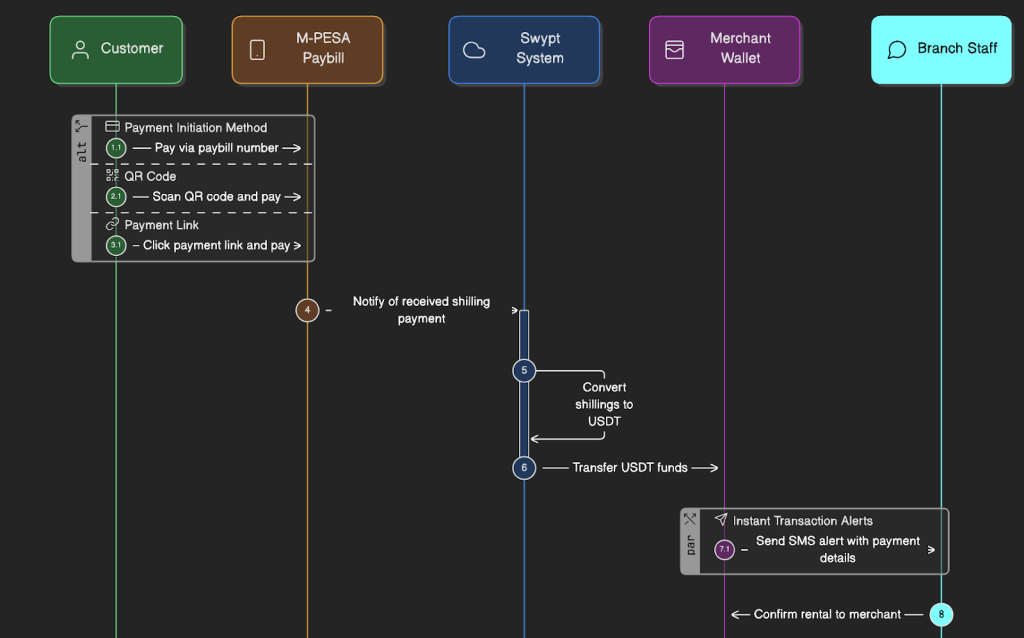 Customer journey from payment to reconciliation
However, the lack of a traditional chargeback mechanism shifts risk. Only a merchant can initiate a reversal, which eliminates the “friendly fraud” that plagues online retail but demands higher consumer trust.
The cheapest route for the business is “peer-to-peer” settlement with other merchants on the same network. Because the underlying assets are on-chain, the business can also settle international obligations with any supplier capable of receiving USDT, effectively removing the friction of traditional cross-border banking.
Swypt is stripping the complexity from self-custody by offering a decentralised bridge between USDT and KES without the traditional friction of blockchain. The platform is strictly non-custodial, meaning it never holds user keys or funds. Instead, it only interacts with a user’s wallet when authorised to settle a specific transaction.
To make the experience feel like a standard banking app, Swypt uses account abstraction that allows users to bypass the headache of seed phrases (the master key to your digital assets), accessing their wallets via email and 2FA across any device.
Why is bypassing the shilling so important?
For Kenyan merchants, the primary incentive is currency preservation. After two years of the shilling’s volatility against the US dollar, holding local currency has become a balance-sheet risk for anyone importing raw materials or finished goods.
Once funds arrive as stablecoins, merchants can move money quickly across multiple channels. They can pay international invoices in USDT, transfer assets to external wallets like Trust Wallet, or convert back to KES for local use.
Swypt claims to remove its own exposure to currency fluctuations by eliminating an “internal float” or the idle cash reserves traditional processors hold.
Lean operations
Swypt’s commercial model is aggressive since there are no upfront fees for accepting payments. Rather, costs are concentrated on the payout side. According to Gachanja, off-ramp fees typically sit below 1%, comfortably beating the spreads of black market FX exchanges or traditional wire fees. For high-volume enterprises, an over-the-counter desk handles liquidity via API.
“Swypt only applies fees on payouts and has no direct upfront fees for pay-ins (M-PESA to paybill charges apply). In comparison to market standards, our fees are majorly below 1% for all transactions,” Gachanja said.
In an era of renewed venture rounds, Swypt is an outlier. The 12-person team is entirely bootstrapped. Gachanja claims that the business has processed over $10 million in volume across 1,000 merchants.
The model is not without its dependencies because Swypt relies on the stability of third-party stablecoins and the continued openness of the M-PESA API (Daraja 3.0). Compliance is handled through providers like Sumsub to navigate Kenya’s shifting regulatory landscape.
Swypt’s edge is its cultural literacy. Most fintechs in Kenya recognise they cannot operate without integrating M-PESA, so Swypt takes advantage of that reality and addresses liquidity challenges without asking business owners to understand smart contracts.