
SCIENCE
Meet Qingzhou, China’s next-gen cargo craft for its Tiangong space station (video)



China is working toward the first launch of a next-generation, low-cost cargo spacecraft option for its Tiangong space station.
Qingzhou, meaning “Light Ship,” is being developed by the Innovation Academy for Microsatellites of the Chinese Academy of Sciences (IAMCAS) as a smaller, lighter and potentially lower-cost complement to China’s existing Tianzhou cargo spacecraft.
You may like
The Qingzhou spacecraft passed a design review in June and entered the initial manufacturing phase, according to a recent China Central Television (CCTV) report.
The prototype measures roughly 10.8 feet (3.3 meters) in diameter, has a launch mass of about 11,000 pounds (5,000 kilograms), and is capable of carrying up to 4,000 pounds (1,800 kg) of cargo to orbit. Its hybrid structure combines a pressurized module for crew supplies and sensitive instruments with an unpressurized aft section capable of carrying external payloads and space-exposure experiments.
“We have now conducted large-scale experiments and are currently loading and verifying the status of the remaining individual machines, as well as conducting final testing. The overall test results are quite good,” Wu Huiying, deputy chief designer of the Qingzhou cargo spacecraft, told CCTV.
Full engineering model production is scheduled to begin in early 2026, with construction expected to be completed by the end of that year. Its debut flight will follow based on the operational needs of the Tiangong station, according to Wu.
The first prototype was initially stated to fly on the debut launch of commercial rocket startup CAS Space’s Kinetica-2. That plan now appears to have been altered, with CAS Space reported to be preparing for that very launch from Jiuquan spaceport in the Gobi Desert in the near future.
Qingzhou is one of a pair of new spacecraft commissioned by China’s human spaceflight agency as the country looks to upgrade its space transportation capabilities. The other, named Haolong, is a reusable shuttle concept being developed by the Chengdu Aircraft Design and Research Institute under the state-owned Aviation Industry Corporation of China.





As the classic crooner Andy Williams once sang, “It’s the most wonderful time of the year,” and that means snowmen, reindeer, sleigh bells, mistletoe, and Good ‘Ol St. Nick.
But it also means checking off your holiday gift list with sparkling literary treats for all your geeky friends and loved ones whose tastes include superheroes, galactic adventure, roaring rockets, starry skies, human spaceflight, queries from the cosmos, and excursions to the magical galaxy far, far away. Of course, if you’re looking for last-minute gifts, you should check out our guides to the best Fallout gifts, best space stocking stuffers and 10 best gifts under $100 for kids.
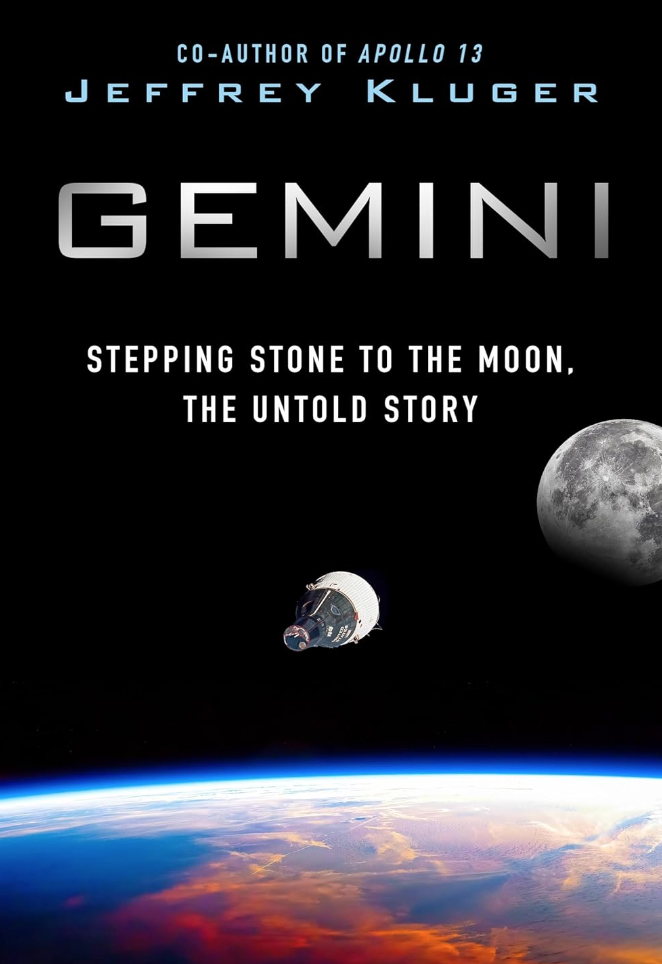
Gemini: Stepping Stone to the Moon, the Untold Story
(Image credit: St, Martin’s Press)
If it weren’t for the Gemini Program that taught NASA astronauts how to walk in space and maneuver spacecraft for docking procedures, America would never have made it to the Moon.
Told in his butter-smooth style and punctuated with expertly detailed accounts of the historic mid-’60s missions, New York Times bestselling author Jeffrey Kluger (“Apollo 13”) brings back all the guts and glory of those heady days when the final frontier was still an unexplored environment fraught with innumerable perils.
You can read our exclusive interview with Author Jeffrey Kluger on this new book.
Today’s best Gemini Stepping Stone To The Moon deals


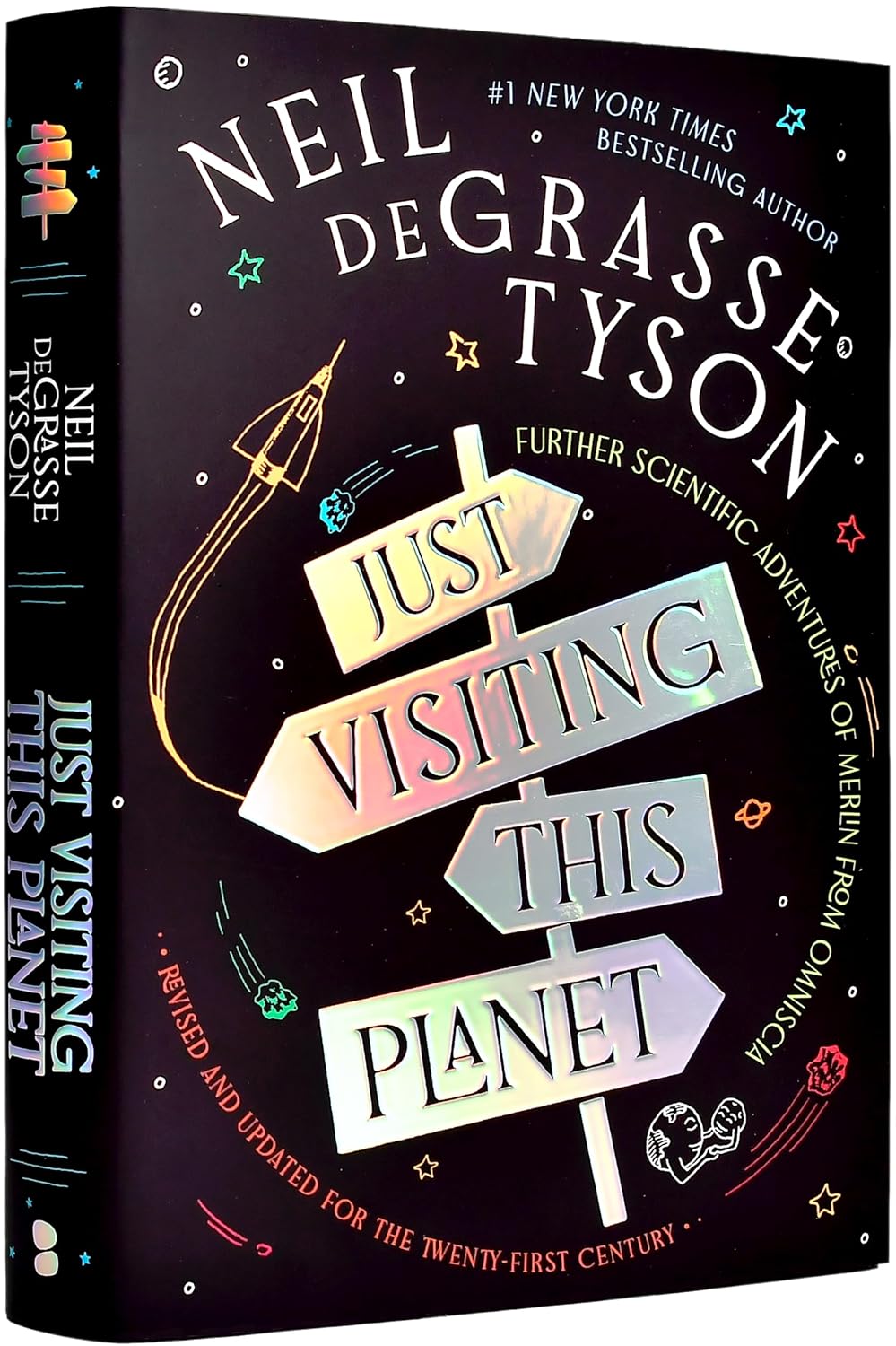
Just Visiting This Planet
(Image credit: Blackstone Publishing)
Here’s the engaging sequel to last year’s Merlin’s Tour of the Universe from celebrity astrophysicist and New York Times bestselling author Neil deGrasse Tyson, which contains 200 more space science questions and answers compiled from readers that first appeared in a column in The McDonald Observatory’s StarDate Magazine.
This newly updated 350-page hardback has been fully refreshed since it was first published in 1998, and collects a constellation of fun responses to queries about planets, stars, comets, black holes, moons, gravity, galaxies, space travel, and more, all told through the wise and wonderful Merlin, a timeless cosmic traveler from Planet Omniscia.
You can read our exclusive interview with Neil deGrasse Tyson on this book in full.
Today’s best Neil deGrasse Tyson Just Visiting This Planet deals
Final Orbit

(Image credit: Mulholland Books)
From one of the most seasoned astronauts who ever left Earth, Chris Hadfield spins an involving yarn centering around NASA flight controller Kaz Zemeckis and China’s clandestine role during the space race in the third installment of his The Apollo Murders series.
The plot unfolds in 1975 when a fresh Apollo mission blasts off to rendezvous with a Russian Soyuz spacecraft for a new era in Soviet-American friendship, when a shocking orbital accident alters the course of this cooperation. Complicating the matter is the launch of China’s first astronaut, Fang Kuo-chun, whose own flight steers him on a perilous path intersecting with the Apollo crew.
Check out our exclusive interview with author Chris Hadfield in full.
Today’s best Final Orbit The Apollo Murder Series deals
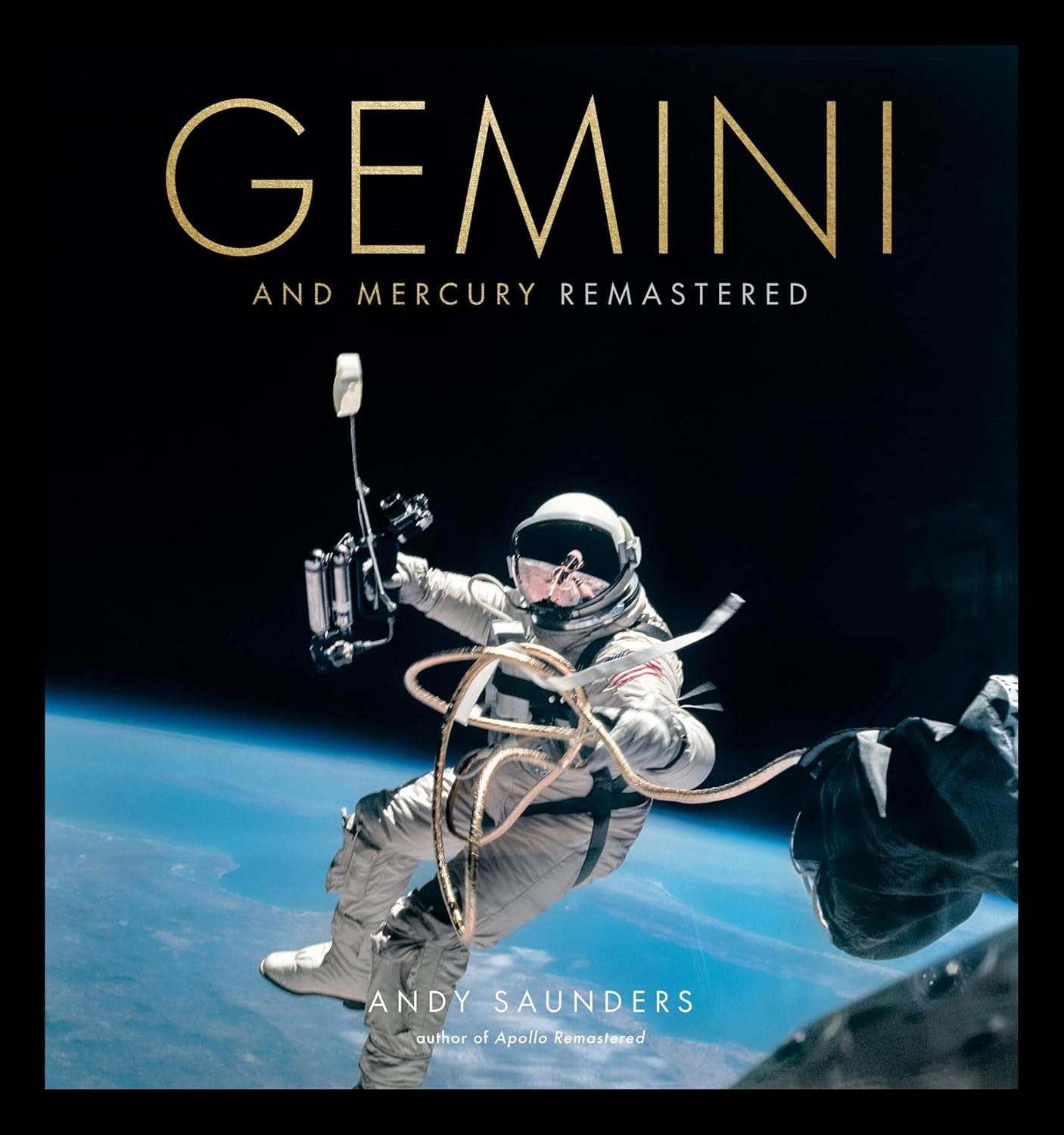
Gemini and Mercury Remastered
(Image credit: Black Dog & Leventhal)
Imaging expert and NASA historian Andy Saunders (Apollo Remastered) follows up his ambitious photographic account of our Apollo Program with this deluxe 320-page edition chronicling the Gemini and Mercury flights with hundreds of restored images curated from the archives of our storied space administration.
His newest masterwork was years in the making and delivers an insider’s peek into these vital missions that provided the foundation for the success of our later trips to the moon. Project Mercury and Project Gemini revealed key questions regarding space travel, the human condition, and the limits of their fragile spacecraft in the most hostile of environments. Saunders’ restoration process blesses us with never-before-seen photos that fully expose the mission dangers and awe-inspiring vantage points in astonishing clarity and color.
You can read our exclusive interview with the author, Andy Saunders, in full.
Today’s best Andy Saunders Gemini and Mercury Remastered deals
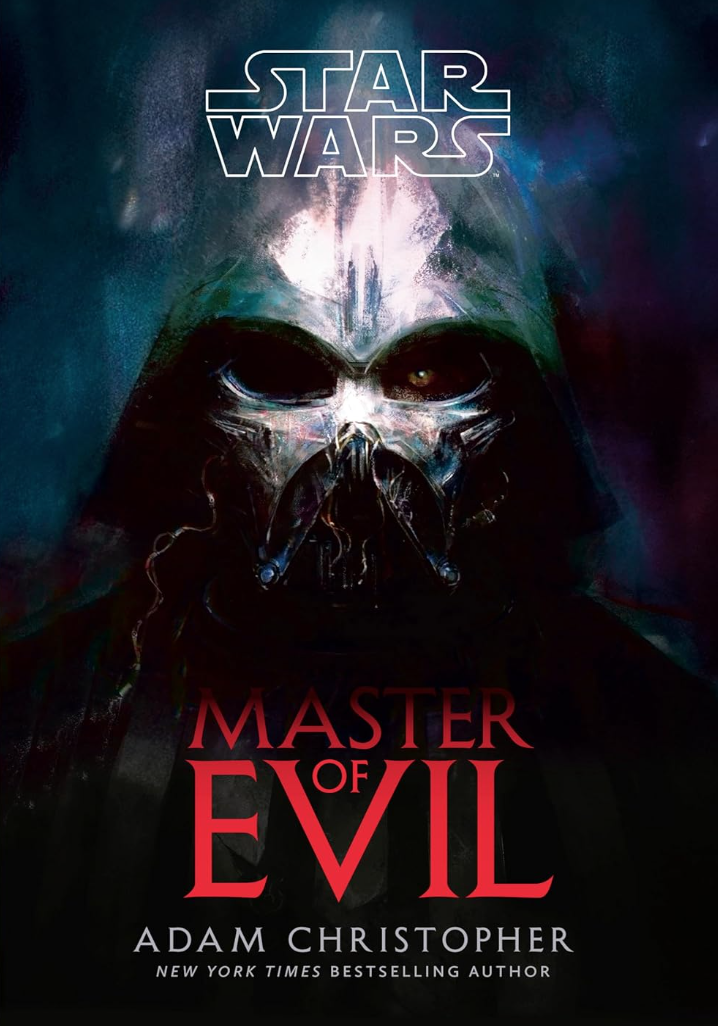
Star Wars: Master of Evil
(Image credit: random house worlds)
Veteran Star Wars author Adam Christopher spins a harrowing yarn from the events following Revenge of the Sith as a raw and vengeful Darth Vader yearns for the arcane mysteries of life and death while being scrutinized by Emperor Palpatine.
Consumed by the addictive elements of the Dark Side, Vader must make a pilgrimage to the scorching planet of Mustafar, where he endeavors to perform a necessary ritual by bleeding a kyber crystal to create his personal lightsaber. The energies unleashed in this unholy ceremony allow for a frightful glimpse into the horrors of the Force. Joined by the Emperor’s scarlet-clad Royal Guard and its leader Colonel Halland Goth, the. Sith Lord will travel to the fringes of the galaxy where a strange shaman dwells.
You can check out our recent exclusive interview with the author, Adam Christopher.
Today’s best Star Wars Master of Evil deals
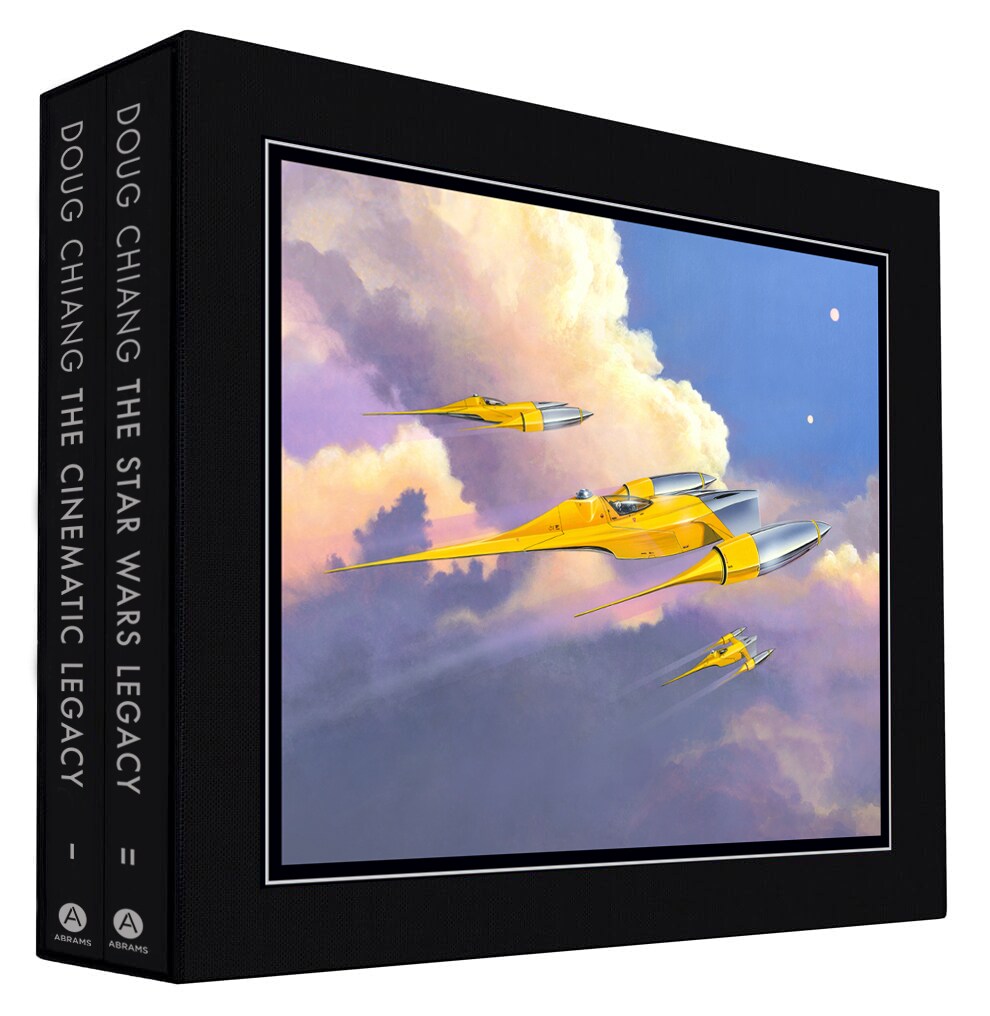
Doug Chiang: The Cinematic Legacy (Volume I) & The Star Wars Legacy (Volume II)
(Image credit: Abrams Books)
If you’re lucky enough to score this two-volume, 800-page behemoth showcasing the work of Lucasfilm’s visionary artist and designer Doug Chiang this Christmas, please drop me an email and let me know how I can join your family!
Chiang’s Oscar-winning conceptual work is a revelation and this deluxe set not only reveals his creative work on Star Wars: The Phantom Menace, but also Attack of the Clones, The Force Awakens, Rogue One: A Star Wars Story, The Last Jedi, Solo: A Star Wars Story, The Rise of Skywalker, and The Mandalorian.
Volume 1, The Cinematic Legacy, presents Chiang’s work prior to joining forces with Lucasfilm and includes designs for Back To The Future Part III, Alien 3, T2: Judgment Day, The Mask, Jumanji, and many more.
Today’s best Doug Chiang The Cinematic Legacy (Volume I) and the Star Wars Legacy (Volume II) deals
The Art of The Fantastic Four: First Steps

(Image credit: Marvel Universe)
Marvel’s First Family came wonderfully alive in full retro-futuristic style this past summer as directed by Matt Shakman and produced by Marvel Studios.
The smash movie can be fully re-experienced in this 288-page deluxe slipcase edition, delivering a bounty of imaginative concept art designs, sketches, character profiles, superhero vehicles, costumes, environments, and behind-the-scenes peeks into the movie-making process. Also included is a companion volume breaking down Reed Richards’ scientific gadgets, trinkets, toys, and inventions that make up his superpowered team.
Today’s best Marvel Studios’ The Fantastic Four: First Steps The Art of the Movie Deluxe Edition Slipcase deals
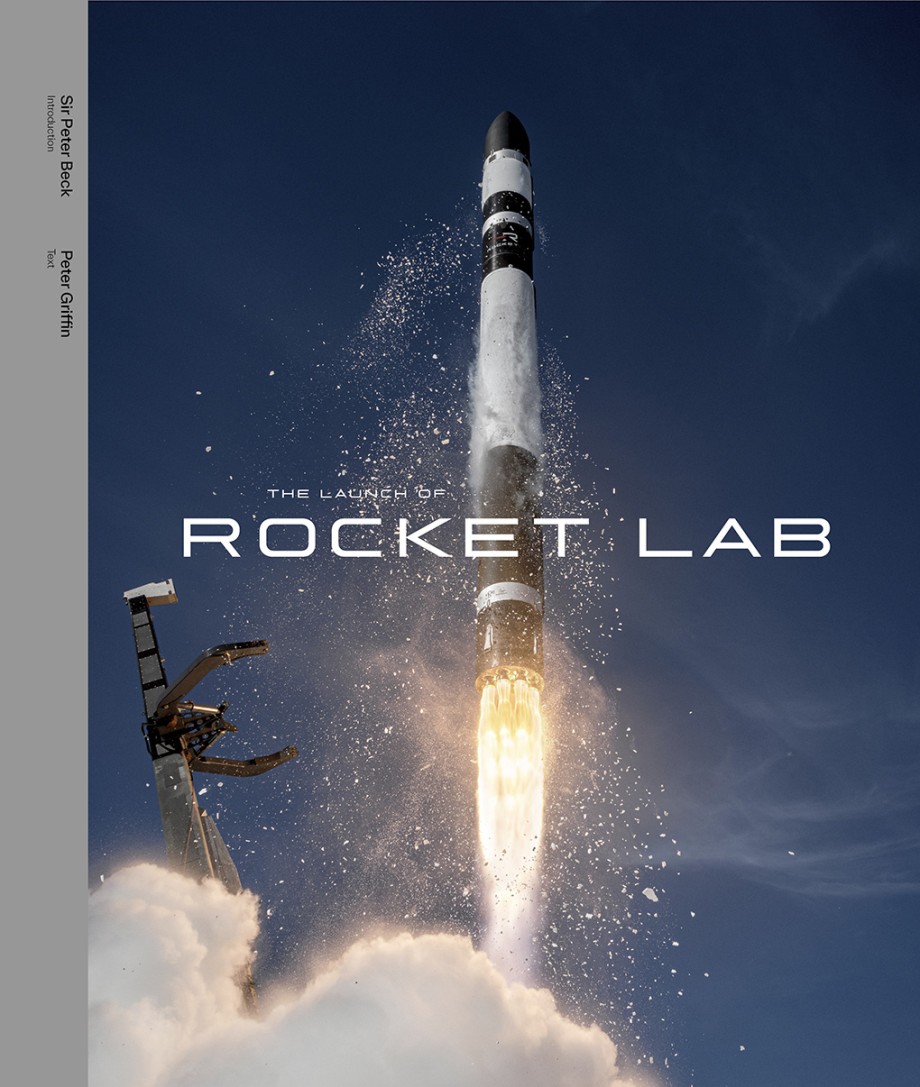
The Launch of Rocket Lab
(Image credit: Blackwell & Ruth)
This inspiring title follows Rocket Lab’s remarkable journey from tiny VC start-up to a global juggernaut in direct competition with Elon Musk’s SpaceX and Jeff Bezos’ Blue Origin.
It contains a wealth of behind-the-scenes photos and original interviews with founder Sir Peter Beck, his expert team, loyal investors, and industry experts that provide a colorful look at one of the major contenders in the current space race as they continue to grow as a force to be reckoned with.
Rocket Lab is currently the fastest company to launch 50 rockets into space, with a market cap of $13.63 billion, a planned mission to the Red Planet, and even aspirations to launch a mission to Venus someday.
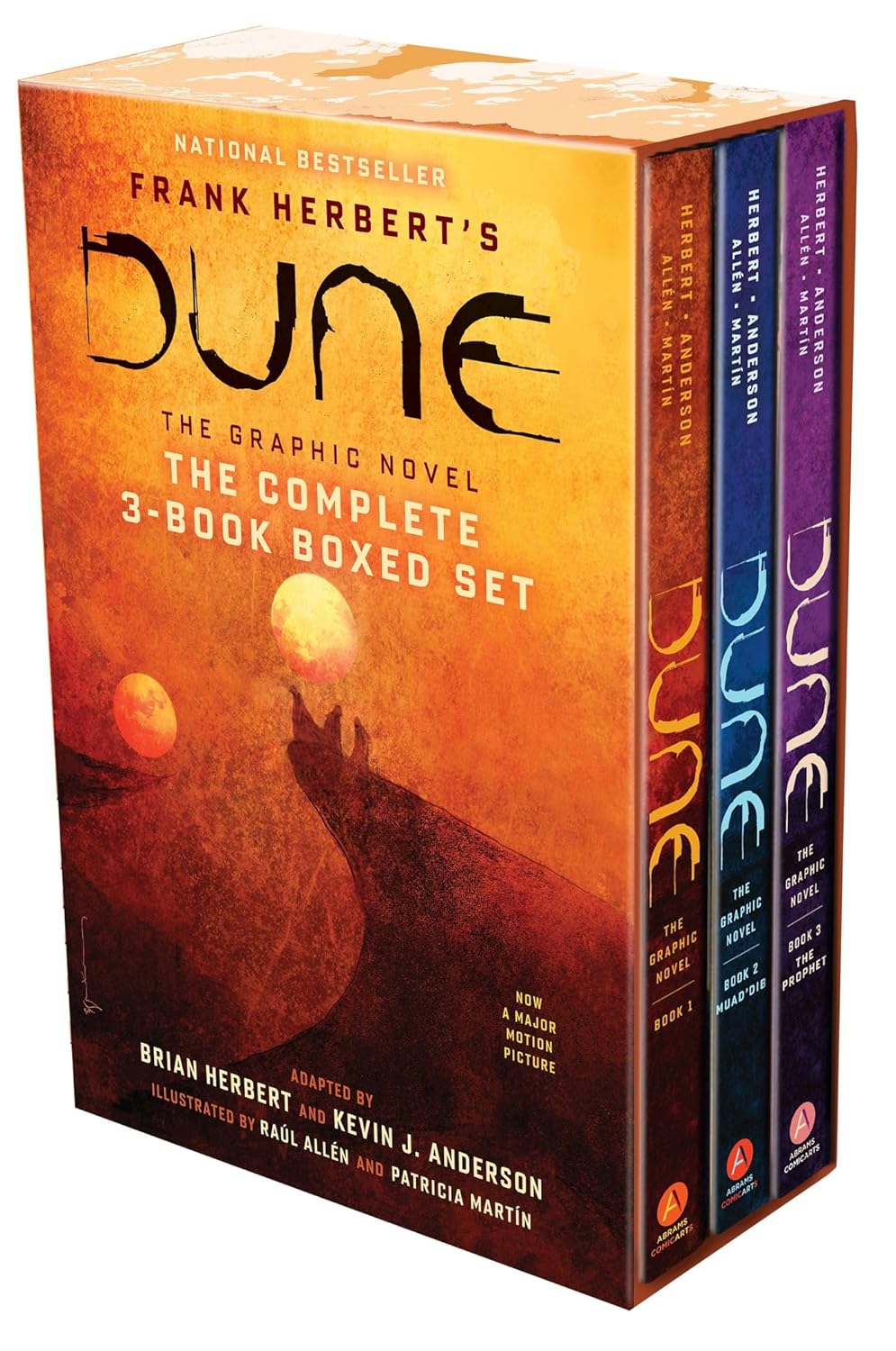
Dune: The Graphic Novel: The Complete 3-Book Boxed Set
(Image credit: Abrams ComicArts)
Just in time for some sweet sci-fi gift-giving, here’s the complete 3-book Dune graphic novel adaptation of legendary author Frank Herbert for the 60th anniversary of the book’s original publication in 1965.
This premium box set, written by Frank’s son, Brian Herbert, with collaborator Kevin J. Anderson, contains vivid illustrations by Raul Allen and Patricia Martin that perfectly capture the galactic turmoil and mysticism that’s enthralled readers for decades as one of the greatest interstellar sagas ever conceived.
You can read our exclusive interview with Kevin J. Anderson in full, too.
Today’s best Dune The Graphic Novel: The Complete 3-book boxed set deals
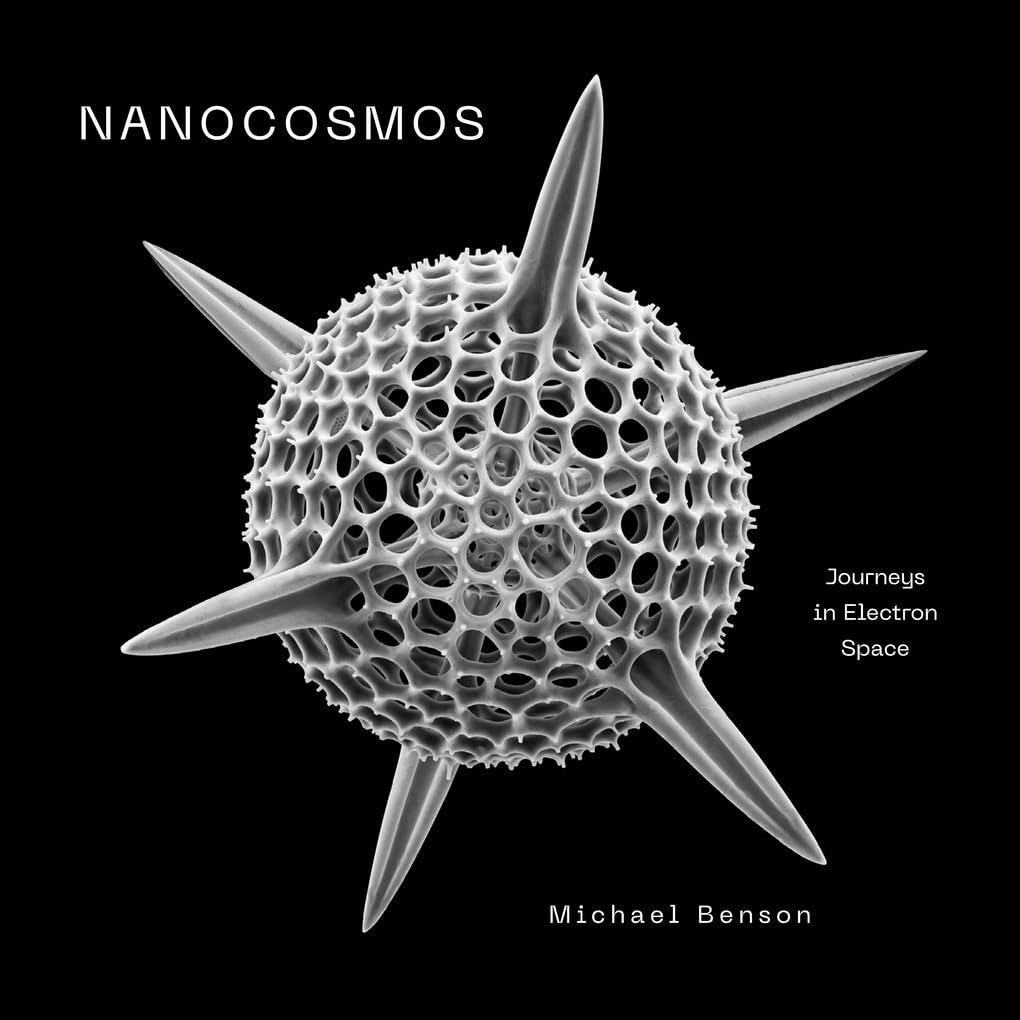
Nanocosmos: Journeys In Electron Space
(Image credit: Abrams Books)
The sublime beauty and mystery of the microscopic world are presented here by author, artist, and film historian Michael Benson. Now, in this six-pound, 320-page coffee-table book, Benson takes us all on a mindblowing trip into the realm of extreme magnification using the might of scanning electron microscope (SEM) technologies.
It’s an ideal gift for space and science lovers as it offers a shocking glimpse of these tiny worlds that surround us daily. The images were captured from SEM scans Benson took over the course of six years at the Canadian Museum of Nature in Quebec, including radiolarians, dinoflagellates, and diatoms, as well as multiple types of insects, microscopic flowers, and even lunar samples obtained from Apollo 16.
Be sure to check out our exclusive interview with author Michael Benson, too.
Today’s best Nanocosmos Journeys in Electron Space deals
Superman: The Art and Making of the Film
(Image credit: Harry N. Abrams)
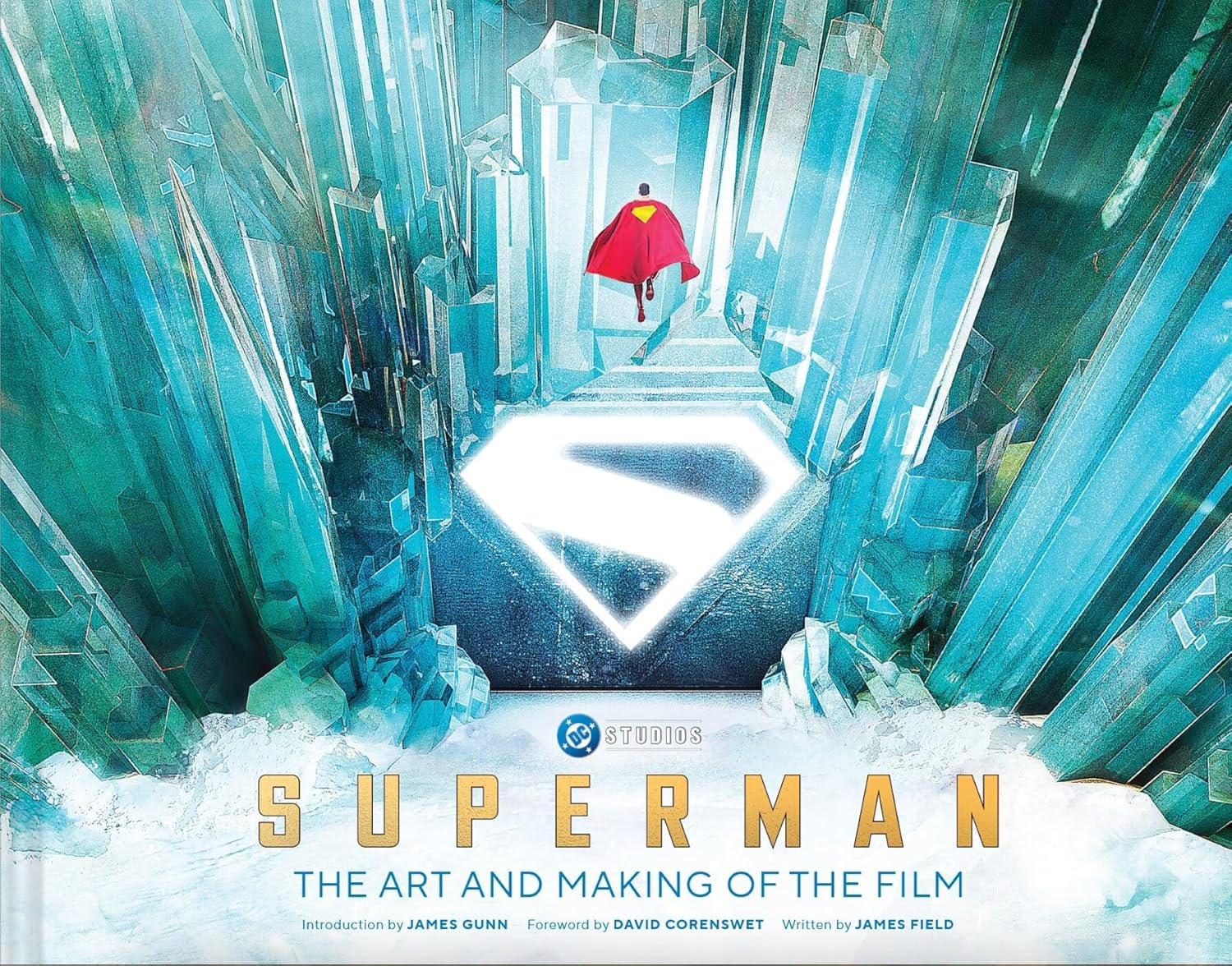
It’s up, up and away with this beautiful concept art book from director James Gunn’s Superman, which landed in theaters this past summer and raked in a comfortable $585 million.
Now, acolytes of the Man of Steel can witness how this superhero spectacle was created by a small army of Hollywood technicians and artists in this 176-page edition that whisks readers behind the scenes for DC Studios’ blockbuster.
Writer James Field (The Art of The Batman) records every stage of the movie’s production, beginning with Gunn and DC Studios co-chairman Peter Safran’s initial brainstorming chats to casting, costumes, set design, and post-production VFX. It includes an intro from writer/director James Gunn and a David Corenswet foreword.
Today’s best Superman The Art and Making of the Film deals
Cellarius Atlas
(Image credit: Taschen)
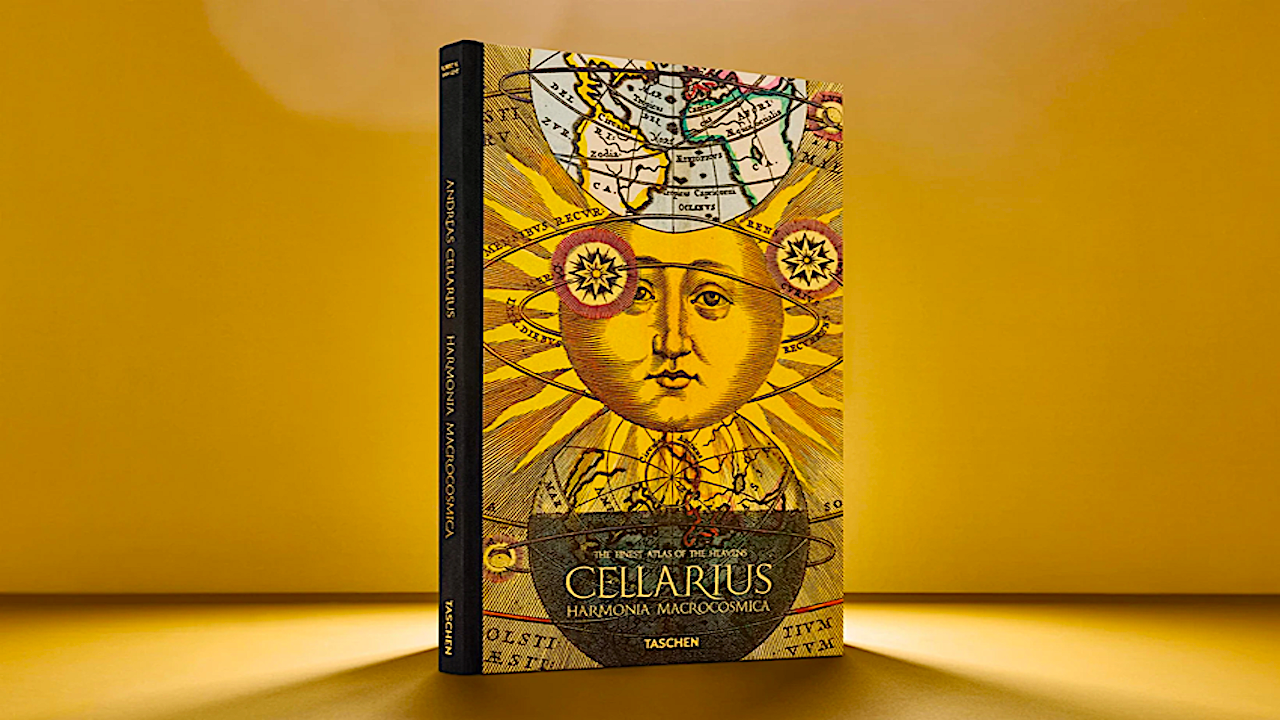
The wonders of the cosmos come alive in a bold new edition of the classic collection of constellation maps from famed Dutch-German mathematician and cosmographer Andreas Cellarius (c. 1596 ? 1665) that unveils these celestial atlas masterworks in unprecedented detail.
Initially published in 1660 in Harmonia Macrocosmica, this revised volume in a larger prestige format contains the complete 29 double-folio maps. These striking plates showcase sublime adorned skies, decorative borders and breathtaking constellations in this astonishing seven-pound reprint measuring 11.42 x 1.57 x 18.9 inches that restores academia’s most stunning depictions of the heavens.
Today’s best Robert Van Gent Cellarius Atlas deals

The final frontier is an unendingly beautiful expanse filled with unimaginable wonders, making it the perfect sandbox for photographers, astronomical observatories and space-based telescopes to capture incredible images that we can hardly fathom. And 2025 was no different.
This year, we covered a range of stunning space images, from an eye-catching alien comet and a planetary parade portrait to the first Vera C. Rubin photos and otherworldly animal lookalikes. Here are 10 of our absolute favorites.
Alien visitor transforms into a “cosmic rainbow”
A new timelapse photo transforms 3I/ATLAS into a giant “cosmic rainbow.” (Image credit: International Gemini Observatory/NOIRLab/NSF/AURA/K. Meech (IfA/U. Hawaii)Image Processing: Jen Miller & Mahdi Zamani (NSF NOIRLab))
The biggest space news story this year was undoubtedly the arrival of the third-ever interstellar object 3I/ATLAS, which has dominated headlines and astronomers’ attention ever since it was first spotted speeding through the solar system in early July. As a result, there has been no shortage of stunning shots of the alien comet.
You may like
Our favorite is this timelapse image captured by the Gemini North telescope on the summit of Hawaii’s Mauna Kea volcano. The image was created by combining 16 different photos using multiple colored filters to create a giant cosmic rainbow.
Read more: Interstellar comet 3I/ATLAS transforms into a giant ‘cosmic rainbow’ in trippy new telescope image
“The Fall of Icarus”
This striking photo shows a skydiver perfectly aligned with the sun’s fiery surface, around 93 million miles (150 million kilometers) from Earth. (Image credit: Andrew McCarthy/cosmicbackground.io)
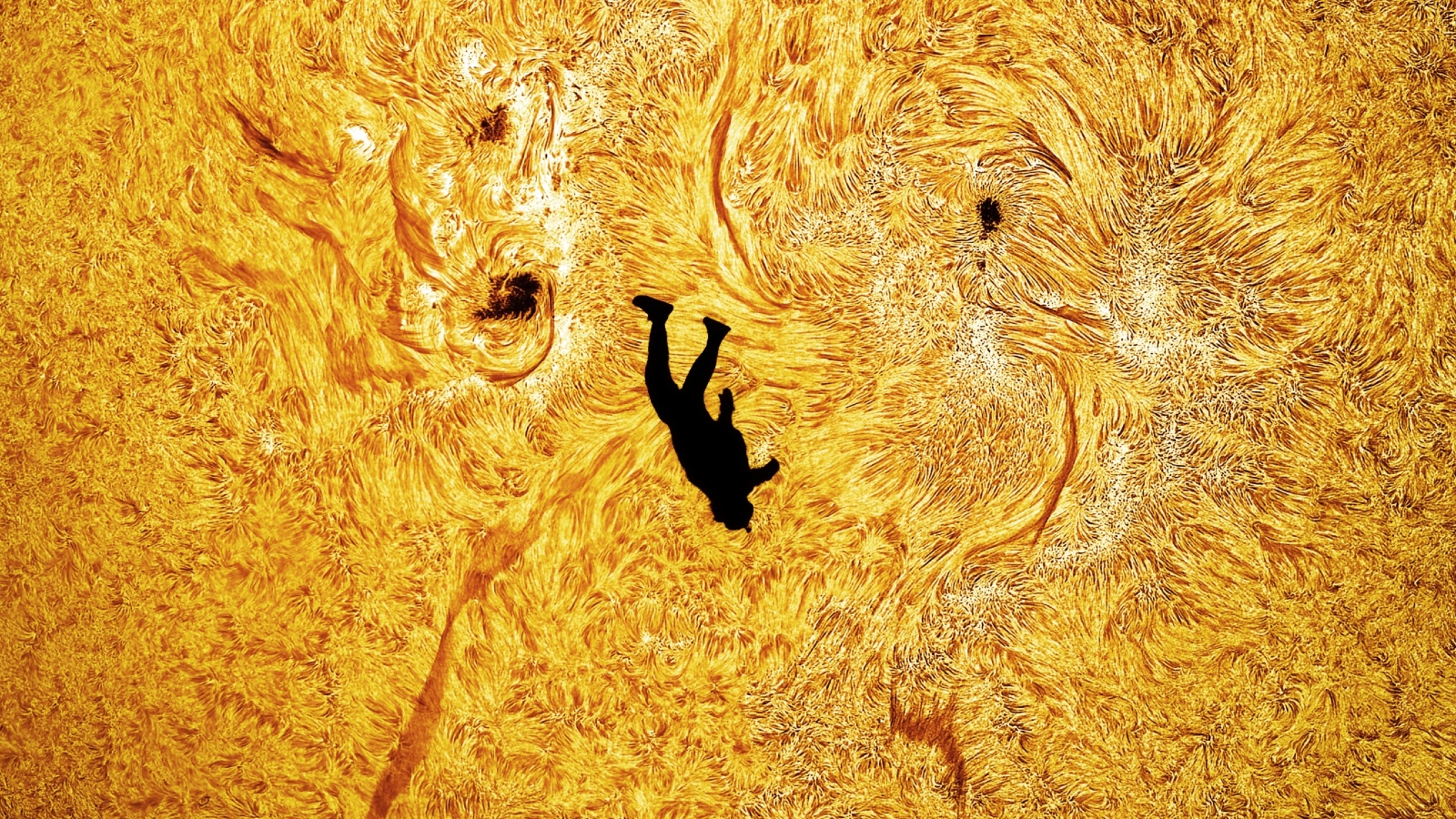
One of the most unbelievable photos of 2025 was this solar spectacle, dubbed The Fall of Icarus, which perfectly captured the moment a skydiver fell directly in front of the sun.
Astrophotographer Andrew McCarthy captured this shot in early November, at a distance of around 8,000 feet (2,440 meters) from the skydiver, YouTuber Gabriel C. Brown. It took six attempts to properly line up Brown with the solar surface before the thrill-seeker leapt from a small propeller-powered craft at an altitude of around 3,500 feet (1,070 m).
“It was a narrow field of view, so it took several attempts to line up the shot,” McCarthy told Live Science. “Capturing the sun is something I’m quite familiar with, but this added new challenges.”
Read more: Astrophotographer snaps ‘absolutely preposterous’ photo of skydiver ‘falling’ past the sun’s surface
Vera C. Rubin’s stream of stars
In its debut image, the Vera C. Rubin Observatory has revealed a vast stellar stream coming from the nearby galaxy M61. (Image credit: Romanowsky et al. 2025, RNAAS)
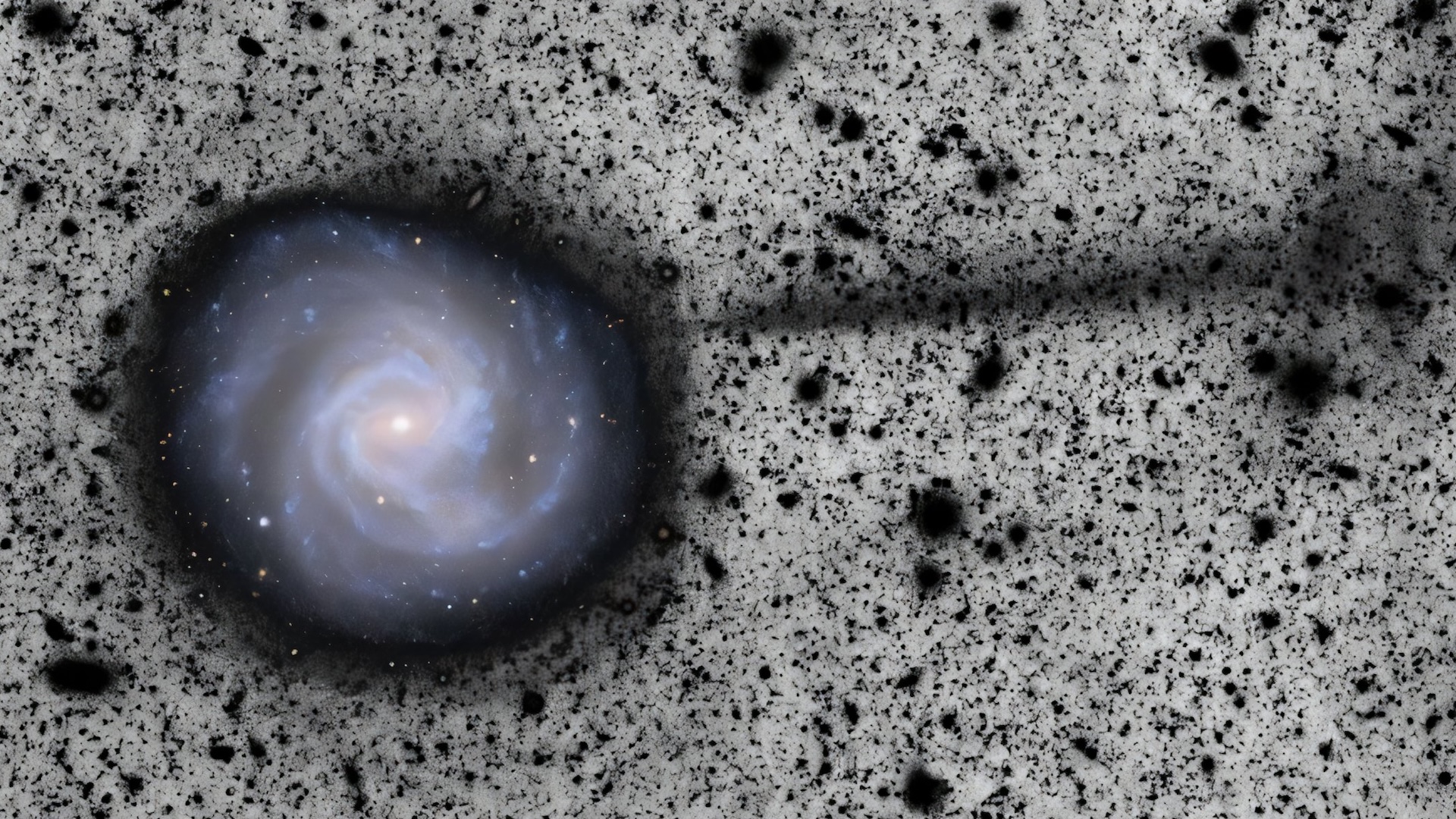
In June, the most powerful digital camera on Earth winked on. The Vera C. Rubin Observatory in Chile’s Atacama desert revealed its first-ever images in June. These debut photos were chock-full of cosmic treasures, including the spiral galaxy M61 (shown here), which researchers noticed was being trailed by a massive stellar tail around the same size as the Milky Way.
You may like
We can look forward to many more spellbinding shots from Rubin in the coming years as it begins its decade-long survey of the night sky.
Read more: First Vera Rubin Observatory image reveals hidden structure as long as the Milky Way trailing behind a nearby galaxy
Perfect planetary parade portrait
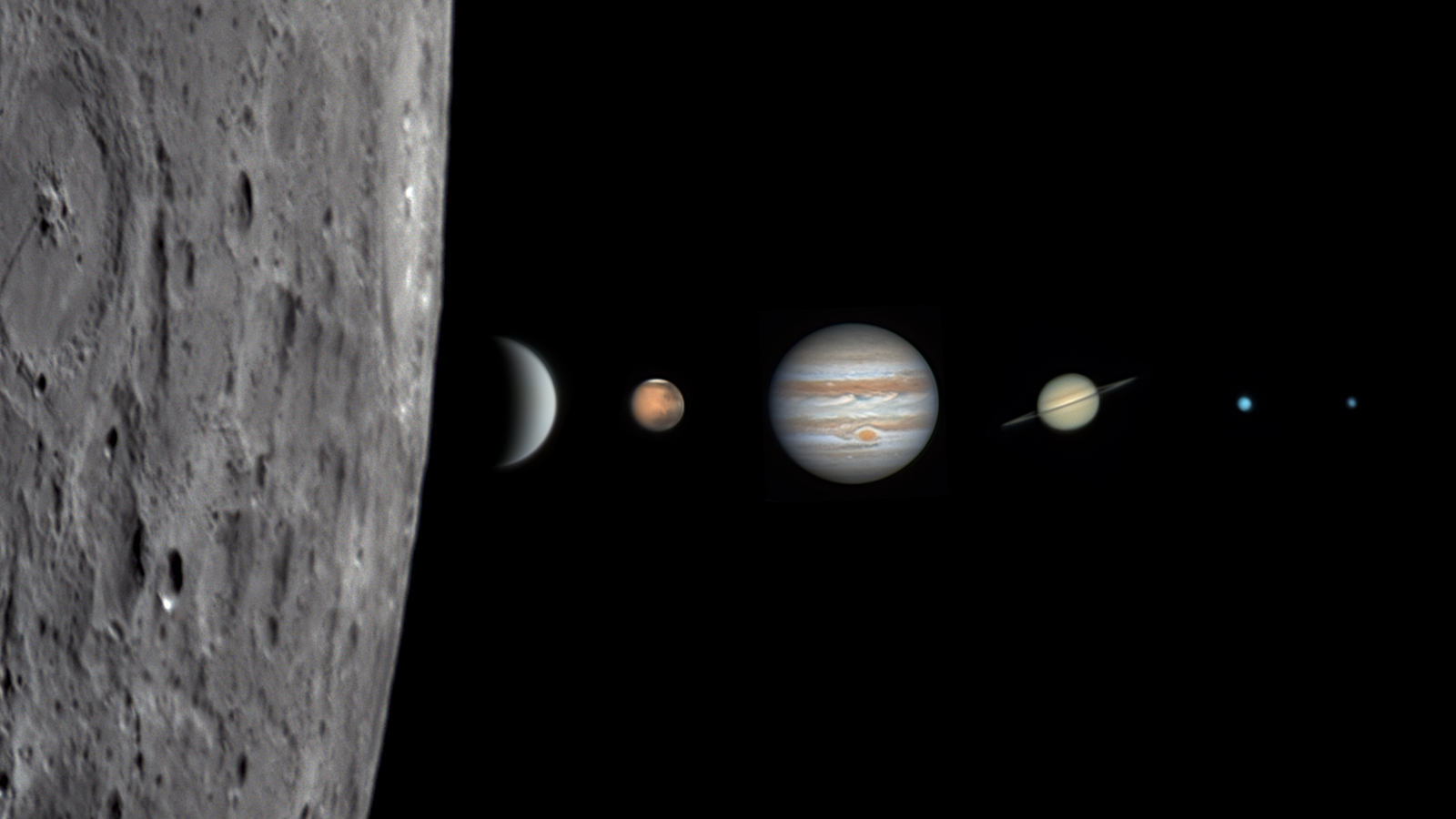
An astrophotographer captured shots of seven solar system worlds during an 80-minute period on Feb. 2 and arranged them into a straight line. (From left to right: the moon, Venus, Mars, Jupiter, Saturn, Uranus and Neptune.) (Image credit: Gwenaël Blanck)
In late January and early February, up to six of the solar system’s planets were simultaneously visible in the night sky in what astronomers refer to as a “planetary parade.” This particular parade was one of the best in recent years, allowing astrophotographers to snap several stunning pics of the event.
Our favorite pick of the bunch is this planetary portrait from French astrophotographer Gwenaël Blanck, which he digitally edited to show each planet alongside the sun in the order of distance from Earth. Blanck snapped each of the individual worlds within 80 minutes of one another.
Read more: Parisian photographer produces phenomenal, perfectly-proportioned ‘planetary parade’ portrait
Giant “diamond ring” shines in X-ray
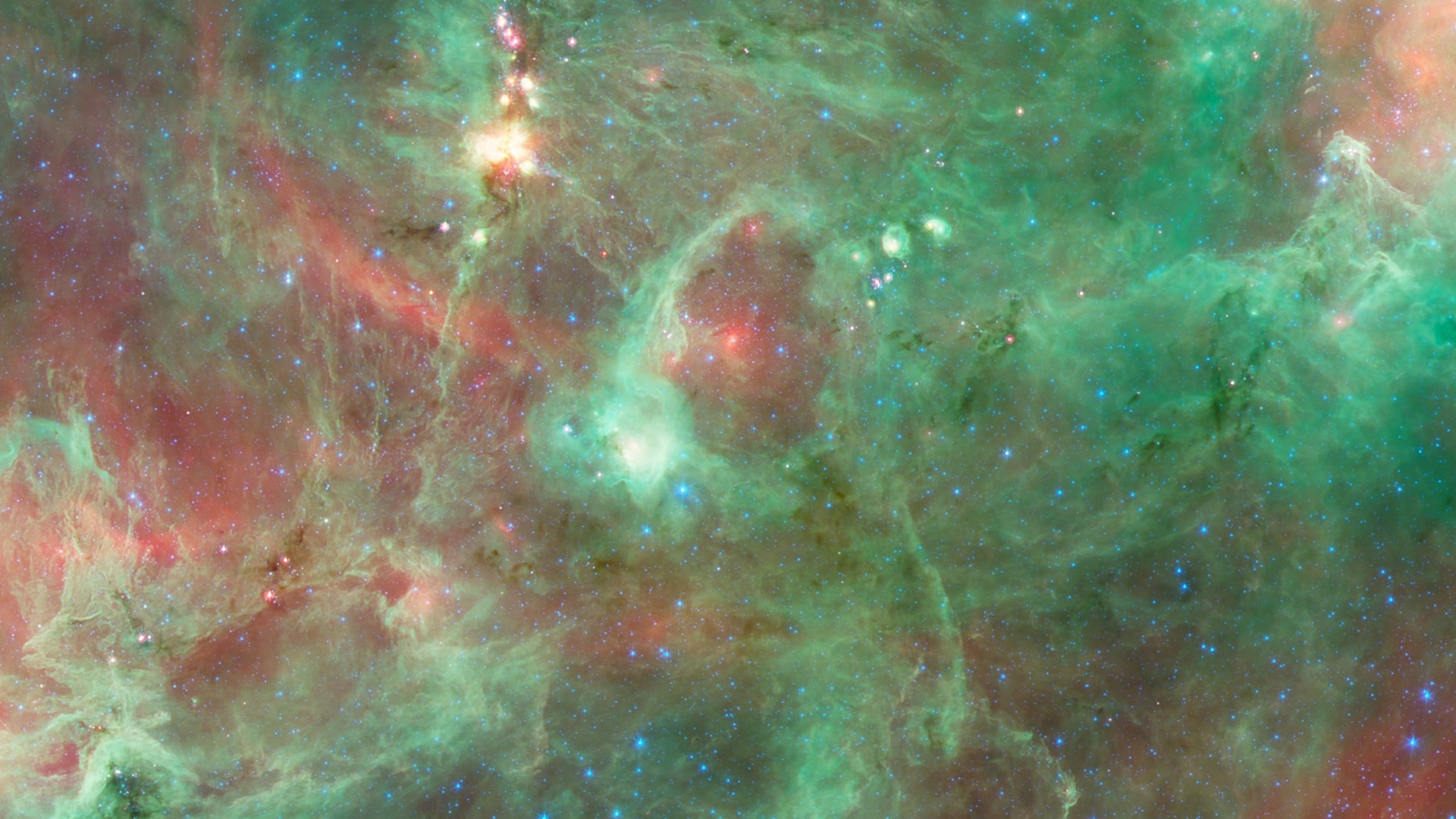
The mysterious ‘diamond ring’ in Cygnus may be the remnants of a burst bubble, new research hints. (Image credit: NASA/JPL-Caltech/Harvard-Smithsonian CfA)
All that glitters is not gold, and in this scintillating starscape, released in November, it is high-energy X-rays that sparkle like a giant ring.
This object, dubbed a “diamond ring,” is an expanding bubble of gas in a star-forming region of the Cygnus constellation. The glowing bubble is around 20 light-years across and is around 400,000 years old. It was photographed by NASA’s Stratospheric Observatory for Infrared Astronomy (SOFIA), which previously scanned the night sky from a telescope onboard a Boeing 747SP aircraft, at an altitude of more than 45,000 feet (13,700 m).
The cosmic ring is not to be confused with Einstein rings, which are rings of light created by gravitational lensing.
Read more: Giant ‘diamond ring’ sparkles 4,500 light-years away in the Cygnus constellation
A cosmic butterfly spreads its wings
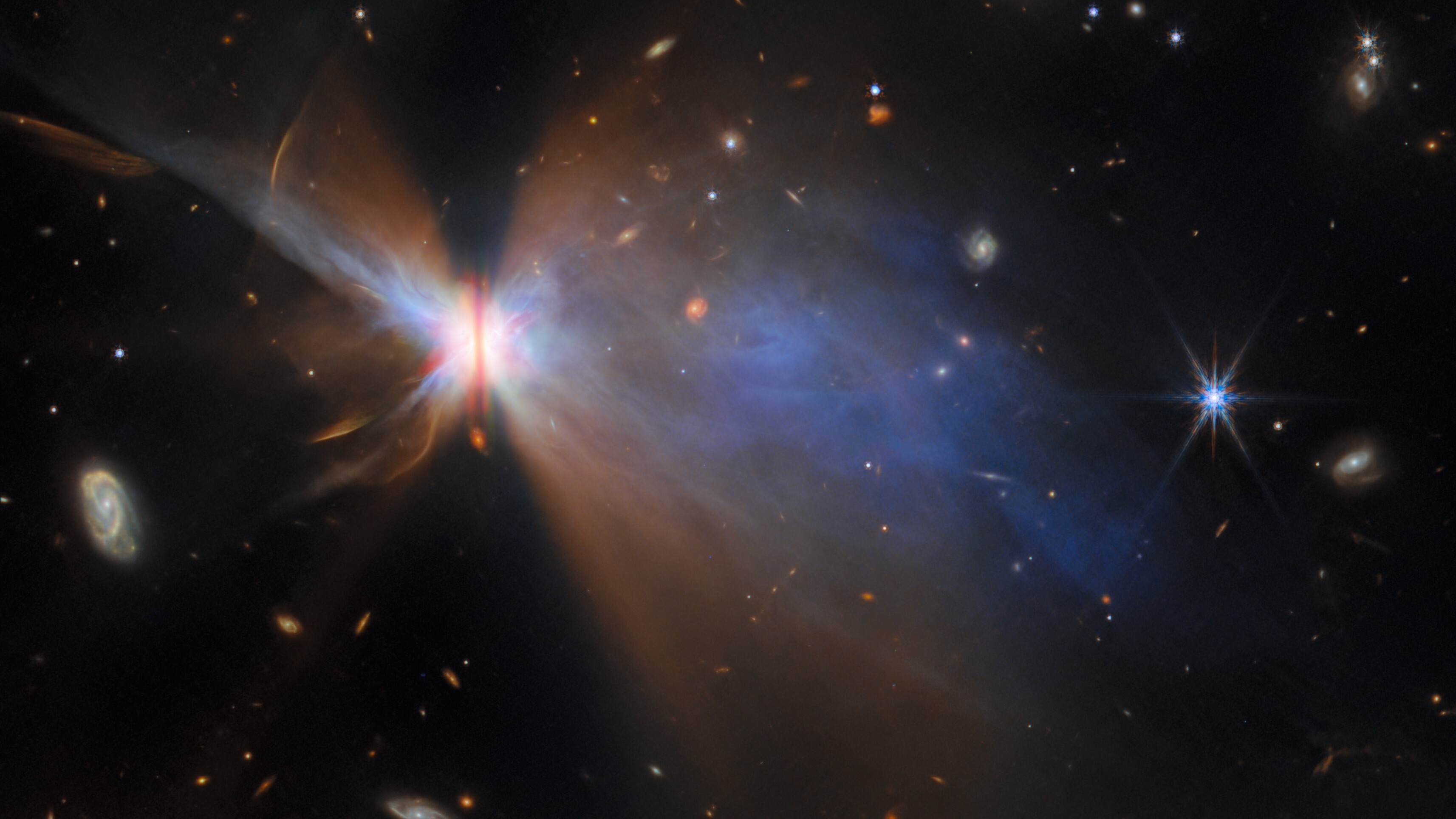
A star’s planet-forming disk glows like a butterfly in this new JWST image. (Image credit: ESA/Webb, NASA & CSA, M. Villenave et al.)
The insect imposter’s shining wings are made from a mini nebula of stellar material leftover from a supernova. This nebula is bisected by a protoplanetary disk that surrounds the baby star like a cosmic cocoon, and just happens to be aligned with Earth so that the two halves of the nebula are seen from side-on. It is located around 525 light-years away, in a star-forming region, known as the Taurus Molecular Cloud.
Read more: James Webb telescope finds a warped ‘Butterfly Star’ shedding its chrysalis
Arsia Mons rises
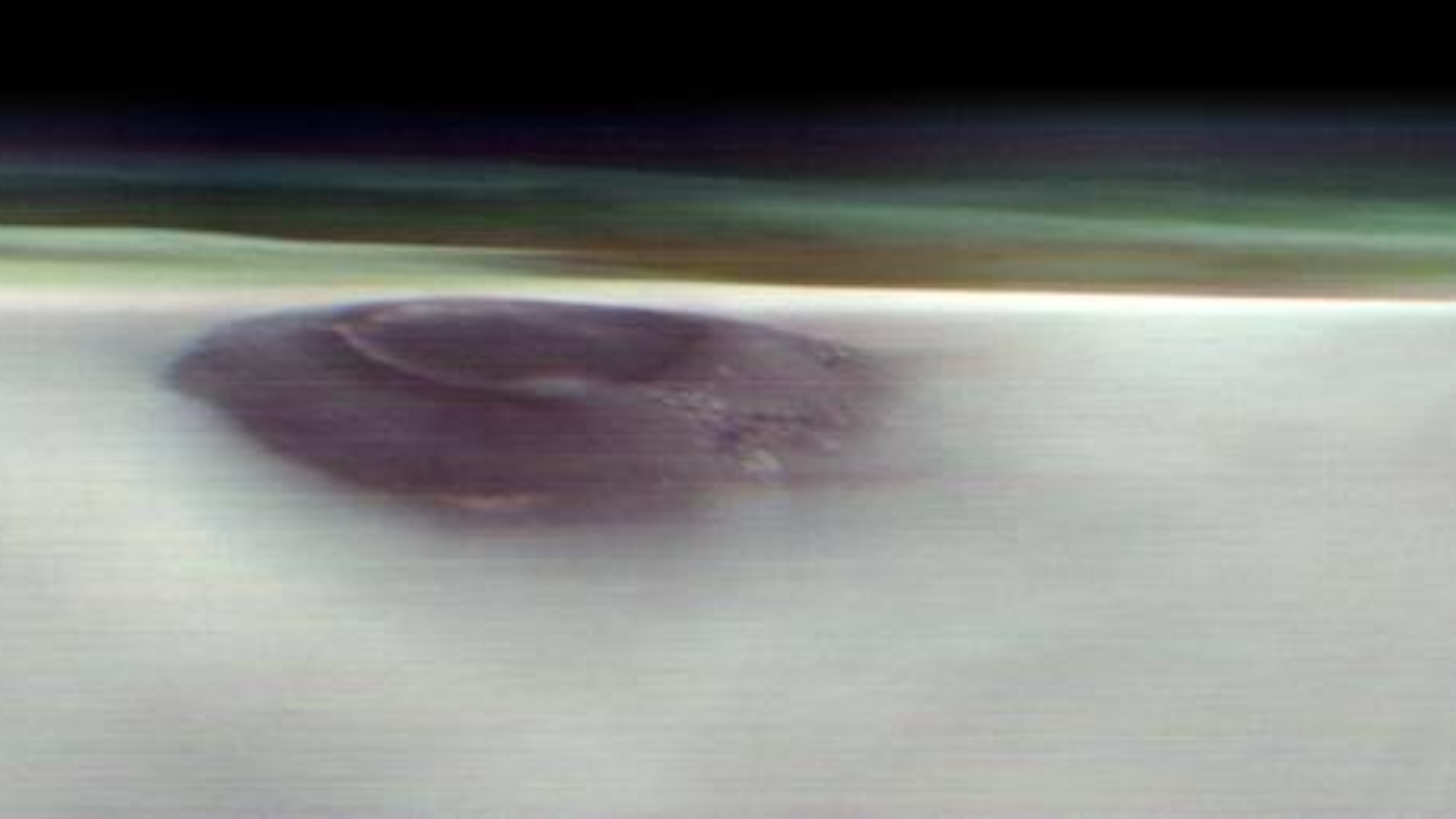
The gargantuan shield volcano Arsia Mons pierces the clouds of Mars in this new NASA orbital image. (Image credit: NASA/JPL-Caltech/ASU)
Speaking of Mars, NASA’s Mars Odyssey orbiter also captured this stunning shot of a giant dead volcano peeking above the clouds on the Red Planet, as eerie green lights dance above the Martian horizon.
The mountain in the image is Arsia Mons, which stands at more than 12 miles (19 kilometers) above the surface of the previously volcanic Tharsis plateau. The extinct volcano is more than twice as tall as Mount Everest, but around 4 miles (6 km) shorter than Mars’ tallest peak, Olympus Mons.
The green lights look like auroras. But they are actually just an effect of the image being partially captured using infrared light, which emanates from the planet’s wispy atmosphere.
Read more: NASA spots Martian volcano twice the height of Mount Everest bursting through the morning clouds
Seen by the “Eye of Sauron”
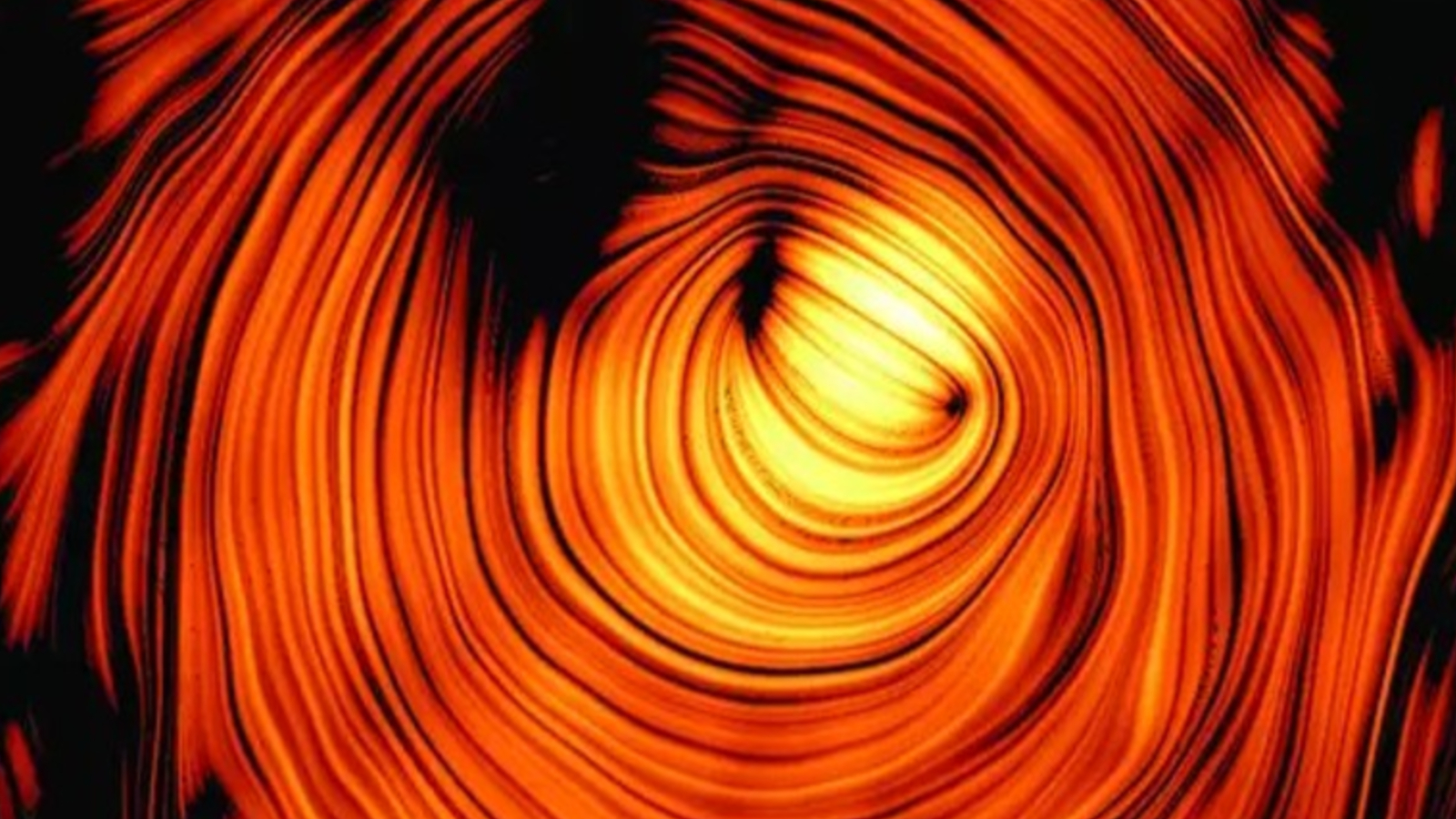
The new image, dubbed the “Eye of Sauron,” shows the complex magnetic field of a high-energy jet being shot directly at Earth by a distant blazar. (Image credit: Y.Y. Kovalev et al.)
There is no escaping the dark lord of Mordor’s malevolent gaze, even from halfway across the universe. That’s the impression given by this photo, dubbed the “Eye of Sauron,” which playfully references J. R. R. Tolkien’s fantasy epic “The Lord of the Rings.”
Read more: Giant, cosmic ‘Eye of Sauron’ snapped staring directly at us in stunning 15-year time-lapse photo
New “heavenly” pillars emerge
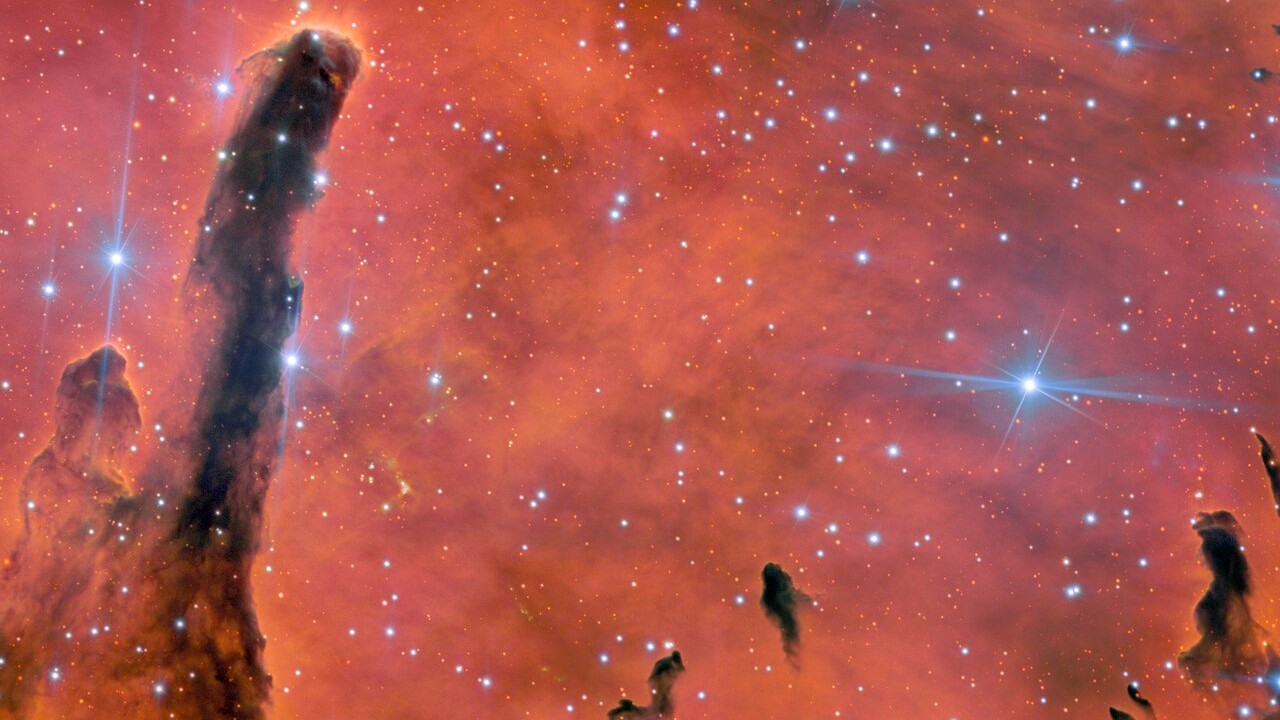
The structure called Ua ʻŌhiʻa Lani, which means the Heavenly ʻŌhiʻa Rains, echoes the legendary ‘Pillars of Creation’. (Image credit: International Gemini Observatory/ NOIRLab /NSF /AURA)
This ethereal image shows a set of stellar structures reminiscent of the famous “Pillars of Creation,” first seen by the Hubble Space Telescope in 1995. The structure is named Ua ‘Ōhi’a Lani, which means the “heavenly rains” in Hawaiin, and this image of it was taken by the Gemini North telescope.
What you are seeing is two distinct regions: the twinkling blue stars of a star cluster, named NGC 6823, overlapping the veil of red gas that comprises a more distant emission nebula, dubbed NGC 6820. The ethereal pillars are made from additional gas and dust that have been sculpted by the foreground stars’ intense radiation.
The original pillars of creation were also recently given a glow-up by JWST, which captured the iconic cosmic structures using infrared light.
Read more: ‘Heavenly rains’: Ethereal structure in the sky rivals ‘Pillars of Creation’
Astronaut snaps a giant “jellyfish” over Earth
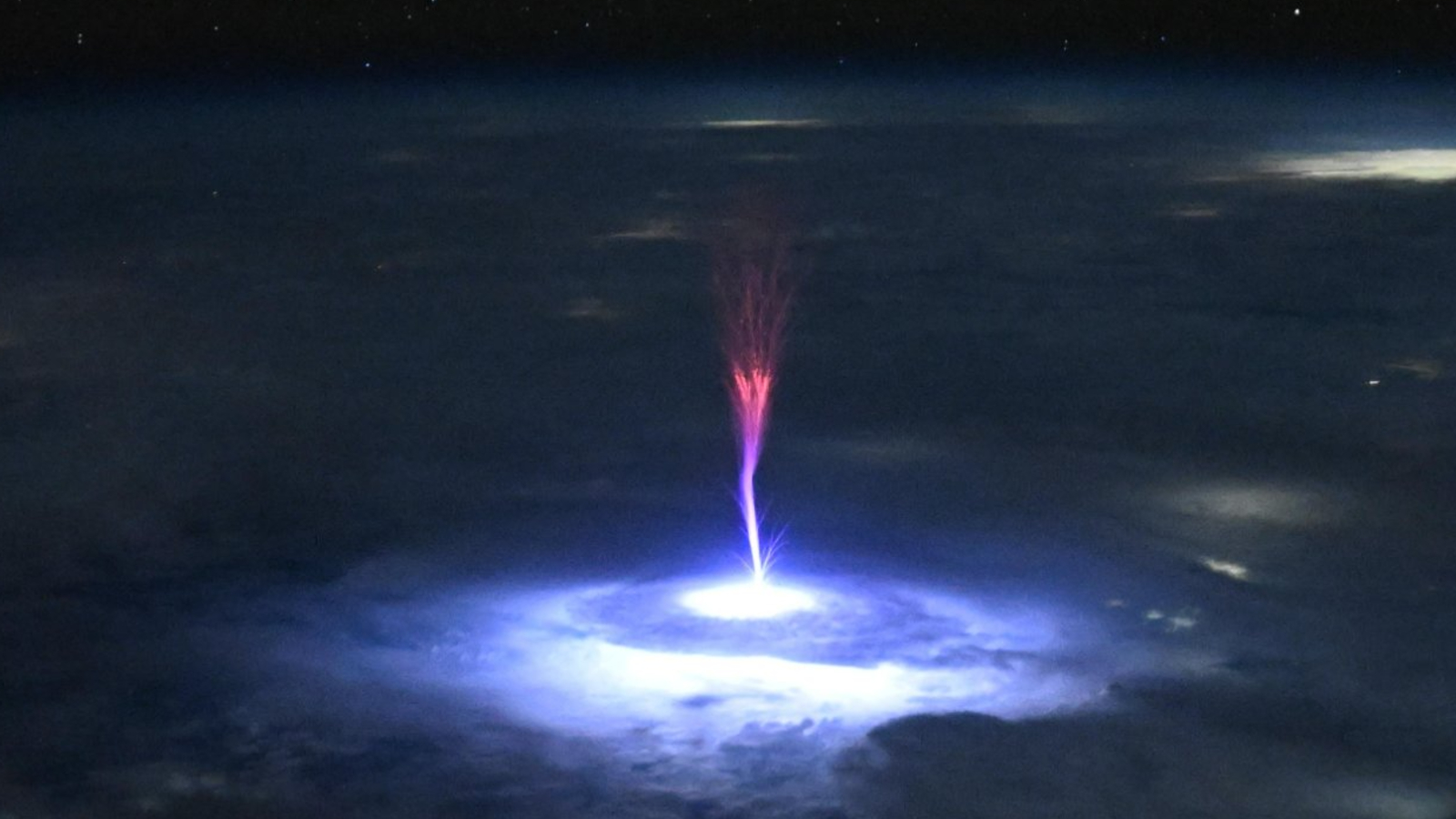
Nichole Ayers snapped a giant red sprite sprawling out over an upward-shotting bolt of lightning during a massive thunderstorm on July 3. (Image credit: NASA/ISS/Nichole Ayers)
As incredible as it is to point our cameras out into the universe, space also provides a unique angle of our own planet. And that’s exactly the case in our final photo, which shows off a giant, electrifying “jellyfish” hovering above Earth.
The luminous branching structure was snapped by NASA astronaut Nichole Ayers in July, while onboard the ISS. It shows a type of transient luminous event that researchers commonly call sprites. In this case, the red jellyfish-like sprite formed at the summit of a rare upward-shooting “gigantic jet” of lightning, up to 50 miles (80 km) above the U.S.-Mexico border.
If you liked this photo, then be sure to check out Live Science’s weekly Earth from space series for more incredible images of our planet from above.
Read more: Astronaut snaps giant red ‘jellyfish’ sprite over North America during upward-shooting lightning event
Want to see more amazing images of the cosmos?Be sure to check out Live Science’s Space Photo of the Week series, or peep our favorite space shots from 2024 or this gallery of stunning James Webb Space Telescope (JWST) images.
SCIENCE
3,300-year-old cremations found in Scotland suggest the people died in a mysterious catastrophic event


Archaeologists have discovered the 3,300-year-old cremated remains of at least eight people who were buried in five urns in Scotland. While it’s unknown how they died, it was likely during some sort of catastrophic event.
The finding is unusual because, although many Bronze Age burial spots in Scotland were reused over the years, the newfound cremations “tell a different story,” the researchers wrote in a new study, published recently in the journal Archaeology Reports Online. In this case, the urns were “tightly arranged, giving the impression of being buried collectively, and then remaining undisturbed except for modern plough damage,” the team wrote.
You may like
Three of the urns each contain the remains of an adult and a juvenile, while the other two each contain only one adult. The burial was found at Twentyshilling Hill, which is near Twentyshilling Hill Wind Farm in southwest Scotland, during excavations conducted in 2020 and 2021 while an access road to the wind farm was being built. The excavations were conducted by a team from Guard Archaeology, a company that undertakes archaeological excavations during or before construction.
“The discovery of five urns tightly packed together at the same time in one mass burial event is very rare and distinguishes the Twentyshilling Barrow from other barrows in Scotland,” the researchers wrote in the report.
The urns date to around 3,300 years ago and contain the cremated remains of eight people. (Image credit: © GUARD Archaeology Ltd)
The team suspects these eight individuals likely died around the same time, during a terrible event. It’s unclear what that event was, but it could have been a famine, disease or war, Ronan Toolis, CEO of Guard Archaeology, told Live Science in an email.
They suspect the individuals died around the same time because the urns appear to have been made by the same craftsperson, Toolis said. Also, during that time, it was common for deceased people in this region to be left out long enough for their flesh to decompose before they were cremated. In this instance, however, the team found that the individuals still had some of their flesh when the cremation was done, which indicates that they had to be cremated in a hurry, the team noted.

A ring of rocks surrounds the urns that archaeologists found in Scotland. (Image credit: © GUARD Archaeology Ltd)
These people would have been farmers, Toolis said. He noted that they likely lived near the burial spot, although their settlement has not been found.
This is “an area of Scotland where few such archaeological remains have so far been discovered, so future research may reveal much more about the context of this barrow,” Toolis said.


For some people, everyday sights and sounds quietly hijack decision-making—and refuse to let go. People naturally learn to connect what they see and hear with what happens next. Over time, visual and sound cues in the environment can signal whether a choice is likely to lead to a good or bad outcome, and the brain […]
SOURCE PAGE

The northern lights may put on another show across the U.S. tonight as speedy solar wind from an Earth-facing coronal hole is forecast to spark minor (G1) geomagnetic storm conditions, according to the National Oceanic and Atmospheric Administration’s (NOAA) Space Weather Prediction Center.
Geomagnetic activity is expected to reach minor (G1) storm levels overnight, which could be good news for aurora chasers as it raises the chance of seeing the northern lights in mid-latitudes.
You may like
Where can I see the northern lights tonight?
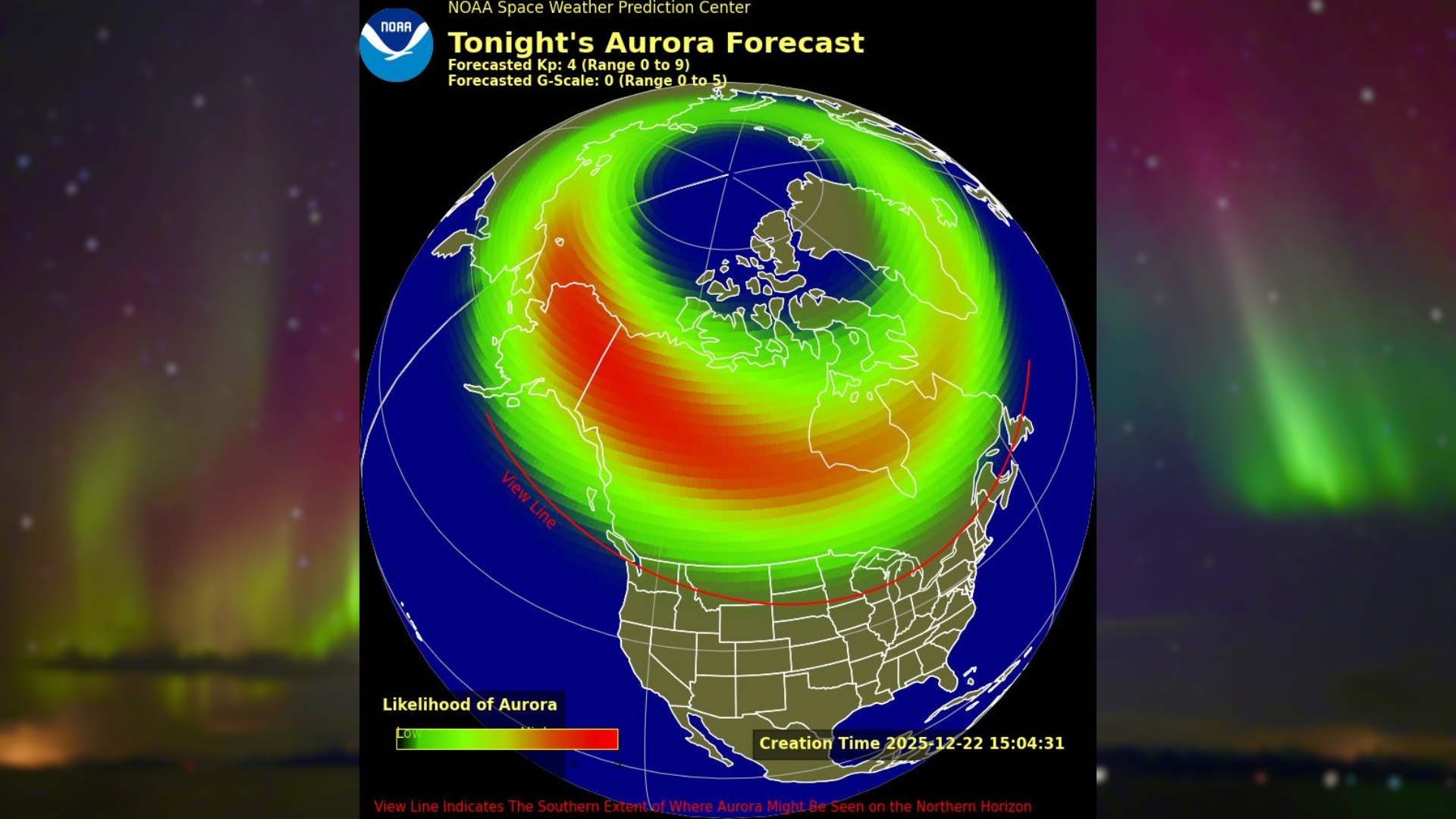
Aurora forecast for tonight courtesy of NOAA’s Space Weather Prediction Center. (Image credit: Map: NOAA Space Weather Prediction Center, background image: Daisy Dobrijevic. Graphic created in Canva Pro.)
States that could see auroras tonight
Based on the latest NOAA aurora forecast map, the following 10 U.S. states appear fully or partially above the aurora view line:
- Alaska
- Washington
- North Dakota
- Minnesota
- Montana
- Maine
- Michigan
- Wisconsin
- South Dakota
- Idaho
Remember, auroras can be fickle creatures. The list is based on current forecast data, but if conditions strengthen and skies are clear, auroras could reach much farther south than expected.
Then again, if conditions don’t align, we might end up with a “nothing burger” and no auroras at all.
Northern Hemisphere aurora forecast courtesy of the U.K. Met Office
What time should I look for the northern lights tonight?
The northern lights could be visible across 10 U.S. states tonight (Dec. 22-23) as soon as it gets dark, so it’s worth keeping an eye on the sky throughout the evening, especially in areas with clear, dark skies.
According to NOAA’s 3-day forecast, geomagnetic storm activity is expected to be best at the following times:
- 4 p.m. – 10 p.m. EST (2100-0300 GMT): Minor G1 level storming possible
How can I see the northern lights from where I live?
If you live in one of the 10 U.S. states forecasted to catch a glimpse of the northern lights tonight, there are a few things you can do to give yourself the best chance of seeing them.
- Find a north-facing vantage point with a clear view of the northern horizon, as far from light pollution as possible.
- Use your phone camera to scan the sky, as a phone camera is great at picking up faint auroras before your eyes spot them. This will give you a good idea of which direction to focus your attention.
- Try and let your eyes adapt to the dark for at least 30 minutes; this will help your night vision develop.
- Wear warm clothing! Part of the fun of aurora hunting is the chase. Be prepared to sit or stand for hours if conditions are looking promising, as you won’t want to miss the show when it starts!
We recommend downloading a space weather app that provides aurora forecasts based on your location. One option I use is “My Aurora Forecast & Alerts,” available for both iOS and Android. However, any similar app should work well.
I also use the “Space Weather Live” app, which is available on iOS and Android, to get a deeper understanding of whether the current space weather conditions are favorable for aurora sightings. Want to capture the perfect photo? Our how to photograph auroras guide can help.

For a half century, the iconic “Lucy” fossil species, Australopithecus afarensis, has held the title of being the most likely direct ancestor of all humans.
But as the list of ancient human relatives has grown and more fossils have been discovered, Lucy’s position has increasingly been called into question. Now, a key paper published last month in the journal Nature could overturn that theory entirely, some scientists say.
You may like
The proposal has revealed intense disagreements in the field. Some say A. anamensis is our direct ancestor, others argue that we don’t know which Australopithecus species we descended from, and still others say the new analysis doesn’t shake up the human family tree at all.
The new discovery is “not altering our picture of human evolution in any way, in my opinion,” Zeray Alemseged, a paleoanthropologist and professor of organismal biology and anatomy at the University of Chicago who was not involved in the new study, told Live Science.
Either way, a resolution might not come until more fossils are found.
An iconic species
Understanding the roots of the debate requires going back a century. In 1925, Raymond Dart announced the discovery of the first known Australopithecus — a skull dubbed the Taung Child unearthed in what is now South Africa that dates to around 2.6 million years ago. For the next 50 years, researchers thought that humans descended directly from the Taung Child’s species, Australopithecus africanus.
But Lucy’s discovery in 1974 at the Hadar site in Ethiopia rewrote that picture. The 3.2 million-year-old fossil became the oldest known australopithecine specimen at the time.
And researchers found her species, A. afarensis, walked upright on two legs similarly to how humans do today, yet it had a smaller brain — about the size of a modern-day chimp’s. This suggested Lucy’s kind could represent a “halfway” point in human evolution between the last common ancestor with chimps and us, making her species a good candidate for our direct ancestor among the many known hominins, the lineage that encompasses humans and our closest relatives.
The skull of a 3-year-old female Australopithecus afarensis, dated to 3.3 million years ago, discovered at the site of Dikika in Ethiopia. (Image credit: Zeresenay Alemseged)
Then, in 1979, her status as our direct ancestor was cemented: an assessment of the evolutionary relationships among hominin fossils uncovered until that point suggested Lucy’s species gave rise to the genus Homo. In that family tree, A. africanus was demoted from our ancestor to a more distant cousin.
You may like
As more australopithecines have been unearthed, the Australopithecus family tree has become bushier and more tangled, complicating the picture of who we may have descended from. But for many anthropologists Lucy’s species still reigns, eventually giving rise to the lineage from which modern humans evolved.
Then the new Nature paper was published. Researchers had unearthed new fossil fragments and tied them to a previously discovered, enigmatic 3.4 million-year-old fossil known as the “Burtele foot”.
The new tooth and jaw fragments allowed anthropologists to ascribe the foot, for the first time, to a little described and controversial species — Australopithecus deyiremeda, a tree-climbing ancient human relative that walked upright on two legs and lived alongside Lucy’s species 3.5 million to 3.3 million years ago at the Woranso-Mille site in Ethiopia.
For Fred Spoor, a professor of evolutionary anatomy at University College London who was not involved in the recent study of the Burtele foot, the new discovery was the nail in the coffin for the theory Lucy’s species was our direct ancestor.
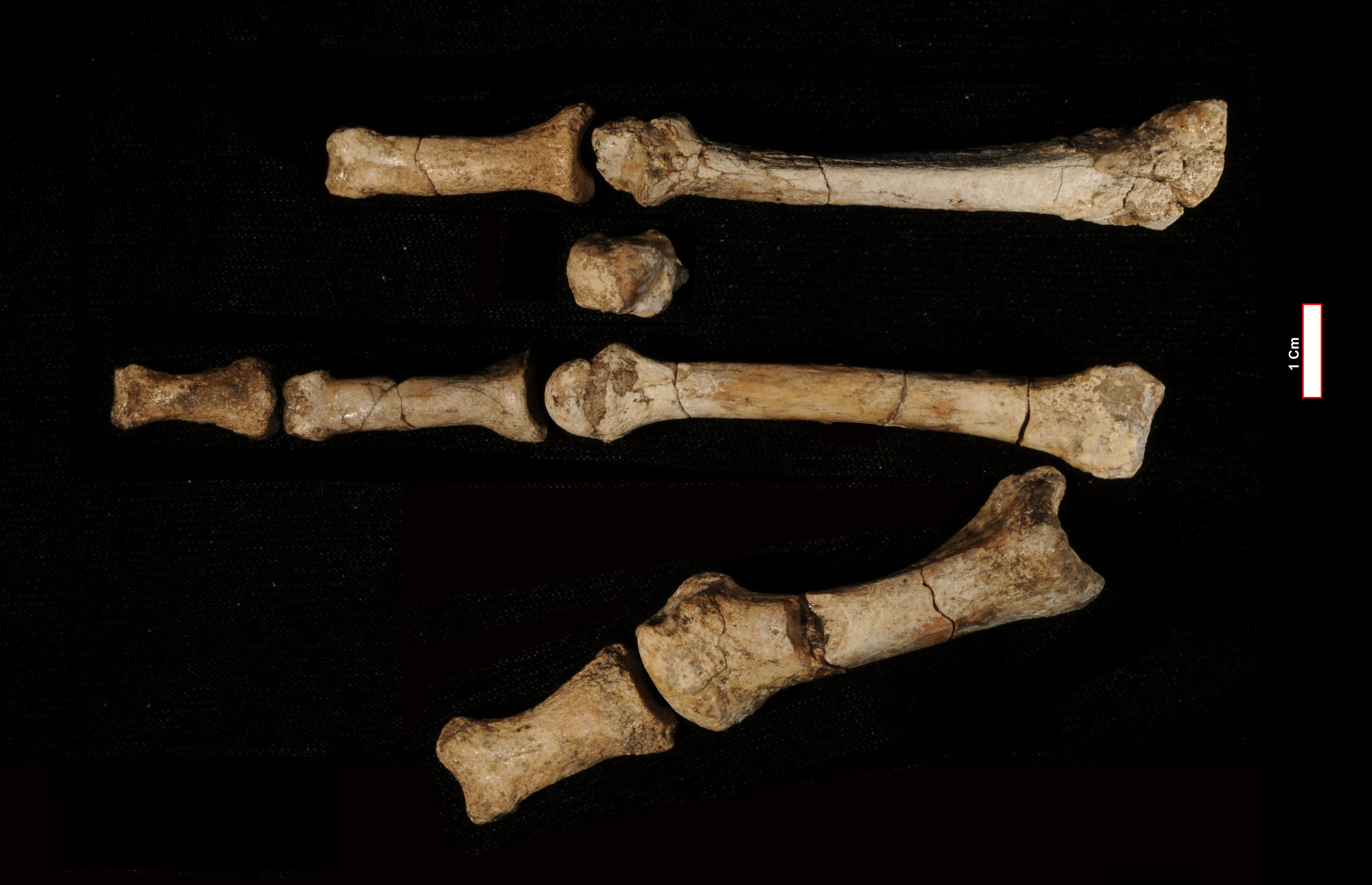
The Burtele foot is the right foot of an adult Australopithecus deyiremeda, who lived around 3.5 million to 3.3 million years ago. (Image credit: Yohannes Haile-Selassie)
That’s because the paper suggested that the species tied to the Burtele foot and the South African A. africanus were more closely related to each other than either was to Lucy’s species. By that logic, then, A. africanus may not have descended from Lucy’s species, but was rather her cousin.
So, it’s possible that both A. deyiremeda and A. africanus descended from the more ancient A. anamensis, who lived in East Africa from around 4.2 million to 3.8 million years ago.
This would also make A. anamensis the direct ancestor to humans, Spoor told Live Science in an email.
For Spoor, this finding would have huge implications. “If this is correct, A. afarensis will lose its iconic status as the ancestor of all later hominins,” probably including us, Spoor wrote in an accompanying commentary about the recent research.
A fierce debate
But other anthropologists are hotly divided on the implications of the new paper.
Some Live Science spoke to thought Spoor’s conclusions were plausible, while other experts said they were “far-fetched” and “a stretch, to put it mildly.”
Because the existing fossil record in East Africa goes much further back in time than the current South African record, many believe the Homo genus arose in East Africa.
Currently the oldest known Homo fossil is a 2.8 million-year-old jawbone from Ethiopia, but models estimate the genus would have actually emerged around 0.5 million to 1.5 million years earlier.
This is older than many of the earliest South African hominin fossils, which were found thousands of miles away. That “would make it unlikely that any of those are the direct ancestor,” Carol Ward, the Curators’ Distinguished Professor of pathology and anatomical sciences at the University of Missouri, told Live Science.
Lucy’s species is still a candidate, but no longer the candidate.
Lauren Schroeder, University of Toronto Mississauga
For many, the most likely candidate for an East African ancestor is still Lucy’s species, A. afarensis, which lived in modern-day Ethiopia, Tanzania and Kenya from around 3.9 million to 3 million years ago. This wide geographic distribution and persistence for almost a million years means it had many opportunities to give rise to other species across Africa, Alemseged said.
Scientists in the “Lucy” camp argue that A. afarensis‘ fully upright mode of walking, broad diet, use of early stone tools and wide geographic range constitute strong evidence for Lucy’s ancestral position in the human family tree.
This makes Spoor’s claim that Lucy’s species wasn’t our direct ancestor a big one. But he isn’t alone in this view.
Thomas Cody Prang, an assistant professor of biological anthropology at Washington University in St. Louis and a co-author of the Nature study, said it’s possible A. afarensis evolved human-like features completely independently of modern humans, like how bats and birds independently evolved wings. Such convergent evolution has been proposed before in our family tree: For example, Prang’s team previously found that A. afarensis and modern humans independently evolved certain body proportions.
If this is true, other species living at roughly the same time as Lucy’s kind are likely ancestors to later hominins, Prang told Live Science in an email.
Prang, for his part, thinks A. deyiremeda‘s anatomy makes the species a better candidate for our direct ancestor than Lucy. That’s because the species has a combination of ancient and new traits. What’s more, a 2015 analysis flagged A. deyiremeda as being more closely related to Homo than Lucy’s species.
Others think the Nature paper resurrects A. africanus as a plausible ancestor to Homo.
Lauren Schroeder, a paleoanthropologist at the University of Toronto Mississauga and who was not involved in the new study, said that either way, many different hominin species were evolving and intermingling across Africa during this 3.5 million to 2 million period of time. That means our evolutionary history is more like a braided stream, with species separating and then recombining, and less like a straight evolutionary line.
“Early Homo could have emerged from a broader, pan-African pool of australopith diversity. So yes, Lucy’s species is still a candidate, but no longer the candidate,” for a direct human ancestor, Schroeder told Live Science in an email.
Even the authors of the new paper disagree on its implications. While Prang supports the dethroning of Lucy’s species as our direct ancestor, the study’s lead author Yohannes Haile-Selassie, a paleoanthropologist and director of Arizona State University’s Institute of Human Origins, insists that Lucy’s species is still the best candidate for the direct ancestor to Homo.
He told Live Science in an email that the more ancient traits found in A. deyiremeda and A. africanus, like having feet adapted for climbing trees, contradict the idea that they are our direct ancestors. On the other hand, Lucy’s species had more human-like feet, which Haile-Selassie said makes A. afarensis the “more likely ancestor of those which came later.”
Of course, it’s possible the smoking gun evidence that settles the debate will never come.
“We will almost certainly never know who our direct ancestor is — and the more we learn about human evolution and how diverse our past was, the more elusive that ancestor becomes,” said Ward.
But that doesn’t mean we’ll ultimately understand less of our evolutionary past, Ward said. “Even though we may never know which one was our ancestor, we can still piece together much of what that ancestor may have been like.”


Earlier today I set you the following set of numerical challenges to celebrate the arrival of 2026.
Auld lang signs
Here is an expression equal to 26 that uses six 1s:
(1+1)×(1+1+11)
Find expressions equal to 26 using:
-
Five 9s
-
Six 8s.
-
Six 7s.
-
Six 6s.
-
Four 5s.
-
Six 4s.
-
Four 3s.
-
Four 2s.
-
a partridge in a pair tree. (Only joking)
You are only allowed the four basic operations, +, –, x, ÷, brackets, exponentiation and concatenation. (Exponentiation is when you make a digit the exponent, such as 11. Concatenation is when you join digits together, such as taking a two 1s and making 11.)
Solutions
9+9+9−(9/9)
8+8+8+((8+8)/8)
7+7+((77+7)/7)
6×6+(6−66)/6
5×5+(5/5)
4+(44×4/(4+4))
33 − 3/3
22 + 2 + 2
Good tidings to all! I’ll be back in 7+7+((77+7)/7)
Thanks to Inder Taneja, author of the website numbers-magic.com. He has many more facts about the coming year in his paper 26 and 2026 in Numbers and Magic Squares
I’ve been setting a puzzle here on alternate Mondays since 2015. I’m always on the look-out for great puzzles. If you would like to suggest one,
SOURCE PAGE

One of the world’s largest Bitcoin mining facilities is seen leaking heat into the environment in a new image captured from orbit by a heat-seeking satellite that was recently released by the U.K.-based company SatVu.
The image reveals the thermal footprint of a major Bitcoin-mining data center in Rockdale, Texas, which has been widely criticized for its electricity consumption and carbon footprint.
You may like
The satellite image reveals in a resolution of 11.5 feet (3.5 meters) where and how much heat leaks into the environment from the plant. SatVu thinks that the insights that could be gleaned from such images could help regulators and grid operators better understand the impact such facilities have on the environment and local power networks.
“Today’s data center buildout is moving incredibly quickly, and the world needs better ways to understand what’s actually happening on the ground,” Thomas Cobti, SatVu’s VP for Business Development, said in a statement. “Thermal data gives an objective view of operational activity as it occurs — not weeks later through reports or announcements.”
Although the image was only released on Dec. 17, it was most likely captured already in 2023, before SatVu’s HotSat-1 satellites failed in orbit in December that year. SatVu plans to launch its replacement HotSat-2 next year and is already building HotSat-3.
The thermal camera aboard these satellites is the best in class, providing an order of a magnitude better resolution than other temperature-measuring devices in orbit.
SatVu released the first HotSat-1 images in October 2023, capturing the heat trails behind locomotives and showing how heat spreads from large sun-drenched concrete parking lots in a city like Las Vegas.
With the newly released image, the company shows how satellites could keep an objective eye on a fast-growing and controversial sector.
“At a closer level, [the image] reveals which substations and cooling systems are under load — clear, physical indicators of real operational behavior,” the company said in the statement. “Together, these layers provide a grounded, evidence-based view of how major data center sites are evolving in real time.”
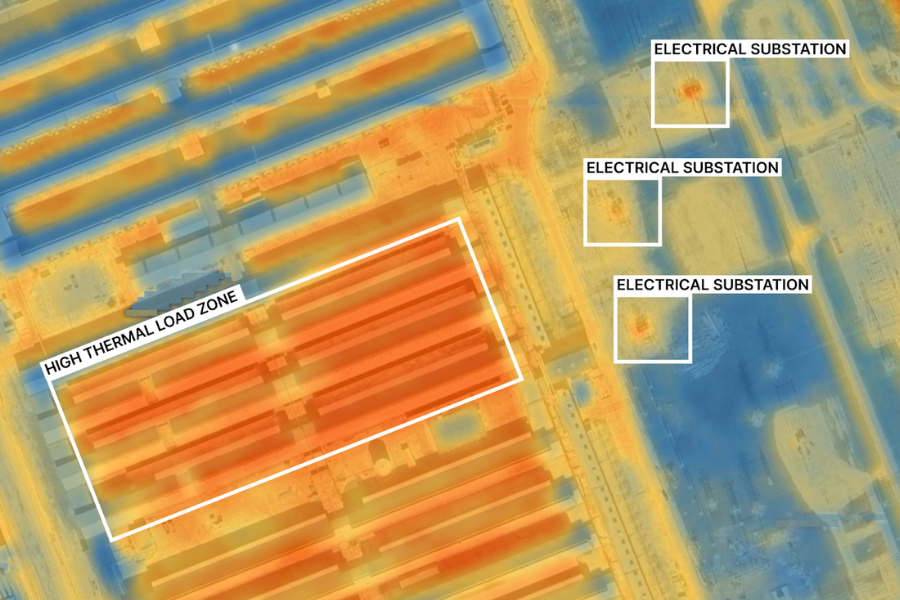
A labeled image taken from Earth satellite company SatVu. (Image credit: SatVu)
A closer inspection of the image shows “distinct thermal signatures across rooftop chillers, transformers and electrical yards, making clear which parts of the facility are active and which remain dormant,” SatVu added.
According to the McKinsey consultancy, investment into computing data centers will continue to grow, reaching more than $7 billion by 2030. Global data centers are believed to contribute by about 0.5% to the global carbon dioxide emissions. Bitcoin mining is especially energy intensive, a recent study estimated that one Bitcoin transaction generates about as much carbon dioxide as a gasoline car generates in a 1,600-mile (2,500-kilometer) drive.

While ongoing showers might suggest this Christmas will be a washout, experts say a wintry snap is on its way and some areas of the UK might even have a white Christmas.
According to the Met Office, high pressure is building – meaning that, while some areas may experience showers, many will have drier and more settled weather.
The UK’s national meteorological service added that a strong easterly breeze would make it feel colder – although not unusually so for this time of year, with temperatures on Christmas Day expected to reach a daytime high of 7C and night-time lows at -3C or -4C. As a result, Father Christmas might be accompanied by Jack Frost.
“The south coast of England down towards South Devon and Cornwall perhaps [has] the greatest chance of seeing the odd wintry flurry if there were to be [any],” Marco Petagna, of the Met Office, told the Guardian. “Of course, for a white Christmas, technically now all we need is one flake of snow to fall anywhere in the UK. And it’s not an unusual occurrence – it’s more unusual for it to be lying snow.”
Snow in Holcombe, Greater Manchester, February 2021. Most of the UK’s snow days actually happen between January and March. Photograph: Christopher Thomond/The Guardian
According to the Royal Meteorological Society (RMetS), a snowflake has tumbled from the sky on Christmas Day 54 times over the past 66 years at least somewhere in the UK, and except for 2024, every year since 2020 has technically been deemed “white”.
In 2023, 11% of weather stations recorded snow falling on Christmas Day, and 9% in 2022, although snow was not recorded as settling in either year. Indeed, as the RMetS notes, a thick blanket of snow at Christmas has only occurred four times since 1960 – in 1981, 1995, 2009 and 2010 – with 2010 having snow on the ground at 83% of stations, the highest percentage ever recorded.
But anyone expecting festive snowball fights is likely to be in for a disappointment this year. “The chance of noteworthy snowfall is only around 10%, so nothing significant,” said Petagna.
It was not always thus: the little ice age meant that between the 16th and 19th centuries it was more common to have a harsh winter – perhaps explaining why the writings of Charles Dickens, who was born in 1812, often refer to a cold and snowy Christmas. In addition, before 1752, when the transition to the Gregorian calendar was completed in Britain, 25 December fell later in the winter.
Snow at Cheltenham racecourse, February 1963 – a particularly harsh winter. Photograph: Maeers/Getty Images
More recently, particularly harsh winters have included those of 1946–47 and 1962-63. “Much of England remained covered in snow every day from late December until early March 1963,” the Met Office has noted.
The rarity of festive snow cover today is, perhaps, not a surprise, given the climate crisis. Met Office data has revealed Decembers in the UK have become warmer in recent decades – conditions that reduce the overall chance of snowfall on Christmas day, although natural variability means cold and snowy spells can still occur.
But just because a snowy Christmas is unlikely this year, it doesn’t mean snowballs are a thing of the past: the Met Office notes that most of the UK’s snow days happen between January and March.
As the poet Sara Coleridge put it: “January brings the snow, makes our feet and fingers glow.”
SCIENCE
New EV motor invention could cut 1,000 pounds from future vehicles, making them much lighter while boosting their range

A new in-wheel motor for electric vehicles (EVs) delivers a massive amount of torque in a lightweight package, its developers say.
The motor — which was made by YASA, a subsidiary of Mercedes-Benz that also provides motors to Ferrari — weighs only 28 pounds (12.7 kilograms) but can deliver up to 1,000 horsepower at once or a sustained 469 to 536 hp for longer durations. This new mark breaks YASA’s own previous unofficial record, a 29-pound motor that yielded 738 horsepower, company representatives said in a statement.
You may like
The ability to pack so much power into such a compact, lightweight motor is due in part to YASA’s axial flux technology. Traditional radial flux motors are longer, tube-like structures, with a stator — the stationary part of a motor that creates a magnetic field used to produce motion — surrounding a cylindrical rotor. A magnetic field is passed perpendicularly to the shaft through the cylinder to spin the rotor.
By contrast, an axial flux motor is more like a pancake, with a disc-like rotor and stator. Magnetic flux passes along the axis parallel to the shaft (hence the name). The axial flux tech allows for much smaller designs than traditional radial designs, according to YASA.
Much lighter EVs in the future
The company emphasized that the design is scalable and doesn’t rely on any rare or exotic materials to function.
The design also opens up a pathway for massive weight reduction in EV design. YASA said that deploying the in-wheel motors in lieu of a traditional power and drivetrain could save around 440 pounds (200 kg). And for vehicles designed from the ground up to incorporate the new motor, the savings could be closer to 1,100 pounds (500 kg).
This is in part because the system also incorporates advanced regenerative braking, the process by which electric vehicles capture energy that would normally be lost as heat during braking and utilize it to recharge the battery.
Instead of power being shunted from the battery to spin the wheels, energy from the wheels is captured to spin the motor, which generates electricity rather than consuming it. The motor resists the rotation while generating energy, thereby slowing the car and powering up the battery. YASA says efficient regenerative braking could reduce the need for traditional friction brakes, saving both weight and space.
While the current iteration is clearly geared toward high-performance EVs and supercars, axial flux motor technology opens the door for longer-range electric vehicles capable of generating more power with fewer, lighter components. The reduction in space required for traditional powertrain components also provides manufacturers an opportunity to streamline aerodynamics or provide more interior space for cargo or passengers.