
SCIENCE
Is the sun really a dwarf star?


The sun is the biggest object in the solar system; at about 865,000 miles (1.4 million kilometers) across, it’s more than 100 times wider than Earth. Despite being enormous, our star is often called a “dwarf.” So is the sun really a dwarf star?
Technically, the sun is a G-type main-sequence star — specifically, a G2V star. The “V” indicates that it is a dwarf, Tony Wong, a professor of astronomy at the University of Illinois Urbana-Champaign, told Live Science.
You may like
“G” is astronomer code for yellow — that is, stars of a temperature range of around 9,260 to 10,340 degrees Fahrenheit (5,125 to 5,725 degrees Celsius), Lucas Guliano, an astronomer at the Harvard-Smithsonian Center for Astrophysics, told Live Science.
Wong noted that G2 means it’s somewhat hotter than a typical G-type star. “They range from G0 to G9 in order of decreasing temperature,” he said. At its surface, the sun is about 9,980 F (5,525 C), Guliano added.
Calling the sun yellow is a bit of a misnomer, however, as the sun’s visible output is greatest in the green wavelengths, Guliano explained. But the sun emits all visible colors, so “the actual color of sunlight is white,” Wong said.
(On Earth, the sun appears yellow because of the way molecules in the atmosphere can scatter the different colors that make up the sun’s white light, according to Stanford University’s Solar Center. This is the same reason the sky appears blue.)
G-type stars also range from G0 to G9 in order of decreasing size, Guliano said. Wong explained that class G stars “range in size from somewhere around 90% the mass of the sun up to around 110% the mass of the sun.”
The sun is what astronomers call a main-sequence star, a class that includes most stars. Nuclear reactions within these stars fuse hydrogen to become helium, unleashing extraordinary amounts of energy. Among the main-sequence stars, the color is determined by the star’s mass.
“The sun is yellow, but less-massive main sequence stars are orange or red, and more massive main sequence stars are blue,” Carles Badenes, a professor of physics and astronomy at the University of Pittsburgh, told Live Science.
The sun is slowly changing as it ages. “It has gotten about 10% larger since it started on the main sequence, and it will get much larger,” Wong said. Even as it grows, however, the sun will still be considered a dwarf until its last stage of life.
In about 5 billion years, the sun will run out of hydrogen fuel and begin to swell to become a red giant, leaving its dwarf days behind. “It will engulf the orbit of Venus, and maybe Earth as well,” Badenes said, “and its surface temperature will get colder, making it red in color.”
Sun quiz: How well do you know our home star?








It has been a whirlwind year for space science, to say the least.
The Trump administration only entered office at the beginning of this year, but has already shaken up the world of academic research and the structure of major science organizations such as NASA and the National Oceanic and Atmospheric Administration. An interstellar comet strayed into our solar system and scientists have been rushing to study this sample from beyond ever since (even during a government shutdown).
Satellites are crowding Earth orbit, the northern lights are suddenly visible to people who would never normally expect to see them, and we even went through one of the shortest days in history. We saw black holes devouring stars in new ways, witnessed experts fight over whether an exoplanet called K2-18b is actually exhibiting signs of life right before NASA’s Perseverance rover found a possible biosignature of its own, and waited patiently for a new observatory to drop its first images — and that barely scratches the surface of it.
You may like
But I was curious about something. With so many massive cosmic stories competing for attention, which ones resonated the most? What space questions were people Googling? What sounded too good to miss?
To find out, I dug into our metrics and searched for the 12 most read stories of 2025. Here’s what I found.
12. China reached out to NASA to avoid a potential satellite collision in 1st-of-its-kind space cooperation

Space debris continues to be a growing problem for space exploration. (Image credit: NASA Goddard Space Flight Center)
Possible satellite accidents and surprising international space cooperation kick off this list; At number 12, is a story that perhaps offered a glimpse of a more collaborative future in orbit that can drown out our Kessler Syndrome worries.
This year, officials with the Chinese National Space Agency did something unexpected: They reached out to NASA after detecting a potential satellite traffic collision, suggesting NASA hold its satellite still while they figure out a maneuver. While NASA has sent such alerts to China before, the reverse hadn’t happened until now.
On one hand, there’s something to be said here about how many satellites are traversing Earth orbit (so many that space traffic control is moving toward normalcy!) and, on the other, it shows China’s space capabilities may have leveled up once more. Detecting and tracking potential collisions requires sophisticated space situational awareness, something long dominated by the U.S.
Read the full article here.
11. Big lake in Quebec suddenly disappears, satellite finds
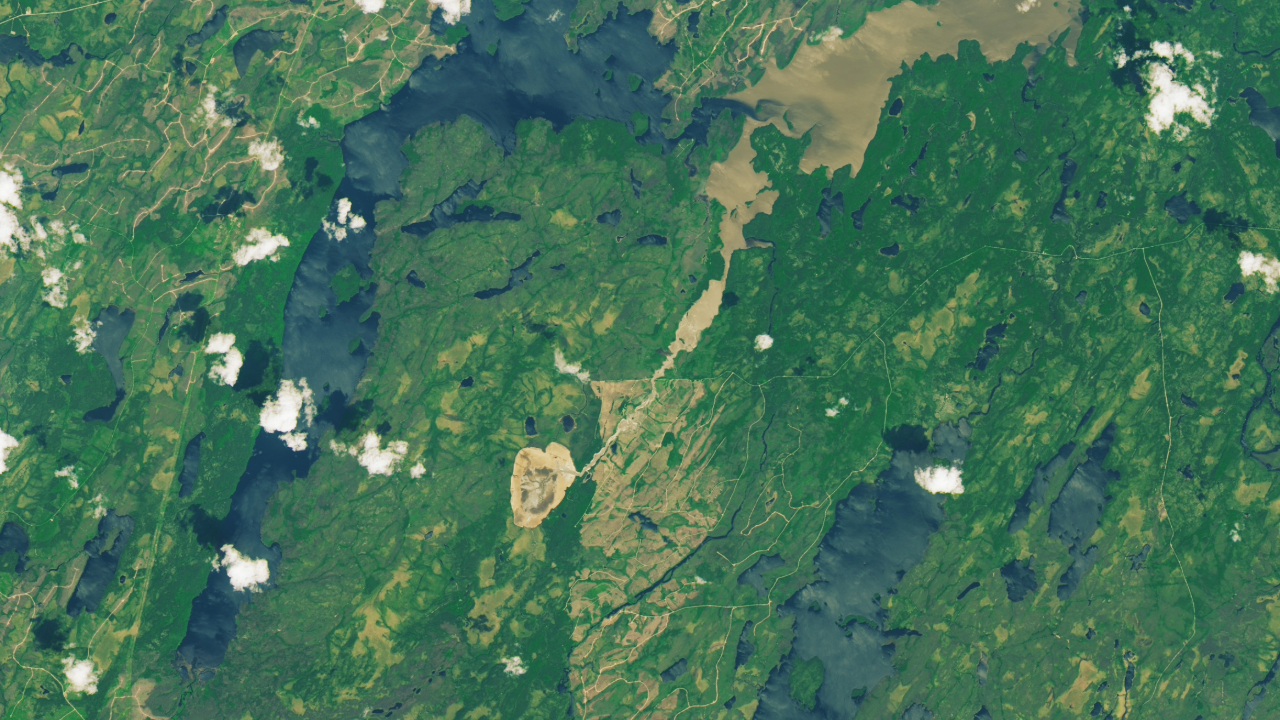
Lac Rouge suddenly disappeared in Quebec. (Image credit: NASA Earth Observatory/images by Wanmei Liang, using Landsat data from the U.S. Geological Survey.)
The headline of this Space Photo of the Day from August is certainly worth a double-take, so I’m not terribly shocked it’s on this list.
You may like
The short explanation for what happened here is that the land surrounding a lake in Quebec collapsed inward on itself, causing the lake’s water to drain suddenly and triggering landslides with little to no warning. Families with the Cree First Nation of Waswanipi, an Indigenous community in Quebec, were devastated by the loss of their traditional hunting, fishing and campgrounds.
Read the full article here.
10. James Webb Space Telescope takes 1st look at interstellar comet 3I/ATLAS with unexpected results
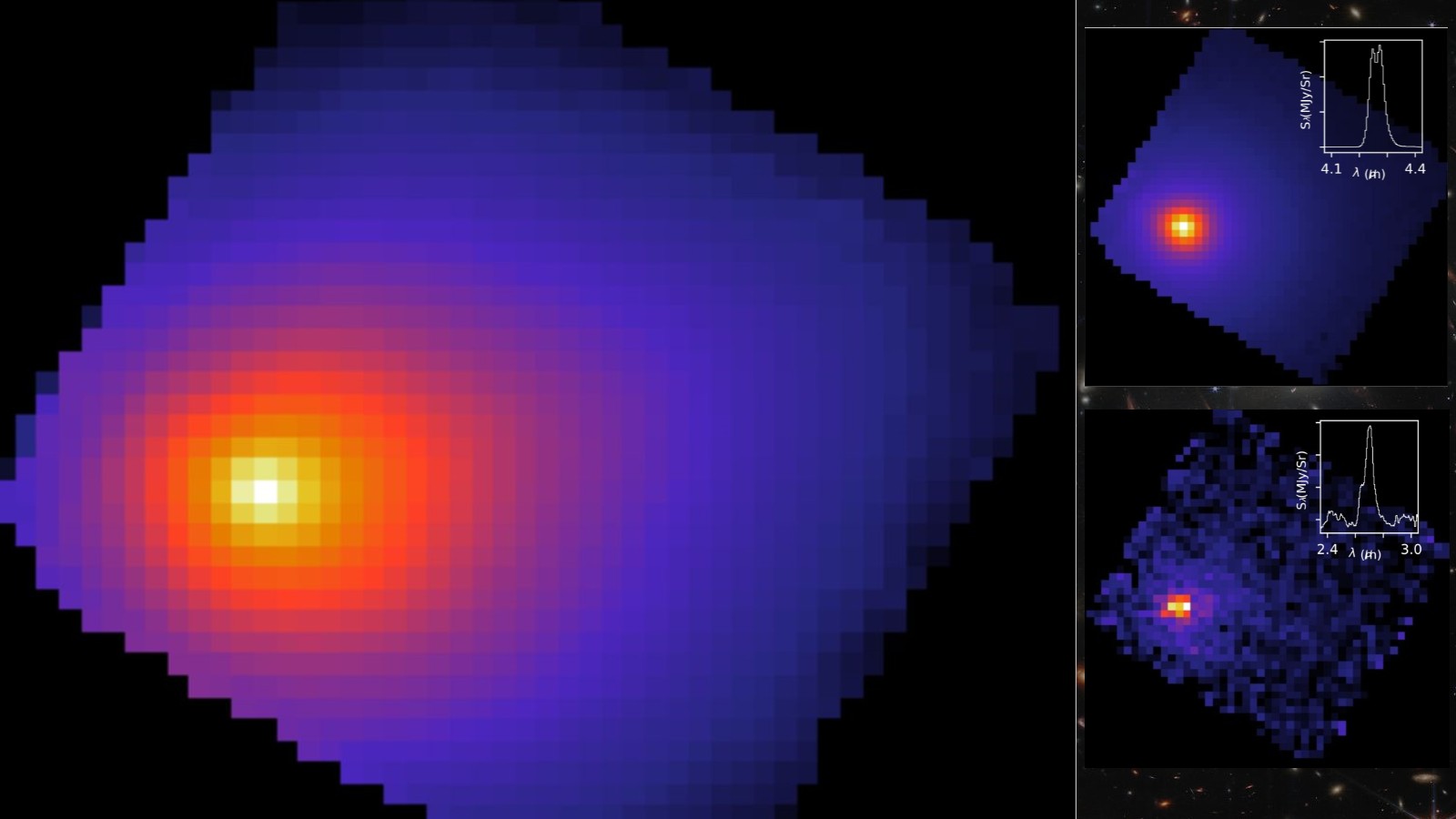
The James Webb Space Telescope turned its eye on interstellar comet 3I/ATLAS, resulting in these images. (Image credit: NASA/James Webb Space Telescope)
Of course comet 3I/ATLAS had to make this list. It’s one of the most fascinating cosmic serendipities to happen in recent memory.
Comets are very cool in and of themselves, but what’s special about 3I/ATLAS is that it came from beyond our solar system — hence, its “interstellar” title – and it’s only the third confirmed object to enter our corner of the cosmos from elsewhere. Scientists are trying to learn as much as possible about this so-called “invader” before it leaves forever, and in this article, you can see data about the comet captured by the James Webb Space Telescope — a highly revered, infrared-light-catching instrument that launched on Christmas Day in 2021.
Read the full article here.
9. Earth will spin faster today to create 2nd-shortest day in history

The second shortest Earth day occurred this summer. (Image credit: joecicak/Getty Images)
The second shortest day on record took place this year on July 22, but it was only 1.34 milliseconds shorter. The record didn’t last long; it was broken again on Aug. 5.
What causes these variations? Well, Earth’s rotation isn’t perfectly constant because of variables like the gravitational pull of the moon on our planet, masses on our planet itself shifting (like its liquid core) and seasonal changes. And even though we can’t actually feel the difference in rotation, it’s maybe nice to know that forces beyond the context of our reality are shifting and aligning to keep our clocks ticking and our journey through the universe a healthy cruise.
Read the full article here.
8. Failed Soviet Venus lander Kosmos 482 crashes to Earth after 53 years in orbit
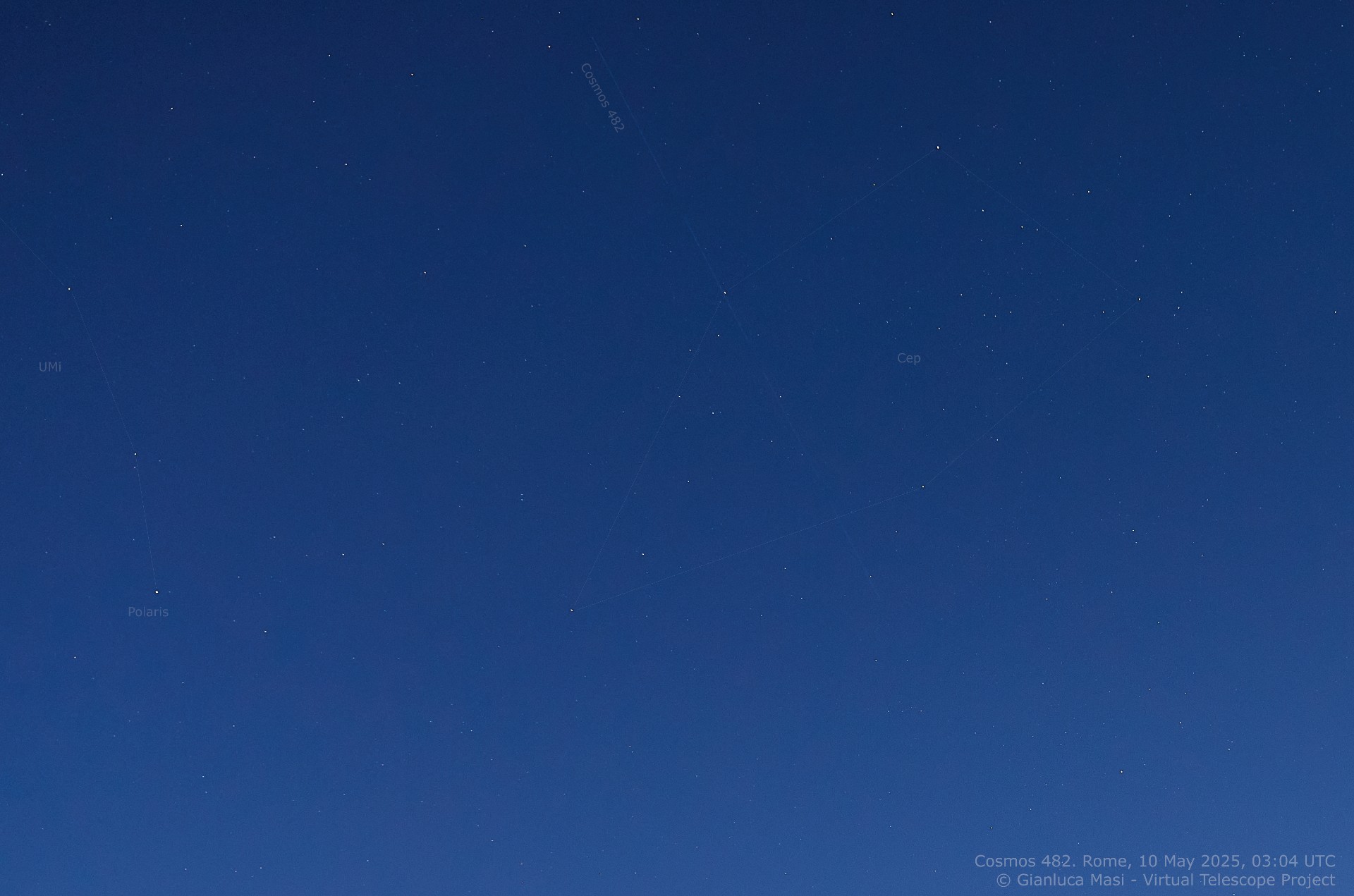
A streak against the dark sky shows Kosmos 482 landing back on Earth (Image credit: Gianluca Masi/The Virtual Telescope Project)
It was a bittersweet moment on May 10 this year, when a Soviet-era spacecraft, Kosmos 482, plunged back to Earth after more than five decades in orbit.
Kosmos 482’s destiny was to ride the tides around Venus, but because of a failure during launch, the spacecraft never made it past our planet’s orbit. And for the last five decades, it had remained in limbo there, unable to continue its journey or return home, until gravity closed the chapter.
At last, it’s home.
Read the full article here.
7. Russian ‘Noah’s Ark’ satellite carrying 75 mice and 1,500 flies lands back on Earth
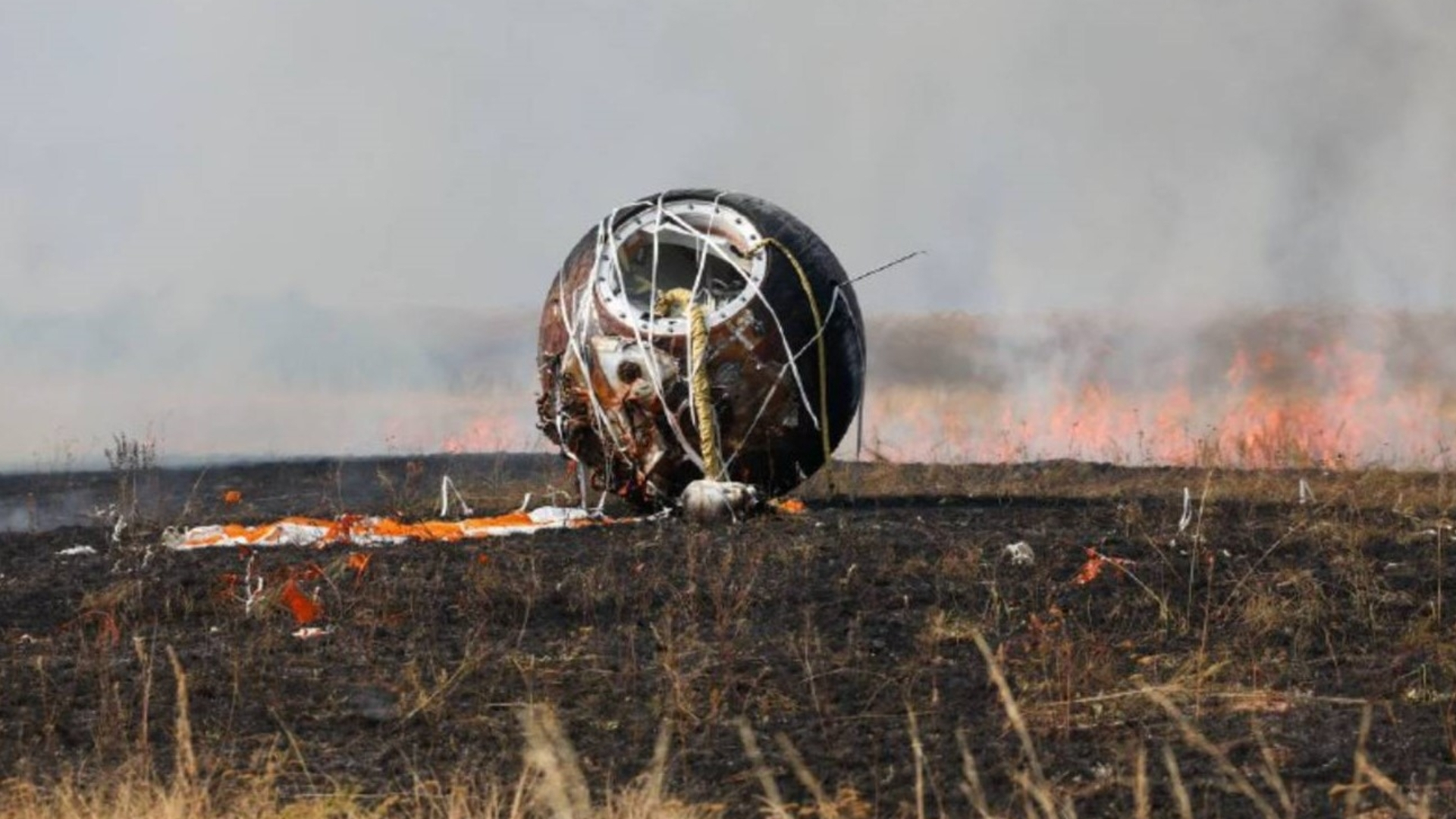
The landing spot of Russia’s Bion-M No. 2 descent module, on the steppes of the Orenburg region. (Image credit: Roscosmos/Ivan Timoshenko)
Speaking of in-orbit objects that returned home, so did a spherical Russian spacecraft carrying 75 mice, 1,500 flies, microorganisms and plant seeds spent 30 days in orbit, exposing its living cargo to cosmic radiation and microgravity before returning to Earth.
While 10 mice died and some flies didn’t survive, most of the animals came back alive, giving scientists valuable insight into how living organisms cope with spaceflight.
Read the full article here.
6. Cosmonaut removed from SpaceX’s Crew 12 mission for violating national security rules: report
In early December, an investigative report from Russian news site The Insider revealed that cosmonaut Oleg Artemyev was removed from SpaceX’s Crew 12 mission after allegedly leaking confidential SpaceX documentation and photos.
This mission, scheduled to launch to the International Space Station as early as February, now lists cosmonaut Andrei Fedyayev as Artemyev’s replacement on the four-person crew.
Read the full article here.

Cosmonaut Oleg Artemyev was removed from the SpaceX Crew 12 mission. (Image credit: NASA/Bill Ingalls)
5. Scientists analyze 76 million radio telescope images, find Starlink satellite interference ‘where no signals are supposed to be present’

An astronomical image marred by trails caused by satellites of SpaceX’s Starlink megaconstellation. (Image credit: Victoria Girgis/Lowell Observatory)
And on the note of SpaceX, the rise of satellite megaconstellations spearheaded by Elon Musk’s company continues to make headlines for the negative impact it has on astronomy observations. Though other satellites are contributors to the issue of signal interference in night sky images — notably AST SpaceMobile’s Bluewalker 3 — SpaceX’s Starlink internet satellites are quite the polluters in this domain. There are over 10,000 deployed satellites, with more on the way.
This article is one of several that investigate how bad the Starlink effect is on astronomy, and how much worse it could get. A new study from this month, for instance, suggests satellite constellations like Starlink could obscure most space telescope observations by the late 2030s.
Read the full article here.
4. What time is Sept. 7 blood moon total lunar eclipse?
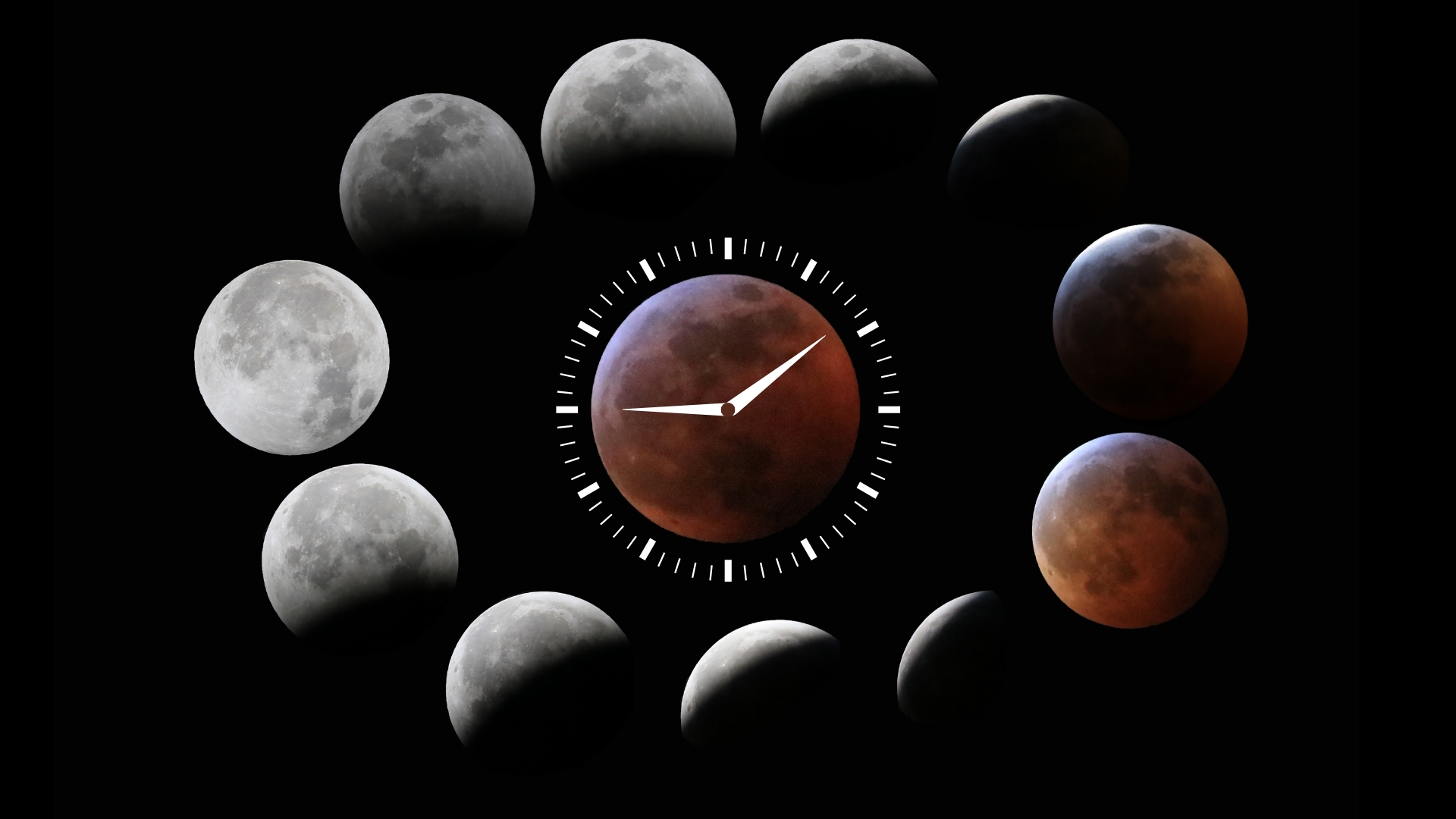
The total lunar eclipse happened on Sept. 7-8, 2025. (Image credit: Created in Canva Pro by Daisy Dobrijevic)
Number four on this list represents several blood moon stories from this year, as humanity’s desire to view our lunar friend became quite clear to me while we searched through our most-read stories.
The blood moon, for context, happened because a total lunar eclipse was visible across Asia and Europe overnight from Sept. 7 through Sept. 8. The moon’s deep red hue appeared as it passed through Earth’s shadow, with the exact shade shaped by conditions in Earth’s atmosphere — a process explained in detail through an accompanying infographic.
It’s also hard to forget how much the 2024 total solar eclipse captivated the world; it would seem space traffic is just as mesmerizing as space traffic control to us.
Read the full article here.
3. NASA’s Perseverance rover hits the Mars rock gold mine: ‘It has been all we had hoped for and more’
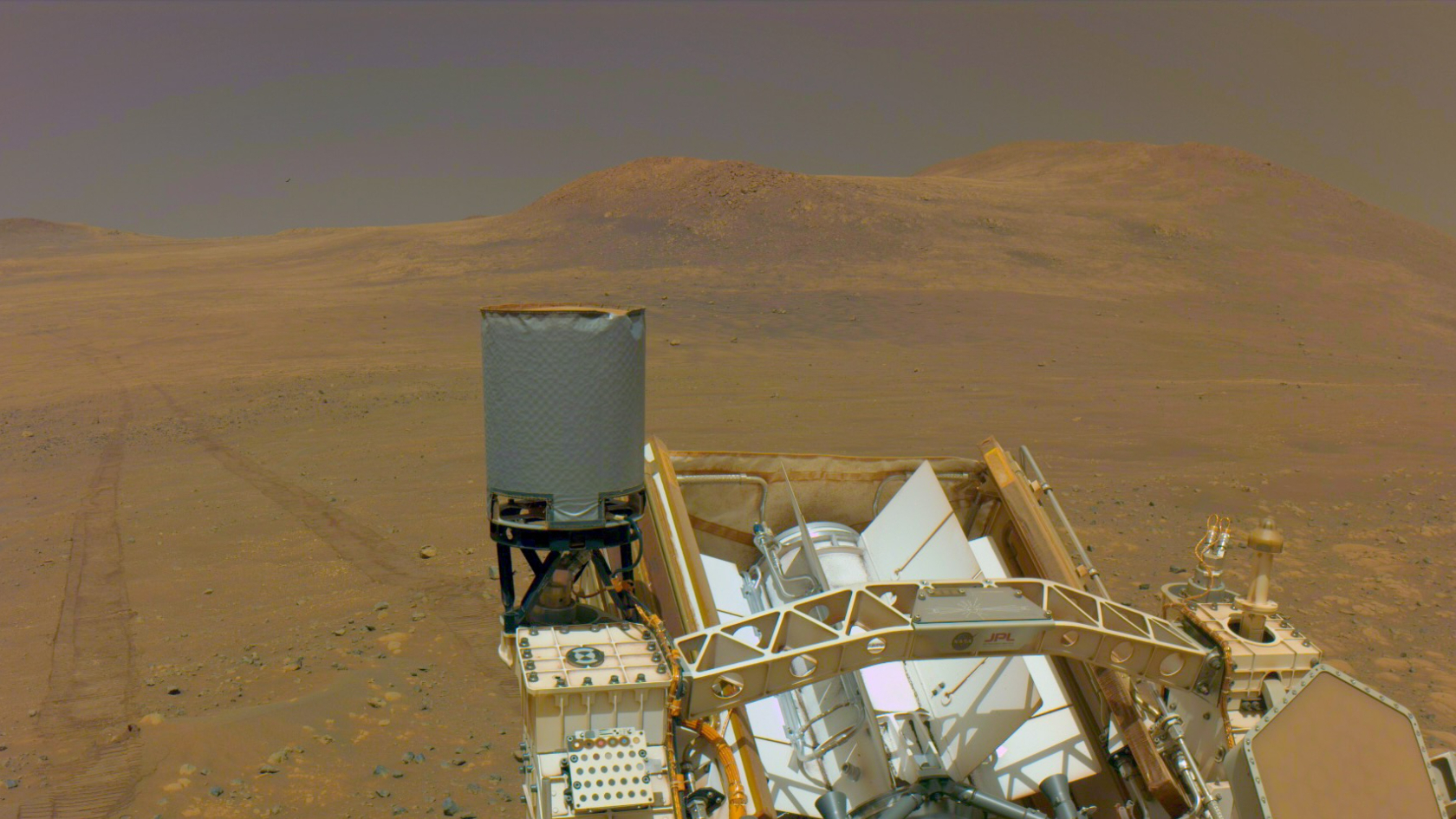
One of the navigation cameras on NASA’s Perseverance captured the rover’s tracks coming from an area called “Witch Hazel Hill,” on May 13, 2025, the 1,503rd Martian day, or sol, of the mission. (Image credit: NASA/JPL-Caltech)
The Perseverance rover had some major wins this year while scouring the Martian surface for clues about the history of the Red Planet. One of them is the absolute bounty of peculiar rocks it found at a spot near Jezero Crater called “Witch Hazel Hill.”
While exploring the region, the rover uncovered intriguing specimens, including once-molten rocks and, for the first time, material from the crater rim itself. One particularly prized sample, dubbed Silver Mountain, captivated scientists with its unusual textures — and will likely remain a highlight of the mission for years to come.
Read the full article here.
2. Northern lights may be visible in these 23 US States June 1
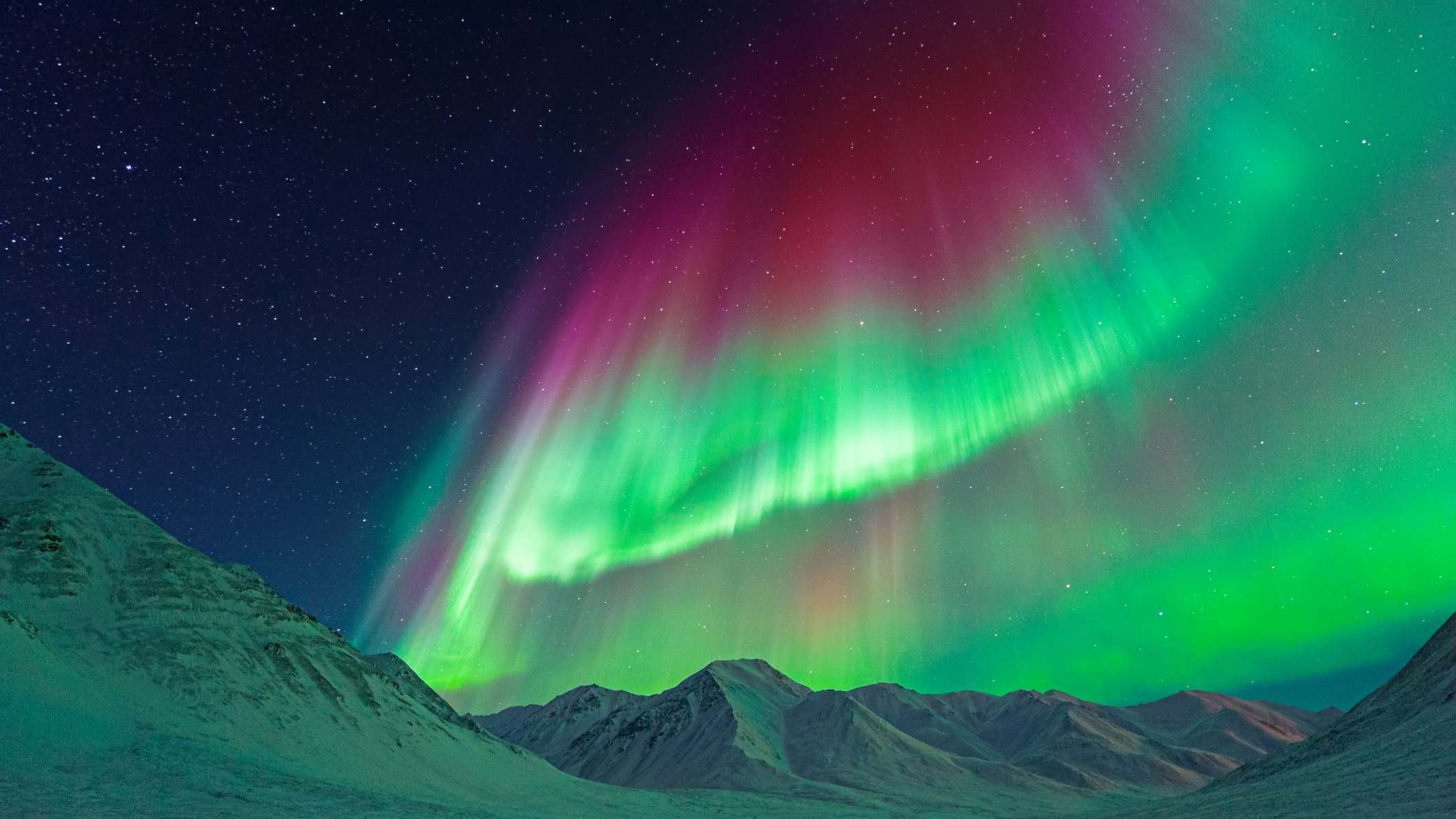
The northern lights put on a spectacular display in 2025. (Image credit: Noppawat Tom Charoensinphon via Getty Images)
Similar to the deal with the blood moon conglomerate, this article represents all the northern lights stories that were running off the charts this year.
The current solar cycle has been kind enough to allow humans across the world to see the northern lights right in their backyards, even if they don’t live in the frigid polar areas of our globe. And after getting a taste of what it’s like to see these surreal light shows, it appears to have become a chase for many.
What’ll happen when a solar cycle doesn’t treat us this well in the future? Hello darkness my old friend?
Read the full article here.
1. Trump’s signing of ‘One Big Beautiful Bill’ includes $85 million to move space shuttle Discovery from Smithsonian to Texas

The future of Space Shuttle Discovery is questionable. (Image credit: Space.com/Chris Daniels)
Welcome to our number one most-read story this year: A rundown of how the Trump administration’s “Big Beautiful Bill” allocated money to move the iconic space shuttle Discovery (currently located at the Smithsonian National Air and Space Museum in Washington D.C.) to Space Center Houston, the official visitor center for NASA’s Johnson Space Center in Texas.
This idea has been met with much disdain from experts, in part because it would entail sort of chipping up Discovery into different pieces. Not to mention, it’d be pretty hard to complete the task — and the money involved could theoretically be used for other stuff.
It’s fitting to have this story at our top spot because of how science has been flipped upside down this year due to changes implemented by the Trump administration. Several of Space.com’s stories in 2025 have been dedicated to peeling back the layers of how the administration — since taking office at the start of this year — has led to mass layoffs of scientists, language changes on scientific websites, an increase in quiet censorship and arguably illegal moves from major organizations like NASA.
Considering the amount of dramatic news we see on this list alone, both directly and indirectly, it will be interesting to see what our 2026 “most read stories” list will look like.
Read the full article here.
SCIENCE
Tooth-in-eye surgery, ‘blood chimerism,’ and a pregnancy from oral sex: 12 wild medical cases we covered in 2025

Each week, Live Science highlights an intriguing case report from the medical literature, where we explore unusual symptoms, rarely seen diagnoses and out-of-the-box treatments. Through this “Diagnostic Dilemma” series, we describe how doctors work to ultimately discover the cause of a patient’s ailment. In complex cases, this diagnostic process can be quite arduous. That’s part of why doctors share case reports: to help other medical professionals who might be facing the same puzzle.
Here are 12 of our most intriguing Diagnostic Dilemmas from the past year. (If descriptions of medical symptoms and procedures make you squeamish, proceed with caution.)
1. Boy spoke foreign language after surgery
A Dutch teenager got knee surgery to treat a soccer injury, and upon waking up from anesthesia, he spoke only English — a language he’d previously spoken only in language classes at school. He kept insisting he was in the U.S., did not recognize his parents, and could not speak or understand spoken Dutch, his native language. Exams turned up no neurological abnormalities, and the doctors didn’t initiate any specific treatment to address the language issue. Within 18 hours of surgery, the boy could understand some Dutch but not speak it without struggling. But then suddenly, he could both understand and speak it as normal. The doctors described the event as a strange case of “foreign language syndrome.”
You may like
2. Woman with no vaginal opening gets pregnant via oral sex
3. Man stabbed by huge fish
A man was brought to a hospital by boat and helicopter after incurring an injury while fishing. He’d caught a white marlin (Kajikia albida) — a large fish with a long, pointy “bill” — and when he leaned over the edge of his boat to release his hook from the fish, it jumped up and struck him. At the hospital, doctors found a fragment of the fish’s bill lodged in the man’s throat, spinal canal and base of his skull. With an emergency surgery and antibiotics to prevent infections, the man survived the encounter without any long-term symptoms.
4. Acupuncture led to joint injury
An X-ray of the front (A) and side (B) of the patient’s left knee. The lines are the tiny golden threads. (Image credit: The New England Journal of Medicine ©2013.) (Image credit: The New England Journal of Medicine ©2013.)
A woman with osteoarthritis of the knee began getting acupuncture regularly when her pain medications started causing bad stomach issues. But her knees then became very sore, and she went to a hospital to be examined. X-rays revealed areas of her joints and shinbones where the bone tissue had thickened and spurs had formed. Additionally, hundreds of tiny flecks could be seen around both knee joints. It turned out that the woman’s acupuncturists had left golden threads inside her knees on purpose as part of her treatment. In other cases, these threads have caused cysts and tissue damage, which can happen when they migrate through the body.
5. Man experiences rare meat allergy
A man in Michigan went to an ER with swollen eyelids and an itchy rash, and he noted that he’d also been experiencing cramps, nausea, abdominal pain and vomiting over the preceding days. When doctors examined the patient, they uncovered signs of anaphylaxis, a severe allergic reaction, and his condition quickly progressed to shock. The medical team successfully stabilized the patient, but a few days later, his condition worsened again. At that point, the doctors spotted a pattern: The symptoms arose when the man ate red meat. An allergy to meat, a condition called alpha-gal syndrome, can be triggered by the bite of certain tick species. It turned out that the man was an avid deer hunter who likely encountered an adult tick or tick larvae while hunting, his doctors concluded.
6. Woman had XY chromosomes in her blood
A woman had her chromosomes checked following a pregnancy loss to see if there might have been an underlying genetic reason for the miscarriage. The test revealed that, at least in the woman’s blood, her chromosomal profile (or karyotype) was 46,XY — the typical karyotype among males. Further tests revealed that across the rest of her tissues, her karyotype was 46,XX, the typical chromosomal profile of a female. The woman had a fraternal twin, so in this case of “chimerism,” the doctors concluded that the XY chromosomes likely came from her brother in the womb but somehow assimilated them only into her blood cells. The doctors suspected the “veins and arteries of the two children became intertwined in the umbilical cord” at some point. The woman had no overt symptoms tied to carrying these chromosomes in her blood and later went on to carry a pregnancy that resulted in the birth of a baby boy.
7. Woman injects herself with black widow venom
A woman visited an emergency room with a headache, severe cramps and muscle pain, as well as an elevated pulse, breathing rate and blood pressure. She told doctors she’d attempted to get high by injecting a ground-up black widow spider (Latrodectus) into her veins in a suspension of distilled water. The doctors suspected the injected dose of black-widow venom was likely much higher than one would get from a bite, and its effects may have been exacerbated by the patient’s allergic reaction to proteins in the venom. After the patient had been treated for several days in an intensive care unit, her symptoms resolved and she was discharged.
8. Nut allergy was triggered by ejaculate
A woman developed hives, swelling under her skin and trouble breathing after having sex with her partner. While receiving treatment at a hospital, she reported having a known allergy to Brazil nuts. She said that her partner ate them a few hours prior to sex but that he’d taken a bath and washed his hands thoroughly before intercourse. When the doctors conducted a skin-prick allergy test, using samples of the partner’s semen, before and after he ate Brazil nuts, they found that the allergy triggers could indeed pass through the semen and set off the woman’s allergy.
You may like
9. Rash mysteriously migrated

A man’s red rash appeared to be “migrating” across his skin, doctors found. (Image credit: The New England Journal of Medicine ©2022)
Following a cancer treatment, a man developed a red rash that started out near the anus and then spread rapidly to the trunk and limbs. The rash, which looked like wavy lines all over the patient’s body, appeared to migrate, with the lines starting out in one spot and later moving across the skin. A stool test revealed Strongyloides stercoralis, a parasite that can cause an infection called strongyloidiasis in humans. These worms were migrating under the man’s skin, and the infection likely arose because the patient’s immune system was stunted by glucocorticoids used in his cancer treatment.
10. Rare tooth-in-eye surgery performed
A rare autoimmune disorder injured a man’s corneas and extensively impeded his sight. To restore vision in one eye, doctors attempted an osteo-odonto-keratoprosthesis, or “tooth-in-eye surgery.” The procedure involves removing one of the patient’s teeth and implanting it in their eye socket, where it serves as a platform for a transparent, plastic lens. The lens stands in for the injured cornea and enables light to enter the eye. The man’s successful procedure was the first of its kind in Canada.
11. “Muscle-plumping” injections cause calcium spike
A man went to a hospital because he was experiencing weakness and vomiting. There, tests revealed that his kidneys were failing and the calcium in his blood was too high. Physical exams and scans revealed abnormalities in his upper-arm and chest muscles — namely, areas of superdense calcification. It turned out that the man had previously gotten injections of silicone-like, oil-based substances to “plump” up the look of his muscles. In this case, the injections triggered a persistent foreign-body reaction, resulting in extensive scarring and calcification of the muscle that leached calcium into the bloodstream.
12. Scientist catches plague from defanged bacteria
A lab worker came down with an infection that, despite medical treatment, ended up being fatal. His doctors were informed that the patient had worked with a weakened strain of Yersinia pestis, the bacterium that causes the plague. This weakened form of the germ was thought to be noninfectious, but nonetheless, the man contracted it. Further tests revealed that the man had unusually high levels of iron in his blood. One way the plague bacteria had been weakened was that its key gene for absorbing iron had been removed — but the man’s blood, which was chock-full of iron, may have enabled the germ to overcome this weakness and establish a deadly infection.
For more intriguing medical cases, check out our Diagnostic Dilemma archives.
This article is for informational purposes only and is not meant to offer medical advice.
SCIENCE
Science history: Dian Fossey found murdered, after decades protecting gorillas that she loved — Dec. 27, 1985

QUICK FACTS
Milestone: Dian Fossey found murdered
Date: Dec. 27, 1985
Where: Karisoke Research Center in Rwanda
Who: The murderer remains unknown
In late December 1985, a worker opened the door to a remote cabin in the Virunga Mountains of Rwanda and encountered a horrific scene: Gorilla researcher Dian Fossey, whose aggressive approach to conservation had pitted her against the local community, had been hacked to death with a machete, and her cabin had been ransacked.
Fossey had been working with an endangered gorilla population in Rwanda’s Volcanoes National Park since the late 1960s. Along with Jane Goodall and Biruté Galdikas, she was one of the three “trimates” chosen by Louis Leakey to study primates in their natural habitat.
Fossey had no formal training in ethology, the science of animal behavior, when she set out for Africa. She began her field work in Kabara, Congo, living in a tiny tent and venturing out to study mountain gorillas (Gorilla beringei beringei) there. After civil war broke out in 1967, she escaped to the Rwandan portion of the mountains and set up a new research project near Mount Karisimbi in Rwanda.
You may like
Fossey was inspired by the work of George Schaller, a biologist who, in 1959, had also studied the gorillas of the Virunga Mountains.
“I knew that animals try to stay out of your way. If you go quietly near them, they come to accept your presence. That’s what I did with gorillas. I just went near them day after day, which was fairly easy because they form cohesive social groups. Soon, I knew them as individuals, both their faces and their behavior, and I just sat and watched them,” Schaller said in a 2006 interview.
Fossey operated on this same principle of patient, unobtrusive observation. Still, the gorillas initially fled from her, and she spent hours tracking and trailing them across the misty forest.
Dian Fossey in 1983, the year her book “Gorillas in the Mist” came out. Fossey’s aggressive tactics to protect the gorillas did not earn her good will with the locals. (Image credit: Peter Breining/San Francisco Chronicle via Getty Images)
After a year, they stopped fleeing at her presence and started beating their chests and vocalizing. It was a bluff meant to scare her off, but it was still far from their ordinary, natural behavior, she said in a 1973 lecture. After two years, she received two young gorillas, Coco and Pucker; rehabilitated them; and learned about gorilla young by observing them.
“I came to know the gorillas’ need for love and affection, and the young gorillas’ need for constant play,” she said.
It would take three years before the gorillas came to accept her presence and reveal more naturalistic behavior, she said in the lecture.
During her decades in Virunga, Fossey described and learned to mimic the vocalizations of gorillas, including the “belch vocalization” that signifies contentment. She also elucidated their tight-knit family structures, courtship and mating rituals, as well as documented the occasional murder of infant gorillas by rival males.
You may like
Although she would eventually earn her doctorate in zoology from the University of Cambridge, Fossey spent her first years studying the gorillas with no formal training. Perhaps because of her initial lack of training, she formed close bonds with individual animals and tended to ascribe more humanlike motivations and descriptions to their actions than is typically accepted in formal zoology. She often described gorillas as more altruistic than humans.
“You take these fine, regal animals,” she told an interviewer, as reported by The New York Times. ”How many fathers have the same sense of paternity? How many human mothers are more caring? The family structure is unbelievably strong.”
She formed a particularly close bond with a gorilla she nicknamed Digit — so named for his damaged finger — who did not have playmates his age. Digit was killed by poachers in 1977.
The last years of Fossey’s life were increasingly focused on conserving the gorillas’ dwindling habitat and combating poachers. She used confrontational methods, such as burning snares, wearing masks to scare poachers, and spray-painting cattle to prevent herders from bringing them into the national park, according to the Dian Fossey Gorilla Fund.
She also shot over the heads of tourists to scare them away and told her graduate students to carry guns, according to The Washington Post.
Given that many of the people living on the fringes of the park lived in poverty and resorted to expansion and herding to survive, this did not earn her good will with many of the locals.
Fossey’s murder was never solved. Many think poachers were responsible for the killing, but other theories have been floated as well.
SCIENCE
Dark matter may be made of pieces of giant, exotic objects — and astronomers think they know how to look for them


Exotic, dark astrophysical objects may be hiding in interstellar space, and a new proposal outlines how to find them: stare really, really hard.
We don’t know what dark matter is, even though we strongly suspect it exists. We see circumstantial evidence for it everywhere, from the rotation rates of galaxies to the growth of the largest structures in the cosmos. For decades, cosmologists have thought dark matter is some sort of exotic particle that was previously unknown to the Standard Model of particle physics. This strange particle would not interact with light, or really much of anything else, except through its gravitational influence.
You may like
It could be that dark matter isn’t made of zillions of tiny particles flying through the universe. Instead, it could be composed of bunched-up collections of much larger objects. In particular, the researchers behind a new study, published in November 2025 in the open access server arXiv, investigated two kinds of exotic objects.
The first is known as a boson star. In this model, dark matter is made of an ultra-ultra-ultra light particle — potentially millions of times lighter than neutrinos, the lightest known particles. They would be so light that their quantum nature would make them appear more like waves at galactic scales than like individual particles. But these waves would sometimes bunch up and collect on themselves, pulling together with their own gravity, without collapsing.
Another possibility is called Q-balls. In this model, dark matter isn’t a particle at all but rather a quantum field that soaks all of space and time. Due to a special property of this field, it could occasionally pinch off, creating gigantic, stable, lump-like balls that wander the cosmos like a floating piece of flour in gravy that hasn’t been mixed well.
Both boson stars and Q-balls, which live under the more general heading of exotic astrophysical dark objects (EADOs), are difficult to detect. They’re large — roughly star-size — but they do not emit light of their own, making them nearly invisible in our scans of the cosmos.
But astronomers have discovered a way that EADOs can betray their presence: microlensing. If a Q-ball or boson star were to pass between us and a distant star, the strong gravity of the EADO would cause the light from the star to act as a gravitational lens. From our perspective, it would make the star appear to suddenly jump into position and then quickly return to normal.
So all we’d have to do is stare at a whole bunch of stars for a really long time and hope we get lucky. Thankfully, we have just the instrument for the job. The Gaia space telescope’s mission was to do just that: stare at a whole bunch of stars for a really long time.
The astronomers behind the study propose a campaign using Gaia data to search for Q-balls and boson stars by looking for their unique, “smoking gun” signal of sudden jumps in stellar positions. Depending on how many are out there, Gaia may have observed up to several thousand EADOs.
But if they’re not out there, then this same campaign would produce stringent limits on Q-balls’ and boson stars’ contributions to the overall dark matter picture. No matter what, staring into the dark would teach us something.
SCIENCE
Most normal matter in the universe isn’t found in planets, stars or galaxies – an astronomer explains where it’s distributed

This article was originally published at The Conversation. The publication contributed the article to Space.com’s Expert Voices: Op-Ed & Insights.
If you look across space with a telescope, you’ll see countless galaxies, most of which host large central black holes, billions of stars and their attendant planets. The universe teems with huge, spectacular objects, and it might seem like these massive objects should hold most of the universe’s matter.
But the Big Bang theory predicts that about 5% of the universe’s contents should be atoms made of protons, neutrons and electrons. Most of those atoms cannot be found in stars and galaxies – a discrepancy that has puzzled astronomers.
You may like
If not in visible stars and galaxies, the most likely hiding place for the matter is in the dark space between galaxies. While space is often referred to as a vacuum, it isn’t completely empty. Individual particles and atoms are dispersed throughout the space between stars and galaxies, forming a dark, filamentary network called the “cosmic web.”
Throughout my career as an astronomer, I’ve studied this cosmic web, and I know how difficult it is to account for the matter spread throughout space.
In a study published in June 2025, a team of scientists used a unique radio technique to complete the census of normal matter in the universe.
The census of normal matter
The most obvious place to look for normal matter is in the form of stars. Gravity gathers stars together into galaxies, and astronomers can count galaxies throughout the observable universe.
The census comes to several hundred billion galaxies, each made of several hundred billion stars. The numbers are uncertain because many stars lurk outside of galaxies. That’s an estimated 1023 stars in the universe, or hundreds of times more than the number of sand grains on all of Earth’s beaches. There are an estimated 1082 atoms in the universe.
However, this prodigious number falls far short of accounting for all the matter predicted by the Big Bang. Careful accounting indicates that stars contain only 0.5% of the matter in the universe. Ten times more atoms are presumably floating freely in space. Just 0.03% of the matter is elements other than hydrogen and helium, including carbon and all the building blocks of life.
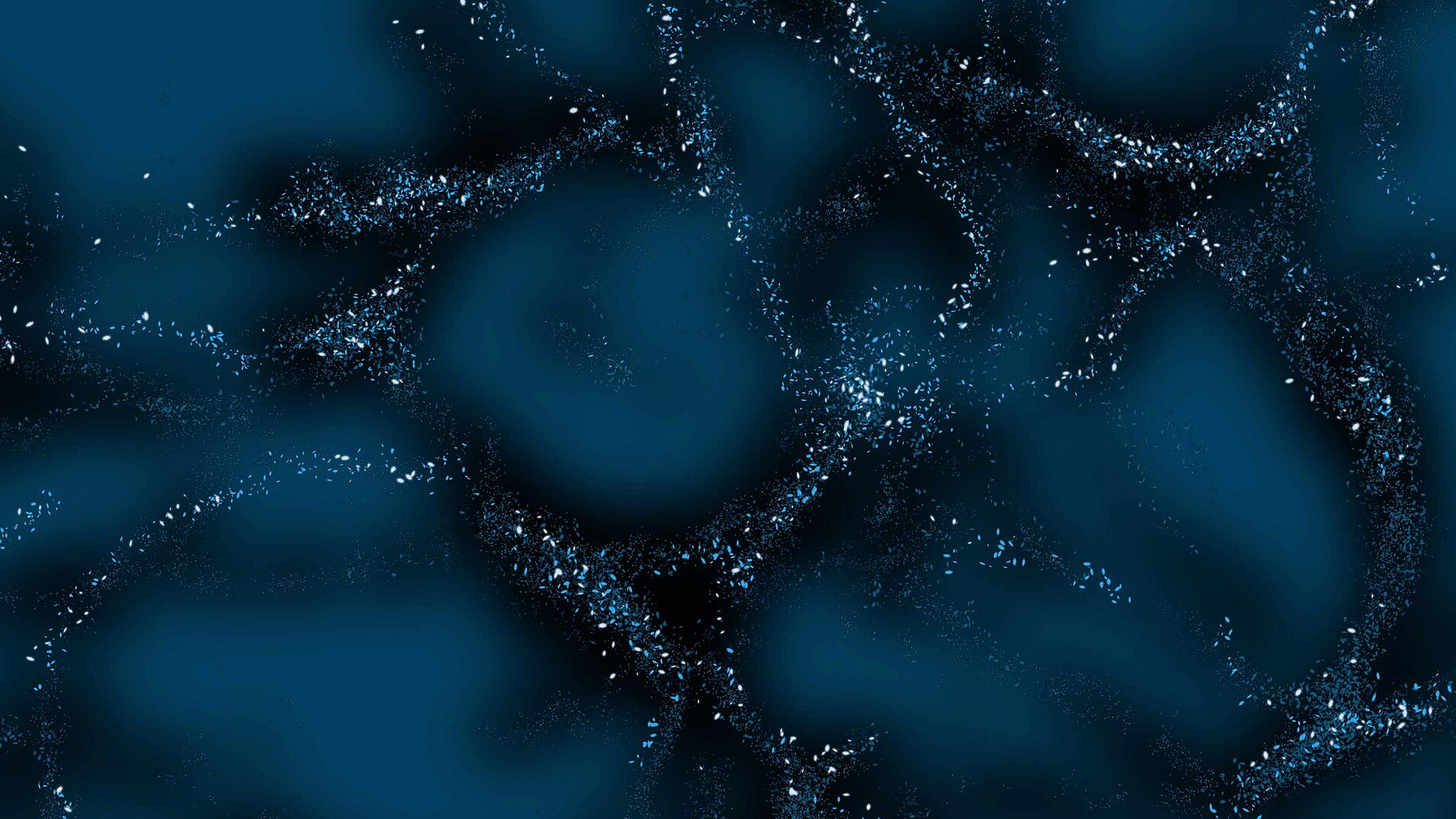
The cosmic web is an underpinning structure to our universe. (Image credit: RubinObs/NOIRLab/SLAC/NSF/DOE/AURA/J. Pinto, CC BY 4.0)
Looking between galaxies
The intergalactic medium – the space between galaxies – is near-total vacuum, with a density of one atom per cubic meter, or one atom every 35 cubic feet. That’s less than a billionth of a billionth of the density of air on Earth. Even at this very low density, this diffuse medium adds up to a lot of matter, given the enormous, 92-billion-light-year diameter of the universe.
You may like
The intergalactic medium is very hot, with a temperature of millions of degrees. That makes it difficult to observe except with X-ray telescopes, since very hot gas radiates out through the universe at very short X-ray wavelengths. X-ray telescopes have limited sensitivity because they are smaller than most optical telescopes.
Astronomers recently used a new tool to solve this missing matter problem. Fast radio bursts are intense blasts of radio waves that can put out as much energy in a millisecond as the Sun puts out in three days. First discovered in 2007, scientists found that the bursts are caused by compact stellar remnants in distant galaxies. Their energy peters out as the bursts travel through space, and by the time that energy reaches the Earth, it is a thousand times weaker than a mobile phone signal would be if emitted on the moon, then detected on Earth.
Research from early 2025 suggests the source of the bursts is the highly magnetic region around an ultra-compact neutron star. Neutron stars are incredibly dense remnants of massive stars that have collapsed under their own gravity after a supernova explosion. The particular type of neutron star that emits radio bursts is called a magnetar, with a magnetic field a thousand trillion times stronger than the Earth’s.
Even though astronomers don’t fully understand fast radio bursts, they can use them to probe the spaces between galaxies. As the bursts travel through space, interactions with electrons in the hot intergalactic gas preferentially slow down longer wavelengths. The radio signal is spread out, analogous to the way a prism turns sunlight into a rainbow. Astronomers use the amount of spreading to calculate how much gas the burst has passed through on its way to Earth.
Puzzle solved
In the new study, published in June 2025, a team of astronomers from Caltech and the Harvard Center for Astrophysics studied 69 fast radio bursts using an array of 110 radio telescopes in California. The team found that 76% of the universe’s normal matter lies in the space between galaxies, with another 15% in galaxy halos – the area surrounding the visible stars in a galaxy – and the remaining 9% in stars and cold gas within galaxies.
The complete accounting of normal matter in the universe provides a strong affirmation of the Big Bang theory. The theory predicts the abundance of normal matter formed in the first few minutes of the universe, so by recovering the predicted 5%, the theory passes a critical test.
Several thousand fast radio bursts have already been observed, and an upcoming array of radio telescopes will likely increase the discovery rate to 10,000 per year. Such a large sample will let fast radio bursts become powerful tools for cosmology. Cosmology is the study of the size, shape and evolution of the universe. Radio bursts could go beyond counting atoms to mapping the three-dimensional structure of the cosmic web.
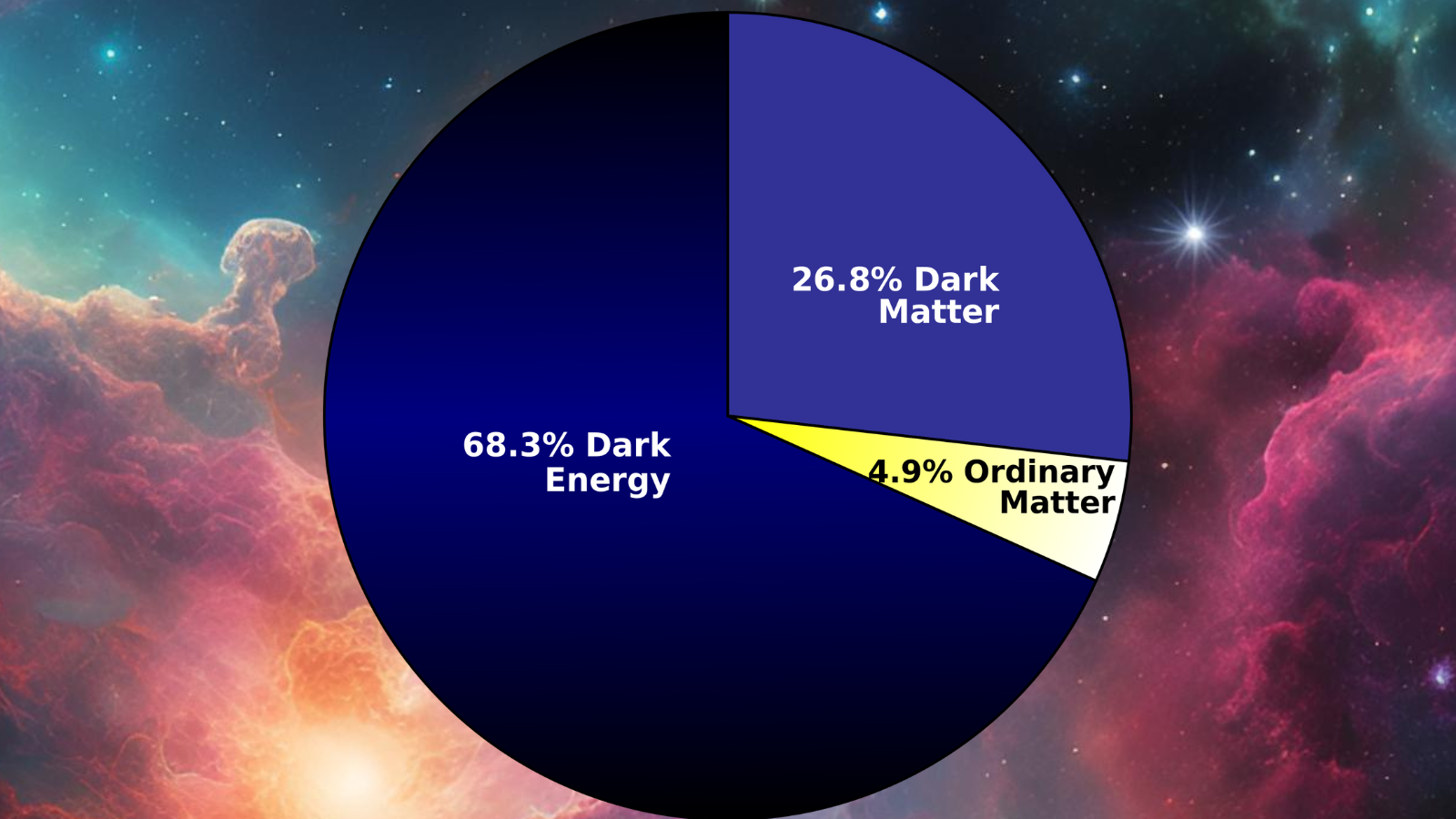
A pie chart showing the universe’s matter-energy budget (Image credit: Robert Lea (created with Canva))
Pie chart of the universe
Scientists may now have the complete picture of where normal matter is distributed, but most of the universe is still made up of stuff they don’t fully understand.
The most abundant ingredients in the universe are dark matter and dark energy, both of which are poorly understood. Dark energy is causing the accelerating expansion of the universe, and dark matter is the invisible glue that holds galaxies and the universe together.
Dark matter is probably a previously unstudied type of fundamental particle that is not part of the standard model of particle physics. Physicists haven’t been able to detect this novel particle yet, but we know it exists because, according to general relativity, mass bends light, and far more gravitational lensing is seen than can be explained by visible matter. With gravitational lensing, a cluster of galaxies bends and magnifies light in a way that’s analogous to an optical lens. Dark matter outweighs conventional matter by more than a factor of five.
One mystery may be solved, but a larger mystery remains. While dark matter is still enigmatic, we now know a lot about the normal atoms making up us as humans, and the world around us.
SCIENCE
Spinosaurus relative longer than a pickup truck stalked Thailand’s rivers 125 million years ago

Two young spinosaurids hunt a juvenile Phuwiangosaurus in Cretaceous Thailand. A large adult spinosaurid (not the newly unveiled Sam Ran spinosaurid) rests in the background beside a body of water, while two feathered Kinnareemimus are depicted by the trees on the right. (Image credit: Kmonvich Lawan)
Around 125 million years ago, a dinosaur longer than a pickup truck stalked rivers to gobble up fish in what is now Thailand.
Spinosaurids were a family of bipedal predators with elongated snouts, crocodile-like teeth and, in many species, sails on their backs. Researchers believe that the Thai specimen, first discovered in 2004, belonged to the Spinosaurinae subfamily, which included the longest-known carnivorous dinosaur genus, Spinosaurus — a potential swimming predator from North Africa that grew up to around 50 feet (15 m) long.
You may like
“This discovery from Thailand helps us better understand what spinosaurines looked like and how they evolved in Asia,” Adun Samathi, an assistant professor at the Walai Rukhavej Botanical Research Institute and Mahasarakham University in Thailand, told Live Science in an email. “[The fossils] also show that dinosaur diversity in Southeast Asia was richer than previously known and expand our understanding of how these unusual fish-eating predators were spread around the world.”
Samathi presented the spinosaurid findings Nov. 12 at the Society of Vertebrate Paleontology 2025 annual meeting in Birmingham, England. The findings haven’t been peer-reviewed, as Samathi and his colleagues still have to submit them to a journal.
The researchers don’t have an official name for the dinosaur. However, they’ve nicknamed it the Sam Ran spinosaurid, as it was found in the Sam Ran locality (area) of the Khok Kruat rock formation in northeastern Thailand, according to Samathi, who studied the spinosaurid as part of his doctoral thesis. (Samathi is one of several students and researchers to study the specimen since its discovery.)
Here’s my project, a spinosaurid from the Early Cretaceous Khok Kruat Formation of Thailand or “Sam Ran spinosaurid”. #spinosauridae #spinosaurus #paleontology pic.twitter.com/qtn8mHK6pHApril 13, 2022
The team quickly identified the dinosaur as a spinosaurid because it has several of the group’s characteristic features, including long neck vertebrae and tall spines on its back vertebrae. However, the species also had features that distinguished it from known spinosaurid species, including shorter spines than Spinosaurus and more paddle-like spines than Ichthyovenator from Loas, which borders Thailand.
The team suspects that the Sam Ran spinosaurid was more closely related to Spinosaurus from North Africa than Ichthyovenator from Laos. However, there’s a lot of uncertainty surrounding the evolution of Asian spinosaurids, as well as spinosaurids in general, and the researchers’ findings are only preliminary at this stage.
The Sam Ran spinosaurid died beside a shallow river before some of its remains were fossilized. Samathi doesn’t think that this spinosaurid could swim, but it seemed to be using the river ecosystem, which was teeming with life when the dinosaur perished relatively early in the Cretaceous period (145 million to 66 million years ago).
“The new spinosaur lived (or at least [was] found) in a river system with gently flowing water and occasional floods, within a dry to semi-arid landscape,” Samathi said. “The site has yielded a variety of animals, including freshwater sharks, bony fish, turtles, crocodiles, and dinosaurs such as a sauropod and an iguanodontian.”

If you have multiple streaming subscriptions and you want to access all content in one place, you’ll want the best streaming device available, but what is that?
A streaming device is something, usually a box or a stick, that connects to your TV (usually via HDMI) and displays apps that are installed through Wi-Fi connectivity, once you’re connected.
Visual Quality
In order to get the most out of your streaming device, you’ll need a device (i.e. a TV/laptop etc) that can support the visual quality the streaming device offers. These days, the best streaming devices all support 4K viewing, although some support it better than others.
If you do have a TV, or another device that supports 4K viewing, you’ll be pleased to hear that the Amazon Fire TV Stick, Roku Ultra, Apple TV and Google TV Streamer all offer 4K visuals. The Apple TV device offers the best picture with its 4K HDR ability, which means it offers 4K viewing, with improved contrast and brightness.
The Roku Ultra offers 4K UHD as a maximum resolution, whereas the Google TV Streamer offers a genuine 4K resolution and the Fire TV stick can play 4K HDR at 60FPS. All of this means you get high-quality visuals from each, but the Apple TV device is technically ahead, marginally, of the others.
Image 1 of 2
 The Amazon Fire TV stick can play 4K HDR at 60FPS.(Image credit: Amazon)
 The Roku Ultra offers 4K UHD as a maximum resolution.(Image credit: Roku)
The extra detail of 4K UHD compared to standard 4K viewing is subtle, but it is the difference between a 3,840 x 2160 and a 4,096 x 2160 resolution. Typically, to the average viewer, this won’t make any noticeable difference, but there are more pixels and a slightly finer picture produced in 4K viewing as opposed to 4K UHD.
Swipe to scroll horizontallyVideo Resolution
Amazon Fire TV Stick
4K HDR up to 60FPS
Roku Ultra
4K UHD
Apple TV 4K
4K HDR
Google TV Streamer
4K
Audio Quality
It’s all well and good viewing something with clear visual quality, but your experience will be ruined if the sound is terrible, so the audio quality is almost, if not just as, important as the visual quality.
Again, the Apple TV streaming device is marginally ahead of the rest, thanks to its Dolby Atmos Spatial Audio feature. Spatial Audio means you get a 3D audio atmosphere, so the audio sounds like it’s coming from different, specific points.
All the other streaming devices in this article offer regular Dolby Atmos audio quality. That’s still an outstanding feature. It’s much better than standard audio, and it means that the audio comes across with more depth and height, leading to a more impressive audio experience. The difference is that the Apple TV’s Dolby Atmos Spatial Audio offers a slightly more immersive audio experience.
Power and Available Apps
Image 1 of 2
 The Apple TV 4K is the premium option.(Image credit: Apple)
 The Google TV Streamer is a close second.(Image credit: Amazon)
Unsurprisingly, as the Apple TV 4K is the premium option in this clash of the best streaming devices, it has the best tech internally to keep it running smoothly. It features 4GB of RAM and an A 15 bionic chip to help it load apps quicker and run faster than previous generations. You can also get up to 128GB of storage, so you can download and use more than enough apps to satisfy your streaming needs.
The Google TV Streamer is a close second with 4GB of RAM, and a quad-core processor. The reason this comes a close second to the Apple TV 4K is due to its storage size; at just 32GB, it’s enough to use some apps, but not nearly as much as you get in the Apple model. Still, it performs well and costs less.
The Amazon Fire TV Stick marks a drop in processing power as it has a quad-core processor, but only 2GB of RAM and only up to 16GB of internal storage. Now, this is enough to get by, and get by sufficiently, but it’s clear that it doesn’t have the same firepower as the competition.
Swipe to scroll horizontallyInternal Power and specs
Apple TV 4K
4GB RAM, A 15 bionic chip, up to 128GB storage
Google TV Streamer
4GB RAM, quad-core processor, 32GB storage
Amazon Fire TV Stick
2GB Ram, up to 16GB internal storage
Roku Ultra
2GB RAM, ARM Cortex 55 CPU
Then we have the Roku Ultra, not bad by any stretch of the imagination, but with 2GB of RAM and an ARM Cortex A 55 CPU, it has all you need to perform well, without boasting the same firepower as the Google or the Apple models.
In terms of the apps available on each device, there are no notable absentees. All of the above have all major streaming services available to access, with the exception of some regional options in some cases. That’s a huge part of what makes these four stand out; you’re truly able to access the streaming services you would want to access, all in one place.
Price
When it comes to actually having to pay for everything you’ve read above, which costs a premium and which is great value?
Well, perhaps unsurprisingly, the premium model, the Apple TV 4K, costs the most. With options costing up to $149, it’s comfortably the most expensive on this list. But considering it’s also the best overall, maybe it isn’t as steep as expected, depending on how much you are willing to spend on a streaming device.
Price Comparison
- Apple TV 4K: Up to $149
- Roku Ultra: $100, regularly on offer
- Google TV Streamer: $100, sometimes on offer
- Amazon Fire TV Stick: Up to $65, regularly on offer
The value option here is undoubtedly the Amazon Fire TV Stick. There are different options available, ranging from the $35 mark to $60. It’s important to remember that these are regularly on sale if you’re buying from Amazon, so you probably won’t have to pay full price.
In between these, we find the Roku Ultra, which will set you back around $100, but is regularly on sale and it’s the same for the Google TV Streamer. Again, we have seen it on sale occasionally.
Verdict
Now that we’ve pitted four of the best streaming devices against each other, we can’t sit on the fence and say they’re all good; it’s down to what you want. While different people will have different preferences, we think the Apple TV 4K is the best streaming device out there.
Its internal storage, power and processor allow for a top streaming experience. Its visuals, audio and loading capabilities put it a little ahead of the competition. However, it is comfortably the most expensive option out there.
If you’re looking for value, or something that’s going to do everything you need and want with a friendly price tag, the Amazon Fire TV Stick is the option you want to pick. Of course, if you don’t want a stick and you want an actual box, the Roku Ultra is a great choice as it’s regularly on sale for a price that competes with the Fire TV Stick. And, if you’re an Android user, or you see a great offer, the Google TV Streamer becomes a top choice. But, overall, the Apple TV 4K reigns supreme here.
SCIENCE
Uranus and Neptune may be ‘rock giants,’ not ‘ice giants,’ new model of their cores suggests

The interiors of Uranus and Neptune may be rockier than scientists previously thought, a new computational model suggests — challenging the idea that the planets should be called “ice giants.”
The new study, published Dec. 10 in the journal Astronomy & Astrophysics, may also help to explain the planets’ puzzling magnetic fields.
You may like
Far out planets
Morf and his supervisor, Ravit Helled, developed a new hybrid model in an attempt to better understand the interior of these cold planets. Models based on physics alone rely heavily on assumptions made by the modeler, while observational models can be too simplistic, Morf explained. “We combined both approaches to get interior models that are both unbiased and physically consistent,” he said.
The pair started by considering how the density of each planet’s core could vary with distance from the center of the planets and then adjusted the model to account for the planets’ gravities. From this, they inferred the temperature and composition of the core and generated a new density profile. The team inputted the new density parameters back into the model and iterated this process until the model core fully matched current observational data.
Voyager 2 took this snaphost of Neptune in 1989. Data on Uranus and Neptune taken during Voyager’s flybys are still some of the best we have. (Image credit: NASA / Voyager 2)
This method generated eight total possible cores for both Uranus and Neptune, three of which had high rock-to-water ratios. This shows that the interiors of Uranus and Neptune are not limited to ice, as previously thought, the researchers said.
All of the modeled cores had convective regions where pure water exists in its ionic phase. This is where extreme temperatures and pressures cause water molecules to break apart into charged protons (H+) and hydroxide ions (OH-). The team thinks such layers may be the source of the planets’ multiple magnetic fields, which cause Uranus and Neptune to have more than two poles. The model also suggests that Uranus’ magnetic field is generated closer to its center than Neptune’s is.
“One of the main issues is that physicists still barely understand how materials behave under the exotic conditions of [high] pressure and temperature found at the heart of a planet [and] this could impact our results,” Morf said. The team aims to improve their model by including other molecules, like methane and ammonia, which also may be found in the cores.
“Both Uranus and Neptune could be rock giants or ice giants depending on the model assumptions,” Helled said. She noted that much of our understanding of these planets may be incomplete, as it’s based largely on data collected by the Voyager 2 space probe in the 1980s.
“Current data is insufficient to distinguish the two, and we therefore need dedicated missions to Uranus and Neptune that can reveal their true nature,” Helled added
The team hopes the model may act as an unbiased tool for any new data from future space missions to these planets.
SCIENCE
The Guardian view on adapting to the climate crisis: it demands political honesty about extreme weather | Editorial


The record-breaking 252mph winds of Hurricane Melissa that devastated Caribbean islands at the end of October were made five times more likely by the climate crisis. Scorching wildfire weather in Spain and Portugal during the summer was made 40 times more likely, while June’s heatwave in England was made 100 times more likely.
Attribution science has made one thing clear: global heating is behind today’s extreme weather. That greenhouse gas emissions warmed the planet was understood. What can now be shown is that this warming produces record heatwaves and more violent storms with increasing frequency.
What we can do to minimise, or at least reduce, the risks to life from such events – as well as more gradual changes – is what climate adaptation experts think about all the time. The alarming consensus is that we are not doing anywhere near enough. The result is paid for in lives: floods and cyclonic storms across Thailand, Sri Lanka and Indonesia left hundreds dead at the end of November.
The president of Cop30 in Brazil, André Corrêa do Lago, called for the UN climate change conference to be a “Cop of adaptation”. But the governments of the most vulnerable countries went home from Belém angry about an outcome that saw the projected size of the annual adaptation budget triple to $120bn, but with the deadline pushed back to 2035 and no clear mechanism to make rich countries pay up.
Even that total falls short of the $300bn in climate finance overall that was agreed at Cop29 in 2024. The risk is that without international support, heavily indebted countries such as Jamaica become trapped, with resources that ought to be directed towards green energy and future-proofing being spent instead on coping with disasters.
But the need for preparation is not limited to low-lying countries and those most affected by extreme heat and violent storms. This imbalance in climate programmes can be seen all over the world. Last month, a group of UK scientists organised what they called a “national emergency briefing” in London in an effort to alert people to the scale of the climate crisis threat – and alarming underpreparedness.
Everyday injustice
In the global context, the politics of adaptation are clear. Poorer countries, including the small island states whose existence is threatened by sea-level rises, have consistently argued that the rich nations whose historical and current emissions are responsible for climate heating must support them to adapt to the crisis, as well as to transition away from fossil fuels. Rightwing, nationalist governments in the west are extremely hostile to this idea – and to aid spending more broadly – even if their most vociferous objections are reserved for the phaseout of fossil fuels and net zero.
But within wealthy countries, adaptation can appear more as a technocratic challenge than a political one. Policies regarding flood risks or increased resilience to high temperatures are not usually top priorities for voters – except when there is a disaster such as the floods in eastern Spain that led to the resignation of Carlos Mazón, president of Valencia, in November. While the grossly mismanaged water industry is a live political issue in England and Wales, big questions about natural resources and the resilience of infrastructure sit outside the daily cut and thrust, with responsibility delegated to arm’s-length agencies and rarely touched on by party leaders.
A recent report from the UK’s Glacier Trust and Climate Majority Project argued that charities and politicians should seek to change this, and promote an “action-oriented public understanding of climate risk”. All must recognise that adaptation cannot simply be left to market forces because the economics of climate risk make private finance retreat just as danger rises.
The long, low-profit investments needed to defend communities from flood, fire and heat are not attractive to private lenders. It is the state that must build seawalls or insure subsistence farmers when the risk becomes too great. Leah Aronowsky, a historian of science at Columbia University, says that climate risk is everyday injustice made worse – and she is right to argue that how we adapt is a political battle.
What adaptation should look like
One reason that adaptation receives so little attention is the sheer urgency of cutting emissions. In the context of warnings that the 1.5C target in the Paris agreement could move out of reach, mitigation – reducing or removing emissions – is the top priority.
Discussing preparations for global heating can feel like a distraction or even an admission of defeat. But while it makes sense for climate campaigners to maintain the strongest possible pressure for emissions cuts, there ought to be scope to get ready for a hotter, more unstable climate as well. Under the terms of the UK’s Climate Change Act, the government is legally obliged to do so, and to regularly review its preparations.
The UK’s Climate Change Committee will soon outline what a truly “well-adapted” country should look like: flood defences that can withstand the storms to come, transport links built for a harsher climate, food and supply chains resilient to global shocks, and coastal communities protected rather than abandoned. Experts also want to ensure that the 1.5m homes that the government has pledged to build in England alone are fit for the future. In an era of polarised attacks on net zero, such projects could help rebuild a shared belief in responsible care for the land.
For the rich world, adaptation is prudent. For the poor world, it is survival. The latest UN report is unequivocal: developing countries will need more than $310bn annually by 2035, yet received just $26bn in 2023. Catastrophic floods in Asia and worsening droughts in Africa this year point to the growing need to accelerate climate adaptation.
Under the Paris agreement, nationally determined contributions (NDCs) – country plans to tackle global heating – are meant to cover both emissions reduction and adaptation to climate impacts.
But NDCs end up focusing mostly on cutting greenhouse gases and establishing decarbonisation pathways. That needs to change. National adaptation plans, which came out of Cop16, need to be foregrounded. These put adaptation centre stage – and demand real plans, real finance, real justice. They ask the question that really matters now: how do vulnerable nations survive a warming world that emissions cuts alone can’t stop?

On Dec. 4, 2025, proud U.S. Space Force officer trainees donned their new service dress uniforms for a class photo ahead of their Officer Training School (OTS) graduation. Arranged in formation, the officers present a unified, formal appearance, signaling the Space Force has reached a new phase of maturity, moving beyond its formative years toward a more established presence within the U.S. military.
What is it?
Since its creation, the Space Force has focused on defining not just missions and capabilities, but also identity. Traditions, ranks, culture, and symbols all play a role in shaping a service that must simultaneously honor military heritage and adapt to the technical, rapidly changing nature of space operations. One of the most visible elements of that identity is the service dress uniform.
You may like
Where is it?
The image was captured at Maxwell Air Force Base, in Alabama.
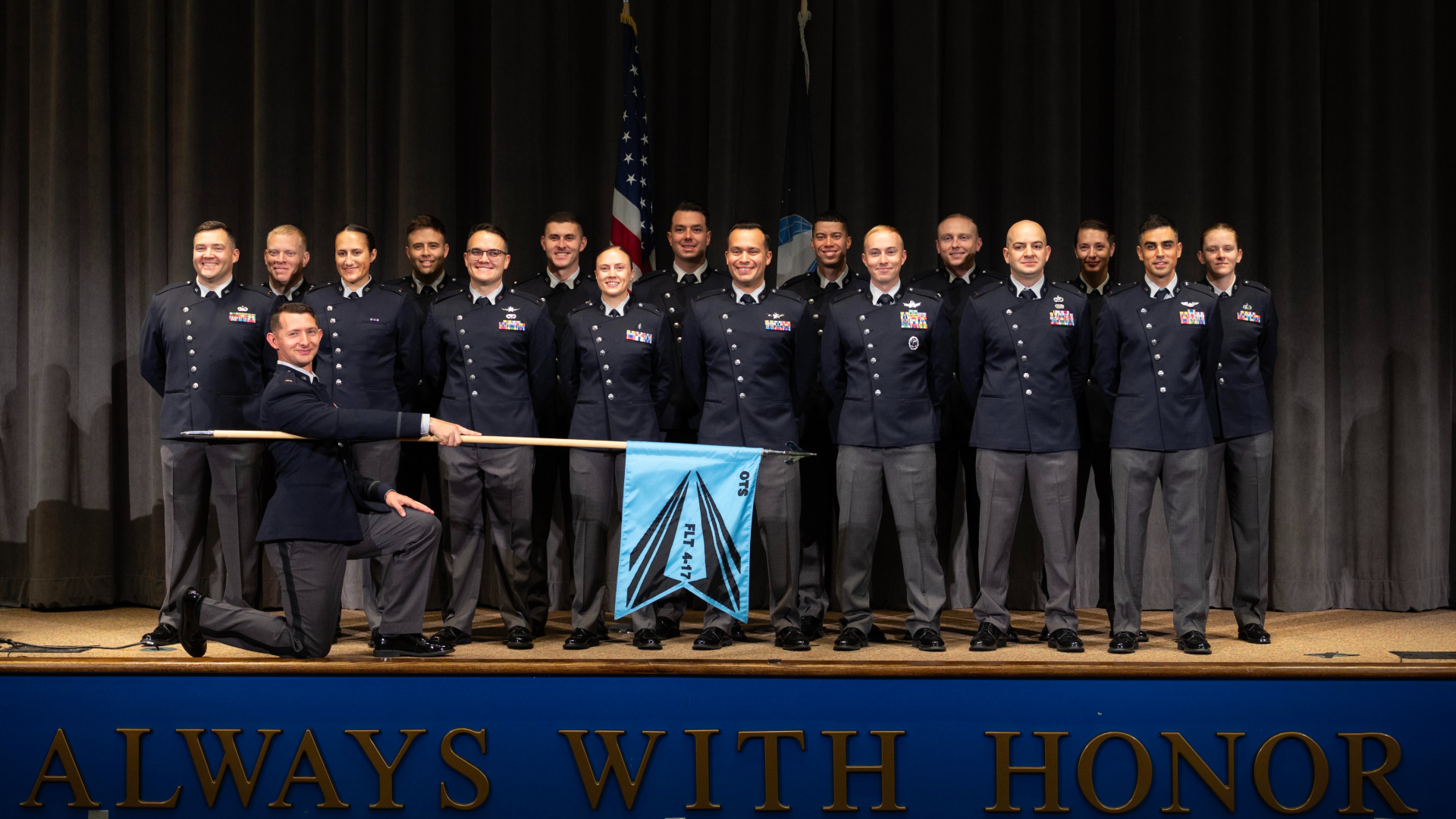
The new class of US Space Force Guardians pose before their graduation ceremony. (Image credit: Tech. Sgt. Savannah L. Waters)
Why is it amazing?
The photograph connects long-standing military customs — such as formal graduation portraits and service dress — with the modern mission of space operations. This blend underscores how the Space Force draws from established military values while preparing for challenges unique to space.
Service dress uniforms are worn during ceremonies, official events, and moments of public representation. Seeing Space Force officers in their own distinctive uniform reinforces the service’s legitimacy and permanence, both within the Department of Defense and in the public eye.
As these newly commissioned Guardians move on to their first assignments, the image stands as a reminder that even in the era of space-based missions and digital warfare, tradition, identity, and human commitment remain central to military service.
Want to learn more?
You can learn more about the US Space Force and military projects.
SCIENCE
1.5 million-year-old Homo erectus face was just reconstructed — and its mix of old and new traits is complicating the picture of human evolution

Scientists have reconstructed the head of an ancient human relative from 1.5 million year-old fossilized bones and teeth. But the face staring back is complicating scientists’ understanding of early human evolution and dispersal, according to a new study.
The rebuilt fossil skull, called DAN5, shares traits with Homo erectus, the first early human relatives to have modern body proportions and to disperse from Africa. But the skull also has some features associated with the earlier species Homo habilis. The findings suggest a complex evolutionary path from early human ancestors to H. erectus, researchers reported Dec. 16 in the journal Nature Communications.
You may like
“We already knew that the DAN5 fossil had a small brain, but this new reconstruction shows that the face is also more primitive than classic African Homo erectus of the same antiquity,” study co-author Karen Baab, a paleontologist at Midwestern University in Arizona, said in a statement. This could mean that the population from the Gona region might have “retained the anatomy of the population that originally migrated out of Africa approximately 300,000 years earlier,” she said.
To reconstruct DAN5’s face, the researchers used micro-computerized tomographic (CT) scans of 10 fossils — five fragments of facial bones and five teeth — to build a 3D model. The process was like “a very complicated 3D puzzle, and one where you do not know the exact outcome in advance,” Baab said. “Fortunately, we do know how faces fit together in general, so we were not starting from scratch.”
The shape of DAN5’s braincase was similar to that of H. erectus. But some of the facial features such as large molars and a flat and narrow nose were more similar to features in the older human ancestor H. habilis.
A similar mix of old and new traits was previously observed in 1.8 million-year-old H. erectus fossils from Dmanisi in the Republic of Georgia, which led some scientists to believe that the species evolved in Eurasia from an earlier Homo population. Older H. erectus fossils dating back 1.8 million years have also been found in Africa. But DAN5 is the first African fossil to have the same mixture of attributes as the Dmanisi hominins, which could support the hypothesis that H. erectus evolved primarily in Africa like other hominins before it. Further complicating the picture, though, is the fact that the DAN5 fossils are younger than those from Dmanisi, suggesting the mixture of old and new traits persisted in Africa for at least 300,000 years.
In future work, the team plans to compare the DAN5 fossils to 1 million-year-old human fossils from Europe, including some that have been identified as H. erectus and as Homo antecessor — a later human relative that lived 1.2 million to 0.8 million years ago — to better understand variability in face shape in the early Homo genus. The team also plans to investigate whether DAN5 might be a product of interbreeding between multiple Homo species.
“We’re going to need several more fossils dated between one to two million years ago to sort this out,” study co-author Michael Rogers, an anthropologist at Southern Connecticut State University, said in the statement.


Researchers analyzing ancient sewer drains at the Roman fort of Vindolanda near Hadrian’s Wall have found clear evidence that people living at the site were infected with three intestinal parasites: roundworm, whipworm, and Giardia duodenalis. All three parasites spread through poor sanitation, typically when food, water, or hands are contaminated with human feces. Roundworms can […]
SOURCE PAGE
Celestron NexStar 8SE
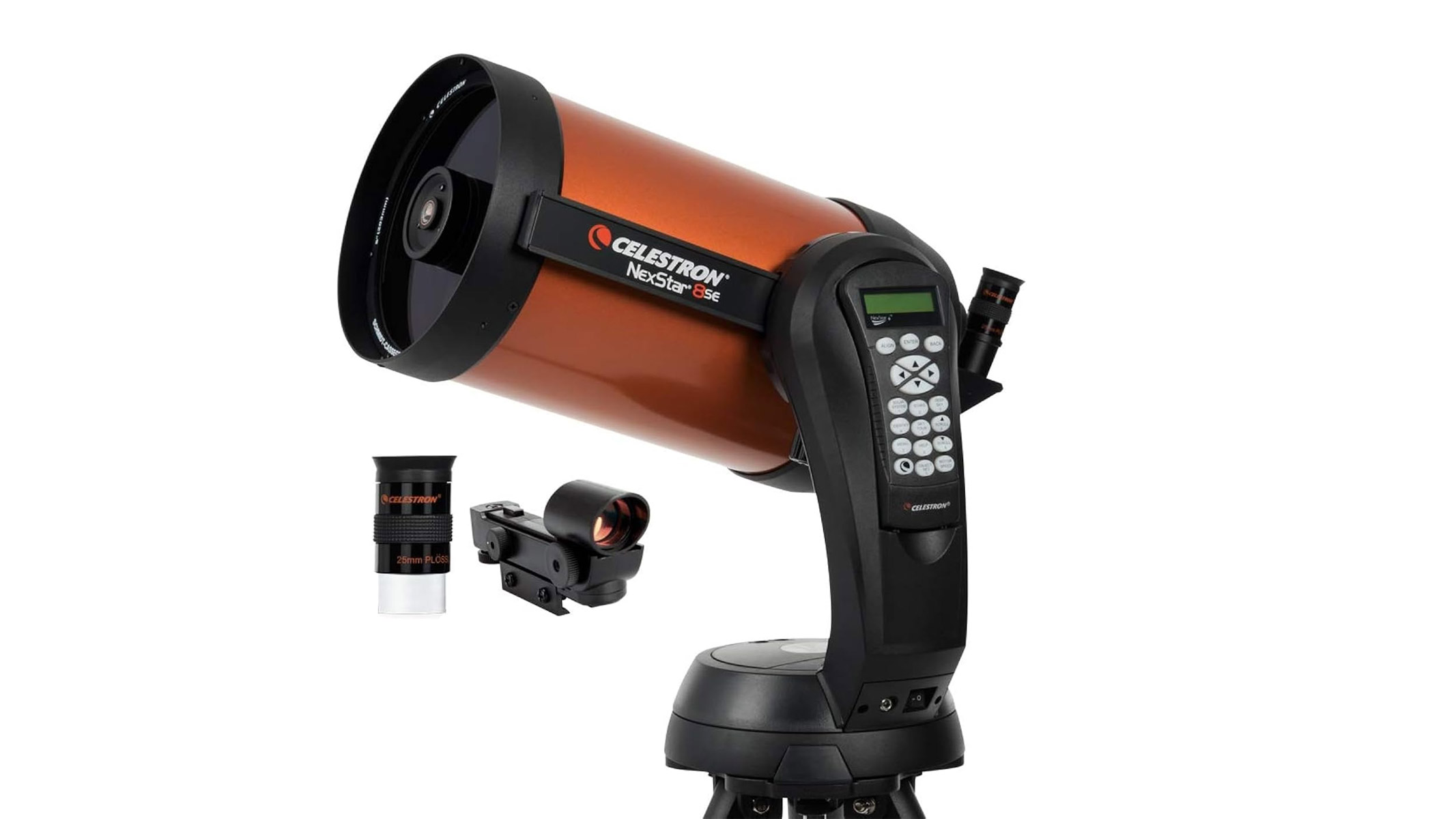
(Image credit: Amazon)
We reckon the Celestron NexStar 8SE is the best motorized telescope out there as it’s great for astrophotography, deep-space observing and it offers stunning detailed imagery. It is a little pricey but for what you get, it’s good value. For a more detailed look, you can check out our Celestron NexStar 8SE review.
Look to the southern sky after dark on Dec. 26 to spot the waxing crescent moon shining near the gas giant Saturn among the stars of the constellation Pisces.
A pair of 10×50 binoculars should easily fit both Saturn and the moon within the same field of view, while revealing an assortment of fascinating surface features on Earth’s natural satellite, which will appear almost half-lit just one day shy of its first quarter phase on Dec. 27.
You may like
Look to the upper region of the lunar crescent to find the menacing form of the Aristotles crater with its eastern rim bathed in impenetrable shadow. The Eudoxus crater is visible just beneath and beyond the dark expanses of Mare Serenitatis (the Sea of Serenity) and Mare Tranquilitatis (the Sea of Tranquility), which served as the landing site of the historic Apollo 11 lunar landing.
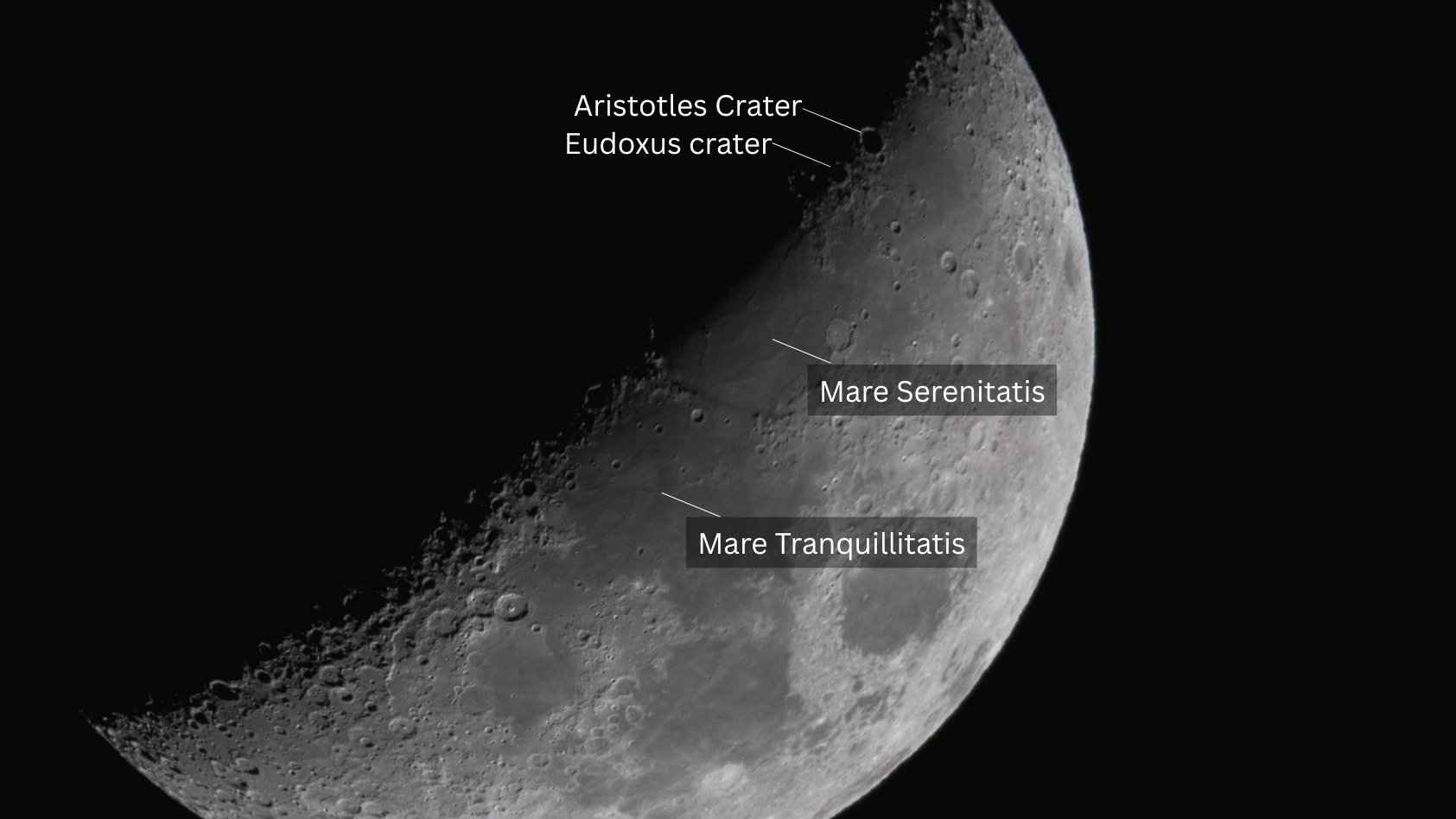
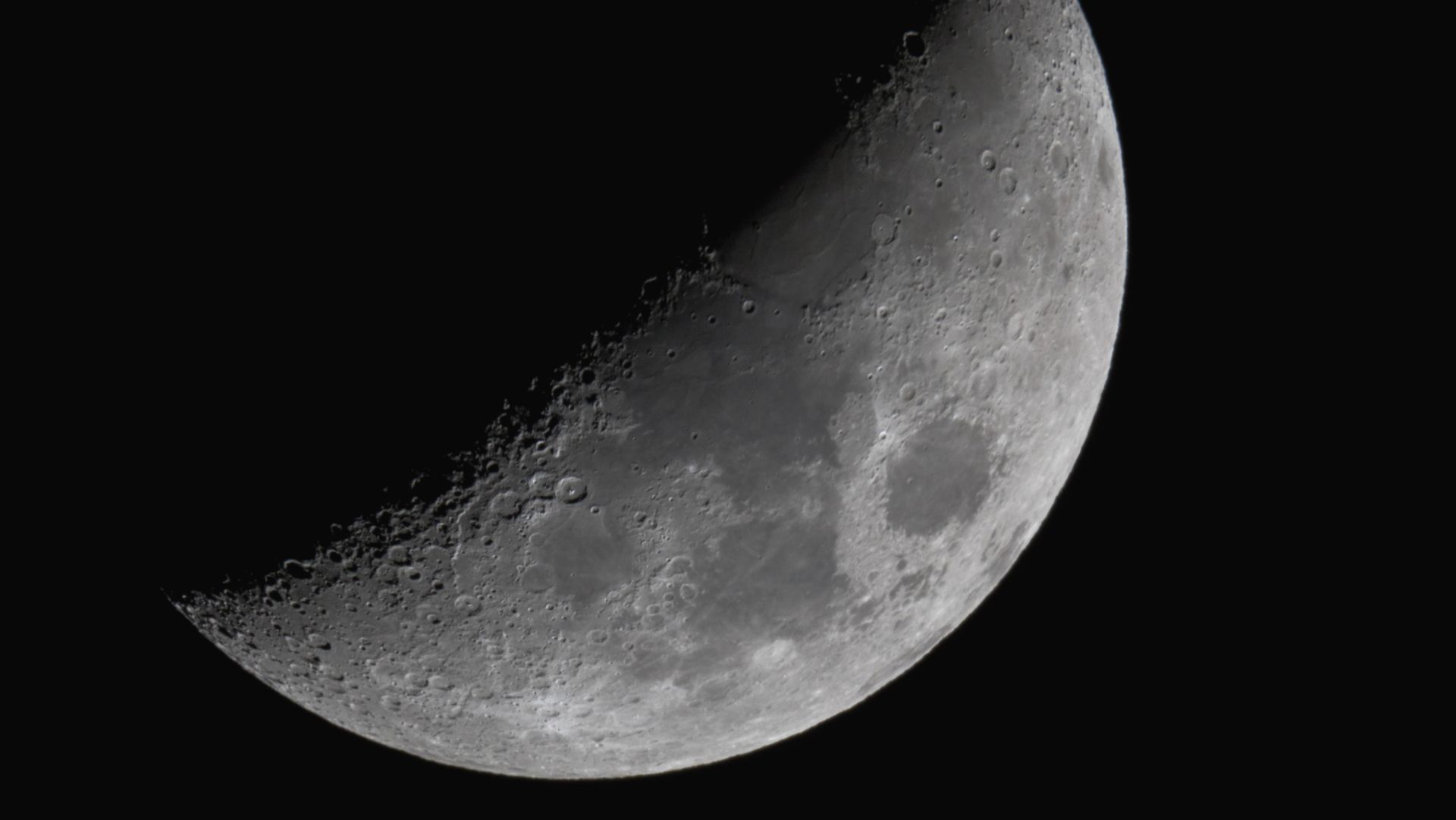
The moon pictured shortly before its first quarter phase. (Image credit: Photo by Rick Kern via Getty Images, annotated by Anthony Wood in Canva)
A telescope with a 6-inch (152 millimeter) aperture will begin to reveal the razor-thin profile of Saturn’s rings, as they rest oriented edge-on to Earth following the gas giant’s ring plane crossing in March. Astronomy filters can also aid in revealing details in Saturn’s upper atmosphere, which appears divided into distinct multi-colored cloud bands that circle the gas giant at 1,600 feet (500 meters) per second.
Want to get a closer look at the diverse menagerie of worlds populating our solar system? Then be sure to browse our picks of the best telescopes for exploring the night sky, along with our guides to picking the best cameras and lenses for astrophotography, if you want to immortalize your stargazing sessions.
Editor’s Note: If you capture an image of the moon with Saturn and want to share it with Space.com’s readers, then please send your photo(s), comments, and your name and location to spacephotos@space.com.

The next global volcanic disaster is more likely to come from volcanoes that appear dormant and are barely monitored than from the likes of famous volcanoes such as Etna in Sicily or Yellowstone in the US.
Often overlooked, these “hidden” volcanoes erupt more often than most people realise. In regions like the Pacific, South America and Indonesia, an eruption from a volcano with no recorded history occurs every seven to ten years. And their effects can be unexpected and far-reaching.
You may like
You don’t have to look far back in history to find another example. In 1982, the little-known and unmonitored Mexican volcano El Chichón erupted explosively after lying dormant for centuries. This series of eruptions caught authorities off-guard: hot avalanches of rock, ash and gas flattened vast areas of jungle. Rivers were dammed, buildings destroyed, and ash fell as far as Guatemala.
More than 2,000 people died and 20,000 were displaced in Mexico’s worst volcanic disaster in modern times. But the catastrophe did not end in Mexico. The sulphur from the eruption formed reflective particles in the upper atmosphere, cooling the northern hemisphere and shifting the African monsoon southwards, causing extreme drought.
This alone would test the resilience and coping strategies of any region. But when it coincided with a vulnerable population that was already experiencing poverty and civil war, disaster was inevitable. The Ethiopian (and East African) famine of 1983-85 claimed the lives of an estimated 1 million people. This brought global attention to poverty with campaigns like Live Aid.
Few scientists, even within my field of Earth science, realise that a remote, little-known volcano played a part in this tragedy.
Despite these lessons, global investment in volcanology has not kept pace with the risks: fewer than half of active volcanoes are monitored, and scientific research still disproportionately focuses on the well-known few.
🌋 #HayliGubbi — a once-dormant shield volcano in Ethiopia’s Afar Rift — has exploded to life. Its ash plume soared to 45,000 ft, signaling a rare, high-energy event in a volcano with no known eruptions for millennia.Visualized: @NASAEarth🛰 #NASA🌍 #worldview pic.twitter.com/BBPyaUjAzzNovember 23, 2025
There are more published studies on one volcano (Mount Etna) than on all the 160 volcanoes of Indonesia, Philippines and Vanuatu combined. These are some of the most densely populated volcanic regions on Earth – and the least understood.
The largest eruptions don’t just affect the communities around them. They can temporarily cool the planet, disrupt monsoons and reduce harvests across entire regions. In the past, such shifts have contributed to famines, disease outbreaks and major social upheaval, yet scientists still lack a global system to anticipate or manage these future risks.
You may like
Mount Etna on the Italian island of Sicily. (Image credit: By Wead via Shutterstock)
To help address this, my colleagues and I recently launched the Global Volcano Risk Alliance, a charity that focuses on anticipatory preparedness for high-impact eruptions. We work with scientists, policymakers and humanitarian organisations to highlight overlooked risks, strengthen monitoring capacity where it is most needed, and support communities before eruptions occur.
Acting early, rather than responding only after disaster strikes, stands the best chance of preventing the next hidden volcano from becoming a global crisis.
Why ‘quiet’ volcanoes aren’t safe
So why do volcanoes fail to receive attention proportionate to their risk? In part, it comes down to predictable human biases. Many people tend to assume that what has been quiet will remain quiet (normalcy bias). If a volcano has not erupted for generations, it is often instinctively considered safe.
The likelihood of an event tends to be judged by how easily examples come to mind (this mental shortcut is known as availability heuristic). Well-known volcanoes or eruptions, such as the Icelandic ash cloud from 2010, are familiar and can feel threatening, while remote volcanoes with no recent eruptions rarely register at all.
These biases create a dangerous pattern: we only invest most heavily after a disaster has already happened (response bias). El Chichón, for instance, was only monitored after the 1982 catastrophe. However, three-quarters of large eruptions (like El Chichón and bigger) come from volcanoes that have been quiet for at least 100 years and, as a result, receive the least attention.
Volcano preparedness needs to be proactive rather than reactive. When volcanoes are monitored, when communities know how to respond, and when communication and coordination between scientists and authorities is effective, thousands of lives can be saved.
Disasters have been averted in these ways in 1991 (at Mount Pinatubo in the Philippines), in 2019 (at Mount Merapi in Indonesia) and in 2021 (at La Soufrière on the Caribbean island of Saint Vincent).
To close these gaps, the world needs to shift attention towards undermonitored volcanoes in regions such as Latin America, south-east Asia, Africa and the Pacific – places where millions of people live close to volcanoes that have little or no historical record. This is where the greatest risks lie, and where even modest investments in monitoring, early warning and community preparedness could save the most lives.
This edited article is republished from The Conversation under a Creative Commons license. Read the original article.

For half a century, psychedelics largely belonged to the cultural left: anti-war, anti-capitalist, suspicious of the church and state. Now, one of the most politically consequential psychedelic drugs in the US – ibogaine – is being championed by evangelical Christians, Republican governors, military veterans, and big tech billionaires.
Many of them see ibogaine, an intense psychedelic derived from a central African rootbark, as a divine technology. In fact, some pointedly do not refer to it as a psychedelic, given the apparent baggage of the term in some circles.
“The psychedelic renaissance is three things: capitalized, conservative and Christian,” Jamie Wheal, author of Recapture the Rapture: Rethinking God, Sex, and Death in a World That’s Lost Its Mind, wrote earlier this year in an article titled Make America Hallucinate Again. “The tactical decision to make military veterans the face of [the psychedelic reform] movement has now taken on a life of its own.”
After the Food and Drug Administration’s rejection of MDMA-assisted therapy for PTSD last year, ibogaine is now center stage. Texas governor Greg Abbott signed off on a landmark $50m funding package for ibogaine research in June, noting the “great promise” of the drug in treating conditions suffered by veterans – more of whom live in Texas than any other state.
Reform discussions are also under way in Ohio, while Colorado is already moving towards sanctioning legal ibogaine treatments, in which patients embark on rollercoaster trips of about 12 hours.
“It has a breakthrough therapeutic impact on veterans who have experienced all the visible and invisible traumas of war, including traumatic brain injuries, which have been fully resolved with a single ibogaine treatment,” says Bryan Hubbard, CEO of advocacy group Americans for Ibogaine and a lawyer from Kentucky who often references his personal prayer, Isaiah 61:1. “This very special emancipation medication has the capacity to substantially improve treatment outcomes for afflictions that affect the mind, body and soul.”
In a Stanford University study published last year in Nature Medicine, 30 US special forces veterans who underwent ibogaine treatment in Mexico experienced significant reductions in traumatic brain injury (TBI), PTSD and depression symptoms. A month later, most of the patients had improved even further, without any reported side effects.
Hubbard, a devout Christian, says the irony of conservative Republicans like himself standing at the forefront of the campaign to provide legal access to psychedelic therapies is not lost on him. His own legal experiences in clinics in Mexico with ibogaine, however, were “the most profound spiritual experiences in my life”.
But there is growing scrutiny of the apparent victory of the cultural right in who gets to define psychedelic healing, and what Wheal has described bleakly as a “counter-counter-cultural turn” in the psychedelics world. “The psychedelic [QAnon] shaman storming the White House on January 6 was an early awakening that within Maga there could be rightwing psychonauts,” says Jeremy Wheat, director of the nonprofit Global Ibogaine Therapy Alliance, a nonprofit.
Ibogaine, which Hunter Biden took in 2014 in a failed attempt to address his drug and alcohol addiction, is “a maverick molecule for a maverick moment”, Wheat adds, after its accidental discovery as a treatment for opioid addiction in the 1960s by heroin addict and film-maker Howard Lotsof. But as clinics in legal jurisdictions expand to cope with the rising demand, the dream-inducing psychedelic – which can rid addicts of even debilitating withdrawal symptoms, while also providing consumers with autobiographical and sometimes distressing movies of their lives – is “just becoming a pill you take”, Wheat says, as part of a “ruthlessly transactional” and lucrative American-style healthcare system.
That traumatized US veterans and victims of the pharmaceutical industry’s opioid crisis are flocking to Mexico to take an African psychedelic is just one consequence of how the “effervescence of irrationality” has migrated to the right in recent years, where libertarian Republican political figures appear keener to take previously unfathomable risks.
On 7 September, ketamine therapy enthusiast Elon Musk – whose allies are now some of the biggest individual funders of psychedelic NGOs, research and drug development – posted on X: “White people are a rapidly diminishing minority of [the] global population.” A few hours later, he added: “We cannot understand the true nature of the Universe, unless we question deeply. I want to know what is real, even if the answer is total obliteration of my consciousness.”
Towards the end of November, former UFC champion Conor McGregor, who recently lost his appeal in a civil rape case after being alleged to have held his female victim in a chokehold, did ibogaine and claimed to have experienced visions of being initiated by Jesus in a viral X post. “I was shown the light,” he wrote. Jesus descended from the white marble steps of heaven and anointed me with a crown. I was saved! My brain. My heart. My soul. Healed!”
McGregor seemingly has political aspirations. He attended Trump’s inauguration in January and visited the president again in March, before hosting Tucker Carlson in Dublin and then running a short-lived anti-immigration campaign for president of Ireland.
A week after McGregor’s trip, the “Don’t Die” longevity entrepreneur Bryan Johnson, a Trump supporter who became a centimillionaire after selling web payments company Braintree in 2013, live-streamed himself tripping on mushrooms – with more than a million people watching on X. Billionaire Salesforce CEO Mark Benioff joined the live stream just weeks after saying Trump should send troops into San Francisco to make the city safer.
Others at the forefront of calls to expand access to ibogaine treatment include former Texas governor Rick Perry, who was Trump’s energy secretary from 2017 to 2019 and co-founded Americans for Ibogaine with Hubbard after receiving funding from Rex Elsass, described by GQ as “the most powerful man in the GOP” that nobody has ever heard of. Google co-founder Sergey Brin reportedly made a $15m investment into a startup researching ibogaine last year.
Congressman Morgan Luttrell, a former Navy Seal, did ibogaine and another psychedelic, 5-MeO-DMT, also known as “the God molecule” himself in 2018 in Mexico prior to his election to the House in 2023. He is the only known federal lawmaker to have tripped on the drugs, which he said eased his war traumas. “I was always ready to go,” he told the Washington Examiner. “I was a hyper-aggressive spec war guy that just couldn’t turn the page and start the new chapter.” But psychedelics were “life-changing” for him. “It was a clean slate; start completely over,” he said.
It was much the same for Rob O’Neill, the Navy Seal veteran credited with killing Osama bin Laden in 2011, who says that ibogaine has helped him address his PTSD as part of a grueling set of trips in which he was forced to witness his own demons. “It gets in your brain. It shows you stuff. And it kind of cleans out the closet,” O’Neill told Tucker Carlson earlier this year. “It’s terrifying.”
But aside from the terrors, the psychedelic experience, says Norman Ohler, author of Tripped: Nazi Germany, the CIA, and the Dawn of the Psychedelic Age, is often characterized by a “unified worldview, without borders or enemies, because you work through your trauma”. Even while he doubts psychedelics can make peace-loving men of the most ardent warmongers, Ohler does not see the apparent upswell in rightwing figures publicly aligning themselves with the psychedelic reform movement as a negative phenomenon.
“If both camps are embracing psychedelics, they can be a unifying force for society,” he says. “Maybe psychedelics will destroy fascism.”
Ohler also recently took ibogaine himself, for psychospiritual purposes, at a clinic in Mexico alongside a group of veterans, one of whom had been suffering from daily migraines after being shot in the head in Afghanistan years before. “After taking ibogaine, his pain was completely gone,” says Ohler. “This is a very special medicine.”
A medicine that also comes with mortal risks. Ibogaine is contraindicated with a host of other drugs and can lead to cardiac arrest, which is why treatments best take place with intensive care ward care and monitoring. A 2021 study reported that 33 ibogaine-related deaths have been reported publicly, but the true figure is likely much higher and there have been questions over how certain clinics have dealt with deaths under their care – even while the psychedelic has reportedly transformed thousands of lives.
For Hubbard, it is paramount that ibogaine is treated as the “very serious medication” that it is. “I don’t shy away from [the term] psychedelics,” he says.
But he does seek to avoid “flamboyant and quixotic” language when making the case. “Someone who is eating a handful of mushrooms and rolling around the mud at Woodstock in 1969 is not a credible advocate for how psychedelics can help deliver individual healing and broader spiritual enlightenment,” he says.