
WORLD NEWS
Finland police seize vessel suspected of damaging Baltic Sea cable | World News

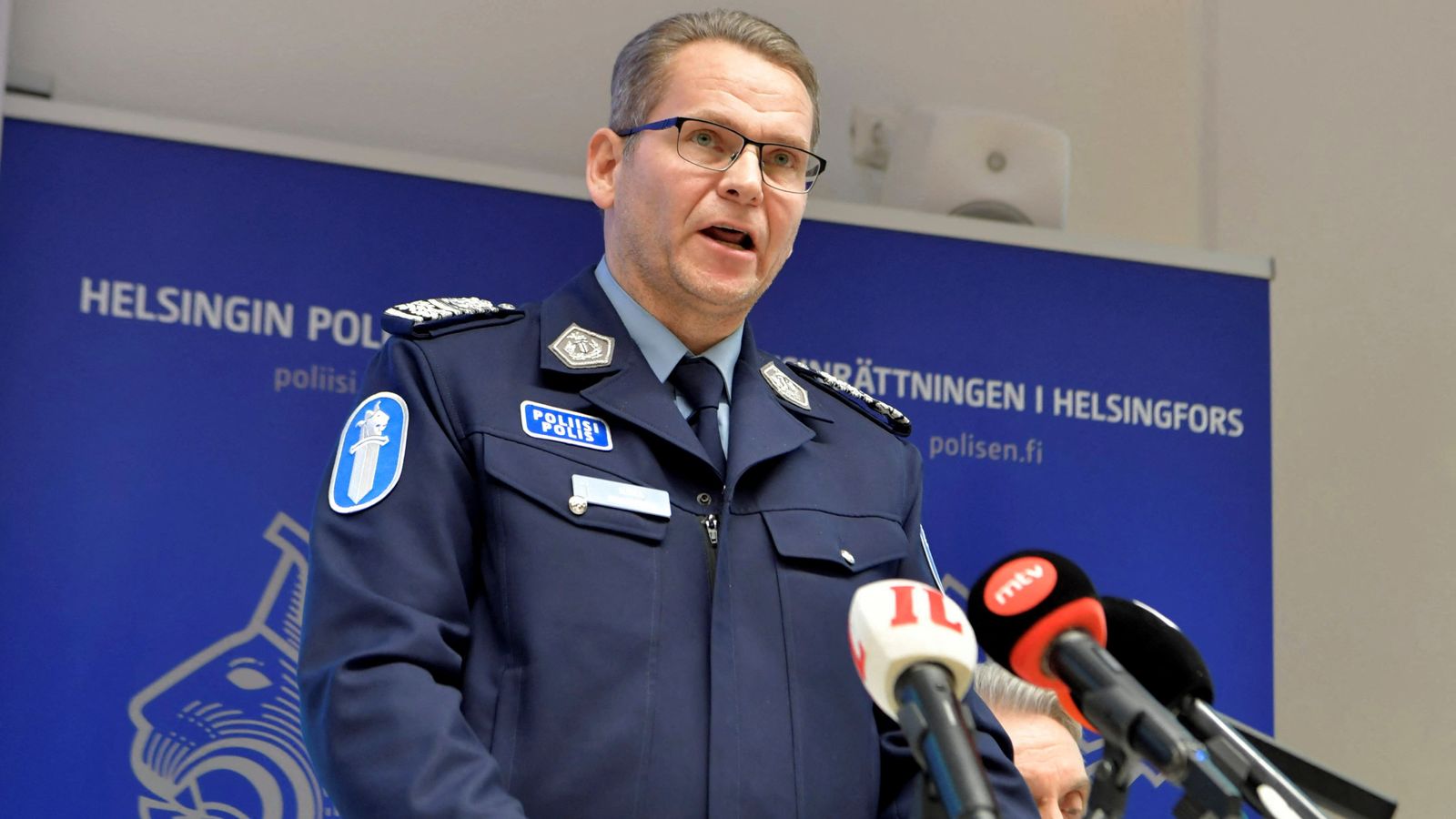
Finnish police have seized a cargo vessel suspected of damaging an undersea cable.
The Fitburg had departed from Russia and was en route to Israel when Finnish authorities detained the ship.
It is suspected of causing damage to a telecoms cable running from Helsinki to Estonia’s capital Tallinn belonging to Finnish telecoms group Elisa.
“Finnish authorities have taken control of the vessel as part of a joint operation,” police said.
Fourteen crew members – said to be Russian, Georgian, Kazakh and Azerbaijani – are being held by authorities.
The Fitburg pictured in the background of the press conference. Pic: Reuters
Eight NATO states border the Baltic Sea, which also borders Russia.
They have been on high alert after a spate of power cable outages, telecoms links and gas pipelines that run along the relatively shallow seabed since Russia invaded Ukraine in 2022.
NATO has boosted its presence in the Baltic with frigates, aircraft and naval drones in recent years.
A spokesperson for the military alliance declined to comment on Wednesday’s incident.
The Fitburg sailed under the flag of St Vincent and the Grenadines, a police spokesperson said.
The vessel was dragging its anchor in the sea, and was directed to Finnish territorial waters, the police and Finland’s Border Guard stated.
“At this stage, the police are investigating the incident as aggravated criminal damage, attempted aggravated criminal damage, and aggravated interference with telecommunications,” the police said.
Read more from Sky News:
Search for missing plane resumes 11 years after it disappeared
Two trains carrying tourists to Machu Picchu crash
Estonia’s justice ministry said a second telecoms cable connecting the country to Finland had also suffered an outage on Wednesday.
It was not immediately clear if the cable, belonging to Sweden’s Arelion, was running parallel to Elisa’s.
Enable Cookies
Allow Cookies Once
Finland’s President Alexander Stubb said the situation was being monitored.
Posting on X, he added: “Finland is prepared for various security challenges and responds to them in the manner the situation requires.”
In December last year, Finland boarded the Russian-linked oil tanker Eagle S which investigators said had damaged a power cable and several telecoms links in the Baltic Sea by dragging its anchor.
A Finnish court in October dismissed a criminal case against the Eagle S captain and other crew members, ruling prosecutors failed to prove intent and that any alleged negligence must be pursued by the ship’s flag state or the crew’s home countries.









NEED TO KNOW
- Glenda Akin broke a Guinness World Record after teaching at the same Tennessee school for more than 60 years
- Akin began her tenure at Westmoreland High School in 1963 and retired in September 2024
- Westmoreland said she “left an unforgettable legacy in our school and community”
A Tennessee teacher made history when she set down her chalk and retired after more than six decades in the classroom.
Glenda Akin broke the Guinness World Record for “longest teacher in the same school (female) on Sept. 13, 2024, according to the record-keeping organization. She taught at Westmoreland High School in Westmoreland for 61 years and 43 days before retiring.
Akin began her tenure at the Sumner County school in 1963 and worked as a social studies and library teacher, according to the Guinness World Records.
Westmoreland High School celebrated her achievement in a Facebook post on Dec. 19, sharing photos of Akin being honored at the school while holding her official certificate.
“Historic Achievement at Westmoreland High School!” the school wrote. “We are incredibly proud to announce that Ms. Glenda Akin has officially been awarded a Guinness World Record for the Longest Career as a Female Teacher in the Same School!”
“With an extraordinary 61 years and 43 days of dedicated service at Westmoreland High School, Ms. Akin’s lifelong commitment to education has shaped generations of students and left an unforgettable legacy in our school and community,” the school continued, adding, “Please join us in congratulating Ms. Glenda Akin on this historic and well-deserved honor!”
While Akin will no longer be walking the hallways during the school day, her legacy will live on in a special way.
Never miss a story — sign up for PEOPLE’s free daily newsletter to stay up-to-date on the best of what PEOPLE has to offer, from celebrity news to compelling human interest stories.
Glenda Akin.
Amber Regan
As seen in the photos shared by Westmoreland, the high school dedicated its library to Akin, renaming it the Glenda Akin Library. A plaque adorned with her photo reads, “Her six decades of service to our school and community will remain forever cherished in the lives of her coworkers and students.”
WORLD NEWS
Wetherspoons customer is sexually assaulted before he is repeatedly punched in pub attack


A man was sexually assaulted before being repeatedly punched in an attack at a Wetherspoons pub.
The victim was on the dance floor at the Union Rooms in Plymouth when he was inappropriately touched by a man on September 12.
When he confronted the individual, he was punched several times and sustained a cut to his face, which required medical treatment.
Devon and Cornwall Police have since released an image of a man who they believe will be able to help ongoing enquiries into the incident.
Devon and Cornwall Police have released a CCTV image released an image of a man who they believe will be able to help ongoing enquiries into an incident at The Union Rooms in Plymouth
The force has urged anyone with information to contact them via their website or by calling them on 101, quoting crime reference 50250238198.
Alternatively, information can be shared anonymously to the independent charity Crimestoppers by calling by calling 0800 555111, or via www.crimestoppers-uk.org.
Share or comment on this article:
Wetherspoons customer is sexually assaulted before he is repeatedly punched in pub attack


The final National Lottery Lotto draw of 2025 is nearly here and with a jackpot of £5.3 million up for grabs, someone could be in line for a very happy New Year indeed
SOURCE PAGE

Iranian protesters attempted to storm a local government building on Wednesday, state media reported, as demonstrations over the cost of living reached their fourth day.
In an unusual response to unrest, the Iranian government on Tuesday offered to set up a dialogue with protest leaders.
The first major protests since before June – when US airstrikes prompted an outpouring of patriotism – began on Sunday.
Shopkeepers and traders in the capital, Tehran, angry about spiralling inflation and the Iranian currency plunging to a record low against the dollar, took to the streets on Sunday, and have since been joined by students.
On Wednesday they attempted to break in to the local governor’s office in the southern Fars province, state media confirmed.
Protesters marched in Tehran on Monday. Pic: Fars News Agency/AP
“A few hours ago an organised group tried to get into the governorate building in the city of Fasa, their attack failed with the intervention of security forces,” state media said.
“The leader of these rioters, a 28-year-old woman, was arrested”.
Iran‘s Tasnim news agency cited a local official as saying four “attackers” had been detained and three members of the security forces had been wounded during the clash.
The governor of Fasa told state media that “the protests were caused by inflation and economic conditions. Individuals
influenced by hostile channels and media participated in them… the situation is back to normal”.
Whereas Iranian authorities have responded to previous protests with fierce security measures and arrests, in this instance it offered to set up a “dialogue mechanism” – though the details have not been confirmed.
Monday’s protests were the biggest since 2022, which were prompted by the death of 22-year-old Mahsa Jina Amini in police custody.
She was arrested by the country’s morality police for allegedly wearing her hijab improperly.
The recent protests come after the rial lost nearly half its value against the dollar in 2025, with inflation reaching 42.5% in December.
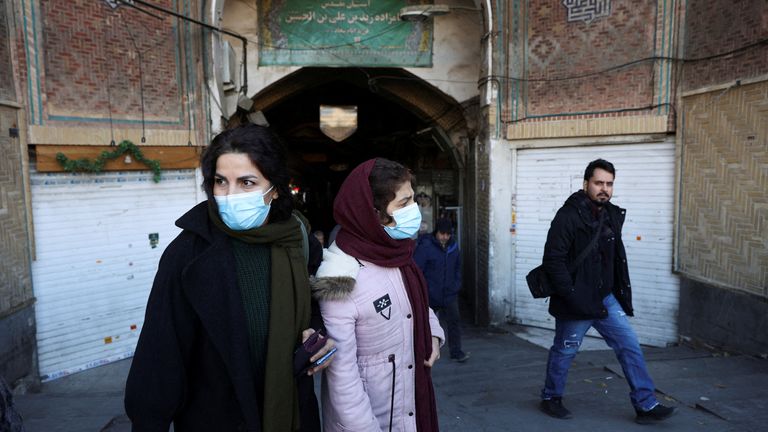
Many traders in Tehran shut up shop this week so they could take to the streets and protest. Pic: WANA/Reuters
On Monday, the governor of Iran’s Central Bank, Mohammad Reza Farzin, resigned, replaced by former economics minister Abdolnasser Hemmati.
Iran’s embattled economy has been navigating US sanctions since 2018, designed to deter its nuclear programme, which it says is peaceful.
These sanctions have hampered the economy and strained household budgets, the impact now exacerbated by the plummeting currency value and inflationary pressure which have pushed up the prices of food and other daily essentials.
WORLD NEWS
A marriage of three: Will Mali, Niger, Burkina Faso bloc reshape the Sahel? | Politics News


“Bienvenue a Bamako!” The fixer, the minder and the men linked to the Malian government were waiting for us at the airport in Bamako. Polite, smiling – and watchful.
It was late December, and we had just taken an Air Burkina flight from Dakar, Senegal across the Sahel, where a storm of political upheaval and armed violence has unsettled the region in recent years.
Recommended Stories
list of 3 itemsend of list
Mali sits at the centre of a reckoning. After two military coups in 2020 and 2021, the country severed ties with its former colonial ruler, France, expelled French forces, pushed out the United Nations peacekeeping mission, and redrew its alliances
Alongside Burkina Faso and Niger, now also ruled by military governments backed by Russian mercenaries, it formed the Alliance of Sahel States (AES) in September 2023. Together, the regional grouping withdrew from the wider Economic Community of West African States (ECOWAS) bloc, accusing it of serving foreign interests rather than African ones.
This month, leaders from the three countries converged in Bamako for the Confederal Summit of Heads of State of the AES, the second such meeting since the alliance was formed. And we were there to cover it.
The summit was a ribbon-cutting moment. Leaders of the three countries inaugurated a new Sahel Investment and Development Bank meant to finance infrastructure projects without reliance on Western lenders; a new television channel built around a shared narrative and presented as giving voice to the people of the Sahel; and a joint military force intended to operate across borders against armed groups. It was a moment to celebrate achievements more than to sign new agreements.
But the reason behind the urgency of those announcements lay beyond the summit hall.
In this layered terrain of fracture and identity, armed groups have found room not only to manoeuvre, but to grow. Jama’at Nusrat al-Islam wal-Muslimin (JNIM), an al-Qaeda affiliate, has expanded from rural Mali, launching attacks across the region and reaching the coast of Benin, exploiting weak state presence and long-unresolved grievances.
As our plane descended toward Bamako, I looked out at an endless stretch of earth, wondering how much of it was now under the control of al-Qaeda affiliates.
From the airport, our minders drove us fast through the city. Motorbikes swerved around us, street hawkers peddled their wares, and Malian pop blared from speakers. At first, this did not feel like a capital under siege. Yet since September, armed groups have been operating a blockade around Bamako, choking off fuel and goods, the military government said.
We drove past petrol stations where long queues stretched into the night. Life continued even as fuel grew scarce. People sat patiently, waiting their turn. Anger seemed to have given way to indifference, while rumours swirled that the authorities had struck quiet deals with the very fighters they claimed to be fighting, simply to keep the city moving.
Motorcycles line up near a closed petrol station, amid ongoing fuel shortages caused by a blockade imposed by al Qaeda-linked fighters in early September, in Bamako, Mali [Stringer/Reuters]
‘To become one country, to hold each other’s hand’
Our minders drove us on to the Sahel Alliance Square, a newly created public space built to celebrate the union of the three countries and its people.
On the way, Malian forces sped past, perhaps toward a front line that feels ever closer, as gunmen linked to JNIM have set up checkpoints disrupting trade routes to the capital in recent months. In September 2024, they also carried out coordinated attacks inside Bamako, hitting a military police school housing elite units, nearby neighbourhoods, and the military airport on the city’s outskirts. And yet, Bamako carries on, as if the war were taking place in a faraway land.
At Sahel Alliance Square, a few hundred young people gathered and cheered as the Malian forces went by, drawn by loud music, trivia questions on stage and the MC’s promise of small prizes.
The questions were simple: Name the AES countries? Name the leaders?
A microphone was handed to the children. The alliance leaders’ names were drilled in: Abdourahamane Tchiani of Niger. Ibrahim Traore of Burkina Faso. Assimi Goita of Mali. Repeated again and again until they stuck.
Correct answers won a prize: a T-shirt stamped with the faces of the alliance leaders.
Moussa Niare, 12 years old and a resident of Bamako, clutched a shirt bearing the faces of the three military leaders.
“They’ve gathered together to become one country, to hold each other’s hand, and to fight a common enemy,” he told us with buoyant confidence, as the government’s attempt to sell the new alliance to the public appeared to be cultivating loyalty among the young.
France out, Russia in
While Mali, Burkina Faso and Niger went through separate political transitions, the paths that brought them into a shared alliance followed a similar pattern.
Between 2020 and 2023, each country saw its democratically elected leadership removed by the military, the takeovers framed as necessary corrections.
In Mali, Colonel Goita seized power after months of protest and amid claims that President Ibrahim Boubacar Keita had failed to curb corruption or halt the advance of armed groups.
In Burkina Faso, the army ousted President Roch Marc Christian Kabore in early 2022 as insecurity worsened; later that year, Captain Traore emerged from a counter-coup, promising a more decisive response to the rebellion.
In Niger, soldiers led by General Tchiani detained President Mohamed Bazoum in July 2023, accusing his government of failing to safeguard national security and of leaning too heavily on foreign partners.
What began as separate seizures of power have since become a shared political project, now expressed through a formal alliance. The gathering in Bamako was to give shape to their union.
One of the key conclusions of the AES summit was the announced launch of a joint military battalion aimed at fighting armed groups across the Sahel.
This follows months of escalating violence, as regional armies assisted by Russian mercenaries push back against armed groups who have been launching attacks for over a decade.
Under the previous civilian governments, former colonial ruler France had a strong diplomatic and military presence. French troops, whose presence in the region dates back to independence, are now being pushed out, as military rulers recast sovereignty as both a political and security imperative. The last troops left Mali in 2022, but at its peak, France had more than 5,000 soldiers deployed there. When they withdrew, the country became a symbol of strategic failure for France’s Emmanuel Macron.
But even before that, French diplomacy appeared tone deaf, and patronising at best, failing to grasp the aspirations of its former colonies. The common regional currency, the CFA franc, still anchored to the French treasury, has become a powerful symbol of that resentment.
Now, French state television and radio have been banned in Mali. In what was once the heart of Francophone West Africa, French media has become shorthand for interference. What was lost was not only influence, but credibility. France was no longer seen as guaranteeing stability, but as producing instability.
Across the Sahel and beyond, anti-French sentiment is surging, often expressed in French itself – the language of the coloniser is now also the language of resistance.
 Captain Ibrahim Traore of Burkina Faso attends the Alliance of Sahel States (AES) second summit in Bamako, Mali [Mali Government Information Center via AP]
‘Like a marriage of reason’
At the end of the summit, Mali’s Goita was preparing to hand over the AES’s rotating leadership to Traore of Burkina Faso.
Young, charismatic, and the new rock star of Pan-Africanism, Traore, in particular, has captured young audiences with help from a loose ecosystem of pro-Russian messaging and Africanist influencers. Across social media platforms, short videos circulate relentlessly: speeches clipped for virality, images of defiance, and slogans reduced to shareable fragments.
Meanwhile, in Burkina Faso, journalists and civil society actors who have criticised the military rules have been sent to the front line under a conscription policy introduced by Traore. Human rights groups outspoken about alleged extrajudicial killings say they have been silenced or sidelined. But much of it is dismissed as collateral, the price, supporters argue, of sovereignty finally reclaimed.
Before the ceremony, we met Mali’s finance minister. At first, he was confident, rehearsed, assured. But when pressed about financing for the ambitious infrastructure projects the three governments have laid out for the Sahel, his composure faltered and his words stuttered. This was a government official unaccustomed to being questioned. The microphone was removed. Later, away from the camera, he told me, “The IMF won’t release loans until Mali has ironed out its relations with France.”
The spokesperson, irritated by my questions, took me aside. As he adjusted the collar of my suit, slowly and patronisingly, he said he sometimes thought about putting journalists in jail “just for fun”.
He did not question the organisation I worked for. He questioned my French passport; my allegiance. I told him my allegiance was to the truth. He smiled, as if that answer confirmed his suspicions.
In the worldview of Mali’s military government – men shaped by years on the front line, living with a permanent sense of threat – journalists and critics are part of the problem. Creating safety was the challenge. The alliance, the spokesperson explained, was the solution to what they could not find within regional body, ECOWAS.
The half-century-old West African institution is a bloc that the three countries had once helped shape. Now, the AES leaders say its ageing, democratically elected presidents have grown detached, more invested in maintaining one another in office than in confronting the region’s crises. In response, they are promoting the AES as an alternative.
As the Sahel alliance grows, it’s also building new infrastructure.
At its new television channel in Bamako, preparations were under way. The ON AIR sign glowed. State-of-the-art cameras sat on tripods like polished weapons.
The channel’s director, Salif Sanogo, told me it would be “a tool to fight disinformation,” a way to counter Western, and more specifically French, narratives and “give voice to the people of the Sahel, by the people of the Sahel”.
The cameras had been bought abroad. The installation was overseen by a French production company. The irony went unremarked.
To defend the alliance, he offered a metaphor. “It’s like a marriage of reason,” he said. “It’s easier to make decisions when you’re married to three. When you’re married to 15, it’s a mess.” He was referring to the 15 member states of ECOWAS.
‘We will survive this, too’
Two years into the AES alliance, they have moved faster than the legacy regional bloc they left behind. A joint military force now binds their borders together, presented as a matter of survival rather than ambition. A mutual defence pact recasts coups and external pressure as shared threats, not national failures. A common Sahel investment and development bank, meant to finance roads, energy, and mineral extraction without recourse to Western lenders, offers sovereignty, they say, without conditions. A common currency is under discussion.
A shared news channel is intended to project a single narrative outward, even as space for independent media contracts at home. And after withdrawing from the International Criminal Court, they have proposed a Sahel penal court, one that would try serious crimes and human rights violations on their own terms. Justice brought home, or justice brought under control, depending on who you ask.
What is taking shape is not just an alliance, but an alternative architecture, built quickly, deliberately, and in full view of its critics.
Where ECOWAS built norms slowly, through elections, mediation, and consensus, AES is building structure. Where ECOWAS insists on patience, AES insists on speed.
To supporters, this is overdue self-determination, dignity restored after decades of dependency. To critics, it is power concentrated in uniforms, accountability postponed, repression dressed up as emancipation.
From the summit stage as he took over the alliance’s leadership, Traore redrew the enemy: Not al-Qaeda. Not ISIL. Not even France. But their African neighbours, cast as the enemy within. He warned of what he called a “black winter”, a speech that held the room and travelled far beyond it, drawing millions of viewers online.
“Why are we, Black people, trying to cultivate hatred among ourselves,” he asked, “and through hypocrisy calling ourselves brothers? We have only two choices: either we put an end to imperialism once and for all, or we remain slaves until we disappear.”
Away from the summit’s “black winter”, under a sunlit sky in Bamako, life moved on with a quieter rhythm. Music drifted through public squares and streets, carrying a familiarity that cut across the tension of speeches and slogans. It was Amadou and Mariam, Mali’s most internationally known musical duo, whose songs once carried the country’s everyday joys far beyond its borders. Amadou died suddenly this year. But the melody lingers.
Its lyrics hold the secret of the largest alliance of all. Not one forged by treaties or uniforms, but by people, across Mali and the Sahel, in all their diversity.
“Sabali”, Mariam sings.
“Forbearance.
“We have survived worse. We will survive this, too.”
WORLD NEWS
European human rights court questions UK decision to strip Shamima Begum of citizenship | Shamima Begum


The European court of human rights has questioned the UK government over its 2019 decision to remove Shamima Begum’s British citizenship.
Lawyers in Europe have asked how Begum’s treatment complies with the UK’s responsibilities to victims of trafficking.
The intervention has encouraged Begum’s lawyers and fuelled Conservative and Reform accusations of meddling by foreign judges and their calls to leave European human rights treaty.
In 2015, as a 15-year-old schoolgirl, Begum left her east London home and travelled with two friends to live under territory held by Islamic State (IS). She was “married off” to an IS fighter with whom she had three children, all of whom died in infancy.
In 2019, the then home secretary, Sajid Javid, revoked her citizenship on grounds of national security, in a decision upheld in the court of appeal last year and backed by the current government.
Campaigners and Begum’s lawyers argue she was the victim of child trafficking. Begum, now 26, remains stateless in a Syrian refugee camp.
A document published by the European court this month confirms that Begum is challenging Javid’s decision under Article 4 of the European convention on human rights – a prohibition of slavery and forced labour.
The case was lodged in December 2024, after she was denied the chance to challenge the removal of her British citizenship at the UK’s supreme court.
Among four questions posed by judges in Strasbourg to the Home Office, they asked: “Did the secretary of state have a positive obligation, by virtue of Article 4 of the convention, to consider whether the applicant had been a victim of trafficking and whether any duties or obligations to her flowed from that fact, before deciding to deprive her of her citizenship?”
Birnberg Peirce Solicitors, which is representing Begum, said the court’s communication “presents an unprecedented opportunity” for the UK and Begum to “grapple with the significant considerations raised in her case and ignored, sidestepped or violated up to now by previous UK administrations”.
One of the lawyers, Gareth Peirce, said: “It is impossible to dispute that a 15-year-old British child was in 2014-15 lured, encouraged and deceived for the purposes of sexual exploitation to leave home and travel to [IS-controlled] territory for the known purpose of being given, as a child, to an [IS] fighter to propagate children for the Islamic State.”
She added: “It is equally impossible not to acknowledge the catalogue of failures to protect a child known for weeks beforehand to be at high risk when a close friend had disappeared to Syria in an identical way and via an identical route.
“It has already been long conceded that the then home secretary, Sajid Javid, who took the precipitous decision in 2019 very publicly to deprive Ms Begum of citizenship, had failed entirely to consider the issues of grooming and trafficking of a school child in London and of the state’s consequent duties.”
Pierce said the challenge comes as the current government has made protections for victims of grooming and trafficking a national priority.
A Home Office spokesperson said any decision made to protect national security would be robustly defended. They added: “The government will always protect the UK and its citizens. That is why Shamima Begum – who posed a national security threat – had her British citizenship revoked and is unable to return to the UK.”
The shadow home secretary, Chris Philp, said Begum had “no place” in the UK because of her support for violent extremists. In a post on X, he wrote: “It is deeply concerning the European Court of Human Rights is now looking at using the ECHR to make the UK take her back.”
Also on X, Richard Tice, Reform’s deputy leader, wrote: “ECHR can jog on….none of their business …just another reason why we must leave this foreign court.”


Israel is to revoke the licences of 37 international non-governmental organisations (INGOs) working in Gaza and the occupied West Bank, saying they failed to meet requirements under new registration rules.
ActionAid, International Rescue Committee, Médecins Sans Frontières and Norwegian Refugee Council are among the aid agencies which will have their licences suspended on 1 January, with their operations to end within 60 days.
Israel said they had, among other things, failed to hand over “complete” personal details of their staff. The INGOs said that could put them at risk.
The move was condemned by 10 countries, which said the rules would have a severe impact on access to essential services.
In a joint statement, the foreign ministers of the UK, France, Canada, Denmark, Finland, Iceland, Japan, Norway, Sweden and Switzerland said INGOs were integral to the humanitarian response in Gaza and that any attempt to stem their ability to operate was “unacceptable”.
“Without them, it will be impossible to meet all urgent needs at the scale required,” they warned.
The European Union’s humanitarian chief, Hadja Lahbib, said: “Israel’s plans to block INGOs in Gaza means blocking life-saving aid.”
International humanitarian law “leaves no room for doubt: aid must reach those in need,” she added.
UN human rights chief Volker Türk called the INGO suspensions “outrageous” and “arbitrary”, and said they made “an already intolerable situation even worse for the people of Gaza”.
The Humanitarian Country Team of the Occupied Palestinian Territory – a forum that brings together UN agencies and more than 200 local and international NGOs – urged the Israeli authorities to reconsider the registration decisions.
It has said INGOs run or support most of Gaza’s field hospitals and primary healthcare centres, emergency shelter responses, water and sanitation services, nutrition stabilisation centres for children with acute malnutrition, and critical mine action activities.
Israel’s ministry of diaspora affairs, which oversees registration applications, said the new measures would not affect the flow of humanitarian assistance to Gaza.
It said aid continued to be delivered through “approved and vetted channels”, including UN agencies, bilateral partners, and humanitarian organisations.
Israeli military body Cogat, which controls Gaza’s crossings and co-ordinates aid deliveries, meanwhile said the INGOs facing suspension “did not bring aid into Gaza throughout the current ceasefire”, which began 11 weeks ago. It added that “even in the past their combined contribution amounted to only about 1% of the total aid volume”.
The diaspora affairs ministry said the primary reason INGOs had their licences revoked was “the refusal to provide complete and verifiable information regarding their employees,” which it said was critical to preventing “the infiltration of terrorist operatives into humanitarian structures”.
Fewer than 15% of the INGOs providing humanitarian assistance to Gaza were found to be in violation of the new regulatory framework, it added.
That framework includes several grounds for rejection, including:
- Denying the existence of Israel as a Jewish and democratic state
- Denying the Holocaust or the Hamas-led attacks on Israel on 7 October 2023
- Supporting an armed struggle against Israel by an enemy state or terrorist organisation
- Promoting “delegitimisation campaigns” against Israel
- Calling for a boycott of Israel or committing to participate in one
- Supporting the prosecution of Israeli security forces in foreign or international courts
The ministry of diaspora affairs also alleged that Israeli investigations had “determined that individuals affiliated with [Médecins Sans Frontières] were linked to terrorist organisations, including the Palestinian Islamic Jihad and Hamas”, without providing any evidence.
“Despite repeated requests, the organisation failed to provide full disclosure regarding the identities and roles of these individuals,” it said.
MSF said it took such allegations extremely seriously and that it would “never knowingly employ people engaging in military activity”.
“Any employee who engages in military activity would pose a danger to our staff and our patients. Publicly making such claims without substantiated evidence puts humanitarian staff at risk and undermines life-saving medical work,” it added.
MSF also warned that deregistration by Israeli authorities would effectively block it from operating in Gaza, “where we support one in five hospital beds and one in three births, cutting off life-saving medical assistance for hundreds of thousands of people”.
Norwegian Refugee Council spokeswoman Shaina Low told NPR that it would no longer be able to bring foreign aid workers into Gaza if it was deregistered, but that its 200 local staff would continue to support communities as best as they could.
Ms Low said NRC had tried to explain to the Israeli authorities why it could not provide them with lists of their Palestinian staff members.
“We’ve seen that hundreds of aid workers were killed over the last two years. And so, for us, it is a safety concern for our staff. And acknowledging who they are – it puts them at risk. Because we’ve seen that aid workers are just as unprotected, and at times, have been targeted by Israeli authorities,” she said.
She also said that the NRC and other INGOs were prevented by data protection laws from complying with an Israeli demand to share details about the funding they received from the EU and EU member states.
“The number one thing that we’re concerned about is the entry of aid,” she added. “We continue to call for Israel to lift these restrictions, to open all of the crossings to allow much more aid to enter than the current rate.”
Israel says it is meeting its obligations in facilitating an increase in aid deliveries.
On 19 December, UN-backed food security experts said there had been improvements in nutrition and food supplies in Gaza since the ceasefire began, but that 100,000 people still experienced “catastrophic conditions” last month.
Other INGOs to be suspended include CARE, Medico International, and Medical Aid for Palestinians.
International Rescue Committee said it was in touch with relevant authorities and seeking a way to sustain the delivery of life-saving aid.
Bushra Khalidi, Oxfam’s policy lead, meanwhile said Cogat’s figures on aid deliveries by the affected INGOs were misleading because “humanitarian impact is not measured by percentages”.
“We are not simply aid volume contributors; we are core implementers. The UN relies on our staff, our partners, our technical expertise, our logistics, and our community networks to deliver assistance,” she explained.
The Humanitarian Country Team of the Occupied Palestinian Territory – a forum that brings together UN agencies and more than 200 local and international NGOs – urged the Israeli authorities to reconsider the registration decisions.
Earlier this month, it complained that the new registration system relied on “vague, arbitrary, and highly politicised criteria and imposes requirements that humanitarian organisations cannot meet without violating international legal obligations or compromising core humanitarian principles”.
In a statement, Israel’s Minister of Diaspora Affairs and Combating Antisemitism, Amichai Chikli, said: “The message is clear: humanitarian assistance is welcome – the exploitation of humanitarian frameworks for terrorism is not.”
The war in Gaza was triggered by the Hamas-led attack on southern Israel on 7 October 2023, in which about 1,200 people were killed and 251 others were taken hostage.
More than 71,260 people have been killed in Israeli attacks in Gaza since then, according to the territory’s Hamas-run health ministry.

12/29/2025December 29, 2025
Berlin homeless charity ‘overwhelmed by solidarity’ after van fire
One VW minibus was totally burned out, while the one parked next to it sustained more superficial damageImage: Rolf Zoellner/epd-bild/picture alliance
The Berliner Stadmission protestant charity has praised the response after two of its three “cold buses” providing winter assistance to the homeless in the German capital were put out of action by a fire, with arson suspected.
“We are overwhelmed by the people’s solidarity,” spokeswoman Barbara Breuer told Germany’s DPA news agency, a day after the news of the fire first broke in the city. “Other organizations and businesses from Berlin have offered their assistance.”
Breuer said initial donations had already come in, though she could not yet provide a precise tally.
“The cold bus trips are assured again, and we are utterly grateful,” she said.
The Berliner Stadtmission provides various assistance from more than 70 sites in and around the Berlin diocese, particularly to those in more extreme need or poverty.
One of the vehicles was a write-off, while the flames also put the one parked next to it out of action temporarilyImage: Sebastian Gollnow/dpa/picture alliance
One of the minibuses was found totally burned out on Sunday, with another one parked next to it sustaining minor damage that will put it out of service temporarily.
Police said they had launched an investigation on suspicion of arson.
Volunteers use the vehicles on cold winter nights to tour the city, providing hot food and drinks and other assistance like sleeping bags and blankets, as well as transporting some of them to shelters for the night.
Berlin is typically one of the colder cities in northern Germany, and freezing temperatures are currently forecast overnight on Monday and Tuesday, with the possibility of snow in the early hours of Wednesday.
City authorities estimate that just over 53,000 people were in homeless accommodation or other shelters in Berlin as of the start of 2025. The less reliable estimates for the number of people sleeping on the streets have not yet been published. But in 2024, that figure stood at just over 6,000.
Berlin’s Cold Bus helping the homeless
To view this video please enable JavaScript, and consider upgrading to a web browser that supports HTML5 video


NEWYou can now listen to Fox News articles!
While the United States presses for negotiations aimed at ending the war in Ukraine, Russia is signaling a parallel strategy — deepening cooperation with U.S. adversaries and portraying itself as resistant to Western pressure.
That posture was on display this week when Iran announced that three of its domestically designed satellites were launched into orbit aboard a Russian rocket.
The launch was broadcast by Iran’s Arabic-language state television channel Al-Alam News Network, which aired footage showing the satellites lifting off from Russian territory. The Associated Press and Reuters reported that the satellites were carried into orbit aboard a Russian rocket launched from eastern Russia, marking the seventh time Iran has conducted a satellite launch with Russian assistance.
IRANIAN PRESIDENT SAYS HIS COUNTRY IS AT ‘TOTAL WAR’ WITH THE US, ISRAEL AND EUROPE: REPORTS
Russian President Vladimir Putin and Iranian President Masoud Pezeshkian shake hands as they meet in Moscow, Russia Jan. 17, 2025. (Evgenia Novozhenina/Pool via Reuters)
Iranian Ambassador to Russia Kazem Jalali said the satellites were “designed and produced by Iranian scientists,” adding that cooperation between Tehran and Moscow continues “despite all the sanctions and threats,” according to Iranian state media cited by Reuters.
Iranian officials claim the satellites are intended for civilian purposes, including environmental monitoring and agriculture, though Western governments have long warned that Iran’s space program could advance technologies applicable to ballistic missile development.
The launch underscored a broader strategic relationship between Moscow that has expanded significantly since Russia’s invasion of Ukraine in 2022. Iran has supplied Russia with drones and other military equipment used on the battlefield, while Russia has provided diplomatic cover, economic cooperation and advanced technical support amid sweeping Western sanctions on both countries.
IRAN REPORTEDLY DEVELOPING CHEMICAL, BIOLOGICAL MISSILE WARHEADS AS PROTESTS SPREAD OVER COLLAPSING ECONOMY
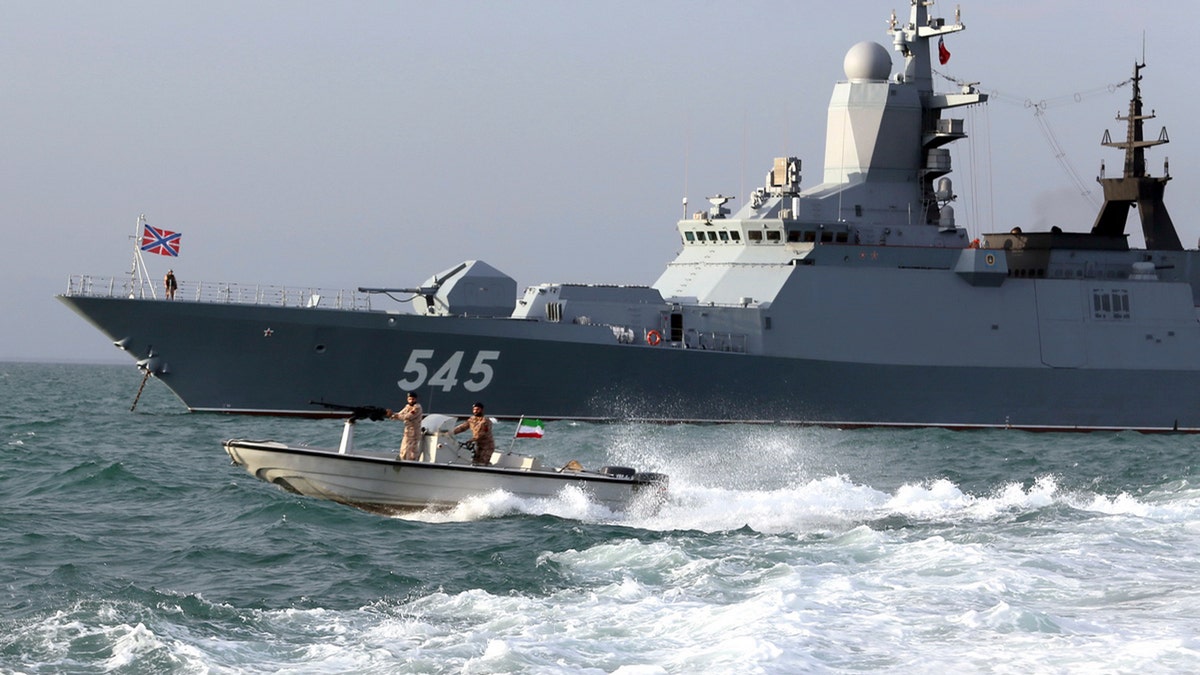
A Russian warship and an Iranian army speed boat attend a joint naval exercise on Tuesday. (AP/Iranian Army)
The growing Russia-Iran alignment comes as tensions between Tehran and Washington continue to rise. After President Donald Trump recently warned that the United States could strike Iran again if it attempted to rebuild its nuclear program, Iranian President Masoud Pezeshkian issued a sharp response.
According to the Associated Press, Pezeshkian said any U.S. attack would be met with a “harsh and discouraging” response. Iranian officials framed the warning as defensive, arguing it was meant to deter potential U.S. aggression rather than signal an intention to initiate conflict. Tehran has repeatedly said its nuclear program is peaceful, a claim the United States and its allies dispute.
CLICK HERE TO DOWNLOAD THE FOX NEWS APP
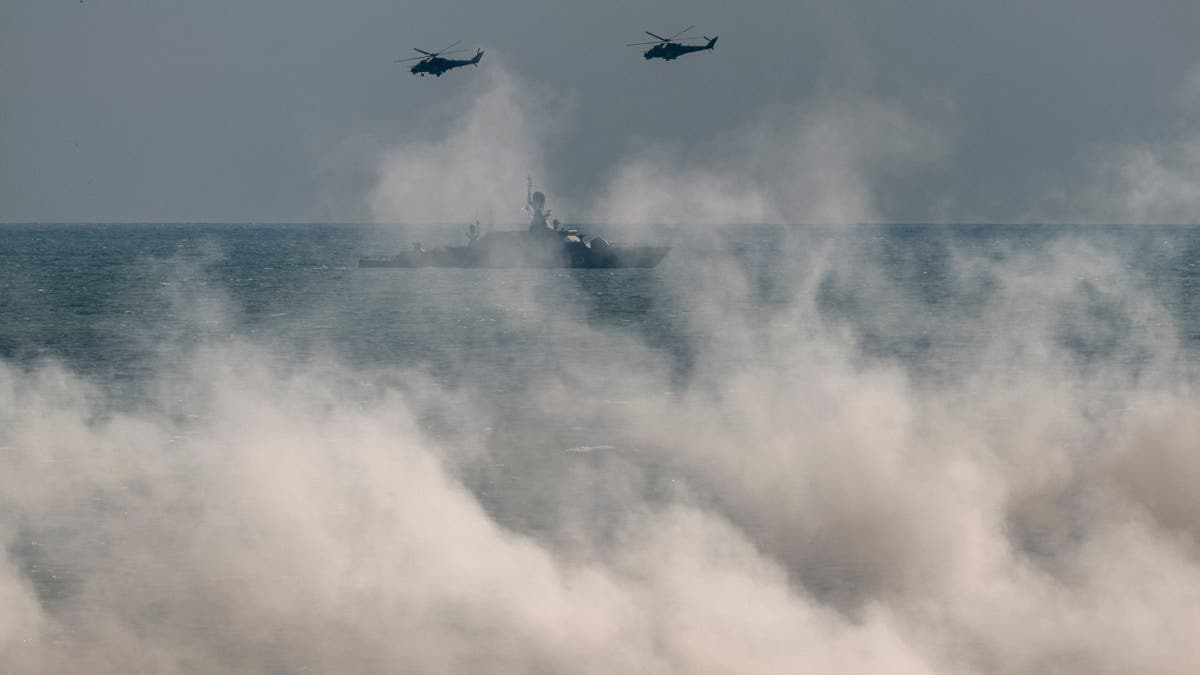
Russian army Mi-24 helicopters fly above a warship at the Turali range on the Caspian Sea coast in the Republic of Dagestan in Southern Russia on Sept. 23, 2020 during the “Caucasus-2020” military drills gathering China, Iran, Pakistan and Myanmar troops, along with ex-Soviet Armenia, Azerbaijan and Belarus. (Dimitar Dilkoff / AFP via Getty Images)
The exchange highlights how Iran and Russia are increasingly positioning themselves as partners pushing back against U.S. pressure, even as Washington attempts to pursue diplomacy on multiple fronts. Russia has portrayed its partnerships with Iran and other sanctioned states as evidence that Western efforts to isolate Moscow have failed, while Iran has used its cooperation with Russia to showcase technological resilience under sanctions.
Efrat Lachter is an investigative reporter and war correspondent. Her work has taken her to 40 countries, including Ukraine, Russia, Iraq, Syria, Sudan and Afghanistan. She is a recipient of the 2024 Knight-Wallace Fellowship for Journalism. Lachter can be followed on X @efratlachter.


Sign up for the daily Inside Washington email for exclusive US coverage and analysis sent to your inbox
Get our free Inside Washington email
Get our free Inside Washington email

President Donald Trump’s plans for a White House ballroom are not unique, according to the longest-serving top aide in the executive residence. Gary Walters, who spent over two decades as White House chief usher – a role akin to the residence’s general manager – under presidents Ronald Reagan, George H.W. Bush, Bill Clinton and George W. Bush, provides context.
In an interview with The Associated Press about his recently published memoir, Walters stated: “All the presidents that I had an opportunity to serve always talked about some possibility of an enlarged area” for entertaining.
President Trump himself has discussed building a White House ballroom for years, even before entering politics.
In July, the White House announced a 90,000-square-foot space would be built on the east side of the complex to accommodate 650 seated guests, with an estimated cost of $200 million. President Trump has stated that it will be funded with private donations, including his own.
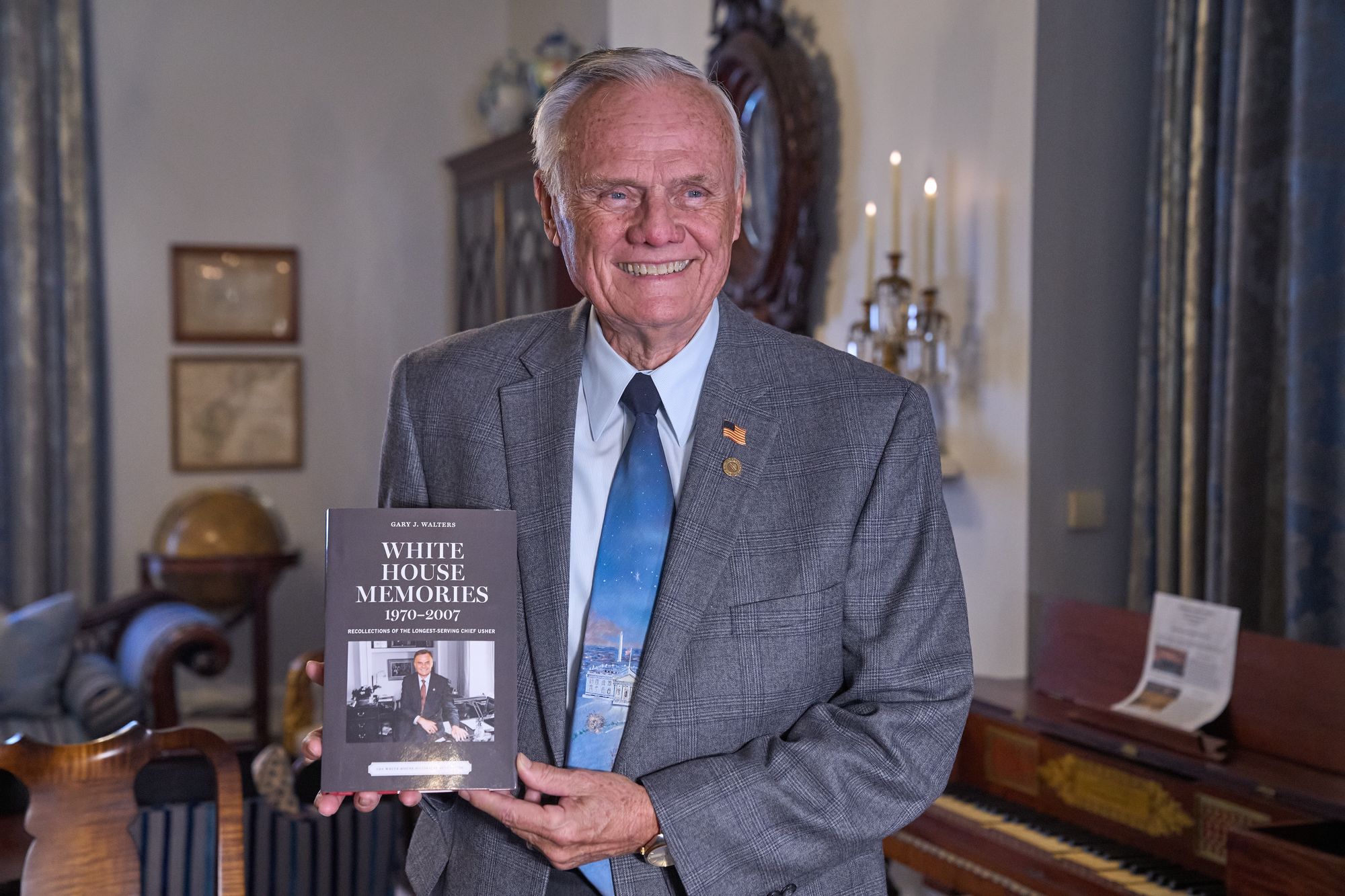 Walters said there is a long history of projects on the campus, ranging from conservatories, greenhouses and stables being torn down to build the West Wing in 1902, to the expansion of the residence with a third floor, to the addition of the East Wing itself during World War II. (AP Photo/Jacquelyn Martin)
The Republican president later upped the proposed ballroom’s capacity to 999 people and, by October, had demolished the two-story East Wing of the White House to build it there. In December, he updated the price tag to $400 million — double the original estimate.
Images of the East Wing being demolished shocked historians, preservationists and others, but Walters said there is a long history of projects on the campus, ranging from conservatories, greenhouses and stables being torn down to build the West Wing in 1902, to the expansion of the residence with a third floor, to the addition of the East Wing itself during World War II to provide workspace for the first lady, her staff and other White House offices.
“So there’s always been construction going on around the White House,” Walters said.
Other presidents bemoaned the lack of space for entertaining
When Walters was on the job, the capacity of the largest public rooms in the White House was among the first topics he discussed with the incoming president, first lady and their social secretary, he said. The presidents he served all talked about the limited number of people the White House could handle.
When set up for a state dinner, the State Dining Room can hold about 130 people: 13 round tables each with seating for 10, Walters said. The East Room can accommodate about 300 chairs — fewer if space is needed for television cameras.
Trump often complains that both rooms are too small. He has also complained about the use of large tents on the south grounds, the main workaround for big events such as ritzy state dinners for foreign leaders. Walters said the tents had issues.
“When it rained, the water flows downhill and the grass became soggy, no matter what we tried to do,” Walters said. “We dug culverts around the outside of the tent to try and get the water.” Tents damaged the grass, requiring more work to reseed it, he said.
Walters admitted it was a bit jarring to see the East Wing torn down, and said he had fond personal memories of the space. “I met my wife at the White House and she worked in the East Wing, so that was a joy for me,” said Walters, 79.
His wife, Barbara, was a receptionist in the visitors office during the administrations of Richard Nixon and Gerald Ford. The couple recently celebrated 48 years of marriage.
Broken bones alter usher’s career trajectory
Walters owes his place in history as the longest-serving White House chief usher to the misfortune of a broken ankle.
He was 23 in early 1970, honorably discharged from the Army and looking for a job that would allow him to finish college at night. The Executive Protective Service, a precursor to the U.S. Secret Service, was hiring and accepted him.
But shortly before the graduation ceremony, Walters broke an ankle playing football. He could not patrol out of uniform, wearing a cast and hobbling around on crutches, so he was given a temporary assignment in the White House Police Control and Appointments Center. He stayed for five years.
“This injury also changed the course of my career,” Walters wrote in his memoir, “White House Memories: 1970-2007: Recollections of the Longest-Serving Chief Usher.” He gained an ”in-depth knowledge of the ways and security systems of the White House that would ultimately greatly benefit me in my future role in the Usher’s Office.”
A few months after being promoted to sergeant in 1975, he learned of an opening in the Usher’s Office. He applied and joined as an assistant in early 1976.
A decade later, he was elevated to chief usher by Reagan, who gave Walters the top job in the residence overseeing maintenance, construction and renovation projects, and food service, along with administrative, financial and personnel functions. He managed a staff of about 90 butlers, housekeepers, cooks, florists, electricians, engineers, plumbers and others.
Walters retired in 2007 after 37 years at the White House, including a record 21 years as chief usher. He served under seven presidents, from Nixon to George W. Bush.
In that time, Walters saw a broad swath of presidential history: the only president who ever resigned, an appointed vice president become the only unelected president, a president be impeached and stay in office, a father and son become president and the Supreme Court decide the most closely contested presidential election in U.S. history.
He’s often asked what he liked most about his work and “without hesitation, I say it is getting to know and interact directly with the president, first lady, and other members of their family. It was an honor to get to know them with my own eyes and ears,” Walters wrote.

NEED TO KNOW
- Jessica Alba’s estranged husband Cash Warren reflected on his year in an Instagram post on Wednesday, Dec. 31
- In the post, he shared photos with his and Alba’s three kids, Honor and Haven and Hayes and shared other highlights from his year
- The post comes amid Warren and Alba’s divorce, with the latter announcing their separation in January
Jessica Alba’s ex Cash Warren is reflecting on his year and sharing some lessons he’s learned along the way.
The film producer, 46, shared an Instagram post on Wednesday, Dec. 31, noting that despite the year starting out as something he “wanted to forget” — likely referring to Alba, 44, announcing their split in January — he was “thankful” for how it evolved.
“You started out as the year I wanted to forget but so damn thankful you grew into the year I’ll always remember,” he wrote alongside a collage of photos and videos featuring his kids and other memorable moments from his year.
“A few lessons I learned over last 365 days,” he continued. “Acceptance is suffering’s antidote. Our minds are the OG algorithm. Negative thoughts will play on repeat if you allow them to[.] The line between enlightenment and narcissism is razor thin. Don’t be fooled by those who don’t know the difference.”
Cash Warren poses alongside his kids, Honor, Haven and Hayes on vacation.
Cash Warren/Instagram
He kicked off his post with a series of family photos showcasing his and Alba’s three children; daughters Honor, 17, and Haven, 14, and son Hayes, 8. The photos appeared to be taken during a family tropical vacation and showed the family smiling together on a beach and Hayes sporting some sunglasses.
He also shared photos of the family during their everyday lives, including a snap of him hanging out with Haven on a couch, a snap of Hayes showing him a bagel with cream cheese and an outdoor photo with Honor on a bench. He also shared a photo he took of his two daughters at dinner and all of his kids appearing to nap on top of him.
Cash Warren shares a photo of his three kids taking a nap on top of him.
Cash Warren/Instagram
Warren also shared clips and videos of him hanging out with his friends, surfboarding, walking on the beach and enjoying sunsets. However, the bulk of his caption was dedicated to his three kids. He noted that Honor’s “ability to stay focused” on her goals no matter what life threw her way this year “was inspiring” and he thanked her for “continuing to blaze the trail for your sister and little bro,” He then revealed, “You’re going to freaking YALE!!!”
For his middle child, Haven, he wrote, “thanks for holding me accountable and for communicating so openly when things weren’t sitting right with you,” adding that her “transparency is everything!” He also noted that she taught him “about the fine art of being nonchalant.”
As for his youngest son, he noted that the 8-year-old taught him “about living life with no regrets.” He also recalled a moment when his son told him, “Dad, you know how many people in the world made a mistake at the exact same time as me? It’s not a big deal,” as he wished him a happy eighth birthday.
“From my day 1s to my new-news … I am so grateful 🥂❤️ 🥳. Thanks for extending your hands to help me get back on my feet. Happy New Year!!,” he completed his caption.
Cash Warren shares a photo with daughters Haven and Honor.
Cash Warren/Instagram
This comes amid a tumultuous year for Warren, whose actress wife, Alba, announced on Instagram that she and her estranged husband were embarking “on a new chapter of growth and evolution as individuals.”
Never miss a story — sign up for PEOPLE’s free daily newsletter to stay up-to-date on the best of what PEOPLE has to offer, from celebrity news to compelling human interest stories.
The Fantastic Four star continued, “We are moving forward with love and kindness and respect for each other and will forever be family. Our children remain our highest priority and we request privacy at this time.”
Cash Warren, Haven Garner Warren, Jessica Alba and Honor Warren in June 2024.
Phillip Faraone/Getty
She officially filed for divorce on Feb. 7, citing irreconcilable differences in court filing obtained by PEOPLE. Alba filed for joint custody of their children and requested that her legal name be restored to Jessica Marie Alba, according to the filing. The former couple’s date of separation was listed as Dec. 27, 2024.
Despite no longer being together, they have continued to put their kids first with their new co-parenting dynamic. The Honest Renovations star shared photos on Instagram, including one taken on Easter of herself reuniting with her estranged husband as they spent time with their children for Easter. “Easter Sunday w the fam 💐🐰🫶🏽,” she captioned the photo.
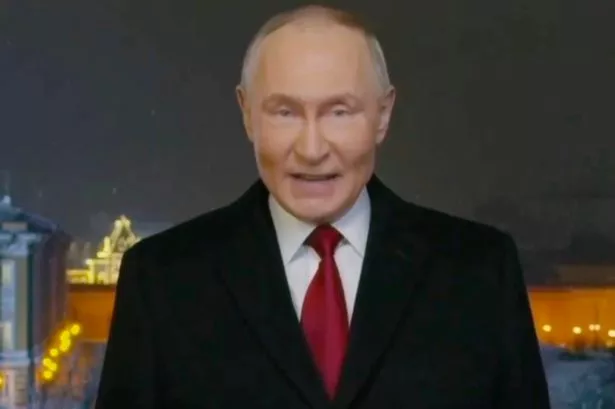
Russian Leader Vladimir Putin gave a New Year’s message angled towards his troops in Ukraine as he defied Donald Trump’s efforts to find peace
SOURCE PAGE

Saudi Arabia’s strike on Mukalla port has triggered tensions with its partner in the Arab coalition in Yemen and its Gulf Arab neighbour, the United Arab Emirates.
The coalition spokesman, Major-General Turki al-Maliki, said two ships entered the port of Mukalla, carrying more than 80 vehicles and containers of weapons and ammunition destined for the Southern Transitional Council (STC), without informing Saudi Arabia or the internationally recognised Yemeni government.
There are serious differences between the two allies in Yemen, and now it is at its peak and perhaps a turning point that would impact Yemen.
The Yemeni government has lost control of events following a military escalation between Saudi Arabia and the UAE in Hadramout governorate, where Mukalla lies, in December.
The Presidential Leadership Council (PLC) is divided into two factions, each loyal to one party in this conflict. The difference had been simmering for years away from the spotlight until it exploded publicly over the past few days.
Saudi Arabia and the UAE are key members of the Arab military coalition in Yemen, formed to confront the Houthis, who took full control of the capital, Sanaa, by force in 2015 and later imposed their own government.
This conflict of interest between Saudi Arabia and the UAE has been escalating gradually since the UAE-backed Southern Transitional Council (STC) formed in 2017 as a separatist political and military force seeking an independent state in the south – South Yemen – an independent state between 1967 and 1990.
Earlier in December, the STC forces crossed red lines by controlling all southern governorates, including Hadramout and al-Mahra governorates. That did not go down well in Saudi Arabia, which considered the move a threat to its national security.
Hadramout also represents economic depth for Yemen with its oil and gas resources and related infrastructure, and also has a vital border crossing with Saudi Arabia, making it part of the equation for border security and trade.
The latest public fallout between Saudi Arabia and the UAE will cast a dark shadow over the situation in Yemen politically, economically, and militarily. The Yemeni political circles were divided into two camps, with the government members each following one of the external parties to the conflict – Saudi and Emirati.
The clearest outcome of the differences would be seen in the eight-member PLC, an internationally recognised body, which is already divided into camps loyal to Saudi Arabia and the UAE.
One camp is headed by Rashad al-Alimi, the PLC president, and includes Sultan al-Arada, Abdullah al-Alimi Bawazir, and Othman Hussein Mujalli. The second is led by the head of the STC force, Aidarus al-Zoubaidi, and includes Abdul Rahman al-Mahrami (also known as Abu Zaraa), Tariq Mohammed Saleh, and Faraj Salmin al-Bahsani.
The leaders of both camps issued two different statements regarding the calls made by al-Alimi for the UAE to withdraw from Yemen following the Saudi strike on the ships carrying weapons to the STC. One was in favour of the UAE’s exit from Yemen, and the other was against — showing they are representing the interests of regional players and at the same time confirming that Yemen is a venue for a proxy war.
Within the Yemeni political landscape, the quick developments and successive events are pushing Yemen into a new phase of an internal war among political and military components that make up the legitimate government, with new internal fighting among many armed factions.
It is also taking the focus away from the Houthi rebellion in the north, which controlled Sanaa and the most populous provinces in Yemen.
The main goal for the legitimate Yemeni government and the Saudi-led Arab coalition was to confront the Houthis’ takeover. Now, the country is on the brink of collapse and a new phase of turmoil after more than a decade of armed conflict, which could help the Houthis to expand their influence beyond their current areas of control.
The latest event will weaken the Saudi-led coalition further and cast doubt over its cohesion and ability to achieve its declared joint goals for Yemen.

His work is consistently ranked among the world’s most expensive art, with paintings fetching more than a $100m at auction. But you no longer need to be a multimillionaire to own a Picasso – for €100, anyone in the world has the chance to walk away with a painting by one of the most influential artists of the 20th century.
The French charity Alzheimer’s Research Foundation announced recently it was raffling Picasso’s 1941 portrait, Tête de femme, which is worth more than €1m, to a single winner. Proceeds from the tickets will help fund Alzheimer’s research, one of the leading causes of death and disability worldwide.
The project, entitled “1 Picasso for 100 Euros”, is the first of its kind in the world, and a natural continuation of Picasso’s legacy, according to his grandson Olivier Picasso.
“My grandfather was very generous, but he was also discreet,” Olivier told the Guardian. “He helped his family, especially my grandmother Marie-Thérèse [Walter]. He helped friends. He helped people in need during the civil war in Spain, during the second world war, and even after, in the 50s and 60s.
Olivier Picasso, grandson of the artist, poses next to Tête de femme. Photograph: Benoît Tessier/Reuters
“So for me, this project is an absolutely logical and legitimate part of his legacy. I hope in the future to be able to do this every year if possible.”
The raffle is the brainchild of Péri Cochin, a French television producer and owner of the tableware company Waww La Table. Cochin came up with the idea after seeing her mother use them at fundraising events she hosted.
“I thought, wouldn’t it be great to do a worldwide raffle, by selling tickets online? I decided it should be a piece of art, and what is the most famous name in art? Obviously, it’s Picasso,” she said.
Cochin contacted Olivier Picasso, a childhood friend of hers. When he and the rest of the Picasso administration and the Picasso estate gave their approval, she reserved the 1941 painting from the Opera gallery, which will receive just under €1m after the draw.
“We are used to hearing about Picasso and these high-priced auctions, but this was the first time where Picasso was really related to a charity,” she said.
Olivier said the family “had an instant connection with the project”, not least because the money raised is going to a good cause. There is no cure for Alzheimer’s disease, and no treatment that can stop or reverse its progression. “Now that we are living older than before, we or people around us could be affected by this disease. And I know how difficult and painful it is,” he added.
The goal is to sell 120,00 tickets, raising €11m for Alzheimer’s research. The draw is scheduled to take place at Christie’s auction house in Paris on 14 April. If not enough tickets are sold to cover the cost of the painting, all participants will be reimbursed.
Olivier said Tête de femme was a “very interesting” work that was painted in the same studio in the Left Bank in Paris as Picasso’s 1937 masterpiece Guernica. “The period was important for my grandfather, because he was at the end of a process to divorce his first wife, Olga Khokhlova – a divorce that never happened because Franco abolished the divorce law [in 1939], despite meeting my grandmother and Dora Maar.
“The period was also very complicated because of the occupation of Paris by the Nazis. And so the colours are darker than usual, with brown, black, and grey. While it’s a beautiful depiction of a woman, there is still the ambience of Picasso. My grandfather kept the painting as a souvenir of the moment.”
Cochin has organised two previous raffles for Picasso paintings, in 2013 and 2020, raising a total of more than €10m. The first winner was 25-year-old Jeffrey Gonano, who became the owner of a Picasso drawing valued at €860,000. “He put the painting in the Museum of Pittsburg for a while, and now it’s in storage at Christie’s in New York, because he didn’t want to keep it at home,” she said.
The second winner was Claudia Borgogno, an accountant from Ventimiglia, Italy, whose son had given her a raffle ticket for Christmas. She became the owner of a 1921 Picasso valued at €1m.
“She still has the painting, she said it would change her life. It’s a really beautiful story,” Cochin added.
 Reuters
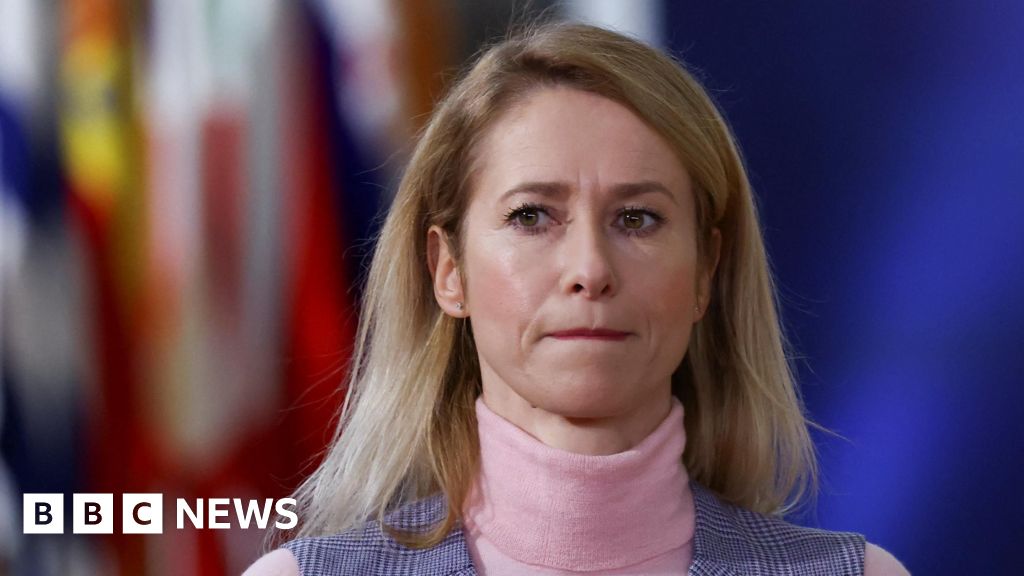
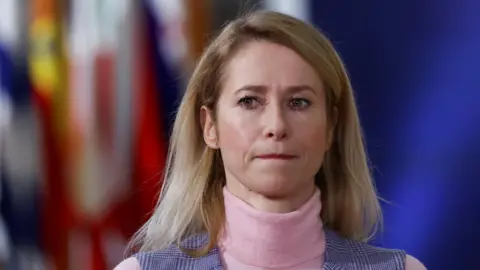
Kaja Kallas accused the Kremlin of trying to derail the peace process with allegations of a Ukrainian attack on government sites
The EU’s top diplomat has called Moscow’s claims that Ukraine targeted Russian government sites a “deliberate distraction” and an attempt to derail the peace process.
Kaja Kallas’ comments on social media appear to be a reference to the Kremlin’s allegation that Ukraine attempted a drone strike on one of Vladimir Putin’s residences.
“No one should accept unfounded claims from the aggressor who has indiscriminately targeted Ukraine’s infrastructure and civilians,” Kallas wrote on social media.
Earlier this week Moscow accused Ukraine of targeting Putin’s private home on Lake Valdai in north-west Russia.
Russia would review its position in the ongoing peace negotiations as a result, the Kremlin said.
Since Foreign Minister Sergei Lavrov first shared the claims, Russian state media and politicians have discussed the alleged attack in increasingly incendiary tones.
“The attack is a strike on the heart of Russia,” said Andrei Kartapolov, head of the Russian parliament’s defence committee. “After what [Ukraine] has done, there can be no forgiveness.”
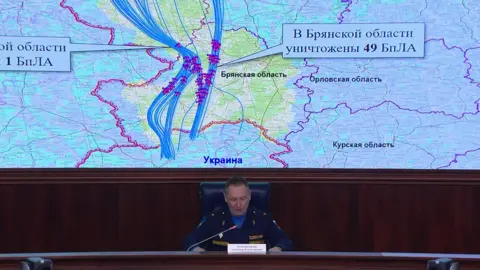
Although the Kremlin initially said it saw no point in sharing proof of the alleged attack, on Wednesday the Russian army released what it said was evidence of the attempted strike.
It included a map allegedly showing that the drones were launched from the Sumy and Chernihiv regions of Ukraine and a video of a downed drone lying in snowy woodland. A serviceman standing next to the wreckage claims it is a Ukrainian Chaklun drone.
The BBC hasn’t been able to verify the footage, and it is not possible to locate where it was shot.
The profile of the wrecked UAV (unmanned aerial vehicle) does bear similarities to Ukrainian-produced Chakluns – but because the components of the drone pictured are inexpensive and widely available online, they cannot be conclusively to traced to the Ukrainian military.
 Russian defence ministry

Russia’s defence ministry released a map which it claimed showed the path of the drones launched by Ukraine
Russia’s defence ministry also released a video of what it said was a local resident who described hearing noises like a rocket at the time of the alleged attack.
However, one Russian investigative media outlet said it had spoken to more than a dozen residents of the area around Putin’s residence and none had heard anything that could indicate 91 drones had approached or been shot down by air defences.
“If something like that had happened, the whole city would have been talking about it,” one person told the outlet.
Ukrainian President Volodymyr Zelensky has strenuously denied the allegations, tying them to the ongoing US-led process to reach a ceasefire in Ukraine.
In recent weeks the American and Ukrainian delegations have been working closely and Zelensky has expressed cautious optimism that his country’s demands were going to be taken into account.
In his view, he said on Tuesday, the claims about the drone attack on Putin’s Valdai residence were about “the fact that over the past month there were quite successful talks and a positive meeting between our teams, culminating in our meeting with President Trump.”
Russia wanted to disrupt the “positive momentum” between the US and Ukraine, Zelensky said.
When the claims emerged Zelensky also warned that the alleged drone strike would be used as an excuse to carry out strikes on Kyiv and Ukrainian government buildings. Overnight on Wednesday air alerts briefly rang out in the capital as a drone approached, but no hits or damage were reported.
 State Emergency Service of Ukraine
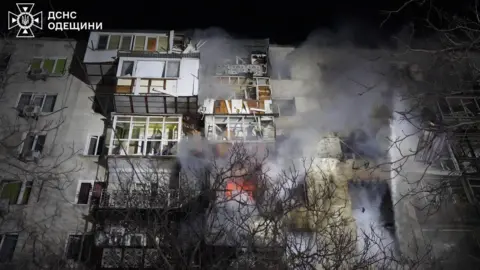
On 30 December Odesa suffered an intense attack which left several civilians injured
Instead, several locations across the country were hit by drones and Odesa on the Black Sea suffered a large-scale attack which saw an apartment block hit and six people injured, including three children. More than 170,000 were also left without power as temperatures struggled to push past 0C.
Odesa has been coming under sustained attack for several weeks. The intensity of the strikes appears to have increased since Putin’s threat in early December to cut off Ukraine’s access to the sea in retaliation for drone attacks on tankers of Russia’s “shadow fleet” in the Black Sea.

Mariya, Yuliya and Diana sang carols in one of Kyiv’s squares to raise money for the Ukrainian armed forces
With hours to go until the end of another year of war, many in Kyiv only had one wish for 2026.
“We hope that all of this will end. We want this to be over and to live as we did before,” 26-year-old Mariya said.
Standing outside the golden-domed St Sophia monastery in Kyiv, she added: “We have a very beautiful country with enormous potential. Our strength is in our people, and that is why we keep going.”
As she spoke, teenage carollers nearby sang Christmas songs, collecting donations for the armed forces. “We all want victory to come in 2026. It’s our united wish,” said one.
Zelensky has expressed the desire for peace negotiations to resume and accelerate early in January with the involvement of both American and European officials. But any deal will ultimately need Russian buy-in, which does not seem forthcoming – and which the alleged drone incident over Putin’s residence may have pushed further into the distance.
So could next year truly bring peace? “We truly hope so, but we can’t say for certain. We are doing everything we can,” Mariya said.
Next to her, a woman named Ksenia shrugged and turned her eye to the sky: “Really, only God knows.”