
SCIENCE
‘The ban assumed the danger was making pigs too human’: Why human organs aren’t grown in pigs in the US


In a New York operating room one day in October 2025, doctors made medical history by transplanting a genetically modified pig kidney into a living patient as part of a clinical trial. The kidney had been engineered to mimic human tissue and was grown in a pig, as an alternative to waiting around for a human organ donor who might never come. For decades, this idea lived at the edge of science fiction. Now it’s on the table, literally.
The patient is one of six taking part in the first clinical trial of pig-to-human kidney transplants. The goal: to see whether gene-edited pig kidneys can safely replace failing human ones.
A decade ago, scientists were chasing a different solution. Instead of editing the genes of pigs to make their organs human-friendly, they tried to grow human organs — made entirely of human cells — inside pigs. But in 2015 the National Institutes of Health paused funding for that work to consider its ethical risks. The pause remains today.
You may like
As a bioethicist and philosopher who has spent years studying the ethics of using organs grown in animals — including serving on an NIH-funded national working group examining oversight for research on human-animal chimeras — I was perplexed by the decision. The ban assumed the danger was making pigs too human. Yet regulators now seem comfortable making humans a little more pig.
Why is it considered ethical to put pig organs in humans but not to grow human organs in pigs?
Urgent need drives xenotransplantation
It’s easy to overlook the desperation driving these experiments. More than 100,000 Americans are waiting for organ transplants. Demand overwhelms supply, and thousands die each year before one becomes available.
For decades, scientists have looked across species for help — from baboon hearts in the 1960s to genetically altered pigs today. The challenge has always been the immune system. The body treats cells it does not recognize as part of itself as invaders. As a result, it destroys them.
A recent case underscores this fragility. A man in New Hampshire received a gene-edited pig kidney in January 2025. Nine months later, it had to be removed because its function was declining. While this partial success gave scientists hope, it was also a reminder that rejection remains a central problem for transplanting organs across species, also known as xenotransplantation.
First clinical trial of pig kidney transplants is underway – YouTube
Researchers are attempting to work around transplant rejection by creating an organ the human body might tolerate, inserting a few human genes and deleting some pig ones. Still, recipients of these gene-edited pig organs need powerful drugs to suppress the immune system both during and long after the transplant procedure, and even this may not prevent rejection. Even human-to-human transplants require lifelong immunosuppressants.
That’s why another approach — growing organs from a patient’s own cells — looked promising. This involved disabling the genes that let pig embryos form a kidney and injecting human stem cells into the embryo to fill the gap where a kidney would be. As a result, the pig embryo would grow a kidney genetically matched to a future patient, theoretically eliminating the risk of rejection.
You may like
Although simple in concept, the execution is technically complex because human and pig cells develop at different speeds. Even so, five years prior to the NIH ban, researchers had already done something similar by growing a mouse pancreas inside a rat.
Cross-species organ growth was not a fantasy — it was a working proof of concept.
Ethics of creating organs in other species
The worries motivating the NIH ban in 2015 on inserting human stem cells into animal embryos did not come from concerns about scientific failure but rather from moral confusion.
Policymakers feared that human cells might spread through the animal’s body — even into its brain — and in so doing blur the line between human and animal. The NIH warned of possible “alterations of the animal’s cognitive state.” The Animal Legal Defense Fund, an animal advocacy organization, argued that if such chimeras gained humanlike awareness, they should be treated as human research subjects.
The worry centers on the possibility that an animal’s moral status — that is, the degree to which an entity’s interests matter morally and the level of protection it is owed – might change. Higher moral status requires better treatment because it comes with vulnerability to greater forms of harm.
Think of the harm caused by poking an animal that’s sentient compared to the harm caused by poking an animal that’s self-conscious. A sentient animal — that is, one capable of experiencing sensations such as pain or pleasure — would sense the pain and try to avoid it. In contrast, an animal that’s self-conscious — that is, one capable of reflecting on having those experiences — would not only sense the pain but grasp that it is itself the subject of that pain. The latter kind of harm is deeper, involving not just sensation but awareness.
Thus, the NIH’s concern is that if human cells migrate into an animal’s brain, they might introduce new forms of experience and suffering, thereby elevating its moral status.
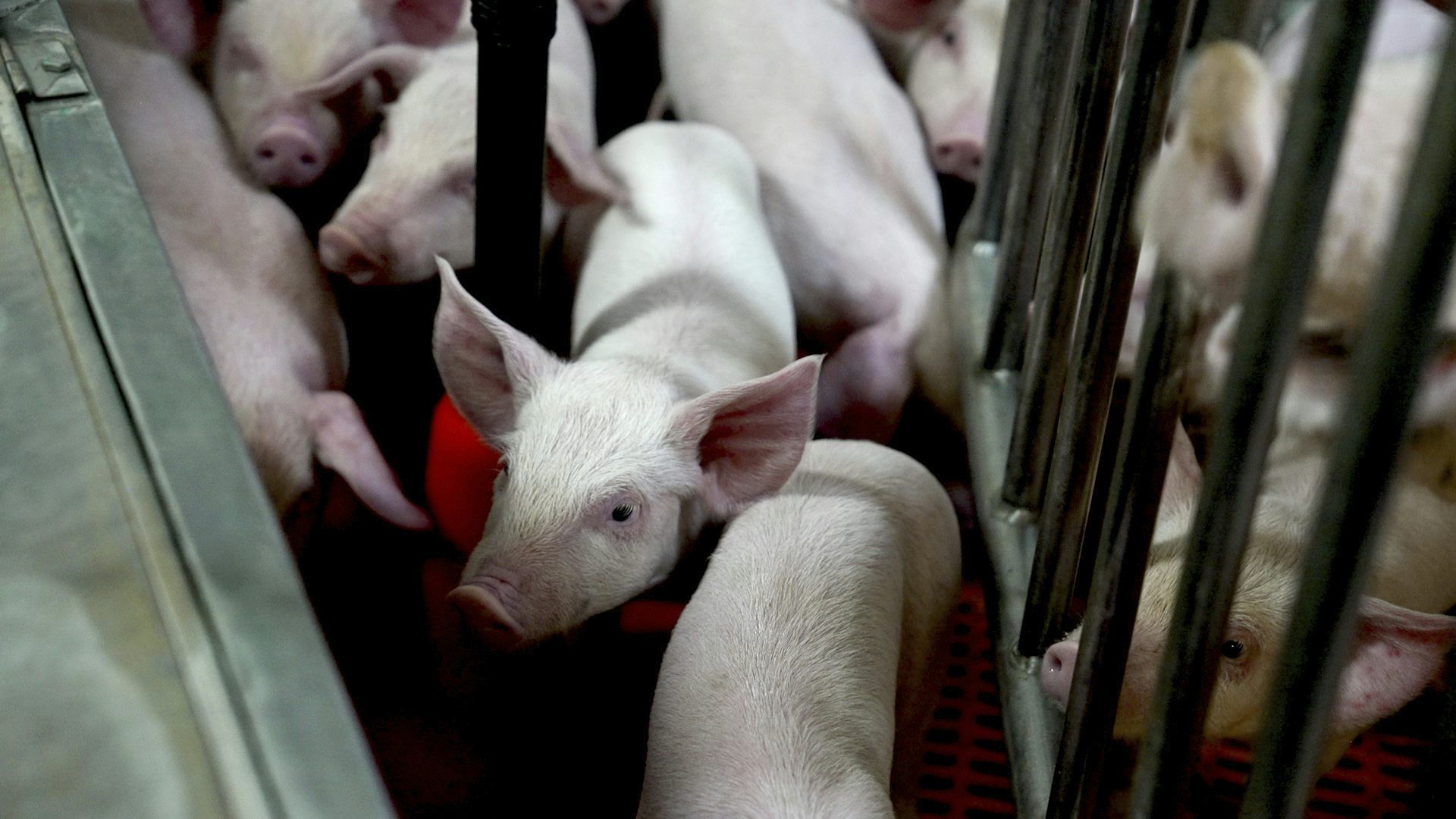
How human do pigs need to be for them to be considered part of the human species? (Image credit: AP Photo/Shelby Lum)
The flawed logic of the NIH ban
However, the reasoning behind the NIH’s ban is faulty. If certain cognitive capacities, such as self-consciousness, conferred higher moral status, then it follows that regulators would be equally concerned about inserting dolphin or primate cells into pigs as they are about inserting human cells. They are not.
In practice, the moral circle of beings whose interests matter is drawn not around self-consciousness but around species membership. Regulators protect all humans from harmful research because they are human, not because of their specific cognitive capacities such as the ability to feel pain, use language or engage in abstract reasoning. In fact, many people lack such capacities. Moral concern flows from that relationship, not from having a particular form of awareness. No research goal can justify violating the most basic interests of human beings.
If a pig embryo infused with human cells truly became something close enough to count as a member of the human species, then current research regulations would dictate it’s owed human-level regard. But the mere presence of human cells doesn’t make pigs humans.
The pigs engineered for kidney transplants already carry human genes, but they aren’t called half-human beings. When a person donates a kidney, the recipient doesn’t become part of the donor’s family. Yet current research policies treat a pig with a human kidney as if it might.
There may be good reasons to object to using animals as living organ factories, including welfare concerns. But the rationale behind the NIH ban that human cells could make pigs too human rests on a misunderstanding of what gives beings — and human beings in particular — moral standing.
This edited article is republished from The Conversation under a Creative Commons license. Read the original article.


As the moon and Mars take center stage in human spaceflight, scientists are leveraging existing space missions to lay the groundwork for a sustained human presence off-planet.
From pinpointing water resources on the moon to shielding crews from harmful radiation and managing abrasive dust, researchers described how new results from in-service missions are addressing practical challenges of exploration at a press briefing Dec. 17 at the American Geophysical Union (AGU) meeting in Louisiana.
You may like
At the AGU briefing, scientists said they are helping support those ambitions by adapting tools and datasets originally developed for Earth to support future moon and Mars missions.
For instance, Gina DiBraccio, a heliophysicist and acting director of the Solar System Exploration Division at NASA’s Goddard Space Flight Center in Maryland, discussed a decision-support tool initially designed to track space weather near Earth that has been extended to incorporate data from Mars missions, helping astronauts assess radiation risks in near real time from the Martian surface.
The dashboard integrates data from multiple Mars missions, including NASA’s MAVEN orbiter, Curiosity and Perseverance rovers, with additional data sources planned, DiBraccio said. The project is envisioned as an all-in-one display astronauts could access on a tablet, allowing crews to monitor space weather events such as solar flares and determine whether protective measures are needed.
“It’s really one of the first steps of tools that astronauts will be able to use to understand and assess space weather from the surface of Mars,” DiBraccio said.
Other long-running missions at Mars are also producing critical datasets for understanding radiation hazards, scientists said.
Shannon Curry, MAVEN’s principal investigator at UC Boulder, highlighted a newly completed catalog of Martian space weather events compiled from the now-silent orbiter data spanning a full solar cycle from 2014 through 2025. The catalog allows scientists to quantify radiation levels in orbit — some of which can penetrate Mars’ thin atmosphere and reach the surface — during periods of both low and high solar activity.
“This really informs, over a full solar cycle, what we can expect to see, and when we can expect to see it,” Curry said.
You may like
Scientists also stressed the importance of pinpointing water resources on the moon, particularly near the lunar south pole, where NASA plans to land astronauts under its Artemis program.

The four astronauts chosen for the Artemis 2 mission to the moon. (Image credit: NASA/Aubrey Gemignani)
“The challenge right now is that the datasets don’t actually agree exactly where the water is,” Bethany Ehlmann, the director of the Laboratory for Atmospheric and Space Physics (LASP) at the University of Colorado Boulder, told reporters during the briefing.
“We know broadly it’s in the south pole, we know broadly there are few craters of interest,” she said. “But it’s like saying, ‘There is water in the city of New Orleans — somewhere.'”
A new imaging spectrometer NASA selected in July could help address that uncertainty, she said. The instrument, which could be used in moon orbit, is designed to act as “enhanced eyes” for astronauts and scientists by mapping water and minerals, and identifying science-packed sites for collecting samples.
Another focus of the briefing was lunar dust, a persistent challenge during the Apollo era. Fine, abrasive particles damaged spacesuits and equipment, and Apollo 17 astronaut Harrison “Jack” Schmitt famously suffered the first recorded case of extraterrestrial hay fever after exposure to moon dust.
“I think dust is probably one of our greatest inhibitors to a nominal operation on the moon,” Apollo 17 commander Gene Cernan said during a post-mission debrief. “I think we can overcome other physiological or physical or mechanical problems except dust.”
Scientists are now tackling that challenge through new instruments and missions.
One of them, DUSTER — short for Dust and Plasma Environment Surveyor — has been selected for NASA’s Artemis IV mission. Led by Xu Wang of the University of Colorado Boulder, the $24.8 million project will deploy a suite of instruments on a rover to record dust and plasma conditions near the lunar surface and assess how they respond to human activity.
Another instrument the team is developing is a Compact Electrostatic Dust Analyzer (CEDA), designed to measure key properties of lunar dust, Wang said. The instrument is designed to operate either on the surface or aboard orbiting spacecraft and to survive hard landings regardless of orientation.
“Dust is everywhere on the moon,” Wang told reporters on Wednesday. “You can’t go around it. You have to deal with and live with it.”
Work is also underway to understand whether Mars’ localized magnetic fields could provide astronomers limited natural protection from radiation. Initial modeling based on orbital observations suggests crustal magnetic fields locked into Martian rocks could offer shielding over distances of a few miles.
To map those regions in greater detail, teams are working to further miniaturize magnetometers that could be mounted on aerial vehicles, such as small drones similar to NASA’s now-retired Ingenuity helicopter, enabling surface surveys at much finer resolution than is possible from orbit, according to Jared Espley, a space scientist at NASA Goddard who is involved with the research.
Together, the work underscores how robotic missions are critically shaping the future of human exploration, scientists said.
“It’s really not a question of robotic exploration or human exploration,” Ehlmann said. “It is an ‘and’ — it’s robotic and human exploration and how we do these best together.”

For all the embarrassment of riches on TV, cinema remains a really big deal for any genre fan. Our guide to the best upcoming sci-fi movies in 2026 features a blockbuster mix of popular franchises, intriguing one-offs, and one of the greatest directors of all time heading back to alien visitation territory.
After seven years away, “Star Wars” returns to the big screen with “The Mandalorian and Grogu”, while “Supergirl” takes James Gunn’s new-look DC Universe into outer space. Denis Villeneuve makes a third trip to Arrakis in “Dune: Part Three”, and — in what’s likely to be the biggest release of the year — Robert Downey Jr reunites with the Marvel Cinematic Universe for “Avengers: Doomsday”.
You may like
Project Hail Mary
Project Hail Mary | Official Trailer 2 – YouTube

Watch On
Release date: March 20, 2026 | Cast: Ryan Gosling, Sandra Hüller, Milana Vayntrub, Ken Leung
Screenwriter Drew Goddard worked wonders with his Oscar-nominated adaptation of Andy Weir’s “The Martian“, and a decade later he’s back to bring the author’s most recent novel to the screen. In “Project Hail Mary“, our sun is one of many stars afflicted by a mysterious plague, prompting humanity to launch a mission to fix the problem before it kills all life on Earth.
Ryan Gosling plays the teacher turned reluctant astronaut who has the fate of an entire planet on his shoulders. Luckily, he’s not alone in the cosmos as an alien engineer, nicknamed Rocky, has arrived at Tau Ceti with a similar agenda. If they can work out how to communicate, this could be the start of a beautiful friendship…
The Super Mario Galaxy Movie
The Super Mario Galaxy Movie | Official Trailer – YouTube

Watch On
Release date: April 3, 2026 | Cast: Chris Pratt, Anya Taylor-Joy, Charlie Day, Jack Black, Keegan-Michael Key
It may not have been a big hit with the critics but the first “The Super Mario Bros Movie” was a massive power-up compared to the risible Bob Hoskins version from the ’90s. Indeed, its mega box office take — second only to “Barbie” in 2023 — proved that Hollywood is, at long last, getting a feel for turning videogame icons into movie stars.
This inevitable sequel riffs on the titular Wii game, blasting Mario, Luigi, Princess Peach, and Toad into outer space to face off against Bowser Jr. Chris Pratt, Anya Taylor-Joy, Charlie Day, Jack Black, and Keegan-Michael Key respawn in their roles from the first movie. Benny Safdie (director of UFC biopic “The Smashing Machine”) comes on board as Bowser’s malevolent offspring, while Captain Marvel herself, Brie Larson, becomes Nintendo royalty as alien princess Rosalina.
Mortal Kombat II
Mortal Kombat II | Official Trailer – YouTube

Watch On
Release date: May 8, 2026 | Cast: Karl Urban, Adeline Rudolph, Jessica McNamee, Josh Lawson
You may like
It’s a case of mid-’90s déjà-vu as two giants of the beat-’em-up videogame world renew hostilities on the big screen. “Street Fighter” lands in October, but first to the punch is “Mortal Kombat II”, the more sci-fi of the duo and a sequel to the 2021 reboot.
That movie was more successful than expected, and this follow-up adds “The Boys” star Karl Urban to the fight card for round two. He stars as ’90s action movie star Johnny Cage, a reluctant conscript in a “war for the fate of your world”, forced to use his martial arts skills to protect Earthrealm (that’s us) from the evil alien forces of Shao Kahn.
Sonya Blade Kano, Jax, and Scorpion all return to the arena, while fans of the game will recognise big-screen newcomers like Kitana (Adeline Rudolph) and Jade (Tati Gabrielle).
The Mandalorian and Grogu
The Mandalorian and Grogu | Official Trailer | In Theaters May 22, 2026 – YouTube

Watch On
Release date: May 22, 2026 | Cast: Pedro Pascal, Sigourney Weaver, Jeremy Allen White
It’s telling that the movie chosen to bring “Star Wars” back to theaters for the first time since 2019’s “The Rise of Skywalker” is a follow-up to a TV series. While “Episode IX” was a major disappointment, “The Mandalorian” has been a crowd-pleasing jewel in the Disney+ crown, the one show that — for its first couple of seasons, at least — everybody loved.
The titular duo’s promotion to the big screen sees them ditching the bounty hunting to help the New Republic hunt down rogue Imperials. “The Fantastic Four: First Steps“‘ Pedro Pascal is back as Din Djarin, joined by Sigourney Weaver as a New Republic colonel, and “The Bear”‘s Jeremy Allen White voicing Jabba the Hutt’s nephew, Rotta.
Don’t be surprised, however, if Imperial nasty Grand Admiral Thrawn (Lars Mikkelsen) shows up in “The Mandalorian and Grogu“, having already made his big comeback in the “Ahsoka” season 1 finale.
Masters of the Universe
Masters of The Universe | Title Reveal – YouTube
Watch On
Release date: June 5, 2026 | Cast: Nicholas Galitzine, Jared Leto, Camila Mendes, Alison Brie, Idris Elba
Aside from Frank Langella’s scenery-devouring performance as bony big bad Skeletor, the first live-action “Masters of the Universe” movie lacked the requisite power of Grayskull. The lucrative toy line was already in decline by the time the film landed in 1987, while the Earth-set, Dolph Lundgren-fronted adaptation bore little relation to the popular cartoon series.
Expect a rather more faithful adaptation second time out, as toy giant Mattel looks to He-Man and co to follow in Barbie’s box-office conquering footsteps. Director Travis Knight has prior experience of transferring action figures to the big screen with “Transformers” spin-off “Bumblebee”, and he’s assembled a big-name cast for the trip to Eternia, including Alison Brie as Evil-Lyn, Idris Elba as Man-at-Arms, and Jared Leto as Skeletor. Meanwhile, British actor Nicholas Galitzine wields the Sword of Power as He-Man.
Supergirl
Supergirl | Official Teaser Trailer – YouTube

Watch On
Release date: June 26, 2026 | Cast: Milly Alcock, Matthias Schoenaerts, Eve Ridley, David Krumholtz, Emily Beecham
Both hail from Krypton and have a penchant for capes, but that’s where the “Superman” / “Supergirl” similarities end. While Clark Kent took the easy route to Earth, the cynical, hard-drinking Kara Zor-El went the long way round, growing up among her fellow Kryptonian survivors in Argo City.
The new film (directed by “Cruella”‘s Craig Gillespie) is based on Tom King and Bilquis Evely’s 2021-2022 comic-book series “Woman of Tomorrow”, and — according to the official synopsis — sees Supergirl embarking “on an epic, interstellar journey of vengeance and justice.” See? Very un-Superman.
Expect a whistlestop tour of DC’s version of outer space, as Kara (played by “House of the Dragon”‘s Milly Alcock) wisecracks her way across various alien planets with crowd-pleasing pooch Krypto. Former Aquaman Jason Momoa gets a new DC role as alien bounty hunter Lobo.
Disclosure Day
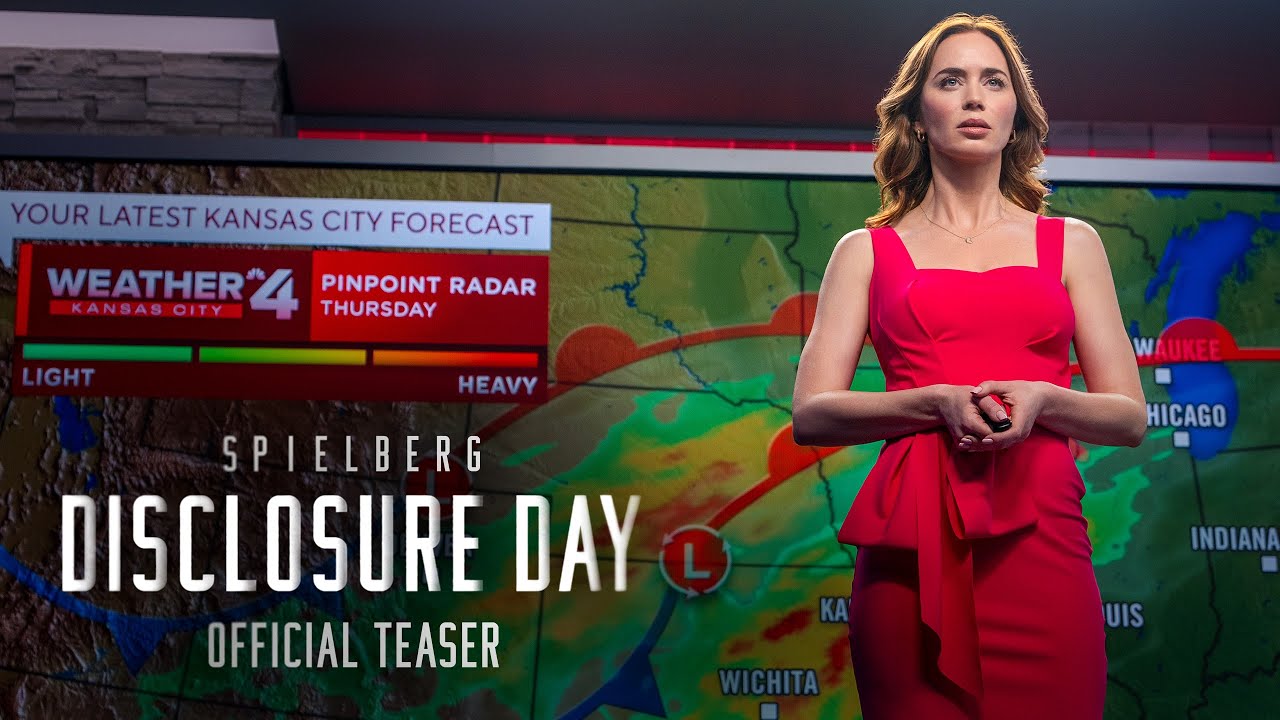
Disclosure Day | Official Teaser – YouTube
Watch On
Release date: June 12, 2026 | Cast: Emily Blunt, Josh O’Connor, Colin Firth, Eve Hewson, Colman Domingo
“Close Encounters of the Third Kind”, “ET”, “War of the Worlds“… Whether they’re friendly or hostile, Steven Spielberg knows a thing or two about alien visitations. But with “Disclosure Day” (the title’s only just been revealed), he’s been taking a leaf out of “Super 8” collaborator JJ Abrams’ book, and playing his cards extremely close to his chest.
A bit of mystery from one of Hollywood’s greatest entertainers is something to be cherished, of course, and the first trailer teases without giving much away. The gist, however, seems to be that extra-terrestrials make contact with a selected few, before promising to go public to the entire world — good luck dealing with the ramifications of that one, human race!
Spielberg’s bringing a quality cast along for the ride, with Emily Blunt taking the lead as a Kansas City weather presenter who starts talking alien live on air. She’s joined by Josh O’Connor, Colin Firth, Eve Hewson, Colman Domingo, and Wyatt Russell. Regular Spielberg wordsmith David Koepp (“Jurassic Park”, “War of the Worlds”, “Indiana Jones and the Kingdom of the Crystal Skull”) is on screenplay duties, working from the director’s own story.
Toy Story 5
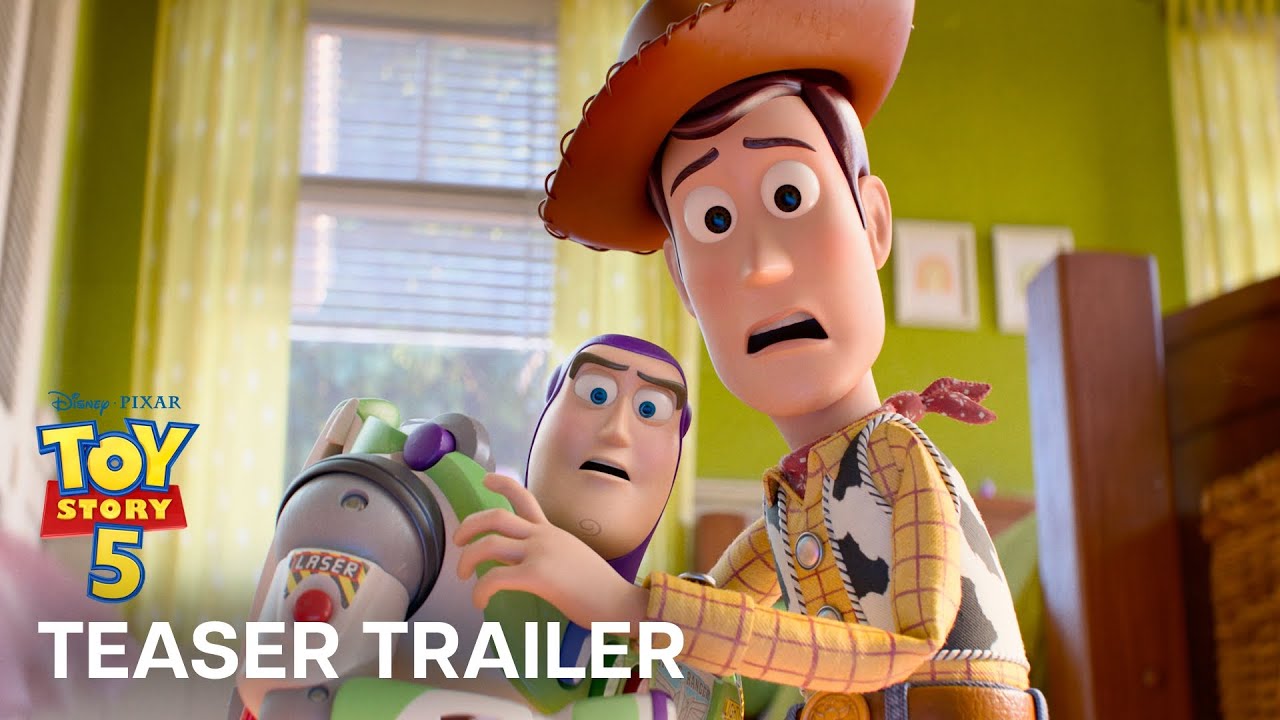
Toy Story 5 | Teaser Trailer | In Theaters June 19 – YouTube
Watch On
Release date: June 19, 2026 | Cast: Tom Hanks, Tim Allen, Joan Cusack, Greta Lee, John Ratzenberger
No, the toys aren’t blasting off to outer space, but this fifth instalment does feature around 50 confused Buzz Lightyears — all of them on a similar voyage of “you are a child’s plaything” self-discovery as Pixar’s original (not-)flying toy. Meanwhile, pull-string cowboy Woody is back in the fold after joining Bo Peep on a mission to rehome lost toys, as the playroom dynamic gets shaken up by the arrival of a frog-faced tablet named Lily Pad (voiced by “Tron: Ares“‘ Greta Lee).
If you’re wondering if we need another “Toy Story”, it’s worth remembering that many said the same thing before the third and fourth movies, and they turned out pretty well. Also, Andrew Stanton (a man who knows a thing or two about the franchise, having co-written every movie so far) is on board as director.
Avengers: Doomsday
Avengers: Doomsday | Only in Theaters December 18, 2026 – YouTube
Watch On
Release date: December 18, 2026 | Cast: Robert Downey Jr, almost every MCU actor you can think of, and a few surprises
It’s well over six years since the brilliant “Avengers: Endgame” wrapped up Marvel’s Infinity Saga in style. Multiverses and numerous Disney+ TV shows have made the MCU rather more unwieldy in the interim, but hopes are high that this fifth outing for Earth’s Mightiest Heroes can restore the record-breaking franchise to past glories.
Directors Anthony and Joe Russo know a thing or two about epic superhero team-ups — they previously called the shots on “Captain America: Civil War” and the last two “Avengers” films — but even they might have their work cut out wrangling “Doomsday”‘s epic cast. As well as MCU regulars like Chris Evans, Chris Hemsworth, Paul Rudd, and Anthony Mackie, the roster features X-Men veterans Patrick Stewart, Ian McKellen, Kelsey Grammer, and James Marsden.
And then there’s the return of Robert Downey Jr, who swaps Iron Man’s armor for another metal mask in his new role as Latverian troublemaker Dr Doom.
Related: Marvel movies in order: chronological & release order
Dune: Part Three

(Image credit: Legendary Entertainment)
Release date: December 18, 2026 | Cast: Timothée Chalamet, Zendaya, Florence Pugh, Rebecca Ferguson, Robert Pattinson
For a book series that was once considered unfilmable, Frank Herbert’s “Dune” is proving to be remarkably adaptable. After turning the first novel into two films, director Denis Villeneuve is wrapping up his desert trilogy with a film inspired by Herbert’s follow-up, “Dune Messiah“.
This time out, Fremen chosen one Paul Atreides is juggling his new role as emperor of the known universe with the ongoing battle to maintain control of Arrakis and its valuable spice. Paul’s decision to marry Princess Irulan at the end of “Part Two” is sure to have some major ramifications, particularly as a significant time jump looks likely — the book’s set 12 years after its predecessor.
Most of the original cast return, along with “The Batman” star Robert Pattinson (reportedly playing the villainous Scytale). “Dune: Part Three” might, however, blink first and shift its release date to avoid a Barbenheimer-style clash with that big Marvel team-up — though we will admit that “Avengers: Dunesday” has a rather nice ring to it…

Essential info:
Price: $229.99 / £199.99
Model number: 10360
Number of pieces: 2417
Dimensions: 27 x 63 x 53.5cm (10.5 x 25 x 21-inches)
Recommended age: 18+
I’m a huge fan of the Space Shuttle programme, and shed a tear when the last shuttle was retired in 2011. Admittedly, it wasn’t particularly cost-effective, but for me, it was the face of post-Space Race space travel. The International Space Station likely wouldn’t exist without it.
Now, thanks to Lego’s Icons range, you can commemorate the Space Shuttle, carried as it often was, on the back of a Boeing 747. This 2,417-piece Lego Icons Shuttle Carrier Aircraft is effectively the replacement for the also-retired Lego NASA Space Shuttle Discovery set, albeit with a slightly higher price tag at $229.99 / £199.99.
At 25 inches long, it’s not as big as, say, the Lego UCS Star Wars Venator set, but you’ll still need a reasonably-sized table or unit to display it on; it’s unlikely to fit on your average shelf. It’ll take you 8 – 10 hours to build, which leaves the question: Is it worth the effort?
For the answer, read on for my Lego Icons Shuttle Carrier Aircraft review. And if it leaves you wanting more, we have rounded up the best Lego space sets.
Today’s best Lego Icons Shuttle Carrier Aircraft deals


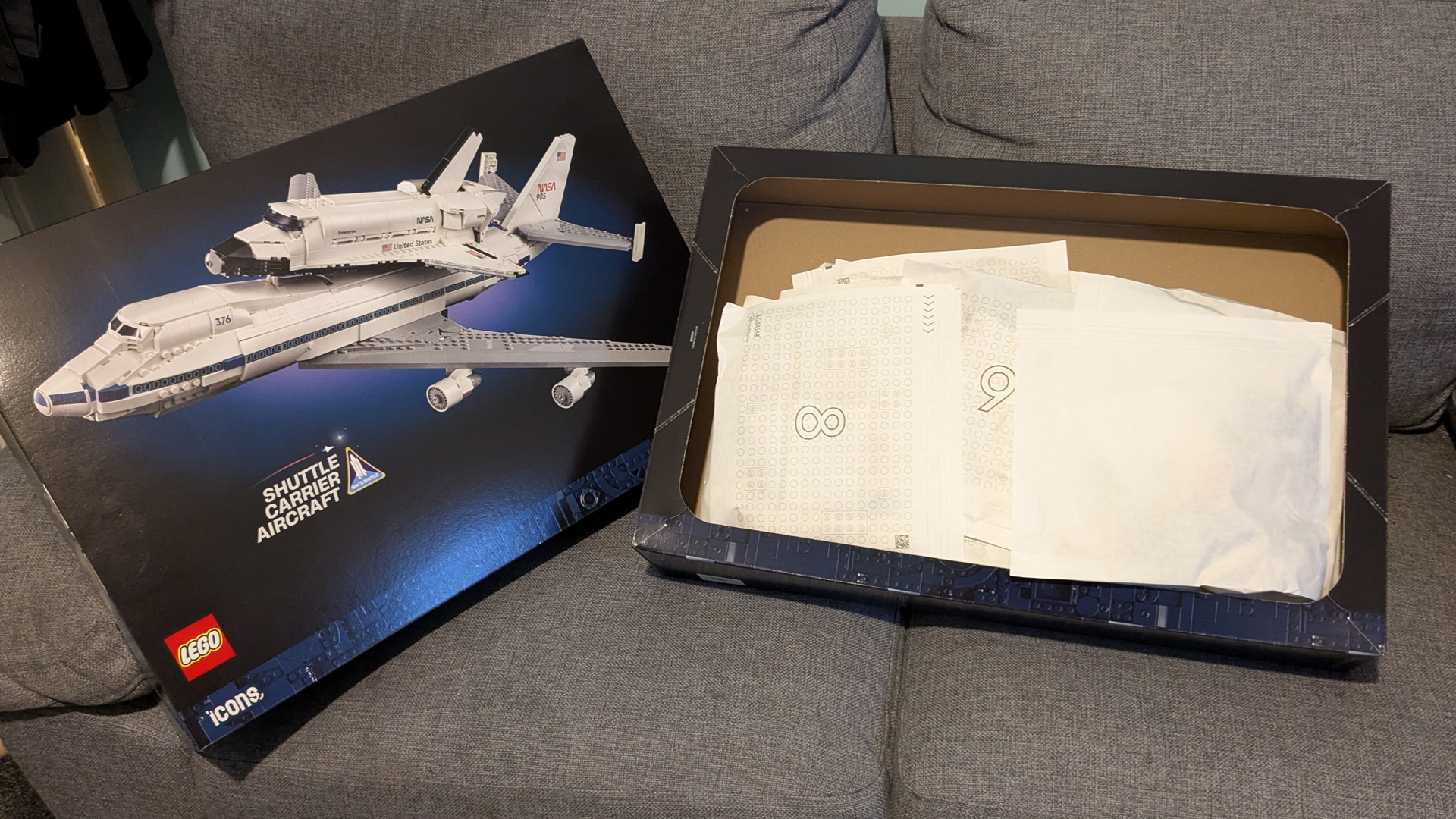
The Lego Icons Shuttle Carrier Aircraft set is split into 16 bags. (Image credit: Future / Chris McMullen)
Lego Icons Shuttle Carrier Aircraft: The build
- A fun build, with some interesting techniques
- Shuttle and jet each have their own instruction book
- Includes 19 stickers, too many for our taste
The Lego Icons Shuttle Carrier Aircraft took me ten hours to put together, working at a relatively leisurely pace. It’s split into sixteen paper bags, which seems daunting at first, but it means you’ll never have to look far for the piece you need.
It’s split into two builds and two manuals. One for the Space Shuttle Enterprise and one for the plane, a Boeing 747, used to taxi the shuttle back and forth. The set’s rated for builders 18+, but the shuttle is within the reach of junior builders and, taking three or so hours to put together, shouldn’t test their patience too much.
The bigger set, the jet, is a little fiddlier and requires more dexterity to assemble, so I’d recommend that it be an adult-assisted build at least. If you’re working solo, it’s advisable to start with the shuttle. That’s not to ease yourself into the build, however. Instead, it’s because once you’ve got the shuttle together, you can glance at it to spur you on through the jet’s initial section.
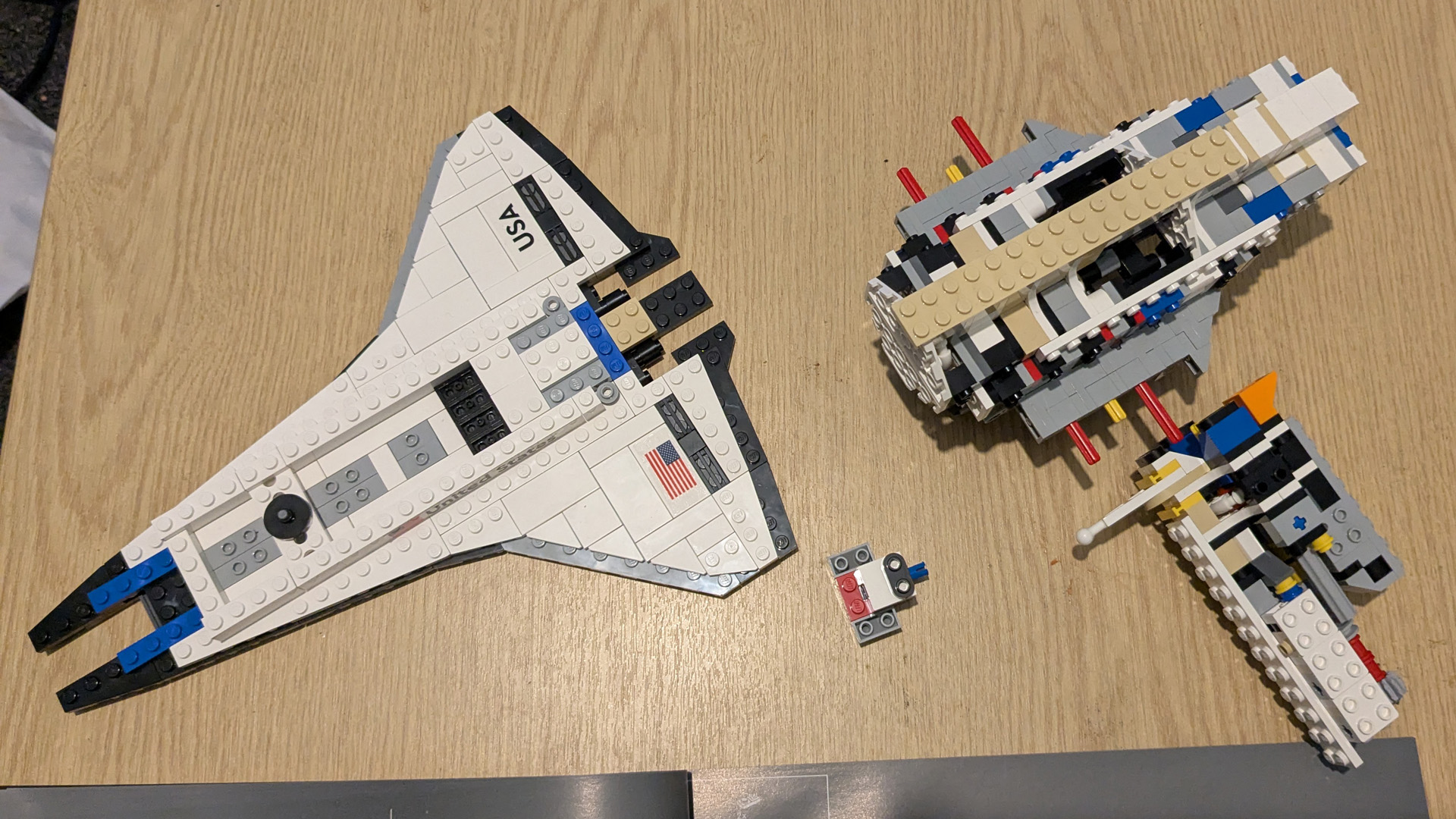
Want to share the fun? Have one person build the shuttle while another builds the Boeing. (Image credit: Future / Chris McMullen)
Because, while the Lego Icons Shuttle Carrier Aircraft is, on the whole, a fun set to assemble, it’s not super motivating to start with a chunk of skinless fuselage that resembles nothing in particular.
Fortunately, once you’re over that speed bump, the build comes into its own, taking on the shape and coloring of the custom Boeing 747. It’s constructed in sections, beginning with the central fuselage and gears, then the cockpit, the tail, the wings and finally the tail fins.
This build employs a diverse and satisfying range of building techniques that will have you smiling when, section by section, it all comes together. Admittedly, I was puzzled as to why that opening jet section required so many cogs and connectors. But I had a big grin on my face as I turned the cog on the underside and watched the plane’s gears raise and lower.
A neat touch is the way that the four engines attach, using a combination of a hinged piece and a flat triangle to hold each steady. I’d never in a million light-years have come up with that.
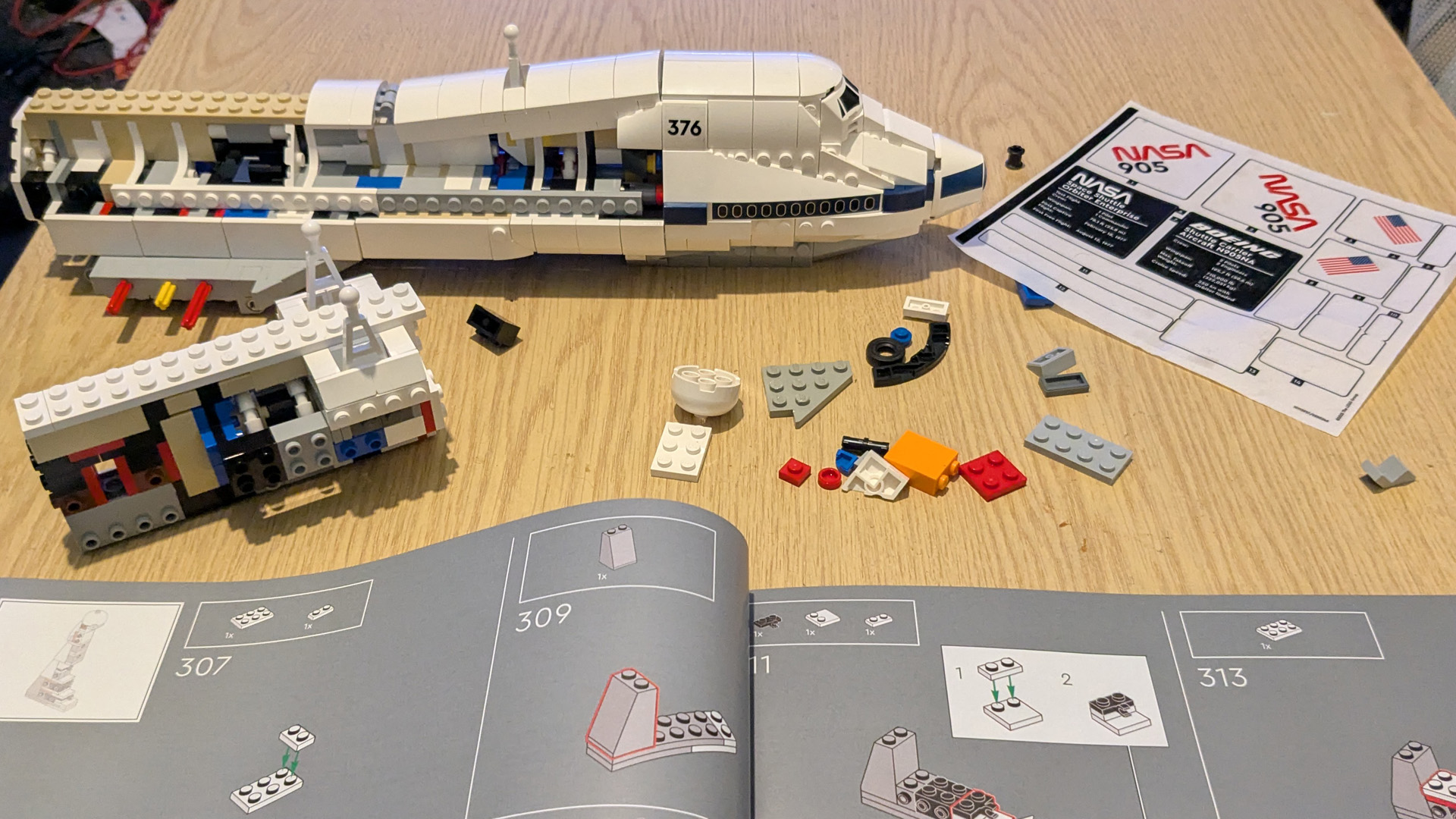
The Lego Icons Shuttle Aircraft Carrier Shuttle starts to come together, though it’s better to start with the shuttle. (Image credit: Future / Chris McMullen)
Unfortunately, there is one blot on this build, and that’s the presence of 19 (count ’em) stickers. The majority of these are used to apply the NASA etc logos to the shuttle and the jet and, statistically, you’re bound to get a hair or a piece of dust behind one of them. That, or you’ll end up having to realign them to get everything just right.
Unfortunately, these stickers are transparent, which amplifies the visibility of smudges and fingerprints. My shuttle and jet are currently displayed facing left, because the right-side NASA sticker is faintly off-white.
Lego Icons Shuttle Carrier Aircraft: Design
- Shuttle and jet and be displayed separately, on or off stand
- Shuttle wheels and engines are stored inside cargo bay
- Cargo bay doors can stick
Unlike the Lego City Modular Space Station, which we also reviewed, the Lego Icons Shuttle Aircraft Carrier is not built with play in mind. The shuttle itself is sturdy enough to be swooshed around outside, but while the jet is just as well put together, it’s so large that I wouldn’t recommend it. I already bumped a Lego Star Wars AT-ST to its doom today, and I’m not repeating that mistake.
However, there is a degree of interactivity in that the space shuttle can be removed from the plane. Unlike the jet itself, the landing gear has to be physically removed, but they, with the engines, can be stored neatly inside the shuttle’s cargo bay.
The one snag is that the shuttle’s cargo bay doors can catch, to the point you may need two fingers to close them properly. It’s not a deal-breaker, but given how much effort Lego has put into getting the set right (stickers aside) it’s slightly disappointing.

The Lego Icons Shuttle Aircraft Carrier Shuttle’s cargo bay opens to hold the engines and wheels. (Image credit: Future / Chris McMullen)
The set’s appearance, however, is anything but a letdown. You have the option of displaying it on the included stand, in a take-off position, and that’s absolutely the best way to behold it. It’s a seriously striking set, and as accurate as you could hope for, given its scale.
You don’t have to apply much pressure to remove and reattach the shuttle from the jet; unlike the wheels and the engines, there’s nowhere to store the tail cone. Nor will you be peeking inside the jet, not least because it isn’t minifigure scale.
But it’s still impressively detailed, down to the aforementioned working gears, and gorgeous to look at. And, if you’re a relative stranger to the space shuttle, the base plaque and the manuals contain a host of useful factoids.
Should you buy the Lego Icons Shuttle Carrier Aircraft?

The Lego Icons Shuttle Aircraft Carrier Shuttle, with the Boeing, can be displayed on wheels or on a stand. (Image credit: Future / Chris McMullen)
If you’ve the slightest interest in the space shuttle, and aren’t buying for play, this Lego Icons Shuttle Aircraft Carrier is absolutely worth your money, especially since the previous shuttle set has been retired. Am I okay with all those stickers? No, but unless Lego takes their NASA range to the next level, I can’t see them manufacturing printed elements for one or two sets.
Perched atop a suitably sized shelf or table, this is as impressive and as accurate as you could hope a set of this scale to be, and it’s a blast to build, too. And while it’s worth the $229 asking price, it’s always worth keeping your eyes open for the best Lego deals; I saved 20% on this set during Black Friday.
Other sets to consider
If you’re looking for a more play-friendly but still realistic set, consider the Lego Creator 3-in-1 Space Astronaut, or if it’s a pocket-friendly sci-fi ship you’re after, have a look at this Lego Interstellar Spaceship. The Lego City Modular Space Station makes a nice companion piece to this set. Or if you’ve got a little more to spend and want a spacecraft that’s still in active use, this Lego NASA Artemis Space Launch System is for you.
Today’s best Lego Icons Shuttle Carrier Aircraft deals
SCIENCE
Melting of West Antarctic ice sheet could trigger catastrophic reshaping of the land beneath

Due to its thick, vast ice sheet, Antarctica appears to be a single, continuous landmass centered over the South Pole and spanning both hemispheres of the globe. The Western Hemisphere sector of the ice sheet is shaped like a hitchhiker’s thumb – an apt metaphor, because the West Antarctic ice sheet is on the go. Affected by Earth’s warming oceans and atmosphere, the ice sheet that sits atop West Antarctica is melting, flowing outward and diminishing in size, all at an astonishing pace.
Much of the discussion about the melting of massive ice sheets during a time of climate change addresses its effects on people. That makes sense: Millions will see their homes damaged or destroyed by rising sea levels and storm surges.
You may like
In layers of sediment accumulated on the sea floor over millions of years, researchers like us are finding evidence that when West Antarctica melted, there was a rapid uptick in onshore geological activity in the area. The evidence foretells what’s in store for the future.
A voyage of discovery
As far back as 30 million years ago, an ice sheet covered much of what we now call Antarctica. But during the Pliocene Epoch, which lasted from 5.3 million to 2.6 million years ago, the ice sheet on West Antarctica drastically retreated. Rather than a continuous ice sheet, all that remained were high ice caps and glaciers on or near mountaintops.
About 5 million years ago, conditions around Antarctica began to warm, and West Antarctic ice diminished. About 3 million years ago, all of Earth entered a warm climate phase, similar to what is happening today.
Glaciers are not stationary. These large masses of ice form on land and flow toward the sea, moving over bedrock and scraping off material from the landscape they cover, and carrying that debris along as the ice moves, almost like a conveyor belt. This process speeds up when the climate warms, as does calving into the sea, which forms icebergs. Debris-laden icebergs can then carry that continental rock material out to sea, dropping it to the sea floor as the icebergs melt.
The drillship JOIDES Resolution is in position for deep-water drilling in the outer Amundsen Sea during International Ocean Discovery Program Expedition 379. Modern icebergs are visible near the ship. (Image credit: Phil Christie / CC BY-NC-ND)
In early 2019, we joined a major scientific trip – International Ocean Discovery Program Expedition 379 – to the Amundsen Sea, south of the Pacific Ocean. Our expedition aimed to recover material from the seabed to learn what had happened in West Antarctica during its melting period all that time ago.
Aboard the drillship JOIDES Resolution, workers lowered a drill nearly 13,000 feet (3,962 meters) to the sea floor and then drilled 2,605 feet (794 meters) into the ocean floor, directly offshore from the most vulnerable part of the West Antarctic ice sheet.
The drill brought up long tubes called “cores,” containing layers of sediments deposited between 6 million years ago and the present. Our research focused on sections of sediment from the time of the Pliocene Epoch, when Antarctica was not entirely ice-covered.
You may like
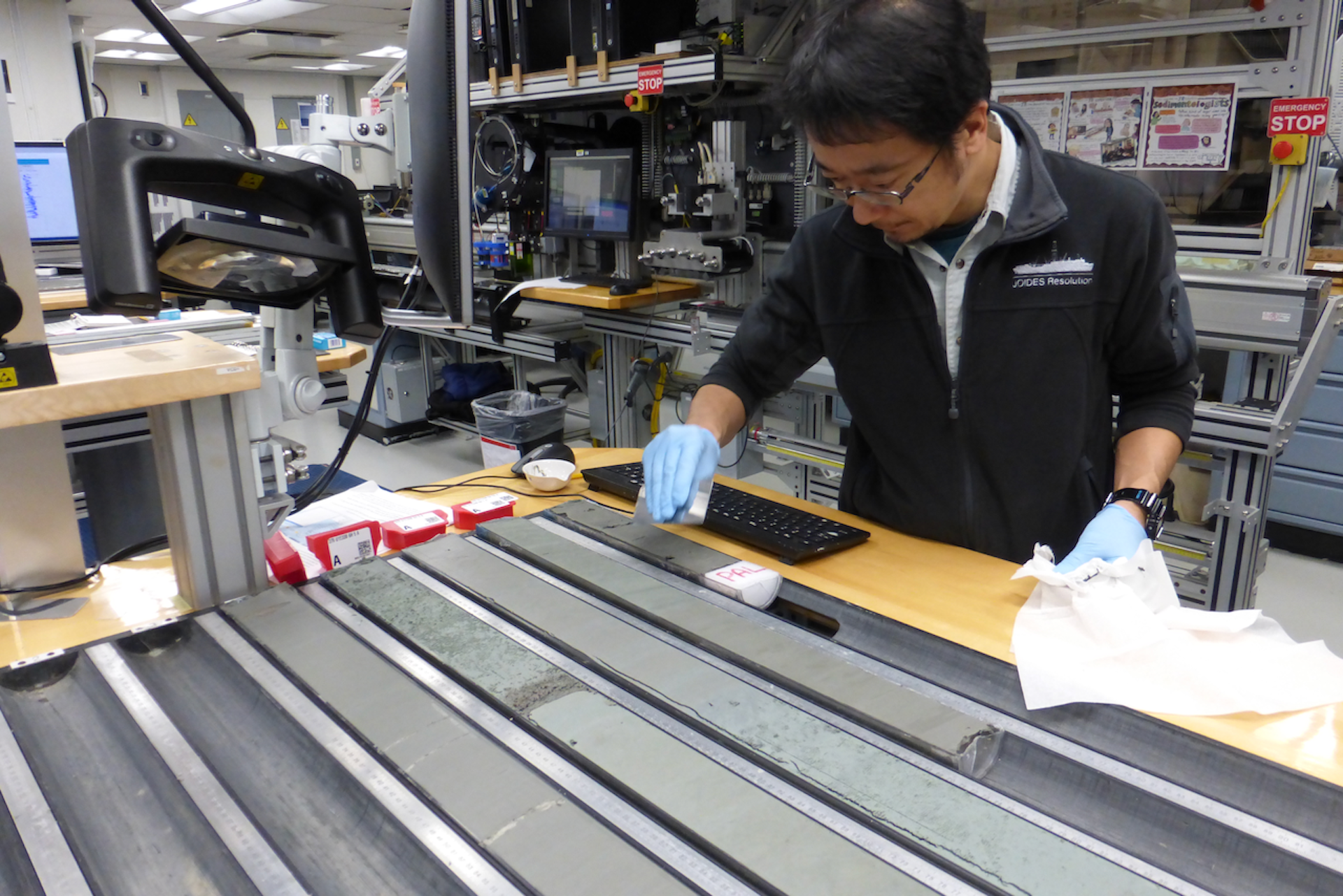
Aboard the JOIDES Resolution drillship, Keiji Horikawa examines a core containing iceberg-carried pebbly clays capped by finely layered muds. (Image credit: Christine Siddoway / CC BY-NC-ND)
An unexpected finding
While onboard, one of us, Christine Siddoway, was surprised to discover an uncommon sandstone pebble in a disturbed section of the core. Sandstone fragments were rare in the core, so the pebble’s origin was of high interest. Tests showed that the pebble had come from mountains deep in the Antarctic interior, roughly 800 miles (1,300 kilometers) from the drill site.
For this to have happened, icebergs must have calved from glaciers flowing off interior mountains and then floated toward the Pacific Ocean. The pebble provided evidence that a deep-water ocean passage – rather than today’s thick ice sheet – existed across the interior of what is now Antarctica.
After the expedition, once the researchers returned to their home laboratories, this finding was confirmed by analyzing silt, mud, rock fragments, and microfossils that also came up in the sediment cores. The chemical and magnetic properties of the core material revealed a detailed timeline of the ice sheet’s retreats and advances over many years.
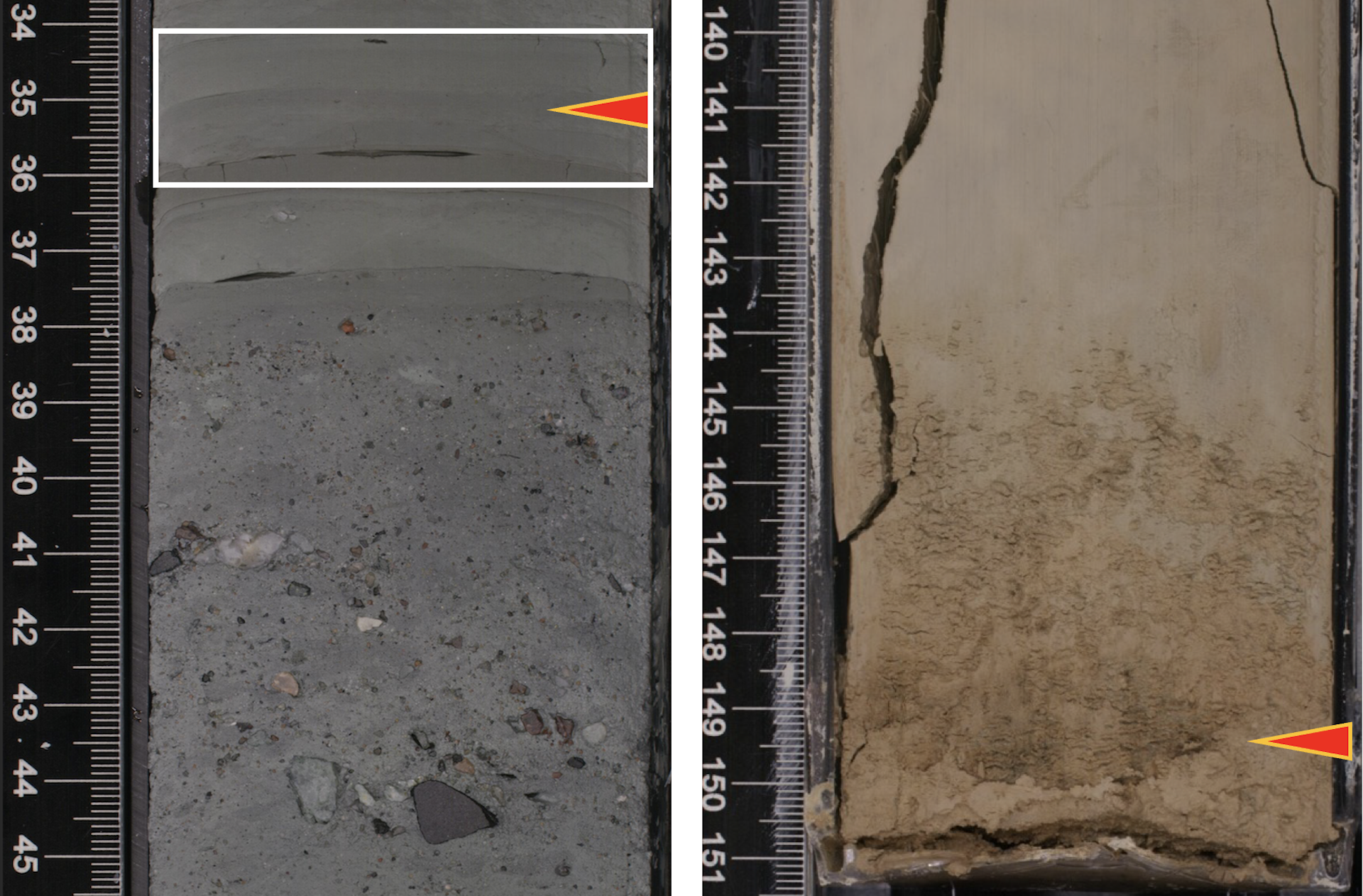
Drilling cores show important markers of events during the Pliocene age: At right, the red arrow marks a layer of volcanic ash erupted from a West Antarctic volcano roughly 3 million years ago. At left is a section illustrating thin layers of mud marking the onset of glacial conditions. It overlies a thick bed of pebbly material dropped from icebergs during interglacial conditions. The white box marks the narrow zone containing the unique isotopic signature. (Image credit: IODP Expedition 379, JOIDES Resolution Science Operator / CC BY-NC-ND)
One key sign came from analyses led by Keiji Horikawa. He tried to match thin mud layers in the core with bedrock from the continent, to test the idea that icebergs had carried such materials very long distances. Each mud layer was deposited right after a deglaciation episode, when the ice sheet retreated, that created a bed of iceberg-carried pebbly clay. By measuring the amounts of various elements, including strontium, neodymium and lead, he was able to link specific thin layers of mud in the drill cores to chemical signatures in outcrops in the Ellsworth Mountains, 870 miles (1400 km) away.
Horikawa discovered not just one instance of this material but as many as five mud layers deposited between 4.7 million and 3.3 million years ago. That suggests the ice sheet melted and open ocean formed, then the ice sheet regrew, filling the interior, repeatedly, over short spans of thousands to tens of thousands of years.
AIS Pliocene heartbeat – YouTube
Creating a fuller picture
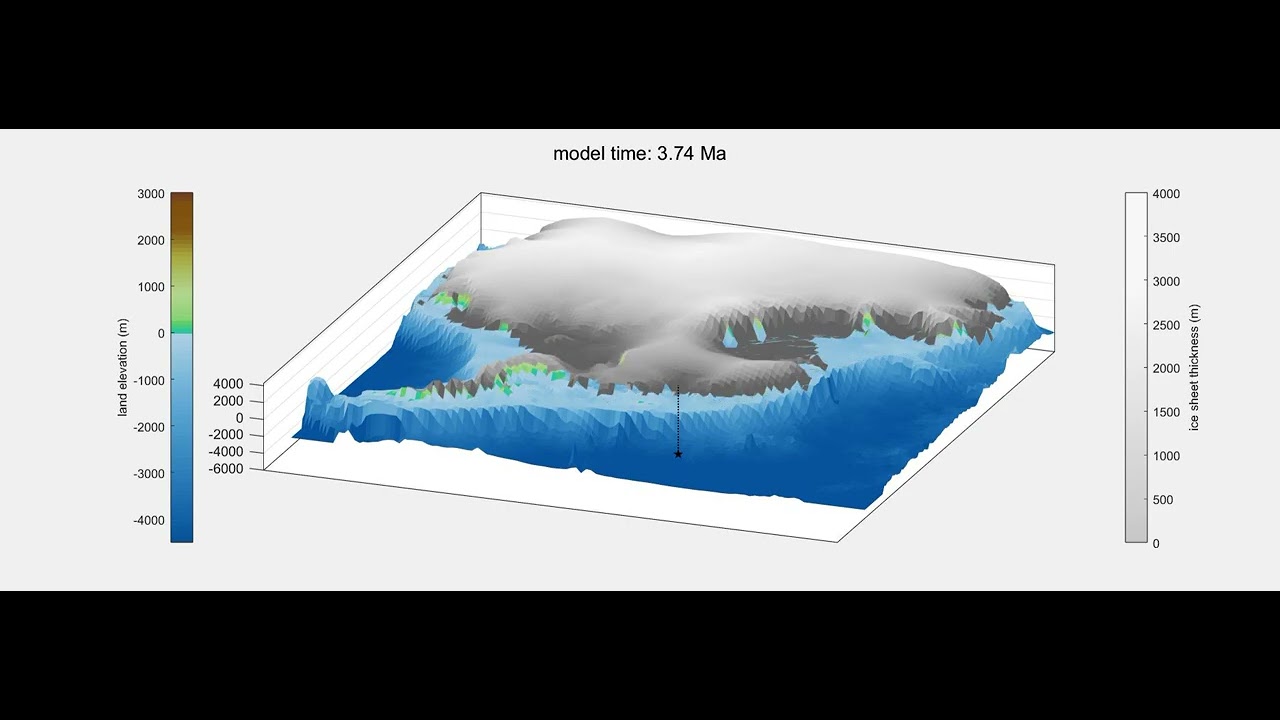
Teammate Ruthie Halberstadt combined this chemical evidence and timing in computer models showing how an archipelago of ice-capped, rugged islands emerged as ocean replaced the thick ice sheets that now fill Antarctica’s interior basins.
The biggest changes happened along the coast. The model simulations show a rapid increase in iceberg production and a dramatic retreat of the edge of the ice sheet toward the Ellsworth Mountains. The Amundsen Sea became choked with icebergs produced from all directions. Rocks and pebbles embedded in the glaciers floated out to sea within the icebergs and dropped to the seabed as the icebergs melted.
Long-standing geological evidence from Antarctica and elsewhere around the world shows that as ice melts and flows off the land, the land itself rises because the ice no longer presses it down. That shift can cause earthquakes, especially in West Antarctica, which sits above particularly hot areas of the Earth’s mantle that can rebound at high rates when the ice above them melts.
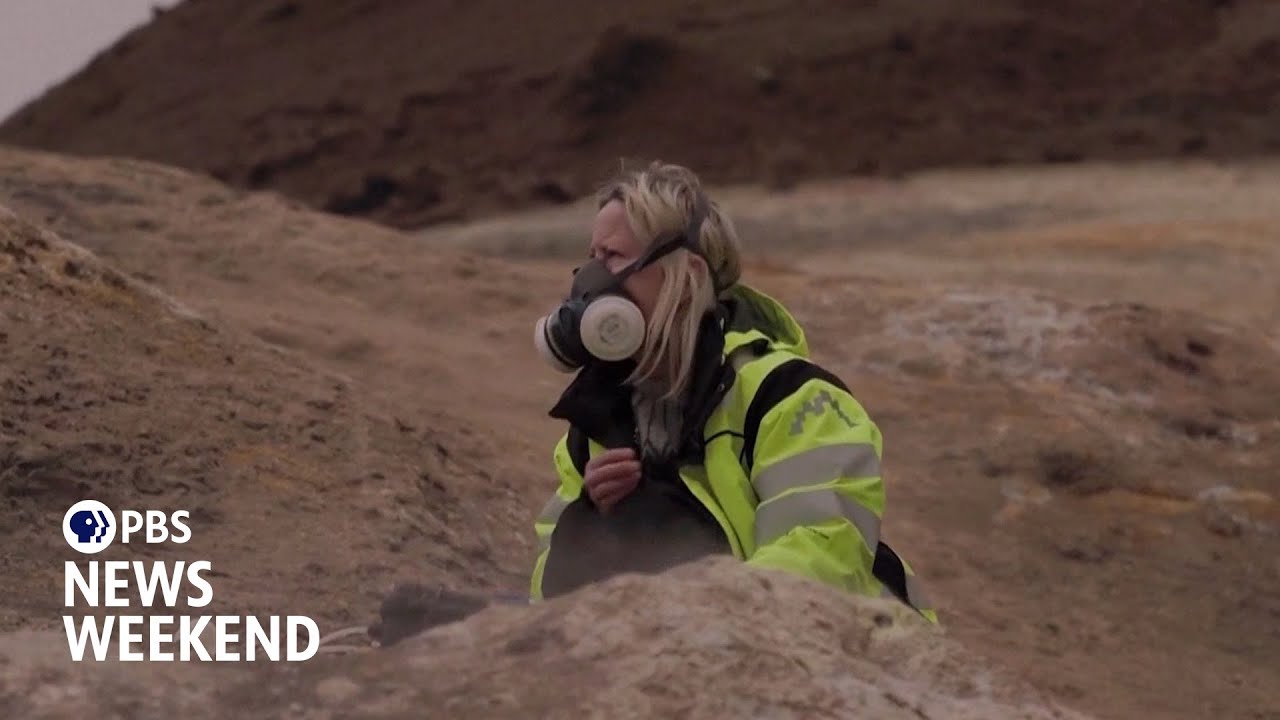
The release of pressure on the land also increases volcanic activity – as is happening in Iceland in the present day. Evidence of this in Antarctica comes from a volcanic ash layer that Siddoway and Horikawa identified in the cores, formed 3 million years ago.
The long-ago loss of ice and upward motions in West Antarctica also triggered massive rock avalanches and landslides in fractured, damaged rock, forming glacial valley walls and coastal cliffs. Collapses beneath the sea displaced vast amounts of sediment from the marine shelf. No longer held in place by the weight of glacier ice and ocean water, huge masses of rock broke away and surged into the water, producing tsunamis that unleashed more coastal destruction.
The rapid onset of all these changes made deglaciated West Antarctica a showpiece for what has been called “catastrophic geology.”
The rapid upswell of activity resembles what has happened elsewhere on the planet in the past. For instance, at the end of the last Northern Hemisphere ice age, 15,000 to 18,000 years ago, the region between Utah and British Columbia was subjected to floods from bursting glacial meltwater lakes, land rebound, rock avalanches and increased volcanic activity. In coastal Canada and Alaska, such events continue to occur today.
As glaciers melt, scientists study potential for more violent volcanic eruptions – YouTube
Dynamic ice sheet retreat
Our team’s analysis of rocks’ chemical makeup makes clear that West Antarctica doesn’t necessarily undergo one gradual, massive shift from ice-covered to ice-free, but rather swings back and forth between vastly different states. Each time the ice sheet disappeared in the past, it led to geological mayhem.
The future implication for West Antarctica is that when its ice sheet next collapses, the catastrophic events will return. This will happen repeatedly, as the ice sheet retreats and advances, opening and closing the connections between different areas of the world’s oceans.
This dynamic future may bring about equally swift responses in the biosphere, such as algal blooms around icebergs in the ocean, leading to an influx of marine species into newly opened seaways. Vast tracts of land upon West Antarctic islands would then open up to growth of mossy ground cover and coastal vegetation that would turn Antarctica more green than its current icy white.
Our data about the Amundsen Sea’s past and the resulting forecast indicate that onshore changes in West Antarctica will not be slow, gradual or imperceptible from a human perspective. Rather, what happened in the past is likely to recur: geologically rapid shifts that are felt locally as apocalyptic events such as earthquakes, eruptions, landslides and tsunamis – with worldwide effects.
This edited article is republished from The Conversation under a Creative Commons license. Read the original article.

Skywatchers are set for a double helping of celestial sights on Saturday, Jan. 3, when the rise of the first full moon of 2026 will be followed shortly by the peak of one of the strongest meteor showers of the year.
Although it’s not as famous as August’s Perseids or December’s Geminids, January’s Quadrantids can be just as prolific. This year, they will be active from Dec. 28 through Jan. 12 and will peak on Jan. 3 starting around 4 p.m. EST (21:00 UTC).
You may like
It’s a narrow peak, lasting about six hours, so North American skywatchers should start looking as soon as it gets dark. Although shooting stars from the Quadrantids tend to be relatively faint, they can often produce bright “fireballs.”
Quadrantids can be seen anywhere in the night sky, but they appear to come from the northern sky — specifically, the constellation Boötes, part of which was formerly called Quadrans Muralis (hence the name of this meteor shower). The best way to visualize this radiant origin point for the Quadrantids is to look at the night sky around the handle of the famous Big Dipper asterism.
The Quadrantid meteor shower happens when, each January, Earth travels through a narrow stream of dust and debris orbiting the sun. The stream is thought to come from an object called 2003 EH, which may be an asteroid or an extinct comet and takes 5.5 years to orbit the sun from around the same distance as Earth (but safely beyond it), according to EarthSky.
The next notable meteor shower wil be the Lyrids in April. When the Lyrid meteor shower peaks on the night of April 21-22 during a crescent moon, the sky conditions will be ideal for seeing about 18 shooting stars per hour.
To maximize the number of meteors you’ll see during either event, find a location with a clear view of as much of the night sky as possible. The bright moon during the Quadrantids will make it pointless to attempt escaping to dark skies, but try to keep the moon behind you to maximize your chances of spotting shooting stars.

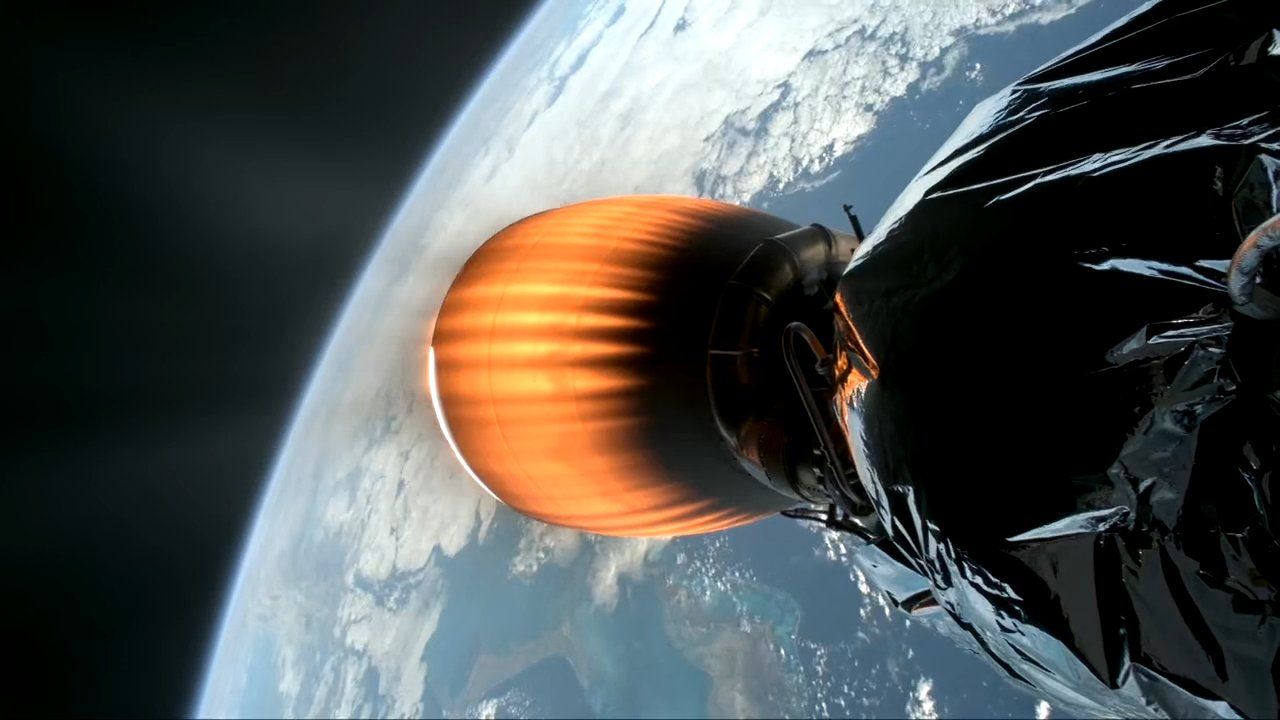
Surprise, surprise: SpaceX shattered its single-year launch record again in 2025.
Elon Musk’s company has now set a new mark six years in a row, and the numbers are getting pretty silly. The record has risen from 25 orbital liftoffs in 2020 to 31 (2021) to 61 (2022) to 96 (2023) to 134 (2024) and, now, to a whopping 167.
That’s a launch almost every other day, a staggering cadence that leaves other companies — and entire nations — in the dust. Indeed, SpaceX launched nearly twice as many orbital missions as China did this year, and the company’s 2025 output represented about 85% of the United States’ total tally.
You may like
All 167 of those launches were conducted by SpaceX’s workhorse Falcon 9, which features a reusable first stage. (There were no liftoffs by the powerful Falcon Heavy, which hasn’t flown since October 2024.) And those Falcon 9 boosters came back to Earth for a safe landing on all but three occasions.
Two of the exceptions were launches in January and October that sent massive Spainsat NG communications satellites to geostationary transfer orbit. These were heavy lifts for the Falcon 9 first stage, which didn’t have enough fuel left over for a return to Earth.
The other non-landing was a failed attempt, suffered during the launch of a batch of Starlink internet satellites on March 3. The booster actually touched down successfully on a drone ship in the Atlantic Ocean as planned that day, but it tipped over after a fire broke out near its base and damaged a landing leg.
Speaking of Starlink missions: They dominated SpaceX’s manifest this year, making up 123 of the 167 Falcon 9 launches. Together, those missions lofted more than 3,000 satellites for the Starlink megaconstellation, which currently consists of more than 9,300 active spacecraft.
SpaceX notched a number of other milestones during this very busy year. For example, the company pulled off its 500th rocket landing and 500th launch of a used rocket in 2025. And it repeatedly extended the record for most launches by a single Falcon 9 booster, which currently stands at 32.
The 167 Falcon 9 missions weren’t SpaceX’s only liftoffs this year, though. The company also launched five suborbital test flights of Starship, a fully reusable vehicle that’s the biggest and most powerful rocket ever built. SpaceX lost at least one of the megarocket’s two stages during the first three Starship flights of the year, but the most recent two, in August and October, were unalloyed successes.
We should see a lot more Starship action in 2026, including the stainless-steel vehicle’s first orbital flight — and maybe, if things go exceedingly well, an uncrewed trip to Mars.
SCIENCE
Centuries-old ‘trophy head’ from Peru reveals individual survived to adulthood despite disabling birth defect

Centuries ago in Peru, a decapitated individual’s head was turned into a “trophy.” Now, a careful look at this trophy head reveals that despite a potentially problematic birth defect, the individual survived into early adulthood.
Based on several photos of the head, a researcher spotted that the individual was born with a cleft lip, Beth Scaffidi, an assistant professor of anthropology and heritage studies at the University of California, Merced, wrote in a new study.
You may like
The latest study, published Nov. 3 in the journal Ñawpa Pacha, is the first time an orofacial cleft has been documented in an Andean trophy head, offering a “unique opportunity” to explore how ancient peoples of the region viewed such conditions, Scaffidi wrote in the paper.
“This finding is important because it shows that people survived, and even thrived, with this condition in the ancient Andes,” Scaffidi told Live Science in an email. “It helps show that what we define as a disability and how we respond to it is culturally, rather than biologically, determined.”
Trophy heads
For millenia, ancient peoples in parts of the Andes mountains in South America, as well as the surrounding regions, collected severed heads as trophies, processing them for preservation and display purposes, Scaffidi said. Most known examples date to between roughly 300 B.C. and A.D. 800, often originating from around modern-day Nazca in coastal Peru’s Ica department (Peru has 24 departments, or regions). Trophy heads were likely passed down as heirlooms through generations, Scaffidi said.
“Most trophies were mummified naturally in the arid desert environment, and many preserve hair and flesh,” Scaffidi said. “We still debate whether these heads were lovingly curated remains of beloved ancestors or souvenirs of violent conquest of enemies, but many do also display violent injuries received before and around the time of death.”
An illustration of the newly analyzed Andean trophy head, which an artist drew based on catalog photos. (Image credit: Grace D. Eriksen; CC BY-NC-ND 4.0)
During a research project, Scaffidi came across an intriguing example in the catalog of the Museum of Modern and Contemporary Art in Saint-Etienne, France, purportedly originating from the Ica department.
Scaffidi examined photographs of the mummified head and determined that the individual was probably male and a young adult at the time of death. Based on the visible facial structures, she diagnosed the individual with a cleft lip.
Perhaps the most serious complication of orofacial clefts is difficulty latching during breastfeeding, but these conditions can also cause respiratory, hearing and speech issues, she wrote in the study. Today, these birth defects are typically treated with surgery in the first few months of life, but in the ancient Andean world they would have presented a significant challenge to mothers and caregivers during the baby’s infancy. The individual Scaffidi studied, for example, would likely have required specialized care to receive nourishment as an infant.
You may like
A special status
But not only did this individual survive into early adulthood, it is possible that their condition even granted them special status, Scaffidi said. Cultural responses to orofacial clefts in the ancient Americas varied widely, from shame to veneration. But taking into account what is known about the worldviews of ancient Andean peoples specifically, it is likely this individual was perceived as sacred and afforded a high-status role throughout life and beyond, Scaffidi said.
In the absence of documentary or textual sources, ancient ceramic vessels from the region — particularly those produced by the Moche culture (A.D. 200 to 850) of northern Peru — provide clues as to how congenital conditions might have been understood at the time.
In the study, Scaffidi found 30 ceramic representations of orofacial clefts that had already been documented from the wider Andean region, 20 of which were from Moche areas. These examples mostly depict males adorned in elite jewelry, head wrappings, or performing shamanic or medical activities, suggesting that they were people of importance. Other research suggests that the Moche believed facial markings protected them from supernatural harm, thus, birth defect markings were revered.
Previous research has indicated that Andean trophy heads were often collected from individuals perceived as having supernatural powers, with the belief that the people taking the heads could use this power to benefit their own communities.
The collection of this particular subject as a trophy head, even through potentially violent means, is consistent with the idea that orofacial clefts were celebrated by the takers, Scaffidi said. What may be seen today as a disability was likely considered a “blessing,” according to the study.
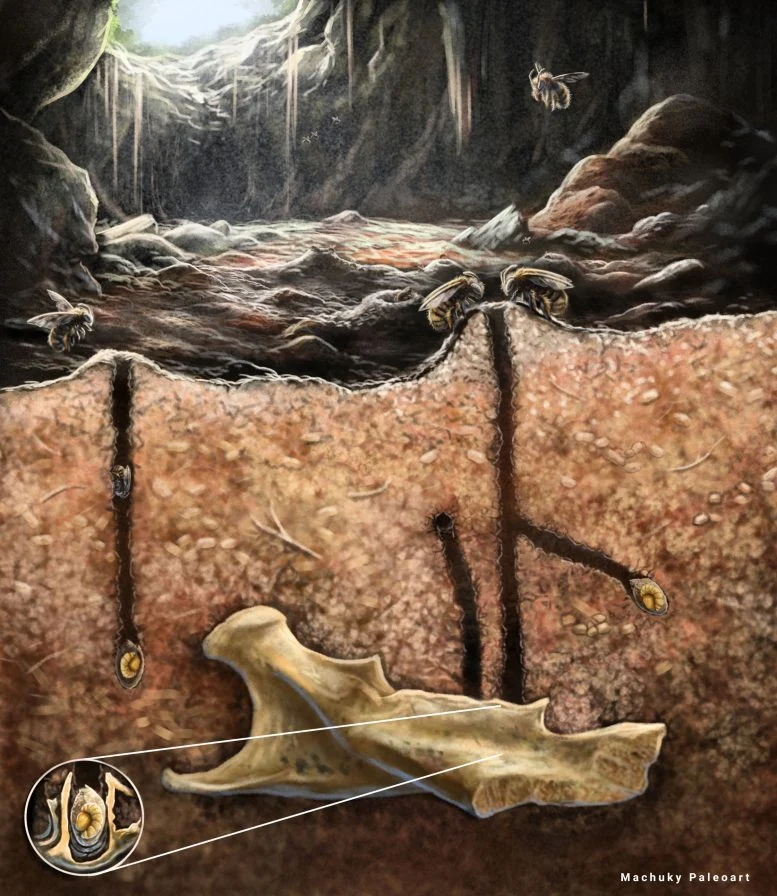
Paleontologists have discovered the first known fossilized bee nests built inside ancient bones, uncovered in a cave that came close to being used as a latrine. A cave on Hispaniola preserves rare evidence that ancient bees nested inside fossil cavities. The find suggests an unusual local environment and a much deeper story about what brought […]
SOURCE PAGE
SCIENCE
The WHO learned to love ‘anti-obesity’ jabs in 2025. I don’t fully agree, but I get it | Devi Sridhar


If there has been a hot topic in health in 2025, it’s definitely been GLP-1s, colloquially referred to as “anti-obesity” jabs. These medications, taken weekly as an injection into the abdomen, result in significant weight loss and, despite being developed to manage type 2 diabetes in those with metabolic disorders, have become mainstream in many countries as a treatment for obesity. Clinicians rave about the health outcomes in patients taking the medication, with study after study emerging on the health benefits of the associated weight loss in those who are obese. Celebrity endorsements, online sales and off-label use have seen them widely used by people of all ages and sizes who want to drop weight.
For the public health community, it’s an odd moment. For years, we’ve advocated for government action on obesity – not through new drugs, but by taking nutrition and food systems seriously. We’ve highlighted the need for government action on making nutritious food affordable, regulating ultra-processed foods, bringing in sugar taxes and banning advertising of unhealthy products to young people, alongside encouraging an increase in physical activity. The solutions are simple: get people to eat more nutritious food and move. The challenge has been implementation, especially in deprived areas.
So when GLP-1 drugs such as semaglutide started to be used as a widespread weight-loss solution, resulting in massive profits for pharmaceutical companies, the first reaction in public health circles was something between horror and exasperation. Not because the drugs didn’t work, but because they symbolised a kind of surrender. After decades of fighting to change the food and physical activity culture, here came a pharmaceutical company offering a weekly jab as the answer to a problem created by the transnational food industry.
The irony isn’t lost on me. One set of companies profits by making populations obese; another now profits by promising to reverse it, at least for as long as people can keep paying and injecting. We still don’t know the long-term side effects of these drugs, especially in those within a healthy weight range and with normal metabolic function.
But in the past year, more and more countries have been moving towards rolling out GLP-1 drugs as the main treatment for obesity. In fact, the World Health Organization (WHO) recently recommended GLP-1 drugs as treatment for obesity in all countries. For decades, the WHO had resisted pharmaceutical solutions for obesity, insisting the crisis was environmental, structural and political. The agency is now saying something different: people are dying of obesity-related diseases across the world, and we have a tool that works.
For some, this is capitulation. Has 2025 been the year that global health finally gave up on fixing the social and commercial causes of obesity and talking about nutrition? Obesity rates are tightly linked to socioeconomic status. In fact, it’s been said that child obesity is a reflection of child poverty. GLP-1s were created to medically treat those with a metabolic disorder. Are we saying that the poorest 20% of people (who have higher obesity rates) have a metabolic disorder that the richest 20% don’t have? Surely not.
We know diet is linked to income, time, education and resources. If obesity is “treatable” with a jab, why take on the food industry? Why invest in affordable fruit and vegetables or healthy school lunches? GLP-1s have become a way for many politicians to appear to be doing something while avoiding dealing with the systematic food production and consumption issues that are making us sick.
But I can understand the WHO’s pivot, because obesity is not a theoretical problem that we have time to solve. It’s killing people and disabling them in daily life. Just ask any clinician about the impact of these drugs on people with heart disease, diabetes, fatty liver disease, joint failure … the list goes on. It’s all well and good talking about redesigning food systems, but right now, we have a drug that reliably reduces weight, improves metabolic markers and reduces cardiovascular risk. In that context, you can understand doctors seeing the health benefits in their patients and the WHO advocating for these drugs to be made affordable and accessible all across the world, including in low-income countries.
We still need to be careful about the reality of these drugs for individuals. They require a weekly injection, potentially creating lifelong dependency, given that studies have shown that weight rebounds when they’re stopped. They have side effects and can cause serious complications, especially for people who aren’t prescribed them by a doctor. They also don’t negate the need to eat a nutritious diet. Just like you can be overweight and malnourished, you can also be thin and malnourished.
Plus, losing weight alone doesn’t bring the health benefits of physical activity. Exercise strengthens the heart, builds muscle, protects the brain from depression, anxiety and dementia, and helps reduce chronic pain. Perhaps 2026 will bring an exercise pill, but so far, we don’t have any drug that can mimic its benefits. For all the promise of GLP-1s, the body still needs what it has always needed: affordable and accessible nutritious food and daily movement. Perhaps it’s a pipe dream, but I hope the coming year will bring societal changes to make that possible for all of us, without needing a weekly jab.
-
Prof Devi Sridhar is chair of global public health at the University of Edinburgh
-
Fit Forever: Wellness for midlife and beyond
On Wednesday 28 January 2026, join Annie Kelly, Devi Sridhar, Joel Snape and Mariella Frostrup, as they discuss how to enjoy longer and healthier lives, with expert advice and practical tips. Book tickets here or at guardian.live
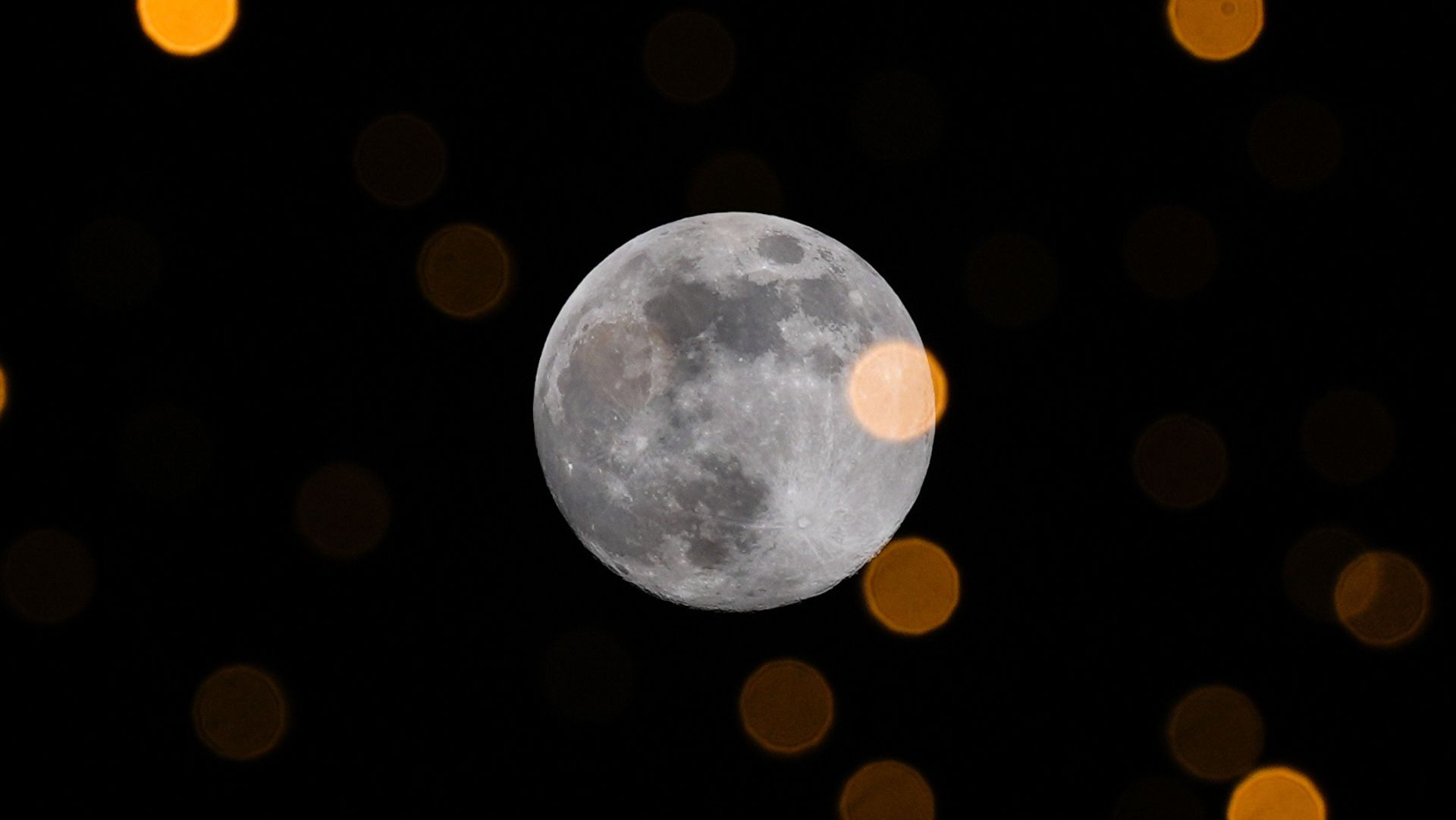
Tear your eyes away from fireworks this New Year’s Eve (Dec. 31) to witness a magnificent natural light show, complete with twinkling constellations and star clusters, the steady light of planets and the awe-inspiring sight of the waxing gibbous moon shining in the constellation Taurus.
The moon will be visible halfway up the eastern horizon in the hours following sunset, with the delicate light of the Pleiades open star cluster vying for attention 5 degrees — roughly the width of your three middle fingers held at arm’s length — to the upper right of the 95%-lit lunar disk.
Look directly below the moon to find the stars of the constellation Orion twinkling close to the eastern horizon. The brightest point of light to Orion’s left is no star at all, but rather the “king of the planets,” Jupiter. On the final night of 2025, Jupiter shines in the constellation Gemini, close to its two brightest stars — Castor and Pollux.
You may like
Saturn’s steady light can also be seen shining halfway up the southern horizon around this time. A telescope with an aperture of around 6 inches will help reveal its famous rings as a thin line bisecting the planet’s cloud tops. The rings are currently oriented edge-on to Earth, but will gradually open up throughout 2026 to reveal their majestic, sweeping structure, including a 2,980-mile (4,800-kilometer) gap known as the Cassini Division.
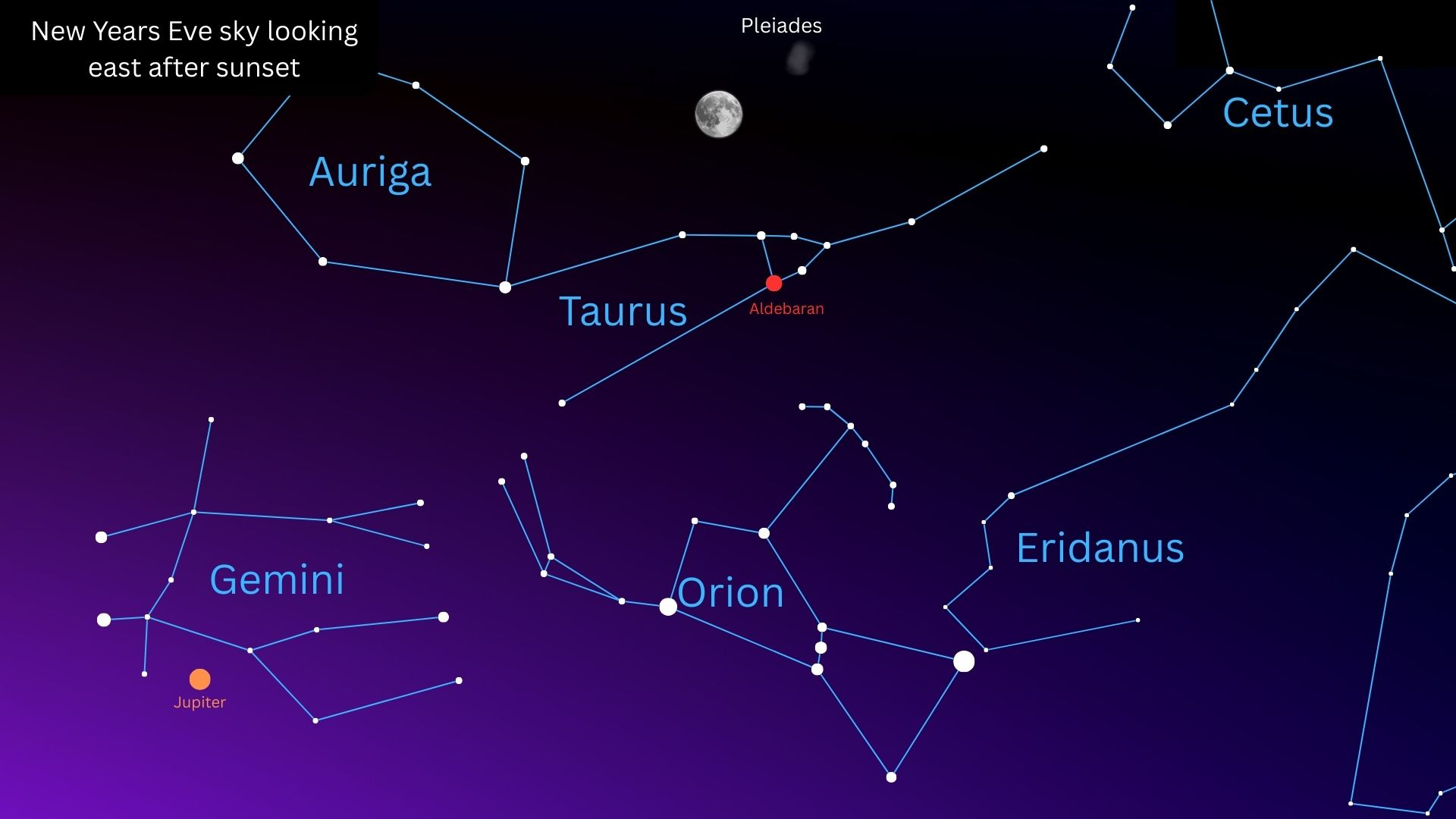
The night sky looking east after sunset on New Years Eve (Image credit: Created by Anthony Wood in Canva)
By midnight, Saturn will have slipped below the horizon, while the moon and Jupiter will stand high overhead. Look roughly 40 degrees above the northern horizon — approximately the width of four clenched fists stacked on top of each other — to find the bright star Polaris, around which the entire sky appears to rotate. To its right you’ll spot the familiar sight of the Big Dipper, tilted so that it appears to be standing on the end of its handle.
Celestron NexStar 8SE

(Image credit: Amazon)
Looking for a telescope companion to explore the skies with in 2026? We reckon the Celestron NexStar 8SE is the best motorized telescope out there as it’s great for astrophotography, deep-space observing and it offers stunning detailed imagery. It is a little pricey but for what you get, it’s good value. For a more detailed look, you can check out our Celestron NexStar 8SE review.
Those same stars will glide silently through the night as the last moments of 2025 fade and the first of a new year begins, heralding the start of another year of incredible stargazing opportunities.
If you’re new to stargazing, be sure to read our article filled with expert advice on how to begin your amateur astronomy journey. We also have tips on how to observe the moon, along with superb roundups of the best telescope and binocular deals available if you’re looking to upgrade your equipment.
Clear skies and a Happy New Year from everyone here at Space.com!
Editor’s Note: If you would like to share your astrophotography with Space.com’s readers, then please send your photo(s), comments, and your name and location to spacephotos@space.com.
SCIENCE
‘They didn’t de-extinct anything’: can Colossal’s genetically engineered animals ever be the real thing? | Extinct wildlife
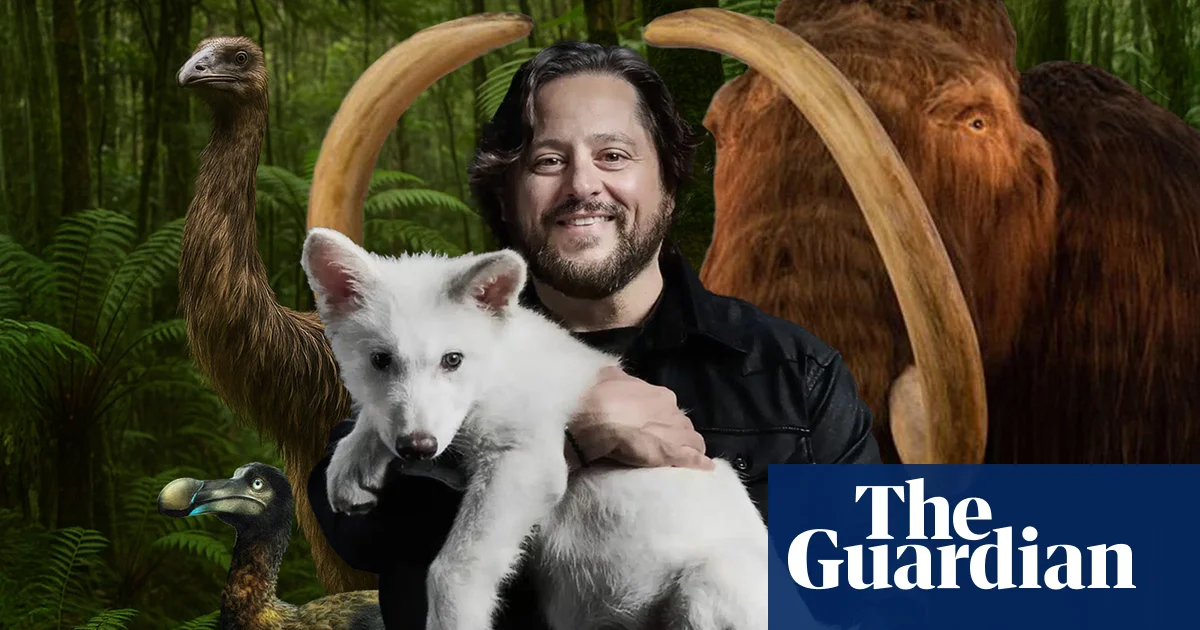
Death and taxes are supposed to be the things we can depend on in this life. But in 2025, the American entrepreneur Ben Lamm sold much of the world on the idea that death did not, after all, need to be for ever.
This was the year the billionaire’s genetics startup, Colossal Biosciences, claimed it had resurrected the dire wolf, an animal that disappeared at the end of the last ice age, by tweaking the DNA of grey wolves. According to the company, it had also edged closer to bringing the woolly mammoth back from the dead, with the creation of genetically engineered “woolly mice”.
In a flurry of high-profile announcements and press releases, it launched projects to revive the Tasmanian tiger (also known as the thylacine), the dodo and the moa, a 3-metre tall bird that has been extinct for 600 years.
“We’ve made a lot of big promises to the world,” Lamm tells the Guardian. “I think that we started to deliver.”
Lamm, a 44-year-old veteran of gaming and AI startups, has brought a brash Silicon Valley showmanship and entrepreneurial drive to the genetic conservation sector – and his approach so far has been extremely lucrative.
A genetically edited mouse with thick hair at a lab in Texas. Colossal created the woolly mouse as part of its plan to recreate mammoths by making an elephant cold-tolerant. Photograph: AP
He quickly realised that de-extinction announcements were a recipe for excitement and publicity. When the company announced its “woolly mouse”, he recalls, “people were losing their minds”.
Watching the response, Lamm says: “I thought: oh my gosh, they’re going to go crazy about the dire wolf stuff.”
He was right. When Colossal unveiled its interpretation of the dire wolf in April, the news made international headlines. Enthusiastic profiles in Time magazine and the New Yorker declared “the dire wolf is back”.
Colossal invited the public to listen to “the first dire wolf howls in over 10,000 years” on YouTube. “Obviously the dire wolves were a massive hit and fan favourite,” Lamm says.
Money poured into Colossal from Hollywood and venture capital firms. The Texas-based start up, co-founded by Lamm and a Harvard geneticist, George Church, was valued at more than $10bn (£7.5bn) at its most recent fundraising round. American socialite and media figure Paris Hilton, filmmaker Peter Jackson, and former American footballer Tom Brady are among the investors, and the company now funds more than 100 scientists working to bring back extinct species from the dead.
Extinction is still for ever. Charles Darwin nicely summed it up: ‘When a group has once wholly disappeared, it does not reappear’Nic Rawlence, University of Otago
Colossal’s approach has also caught the attention of the powerful: the Trump administration cited the “resurrection” of the dire wolf as it made efforts to cut the endangered species list in the US.
“It’s time to fundamentally change how we think about species conservation,” said the US interior secretary, Doug Burgum. “We need to continue improving recovery efforts to make that a reality, and the marvel of ‘de-extinction’ technology can help forge a future where populations are never at risk.”
In the future, he said, “‘de-extinction’ can serve as a bedrock for modern species conservation.”
But the announcements have been met by far less excitement among scientists. Shortly after the dire wolf announcement, and to much less fanfare, a group of the world’s leading experts on canids concluded that the company had not really resurrected the species.
Rather, they had made 20 edits to the DNA of grey wolves, and the resulting animals did not substantially differ from those that now roamed North America, the group said.
Colossal’s ‘dire wolf’ cubs. The species died out 12,000 years ago. Photograph: Colossal/AFP/Getty
Amid the scientific reaction, Colossal’s chief scientist, Beth Shapiro, a leading expert on ancient DNA, acknowledged to New Scientist that: “It’s not possible to bring something back that is identical to a species that used to be alive. Our animals are grey wolves with 20 edits that are cloned.”
Many researchers in the sector who are not employed by Colossal have been far stronger in their criticism of the company’s claims. Nic Rawlence, director of the palaeogenetics laboratory at the University of Otago in New Zealand, is an expert on the moa, which the company is trying to resurrect. Bringing it back from the dead is not possible, Rawlence says.
“Extinction is still for ever. Charles Darwin nicely summed it up when he said, ‘when a group has once wholly disappeared, it does not reappear; for the link of generation has been broken.’
“Rather than true de-extinction, Colossal’s attempts are genetically engineered poor copies at best, passed off as the real deal,” he says. “Colossal are preying on people’s desire to undo the sins of the past. However, to achieve this, Colossal is spreading misinformation and undermining trust in science by attacking critics.”
In a number of academic journals and scientists’ commentaries, the company’s announcements were met with deep scepticism. The geneticist Adam Rutherford called the mammoth announcements “elephantine fantasies” that would only be possible with the invention of time travel.
Others argue that overhyped claims of bringing back lost species weaken trust in science and scientists. “I don’t think they de-extincted anything,” Jeanne Loring, a stem-cell biologist, told Nature.
Those concerns have not slowed the company’s push forward. In the next few years, Colossal’s team of scientists will unveil its interpretation of the woolly mammoth. It will be a genetically modified Asian elephant adapted to live at -40C (-40F), with long hair, small ears and other mammoth characteristics interpreted from frozen DNA, says Lamm, who bristles at the suggestion this creature may not constitute a mammoth.
One of Colossal’s ‘dire wolves’ at the age of one. Critics say the firm merely tweaked grey wolf genes but did not resurrect Aenocyon dirus. Photograph: AP/Colossal
“We believe in free speech so if people want to call our mammoth a mammoth, or a genetically modified, cold-tolerant Asian elephant with lost mammoth alleles [variants of genes] inserted through genetic engineering, we’re cool with that. Whatever,” he says.
“If a child cares more about biodiversity loss and the climate because they saw a Colossal mammoth, who gives a shit?” Lamm adds. “That’s our view.”
Modern conservation doesn’t work at the speed at which we are eradicating species and changing the planetBen Lamm
For a number of scientists, making public criticisms of the company has come at a cost. In July, New Scientist revealed that several scientists who had been critical of Colossal had been the subject of seemingly AI-generated articles in a mystery smear campaign, attacking their credentials and academic records.
Lamm says the company has nothing to do with the stories. “We have a lot of support from different communities publicly, ranging from scientists all the way to crypto; it’s a big spectrum. People argue about things all the time. So, if you are going to be a critic, you should be comfortable that you may also be criticised,” he says.
The criticism has irritated Lamm. He points to Colossal’s efforts to conserve elephants and in trying to save the northern white rhino as evidence that his company can change the way the sector works. The company’s website frames its work as part of efforts to counteract the collapse of biodiversity, which some scientists have called the sixth mass extinction of life on Earth.
An impression of a South Island giant moa, one of two species of the tallest birds that ever existed, with a human drawn to scale. Colossal says it is trying to revive the extinct New Zealand birds. Photograph: Colossal
“The worst part of conservation is conservationists ,” he says. “A lot of models out there are not working and we need new models. The reality is, modern conservation – while it works – doesn’t work at the speed at which we are eradicating species and changing the planet.
“We’ve got to get more of these incredible scientists off the couch and in the field saving animals. They must communicate it in a way that isn’t behind some paywalled scientific paper but in a way that gets a kid, like, ‘Oh, I want to go to Africa and save elephants. Oh my gosh, I have to save the dugong. What do you mean drug cartels are killing the vaquita? How can I help that?’”
Even Colossal’s harshest critics recognise the potential of gene editing to save species caught in genetic bottlenecks. Many wildlife populations have become dangerously inbred as their numbers dwindle, and Colossal is working to reintroduce genetic diversity back into populations, such as the critically endangered red wolf in North America, by reintroducing lost genes from museum specimens.
Despite the excitement and money around Colossal, however, conservationists say its work can never be a substitute for traditional efforts to save species from extinction: the time-consuming work of controlling predators, protecting ecosystems and restoring habitats.
“De-extinction technology could be a useful conservation tool for living species,” says Rawlence, “but it won’t replace unsexy grunt work.”
Find more age of extinction coverage here, and follow the biodiversity reporters Phoebe Weston and Patrick Greenfield in the Guardian app for more nature coverage
Ancient Australian rocks suggest Earth’s continents formed later than expected and share a common origin with the Moon. A study of feldspar crystals preserved in Australia’s oldest magmatic rocks is shedding new light on the early evolution of Earth’s mantle and continents, as well as the origins of the Moon. The research was led by […]
SOURCE PAGE

Earth is surrounded by human-made debris that orbits our planet. The problem is worsening every year, and 2025 was no different.
Space debris experts say nearly 130 million pieces of orbital junk are zipping around our planet: high-speed leftovers from rocket stage explosions, abandoned satellites, as well as bits and pieces of junk from space hardware deployments. Some of this meandering mess is the result of the deliberate demolition of spacecraft by way of anti-satellite weapons testing.
All this space clutter means increased risk of collisions that generate more debris — better known as the Kessler syndrome. That cascading effect was detailed back in 1978 by NASA scientists, Donald Kessler and Burton Cour-Palais in the seminal space physics paper “Collision frequency of artificial satellites: The creation of a debris belt.” 47 years later, the problem has only gotten worse, and as several debris strike incidents this year show, we still have no good way to solve or even slow down the accumulation of orbital debris around our planet.
You may like
Debris strike prompts emergency launch
As China’s Shenzhou-20 astronauts were preparing to undock from the country’s space station on Nov. 5, that crew found that their spacecraft had developed tiny cracks in its viewport window. The cause was tagged to an external impact from space debris, rendering the craft unsuitable for a safe crew return.
This incident called for the first emergency launch mission in China’s human spaceflight program; an uncrewed, cargo-loaded Shenzhou-22 spaceship was launched on Nov. 25.
The Shenzhou saga ended well with the Chinese astronauts safely returning to Earth aboard the Shenzhou-21 spacecraft. It was the first alternative return procedure activated in the history of China’s space station program.
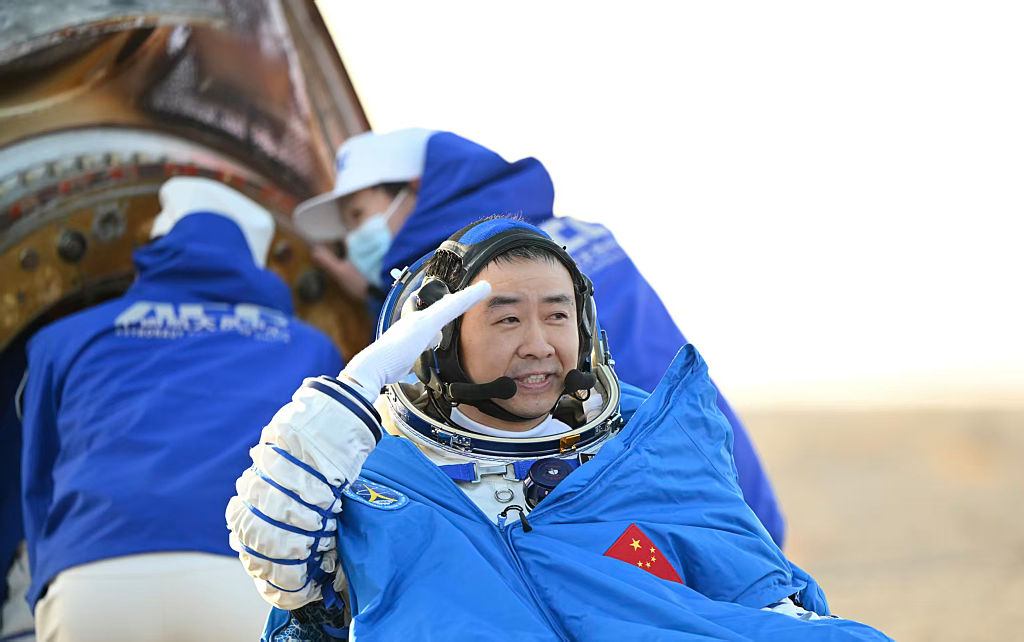
China’s Shenzhou-20 commander Chen Dong salutes a crowd. (Image credit: VCG/Getty Images)
However, the Shenzhou-20 landing delay is not just a procedural footnote. It’s a signal about the state of our orbital commons, said Moriba Jah, a space debris expert and professor at the University of Texas at Austin.
“A crew return was postponed because microscopic debris compromised a spacecraft window,” Jah told Space.com. “That decision, to delay and substitute vehicles, reflects responsible risk management grounded in incomplete knowledge. It also exposes the deeper issue. That is, our collective inability to maintain continuous, verifiable understanding of what moves through orbit,” he said.
Every fragment we leave aloft, said Jah, “adds to a rising tide of uncertainty.”
Wanted: data fidelity and transparency
That uncertainty is not merely statistical, it is epistemic, Jah said. “When the rate at which uncertainty grows exceeds the rate at which knowledge is renewed, safety margins erode,” advocating the designing of missions, governance frameworks, and information systems that “regenerate knowledge faster than it decays,” he said.
You may like
A cracked window of the Shenzhou-20 spacecraft, Jah said, “traces back to gaps in global tracking, attribution, and accountability. Until nations and companies treat data fidelity and transparency as part of safety engineering, similar near-misses will recur.”
China’s decision to delay the Shenzhou-piloted vessel’s re-entry until its engineers were confident in the assessment “was an act of epistemic humility — recognizing what was unknown and adjusting accordingly. Such humility should be codified, not exceptional,” he said.
In practice, Jah said that the Shenzhou-20 episode should push the international community toward auditable stewardship, that is, common baselines for orbital situational awareness, interoperable knowledge graphs, and certification programs that recognize missions restoring order rather than adding risk.
“Only by aligning engineering, policy, and information ethics can we prevent ‘routine’ anomalies from becoming precursors to catastrophe,” Jah said. “If we learn the right lesson, this will not be remembered as a lucky escape but as a turning point,” he said, adding that “evidence that safety in orbit begins with honesty about what we do and do not know, and with the will to regenerate knowledge faster than we lose it.”
Ignoring long-term effects
Darren McKnight is a senior technical fellow of LeoLabs, a group dedicated to space domain awareness.
For McKnight the biggest issues in 2025 were:
- Proliferation of satellite constellations, some responsibly like Starlink, Iridium, and OneWeb and some poorly like China’s “Thousand Sails” megaconstellation and its “Guowang” satellite internet payloads, leaving rocket bodies at a high rate and at high altitudes and not working with other constellations to “show your work, share your work, and understand context.”
- Abandonment of rocket bodies in orbits that will linger for more than 25 years. The good news is there can be a 30% reduction in debris-generating potential in low Earth orbit by removing the top 10 statistically-most-concerning objects. The bad news, however, is that the global community is leaving rocket bodies at an accelerating rate despite the known negative, long-term effects for doing so.
“Some operators in low Earth orbit are ignoring known long-term effects of behavior for short-term gain,” McKnight said, a situation he senses that parallels the early stages of global warming.
“Some will not change behavior until something bad happens.” McKnight concluded.
Risks and responsibilities
Raising another voice of concern is the United Nations Environment Program (UNEP). This month it released “Safeguarding Space: Environmental Issues, Risks and Responsibilities.” That document dubbed a set of space debris woes as “emerging issues.”
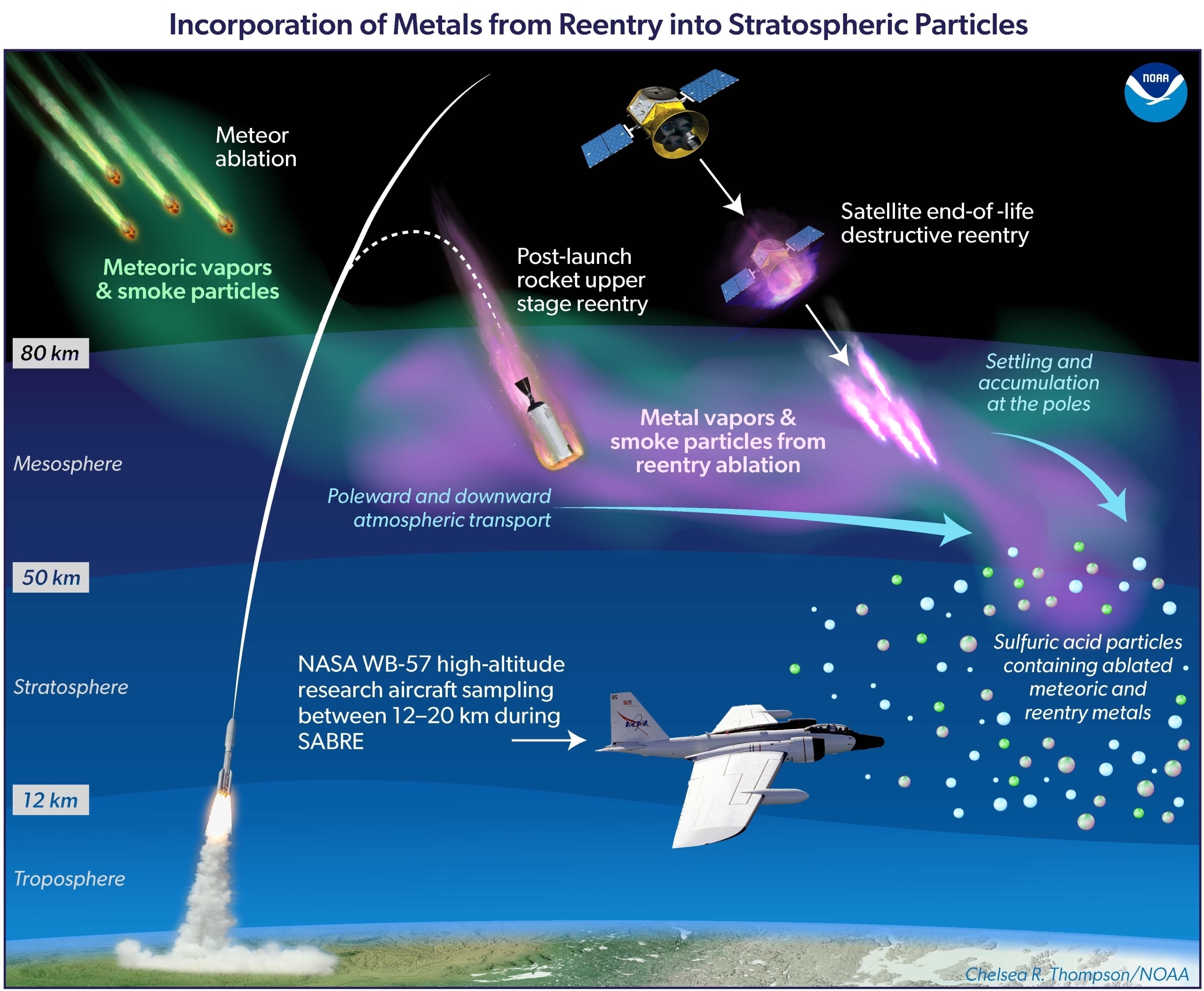
In an era of increasing global launch rates, heightened by the buckshot approach to tossing mega-satellite constellations into Earth orbit, there’s also escalating anxiety about the ramifications from reentry of defunct space hardware. (Image credit: Chelsea Thompson/NOAA)
“The space sector is growing exponentially, with over 12,000 spacecraft deployed in the past decade and many more planned as the world embraces the benefits provided by satellite services. This growth presents significant environmental challenges at all layers of the atmosphere,” the document explains.
Specifically flagged by the UNEP are air pollution from launch emissions, spacecraft emissions in the stratosphere, as well as space debris re-entry and the potential to alter Earth’s atmospheric chemistry and dynamics with implications for climate change and depleting stratospheric ozone.
The UN group’s bottom line?
“A multilateral, interdisciplinary approach is needed to better understand the risks and impacts and how to balance them with the essential daily services and benefits that space activity brings to humanity,” the document states.
SCIENCE
3.7-Billion-Year-Old Rocks Challenge Long-Held Ideas About Earth’s Early Continents || 3.7-Billion-Year-Old Rocks in Australia Are Rewriting the Story of Earth’s First Continents

Ancient Australian rocks suggest Earth’s continents formed later than expected and share a common origin with the Moon. A study of feldspar crystals preserved in Australia’s oldest magmatic rocks is shedding new light on the early evolution of Earth’s mantle and continents, as well as the origins of the Moon. The research was led by […]
SOURCE PAGE
SCIENCE
‘Artificial intelligence’ myths have existed for centuries – from the ancient Greeks to a pope’s chatbot

It seems the AI hype has turned into an AI bubble. There have been many bubbles before, from the Tulip mania of the 17th century to the derivatives bubble of the 21st century. For many commentators, the most relevant precedent today is the dotcom bubble of the 1990s. Back then, a new technology (the World Wide Web) unleashed a wave of “irrational exuberance.” Investors poured billions into any company with “.com” in the name.
Three decades later, another new technology has unleashed another wave of exuberance. Investors are pouring billions into any company with “AI” in its name. But there is a crucial difference between these two bubbles, which isn’t always recognised. The World Wide Web existed. It was real. General Artificial Intelligence does not exist, and no one knows if or when it ever will.
You may like
So why are investors so keen to give money to the people selling AI systems? One reason might be that AI is a mythical technology. I don’t mean it is a lie. I mean it evokes a powerful, foundational story of Western culture about human powers of creation.
Perhaps investors are willing to believe AI is just around the corner because it taps into myths that are deeply ingrained in their imaginations?
The myth of Prometheus
The most relevant myth for AI is the Ancient Greek myth of Prometheus.
There are many versions of this myth, but the most famous are found in Hesiod’spoems Theogony and Works and Days, and in the play Prometheus Bound, traditionally attributed to Aeschylus.
Prometheus was a Titan, a god in the Ancient Greek pantheon. He was also a criminal who stole fire from Hephaestus, the blacksmith god. Hiding the fire in a stalk of fennel, Prometheus came to earth and gave it to humankind. As punishment, he was chained to a mountain, where an eagle visited every day to eat his liver.
Prometheus’ gift was not simply the gift of fire; it was the gift of intelligence. In Prometheus Bound, he declares that before his gift humans saw without seeing and heard without hearing. After his gift, humans could write, build houses, read the stars, perform mathematics, domesticate animals, construct ships, invent medicines, interpret dreams and give proper offerings to the gods.
The myth of Prometheus is a creation story with a difference. In the Hebrew Bible, God does not give Adam the power to create life. But Prometheus gives (some of) the gods’ creative power to humankind.
You may like
Hesiod indicates this aspect of the myth in Theogony. In that poem, Zeus not only punishes Prometheus for the theft of fire; he punishes humankind as well. He orders Hephaestus to fire up his forge and construct the first woman, Pandora, who unleashes evil on the world.
The fire that Hephaestus uses to make Pandora is the same fire that Prometheus has given humankind.
In this 18th-century engraving, Prometheus constructs the first man. (Image credit: AnonymousUnknown author, Public domain, via Wikimedia Commons)
The Greeks proposed the idea that humans are a form of artificial intelligence. Prometheus and Hephaestus use technology to manufacture men and women. As historian Adrienne Mayor reveals in her book Gods and Robots, the ancients often depicted Prometheus as a craftsman, using ordinary tools to create human beings in an ordinary workshop.
If Prometheus gave us the fire of the gods, it would seem to follow that we can use this fire to make our own intelligent beings. Such stories abound in Ancient Greek literature, from the inventor Daedalus, who created statues that came to life, to the witch Medea, who could restore youth and potency with her cunning drugs. Greek inventors also constructed mechanical computers for astronomy and remarkable moving figures powered by gravity, water and air.
The Pope and the chatbot
2,700 years have passed since Hesiod first wrote down the story of Prometheus. In the ensuing centuries, the myth has been endlessly retold, especially since the publication of Mary Shelley’s Frankenstein; or the Modern Prometheus in 1818.
But the myth is not always told as fiction. Here are two historical examples where the myth of Prometheus seemed to come true.
Gerbert of Aurillac was the Prometheus of the 10th century. He was born in the early 940s CE, went to school at Aurillac Abbey, and became a monk himself. He proceeded to master every known branch of learning. In the year 999, he was elected Pope. He died in 1003 under his pontifical name, Sylvester II.
Rumours about Gerbert spread wildly across Europe. Within a century of his death, his life had already become legend. One of the most famous legends, and the most pertinent in our age of AI hype, is that of Gerbert’s “brazen head.” The legend was told in the 1120s by the English historian William of Malmesbury, in his well researched and highly regarded book, Deeds of the English Kings.
Gerbert was deeply learned in astronomy, a science of prediction. Astronomers could use the astrolabe to predict the position of the stars and foresee cosmological events such as eclipses. According to William, Gerbert used his knowledge of astronomy to construct a talking head. After inspecting the movements of the stars and planets, he cast a head in bronze that could answer yes-or-no questions.
First Gerbert asked the head: “Will I become Pope?”
“Yes,” answered the head.
Then Gerbert asked: “Will I die before I sing mass in Jerusalem?”
“No,” the head replied.
In both cases, the head was correct, though not as Gerbert anticipated. He did become Pope, and he sensibly avoided going on pilgrimage to Jerusalem. One day, however, he sang mass at Santa Croce in Gerusalemme in Rome. Unfortunately for Gerbert, Santa Croce in Gerusalemme was known in those days simply as “Jerusalem.”
Gerbert sickened and died. On his deathbed, he asked his attendants to cut up his body and cast away the pieces, so he could go to his true master, Satan. In this way, he was, like Prometheus, punished for his theft of fire.

Pope Sylvester II and the Devil (Image credit: Chronicon pontificum et imperatorum, Public domain, via Wikimedia Commons)
It is a thrilling story. It is not clear whether William of Malmesbury actually believed it. But he does try to persuade his readers that it is plausible. Why did this great historian with a devotion to the truth insert some fanciful legends about a French pope into his history of England? Good question!
Is it so fanciful to believe that an advanced astronomer might build a general-purpose prediction machine? In those days, astronomy was the most powerful science of prediction. The sober and scholarly William was at least willing to entertain the idea that brilliant advances in astronomy might make it possible for a Pope to build an intelligent chatbot.
Today, that same possibility is credited to machine-learning algorithms, which can predict which ad you will click, which movie you will watch, which word you will type next. We can be forgiven for falling under the same spell.
The anatomist and the automaton
The Prometheus of the 18th century was Jacques de Vaucanson, at least according to Voltaire:
Bold Vaucanson, rival of Prometheus,Seems, imitating the springs of nature,To steal the fire of heaven to animate the body.

Jacques de Vaucanson – Joseph Boze (1784) (Image credit: Joseph Boze, Public domain, via Wikimedia Commons)
Vaucanson was a great machinist, famous for his automata. These were clockwork devices that realistically simulated human or animal anatomy. Philosophers of the time believed that the body was a machine — so why couldn’t a machinist build one?
Sometimes Vaucanson’s automata were scientifically significant. He constructed a piper, for example, that had lips and lungs and fingers, and blew the pipe in much the same way a human would. Historian Jessica Riskin explains in her book The Restless Clock that Vaucanson had to make significant discoveries in acoustics in order to make his piper play in tune.
Sometimes his automata were less scientific. His digesting duck was hugely famous, but turned out to be fraudulent. It appeared to eat and digest food, but its poos were in fact prefabricated pellets hidden inside the mechanism.
Vaucanson spent decades working on what he called a “moving anatomy.” In 1741, he presented a plan to the Lyons Academy to build an “imitation of all animal operations.” Twenty years later, he was at it again. He secured support from King Louis XV to build a simulation of the circulatory system. He claimed he could build a complete, living artificial body.

Three of Vaucanson’s famous automata: the Flute Player, the Digesting Duck, and the Provençal Farmer, who played the pipe and tambourine. (Image credit: See page for author, Public domain, via Wikimedia Commons)
There is no evidence that Vaucanson ever completed a whole body. In the end, he couldn’t live up to the hype. But many of his contemporaries believed he could do it. They wanted to believe in his magical mechanisms. They wished he would seize the fire of life.
If Vaucanson could manufacture a new human body, couldn’t he also repair an existing one? This is the promise of some AI companies today. According to Dario Amodei, CEO of Anthropic, AI will soon allow people “to live as long as they want.” Immortality seems like an attractive investment.
Sylvester II and Vaucanson were great technologists, but neither was a Prometheus. They stole no fire from the gods. Will the aspiring Prometheans of Silicon Valley succeed where their predecessors have failed? If only we had Sylvester II’s brazen head, we could ask it.
This edited article is republished from The Conversation under a Creative Commons license. Read the original article.